AB 2243: State Bank Act.
- Session Year: 2025-2026
- House: Assembly
- Latest Version Date: 2026-04-20
Current Status:
In Progress
(2026-05-14: In committee: Held under submission.)
Introduced
In Committee
Awaiting First Chamber Vote
Passed First Chamber
In Committee
Awaiting Second Chamber Vote
Passed Second Chamber
Enacted
What does this bill do?
The bill creates a State Bank Commission to prepare a plan for a state-owned bank that would hold the state’s general fund and provide public-purpose financing, affecting state government, public banks, local governments, and borrowers. The plan must address capitalization and funding options, a state guarantee for public deposits, loan backstops, and alternatives for securing public deposits. It must also include a five-year business plan prioritizing climate, housing, small businesses and local governments, propose governance and accountability rules, and be published if adopted, but the plan would not create the bank without further laws.
The summary is provided by generative AI which can make mistakes. For original language, please view the details in the table below.
The Bergeson-Peace Infrastructure and Economic Development Bank Act creates within the Governors Office of Business and Economic Development the Infrastructure and Economic Development Bank and requires it to administer the act, which, among other things, provides for the financing of certain economic development projects. Existing law authorizes the Commissioner of Financial Protection and Innovation to license up to two public banks in the state per year, as prescribed, upon an application by a local agency. Existing law prohibits the commissioner from issuing a public bank license after the expiration of a period of 7 years from the date upon which the commissioner first promulgated certain regulations related to public banks.
This bill bill, the State Bank Act, would delete that public bank licensing prohibition and would create in state government the State Bank Commission and provide for its membership, as prescribed.
This bill would require, on or before June 1, 2028, the commission to develop a state bank plan that addresses various items with respect to creating a state bank, including a state guarantee of public deposits, including those held by public banks. The bill would require, on or before January 1, 2028, the commission to hold at least 2 public hearings to solicit input on the state bank plan from members of the public and, by July 1, 2028, vote whether to adopt the state bank plan. The bill would require, if the commission adopts by a majority vote the state bank plan, the commission to publish the state bank plan and the fact of its adoption on its internet website.
The Bergeson-Peace Infrastructure and Economic Development Bank Act creates within the Governors Office of Business and Economic Development the Infrastructure and Economic Development Bank and requires it to administer the act, which, among other things, provides for the financing of certain economic development projects. Existing law authorizes the Commissioner of Financial Protection and Innovation to license up to two public banks in the state per year, as prescribed, upon an application by a local agency. Existing law prohibits the commissioner from issuing a public bank license after the expiration of a period of 7 years from the date upon which the commissioner first promulgated certain regulations related to public banks.
This bill would express the intent of the Legislature to enact legislation that would relate to doing certain things with respect to public banking, including considering the creation of a state-owned depository bank or an expanded role for the California Infrastructure and Economic Development Bank to hold public deposits, provide public-purpose financing, and coordinate with existing state financing authorities and programs with the goal of centralizing and streamlining state financial activities. delete that public bank licensing prohibition and would create in state government the State Bank Commission and provide for its membership, as prescribed.
This bill would require, on or before June 1, 2028, the commission to develop a state bank plan that addresses various items with respect to creating a state bank, including a state guarantee of public deposits, including those held by public banks. The bill would require, on or before January 1, 2028, the commission to hold at least 2 public hearings to solicit input on the state bank plan from members of the public and, by July 1, 2028, vote whether to adopt the state bank plan. The bill would require, if the commission adopts by a majority vote the state bank plan, the commission to publish the state bank plan and the fact of its adoption on its internet website.
The Bergeson-Peace Infrastructure and Economic Development Bank Act creates within the Governors Office of Business and Economic Development the Infrastructure and Economic Development Bank and requires it to administer the act, which, among other things, provides for the financing of certain economic development projects. Existing law authorizes the Commissioner of Financial Protection and Innovation to license up to two public banks in the state per year, as prescribed, upon an application by a local agency.
This bill would express the intent of the Legislature to enact legislation that would relate to doing certain things with respect to public banking, including considering the creation of a state-owned depository bank or an expanded role for the California Infrastructure and Economic Development Bank to hold public deposits, provide public-purpose financing, and coordinate with existing state financing authorities and programs with the goal of centralizing and streamlining state financial activities.
This act shall be known as the State Bank Act.
SEC. 2.Title 6.6 (commencing with Section 62700) is added to the Government Code, to read:6.6.State Bank1.General Provisions62700.As used in this title:
(a)IBank means the Infrastructure and Economic Development Bank created pursuant to Section 63021.
(b)Commission means the State Bank Commission.
(c)Local agency means a county, city, or city and county.
(d)Local financial institution has the meaning defined in Section 57600.
(e)Public bank has the meaning defined in Section 57600.
(f)Public development facilities has the meaning defined in Section 63010.
(g)Public purpose financing means the provision of financial assistance, including, but not limited to, direct loans, loan guarantees, credit enhancements, and bond purchases, for public development facilities, and other projects, programs, or activities that provide a demonstrable public benefit, including, but not limited to, the promotion of affordable housing, public infrastructure, environmental resilience, economic development, and social equity within the state.
(h)Social housing has the meaning defined in Section 50612 of the Health and Safety Code.
(i)State bank plan means a plan to create a state-owned depository bank that does all of the following:
(1)Holds the states general fund moneys.
(2)Conducts public-purpose financing.
(3)Centralizes other state financial programs.
2.State Bank Commission62705.(a)There is hereby created in state government the State Bank Commission.
(b)The commission shall consist of all of the following members or their designees:
(1)The Governor.
(2)The Treasurer.
(3)The Controller.
(4)One member appointed by the Speaker of the Assembly with expertise in affordable housing finance.
(5)One member appointed by the Speaker of the Assembly with expertise in community lending, community development finance institutions, or credit unions.
(6)One member appointed by the Senate Committee on Rules with expertise in public finance or public banking.
(7)One member appointed by the Senate Committee on Rules with expertise in climate or infrastructure finance.
(8)One member appointed by the Governor with expertise in small business lending or economic development finance.
(9)One member appointed by the Governor with expertise in banking operations.
62706.(a)On or before July 1, 2027, the commission shall contract with one or more independent entities with appropriate expertise in public banking, public finance, and depository institutions to create a state bank plan.
(b)On or before June 1, 2028, the commission shall develop a state bank plan, which shall address all of the following:
(1)Capitalization options.
(2)State guarantee of public deposits, including those held by public banks.
(3)Backstop mechanisms for loans, including the feasibility and proposed design of a multistate pooled backstop fund that includes public banks.
(4)A five-year business plan that, depending on available capital and in partnership with local financial institutions and public banks, provides financial products or services prioritizing public-purpose financing needs not adequately served by private capital markets related to climate, housing, small business, and local government that evaluates the creation of all of the following financing programs or activities:
(A)Building decarbonization or neighborhood-based decarbonization activities, including those described in Article 5 (commencing with Section 25665) of Chapter 7.6 of Division 15 of the Public Resources Code and Article 11 (commencing with Section 660) of Chapter 3 of Part 1 of Division 1 of the Public Utilities Code.
(B)Home hardening and other measures to address nature-related catastrophe risks that prioritize multifamily properties.
(C)Social housing, community land trusts, or facilitating community or tenant opportunities to purchase affordable housing.
(D)Small businesses located in underbanked, rural, tribal, or disadvantaged communities, as identified pursuant to Section 39711 of the Health and Safety Code.
(E)Technical assistance and financial services for public banks or for local agencies in the process of organizing or establishing a public bank.
(5)Centralization of, and coordination with, the states other financing activities, including, but not limited to, those conducted by the IBank, State Air Resources Board, the Energy Commission, the Treasurer, and the California Housing Finance Agency.
(6)Application of appropriate investment screens to exclude investments that are incompatible with the banks environmental, social, and governance standards adopted by the banks board.
(7)Holding the deposits or other money belonging to, or in the control or custody of, any state property insurance program and other roles the state bank may serve in holistically reducing wildfire and other nature-related catastrophe risks and aiding in the financial recovery from those risks.
(8)Alternatives to existing security requirements for public deposits held in a state-owned depository.
(9)Evaluation of whether a state-owned depository bank should be established via conversion of an existing state entity or creation of a new entity.
(10)Proposed governance structure for the state-owned depository bank that ensures democratic accountability to the public, including consideration of an appropriate balance of interests within the governing body, mechanisms for meaningful public participation, legislative oversight, appropriate transparency and disclosure provisions, and protections against conflicts of interest.
(c)On or before January 1, 2028, the commission shall hold at least two public hearings to solicit input on the state bank plan from members of the public.
(d)On or before July 1, 2028, the commission shall vote whether to adopt the state bank plan.
(e)(1)If the commission adopts by a majority vote the state bank plan, the commission shall publish the state bank plan and the fact of its adoption on its internet website.
(2)A plan adopted pursuant to this subdivision shall not have any effect other than through the enactment of subsequent, implementing legislation.
(a)The Commissioner of Financial Protection and Innovation shall not issue more than two public bank licenses in a calendar year.
(b)The Commissioner of Financial Protection and Innovation shall not issue a public bank license if issuing that public bank license would cause there to be more than 10 public banks authorized to transact business pursuant to Division 1.1 (commencing with Section 1000) of the Financial Code.
(c)The Commissioner of Financial Protection and Innovation shall conduct a study of public banking in California within two years after the date upon which the commissioner issues the 10th public bank license.
(d)The Commissioner of Financial Protection and Innovation shall not issue a public bank license after the expiration of a period of seven years from the date upon which the commissioner first promulgates regulations for the purpose of carrying out the commissioners duties under this division.SEC. 2.Title 6.6 (commencing with Section 62700) is added to the Government Code, to read:6.6.State Bank1.General Provisions62700.As used in this title:
(a)IBank means the Infrastructure and Economic Development Bank created pursuant to Section 63021.
(b)Commission means the State Bank Commission.
(c)Local agency means a county, city, or city and county.
(d)Local financial institution has the meaning defined in Section 57600.
(e)Public bank has the meaning defined in Section 57600.
(f)Public development facilities has the meaning defined in Section 63010.
(g)Public purpose financing means the provision of financial assistance, including, but not limited to, direct loans, loan guarantees, credit enhancements, and bond purchases, for public development facilities, and other projects, programs, or activities that provide a demonstrable public benefit, including, but not limited to, the promotion of affordable housing, public infrastructure, environmental resilience, economic development, and social equity within the state.
(h)Social housing has the meaning defined in Section 50612 of the Health and Safety Code.
(i)State bank plan means a plan to create a state-owned depository bank that does all of the following:
(1)Holds the states general fund moneys.
(2)Conducts public-purpose financing.
(3)Centralizes other state financial programs.
2.State Bank Commission62705.(a)There is hereby created in state government the State Bank Commission.
(b)The commission shall consist of all of the following members or their designees:
(1)The Governor.
(2)The Treasurer.
(3)The Controller.
(4)One member appointed by the Speaker of the Assembly with expertise in affordable housing finance.
(5)One member appointed by the Speaker of the Assembly with expertise in community lending, community development finance institutions, or credit unions.
(6)One member appointed by the Senate Committee on Rules with expertise in public finance or public banking.
(7)One member appointed by the Senate Committee on Rules with expertise in climate or infrastructure finance.
(8)One member appointed by the Governor with expertise in small business lending or economic development finance.
(9)One member appointed by the Governor with expertise in banking operations.
62706.(a)On or before July 1, 2027, the commission shall contract with one or more independent entities with appropriate expertise in public banking, public finance, and depository institutions to create a state bank plan.
(b)On or before June 1, 2028, the commission shall develop a state bank plan, which shall address all of the following:
(1)Capitalization options.
(2)State guarantee of public deposits, including those held by public banks.
(3)Backstop mechanisms for loans, including the feasibility and proposed design of a multistate pooled backstop fund that includes public banks.
(4)A five-year business plan that, depending on available capital and in partnership with local financial institutions and public banks, provides financial products or services prioritizing public-purpose financing needs not adequately served by private capital markets related to climate, housing, small business, and local government that evaluates the creation of all of the following financing programs or activities:
(A)Building decarbonization or neighborhood-based decarbonization activities, including those described in Article 5 (commencing with Section 25665) of Chapter 7.6 of Division 15 of the Public Resources Code and Article 11 (commencing with Section 660) of Chapter 3 of Part 1 of Division 1 of the Public Utilities Code.
(B)Home hardening and other measures to address nature-related catastrophe risks that prioritize multifamily properties.
(C)Social housing, community land trusts, or facilitating community or tenant opportunities to purchase affordable housing.
(D)Small businesses located in underbanked, rural, tribal, or disadvantaged communities, as identified pursuant to Section 39711 of the Health and Safety Code.
(E)Technical assistance and financial services for public banks or for local agencies in the process of organizing or establishing a public bank.
(5)Centralization of, and coordination with, the states other financing activities, including, but not limited to, those conducted by the IBank, State Air Resources Board, the Energy Commission, the Treasurer, and the California Housing Finance Agency.
(6)Application of appropriate investment screens to exclude investments that are incompatible with the banks environmental, social, and governance standards adopted by the banks board.
(7)Holding the deposits or other money belonging to, or in the control or custody of, any state property insurance program and other roles the state bank may serve in holistically reducing wildfire and other nature-related catastrophe risks and aiding in the financial recovery from those risks.
(8)Alternatives to existing security requirements for public deposits held in a state-owned depository.
(9)Evaluation of whether a state-owned depository bank should be established via conversion of an existing state entity or creation of a new entity.
(10)Proposed governance structure for the state-owned depository bank that ensures democratic accountability to the public, including consideration of an appropriate balance of interests within the governing body, mechanisms for meaningful public participation, legislative oversight, appropriate transparency and disclosure provisions, and protections against conflicts of interest.
(c)On or before January 1, 2028, the commission shall hold at least two public hearings to solicit input on the state bank plan from members of the public.
(d)On or before July 1, 2028, the commission shall vote whether to adopt the state bank plan.
(e)If the commission adopts by a majority vote the state bank plan, the commission shall publish the state bank plan and the fact of its adoption on its internet website.
SECTION 1.It is the intent of the Legislature to enact legislation that would relate to doing all of the following:(a)Establishing a phased process for developing public banking and other public financing tools to save money, lower borrowing costs, reduce state administrative costs, and support Californias priorities.(b)Considering the creation of a state-owned depository bank or an expanded role for the California Infrastructure and Economic Development Bank to hold public deposits, provide public-purpose financing, and coordinate with existing state financing authorities and programs with the goal of centralizing and streamlining state financial activities.(c)Ensuring that any expansion or creation of a state bank promotes transparency, accountability, and public input, including through public hearings and stakeholder engagement.(d)Evaluating governance structures, capitalization options, risk management mechanisms, and coordination with existing state financing authorities.(e)Supporting financing for affordable housing, climate resilience, local governments, and small businesses, and other projects that advance equity and economic development across California.(f)Providing technical assistance and financial support for the formation of local public banks, including viability studies, business plans, charter applications, and development of shared resources, including risk pooling, compliance, and administrative capacity.It is the intent of the Legislature to enact legislation that would relate to doing all of the following:
(a)Establishing a phased process for developing public banking and other public financing tools to save money, lower borrowing costs, reduce state administrative costs, and support Californias priorities.
(b)Considering the creation of a state-owned depository bank or an expanded role for the California Infrastructure and Economic Development Bank to hold public deposits, provide public-purpose financing, and coordinate with existing state financing authorities and programs with the goal of centralizing and streamlining state financial activities.
(c)Ensuring that any expansion or creation of a state bank promotes transparency, accountability, and public input, including through public hearings and stakeholder engagement.
(d)Evaluating governance structures, capitalization options, risk management mechanisms, and coordination with existing state financing authorities.
(e)Supporting financing for affordable housing, climate resilience, local governments, and small businesses, and other projects that advance equity and economic development across California.
(f)Providing technical assistance and financial support for the formation of local public banks, including viability studies, business plans, charter applications, and development of shared resources, including risk pooling, compliance, and administrative capacity.
|
Date
|
Status
|
|---|---|
| May 14, 2026 | In committee: Held under submission. |
| May 6, 2026 | In committee: Set, first hearing. Referred to APPR. suspense file. |
| Apr 23, 2026 | From committee: Do pass and re-refer to Com. on APPR. (Ayes 7. Noes 2.) (April 23). Re-referred to Com. on APPR. |
| Apr 21, 2026 | Re-referred to Com. on B. & F. |
| Apr 20, 2026 | From committee chair, with author's amendments: Amend, and re-refer to Com. on B. & F. Read second time and amended. |
| Apr 14, 2026 | From committee: Do pass and re-refer to Com. on B. & F. (Ayes 5. Noes 2.) (April 14). Re-referred to Com. on B. & F. |
| Mar 23, 2026 | Re-referred to Com. on E.D., G., & H.I. |
| Mar 19, 2026 | From committee chair, with author's amendments: Amend, and re-refer to Com. on E.D., G., & H.I. Read second time and amended. |
| Mar 19, 2026 | Referred to Coms. on E.D., G., & H.I. and B. & F. |
| Feb 20, 2026 | From printer. May be heard in committee March 22. |
| Feb 19, 2026 | Read first time. To print. |
|
Date
|
Description
|
Location
|
Votes
|
|
|---|---|---|---|---|
| Apr 23, 2026 | Do pass and be re-referred to the Committee on [Appropriations] | Assembly Standing Committee on Banking and Finance |
Passed |
This list shows positions taken on this bill by organizations on the date displayed, which is linked to the original source.
Positions by individuals are not included.
|
Organization
|
Position
|
Date
|
|---|---|---|
| 350 Sacramento | ** Support | |
| Adr Continental Group | ** Support | |
| Asian Business Association | ** Support | |
| Asian Business Association of Silicon Valley | ** Support | |
| Asian Journal Publications, Inc. | ** Support | |
| Bolema Brand | ** Support | |
| California Alliance for Community Energy | ** Support | |
| California Association for Micro Enterprise Opportunity | ** Support | |
| California Bankers Association | ** Against | |
| California Climate Action | ** Support | |
| California Community Banking Network | ** Against | |
| California Community Banking Network0 | ** Against | |
| California Democratic Party Delegates (statewide, 65 Signatories) | ** Support | |
| California Democratic Renters Council | ** Support | |
| California Faculty Association - San Francisco State University | ** Support | |
| California Federation Of Teachers | ** Support | |
| California Federation of Teachers Afl-cio | ** Support | |
| California Public Banking Alliance | ** Support | |
| California Solidarity Economy Network (CALSEN) | ** Support | |
| California State Bank Coalition | ** Support | |
| California State University Employees Union (Csueu) | ** Support | |
| California State University Employees Union, Seiu Local 2579 | ** Support | |
| California YIMBY | ** Support | |
| California's Credit Unions | ** Against | |
| Cameo - California Association for Micro Enterprise Opportunity | ** Support | |
| Center Against Racism & Trauma INC. | ** Support | |
| CFT – a Union of Educators & Classified Professionals, AFT, AFL-CIO | ** Support | |
| Climate Action California | ** Support | |
| Codepink Sonoma County | ** Support | |
| Cooperation Humboldt | ** Support | |
| Courage California | ** Support | |
| Daryl M Rush Builder Fabricator | ** Support | |
| Democracy Collaborative | ** Support | |
| Democracy Collaborative | ** Support | |
| Demos | ** Support | |
| Destination Crenshaw | ** Support | |
| Economic Security California Action | ** Support | |
| End Poverty in California (EPIC) | ** Support | |
| End Poverty in California, a Project of Tides Center | ** Support | |
| Fossil Free California | ** Support | |
| Friends of the Earth - US | ** Support | |
| Friends of the Earth U.S. | ** Support | |
| Friends of the Earth. | ** Support | |
| Friends of the Public Bank East Bay | ** Support | |
| Glide | ** Support | |
| Green Party Humboldt County | ** Support | |
| Green Party of Santa Clara County CA | ** Support | |
| Greenlining Institute | ** Support | |
| human agenda | ** Support | |
| Indivisible California StateStrong | ** Support | |
| Job Guarantee Action Project | ** Support | |
| Media Alliance | ** Support | |
| Move LA | ** Support | |
| Natural Resources Defense Council (NRDC) | ** Support | |
| North Coast Progressive Alliance | ** Support | |
| People for Public Banking Central Coast | ** Support | |
| Physicians for Social Responsibility - Sacramento Chapter | ** Support | |
| Poder SF | ** Support | |
| Public Bank - East Bay | ** Support | |
| Public Bank - San Diego | ** Support | |
| Public Bank Fresno | ** Support | |
| Public Bank LA | ** Support | |
| Public Bank Los Angeles | ** Support | |
| Public Bank Pomona Valley | ** Support | |
| Public Bank Sacramento | ** Support | |
| S&b Water, INC. | ** Support | |
| S&l Ffa | ** Support | |
| Sacramento Area Congregation Together | ** Support | |
| Sacramento Area Congregations Together (SACACT) | ** Support | |
| Sacramento Climate Coalition | ** Support | |
| San Francisco Public Bank Coalition | ** Support | |
| Santa Clara County Democratic Party | ** Support | |
| Santa Cruz Climate Action Network | ** Support | |
| Small Business Majority | ** Support | |
| Socioenergetics Foundation | ** Support | |
| Sonoma County Democratic Party | ** Support | |
| South Bay Progressive Alliance | ** Support | |
| Southern California Black Chamber of Commerce | ** Support | |
| Starting Over Strong | ** Support | |
| The Academy of Financial Education | ** Support | |
| The Greenlining Institute | ** Support | |
| The Gubbio Project | ** Support | |
| The Rainbow Garden | ** Support | |
| Third ACT | ** Support | |
| Third Act Sacramento | ** Support | |
| U.s. Solidarity Economy Network | ** Support | |
| United Parents and Students | ** Support | |
| Vision Culture Foundation | ** Support | |
| Wellbeing Economy Alliance California | ** Support | |
| western center on law & poverty | ** Support | |
| Women's International League for Peace and Freedom, US | ** Support |
Date of Hearing: May 6, 2026
ASSEMBLY COMMITTEE ON APPROPRIATIONS
Buffy Wicks, Chair
ABPCA Bill Id:AB 2243
Author:(Haney) – As Amended Ver:April 20, 2026
Policy Committee: | Economic Development, Growth, and Household Impact | Vote: | 5 - 2 |
Banking and Finance | 7 - 2 | ||
|
|
Urgency: No State Mandated Local Program: No Reimbursable: No
SUMMARY:
This bill establishes the State Bank Commission with specified appointees, and requires the commission, by July 1, 2027, to contract with one or more independent entities with appropriate expertise to develop a state bank plan by June 1, 2028.
FISCAL EFFECT:
One-time General Fund costs of an unknown but possibly significant amount, potentially in the low hundreds of thousands of dollars, to establish and staff the commission and complete the required plan.
Generally, the committee will move to the suspense file any bill it determines to have the primary purpose of creating a commission.
COMMENTS:
- Purpose. According to the author:
Each year, California pays roughly $8 billion in total debt service, including about $4 billion in interest payments to private lenders. These are taxpayer dollars that do not build housing, roads, or schools. Instead, they go to financial institutions for the price of borrowing. A state public bank would give California a financial tool to lower costs and keep more investment dollars circulating in the state’s economy. Instead of profits flowing to private shareholders, the earnings generated by a public bank can be returned to the public and reinvested in California communities. Without new financing tools, California will continue paying billions in interest while struggling to fund the investments needed to address affordability and economic growth.
- Background. Public banks have a long history in the U.S. with the most storied example being the Bank of North Dakota (BND) established in 1919 and the only state-owned bank currently in operation. Theoretically, a state bank operates in partnership with credit unions, community banks, and community development loan funds (CDFLs) as a wholesale institution. Proponents of this measure, including the California State Bank Coalition, argue a state bank could save California money, “lower borrowing costs, better align existing financing tools, protect public funds, and build a stronger, more coordinated public financial infrastructure.” The bill requires the creation of the commission tasked with the development of a state bank plan, which the commission must vote to adopt or reject by July 1, 2028, implementation of which would be facilitated by future legislation.
Analysis Prepared by: Aaron Heredia / APPR. / (916) 319-2081
Date of Hearing: April 23, 2026
ASSEMBLY COMMITTEE ON BANKING AND FINANCE
Avelino Valencia, Chair
ABPCA Bill Id:AB 2243 (
Author:Haney) – As Amended Ver:April 20, 2026
SUBJECT: State Bank Act
SUMMARY: This bill eliminates the prohibition on public bank licensing and establishes a State Bank Commission. By mid-2028, the Commission must formulate and vote on a state bank plan following public hearings; if approved, the plan is to be made available on a public website.
Specifically, this bill:
- Creates the State Bank Commission and provides for its membership, as prescribed.
- Removes the public bank licensing prohibition for a period of seven years from the date the commissioner first promulgates regulations pursuant to the commissioner’s duties.
- Requires, on or before June 1, 2028, the commission to develop a state bank plan that addresses various items with respect to creating a state bank, including a state guarantee of public deposits, including those held by public banks.
- Would require, on or before January 1, 2028, the commission to hold at least 2 public hearings to solicit input on the state bank plan from members of the public and, by July 1, 2028, vote whether to adopt the state bank plan.
- Requires, if the commission adopts by a majority vote the state bank plan, the commission to publish the state bank plan and the fact of its adoption on its internet website.
EXISTING LAW:
- Requires a local agency to conduct a study to assess the viability of the proposed bank prior to submitting an application to organize and operate as a public bank. The key study elements are as follows:
- A discussion of the purposes of the bank including, but not limited to, achieving cost savings, strengthening local economies, supporting community economic development, and addressing infrastructure and housing needs for localities.
- A fiscal analysis of costs associated with starting the proposed public bank.
- Financial projections, including a pro forma balance sheet and income statement, of the proposed public bank for at least the first five years of operation. The financial projection must include an estimate of the time period for when expected revenues meet or exceed expected costs and an estimate of the total operating subsidy that the local agency may be required to provide until the proposed public bank generates sufficient revenue to cover its costs. The analysis must provide projections for both favorable economic conditions and economic recession.
- A legal analysis of whether the proposed structure and operations of the public bank would likely comply with Section 6 of Article XVI of the California Constitution.
- An analysis of how the proposed governance structure of the public bank would protect the bank from unlawful insider transactions and apparent conflicts of interest. (Government Code (Gov.Code) section 57606(a))
- Requires a public bank to obtain and maintain deposit insurance provided by the Federal Deposit Insurance Corporation under the Federal Deposit Insurance Act, if approved. (Gov.Code section 57602(a))
- Authorizes the Commissioner of the Department of Financial Protection and Innovation (DFPI) to license up to two public banks in the state per year, as specified, upon an application by a local agency, up to 10 total. (Gov.Code section 57607(a) and (b))
- Prohibits the Commissioner from issuing a public bank license after the expiration of a period of 7 years from the date upon which the commissioner first promulgated certain regulations related to public banks. (Gov.Code section 57607(d))
FISCAL EFFECT: According to the author, the anticipated cost is roughly $4 million for the commission. A budget request has been submitted to reflect the anticipated fiscal effect.
COMMENTS:
- Purpose
Statement from the Author
“California is the fourth-largest economy in the world, generating nearly $300 billion in annual revenue. Yet despite this economic strength, the state continues to rely heavily on private financial institutions to finance public investments.
When California borrows through private lenders, taxpayers ultimately pay the cost through interest payments, underwriting fees, and financing costs. Over the life of many projects, these costs can add up to billions of dollars that do not go toward building housing or improving infrastructure. Each year, California pays roughly $8 billion in total debt service, including about $4 billion in interest payments to private lenders. These are taxpayer dollars that do not build housing, roads, or schools. Instead, they go to financial institutions for the price of borrowing.
A state public bank would give California a financial tool to lower costs and keep more investment dollars circulating in the state’s economy. Instead of profits flowing to private shareholders, the earnings generated by a public bank can be returned to the public and reinvested in California communities. Without new financing tools, California will continue paying billions in interest while struggling to fund the investments needed to address affordability and economic growth.”
- Background
AB 857 (Chiu, Chapter 442, Statutes of 2019) established a framework for local agencies to apply for public bank licenses under standards similar to private institutions, including FDIC insurance and regulatory oversight. Another previously explored public banking concept includes AB 310 (Santiago, 2020) which proposed creating a depository bank within the California Infrastructure and Economic Development Bank (I-Bank) and directing a portion of state funds into it but did not advance. Other jurisdictions have pursued similar efforts with varying outcomes. For example, Oregon’s HB 2763 (2023) would have created a task force to study a state bank but was vetoed, while Massachusetts has considered proposals to capitalize a public bank to support local investment. At the federal level, legislation has been introduced to establish a national regulatory framework for public banking.
The most prominent model of public banking in the United States is the Bank of North Dakota (BND), established in 1919 and the only state-owned bank currently in operation. BND functions as a partner to private financial institutions, leveraging loan participation and federal funding mechanisms to support lending. As of 2024, BND reported $10.8 billion in assets and $200.4 million in net income, returning $335 million to the state treasury, demonstrating a sustainable model built on strong capitalization and conservative risk management. AB 2243 seeks to build on these lessons and determine whether a similar or adapted model could be viable in California and how it could be structured to meet the state’s unique economic and policy needs.
AB 2243 proposes the creation of a State Bank Commission to evaluate whether and how California should establish a state-owned depository bank capable of holding state funds, conducting public-purpose financing, and coordinating existing financing programs. The bill reflects a measured, planning-first approach by requiring the commission to develop a detailed framework addressing key structural issues, including capitalization, deposit guarantees, loan backstops, governance, transparency, and coordination with existing entities in line with the requirements of the Government Code.
The proposal responds to California’s current reliance on a fragmented financing landscape, which can limit the state’s ability to lower borrowing costs, align public investments, and address gaps not well served by private capital markets. The bill requires the nine-member commission to contract with one or more independent entities with expertise in public banking financing, public banking, and depository institutions. The commission must develop a plan to address: capitalization of operations, state guarantee of public bank deposits, backstop mechanisms for loans, including the feasibility and proposed design of a multistate pooled backstop fund that includes public banks. The commission must also produce a five-year business plan assessing how a state bank could support priority areas such as building decarbonization, wildfire and disaster resilience, social and affordable housing (including community land trusts and acquisition opportunities), and expanded access to capital for small businesses in underbanked, rural, tribal, and disadvantaged communities. The plan would also evaluate technical assistance for local public banks, positioning the state to better coordinate and deploy public capital toward long-term policy goals.
AMENDMENTS
The following amendments were taken in the Assembly Committee on Economic Development, Growth, and Household Impact and will be processed on its behalf in this Committee:
- Amendment 1: Delete Gov.Code Section 57607(a)(b), and (c)
- Amendment 2: Repeal the amendment to Gov.Code Section 57607(d)
- Amendment 3: Add clarifying language that the Legislature has the ultimate decision-making authority to create the public bank.
Amendment 1: Section 57607 of the Government Code is amended to read: 57607. (a) The Commissioner of Financial Protection and Innovation shall not issue more than two public bank licenses in a calendar year.
(b) The Commissioner of Financial Protection and Innovation shall not issue a public bank license if issuing that public bank license would cause there to be more than 10 public banks authorized to transact business pursuant to Division 1.1 (commencing with Section 1000) of the Financial Code.
(c) The Commissioner of Financial Protection and Innovation shall conduct a study of public banking in California within two years after the date upon which the commissioner issues the 10th public bank license.
Amendment 2: (d) The Commissioner of Financial Protection and Innovation shall not issue a public bank license after the expiration of a period of seven years from the date upon which the commissioner first promulgates regulations for the purpose of carrying out the commissioner’s duties under this division.
(d) The Commissioner of Financial Protection and Innovation shall not issue a public bank license after the expiration of a period of seven years from the date upon which the commissioner first promulgates regulations for the purpose of carrying out the commissioner’s duties under this division.
Amendment 3: A plan adopted pursuant to this subdivision shall not have any effect other than through the enactment of subsequent, implementing legislation.
REGISTERED SUPPORT / OPPOSITION:
Support
Last verified 4/18/26
350 Sacramento
Adr Continental Group
Asian Business Association
Asian Business Association of Silicon Valley
Asian Journal Publications, INC.
Bolema Brand
California Alliance for Community Energy
California Association for Micro Enterprise Opportunity
California Climate Action
California Democratic Party Delegates (statewide, 65 Signatories)
California Democratic Renters Council
California Faculty Association - San Francisco State University
California Federation of Teachers
California Federation of Teachers Afl-cio
California Public Banking Alliance
California Solidarity Economy Network (CALSEN)
California State University Employees Union (CSUEU)
California State University Employees Union, Seiu Local 2579
California Yimby
Cameo - California Association for Micro Enterprise Opportunity
Center Against Racism & Trauma INC.
Cft – a Union of Educators & Classified Professionals, Aft, Afl-cio
Climate Action California
Codepink Sonoma County
Cooperation Humboldt
Courage California
Daryl M Rush Builder Fabricator
Democracy Collaborative
Demos
Destination Crenshaw
Economic Security California Action
End Poverty in California (EPIC)
End Poverty in California, a Project of Tides Center
Fossil Free California
Friends of the Earth.
Friends of the Public Bank East Bay
Glide
Green Party Humboldt County
Green Party of Santa Clara County CA
Greenlining Institute
Human Agenda
Indivisible California Statestrong
Job Guarantee Action Project
Media Alliance
Move LA
Natural Resources Defense Council (NRDC)
North Coast Progressive Alliance
People for Public Banking Central Coast
Physicians for Social Responsibility - Sacramento Chapter
Poder Sf
Public Bank - East Bay
Public Bank - San Diego
Public Bank Fresno
Public Bank LA
Public Bank Los Angeles
Public Bank Pomona Valley
Public Bank Sacramento
S&b Water, INC.
S&l Ffa
Sacramento Area Congregations Together (SACACT)
Sacramento Climate Coalition
San Francisco Public Bank Coalition
Santa Clara County Democratic Party
Santa Cruz Climate Action Network
Small Business Majority
Socioenergetics Foundation
Sonoma County Democratic Party
South Bay Progressive Alliance
Southern California Black Chamber of Commerce
Starting Over Strong
The Academy of Financial Education
The Greenlining Institute
The Gubbio Project
The Rainbow Garden
Third ACT
Third ACT Sacramento
U.s. Solidarity Economy Network
United Parents and Students
Vision Culture Foundation
Wellbeing Economy Alliance California
Western Center on Law & Poverty
Women's International League for Peace and Freedom, US
Opposition
4/18/26
California Bankers Association
California Community Banking Network
California's Credit Unions
Analysis Prepared by: Desiree Nguyen Orth / B. & F. / (916) 319-3081
Date of Hearing: April 14, 2026
ASSEMBLY COMMITTEE ON ECONOMIC DEVELOPMENT, GROWTH, AND HOUSEHOLD IMPACT
José Luis Solache, Jr., Chair
ABPCA Bill Id:AB 2243 (
Author:Haney) – As Amended Ver:March 19, 2026
SUBJECT: State bank commission
SUMMARY: This bill removes the ban on public bank licensing, creates a State Bank Commission, and requires it to develop and vote on a state bank plan by mid-2028 after holding public hearings. If adopted, the plan must be published online.
Specifically, this bill:
- Deletes that public bank licensing prohibition and would create in state government the State Bank Commission and provide for its membership, as prescribed.
- Requires, on or before June 1, 2028, the commission to develop a state bank plan that addresses various items with respect to creating a state bank, including a state guarantee of public deposits, including those held by public banks.
- Would require, on or before January 1, 2028, the commission to hold at least 2 public hearings to solicit input on the state bank plan from members of the public and, by July 1, 2028, vote whether to adopt the state bank plan.
- Requires, if the commission adopts by a majority vote the state bank plan, the commission to publish the state bank plan and the fact of its adoption on its internet website.
EXISTING LAW:
- Authorizes the Commissioner of Financial Protection and Innovation to license up to two public banks in the state per year, as prescribed, upon an application by a local agency.
- Prohibits the commissioner from issuing a public bank license after the expiration of a period of 7 years from the date upon which the commissioner first promulgated certain regulations related to public banks.
FISCAL EFFECT: According to the author, the anticipated cost is roughly $4 million for the commission. They have submitted a budget request to reflect that anticipated fiscal effect.
COMMENTS: AB 2243 proposes the creation of a State Bank Commission to evaluate whether and how California should establish a state-owned depository bank capable of holding state funds, conducting public-purpose financing, and coordinating existing financing programs. The bill reflects a measured, planning-first approach by requiring the commission to develop a detailed framework addressing key structural issues, including capitalization, deposit guarantees, loan backstops, governance, transparency, and coordination with existing entities. It also removes the current sunset on local public bank licensing authority, preserving the state’s ability to continue supporting locally driven public banking efforts while a broader statewide strategy is evaluated.
The proposal responds to California’s current reliance on a fragmented financing landscape, which can limit the state’s ability to lower borrowing costs, align public investments, and address gaps not well served by private capital markets. To that end, AB 2243 requires the commission to produce a five-year business plan assessing how a state bank could support priority areas such as building decarbonization, wildfire and disaster resilience, social and affordable housing (including community land trusts and acquisition opportunities), and expanded access to capital for small businesses in underbanked, rural, tribal, and disadvantaged communities. The plan would also evaluate technical assistance for local public banks, positioning the state to better coordinate and deploy public capital toward long-term policy goals.
California has previously explored public banking concepts. AB 857 (Chiu, Chapter 442, Statutes of 2019) established a framework for local agencies to apply for public bank licenses under standards similar to private institutions, including FDIC insurance and regulatory oversight. AB 310 (Santiago, 2020) proposed creating a depository bank within the California Infrastructure and Economic Development Bank (I-Bank) and directing a portion of state funds into it but did not advance. Other jurisdictions have pursued similar efforts with varying outcomes. For example, Oregon’s HB 2763 (2023) would have created a task force to study a state bank but was vetoed, while Massachusetts has considered proposals to capitalize a public bank to support local investment. At the federal level, legislation has been introduced to establish a national regulatory framework for public banking.
The most prominent model of public banking in the United States is the Bank of North Dakota (BND), established in 1919 and the only state-owned bank currently in operation. BND functions as a partner to private financial institutions, leveraging loan participation and federal funding mechanisms to support lending. As of 2024, BND reported $10.8 billion in assets and $200.4 million in net income, returning $335 million to the state treasury, demonstrating a sustainable model built on strong capitalization and conservative risk management. AB 2243 builds on these lessons by tasking the commission with determining whether a similar or adapted model could be viable in California and how it could be structured to meet the state’s unique economic and policy needs.
Author’s Statement: According to the author, “California is the fourth-largest economy in the world, generating nearly $300 billion in annual revenue. Yet despite this economic strength, the state continues to rely heavily on private financial institutions to finance public investments.
When California borrows through private lenders, taxpayers ultimately pay the cost through interest payments, underwriting fees, and financing costs. Over the life of many projects, these costs can add up to billions of dollars that do not go toward building housing or improving infrastructure. Each year, California pays roughly $8 billion in total debt service, including about $4 billion in interest payments to private lenders. These are taxpayer dollars that do not build housing, roads, or schools. Instead, they go to financial institutions for the price of borrowing.
A state public bank would give California a financial tool to lower costs and keep more investment dollars circulating in the state’s economy. Instead of profits flowing to private shareholders, the earnings generated by a public bank can be returned to the public and reinvested in California communities. Without new financing tools, California will continue paying billions in interest while struggling to fund the investments needed to address affordability and economic growth.”
REGISTERED SUPPORT / OPPOSITION:
Support
Adr Continental Group
Asian Business Association
Asian Business Association of Silicon Valley
Asian Journal Publications, INC.
California Association for Micro Enterprise Opportunity
California Democratic Party Delegates (statewide, 65 Signatories)
California Faculty Association - San Francisco State University
California Federation of Teachers Afl-cio
California Public Banking Alliance
California Solidarity Economy Network (CALSEN)
California State University Employees Union, Seiu Local 2579
California Yimby
Cameo - California Association for Micro Enterprise Opportunity
Climate Action California
Cooperation Humboldt
Courage California
Democracy Collaborative
Destination Crenshaw
Economic Security California Action
End Poverty in California (EPIC)
Fossil Free California
Friends of the Earth - US
Friends of the Earth U.s.
Friends of the Public Bank East Bay
Glide
Human Agenda
Indivisible California Statestrong
Media Alliance
Move LA
North Coast Progressive Alliance
People for Public Banking Central Coast
Physicians for Social Responsibility - Sacramento Chapter
Poder Sf
Public Bank - East Bay
Public Bank - San Diego
Public Bank Fresno
Public Bank Los Angeles
Public Bank Pomona Valley
Public Bank Sacramento
Sacramento Area Congregation Together
Sacramento Climate Coalition
San Francisco Public Bank Coalition
Santa Cruz Climate Action Network
Small Business Majority
South Bay Progressive Alliance
Southern California Black Chamber of Commerce
Starting Over Strong
The Greenlining Institute
The Gubbio Project
Third ACT Sacramento
U.s. Solidarity Economy Network
United Parents and Students
Vision Culture Foundation
Wellbeing Economy Alliance California
Women's International League for Peace and Freedom, US
Opposition
California Bankers Association
California Community Banking Network0
California's Credit Unions
Analysis Prepared by: Carla Castilla / E.D., G., & H.I. / (916) 319-2090
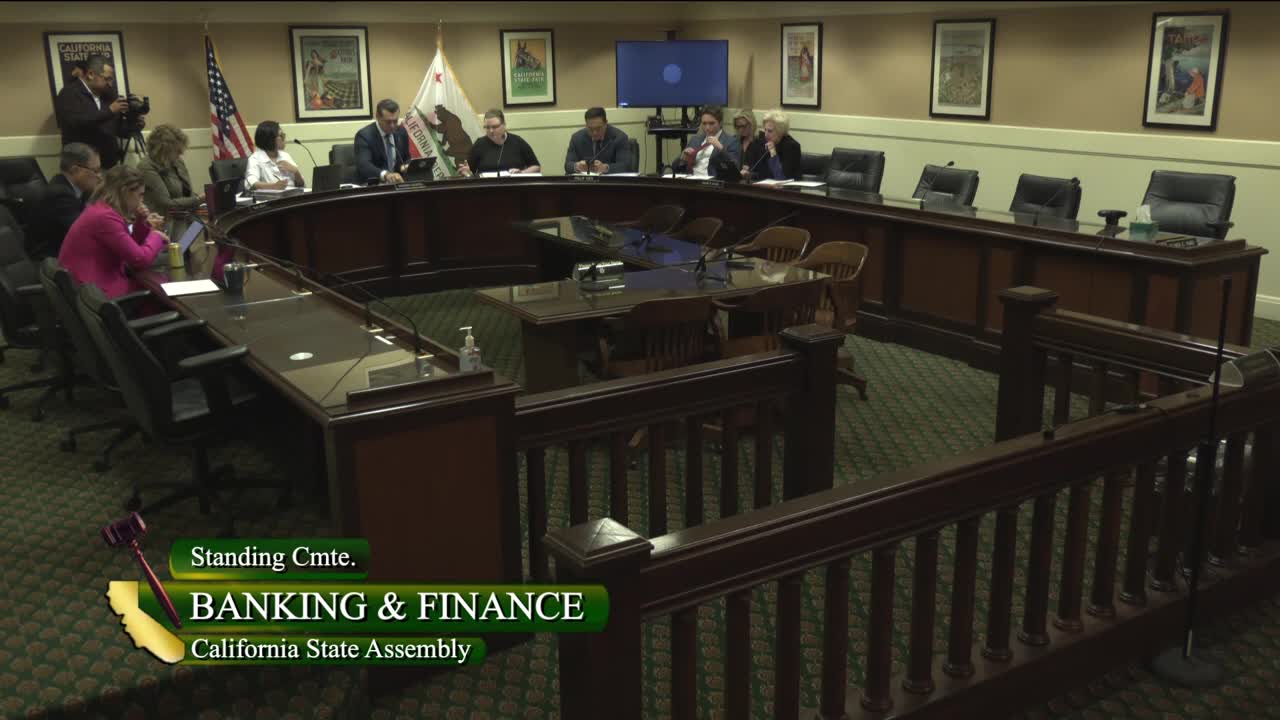
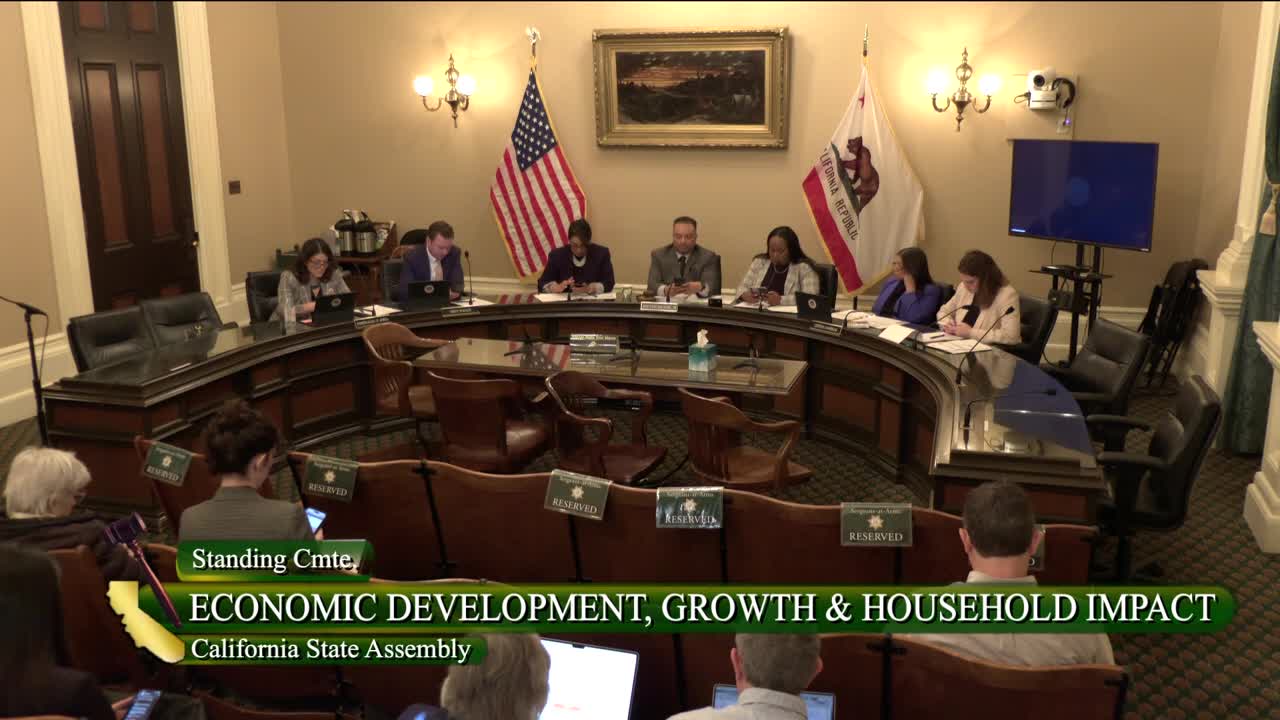
Discussed in Hearing
 19MIN
Assembly Standing Committee on Banking and Finance
 20MIN