AB 2419: Probation officers: body-worn cameras: County of Los Angeles.
- Session Year: 2025-2026
- House: Assembly
- Latest Version Date: 2026-02-20
Current Status:
In Progress
(2026-05-14: In committee: Held under submission.)
Introduced
In Committee
Awaiting First Chamber Vote
Passed First Chamber
In Committee
Awaiting Second Chamber Vote
Passed Second Chamber
Enacted
Existing law subjects a minor between 12 and 17 years of age, who violates any federal, state, or local law or ordinance, and a minor under 12 years of age who is alleged to have committed specified serious offenses, to the jurisdiction of the juvenile court, which may adjudge the minor to be a ward of the court. Existing law assigns various responsibilities relating to these individuals to the probation officer, including, among others, the responsibility to supervise minors placed on probation.
This bill would require the County of Los Angeles to implement a body-worn camera program for the County of Los Angeles Probation Department (probation department). The bill would require the county, the probation department, and affected employee organizations to develop the body-worn camera policy and a plan for implementing the body-worn camera program by no later than June 1, 2027. The bill would require the body-worn camera program to be implemented beginning on January 1, 2028. The bill would specify the minimum requirements for the policy, including the best practices for officer review of recorded body-worn camera data. Because this bill would create new duties for the County of Los Angeles and the County of Los Angeles Probation Department, this bill would impose a state-mandated local program.
This bill would make legislative findings and declarations as to the necessity of a special statute for the County of Los Angeles.
The California Constitution requires the state to reimburse local agencies and school districts for certain costs mandated by the state. Statutory provisions establish procedures for making that reimbursement.
This bill would provide that, if the Commission on State Mandates determines that the bill contains costs mandated by the state, reimbursement for those costs shall be made pursuant to the statutory provisions noted above.
(a)The County of Los Angeles (county) shall implement a body-worn camera program for the County of Los Angeles Probation Department (probation department). This program shall apply to all probation officers and staff interacting with probation clients in the field and in facilities.
(b)The county, the probation department, and affected employee organizations shall, no later than June 1, 2027, develop a body-worn camera policy that mirrors best practices of law enforcement agencies in the City and County of Los Angeles.
(c)The county shall, no later than June 1, 2027, in conjunction with the probation department and affected employee organizations, develop a plan for implementing a body-worn camera program for the probation department. The program shall be implemented beginning on January 1, 2028.
(d)The policy developed pursuant to subdivision (b) shall include, at a minimum, all of the following:
(1)Which officers should be assigned to wear a body camera and the circumstances under which the cameras should be worn.
(2)The minimum specifications for body-worn cameras.
(3)The best locations on an officers body where the camera shall be worn.
(4)Best practices for officers to notify members of the public that they are being recorded.
(5)Who should retain body camera data and how they should do it.
(6)Best practices for officer review of recorded body-worn camera data and body-worn camera datas use for training.
SEC. 2.The Legislature finds and declares that a special statute is necessary and that a general statute cannot be made applicable within the meaning of Section 16 of Article IV of the California Constitution because of the unique challenges and myriad of issues relative to the County of Los Angeles Probation Department based on the size and population overseen by the probation department.
SEC. 3.If the Commission on State Mandates determines that this act contains costs mandated by the state, reimbursement to local agencies and school districts for those costs shall be made pursuant to Part 7 (commencing with Section 17500) of Division 4 of Title 2 of the Government Code.
|
Date
|
Status
|
|---|---|
| May 14, 2026 | In committee: Held under submission. |
| May 6, 2026 | In committee: Set, first hearing. Referred to APPR. suspense file. |
| Apr 15, 2026 | From committee: Do pass and re-refer to Com. on APPR. (Ayes 9. Noes 0.) (April 14). Re-referred to Com. on APPR. |
| Mar 9, 2026 | Referred to Com. on PUB. S. |
| Feb 21, 2026 | From printer. May be heard in committee March 23. |
| Feb 20, 2026 | Read first time. To print. |
|
Date
|
Description
|
Location
|
Votes
|
|
|---|---|---|---|---|
| Apr 14, 2026 | Do pass and be re-referred to the Committee on [Appropriations] | Assembly Standing Committee on Public Safety |
Passed |
This list shows positions taken on this bill by organizations on the date displayed, which is linked to the original source.
Positions by individuals are not included.
|
Organization
|
Position
|
Date
|
|---|---|---|
| Association of Orange County Deputy Sheriff | ** Support | |
| Association Of Orange County Deputy Sheriffs | ** Support | |
| California Fraternal Order of Police | ** Support | |
| Freedom 4 Youth | ** Against | |
| Justice2jobs Coalition | ** Against | |
| LA Defensa | ** Against | |
| Long Beach Police Officers Association | ** Support | |
| Professional Managers Association (PMA) Afscme 1967 | ** Support | |
| Sacramento County Deputy Sheriffs Association | ** Support | |
| san bernardino county sheriff's employees' benefit association | ** Support | |
| Santa Ana Police Officers Association | ** Support | |
| State Coalition Of Probation Organizations | ** Support | |
| Teamsters California | ** Support | |
| Urban Peace Institute | ** Against |
Date of Hearing: May 6, 2026
ASSEMBLY COMMITTEE ON APPROPRIATIONS
Buffy Wicks, Chair
ABPCA Bill Id:AB 2419
Author:(Quirk-Silva) – As Introduced Ver:February 20, 2026
Policy Committee: | Public Safety | Vote: | 9 - 0 |
|
| ||
|
|
Urgency: No State Mandated Local Program: Yes Reimbursable: Yes
SUMMARY:
This bill requires the County of Los Angeles to implement a body-worn camera program for the County of Los Angeles Probation Department and requires the county, probation department, and affected employee organizations to organize to develop a body-worn camera policy that mirrors best practices of law enforcement agencies in Los Angeles, as specified.
FISCAL EFFECT:
Potentially significant one-time and ongoing local costs to procure cameras, build out data storage and management infrastructure, develop policies, train staff, and operate a body-worn camera program covering all probation officers and staff who interact with probation clients in the field and in facilities. The Los Angeles County Probation Department is one of the largest probation agencies in the country, with several thousand sworn and civilian staff across juvenile facilities and adult and juvenile field operations. Because the bill imposes new operational duties on a single named local agency, the Commission on State Mandates would determine whether the bill creates a reimbursable state-mandated local program. If the Commission so determines, potentially significant ongoing General Fund costs could result for reimbursement of LA County’s program costs.
The Legislative Analyst’s Office recently warned of General Fund structural deficits of around $35 billion per year beginning in the 2027-28 fiscal year.
COMMENTS:
- Purpose. According to the author:
AB 2419 addresses longstanding oversight and safety failures within Los Angeles County’s juvenile probation system. These facilities have faced repeated scrutiny after the California Board of State and Community Corrections found conditions unsuitable for confinement, and the county has paid billions of dollars in settlements to victims of mistreatment.
Body-worn cameras are already standard practice for many law enforcement agencies. They help de-escalate conflicts, improve accountability, and provide an objective record of interactions. Requiring their use by juvenile probation officers strengthens transparency and public trust. It ensures that encounters between officers and youth rely on clear evidence rather than conflicting accounts, and helps our probation system to focus resources on safety and rehabilitation.
- Background. Existing law directs law enforcement agencies adopting body-worn cameras to consider specified best practices for data downloading, retention, storage, and security; AB 748 (Ting), Chapter 960, Statutes of 2018, established the public-disclosure framework for critical-incident audio and video recordings; and the Commission on Peace Officer Standards and Training is required to treat tampering with body-worn camera data to conceal misconduct as serious misconduct for purposes of peace officer decertification. This bill layers a special-statute requirement on top of that framework specific to LA County Probation.
- Support and Opposition. Supporters, led by Teamsters California and including the State Coalition of Probation Organizations, argue that body-worn cameras provide first-person documentation that fixed surveillance systems do not capture in close-range staff-youth interactions, strengthen institutional oversight, protect youth and staff from false allegations, and represent sound fiscal policy because avoided investigative time and reduced settlement risk could offset program costs. Opponents, led by LA Defensa, argue that the county should first achieve full compliance with existing fixed-camera coverage requirements under the stipulated judgment governing its juvenile facilities, that research does not consistently support body-worn cameras’ effectiveness at improving evidence quality or reducing complaints and liability, that activation depends on officer discretion, and that detained youth have raised concerns about when and how cameras would be activated in private settings such as bathrooms and showers.
- Related Legislation. SB 337 (Menjivar), of the current legislative session, requires California Department of Corrections and Rehabilitation to adopt body-worn camera policies for state prisons; it was gut-and-amended to require the California Department of Corrections and Rehabilitation to adopt, and update regularly, a prison rape elimination policy. The bill is pending in Senate Rules.
SB 691 (Wahab), of the current legislative session, requires law enforcement agencies to update body-worn camera policies for sensitive medical and psychological encounters. SB 691 is currently pending referral in the Assembly.
- Prior Legislation. AB 748 (Ting), Chapter 960, Statutes of 2018, established the critical-incident disclosure framework.
Several earlier proposals to establish statewide body-worn camera standards or release rules — including AB 1069 (Rodriguez), of the 2019-2020 Legislative Session, AB 66 (Weber), of the 2015-2016 Legislative Session, AB 1957 (Quirk), of the 2015-2016 Legislative Session, and AB 1940 (Cooper), of the 2015-2016 Legislative Session — failed passage or were not taken up.
Analysis Prepared by: Shiran Zohar / APPR. / (916) 319-2081
Date of Hearing:
Chief Counsel: Andrew Ironside
ASSEMBLY COMMITTEE ON
Nick Schultz, Chair
ABPCA Bill Id:
Author:() – As Ver:
SUMMARY:
Requires the County of Los Angeles (County) to implement a body-worn camera program for the County of Los Angeles Probation Department (probation department) and requires the County, probation department, and affected employee organizations to organize to develop a body-worn camera policy that mirrors best practices of law enforcement agencies in Los Angeles, as specified. Specifically, this bill:
- Requires the County to implement a body-worn camera program for the Probation Department, that is applicable to all probation officers and staff interacting with probation clients in the field and in facilities.
- Requires the County, probation department, and affected employee organizations to develop, by June 1, 2027, a body-worn camera policy that mirrors best practices of law enforcement agencies in the City and County of Los Angeles.
- Requires the County, no later than June 1, 2027, in conjunction with the probation department and affected employee organizations, to develop a plan for implementing a body-worn camera program for the probation department. The program shall be implemented beginning on January 1, 2028.
- Requires the body-worn camera policy, at a minimum, to include:
- Which officers are required to wear body cameras and the circumstances under which the cameras should be worn;
- Minimum body-worn camera specifications;
- The best locations on an officer’s body where the camera shall be worn;
- Best practices for officers to notify members of the public that they are being recorded;
- Who should retain body camera data and how they should do it; and,
- Best practices for officer review of recorded body-worn camera data and body-worn camera data’s use for training.
- Makes findings and declarations on why a special statute is necessary.
EXISTING LAW:
- Provides that when a minor is adjudged a ward of the juvenile court, the court may make orders for the minor’s care, custody, and supervision, and generally places the minor under the supervision of a probation officer. (Welf. & Inst. Code, § 727.)
- Requires probation officers to supervise minors under their jurisdiction, including ensuring compliance with court-ordered conditions and attendance at required hearings. (Welf. & Inst. Code, § 841.)
- Instructs agencies to consider the following best practices regarding the downloading and storage of data in establishing policies and procedures for the implementation and operation of a body-worn camera system:
- Designate the person responsible for downloading the recorded data, as specified.
- Establish when data should be downloaded to ensure the data is entered into the system in a timely manner, the cameras are properly maintained and ready for the next use, and for purposes of tagging and categorizing the data.
- Categorize and tag body-worn camera video at the time the data is downloaded and classified according to the type of event or incident captured in the data.
- Specifically state the length of time that recorded data is to be stored, as specified.
- State where the body-worn camera data will be stored, as specified.
- Consider specified factors to protect the security and integrity of the data if using a third-party vendor to manage the data storage system.
- Require that all recorded data from body-worn cameras are property of their respective law enforcement agency and shall not be accessed or released for any unauthorized purpose, explicitly prohibit agency personnel from accessing recorded data for personal use and from uploading recorded data onto public and social media internet websites, and include sanctions for violations of this prohibition. (Pen. Code, § 832.18, subd. (b)(1)-(8).)
- Provides that law enforcement agency body-worn camera policies shall not be interpreted to limit the public’s right to access data under the California Public Records Act. (Pen. Code, § 832.18, subd. (d).)
- The California Public Records Act provides that access to information concerning the conduct of the people’s business is a fundamental and necessary right of every person in this state. (Gov. Code, § 7920.000 et. seq.)
- Provides that notwithstanding other restrictions regarding the disclosure of law enforcement records, a video or audio recording that relates to a critical incident, as defined, may be withheld for specified reasons. (Gov. Code, § 7923.625, subds. (a) & (b).)
- Requires the Commission on Peace Officer Standards and Training (POST) to adopt a definition of “serious misconduct” that shall serve as the criteria to be considered for ineligibility for, or revocation of, peace officer certification, and which must include tampering with data recorded by a body-worn camera or other recording device for the purpose of concealing misconduct. (Pen. Code, § 13510.8, subd. (b).)
FISCAL EFFECT:
Unknown
COMMENTS:
- Author's Statement: According to the author, “AB 2419 addresses longstanding oversight and safety failures within Los Angeles County’s juvenile probation system. These facilities have faced repeated scrutiny after the California Board of State and Community Corrections found conditions unsuitable for confinement, and the county has paid billions of dollars in settlements to victims of mistreatment.
“Body-worn cameras are already standard practice for many law enforcement agencies. They help de-escalate conflicts, improve accountability, and provide an objective record of interactions. Requiring their use by juvenile probation officers strengthens transparency and public trust. It ensures that encounters between officers and youth rely on clear evidence rather than conflicting accounts, and helps our probation system to focus resources on safety and rehabilitation.”
- Relevant Background on Body-Worn Cameras: Body-worn cameras, or “bodycams,” are small recording devices that can be attached to an officer’s uniform to capture audio and video of their interactions with the public. While a handful of law enforcement agencies across the country began experimenting with bodycams in the early 2000s, widespread adoption of the technology remained limited until the mid-2010s. The first full scientific study on policing with bodycams was conducted in Rialto, California, in 2012, where researchers found that bodycams were effective at preventing escalation during public interactions with police: during the 12-month experiment, use-of-force by officers wearing cameras fell by 59%, and reports against officers fell by 87% over the previous year’s figures.[1] In 2014, the fatal shooting of Michael Brown in Ferguson, Missouri, drew national attention to police use-of-force issues and galvanized public demand for police accountability and transparency. The incident also spurred the Obama Administration to launch a $75 million bodycam partnership program, providing matching funds to local agencies that adopted the technology.[2] By 2016, 47% of general-purpose law enforcement agencies in the United States had acquired bodycams, and 86% of those agencies had a formal bodycam policy.[3]
Following this national trend, in 2015, the Legislature passed AB 69 (Rodriguez), Chapter 461, Statutes of 2015, which required law enforcement entities to consider specified best practices regarding the downloading and storage of bodycam data when establishing agency-wide bodycam policies and procedures.[4] These best practices include establishing measures to prevent tampering and unauthorized use or distribution of data, establishing clear data retention requirements, stating where the data will physically be stored, ensuring that any third-party vendors used to manage data storage are secure and reliable, and prohibiting agency personnel from disclosing bodycam data to the public or uploading data onto social media, among others. Though existing law does not expressly state when officers must activate or deactivate their bodycams, such guidance is routinely included in a particular agency’s bodycam policy. The bodycam policy of the San Francisco Police Department provides a useful example:
All on-scene members equipped with a BWC shall activate their BWC equipment to record in the following circumstances: Detentions and arrests; Consensual encounters where the member suspects that the citizen may have knowledge of criminal activity as a suspect, witness, or victim, except as noted;. 5150 evaluations; Traffic and pedestrian stops; Vehicle pursuits; Foot pursuits; Uses of force; When serving a search or arrest warrant; Conducting any of the following searches on one's person and/or property: [a. Incident to an arrest b. Cursory c. Probable cause d. Probation/parole e. Consent f. Vehicles]; Transportation of arrestees and detainees; During any citizen encounter that becomes hostile; In any situation when the recording would be valuable for evidentiary purposes; Only in situations that serve a law enforcement purpose.
Members shall not activate the BWC when encountering: Sexual assault and child abuse victims during a preliminary investigation; Situations that could compromise the identity of confidential informants and undercover operatives; Strip searches. However, a member may record in these circumstances if the member can articulate an exigent circumstance that required deviation from the normal rule in these situations. Members shall not activate the BWC in a manner that is specifically prohibited by [other guidelines regarding surreptitious recording and First Amendment Activities].[5]
In 2018, the Los Angeles Police Commission approved a policy requiring the Los Angeles Police Department (LAPD) to release video footage of officer-involved shootings and other “critical incidents” within 45 days, unless there are extenuating circumstances that require delaying release.[6] This policy became the model for AB 748 (Ting) Chapter 960, Statutes of 2018, which was passed by the Legislature that same year and required that audio and visual recordings of critical incidents resulting in either the discharge of a firearm by law enforcement or in death or great bodily injury to a person from the use of force by law enforcement be made publicly available under the California Public Records Act within 45 days of the incident, with limited exceptions.[7] Under AB 748, if an agency demonstrates that the public interest in withholding a particular critical incident video or audio recording clearly outweighs the public interest in disclosure because the release of the recording would violate the privacy interests of the recording’s subject, the agency must provide the requesting party the specific basis for the expectation of privacy and the public interest served by withholding the recording, and may use redaction technology to obscure specific portions of the recording.[8]
- Oversight of the Los Angeles County Probation Department: The Los Angeles County Probation Department has faced heightened scrutiny following reported incidents involving youth safety and staff misconduct, including allegations that probation officers facilitated or failed to intervene in so-called “gladiator fights” within juvenile facilities.[9]
In response to these incidents, the California Department of Justice initiated a criminal investigation resulting in indictments against multiple probation officers, alleging that dozens of fights involving youth occurred over a period of months.[10] Additionally, the Attorney General has sought a court-ordered receivership over Los Angeles County juvenile halls, citing ongoing safety and operational failures.[11] Oversight bodies, including the Los Angeles County Probation Oversight Commission, have also documented persistent concerns regarding violence, unsafe conditions, and systemic deficiencies within probation facilities.[12]
At the same time, the County has incurred significant financial liability related to misconduct in its juvenile facilities. For example, Los Angeles County has approved multimillion-dollar settlements arising from incidents in probation custody, including a $2.67 million settlement related to a youth assault connected to these incidents.[13] More broadly, the County has agreed to a historic multibillion-dollar settlement resolving thousands of claims of abuse occurring in juvenile facilities and related systems.[14]
- Argument in Support: According to Teamsters California, “While juvenile facilities rely on fixed surveillance systems, those cameras do not consistently capture close-range, dynamic staff-youth interactions. Body-worn cameras provide first-person documentation that strengthens institutional oversight, protects youth and staff from false allegations, improves investigative integrity, and supports compliance with policy and professional standards.
“Importantly, BWCs also represent sound fiscal policy. Although implementation includes equipment, storage, and training costs, technology expenses continue to decline as adoption scales statewide. Objective video evidence reduces investigative time, lowers litigation exposure, and mitigates costly settlement risk. Avoiding even a small number of high-cost lawsuits can offset program expenditures.
“Strong outcomes occur when deployment is paired with clear activation standards, supervisory review protocols, retention policies, and robust privacy protections for minors. AB 2419 provides a framework to ensure thoughtful and responsible implementation.”
- Argument in Opposition: According to La Defensa, “One area of concern and current monitoring per the Detailed Plan is insufficient video coverage of juvenile hall units. The Probation Department reported a total of 668 use-of-force incidents at Los Padrinos. In its review of a sample of 84 use-of-force incidents, the Office of Inspector General found that only 69% of the cameras provided sufficient coverage to capture the use of force, and only 64 had video recordings. The County should work toward full compliance with this portion of the stipulated judgement before evaluating whether body worn cameras are an appropriate solution to Probation staff misconduct.
“We are not confident that body cameras are an appropriate solution to remedy this problem in the interim. Research does not support the effectiveness of body-worn cameras in achieving desired outcomes including, but not limited to, increasing evidence quality, reducing civilian complaints, and reducing agency liability.
“In addition to lackluster evidence supporting their use, the devices rely on officers to use their discretion to start and stop recording. The County's Sheriff’s Department recently finalized its in-custody policy for body worn cameras and, as is the case for all body worn cameras, the law enforcement officer must activate the body worn camera in order for the recording to be saved.3 The camera does not simply record all activity all of the time. This requires an officer to exercise appropriate discretion to activate the body worn camera prior to use of force, misconduct, a disturbance or a riot, etc. We can reasonably assume that the County’s Probation Department would utilize a similar, if not, identical policy.
“Given that 80% of Los Angeles County’s probation officers are opposed to this bill4, it raises significant concerns about the regular, consistent and appropriate use of body worn cameras and whether it will actually address the reality of juvenile halls. Just some of the demands being made by AFSCME 685 (the bargaining unit for deputy probation officers), include 1) ensuring body camera footage is used to evaluate youth-on-staff and youth-on-youth assaults, not just staff conduct 2) addressing gaps in the law so assaults on staff in custody carry real consequences and 3) allowing officers to review body camera footage before submitting a use-of-force report; the ultimate impact may actually further criminalize youth rather than protecting them from an agency that has already committed immense harm.
“Finally, and perhaps most importantly, these facilities are where young people live. It is their home for the period of their detention. Currently and formerly incarcerated youth in Los Angeles have shared with youth advocacy groups that they are concerned how and when body worn cameras would be utilized, such as when using the bathroom or showering.
“Los Angeles County juvenile halls have been under increased scrutiny for years now and while we support increased efforts to make youth safer, we believe that efforts to decarcerate youth and get into compliance with current legal mandates need to be prioritized; not further investments in a failing probation department.”
- Related Legislation:
- SB 337 (Menjivar), of the 2025-2026 Legislative Session, would require the Department of Corrections and Rehabilitation (CDCR) to adopt policies governing body-worn camera use in state prisons, including restrictions on when cameras may be deactivated, documentation requirements for any deactivation, and additional oversight measures related to searches, investigations, and staff misconduct. SB 337 is pending a hearing in the Assembly Appropriations Committee.
- SB 691 (Wahab), of the 2025-2026 Legislative Session, would require law enforcement agencies to update body-worn camera policies to include procedures for limiting recording during sensitive medical or psychological treatment and for permitting emergency personnel to request redaction of related footage. SB 691 is currently pending referral in the Assembly.
- Prior Legislation:
- AB 1069 (Rodriguez), of the 2019-2020 Legislative Session, would have authorized a video or audio recording made with a body-worn camera to be disclosed only if it relates to the depiction of the commission of a crime, a depiction of an incident in which officer misconduct is alleged, of a depiction of a tactical response to an incident of significance. The hearing on AB 1069 was canceled at the request of the author.
- AB 748 (Ting), Chapter 960, Statutes of 2018, established a standard for the release of body-worn camera footage by balancing privacy interests with the public’s interest in the footage.
- AB 2533 (Santiago), of the 2015-2016 Legislative Session, required a public safety officer to be provided a minimum of three business days’ notice before a public safety department or other public agency releases on the Internet any audio or video of the officer recorded by the officer. AB 2353 failed passage in the Senate Public Safety Committee.
- AB 1957 (Quirk), of the 2015-2016 Legislative Session, would have required a state or local law enforcement agency to make available, upon request, footage from a law enforcement body-worn camera 60 days after the commencement of an investigation into misconduct that uses or involves that footage. AB 1957 failed passage on the Assembly Floor.
- AB 1940 (Cooper), of the 2015-2016 Legislative Session, would exempt body-worn camera recordings that depict the use of force resulting in serious injury or death from public disclosure pursuant to the act unless a judicial determination is made, after the adjudication of any civil or criminal proceeding related to the use of force incident, that the interest in public disclosure outweighs the need to protect the individual right to privacy. AB 1940 failed passage in the Senate Public Safety Committee
- AB 66 (Weber), of the 2015-2016 Legislative Session, established statewide policies and guidelines for law enforcement agencies that require their officers to wear body-worn cameras. AB 66 was not taken up in the Assembly Appropriations Committee.
- AB 1069 (Rodriguez), of the 2019-2020 Legislative Session, would have authorized a video or audio recording made with a body-worn camera to be disclosed only if it relates to the depiction of the commission of a crime, a depiction of an incident in which officer misconduct is alleged, of a depiction of a tactical response to an incident of significance. The hearing on AB 1069 was canceled at the request of the author.
REGISTERED SUPPORT / OPPOSITION:
Support
Association of Orange County Deputy Sheriff's
Association of Orange County Deputy Sheriffs
California Fraternal Order of Police
Long Beach Police Officers Association
Professional Managers Association (PMA) Afscme 1967
Sacramento County Deputy Sheriffs Association
San Bernardino County Sheriff's Employees' Benefit Association
Santa Ana Police Officers Association
State Coalition of Probation Organizations
Teamsters California
Teamsters Local 986
Opposition
Freedom 4 Youth
Justice2jobs Coalition
LA Defensa
Urban Peace Institute
Analysis Prepared by:
Ariel, Barak, et al. “The Effect of Police Body-Worn Cameras on Use of Force and Citizens’ Complaints Against the Police: A Randomized Controlled Trial.” Journal of Quantitative Criminology. Volume 31, pages 509–535, (2015). The Effect of Police Body-Worn Cameras on Use of Force and Citizens’ Complaints Against the Police: A Randomized Controlled Trial | Journal of Quantitative Criminology ↑
“Obama requests $263 million for police body cameras.” NBC News. 1 December 2014. Obama Requests $263 Million for Police Body Cameras, Training; ultimately, of the $75 million requested from Congress, only 23.2 million was allocated – see Office of Public Affairs | Justice Department Awards over $23 Million in Funding for Body Worn Camera Pilot Program to Support Law Enforcement Agencies in 32 States | United States Department of Justice ↑
Hyland, Shelley. “Body-Worn Cameras in Law Enforcement Agencies, 2016.” Department of Justice Bureau of Justice Statistics. November 2018. Body-Worn Cameras in Law Enforcement Agencies, 2016 | Bureau of Justice Statistics ↑
AB 69 is codified at Pen. Code, § 832.18. ↑
San Francisco Police Department General Order 10.11, “Body Worn Cameras.” Effective 6/01/16. SFPD-DGO10.11-Body Worn Cameras.pdf; the format of this policy has been modified for the purposes of this analysis. ↑
“Board of Police Commissioners Critical Incident Video Release Policy.” 20 February 2018. Board of Police Commissioners Critical Incident Video Release Policy - LAPD Online ↑
Gov. Code, § 7923.625. ↑
Id. ↑
https://www.latimes.com/california/story/2024-04-12/video-shows-l-a-probation-officers-letting-group-beat-teen-in-los-padrinos-juvenile-hall ↑
https://oag.ca.gov/news/press-releases/attorney-general-bonta-files-criminal-charges-against-30-officers-role?utm ↑
https://oag.ca.gov/news/press-releases/attorney-general-bonta-asks-court-place-los-angeles-county-juvenile-halls ↑
https://content.govdelivery.com/accounts/CALACOUNTY/bulletins/3fc2764?reqfrom=share ↑
https://lacounty.gov/2025/04/04/la-county-reaches-4-billion-tentative-settlement-in-thousands-of-sexual-abuse-cases/ ↑
Discussed in Hearing
 12MIN
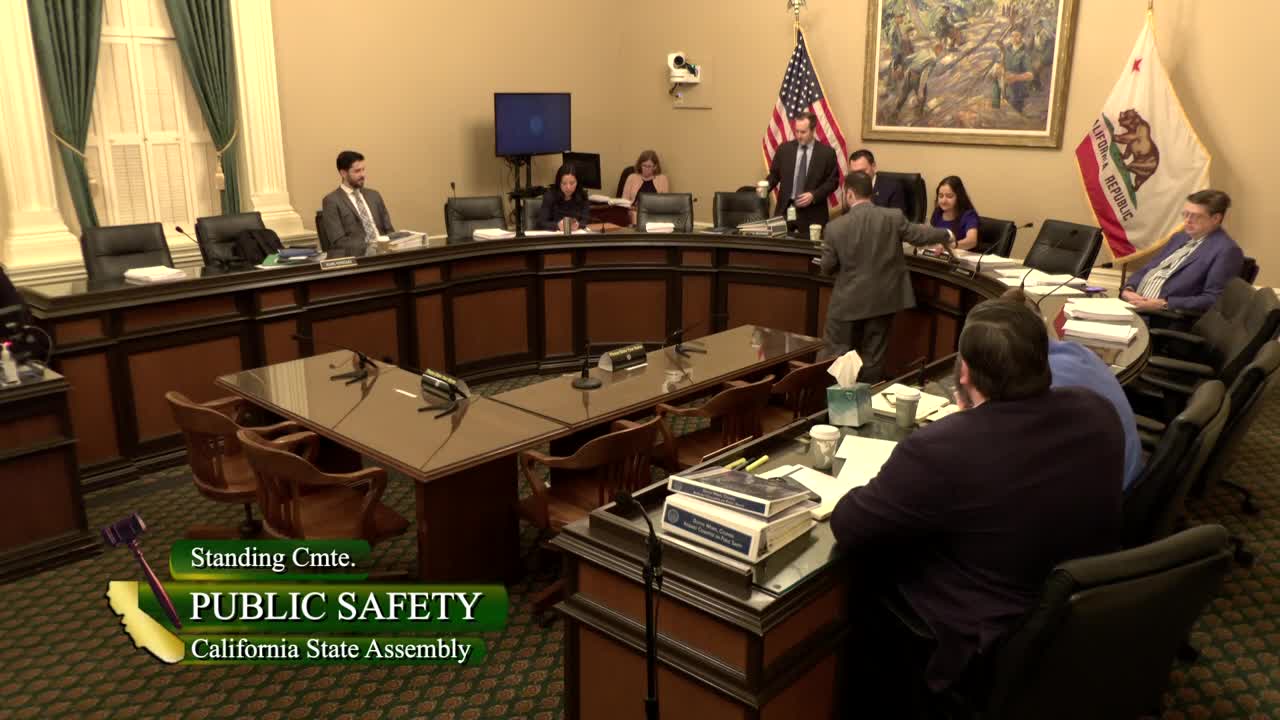
Assembly Standing Committee on Public Safety
Bill Author

Bill Co-Author(s):