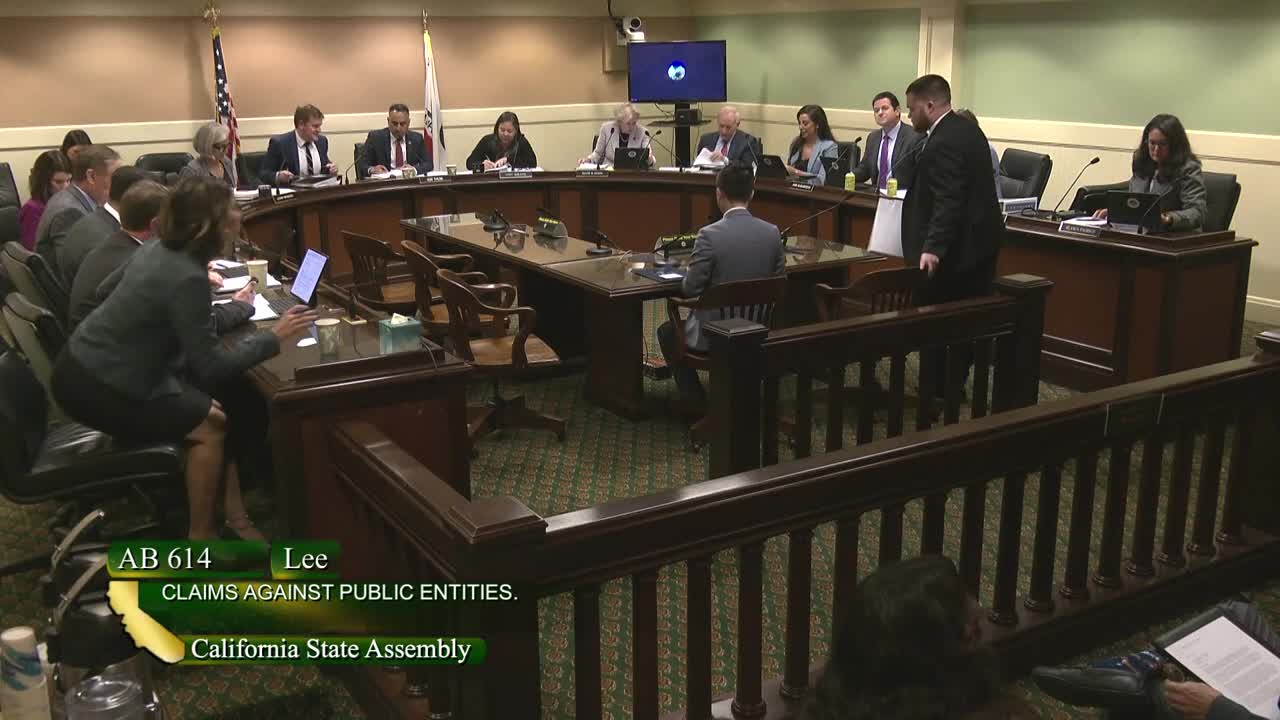
AB 614: Claims against public entities.
- Session Year: 2025-2026
- House: Assembly
- Latest Version Date: 2025-03-27
Current Status:
Failed
(2026-02-02: From committee: Filed with the Chief Clerk pursuant to Joint Rule 56.)
Introduced
In Committee
Awaiting First Chamber Vote
Passed First Chamber
In Committee
Awaiting Second Chamber Vote
Passed Second Chamber
Enacted
Existing law, the Government Claims Act, establishes the liability and immunity of a public entity for its acts or omissions that cause harm to persons and requires that a claim against a public entity relating to a cause of action for death or for injury to person, personal property, or growing crops be presented not later than 6 months after accrual of the cause of action. Under existing law, claims relating to any other cause of action are required to be presented no later than one year after the accrual of the cause of action.
This bill would remove the provisions requiring a claim against a public entity relating to a cause of action for death or for injury to person, personal property, or growing crops to be presented not later than 6 months after accrual of the cause of action and would instead require a claim relating to any cause of action to be presented not later than one year after accrual of the cause of action. action, unless otherwise specified by law.
Existing law, the Government Claims Act, establishes the liability and immunity of a public entity for its acts or omissions that cause harm to persons and requires that a claim against a public entity relating to a cause of action for death or for injury to person, personal property, or growing crops be presented not later than 6 months after accrual of the cause of action. Under existing law, claims relating to any other cause of action are required to be presented no later than one year after the accrual of the cause of action.
This bill would remove the provisions requiring a claim against a public entity relating to a cause of action for death or for injury to person, personal property, or growing crops to be presented not later than 6 months after accrual of the cause of action and would instead require a claim relating to any cause of action to be presented not later than one year after accrual of the cause of action.
(a)A Unless otherwise specified by law, a claim relating to any cause of action shall be presented as provided in Article 2 (commencing with Section 915) not later than one year after the accrual of the cause of action.
(b)For purposes of determining whether a claim was commenced within the period provided by law, the date the claim was presented to the Department of General Services is one of the following:
(1)The date the claim is submitted with a twenty-five dollar ($25) filing fee.
(2)If a fee waiver is granted, the date the claim was submitted with the affidavit requesting the fee waiver.
(3)If a fee waiver is denied, the date the claim was submitted with the affidavit requesting the fee waiver, provided the filing fee is paid to the department within 10 calendar days of the mailing of the notice of the denial of the fee waiver.
(a)A claim relating to a cause of action for death or for injury to person or to personal property or growing crops shall be presented as provided in Article 2 (commencing with Section 915) not later than six months after the accrual of the cause of action. A claim relating to any other any cause of action shall be presented as provided in Article 2 (commencing with Section 915) not later than one year after the accrual of the cause of action.
(b)For purposes of determining whether a claim was commenced within the period provided by law, the date the claim was presented to the Department of General Services is one of the following:
(1)The date the claim is submitted with a twenty-five dollar ($25) filing fee.
(2)If a fee waiver is granted, the date the claim was submitted with the affidavit requesting the fee waiver.
(3)If a fee waiver is denied, the date the claim was submitted with the affidavit requesting the fee waiver, provided the filing fee is paid to the department within 10 calendar days of the mailing of the notice of the denial of the fee waiver.
|
Date
|
Status
|
|---|---|
| Feb 2, 2026 | From committee: Filed with the Chief Clerk pursuant to Joint Rule 56. |
| Jan 31, 2026 | Died pursuant to Art. IV, Sec. 10(c) of the Constitution. |
| May 23, 2025 | In committee: Held under submission. |
| May 7, 2025 | In committee: Set, first hearing. Referred to APPR. suspense file. |
| Mar 28, 2025 | Re-referred to Com. on APPR. |
| Mar 27, 2025 | Read second time and amended. |
| Mar 26, 2025 | From committee: Amend, and do pass as amended and re-refer to Com. on APPR. (Ayes 11. Noes 0.) (March 25). |
| Mar 3, 2025 | Referred to Com. on JUD. |
| Feb 14, 2025 | From printer. May be heard in committee March 16. |
| Feb 13, 2025 | Read first time. To print. |
|
Date
|
Description
|
Location
|
Votes
|
|
|---|---|---|---|---|
| Mar 25, 2025 | Do pass as amended and be re-referred to the Committee on [Appropriations] | Assembly Standing Committee on Judiciary |
Passed |
This list shows positions taken on this bill by organizations on the date displayed, which is linked to the original source.
Positions by individuals are not included.
|
Organization
|
Position
|
Date
|
|---|---|---|
| Aclu California Action | ** Support | |
| All of Us or None Los Angeles | ** Support | |
| Alliance for Boys and Men of Color | ** Support | |
| Asian Prisoner Support Committee | ** Support | |
| Association of California Healthcare Districts | ** Against | |
| California Alliance for Youth and Community Justice | ** Support | |
| California Association Of Joint Powers Authorities | ** Against | |
| California State Association Of Counties | ** Against | |
| Communities United for Restorative Youth Justice | ** Support | |
| Consumer Attorneys Of California | ** Support | |
| Courage California | ** Support | |
| Disability Rights California | ** Support | |
| Initiate Justice | ** Support | |
| Initiate Justice Action | ** Support | |
| League Of California Cities | ** Against | |
| Legal Aid At Work | ** Support | |
| Legal Services for Prisoners with Children | ** Support | |
| Milpa Collective | ** Support | |
| Public Risk Innovation Solutions and Management | ** Against | |
| Rural County Representatives of California | ** Against | |
| Schools Excess Liability Fund | ** Against | |
| Silicon Valley De-Bug | ** Support | |
| Sister Warriors Freedom Coalition | ** Support | |
| Urban Counties of California | ** Against | |
| Urban Peace Movement | ** Support |
Date of Hearing: May 7, 2025
ASSEMBLY COMMITTEE ON APPROPRIATIONS
Buffy Wicks, Chair
ABPCA Bill Id:AB 614
Author:(Lee) – As Amended Ver:March 27, 2025
Policy Committee: | Judiciary | Vote: | 11 - 0 |
|
| ||
|
|
Urgency: No State Mandated Local Program: No Reimbursable: No
SUMMARY:
This bill extends, from six months to one year, the time period in which a person must present a claim against a government entity for death or injury to a person, personal property, or growing crops to the government entity before the person may file a civil lawsuit.
FISCAL EFFECT:
- Costs (General Fund, special funds) of an unknown but likely significant amount to state entities to litigate and settle additional Government Claims Act (GCA) claims. As described in more detail below, this bill may increase the number of GCA claims filed and result in claims that have been more thoroughly investigated before submission.
At the time this analysis was prepared, the following agencies had reported costs associated with the bill:
- California Highway Patrol (CHP) anticipates “difficult to quantify” but significant costs for settlements, attorney fees, experts’ costs, and staff time to respond to additional GCA claims and resulting lawsuits, possibly in the tens of millions of dollars annually. CHP cited likely increases in jury awards and attorneys’ fees for its car accident cases, one of the most common types of CGA claims filed with CHP. CHP reports a 20% increase in these claims could result in increased costs of approximately $3.7 million to CHP.
- California Department of Corrections and Rehabilitation (CDCR) expects “substantial new liability” with potentially-significant fiscal impacts. The department reports it paid approximately $1.4 million in fiscal year 2022-23 and $430,000 in fiscal year 2023-24 in GCA claims. Assuming similar claim payments in the future, if claims increase 20% as a result of this bill, CDCR’s GCA claims payments may increase by about $183,000 annually, not including litigation costs for contesting the additional claims.
- Department of State Hospitals cannot project costs with certainty at this point, but an increase in GCA claims may result in additional costs in the high tens of thousands or low hundreds of thousands of dollars annually.
- Local, non-reimbursable costs of an unknown but significant amount to local government entities to litigate additional GCA claims and, potentially, for increased insurance premiums.
- Minor and absorbable costs to the Department of General Services to process additional claims.
COMMENTS:
- Purpose. This bill is sponsored by Communities United for Restorative Youth Justice. According to the author:
Filing a claim against a public entity is a complex and burdensome process. Victims must first research if they have a valid claim and find the correct agency to file with. They then must gather necessary evidence and track strict deadlines, which often requires finding legal representation. The current six-month deadline for claims involving property damage, injury, or death creates an unnecessary and unreasonable obstacle to those seeking justice. Many people dealing with medical recovery, emotional distress, or financial hardship are unable to meet this short timeframe, forcing them to either rush through the process or forfeit their right to seek redress.
- Background. The GCA governs certain civil law claims against state and local government entities. Under the GCA, a person who wishes to file a lawsuit against such a government entity must first complete an administrative claims process. The person must present their claim to the government entity they wish to sue, and the entity has 45 days to settle or reject the claim. After 45 days, if the claim is not resolved or the entity has not responded, the person may file a civil lawsuit based on the claim. Under existing law, a person must present a claim for death or injury to a person, personal property, or growing crops within six months of the harm that occurred. A claim for any other type of harm must be presented within one year of the harm. If a person fails to present their claim within the applicable deadline, the person may not pursue a lawsuit against the government entity based on the claim.
This bill extends, from six months to one year, the deadline for presenting a GCA claim for death or injury to a person, personal property, or growing crops. As described in more detail in the analysis of this bill by the Assembly Committee on Judiciary, it is not clear exactly how this change will impact the number of claims presented. It seems likely that at least some additional claims will be presented that would otherwise be barred by the existing six-month deadline. The policy committee analysis also notes that the additional time may permit better investigation of claims before they are submitted. This may result in an increase in meritorious claims that are presented – claims that make a strong case that the government entity is liable for harm – and, potentially, a decrease in unmeritorious claims presented. Actual costs cannot be predicted with certainty and will depend on the number of claims, the quality of claims, and whether government entities seek to litigate or settle claims. To the extent the bill results in additional, meritorious claims presented to government entities, there will likely be a corresponding increase in government litigation and settlement costs.
- Support and Opposition. This bill is supported by a coalition of civil and consumer rights organizations, which writes:
The importance of this [bill’s] time extension cannot be understated. For serious harms such as injury and wrongful death, six months is an extremely short amount of time to find a reliable attorney, gather and preserve evidence, and file a claim, all while healing from injury or navigating the trauma and grief of losing a loved one. For people unfamiliar with the legal system, who come from marginalized communities, or have limited resources, this barrier is especially difficult…Just like any other actor in our society, when the government causes serious harm, the injured individual(s) should be able to seek appropriate redress in a manner that reflects a commitment to procedural fairness.
Writing in opposition, a coalition of county and local government representatives states:
Extending the tort claim process timeline from six months to one year provides little benefit to a claimant, and increases both the burden on public entities and hazards to the public. As noted, the tort claim process exists in part to provide public entities with notice of a potential claim and lawsuit so they may conduct their own internal investigation, collect and preserve evidence, and resolve claims and suits more quickly and efficiently. A longer claim process lengthens and increases costs for all these activities, particularly for litigation costs...Just as importantly, delaying the initial claim filing hinders the prompt correction of dangerous conditions, with obvious – and immediate – negative consequences for public safety.
Analysis Prepared by: Annika Carlson / APPR. / (916) 319-2081
Date of Hearing: March 25, 2025
ASSEMBLY COMMITTEE ON JUDICIARY
Ash Kalra, Chair
ABPCA Bill Id:AB 614
Author:(Lee) – As Introduced Ver:February 13, 2025
As Proposed to be Amended
SUBJECT: Claims against public entities
KEY ISSUE: should the government claims act presentation timeline be modified so that all claims against government entities must be presented to the government within one year of accrual?
SYNOPSIS
Procedures for filing legal claims against government entities have existed in California statute, in some form, since the 1850s. The modern Government Claims Act was adopted in the late 1950s. Unlike traditional tort claims, claims against government entities must first be presented to the government entity who may then choose to settle or reject the claim. Only once a claim is rejected can a claim against a government entity proceed to the civil justice system. Under existing law, most claims against the government must be presented to the government within one year of the claim accruing. However, claims for death or for injury to persons or to personal property or growing crops must be presented within six months of accrual.
This measure seeks to standardize the presentation timeline for all government claims. The bill opts to adopt the longer one year claim presentation timeline as the new standard for all claims against the government. The bill, as proposed to be amended, clarifies that the new timeline should not impact any statutes with more specific claim timelines or those exempt from the claim presentation requirements.
This bill is sponsored by Communities United for Restorative Youth Justice and is supported by a coalition of civil and consumer rights organizations. The proponents of this bill contend that the existing six month presentation timeline for injury cases is too short, and that this timeline disproportionately harms disabled Californians and Californians of color. This bill is strongly opposed by a coalition of local governments and their insurance providers. The opposition contends that this bill will further exacerbate the growing insurance cost crisis plaguing local agencies in California. The opposition also believes that this bill will fail to help those the proponents seek to assist; and that the bill will cause harm to all Californians by hindering local agencies ability to respond to potentially dangerous conditions within the local government’s jurisdiction. Although proposed amendments address technical issues raised by some stakeholders, they do not mollify the opposition’s primary concerns.
SUMMARY: Expands the period of time for presenting claims to a government entity for damages as a result of death or for injury to persons or to personal property or growing crops from six months to one year. Specifically, this bill provides that, unless otherwise specified in law, all claims against a government entity must be presented to the government entity not later than one year after the accrual of the cause of action.
EXISTING LAW:
- Establishes the Government Claims Act that outlines the process for filing civil legal claims against state and local government entities. (Government Code Section 810 et seq.)
- Requires a claim against a public agency to be presented by the claimant or by a person acting on their behalf to the government entity and show all of the following:
- The name and post office address of the claimant;
- The post office address to which the person presenting the claim desires notices to be sent;
- The date, place and other circumstances of the occurrence or transaction which gave rise to the claim asserted;
- A general description of the indebtedness, obligation, injury, damage or loss incurred so far as it may be known at the time of presentation of the claim;
- The name or names of the public employee or employees causing the injury, damage, or loss, if known; and
- The amount claimed if it totals less than ten thousand dollars ($10,000) as of the date of presentation of the claim, including the estimated amount of any prospective injury, damage, or loss, insofar as it may be known at the time of the presentation of the claim, together with the basis of computation of the amount claimed. (Government Code Section 910.)
- If the amount claimed exceeds ten thousand dollars ($10,000), no dollar amount should be included in the claim. (Ibid.)
- Requires a claim against a government entity relating to a cause of action for death or for injury to person or to personal property or growing crops must be presented to the government entity not later than six months after the accrual of the cause of action and that a claim relating to any other cause of action must be presented within one year of the accrual of the cause of action. (Government Code Section 911.2.)
- Provides that the following claims do not need to be presented to a government entity before asserting a request for monetary damages:
- Claims under the Revenue and Taxation Code or other statute prescribing procedures for the refund, rebate, exemption, cancellation, amendment, modification, or adjustment of any tax, assessment, fee, or charge or any portion of the charge, or of any penalties, costs, or related charges;
- Claims in connection with the filing of a notice of lien, statement of claim, or stop notice that is required under any law relating to liens of mechanics, laborers, or materialmen;
- Claims by public employees for fees, salaries, wages, mileage, or other expenses and allowances;
- Claims for workers’ compensation, as specified;
- Applications or claims for any form of public assistance under the Welfare and Institutions Code or other provisions of law relating to public assistance programs, and claims for goods, services, provisions, or other assistance rendered for or on behalf of any recipient of any form of public assistance;
- Applications or claims for money or benefits under any public retirement or pension system;
- Claims for principal or interest upon any bonds, notes, warrants, or other evidences of indebtedness;
- Claims that relate to a special assessment constituting a specific lien against the property assessed and that are payable from the proceeds of the assessment, by offset of a claim for damages against it or by delivery of any warrant or bonds representing it;
- Claims by the state or by a state department or agency or by another local public entity or by a judicial branch entity;
- Claims arising under any provision of the Unemployment Insurance Code, including, but not limited to, claims for money or benefits, or for refunds or credits of employer or worker contributions, penalties, or interest, or for refunds to workers of deductions from wages in excess of the amount prescribed;
- Claims for the recovery of penalties or forfeitures made in accordance with specified provisions of the Labor Code;
- Claims governed by the Pedestrian Mall Law of 1960, as specified;
- Claims made for the recovery of damages suffered as a result of childhood sexual assault, as specified; and
- Claims made pursuant to the Education Code for reimbursement of pupil fees for participation in educational activities. (Government Code Section 905.)
- Provides that all persons within the jurisdiction of this state have the right to be free from any violence, or intimidation by threat of violence, committed against their persons or property because of political affiliation, or on account of any characteristic listed or defined in the Unruh Civil Rights Act, or position in a labor dispute, or because another person perceives them to have one or more of those characteristics. (Civil Code Section 51.7.)
- Provides, pursuant to federal law, that every person who, under color of any statute, ordinance, regulation, custom, or usage, of any State or Territory or the District of Columbia, subjects, or causes to be subjected, any citizen of the United States or other person within the jurisdiction thereof to the deprivation of any rights, privileges, or immunities secured by the Constitution and laws, is to be liable to the party injured in an action at law, suit in equity, or other proper proceeding for redress, except that in any action brought against a judicial officer for an act or omission taken in such officer’s judicial capacity, injunctive relief shall not be granted unless a declaratory decree was violated or declaratory relief was unavailable. (42 US Code Section 1983.)
FISCAL EFFECT: As currently in print this bill is keyed fiscal.
COMMENTS: Unlike traditional civil actions, in which a plaintiff directly files suit against an alleged defendant, claims against government entities are subject to unique timelines and processes. These processes are enumerated in the Government Claims Act. (Government Code Section 810 et seq.) Most claims against government entities must be presented to the government entity within one year of the claim’s accrual. However, since the 1950s, claims related to death or for injury to person or to personal property or growing crops must be presented within six months of accrual. The author and proponents of this measure contend this six month timeline is too short, especially in light of the potential injuries and trauma suffered by would-be plaintiffs. Accordingly, seeking to standardize timelines in the Government Claims Act, this bill would provide that all claims for damages against a government entity must be presented to the government entity within one year of the claim’s accrual. In support of this measure the author states:
Filing a claim against a public entity is a complex and burdensome process. Victims must first research if they have a valid claim and find the correct agency to file with. They then must gather necessary evidence and track strict deadlines, which often requires finding legal representation. The current six-month deadline for claims involving property damage, injury, or death creates an unnecessary and unreasonable obstacle to those seeking justice. Many people dealing with medical recovery, emotional distress, or financial hardship are unable to meet this short timeframe, forcing them to either rush through the process or forfeit their right to seek redress.
By extending the filing deadline from six months to one year, AB 614 ensures that individuals have time to understand their legal options, secure representation, and gather the necessary evidence. AB 614 upholds access to justice for all Californians by providing a reasonable and equitable opportunity to hold public entities accountable for harm.
The history of, and justification for, the Government Claims Act. According to the California Law Revision Commission, the origins of the state’s Government Claims Act date back to 1855. (Recommendation and Study relating to The Presentation of Claims Against Public Entities (Jan 1959) 25 Cal. Law Revision Com. Rep. (1959) at page A-7.) However, until the 1950s, the Legislature enacted standalone statutes governing individual types of claims against government entities. As a result of the piecemeal approach to addressing government claims, by 1955, more than 174 individual statutes addressed unique claims against the government. Seeking to streamline and consolidate these code sections, in 1956 the Legislature tasked the California Law Revision Commission with examining how to clarify the various code sections dealing with claims against the government. (ACR 12 (Smith) Res. Chap. 35, Stats. 1956.) In revising the government claims laws, the California Law Revision Commission was guided by the two primary policy goals of all government claims presentation statutes: first, that government entities should be given the opportunity to make early investigations into potential legal claims; and secondly, that government entities should strive to settle claims in a timely manner before lawsuits are formally filed. (Recommendation and Study relating to The Presentation of Claims Against Public Entities (Jan 1959) 25 Cal. Law Revision Com. Rep., supra.) One of the primary methods that the California Law Revision Commission managed to streamline the codes related to government claims was to essentially merge the existing code sections related to claims against local governments into the code managing claims against the state to create one unified government claims presentation process. (Id. at A-12.)
A critical aspect of the Government Claims Act, when compared to traditional tort claims, is the claims against government entities must first be “presented” to the government. Only once the government rejects or ignores a claim for 45-days may a plaintiff file suit in court. The failure to “present” the claim to the government prior to filing suit will bar the ultimate ability for the plaintiff to pursue the claim in court.
Of note to this bill, when presented with the question as to how to determine the time for presenting claims, the California Law Revision Commission recommended, “a single uniform filing time be prescribed for all type of claims covered by the act.” (Id. at A-124.) The Commission then recommended that all claims be presented within six months of accrual. (Id. at 125.) However, it appears that as a result of public comment, largely from local governments, contract and other non-injury related claims were provided the one-year accrual period found in existing law when the Legislature ultimately acted on the Commission’s recommendations (see County Auditors Association public comment letter to California Law Revision Commission’s report available at: https://clrc.ca.gov/pub/1959/M59-0404b.pdf.) The longer presentation timeline stemmed from a desire to permit local agencies sufficient time to analyze the copious amounts of paper records that were then required to review such claims. Accordingly, tort claims for injury and wrongful death have been subject to the present six-month presentation requirement for nearly 70 years.
This bill standardizes Government Claims Act presentation timelines. Seeking to reduce confusion resulting from different presentation deadlines, and to provide greater time for investigating and compiling evidence in all government tort claims, this bill would provide that most claims against government entities must be presented with one-year of the claim’s accrual. Recognizing that not all claims against government entities require presentation, proposed amendments ensure that the bill does not inadvertently affect other statutes of limitation provided in law.
Proponents of this bill argue that six months is insufficient time for many Californians to successfully file claims against government entities. The proponents of this bill, a coalition of civil rights, consumer rights, and criminal justice reform advocates, argue that the existing government claim presentation timeline is too short for victims of traumatic events. The sponsor of this bill, Communities United for Restorative Youth Justice, writes, “For serious harms such as injury and wrongful death, six months is an extremely short amount of time to find a reliable attorney, gather and preserve evidence, and file a claim, all while healing from injury or navigating the trauma and grief of losing a loved one.”
In conversations with stakeholders, both those supporting and those opposing this bill, it is unclear how many claims are never filed due to the existing six-month presentation deadline, and thus this bill’s impact on the overall quantity of claims filed is likely to be relatively minor. Indeed, one may surmise that because the existing timeline has existed for decades, that the existing timeline may not impede most claims from being filed. However, the legal practitioners who file these claims do authoritatively note that the six-month timeline may significantly hinder the quality of claims filed. Addressing this point, the Consumer Attorneys of California note, “the current law of six months can lead to premature filing of claims as victims may not have time to adequately investigate cases but are faced with an arbitrary timeframe to file.” Although the existing law may not be hindering most claims from being presented to government agencies, the existing law may well be resulting in claims being filed that are poorly drafted or filed without a full understanding of all relevant evidence. If the existing law is resulting in a preponderance of poorly or prematurely filed claims, the current six-moth presentation timeline may inadvertently result in delaying timely settlements in clear-cut cases, forcing parties into protracted discovery, and generally increasing litigation costs for all parties.
Opponents of this measure contend that the bill, in practice, will not help the very Californians the proponents seek to assist. This measure is, unsurprisingly, opposed by a coalition of local government agencies. They contend that while this bill seeks to help the most vulnerable Californians who have been injured by an act of an agent of the government the bill instead, “provides little benefit to a claimant, and increases both the burden on public entities and hazards to the public.” The opposition puts forward several points to buttress this claim. First, the opponents to this measure note that one of the goals of the Government Claims Act is to ensure that a government entity is quickly alerted to “dangerous practices or property conditions may continue to injure others unless quickly remedied.” While there is little doubt that government agencies should quickly move to address potential hazards to the public, given the significant improvement in technology since the 1950s reforms to the Government Claims Act, including social media, one may wonder how much the current six-month claim presentation timeline is actually needed to alert government agencies to hazards. For example, most members of the public can report a cracked or defective sidewalk before any injury occurs by using government operated “311” smartphone applications or simply posting videos of the hazard to social media.
The second argument that this bill harms the very members of the public it seeks to serve relates to the preservation and collection of evidence following a tort. The opposition cites the aforementioned 1959 California Law Revision Commission study and notes, “Evidence relating to liability or non-liability in such cases is often solely, or largely, in the form of oral testimony of witnesses. The advantages of early interview before memories grow dim are considerable.” Again this argument was more compelling in the 1950s than the 2020s. Although witness testimony is still critical in many tort cases, the widespread deployment of surveillance technology, including security cameras, helps alleviate the reliance on witnesses alone. Additionally, digitized medical records and similar technologies help create a far more robust and easily accessible litigation record than one could craft in the 1950s. Nonetheless, the local agencies do raise a strong point that the existing six-month timeline helps agencies conduct their own investigations into alleged injuries and can prompt faster resolution of these matters.
The final argument that the measure is counterproductive to those it’s designed to help is based on the perception that the proponents of this bill seek to address harm targeted toward underserved and predominantly minority communities, including claims related to police brutality and other forms of violence committed by government actors. The opponents rightfully note that many claims related to injuries stemming from a plaintiff’s protected status frequently are litigated under federal law, specifically 42 U.S. Code Section 1983, and not the Government Claims Act. While this is true, it is also true that tort victims from underrepresented frequently struggle to find counsel, especially when language barriers exist. However, the opposition is correct in noting that an additional six months to file claims against the government may not remedy these systematic issues that tend to plague the civil justice system writ large.
Opponents of this measure contend that regardless of how many new claims are actually generated by this measure, it exposes local governments to increased costs. The opponents of this measure also highlight the crisis plaguing the insurance markets for local agencies. As a result of legislation reviving lapsed sexual assault claims as well as a litany of local agencies facing scandals and lawsuits related to conditions in county detention facilities, local governments are finding the cost of liability insurance increasingly excessive. While most stakeholders agree that this measure is unlikely to result in a significant increase in the overall amount of claims filed against the government, the opponents to this bill note that the extra six months of legal exposure contemplated by this bill will be priced into their insurance premiums.
Undoubtedly, California’s local governments are struggling to maintain vital services in the face of rising insurance costs. However, these costs are largely driven by actual liability incurred by the local agencies as a result of harms their employees and agents inflicted on their own citizens. While keeping cost pressures on local agencies to a minimum is critical, especially in the new era of austerity from the federal government, ensuring that tort victims are made whole is an equally compelling public policy interest. Accordingly, eliminating the discrepancy in the existing Government Claims Act presentation timeline is certainly a worthy goal. However, the author may wish to consider whether the public’s interest would be better served if the deadline for all claims was six months rather than twelve months. Nonetheless, given the lack of clear data reflecting the actual costs this measure may impose on local agencies (including potential savings offsets from reduced discovery and litigation), as well as the overwhelming need to ensure victims are made whole, the Committee does not see a need to amend the bill to a uniform six month timeline at this juncture.
Proposed amendments clarify that this bill does not shorten litigation timelines for claims not subject to the Government Claims Act. Several stakeholders representing government employees contacted the Committee regarding concerns about how the language currently in print would impact cases not subject to the presentation requirements of the Government Claims Act, specifically claims arising under the Fair Employment and Housing Act. Notably, the Fair Employment and Housing Act is not explicitly excluded from the claims presentation requirements of the Government Claims Act (Government Code Section 905.) However, California courts have noted that because the Fair Employment and Housing Act is a standalone and comprehensive “statutory scheme to combat employment discrimination” it is exempt from the presentation requirement of the Government Claims Act. (Snipes v. City of Bakersfield (1983) 145 Cal.App.3d 861, 863.) Additionally, the Fair Employment and Housing Act is not the only specific statutory scheme to receive a statutory or judicial exemption from the Government Claims Act. The author notes that this bill is not intended to supersede more specific statutory claim timelines. Accordingly, to clarify that this bill is not intended to reverse other statutory timelines or case law, the author is proposing the following amendment:
Government Code Section 911.2. (a) Unless otherwise specified by law, a A claim relating to any cause of action shall be presented as provided in Article 2 (commencing with Section 915) not later than one year after the accrual of the cause of action.
The above-mentioned stakeholders representing government employees have informed the Committee that this amendment should address their concerns.
ARGUMENTS IN SUPPORT: This measure is sponsored by Communities United for Restorative Youth Justice and the bill is supported by a coalition of criminal justice reform advocates, disability rights advocates, and consumer groups. In support of the bill, Communities United for Restorative Youth Justice writes:
The California Government Claims Act (CGCA) has a strict, burdensome, and unequal statute of limitations for individuals pursuing state civil claims for compensation against government entities. Failing to meet these strict requirements can foreclose any opportunity to pursue justice even when the claim has merit. To make matters worse, people who experience the most egregious harms must meet the most stringent time constraints.
Under current law, anyone attempting to initiate a CGCA claim for damages against a government official or entity must file an administrative complaint within one year of the incident. Yet, if the person was injured or killed, or their property was damaged, they only have six months from the date of the incident to file a complaint, leading to an imbalance of justice. If they fail to meet this deadline, they are denied the right to pursue legal action.
The importance of this time extension cannot be understated. For serious harms such as injury and wrongful death, six months is an extremely short amount of time to find a reliable attorney, gather and preserve evidence, and file a claim, all while healing from injury or navigating the trauma and grief of losing a loved one. For people unfamiliar with the legal system, who come from marginalized communities, or have limited resources, this barrier is especially difficult.
Additionally, Disability Rights California notes:
People with disabilities, especially people of color with disabilities, experience disproportionate violence, harm, and death caused by government actors. In addition, people with disabilities often face unique and significant challenges when navigating the inaccessible legal system. Extending the statute of limitations to one year under AB 614 would provide individuals with disabilities a fairer opportunity to pursue justice and secure appropriate support and services.
ARGUMENTS IN OPPOSITION: This bill is stridently opposed by a coalition of local governments and their property-casualty insurance providers. The opposition coalition jointly writes:
Public entities are required to comply with an administrative claims process. A claimant injured by a public entity must first file a claim with the public entity before filing a civil lawsuit. A claimant can file their suit if their claim is rejected by the public entity, or is deemed rejected 45 days after they filed their claim, whichever is sooner. As explained by the California Law Revision Commission in the 1963 report that recommended adoption of the current Government Claims Act, "Claims statutes have two principal purposes. First, they give the governmental entity an opportunity to settle just claims before suit is brought. Second, they permit the entity to make an early investigation of the facts on which a claim is based, thus enabling it to defend itself against unjust claims and to correct the conditions or practices which gave rise to the claim."
Extending the tort claim process timeline from six months to one year provides little benefit to a claimant, and increases both the burden on public entities and hazards to the public. As noted, the tort claim process exists in part to provide public entities with notice of a potential claim and lawsuit so they may conduct their own internal investigation, collect and preserve evidence, and resolve claims and suits more quickly and efficiently. A longer claim process lengthens and Increases costs for all these activities, particularly for litigation costs. Retaining legal counsel in anticipation of a claim is a major cost for public entities. Delaying the start of the claim process puts evidence that is necessary to defend a potential claim or suit at risk of becoming stale. A lack of evidence could be the difference in successfully defending a lawsuit or having to settle an unmeritorious claim. Just as importantly, delaying the initial claim filing hinders the prompt correction of dangerous conditions, with obvious – and immediate – negative consequences for public safety.
The Government Claims Act outlines a process to file a late claim within a year of the date of injury. These provisions allow more liberal time allowances in cases for a late filing of a claim upon a showing of cause. The existing structure of the Government Claims Act has effectively balanced the foregoing policies with the need to provide some “[r]elief for persons who could not reasonably have been expected to present a claim” for over 60 years, and there is no cogent reason for disturbing this well-settled area of law now.
Finally, the more legal risk that public entities face, the higher their liability insurance premiums. The time it takes to resolve claims, and the ultimate cost of litigation and settlements significantly impact these premiums. Furthermore, liability insurers are already facing significant cost pressures to continue offering coverage in California. Most public sector entities obtain liability insurance through a Joint Powers Authority risk sharing pool funded by the public agencies themselves. These increased premiums directly impact jurisdiction’s ability to fund direct services. By extending the claim timeline, AB 614 only increases this pressure.
REGISTERED SUPPORT / OPPOSITION:
Support
Communities United for Restorative Youth Justice (sponsor)
ACLU California Action
All of Us or None Los Angeles
Alliance for Boys and Men of Color
Asian Prisoner Support Committee
California Alliance for Youth and Community Justice
Consumer Attorneys of California
Courage California
Disability Rights California
Initiate Justice
Initiate Justice Action
Legal Aid At Work
Legal Services for Prisoners With Children
Milpa Collective
Silicon Valley De-bug
Sister Warriors Freedom Coalition
Urban Peace Movement
Opposition
Association of California Healthcare Districts
California Association of Joint Powers Authorities
California State Association of Counties
League of California Cities
Public Risk Innovation, Solutions, and Management
Rural County Representatives of California
Schools Excess Liability Fund
Urban Counties of California
Analysis Prepared by: Nicholas Liedtke / JUD. / (916) 319-2334
Discussed in Hearing
 19MIN
Assembly Standing Committee on Judiciary
Bill Author

Bill Co-Author(s):