SB 438: School attendance: College and Career Access Pathways partnerships.
- Session Year: 2025-2026
- House: Senate
- Latest Version Date: 2025-02-18
Current Status:
Failed
(2026-02-02: Returned to Secretary of Senate pursuant to Joint Rule 56.)
Introduced
In Committee
Awaiting First Chamber Vote
Passed First Chamber
In Committee
Awaiting Second Chamber Vote
Passed Second Chamber
Enacted
Existing law authorizes the governing board of a community college district to enter into a College and Career Access Pathways (CCAP) partnership with the governing board of a school district or a county office of education, or the governing body of a charter school, as provided. Existing law provides that the minimum schoolday in any high school is 240 minutes, except as provided, including that a day of attendance for a pupil enrolled in grades 11 and 12 at an early college high school or middle college high school is 180 minutes of attendance if the pupil is also enrolled in a community college, classes of the California State University, or classes of the University of California, as specified.
This bill would additionally reduce the 240-minute minimum schoolday to instead be 180 minutes of attendance for a pupil enrolled under a CCAP partnership if the pupil is also enrolled in a community college, as specified.
(a)A day of attendance for a pupil enrolled in grade 11 or 12 at an early college high school or middle college high school is 180 minutes of attendance if the pupil is also enrolled part time in courses of the California State University or the University of California for which academic credit will be provided upon satisfactory completion of enrolled courses.
(b)A day of attendance for a pupil enrolled in an early college high school or school, a middle college high school, or enrolled under a College and Career Access Pathways partnership agreement, who is also a special part-time student enrolled in a community college under Article 1 (commencing with Section 48800) of Chapter 5 of Part 27, and who will receive academic credit upon satisfactory completion of enrolled courses, is 180 minutes of attendance.
(c)A day of attendance for a pupil enrolled in an early college high school or school, a middle college high school school, or enrolled under a College and Career Access Pathways partnership agreement who does not satisfy subdivision (a) or (b) is 240 minutes of attendance.
(d)For a charter school that is an early college high school or middle college high school, for purposes of calculating classroom-based average daily attendance for classroom-based instruction apportionments, at least 80 percent of the instructional time offered by the charter school shall be at the schoolsite, and the charter school shall require the attendance of a pupil enrolled in grade 11 or 12 for a minimum of 50 percent of the minimum instructional time required to be offered pursuant to paragraph (1) of subdivision (a) of Section 47612.5 if the pupil is also enrolled part time in courses of the California State University or the University of California for which academic credit will be provided upon satisfactory completion of enrolled courses.
(e)For a charter school that is an early college high school or middle college high school, for purposes of calculating classroom-based average daily attendance for classroom-based instruction apportionments, at least 80 percent of the instructional time offered by the charter school shall be at the schoolsite, and the charter school shall require the attendance of a pupil for a minimum of 50 percent of the minimum instructional time required to be offered pursuant to paragraph (1) of subdivision (a) of Section 47612.5 if the pupil is also a special part-time student enrolled in a community college under Article 1 (commencing with Section 48800) of Chapter 5 of Part 27, and who will receive academic credit upon satisfactory completion of enrolled courses.
(f)For a pupil enrolled in a charter school that is an early college high school or middle college high school and who does not satisfy the attendance and enrollment requirements of subdivision (d) or (e), for purposes of calculating classroom-based average daily attendance for classroom-based instruction apportionments, at least 80 percent of the instructional time offered by the charter school shall be at the schoolsite, and the charter school shall require the attendance of the pupil for a minimum of 67 percent of the minimum instructional time required to be offered pursuant to paragraph (1) of subdivision (a) of Section 47612.5.
(g)For purposes of this section, middle the following definitions apply:
(1)College and Career Access Pathways partnership agreement means the same as described in Section 76004.
(2)Middle college high school is means the same as described in Section 11300 and early college high school is means the same as described in Section 11302.
(h)The requirements of this section shall be subject to annual audits, which shall be conducted pursuant to Section 41020.
|
Date
|
Status
|
|---|---|
| Feb 2, 2026 | Returned to Secretary of Senate pursuant to Joint Rule 56. |
| May 23, 2025 | May 23 hearing: Held in committee and under submission. |
| May 16, 2025 | Set for hearing May 23. |
| Apr 7, 2025 | April 7 hearing: Placed on APPR. suspense file. |
| Mar 28, 2025 | Set for hearing April 7. |
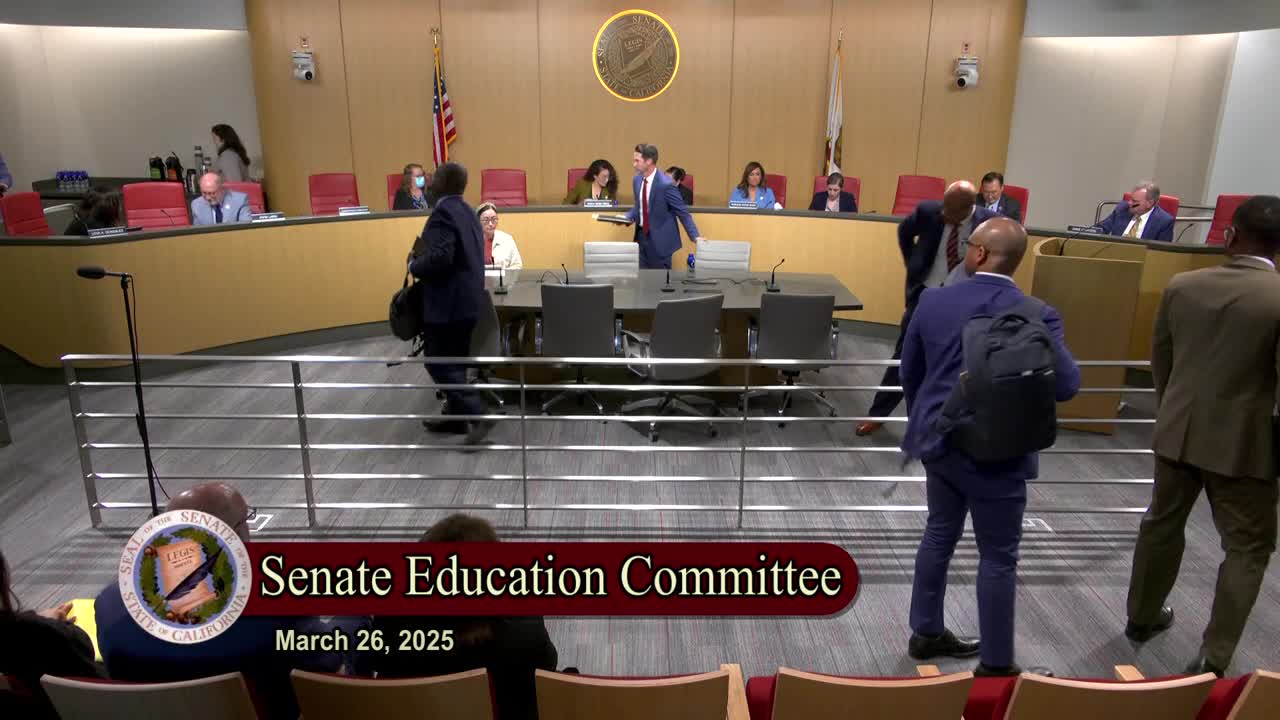
| Mar 26, 2025 | From committee: Do pass and re-refer to Com. on APPR. (Ayes 7. Noes 0. Page 566.) (March 26). Re-referred to Com. on APPR. |
| Mar 11, 2025 | Set for hearing March 26. |
| Feb 26, 2025 | Referred to Com. on ED. |
| Feb 19, 2025 | From printer. May be acted upon on or after March 21. |
| Feb 18, 2025 | Introduced. Read first time. To Com. on RLS. for assignment. To print. |
|
Date
|
Description
|
Location
|
Votes
|
|
|---|---|---|---|---|
| Apr 7, 2025 | Placed on suspense file | Senate Standing Committee on Appropriations |
Passed |
|
| Mar 26, 2025 | Do pass, but first be re-referred to the Committee on [Appropriations] | Senate Standing Committee on Education |
Passed |
This list shows positions taken on this bill by organizations on the date displayed, which is linked to the original source.
Positions by individuals are not included.
|
Organization
|
Position
|
Date
|
|---|---|---|
| Antelope Valley Union High School District | ** Support | |
| Association Of California School Administrators | ** Support | |
| Bret Harte Union High School District | ** Support | |
| California Charter Schools Association | ** Support | |
| California High School Coalition | ** Support | |
| Centinela Valley Union High School District | ** Support | |
| Children Now | ** Support | |
| Fall River Joint Unified School District | ** Support | |
| Hispanas Organized for Political Equality | ** Support | |
| Liberty Union HS District | ** Support | |
| Los Angeles Unified School District | ** Support | |
| Merced Union High School District | ** Support | |
| Mountain View Los Altos Union High School District | ** Support | |
| Roseville Joint Union High School District | ** Support | |
| San Diego Unified School District | ** Support | |
| Sierra Sands Unified School District | ** Support | |
| Summerville Union High School District | ** Support | |
| Taft Union High School District | ** Support | |
| The Education Trust - West | ** Support | |
| Wheatland Union High School District | ** Support |
SENATE COMMITTEE ON
Senator Anna Caballero, Chair
2025 - 2026 Regular Session
SB 438 (Cabaldon) - School attendance: College and Career Access Pathways partnerships
Version: | Policy Vote: |
Urgency: | Mandate: |
Hearing Date: | Consultant: |
Bill Summary:
This bill reduces the minimum schoolday requirement for students enrolled under a College and Career Access Pathways (CCAP) partnership.
Fiscal Impact:
- The bill’s reduction in the minimum schoolday requirement for students participating under CCAP partnerships could result in an unknown increase in students enrolling in community college courses, thereby creating additional Proposition 98 General Fund costs for increased apportionment costs to community college districts. The extent of these costs would depend on the exact number of full-time equivalent students (FTES) enrolled in community colleges, but could be in the hundreds of thousands to low millions of dollars each year.
- This bill is not expected to result in changes to average daily attendance (ADA) or Local Control Funding Formula (LCFF) costs as long as the local educational agency (LEA) serving these students meets the minimum instructional time requirements.
Background:
Existing law authorizes the governing board of a California Community College (CCC) district to enter into a CCAP partnership with a school district, county office of education, or charter school to expand dual enrollment opportunities, particularly for students underrepresented in higher education. It requires CCAP partnership agreements to be approved by the governing boards of both participating entities and to outline program details, including the number of students to be served, course offerings, and student eligibility criteria. Existing law prohibits CCAP partnerships from offering physical education courses and requires that CCAP agreements comply with all relevant labor, academic, and reporting regulations.
Middle College High Schools (MCHS) are collaborative programs that allow high school students to earn a high school diploma while concurrently taking college courses. They are structured to support at-risk students and provide intensive counseling and administrative attention to help students transition into college-level coursework. These programs require a reduced adult-student ratio, flexible scheduling, and integration of work-based learning experiences.
Early College High Schools (ECHS) are autonomous schools designed to blend high school and college into a structured program. ECHS students begin taking college courses as soon as they demonstrate readiness, with the opportunity to earn an associate degree or a significant number of transferable college credits by the time they graduate high school. These schools focus on historically underrepresented students in higher education and integrate both high school and college coursework into a seamless educational experience.
Existing law authorizes a student to enroll in a community college as a special part-time or full-time student upon determination by their high school principal and with parental consent. Special part-time students may take one or more courses at a CCC and may count these courses toward high school graduation requirements.
Existing law establishes the minimum schoolday for high school students at 240 minutes, except for specified exceptions, including a reduced 180-minute minimum for ECHS and MCHS students who are also enrolled in a community college or other postsecondary coursework.
Proposed Law:
This bill reduces the 240-minute minimum schoolday requirement to 180 minutes for pupils enrolled under a CCAP partnership if the pupil is also enrolled in a community college, as specified. This reduction would align CCAP partnerships with the minimum schoolday requirement of 180 minutes for students enrolled in ECHS and MCHS programs.
Staff Comments:
Dual enrollment allows high school students to take college courses while still in high school. The courses provide an opportunity for students to earn college credit early and potentially accelerate their time to degree completion. Dual enrollment programs exist in several forms, including CCAP partnerships, which provide structured dual enrollment opportunities for students who may not already be college bound or who are underrepresented in higher education. Further, CCAP is designed to provide seamless pathways from high school to community college, emphasizing career technical education, transfer preparation, and improving college readiness. CCAP courses are typically offered on high school campuses and are free to students, removing many of the traditional barriers to college course access.
The 2021-22 CCCCO Dual Enrollment Legislative Report found that CCAP participation increased from 21,129 FTES in 2022-23 to 24,018 FTES in 2023-24. To the extent that the bill’s reduction in the minimum schoolday requirement makes dual enrollment more accessible and expands CCAP partnerships, there would likely be increased enrollment in community college courses. While the exact increase in FTES is unknown, community college districts would be eligible to receive additional apportionment funds from the state.
-- END --
SENATE COMMITTEE ON EDUCATION
Senator Sasha Renée Pérez, Chair
2025 - 2026 Regular
Bill No: SB 438 Hearing Date: March 26, 2025
Author: | |||
Version: | February 18, 2025 | ||
Urgency: | No | Fiscal: | Yes |
Consultant: | Ian Johnson | ||
Subject: School attendance: College and Career Access Pathways partnerships.
SUMMARY
This bill reduces the 240-minute minimum schoolday requirement to 180 minutes for pupils enrolled under a College and Career Access Pathways (CCAP) partnership, as specified.
BACKGROUND
Existing law:
- Establishes the minimum schoolday for high school students at 240 minutes, except for specified exceptions, including a reduced 180-minute minimum for Early College High Schools (ECHS) and Middle College High Schools (MCHS) students who are also enrolled in a community college or other postsecondary coursework.
- Authorizes a student to enroll in a California Community College (CCC) as a special part-time or full-time student upon determination by their high school principal and with parental consent. Special part-time students may take one or more courses at a CCC and may count these courses toward high school graduation requirements.
- Authorizes the governing board of a CCC district to enter into a CCAP partnership with a school district, county office of education, or charter school to expand dual enrollment opportunities, particularly for students underrepresented in higher education.
- Requires CCAP partnership agreements to be approved by the governing boards of both participating entities and to outline program details, including the number of students to be served, course offerings, and student eligibility criteria.
- Prohibits CCAP partnerships from offering physical education courses and requires that CCAP agreements comply with all relevant labor, academic, and reporting regulations.
- Requires the CCC Chancellor’s Office to report annually on CCAP participation, student demographics, and student outcomes, including the total number of full-time equivalent students (FTES) generated through CCAP partnerships.
- Defines MCHS as collaborative programs that allow high school students to earn a high school diploma while concurrently taking college courses. MCHS are structured to support at-risk students and provide intensive counseling and administrative attention to help students transition into college-level coursework. These programs require a reduced adult-student ratio, flexible scheduling, and integration of work-based learning experiences.
- Defines ECHS as autonomous schools designed to blend high school and college into a structured program. ECHS students begin taking college courses as soon as they demonstrate readiness, with the opportunity to earn an associate degree or a significant number of transferable college credits by the time they graduate high school. These schools focus on historically underrepresented students in higher education and integrate both high school and college coursework into a seamless educational experience.
ANALYSIS
This bill reduces the 240-minute minimum schoolday requirement to 180 minutes for pupils enrolled under a CCAP partnership if the pupil is also enrolled in a community college, as specified. This change aligns CCAP students with students enrolled in ECHS and MCHS, who are already subject to a 180-minute minimum schoolday requirement.
STAFF COMMENTS
- Need for the bill. According to the author, “Structured dual enrollment programs help students succeed in college, drastically improve graduation rates, and ease the heavy financial burden of earning a degree. College and Career Access Pathways (CCAP) was specifically designed to expand access to these pivotal programs for underrepresented students. This program is remarkably successful—82% of its students are enrolled in college within a year of graduating high school, far surpassing the 66% enrollment rate for all high school graduates. The benefits of dual enrollment extend beyond college, with long-term benefits such as higher wages and economic stability that ripple through their families and communities.
“Despite the clear advantages of CCAP, the program is not granted the same flexibility as other dual enrollment programs. Under current law, early and middle college high schools benefit from a reduced instructional time requirement of 180 minutes per day for their students also enrolled in part-time college courses. However, school districts participating in a CCAP partnership are penalized as they must adhere to a higher daily instructional requirement of 240 minutes.
“SB 438 seeks to level the playing field by eliminating this inequity, ensuring that CCAP agreements are no longer penalized compared to other dual enrollment options. This bill will pave the way for the expanded reach of dual enrollment programs, providing more students with a critical opportunity to succeed and thrive in higher education.”
- Existing Dual Enrollment Options. Dual enrollment allows high school students to take college courses while still completing their high school education. These courses provide an opportunity for students to earn college credit early, potentially accelerating their time to degree completion and exposing them to the academic expectations of higher education. Dual enrollment programs exist in several forms, including all of the following:
- CCAP Partnerships. Created to provide structured dual enrollment opportunities for students who may not already be college bound or who are underrepresented in higher education. Unlike traditional dual enrollment, which often serves high-achieving students, CCAP is designed to provide seamless pathways from high school to community college, emphasizing career technical education, transfer preparation, and improving college readiness. CCAP courses are typically offered on high school campuses and are free to students, removing many of the traditional barriers to college course access.
- ECHS. Small, autonomous schools that blend high school and college coursework into a unified educational program. Students start taking college courses as soon as they are ready, with the goal of completing a substantial number of transferable college credits—often an associate degree—by the time they graduate from high school. These schools are designed to serve students who may not otherwise see themselves as college-bound and provide intensive academic and advising support.
- MCHS. High school programs that operate in close collaboration with community colleges, often located on or near college campuses. They target students who may be at risk of dropping out of high school or who need a non-traditional learning environment. Like ECHS, MCHS students take college courses alongside their high school coursework, but these programs are specifically designed to provide a bridge for students who might struggle in a traditional high school setting.
The key distinction between CCAP partnerships and ECHS/MCHS programs is that CCAP students remain in a traditional high school setting, taking college courses as part of their high school curriculum, whereas ECHS and MCHS students are fully integrated into a college-preparatory structure that guides them toward early college completion.
- Balancing Increased Access with Educational Quality. The author and supporters of this bill argue that reducing the minimum instructional time requirement will remove a barrier to CCAP participation, allowing more students to take advantage of dual enrollment opportunities. They contend that the existing 240-minute requirement limits scheduling flexibility, making it harder for students to enroll in CCAP courses and for schools to expand dual enrollment programs.
Reducing the minimum schoolday to 180 minutes for CCAP students also enrolled in community college courses could provide greater flexibility for students facing scheduling conflicts. However, it could also lead to a net decrease in structured instructional time, particularly for those taking only one or two college courses. Unlike students in ECHS and MCHS, who participate in fully integrated programs with academic supports, CCAP students remain in traditional high schools where advising and scheduling coordination may vary.
Additionally, many community college courses do not meet daily. A student taking only one CCAP course may have significantly reduced total instructional time on non-college course days, which could result in unintended gaps in learning. The impact of this change will likely depend on how districts implement dual enrollment programs, guide students in structuring their schedules, and ensure that students receive adequate academic engagement across both high school and college courses.
- Is Instructional Time a Key Factor in CCAP Participation? While this bill seeks to make dual enrollment more accessible by reducing the minimum instructional time requirement, it is unclear whether this change will have a major impact on CCAP participation compared to other factors.
The 2021 CCCCO CCAP Legislative Report identified several challenges to CCAP expansion, including program administration, student advising, and course availability, but did not cite the 240-minute instructional time requirement as a significant barrier.
Additionally, CCAP enrollment has grown steadily even under the existing requirement. The 2021-22 CCCCO Dual Enrollment Legislative Report found that CCAP participation increased from 13,096 FTES in 2020-21 to 16,136 FTES in 2021-22, suggesting that factors such as course access and scheduling flexibility may be more significant drivers of participation than instructional time alone.
Some school districts argue that aligning CCAP instructional time with ECHS and MCHS will make dual enrollment more accessible. However, without additional data, it remains an open question whether this policy change will meaningfully increase participation or whether other programmatic adjustments—such as expanded advising and course offerings—would have a greater effect.
- Lessons from Research on Dual Enrollment. A 2024 Public Policy Institute of California (PPIC) report found that dual enrollment improves college enrollment and success rates, particularly for underrepresented students. However, it also highlights persistent equity gaps, with Latino and Black students participating at lower rates than their white and Asian peers.
The report emphasizes that structured pathways, strong advising, and student support services are critical to maximizing the benefits of dual enrollment. Simply lowering instructional time requirements may not meaningfully increase participation or success without addressing these broader challenges.
A 2024 UC Davis Wheelhouse study reinforces these findings, showing that while dual enrollment participation has increased, gaps in course access, advising, and credit accumulation persist for underrepresented students. The study underscores the need for stronger coordination between high schools and community colleges to ensure students transition successfully from dual enrollment to postsecondary education.
While increasing flexibility for CCAP students may help some students participate in dual enrollment, research suggests that providing structured supports—such as academic counseling and clear course pathways—may be equally or more important in ensuring student success.
- Arguments in Support. Supporters of this bill, including the California High School Coalition, argue that the bill removes a barrier that limits student participation in dual enrollment. They contend that requiring CCAP students to meet a 240-minute instructional threshold—compared to the 180-minute requirement for early and middle college high school students—creates scheduling and funding constraints that make it harder for school districts to expand dual enrollment programs.
SUPPORT
California High School Coalition (sponsor)
Antelope Valley Union High School District
Association of California School Administrators
Bret Harte Union High School District
California Charter Schools Association
Centinela Valley Union High School District
Children Now
Fall River Joint Unified School District
Hispanas Organized for Political Equality
Liberty Union HS District
Los Angeles Unified School District
Merced Union High School District
Mountain View - Los Altos Union High School District
Roseville Joint Union High School District
San Diego Unified School District
Sierra Sands Unified School District
Summerville Union High School District
Taft Union High School District
The Education Trust - West
Wheatland Union High School District
OPPOSITION
None received
-- END --
Bill Author

Bill Co-Author(s):