SB 529: Personal income taxes: deduction: California qualified tuition program.
- Session Year: 2025-2026
- House: Senate
- Latest Version Date: 2025-05-07
Current Status:
Failed
(2026-02-02: Returned to Secretary of Senate pursuant to Joint Rule 56.)
Introduced
In Committee
Awaiting First Chamber Vote
Passed First Chamber
In Committee
Awaiting Second Chamber Vote
Passed Second Chamber
Enacted
The Personal Income Tax Law, in modified conformity with federal income tax law, excludes from the gross income distributions to a beneficiary of, and earnings by a contributor to, a qualified tuition program, which includes a Golden State Scholarshare College Savings Trust, if specified conditions are met.
This bill, for taxable years beginning on or after January 1, 2026, would allow under that law a deduction against gross income in the amount equal to the monetary contribution made by a qualified taxpayer, as defined, to the California qualified tuition program established pursuant to the Golden State Scholarshare Trust Act not to exceed either $5,000 or $10,000, as provided. The bill would require, with exceptions, in the case of any distribution in excess of qualified higher education expenses, as defined, that the aggregate amount of the deduction allowed that reduced the qualified taxpayers gross income in any taxable year be added to the gross income of the qualified taxpayer in the taxable year of the distribution, as provided.
Existing law requires any bill authorizing a new tax deduction to contain, among other things, specific goals, purposes, and objectives that the tax deduction will achieve, detailed performance indicators, and data collection requirements.
The bill would make specified findings detailing the goals, purposes, and objectives of the above-described tax deduction, performance indicators for determining whether the deduction meets those goals, purposes, and objectives, and data collection requirements.
This bill would take effect immediately as a tax levy.
The Personal Income Tax Law, in modified conformity with federal income tax law, excludes from the gross income distributions to a beneficiary of, and earnings by a contributor to, a qualified tuition program, which includes a Golden State Scholarshare College Savings Trust, if specified conditions are met.
This bill, for taxable years beginning on or after January 1, 2026, would allow under that law a deduction against gross income in the amount equal to the monetary contribution made by a qualified taxpayer, as defined, to the California qualified tuition program established pursuant to the Golden State Scholarshare Trust Act not to exceed either $5,000 or $10,000, as provided. The bill would require, with exceptions, in the case of any distribution in excess of qualified higher education expenses, as defined, that the aggregate amount of the deduction allowed that reduced the qualified taxpayers gross income in any taxable year be added to the gross income of the qualified taxpayer in the taxable year of the distribution, as provided.
Existing law requires any bill authorizing a new tax deduction to contain, among other things, specific goals, purposes, and objectives that the tax deduction will achieve, detailed performance indicators, and data collection requirements.
The bill would make specified findings detailing the goals, purposes, and objectives of the above-described tax deduction, performance indicators for determining whether the deduction meets those goals, purposes, and objectives, and data collection requirements.
This bill would take effect immediately as a tax levy.
(a)Section 62 of the Internal Revenue Code, relating to adjusted gross income defined, shall apply, except as otherwise provided.
(b)Section 62(a)(2)(D) of the Internal Revenue Code, relating to certain expenses of elementary and secondary school teachers, shall not apply.
(c)Section 62(a)(21) of the Internal Revenue Code, relating to attorneys fees relating to awards to whistleblowers, shall not apply.
(d)Section 62(a) of the Internal Revenue Code, relating to the general rule, is modified to provide that the deduction under Section 17206.2 shall be allowed in determining adjusted gross income.
SEC. 2.Section 17206.2 is added to the Revenue and Taxation Code, to read:17206.2.(a)For taxable years beginning on or after January 1, 2026, there shall be allowed a deduction in the amount equal to the monetary contribution made by a qualified taxpayer during the taxable year to one or more accounts established pursuant to the California qualified tuition program on behalf of a beneficiary, but in no event shall the deduction amount exceed the following:
(1)In the case of a qualified taxpayer who is a head of household, a surviving spouse, as defined in Section 17046, or a married couple filing a joint return, ten thousand dollars ($10,000).
(2)In the case of a qualified taxpayer filing a return other than as described in paragraph (1), five thousand dollars ($5,000).
(b)For the purposes of this section, the following definitions shall apply:
(1)California qualified tuition program means a qualified tuition program, as defined in Section 529 of the Internal Revenue Code, relating to qualified tuition programs, and as established pursuant to the Golden State Scholarshare Trust Act (Article 19 (commencing with Section 69980) of Chapter 2 of Part 42 of Division 5 of Title 3 of the Education Code).
(2)Monetary contribution means cash contributions, pursuant to Section 529(b)(2) of the Internal Revenue Code, relating to cash contributions, to the California qualified tuition program, but shall not include cash contributions to the California qualified tuition program with respect to either of the following:
(A)Any amount transferred to the California qualified tuition program from a qualified tuition program established pursuant to Section 529 of the Internal Revenue Code, relating to qualified tuition programs, that is not the California qualified tuition program.
(B)Any amount transferred from the credit of one beneficiary under the California qualified tuition program to the credit of another beneficiary under the California qualified tuition program.
(3)Qualified higher education expenses means qualified higher education expenses, as defined in Section 529(e)(3) of the Internal Revenue Code.
(4)Qualified taxpayer means an individual, or a married couple if filing a joint return, who, on behalf of a beneficiary, contributes money to a California qualified tuition program for which the taxpayer, or a spouse in the case of a married couple filing a joint return, is the account owner and whose adjusted gross income does not exceed the following:
(A)In the case of a taxpayer who is a head of household, a surviving spouse, as defined in Section 17046, or a married couple filing a joint return, one hundred fifty thousand dollars ($150,000).
(B)In the case of a taxpayer filing a return other than as described in subparagraph (A), seventy-five thousand dollars ($75,000).
(c)For each taxable year beginning on or after January 1, 2021, 2027, the Franchise Tax Board shall recompute the adjusted gross income limits specified in paragraph (2) of subdivision (b) by multiplying the adjusted gross income limit for the preceding taxable year by the inflation adjustment factor computed pursuant to subparagraph (A) of paragraph (2) of subdivision (h) of Section 17041, rounded off to the nearest dollar.
(d)(1)In the case of any distribution in excess of qualified higher education expenses, the aggregate amount of the deduction allowed under subdivision (a) that reduced the qualified taxpayers gross income in any taxable year shall be added to the gross income of the qualified taxpayer in the taxable year of the distribution to the extent that the distribution is attributable to the aggregate amount of contributions for which a deduction is allowed under this section in taxable years beginning on or after January 1, 2026.
(2)Paragraph (1) shall not apply to that portion of a distribution that, within 60 days of the distribution, is transferred to another California qualified tuition program.
(e)For the purposes of Section 529(c)(3) of the Internal Revenue Code, relating to distributions, amounts allowed as a deduction under this section shall not be treated as investment in the contract in applying Section 72 of the Internal Revenue Code, relating to annuities; certain proceeds of endowment and life insurance contracts.
(f)A qualified taxpayer shall maintain records that are adequate to substantiate any deduction allowed under this section, and shall, upon request, provide such records to the Franchise Tax Board.
(g)(1)The Franchise Tax Board may adopt regulations necessary or appropriate to carry out the purposes of this section.
(2)The Administrative Procedure Act (Chapter 3.5 (commencing with Section 11340) of Part 1 of Division 3 of Title 2 of the Government Code) does not apply to any standard, criterion, procedure, determination, rule, notice, or guideline established or issued by the Franchise Tax Board pursuant to this section.
(h)For purposes of complying with Section 41, the Legislature finds and declares the following:
(1)Objectives of this act are as follows:
(A)To provide a tax incentive to motivate California families to open and contribute to a Scholarshare account, Californias 529 college savings plan account, for the purposes of saving for future college expenses, thereby encouraging more Californians to pursue a postsecondary education and reducing the amount of student loan debt they may accumulate upon graduation.
(B)To reduce the amount of student loan debt on a dollar-for-dollar basis, thereby increasing a persons ability to purchase a home, car, and other products that help stimulate economic activity.
(2)The performance indicators related to this act are as follows:
(A)The number of deductions allowed pursuant to this section.
(B)The total dollar amount of deductions allowed pursuant to this section.
(C)The number of new Scholarshare accounts opened during the calendar year in which the deduction allowed by this section is in effect.
(3)The Scholarshare Investment Board shall have the following data collection and reporting requirements:
(A)Collect data on the amount of deductions allowed, and aggregated income information for taxpayers allowed those deductions, for the taxable year, from the Franchise Tax Board when this data is finalized, but no later than April 1 of the second calendar year following the taxable year. Upon the request of the Scholarshare Investment Board, the Franchise Tax Board shall provide this information to the Scholarshare Investment Board.
(B)Collect data on the total amount of contributions made to Scholarshare accounts by March 1 of each calendar year that the deduction may be claimed on a tax return.
(C)Survey new and existing Scholarshare account owners to collect information about their motivation to do all of the following:
(i)Open a Scholarshare account.
(ii)Contribute to a Scholarshare account.
(iii)Increase the frequency and amount of contributions to a Scholarshare account.
(iv)Refer a Scholarshare account to friends and family.
(4)(A)On or before July 1, 2027, and annually thereafter, the Scholarshare Investment Board shall deliver a report to the Legislature that shall include, but not be limited to, prior year and cumulative baseline data and information described in paragraph (3).
(B)The report required pursuant to subparagraph (A) shall be submitted in compliance with Section 9795 of the Government Code.
SEC. 3.This act provides for a tax levy within the meaning of Article IV of the California Constitution and shall go into immediate effect.
(a)Section 62 of the Internal Revenue Code, relating to adjusted gross income defined, shall apply, except as otherwise provided.
(b)Section 62(a)(2)(D) of the Internal Revenue Code, relating to certain expenses of elementary and secondary school teachers, shall not apply.
(c)Section 62(a)(21) of the Internal Revenue Code, relating to attorneys attorneys fees relating to awards to whistleblowers, shall not apply.
(d)Section 62(a) of the Internal Revenue Code, relating to the general rule, is modified to provide that the deduction under Section 17206.2 shall be allowed in determining adjusted gross income.
SEC. 2.Section 17206.2 is added to the Revenue and Taxation Code, to read:17206.2.(a)For taxable years beginning on or after January 1, 2026, there shall be allowed a deduction in the amount equal to the monetary contribution made by a qualified taxpayer during the taxable year to one or more accounts established pursuant to the California qualified tuition program on behalf of a beneficiary, but in no event shall the deduction amount exceed the following:
(1)In the case of a qualified taxpayer who is a head of household, a surviving spouse, as defined in Section 17046, or a married couple filing a joint return, ten thousand dollars ($10,000).
(2)In the case of a qualified taxpayer filing a return other than as described in paragraph (1), five thousand dollars ($5,000).
(b)For the purposes of this section, the following definitions shall apply:
(1)California qualified tuition program means a qualified tuition program, as defined in Section 529 of the Internal Revenue Code, relating to qualified tuition programs, and as established pursuant to the Golden State Scholarshare Trust Act (Article 19 (commencing with Section 69980) of Chapter 2 of Part 42 of Division 5 of Title 3 of the Education Code).
(2)Monetary contribution means cash contributions, pursuant to Section 529(b)(2) of the Internal Revenue Code, relating to cash contributions, to the California qualified tuition program, but shall not include cash contributions to the California qualified tuition program with respect to either of the following:
(A)Any amount transferred to the California qualified tuition program from a qualified tuition program established pursuant to Section 529 of the Internal Revenue Code, relating to qualified tuition programs, that is not the California qualified tuition program.
(B)Any amount transferred from the credit of one beneficiary under the California qualified tuition program to the credit of another beneficiary under the California qualified tuition program.
(3)Qualified higher education expenses means qualified higher education expenses, as defined in Section 529(e)(3) of the Internal Revenue Code.
(4)Qualified taxpayer means an individual, or a married couple if filing a joint return, who, on behalf of a beneficiary, contributes money to a California qualified tuition program for which the taxpayer, or a spouse in the case of a married couple filing a joint return, is the account owner and whose adjusted gross income does not exceed the following:
(A)In the case of a taxpayer who is a head of household, a surviving spouse, as defined in Section 17046, or a married couple filing a joint return, one hundred fifty thousand dollars ($150,000).
(B)In the case of a taxpayer filing a return other than as described in subparagraph (A), seventy-five thousand dollars ($75,000).
(c)For each taxable year beginning on or after January 1, 2021, the Franchise Tax Board shall recompute the adjusted gross income limits specified in paragraph (2) of subdivision (b) by multiplying the adjusted gross income limit for the preceding taxable year by the inflation adjustment factor computed pursuant to subparagraph (A) of paragraph (2) of subdivision (h) of Section 17041, rounded off to the nearest dollar.
(d)(1)In the case of any distribution in excess of qualified higher education expenses, the aggregate amount of the deduction allowed under subdivision (a) that reduced the qualified taxpayers gross income in any taxable year shall be added to the gross income of the qualified taxpayer in the taxable year of the distribution to the extent that the distribution is attributable to the aggregate amount of contributions for which a deduction is allowed under this section in taxable years beginning on or after January 1, 2026.
(2)Paragraph (1) shall not apply to that portion of a distribution that, within 60 days of the distribution, is transferred to another California qualified tuition program.
(e)For the purposes of Section 529(c)(3) of the Internal Revenue Code, relating to distributions, amounts allowed as a deduction under this section shall not be treated as investment in the contract in applying Section 72 of the Internal Revenue Code, relating to annuities; certain proceeds of endowment and life insurance contracts.
(f)A qualified taxpayer shall maintain records that are adequate to substantiate any deduction allowed under this section, and shall, upon request, provide such records to the Franchise Tax Board.
(g)(1)The Franchise Tax Board may adopt regulations necessary or appropriate to carry out the purposes of this section.
(2)The Administrative Procedure Act (Chapter 3.5 (commencing with Section 11340) of Part 1 of Division 3 of Title 2 of the Government Code) does not apply to any standard, criterion, procedure, determination, rule, notice, or guideline established or issued by the Franchise Tax Board pursuant to this section.
(h)For purposes of complying with Section 41, the Legislature finds and declares the following:
(1)Objectives of this act are as follows:
(A)To provide a tax incentive to motivate California families to open and contribute to a Scholarshare account, Californias 529 college savings plan account, for the purposes of saving for future college expenses, thereby encouraging more Californians to pursue a postsecondary education and reducing the amount of student loan debt they may accumulate upon graduation.
(B)To reduce the amount of student loan debt on a dollar-for-dollar basis, thereby increasing a persons ability to purchase a home, car, and other products that help stimulate economic activity.
(2)The performance indicators related to this act are as follows:
(A)The number of deductions allowed pursuant to this section.
(B)The total dollar amount of deductions allowed pursuant to this section.
(C)The number of new Scholarshare accounts opened during the calendar year in which the deduction allowed by this section is in effect.
(3)The Scholarshare Investment Board shall have the following data collection and reporting requirements:
(A)Collect data on the amount of deductions allowed, and aggregated income information for taxpayers allowed those deductions, for the taxable year, from the Franchise Tax Board when this data is finalized, but no later than April 1 of the second calendar year following the taxable year. Upon the request of the Scholarshare Investment Board, the Franchise Tax Board shall provide this information to the Scholarshare Investment Board.
(B)Collect data on the total amount of contributions made to Scholarshare accounts by March 1 of each calendar year that the deduction may be claimed on a tax return.
(C)Survey new and existing Scholarshare account owners to collect information about their motivation to do all of the following:
(i)Open a Scholarshare account.
(ii)Contribute to a Scholarshare account.
(iii)Increase the frequency and amount of contributions to a Scholarshare account.
(iv)Refer a Scholarshare account to friends and family.
(4)(A)On or before July 1, 2027, and annually thereafter, the Scholarshare Investment Board shall deliver a report to the Legislature that shall include, but not be limited to, prior year and cumulative baseline data and information described in paragraph (3).
(B)The report required pursuant to subparagraph (A) shall be submitted in compliance with Section 9795 of the Government Code.
SEC. 3.This act provides for a tax levy within the meaning of Article IV of the California Constitution and shall go into immediate effect.
|
Date
|
Status
|
|---|---|
| Feb 2, 2026 | Returned to Secretary of Senate pursuant to Joint Rule 56. |
| May 14, 2025 | May 14 set for first hearing. Failed passage in committee. (Ayes 2. Noes 0. Page 1082.) Reconsideration granted. |
| May 7, 2025 | From committee with author's amendments. Read second time and amended. Re-referred to Com. on REV. & TAX. |
| Mar 18, 2025 | Set for hearing May 14. |
| Mar 5, 2025 | Referred to Com. on REV. & TAX. |
| Feb 21, 2025 | From printer. May be acted upon on or after March 23. |
| Feb 20, 2025 | Introduced. Read first time. To Com. on RLS. for assignment. To print. |
|
Date
|
Description
|
Location
|
Votes
|
|
|---|---|---|---|---|
| May 14, 2025 | [First] hearing set for [05-14-2025]: Failed passage in Committee. Reconsideration granted | Senate Standing Committee on Revenue and Taxation |
Passed |
|
| May 14, 2025 | Do pass, but first be re-referred to the Committee on [Appropriations] | Senate Standing Committee on Revenue and Taxation |
Failed |
This list shows positions taken on this bill by organizations on the date displayed, which is linked to the original source.
Positions by individuals are not included.
|
Organization
|
Position
|
Date
|
|---|---|---|
| California Catholic Conference | ** Support | |
| California Tax Reform Association | ** Against | |
| California Teachers Association | ** Against | |
| Securities Industry And Financial Markets Association | ** Against |
SENATE COMMITTEE ON REVENUE AND TAXATION
Senator Jerry McNerney, Chair
2025 - 2026 Regular
Bill No: | SB 529 | Hearing Date: | 5/14/25 |
Author: | Choi | Tax Levy: | Yes |
Version: | 5/7/25 Amended | Fiscal: | Yes |
Consultant: | Summers | ||
Personal income taxes: deduction: California qualified tuition program
Authorizes a personal income tax deduction against gross income equal to the contribution made to a California qualified tuition program, not to exceed $5,000 or $10,000, as provided, beginning on or after January 1, 2026.
Background
Tax expenditures. California law allows various income tax credits, deductions, exemptions, and exclusions. The Legislature enacts such tax incentives to compensate taxpayers for incurring certain expenses, such as child adoption, or to influence certain behavior, such as charitable giving. The Legislature uses tax incentives to encourage taxpayers to do something they would otherwise not do, but for the tax credit. The Department of Finance is required annually to publish a list of tax expenditures, which currently total around $91.5 billion.
Income. Existing federal and state laws provide that gross income includes all income from any source, including compensation for services, business income, gains from property, interest, dividends, rents, and royalties, unless specifically excluded. Existing federal and state laws allow for the deduction of certain expenses from gross income when calculating adjusted gross income (AGI). Some examples include moving expenses for members of the armed service, as well as certain ordinary and necessary trade and business expenses. These are known as “above the line” deductions. Unlike itemized deductions, such as charitable deductions and mortgage interest deductions, all taxpayers with these types of expenses may take the corresponding deduction. In other words, the taxpayer can take above-the-line deductions regardless of whether the taxpayer claims the standard or itemized deduction.
California conformity to IRC 529 generally. California conforms to IRC 529 through standalone conformity (AB 2797, Committee on Budget, 1998), which has been modified and updated over the years. California modifies the additional 10% tax on excess distributions to instead be an additional tax of 2.5% for state purposes. Similar to federal law, state law provides that contributions made to a qualified tuition program (QTP), including the ScholarShare program, are not deductible.
QTP - 529 college saving plans. A QTP, commonly called a 529 plan, is a tax-advantaged savings plan for future educational expenses. The name originates from Section 529 of the Internal Revenue Code, which authorizes specific tax advantages for QTPs. Two types of 529 plans are available: college savings plans and prepaid plans. A state, state agency, or instrumentality of a state can establish and maintain either a college savings plan or a prepaid plan. Additionally, eligible educational institutions can establish and maintain a prepayment plan, but not a savings plan. QTP contributions on behalf of any beneficiary cannot be more than the amount necessary to provide for the beneficiary's qualified higher education expenses. The contributions to the QTP are made using after-tax dollars.
529 college savings plans. 529 college savings plans allow contributors to invest in various financial instruments, which can earn interest, dividends, and capital gains based on the performance of these investments. When making a distribution from 529 college savings plans for qualified education expenses or other qualified purposes pursuant to IRC 529, the earnings are not taxed, nor are the principal contributions, as it is simply a return of the original after-tax contributions. If distributions are made for non-qualified purposes, the earnings portion is taxed as income and subject to a 10% federal penalty and a 2.5% state penalty.
529 prepaid tuition plan. On the other hand, a 529 prepaid tuition plan locks in current tuition rates, thus offering a hedge against tuition inflation. The purchase price paid per tuition unit becomes the basis for the 529 prepaid tuition investment contract. When the 529 prepaid tuition plan makes a distribution, the prepaid units are assigned a value at the current tuition rate or the rate spelled out in the investment contract. The difference between the basis and the current assigned value is the plan’s “earnings.” These earnings are not subject to tax if made for qualified education expenses, qualified purposes pursuant to IRC 529, or were the result of a refund for a scholarship, Veterans Affairs benefit, or service-academy value. However, a distribution for any other purpose will result in a 10% federal penalty and a 2.5% state penalty on earnings. The return of basis is not subject to tax because it was paid with after-tax dollars.
State-administered 529 college savings plan. The Golden State ScholarShare Trust Program is a 529 savings plan administered by the State Treasurer's Office that offers California families a tax-advantaged college tuition savings plan to invest and save for college. ScholarShare is the state’s only QTP. However, California universities and colleges may participate in institutional plans or accept QTPs from other states.
Qualified higher education expenses. Originally, QTPs were only authorized to pay for a beneficiary's qualified higher education expenses at an eligible institution of higher education. Qualified higher education expenses generally include expenses required for the enrollment or attendance of the designated beneficiary at any college, university, vocational school, or other postsecondary educational institution eligible to participate in a student aid program administered by the Department of Education. However, recent changes have expanded the scope of these expenses to include:
- Tuition expenses in connection with a beneficiary's enrollment or attendance at an elementary or secondary (kindergarten through grade 12) public, private, or religious school up to $10,000 per year from all of the beneficiary's QTPs. (Federal only - California does not currently conform.)
- Expenses for fees, books, supplies, and equipment required for participation in an apprenticeship program registered and certified with the Secretary of Labor. (Federal and state - AB 340 Ward, 2021.)
- Qualified education loan repayments on a designated beneficiary's or their sibling's student loan, limited to $10,000 in an individual's lifetime. (Federal and state - AB 340 Ward, 2021.)
- Allows families to roll over funds from a 529 education savings account to an ABLE account for the same beneficiary or a member of the beneficiary's family. (Federal and state - AB 91 Burke, 2019).
- Individual Retirement Account. (Federal only - California does not currently conform.)
The author seeks to incentivize Californians to open and contribute to a California-qualified tuition program by authorizing a personal income tax deduction for contributions made to a beneficiary's California QTP.
Proposed Law
Senate Bill 529 authorizes a personal income above-the-line deduction against gross income equal to the cash contribution made to a California qualified tuition program, beginning on or after January 1, 2026. The bill limits the deduction to $10,000 for a head of household, a surviving spouse, or a married couple filing a joint return whose adjusted gross income (AGI) does not exceed $150,000; or $5,000 if filing a return other than described above, and whose adjusted gross income AGI does not exceed $75,000. The bill also:
- Define a “California qualified tuition program” as a QTP established pursuant to the Golden State ScholarShare Trust Act.
- Excludes from the allowed deduction contributions transferred from an existing Non-California QTP to a California QTP account for the same beneficiary or from an existing beneficiary’s California QTP account to the credit of another beneficiary’s California QTP account;
- Includes an “add-back” provision, requiring distributions in excess of qualified higher educational expenses to be added back to the taxpayer’s gross income in the year the distribution is made;
- Authorizes an exception to the “add-back” provision if the distribution in excess of qualified education expenses is transferred to another California qualified tuition program within 60 days of the distribution;
- Specifies that the amounts allowed as a deduction under this section would not be treated as a basis in the California QTP;
- Requires FTB annually to adjust for inflation the AGI limits;
- Makes legislative findings and declarations to comply with Section 41 of the Revenue and Taxation Code.
State Revenue Impact
According to the Franchise Tax Board (FTB), SB 529 will result in revenue losses of $2.9 million in fiscal year (FY) 2025-26, $5.4 million in FY 2026-27, and $6.0 million in FY 2027-28. FTB’s costs for implementing this bill have yet to be determined.
Comments
- Purpose of the bill. According to the author, “California is home to the most universities in the United States, and it has been a priority for many families to send their children to a university and earn a four-year degree. However, California is one of only seven states that does not offer a proactive tax incentive for saving with a 529 plan. SB 529 will ensure that families supporting their children through contributions to qualified 529 college savings plans receive assistance from the state through a tax deduction. This tax deduction will only apply to eligible families and is not to exceed $5,000 annually for single tax filers, and $10,000 for married joint tax filers. Providing this incentive for families who open and contribute to qualified 529 college savings plans will make higher education more accessible to all Californians.
- “Windfall” or “but for” tax benefit? Tax expenditures produce two different outcomes. The first outcome is a “windfall,” where the tax expenditure rewards behavior that would have occurred without the tax benefit. The second outcome is a “but for tax benefit,” where a particular activity would not have occurred without the incentive created by the tax expenditure. Here, those with the financial means to contribute to California QTP are given a new tax benefit for behavior they were already inclined to engage in due to significant current incentives in federal and state law, arguably providing a “windfall”. However, it can be argued that “but for” the new deduction, many lower- and middle-income families would not prioritize or be able to afford saving for college expenses at all. However, the bill’s deduction may not be enough to change saving behavior for truly cash-strapped families.
- Revenue loss. Existing tax law provides various credits, deductions, exclusions, and exemptions for certain taxpayers. By allowing a deduction against personal income, SB 529 will result in the State General Fund receiving less revenue. As a result, the state will have to reduce spending or increase taxes to account for the loss.
- Precedent. Income is generally taxable, regardless of the source from which it is derived. If the Legislature allows a deduction for contributions to California QTPs, why should it not extend the same treatment for other non-California QTPs, such as out-of-state 529 college savings plans or institutional prepaid tuition plans? This may lead to a slippery slope where other deductions against gross income are authorized, thereby eroding the income tax base.
- Equity. SB 529 primarily benefits families with sufficient disposable income to contribute to education savings plans. According to a 2022 survey on 529 plan users, 26% earned less than $74,999 a year; 49% earned between $75,000 and $149,999; and roughly 25% made over $149,999.[1] This survey also found that 66% of households earning less than $74,999 were not saving for college at all, which is disproportionately high compared to 19% for households with incomes from $75,000 to $149,999 and 7% for households with incomes over $150,000. Families with limited financial resources, who cannot save meaningfully in 529 plans, will not benefit from the new deduction. In this way, SB 529 may inadvertently widen existing wealth gaps by reinforcing advantages for higher-income households. Although the bill aligns with federal tax policy and reduces compliance burdens, it does not address the underlying disparities in access to savings vehicles. Policymakers may wish to consider complementary measures to support low- and moderate-income families who struggle to afford higher education.
- Who benefits? California’s progressive income tax system applies higher marginal rates as annual taxable income grows above certain thresholds. An above-the-line deduction reduces taxpayer AGI before any standard or itemized deductions are applied. As a result, SB 529’s deduction benefits every filer who qualifies, regardless of whether they itemize. Additionally, by lowering AGI, it can move taxpayers into a lower marginal tax bracket, trimming the rate applied to the rest of their income and potentially unlocking other income-based credits or deductions such as the child tax credit or IRA contribution limits.
- Sunset. California law allows various income tax credits, deductions, exemptions, and exclusions. Many tax expenditures contain a sunset date, which allows a future legislature to review them to determine whether they should be extended, modified, or allowed to end. SB 529 does not contain a sunset date.
- Conformity. SB 529 authorizes a deduction for state tax purposes that is not allowed under federal law. While the bill would provide a financial benefit to individuals with AGI under $75,000/ $150,000 (joint), taxpayers often find different treatment between state and federal taxes for the same item of income confusing and frustrating.
- Related legislation. AB 1589 (Connolly, 2023) and AB 1026 (Ta, 2023), similar to this bill, died in the Assembly Revenue and Taxation Committee. SB 1374 (Borgeas, 2022), substantially similar to this bill, was vetoed by the governor. The Committee will also consider at its 5/14 hearing, SB 657 (Niello), which excludes from gross income a special rollover distribution from a QTP account to a Roth IRA, conforming to changes made by SECURE 2.0 to IRC 529.
- Section 41. Section 41 of the Revenue and Taxation Code requires any bill enacting a new tax expenditure to contain, among other things, specific goals, purposes, and objectives that the tax expenditure will achieve and detailed performance indicators, along with data collection and reporting requirements (SB 1335, Leno, 2014). To satisfy these requirements, SB 529 finds and declares the objectives of this act are to provide a tax incentive to motivate California families to open and contribute to a ScholarShare account; encourage more Californians to pursue a postsecondary education; reduce the amount of student loan debt they may accumulate upon graduation; and thereby increase a person’s ability to purchase a home, car, and other products that help stimulate economic activity. The performance indicators related to this act are the number of deductions allowed pursuant to this section, the total dollar amount of deductions allowed pursuant to this section, and the number of new ScholarShare accounts opened during the calendar year in which the deduction allowed by this section is in effect. To aid the Legislature in determining whether this act meets the goals, purposes, and objectives, SB 529 directs the FTB to share income and deduction information, upon request, from the ScholarShare Investment Board by April 1 of each year, and for the ScholarShare Investment Board to submit a report to the Legislature by July 1, 2027, regarding the total amount of contributions made to ScholarShare accounts by March 1 and specified survey data about ScholarShare account owners.
Support and Opposition
(5/9/25)
Support: California Catholic Conference
Opposition: California Tax Reform Association
California Teachers Association
Securities Industry and Financial Markets Association
-- END --
Curley, P. (2022, June 10). Target market analysis: Income of 529 users, non-529 college savers & non-savers (2022). 529 Conference. https://www.529conference.com/target-market-analysis-income-of-529-users-non-529-college-savers-non-savers-2022/ ↑
Discussed in Hearing
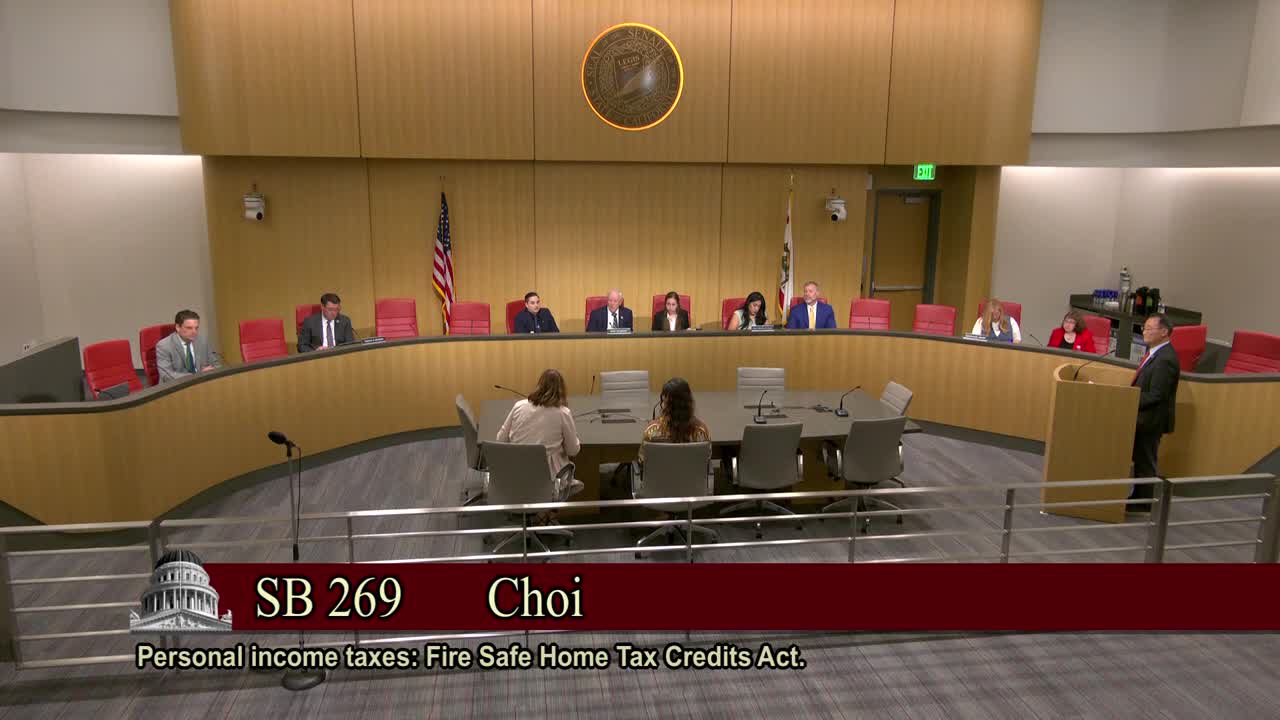 7MIN
Senate Standing Committee on Revenue and Taxation
Bill Author