SB 539: School facilities.
- Session Year: 2025-2026
- House: Senate
- Latest Version Date: 2025-04-10
Current Status:
Failed
(2026-02-02: Returned to Secretary of Senate pursuant to Joint Rule 56.)
Introduced
In Committee
Awaiting First Chamber Vote
Passed First Chamber
In Committee
Awaiting Second Chamber Vote
Passed Second Chamber
Enacted
(1)The Leroy F. Greene School Facilities Act of 1998 provides for the adoption of rules, regulations, and procedures, under the administration of the Director of General Services, for the allocation of state funds by the State Allocation Board for the construction and modernization of public school facilities. The act permits a school district to apply for hardship assistance in cases of extraordinary circumstances. The act requires, for health and safety projects for school facilities that are determined by the Department of General Services to pose an unacceptable risk of injury to occupants in the event of a seismic event, a school district to demonstrate that certain conditions are satisfied, including that the school facilities are needed to ensure the health and safety of pupils if the health and safety of pupils is at risk.
This bill would apply the above-described provisions to health and safety projects for school facilities that are determined by the Department of General Services to pose an unacceptable risk of injury to occupants in the event of a wildfire, flood, or other state of emergency proclaimed by the Governor, and would specify that the above-described condition includes ending the disruption to the delivery of educational services due to damage to, or destruction of, school facilities. The bill, for projects approved under these provisions, would authorize a school district to employ design sequencing methods to allow for any project delivery method authorized under existing law to support concurrent coordination and approval by the State Department of Education, the State Architect, and the State Allocation Board for expedited permitting, approval, and construction processes, and would authorize those state agencies to use machine learning to automate nondiscretionary aspects of those processes. The bill would also authorize a school district to use machine learning to prepare documents and materials for the permitting process for these projects.
(2)Existing law requires the State Department of Education to take specified actions relating to the construction of school facilities, including to establish standards for use by school districts to ensure that the design and construction of school facilities are educationally appropriate and promote school safety.
This bill would require the department, the Division of the State Architect, the Office of Public School Construction, and the State Allocation Board, beginning July 1, 2026, and every 5 years thereafter, to engage the Government Operations Agency to collaboratively review the processes relating to school design and construction to identify short-term, intermediate, and long-term improvements that can be made to those processes. The bill would require those entities, on or before December 1, 2026, and every 5 years thereafter, to submit a report to the appropriate fiscal and policy committees of the Legislature that identifies process changes to streamline how local educational agencies receive the approval required for school construction and secure state funding. The bill would require the report required on or before December 1, 2026, to also address specified priorities, including, among other things, implementation of specific timeframes for the Division of the State Architect to review submitted proposals and the development of an alternative project delivery method specific to the need to expedite school reconstruction and repair in the aftermath of an emergency.
(1)The Leroy F. Greene School Facilities Act of 1998 provides for the adoption of rules, regulations, and procedures, under the administration of the Director of General Services, for the allocation of state funds by the State Allocation Board for the construction and modernization of public school facilities. The act permits a school district to apply for hardship assistance in cases of extraordinary circumstances. The act requires, for health and safety projects for school facilities that are determined by the Department of General Services to pose an unacceptable risk of injury to occupants in the event of a seismic event, a school district to demonstrate that certain conditions are satisfied, including that the school facilities are needed to ensure the health and safety of pupils if the health and safety of pupils is at risk.
This bill would apply the above-described provisions to health and safety projects for school facilities that are determined by the Department of General Services to pose an unacceptable risk of injury to occupants in the event of a wildfire, flood, or other state of emergency proclaimed by the Governor, and would specify that the above-described condition includes ending the disruption to the delivery of educational services due to damage to, or destruction of, school facilities. The bill, for projects approved under these provisions, would authorize a school district to employ design sequencing methods to allow for concurrent coordination and approval by the State Department of Education, the State Architect, and the State Allocation Board for expedited permitting, approval, and construction processes, and would authorize those state agencies to use machine learning to automate nondiscretionary aspects of those processes. The bill would also authorize a school district to use machine learning to prepare documents and materials for the permitting process for these projects.
(2)Existing law requires the State Department of Education to take specified actions relating to the construction of school facilities, including to establish standards for use by school districts to ensure that the design and construction of school facilities are educationally appropriate and promote school safety.
This bill would require the department, the Division of the State Architect, the Office of Public School Construction, and the State Allocation Board, beginning July 1, 2026, and every 5 years thereafter, to engage the Government Operations Agency to collaboratively review the processes relating to school design and construction to identify short-term, intermediate, and long-term improvements that can be made to those processes. The bill would require those entities, on or before December 1, 2026, and every 5 years thereafter, to submit a report to the appropriate fiscal and policy committees of the Legislature that identifies process changes to streamline how local educational agencies receive the approval required for school construction and secure state funding. The bill would require the report required on or before December 1, 2026, to also address specified priorities, including, among other things, implementation of specific timeframes for the Division of the State Architect to review submitted proposals and the development of an alternative project delivery method specific to the need to expedite school reconstruction and repair in the aftermath of an emergency.
The Leroy F. Greene School Facilities Act of 1998 provides for the adoption of rules, regulations, and procedures, under the administration of the Director of General Services, for the allocation of state funds by the State Allocation Board for the construction and modernization of public school facilities. The act permits a school district to apply for hardship assistance in cases of extraordinary circumstances. The act requires, for health and safety projects for school facilities that are determined by the Department of General Services to pose an unacceptable risk of injury to occupants in the event of a seismic event, a school district to demonstrate that certain conditions are satisfied, including that the school facilities are needed to ensure the health and safety of pupils if the health and safety of pupils is at risk.
This bill would apply the above-described provisions to health and safety projects for school facilities that are determined by the Department of General Services to pose an unacceptable risk of injury to occupants in the event of a wildfire, flood, or other state of emergency proclaimed by the Governor, and would specify that the above-described condition includes ending the disruption to the delivery of educational services due to damage to, or destruction of, school facilities. The bill, for projects approved under these provisions, would authorize a school district to employ design sequencing methods to allow for concurrent coordination and approval by the State Department of Education, the State Architect, and the State Allocation Board for expedited permitting, approval, and construction processes, and would authorize those state agencies to use machine learning to automate nondiscretionary aspects of those processes. The bill would also authorize a school district to use machine learning to prepare documents and materials for the permitting process for these projects.
(a)(1)For health and safety projects for school facilities that are determined by the department to pose an unacceptable risk of injury to occupants in the event of a seismic event, wildfire, flood, or other state of emergency proclaimed by the Governor, a school district shall demonstrate both of the following to the satisfaction of the board:
(A)That due to unusual circumstances that are beyond the control of the school district, excessive costs need to be incurred in the construction of school facilities.
(B)That the facilities are needed to ensure the health and safety of pupils if the health and safety of pupils is at risk, including to end the disruption to the delivery of educational services due to damage to, or destruction of, school facilities.
(2)For purposes of paragraph (1), health and safety projects include projects to replace the most vulnerable school facilities that are identified as a Category 2 building, as defined in the report submitted pursuant to Section 17317.
(b)(1)A school district is eligible for health and safety funding to replace, reconstruct, or construct new classrooms and related facilities if the school district demonstrates there is a threat to the health and safety of pupils. To determine the applicable grant amounts, the district shall prepare and submit to the department a cost-benefit analysis that compares the minimum cost to remain in the classroom or related facility and mitigate the health and safety problem with the current replacement cost.
(2)The project qualifies for modernization funding if the minimum cost is less than 50 percent of the current replacement cost of the classroom or related facility.
(3)The project qualifies for replacement facilities if the cost-benefit analysis prepared pursuant to paragraph (1) demonstrates that the cost to remain in the classroom or related facility and mitigate the problem is at least 50 percent of the replacement value.
(c)Notwithstanding any other law, for For health and safety projects for school facilities under this section, a school district may employ design sequencing methods to allow for any project delivery method authorized under existing law to support concurrent coordination and approval by the State Department of Education, the State Architect, and the State Allocation Board for expedited permitting, approval, and construction processes, and those state agencies may use machine learning to automate nondiscretionary aspects of those processes. A school district may also use machine learning to prepare documents and materials required for the permitting process.
(d)The department shall develop regulations to define eligible health and safety projects that meet the requirements of subdivisions (a) and (b) for purposes of project approval by the board.
(e)For purposes of this section, design sequencing means a method of project delivery that enables the sequencing of design activities to permit each construction phase to commence when the design for that phase is complete, instead of requiring the design for the entire project to be completed before commencing construction.SEC. 2.Section 17254 is added to the Education Code, to read:17254.The department, the Division of the State Architect, the Office of Public School Construction, and the State Allocation Board shall do both of the following:
(a)Beginning July 1, 2026, and every five years thereafter, engage the Government Operations Agency to collaboratively review the processes relating to school design and construction to identify short-term, intermediate, and long-term improvements that can be made to those processes. The process review shall include collaboratively soliciting qualitative feedback from local educational agencies and school construction experts.
(b)(1)Notwithstanding Section 10231.5 of the Government Code, on or before December 1, 2026, and every five years thereafter, submit a report to the appropriate fiscal and policy committees of the Legislature, in compliance with Section 9795 of the Government Code, that identifies process changes to streamline how local educational agencies receive the approval required for school construction, including the requirements of the Division of the State Architect, and secure state funding, including from the state bond funds made available pursuant to the Leroy F. Greene School Facilities Act of 1998 (Chapter 12.5 (commencing with Section 17070.10) of Part 10).
(2)The report required on or before December 1, 2026, shall also address all of the following priorities:
(A)Implementation of specific timeframes for the Division of the State Architect to review submitted proposals.
(B)Development of an alternative project delivery method specific to the need to expedite school reconstruction and repair in the aftermath of an emergency.
(C)Development of an alternate project delivery method that incorporates process changes identified in the most recent process review described in subdivision (a) and innovations in design, construction, and financial management, such as progressive design-build, design sequencing, or incremental plan review principles, as appropriate.
(D)Development of legislative proposals needed to allow innovations in design, construction, and financial management to become legal pathways to facilitating school facilities construction.
(E)Alternatives to current practices that unintentionally disadvantage local educational agencies, such as preferences given on a first-come-first-served basis.
(3)It is the intent of the Legislature that the appropriate fiscal and policy committees of the Legislature determine the priorities to be addressed by reports required after December 1, 2026.
(c)For purposes of this section, design sequencing means a method of project delivery that enables the sequencing of design activities to permit each construction phase to commence when the design for that phase is complete, instead of requiring the design for the entire project to be completed before commencing construction.
(a)(1)For health and safety projects for school facilities that are determined by the department to pose an unacceptable risk of injury to occupants in the event of a seismic event, wildfire, flood, or other state of emergency proclaimed by the Governor, a school district shall demonstrate both of the following to the satisfaction of the board:
(A)That due to unusual circumstances that are beyond the control of the school district, excessive costs need to be incurred in the construction of school facilities.
(B)That the facilities are needed to ensure the health and safety of pupils if the health and safety of pupils is at risk, including to end the disruption to the delivery of educational services due to damage to, or destruction of, school facilities.
(2)For purposes of paragraph (1), health and safety projects include projects to replace the most vulnerable school facilities that are identified as a Category 2 building, as defined in the report submitted pursuant to Section 17317.
(b)(1)A school district is eligible for health and safety funding to replace, reconstruct, or construct new classrooms and related facilities if the school district demonstrates there is a threat to the health and safety of pupils. To determine the applicable grant amounts, the district shall prepare and submit to the department a cost-benefit analysis that compares the minimum cost to remain in the classroom or related facility and mitigate the health and safety problem with the current replacement cost.
(2)The project qualifies for modernization funding if the minimum cost is less than 50 percent of the current replacement cost of the classroom or related facility.
(3)The project qualifies for replacement facilities if the cost-benefit analysis prepared pursuant to paragraph (1) demonstrates that the cost to remain in the classroom or related facility and mitigate the problem is at least 50 percent of the replacement value.
(c)Notwithstanding any other law, for health and safety projects for school facilities under this section, a school district may employ design sequencing methods to allow for concurrent coordination and approval by the State Department of Education, the State Architect, and the State Allocation Board for expedited permitting, approval, and construction processes, and those state agencies may use machine learning to automate nondiscretionary aspects of those processes. A school district may also use machine learning to prepare documents and materials required for the permitting process.
(d)The department shall develop regulations to define eligible health and safety projects that meet the requirements of subdivisions (a) and (b) for purposes of project approval by the board.
(e)For purposes of this section, design sequencing means a method of project delivery that enables the sequencing of design activities to permit each construction phase to commence when the design for that phase is complete, instead of requiring the design for the entire project to be completed before commencing construction.
SEC. 2.Section 17254 is added to the Education Code, to read:17254.The department, the Division of the State Architect, the Office of Public School Construction, and the State Allocation Board shall do both of the following:
(a)Beginning July 1, 2026, and every five years thereafter, engage the Government Operations Agency to collaboratively review the processes relating to school design and construction to identify short-term, intermediate, and long-term improvements that can be made to those processes. The process review shall include collaboratively soliciting qualitative feedback from local educational agencies and school construction experts.
(b)(1)Notwithstanding Section 10231.5 of the Government Code, on or before December 1, 2026, and every five years thereafter, submit a report to the appropriate fiscal and policy committees of the Legislature, in compliance with Section 9795 of the Government Code, that identifies process changes to streamline how local educational agencies receive the approval required for school construction, including the requirements of the Division of the State Architect, and secure state funding, including from the state bond funds made available pursuant to the Leroy F. Greene School Facilities Act of 1998 (Chapter 12.5 (commencing with Section 17070.10) of Part 10).
(2)The report required on or before December 1, 2026, shall also address all of the following priorities:
(A)Implementation of specific timeframes for the Division of the State Architect to review submitted proposals.
(B)Development of an alternative project delivery method specific to the need to expedite school reconstruction and repair in the aftermath of an emergency.
(C)Development of an alternate project delivery method that incorporates process changes identified in the most recent process review described in subdivision (a) and innovations in design, construction, and financial management, such as progressive design-build, design sequencing, or incremental plan review principles, as appropriate.
(D)Development of legislative proposals needed to allow innovations in design, construction, and financial management to become legal pathways to facilitating school facilities construction.
(E)Alternatives to current practices that unintentionally disadvantage local educational agencies, such as preferences given on a first-come-first-served basis.
(3)It is the intent of the Legislature that the appropriate fiscal and policy committees of the Legislature determine the priorities to be addressed by reports required after December 1, 2026.
(a)(1)For health and safety projects for school facilities that are determined by the department to pose an unacceptable risk of injury to occupants in the event of a seismic event, wildfire, flood, or other state of emergency proclaimed by the Governor, a school district shall demonstrate both of the following to the satisfaction of the board:
(A)That due to unusual circumstances that are beyond the control of the school district, excessive costs need to be incurred in the construction of school facilities.
(B)That the facilities are needed to ensure the health and safety of pupils if the health and safety of pupils is at risk. risk, including to end the disruption to the delivery of educational services due to damage to, or destruction of, school facilities.
(2)For purposes of paragraph (1), health and safety projects include projects to replace the most vulnerable school facilities that are identified as a Category 2 building, as defined in the report submitted pursuant to Section 17317.
(b)(1)A school district is eligible for health and safety funding to replace, reconstruct, or construct new classrooms and related facilities if the school district demonstrates there is a threat to the health and safety of pupils. To determine the applicable grant amounts, the district shall prepare and submit to the department a cost-benefit analysis that compares the minimum cost to remain in the classroom or related facility and mitigate the health and safety problem with the current replacement cost.
(2)The project qualifies for modernization funding if the minimum cost is less than 50 percent of the current replacement cost of the classroom or related facility.
(3)The project qualifies for replacement facilities if the cost-benefit analysis prepared pursuant to paragraph (1) demonstrates that the cost to remain in the classroom or related facility and mitigate the problem is at least 50 percent of the replacement value.
(c)Notwithstanding any other law, for health and safety projects for school facilities under this section, a school district may employ design sequencing methods to allow for concurrent coordination and approval by the State Department of Education, the State Architect, and the State Allocation Board for expedited permitting, approval, and construction processes, and those state agencies may use machine learning to automate nondiscretionary aspects of those processes. A school district may also use machine learning to prepare documents and materials required for the permitting process.
(c)(d)The department shall develop regulations to define eligible health and safety projects that meet the requirements of subdivisions (a) and (b) for purposes of project approval by the board.
(e)For purposes of this section, design sequencing means a method of project delivery that enables the sequencing of design activities to permit each construction phase to commence when the design for that phase is complete, instead of requiring the design for the entire project to be completed before commencing construction.
|
Date
|
Status
|
|---|---|
| Feb 2, 2026 | Returned to Secretary of Senate pursuant to Joint Rule 56. |
| May 23, 2025 | May 23 hearing: Held in committee and under submission. |
| May 16, 2025 | Set for hearing May 23. |
| Apr 28, 2025 | April 28 hearing: Placed on APPR. suspense file. |
| Apr 17, 2025 | Set for hearing April 28. |
| Apr 10, 2025 | Read second time and amended. Re-referred to Com. on APPR. |
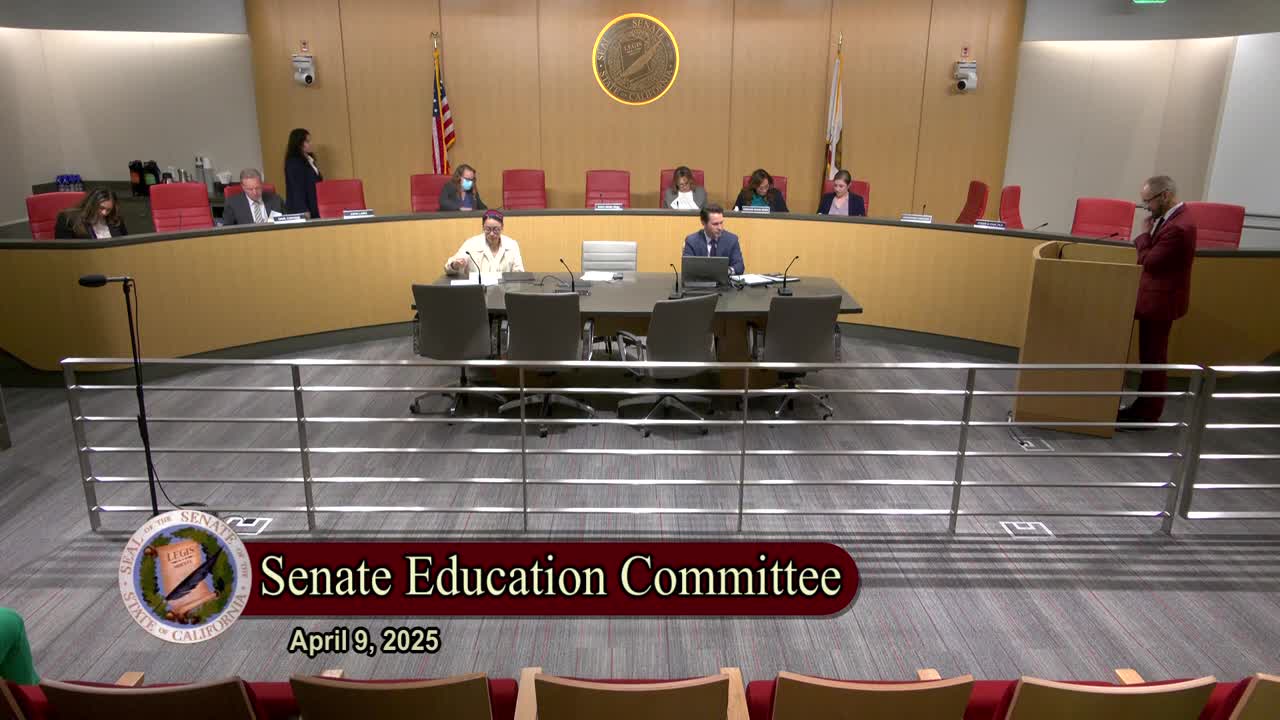
| Apr 9, 2025 | From committee: Do pass as amended and re-refer to Com. on APPR. (Ayes 7. Noes 0. Page 735.) (April 9). |
| Mar 28, 2025 | Set for hearing April 9. |
| Mar 27, 2025 | From committee with author's amendments. Read second time and amended. Re-referred to Com. on ED. |
| Mar 13, 2025 | March 26 set for first hearing canceled at the request of author. |
| Mar 11, 2025 | Set for hearing March 26. |
| Mar 5, 2025 | Referred to Com. on ED. |
| Feb 21, 2025 | From printer. May be acted upon on or after March 23. |
| Feb 20, 2025 | Introduced. Read first time. To Com. on RLS. for assignment. To print. |
|
Date
|
Description
|
Location
|
Votes
|
|
|---|---|---|---|---|
| Apr 28, 2025 | Placed on suspense file | Senate Standing Committee on Appropriations |
Passed |
|
| Apr 9, 2025 | Do pass as amended, but first amend, and re-refer to the Committee on [Appropriations] | Senate Standing Committee on Education |
Passed |
This list shows positions taken on this bill by organizations on the date displayed, which is linked to the original source.
Positions by individuals are not included.
SENATE COMMITTEE ON APPROPRIATIONS
Senator Anna Caballero, Chair
2025 - 2026 Regular Session
SB 539 (Cabaldon) - School facilities
Version: April 10, 2025 | Policy Vote: ED. 7 - 0 |
Urgency: No | Mandate: No |
Hearing Date: April 28, 2025 | Consultant: Lenin Del Castillo |
Bill Summary:
This bill expands eligibility for Facility Hardship funding within the School Facility Program (SFP) to include health and safety risks from wildfires, floods, and other declared emergencies. This bill also authorizes the use of existing project delivery methods to streamline project coordination and approvals, requires the periodic review of school construction processes to identify improvements, including the use of design sequencing.
Fiscal Impact:
- The Department of General Services estimates additional costs of approximately $905,000 every 5 years, starting in 2026, to review processes and submit the required report. Of this amount, $384,000 would be for the Office of Public School Construction (OPSC) and the remaining $521,000 for the Division of the State Architect (DSA). The DGS indicates that to the extent that the bill’s recurring process reviews and legislative reports result in changes to the School Facility Program, it may create indirect cost pressures related to regulatory development and implementation of program changes. (General obligation bond funds)
- To the extent that the DSA elects to use machine learning to automate nondiscretionary aspects of the permitting, approval, and construction processes, the DGS indicates that it would necessitate a substantial investment in technology, personnel, and infrastructure resulting in initial costs of $3 million to $8 million, with annual maintenance costs of about $1 million. (General obligation bond funds or fees)
- While the bill proposes to include health and safety risks from wildfires, floods, and other emergencies as part of Facility Hardship, the State Allocation Board (SAB) currently has the authority to provide interim housing and expedited reconstruction funding to school districts impacted by Governor-declared emergencies. Therefore, it is unclear if the bill would expand the number of projects eligible for Facility Hardship funding and create additional cost pressure on existing and future general obligation bond funds provided for the SFP.
Background:
Existing law establishes the SFP which administers state and local bond funds for K-12 public school construction and modernization. The program provides state matching funds to school districts through various grant programs, including New Construction, Modernization, Facility Hardship, Seismic Mitigation, Charter School Facilities, and Career Technical Education. The SFP is administered by the Office of Public School Construction (OPSC) under the direction of the State Allocation Board (SAB). Projects must be approved by the Division of the State Architect (DSA) for structural safety and accessibility and by the California Department of Education (CDE) for educational adequacy. School districts must establish eligibility before applying and follow a multi-step process, including approvals, funding apportionment, and fund release.
Facility Hardship grants are available when school facilities present an imminent threat to the health and safety of students and staff. These grants may support rehabilitation or replacement of facilities due to structural deficiencies, environmental hazards, or damage from natural disasters.
Proposed Law:
This bill expands eligibility for Facility Hardship funding under the SFP to include health and safety risks caused by wildfires, floods, and other state of emergencies proclaimed by the Governor. It specifies that a risk to pupil health and safety includes the disruption of educational services due to facility damage or destruction.
This bill authorizes school districts to employ any project delivery method authorized under existing law to support concurrent coordination and approval for expedited permitting, approval, and construction processes, as specified. This bill also allows CDE, DSA, and SAB to use machine learning to automate nondiscretionary elements of the permitting and approval process for these projects. Further, the bill allows a school district to use machine learning to prepare documents and materials required for the permitting process.
This bill requires the Department of General Services (DGS), DSA, OPSC, and SAB, in coordination with the Government Operations Agency, to conduct a school construction process review every five years beginning July 1, 2026. It also requires a report to the Legislature by December 1, 2026, and every five years thereafter, with findings, recommendations for process improvements, and proposals for alternative project delivery methods, as specified. For purposes of this section, the bill defines “design sequencing” to mean a method of project delivery that enables the sequencing of design activities to permit each construction phase to commence when the design for that phase is complete, instead of requiring the design for the entire project to be completed before commencing construction.
Related Legislation:
AB 247 (Muratsuchi, Chapter 81, Statutes of 2024) placed Proposition 2 on the General Election ballot for November 5, 2024. It was approved by voters and provided $8.5 billion in new bond authority for K-12 school construction and modernization. Proposition 2 also includes a revised state-local match formula, new supplemental grants, expanded disaster recovery authority, and increased access for small and high-need districts. According to the OPSC, as of the April 2025 meeting of the SAB, $8.02 billion remains in bond authority from Proposition 2.
Staff Comments:
This bill requires DGS, DSA, and the OPSC to undergo a process review and work collaboratively to streamline school planning and design and help school districts address their facility needs. Following the January 2025 wildfires in Southern California which destroyed or severely damaged eight school sites in Los Angeles and Pasadena, the author seeks to expedite the rebuilding process in disaster-affected communities. As part of this recurring process review, key stakeholders could explore new methods for improving delivery and permitting systems, including the design sequencing method which allows phased construction to begin once a portion of a project’s design is complete.
The Department of General Services estimates workload costs of approximately $905,000 every 5 years, starting in 2026, to review processes and submit the required report. Of this amount, $384,000 would be for the OPSC and the remaining $521,000 for the DSA. DSA’s fiscal impact assumes 10 staff members (architects, engineers, managers) each dedicating 100 hours annually to coordinate with government partners and to solicit qualitative feedback from LEAs and experts as well as organizing and facilitating workshops or surveys for about 100 LEAs and 20 experts. It also includes collecting data on DSA review times and project delivery innovations, including external consultant support for legislative proposals, and assumes 5 staff members spending approximately 200 hours to draft, analyze and finalize the report covering timeframes, delivery methods, legislative proposals, and LEA disadvantages. The OPSC’s fiscal impact includes working with the California Department of Education and Government Operations Agency to collaboratively review the processes relating to school design and construction to identify improvements, to solicit qualitative feedback from local educational agencies and school construction experts, and to draft the new legislative report.
-- END --
SENATE COMMITTEE ON EDUCATION
Senator Sasha Renée Pérez, Chair
2025 - 2026 Regular
Bill No: Hearing Date: April 9, 2025
Author: | Cabaldon | ||
Version: |
| ||
Urgency: | Fiscal: | ||
Consultant: | |||
Subject:
SUMMARY
This bill expands eligibility for Facility Hardship funding within the state’s School Facility Program (SFP) to include health and safety risks from wildfires, floods, and other declared emergencies. Further, the bill authorizes the use of design sequencing and machine learning to streamline project approval and delivery and requires periodic reviews of the school construction process to identify possible improvements.
BACKGROUND
The SFP, established by the Leroy F. Greene School Facilities Act of 1998, is California’s primary vehicle for funding K-12 public school construction and modernization. The SFP provides state matching funds to school districts through various grant programs, including New Construction, Modernization, Facility Hardship, Seismic Mitigation, Charter School Facilities, and Career Technical Education.
The SFP is administered by the Office of Public School Construction (OPSC) under the direction of the State Allocation Board (SAB). Projects must be approved by the Division of the State Architect (DSA) for structural safety and accessibility and by the California Department of Education (CDE) for educational adequacy. School districts must establish eligibility before applying and follow a multi-step process, including approvals, funding apportionment, and fund release.
Facility Hardship grants are available when school facilities present an imminent threat to the health and safety of students and staff. These grants may support rehabilitation or replacement of facilities due to structural deficiencies, environmental hazards, or damage from natural disasters.
In 2024, the Legislature passed AB 247 (Muratsuchi, Chapter 81, Statutes of 2024), placing Proposition 2 on the ballot. Approved by voters in November 2024, Proposition 2 provided $8.5 billion in new bond authority for school construction and modernization and introduced policy changes to the SFP. These include a revised state-local match formula, new supplemental grants, expanded disaster recovery authority, and increased access for small and high-need districts.
ANALYSIS
This bill:
- Expands eligibility for Facility Hardship funding under the SFP to include health and safety risks caused by wildfires, floods, and other Governor-declared emergencies.
- Specifies that a risk to pupil health and safety includes the disruption of educational services due to facility damage or destruction.
- Authorizes school districts to use design sequencing for Facility Hardship projects to allow for concurrent coordination and state approvals for expedited permitting, approval, and construction processes.
- Allows CDE, DSA, and SAB to use machine learning to automate nondiscretionary elements of the permitting and approval process for these projects. Also authorizes school districts to use machine learning to prepare project documentation.
- Defines “design sequencing” to mean a method of project delivery that enables the sequencing of design activities to permit each construction phase to commence when the design for that phase is complete, instead of requiring the design for the entire project to be completed before commencing construction.
- Requires the Department of General Services (DGS), DSA, OPSC, and SAB, in coordination with the Government Operations Agency, to conduct a school construction process review every five years beginning July 1, 2026.
- Requires a report to the Legislature by December 1, 2026, and every five years thereafter, with findings, recommendations for process improvements, and proposals for alternative project delivery methods.
STAFF COMMENTS
- Need for the bill. According to the author, “When we ask working Californians to send their students to leaking portable structures, or ask our neighbors recovering from wildfires to reestablish their lives without the stability of school for their children—we fail in the delivery and promise of government.
“Beginning 2026 and each five years after, SB 539 requires the California Department of Education (CDE) and the California Department of General Services’ (DGS) Division of the State Architect (DSA) and the Office of Public School Construction (OPSC) to undergo a process review and work collaboratively to streamline school planning, design, and the availability of state funding to help Local Educational Agencies address their facility need. Working with the Government Operation Agency, they will unleash new technology and borrow from innovations in design, construction, and financial management to build schools faster and more affordably.
“After the passage of Proposition 51, the Legislature approved Assembly Bill 203 (Chaptered by Secretary of State - Chapter 837, Statutes of 2017), which enacted a feasibility study regarding the restructure of the funding application process to remove duplicative information submittals and address frustration over how long it took to receive state agency approvals. When voters approved Proposition 2, the 2024 school facilities construction bond, they again trusted the Legislature to use bond dollars appropriately. Through consistent, data-driven, and proactive oversight—the Legislature can assess school construction timelines and ensure efficient, affordable school construction.”
- The School Facility Program: State-Local Partnership with Shared Responsibilities. The SFP is a long-standing state-local funding partnership for school construction and modernization. It provides matching grants to local educational agencies (LEAs) and requires collaboration across multiple state entities—OPSC, DSA, and CDE—to ensure that projects meet structural safety, educational quality, and funding accountability standards. LEAs retain responsibility for planning, financing, and managing construction projects, while the state provides regulatory oversight and bond-funded assistance.
While the program has enabled thousands of school improvements since 1998, it has also drawn criticism for being difficult to navigate—especially for small districts and those unfamiliar with state processes. This bill aims to address that concern, particularly in the context of emergency rebuilding, by exploring new tools and workflows that could streamline access to state funding and approvals.
- Proposition 2: Further Investment, Structural Reform, and an Equity-Focused Reset. In response to persistent funding shortages and structural barriers, the Legislature placed Proposition 2 on the November 2024 ballot through AB 247 (Muratsuchi, Chapter 81, Statutes of 2024). Approved by voters, the measure authorized $8.5 billion for K-12 school construction and modernization and introduced significant structural reforms to the SFP.
These include:
- A sliding scale matching formula, providing greater state funding to districts with lower bonding capacity, high-need student populations, or small enrollment;
- A requirement that districts submit a five-year facilities master plan and facilities inventory to qualify for new construction or modernization funds;
- New supplemental grants for transitional kindergarten classrooms, career technical education spaces, energy-efficient buildings, essential campus facilities, and the replacement of buildings over 75 years old;
- Expanded authority for the SAB to provide assistance to districts impacted by natural disasters, including interim housing and expedited rebuilding;
- A higher bonding capacity threshold for financial hardship eligibility, expanding access to 100% state funding for more districts.
These reforms are now in effect and actively shaping program implementation. OPSC, CDE, and DSA are working with stakeholders to develop associated regulations and procedures.
- Some Say the SFP Is Too Linear—But That Structure Exists for Good Reason. The SFP is often described as “linear” because many steps in the school construction process occur in sequence. While this structure can extend project timelines, much of it is by design and for good reason—intended to ensure safety, legal compliance, and responsible use of public funds.
Key reasons for sequential stages include:
- DSA structural and accessibility review must follow the completion of full architectural and engineering plans. Approving or constructing facilities before this review could jeopardize structural safety or violate state building codes.
- CDE’s review of site layout and educational adequacy must be based on complete, stable plans that reflect the district’s instructional priorities. If districts change designs midway through the process, those changes often necessitate additional state review.
- OPSC cannot apportion state bond funds until key documentation—such as plan approvals, eligibility certification, and cost estimates—is complete and verified.
- Compliance with the California Environmental Quality Act (CEQA) and other local governance steps, such as site selection, bond passage, board approvals, and more.
While CDE, DSA, and OPSC do coordinate where possible, efforts toward streamlined approvals are often constrained by the state’s responsibility to verify accurate and complete plans. These sequential steps are not necessarily signs of inefficiency, but intentional safeguards—designed to ensure projects are safe, equitable, and built to serve students well for decades.
- Proposition 2 Expanded Disaster Recovery Support—and Agencies Are Already Providing It. One of the most significant changes in Proposition 2 was the creation of a new disaster relief authority. It allows the SAB to provide interim housing and expedited reconstruction funding to districts affected by Governor-declared emergencies. This authority is already being exercised.
Following the January 2025 Southern California wildfires, which destroyed or severely damaged eight school sites in Los Angeles and Pasadena, the SAB voted to reserve its remaining $177.5 million in General Fund authority to support affected districts. OPSC has been working directly with these districts—including both traditional and charter school operators—to prepare Facility Hardship applications and provide technical assistance. In parallel, DSA allows LEAs to place interim facilities immediately following a disaster without prior approval, provided they notify DSA and follow up with the appropriate documentation. This flexibility enables districts to resume operations quickly while still ensuring that safety and accessibility requirements are addressed. Together, these efforts show that the existing framework already supports expedited response and meaningful flexibility in post-disaster situations.
- This Bill Seeks to Accelerate Emergency Rebuilding—But Design Sequencing Should Be Studied Before Being Fully Authorized.
This bill proposes a new approach for delivering Facility Hardship projects—those tied to imminent health and safety threats—by allowing phased construction to begin once a portion of a project’s design is complete, a method the bill refers to as “design sequencing.” It also authorizes both state agencies and school districts to use machine learning to automate nondiscretionary aspects of the permitting and approval process.
The goal of expediting rebuilding in disaster-affected communities has merit. However, reconstruction after a major event is rarely a straightforward replacement of facilities. Districts often use this opportunity to re-evaluate instructional needs, update site configurations, or redesign campuses entirely. This planning work—including community engagement and educational alignment—still takes time, even when state approvals are expedited.
Importantly, current law already provides school districts with meaningful flexibility in delivering projects. For example, DSA permits incremental plan review, which allows construction to begin on elements like grading or foundations before the full design is approved. In addition, school districts may already utilize alternative delivery methods such as design-build, lease-leaseback, construction manager at risk, and job order contracting. These methods are supported by more robust statutory frameworks and include key safeguards around safety, transparency, and accountability.
By contrast, “design sequencing” is a newly introduced term that has not yet been implemented within the SFP. As currently drafted, it is paired with a “notwithstanding any other law” clause—raising concerns about how it would interact with existing statutes and regulatory processes. Unlike other project delivery models currently in law, the design sequencing concept has not undergone the same level of policy development or stakeholder vetting.
Recognizing this, the bill includes a recurring school construction process review, beginning in 2026, to explore opportunities for improving delivery and permitting systems. Stakeholder input gathered during this review can help assess the viability, risks, and potential structure of design sequencing or other innovative approaches.
Therefore, staff recommends the following amendments to better align the bill’s implementation timeline with the intent of this review process:
- Strike the “notwithstanding any other law” clause in subdivision (c);
- Amend subdivision (c) to allow school districts to use any project delivery method allowable under existing law to support expedited permitting and approval;
- Strike the definition of “design sequencing” from the operative section of the bill; and
- Move the definition of “design sequencing” to the section of the bill establishing the school construction process review, to serve as a starting point for stakeholder discussion.
These changes maintain the bill’s focus on innovation and rebuilding flexibility, while ensuring that any new delivery method is developed with input from the agencies and stakeholders responsible for implementation.
- What Is the Purpose of This Review—and Is It Justified? This bill draws inspiration from AB 203 (O’Donnell, Chapter 837, Statutes of 2017), which required DGS to convene a working group to study California’s school construction approval process. The resulting report, published in 2019, identified areas for improvement, including better interagency coordination, more transparency in review timelines, and opportunities to expand project delivery options.
While this bill would build on that effort by requiring a recurring process review rather than a one-time report, the policy rationale for doing so could benefit from further clarification. Is the goal to accelerate approvals, improve interagency communication, enhance public accountability, or something else? And how would success be measured—by reduced timelines, increased project approvals, or better educational outcomes?
Since the passage of Proposition 2, OPSC has moved quickly to operationalize new components of the SFP—including expanded disaster assistance and the rollout of new modernization and hardship funding provisions. This has involved new technical assistance efforts, stakeholder outreach, and updates to SFP timelines and policies. These efforts suggest that agency responsiveness may not be the bottleneck, particularly in post-disaster scenarios.
As the bill moves forward, the author may wish to more clearly define the intended outcomes of this recurring review and consider whether additional statutory direction is needed to ensure it adds value beyond existing efforts.
SUPPORT
None received
OPPOSITION
None received
-- END --
Bill Author

Bill Co-Author(s):