SB 696: Sales and Use Tax Law: exemptions: firefighting equipment.
- Session Year: 2025-2026
- House: Senate
- Latest Version Date: 2025-05-08
Current Status:
Failed
(2026-02-02: Returned to Secretary of Senate pursuant to Joint Rule 56.)
Introduced
In Committee
Awaiting First Chamber Vote
Passed First Chamber
In Committee
Awaiting Second Chamber Vote
Passed Second Chamber
Enacted
Existing state sales and use tax laws impose a tax on retailers measured by the gross receipts from the sale of tangible personal property sold at retail in this state or on the storage, use, or other consumption in this state of tangible personal property purchased from a retailer for storage, use, or other consumption in this state. The Sales and Use Tax Law provides various exemptions from those taxes.
This bill, on and after July 1, 2026, and before January 1, 2031, would exempt from those taxes the gross receipts from the sale in this state of, and the storage, use, or other consumption in this state of, firefighting apparatus, equipment, or specialized vehicles, as defined, purchased by a fire department, including an all-volunteer fire department, as defined, or a fire protection district.
Existing law requires any bill authorizing a new tax expenditure to contain, among other things, specific goals that the tax expenditure will achieve, detailed performance indicators, and data collection requirements.
This bill also would include additional information required for any bill authorizing a new tax expenditure.
The Bradley-Burns Uniform Local Sales and Use Tax Law authorizes counties and cities to impose local sales and use taxes in conformity with the Sales and Use Tax Law, and existing laws authorize districts, as specified, to impose transactions and use taxes in accordance with the Transactions and Use Tax Law, which generally conforms to the Sales and Use Tax Law. Amendments to the Sales and Use Tax Law are automatically incorporated into the local tax laws.
This bill would provide that the exemption created by the bill does not apply to local sales and use taxes or transactions and use taxes.
Existing law imposes or dedicates certain state sales and use tax rates for local funding, including through the Local Revenue Fund 2011.
This bill would provide that the exemption created by the bill does not apply to those state sales and use tax rates imposed or dedicated for local government funding, including those rates for which revenues are deposited into the Local Revenue Fund 2011.
This bill would take effect immediately as a tax levy.
Existing state sales and use tax laws impose a tax on retailers measured by the gross receipts from the sale of tangible personal property sold at retail in this state or on the storage, use, or other consumption in this state of tangible personal property purchased from a retailer for storage, use, or other consumption in this state. The Sales and Use Tax Law provides various exemptions from those taxes.
This bill, on and after January July 1, 2026, and before January 1, 2031, would exempt from those taxes the gross receipts from the sale in this state of, and the storage, use, or other consumption in this state of, firefighting apparatus, equipment, or specialized vehicles purchased for use vehicles, as defined, purchased by a fire department, including an all-volunteer fire department, as defined, or a fire protection district.
Existing law requires any bill authorizing a new tax expenditure to contain, among other things, specific goals that the tax expenditure will achieve, detailed performance indicators, and data collection requirements.
This bill also would include additional information required for any bill authorizing a new tax expenditure.
The Bradley-Burns Uniform Local Sales and Use Tax Law authorizes counties and cities to impose local sales and use taxes in conformity with the Sales and Use Tax Law, and existing laws authorize districts, as specified, to impose transactions and use taxes in accordance with the Transactions and Use Tax Law, which generally conforms to the Sales and Use Tax Law. Amendments to the Sales and Use Tax Law are automatically incorporated into the local tax laws.
Existing law requires the state to reimburse counties and cities for revenue losses caused by the enactment of sales and use tax exemptions.This bill would provide that, notwithstanding Section 2230 of the Revenue and Taxation Code, no appropriation is made and the state shall not reimburse any local agencies for sales and use tax revenues lost by them pursuant to this bill.This bill would provide that the exemption created by the bill does not apply to local sales and use taxes or transactions and use taxes.
Existing law imposes or dedicates certain state sales and use tax rates for local funding, including through the Local Revenue Fund 2011.
This bill would provide that the exemption created by the bill does not apply to those state sales and use tax rates imposed or dedicated for local government funding, including those rates for which revenues are deposited into the Local Revenue Fund 2011.
This bill would take effect immediately as a tax levy.
Existing state sales and use tax laws impose a tax on retailers measured by the gross receipts from the sale of tangible personal property sold at retail in this state or on the storage, use, or other consumption in this state of tangible personal property purchased from a retailer for storage, use, or other consumption in this state. The Sales and Use Tax Law provides various exemptions from those taxes.
This bill, on and after January 1, 2026, and before January 1, 2031, would exempt from those taxes the gross receipts from the sale in this state of, and the storage, use, or other consumption in this state of, firefighting apparatus, equipment, or specialized vehicles purchased for use by a fire department, including an all-volunteer fire department, or a fire district.
Existing law requires any bill authorizing a new tax expenditure to contain, among other things, specific goals that the tax expenditure will achieve, detailed performance indicators, and data collection requirements.
This bill also would include additional information required for any bill authorizing a new tax expenditure.
The Bradley-Burns Uniform Local Sales and Use Tax Law authorizes counties and cities to impose local sales and use taxes in conformity with the Sales and Use Tax Law, and existing laws authorize districts, as specified, to impose transactions and use taxes in accordance with the Transactions and Use Tax Law, which generally conforms to the Sales and Use Tax Law. Amendments to the Sales and Use Tax Law are automatically incorporated into the local tax laws.
Existing law requires the state to reimburse counties and cities for revenue losses caused by the enactment of sales and use tax exemptions.
This bill would provide that, notwithstanding Section 2230 of the Revenue and Taxation Code, no appropriation is made and the state shall not reimburse any local agencies for sales and use tax revenues lost by them pursuant to this bill.
This bill would take effect immediately as a tax levy.
(a)On and after July 1, 2026, and before January 1, 2031, there are exempted from the taxes imposed by this part the gross receipts from the sale of, and the storage, use, or other consumption in this state of, firefighting apparatus, equipment, or specialized vehicles purchased by a fire department, including an all-volunteer fire department, or a fire protection district.
(b)For purposes of this section the following definitions apply:
(1)All-volunteer fire department has the same meaning as that term is defined in Section 6018.10.
(2)Firefighting apparatus, equipment, or specialized vehicles includes, but is not limited to, all of the following:
(A)Electronic and communication equipment, including radios, cellular telephones, laptops, and computers.
(B)Specialized vehicles, including command staff vehicles, vessels such as boats and swift water rafts, ladder trucks, fire engines, and trailers.
(C)Personal protective equipment, including self-contained breathing apparatuses, safety boots, and turnouts.
(D)Equipment for vehicles, including ladders, hoses, axes, defibrillators, medical supplies, rope rescue equipment, auto extrication equipment, chainsaws, ventilation fans, wildland firefighting tools, portable water tanks, portable pumps, and thermal imaging cameras.
(E)Tools, parts, and supplies used for maintaining the items listed above.
(3)(A)Fire department means any of the following:
(i)A fire department of a city, county, city and county, district, or other public or municipal corporation or political subdivision.
(ii)The Department of Forestry and Fire Protection. (iii)(ii)A county forestry or firefighting department or unit.
(B)Fire department does not include any fire department of the University of California, the California State University, or any other educational institution. the following:
(i)A fire department of the University of California, the California State University, or any other educational institution.
(ii)The Department of Forestry and Fire Protection.
(c)(1)Notwithstanding any provision of the Bradley-Burns Uniform Local Sales and Use Tax Law (Part 1.5 (commencing with Section 7200)) or the Transactions and Use Tax Law (Part 1.6 (commencing with Section 7251)), the exemption established by this section does not apply with respect to any tax levied by a county, city, or district pursuant to, or in accordance with, either of those laws.
(2)Notwithstanding subdivision (a), the exemption established by this section shall not apply with respect to any tax levied pursuant to Section 6051.2 or 6201.2, pursuant to Section 35 of Article XIII of the California Constitution, or any tax levied pursuant to Section 6051 or 6201 that is deposited in the State Treasury to the credit of the Local Revenue Fund 2011 pursuant to Section 6051.15 or 6201.15.
(d)An exemption shall not be allowed under this section unless the purchaser furnishes the retailer with an exemption certificate, completed in accordance with any instructions or regulations as the department may prescribe, and the retailer retains the exemption certificate in its records and furnishes it to the department upon request.
(e)(1)For the purposes of complying with Section 41, the Legislature finds and declares both of the following:
(A)The specific goal that the exemption will achieve is to reduce the financial burden placed on local fire departments, thereby allowing for more efficient use of resources by those departments.
(B)Detailed performance indicators for the Legislature to use to measure whether the exemption meets the goal described in subparagraph (A) are the following:
(i)The number of taxpayers exempting purchases from tax pursuant to this section.
(ii)The total dollar value of sales exempted from tax pursuant to this section.
(2)On or before April 1, 2028, and annually thereafter, the California Department of Tax and Fee Administration shall analyze the performance indicators in subparagraph (B) of paragraph (1) and shall submit a report of its findings to the Legislature in compliance with Section 9795 of the Government Code.
(f)This section shall remain operative only until January 1, 2031, and as of that date is repealed.
SEC. 2.This act provides for a tax levy within the meaning of Article IV of the California Constitution and shall go into immediate effect.
(a)On and after January July 1, 2026, and before January 1, 2031, there are exempted from the taxes imposed by this part the gross receipts from the sale of, and the storage, use, or other consumption in this state of, firefighting apparatus, equipment, or specialized vehicles purchased for use by a fire department, including an all-volunteer fire department, or a fire protection district.
(b)For purposes of this section the following definitions apply:
(1)All-volunteer fire department has the same meaning as that term is defined in Section 6018.10.
(2)Firefighting apparatus, equipment, or specialized vehicles includes, but is not limited to, all of the following:
(A)Electronic and communication equipment, including radios, cellular telephones, laptops, and computers.
(B)Specialized vehicles, including command staff vehicles, vessels such as boats and swift water rafts, ladder trucks, fire engines, and trailers.
(C)Personal protective equipment, including self-contained breathing apparatuses, safety boots, and turnouts.
(D)Equipment for vehicles, including ladders, hoses, axes, defibrillators, medical supplies, rope rescue equipment, auto extrication equipment, chainsaws, ventilation fans, wildland firefighting tools, portable water tanks, portable pumps, and thermal imaging cameras.
(E)Tools, parts, and supplies used for maintaining the items listed above.
(3)(A)Fire department means any of the following:
(i)A fire department of a city, county, city and county, district, or other public or municipal corporation or political subdivision.
(ii)The Department of Forestry and Fire Protection.
(iii)A county forestry or firefighting department or unit.
(B)Fire department does not include any fire department of the University of California, the California State University, or any other educational institution.
(c)(1)Notwithstanding any provision of the Bradley-Burns Uniform Local Sales and Use Tax Law (Part 1.5 (commencing with Section 7200)) or the Transactions and Use Tax Law (Part 1.6 (commencing with Section 7251)), the exemption established by this section does not apply with respect to any tax levied by a county, city, or district pursuant to, or in accordance with, either of those laws.
(2)Notwithstanding subdivision (a), the exemption established by this section shall not apply with respect to any tax levied pursuant to Section 6051.2 or 6201.2, pursuant to Section 35 of Article XIII of the California Constitution, or any tax levied pursuant to Section 6051 or 6201 that is deposited in the State Treasury to the credit of the Local Revenue Fund 2011 pursuant to Section 6051.15 or 6201.15.
(d)An exemption shall not be allowed under this section unless the purchaser furnishes the retailer with an exemption certificate, completed in accordance with any instructions or regulations as the department may prescribe, and the retailer retains the exemption certificate in its records and furnishes it to the department upon request.
(b)(e)(1)For the purposes of complying with Section 41, the Legislature finds and declares both of the following:
(A)The specific goal that the exemption will achieve is to reduce the financial burden placed on local fire departments, thereby allowing for more efficient use of resources by those departments.
(B)Detailed performance indicators for the Legislature to use to measure whether the exemption meets the goal described in subparagraph (A) are the following:
(i)The number of taxpayers exempting purchases from tax pursuant to this section.
(ii)The total dollar value of sales exempted from tax pursuant to this section.
(2)On or before April 1, 2027, 2028, and annually thereafter, the California Department of Tax and Fee Administration shall analyze the performance indicators in subparagraph (B) of paragraph (1) and shall submit a report of its findings to the Legislature in compliance with Section 9795 of the Government Code.
(c)(f)This section shall remain operative only until January 1, 2031, and as of that date is repealed.
SEC. 2.Notwithstanding Section 2230 of the Revenue and Taxation Code, no appropriation is made by this act and the state shall not reimburse any local agency for any sales and use tax revenues lost by it under this act.SEC. 3.SEC. 2.This act provides for a tax levy within the meaning of Article IV of the California Constitution and shall go into immediate effect.
(a)On and after January 1, 2026, and before January 1, 2031, there are exempted from the taxes imposed by this part the gross receipts from the sale of, and the storage, use, or other consumption in this state of, firefighting apparatus, equipment, or specialized vehicles purchased for use by a fire department, including an all-volunteer fire department, or a fire district.
(b)(1)For the purposes of complying with Section 41, the Legislature finds and declares both of the following:
(A)The specific goal that the exemption will achieve is to reduce the financial burden placed on local fire departments, thereby allowing for more efficient use of resources by those departments.
(B)Detailed performance indicators for the Legislature to use to measure whether the exemption meets the goal described in subparagraph (A) are the following:
(i)The number of taxpayers exempting purchases from tax pursuant to this section.
(ii)The total dollar value of sales exempted from tax pursuant to this section.
(2)On or before April 1, 2027, and annually thereafter, the California Department of Tax and Fee Administration shall analyze the performance indicators in subparagraph (B) of paragraph (1) and shall submit a report of its findings to the Legislature in compliance with Section 9795 of the Government Code.
(c)This section shall remain operative only until January 1, 2031, and as of that date is repealed.
SEC. 2.Notwithstanding Section 2230 of the Revenue and Taxation Code, no appropriation is made by this act and the state shall not reimburse any local agency for any sales and use tax revenues lost by it under this act.
SEC. 3.This act provides for a tax levy within the meaning of Article IV of the California Constitution and shall go into immediate effect.
|
Date
|
Status
|
|---|---|
| Feb 2, 2026 | Returned to Secretary of Senate pursuant to Joint Rule 56. |
| May 23, 2025 | May 23 hearing: Held in committee and under submission. |
| May 20, 2025 | Set for hearing May 23. |
| May 19, 2025 | May 19 hearing: Placed on APPR. suspense file. |
| May 15, 2025 | Set for hearing May 19. |
| May 14, 2025 | From committee: Do pass and re-refer to Com. on APPR. (Ayes 5. Noes 0. Page 1083.) (May 14). Re-referred to Com. on APPR. |
| May 8, 2025 | From committee with author's amendments. Read second time and amended. Re-referred to Com. on REV. & TAX. |
| May 6, 2025 | From committee with author's amendments. Read second time and amended. Re-referred to Com. on REV. & TAX. |
| Mar 18, 2025 | Set for hearing May 14. |
| Mar 5, 2025 | Referred to Com. on REV. & TAX. |
| Feb 24, 2025 | From printer. May be acted upon on or after March 24. |
| Feb 24, 2025 | Read first time. |
| Feb 21, 2025 | Introduced. To Com. on RLS. for assignment. To print. |
|
Date
|
Description
|
Location
|
Votes
|
|
|---|---|---|---|---|
| May 19, 2025 | Placed on suspense file | Senate Standing Committee on Appropriations |
Passed |
|
| May 14, 2025 | Do pass, but first be re-referred to the Committee on [Appropriations] | Senate Standing Committee on Revenue and Taxation |
Passed |
This list shows positions taken on this bill by organizations on the date displayed, which is linked to the original source.
Positions by individuals are not included.
|
Organization
|
Position
|
Date
|
|---|---|---|
| Burbank Paradise Fire Protection District | ** Support | |
| California Fire Chiefs Association | ** Support | |
| California Special Districts Association | ** Support | |
| California Teachers Association | ** Against | |
| Cameron Park Community Services District | ** Support | |
| El Dorado County Fire Chiefs Association | ** Support | |
| El Dorado County Fire Protection District | ** Support | |
| El Dorado County Professional Firefighters Association | ** Support | |
| Fallen Leaf Lake Community Services District Fire Department | ** Support | |
| Fire Districts Association Of California | ** Support | |
| Howard Jarvis Taxpayers Association | ** Support | |
| Hughson Fire Protection District | ** Support | |
| Keyes Fire Protection District | ** Support | |
| Lake Valley Fire Protection District | ** Support | |
| Lathrop Manteca Fire Protection District | ** Support | |
| Liberty Fire District | ** Support | |
| Mickey Kaiserman, Director, El Dorado County Fire Protection District | ** Support | |
| Paul Gilchrest, Director, El Dorado County Fire Protection District | ** Support | |
| Taxpayers Association of El Dorado County | ** Support | |
| Turlock Rural Fire Protection District | ** Support | |
| West Stanislaus County Fire Protection District | ** Support |
SENATE COMMITTEE ON
Senator Anna Caballero, Chair
2025 - 2026 Regular Session
SB 696 (Alvarado-Gil) - Sales and Use Tax Law: exemptions: firefighting equipment
Version: | Policy Vote: |
Urgency: | Mandate: |
Hearing Date: | Consultant: |
Bill Summary:
SB 696 would enact a state General Fund-only sales and use tax (SUT) exemption for firefighting apparatus, equipment, or specialized vehicles, as defined, purchased by a fire department, including an all-volunteer fire department, or a fire protection district, as specified.
Fiscal Impact:
The California Department of Tax and Fee Administration (CDTFA) estimates that this bill would result in a General Fund revenue loss of $21 million in 2026-27. CDTDF’s administrative costs would be minor and absorbable.
Background:
Tax expenditure programs (TEPs) are special tax provisions that reduce the amount of revenues the “basic” tax system would otherwise generate in order to provide (1) benefits to certain groups of taxpayers, and/or (2) incentives to encourage certain types of behavior and activities, such as charitable giving. Specifically, current law provides for, among other things, various income and corporation tax credits and deductions, as well as exemptions from the sales and use tax. The Department of Finance is required to publish a list of TEPs (currently totaling several hundred), which currently exceed $91 billion annually.
Except where a specific exemption or exclusion is provided, current law imposes SUT on all retailers for the privilege of selling tangible personal property (TPP) at retail in California, or on the storage, use, or other consumption in this state of TPP purchased from a retailer. Unless purchasers pay the sales tax to the retailer, they are liable for the use tax, which the law imposes on any person consuming tangible personal property in the state. The use tax is the same rate as the sales tax.
After CDTFA collects SUT revenue ($80 billion in 2022-23), it allocates the money to various state and local funds. Roughly half—collected from an approximately 3.9 percent rate—goes to the General Fund and can be spent on any state program, such as education, health care, and criminal justice. Another 1.25 percent, known as the Bradley-Burns rate, goes to cities and counties for general purposes. Three sales tax funds have uniform state rates and support specified programs—a 1.0625 percent rate for 2011 realignment (county-administered criminal justice, mental health, and social service programs); a 0.5 percent rate for 1991 realignment (county-administered health and social services programs); and a 0.5 percent rate for city and county public safety programs pursuant to Proposition 172 (1993). Additionally, some local governments levy optional local rates—known as Transactions and Use Taxes (TUTs)—and a small portion of these funds are used for general purposes. As of December 31, 2024, the average statewide SUT rate was 8.71 percent.
Many items, such as prescription drugs, food, and poultry litter, are fully exempt from the SUT in California. Other items are exempted only from the state sales tax of 3.9375%, but not the local share, such as farm equipment and machinery, diesel fuel used for farming and food processing, teleproduction and postproduction equipment, timber harvesting equipment and machinery, and racehorse breeding stock.
The California Department of Forestry and Fire Protection indicates that in 2024, there were 605,868 emergency responses, 8,024 wildfires, 1,050,012 acres burned, and 2,148 structures damaged or destroyed. In 2023, there were 595,075 emergency responses, 7,386 wildfires, 332,822 acres burned, and 179 structures damaged or destroyed. Through May 6, 2025, the current calendar year has seen 208,397 emergency responses, 1,083 wildfires, 61,205 acres burned, and 16,251 structures damaged or destroyed.
Proposed Law:
This bill would enact a state General Fund-only (3.9375 percent) SUT exemption for firefighting apparatus, equipment, or specialized vehicles, as defined, purchased by a fire department, including an all-volunteer fire department, or a fire protection district beginning July 1, 2026, and before January 1, 2031.
Related Legislation:
- AB 1121 (Rodriguez, 2021) would have exempted from SUT the sale or purchase of emergency preparation items, as defined, sold or purchased during a specified three-day period. This bill died in the Assembly Revenue and Taxation Committee.
- AB 1049 (Grayson, 2019) would have exempted from SUT the sale or purchase of equipment, as defined, purchased for exclusive use by an on-call volunteer fire department, as defined. This bill was held under submission on the Suspense File of the Assembly Appropriations Committee.
Staff Comments: Local government financial data from the California State Controller’s Office indicate that California cities, counties, and special districts spent $14.3 billion for fire protection in 2022-23. Department staff estimate that this figure will reach $15.5 billion in 2026-27. It is assumed that California local governments spend 3.5 percent of their total fire protection budget on purchases of firefighting apparatus, equipment, or specialized vehicles as defined in this bill.
-- END --
SENATE COMMITTEE ON REVENUE AND TAXATION
Senator Jerry McNerney, Chair
2025 - 2026 Regular
Bill No: | SB 696 | Hearing Date: | 5/14/25 |
Author: | Alvarado-Gil | Tax Levy: | Yes |
Version: | 5/8/25 Amended | Fiscal: | Yes |
Consultant: | Summers | ||
Sales and Use Tax Law: exemptions: firefighting equipment
Enacts a state General Fund-only (3.9375%) sales and use tax exemption for firefighting apparatus, equipment, or specialized vehicles, as defined, purchased by a fire department, including an all-volunteer fire department, or a fire protection district beginning July 1, 2026, and before January 1, 2031.
Background
Tax expenditures. California law allows various tax incentives, such as credits, deductions, exemptions, and exclusions. When a tax law is determined to have a cost in the form of foregone revenues, such as a sales and use tax exemption, state law refers to them as “tax expenditures.” The Legislature enacts such tax incentives to compensate taxpayers for incurring certain expenses, such as costs related to child adoption, or to influence certain behaviors, such as participating in charitable giving. The Legislature uses tax incentives to encourage taxpayers to do something they would not otherwise do but for the tax incentive. The Department of Finance must annually publish a list of tax expenditures, which currently totals around $91.5 billion.
Sales and use tax (SUT). State law imposes the sales tax on every retailer selling tangible personal property in this state. Retailers must register with the California Department of Tax and Fee Administration (CDTFA) and remit sales tax amounts collected at sale to CDTFA. If the purchaser does not pay the sales tax to the retailer, the purchaser is liable for paying use tax to the CDTFA. The use tax is imposed on any person consuming tangible personal property in the state. The use tax must be remitted on or before the last day of the month following the quarterly period in which the person made the purchase. The use tax rate is the same as the sales tax rate. The table below shows that the current statewide SUT rate is 7.25%. Additionally, cities and counties may increase the sales and use tax rate up to 2% with voter approval for specific or general purposes pursuant to the California Constitution’s vote requirements.
Rate | Jurisdiction | Purpose/Authority |
3.9375% | State (General Fund) | State general purposes. |
1.0625% | Local Revenue Fund (2011 Realignment) | Local governments to fund local public safety services. |
0.50% | State (1991 Realignment) | Local governments to fund health and welfare programs. |
0.50% | State (Proposition 172 - 1993) | Local governments to fund public safety services. |
Rate | Jurisdiction | Purpose/Authority |
1.25% | Local (City/County) 1.00% City and County 0.25% Local transportation | City and county general operations. Dedicated to county transportation purposes |
7.25% | Total Statewide Rate |
Tax exemptions. Many items, such as prescription drugs, food, and poultry litter, are fully exempt from the SUT in California. Other items are exempted only from the state sales tax of 3.9375%, but not the local share, such as farm equipment and machinery, diesel fuel used for farming and food processing, teleproduction and postproduction equipment, timber harvesting equipment and machinery, and racehorse breeding stock. Further, the United States government is exempt from paying the state SUT. However, state law does not provide a blanket exemption from the SUT for other public agencies like cities, counties, special districts, state agencies, transit agencies, or state departments. As a result, these public agencies generally pay the SUT when purchasing tangible personal property or using it in the state.
California Fires. Over the last decade, California has experienced increased, intense, and record-breaking wildfires. These fires have resulted in a devastating loss of life and billions of dollars in damage to property and infrastructure. According to the California Department of Forestry and Fire Protection (CAL FIRE), in 2024 alone, there were 605,868 emergency responses: 8,024 wildfires: 1,050,012 acres burned: 2,148 structures damaged or destroyed: and one fatality. In 2023, there were 595,075 emergency responses: 7,386 wildfires: 332,822 acres burned: 179 structures damaged or destroyed: and four fatalities. As of May 6, 2025, for the year 2025, there have already been 208,397 emergency responses: 1,083 wildfires: 61,205 acres burned: 16,251 structures damaged or destroyed: and 30 fatalities.
The author wants to reduce the financial burden placed on the local fire department by authorizing a SUT exemption for creation purchases made by fire departments.
Proposed Law
SB 696 enacts a state General Fund-only (3.9375%) sales and use tax exemption for firefighting apparatus, equipment, or specialized vehicles, as defined, purchased by a fire department, including an all-volunteer fire department, or a fire protection district beginning July 1, 2026, and before January 1, 2031. The bill makes legislative findings and declarations supporting its purposes, defines several terms, and complies with Section 41 of the Revenue and Taxation Code.
State Revenue Impact
According to the CDTFA, SB 696 will result in an estimated sales and use tax revenue loss of $21.4 million in fiscal year 2026-27.
Comments
- Purpose of the bill. According to the author, “The increase of wildfires in California significantly impacts the amount of fires that rural firefighters must respond to, and therefore the materials and resources that they must utilize in order to protect California homes and families. Necessary firefighting equipment including fire trucks, protective gear, and extinguishing tools are costly. California currently offers tax exemptions to certain government entities and non-profits for organizational use. SB 696 would allow fire departments, volunteer fire departments, and fire districts to claim a tax exemption on the sale, storage, use, and consumption of firefighting apparatus, equipment, and specialized vehicles purchased for use. The tax exemption would be imposed on or after January 1, 2026 and sunset in 2031.”
- “Windfall” or “but for” tax benefit? Tax expenditures produce two different outcomes. The first outcome is a “windfall,” where the tax expenditure rewards behavior that would have occurred without the tax benefit. The second outcome is a “but for tax benefit,” where a particular activity would not have occurred without the incentive created by the tax expenditure. Here, fire departments already purchase the equipment, apparatus, and specialize vehicles, and it is unclear whether or how many local fire departments who need new or additional equipment, apparatus, and specialize vehicles are forgoing these purchases due to the sales and use tax. As a result, SB 696 may be a “windfall” for some fire departments while serving as a “but for tax benefit” to others. The Committee may wish to consider the incentive effects of SB 696 given the possibility of a windfall for fire departments.
- Revenue loss. Existing tax law provides various credits, deductions, exclusions, and exemptions for certain taxpayers. By authorizing a full SUT exemption for firefighting equipment, SB 696 will result in the State General Fund receiving less revenue. As a result, the state will have to reduce spending or increase taxes to account for the loss.
- Precedent. Tangible personal property is generally taxable, regardless of the purpose for purchase. By exempting purchases of firefighting equipment, apparatus, and specialized vehicles from the State General Fund sales and use tax rate, this bill reduces costs incurred by fire departments necessary to provide a vital public service. Absent an exemption, sales tax applies to almost every purchase fire departments make, thereby generating revenue for the state General Fund. While the Legislature has enacted a similar exemption for zero-emission transit buses purchased by local agencies, this bill expands the precedent of subsidizing public service spending. The Committee may wish to consider whether the need to offset fire department costs incurred for equipment, apparatus, and specialized vehicles is more acute than costs incurred to provide other services. Additionally, if the Legislature allows a full SUT exemption for firefighting equipment, why should it not extend the same treatment to other emergency service professions? This may lead to a slippery slope where professional equipment is exempt from the SUT, thereby eroding the tax base.
- State, not local. In recent years, most new sales and use tax exemptions have been limited to the state share of the sales tax, such as equipment used in research and manufacturing, and equipment and fuel used in agriculture. SB 696 continues this trend by extending an existing exemption that only applies against the State General Fund portion of the Sales and Use Tax. As a result, the bill should not negatively affect local revenues.
- Section 41. Section 41 of the Revenue and Taxation Code requires any bill enacting a new tax expenditure to contain, among other things, specific goals, purposes, and objectives that the tax expenditure will achieve and detailed performance indicators, along with data collection and reporting requirements (SB 1335, Leno, 2014). To satisfy these requirements, SB 696 finds and declares that the goal is to reduce the financial burden placed on the local fire department. Detailed performance indicators are the number of taxpayers exempting purchases from tax pursuant to this section and the total dollar value of sales exempted from tax pursuant to this section.
To aid the Legislature in determining whether this act meets the goals, purposes, and objectives, SB 696 directs the CDTFA, to the extent feasible, to submit a report to the Legislature by April 1, 2028, and annually thereafter.
Support and Opposition
(5/9/25)
Support: El Dorado County Fire Protection District (Sponsor)
Mickey Kaiserman, Director, El Dorado County Fire Protection District
Paul Gilchrest, Director, El Dorado County Fire Protection District
Burbank Paradise Fire Protection District
California Fire Chiefs Association
California Special Districts Association
Cameron Park Community Services District
El Dorado County Fire Chiefs' Association
El Dorado County Professional Firefighters Association
Fallen Leaf Lake Community Services District Fire Department
Fire Districts Association of California
Howard Jarvis Taxpayers Association
Hughson Fire Protection District
Keyes Fire Protection District
Lake Valley Fire Protection District
Lathrop Manteca Fire Protection District
Liberty Fire District
Taxpayers Association of El Dorado County
Turlock Rural Fire Protection District
West Stanislaus County Fire Protection District
Opposition: California Teachers Association
-- END --
Discussed in Hearing
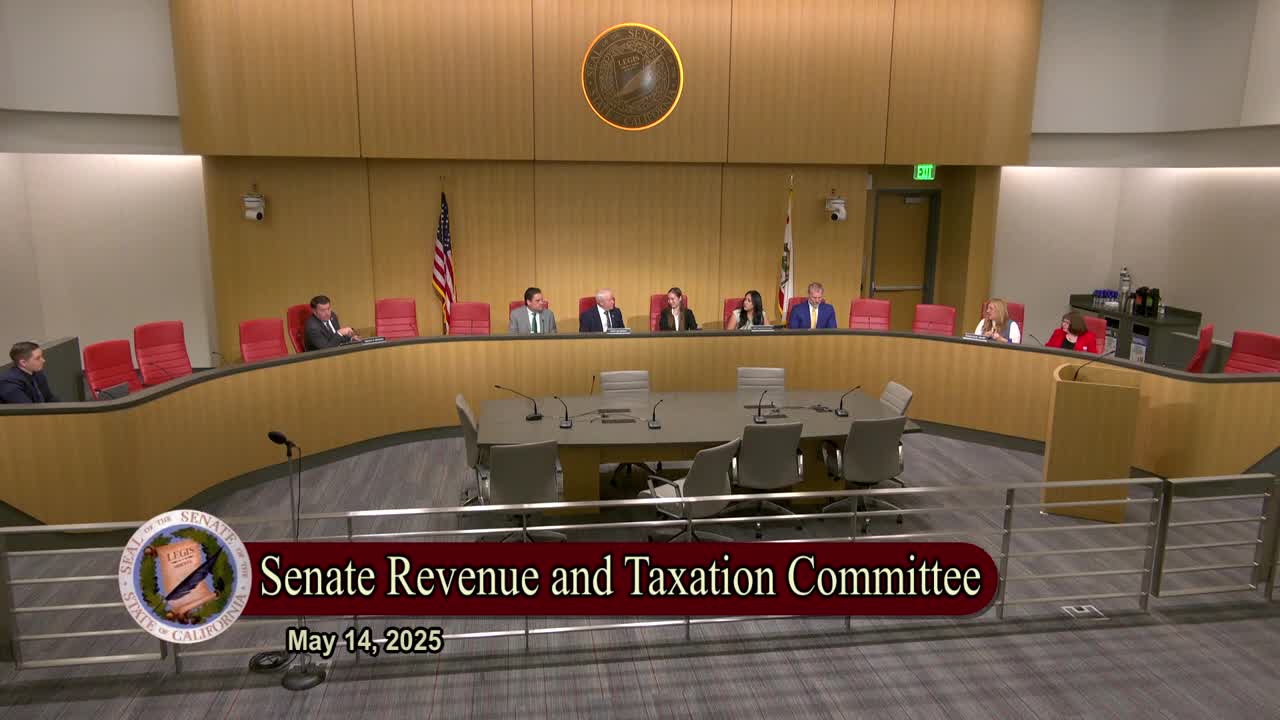 10MIN
Senate Standing Committee on Revenue and Taxation
Bill Author

Bill Co-Author(s):