AB 1349: Public postsecondary education: California First Act.
- Session Year: 2015-2016
- House: Assembly
- Latest Version Date: 2015-02-27
Existing law establishes the segments of the public postsecondary education system in the state, including the University of California, administered by the Regents of the University of California, and the California State University, administered by the Trustees of the California State University.
This bill would establish the California First Act, which would require the trustees, and request the regents, to guarantee undergraduate admission at a campus, though not necessarily at a campus or in a major of the applicants choice, within their respective systems, to all eligible California residents who submit timely applications for undergraduate admission. The bill would require the trustees, and request the regents, to submit an annual report to the Legislature on or before July 1, 2017, and on or before every July 1 thereafter, disclosing specified admissions statistics from the coming academic year.
This article shall be known, and may be cited, as the California First Act. The purpose of this act is to improve undergraduate access to the California State University and the University of California, in accordance with the California Master Plan for Higher Education, for California residents, as defined in subdivision (b) of Section 70010.1.
66208.2.The Trustees of the California State University shall, and the Regents of the University of California are requested to, guarantee undergraduate admissions at a campus, though not necessarily at a campus or in a major of the applicants choice, within their systems, to all California residents who apply on time and satisfy the undergraduate admissions eligibility requirements of those systems, respectively.
66208.4 .(a)The trustees shall, and the regents are requested to, submit an annual report to the Legislature on or before July 1, 2017, and on or before every July 1 thereafter, for each campus and systemwide, for its respective system on the total number of undergraduate applications received, the number of undergraduate applicants admitted, and the number of undergraduate applicants who were not admitted for the coming academic year.
(b)A report to be submitted pursuant to subdivision (a) shall be submitted in compliance with Section 9795 of the Government Code.
|
Date
|
Status
|
|---|---|
| Feb 27, 2015 | Introduced. To print. |
| Mar 1, 2015 | From printer. May be heard in committee March 31. |
| Mar 2, 2015 | Read first time. |
| Mar 23, 2015 | Referred to Com. on HIGHER ED. |
| Apr 22, 2015 | From committee: Do pass and re-refer to Com. on APPR. (Ayes 11. Noes 2.) (April 21). Re-referred to Com. on APPR. |
| May 6, 2015 | In committee: Set, first hearing. Referred to APPR. suspense file. |
| May 28, 2015 | In committee: Held under submission. |
| Jan 31, 2016 | Died pursuant to Article IV, Sec. 10(c) of the Constitution. |
| Feb 1, 2016 | From committee: Filed with the Chief Clerk pursuant to Joint Rule 56. |
|
Date
|
Description
|
Location
|
Votes
|
|
|---|---|---|---|---|
| Apr 21, 2015 | Do pass and be re-referred to the Committee on [Appropriations] | Assembly Standing Committee on Higher Education |
Passed |
This list shows positions taken on this bill by organizations on the date displayed, which is linked to the original source.
Positions by individuals are not included.
|
Organization
|
Position
|
Date
|
|---|---|---|
| Community College League of California | ** Support | Apr 21, 2015 |
AB 1349
Page 2
Date of Hearing: May 6, 2015
ASSEMBLY COMMITTEE ON APPROPRIATIONS
Jimmy Gomez, Chair
AB 1349
(Weber) – As Introduced February 27, 2015
Policy Committee: |
Higher Education |
Vote: |
11 - 2 |
|
|
|
|
|
|
|
|
Urgency: No State Mandated Local Program: No Reimbursable: No
SUMMARY:
This bill requires the California State University (CSU) Trustees and requests the University of California (UC) Regents to:
Guarantee undergraduate admissions, though not necessarily at a campus or major of an applicant's choice, to all California residents who apply on time and satisfy the respective systems' undergraduate admission eligibility requirements.
Report to the Legislature, by July 1, 2017, and annually thereafter, for each campus and systemwide, total undergraduate applications received, the number admitted and the number not admitted for the coming academic year.
FISCAL EFFECT:
CSU indicates that, in the fall of 2014, it denied admission to about 30,000 fully eligible California residents due to lack of funding. Assuming that, through redirection and required admission to the system, the CSU experienced an enrollment increase of 15,000 full-time equivalent students, the impact in the first year would exceed $100 million. The cost for this cohort would be on-going for at least four-years as these students complete their studies at CSU. In future years, there would be additional costs for each cohort of students that were admitted beyond state funding. In addition, there could be significant capital outlay costs to accommodate the additional enrollment.
In addition, CSU does not have a centralized admission process, and would thus require several million dollars for technology upgrades and procedural changes to implement a redirection of CSU-eligible applicants to other CSU campuses.
UC contends that it is currently meeting the bill's requirement, in part by offering many eligible students admission to the Merced campus rather than a campus of their choice, and most of these students do not accept admission. To the extent Merced and other UC campuses eventually reach their enrollment capacity, and eligible students could no longer be redirected, the bill could create cost pressure to accommodate additional eligible students, including new capital outlays.
The reporting requirements for both segments are minor and absorbable.
A new eligibility study would be needed, at a cost of at least $1 million, so that the segments could ensure that they accepting admission for the correct cohort of applicants pursuant to the state's Master Plan for Higher Education.
COMMENTS:
Purpose. According to the author, as the economy improves and funding for our public postsecondary educational institutions increases, it is time for the state to enshrine a critical principal of the Master Plan in state law. This bill is intended to guarantee undergraduate admission for all eligible California resident applicants and ensure reporting to the Legislature on resident undergraduate admission. The author believes this bill appropriately reaffirms and refocuses CSU and UC on educating California students, while still maintaining the beneficial infusion of talent from nonresidents.
Admissions. In addition to other admission criteria for each respective system, the state's Master Plan calls for freshman eligibility pools for UC and CSU. UC is to draw its incoming freshman class from the top 12.5% (one-eighth) of public high school graduates and CSU is to draw from the top 33% (one-third) of this cohort. UC and CSU currently report on whether they are accommodating eligible freshman students; UC asserts it has been admitting all eligible students, although not necessarily to the campus and program of choice. CSU claims it has denied access to over 18,000 eligible freshman applicants. However, according to the LAO, because an eligibility study has not been conducted since 2007, UC and CSU have no way of knowing if they are actually admitting or denying students in compliance with the Master Plan.
The Master Plan calls for UC and CSU to accept qualified transfer students who complete 60 units of transferable credit at a community college and meet minimum GPA requirements. For UC the minimum GPA is 2.4 and for CSU the minimum GPA is 2.0. UC indicates it is currently admitting all eligible transfer students, however not all students are being accepted into their campus or program of choice. CSU reports denying admission to 11,800 eligible transfer students in fall 2014.
Analysis Prepared by: Chuck Nicol / APPR. / (916) 319-2081
AB 1349
Page 3
Date of Hearing: April 21, 2015
ASSEMBLY COMMITTEE ON HIGHER EDUCATION
Jose Medina, Chair
AB 1349
(Weber) – As Introduced February 27, 2015
SUBJECT: Public postsecondary education: California First Act
SUMMARY: Requires the California State University (CSU) and the University of California (UC) to guarantee undergraduate admissions to eligible California students, as specified and defined. Specifically, this bill:
Establishes the California First Act to improve undergraduate access to CSU and UC, in accordance with the California Master Plan for Higher Education, for California residents (defined as persons who are not required to pay nonresident tuition).
Requires the Trustees of the CSU, and requests the Regents of the UC, to guarantee undergraduate admissions at a campus, not necessarily at a campus or in a major of the applicant's choice, within their systems, to all eligible California residents who apply on time and satisfy the undergraduate admissions eligibility requirements.
Requires the Trustees, and requests the Regents, to submit an annual report to the Legislature on or before July 1, 2017, and every July 1 thereafter, for each campus and systemwide, for the total number of undergraduate applications received, the number of undergraduate applicants admitted, and the number of undergraduate applicants not admitted for the coming academic year.
EXISTING LAW:
Establishes the intent of the Legislature that each resident of California who has the capacity and motivation to benefit from higher education should have the opportunity to enroll and progress in an institution of higher education. (Education Code Section 66201)
Establishes the intent of the Legislature that UC and CSU seek to maintain an undergraduate student population ratio of 60% upper division students and 40% lower division students to accommodate California Community College (CCC) transfer students. (EDC Section 66201.5)
Establishes that UC and CSU are expected to plan for adequate spaces to accommodate all California resident students who are eligible and likely to apply to attend an appropriate place within the system and that the Legislature intends to fund programs in order to accomplish these purposes. (EDC Section 66202.5)
FISCAL EFFECT: Unknown
COMMENTS: Purpose of this bill. According to the author, higher education access is an essential element of California’s Master Plan for Higher Education (Master Plan). However, in recent years, the state's budget crisis led California's public colleges and universities to turn away otherwise qualified students and increase student fees and tuition. During this period of economic volatility, the author notes that a disturbing trend developed where California institutions focused new admissions efforts on out-of-state students who pay higher tuition prices. According to the author, as the economy improves and funding for our public postsecondary educational institutions increases, it is time for the state to enshrine a critical principal of the Master Plan in state law. This bill establishes the California First Act, to guarantee undergraduate admission for all eligible California resident applicants and to ensure reporting to the Legislature on resident undergraduate admission. The author believes this bill appropriately reaffirms and refocuses CSU and UC on educating California students, while still maintaining the beneficial infusion of talent from nonresidents.
Qualified freshman resident students. The Master Plan calls for freshman eligibility pools for UC and CSU. UC is to draw its incoming freshman class from the top 12.5% (one-eighth) of public high school graduates. CSU is to draw its applicant pool from the top 33% (one-third) of public high school graduates. Freshman applicants are required to complete a set of high school coursework (known as "A-G" requirements); in 2012-13, 39% of high school graduates had successfully completed A-G requirements. UC and CSU have additional freshman admission criteria, including requiring certain test scores and GPAs. UC and CSU currently report on whether they are accommodating eligible freshman students; UC asserts it has been admitting all eligible students, although not necessarily to the campus and program of choice. CSU claims it has denied access to over 18,000 eligible freshman applicants. However, according to the LAO, because an eligibility study has not been conducted since 2007, UC and CSU have no way of knowing if they are actually admitting or denying students in compliance with the Master Plan.
Qualified transfer resident students. The Master Plan calls for UC and CSU to accept qualified transfer students who complete 60 units of transferable credit at a community college and meet minimum GPA requirements. For UC the minimum GPA is 2.4 and for CSU the minimum GPA is 2.0. UC indicates it is currently admitting all eligible transfer students, however not all students are being accepted into their campus or program of choice. CSU reports denying admission to 11,800 eligible transfer students in fall 2014.
CSU local service areas. CSU is designed to function as a regional system, with students eligible for access to a CSU campus in their general vicinity. However, several campuses of the CSU have raised admission standards for certain programs above the systemwide standard and five campuses currently have higher admission standards for every program offered – meaning these campuses and programs deny admission to some local students eligible to attend CSU. The LAO notes that CSU has not indicated how many of the 11,800 students turned away were denied access to their local campus. LAO has recommended, and budget subcommittee staff has requested, CSU report on (1) the number of eligible transfer students were denied access to their local campus in fall 2014, and (2) the number of nonlocal students admitted in fall 2014 to campuses denying admission to eligible local transfer students.
Enrollment targets. Historically, in the annual state budget the Legislature specified enrollment levels for the CSU and UC and provided additional funding in years when enrollment was expected to grow. Enrollment growth funding has been based primarily on changes in the college-age population and eligibility studies. In four of the last eight years, the state has not set enrollment targets in the budget. Without enrollment-based budgeting, the state and universities have disagreed over the number of California students UC and CSU are expected to serve. Both CSU and UC assert that they have more enrolled resident students than the state has funded. According to the Legislative Analyst's Office (LAO), enrollment funding allows the Legislature to set clear expectations about higher education access and aligns state funding with costs.
Committee consideration. This bill requires CSU, and requests UC, to admit all qualified undergraduate California residents. As previously noted, the LAO has indicated that it is impossible to determine whether CSU and UC are admitting all qualified freshman students without an updated eligibility study. Additionally, CSU has indicated it is not currently admitting students for which it is not funded, and is not admitting all eligible students in compliance with the Master Plan. While UC contends it is currently in compliance with the Master Plan, it has also indicated that it will, moving forward, only admit California students for which it is funded by the state. In the absence of appropriate funding, it is unclear how UC and CSU would meet this requirement. For example, would UC and CSU raise student fees in order to ensure revenues necessary to meet the admission guarantee established in this bill? The author and committee may wish to consider making the provisions of this bill contingent upon the provision of adequate annual funding in the Budget Act.
Related Legislation.
AB 352 (Gaines), pending in this Committee, establishes limits on nonresident enrollment at campuses of the CSU and UC.
AB 1370 (Medina), pending in this Committee, would revise existing provisions and add new requirements governing the nonresident tuition at UC and CSU.
SCA 4 (Nguyen), pending in the Senate, would place on the ballot a constitutional amendment to limit out of state students at UC to not more than 10% and to limit undergraduate tuition and fees at UC through the 2020-2021 academic year to the 2016-17 level.
REGISTERED SUPPORT / OPPOSITION:
Support
Community College League of California
Opposition
None on File
Analysis Prepared by: Laura Metune / HIGHER ED. / (916) 319-3960
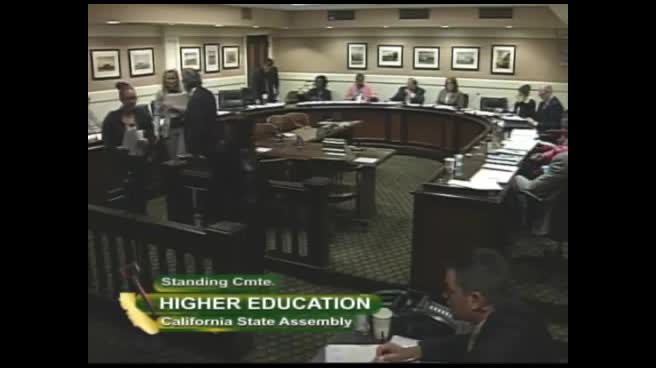
Discussed in Hearing
 15MIN
Assembly Standing Committee on Higher Education
Bill Author

Bill Co-Author(s):