AB 1781: Child development programs.
- Session Year: 2015-2016
- House: Assembly
- Latest Version Date: 2016-04-11
The Child Care and Development Services Act declares its purpose is to provide a comprehensive, coordinated, and cost-effective system of child care and development services for children from infancy to 13 years of age and their parents, including a full range of supervision, health, and support services through full- and part-time programs.
This bill would require the Superintendent of Public Instruction, in conjunction with Department of Education and other appropriate state agencies and stakeholders, to (1) convene a task force to examine rules and regulations regarding priorities established for children attending child development programs under contract with the department, (2) report to the Legislature as to whether these priorities should be amended to give priority to children of California National Guard students or other military personnel students, and (3) develop plans for these child development programs to implement in order to support the children in cases of state emergency when the students are called to duty.
Under existing law, the University of California, under the administration of the Regents of the University of California, the California State University, under the administration of the Trustees of the California State University, and the California Community Colleges, under the administration of the Board of Governors of the California Community Colleges, are the 3 segments of public postsecondary education in this state.
Existing law authorizes higher educational institutions to establish and maintain child development programs on or near their respective campuses.
This bill would require child development programs established by the California Community Colleges, the California State University, and the University of California to give specified priority to children of students who are active duty members of the California National Guard.
Existing law establishes the California Community Colleges, under the administration of the Board of Governors of the California Community Colleges, as one of the segments of public postsecondary education in this state.
This bill would make nonsubstantive changes to those provisions.
Existing law establishes the California Community Colleges, under the administration of the Board of Governors of the California Community Colleges, as one of the segments of public postsecondary education in this state.
This bill would make nonsubstantive changes to those provisions.
The Superintendent, in conjunction with the department and other appropriate state agencies and stakeholders, shall comply with all of the following requirements:
(a)Convene a task force to examine the most current rules and regulations regarding priorities established for children attending a child development program under contract with the department.
(b)(1)Submit a written report, on or before January 31, 2018, to the appropriate policy committees of the Legislature that opines whether priorities described in subdivision (a) should be amended to give priority to children of California National Guard students or other military personnel students.
(2)A report to be submitted pursuant to this subdivision shall be submitted in compliance with Section 9795 of the Government Code.
(c)Develop plans for child development programs under contract with the department to implement in order to support children of California National Guard students or other military personnel students in cases of state emergency when these students are called to duty.
SECTION 1.Section 66061 is added to the Education Code, to read:66061.(a)Child development programs established by the California Community Colleges, the California State University, and the University of California pursuant to Section 66060 shall give priority to children of students who are active duty members of the California National Guard.
(b)Priority pursuant to subdivision (a) shall not exceed other priorities established, as of January 1, 2017, by the public postsecondary educational institution or the Superintendent of Public Instruction for the program.
(a)Child development programs established by the California Community Colleges, the California State University, and the University of California pursuant to Section 66060 shall give priority to children of students who are active duty members of the California National Guard.
(b)Priority pursuant to subdivision (a) shall not exceed other priorities established, as of January 1, 2017, by the public postsecondary educational institution or the Superintendent of Public Instruction for the program.
SECTION 1.Section 70900 of the Education Code is amended to read:70900.There is hereby established the California Community Colleges, a postsecondary education system consisting of community college districts established pursuant to law and the Board of Governors of the California Community Colleges. The board of governors shall carry out the functions specified in Section 70901, and local districts shall carry out the functions specified in Section 70902.
There is hereby created established the California Community Colleges, a postsecondary education system consisting of community college districts heretofore and hereafter established pursuant to law and the Board of Governors of the California Community Colleges. The board of governors shall carry out the functions specified in Section 70901 70901, and local districts shall carry out the functions specified in Section 70902.
|
Date
|
Status
|
|---|---|
| Feb 4, 2016 | Read first time. To print. |
| Feb 5, 2016 | From printer. May be heard in committee March 6. |
| Mar 17, 2016 | From committee chair, with author's amendments: Amend, and re-refer to Com. on HIGHER ED. Read second time and amended. |
| Mar 17, 2016 | Referred to Coms. on HIGHER ED. and V.A. |
| Mar 28, 2016 | Re-referred to Com. on HIGHER ED. |
| Apr 6, 2016 | From committee: Do pass and re-refer to Com. on V.A. (Ayes 13. Noes 0.) (April 5). Re-referred to Com. on V.A. |
| Apr 11, 2016 | From committee chair, with author's amendments: Amend, and re-refer to Com. on V.A. Read second time and amended. |
| Apr 12, 2016 | In committee: Set, first hearing. Hearing canceled at the request of author. |
| Apr 12, 2016 | Re-referred to Com. on V.A. |
|
Date
|
Description
|
Location
|
Votes
|
|
|---|---|---|---|---|
| Apr 5, 2016 | Do pass and be re-referred to the Committee on [Veterans Affairs] | Assembly Standing Committee on Higher Education |
Passed |
This list shows positions taken on this bill by organizations on the date displayed, which is linked to the original source.
Positions by individuals are not included.
Date of Hearing: April 12, 2016
ASSEMBLY COMMITTEE ON VETERANS AFFAIRS
Jacqui Irwin, Chair
ABPCA Bill Id:AB 1781 (
Author:Lopez) – As Amended Ver:March 17, 2016
SUBJECT: Public postsecondary education: child development programs
SUMMARY: As proposed to be amended: This bill directs the Superintendent of Public Instruction (SPI) in conjunction with the appropriate state agencies and stakeholders, to examine the current rules and regulations regarding the priority of children specifically attending a child development program under contract with the California Department of Education (CDE), and opine as to whether or not the existing priorities should be amended to include children of California National Guard (CNG) students; and, develop plans for child care services in cases of state emergencies when the CNG personnel is called to duty.
EXISTING LAW: Authorizes higher educational institutions to establish and maintain child development programs on or near their respective campuses.
FISCAL EFFECT: Unknown
COMMENTS: According to the author, due to the inconsistency of military personnel’s demanding job schedules, their children can be subjected to conditions where they are left without care.
Policy question for members:
What specific problem or issue does this bill address?
REGISTERED SUPPORT / OPPOSITION:
Support
None on File.
Opposition
None on File.
Analysis Prepared by: John Spangler / V.A. / (916) 319-3550
Date of Hearing: April 5, 2016
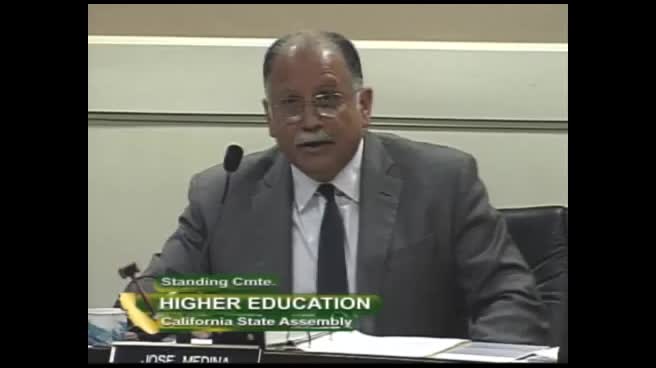
ASSEMBLY COMMITTEE ON HIGHER EDUCATION
Jose Medina, Chair
ABPCA Bill Id:AB 1781 (
Author:Lopez) – As Amended Ver:March 17, 2016
[Note: This bill is double referred to the Assembly Veterans Affairs Committee and will be heard as it relates to issues under its jurisdiction.]
SUBJECT: Public postsecondary education: child development programs
SUMMARY: Requires child development programs established by the California Community Colleges (CCC), the California State University (CSU), and the University of California (UC), as authorized, to give priority to children of students who are active duty members of the California National Guard (CNG); and, specifies that the priority shall not exceed other priorities established, as of January 1, 2017, by the public postsecondary educational institution or the State Superintendent of Public Instruction (SPI) for the program.
EXISTING LAW:
- Authorizes higher educational institutions to establish and maintain child development programs on or near their respective campuses; specifies that those higher educational institutions under contract with the California Department of Education (CDE) for child care and development services are subject to the rules and regulations adopted by the SPI; requires that children of students of each campus operating a child development program shall have first priority for service in that program, in accordance with the priorities established in subdivision (b) of Education Code (EC) Section 8263; and, requires the SPI, in cooperation with higher educational institutions, to establish rules and regulations governing programs operated, as specified (EC Section 66060).
- Establishes the Child Care and Developmental Services Act to provide child care and development services as part of a coordinated, comprehensive, and cost-effective system serving children from birth to 13 years old and their parents and including a full range of supervision, health, and support services through full- and part-time programs (EC Section 8200, et seq.).
- Declares legislative intent to give priority access to child development programs to children of families that qualify for applicable federal public assistance and other low-income and disadvantage families (EC Section 8205).
- Requires the SPI to administer general child care and development programs to include, among other things as specified, age- and developmentally-appropriate activities, supervision, parenting education and involvement, and nutrition. Further allows such programs to be designed to meet child-related needs identified by parents or guardians, as specified (EC Sections 8240 and 8241).
- Stipulates requirements families must meet in order to be eligible for federal and state subsidized child development services, and grants priority enrollment to children who have been or are at risk of being abused or neglected, as specified (EC Section 8263).
FISCAL EFFECT: Unknown
COMMENTS: Need for this measure. According to the author, due to the inconsistency of military personnel’s demanding job schedules, their children can be subjected to conditions where they are left without care. The author states, "California Military Department’s Office of Governmental Affairs has also noted that Service Members could be called for active duty for as little as a few days or be called for a couple of months in response to any state emergency."
The author argues that, "This bill will grant active duty members of the California National Guard who are students attending a California college or university to be given priority to enroll their child at a campus child development center, if available. Allowing this will take off a burden many service members face when activated for state duty."
General child care and development programs. According to the CDE, general child care and development programs are state and federally funded programs that use centers and family child care home networks operated or administered by either public or private agencies and local educational agencies. These agencies provide child development services for children from birth through 12 years of age and older children with exceptional needs. Said programs provide an educational component that is developmentally, culturally, and linguistically appropriate for the children served. Additionally, the programs also provide meals and snacks to children, parent education, referrals to health and social services for families, and staff development opportunities to employees.
The CDE currently contracts with over 700 private, non-profit, as well as other public agencies so that low-income families can find safe, healthy, and age-appropriate educational environments for the care of their children. The care can be provided in licensed centers, family child care homes, as well as in homes and centers exempt from licensure. The early education system administered by the CDE continues to be the largest, most culturally diverse, and most comprehensive system in the nation, with funding for fiscal year 2015–16 at $2.4 billion. Services are projected to provide child care to some 450,000 children. Contractors for direct services include school districts, county offices of education, cities, local park and recreation districts, county welfare departments, other public entities, community-based organizations, and private agencies.
As of March 2016, 52 CCC campuses, 1 CSU campus, and 7 UC campuses have child development programs under contract with the CDE.
Current practices of the CCC, CSU, and UC. Committee staff understands that of the CCC, CSU, and UC campuses that have child development programs, each campus differs in the administration of the child development program. According to the CCC Chancellor's Office, any child development center or lab of the CCC must follow the strict eligibility and priority requirements as directed by their contracts with the CDE. Some CCC campuses have parent fee-based slots, and have their own waiting lists and prioritization policies for that sub-set of children. According to the California State Student Association, nearly all of the programs at the CSU are operated under campus Associated Students/Associated Students, Inc. Some programs are funded through student fees, parent fees and/or private funds. Many of the CSU campuses give priority to low-income students seeking to have their children attend a child development program on campus. According to the UC Office of the President, each campus has a wait list for more children to be able to attend the child care program on campus.
The segments have raised questions as to whether or not this measure can be implemented. As outlined in the "Existing Law" section of this analysis, the child development programs as run by the postsecondary education institutions must adhere to all of the rules and regulations as established by the SPI. This measure does not appear to align to existing rules and regulations as established by the SPI.
Active duty CNG. As presently drafted, it is unclear as to what is meant by "active duty CNG". If a member of the CNG is on active duty, he/she would presumably not be on campus and attending classes. If the author wants to ensure that all CNG students' children are eligible, the author may wish to work with the Assembly Veterans Affairs Committee in order to ensure all CNG are captured in this measure.
Additionally, the CCC and CSU systems do not centrally collect data for the number of enrolled "active duty CNG". However, the CCC estimates that this year, systemwide, approximately 65 CNG are enrolled. The UC states that in 2015, systemwide, there were 43 CNG enrolled. It is presently unclear as to how many children of active duty CNG may benefit from this measure.
Policy considerations. This measure calls for the creation of a new priority for children of students who are active duty CNG for the stated purpose of supporting CNG students with child care needs when they are called to active duty. It is unclear how this bill, which would prioritize active duty CNG for campus-based child care, would meet this goal. Generally, campus-based child care is available to students during regular business hours or campus operating hours, and not necessarily open to support emergency child care needs.
Further, with limited slots for children to attend the child development programs of the CCC, CSU, and UC campuses, and the initial priorities given to children in dangerous situations and then to children from low-income households, this measure could have the unintended consequence of displacing current and waitlisted students.
Additionally, the role of the CNG is vital to our state, as are other students who hold military and emergency services roles; it is unclear why CNG students' children, but not other vital service providers, should be giving top priority to limited slots for campus child development programs.
Lastly, Committee staff understands that this bill may violate existing policies governing campuses child development programs under contract with the CDE, which are currently required to provide priority to other categories of students. To note, child care development programs fall under the jurisdiction of the Assembly Education Committee.
To address the policy concerns, Committee staff recommends, and the author has accepted, the following amendments:
Strike out Section One entirely and replace with the following: The SPI, in conjunction with the CDE and other appropriate state agencies and stakeholders, shall convene a task force in order to examine the current rules and regulations regarding the priority of children specifically attending a child development program under contract with the CDE, and opine in writing to the appropriate policy committees of the Legislature, on or before January 31, 2018, as to whether or not the existing priorities should be amended to include children of CNG and other military personnel students; and, develop plans for child development programs for their children in cases of state emergencies when the CNG and other military personnel are called to duty.
Note, due to the Legislative Calendar Deadlines, the amendments will be processed and adopted in the Assembly Veterans Affairs Committee.
REGISTERED SUPPORT / OPPOSITION:
Support
None on file.
Opposition
None on file.
Analysis Prepared by: Jeanice Warden / HIGHER ED. / (916) 319-3960
Discussed in Hearing
 2MIN
Assembly Standing Committee on Higher Education
Bill Author

Bill Co-Author(s):