AB 1888: Cal Grants: nondiscrimination.
- Session Year: 2015-2016
- House: Assembly
- Latest Version Date: 2016-05-02
The Cal Grant Program establishes the Cal Grant A and B Entitlement Awards, the California Community College Transfer Entitlement Awards, the Competitive Cal Grant A and B Awards, the Cal Grant C Awards, and the Cal Grant T Awards under the administration of the Student Aid Commission, and establishes eligibility requirements for awards under these programs for participating students attending qualifying institutions.
This bill would require, commencing with the 201718 academic year, each Cal Grant participating institution, as a condition for its voluntary participation in the Cal Grant Program, to certify to the commission in the institutions participation agreement for the Cal Grant Program that the institution shall not subject a student an applicant, student, or employee of the institution to discrimination on the basis of, among other things, sex, sexual orientation, gender identity, or gender expression, and that the institution shall not have, apply for, or receive, or receive a waiver by the United States Department of Education from nondiscrimination requirements for the receipt of federal funds. funds, except as provided. The bill would provide that an institution that is ineligible for participation in the Cal Grant Program under these provisions is still eligible for renewal Cal Grant awards for recipients who were enrolled in the ineligible institution during the academic year immediately preceding the academic year for which the institution is ineligible and who choose to renew their Cal Grant awards to attend the ineligible institution, to the same extent as if the recipients attended an eligible institution.
The Cal Grant Program establishes the Cal Grant A and B Entitlement Awards, the California Community College Transfer Entitlement Awards, the Competitive Cal Grant A and B Awards, the Cal Grant C Awards, and the Cal Grant T Awards under the administration of the Student Aid Commission, and establishes eligibility requirements for awards under these programs for participating students attending qualifying institutions.
This bill would require, commencing with the 201718 academic year, each Cal Grant participating institution, as a condition for its voluntary participation in the Cal Grant Program, to certify to the commission in the institutions participation agreement for the Cal Grant program Program that the institution shall not subject a student or employee of the institution to discrimination on the basis of, among other things, sex, sexual orientation, gender identity, or gender expression, and that the institution shall not apply for, or receive, a waiver by the United States Department of Education from nondiscrimination requirements for the receipt of federal funds.
The Cal Grant Program establishes the Cal Grant A and B Entitlement Awards, the California Community College Transfer Entitlement Awards, the Competitive Cal Grant A and B Awards, the Cal Grant C Awards, and the Cal Grant T Awards under the administration of the Student Aid Commission, and establishes eligibility requirements for awards under these programs for participating students attending qualifying institutions.
This bill would require, commencing with the 201718 academic year, each Cal Grant participating institution, as a condition for its voluntary participation in the Cal Grant Program, to certify to the commission in the institutions participation agreement for the Cal Grant program that the institution shall not subject a student or employee of the institution to discrimination on the basis of, among other things, sex, sexual orientation, gender identity, or gender expression, and that the institution shall not apply for, or receive, a waiver by the United States Department of Education from nondiscrimination requirements for the receipt of federal funds.
(a)As a condition for its voluntary participation in the Cal Grant Program, each Cal Grant participating institution shall, commencing with the 201718 academic year, certify to the commission in the institutions participation agreement for the Cal Grant Program both of the following:
(a)The
(1)(A)Except as provided in subparagraph (B) or (C), the institution shall not subject a student an applicant, student, or employee of the institution to discrimination on any basis listed in Section 66270, including sex, sexual orientation, gender identity, or gender expression. the basis of disability, gender, gender identity, gender expression, nationality, race or ethnicity, religion, sexual orientation, or any characteristic listed or defined in Section 11135 of the Government Code or any other characteristic that is contained in the prohibition of hate crimes set forth in subdivision (a) of Section 422.6 of the Penal Code.
(B)For purposes of subparagraph (A), a religious educational institution may hire and employ, or admit and enroll, persons of a particular religion if that educational institution is controlled by a religious institution and the educational institution is directed toward the propagation of that particular religion.
(C)For purposes of subparagraph (A), an institution that traditionally and continually from its establishment has had a policy of admitting only students of one sex may continue that practice.
(b)
(2)(A)The institution shall not have, apply for, or receive, receive a waiver by the United States Department of Education from federal nondiscrimination requirements for the receipt of funds under Title IX of the Education Amendments of 1972 (20 U.S.C. Sec. 1681, et seq.).
(B)Subparagraph (A) does not apply to an institution that applied for and received a waiver as described in subparagraph (A) and that has provided evidence to the commission that it relinquished that waiver before the commencement of the 201718 academic year.
(b)An institution that is ineligible for participation in the Cal Grant Program under subdivision (a) shall be eligible for renewal Cal Grant awards for recipients who were enrolled at the ineligible institution during the academic year immediately preceding the academic year for which the institution is ineligible and who choose to renew their Cal Grant awards to attend the ineligible institution, to the same extent as if the recipients attended an eligible institution. This renewal option shall be available only for a recipient who continues to attend the ineligible institution and shall cease as soon as the recipient is no longer enrolled in that institution.
As a condition for its voluntary participation in the Cal Grant Program, each Cal Grant participating institution shall, commencing with the 201718 academic year, certify to the commission in the institutions participation agreement for the Cal Grant program Program both of the following:
(a)The institution shall not subject a student or employee of the institution to discrimination on any basis listed in Section 220, 66270, including sex, sexual orientation, gender identity, or gender expression.
(b)The institution shall not apply for, or receive, a waiver by the United States Department of Education from federal nondiscrimination requirements for the receipt of funds under Title IV of the federal Higher Education Act of 1965, as amended IX of the Education Amendments of 1972 (20 U.S.C. Sec. 1070 1681, et seq.).
As a condition for its voluntary participation in the Cal Grant Program, each Cal Grant participating institution shall, commencing with the 201718 academic year, certify to the commission in the institutions participation agreement for the Cal Grant program both of the following:
(a)The institution shall not subject a student or employee of the institution to discrimination on any basis listed in Section 220, including sex, sexual orientation, gender identity, or gender expression.
(b)The institution shall not apply for, or receive, a waiver by the United States Department of Education from federal nondiscrimination requirements for the receipt of funds under Title IV of the federal Higher Education Act of 1965, as amended (20 U.S.C. Sec. 1070 et seq.).
|
Date
|
Status
|
|---|---|
| Feb 11, 2016 | Read first time. To print. |
| Feb 12, 2016 | From printer. May be heard in committee March 13. |
| Feb 25, 2016 | Referred to Com. on HIGHER ED. |
| Mar 28, 2016 | From committee: Amend, and do pass as amended and re-refer to Com. on APPR. (Ayes 8. Noes 1.) (March 15). |
| Mar 29, 2016 | Read second time and amended. |
| Mar 30, 2016 | Re-referred to Com. on APPR. |
| Apr 6, 2016 | In committee: Hearing postponed by committee. |
| May 2, 2016 | From committee chair, with author's amendments: Amend, and re-refer to Com. on APPR. Read second time and amended. |
| May 3, 2016 | Re-referred to Com. on APPR. |
| May 11, 2016 | In committee: Set, first hearing. Referred to APPR. suspense file. |
| May 27, 2016 | In committee: Held under submission. |
|
Date
|
Description
|
Location
|
Votes
|
|
|---|---|---|---|---|
| Mar 15, 2016 | Do pass as amended and be re-referred to the Committee on [Appropriations] | Assembly Standing Committee on Higher Education |
Passed |
This list shows positions taken on this bill by organizations on the date displayed, which is linked to the original source.
Positions by individuals are not included.
|
Organization
|
Position
|
Date
|
|---|---|---|
| ACLU of California | * Support | Mar 15, 2016 |
| American Civil Liberties Union of California | * Support | Mar 15, 2016 |
| California Federation Of Teachers | * Support | Mar 15, 2016 |
| Equality California | * Support | Mar 15, 2016 |
| Law Firm of Hiroshima Daggett | * Against | Mar 15, 2016 |
| Santa Clara Unified School District | * Support | Mar 15, 2016 |
Date of Hearing: May 11, 2016
ASSEMBLY COMMITTEE ON APPROPRIATIONS
Lorena Gonzalez, Chair
ABPCA Bill Id:AB 1888
Author:(Low) – As Amended Ver:May 2, 2016
Policy Committee: | Higher Education | Vote: | 8 - 1 |
|
|
Urgency: No State Mandated Local Program: No Reimbursable: No
SUMMARY:
This bill requires, as a condition of voluntary participation in the Cal Grant Program, each Cal Grant participating public and private higher education institution, commencing in 2017–18, to certify both of the following to the California Student Aid Commission (CSAC):
- The institution does not subject an applicant, student or employee to discrimination on the basis of disability, gender, gender identity, gender expression, nationality, race or ethnicity, religion, sexual orientation, age, or disability or any characteristic contained in the state's prohibition of hate crimes, per Penal Code Section 422.6.
- The institution shall not have, apply for, or receive a waiver from the United States Department of Education (USDE) from federal nondiscrimination requirements for the receipt of funds under Title IX of the Education Amendments of 1972.
The bill also:
- Provides that, notwithstanding (1):
- A religious educational institution may hire or employ, or admit or enroll, persons of a particular religion if that educational institution is controlled by a religious institution and the educational institution is directed toward the propagation of that particular religion.
- An institution that since its establishment has had a policy of admitting students of only one sex may continue to do so.
- A religious educational institution may hire or employ, or admit or enroll, persons of a particular religion if that educational institution is controlled by a religious institution and the educational institution is directed toward the propagation of that particular religion.
- Stipulates that (2) does not apply to an institution that received a waiver, but provides evidence to CSAC prior to 2017-18 that it has relinquished the waiver.
- Stipulates the Cal Grant recipients attending an institution prior to the academic year in which the institution is deemed ineligible for Cal Grant participation pursuant to this bill are eligible for renewal of their Cal Grant awards for as long as they remain continuously enrolled at that institution.
FISCAL EFFECT:
- CSAC anticipates needing one new auditor position ($120,000 annually GF) to review institutional compliance and student/employee discrimination complaints. The commission indicates that this is similar to the workload demands of recently enacted legislation that also conditioned Cal Grant participation of specific institutional actions.
- Given the consequences to the institutions that could be impacted by this bill and the legal issues raised by this bill (see Comment #4 below), the probability of litigation against the state appears fairly high. The state could therefore incur significant legal costs, at least in the hundreds of thousands of dollars.
- Based on information from CSAC, seven institutions that participate in the Cal Grant Program have either received or requested a federal waiver: Biola University, Fresno Pacific University, Loma Linda University, Pacific Union College, The Master's College, Simpson University, and William Jessup University. (Pepperdine University requested withdrawal of its religious exemption in January 2016.) In 2014-15, about 3,200 students at these seven schools—representing 20% to 50% of their respective undergraduate enrollments—received $26.6 million in Cal Grants. The most recent amendments to this bill allow these students to remain that their institution and continue to receive their Cal Grant. These costs will decline over four years as these students complete their Cal Grant eligibility. If these schools do not relinquish their federal waivers, and to the extent new students eligible under the Cal Grant Entitlement Program would attend one of these schools, and thus forego their Cal Grant award, the state would realize unknown, but potentially significant Cal Grant savings. (The maximum Cal Grant award at such schools is currently about $8,000.) Many such students likely would elect to attend another institution that participates in the Cal Grant program, however, thus the extent of any possible savings is unknown.
To the extent some of the Cal Grant-eligible students described above would instead attend a California Community College or the California State University (CSU), the state would bear the costs of those students attendance. For every 100 additional CCC or CSU students, state costs would be $475,000 (GF-Prop 98) at the CCC or $750,000 (General Fund) at the CSU. These costs would be offset to some extent by savings from lower Cal Grant awards amounts at the CCC and CSU.
COMMENTS:
- Purpose. According to the author, AB 1888 upholds California's commitment to nondiscrimination by requiring all Cal Grant participating institutions to certify to CSAC that they shall not discriminate on the basis of a protected class, including, sex, sexual orientation, gender identity, or gender expression. The author argues that allowing religion to be used as an instrument for discrimination goes against California public policy and should not be supported with state funding.
Equality California (EQCA), the bill's sponsor, argues that religious protection should not be used to justify discrimination. According to EQCA, overly broad religious exemptions leave room for individuals and institutions to discriminate depending on how they apply, or choose not to apply, their religious beliefs.
- The Equity in Education Act prohibits, among other protections, a person from being subjected to discrimination on the basis of disability, gender, gender identity, gender expression, nationality, race or ethnicity, religion, sexual orientation, or any other characteristic that is contained in the definition of hate crimes, in any program or activity conducted by an educational institution that receives, or benefits from, state financial assistance or enrolls pupils who receive state student financial aid. An exemption is provided for an educational institution that is controlled by a religious organization if the application would not be consistent with the religious tenets of that organization.
- Federal Title IX of the Education Amendments of 1972 (Title IX) prohibits discrimination, on the basis of sex, in educational programs or activities receiving Federal financial assistance. Various exemptions are provided, including for fraternities and sororities, military institutions, traditional male or female institutions, and institutions controlled by religious organizations. An exemption is provided for religious colleges that fall within specified guidelines. Federal guidance issued in 2014 clarified that the Title IX discrimination prohibition “extends to claims of discrimination based on gender identity or failure to conform to stereotypical notions of masculinity or femininity.”
In response to the USDE guidance, a number of religious institutions have applied for exemption to Title IX. According to a report from the HRC, 56 schools nationwide have requested an exemption, 33 have received an exemption from the law as it pertains to protecting students on the basis of gender identity, and 23 have obtained an exemption based on laws pertaining to protecting students on the basis of sexual orientation. Schools most commonly requested exemptions from provisions of the law relating to housing, access to facilities, and athletics.
- Opposition. The Association of Independent California Colleges and Universities (AICCU) argues, based on current enrollments, that AB 1888 could impact almost 9,000 who would otherwise attend one of the state's faith-based colleges. These low-income students would either have to forgo their Cal Grants or attend a different institution that would still participate in the Cal Grant program. Several AICCU member schools expressed similar concerns.
The National Center for Law and Policy argues that AB 1888 unnecessarily restricts educational choices and "serves as an existential threat to church autonomy, the self-governance of religious organizations, and religious liberty…" The Center alludes to lawsuits challenging the unconstitutionality of AB 1888, "which coerces a waiver of federal constitutional and statutory rights.
Analysis Prepared by: Chuck Nicol / APPR. / (916) 319-2081
Date of Hearing: March 15, 2016
ASSEMBLY COMMITTEE ON HIGHER EDUCATION
Jose Medina, Chair
ABPCA Bill Id:AB 1888 (
Author:Low) – As Introduced Ver:February 11, 2016
SUBJECT: Cal Grants: nondiscrimination
SUMMARY: Prohibits an institution participating in the Cal Grant Program from discriminating against a student or employee on the basis of a protected class. Specifically, this bill:
- Requires, as a condition of voluntary participation in the Cal Grant Program, each Cal Grant participating institution to, commencing with the 2017–18 academic year, certify to the California Student Aid Commission (CSAC) in the institution’s participation agreement (IPA) for the Cal Grant program both of the following:
- The institution shall not subject a student or employee of the institution to discrimination on any basis listed in Education Code (EDC) Section 220, including sex, sexual orientation, gender identity, or gender expression.
- The institution shall not apply for, or receive, a waiver by the United States Department of Education (USDE) from federal nondiscrimination requirements for the receipt of funds under Title IV of the federal Higher Education Act of 1965, as amended (20 U.S.C. Sec. 1070 et seq.).
EXISTING STATE LAW
- Establishes the Equity in Education/Higher Education acts to prohibit, among other protections, a person from being subjected to discrimination on the basis of disability, gender, gender identity, gender expression, nationality, race or ethnicity, religion, sexual orientation, or any other characteristic that is contained in the definition of hate crimes, in any program or activity conducted by an educational institution that receives, or benefits from, state financial assistance or enrolls pupils who receive state student financial aid (EDC Sections 200 and 66270). An exemption is provided for an educational institution that is controlled by a religious organization if the application would not be consistent with the religious tenets of that organization. (EDC Sections 221 and 66271)
- Establishes the Unruh Civil Rights Act to provide free and equal accommodations, advantages, facilities, privileges, or services in all business establishments regardless of sex, race, color, religion, ancestry, national origin, disability, medical condition, genetic information, marital status, or sexual orientation. (Civil Code Section 51)
EXISTING FEDERAL LAW establishes Federal Title IX of the Education Amendments of 1972 (Title IX) to prohibit discrimination, on the basis of sex, in educational programs or activities receiving Federal financial assistance. Various exemptions are provided, including for fraternities and sororities, military institutions, traditional male or female institutions, and institutions controlled by religious organizations. (Title 20 U.S.C. Sections 1681-1688)
- For purposes of the Title IX religious exemption, an institution will be considered to be controlled by a religious organization if one or more of the following conditions is true:
- It is a school or department of divinity, defined as an institution or a department or branch of an institution whose program is specifically for the education of students to prepare them to become ministers of religion or to enter upon some other religious vocation, or to prepare them to teach theological subjects; or
- It requires its faculty, students or employees to be members of, or otherwise espouse a personal belief in, the religion of the organization by which it claims to be controlled; or,
- Its charter and catalog, or other official publication, contains explicit statement that it is controlled by a religious organization or an organ thereof or is committed to the doctrines of a particular religion, and the members of its governing body are appointed by the controlling religious organization or an organ thereof, and it receives a significant amount of financial support from the controlling religious organization or an organ thereof. (34 C.F.R. § 106.12)
FISCAL EFFECT: Unknown.
COMMENTS: Purpose of this bill. According to the author, this bill upholds California's commitment to nondiscrimination by requiring all Cal Grant participating institutions to certify to CSAC that they shall not discriminate on the basis of a protected class, including, sex, sexual orientation, gender identity, or gender expression. The author argues that allowing religion to be used as an instrument for discrimination goes against California public policy and should not be supported with state funding.
Background. According to the Human Rights Campaign (HRC) report Hidden Discrimination: Title IX Religious Exemptions Putting LGBT Students at Risk, the Civil Rights Act of 1964 prohibits discrimination in public educational institutions on the basis of race, color, national origin, sex, and religion. However, Title IV of the Civil Rights Act, which prohibits public and private educational institutions from accepting federal funding for noncompliance, is limited to race, color and national origin. Title VII of the Civil Rights Act prohibits discrimination, including on the basis of sex, in employment. According to HRC, courts have increasingly allowed claims of employment discrimination based on an employee's sexual orientation or gender identity under Title VII sex discrimination provisions.
Title IX was enacted to protect students from discrimination on the basis of sex. An exemption is provided for religious colleges that fall within specified guidelines. Federal guidance issued in 2014 clarified that the Title IX discrimination prohibition “extends to claims of discrimination based on gender identity or failure to conform to stereotypical notions of masculinity or femininity.” In response to the USDE guidance, a number of religious institutions have applied for exemption to Title IX.
According to the HRC report, six California colleges have requested a Title IX exemption from the USDE. Based on information available from CSAC, four of these institutions participate in the Cal Grant Program: Biola University, Fresno Pacific University, Simpson University, and William Jessup University.
In requesting approval of an exemption to Title IX, Biola University cites the governing board's "Statement on Transsexualism and Transgenderism" that provides, in part, Biola University, in employment and student life "will not support persistent or exaggerated examples of cross-dressing that are grounded in the fundamental rejection of biological birth sex, or other actions or expressions that are deliberately discordant with birth sex, or advocacy of such viewpoints that are inconsistent with the University's theological positions." Biola further notes that any individual who violates Biola's Standards of Conduct is subject to discipline, including possible dismissal from the university.
Fresno Pacific University's student handbook outlines the Values and Behavioral Standards that all students are required to abide by, and states, in part "Certain sexual behaviors are prohibited. These include but are not limited to: fornication, adultery, and same-sex romantic relations." In requesting USDE grant an exemption, the university writes "Fresno Pacific University has admitted openly gay students who are willing and choose to live in accordance with the Confession of Faith and the Fresno Pacific Idea. However, in keeping with our biblical beliefs regarding the morality of actions, we cannot in good conscience support or encourage an individual to live in conflict with biblical principles in any area, including gender and gender identity."
According to the Human Rights Campaign report, nationwide 56 schools have requested an exemption, 33 have received an exemption from the law as it pertains to protecting students on the basis of gender identity and 23 have obtained an exemption based on laws pertaining to protecting students on the basis of sexual orientation. Schools most commonly requested exemptions from provisions of the law relating to housing, access to facilities, and athletics.
Arguments in support. Equality California (EQCA) is the sponsor of this bill and argues that religious protection should not be used to justify discrimination. According to EQCA, overly broad religious exemptions leave room for individuals and institutions to discriminate depending on how they apply, or choose not to apply, their religious beliefs. According to EQCA, this discrimination can take many forms, from the termination of employees or expulsion of students based on sexual orientation or gender identity, to forbidding faculty from talking about subjects that don't conform to the school's ideology. The American Civil Liberties Union of California argues that, by prohibiting funding to academic institutions that seek to discriminate in a private setting, this bill makes Cal Grant funding consistent with California public policy.
Comments of concern. The Association of Independent California Colleges and Universities (AICCU) and Seyfarth Shaw LLP have expressed concern regarding this proposal. According to AICCU, the Cal Grant program was started to allow low-income students to attend private, nonprofit institutions of their choice. By eliminating this student choice, this bill could deny the lowest income students access to the same quality education that their better-off peers have access to and may be denying them a spot at a California institution all together. Seyfarth Shaw LLP argues this bill conflicts with the right of "private choice" recognized by the U.S. Supreme Court in Zelman v. Simmons-Harris, 536 U.S. 639 (2002). Seyvarth Shaw LLP also argues that conditioning Cal Grants on a federally-guaranteed right to seek a Title IX waiver is not legally justifiable for a number of reasons; including the conflict it creates with federal law.
Amendments and Issues to Consider. The author and committee may wish to consider the following issues and suggested amendments:
- Committee staff suggests an amendment, on page 2, line 9 to change the reference to the EDC nondiscrimination requirements in the Higher Education Equity Act (Section 66270).
- Committee staff suggests an amendment, on page 2, line 15 to correct the reference to federal law, to reflect Title IX of the Education Amendments of 1972.
- As previously outlined, exceptions to nondiscrimination requirements exist in state and federal law for specific college and university activities, such as membership of fraternities and sororities, granting of characteristic-based scholarships, and enrollment at traditionally all-female, or –male colleges. The author may wish to work with Legislative Counsel to ensure this bill is consistent with existing unlawful discrimination provisions governing colleges and universities.
- This bill would prohibit an institution from applying for, or receiving a Title IX waiver from the USDE. Committee staff is aware of at least one California-based college that obtained a Title IX waiver and subsequently surrendered the waiver after determining that the institution could comply with the provisions of Title IX. The author may wish to clarify this provision to allow for an institution to relinquish its waiver. Further, moving forward the author may wish to consider, if an institution is compliant with California's nondiscrimination laws, is it necessary to also prohibit an institution from seeking a Title IX exemption?
REGISTERED SUPPORT / OPPOSITION:
Support
American Civil Liberties Union of California
Equality California
Opposition
None on File
Analysis Prepared by: Laura Metune / HIGHER ED. / (916) 319-3960
Discussed in Hearing
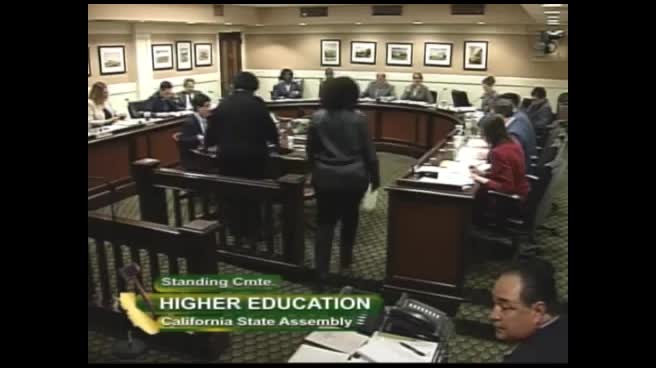
Assembly Standing Committee on Higher Education
Bill Author



