AB 1961: Student financial aid: Ortiz-Pacheco-Poochigian-Vasconcellos Cal Grant Program: private nonprofit postsecondary educational institutions.
- Session Year: 2015-2016
- House: Assembly
- Latest Version Date: 2016-04-21
Existing law, known as the Ortiz-Pacheco-Poochigian-Vasconcellos Cal Grant Program, establishes the Cal Grant A and B entitlement awards, the California Community College Transfer Entitlement awards, the Competitive Cal Grant A and B awards, the Cal Grant C awards, and the Cal Grant T awards under the administration of the Student Aid Commission, and establishes eligibility requirements for awards under these programs for participating students attending qualifying institutions.
Existing law establishes the maximum tuition award amount for each Cal Grant A and B award for new recipient students attending private nonprofit postsecondary educational institutions at $9,084 for the 201516 and 201617 award years and $8,056 for the 201718 award year and each award year thereafter. Existing law also establishes these amounts as the maximum tuition award amounts for new recipients attending private for-profit postsecondary educational institutions that are accredited, as specified.
This bill would instead increase the maximum tuition award amount for Cal Grant A and B awards for new recipients at private nonprofit postsecondary educational institutions to no less than $10,000 for the 201718 award year and each award year thereafter. For these award years, the maximum tuition award amounts would remain at $8,056 for new recipients attending accredited private for-profit postsecondary educational institutions as referred to above. The bill would impose requirements on private nonprofit postsecondary educational institutions to provide specified data to a specified association as a condition for the funding of Cal Grant awards to their students and would require the association to report on that information to the Legislature, the Governor, the Department of Finance, and the Legislative Analysts Office.
Existing law, known as the Ortiz-Pacheco-Poochigian-Vasconcellos Cal Grant Program, establishes the Cal Grant A and B entitlement awards, the California Community College Transfer Entitlement awards, the Competitive Cal Grant A and B awards, the Cal Grant C awards, and the Cal Grant T awards under the administration of the Student Aid Commission, and establishes eligibility requirements for awards under these programs for participating students attending qualifying institutions.
This bill would make nonsubstantive changes to these provisions.
Existing law establishes the maximum tuition award amount for each Cal Grant A and B award for new recipient students attending private nonprofit postsecondary educational institutions at $9,084 for the 201516 and 201617 award years and $8,056 for the 201718 award year and each award year thereafter. Existing law also establishes these amounts as the maximum tuition award amounts for new recipients attending private for-profit postsecondary educational institutions that are accredited, as specified.
This bill would instead increase the maximum tuition award amount for Cal Grant A and B awards for new recipients at private nonprofit postsecondary educational institutions to no less than $10,000 for the 201718 award year and each award year thereafter. For these award years, the maximum tuition award amounts would remain at $8,056 for new recipients attending accredited private for-profit postsecondary educational institutions as referred to above.
Existing law, known as the Ortiz-Pacheco-Poochigian-Vasconcellos Cal Grant Program, establishes the Cal Grant A and B entitlement awards, the California Community College Transfer Entitlement awards, the Competitive Cal Grant A and B awards, the Cal Grant C awards, and the Cal Grant T awards under the administration of the Student Aid Commission, and establishes eligibility requirements for awards under these programs for participating students attending qualifying institutions.
This bill would make nonsubstantive changes to these provisions.
(a)Cal Grant Program awards shall be known as Cal Grant A Entitlement Awards, Cal Grant B Entitlement Awards, California Community College Transfer Entitlement Awards, Competitive Cal Grant A and B Awards, Cal Grant C Awards, and Cal Grant T Awards.
(b)Maximum award amounts for students at independent institutions and for Cal Grant C and T awards shall be identified in the annual Budget Act. Maximum award amounts for Cal Grant A and B awards for students attending public institutions shall be referenced in the annual Budget Act.
(c)(1)Notwithstanding subdivision (b), and subdivision (c) of Section 66021.2, commencing with the 201314 award year, the maximum tuition award amounts for Cal Grant A and B awards for students attending private for-profit and nonprofit postsecondary educational institutions shall be as follows:
(A)Four thousand dollars ($4,000) for new recipients attending private for-profit postsecondary educational institutions.
(B)For the 201516 and 201617 award years, nine thousand eighty-four dollars ($9,084) for new recipients attending private nonprofit postsecondary educational institutions. For the 201718 award year and each award year thereafter, no less than ten thousand dollars ($10,000) ($10,000), as determined in the annual Budget Act, for new recipients attending private nonprofit postsecondary educational institutions.
(2)The renewal award amount for a student whose initial award is subject to a maximum award amount specified in this subdivision shall be calculated pursuant to paragraph (2) of subdivision (a) of Section 69433.
(3)Notwithstanding subparagraph (A) of paragraph (1), for the 201718 award year and each award year thereafter, the maximum tuition award amounts for new recipients attending private for-profit postsecondary educational institutions that are accredited by the Western Association of Schools and Colleges as of July 1, 2012, shall be eight thousand fifty-six dollars ($8,056).
(d)As a condition for the funding of Cal Grant awards to its students, a private nonprofit postsecondary educational institution shall submit performance metrics to the Association of Independent California Colleges and Universities. The association, in collaboration with the public segments of higher education, shall determine the form and content of these metrics, to ensure data are defined, collected, and reported in a consistent and comparable manner, and to ensure data integrity. The association shall provide that information in a cumulative report generated by the association to the Legislature, the Governor, the Department of Finance, and the Legislative Analysts Office on or before March 15, 2017, and on or before March 15 of each year thereafter. The report shall be submitted to the Legislature in compliance with Section 9795 of the Government Code and shall include all of the following data with respect to each participating private nonprofit postsecondary educational institution:
(1)The number of undergraduate students enrolled in that institution.
(2)The percentage of undergraduate students of that institution who are California residents.
(3)The number of graduate students enrolled in that institution.
(4)The number of transfer students from the California Community Colleges enrolled in that institution.
(5)The percentage of undergraduate students of that institution who are transfer students from the California Community Colleges.
(6)The number of Pell Grant recipients enrolled in that institution.
(7)The percentage of undergraduate students of that institution who are Pell Grant recipients.
(8)The number of Cal Grant recipients enrolled in that institution. With respect to those Cal Grant recipients, both of the following shall be included:
(A)Their ethnic composition, expressed in percentages.
(B)The median amount of institutional aid provided to them.
(9)The percentage of undergraduate students of that institution who are Cal Grant recipients.
(10)The four- and six-year graduation rates for freshman entrants of that institution disaggregated by both of the following:
(A)Pell Grant recipients.
(B)Cal Grant recipients.
(11)The two- and three-year graduation rates for transfer students from the California Community Colleges disaggregated by both of the following:
(A)Pell Grant recipients.
(B)Cal Grant recipients.
(12)The number of degrees awarded annually by the institution in total and in each of the following categories:
(A)Undergraduate students who first enrolled in the institution as freshmen.
(B)Undergraduate students who first enrolled in the institution as transfer students.
(C)Graduate students.
(D)Pell Grant recipients.
(E)The number of degrees or credentials awarded in health-related fields, teacher preparation, and the fields of science, technology, engineering, and mathematics (STEM).
(e)The collection, reporting, and housing of data for the report prepared pursuant to subdivision (d) shall be conducted both in a manner that ensures data integrity and security and that is in conformance with any federal and state laws on the confidentiality of student information.
(a)Cal Grant Program awards shall be known as Cal Grant A Entitlement Awards, Cal Grant B Entitlement Awards, California Community College Transfer Entitlement Awards, Competitive Cal Grant A and B Awards, Cal Grant C Awards, and Cal Grant T Awards.
(b)Maximum award amounts for students at independent institutions and for Cal Grant C and T awards shall be identified in the annual Budget Act. Maximum award amounts for Cal Grant A and B awards for students attending public institutions shall be referenced in the annual Budget Act.
(c)(1)Notwithstanding subdivision (b), and subdivision (c) of Section 66021.2, commencing with the 201314 award year, the maximum tuition award amounts for Cal Grant A and B awards for students attending private for-profit and nonprofit postsecondary educational institutions shall be as follows:
(A)Four thousand dollars ($4,000) for new recipients attending private for-profit postsecondary educational institutions.
(B)For the 201516 and 201617 award years, nine thousand eighty-four dollars ($9,084) for new recipients attending private nonprofit postsecondary educational institutions. For the 201718 award year and each award year thereafter, eight thousand fifty-six dollars ($8,056) no less than ten thousand dollars ($10,000) for new recipients attending private nonprofit postsecondary educational institutions.
(2)The renewal award amount for a student whose initial award is subject to a maximum award amount specified in this subdivision shall be calculated pursuant to paragraph (2) of subdivision (a) of Section 69433.
(3)Notwithstanding subparagraph (A) of paragraph (1), for the 201718 award year and each award year thereafter, the maximum tuition award amounts for new recipients attending private for-profit postsecondary educational institutions that are accredited by the Western Association of Schools and Colleges as of July 1, 2012, shall have the same maximum tuition award amounts as are set forth in subparagraph (B) of paragraph (1). be eight thousand fifty-six dollars ($8,056).
SECTION 1.Section 69437 of the Education Code is amended to read:69437.(a)Commencing with the 200102 academic year, and each academic year thereafter, there shall be established the Competitive Cal Grant A and Cal Grant B award program for students who did not receive a Cal Grant A or Cal Grant B entitlement award pursuant to Article 2 (commencing with Section 69434), Article 3 (commencing with Section 69435), or Article 4 (commencing with Section 69436). Awards made under this section are not entitlements. The submission of an application by a student under this section shall not entitle that student to an award. The selection of students under this article shall be determined pursuant to subdivision (c) and other relevant criteria established by the commission.
(b) Commencing with the 201516 academic year, a total of 25,750 Cal Grant A and Cal Grant B awards shall be granted annually under this article on a competitive basis for applicants who meet the general eligibility criteria established in Article 1 (commencing with Section 69430) and the priorities established by the commission pursuant to subdivision (c).
(1)Fifty percent of the awards referenced in this subdivision are available to all students, including California community college students, who meet the financial need and academic requirements established pursuant to this article. A student enrolling at a qualifying baccalaureate degree granting institution shall apply by the March 2 deadline. A California community college student is eligible to apply at the March 2 or the September 2 deadline.
(2)Fifty percent of the awards referenced in this subdivision are reserved for students who will be enrolled at a California community college. The commission shall establish a second application deadline of September 2 for community college students to apply for these awards effective with the fall term or semester of the 200102 academic year.
(3)If any awards are not distributed pursuant to paragraphs (1) and (2) upon initial allocation of the awards under this article, the commission shall make awards to as many eligible students as possible, beginning with the students with the lowest expected family contribution and highest academic merit, consistent with the criteria adopted by the commission pursuant to subdivision (c), as practicable without exceeding an annual cumulative total of 25,750 awards.
(c)(1)On or before February 1, 2001, acting pursuant to a public hearing process that is consistent with the Bagley-Keene Open Meeting Act (Article 9 (commencing with Section 11120) of Chapter 1 of Part 1 of Division 3 of Title 2 of the Government Code), the commission shall establish selection criteria for Cal Grant A and Cal Grant B awards under the competitive program that give special consideration to disadvantaged students, taking into consideration those financial, educational, cultural, language, home, community, environmental, and other conditions that hamper a students access to, and ability to persist in, postsecondary education programs.
(2)Additional consideration shall be given to both of the following:
(A)Students pursuing Cal Grant B awards who reestablish their grade point averages.
(B)Students who did not receive awards pursuant to Article 2 (commencing with Section 69434), Article 3 (commencing with Section 69435), or Article 4 (commencing with Section 69436).
(d)All other students who meet the eligibility requirements pursuant to Article 1 (commencing with Section 69430) are eligible to compete for an award pursuant to this article.
(a)Commencing with the 200102 academic year, and each academic year thereafter, there shall be established the Competitive Cal Grant A and Cal Grant B award program for students who did not receive a Cal Grant A or Cal Grant B entitlement award pursuant to Article 2 (commencing with Section 69434), Article 3 (commencing with Section 69435), or Article 4 (commencing with Section 69436). Awards made under this section are not entitlements. The submission of an application by a student under this section shall not entitle that student to an award. The selection of students under this article shall be determined pursuant to subdivision (c) and other relevant criteria established by the commission.
(b) Commencing with the 201516 academic year, a total of 25,750 Cal Grant A and Cal Grant B awards shall be granted annually under this article on a competitive basis for applicants who meet the general eligibility criteria established in Article 1 (commencing with Section 69430) and the priorities established by the commission pursuant to subdivision (c).
(1)Fifty percent of the awards referenced in this subdivision are available to all students, including California community college students, who meet the financial need and academic requirements established pursuant to this article. A student enrolling at a qualifying baccalaureate degree granting institution shall apply by the March 2 deadline. A California community college student is eligible to apply at the March 2 or the September 2 deadline.
(2)Fifty percent of the awards referenced in this subdivision are reserved for students who will be enrolled at a California community college. The commission shall establish a second application deadline of September 2 for community college students to apply for these awards effective with the fall term or semester of the 200102 academic year.
(3)If any awards are not distributed pursuant to paragraphs (1) and (2) upon initial allocation of the awards under this article, the commission shall make awards to as many eligible students as possible, beginning with the students with the lowest expected family contribution and highest academic merit, consistent with the criteria adopted by the commission pursuant to subdivision (c), as practicable without exceeding an annual cumulative total of 25,750 awards.
(c)(1)On or before February 1, 2001, acting pursuant to a public hearing process that is consistent with the Bagley-Keene Open Meeting Act (Article 9 (commencing with Section 11120) of Chapter 1 of Part 1 of Division 3 of Title 2 of the Government Code), the commission shall establish selection criteria for Cal Grant A and Cal Grant B awards under the competitive program that give special consideration to disadvantaged students, taking into consideration those financial, educational, cultural, language, home, community, environmental, and other conditions that hamper a students access to, and ability to persist in, postsecondary education programs.
(2)Additional consideration shall be given to both of the following:
(A)Students pursuing Cal Grant B awards who reestablish their grade point averages.
(B)Students who did not receive awards pursuant to Article 2 (commencing with Section 69434), Article 3 (commencing with Section 69435), or Article 4 (commencing with Section 69436).
(d)All other students who meet the eligibility requirements pursuant to Article 1 (commencing with Section 69430) are eligible to compete for an award pursuant to this article.
|
Date
|
Status
|
|---|---|
| Feb 12, 2016 | Read first time. To print. |
| Feb 16, 2016 | From printer. May be heard in committee March 17. |
| Mar 17, 2016 | From committee chair, with author's amendments: Amend, and re-refer to Com. on HIGHER ED. Read second time and amended. |
| Mar 17, 2016 | Referred to Com. on HIGHER ED. |
| Mar 28, 2016 | Re-referred to Com. on HIGHER ED. |
| Apr 20, 2016 | From committee: Amend, and do pass as amended and re-refer to Com. on APPR. (Ayes 12. Noes 0.) (April 19). |
| Apr 21, 2016 | Read second time and amended. |
| Apr 25, 2016 | Re-referred to Com. on APPR. |
| May 11, 2016 | In committee: Set, first hearing. Referred to APPR. suspense file. |
| May 27, 2016 | In committee: Held under submission. |
|
Date
|
Description
|
Location
|
Votes
|
|
|---|---|---|---|---|
| Apr 19, 2016 | Do pass as amended and be re-referred to the Committee on [Appropriations] | Assembly Standing Committee on Higher Education |
Passed |
This list shows positions taken on this bill by organizations on the date displayed, which is linked to the original source.
Positions by individuals are not included.
|
Organization
|
Position
|
Date
|
|---|---|---|
| American Association of Independent Colleges and Universities | ** Support | Apr 19, 2016 |
| California Chamber Of Commerce | ** Support | Apr 19, 2016 |
Date of Hearing: May 11, 2016
ASSEMBLY COMMITTEE ON APPROPRIATIONS
Lorena Gonzalez, Chair
ABPCA Bill Id:AB 1961
Author:(Baker) – As Amended Ver:April 21, 2016
Policy Committee: | Higher Education | Vote: | 12 - 0 |
Urgency: No State Mandated Local Program: No Reimbursable: No
SUMMARY:
This bill:
- Increases, from $8,056 to no less than $10,000, the maximum Cal Grant award, for 2017-18 and thereafter, for private, nonprofit postsecondary educational institutions.
- Requires private, nonprofit postsecondary educational institutions, as a condition for the funding of Cal Grants to its students, to annually report specified student performance metrics to the Association of Independent Colleges and Universities (AICCU), which must submit a cumulative report to the Legislature, Governor, Department of Finance, and Legislative Analyst's Office by March 15 of each year.
FISCAL EFFECT:
General Fund costs, for increase grant awards, of about $15 million in 2017-18, increasing to $50 million in 2020-21.
COMMENTS:
Background and Purpose. Under current law, the maximum Cal Grant award amount, for students attending private non-profit institutions or private for-profit WASC accredited institutions, is set at $9,084 for 2015-16 and reduces to $8,056 beginning in 2017-18. According to the author, "this bill would bring more parity to Cal Grant students attending private nonprofit universities with those at California’s public institutions. Also, stopping the 11.3% cut slated for 2017-18 will prevent further access limits to higher education opportunities for California students at a time when public colleges and universities are already admitting fewer Californians."
In addition, the reporting requirements in this bill mirror reports provided by the California State University and the University of California. AB 831 (Bonilla), which in part included these same reporting requirements, was held on this committee's Suspense file.
Analysis Prepared by: Chuck Nicol / APPR. / (916) 319-2081
Date of Hearing: April 19, 2016
ASSEMBLY COMMITTEE ON HIGHER EDUCATION
Jose Medina, Chair
ABPCA Bill Id:AB 1961 (
Author:Baker) – As Amended Ver:March 17, 2016
SUBJECT: Student financial aid: Ortiz-Pacheco-Poochigian-Vasconcellos Cal Grant Program: private nonprofit postsecondary educational institutions
SUMMARY: Increases the maximum amount of the Cal Grant program for the 2017-18 award year and each award year thereafter for private, nonprofit postsecondary educational institutions from $8,056 to no less than $10,000.
EXISTING LAW: Authorizes the Cal Grant Program, administered by CSAC, to provide grants to financially needy students to attend college. The maximum grants for Cal Grant A and B awards, for students attending University of California (UC) and California State University (CSU) are equal to the amount of mandatory systemwide fees at the respective segments. The maximum award amount for students attending private institutions is set at $4,000 for private for-profit institutions and for private non-profit institutions or private for-profit WASC accredited institutions, the amount is set at $9,084, and reduces to $8,056 beginning in 2017-18.
FISCAL EFFECT: Unknown.
COMMENTS: Purpose of this bill. According to the author, "this bill would bring more parity to Cal Grant students attending private nonprofit universities with those at California’s public institutions. Also, stopping the 11.3 percent cut slated for 2017-18 will prevent further access limits to higher education opportunities for California students at a time when public colleges and universities are already admitting fewer Californians. Increasing opportunities for higher education in California will impact the growth of the state’s economy by improving workforce development.
Background on Cal Grant Program. According to the Public Policy Institute of California (PPIC), more than half of all postsecondary students in California receive grant or scholarship aid. The primary sources of financial aid funding are the federal government (43% in 2012), the state government (23% in 2012) and institutional aid (27% in 2012).
State grant aid in California is provided primarily through the Cal Grant Program and the CCC Board of Governors Fee Waiver program. Cal Grant A awards cover full tuition and fees at UC ($12,192) or CSU ($5,472), up to $9,048 at private colleges accredited by the Western Association of Schools and Colleges (WASC), and up to $4,000 at other private colleges. Cal Grant B awards provide additional grant aid up to $1,648 for very low-income students to help pay for access costs. Cal Grant C provides up to $2,462 in tuition and $547 for living expenses for vocational students.
Cal Grant A and B Entitlement Awards guarantee awards to students who meet specified GPA and income-related criteria and apply within deadlines. The majority of Cal Grant recipients (211,300 in 2013-14) receive an Entitlement award. The majority of Cal Grant applicants, however, do not qualify for an Entitlement award because they are more than a year out of high school, decide to go to college after the Entitlement application deadline, or do not meet age or other requirements when they transfer. Competitive Cal Grant A and B awards are available to applicants who did not receive an entitlement award. In the Competitive program, over 300,000 applicants compete annually for 22,500 awards.
Unmet need. According to The Institute for College Access and Success (TICAS), the Cal Grant Program leaves the neediest students underserved. Less than one quarter of the lowest income aid applicants in California receives a Cal Grant and on average lower income recipients are awarded smaller grants than higher income recipients. TICAS notes that underrepresented students are also less likely to receive grants, and their grants tend to be smaller. The average student denied a Cal Grant has an average family income of less than $21,000, a family size of three, and a GPA of 2.9. The Committee may wish to consider how the proposal contained in this bill, to increase the maximum grant amount for students attending private non-profit colleges, fits into overall higher education affordability priorities.
Prior Legislation. AB 831 (Bonilla) of 2015, and 1318 (Bonilla) of 2014 would have established a formula to determine the amount of Cal Grant awards for students attending private colleges based on the average General Fund subsidy the state provides for financially needy students attending the University of California and California State University. Additionally, these bills would have required these institutions to report on specified performance and outcome measures, consistent with reporting requirements of CSU and UC. AB 831 was held in the Assembly Appropriations Committee and AB 1318 was held by the author on the Senate Floor.
Accountability and reporting. As part of the 2013-14 Budget (AB 94, Committee on Budget, 2013), the Legislature requires the UC and the CSU to annually report on specified performance measures for the preceding academic year in order to inform budget and policy decisions, and promote the effective and efficient use of available resources. These performance measures include data on the number of transfer students, the number and proportion of low-income students, graduation rates, transfer rates, degree completions, costs per degree, the number of Science, Technology, Engineering and Math (STEM) degrees and other measures.
This bill would expend additional public resources at nonprofit, private WASC-accredited institutions through the Cal Grant Program. AB 831 and AB 1318, which also proposed to increase the maximum Cal Grant award for independent institutions, required institutions to report on performance measures similar to those contained in AB 94. The goal was to promote the effective and efficient use of state financial funds.
Suggested amendments. The author and committee may wish to consider amendments, consistent with the language included in AB 831, as approved by this committee in 2015, to require annual reporting similar to that required of CSU and UC:
- Require, as a condition for increased funding, a private nonprofit postsecondary educational institution to submit performance metrics to the Association of Independent California Colleges and Universities (AICCU).
- Require AICCU, in collaboration with the public higher education segments, to determine a form and content for consistent collection and reporting of required performance metrics.
- Require AICCU to provide performance metric data in a cumulative report to the Legislature, Governor, Department of Finance, and Legislative Analyst's Office on or before March 15, 2017 and each year thereafter.
- Require the AICCU report to include all of the following data with respect to each participating private nonprofit postsecondary educational institution:
- The number of undergraduate students enrolled in that institution and the percentage who are California residents;
- The number of graduate students enrolled in that institution;
- The number of transfer students from the California Community Colleges (CCC) enrolled in that institution and the percentage of undergraduate students of that institution who are transfer students from the CCC;
- The number of Pell Grant recipients enrolled in that institution and the percentage of undergraduate students of that institution who are Pell Grant recipients;
- The number and percentage of Cal Grant recipients enrolled in that institution and their ethnic composition and the median amount of institutional aid provided to them;
- The four- and six-year graduation rates for freshman entrants of that institution disaggregated by Pell and Cal Grant recipients;
- The two- and three-year graduation rates for transfer students from the CCC disaggregated by Pell and Cal Grant recipients;
- The number of degrees awarded annually by the institution in total and in each of the following categories:
- Undergraduate students who first enrolled in the institution as freshmen;
- Undergraduate students who first enrolled in the institution as transfer students;
- Graduate students;
- Pell Grant recipients; and,
- The number of degrees or credentials awarded in health-related fields, teacher preparation, and the fields of science, technology, engineering, and mathematics.
Unclear grant amount. As drafted, the bill provides that the Cal Grant award amount, as proposed, will be no less than $10,000. Committee staff understands that the author's intent is that this amount could be increased, but not decreased below $10,000, in the annual Budget Act.
REGISTERED SUPPORT / OPPOSITION:
Support
American Association of Independent Colleges and Universities
California Chamber of Commerce
Opposition
None on File
Analysis Prepared by: Laura Metune / HIGHER ED. / (916) 319-3960
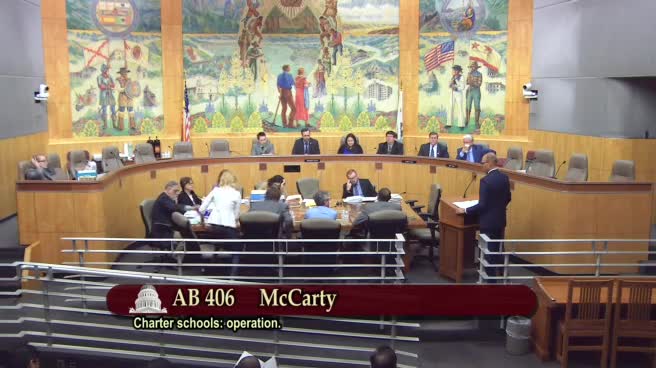
Discussed in Hearing
 3MIN
Senate Standing Committee on Education
 7MIN
Assembly Standing Committee on Higher Education
Bill Author

Bill Co-Author(s):