AB 2694: Taxation: renters’ credit.
- Session Year: 2015-2016
- House: Assembly
- Latest Version Date: 2016-05-12
The Personal Income Tax Law authorizes various credits against the taxes imposed by that law, including a credit for qualified renters in the amount of $120 for married couples filing joint returns, heads of household, and surviving spouses if adjusted gross income is $50,000, as adjusted, or less, and in the amount of $60 for other individuals if adjusted gross income is $25,000, as adjusted, or less. Existing law requires the Franchise Tax Board to annually adjust for inflation these adjusted gross income amounts. For 2016, the adjusted gross income limit is $76,518 and $38,259, respectively.
This bill would, for taxable years beginning on and after January 1, 2016, and before January 1, 2020, increase this credit for a qualified renter to $240 $140 for married couples filing joint returns, heads of household, and surviving spouses if adjusted gross income is $100,000 or less, and to an amount equal to $120 $70 for other individuals if adjusted gross income is $50,000 or less. The bill would require the Franchise Tax Board to annually adjust the adjusted gross income amount for inflation, beginning January 1, 2017. individuals.
This bill would take effect immediately as a tax levy.
The Personal Income Tax Law authorizes various credits against the taxes imposed by that law, including a credit for qualified renters in the amount of $120 for married couples filing joint returns, heads of household, and surviving spouses if adjusted gross income is $50,000, as adjusted, or less, and in the amount of $60 for other individuals if adjusted gross income is $25,000, as adjusted, or less. Existing law requires the Franchise Tax Board to annually adjust for inflation these adjusted gross income amounts. For 2016, the adjusted gross income limit is $76,518 and $38,259, respectively.
This bill would, for taxable years beginning on and after January 1, 2016, increase this credit for a qualified renter to $240 for married couples filing joint returns, heads of household, and surviving spouses if adjusted gross income is $100,000 or less, and to an amount equal to $120 for other individuals if adjusted gross income is $50,000 or less. The bill would require the Franchise Tax Board to annually adjust the adjusted gross income amount for inflation, beginning January 1, 2017.
This bill would take effect immediately as a tax levy.
(a)(1)For a qualified renter, there shall be allowed a credit against his or her net tax, as defined in Section 17039. The amount of the credit shall be as follows:
(A)For taxable years beginning before January 1, 2016: 2016, and for taxable years beginning on or after January 1, 2020:
(i)For married couples filing joint returns, heads of household, and surviving spouses, as defined in Section 17046, the credit shall be equal to one hundred twenty dollars ($120) if adjusted gross income is fifty thousand dollars ($50,000) or less.
(ii)For other individuals, the credit shall be equal to sixty dollars ($60) if adjusted gross income is twenty-five thousand dollars ($25,000) or less.
(B)For taxable years beginning on or after January 1, 2016: 2016, and before January 1, 2020:
(i)For married couples filing joint returns, heads of household, and surviving spouses, as defined in Section 17046, the credit shall be equal to two hundred forty dollars ($240) if adjusted gross income is one hundred thousand dollars ($100,000) or less. one hundred forty dollars ($140).
(ii)For other individuals, the credit shall be equal to one hundred twenty dollars ($120) if adjusted gross income is fifty thousand dollars ($50,000) or less. seventy dollars ($70).
(2)Except as provided in subdivision (b), a husband and wife shall receive only one credit under this section. If the husband and wife file separate returns, the credit may be taken by either or equally divided between them, except as follows:
(A)If one spouse was a resident for the entire taxable year and the other spouse was a nonresident for part or all of the taxable year, the resident spouse shall be allowed one-half the credit allowed to married persons and the nonresident spouse shall be permitted one-half the credit allowed to married persons, prorated as provided in subdivision (e).
(B)If both spouses were nonresidents for part of the taxable year, the credit allowed to married persons shall be divided equally between them subject to the proration provided in subdivision (e).
(b)For a husband and wife, if each spouse maintained a separate place of residence and resided in this state during the entire taxable year, each spouse will be allowed one-half the full credit allowed to married persons provided in subdivision (a).
(c)For purposes of this section, a qualified renter means an individual who satisfies both of the following:
(1)Was a resident of this state, as defined in Section 17014.
(2)Rented and occupied premises in this state which constituted his or her principal place of residence during at least 50 percent of the taxable year.
(d)Qualified renter does not include any of the following:
(1)An individual who for more than 50 percent of the taxable year rented and occupied premises that were exempt from property taxes, except that an individual, otherwise qualified, is deemed a qualified renter if he or she or his or her landlord pays possessory interest taxes, or the owner of those premises makes payments in lieu of property taxes that are substantially equivalent to property taxes paid on properties of comparable market value.
(2)An individual whose principal place of residence for more than 50 percent of the taxable year is with any other person who claimed that individual as a dependent for income tax purposes.
(3)An individual who has been granted or whose spouse has been granted the homeowners property tax exemption during the taxable year. This paragraph does not apply to an individual whose spouse has been granted the homeowners property tax exemption if each spouse maintained a separate residence for the entire taxable year.
(e)An otherwise qualified renter who is a nonresident for any portion of the taxable year shall claim the credits set forth in subdivision (a) at the rate of one-twelfth of those credits for each full month that individual resided within this state during the taxable year.
(f)A person claiming the credit provided in this section shall, as part of that claim, and under penalty of perjury, furnish that information as the Franchise Tax Board prescribes on a form supplied by the board.
(g)The credit provided in this section shall be claimed on returns in the form as the Franchise Tax Board may from time to time prescribe.
(h)For purposes of this section, premises means a house or a dwelling unit used to provide living accommodations in a building or structure and the land incidental thereto, but does not include land only, unless the dwelling unit is a mobilehome. The credit is not allowed for any taxable year for the rental of land upon which a mobilehome is located if the mobilehome has been granted a homeowners exemption under Section 218 in that year.
(i)This section shall become operative on January 1, 1998, and applies to any taxable year beginning on or after January 1, 1998.
(j)For each taxable year beginning on or after January 1, 1999, and before January 1, 2016, and for each taxable year beginning on or after January 1, 2017, 1999, the Franchise Tax Board shall recompute the adjusted gross income amounts set forth in subparagraphs (A) and (B), respectively, subparagraph (A) of paragraph (1) of subdivision (a). The computation shall be made as follows:
(1)The Department of Industrial Relations shall transmit annually to the Franchise Tax Board the percentage change in the California Consumer Price Index for all items from June of the prior calendar year to June of the current year, no later than August 1 of the current calendar year.
(2)The Franchise Tax Board shall compute an inflation adjustment factor by adding 100 percent to that portion of the percentage change figure furnished pursuant to paragraph (1) and dividing the result by 100.
(3)The Franchise Tax Board shall multiply the amounts in subparagraph (A) of paragraph (1) of subdivision (a) for the preceding taxable year by the inflation adjustment factor determined in paragraph (2), and round off the resulting products to the nearest one dollar ($1).
(4)(A)In computing the amounts pursuant to this subdivision, the amounts provided in clause (i) of subparagraph (A) of paragraph (1) of subdivision (a) shall be twice the amount provided in clause (ii) of subparagraph (A) of paragraph (1) of subdivision (a).
(B)In computing the amounts pursuant to this subdivision, the amounts provided in clause (i) of subparagraph (B) of paragraph (1) of subdivision (a) shall be twice the amount provided in clause (ii) of subparagraph (B) of paragraph (1) of subdivision (a).
SEC. 2.This act provides for a tax levy within the meaning of Article IV of the California Constitution and shall go into immediate effect.
(a)(1)For a qualified renter, there shall be allowed a credit against his or her net tax, as defined in Section 17039. The amount of the credit shall be as follows:
(A)For taxable years beginning before January 1, 2016:
(i)For married couples filing joint returns, heads of household, and surviving spouses, as defined in Section 17046, the credit shall be equal to one hundred twenty dollars ($120) if adjusted gross income is fifty thousand dollars ($50,000) or less.
(ii)For other individuals, the credit shall be equal to sixty dollars ($60) if adjusted gross income is twenty-five thousand dollars ($25,000) or less.
(B)For taxable years beginning on or after January 1, 2016:
(i)For married couples filing joint returns, heads of household, and surviving spouses, as defined in Section 17046, the credit shall be equal to two hundred forty dollars ($240) if adjusted gross income is one hundred thousand dollars ($100,000) or less.
(ii)For other individuals, the credit shall be equal to one hundred twenty dollars ($120) if adjusted gross income is fifty thousand dollars ($50,000) or less.
(2)Except as provided in subdivision (b), a husband and wife shall receive only one credit under this section. If the husband and wife file separate returns, the credit may be taken by either or equally divided between them, except as follows:
(A)If one spouse was a resident for the entire taxable year and the other spouse was a nonresident for part or all of the taxable year, the resident spouse shall be allowed one-half the credit allowed to married persons and the nonresident spouse shall be permitted one-half the credit allowed to married persons, prorated as provided in subdivision (e).
(B)If both spouses were nonresidents for part of the taxable year, the credit allowed to married persons shall be divided equally between them subject to the proration provided in subdivision (e).
(b)For a husband and wife, if each spouse maintained a separate place of residence and resided in this state during the entire taxable year, each spouse will be allowed one-half the full credit allowed to married persons provided in subdivision (a).
(c)For purposes of this section, a qualified renter means an individual who satisfies both of the following:
(1)Was a resident of this state, as defined in Section 17014.
(2)Rented and occupied premises in this state which constituted his or her principal place of residence during at least 50 percent of the taxable year.
(d)Qualified renter does not include any of the following:
(1)An individual who for more than 50 percent of the taxable year rented and occupied premises that were exempt from property taxes, except that an individual, otherwise qualified, is deemed a qualified renter if he or she or his or her landlord pays possessory interest taxes, or the owner of those premises makes payments in lieu of property taxes that are substantially equivalent to property taxes paid on properties of comparable market value.
(2)An individual whose principal place of residence for more than 50 percent of the taxable year is with any other person who claimed that individual as a dependent for income tax purposes.
(3)An individual who has been granted or whose spouse has been granted the homeowners property tax exemption during the taxable year. This paragraph does not apply to an individual whose spouse has been granted the homeowners property tax exemption if each spouse maintained a separate residence for the entire taxable year.
(e)An otherwise qualified renter who is a nonresident for any portion of the taxable year shall claim the credits set forth in subdivision (a) at the rate of one-twelfth of those credits for each full month that individual resided within this state during the taxable year.
(f)A person claiming the credit provided in this section shall, as part of that claim, and under penalty of perjury, furnish that information as the Franchise Tax Board prescribes on a form supplied by the board.
(g)The credit provided in this section shall be claimed on returns in the form as the Franchise Tax Board may from time to time prescribe.
(h)For purposes of this section, premises means a house or a dwelling unit used to provide living accommodations in a building or structure and the land incidental thereto, but does not include land only, unless the dwelling unit is a mobilehome. The credit is not allowed for any taxable year for the rental of land upon which a mobilehome is located if the mobilehome has been granted a homeowners exemption under Section 218 in that year.
(i)This section shall become operative on January 1, 1998, and applies to any taxable year beginning on or after January 1, 1998.
(j)For each taxable year beginning on or after January 1, 1999, and before January 1, 2016, and for each taxable year beginning on or after January 1, 2017, the Franchise Tax Board shall recompute the adjusted gross income amounts set forth in subparagraphs (A) and (B), respectively, of paragraph (1) of subdivision (a). The computation shall be made as follows:
(1)The Department of Industrial Relations shall transmit annually to the Franchise Tax Board the percentage change in the California Consumer Price Index for all items from June of the prior calendar year to June of the current year, no later than August 1 of the current calendar year.
(2)The Franchise Tax Board shall compute an inflation adjustment factor by adding 100 percent to that portion of the percentage change figure furnished pursuant to paragraph (1) and dividing the result by 100.
(3)The Franchise Tax Board shall multiply the amounts in paragraph (1) of subdivision (a) for the preceding taxable year by the inflation adjustment factor determined in paragraph (2), and round off the resulting products to the nearest one dollar ($1).
(4)(A)In computing the amounts pursuant to this subdivision, the amounts provided in clause (i) of subparagraph (A) of paragraph (1) of subdivision (a) shall be twice the amount provided in clause (ii) of subparagraph (B) (A) of paragraph (1) of subdivision (a).
(B)In computing the amounts pursuant to this subdivision, the amounts provided in clause (i) of subparagraph (B) of paragraph (1) of subdivision (a) shall be twice the amount provided in clause (ii) of subparagraph (B) of paragraph (1) of subdivision (a).
SEC. 2.This act provides for a tax levy within the meaning of Article IV of the Constitution and shall go into immediate effect.
(a)(1)For a qualified renter, there shall be allowed a credit against his or her net tax, as defined in Section 17039. The amount of the credit shall be as follows:
(A)For taxable years beginning before January 1, 2016:
(i)For married couples filing joint returns, heads of household, and surviving spouses, as defined in Section 17046, the credit shall be equal to one hundred twenty dollars ($120) if adjusted gross income is fifty thousand dollars ($50,000) or less.
(ii)For other individuals, the credit shall be equal to sixty dollars ($60) if adjusted gross income is twenty-five thousand dollars ($25,000) or less.
(B)For taxable years beginning on or after January 1, 2016:
(i)For married couples filing joint returns, heads of household, and surviving spouses, as defined in Section 17046, the credit shall be equal to two hundred forty dollars ($240) if adjusted gross income is one hundred thousand dollars ($100,000) or less.
(ii)For other individuals, the credit shall be equal to one hundred twenty dollars ($120) if adjusted gross income is fifty thousand dollars ($50,000) or less.
(2)Except as provided in subdivision (b), a husband and wife shall receive but only one credit under this section. If the husband and wife file separate returns, the credit may be taken by either or equally divided between them, except as follows:
(A)If one spouse was a resident for the entire taxable year and the other spouse was a nonresident for part or all of the taxable year, the resident spouse shall be allowed one-half the credit allowed to married persons and the nonresident spouse shall be permitted one-half the credit allowed to married persons, prorated as provided in subdivision (e).
(B)If both spouses were nonresidents for part of the taxable year, the credit allowed to married persons shall be divided equally between them subject to the proration provided in subdivision (e).
(b)For a husband and wife, if each spouse maintained a separate place of residence and resided in this state during the entire taxable year, each spouse will be allowed one-half the full credit allowed to married persons provided in subdivision (a).
(c)For purposes of this section, a qualified renter means an individual who satisfies both of the following:
(1)Was a resident of this state, as defined in Section 17014.
(2)Rented and occupied premises in this state which constituted his or her principal place of residence during at least 50 percent of the taxable year.
(d)Qualified renter does not include any of the following:
(1)An individual who for more than 50 percent of the taxable year rented and occupied premises that were exempt from property taxes, except that an individual, otherwise qualified, is deemed a qualified renter if he or she or his or her landlord pays possessory interest taxes, or the owner of those premises makes payments in lieu of property taxes that are substantially equivalent to property taxes paid on properties of comparable market value.
(2)An individual whose principal place of residence for more than 50 percent of the taxable year is with any other person who claimed that individual as a dependent for income tax purposes.
(3)An individual who has been granted or whose spouse has been granted the homeowners property tax exemption during the taxable year. This paragraph does not apply to an individual whose spouse has been granted the homeowners property tax exemption if each spouse maintained a separate residence for the entire taxable year.
(e)An otherwise qualified renter who is a nonresident for any portion of the taxable year shall claim the credits set forth in subdivision (a) at the rate of one-twelfth of those credits for each full month that individual resided within this state during the taxable year.
(f)A person claiming the credit provided in this section shall, as part of that claim, and under penalty of perjury, furnish that information as the Franchise Tax Board prescribes on a form supplied by the board.
(g)The credit provided in this section shall be claimed on returns in the form as the Franchise Tax Board may from time to time prescribe.
(h)For purposes of this section, premises means a house or a dwelling unit used to provide living accommodations in a building or structure and the land incidental thereto, but does not include land only, unless the dwelling unit is a mobilehome. The credit is not allowed for any taxable year for the rental of land upon which a mobilehome is located if the mobilehome has been granted a homeowners exemption under Section 218 in that year.
(i)This section shall become operative on January 1, 1998, and applies to any taxable year beginning on or after January 1, 1998.
(j)For each taxable year beginning on or after January 1, 1999, and before January 1, 2016, and for each taxable year beginning on or after January 1, 2017, the Franchise Tax Board shall recompute the adjusted gross income amounts set forth in subparagraphs (A) and (B), respectively, of paragraph (1) of subdivision (a). The computation shall be made as follows:
(1)The Department of Industrial Relations shall transmit annually to the Franchise Tax Board the percentage change in the California Consumer Price Index for all items from June of the prior calendar year to June of the current year, no later than August 1 of the current calendar year.
(2)The Franchise Tax Board shall compute an inflation adjustment factor by adding 100 percent to that portion of the percentage change figure furnished pursuant to paragraph (1) and dividing the result by 100.
(3)The Franchise Tax Board shall multiply the amounts in paragraph (1) of subdivision (a) for the preceding taxable year by the inflation adjustment factor determined in paragraph (2), and round off the resulting products to the nearest one dollar ($1).
(4)In computing the amounts pursuant to this subdivision, the amounts provided in subparagraph (A) of paragraph (1) of subdivision (a) shall be twice the amount provided in subparagraph (B) of paragraph (1) of subdivision (a).
SEC. 2.This act provides for a tax levy within the meaning of Article IV of the Constitution and shall go into immediate effect.
(a)(1)For a qualified renter, there shall be allowed a credit against his or her net tax, as defined in Section 17039. The amount of the credit shall be as follows:
(A)For taxable years beginning before January 1, 2016: married
(i)For married couples filing joint returns, heads of household, and surviving spouses, as defined in Section 17046, the credit shall be equal to one hundred twenty dollars ($120) if adjusted gross income is fifty thousand dollars ($50,000) or less.
(B)
(ii)For other individuals, tax the credit shall be equal to sixty dollars ($60) if adjusted gross income is twenty-five thousand dollars ($25,000) or less.
(B)
(B)For taxable years beginning on or after January 1, 2016:
(i)For married couples filing joint returns, heads of household, and surviving spouses, as defined in Section 17046, the credit shall be equal to two hundred forty dollars ($240) if adjusted gross income is one hundred thousand dollars ($100,000) or less.
(ii)For other individuals, the credit shall be equal to one hundred twenty dollars ($120) if adjusted gross income is fifty thousand dollars ($50,000) or less.
(2)Except as provided in subdivision (b), a husband and wife shall receive but one credit under this section. If the husband and wife file separate returns, the credit may be taken by either or equally divided between them, except as follows:
(A)If one spouse was a resident for the entire taxable year and the other spouse was a nonresident for part or all of the taxable year, the resident spouse shall be allowed one-half the credit allowed to married persons and the nonresident spouse shall be permitted one-half the credit allowed to married persons, prorated as provided in subdivision (e).
(B)If both spouses were nonresidents for part of the taxable year, the credit allowed to married persons shall be divided equally between them subject to the proration provided in subdivision (e).
(b)For a husband and wife, if each spouse maintained a separate place of residence and resided in this state during the entire taxable year, each spouse will be allowed one-half the full credit allowed to married persons provided in subdivision (a).
(c)For purposes of this section, a qualified renter means an individual who satisfies both of the following:
(1)Was a resident of this state, as defined in Section 17014.
(2)Rented and occupied premises in this state which constituted his or her principal place of residence during at least 50 percent of the taxable year.
(d)Qualified renter does not include any of the following:
(1)An individual who for more than 50 percent of the taxable year rented and occupied premises that were exempt from property taxes, except that an individual, otherwise qualified, is deemed a qualified renter if he or she or his or her landlord pays possessory interest taxes, or the owner of those premises makes payments in lieu of property taxes that are substantially equivalent to property taxes paid on properties of comparable market value.
(2)An individual whose principal place of residence for more than 50 percent of the taxable year is with another any other person who claimed that individual as a dependent for income tax purposes.
(3)An individual who has been granted or whose spouse has been granted the homeowners property tax exemption during the taxable year. This paragraph does not apply to an individual whose spouse has been granted the homeowners property tax exemption if each spouse maintained a separate residence for the entire taxable year.
(e)An otherwise qualified renter who is a nonresident for any portion of the taxable year shall claim the credits set forth in subdivision (a) at the rate of one-twelfth of those credits for each full month that individual resided within this state during the taxable year.
(f)A person claiming the credit provided in this section shall, as part of that claim, and under penalty of perjury, furnish that information as the Franchise Tax Board prescribes on a form supplied by the board.
(g)The credit provided in this section shall be claimed on returns in the form as the Franchise Tax Board may from time to time prescribe.
(h)For purposes of this section, premises means a house or a dwelling unit used to provide living accommodations in a building or structure and the land incidental thereto, but does not include land only, unless the dwelling unit is a mobilehome. The credit is not allowed for any taxable year for the rental of land upon which a mobilehome is located if the mobilehome has been granted a homeowners exemption under Section 218 in that year.
(i)This section shall become operative on January 1, 1998, and applies to any taxable year beginning on or after January 1, 1998.
(j)For each taxable year beginning on or after January 1, 1999, and before January 1, 2016, and for each taxable year beginning on or after January 1, 2017, the Franchise Tax Board shall recompute the adjusted gross income amounts set forth in subparagraphs (A) and (B), respectively, of paragraph (1) subdivision (a). The computation shall be made as follows:
(1)The Department of Industrial Relations shall transmit annually to the Franchise Tax Board the percentage change in the California Consumer Price Index for all items from June of the prior calendar year to June of the current year, no later than August 1 of the current calendar year.
(2)The Franchise Tax Board shall compute an inflation adjustment factor by adding 100 percent to the that portion of the percentage change figure which is furnished pursuant to paragraph (1) and dividing the result by 100.
(3)The Franchise Tax Board shall multiply the amount in subparagraph (B) of amounts in paragraph (1) of subdivision (d) (a) for the preceding taxable year by the inflation adjustment factor determined in paragraph (2), and round off the resulting products to the nearest one dollar ($1).
(4)In computing the amounts pursuant to this subdivision, the amounts provided in subparagraph (A) of paragraph (1) of subdivision (a) shall be twice the amount provided in subparagraph (B) of paragraph (1) of subdivision (a).
SEC. 2.This act provides for a tax levy within the meaning of Article IV of the Constitution and shall go into immediate effect.
|
Date
|
Status
|
|---|---|
| Feb 19, 2016 | Introduced. To print. |
| Feb 21, 2016 | From printer. May be heard in committee March 22. |
| Feb 22, 2016 | Read first time. |
| Mar 10, 2016 | Referred to Com. on REV. & TAX. |
| Mar 28, 2016 | From committee chair, with author's amendments: Amend, and re-refer to Com. on REV. & TAX. Read second time and amended. |
| Mar 29, 2016 | Re-referred to Com. on REV. & TAX. |
| Apr 6, 2016 | From committee chair, with author's amendments: Amend, and re-refer to Com. on REV. & TAX. Read second time and amended. |
| Apr 7, 2016 | Re-referred to Com. on REV. & TAX. |
| May 9, 2016 | In committee: Set, first hearing. Referred to REV. & TAX. suspense file. |
| May 11, 2016 | From committee: Amend, and do pass as amended and re-refer to Com. on APPR. (Ayes 9. Noes 0.) (May 9). |
| May 12, 2016 | Read second time and amended. |
| May 16, 2016 | Re-referred to Com. on APPR. |
| May 18, 2016 | In committee: Set, first hearing. Referred to APPR. suspense file. |
| May 27, 2016 | In committee: Held under submission. |
|
Date
|
Description
|
Location
|
Votes
|
|
|---|---|---|---|---|
| May 9, 2016 | Do pass as amended and be re-referred to the Committee on [Appropriations] | Assembly Standing Committee on Revenue and Taxation |
Passed |
This list shows positions taken on this bill by organizations on the date displayed, which is linked to the original source.
Positions by individuals are not included.
|
Organization
|
Position
|
Date
|
|---|---|---|
| California Apartment Association | ** Support | May 9, 2016 |
| California Rural Legal Assistance Foundation, Inc. | ** Support | May 9, 2016 |
| California Tax Reform Association | ** Against | May 9, 2016 |
| Western Center On Law And Poverty Inc. | ** Support | May 9, 2016 |
Date of Hearing: May 18, 2016
ASSEMBLY COMMITTEE ON APPROPRIATIONS
Lorena Gonzalez, Chair
ABPCA Bill Id:AB 2694
Author:(Lackey) – As Amendeday Ver:May 12, 2016
Policy Committee: | Revenue and Taxation | Vote: | 9 - 0 |
|
| ||
|
|
Urgency: No State Mandated Local Program: No Reimbursable: No
SUMMARY:
This bill increases the Renter’s Credit under the Personal Income Tax (PIT) Law from $120 to $140 for couples filing joint returns, heads of household, and surviving spouses, and from $60 to $70 for other individuals. These increases will be operative for taxable years beginning on or after January 1, 2016, and before January 1, 2020.
FISCAL EFFECT:
Annual GF revenue loss of approximately $18 million for tax years 2016 through 2019.
COMMENTS:
- Purpose. AB 2694 aims to make the California Renter’s Credit more reflective of the current housing market. The Renter’s Credit has not been increased in over 25 years, and renters are under increasing financial pressure as housing costs rise.
- Background. The Renter’s Credit provides a credit to low-income taxpayers who rent their primary residence in order to counteract the inequity between renters and homeowners. The credit was originally enacted in 1972 as part of a comprehensive property tax reform program. That program allowed for an increase in the Homeowner's Property Tax Exemption Credit that reduces the property tax on owner-occupied property. In contrast, rental property is not eligible for the homeowner's exemption. The Renter’s Credit was increased significantly in 1979 shortly after the approval of Proposition 13 because it was thought that homeowners were receiving a benefit from Proposition 13, while renters were not.
Today, the amount of the credit is $60 for single, married filing separately, and head of household filers with income not exceeding the California AGI limitation. The credit amount is $120 for married filing jointly and qualified widower.
- Who claims the Renter’s Credit? Data for 2012 shows that a majority Renter’s Credit benefits are concentrated among households with household incomes between $20,000 and $60,000: Around 80% of allocated credit amounts were given to households in this income range. The Renter’s Credit requires a taxpayer to have income tax liability, so it does not reach households with very low incomes.
Analysis Prepared by: Luke Reidenbach / APPR. / (916) 319-2081
Date of Hearing: May 9, 2016
ASSEMBLY COMMITTEE ON REVENUE AND TAXATION
Sebastian Ridley-Thomas, Chair
ABPCA Bill Id:AB 2694 (
Author:Lackey) – As Amended Ver:April 6, 2016
Majority vote. Tax levy. Fiscal committee.
SUBJECT: Taxation: renters' credit
SUMMARY: Increases the renters' credit under the Personal Income Tax (PIT) Law from $120 to $240 for couples filing joint returns, heads of household, and surviving spouses, and from $60 to $120 for other individuals. Specifically, this bill:
- Increases an existing tax credit under the PIT Law that may be claimed by qualified renters for taxable years beginning January 1, 2016 as follows:
- $240 for married couples filing joint returns, heads of household, and surviving spouses if adjusted gross income (AGI) is $100,000 or less; or,
- $120 for other individuals if AGI is $50,000 or less.
- Requires the Franchise Tax Board (FTB) to adjust annually the specified AGI amounts for inflation beginning January 1, 2017.
- Takes immediate effect as a tax levy.
EXISTING LAW:
- Allows various tax credits under the PIT Law, generally designed to encourage socially beneficial behavior or to provide relief to taxpayers who incur specified expenses.
- Allows a tax credit for qualified renters as follows:
- $120 for married couples filing joint returns, heads of household, and surviving spouses if adjusted gross income (AGI) is $50,000 or less; or,
- $60 for other individuals if AGI is $25,000 or less.
- Requires the FTB to adjust annually the specified AGI amounts for inflation. For 2016, the AGI limits are $76,518 and $38,259, respectively.
- Defines a "qualified renter" as an individual who satisfies both of the following:
- Was a resident of this state; and,
- Rented and occupied premises in this state which constituted his or her principal place of residence during at least half of the taxable year.
- Specifies that a qualified renter does not include an individual whose principal place of residence is with another person who claims him or her as a dependent for income tax purposes, and other exclusions, as specified.
- Requires any person claiming the credit to do so under penalty of perjury.
FISCAL EFFECT: The FTB estimates General Fund revenue losses of $200 million in fiscal year (FY) 2016-17, $210 million in FY 2017-18, and $210 million in FY 2018-19.
COMMENTS:
- Author's Statement: The author has provided the following statement in support of this bill:
Research by the Center on Budget and Policy Priorities shows that low-income renters are far more likely to pay a higher share of their income for housing than higher-income households. While many tax benefits exist for homeowners – who tend to generally be more affluent – renters lack similar benefits that reduce their housing cost burden.
California housing costs have increased dramatically over the past few years which have placed a disproportionately high burden on working and middle-class families. The statewide median rent now exceeds $2,050 for a 2-bedroom, according to a February 2016 report by Apartment List with cities like Los Angeles and San Jose rising to over $2600 per month.
Short supplies of subsidized and affordable housing means that there is little relief for families struggling to cope with rising rental prices. The high price of housing is a key contributor to the state's troubling poverty rate, which the PPIC estimates includes 21% of all Californians when factoring in housing and other cost of living expenses. Not only does housing affordability affect low-income households, but in many urban areas middle-class families are struggling as well.
California's rental tax credit has not been increased for over 25 years. Doubling the amount this tax incentive offers to renters will make it more reflective of the current housing market, and is a near-term solution that the Legislature can provide to working and middle-class families while other potential strategies for expanding affordable housing will take many years to implement. With many working multiple-jobs or devoting a disproportionately high amount of their wages to afford rent, it's clear that some financial relief is desperately needed now.
- Arguments in Support: Proponents of this bill state that the "existing [renters'] credit amount has not increased since 1998, incrementally reducing its value over time" as cost of living in California has increased, and that "[f]or many low-income tenant households, the modest sums offered through this program would equate to one or two weeks' worth of wages."
- Arguments in Opposition: Opponents of this bill state that the bill should be amended to be revenue neutral. Opponents acknowledge that "the renters' credit [is] one of the few tax benefits renters get compared to homeowners." However, "[o]ur only opposition is a matter of cost, and we urge you to close one of the many unjustified loopholes, credits, exemptions and deductions in the tax code to make up for the revenue loss, approximately 50% of which would be absorbed by our schools under Proposition 98."
- What is a "Tax Expenditure"? Existing law provides various credits, deductions, exclusions, and exemptions for particular taxpayer groups. In the late 1960s, United States Treasury officials began arguing that these features of the tax law should be referred to as "expenditures," since they are generally enacted to accomplish some governmental purpose and there is a determinable cost associated with each of them (in the form of forgone revenues). This bill would increase an existing tax expenditure program by doubling the amount of the renters' credit and doubling AGI eligibility limitations for the credit.
- Tax Expenditure vs. Direct Expenditure: As the Department of Finance notes in its annual Tax Expenditure Report, there are several key differences between tax expenditures and direct expenditures. First, tax expenditures are reviewed less frequently than direct expenditures once they are put in place. This can offer taxpayers greater certainty, but it can also result in tax expenditures remaining part of the tax code without demonstrating any public benefit. Second, there is generally no control over the amount of revenue losses associated with any given tax expenditure. Finally, it should also be noted that, once enacted, it takes a two-thirds vote to rescind an existing tax expenditure absent a sunset date.
This bill does not include a sunset date. The Committee may wish to consider including a five-year sunset date on the increased renters' credit, especially since market forces may eventually cause rent prices to level out and eliminate the need for amplified relief.
- Affordable Housing Crisis: There is no doubt that California is in the midst of a serious housing shortage impacting both homeowners and renters alike. In a recent report, the Legislative Analyst's Office concludes that facilitating more private housing development, especially in the state's coastal urban communities, is the key remedy to help make housing more affordable for low-income Californians. Existing affordable housing programs assist only a small proportion of low-income Californians, with the majority receiving little or no assistance – expanding such programs to help these households would be prohibitively expensive and potentially have a greater impact if the programs were tailored to support Californians with specialized housing needs.[1]
The author's office contends that absent broader changes to the state's housing policies, targeted tax incentives as provided in this bill can help provide relief for households spending a disproportionate share of their income on housing. While increasing the amount and scope of the renters' credit would provide considerable relief to some low-income individuals, the increase would also put money in the pockets of individuals who may not notice it. For example, an increased credit may have greater economic impact for a family with numerous dependents than a young professional receiving financial support from family. Additionally, a greater proportion of renters in regions of California with lower median incomes and costs of living would become eligible for the credit compared to renters in regions with higher median incomes and costs of living where the housing shortage is most pronounced. As a result, it is difficult to estimate the impact of relief that will be afforded to low-income taxpayers under this expanded tax expenditure program.
Some economists have argued that tax subsidies for homeownership, such as the mortgage interest deduction, are factored into the price of housing and, thus, essentially inflate the prices of homes. This preferential tax treatment may encourage households to over-invest in housing and invest less in business investments that might contribute more to the nation's productivity and output. Would the tax credit have a similar impact on the rental market? Would the tax credit provide taxpayers with meaningful relief or simply increase rents higher? The Committee may wish to consider narrowing the scope of the increased credit to direct it towards individuals with the most need, or as an alternative, funding a grant program that targets vulnerable renters or supports other anti-poverty efforts.
- Related Legislation: SB 1103 (Cannella) increases the renters' credit to $200 for married couples filing joint returns, heads of household, and surviving spouses and $100 for other individuals. SB 1103 is pending hearing by the Senate Committee on Governance and Finance.
AB 476 (Chang) would have increased the renters' credit to $428 for married couples filing joint returns, heads of household, and surviving spouses and $214 for other individuals, and would have provided an increase in the homeowners' property tax exemption. AB 476 was held on this Committee's Suspense File.
REGISTERED SUPPORT / OPPOSITION:
Support
California Apartment Association
California Rural Legal Assistance Foundation
Western Center on Law and Poverty
Opposition
California Tax Reform Association
Analysis Prepared by: Irene Ho / REV. & TAX. / (916) 319-2098
Legislative Analyst's Office, Perspectives on Helping Low-Income Californians Afford Housing. February 9, 2016. ↑
Discussed in Hearing
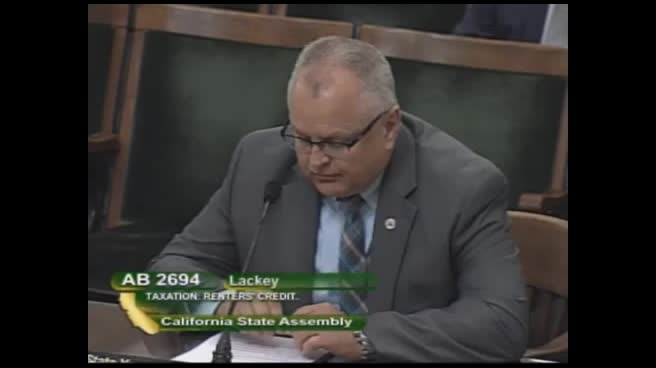 3MIN
Assembly Standing Committee on Revenue and Taxation
Bill Author