AB 2787: Student financial aid: Middle Class Scholarship Program: private nonprofit postsecondary educational institutions.
- Session Year: 2015-2016
- House: Assembly
- Latest Version Date: 2016-04-12
Under existing law, the Middle Class Scholarship Program provides that, subject to an available and sufficient appropriation, commencing with the 201415 academic year, an undergraduate student enrolled at the University of California or the California State University, and meeting certain requirements, is eligible for a scholarship award that, combined with other federal, state, and institutionally administered grants and fee waivers, totals up to 40% of the systemwide tuition and fees. Under existing law, to receive an award under the Middle Class Scholarship Program, a student is required to have an annual household income that does not exceed $150,000 as adjusted to reflect changes in the cost of living, satisfy specified requirements for a Cal Grant award, be a California resident or exempt from paying nonresident tuition, file specified financial aid forms, timely apply for publicly funded student financial aid for which he or she is eligible, maintain at least a 2.0 grade point average, be pursuing his or her first undergraduate baccalaureate degree or be enrolled in a specified professional teacher preparation program, and be enrolled at least part time.
Existing law transfers $159,000,000 from the General Fund to the Middle Class Scholarship Fund, and appropriates that sum to the Student Aid Commission for purposes of the scholarship program for the 201718 fiscal year. year, and each fiscal year thereafter.
Existing law requires the University of California and the California State University, in order for students of their respective segments to remain eligible to receive a scholarship award under the Middle Class Scholarship Program, to not supplant their respective institutional need-based grants with funds provided for scholarships under this program, and to maintain their funding amounts at a level that, at a minimum, is equal to the level maintained for undergraduate students during the 201314 academic year.
This bill would extend the Middle Class Scholarship Program to undergraduate students who meet the requirements of the program and are enrolled in participating private nonprofit postsecondary educational institutions, as defined, commencing with the 201718 academic year, as specified, but the bill would not affect the statutory appropriation for the program for the 201718 fiscal year that is referenced above. specified. By expanding the appropriation described above, the bill would make an appropriation. The bill would subject participating private nonprofit postsecondary educational institutions to the requirement to maintain its scholarship funding levels, as referenced above.
Under existing law, the Middle Class Scholarship Program provides that, subject to an available and sufficient appropriation, commencing with the 201415 academic year, an undergraduate student enrolled at the University of California or the California State University, and meeting certain requirements, is eligible for a scholarship award that, combined with other federal, state, and institutionally administered grants and fee waivers, totals up to 40% of the systemwide tuition and fees. Under existing law, to receive an award under the Middle Class Scholarship Program, a student is required to have an annual household income that does not exceed $150,000 as adjusted to reflect changes in the cost of living, satisfy specified requirements for a Cal Grant award, be a California resident or exempt from paying nonresident tuition, file specified financial aid forms, timely apply for publicly funded student financial aid for which he or she is eligible, maintain at least a 2.0 grade point average, be pursuing his or her first undergraduate baccalaureate degree or be enrolled in a specified professional teacher preparation program, and be enrolled at least part time.
Existing law transfers $159,000,000 from the General Fund to the Middle Class Scholarship Fund, and appropriates that sum to the Student Aid Commission for purposes of the scholarship program for the 201718 fiscal year.
Existing law requires the University of California and the California State University, in order for students of their respective segments to remain eligible to receive a scholarship award under the Middle Class Scholarship Program, to not supplant their respective institutional need-based grants with funds provided for scholarships under this program, and to maintain their funding amounts at a level that, at a minimum, is equal to the level maintained for undergraduate students during the 201314 academic year.
This bill would extend the Middle Class Scholarship Program to undergraduate students who meet the requirements of the program and are enrolled in private nonprofit postsecondary educational institutions, commencing with the 201718 academic year, as specified, but the bill would not affect the statutory appropriation for the program for the 201718 fiscal year that is referenced above. The bill would subject participating private nonprofit postsecondary educational institutions to the requirement to maintain its scholarship funding levels, as referenced above.
(a)(1)Subject to an available and sufficient appropriation, commencing with the 201415 academic year, an undergraduate student enrolled in the California State University, the University of California, or, commencing with the 201718 academic year, a private nonprofit postsecondary educational institution who meets the requirements of paragraph (2) is eligible for a scholarship award as described in that paragraph.
(2)Each academic year, except as provided in paragraphs (3) and (4), an eligible student shall receive a scholarship award in an amount that, combined with other federal, state, or institutionally administered student grants or fee waivers received by an eligible student, is up to 40 percent of the amount charged to that student in that academic year for mandatory systemwide tuition and fees of a student of the California State University or the University of California, or the tuition and mandatory fees of or, with respect to a student of a private nonprofit postsecondary educational institution, a scholarship award calculated in accordance with paragraph (2) of subdivision (a) of Section 70023, if all of the following requirements are met, to the satisfaction of the commission, each academic year:
(A)The students annual household income does not exceed one hundred fifty thousand dollars ($150,000). For awards distributed for the 201617 academic year and subsequent academic years, the commission shall annually adjust the maximum income level set under this subparagraph in accordance with the percentage changes in the cost of living within the meaning of paragraph (1) of subdivision (e) of Section 8 of Article XIII B of the California Constitution. For purposes of this article, annual household income shall be calculated in a manner that is consistent with the requirements applicable to the Ortiz-Pacheco-Poochigian-Vasconcellos Cal Grant Program (Chapter 1.7 (commencing with Section 69430)) and Section 69506.
(B)Beginning with awards distributed in the 201516 academic year, the students household asset level shall not exceed one hundred fifty thousand dollars ($150,000). For awards distributed in the 201617 academic year and subsequent academic years, the commission shall annually adjust the maximum household asset level set under this subparagraph in accordance with the percentage changes in the cost of living within the meaning of paragraph (1) of subdivision (e) of Section 8 of Article XIIIB of the California Constitution. For purposes of this article, students household asset level shall be calculated in a manner that is consistent with the requirements applicable to the Ortiz-Pacheco-Poochigian-Vasconcellos Cal Grant Program (Chapter 1.7 (commencing with Section 69430)) and Section 69506.
(C)The student satisfies the eligibility requirements for a Cal Grant award pursuant to Section 69433.9, except that a student who is exempt from nonresident tuition under Section 68130.5 shall not be required to satisfy the requirements of subdivision (a) of Section 69433.9.
(D)The student is exempt from paying nonresident tuition, or would be exempt if the student attended a public institution.
(E)The student completes and submits a Free Application for Federal Student Aid (FAFSA) application. The FAFSA must be submitted or postmarked by no later than March 2. If the student is not able to complete a FAFSA application, the student may satisfy this subparagraph by submitting an application determined by the commission to be equivalent to the FAFSA application for purposes of this article by March 2.
(F)The student makes a timely application or applications for all other federal, state, or institutionally administered grants or fee waivers for which the student is eligible.
(G)The student maintains satisfactory academic progress in a manner that is consistent with the requirements applicable to the Ortiz-Pacheco-Poochigian-Vasconcellos Cal Grant Program pursuant to subdivision (m) of Section 69432.7.
(H)The student is pursuing his or her first undergraduate baccalaureate degree or has completed a baccalaureate degree and has been admitted to, and is enrolled in, a program of professional teacher preparation at an institution approved by the California Commission on Teacher Credentialing.
(I)The student is enrolled at least part time.
(3)(A)The percentage specified in paragraph (2) shall be reduced by 0.6-percent increments per one thousand dollars ($1,000) of annual household income in excess of one hundred thousand dollars ($100,000), to a minimum 10 percent of the mandatory systemwide tuition and fees for an academic year, provided that no scholarship award shall be provided to a student with an annual household income exceeding one hundred fifty thousand dollars ($150,000). Beginning with award calculations for the 201617 academic year, and for subsequent academic years, the commission shall annually adjust the income levels specified in this subparagraph by the percentage change in the cost of living within the meaning of paragraph (1) of subdivision (e) of Section 8 of Article XIII B of the California Constitution and shall adjust the incremental reduction accordingly to ensure that a minimum of 10 percent of the mandatory systemwide tuition and fees for an academic year are awarded. This reduction shall be in addition to any reduction required by Section 70023.
(B)Notwithstanding subparagraph (A), for any student who qualifies for a scholarship award of at least one dollar ($1), the minimum annual scholarship amount for full-time enrollment is ninety dollars ($90).
(4)For the 201415, 201516, and 201617 academic years, the maximum amount of a students scholarship award shall be 35 percent, 50 percent, and 75 percent, respectively, of the total scholarship award amount that the student would otherwise be eligible to receive.
(b)In order for students enrolled in their respective segments to remain eligible to receive a scholarship award under this article, the University of California, the California State University, and a participating private nonprofit postsecondary educational institution shall not supplant their respective institutional need-based grants with the funds provided for scholarships under this article, and shall maintain their funding amounts at a level that, at a minimum, is equal to the level maintained for undergraduate students during the 201314 academic year.
(c)The University of California and the California State University shall report on the implementation of this article as part of the report made pursuant to Section 66021.1.
(d)A Middle Class Scholarship Program award authorized pursuant to this article shall be defined as a full-time equivalent grant. An award to a part-time student shall be a fraction of a full-time grant, as determined by the proportionate amount charged for the tuition and fees. A part-time student shall not be discriminated against in the selection of Middle Class Scholarship Program awards. For purposes of this section, full-time student and part-time student have the same meaning as specified in subdivision (f) of Section 69432.7.
(e)Section 70023 does not apply to a student attending a private nonprofit postsecondary educational institution.
SEC. 2.Section 70023 of the Education Code is amended to read:70023.(a)(1)For each academic year, the commission shall determine an amount sufficient, when combined with other federal, state, or institutionally administered student grants or fee waivers received by eligible students from other sources, to provide scholarships to eligible students in the amounts described in paragraphs (2) and (3) of subdivision (a) of Section 70022. The University of California and the California State University shall provide the commission with any financial aid data that are necessary for the determination of these amounts.
(2)(A)Commencing with the 201718 academic year, a student who attends a participating private nonprofit postsecondary educational institution and meets the requirements of subdivision (a) of Section 70022 shall be eligible to receive up to 40 percent of the amount of the maximum grant award for which that student would be eligible under the Cal Grant Program established pursuant to Chapter 1.7 (commencing with Section 69430).
(B)For purposes of this paragraph, a participating private nonprofit postsecondary educational institution includes only an institution that meets both of the following requirements:
(i)It is a qualifying institution as defined in subdivision (l) of Section 69432.7.
(ii)It informs the Student Aid Commission, in writing and in a timely manner, that it chooses to participate in the scholarship program established by this article.
(b)The commission shall annually determine if the amounts appropriated under this section in each fiscal year are sufficient to cover the costs of the scholarships as projected to be awarded pursuant to the program. If those amounts are not sufficient for this purpose, the scholarships shall be reduced proportionately by an equal percentage for all recipients of scholarships under this article.
(c)The commission may adopt regulations necessary to carry out the purposes of this article under subdivision (b) as emergency regulations in accordance with Chapter 3.5 (commencing with Section 11340) of Part 1 of Division 3 of Title 2 of the Government Code. For purposes of the Administrative Procedure Act, including Section 11349.6 of the Government Code, the adoption of those regulations shall be deemed to be an emergency and necessary for the immediate preservation of the public peace, health and safety, or general welfare, notwithstanding subdivision (e) of Section 11346.1 of the Government Code. Notwithstanding subdivision (e) of Section 11346.1 of the Government Code, any regulation adopted pursuant to this section shall not remain in effect more than 180 days unless the commission complies with all provisions of Chapter 3.5 (commencing with Section 11340) of Part 1 of Division 3 of Title 2 of the Government Code, as required by subdivision (e) of Section 11346.1 of the Government Code.
(d)The unencumbered balance, as of June 30 of each fiscal year, of the amount appropriated from the Middle Class Scholarship Fund pursuant to paragraph (1) of subdivision (e) shall revert to the General Fund.
(e)(1)Upon order of the Director of Finance, the following amounts shall be transferred from the General Fund to the Middle Class Scholarship Fund, and are hereby appropriated to the commission for allocation pursuant to this article:
(A)For the 201415 fiscal year, one hundred seven million dollars ($107,000,000).
(B)For the 201516 fiscal year, eighty-two million dollars ($82,000,000).
(C)For the 201617 fiscal year, one hundred sixteen million dollars ($116,000,000).
(D)For the 201718 fiscal year and for each fiscal year thereafter, one hundred fifty-nine million dollars ($159,000,000).
(2)An annual appropriation to the commission is hereby established in the amounts and for the fiscal years described in paragraph (1) to carry out the purposes of this section and Section 70022.
(3)It is the intent of the Legislature that any savings realized from changes made to the allocations under this subdivision by a bill providing for appropriations related to the Budget Bill for the 201516 fiscal year shall be used to support higher education.
(4)The funds transferred and appropriated pursuant to paragraph (1) shall only be available for encumbrance in the fiscal year in which they are transferred, and the General Fund shall have no liability or any obligation beyond the transfers explicitly authorized in paragraph (1) unless a subsequent transfer or allocation is required pursuant to statute.
(5)In any fiscal year, additional appropriations may be enacted pursuant to statute to carry out the purposes of this article.
(6)(A)Beginning with the Governors Budget proposal for the 201415 fiscal year, and in the Governors Budget for each fiscal year thereafter, the Department of Finance shall include a fund condition statement for the Middle Class Scholarship Fund for the fiscal year of the proposed budget and the two immediately preceding fiscal years prepared in accordance with existing law.
(B)Upon order of the Director of Finance and commencing with the 201314 fiscal year, if the May Revision projects a budget deficit for the next fiscal year, the amount specified in paragraph (1) for the fiscal year for which the budget deficit is projected may be reduced by up to 33 percent.
(f)Subject to an appropriation in the annual Budget Act for its purposes, the commission may begin implementation of, and establish outreach services relating to, this article.
(a)(1)Subject to an available and sufficient appropriation, commencing with the 201415 academic year, an undergraduate student enrolled in the California State University or University, the University of California California, or, commencing with the 201718 academic year, a private nonprofit postsecondary educational institution who meets the requirements of paragraph (2) is eligible for a scholarship award as described in that paragraph.
(2)Each academic year, except as provided in paragraphs (3) and (4), an eligible student shall receive a scholarship award in an amount that, combined with other federal, state, or institutionally administered student grants or fee waivers received by an eligible student, is up to 40 percent of the amount charged to that student in that academic year for mandatory systemwide tuition and fees, fees of a student of the California State University or the University of California, or the tuition and mandatory fees of a student of a private nonprofit postsecondary educational institution, if all of the following requirements are met, to the satisfaction of the commission, each academic year:
(A)The students annual household income does not exceed one hundred fifty thousand dollars ($150,000). For awards distributed for the 201617 academic year and subsequent academic years, the commission shall annually adjust the maximum income level set under this subparagraph in accordance with the percentage changes in the cost of living within the meaning of paragraph (1) of subdivision (e) of Section 8 of Article XIII B of the California Constitution. For purposes of this article, annual household income shall be calculated in a manner that is consistent with the requirements applicable to the Ortiz-Pacheco-Poochigian-Vasconcellos Cal Grant Program (Chapter 1.7 (commencing with Section 69430)) and Section 69506.
(B)Beginning with awards distributed in the 201516 academic year, the students household asset level shall not exceed one hundred fifty thousand dollars ($150,000). For awards distributed in the 201617 academic year and subsequent academic years, the commission shall annually adjust the maximum household asset level set under this subparagraph in accordance with the percentage changes in the cost of living within the meaning of paragraph (1) of subdivision (e) of Section 8 of Article XIIIB of the California Constitution. For purposes of this article, students household asset level shall be calculated in a manner that is consistent with the requirements applicable to the Ortiz-Pacheco-Poochigian-Vasconcellos Cal Grant Program (Chapter 1.7 (commencing with Section 69430)) and Section 69506.
(C)The student satisfies the eligibility requirements for a Cal Grant award pursuant to Section 69433.9, except that a student who is exempt from nonresident tuition under Section 68130.5 shall not be required to satisfy the requirements of subdivision (a) of Section 69433.9.
(D)The student is exempt from paying nonresident tuition. tuition, or would be exempt if the student attended a public institution.
(E)The student completes and submits a Free Application for Federal Student Aid (FAFSA) application. The FAFSA must be submitted or postmarked by no later than March 2. If the student is not able to complete a FAFSA application, the student may satisfy this subparagraph by submitting an application determined by the commission to be equivalent to the FAFSA application for purposes of this article by March 2.
(F)The student makes a timely application or applications for all other federal, state, or institutionally administered grants or fee waivers for which the student is eligible.
(G)The student maintains satisfactory academic progress in a manner that is consistent with the requirements applicable to the Ortiz-Pacheco-Poochigian-Vasconcellos Cal Grant Program pursuant to subdivision (m) of Section 69432.7.
(H)The student is pursuing his or her first undergraduate baccalaureate degree or has completed a baccalaureate degree and has been admitted to, and is enrolled in, a program of professional teacher preparation at an institution approved by the California Commission on Teacher Credentialing.
(I)The student is enrolled at least part time.
(3)(A)The percentage specified in paragraph (2) shall be reduced by 0.6-percent increments per one thousand dollars ($1,000) of annual household income in excess of one hundred thousand dollars ($100,000), to a minimum 10 percent of mandatory systemwide the tuition and fees for an academic year, provided that no scholarship award shall be provided to a student with an annual household income exceeding one hundred fifty thousand dollars ($150,000). Beginning with award calculations for the 201617 academic year, and for subsequent academic years, the commission shall annually adjust the income levels specified in this subparagraph by the percentage change in the cost of living within the meaning of paragraph (1) of subdivision (e) of Section 8 of Article XIII B of the California Constitution and shall adjust the incremental reduction accordingly to ensure that a minimum of 10 percent of mandatory systemwide the tuition and fees for an academic year are awarded. This reduction shall be in addition to any reduction required by Section 70023.
(B)Notwithstanding subparagraph (A), for any student who qualifies for a scholarship award of at least one dollar ($1), the minimum annual scholarship amount for full-time enrollment is ninety dollars ($90).
(4)For the 201415, 201516, and 201617 academic years, the maximum amount of a students scholarship award shall be 35 percent, 50 percent, and 75 percent, respectively, of the total scholarship award amount that the student would otherwise be eligible to receive.
(b)In order for students enrolled in their respective segments to remain eligible to receive a scholarship award under this article, the University of California and California, the California State University University, and a participating private nonprofit postsecondary educational institution shall not supplant their respective institutional need-based grants with the funds provided for scholarships under this article, and shall maintain their funding amounts at a level that, at a minimum, is equal to the level maintained for undergraduate students during the 201314 academic year.
(c)The University of California and the California State University shall report on the implementation of this article as part of the report made pursuant to Section 66021.1.
(d)A Middle Class Scholarship Program award authorized pursuant to this article shall be defined as a full-time equivalent grant. An award to a part-time student shall be a fraction of a full-time grant, as determined by the proportionate amount charged for systemwide the tuition and fees. A part-time student shall not be discriminated against in the selection of Middle Class Scholarship Program awards. For purposes of this section, full-time student and part-time student have the same meaning as specified in subdivision (f) of Section 69432.7.
(e)Section 70023 does not apply to a student attending a private nonprofit postsecondary educational institution.
|
Date
|
Status
|
|---|---|
| Feb 19, 2016 | Introduced. To print. |
| Feb 21, 2016 | From printer. May be heard in committee March 22. |
| Feb 22, 2016 | Read first time. |
| Mar 10, 2016 | Referred to Com. on HIGHER ED. |
| Apr 12, 2016 | From committee chair, with author's amendments: Amend, and re-refer to Com. on HIGHER ED. Read second time and amended. |
| Apr 12, 2016 | In committee: Set, first hearing. Hearing canceled at the request of author. |
| Apr 13, 2016 | Re-referred to Com. on HIGHER ED. |
| Apr 19, 2016 | In committee: Set, second hearing. Failed passage. Reconsideration granted. |
|
Date
|
Description
|
Location
|
Votes
|
|
|---|---|---|---|---|
| Apr 19, 2016 | Reconsideration. | Assembly Standing Committee on Higher Education |
Passed |
|
| Apr 19, 2016 | Do pass and be re-referred to the Committee on [Appropriations] | Assembly Standing Committee on Higher Education |
Failed |
This list shows positions taken on this bill by organizations on the date displayed, which is linked to the original source.
Positions by individuals are not included.
|
Organization
|
Position
|
Date
|
|---|---|---|
| California Catholic Conference | * Support | Apr 19, 2016 |
| California Chamber Of Commerce | ** Support | Apr 19, 2016 |
| California Student Aid Comission | * Support | Apr 19, 2016 |
Date of Hearing: April 19, 2016
ASSEMBLY COMMITTEE ON HIGHER EDUCATION
Jose Medina, Chair
ABPCA Bill Id:AB 2787 (
Author:Chávez) – As Amended Ver:April 12, 2016
SUBJECT: Student financial aid: Middle Class Scholarship Program: private nonprofit postsecondary educational institutions
SUMMARY: Expands the Middle Class Scholarship Program (MCS) to include students attending private nonprofit postsecondary educational institutions that participate in the Cal Grant Program, and provides that the maximum award amount will be 40% of the maximum award that the student would have received under the Cal Grant Program.
EXISTING LAW:
- Establishes the MCS to provide, commencing with the 2014-15 academic year, and subject to available and sufficient appropriations, an undergraduate student enrolled in the California State University (CSU) or the University of California (UC), who meets eligibility requirements, an award.
- Provides that the MCS award amount shall, when combined with other federal, state, or institutionally administered student grants or fee waivers, is up to 40% of the amount charged to that student in that academic year for mandatory systemwide tuition and fees.
- Eligibility requirements provide that:
- The student’s annual household income does not exceed $150,000. For awards distributed for the 2016–17 academic year and subsequent academic years, CSAC is required to shall annually adjust the maximum income level in accordance with changes in the cost of living;
- The student’s household asset level shall not exceed $150,000. For awards distributed in the 2016–17 academic year and subsequent academic years, CSAC is required to annually adjust the maximum household asset level consistent with changes in cost of living;
- The student satisfies other eligibility requirements for a Cal Grant award, as specified;
- The student is exempt from paying nonresident tuition;
- The student completes and submits a Free Application for Federal Student Aid (FAFSA) application by no later than March 2;
- The student makes a timely application or applications for all other federal, state, or institutionally administered grants or fee waivers for which the student is eligible;
- The student maintains satisfactory academic progress;
- The student is pursuing his or her first undergraduate baccalaureate degree or has completed a baccalaureate degree and has been admitted to, and is enrolled in, a program of professional teacher preparation at an institution approved by the California Commission on Teacher Credentialing; and,
- The student is enrolled at least part time.
- Provides that the percentage of the award shall be reduced by 0.6 percent per $1,000 of household annual income in excess of $100,000.
- Provides that the minimum annual scholarship amount for full-time enrollment is $90.
- Provides that, for 2014–15, 2015–16, and 2016–17 academic years, the maximum amount of a student’s scholarship award shall be 35 percent, 50 percent, and 75 percent, respectively, of the total scholarship award amount that the student would otherwise be eligible to receive.
- Prohibits UC and CSU from supplanting their respective institutional need-based grants with the funds provided for scholarships under the MCS, and requires institutions to maintain funding amounts at levels that, at minimum, are equal to the level maintained for undergraduate students in 2013-14.
- Requires UC and CSU to report on MCS implementation.
FISCAL EFFECT: Unknown.
COMMENTS: Purpose of this bill. The author provided the following background information in regards to this bill:
- What problem is this bill seeking to address? Please present all relevant (and specific) facts that demonstrate the need for this bill. According to the author's background materials "the Middle Class Scholarship program provides undergraduate students with family incomes up to $150,000 and a maximum household amount of $150,000, a scholarship to attend UC or CSU campuses. Given that tuition rates, not just in public institutions but also in private non-profit institutions, have steadily increased year after year, college has become increasingly less affordable. This scholarship ultimately helps to alleviate some of the increasing costs of attending college; however, it only applies to public institutions. It does not currently address the cost burdens incurred by students attending private non-profit institutions."
- What is the deficiency in current law that this bill seeks to remedy? Why is legislation necessary to resolve this problem? According to the author, "this bill will extend the MCS to students attending private non-profit institutions and thus help all students, regardless of what institution they are attending, alleviate some of the cost burdens associated with rising tuition costs while they are attending."
- How will the enactment of this bill address this problem? According to the author, "this bill will extend the MCS to apply to both public and private non-profit institutions."
Issues to consider. The author and Committee may wish to consider the following:
- Funding. This bill does not appropriate funding to support costs associated with extending MCS to cover students enrolled in nonprofit postsecondary educational institutions. Does the author intend for MCS to not be applicable to students at independent institutions until it is subsequently funded? Is this expansion intended to be an entitlement or a competitive grant program? In the absence of additional funds what would the impact of this bill be on existing MCS recipients?
- Supplanting campus aid. Public institutions are required to report to the Legislature regarding campus need-based aid programs. This reporting ensures that the institutions comply with the requirements that MCS funds are not used to supplant existing campus aid programs. There is no provision of this bill that would ensure against MCS funds supplanting private, nonprofit institutional campus based aid. Is it prudent to expend state resources in a way that potentially supplants campus based aid?
- Other financial aid priorities. As discussed in more detail in the analysis of other bills before this Committee, the Cal Grant program is still missing hundreds of thousands of low-income students. While the Budget Act of 2015-16 increased the number of annual competitive Cal Grants to 25,750, this number still falls far short of meeting demand. In 2014, for example, over 300,000 students had income and asset levels to qualify for a Cal Grant. Should expanding the MCS to middle-class students attending nonprofit, private colleges be prioritized over other financial aid program expansions?
REGISTERED SUPPORT / OPPOSITION:
Support
California Chamber of Commerce
Opposition
None on File
Analysis Prepared by: Laura Metune / HIGHER ED. / (916) 319-3960
Discussed in Hearing
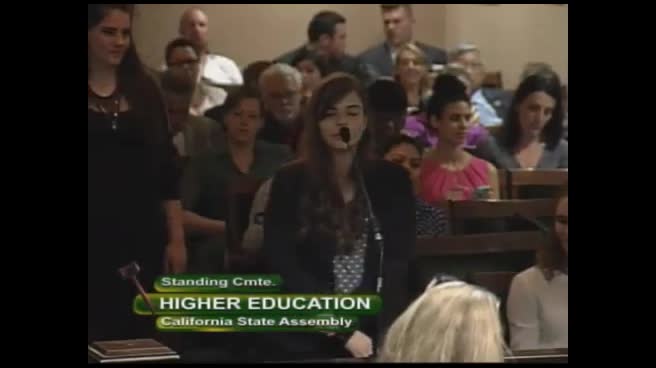 9MIN
Assembly Standing Committee on Higher Education
Bill Author

Bill Co-Author(s):