SB 1396: Wildlife Conservation Board: Inner Coast Range Program.
- Session Year: 2015-2016
- House: Senate
- Latest Version Date: 2016-05-31
Existing law, the Wildlife Conservation Law of 1947, establishes the Wildlife Conservation Board in the Department of Fish and Wildlife. Under existing law, the board consists of the president of the Fish and Game Commission, the Director of Fish and Wildlife, and the Director of Finance. Existing law prescribes the boards duties with regard to, among other things, real property acquisitions for property used for wildlife preservation and conservation purposes.
This bill would establish the Inner Coast Range Program with specified goal areas and authorization related to the Inner Coast Range Region, as defined. This bill would require the board to establish an advisory board for the program consisting of representatives one representative of each of the counties within the region and would authorize the board to invite certain legislators and representatives of state and federal agencies to participate as members on the advisory board. The bill would create the Inner Coast Range Program Fund in the State Treasury and would provide that moneys in the fund would be available, upon appropriation, for the purposes of the program.
The bill would require the board to make an annual a biannual report to the Legislature and to the Secretary of the Natural Resources Agency regarding expenditures, land, management costs, and administrative costs for the purposes of the program. The bill, by January 1, 2027, would require the board, in consultation with the advisory board, to review the program and issue a report to the relevant policy committees of the Legislature about the possible creation of a state conservancy for the Inner Coast Range Region.
Existing law, the Wildlife Conservation Law of 1947, establishes the Wildlife Conservation Board in the Department of Fish and Wildlife. Under existing law, the board consists of the president of the Fish and Game Commission, the Director of Fish and Wildlife, and the Director of Finance. Existing law prescribes the boards duties with regard to, among other things, real property acquisitions for property used for wildlife preservation and conservation purposes.
This bill would establish the Inner Coast Range Program with specified goal areas and authorization related to the Inner Coast Range Region, as defined. This bill would require the board to establish an advisory board for the program consisting of representatives of counties within the region and would authorize the board to invite certain legislators and representatives of federal agencies to participate as members on the advisory board. The bill would create the Inner Coast Range Program Fund in the State Treasury and would provide that moneys in the fund would be available, upon appropriation, for the purposes of the program.
The bill would require the board to make an annual report to the Legislature and to the Secretary of the Natural Resources Agency regarding expenditures, land, management costs, and administrative costs for the purposes of the program. The bill, by January 1, 2027, would require the board, in consultation with the advisory board, to review the program and issue a report to the relevant policy committees of the Legislature about the possible creation of a state conservancy for the Inner Coast Range Region.
Existing law establishes various conservancies in the Natural Resources Agency to acquire, manage, direct the management of, and conserve public lands in the state.
This bill would establish the Inner Coast Range Conservancy in the agency to undertake various activities related to the Inner Coast Range Region, as defined, and would prescribe the management, powers, and duties of the conservancy. The bill would create the Inner Coast Range Conservancy Fund in the State Treasury. Moneys in the fund would be available, upon appropriation, for the purposes of the conservancy.
The Legislature finds and declares all of the following:
(a)The Inner Coast Range Region is a globally significant area, including world-renowned geological, biological, and cultural resources, a national monument, and many large, pristine areas that are open for public use.
(b)The Inner Coast Range Region is an important part of the states economy, providing substantial agricultural products, timber, water, fishery and other biological resources, ranching, tourism, and recreation.
(c)In cooperation with local governments, private businesses, nonprofit organizations, and the public, a collaborative conservation program focused on the 10 million acre Inner Coast Range Region, which is more than 15,000 square miles, can help do all of the following:
(1)Provide increased opportunities for tourism and recreation.
(2)Protect, conserve, and restore the regions physical, cultural, archaeological, historical, and living resources.
(3)Aid in the preservation of working landscapes.
(4)Reduce the risk and severity of natural disturbances, such as wildfires, and restore resiliency to natural landscapes.
(5)Protect and improve water supply and water and air quality and improve water use efficiency.
(6)Assist the regional economy through the operation of a collaborative regional conservation program.
(7)Identify the highest priority projects and initiatives for which funding is needed.
(8)Undertake efforts to enhance public use and enjoyment of lands owned by the public.
(9)Support efforts that advance, in a complementary manner, environmental preservation and restoration as well as the economic well-being of the regions residents.
SECTION 1.SEC. 2.Chapter 4.5 (commencing with Section 1440) is added to Division 2 of the Fish and Game Code, to read:4.5.Inner Coast Range Program1.General Provisions and Definitions1440.The Legislature finds and declares all of the following:
(a)The Inner Coast Range Region is a globally significant area, including world-renowned geological, biological, and cultural resources, a national monument, and many large, pristine areas that are open for public use.
(b)The Inner Coast Range Region is an important part of the states economy, providing substantial agricultural products, timber, water, fishery and other biological resources, ranching, tourism, and recreation.
(c)In cooperation with local governments, private businesses, nonprofit organizations, and the public, a collaborative conservation program focused on the 10 million acre Inner Coast Range Region, which is more than 15,000 square miles, can help do all of the following:
(1)Provide increased opportunities for tourism and recreation.
(2)Protect, conserve, and restore the regions physical, cultural, archaeological, historical, and living resources.
(3)Aid in the preservation of working landscapes.
(4)Reduce the risk and severity of natural disturbances, such as wildfires, and restore resiliency to natural landscapes.
(5)Protect and improve water supply and water and air quality and improve water use efficiency.
(6)Assist the regional economy through the operation of a collaborative regional conservation program.
(7)Identify the highest priority projects and initiatives for which funding is needed.
(8)Undertake efforts to enhance public use and enjoyment of lands owned by the public.
(9)Support efforts that advance, in a complementary manner, environmental preservation and restoration as well as the economic well-being of the regions residents.
1440.5.1440.For the purposes of this chapter, the following terms have the following meanings:
(a)Advisory board means the advisory board established in Section 1442.
(b)Board means the Wildlife Conservation Board.
(c)Fund means the Inner Coast Range Program Fund created pursuant to Section 1462. 1461.
(d)Local public agency means a city, county, district, or joint powers authority.
(e)Nonprofit organization means a private, nonprofit organization that qualifies for exempt status under Section 501(c)(3) of Title 26 of the United States Code and whose charitable purposes are consistent with the purposes of the board.
(f)Region or Inner Coast Range Region means all or portions of the area lying within the Counties of Colusa, Del Norte, Glenn, Humboldt, Lake, Mendocino, Napa, Shasta, Siskiyou, Solano, Tehama, Trinity, and Yolo, described as the area within the following boundaries:
(1)On the south by the southern boundary of the Putah Creek watershed, including a portion of the Inner Coast Range in eastern Napa County and northern Solano County north of Vacaville and Fairfield.
(2)On the east by Interstates 505 and 5, northward to a point on the Sacramento River channel adjacent to the intersection of Highway 299 and Interstate 5 in the City of Redding, northward along the centerline of the Sacramento River to its headwaters near Black Butte, northeastward along the southern boundary of the watershed of the Klamath River to the northern boundary of the State of California.
(3)On the north by the northern border of the State of California.
(4)On the west by the eastern boundary of the Napa River watershed, the eastern boundary of the Russian River watershed, northward along the western boundary of the watershed of the main stem of the Eel River, northwestward along the western boundary of the watershed of the South Fork of the Eel River to the southern Humboldt County boundary, eastward to the western Trinity County boundary, northward to the western boundary of the Trinity River watershed, northward along the western boundary of the Trinity River watershed to the confluence of the Trinity River and the Klamath River, northward from the confluence along the upstream western boundary of the Klamath River watershed to the northern boundary of the State of California.
(g)Tribal organization means an Indian tribe, band, nation, or other organized group or community, or a tribal agency authorized by a tribe, which is recognized as eligible for special programs and services provided by the United States to Indians because of their status as Indians and is identified on pages 52829 to 52835, inclusive, of Number 250 of Volume 53 (December 29, 1988) of the Federal Register, as that list may be updated or amended from time to time, as well as California-recognized Indian tribes.
2.Inner Coast Range Program1441.The Inner Coast Range Program is hereby created with the following goal areas for the region, and the board is authorized to do all of the following, working in collaboration and cooperation with local governments and interested parties, for the purposes of the program:
(a)Provide increased opportunities for tourism and recreation.
(b)Protect, conserve, and restore the regions physical, cultural, archaeological, historical, and living resources.
(c)Aid in the preservation of working landscapes.
(d)Reduce the risk and severity of natural disturbances, such as wildfires, and restore resiliency to natural landscapes.
(e)Protect and improve water supply and water and air quality and improve water use efficiency.
(f)Assist the regional economy.
(g)Identify the highest priority projects and initiatives for which funding is needed.
(h)Undertake efforts to enhance public use and enjoyment of lands owned by the public.
(i)Support efforts that advance, in a complementary manner, environmental preservation and restoration as well as the economic well-being of the regions residents.
1442.(a)(1)The board shall establish an advisory board for the program consisting of representatives of counties with lands within the Inner Coast Range Region.
(2)An equal number of advisory board members from each county shall be Each county shall have one representative on the advisory board. The board shall establish any additional qualifications for advisory board members that the board deems necessary and appropriate.
(b)Notwithstanding paragraph (2) of subdivision (a), the board may invite legislators representing the region and representatives of state and federal agencies agencies, such as the United States Forest Service and the United States Bureau of Land Management Management, to participate as members of the advisory board.
1443.The board may establish committees, hold community meetings, and engage in public outreach using advanced forms of technology in order to facilitate the decisionmaking process for the purposes of this chapter. Members of committees may be reimbursed for the actual and necessary expenses, including travel expenses, that they incur in attending regular meetings of the committee of which they are a member.
1444.The board may establish and maintain a headquarters office within the region.
3.Jurisdiction and Cooperation1445.The board may undertake activities identified in this chapter within the Inner Coast Range Region for the purpose of the Inner Coast Range Program. The board shall carry out projects and activities to further the purposes of this chapter throughout the region. The board shall make every effort to ensure that, over time, Inner Coast Range Program funding and other efforts are spread equitably across the region and among the stated goal areas, with adequate allowance for the variability of costs associated with the region and types of projects.
1446.In carrying out this chapter, the board shall cooperate with and consult with the city or county where a grant is proposed to be expended or an interest in real property is proposed to be acquired and shall, as necessary or appropriate, coordinate its efforts with other state agencies, in cooperation with the Secretary of the Natural Resources Agency.
1447.The board, in consultation with the advisory board, shall adopt guidelines setting priorities and criteria for projects and programs in the region, based upon its assessment of program requirements, institutional capabilities, and funding needs throughout the region, and federal, state, and local plans, including land and resources management plans, general plans, recreation plans, urban water management plans, groundwater management plans, and groundwater sustainability plans. As part of the process of developing guidelines for projects and programs in the region, the board shall undertake and facilitate a strategic program planning process involving meetings and workshops, with the purpose of formulating strategic program objectives and priorities. The strategic program shall be updated regularly, at least once every five years.
1448.Nothing in this chapter grants to the board:
(a)Any of the powers of a city or county to regulate land use.
(b)Any powers to regulate any activities on land, except as the owner of an interest in the land, or pursuant to an agreement with, or a license or grant of management authority from, the owner of an interest in the land.
(c)Any powers over water rights held by others.
4.Grants and Loans1449.(a)The board may make grants or loans to public agencies, nonprofit organizations, and tribal organizations in order to carry out the purposes of this chapter, including grants or loans provided to acquire an interest in real property, including a fee interest in that property. Grant or loan funds shall be disbursed to a recipient entity only after the entity has entered into an agreement with the board, on the terms and conditions specified by the board. After approving a grant, the board may assist the grantee in carrying out the purposes of the grant.
(b)When awarding grants or making loans pursuant to this chapter, the board may require repayment of those funds on the terms and conditions it deems appropriate. Proceeds from the repayment or reimbursement of amounts granted or loaned by the board shall be deposited in the fund.
(c)An entity applying for a grant from the board to acquire an interest in real property shall specify all of the following in the grant application:
(1)The intended use of the property.
(2)The manner in which the land will be managed.
(3)How the cost of ongoing management will be funded.
1450.In the case of a grant of funds to a nonprofit organization or tribal organization to acquire an interest in real property, including, but not limited to, a fee interest, for the purposes of this chapter, the agreement between the board and the recipient organization shall require all of the following:
(a)The purchase price of an interest in real property acquired by the organization shall not exceed fair market value as established by an appraisal approved by the board. pursuant to the statutes and regulations that apply to the board.
(b)The terms under which the interest in real property is acquired shall be subject to the boards approval.
(c)An interest in real property to be acquired under the grant shall not be used as security for a debt unless the board approves the transaction.
(d)The transfer of an interest in the real property shall be subject to approval of the board, and a new agreement sufficient to protect the public interest shall be entered into between the board and the transferee.
(e)A deed or instrument by which the organization acquires an interest in real property under the grant shall include a power of termination on the part of the state, subject to the requirements of Chapter 5 (commencing with Section 885.010) of Title 5 of Part 2 of Division 2 of the Civil Code. The deed or instrument shall provide that the state may exercise the power of termination by notice in the event of the organizations violation of the purpose of the grant through breach of a material term or condition thereof and that, upon recordation of the notice, full title to the interest in real property identified in the notice shall immediately vest in the state or in another public agency or a nonprofit organization designated by the board to which the state conveys or has conveyed its interest.
(f)A deed or instrument by which the organization acquires an interest in real property under the grant shall provide that the conveyance is subject to a remainder interest vested in the state. If the existence of the organization is terminated for any reason, the board may require that the remainder shall become a present interest and that full title to the real property shall vest in the state or in another public agency or a nonprofit organization designated by the board to which the state conveys or has conveyed its interest.
1451.(a)The board may expend funds and award grants and loans to facilitate collaborative planning efforts and to develop projects and programs that are designed to further the purposes of this chapter.
(b)The board may provide and make available technical information, expertise, and other nonfinancial assistance to public agencies, nonprofit organizations, and tribal organizations, to support program and project development and implementation.
(c)The recipient of a grant or loan provided by the board pursuant to this chapter for the acquisition of real property shall provide for the management of the real property to be acquired as specified in the grant agreement.
1452.The board may apply for and receive grants to carry out the purposes of this chapter.
5.Interests in Real Property1453.(a)The In accordance with Chapter 4 (commencing with Section 1300), the board may acquire from willing sellers or transferors an interest in any real property, in order to carry out the purposes of this chapter. However, the board shall not acquire a fee interest in real property by purchase.
(b)The acquisition of an interest in real property under this section is not subject to the Property Acquisition Law (Part 11 (commencing with Section 15850) of Division 3 of Title 2 of the Government Code), unless the value of the interest exceeds two hundred fifty thousand dollars ($250,000) per lot or parcel, as adjusted for annual changes to the Consumer Price Index for the State of California, as calculated by the Department of Finance. However, the board may request the State Public Works Board to review and approve specific acquisitions.
(c)The board shall not exercise the power of eminent domain.
1454.Notwithstanding Section 11005.2 of the Government Code or any other law, the board may lease, rent, sell, exchange, or otherwise transfer an interest, option, or contractual right in real property, as well as a vested right severable therefrom, that has been acquired under this chapter, to a person or entity, subject to terms and conditions in furtherance of the boards purposes.
1455.1454.(a)For the purposes of this chapter, the board shall take whatever actions are reasonably necessary and incidental to the management of lands or interests in lands under its ownership or control and may initiate, negotiate, and participate in agreements for the management of those lands or interests with public agencies or private individuals or entities.
(b)The board may improve, restore, or enhance lands for the purpose of protecting the natural environment, improving public enjoyment of or public access to public lands, or to otherwise meet the objectives of this chapter and may carry out the planning and design of those improvements or other measures.
(c)The board may enter into an agreement with a public agency, nonprofit organization, or private entity for the construction, management, or maintenance of facilities authorized by the board to meet the objectives of this chapter.
6.Funding and Expenditures1456.1455.The board shall make an annual a biannual report to the Legislature and to the Secretary of the Natural Resources Agency regarding expenditures, land management costs, and administrative costs incurred pursuant to this chapter. The board shall submit the report to the Legislature in compliance with Section 9795 of the Government Code.
1457.1456.The board may expend funds under this chapter to conduct research and monitoring in connection with the development and implementation of the program.
1458.1457.(a)For the purposes of this chapter, the board may receive gifts, donations, bequests, devises, subventions, grants, rents, royalties, and other assistance and funds from public and private sources.
(b)Except as provided in Section 1453, the board may receive an interest in real or personal property for the purposes of this chapter through transfer, succession, or other mode of acquisition generally recognized by law.
(c)All moneys or income received by the board for the purposes of this chapter pursuant to this article shall be deposited in the fund for expenditure pursuant to this chapter.
1459.1458.The board shall not make any expenditures that would either directly support or deter the planning or implementation of the Sites Reservoir project.
1460.1459.The board may fix and collect a fee for a direct service it renders for the purposes of this chapter, provided the service is rendered at the request of the individual or entity receiving the service. The amount of a fee shall not exceed the boards reasonable costs and expenses of providing the service rendered. All fees received by the board pursuant to this section shall be deposited in the fund for expenditure for the purposes of this chapter.
1461.1460.Proceeds from a lease, rental, sale, exchange, or transfer of an interest or option in real property for the purposes of the Inner Coast Range Program, and all other income of the board for the purposes of the Inner Coast Range Program, shall be deposited in the fund for expenditure for the purposes of this chapter.
1462.1461.The Inner Coast Range Conservancy Program Fund is hereby created in the State Treasury. Moneys in the fund shall be available, upon appropriation by the Legislature, only for the purposes of this chapter.
7.Legislative Review1463.1462.(a)By January 1, 2027, the board, in consultation with the advisory board, shall review the Inner Coast Range Program and issue a report to the relevant policy committees of the Legislature about the possible creation of a state conservancy for the Inner Coast Range Region.
(b)Pursuant to Section 10231.5 of the Government Code, this article is repealed on January 1, 2031.
The Legislature finds and declares all of the following:
(a)The Inner Coast Range Region is a globally significant area, including world-renowned geological, biological, and cultural resources, a national monument, and many large, pristine areas that are open for public use.
(b)The Inner Coast Range Region is an important part of the states economy, providing substantial agricultural products, timber, water, fishery and other biological resources, ranching, tourism, and recreation.
(c)In cooperation with local governments, private businesses, nonprofit organizations, and the public, a collaborative conservation program focused on the 10 million acre Inner Coast Range Region, which is more than 15,000 square miles, can help do all of the following:
(1)Provide increased opportunities for tourism and recreation.
(2)Protect, conserve, and restore the regions physical, cultural, archaeological, historical, and living resources.
(3)Aid in the preservation of working landscapes.
(4)Reduce the risk and severity of natural disturbances, such as wildfires, and restore resiliency to natural landscapes.
(5)Protect and improve water supply and water and air quality and improve water use efficiency.
(6)Assist the regional economy through the operation of a collaborative regional conservation program.
(7)Identify the highest priority projects and initiatives for which funding is needed.
(8)Undertake efforts to enhance public use and enjoyment of lands owned by the public.
(9)Support efforts that advance, in a complementary manner, environmental preservation and restoration as well as the economic well-being of the regions residents.
1440.5.For the purposes of this chapter, the following terms have the following meanings:
(a)Advisory board means the advisory board established in Section 1442.
(b)Board means the Wildlife Conservation Board.
(c)Fund means the Inner Coast Range Program Fund created pursuant to Section 1462.
(d)Local public agency means a city, county, district, or joint powers authority.
(e)Nonprofit organization means a private, nonprofit organization that qualifies for exempt status under Section 501(c)(3) of Title 26 of the United States Code and whose charitable purposes are consistent with the purposes of the board.
(f)Region or Inner Coast Range Region means all or portions of the area lying within the Counties of Colusa, Del Norte, Glenn, Humboldt, Lake, Mendocino, Napa, Shasta, Siskiyou, Solano, Tehama, Trinity, and Yolo, described as the area within the following boundaries:
(1)On the south by the southern boundary of the Putah Creek watershed, including a portion of the Inner Coast Range in eastern Napa County and northern Solano County north of Vacaville and Fairfield.
(2)On the east by Interstates 505 and 5, northward to a point on the Sacramento River channel adjacent to the intersection of Highway 299 and Interstate 5 in the City of Redding, northward along the centerline of the Sacramento River to its headwaters near Black Butte, northeastward along the southern boundary of the watershed of the Klamath River to the northern boundary of the State of California.
(3)On the north by the northern border of the State of California.
(4)On the west by the eastern boundary of the Napa River watershed, the eastern boundary of the Russian River watershed, northward along the western boundary of the watershed of the main stem of the Eel River, northwestward along the western boundary of the watershed of the South Fork of the Eel River to the southern Humboldt County boundary, eastward to the western Trinity County boundary, northward to the western boundary of the Trinity River watershed, northward along the western boundary of the Trinity River watershed to the confluence of the Trinity River and the Klamath River, northward from the confluence along the upstream western boundary of the Klamath River watershed to the northern boundary of the State of California.
(g)Tribal organization means an Indian tribe, band, nation, or other organized group or community, or a tribal agency authorized by a tribe, which is recognized as eligible for special programs and services provided by the United States to Indians because of their status as Indians and is identified on pages 52829 to 52835, inclusive, of Number 250 of Volume 53 (December 29, 1988) of the Federal Register, as that list may be updated or amended from time to time, as well as California-recognized Indian tribes.
2.Inner Coast Range Program1441.The Inner Coast Range Program is hereby created with the following goal areas for the region, and the board is authorized to do all of the following, working in collaboration and cooperation with local governments and interested parties, for the purposes of the program:
(a)Provide increased opportunities for tourism and recreation.
(b)Protect, conserve, and restore the regions physical, cultural, archaeological, historical, and living resources.
(c)Aid in the preservation of working landscapes.
(d)Reduce the risk and severity of natural disturbances, such as wildfires, and restore resiliency to natural landscapes.
(e)Protect and improve water supply and water and air quality and improve water use efficiency.
(f)Assist the regional economy.
(g)Identify the highest priority projects and initiatives for which funding is needed.
(h)Undertake efforts to enhance public use and enjoyment of lands owned by the public.
(i)Support efforts that advance, in a complementary manner, environmental preservation and restoration as well as the economic well-being of the regions residents.
1442.(a)(1)The board shall establish an advisory board for the program consisting of representatives of counties with lands within the Inner Coast Range Region.
(2)An equal number of advisory board members from each county shall be on the advisory board. The board shall establish any additional qualifications for advisory board members that the board deems necessary and appropriate.
(b)Notwithstanding paragraph (2) of subdivision (a), the board may invite legislators representing the region and representatives of federal agencies such as the United States Forest Service and the United States Bureau of Land Management to participate as members of the advisory board.
1443.The board may establish committees, hold community meetings, and engage in public outreach using advanced forms of technology in order to facilitate the decisionmaking process for the purposes of this chapter. Members of committees may be reimbursed for the actual and necessary expenses, including travel expenses, that they incur in attending regular meetings of the committee of which they are a member.
1444.The board may establish and maintain a headquarters office within the region.
3.Jurisdiction and Cooperation1445.The board may undertake activities identified in this chapter within the Inner Coast Range Region for the purpose of the Inner Coast Range Program. The board shall carry out projects and activities to further the purposes of this chapter throughout the region. The board shall make every effort to ensure that, over time, Inner Coast Range Program funding and other efforts are spread equitably across the region and among the stated goal areas, with adequate allowance for the variability of costs associated with the region and types of projects.
1446.In carrying out this chapter, the board shall cooperate with and consult with the city or county where a grant is proposed to be expended or an interest in real property is proposed to be acquired and shall, as necessary or appropriate, coordinate its efforts with other state agencies, in cooperation with the Secretary of the Natural Resources Agency.
1447.The board, in consultation with the advisory board, shall adopt guidelines setting priorities and criteria for projects and programs in the region, based upon its assessment of program requirements, institutional capabilities, and funding needs throughout the region, and federal, state, and local plans, including land and resources management plans, general plans, recreation plans, urban water management plans, groundwater management plans, and groundwater sustainability plans. As part of the process of developing guidelines for projects and programs in the region, the board shall undertake and facilitate a strategic program planning process involving meetings and workshops, with the purpose of formulating strategic program objectives and priorities. The strategic program shall be updated regularly, at least once every five years.
1448.Nothing in this chapter grants to the board:
(a)Any of the powers of a city or county to regulate land use.
(b)Any powers to regulate any activities on land, except as the owner of an interest in the land, or pursuant to an agreement with, or a license or grant of management authority from, the owner of an interest in the land.
(c)Any powers over water rights held by others.
4.Grants and Loans1449.(a)The board may make grants or loans to public agencies, nonprofit organizations, and tribal organizations in order to carry out the purposes of this chapter, including grants or loans provided to acquire an interest in real property, including a fee interest in that property. Grant or loan funds shall be disbursed to a recipient entity only after the entity has entered into an agreement with the board, on the terms and conditions specified by the board. After approving a grant, the board may assist the grantee in carrying out the purposes of the grant.
(b)When awarding grants or making loans pursuant to this chapter, the board may require repayment of those funds on the terms and conditions it deems appropriate. Proceeds from the repayment or reimbursement of amounts granted or loaned by the board shall be deposited in the fund.
(c)An entity applying for a grant from the board to acquire an interest in real property shall specify all of the following in the grant application:
(1)The intended use of the property.
(2)The manner in which the land will be managed.
(3)How the cost of ongoing management will be funded.
1450.In the case of a grant of funds to a nonprofit organization or tribal organization to acquire an interest in real property, including, but not limited to, a fee interest, for the purposes of this chapter, the agreement between the board and the recipient organization shall require all of the following:
(a)The purchase price of an interest in real property acquired by the organization shall not exceed fair market value as established by an appraisal approved by the board.
(b)The terms under which the interest in real property is acquired shall be subject to the boards approval.
(c)An interest in real property to be acquired under the grant shall not be used as security for a debt unless the board approves the transaction.
(d)The transfer of an interest in the real property shall be subject to approval of the board, and a new agreement sufficient to protect the public interest shall be entered into between the board and the transferee.
(e)A deed or instrument by which the organization acquires an interest in real property under the grant shall include a power of termination on the part of the state, subject to the requirements of Chapter 5 (commencing with Section 885.010) of Title 5 of Part 2 of Division 2 of the Civil Code. The deed or instrument shall provide that the state may exercise the power of termination by notice in the event of the organizations violation of the purpose of the grant through breach of a material term or condition thereof and that, upon recordation of the notice, full title to the interest in real property identified in the notice shall immediately vest in the state or in another public agency or a nonprofit organization designated by the board to which the state conveys or has conveyed its interest.
(f)A deed or instrument by which the organization acquires an interest in real property under the grant shall provide that the conveyance is subject to a remainder interest vested in the state. If the existence of the organization is terminated for any reason, the board may require that the remainder shall become a present interest and that full title to the real property shall vest in the state or in another public agency or a nonprofit organization designated by the board to which the state conveys or has conveyed its interest.
1451.(a)The board may expend funds and award grants and loans to facilitate collaborative planning efforts and to develop projects and programs that are designed to further the purposes of this chapter.
(b)The board may provide and make available technical information, expertise, and other nonfinancial assistance to public agencies, nonprofit organizations, and tribal organizations, to support program and project development and implementation.
(c)The recipient of a grant or loan provided by the board pursuant to this chapter for the acquisition of real property shall provide for the management of the real property to be acquired as specified in the grant agreement.
1452.The board may apply for and receive grants to carry out the purposes of this chapter.
5.Interests in Real Property1453.(a)The board may acquire from willing sellers or transferors an interest in any real property, in order to carry out the purposes of this chapter. However, the board shall not acquire a fee interest in real property by purchase.
(b)The acquisition of an interest in real property under this section is not subject to the Property Acquisition Law (Part 11 (commencing with Section 15850) of Division 3 of Title 2 of the Government Code), unless the value of the interest exceeds two hundred fifty thousand dollars ($250,000) per lot or parcel, as adjusted for annual changes to the Consumer Price Index for the State of California, as calculated by the Department of Finance. However, the board may request the State Public Works Board to review and approve specific acquisitions.
(c)The board shall not exercise the power of eminent domain.
1454.Notwithstanding Section 11005.2 of the Government Code or any other law, the board may lease, rent, sell, exchange, or otherwise transfer an interest, option, or contractual right in real property, as well as a vested right severable therefrom, that has been acquired under this chapter, to a person or entity, subject to terms and conditions in furtherance of the boards purposes.
1455.(a)For the purposes of this chapter, the board shall take whatever actions are reasonably necessary and incidental to the management of lands or interests in lands under its ownership or control and may initiate, negotiate, and participate in agreements for the management of those lands or interests with public agencies or private individuals or entities.
(b)The board may improve, restore, or enhance lands for the purpose of protecting the natural environment, improving public enjoyment of or public access to public lands, or to otherwise meet the objectives of this chapter and may carry out the planning and design of those improvements or other measures.
(c)The board may enter into an agreement with a public agency, nonprofit organization, or private entity for the construction, management, or maintenance of facilities authorized by the board to meet the objectives of this chapter.
6.Funding and Expenditures1456.The board shall make an annual report to the Legislature and to the Secretary of the Natural Resources Agency regarding expenditures, land management costs, and administrative costs incurred pursuant to this chapter. The board shall submit the report to the Legislature in compliance with Section 9795 of the Government Code.
1457.The board may expend funds under this chapter to conduct research and monitoring in connection with the development and implementation of the program.
1458.(a)For the purposes of this chapter, the board may receive gifts, donations, bequests, devises, subventions, grants, rents, royalties, and other assistance and funds from public and private sources.
(b)Except as provided in Section 1453, the board may receive an interest in real or personal property for the purposes of this chapter through transfer, succession, or other mode of acquisition generally recognized by law.
(c)All moneys or income received by the board for the purposes of this chapter shall be deposited in the fund for expenditure pursuant to this chapter.
1459.The board shall not make any expenditures that would either directly support or deter the planning or implementation of the Sites Reservoir project.
1460.The board may fix and collect a fee for a direct service it renders for the purposes of this chapter, provided the service is rendered at the request of the individual or entity receiving the service. The amount of a fee shall not exceed the boards reasonable costs and expenses of providing the service rendered. All fees received by the board pursuant to this section shall be deposited in the fund for expenditure for the purposes of this chapter.
1461.Proceeds from a lease, rental, sale, exchange, or transfer of an interest or option in real property for the purposes of the Inner Coast Range Program, and all other income of the board for the purposes of the Inner Coast Range Program, shall be deposited in the fund for expenditure for the purposes of this chapter.
1462.The Inner Coast Range Conservancy Program Fund is hereby created in the State Treasury. Moneys in the fund shall be available, upon appropriation by the Legislature, only for the purposes of this chapter.
7.Legislative Review1463.(a)By January 1, 2027, the board, in consultation with the advisory board, shall review the Inner Coast Range Program and issue a report to the relevant policy committees of the Legislature about the possible creation of a state conservancy for the Inner Coast Range Region.
(b)Pursuant to Section 10231.5 of the Government Code, this article is repealed on January 1, 2031.
All matter omitted in this version of the bill appears in the bill as introduced in the Senate, February 19, 2016. (JR11)This division shall be known, and may be cited, as the Inner Coast Range Conservancy Act.
33401.The Legislature finds and declares all of the following:
(a)The Inner Coast Range Region is a globally significant area, including world renowned geological, biological, and cultural resources, a national monument, and many large, pristine areas that are open for public use.
(b)The Inner Coast Range Region is an important part of the states economy, providing substantial agricultural products, timber, water, fishery and other biological resources, ranching, tourism, and recreation.
(c)In cooperation with local governments, private businesses, nonprofit organizations, and the public, an Inner Coast Range Conservancy can help do all of the following:
(1)Provide increased opportunities for tourism and recreation.
(2)Protect, conserve, and restore the regions physical, cultural, archaeological, historical, and living resources.
(3)Aid in the preservation of working landscapes.
(4)Reduce the risk and severity of natural disturbances, such as wildfires, and restore resiliency to natural landscapes.
(5)Protect and improve water supply and water and air quality, and improve water use efficiency.
(6)Assist the regional economy through the operation of the conservancys program.
(7)Identify the highest priority projects and initiatives for which funding is needed.
(8)Undertake efforts to enhance public use and enjoyment of lands owned by the public.
(9)Support efforts that advance, in a complementary manner, environmental preservation and restoration as well as the economic well-being of the regions residents.
33402.For the purposes of this division, the following terms have the following meanings:
(a)Board means the Governing Board of the Inner Coast Range Conservancy.
(b)Conservancy means the Inner Coast Range Conservancy.
(c)Fund means the Inner Coast Range Conservancy Fund created pursuant to Section 33475.
(d)Local public agency means a city, county, district, or joint powers authority.
(e)Nonprofit organization means a private, nonprofit organization that qualifies for exempt status under Section 501(c)(3) of Title 26 of the United States Code, and whose charitable purposes are consistent with the purposes of the conservancy.
(f)Region or Inner Coast Range Region means all or portions of the area lying within the Counties of Colusa, Del Norte, Glenn, Humboldt, Lake, Mendocino, Napa, Shasta, Siskiyou, Solano, Tehama, Trinity, and Yolo, described as the area within the following boundaries:
On the south by the southern boundary of the Putah Creek watershed, including a portion of the Inner Coast Range in eastern Napa County and northern Solano County north of Vacaville and Fairfield; on the east by Interstates 505 and 5, northward, including the eastern boundary of the Trinity River watershed, including the western boundary of the Shasta River watershed to the Klamath River, northward along Interstate 5 to the northern boundary of the State of California; on the north by the northern border of the State of California; and on the west by the eastern boundary of the Napa River watershed, the eastern boundary of the Russian River watershed, northward along the western boundary of the watershed of the main stem of the Eel River to the southern Humboldt County boundary, eastward to the western Trinity County boundary, northward to the western boundary of the Trinity River watershed, northward along the western boundary of the Trinity River watershed to the confluence of the Trinity River and the Klamath River, northward along the western boundary of the Klamath River watershed to the northern boundary of the State of California.
(g)Subregions means the four subregions in which the Inner Coast Range Region is located, described as follows:
(1)The east subregion, comprising the Counties of Colusa, Glenn, and Tehama.
(2)The west subregion, comprising the Counties of Humboldt, Mendocino, and Trinity.
(3)The south subregion, comprising the Counties of Lake, Napa, Solano, and Yolo.
(4)The north subregion, comprising the Counties of Del Norte, Shasta, and Siskiyou.
(h)Tribal organization means an Indian tribe, band, nation, or other organized group or community, or a tribal agency authorized by a tribe, which is recognized as eligible for special programs and services provided by the United States to Indians because of their status as Indians and is identified on pages 52829 to 52835, inclusive, of Number 250 of Volume 53 (December 29, 1988) of the Federal Register, as that list may be updated or amended from time to time.
2.Inner Coast Range Conservancy33420.There is in the Natural Resources Agency the Inner Coast Range Conservancy, which is created as a state agency to do all of the following, working in collaboration and cooperation with local governments and interested parties:
(a)Provide increased opportunities for tourism and recreation.
(b)Protect, conserve, and restore the regions physical, cultural, archaeological, historical, and living resources.
(c)Aid in the preservation of working landscapes.
(d)Reduce the risk and severity of natural disturbances, such as wildfires, and restore resiliency to natural landscapes.
(e)Protect and improve water supply and water and air quality and improve water use efficiency.
(f)Assist the regional economy through the operation of the conservancys program.
(g)Identify the highest priority projects and initiatives for which funding is needed.
(h)Undertake efforts to enhance public use and enjoyment of lands owned by the public.
(i)Support efforts that advance, in a complementary manner, environmental preservation and restoration as well as the economic well-being of the regions residents.
33421.(a)The board shall consist of 11 voting members and two nonvoting liaison advisers, appointed or designated as follows:
(1)The 11 voting members of the board shall consist of all of the following:
(A)The Secretary of the Natural Resources Agency, or his or her designee.
(B)The Director of Finance, or his or her designee.
(C)Three public members appointed by the Governor, who are not elected officials, to represent statewide interests.
(D)One public member appointed by the Speaker of the Assembly, who is not an elected official, to represent statewide interests.
(E)One public member appointed by the Senate Committee on Rules, who is not an elected official, to represent statewide interests.
(F)One member for each of the four subregions who shall be a member of the board of supervisors of a county located within that subregion, and whose supervisorial district shall be at least partially contained within the Inner Coast Range Region. Each member shall be selected by the counties within that subregion, according to the following procedure:
(i)Each county board of supervisors within a subregion shall select a member of that board to determine, with the selected members of the other counties in the subregion, which member of a board of supervisors within the subregion shall be appointed as a member of the conservancy board. An alternate may be appointed. The appointed member and any alternate shall have at least part of his or her supervisorial district within the subregion.
(ii)The initial appointment of a member for each subregion shall be made no later than 60 days after the effective date of this division. A subsequent appointment to a regular term on the board shall be made before the date specified in Section 33422 for the commencement of that term. A vacancy occurring before the end of a term shall be filled for the remainder of the term within 60 days of the vacancy.
(iii)If the boards of supervisors within a subregion do not appoint a member to the board within the timeframe specified in clause (ii), the Governor shall appoint one of the supervisors selected pursuant to clause (i) to serve as the board member for the subregion.
(2)The two nonvoting liaison advisers who serve in an advisory, nonvoting capacity shall consist of all of the following:
(A)One representative of the United States Forest Service, designated by the United States Secretary of Agriculture.
(B)One representative of the United States Bureau of Land Management, designated by the United States Secretary of the Interior.
(b)Appointing powers shall seek to include individuals from a breadth of backgrounds.
33422.Members and alternates, if any, shall serve terms as follows:
(a)The members appointed pursuant to subparagraphs (C) to (E), inclusive, of paragraph (1) of subdivision (a) of Section 33421 shall serve at the pleasure of the appointing power.
(b)The members and alternates, if any, appointed under subparagraph (F) of paragraph (1) of subdivision (a) of Section 33421 shall serve, as follows:
(1)Members and alternates for the west subregion and the north subregion shall have terms beginning on January 1 in an odd-numbered year and ending on December 31 of the following even-numbered year. All terms shall be for two years.
(2)Members and alternates for the east subregion and the south subregion shall have terms beginning on January 1 in an even-numbered year and ending on December 31 in the following odd-numbered year. Members and alternates for these regions who are appointed to the board at its initiation shall serve a one-year term. Subsequent terms shall be for two years.
(c)No member of the board, whose appointment to the board was contingent upon meeting a condition of eligibility under this division, shall serve beyond the time when the member ceases to meet that condition.
33423.(a)The voting members appointed or designated under paragraph (1) of subdivision (a) of Section 33421 who are not state employees shall be compensated for attending meetings of the conservancy at the rate of one hundred dollars ($100) per scheduled meeting day.
(b)All members of the board shall be reimbursed for their actual and necessary expenses, including travel expenses, incurred in attending meetings of the conservancy and carrying out the duties of the office.
33424.Annually, the voting members of the board shall elect from among the voting members a chairperson and vice-chairperson, and other officers as necessary. If the office of the chairperson or vice-chairperson becomes vacant, a new chairperson or vice-chairperson shall be elected by the voting members of the board to serve for the remainder of the term.
33425.(a)Six of the voting members shall constitute a quorum for the transaction of the business of the conservancy. The board shall not transact the business of the conservancy if a quorum is not present at the time a vote is taken. A decision of the board requires an affirmative vote of six of the voting members, and the vote is binding with respect to all matters acted on by the conservancy.
(b)The board shall adopt rules, regulations, and procedures for the conduct of business by the conservancy.
(c)The voting members of the board appointed or designated pursuant to paragraph (1) of subdivision (a) of Section 33421 and the nonvoting advisers selected pursuant to paragraph (2) of subdivision (a) of Section 33421, shall have the right to attend all meetings of the board, including closed sessions.
33426.The board may establish advisory boards or committees, hold community meetings, and engage in public outreach using advanced forms of technology in order to facilitate the decisionmaking process. Members of advisory boards or committees may be reimbursed for the actual and necessary expenses, including travel expenses, that they incur in attending regular meetings of the advisory board or committee of which they are a member.
33427.The board shall establish and maintain a headquarters office within the region. The conservancy may rent or own real and personal property and equipment pursuant to applicable statutes and regulations.
33428.The board shall determine the qualifications of, and shall appoint, an executive officer of the conservancy, who shall be exempt from civil service. The board shall employ other staff as necessary to execute the powers and functions provided for under this division.
33429.The board may enter into contracts with private entities and public agencies to procure consulting and other services necessary to achieve the purposes of this division.
33430.The conservancys expenses for support and administration may be paid from the conservancys operating budget and any other funding sources available to the conservancy.
33431.The board shall conduct business in accordance with the requirements of the Bagley-Keene Open Meeting Act (Article 9 (commencing with Section 11120) of Chapter 1 of Part 1 of Division 3 of Title 2 of the Government Code).
33432.The board shall hold its regular meetings within, or near, the region.
33433.The board shall post agendas for each board meeting on the Internet.
3.Jurisdiction and Cooperation33440.The conservancys jurisdiction is limited to the Inner Coast Range Region.
33441.The conservancy shall carry out projects and activities to further the purposes of this division throughout the region. The board shall make every effort to ensure that, over time, conservancy funding and other efforts are spread equitably across each of the various subregions and among the stated goal areas, with adequate allowance for the variability of costs associated with individual regions and types of projects.
33442.In carrying out this division, the conservancy shall cooperate with and consult with the city or county where a grant is proposed to be expended or an interest in real property is proposed to be acquired; and shall, as necessary or appropriate, coordinate its efforts with other state agencies, in cooperation with the Secretary of the Natural Resources Agency. The conservancy shall, as necessary and appropriate, cooperate and consult with a public water system that owns or operates facilities, including lands appurtenant thereto, where a grant is proposed to be expended or an interest in land is proposed to be acquired.
33443.The conservancy shall adopt guidelines setting priorities and criteria for projects and programs, based upon its assessment of program requirements, institutional capabilities, and funding needs throughout the region, and federal, state, and local plans, including land and resource management plans, general plans, recreation plans, urban water management plans, groundwater management plans, and groundwater sustainability plans. As part of the process of developing guidelines for projects and programs, the conservancy shall undertake and facilitate a strategic program planning process involving meetings and workshops within each of the subregions, with the purpose of formulating strategic program objectives and priorities within that subregion. The strategic program shall be updated regularly, at least once every five years.
33444.Nothing in this division grants to the conservancy:
(a)Any of the powers of a city or county to regulate land use.
(b)Any powers to regulate any activities on land, except as the owner of an interest in the land, or pursuant to an agreement with, or a license or grant of management authority from, the owner of an interest in the land.
(c)Any powers over water rights held by others.
4.Grants and Loans33450.(a)The conservancy may make grants or loans to public agencies, nonprofit organizations, and tribal organizations in order to carry out the purposes of this division, including grants or loans provided to acquire an interest in real property, including a fee interest in that property. Grant or loan funds shall be disbursed to a recipient entity only after the entity has entered into an agreement with the conservancy, on the terms and conditions specified by the conservancy. After approving a grant, the conservancy may assist the grantee in carrying out the purposes of the grant.
(b)When awarding grants or making loans pursuant to this division, the conservancy may require repayment of those funds on the terms and conditions it deems appropriate. Proceeds from the repayment or reimbursement of amounts granted or loaned by the conservancy shall be deposited in the fund.
(c)An entity applying for a grant from the conservancy to acquire an interest in real property shall specify all of the following in the grant application:
(1)The intended use of the property.
(2)The manner in which the land will be managed.
(3)How the cost of ongoing management will be funded.
33451.In the case of a grant of funds to a nonprofit organization or tribal organization to acquire an interest in real property, including, but not limited to, a fee interest, the agreement between the conservancy and the recipient organization shall require all of the following:
(a)The purchase price of an interest in real property acquired by the organization shall not exceed fair market value as established by an appraisal approved by the conservancy.
(b)The terms under which the interest in real property is acquired shall be subject to the conservancys approval.
(c)An interest in real property to be acquired under the grant shall not be used as security for a debt unless the conservancy approves the transaction.
(d)The transfer of an interest in the real property shall be subject to approval of the conservancy, and a new agreement sufficient to protect the public interest shall be entered into between the conservancy and the transferee.
(e)A deed or instrument by which the organization acquires an interest in real property under the grant shall include a power of termination on the part of the state, subject to the requirements of Chapter 5 (commencing with Section 885.010) of Title 5 of Part 2 of Division 2 of the Civil Code. The deed or instrument shall provide that the state may exercise the power of termination by notice in the event of the organizations violation of the purpose of the grant through breach of a material term or condition thereof, and that, upon recordation of the notice, full title to the interest in real property identified in the notice shall immediately vest in the state, or in another public agency or a nonprofit organization designated by the conservancy to which the state conveys or has conveyed its interest.
(f)A deed or instrument by which the organization acquires an interest in real property under the grant shall provide that the conveyance is subject to a remainder interest vested in the state. If the existence of the organization is terminated for any reason, the conservancy may require that the remainder shall become a present interest and that full title to the real property shall vest in the state, or in another public agency or a nonprofit organization designated by the conservancy to which the state conveys or has conveyed its interest.
33452.(a)The conservancy may expend funds and award grants and loans to facilitate collaborative planning efforts and to develop projects and programs that are designed to further the purposes of this division.
(b)The conservancy may provide and make available technical information, expertise, and other nonfinancial assistance to public agencies, nonprofit organizations, and tribal organizations, to support program and project development and implementation.
(c)The recipient of a grant or loan provided by the conservancy pursuant to this division for the acquisition of real property shall provide for the management of the real property to be acquired as specified in the grant agreement.
33453.The conservancy may apply for and receive grants to carry out the purposes of this division.
5.Interests in Real Property33460.(a)The conservancy may acquire from willing sellers or transferors, an interest in any real property, in order to carry out the purposes of this division. However, the conservancy shall not acquire a fee interest in real property by purchase.
(b)The acquisition of an interest in real property under this section is not subject to the Property Acquisition Law (Part 11 (commencing with Section 15850) of Division 3 of Title 2 of the Government Code), unless the value of the interest exceeds two hundred fifty thousand dollars ($250,000) per lot or parcel, as adjusted for annual changes to the Consumer Price Index for the State of California, as calculated by the Department of Finance. However, the conservancy may request the State Public Works Board to review and approve specific acquisitions.
(c)The conservancy shall not exercise the power of eminent domain.
33461.Notwithstanding Section 11005.2 of the Government Code or any other law, the conservancy may lease, rent, sell, exchange, or otherwise transfer an interest, option, or contractual right in real property, as well as a vested right severable therefrom, that has been acquired under this division, to a person or entity, subject to terms and conditions in furtherance of the conservancys purposes.
33462.(a)The conservancy shall take whatever actions are reasonably necessary and incidental to the management of lands or interests in lands under its ownership or control and may initiate, negotiate, and participate in agreements for the management of those lands or interests with public agencies or private individuals or entities.
(b)The conservancy may improve, restore, or enhance lands for the purpose of protecting the natural environment, improving public enjoyment of or public access to public lands, or to otherwise meet the objectives of this division and may carry out the planning and design of those improvements or other measures.
(c)The conservancy may enter into an agreement with a public agency, nonprofit organization, or private entity for the construction, management, or maintenance of facilities authorized by the conservancy.
6.Funding and Expenditures33470.The conservancy shall make an annual report to the Legislature and to the Secretary of the Natural Resources Agency regarding expenditures, land management costs, and administrative costs.
33471.The conservancy may expend funds under this division to conduct research and monitoring in connection with the development and implementation of the program administered under this division.
33472.(a)The conservancy may receive gifts, donations, bequests, devises, subventions, grants, rents, royalties, and other assistance and funds from public and private sources.
(b)Except as provided in Section 33460, the conservancy may receive an interest in real or personal property through transfer, succession, or other mode of acquisition generally recognized by law.
(c)All moneys or income received by the conservancy shall be deposited in the fund for expenditure for the purposes of this division.
33473.The conservancy may fix and collect a fee for a direct service it renders, provided the service is rendered at the request of the individual or entity receiving the service. The amount of a fee shall not exceed the conservancys reasonable costs and expenses of providing the service rendered. All fees received by the conservancy shall be deposited in the fund for expenditure for the purposes of this division.
33474.Proceeds from a lease, rental, sale, exchange, or transfer of an interest or option in real property, and all other income of the conservancy, shall be deposited in the fund for expenditure for the purposes of this division.
33475.The Inner Coast Range Conservancy Fund is hereby created in the State Treasury. Moneys in the fund shall be available, upon appropriation by the Legislature, only for the purposes of this division.
|
Date
|
Status
|
|---|---|
| May 11, 2016 | From committee with author's amendments. Read second time and amended. Re-referred to Com. on APPR. |
| Jun 16, 2016 | June 28 set for first hearing canceled at the request of author. |
| Jun 9, 2016 | Referred to Com. on W., P., & W. |
| Jun 2, 2016 | Read third time. Passed. (Ayes 25. Noes 13.) Ordered to the Assembly. |
| Jun 2, 2016 | Read third time. Passed. (Ayes 25. Noes 13. Page 4124.) Ordered to the Assembly. |
| Jun 2, 2016 | In Assembly. Read first time. Held at Desk. |
| May 31, 2016 | Read second time and amended. Ordered to third reading. |
| May 27, 2016 | From committee: Do pass as amended. (Ayes 5. Noes 2.) (May 27). |
| May 27, 2016 | From committee: Do pass as amended. (Ayes 5. Noes 2. Page 4009.) (May 27). |
| May 20, 2016 | Set for hearing May 27. |
| May 16, 2016 | May 16 hearing: Placed on APPR. suspense file. (Ayes 7. Noes 0.) |
| Feb 19, 2016 | Introduced. To Com. on RLS. for assignment. To print. |
| May 6, 2016 | Set for hearing May 16. |
| May 4, 2016 | May 9 set for first hearing canceled at the request of author. |
| Apr 29, 2016 | Set for hearing May 9. |
| Apr 12, 2016 | From committee: Do pass and re-refer to Com. on APPR. (Ayes 6. Noes 2.) (April 12). Re-referred to Com. on APPR. |
| Apr 12, 2016 | From committee: Do pass and re-refer to Com. on APPR. (Ayes 6. Noes 2. Page 3496.) (April 12). Re-referred to Com. on APPR. |
| Mar 24, 2016 | Set for hearing April 12. |
| Mar 10, 2016 | Referred to Com. on N.R. & W. |
| Feb 22, 2016 | Read first time. |
| Feb 22, 2016 | From printer. May be acted upon on or after March 23. |
|
Date
|
Description
|
Location
|
Votes
|
|
|---|---|---|---|---|
| Jun 2, 2016 | Senate 3rd Reading SB1396 Wolk | Senate Floor |
Passed |
|
| May 27, 2016 | Do pass as amended | Senate Standing Committee on Appropriations |
Passed |
|
| May 16, 2016 | Placed on suspense file | Senate Standing Committee on Appropriations |
Passed |
|
| Apr 12, 2016 | Do pass, but first be re-referred to the Committee on [Appropriations] | Senate Standing Committee on Natural Resources and Water |
Passed |
This list shows positions taken on this bill by organizations on the date displayed, which is linked to the original source.
Positions by individuals are not included.
|
Organization
|
Position
|
Date
|
|---|---|---|
| California Cattlemen'S Association | ** Against | Jun 2, 2016 |
| California Farm Bureau | ** Against | Jun 2, 2016 |
| Colusa County | * Against | Apr 12, 2016 |
| County of Lake | ** Support | Jun 2, 2016 |
| East Lake Resource Conservation District | ** Support | Jun 2, 2016 |
| Glenn County Rangeland Association | ** Against | Jun 2, 2016 |
| Lake County Land Trust | ** Support | Jun 2, 2016 |
| One individual | ** Against | Jun 2, 2016 |
| San Gabriel Basin Water Quality Authority | * Support | Apr 12, 2016 |
| Tehama County Cattlemen's Association | ** Against | Jun 2, 2016 |
| Toleomi | * Indeterminate | Apr 12, 2016 |
| Trinity County | * Support | Apr 12, 2016 |
| Tuleyome | ** Support | Jun 2, 2016 |
Office of Senate Floor Analyses (916) 651-1520 Fax: (916) 327-4478 | SB |
THIRD READING
Bill No: SB 1396
:
SENATE NATURAL RES. & WATER COMMITTEE: 6-2, 4/12/16
AYES: Pavley, Allen, Hertzberg, Jackson, Monning, Wolk
NOES: Stone, Vidak
NO VOTE RECORDED: Hueso
SENATE APPROPRIATIONS COMMITTEE: 5-2, 5/27/16
AYES: Lara, Beall, Hill, McGuire, Mendoza
NOES: Bates, Nielsen
DIGEST: This bill creates the Inner Coast Range Program, with an advisory board, within the Wildlife Conservation Board.
Existing law:
- Creates 10 state conservancies and the Wildlife Conservation Board (WCB) for purposes of acquiring, restoring, and conserving important recreational, open-space and habitat lands. They range in size from the largest conservancies (Coastal, Sierra Nevada) to the smallest (Baldwin Hills, San Diego River, San Joaquin River), and often are funded through specific allocations in state bond acts. Some are urban (four in the Los Angeles area), some very rural (Tahoe and Sierra Nevada), most operate within a specified geographic area, and one, the Coastal Conservancy, has a jurisdiction that includes the entire coast and the inland watersheds that drain into the ocean. The ten conservancies include Baldwin Hills, Tahoe, Coachella Valley Mountains, Sacramento-San Joaquin Delta, San Diego River, San Gabriel and Lower Los Angeles Rivers and Mountains, San Joaquin river, Santa Monica Mountains, Sierra Nevada, and Coastal).
- Creates the WCB which fulfills a statewide land acquisition function that has proven useful in areas not served by a conservancy. And in areas served by a conservancy, the WCB has been a very useful partner in funding various projects and leveraging other dollars
- Specifies the composition of the boards of each conservancy and the WCB. The board of the WCB consists of the President of the Fish and Game Commission, the director of the Department of Fish and Wildlife, and the director of the Department of Finance. Conservancy boards generally have a majority of appointees who were either directly appointed by the Governor or who served on a conservancy board because of their appointment to another position, such as the Director of Finance or the Secretary for Natural Resources, both of whom serve on many conservancy boards. That remains the status for most conservancies although both the Sierra Nevada and Delta conservancies have a narrow majority of local government representatives.
- Creates programs within the State Coastal Conservancy for both the San Francisco Bay region and the Santa Ana River. Through that structure, those regions are covered by the conservancy, are eligible for specific line-item appropriations in the budget or bond measures, and have achieved some cost-savings with smaller administrative or additional personnel costs than would normally occur with an entirely new organization.
This bill:
- Makes findings regarding the significance of the Inner Coast Range for scientific, recreational, economic, and other purposes.
- Defines the region, and includes specific boundaries for the Inner Coast Range region. Generally, it include all or parts of Colusa, Del Norte, Glenn, Humboldt, Lake, Mendocino, Napa, Shasta, Siskiyou, Solano, Tehama, Trinity, and Yolo counties.
- Establishes the Inner Coast Range Program (Program) within the WCB and identifies the functions of the Program which include tourism, recreation, assisting the regional economy, all of which must be done in collaboration and cooperation with local governments and other interested parties.
- Requires the WCB to establish an advisory board of one member from each county. The qualifications of advisory board members will be established by the WCB. The WCB may also invite legislators representing the region and representatives of appropriate state and federal agencies to participate as members of the advisory board.
- Authorizes the WCB to establish committees, hold community meetings, and allows, but does not require, the WC B to establish a headquarters office for the Program within the region.
- Directs the WCB to ensure that Program funding and other efforts are distributed equitably across the region.
- Requires the WCB to cooperate with and consult local governments where a grant is proposed to be expended or an interest in real property is proposed for acquisition and further requires coordination with other state agencies in cooperation with the Natural Resources Agency.
- Requires the WCB, in consultation with the advisory board to adopt guidelines setting priorities and criteria for projects which is to reflect existing local government general plans as well as existing plans regarding land and resource management, water, groundwater, and other planning efforts. A strategic plan shall be developed and updated every five years.
- Prohibits the WCB in administering the Program from regulating land use which remains a matter for local government except in situations where the Program owns an interest in land or pursuant to an agreement with the landowner. The Program is also prohibited from affecting water rights held by others.
- Authorizes the WCB to make grants for the purposes of the Program and establishes requirements for grants, appraisals, and other terms of any such grant. Like every other state conservancy, grants may be made to public agencies, nonprofits, and tribes to acquire an interest in property, including a fee interest in that property. The WCB may also provide planning and technical assistance to applicants.
- Prohibits the WCB from acquiring a fee interest in real property by purchase.
- Prohibits the WCB from the exercise of the power of eminent domain.
- Provides that acquisitions valued at more than $250,000 are subject to the Property Acquisition Law.
- Requires biannual reporting of expenditures, land management costs, and administrative costs of the Program.
- Prohibits the Program from supporting or deterring the planning of the Sites Reservoir project.
- Authorizes the WCB to manage the lands of the Program where necessary as well as to improve or restore such lands.
- Establishes a fund for the Program, requires all Program funds from bonds or other sources to be deposited in that fund, and provides that the fund is subject to appropriation by the Legislature.
FISCAL EFFECT: Appropriation: No Fiscal Com.: Yes Local: No
According to the Senate Appropriations Committee, unknown, but potentially in the low hundreds of thousands, in costs to the WCB (special fund) to develop and administer the program. These costs would be partially mitigated because the WCB would conduct some activities in this region in its normal course of business.
Tuleyome (source)
County of Lake
East Lake Resource Conservation District
Lake County Land Trust
OPPOSITION: (Verified 5/27/16)
California Cattlemen’s Association
California Farm Bureau
Glenn County Rangeland Association
Tehama County Cattlemen’s Association
One individual
ARGUMENTS IN SUPPORT: According to the author, the Inner Coast Range of Northern California is a globally significant region, including world-renowned geological, biological, and cultural resources, a natural monument, many publicly owned lands, and an important part of the state’s economy providing substantial agricultural products, timber, water, fisheries, and ranching, tourism, and recreation.
As sponsor, Tuleyome, a regional nonprofit, and the Lake County Land Trust and the East Lake Resource Conservation District, are both in support because they believe that a new conservancy would support collaborative efforts to protect, conserve, and restore the region’s physical, cultural, archeological, historical, and biological resources while preserving working landscapes.
Lake County Board of Supervisors passed a resolution of support of the new conservancy.
ARGUMENTS IN OPPOSITION: The California Farm Bureau appreciates the prohibition on eminent domain and ownership in fee title, but does not want grants to go to third parties who may obtain fee title from willing sellers. In that concern, the Farm Bureau is allied with the California Cattlemen’s Association. Others in opposition have a policy against any net loss of private property in the state and also assert that this program would make it more difficult to conduct agricultural and ranching activities.
5/31/16 22:24:23
**** END ****
SENATE COMMITTEE ON
Senator Ricardo Lara, Chair
2015 - 2016 Regular Session
SB 1396 (Wolk) - Wildlife Conservation Board: Inner Coast Range Program
Version: | Policy Vote: |
Urgency: | Mandate: |
Hearing Date: | Consultant: |
Bill Summary:
SB 1396 establishes the Inner Coast Range Program (program) within the Wildlife Conservation Board (WCB) to further the resource and recreational goals of the Inner Coast Region.
*********** ANALYSIS ADDENDUM – SUSPENSE FILE ***********
The following information is revised to reflect amendments
adopted by the committee on May 27, 2016
Bill Summary:
SB 1396 establishes the Inner Coast Range Program (program) within the Wildlife Conservation Board (WCB) to address the resource and recreational goals of the Inner Coast Region.
Fiscal Impact:
- Unknown, but potentially in the low hundreds of thousands, in costs to the WCB (special fund) to develop and administer the program.
Author Amendments:
- Outlines advisory board composition.
- Makes conforming changes.
-- END --
SENATE COMMITTEE ON
Senator Ricardo Lara, Chair
2015 - 2016 Regular Session
SB 1396 (Wolk) - Wildlife Conservation Board: Inner Coast Range Program
Version: May 11, 2016 | Policy Vote: |
Urgency: | Mandate: |
Hearing Date: | Consultant: |
This bill meets the criteria for referral to the Suspense File.
Bill Summary:
SB 1396 establishes the Inner Coast Range Program (program) within the Wildlife Conservation Board (WCB) to address the resource and recreational goals of the Inner Coast Region.
Fiscal Impact:
- Unknown, but potentially in the low hundreds of thousands, in costs to the WCB (special fund) to develop and administer the program.
Background:
California has 10 conservancies which provide various services within their regions, including public recreation, habitat protection, open space acquisition, and projects to restore and enhance natural areas and public facilities. They range in size from the largest conservancies (Coastal, Sierra Nevada) to the smallest (Baldwin Hills, San Diego River, San Joaquin River), and often are funded through specific allocations in state bond acts.
Some are urban (four in the Los Angeles area), some very rural (Tahoe and Sierra Nevada), and most work within a specified geographic area, and one, the Coastal Conservancy, has a jurisdiction that includes the entire coast and the inland watersheds that drain into the ocean.
The ten conservancies include Baldwin Hills, Tahoe, Coachella Valley Mountains, Sacramento-San Joaquin Delta, San Diego River, San Gabriel and Lower Los Angeles Rivers and Mountains, San Joaquin River, Santa Monica Mountains, Sierra Nevada, and Coastal).
At one point, successive administrations insisted that the boards of the conservancies contain a majority of appointees who were either directly appointed by the Governor or who served on a conservancy board because of their appointment to another position, such as the Director of Finance or the Secretary for Natural Resources, both of whom serve on many conservancy boards. That remains the status for most conservancies although both the Sierra Nevada and Delta conservancies have a narrow majority of local government representatives.
Although not a conservancy, the WCB fulfills a statewide land acquisition function that has proven useful in areas not served by a conservancy. In areas served by a conservancy, the WCB has been a very useful partner in funding various projects and leveraging other dollars as well.
Also, both the San Francisco Bay region and the Santa Ana River are distinct statutory programs within the State Coastal Conservancy. Through that structure, those regions are covered by the WCB, are eligible for specific line-item appropriations in the budget or bond measures, and have achieved some cost-savings with smaller administrative or additional personnel costs than would normally occur with an entirely new organization.
Proposed Law:
This bill:
- Establishes the Inner Coast Range Program within the WCB to address the resource and recreational goals of the Inner Coast Region.
Establishes the Inner Coast Range Conservancy Fund for the WCB to receive budget or bond funding that would be subject to appropriation by the Legislature.
Specifies that the covered region is divided into 4 subregions. The east subregion includes the Counties of Colusa, Glenn, and Tehama. The west subregion includes the Counties of Humboldt, Mendocino, and Trinity. The south subregion includes the Counties of Lake, Napa, Solano, and Yolo. The north subregion includes the Counties of Del Norte, Shasta, and Siskyou.
The WCB would be authorized to work in collaboration with local governments and the public on numerous activities including: tourism, recreation, conservation, preservation of working landscapes, avoidance of risk from wildfires, enhance public use and enjoyment of lands owned by the public, and advance, in a complementary manner, environmental preservation and the economic well-being of the region’s residents.
An 11 member board would be created consisting of the Secretary of Natural Resources (or designee), the Director of Finance (or designee), three public members appointed by the Governor, one public member appointed by the Speaker of the Assembly, and one public member appointed by the Senate Rules Committee. Additionally, one member for each of the four subregions who shall be a member of the board of supervisors and whose supervisorial district is at least partially contained within the boundaries of the WCB would be selected as well as an optional alternate.
The supervisorial members would be selected within 60 days after the WCB legislation become effective There are provisions to fill vacancies. If no appointment is made, the Governor is directed to appoint a supervisors to serve as the board member for the subregion.
Two nonvoting federal liaison advisers would be asked to serve; one would be from the Forest Service and the other from the Bureau of Land Management.
As proposed, legislative members would serve at the pleasure of their appointing authority. Local government representatives from the west and north subregions would serve 2 year terms. Local government representatives from the east and south subregions would also serve 2 year terms but their initial term would be one year.
The bill provides for per diem payments of $100 per day.
The voting members of the board would elect a chair and any other officers annually.
A quorum would consist of 6 members.
The board is authorized to adopt rules, regulations, and procedures for the conduct of its meetings. It may establish advisory board or committees, hold community meetings, and engage in public outreach.
The board is authorized to establish a headquarters, rent or own real and personal property pursuant to applicable statutes and regulations.
The board would appoint an executive officer who would be exempt from civil service as well as other staff as necessary.
The board may enter into contracts with private entities and public agencies for consulting and other services.
Its expenses for support and administration may be paid from the WCB’s operating budget and any other funding sources available to it.
Board meetings would be subject to the Bagley-Keene Open Meeting Act, and its regular meetings would be within, or near, the region. Agendas would be required to be posted on the internet.
Projects of the WCB would be limited to the region of the WCB and over time, the WCB would attempt to ensure that they are spread equitably across the subregions.
The WCB is charged with cooperating and consulting with local governments where a grant is proposed to be expended or an interest in real property is proposed to be acquired. It is also directed to consult with public water systems.
The WCB would adopt guidelines that establish priorities throughout the region which would be based upon its own assessment as well as various planning documents prepared by federal, state, and local governments including general plans, urban water management plans, ground water management plans, and groundwater sustainability plans. The guidelines would be dependent on meetings and workshops in each of the subregions and would be updated at least every five years.
The WCB would not be authorized to regulate any land use except to the extent of its ownership interest in land or pursuant to an agreement from the owner of an interest in the land. It would also not have any power over water rights held by others.
The WCB would be authorized to make grants or loans to public agencies, nonprofits, and tribal organizations including grants and loans provided to acquire an interest in property, including fee title. The WCB would be required to ensure that the third party is capable of meeting all the specified conditions for these transactions, including that the purchase price not exceed fair market value.
The WCB would be able to award grants and loans to facilitate collaborative planning efforts and to develop projects and programs that facilitate its purposes, and may provide technical and other nonfinancial assistance to public agencies, nonprofit organizations, and tribal organizations.
The WCB itself may obtain an interest in property (such as a conservation easement) from willing sellers, but shall not acquire a fee interest in real property by purchase.
The WCB is required to provide an annual report.
Related Legislation:
SB 1390 (Correa, Chapter 562, Statutes of 2014) established the Santa Ana River Conservancy Program within the State Coastal Conservancy to address the resource and recreational goals of the Santa Ana River corridor.
SB 1048 (Sher) Chapter 896, Statutes of 1997 created the San Francisco Bay Area Conservancy Program within the Coastal Conservancy.
Staff Comments:
Staff notes that by creating an additional program within the WCB, this bill puts costs pressures on the WCB’s existing and future funds, which are largely from bonds. However, this cost pressure is somewhat mitigated because some priority projects of this program are likely to be priorities of the WCB under their existing mission even if this program was not created.
-- END --
SENATE COMMITTEE ON NATURAL RESOURCES AND WATER
Senator Fran Pavley, Chair
2015 - 2016 Regular
Bill No: SB 1396 Hearing Date: April 12, 2016
Author: | |||
Version: |
| ||
Urgency: | Fiscal: | ||
Consultant: | |||
Subject: Inner Coast Range Conservancy
BACKGROUND AND EXISTING LAW
California has 10 conservancies which provide various services within their regions, including public recreation, habitat protection, open space acquisition, and projects to restore and enhance natural areas and public facilities. They range in size from the largest conservancies (Coastal, Sierra Nevada) to the smallest (Baldwin Hills, San Diego River, San Joaquin River), and often are funded through specific allocations in state bond acts.
Some are urban (four in the Los Angeles area), some very rural (Tahoe and Sierra Nevada), and most work within a specified geographic area, and one, the Coastal Conservancy, has a jurisdiction that includes the entire coast and the inland watersheds that drain into the ocean.
The ten conservancies include Baldwin Hills, Tahoe, Coachella Valley Mountains, Sacramento-San Joaquin Delta, San Diego River, San Gabriel and Lower Los Angeles Rivers and Mountains, San Joaquin river, Santa Monica Mountains, Sierra Nevada, and Coastal).
At one point, successive administrations insisted that the boards of the conservancies contain a majority of appointees who were either directly appointed by the Governor or who served on a conservancy board because of their appointment to another position, such as the Director of Finance or the Secretary for Natural Resources, both of whom serve on many conservancy boards. That remains the status for most conservancies although both the Sierra Nevada and Delta conservancies have a narrow majority of local government representatives.
Although not a conservancy, the Wildlife Conservation Board (WCB) fulfills a statewide land acquisition function that has proven useful in areas not served by a conservancy. In areas served by a conservancy, the WCB has been a very useful partner in funding various projects and leveraging other dollars as well.
Also, both the San Francisco Bay region and the Santa Ana River are distinct statutory programs within the State Coastal Conservancy. Through that structure, those regions are covered by the conservancy, are eligible for specific line-item appropriations in the budget or bond measures, and have achieved some cost-savings with smaller administrative or additional personnel costs than would normally occur with an entirely new organization.
PROPOSED LAW
This bill would create the Inner Coast Range Conservancy that would include all or portions of the Counties of Colusa, Del Norte, Glenn, Humboldt, Lake, Mendocino, Napa, Shasta, Siskiyou, Solano, Tehama, Trinity, and Yolo. The bill contains numerous findings regarding the ecological value of the area and the importance of undertaking conservation projects that complement the region’s economic well-being.
The bill establishes a fund for the conservancy to receive budget or bond funding that would be subject to appropriation by the Legislature.
The region is divided into 4 subregions. The east subregion includes the Counties of Colusa, Glenn, and Tehama. The west subregion includes the Counties of Humboldt, Mendocino, and Trinity. The south subregion includes the Counties of Lake, Napa, Solano, and Yolo. The north subregion includes the Counties of Del Norte, Shasta, and Siskyou.
Tribal organizations are defined as federally recognized tribes.
The conservancy would be authorized to work in collaboration with local governments and the public on numerous activities including: tourism, recreation, conservation, preservation of working landscapes, avoidance of risk from wildfires, enhance public use and enjoyment of lands owned by the public, and advance, in a complementary manner, environmental preservation and the economic well-being of the region’s residents.
An 11 member board would be created consisting of the Secretary of Natural Resources (or designee), the Director of Finance (or designee), three public members appointed by the Governor, one public member appointed by the Speaker of the Assembly, and one public member appointed by the Senate Rules Committee. Additionally, one member for each of the four subregions who shall be a member of the board of supervisors and whose supervisorial district is at least partially contained within the boundaries of the conservancy would be selected as well as an optional alternate.
The supervisorial members would be selected within 60 days after the conservancy legislation become effective There are provisions to fill vacancies. If no appointment is made, the Governor is directed to appoint a supervisors to serve as the board member for the subregion.
Two nonvoting federal liaison advisers would be asked to serve; one would be from the Forest Service and the other from the Bureau of Land Management.
As proposed, legislative members would serve at the pleasure of their appointing authority. Local government representatives from the west and north subregions would serve 2 year terms. Local government representatives from the east and south subregions would also serve 2 year terms but their initial term would be one year.
The bill provides for per diem payments of $100 per day.
The voting members of the board would elect a chair and any other officers annually.
A quorum would consist of 6 members.
The board is authorized to adopt rules, regulations, and procedures for the conduct of its meetings. It may establish advisory board or committees, hold community meetings, and engage in public outreach.
The board is authorized to establish a headquarters, rent or own real and personal property pursuant to applicable statutes and regulations.
The board would appoint an executive officer who would be exempt from civil service as well as other staff as necessary.
The board may enter into contracts with private entities and public agencies for consulting and other services.
Its expenses for support and administration may be paid from the conservancy’s operating budget and any other funding sources available to it.
Board meetings would be subject to the Bagley-Keene Open Meeting Act, and its regular meetings would be within, or near, the region. Agendas would be required to be posted on the internet.
Projects of the conservancy would be limited to the region of the conservancy and over time, the conservancy would attempt to ensure that they are spread equitably across the subregions.
The conservancy is charged with cooperating and consulting with local governments where a grant is proposed to be expended or an interest in real property is proposed to be acquired. It is also directed to consult with public water systems.
The conservancy would adopt guidelines that establish priorities throughout the region which would be based upon its own assessment as well as various planning documents prepared by federal, state, and local governments including general plans, urban water management plans, ground water management plans, and groundwater sustainability plans. The guidelines would be dependent on meetings and workshops in each of the subregions and would be updated at least every five years.
The conservancy would not be authorized to regulate any land use except to the extent of its ownership interest in land or pursuant to an agreement from the owner of an interest in the land. It would also not have any power over water rights held by others.
The conservancy would be authorized to make grants or loans to public agencies, nonprofits, and tribal organizations including grants and loans provided to acquire an interest in property, including fee title. The conservancy would be required to ensure that the third party is capable of meeting all the specified conditions for these transactions, including that the purchase price not exceed fair market value.
The conservancy would be able to award grants and loans to facilitate collaborative planning efforts and to develop projects and programs that facilitate its purposes, and may provide technical and other nonfinancial assistance to public agencies, nonprofit organizations, and tribal organizations.
The conservancy itself may obtain an interest in property (such as a conservation easement) from willing sellers, but shall not acquire a fee interest in real property by purchase.
The conservancy is required to provide an annual report.
ARGUMENTS IN SUPPORT
According to the author, the Inner Coast Range of Northern California is a globally significant region, including world-renowned geological, biological, and cultural resources, a natural monument, many publicly owned lands, and an important part of the state’s economy providing substantial agricultural products, timber, water, fisheries, and ranching, tourism, and recreation.
As sponsor, Tuleyome, a regional nonprofit, and the Lake County Land Trust and the East Lake Resource Conservation District, are both in support because they believe that a new conservancy would support collaborative efforts to protect, conserve, and restore the region’s physical, cultural, archeological, historical, and biological resources while preserving working landscapes.
Lake County Board of Supervisors passed a resolution of support of the new conservancy.
ARGUMENTS IN OPPOSITION
None received.
COMMENTS
This bill is a work in progress, and as such, staff is not recommending any amendments at this juncture. Staff is open to assisting the author with any future requests regarding this bill. It is clear that the region has unmet needs for conservation across the entire range of activities that conservancies typically undertake. Those needs could be met by a new conservancy as well as through other means.
In its current form, the bill models the new conservancy after the Sierra Nevada Conservancy, which is unique in that it does not directly hold fee title to land but instead awards grants to others who may hold fee title under fairly restrictive conditions that are acceptable to local governments in that region. In addition, unlike other conservancies, the Sierra Nevada Conservancy (and the Delta Conservancy) have a narrow, one-vote edge in local government representation compared to the other conservancies that have a majority of appointed officials or public members appointed by the Governor.
For the benefit of the author and the committee members, it seems likely that future topics of discussion may involve any of the following:
- If, in the Appropriations process or in conversations with the administration or Assembly policy committees, a new conservancy is considered prohibitively expensive or is not viewed favorably for other reasons, the author may want to explore creating a program within an existing conservancy such as the Coastal Conservancy or possibly the Sierra Nevada Conservancy.
- There are pluses and minuses to an affiliation with each conservancy. The Sierra Nevada Conservancy includes some of the Cascades as would the Inner Coast Conservancy so there is some geographic proximity as well as a perception of some political similarities among rural mountain counties. On the other hand, the Coastal Conservancy touches on even more of the territory of the proposed new conservancy, has undertaken some projects within the proposed new jurisdiction, and has an established record of incorporating specialized programs within its ongoing work. The two examples are the San Francisco Bay program and the Santa Ana River program. Both conservancies have impressive records of collaboration with local governments and the public generally. There is significant local input in both instances through an advisory committee which should also be considered for the Inner Coast Range program if that turns out to be the chosen option.
- The author may also want to explore sharing administrative costs with another conservancy which is now done on a limited basis by a couple of conservancies with admittedly mixed reviews. However, it is a way to reduce direct costs of a new entity if that becomes a point of concern.
- A third option, a sort of hybrid, could create a new program within an existing conservancy with a defined term of years, after which the program would be evaluated by the Legislature with an understanding that the program could become a new conservancy after the initial trial period.
One advantage to this approach would be to create a window of several years for the region’s land trusts to become more expert in their skills and to expand their capacity under the umbrella of an established conservancy. Currently, with limited exceptions, according to land trust experts in California, the region’s land trusts are relatively under-budgeted and understaffed, and some have questioned the capacity and experience to become full-fledged partners with a new conservancy right out of the gate. The concern is less about conservation easements as it is about fee title. This new conservancy, modeled as it is after the Sierra Nevada Conservancy, would not own fee title directly but could arrange for public agencies, nonprofits, and tribes to hold title. The proper management of lands, whether in fee or lesser interests, is the ultimate key to the success of the conservancy and its partners.
- Staff is aware that some are interested in creating even more subregions to achieve more local government representation on the new conservancy board. If that is agreeable to the administration that is one thing. That said, two new subregions, for example, would add a margin of 3 local government members over those appointed by the Governor and would be a first for a California conservancy.
- Assuming the bill moves forward, staff would like to work with the author on a series of amendments that would include state as well as federally-recognized tribes, and impose 4-year terms on the legislative members (to avoid litigation regarding pleasure appointments of the legislature to executive branch agencies). There are also some references to planning documents in Chapter 3 that are somewhat clunky, and the “Goal Areas” of the conservancy should be in a separate chapter which was probably the original intent. The requirement for the conservancy to consult with public water agencies is of unknown pedigree. There may well be some other technical amendments which is no surprise for a bill of this scope at its first hearing.
SUPPORT
East Lake Resource Conservation District
Tuleyome
County of Lake
Lake County Land Trust
OPPOSITION
None Received
-- END --
Discussed in Hearing
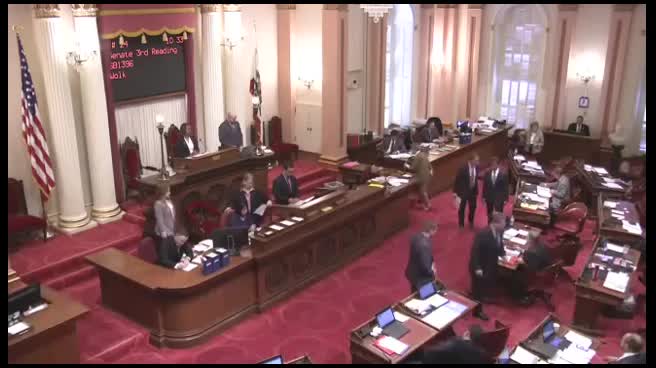 8MIN
Senate Floor
 12MIN
Senate Standing Committee on Natural Resources and Water
Bill Author