SB 479: Healing arts: behavior analysis: licensing.
- Session Year: 2015-2016
- House: Senate
- Latest Version Date: 2015-08-17
Existing law provides for the licensure and regulation of various healing arts licensees by various boards, as defined, within the Department of Consumer Affairs, including the Board of Psychology. Under existing law, until January 1, 2017, the board is vested with the power to enforce the Psychology Licensing Law, and consists of 9 members, 4 of whom are public members and 5 of whom are licensed psychologists. Existing law requires the board to post information on its licensees, as specified, including, among others, psychological assistants. Existing law specifies that a quorum of the board requires 5 members.
This bill would, on and after July 1, 2017, increase the number of members on the board to 11, and would increase the number of members for a quorum to 6 members. The bill would require the 2 new members to meet certain requirements, including, but not limited to, that one of the new members is licensed as a psychologist and qualified to practice behavior analysis, as defined.
This bill would establish the Behavior Analyst Act. The bill would require a person to apply for and obtain a license from the board prior to engaging in the practice of behavior analysis, as defined, either as a behavior analyst or an assistant behavior analyst. The bill would require these applicants to, among other things, meet certain educational and training requirements, and submit fingerprints for both a state and federal criminal background check. The bill would require an assistant behavior analyst applicant to provide proof to the board of ongoing supervision by a licensed behavior analyst or a licensed psychologist who is qualified to practice behavior analysis, as specified. The bill would provide that those licenses expire 2 years after the date of issuance and would authorize the renewal of unexpired licenses if certain requirements are met, including the completion of specified continuing education. The bill would also require an applicant to certify, under penalty of perjury, that he or she is in compliance with that continuing education requirement. By expanding the crime of perjury, the bill would impose a state-mandated local program.
This bill would also require a behavior analysis technician, as defined, who practices under the direction and supervision of a licensed behavior analyst, a licensed assistant behavior analyst, or a licensed psychologist who is qualified to practice behavior analysis, to submit, among other things, an application subject to board approval, fingerprints for a state and federal criminal background check, and payment of an annual application fee.
This bill would, until January 1, 2021, vest the board with the power to enforce the Behavior Analyst Act, and would require the board to, among other things, post information regarding licensed behavior analysts and licensed assistant behavior analysts, as specified. The bill would, until January 1, 2021, create the Behavior Analyst Committee within the jurisdiction of the board, and would require the committee to be comprised of 5 members who shall be appointed as specified. The bill would authorize the committee to make recommendations to the board regarding the regulation of the practice of behavior analysis in the state.
This bill would define certain terms for these purposes. The bill would require the board to conduct disciplinary hearings, as specified. The bill, on and after July 1, 2018, would make it unlawful to, among other things, practice behavior analysis without being licensed by the board, except as specified.
This bill would make a licensee and or health care facility, as defined, that fails or refuses to comply with an authorized client request or court order for the medical records of a client subject to a specified civil penalty, except as specified. The bill would also make a licensee or health care facility with multiple violations of those court orders subject to a crime. By creating a new crime, the bill would impose a state-mandated local program.
This bill would make a violation of any of these provisions a misdemeanor punishable by 6 months in the county jail or a fine not to exceed $2,500, or by both imprisonment and a fine. By creating a new crime, this bill would result in a state-mandated local program.
The California Constitution requires the state to reimburse local agencies and school districts for certain costs mandated by the state. Statutory provisions establish procedures for making that reimbursement.
This bill would provide that no reimbursement is required by this act for a specified reason.
Existing law provides for the licensure and regulation of various healing arts licensees by various boards, as defined, within the Department of Consumer Affairs, including the Board of Psychology. Under existing law, until January 1, 2017, the board is vested with the power to enforce the Psychology Licensing Law, and consists of 9 members, 4 of whom are public members and 5 of whom are licensed psychologists. Existing law requires the board to post information on its licensees, as specified, including, among others, psychological assistants. Existing law specifies that a quorum of the board requires 5 members.
This bill would, on and after July 1, 2017, increase the number of members on the board to 11, and would increase the number of members for a quorum to 6 members. The bill would require the 2 new members to meet certain requirements, including, but not limited to, that one of the new members is qualified to practice behavior analysis, as defined.
This bill would establish the Behavior Analyst Act. The bill would require a person to apply for and obtain a license from the board prior to engaging in the practice of behavior analysis, as defined, either as a behavior analyst or an assistant behavior analyst. The bill would require these applicants to, among other things, meet certain educational and training requirements, and submit fingerprints for both a state and federal criminal background check. The bill would require an assistant behavior analyst applicant to provide proof to the board of ongoing supervision by a licensed behavior analyst or a licensed psychologist who is qualified to practice behavior analysis, as specified. The bill would provide that those licenses expire 2 years after the date of issuance and would authorize the renewal of unexpired licenses if certain requirements are met, including the completion of specified continuing education. The bill would also require an applicant to certify, under penalty of perjury, that he or she is in compliance with that continuing education requirement. By expanding the crime of perjury, the bill would impose a state-mandated local program.
This bill would also require a paraprofessional technician, behavior analysis technician, as defined, who practices under the supervision of a licensed behavior analyst or analyst, a licensed assistant behavior analyst, or a licensed psychologist who is qualified to practice behavior analysis, to submit, among other things, an application subject to board approval, fingerprints for a state and federal criminal background check, and payment of an annual application fee.
This bill would, until January 1, 2021, vest the board with the power to enforce the Behavior Analyst Act, and would require the board to, among other things, post information regarding licensed behavior analysts and licensed assistant behavior analysts, as specified. The bill would, until January 1, 2021, create the Behavior Analyst Committee within the jurisdiction of the board, and would require the committee to be comprised of 5 members who shall be appointed as specified. The bill would authorize the committee to make recommendations to the board regarding the regulation of the practice of behavior analysis in the state.
This bill would define certain terms for these purposes. The bill would require the board to conduct disciplinary hearings, as specified. The bill, on and after July 1, 2018, would make it unlawful to, among other things, practice behavior analysis without being licensed by the board, except as specified.
This bill would make a licensee and health care facility, as defined, that fails or refuses to comply with an authorized client request or court order for the medical records of a client subject to a specified civil penalty, except as specified. The bill would also make a licensee or health care facility with multiple violations of those court orders subject to a crime. By creating a new crime, the bill would impose a state-mandated local program.
This bill would make a violation of any of these provisions a misdemeanor punishable by 6 months in the county jail or a fine not to exceed $2,500, or by both imprisonment and a fine. By creating a new crime, this bill would result in a state-mandated local program.
The California Constitution requires the state to reimburse local agencies and school districts for certain costs mandated by the state. Statutory provisions establish procedures for making that reimbursement.
This bill would provide that no reimbursement is required by this act for a specified reason.
Existing law provides for the licensure and regulation of various healing arts licensees by various boards, as defined, within the Department of Consumer Affairs, including the Board of Psychology. Under existing law, until January 1, 2017, the board is vested with the power to enforce the Psychology Licensing Law, and consists of 9 members, 4 of whom are public members and 5 of whom are licensed psychologists. Existing law requires the board to post information on its licensees, as specified, including, among others, psychological assistants. Existing law specifies that a quorum of the board requires 5 members.
This bill would, on and after July 1, 2017, increase the number of members on the board to 11, and would increase the number of members for a quorum to 6 members. The bill would require the 2 new members to meet certain requirements, including, but not limited to, that one of the new members is qualified to practice behavior analysis, as defined.
This bill would establish the Behavior Analyst Act. The bill would require a person to apply for and obtain a license from the board prior to engaging in the practice of behavior analysis, as defined, either as a behavior analyst or an assistant behavior analyst. The bill would require these applicants to, among other things, meet certain educational and training requirements, and submit fingerprints for both a state and federal criminal background check. The bill would provide that those licenses expire 2 years after the date of issuance and would authorize the renewal of unexpired licenses if certain requirements are met, including the completion of specified continuing education. The bill would also require an applicant to certify, under penalty of perjury, that he or she is in compliance with that continuing education requirement. By expanding the crime of perjury, the bill would impose a state-mandated local program.
This bill would also require a paraprofessional technician, as defined, who practices under the supervision of a licensed behavior analyst or a licensed assistant behavior analyst, to submit, among other things, an application subject to board approval, fingerprints for a state and federal criminal background check, and payment of an annual application fee.
This bill would, until January 1, 2021, vest the board with the power to enforce the Behavior Analyst Act, and would require the board to, among other things, post information regarding licensed behavior analysts and licensed assistant behavior analysts, as specified. The bill would, until January 1, 2021, create the Behavior Analyst Committee within the jurisdiction of the board, and would require the committee to be comprised of 5 members who shall be appointed as specified. The bill would authorize the committee to make recommendations to the board regarding the regulation of the practice of behavior analysis in the state.
This bill would define certain terms for these purposes. The bill would require the board to conduct disciplinary hearings, as specified. The bill, on and after July 1, 2018, would make it unlawful to, among other things, practice behavior analysis without being licensed by the board, except as specified.
This bill would make a licensee and health care facility, as defined, that fails or refuses to comply with an authorized client request or court order for the medical records of a client subject to a specified civil penalty, except as specified. The bill would also make a licensee or health care facility with multiple violations of those court orders subject to a crime. By creating a new crime, the bill would impose a state-mandated local program.
This bill would make a violation of any of these provisions a misdemeanor punishable by 6 months in the county jail or a fine not to exceed $2,500, or by both imprisonment and a fine. By creating a new crime, this bill would result in a state-mandated local program.
The California Constitution requires the state to reimburse local agencies and school districts for certain costs mandated by the state. Statutory provisions establish procedures for making that reimbursement.
This bill would provide that no reimbursement is required by this act for a specified reason.
Existing law provides for the licensure and regulation of various healing arts licensees by various boards, as defined, within the Department of Consumer Affairs, including the Board of Psychology. Under existing law, until January 1, 2017, the board is vested with the power to enforce the Psychology Licensing Law, and consists of 9 members, 4 of whom are public members and 5 of whom are licensed psychologists. Existing law requires the board to post information on its licensees, as specified, including, among others, psychological assistants. Existing law specifies that a quorum of the board requires 5 members.
This bill would, on and after July 1, 2017, increase the number of members on the board to 11, and would increase the number of members for a quorum to 6 members. The bill would require the 2 new members to meet certain requirements, including, but not limited to, that they one of the new members is qualified to practice behavior analysis, as defined.
This bill would establish the Behavior Analyst Act. The bill would require a person to apply for and obtain a license from the board prior to engaging in the practice of behavior analysis, as defined, either as a behavior analyst or an assistant behavior analyst. The bill would require applicants to, among other things, meet certain educational and training requirements, and submit fingerprints for both a state and federal criminal background check.
This bill would, until January 1, 2021, vest the board with the power to enforce the Behavior Analyst Act, and would require the board to, among other things, post information regarding licensed behavior analysts and licensed assistant behavior analysts, as specified. The bill would, until January 1, 2021, create the Behavior Analyst Committee within the jurisdiction of the board, and would require the committee to be comprised of 5 members who shall be appointed as specified. The bill would authorize the committee to make recommendations to the board regarding the implementation of the act. regulation of the practice of behavior analysis in the state.
This bill would define certain terms for these purposes. The bill would require the board to conduct disciplinary hearings, as specified. The bill bill, on and after January 1, 2018, July 1, 2018, would make it unlawful to, among other things, practice behavior analysis without being licensed by the board, except as specified.
This bill would make a violation of any of these provisions a misdemeanor punishable by 6 months in the county jail or a fine not to exceed $2,500, or by both imprisonment and a fine. By creating a new crime, this bill would result in a state-mandated local program.
The California Constitution requires the state to reimburse local agencies and school districts for certain costs mandated by the state. Statutory provisions establish procedures for making that reimbursement.
This bill would provide that no reimbursement is required by this act for a specified reason.
Existing law provides for the licensure and regulation of various healing arts licensees by various boards, as defined, within the Department of Consumer Affairs, including the Board of Behavioral Sciences and the Board of Psychology. Under existing law, until January 1, 2017, the board is vested with the power to enforce the Psychology Licensing Law, and consists of 9 members, 4 of whom are public members and 5 of whom are licensed psychologists. Existing law requires the board to post information on its licensees, as specified, including, among others, psychological assistants. Existing law specifies that a quorum of the board requires 5 members.
This bill would declare the intent of the legislature to enact legislation to license and regulate the profession of applied behavioral analysis.
This bill would, on and after July 1, 2017, increase the number of members on the board to 11, and would increase the number of members for a quorum to 6 members. The bill would require the 2 new members to meet certain requirements, including, but not limited to, that they practice behavior analysis, as defined.
This bill would establish the Behavior Analyst Act. The bill would require a person to apply for and obtain a license from the board prior to engaging in the practice of behavior analysis, as defined, either as a behavior analyst or an assistant behavior analyst. The bill would require applicants to, among other things, meet certain educational and training requirements, and submit fingerprints for both a state and federal criminal background check.
This bill would, until January 1, 2021, vest the board with the power to enforce the Behavior Analyst Act, and would require the board to, among other things, post information regarding licensed behavior analysts and licensed assistant behavior analysts, as specified. The bill would, until January 1, 2021, create the Behavior Analyst Committee within the jurisdiction of the board, and would require the committee to be comprised of 5 members who shall be appointed as specified. The bill would authorize the committee to make recommendations to the board regarding the implementation of the act.
This bill would define certain terms for these purposes. The bill would require the board to conduct disciplinary hearings, as specified. The bill on and after January 1, 2018, make it unlawful to, among other things, practice behavior analysis without being licensed by the board, except as specified.
This bill would make a violation of any of these provisions a misdemeanor punishable by 6 months in the county jail or a fine not to exceed $2,500, or by both imprisonment and a fine. By creating a new crime, this bill would result in a state-mandated local program.
The California Constitution requires the state to reimburse local agencies and school districts for certain costs mandated by the state. Statutory provisions establish procedures for making that reimbursement.
This bill would provide that no reimbursement is required by this act for a specified reason.
Existing law provides for the licensure and regulation of various healing arts licensees by various boards, as defined, within the Department of Consumer Affairs, including the Board of Behavioral Sciences and the Board of Psychology.
This bill would declare the intent of the legislature to enact legislation to license and regulate the profession of applied behavioral analysis.
(a)Each entity specified in subdivisions (c), (d), and (e) shall provide on the Internet information regarding the status of every license issued by that entity in accordance with the California Public Records Act (Chapter 3.5 (commencing with Section 6250) of Division 7 of Title 1 of the Government Code) and the Information Practices Act of 1977 (Chapter 1 (commencing with Section 1798) of Title 1.8 of Part 4 of Division 3 of the Civil Code). The public information to be provided on the Internet shall include information on suspensions and revocations of licenses issued by the entity and other related enforcement action, including accusations filed pursuant to the Administrative Procedure Act (Chapter 3.5 (commencing with Section 11340) of Part 1 of Division 3 of Title 2 of the Government Code) taken by the entity relative to persons, businesses, or facilities subject to licensure or regulation by the entity. The information may not include personal information, including home telephone number, date of birth, or social security number. Each entity shall disclose a licensees address of record. However, each entity shall allow a licensee to provide a post office box number or other alternate address, instead of his or her home address, as the address of record. This section shall not preclude an entity from also requiring a licensee, who has provided a post office box number or other alternative mailing address as his or her address of record, to provide a physical business address or residence address only for the entitys internal administrative use and not for disclosure as the licensees address of record or disclosure on the Internet.
(b)In providing information on the Internet, each entity specified in subdivisions (c) and (d) shall comply with the Department of Consumer Affairs guidelines for access to public records.
(c)Each of the following entities within the Department of Consumer Affairs shall comply with the requirements of this section:
(1)The Board for Professional Engineers, Land Surveyors, and Geologists shall disclose information on its registrants and licensees.
(2)The Bureau of Automotive Repair shall disclose information on its licensees, including auto repair dealers, smog stations, lamp and brake stations, smog check technicians, and smog inspection certification stations.
(3)The Bureau of Electronic and Appliance Repair, Home Furnishings, and Thermal Insulation shall disclose information on its licensees and registrants, including major appliance repair dealers, combination dealers (electronic and appliance), electronic repair dealers, service contract sellers, and service contract administrators.
(4)The Cemetery and Funeral Bureau shall disclose information on its licensees, including cemetery brokers, cemetery salespersons, cemetery managers, crematory managers, cemetery authorities, crematories, cremated remains disposers, embalmers, funeral establishments, and funeral directors.
(5)The Professional Fiduciaries Bureau shall disclose information on its licensees.
(6)The Contractors State License Board shall disclose information on its licensees and registrants in accordance with Chapter 9 (commencing with Section 7000) of Division 3. In addition to information related to licenses as specified in subdivision (a), the board shall also disclose information provided to the board by the Labor Commissioner pursuant to Section 98.9 of the Labor Code.
(7)The Bureau for Private Postsecondary Education shall disclose information on private postsecondary institutions under its jurisdiction, including disclosure of notices to comply issued pursuant to Section 94935 of the Education Code.
(8)The California Board of Accountancy shall disclose information on its licensees and registrants.
(9)The California Architects Board shall disclose information on its licensees, including architects and landscape architects.
(10)The State Athletic Commission shall disclose information on its licensees and registrants.
(11)The State Board of Barbering and Cosmetology shall disclose information on its licensees.
(12)The State Board of Guide Dogs for the Blind shall disclose information on its licensees and registrants.
(13)The Acupuncture Board shall disclose information on its licensees.
(14)The Board of Behavioral Sciences shall disclose information on its licensees, including licensed marriage and family therapists, licensed clinical social workers, licensed educational psychologists, and licensed professional clinical counselors.
(15)The Dental Board of California shall disclose information on its licensees.
(16)The State Board of Optometry shall disclose information regarding certificates of registration to practice optometry, statements of licensure, optometric corporation registrations, branch office licenses, and fictitious name permits of its licensees.
(17)The Board of Psychology shall disclose information on its licensees, including psychologists, psychological assistants, registered psychologists, behavior analysts, and assistant behavior analysts.
(d)The State Board of Chiropractic Examiners shall disclose information on its licensees.
(e)The Structural Pest Control Board shall disclose information on its licensees, including applicators, field representatives, and operators in the areas of fumigation, general pest and wood destroying pests and organisms, and wood roof cleaning and treatment.
(f)Internet for the purposes of this section has the meaning set forth in paragraph (6) of subdivision (f) of Section 17538.
SEC. 2.Section 2920 of the Business and Professions Code is amended to read:2920.(a)The Board of Psychology shall enforce and administer this chapter and Chapter 6.7 (commencing with Section 2999.10). The board shall consist of 9 members, 4 of whom shall be public members.
(b)On and after July 1, 2017, notwithstanding subdivision (a), the board shall consist of 11 members, 5 of whom shall be public members.
(c)This section shall remain in effect only until January 1, 2017, and as of that date is repealed.
(d)Notwithstanding any other law, the repeal of this section renders the board subject to review by the appropriate policy committees of the Legislature.
SEC. 3.Section 2922 of the Business and Professions Code is amended to read:2922.(a)In appointing the members of the board, except the public members, the Governor shall use his or her judgment to select psychologists who represent, as widely as possible, the varied professional interests of psychologists in California.
(b)The Governor shall appoint two of the public members and the five licensed members of the board qualified as provided in Section 2923. The Senate Committee on Rules and the Speaker of the Assembly shall each appoint a public member.
(c)This section shall become inoperative on July 1, 2017, and, as of January 1, 2018, is repealed.
SEC. 4.Section 2922 is added to the Business and Professions Code, to read:2922.(a)In appointing the licensed members of the board, the Governor shall use his or her judgment to select psychologists and behavior analysts who represent, as widely as possible, the varied professional interests of psychologists and behavior analysts in California.
(b)The Governor shall appoint three of the public members and the six licensed members of the board qualified as provided in Section 2923. The Senate Committee on Rules and the Speaker of the Assembly shall each appoint a public member.
(c)This section shall become operative on July 1, 2017.
SEC. 5.Section 2923 of the Business and Professions Code is amended to read:2923.(a)Each member of the board shall have all of the following qualifications:
(1)He or she shall be a resident of this state.
(2)Each member appointed, except the public members, shall be a licensed psychologist.
(b)The public members shall not be licentiates of the board or of any board under this division or of any board referred to in the Chiropractic Act or the Osteopathic Act.
(c)This section shall become inoperative on July 1, 2017, and, as of January 1, 2018, is repealed.
SEC. 6.Section 2923 is added to the Business and Professions Code, to read:2923.(a)Each member of the board shall be a resident of this state.
(b)Five members of the board shall be licensed as psychologists under this chapter.
(c)One member shall be licensed as a psychologist and qualified to practice behavior analysis, as defined in Section 2999.12, as follows:
(1)For the first appointment after the operative date of this section, the member shall hold a certificate as a certified behavior analyst from a certifying entity, as defined in Section 2999.12.
(2)For subsequent appointments, the member shall be licensed as a behavior analyst under Chapter 6.7 (commencing with Section 2999.10).
(d)The public members shall not be licentiates of the board or of any board under this division or of any board referred to in the Chiropractic Act or the Osteopathic Act.
(e)This section shall become operative on July 1, 2017.
SEC. 7.Section 2927 of the Business and Professions Code is amended to read:2927.(a)Five members of the board shall at all times constitute a quorum.
(b)This section shall become inoperative on July 1, 2017, and, as of January 1, 2018, is repealed.
SEC. 8.Section 2927 is added to the Business and Professions Code, to read:2927.(a)Six members of the board shall at all times constitute a quorum.
(b)This section shall become operative on July 1, 2017.
SEC. 9.Chapter 6.7 (commencing with Section 2999.10) is added to Division 2 of the Business and Professions Code, to read:6.7.Behavior Analysts1.General Provisions 2999.10.This chapter shall be known and may be cited as the Behavior Analyst Act.
2999.11.(a)The Legislature finds and declares that the practice of behavior analysis in California affects the public health, safety, and welfare, and is subject to regulation to protect the public from the unauthorized and unqualified practice of behavior analysis, and unprofessional, unethical, or harmful conduct by persons licensed to practice behavior analysis.
(b)It is the intent of the Legislature that the board begin accepting applications for behavior analyst licensure and assistant behavior analyst licensure no later than January 1, 2018, provided that the funds necessary to implement this chapter have been appropriated by the Legislature as specified in Section 2999.98.
2999.12.For purposes of this chapter, the following terms have the following meanings:
(a)Board means the Board of Psychology.
(b)Certifying entity means the Behavior Analyst Certification Board or its successor, or another national credentialing organization with behavior analyst certification programs approved by the board and accredited by the National Commission for Certifying Agencies.
(c)Committee means the Behavior Analyst Committee.
(d)Department means the Department of Consumer Affairs.
(e)Licensed assistant behavior analyst means a person licensed under this chapter to practice behavior analysis under the supervision of a licensed behavior analyst.
(f)Licensed behavior analyst means a person licensed under this chapter to practice behavior analysis.
(g)Behavior analysis technician means an individual who works directly with a client to implement applied behavior analysis services under the direction and supervision of a licensed behavior analyst or analyst, a licensed assistant behavior analyst and analyst, or a licensed psychologist who is qualified to practice behavior analysis, and has successfully completed the application requirements described in Section 2999.36.
(h)(1)Practice of behavior analysis or to practice behavior analysis means the design, implementation, and evaluation of instructional and environmental modifications to produce socially significant improvements in human behavior and includes the empirical identification of functional relations between behavior and environmental factors, known as functional assessment and analysis, interventions based on scientific research and the direct observation and measurement of behavior and the environment, and utilization of contextual factors, motivating operations, antecedent stimuli, positive reinforcement, and other consequences to help people develop new behaviors, increase or decrease existing behaviors, and emit behaviors under specific environmental conditions.
(2)The practice of behavior analysis does not include psychological testing and assessment, diagnosis of a mental or physical disorder, neuropsychology, psychotherapy, cognitive therapy, sex therapy, psychoanalysis, hypnotherapy, counseling, prescribing drugs, performing surgery, or administering electroconvulsive therapy.
(3)The Legislature recognizes that the scopes of practice of healing arts licensees regulated under this division sometimes contain similar practices. However, nothing herein shall be construed to allow a licensed behavior analyst or a licensed assistant behavior analyst to engage in those practices, including, but not limited to, assessments, other than specific to their scope of practice within behavior analysis as described herein. Any person practicing behavior analysis under this chapter who violates this provision is subject to disciplinary action by both the Board of Psychology and the board overseeing the relevant practice.
2.Administration2999.20.(a)The Board of Psychology is vested with the power to administer the provisions and requirements of this chapter, and may make and enforce rules and regulations that are reasonably necessary to carry out its provisions.
(b)This section shall remain in effect only until January 1, 2021, and as of that date is repealed. Notwithstanding any other law, the repeal of this section renders the board subject to review by the appropriate policy committees of the Legislature.
2999.21.Protection of the public shall be the highest priority for the board in exercising its licensing, regulatory, and disciplinary functions pursuant to this chapter. Whenever the protection of the public is inconsistent with other interests sought to be promoted, the protection of the public shall be paramount.
2999.22.The board shall adopt, amend, and repeal regulations to implement the requirements of this chapter. All regulations adopted by the board shall comply with the provisions of Chapter 3.5 (commencing with Section 11340) of Part 1 of Division 3 of Title 2 of the Government Code.
2999.23.The board shall adopt a program of consumer and professional education in matters relevant to the ethical practice of behavior analysis. The board shall establish as its standards of ethical conduct relating to the practice of behavior analysis, the Professional and Ethical Compliance Code for Behavior Analysts published by the Behavior Analyst Certification Board. These standards shall be applied by the board as the accepted standard of care in all licensing examination development and in all board enforcement policies and disciplinary case evaluations.
2999.23.5.The board may employ, subject to civil service and other laws, employees as may be necessary to carry out the provisions of this chapter under the direction of the executive officer of the board.
2999.24.The board shall maintain, and make available to the public, a list of all licensees. The board shall make available on its Internet Web site information regarding the status of every license issued by the board under this chapter pursuant to Section 27.
2999.25.(a)The Behavior Analyst Committee is hereby created within the jurisdiction of the board to make recommendations to the board regarding the regulation of the practice of behavior analysis in the state in order to protect the public from the unauthorized and unqualified practice of applied behavior analysis, and unprofessional, unethical, or harmful conduct by persons licensed to practice behavior analysis.
(b)The committee shall consist of five members. Two members shall be licensed behavior analysts, one of which shall also be a member of the board. One member shall be a psychologist licensed under Chapter 6.6 (commencing with Section 2900) and who holds a current certification from a certifying entity as a behavior analyst. One member shall be a licensed assistant behavior analyst. One member shall be a public member who is not licensed under this chapter, under any chapter within this division, or by any board referred to in the Chiropractic Act or the Osteopathic Act.
(c)The Governor shall appoint one licensed behavior analyst member, the licensed psychologist member, and the licensed assistant behavior analyst member. The Senate Committee on Rules shall appoint the public member, and the Speaker of the Assembly shall appoint one licensed behavior analyst member.
(d)Notwithstanding subdivisions (b) and (c), the initially appointed members of the committee shall be appointed as follows:
(1)The initial members appointed by the Governor shall be as follows:
(A)One member shall be currently certified by a certifying entity as a certified behavior analyst and shall serve an initial term of one year.
(B)One member shall be currently certified by a certifying entity as a certified assistant behavior analyst and shall serve an initial term of two years.
(C)One member shall be a licensed psychologist who is currently certified by a certifying entity as a certified behavior analyst and shall serve an initial term of three years.
(2)The initial member appointed by the Senate Committee on Rules shall serve a term of four years.
(3)The initial member appointed by the Speaker of the Assembly shall be currently certified by a certifying entity as a certified behavior analyst and shall serve an initial term of four years.
(e)Except as provided in subdivision (d), each member of the committee shall hold office for a term of four years, and shall serve until the appointment of his or her successor or until one year has elapsed since the expiration of the term for which he or she was appointed, whichever occurs first. Vacancies shall be filled by the appointing power for the unexpired portion of the terms in which they occur. A member shall not serve for more than two consecutive terms.
(f)All terms shall begin on July 1 and expire on June 30.
(g)Each member of the committee shall receive per diem and expenses as provided in Sections 103 and 113.
(h)Three members of the committee shall at all times constitute a quorum.
(i)This section shall become operative on July 1, 2017.
(j)This section shall remain in effect only until January 1, 2021, and as of that date is repealed. Notwithstanding any other law, the repeal of this section renders the committee subject to review by the appropriate policy committees of the Legislature.
2999.26.The committee shall do all of the following:
(a)Meet at least once per quarter. All meetings of the committee shall be public meetings. Notice of each regular meeting of the committee shall be given in accordance with the Bagley-Keene Open Meeting Act (Article 9 (commencing with Section 11120) of Chapter 1 of Part 1 of Division 3 of Title 2 of the Government Code).
(b)Committee meetings may be called upon reasonable notice at the discretion of the chair, and shall be called at any time upon reasonable notice by a written request of two committee members to the chair.
(c)The committee shall elect a chair and a vice chair from among its members at the first meeting held in each fiscal year. The chair shall preside at all meetings of the committee and shall work with the executive officer of the board to coordinate the committees business. If the chair is unable to attend a meeting, the vice chair shall preside at the meeting.
2999.27.(a)The committee may make recommendations to the board regarding licensing and practice standards.
(b)The committee may make recommendations to the board regarding the adoption, amendment, and repeal of regulations to implement the requirements of this chapter including, but not limited to, the setting of fees and the establishment of disciplinary guidelines.
3.Licensing2999.30.To qualify for licensure as a licensed behavior analyst or a licensed assistant behavior analyst, each applicant shall meet the boards regulatory requirements for behavior analyst or assistant behavior analyst licensure, as applicable, including all of the following:
(a)The applicant has not committed acts or crimes constituting grounds for denial of licensure under Section 480.
(b)The board shall not issue a license or registration to any person who has been convicted of a crime in this state, or another state, or in a territory of the United States that involves sexual abuse of a child, or who is required to register pursuant to Section 290 of the Penal Code or the equivalent in another state or territory.
(c)The applicant has successfully passed a state and federal level criminal offender record information search conducted through the Department of Justice, as follows:
(1)The board shall request from the Department of Justice subsequent arrest notification service, pursuant to Section 11105.2 of the Penal Code, for each person who submitted information pursuant to this subdivision.
(2)The Department of Justice shall charge a fee sufficient to cover the cost of processing the request described in this section.
2999.31.(a)In order to obtain a license as a behavior analyst, an individual shall submit an application on a form approved by the board accompanied by the fees required by the board as specified in Section 2999.93.
(b)An applicant shall include, with the application, verification from the certifying entity that the applicant meets both of the following requirements:
(1)Has passed the Board Certified Behavior Analyst examination or an equivalent examination administered by the certifying entity.
(2)Maintains an active status as a certified behavior analyst with the certifying entity.
(c)Each applicant shall obtain a passing score on a California law and ethics examination administered by the board.
(d)This section shall become inoperative on July 1, 2018. An applicant who submits his or her application prior to July 1, 2018, shall be required to meet the requirements of this section to be licensed by the board.
(e)This section shall remain in effect only until January 1, 2019, and as of that date is repealed.
2999.32.(a)In order to obtain a license as a behavior analyst, an individual shall submit an application on a form approved by the board accompanied by the fees required by the board as specified in Section 2999.93.
(b)An applicant shall include, with the application, verification from the certifying entity that the applicant meets both of the following requirements:
(1)Has passed the Board Certified Behavior Analyst examination or an equivalent examination administered by the certifying entity.
(2)Maintains an active status as a certified behavior analyst with the certifying entity.
(c)Each applicant shall obtain a passing score on a California law and ethics examination administered by the board.
(d)The applicant shall possess a masters degree or higher level of education from an institution, which meets the requirements described in Section 2999.35, that was conferred in behavior analysis, psychology, or education, or conferred in a degree program in which the applicant completed a behavior analysis course sequence approved by the certifying entity. entity or otherwise deemed an applicable equivalent by the certifying entity.
(e)In addition to subdivisions (a) to (d), inclusive, an individual shall meet one of the following paragraphs in order to be licensed under this chapter:
(1)An individual shall have completed both of the following:
(A)Two hundred seventy hours of classroom graduate-level instruction in all of the following content areas:
(i)Ethical and professional conduct coursework consisting of 45 hours. The content must be taught in one or more freestanding courses devoted to ethical and professional conduct of behavior analysts.
(ii)Concepts and principles of behavior analysis consisting of 45 hours.
(iii)Research methods in behavior analysis, consisting of 25 hours of measurement, including data analysis, and 20 hours of experimental design.
(iv)Applied behavior analysis, consisting of 45 hours of fundamental elements of behavior change and specific behavior change procedures, 30 hours of identification of the problem and assessment, 10 hours of intervention and behavior change considerations, 10 hours of behavior change systems, and 10 hours of implementation, management, and supervision.
(v)Elective coursework in behavior analysis consisting of 30 hours.
(B)Supervised experiential training by any of the following:
(i)One thousand five hundred hours of independent field work in behavior analysis supervised in accordance with the requirements of the certifying entity.
(ii)One thousand hours of supervised practicum in behavior analysis within a university practicum approved by the certifying entity, taken for graduate academic credit, and completed with a passing grade.
(iii)Seven hundred fifty hours of supervised intensive practicum in behavior analysis within a university practicum approved by the certifying entity, taken for graduate academic credit, and completed with a passing grade.
(iv)A combination of the supervised experience in clause (i), (ii), or (iii). Hours may be completed in any combination of the categories of supervised experience. Hours accrued through a combination of supervised experience shall be proportionately calculated.
(2)An individual shall meet all of the following requirements:
(A)Have a faculty appointment of at least three years, cumulatively, of full-time work as a faculty member at a fully accredited higher education institution within a five-year period.
(B)Taught at least five sections or iterations of behavior analysis coursework. An applicant shall have taught at least two behavior analysis content areas, which are concepts and principles of behavior, single-subject research methods, applied behavior analysis, and ethics in behavior analysis, in separate courses. Each course taught shall have been exclusively or primarily devoted to behavior analysis content, and shall have been taught at the graduate level. An applicant shall submit proof of completion of the faculty appointment and teaching requirements from a department head, including the syllabus for each course taught, to the board.
(C)Published one article with all of the following characteristics:
(i)Behavior analytic in nature.
(ii)Includes at least one experimental evaluation.
(iii)Published in a high-quality, peer reviewed journal.
(iv)The applicant is the first, second, or corresponding author.
(v)The article may have been published at any time during the applicants career.
(D)Obtained supervised experiential training by any of the following:
(i)One thousand five hundred hours of independent field work in behavior analysis supervised in accordance with the requirements of the certifying entity.
(ii)One thousand hours of supervised practicum in behavior analysis within a university practicum approved by the certifying entity, taken for graduate academic credit, and completed with a passing grade.
(iii)Seven hundred fifty hours of supervised intensive practicum in behavior analysis within a university practicum approved by the certifying entity, taken for graduate credit, and completed with a passing grade.
(iv)A combination of the supervised experience in clause (i), (ii), or (iii). Hours may be completed in any combination of the categories of supervised experience. Hours accrued through a combination of supervised experience shall be proportionately calculated.
(3)An individual shall have completed all of the following:
(A)A doctoral degree in behavior analysis, psychology, or education from an accredited higher education institution.
(B)Ten years of postdoctoral experience practicing behavior analysis. The duration of practice shall be at least 10 years, cumulatively, of full-time practice. An applicants practice shall have occurred under a relevant state professional credential or license.
(C)At least 500 hours of supplemental supervised experiential training that meets current experience standards of the certifying entity, commencing after the 10 years of postdoctoral experience required in paragraph (b).
(f)This section shall become operative on July 1, 2018.
2999.33.(a)To obtain a license as an assistant behavior analyst, an individual shall submit an application on a form approved by the board accompanied by the fees required by the board as specified in Section 2999.93.
(b)An applicant shall include, with the application, verification from the certifying entity that the applicant meets all of the following requirements:
(1)Has passed the Board Certified Assistant Behavior Analyst examination or equivalent examination administered by the certifying entity.
(2)Maintains an active status as a certified assistant behavior analyst with the certifying entity.
(c)Each applicant shall obtain a passing score on a California law and ethics examination administered by the board.
(d)Each applicant shall provide proof to the board of ongoing supervision by a licensed behavior analyst or a licensed psychologist who is qualified to practice behavior analysis in a manner consistent with the certifying entitys requirements for supervision of assistant behavior analysts.
(e)This section shall become inoperative on July 1, 2018. An applicant who submits his or her application prior to July 1, 2018, shall be required to meet the requirements of this section to be licensed by the board.
(f)This section shall remain in effect only until January 1, 2019, and as of that date is repealed.
2999.34.(a)In order for an individual to be licensed as an assistant behavior analyst under this chapter, he or she shall possess a baccalaureate degree or higher level of education from an institution that meets the requirements described in Section 2999.35.
(b)An applicant shall include, with the application, verification from the certifying entity that the applicant meets both of the following requirements:
(1)Has passed the Board Certified Assistant Behavior Analyst examination or an equivalent examination administered by the certifying entity.
(2)Maintains an active status as a certified assistant behavior analyst with the certifying entity.
(c)Each applicant shall obtain a passing score on a California law and ethics examination administered by the board.
(d)Each applicant shall provide proof to the board of ongoing supervision by a licensed behavior analyst or a licensed psychologist who is qualified to practice behavior analysis in a manner consistent with the certifying entitys requirements for supervision of assistant behavior analysts.
(e)In addition to subdivisions (a) to (d), inclusive, an individual shall meet all of the following requirements in order to be licensed under this chapter:
(1)Completed a baccalaureate degree or higher level of education from an institution that meets the requirements in Section 2999.35.
(2)An applicant shall meet both of the following:
(A)Completed 180 classroom hours of undergraduate or graduate level instruction in all of the following content areas:
(i)Ethical and professional conduct coursework of behavior analysis consisting of 15 hours.
(ii)Concepts and principles of behavior analysis consisting of 45 hours.
(iii)Research methods in behavior analysis, consisting of 10 hours of measurement, including data analysis, and five hours of experimental design.
(iv)Applied behavior analysis, consisting of 45 hours of fundamental elements of behavior change and specific behavior change procedures, 30 hours of identification of the problem and assessment, five hours of intervention and behavior change considerations, five hours of behavior change systems, and five hours of implementation, management, and supervision.
(v)Elective coursework in behavior analysis consisting of 15 hours.
(B)Obtained supervised experiential training by any of the following:
(i)One thousand hours of independent field work in behavior analysis supervised in accordance with the requirements of the certifying entity, taken for academic credit, and completed with a passing grade.
(ii)Six hundred seventy hours of supervised practicum in behavior analysis within a university practicum approved by the certifying entity, taken for academic credit, and completed with a passing grade.
(iii)Five hundred hours of supervised intensive practicum in behavior analysis within a university practicum approved by the certifying entity, taken for academic credit, and completed with a passing grade.
(iv)A combination of the supervised experience in clause (i), (ii), or (iii). Hours may be completed in any combination of the categories of supervised experience. Hours accrued through a combination of supervised experience shall be proportionately calculated.
(f)This section shall become operative on July 1, 2018.
2999.35.The education required to obtain a behavior analyst license or an assistant behavior analyst license shall be from any of the following:
(a)A United States institution of higher education listed by the Council for Higher Education Accreditation.
(b)A Canadian institution of higher education that is a member of the Association of Universities and Colleges of Canada or the Association of Canadian Community Colleges.
(c)An applicant for licensure trained in an educational institution outside the United States or Canada shall demonstrate to the satisfaction of the board that he or she possesses a degree in a relevant subject that is equivalent to a degree earned from a regionally accredited university in the United States or Canada. Such an applicant shall provide to the board a comprehensive evaluation of the degree performed by a foreign credential service that is a member of the National Association of Credential Evaluation Services (NACES), and any other documentation that the board deems necessary.
2999.36.(a)Behavior analysis technicians practicing in this state under the direction and supervision of an individual licensed under this chapter or a licensed psychologist who is qualified to practice behavior analysis shall satisfy all of the following requirements:
(1)Be at least 18 years of age and possess a minimum of a high school diploma or its equivalent.
(2)Submit an application on a form approved by the board.
(3)Submit fingerprint images to the California Department of Justice for a state and federal criminal background report within 14 days from the date of application.
(4)Annually pay an application fee, in an amount not to exceed a reasonable regulatory cost, to be determined by the board.
(b)The board may deny or revoke acceptance of an application under this section if it is determined to be in the best interest of public safety and welfare, as described in Section 2999.21.
2999.36.5.On and after July 1, 2018, it shall be unlawful for any person to engage in any of the following acts:
(a)Engage in the practice of behavior analysis, as defined in Section 2999.12, without first having complied with the provisions of this chapter and without holding a current, valid, and active license as required by this chapter.
(b)Represent himself or herself by the title licensed behavior analyst, or licensed assistant behavior analyst without being duly licensed according to the provisions of this chapter.
(c)Make any use of any title, words, letters, or abbreviations that may reasonably be confused with a designation provided by this chapter to denote a standard of professional or occupational competence without being duly licensed.
(d)Materially refuse to furnish the board information or records required or requested pursuant to this chapter.
2999.37.This chapter does not apply to any of the following:
(a)An individual licensed to practice psychology in this state under Chapter 6.6 (commencing with Section 2900), if the practice of behavior analysis engaged in by the licensed psychologist is within the licensed psychologists training and competence.
(b)A speech-language pathologist or an audiologist licensed under Chapter 5.3 (commencing with Section 2530), an occupational therapist licensed under Chapter 5.6 (commencing with Section 2570), a physical therapist licensed under Chapter 5.7 (commencing with Section 2600), a marriage and family therapist licensed under Chapter 13 (commencing with Section 4980), an educational psychologist licensed under Chapter 13.5 (commencing with Section 4989.10), a clinical social worker licensed under Chapter 14 (commencing with Section 4991), or a professional clinical counselor licensed under Chapter 16 (commencing with Section 4999.10), if the services provided by any of those licensees are within his or her licensed scope of practice and within the scope of his or her training and competence, provided that he or she does not represent himself or herself as a licensed behavior analyst or licensed assistant behavior analyst.
(c)A student or other individual pursuing supervised experience for any of the following:
(1)Experiential training toward a license described in this chapter in accordance with this chapter.
(2)Experience in behavior analysis toward a license described in subdivision (a) or (b) in accordance with the requirements of the respective licensure act in this division.
(3)As part of a defined program of study, course, practicum, internship, or postdoctoral program, provided that the behavior analysis activities are directly supervised by a licensed behavior analyst, a licensed psychologist, or by an instructor in a course sequence approved by a certifying entity.
(d)A parent or guardian of a recipient of behavior analysis services who acts under the direction of a licensed behavior analyst or licensed assistant behavior analyst.
(e)An individual who teaches behavior analysis or conducts behavior analysis research, provided that such teaching or research does not involve the direct delivery of behavior analysis services.
(f)A behavior analyst licensed in another state or certified by the certifying entity to practice independently, and who temporarily provides behavior analysis services in California during a period of not more than 90 days in a calendar year.
(g)An individual who is vendorized by one or more regional centers of the State Department of Developmental Services while practicing behavior analysis services authorized under that vendorization. That individual shall not represent himself or herself as a licensed behavior analyst or licensed assistant behavior analyst unless he or she holds a license under this chapter, and shall not offer behavior analysis services to any person or entity other than the regional centers with which he or she is vendorized or accept remuneration for providing behavior analysis services other than the remuneration received from those regional centers unless he or she holds a license under this chapter.
(h)An individual employed by a local educational agency for the purpose of assisting students with behavioral and developmental issues when in classroom and other school settings.
2999.41.A licensee shall give written notice to the board of a name change within 30 days after each change, giving both the old and new names. A copy of the legal document authorizing the name change, such as a court order or marriage certificate, shall be submitted with the notice.
2999.44.(a)A license shall expire and become invalid two years after it is issued at 12 midnight on the last day of the month in which it was issued, if not renewed.
(b)To renew an unexpired license, the licensee shall, on or before the date on which it would otherwise expire, apply for renewal on a form provided by the board, accompanied by the renewal fee set by the board. The licensee shall include verification from the certifying entity that he or she maintains an active certification status with the renewal form.
(c)To renew an assistant behavior analyst license, in addition to the requirements in subdivision (b), the licensee shall submit proof of ongoing supervision by a licensed behavior analyst or a licensed psychologist who is qualified to practice behavior analysis in a manner consistent with the boards requirements for supervision of assistant behavior analysts.
2999.45.(a)A license that has expired may be renewed at any time within three years after its expiration by applying for renewal on a form provided by the board, payment of all accrued and unpaid renewal fees, and the delinquency fee specified in Section 2999.93. The licensee shall include verification from the certifying entity that he or she maintains an active certification status with the renewal form.
(b)Except as provided in Section 2999.46.5, a license that is not renewed within three years of its expiration shall not be renewed, restored, or reinstated, and the license shall be canceled immediately upon expiration of the three-year period.
2999.46.(a)The board shall not issue any renewal license, a new license after expiration of an expired license, or a reinstatement license unless the applicant submits proof that he or she has completed not less than 32 hours of approved continuing education in the preceding two-year licensure cycle for licensed behavior analysts and 20 hours of approved continuing education in the preceding two-year licensure cycle for licensed assistant behavior analysts.
(b)Each person renewing or reinstating his or her license or obtaining a new license after expiration of a prior license issued pursuant to this chapter shall submit proof of compliance with this section to the board.
(c)A person applying for renewal, a new license after expiration of a prior license, or reinstatement to an active license status shall certify under penalty of perjury that he or she is in compliance with this section.
(d)The board may recognize continuing education courses that have been approved by one or more private nonprofit organizations that have at least 10 years experience managing continuing education programs for behavior analysts.
(e)The board shall adopt regulations as necessary for implementation of this section.
2999.46.5.(a)A suspended license is subject to expiration and shall be renewed as provided in this article, but such renewal does not entitle the licensee, while the license remains suspended, and until it is reinstated, to engage in the licensed activity or in any other activity or conduct in violation of the order or judgment by which the license was suspended.
(b)A license revoked on disciplinary grounds is subject to expiration as provided in this article, but it may not be renewed. If it is reinstated after its expiration, the licensee, as a condition of reinstatement, shall pay a reinstatement fee in an amount equal to the renewal fee, plus the delinquency fee, and any fees accrued at the time of its revocation.
4.Enforcement2999.60.The board may on its own, and shall, upon the receipt of a complaint from any person, investigate the actions of any licensee. The board shall review a licensees alleged violation of statute, regulation, or any other law and any other complaint referred to it by the public, a public agency, or the department, and may upon a finding of a violation take disciplinary action under this article.
2999.61.A license issued under this chapter may be denied, revoked, or otherwise sanctioned upon demonstration of ineligibility for licensure, including, but not limited to, failure to maintain active certification by the certifying entity or falsification of documentation submitted to the board for licensure or submitted to the certifying authority for certification.
2999.62.The board may deny a license application, may issue a license with terms and conditions, may suspend or revoke a license, or may place a license on probation if the applicant or licensee has been guilty of unprofessional conduct. Unprofessional conduct shall include, but not be limited to:
(a)Conviction of a crime substantially related to the qualifications, functions, or duties of a licensed behavior analyst or a licensed assistant behavior analyst.
(b)Use of any controlled substance as defined in Division 10 (commencing with Section 11000) of the Health and Safety Code, dangerous drug, or any alcoholic beverage to an extent or in a manner dangerous to himself or herself, any other person, or the public, or to an extent that this use impairs his or her ability to safely perform the practice of behavior analysis.
(c)Fraudulently or neglectfully misrepresenting the type or status of a license actually held.
(d)Impersonating another person holding a license or allowing another person to use his or her license.
(e)Use of fraud or deception in applying for a license or in passing any examination required by this chapter.
(f)Paying, offering to pay, accepting, or soliciting any consideration, compensation, or remuneration, whether monetary or otherwise, for the referral of clients.
(g)Violating Section 17500.
(h)Willful, unauthorized communication of information received in professional confidence.
(i)Violating any rule of professional conduct promulgated by the board and set forth in regulations duly adopted under this chapter.
(j)Being grossly negligent in the practice of his or her profession.
(k)Violating any of the provisions of this chapter or regulations duly adopted thereunder.
(l)The aiding or abetting of any person to engage in the unlawful practice of behavior analysis.
(m)The suspension, revocation, or imposition of probationary conditions or other disciplinary action by another state or country of a license, certificate, or registration to practice behavior analysis issued by that state or country to a person also holding a license issued under this chapter if the act for which the disciplinary action was taken constitutes a violation of this section. A certified copy of the decision or judgment of the other state or country shall be conclusive evidence of that action.
(n)The commission of any dishonest, corrupt, or fraudulent act.
(o)Any act of sexual abuse or sexual relations with a patient or former patient within two years following termination of therapy, or sexual misconduct that is related to the qualifications, functions, or duties of a licensed behavior analyst or a licensed assistant behavior analyst.
(p)Functioning outside of his or her particular field or fields of competence as established by his or her education, training, and experience.
(q)Willful failure to submit, on behalf of an applicant for licensure, verification of supervised experience to the board.
(r)Repeated acts of negligence.
(s)Failure to comply with all ethical and disciplinary standards published by the certifying entity.
2999.63.(a)Except as provided in subdivisions (b), (c), and (e), any accusation filed against a licensee pursuant to Section 11503 of the Government Code shall be filed within three years from the date the board discovers the alleged act or omission that is the basis for disciplinary action, or within seven years from the date the alleged act or omission that is the basis for disciplinary action occurred, whichever occurs first.
(b)An accusation filed against a licensee pursuant to Section 11503 of the Government Code alleging the procurement of a license by fraud or misrepresentation is not subject to the limitations set forth in subdivision (a).
(c)The limitation provided for by subdivision (a) shall be tolled for the length of time required to obtain compliance when a report required to be filed by the licensee or registrant with the board pursuant to Article 11 (commencing with Section 800) of Chapter 1 is not filed in a timely fashion.
(d)If an alleged act or omission involves a minor, the seven-year limitations period provided for by subdivision (a) and the 10-year limitations period provided for by subdivision (e) shall be tolled until the minor reaches the age of majority.
(e)An accusation filed against a licensee pursuant to Section 11503 of the Government Code alleging sexual misconduct shall be filed within three years after the board discovers the act or omission alleged as the ground for disciplinary action, or within 10 years after the act or omission alleged as the ground for disciplinary action occurs, whichever occurs first.
(f)The limitations period provided by subdivision (a) shall be tolled during any period if material evidence necessary for prosecuting or determining whether a disciplinary action would be appropriate is unavailable to the board due to an ongoing criminal investigation.
2999.64.Notwithstanding Section 2999.62, any proposed decision or decisions issued under this chapter in accordance with the procedures set forth in Chapter 5 (commencing with Section 11500) of Part 1 of Division 3 of Title 2 of the Government Code that contains any finding of fact that the licensee engaged in any act of sexual contact, as defined in Section 728, when that act is with a patient, or with a former patient, within two years following termination of services, shall contain an order of revocation. The revocation shall not be stayed by the administrative law judge.
2999.66.The board may deny an application for, or issue subject to terms and conditions, or suspend or revoke, or impose probationary conditions upon, a license or registration after a hearing as provided in Section 2999.70.
2999.67.A plea or verdict of guilty or a conviction following a plea of nolo contendere made to a charge which is substantially related to the qualifications, functions, and duties of a licensed behavior analyst or licensed assistant behavior analyst is deemed to be a conviction within the meaning of this article. The board may order the license suspended or revoked, or may decline to issue a license when the time for appeal has elapsed, the judgment of conviction has been affirmed on appeal, or when an order granting probation is made suspending the imposition of sentence, irrespective of a subsequent order under Section 1203.4 of the Penal Code allowing the person to withdraw his or her plea of guilty and to enter a plea of not guilty, or setting aside the verdict of guilty, or dismissing the accusation, information, or indictment.
2999.68.Any person required to register as a sex offender pursuant to Section 290 of the Penal Code, is not eligible for licensure by the board.
2999.69.An administrative disciplinary decision that imposes terms of probation may include, among other things, a requirement that the licensee who is being placed on probation pay the monetary costs associated with monitoring the probation.
2999.70.The proceedings under this article shall be conducted by the board in accordance with Chapter 5 (commencing with Section 11500) of Part 1 of Division 3 of Title 2 of the Government Code.
2999.80.A person who violates any of the provisions of this chapter is guilty of a misdemeanor punishable by imprisonment in a county jail not exceeding six months or by a fine not exceeding two thousand five hundred dollars ($2,500), or by both that fine and imprisonment.
2999.81.In addition to other proceedings provided in this chapter, whenever any person has engaged, or is about to engage, in any acts or practices that constitute, or will constitute, an offense against this chapter, the superior court in and for the county wherein the acts or practices take place, or are about to take place, may issue an injunction or other appropriate order restraining that conduct on application of the board, the Attorney General, or the district attorney of the county. Proceedings under this section shall be governed by Chapter 3 (commencing with Section 525) of Title 7 of Part 2 of the Code of Civil Procedure, except that it shall be presumed that there is no adequate remedy at law and that irreparable damage will occur if the continued violation is not restrained or enjoined. On the written request of the board, or on its own motion, the board may commence an action in the superior court under this section.
2999.83.(a)(1)A licensee who fails or refuses to comply with a request for the medical records of a client, that is accompanied by that clients written authorization for release of those records to the board, within 15 days of receiving the request and authorization, shall pay to the board a civil penalty of one thousand dollars ($1,000) per day for each day that the documents have not been produced after the 15th day, unless the licensee is unable to provide the documents within this time period for good cause.
(2)A health care facility shall comply with a request for the medical records of a client that is accompanied by that clients written authorization for release of records to the board together with a notice citing this section and describing the penalties for failure to comply with this section. Failure to provide the authorizing clients medical records to the board within 30 days of receiving the request, authorization, and notice shall subject the health care facility to a civil penalty, payable to the board, of up to one thousand dollars ($1,000) per day for each day that the documents have not been produced after the 30th day, up to ten thousand dollars ($10,000), unless the health care facility is unable to provide the documents within this time period for good cause. This paragraph shall not require health care facilities to assist the board in obtaining the clients authorization. The board shall pay the reasonable costs of copying the medical records.
(b)(1)A licensee who fails or refuses to comply with a court order, issued in the enforcement of a subpoena, mandating the release of records to the board shall pay to the board a civil penalty of one thousand dollars ($1,000) per day for each day that the documents have not been produced after the date by which the court order requires the documents to be produced, unless it is determined that the order is unlawful or invalid. Any statute of limitations applicable to the filing of an accusation by the board shall be tolled during the period the licensee is out of compliance with the court order and during any related appeals.
(2)Any licensee who fails or refuses to comply with a court order, issued in the enforcement of a subpoena, mandating the release of records to the board, shall be subject to a civil penalty, payable to the board, of in an amount not to exceed five thousand dollars ($5,000). The amount of the penalty shall be added to the licensees renewal fee if it is not paid by the next succeeding renewal date. Any statute of limitations applicable to the filing of an accusation by the board shall be tolled during the period the licensee is out of compliance with the court order and during any related appeals.
(3)A health care facility that fails or refuses to comply with a court order, issued in the enforcement of a subpoena, mandating the release of client records to the board, that is accompanied by a notice citing this section and describing the penalties for failure to comply with this section, shall pay to the board a civil penalty of up to one thousand dollars ($1,000) per day for each day that the documents have not been produced, up to ten thousand dollars ($10,000), after the date by which the court order requires the documents to be produced, unless it is determined that the order is unlawful or invalid. Any statute of limitations applicable to the filing of an accusation by the board against a licensee shall be tolled during the period the health care facility is out of compliance with the court order and during any related appeals.
(4)Any health care facility that fails or refuses to comply with a court order, issued in the enforcement of a subpoena, mandating the release of records to the board, shall be subject to a civil penalty, payable to the board, of in an amount not to exceed five thousand dollars ($5,000). Any statute of limitations applicable to the filing of an accusation by the board against a licensee shall be tolled during the period the health care facility is out of compliance with the court order and during any related appeals.
(c)Multiple acts by a licensee in violation of subdivision (b) shall be a misdemeanor punishable by a fine not to exceed five thousand dollars ($5,000) or by imprisonment in a county jail not exceeding six months, or by both that fine and imprisonment. Multiple acts by a health care facility in violation of subdivision (b) shall be a misdemeanor punishable by a fine not to exceed five thousand dollars ($5,000) and shall be reported to the State Department of Health Care Services and shall be considered as grounds for disciplinary action with respect to licensure, including suspension or revocation of the license or certificate.
(d)A failure or refusal of a licensee to comply with a court order, issued in the enforcement of a subpoena, mandating the release of records to the board constitutes unprofessional conduct and is grounds for suspension or revocation of his or her license.
(e)The imposition of the civil penalties authorized by this section shall be in accordance with the Administrative Procedure Act (Chapter 5 (commencing with Section 11500) of Part 1 of Division 3 of Title 2 of the Government Code).
(f)For purposes of this section, health care facility means a clinic or health facility licensed or exempt from licensure pursuant to Division 2 (commencing with Section 1200) of the Health and Safety Code.
5.Revenue2999.90.The board shall report each month to the Controller the amount and source of all revenue received pursuant to this chapter and at the same time deposit the entire amount thereof in the State Treasury for credit to the Psychology Fund established by Section 2980.
2999.91.(a)The moneys credited to the Psychology Fund under Section 2999.90 shall, upon appropriation by the Legislature, be used for the purposes of carrying out and enforcing the provisions of this chapter.
(b)The board shall keep records that will reasonably ensure that funds expended in the administration of each licensing category bear a reasonable relation to the revenue derived from each category, and shall so notify the department no later than May 31 of each year.
2999.93.The board shall establish fees for the application for and the issuance and renewal of licenses to cover, but not exceed, the reasonable regulatory costs of the board related to administering this chapter. The fees shall be fixed by the board in regulations that are duly adopted under this chapter. Fees assessed pursuant to this section shall not exceed the following:
(a)The delinquency fee shall be 50 percent of the biennial renewal fee.
(b)The fee for rescoring an examination shall be twenty dollars ($20).
(c)The fee for issuance of a replacement license shall be twenty dollars ($20).
(d)The fee for issuance of a certificate or letter of good standing shall be twenty-five dollars ($25).
2999.94.(a)A person licensed under this chapter is exempt from the payment of the renewal fee in any one of the following instances:
(1)While engaged in full-time active service in the United States Army, Navy, Air Force, or Marine Corps.
(2)While in the United States Public Health Service.
(3)While a volunteer in the Peace Corps or AmeriCorps VISTA.
(b)Every person exempted from the payment of the renewal fee by this section shall not engage in any private practice and shall become liable for the fee for the current renewal period upon the completion of his or her period of full-time active service and shall have a period of 60 days after becoming liable within which to pay the fee before the delinquency fee becomes applicable. Any person who completes his or her period of full-time active service within 60 days of the end of a renewal period is exempt from the payment of the renewal fee for that period.
(c)The time spent in that full-time active service or full-time training and active service shall not be included in the computation of the three-year period for renewal of an expired license specified in Section 2999.45.
(d)The exemption provided by this section shall not be applicable if the person engages in any practice for compensation other than full-time service in the United States Army, Navy, Air Force, or Marine Corps, in the United States Public Health Service, or the Peace Corps or AmeriCorps VISTA.
2999.98.The licensing and regulatory program under this chapter shall be supported from fees assessed to applicants and licensees. Startup funds to implement this program shall be derived, as a loan, from the Psychology Fund, subject to an appropriation by the Legislature in the annual Budget Act. The board shall not implement this chapter until funds have been appropriated.
SEC. 10.No reimbursement is required by this act pursuant to Section 6 of Article XIIIB of the California Constitution because the only costs that may be incurred by a local agency or school district will be incurred because this act creates a new crime or infraction, eliminates a crime or infraction, or changes the penalty for a crime or infraction, within the meaning of Section 17556 of the Government Code, or changes the definition of a crime within the meaning of Section 6 of Article XIIIB of the California Constitution.
(a)Each entity specified in subdivisions (c), (d), and (e) shall provide on the Internet information regarding the status of every license issued by that entity in accordance with the California Public Records Act (Chapter 3.5 (commencing with Section 6250) of Division 7 of Title 1 of the Government Code) and the Information Practices Act of 1977 (Chapter 1 (commencing with Section 1798) of Title 1.8 of Part 4 of Division 3 of the Civil Code). The public information to be provided on the Internet shall include information on suspensions and revocations of licenses issued by the entity and other related enforcement action, including accusations filed pursuant to the Administrative Procedure Act (Chapter 3.5 (commencing with Section 11340) of Part 1 of Division 3 of Title 2 of the Government Code) taken by the entity relative to persons, businesses, or facilities subject to licensure or regulation by the entity. The information may not include personal information, including home telephone number, date of birth, or social security number. Each entity shall disclose a licensees address of record. However, each entity shall allow a licensee to provide a post office box number or other alternate address, instead of his or her home address, as the address of record. This section shall not preclude an entity from also requiring a licensee, who has provided a post office box number or other alternative mailing address as his or her address of record, to provide a physical business address or residence address only for the entitys internal administrative use and not for disclosure as the licensees address of record or disclosure on the Internet.
(b)In providing information on the Internet, each entity specified in subdivisions (c) and (d) shall comply with the Department of Consumer Affairs guidelines for access to public records.
(c)Each of the following entities within the Department of Consumer Affairs shall comply with the requirements of this section:
(1)The Board for Professional Engineers, Land Surveyors, and Geologists shall disclose information on its registrants and licensees.
(2)The Bureau of Automotive Repair shall disclose information on its licensees, including auto repair dealers, smog stations, lamp and brake stations, smog check technicians, and smog inspection certification stations.
(3)The Bureau of Electronic and Appliance Repair, Home Furnishings, and Thermal Insulation shall disclose information on its licensees and registrants, including major appliance repair dealers, combination dealers (electronic and appliance), electronic repair dealers, service contract sellers, and service contract administrators.
(4)The Cemetery and Funeral Bureau shall disclose information on its licensees, including cemetery brokers, cemetery salespersons, cemetery managers, crematory managers, cemetery authorities, crematories, cremated remains disposers, embalmers, funeral establishments, and funeral directors.
(5)The Professional Fiduciaries Bureau shall disclose information on its licensees.
(6)The Contractors State License Board shall disclose information on its licensees and registrants in accordance with Chapter 9 (commencing with Section 7000) of Division 3. In addition to information related to licenses as specified in subdivision (a), the board shall also disclose information provided to the board by the Labor Commissioner pursuant to Section 98.9 of the Labor Code.
(7)The Bureau for Private Postsecondary Education shall disclose information on private postsecondary institutions under its jurisdiction, including disclosure of notices to comply issued pursuant to Section 94935 of the Education Code.
(8)The California Board of Accountancy shall disclose information on its licensees and registrants.
(9)The California Architects Board shall disclose information on its licensees, including architects and landscape architects.
(10)The State Athletic Commission shall disclose information on its licensees and registrants.
(11)The State Board of Barbering and Cosmetology shall disclose information on its licensees.
(12)The State Board of Guide Dogs for the Blind shall disclose information on its licensees and registrants.
(13)The Acupuncture Board shall disclose information on its licensees.
(14)The Board of Behavioral Sciences shall disclose information on its licensees, including licensed marriage and family therapists, licensed clinical social workers, licensed educational psychologists, and licensed professional clinical counselors.
(15)The Dental Board of California shall disclose information on its licensees.
(16)The State Board of Optometry shall disclose information regarding certificates of registration to practice optometry, statements of licensure, optometric corporation registrations, branch office licenses, and fictitious name permits of its licensees.
(17)The Board of Psychology shall disclose information on its licensees, including psychologists, psychological assistants, registered psychologists, behavior analysts, and assistant behavior analysts.
(d)The State Board of Chiropractic Examiners shall disclose information on its licensees.
(e)The Structural Pest Control Board shall disclose information on its licensees, including applicators, field representatives, and operators in the areas of fumigation, general pest and wood destroying pests and organisms, and wood roof cleaning and treatment.
(f)Internet for the purposes of this section has the meaning set forth in paragraph (6) of subdivision (f) of Section 17538.
SEC. 2.Section 2920 of the Business and Professions Code is amended to read:2920.(a)The Board of Psychology shall enforce and administer this chapter and Chapter 6.7 (commencing with Section 2999.10). The board shall consist of 9 members, 4 of whom shall be public members.
(b)On and after July 1, 2017, notwithstanding subdivision (a), the board shall consist of 11 members, 5 of whom shall be public members.
(c)This section shall remain in effect only until January 1, 2017, and as of that date is repealed.
(d)Notwithstanding any other law, the repeal of this section renders the board subject to review by the appropriate policy committees of the Legislature.
SEC. 3.Section 2922 of the Business and Professions Code is amended to read:2922.(a)In appointing the members of the board, except the public members, the Governor shall use his or her judgment to select psychologists who represent, as widely as possible, the varied professional interests of psychologists in California.
(b)The Governor shall appoint two of the public members and the five licensed members of the board qualified as provided in Section 2923. The Senate Committee on Rules and the Speaker of the Assembly shall each appoint a public member.
(c)This section shall become inoperative on July 1, 2017, and, as of January 1, 2018, is repealed.
SEC. 4.Section 2922 is added to the Business and Professions Code, to read:2922.(a)In appointing the licensed members of the board, the Governor shall use his or her judgment to select psychologists and behavior analysts who represent, as widely as possible, the varied professional interests of psychologists and behavior analysts in California.
(b)The Governor shall appoint three of the public members and the six licensed members of the board qualified as provided in Section 2923. The Senate Committee on Rules and the Speaker of the Assembly shall each appoint a public member.
(c)This section shall become operative on July 1, 2017.
SEC. 5.Section 2923 of the Business and Professions Code is amended to read:2923.(a)Each member of the board shall have all of the following qualifications:
(1)He or she shall be a resident of this state.
(2)Each member appointed, except the public members, shall be a licensed psychologist.
(b)The public members shall not be licentiates of the board or of any board under this division or of any board referred to in the Chiropractic Act or the Osteopathic Act.
(c)This section shall become inoperative on July 1, 2017, and, as of January 1, 2018, is repealed.
SEC. 6.Section 2923 is added to the Business and Professions Code, to read:2923.(a)Each member of the board shall be a resident of this state.
(b)Five members of the board shall be licensed as psychologists under this chapter.
(c)One member shall be qualified to practice behavior analysis, as defined in Section 2999.12, as follows:
(1)For the first appointment after the operative date of this section, the member shall hold a certificate as a certified behavior analyst from a certifying entity, as defined in Section 2999.12.
(2)For subsequent appointments, the member shall be licensed as a behavior analyst under Chapter 6.7 (commencing with Section 2999.10).
(d)The public members shall not be licentiates of the board or of any board under this division or of any board referred to in the Chiropractic Act or the Osteopathic Act.
(e)This section shall become operative on July 1, 2017.
SEC. 7.Section 2927 of the Business and Professions Code is amended to read:2927.(a)Five members of the board shall at all times constitute a quorum.
(b)This section shall become inoperative on July 1, 2017, and, as of January 1, 2018, is repealed.
SEC. 8.Section 2927 is added to the Business and Professions Code, to read:2927.(a)Six members of the board shall at all times constitute a quorum.
(b)This section shall become operative on July 1, 2017.
SEC. 9.Chapter 6.7 (commencing with Section 2999.10) is added to Division 2 of the Business and Professions Code, to read:6.7.Behavior Analysts1.General Provisions 2999.10.This chapter shall be known and may be cited as the Behavior Analyst Act.
2999.11.(a)The Legislature finds and declares that the practice of behavior analysis in California affects the public health, safety, and welfare, and is subject to regulation to protect the public from the unauthorized and unqualified practice of behavior analysis, and unprofessional, unethical, or harmful conduct by persons licensed to practice behavior analysis.
(b)It is the intent of the Legislature that the board begin accepting applications for behavior analyst licensure and assistant behavior analyst licensure no later than January 1, 2018, provided that the funds necessary to implement this chapter have been appropriated by the Legislature as specified in Section 2999.98.
2999.12.For purposes of this chapter, the following terms have the following meanings:
(a)Board means the Board of Psychology.
(b)Certifying entity means the Behavior Analyst Certification Board or its successor, or another national credentialing organization with behavior analyst certification programs approved by the board and accredited by the National Commission for Certifying Agencies.
(c)Committee means the Behavior Analyst Committee.
(d)Department means the Department of Consumer Affairs.
(e)Licensed assistant behavior analyst means a person licensed under this chapter to practice behavior analysis under the supervision of a licensed behavior analyst.
(f)Licensed behavior analyst means a person licensed under this chapter to practice behavior analysis.
(g)Paraprofessional Behavior analysis technician means an individual who works directly with a client to implement applied behavior analysis services under the direction and supervision of a licensed behavior analyst or a licensed assistant behavior analyst and has successfully completed the application requirements described in Section 2999.36.
(h)(1)Practice of behavior analysis or to practice behavior analysis means the design, implementation, and evaluation of instructional and environmental modifications to produce socially significant improvements in human behavior and includes the empirical identification of functional relations between behavior and environmental factors, known as functional assessment and analysis, interventions based on scientific research and the direct observation and measurement of behavior and the environment, and utilization of contextual factors, motivating operations, antecedent stimuli, positive reinforcement, and other consequences to help people develop new behaviors, increase or decrease existing behaviors, and emit behaviors under specific environmental conditions.
(2)The practice of behavior analysis does not include psychological testing and assessment, diagnosis of a mental or physical disorder, neuropsychology, psychotherapy, cognitive therapy, sex therapy, psychoanalysis, hypnotherapy, counseling, prescribing drugs, performing surgery, or administering electroconvulsive therapy.
(3)The Legislature recognizes that the scopes of practice of healing arts licensees regulated under this division sometimes contain similar practices. However, nothing herein shall be construed to allow a licensed behavior analyst or a licensed assistant behavior analyst to engage in those practices practices, including, but not limited to, assessments, other than specific to their scope of practice within behavior analysis as described herein. Any person practicing behavior analysis under this chapter who violates this provision is subject to disciplinary action by both the Board of Psychology and the board overseeing the relevant practice.
2.Administration2999.20.(a)The Board of Psychology is vested with the power to administer the provisions and requirements of this chapter, and may make and enforce rules and regulations that are reasonably necessary to carry out its provisions.
(b)This section shall remain in effect only until January 1, 2021, and as of that date is repealed. Notwithstanding any other law, the repeal of this section renders the board subject to review by the appropriate policy committees of the Legislature.
2999.21.Protection of the public shall be the highest priority for the board in exercising its licensing, regulatory, and disciplinary functions pursuant to this chapter. Whenever the protection of the public is inconsistent with other interests sought to be promoted, the protection of the public shall be paramount.
2999.22.The board shall adopt, amend, and repeal regulations to implement the requirements of this chapter. All regulations adopted by the board shall comply with the provisions of Chapter 3.5 (commencing with Section 11340) of Part 1 of Division 3 of Title 2 of the Government Code.
2999.23.The board shall adopt a program of consumer and professional education in matters relevant to the ethical practice of behavior analysis. The board shall establish as its standards of ethical conduct relating to the practice of behavior analysis, the Professional and Ethical Compliance Code for Behavior Analysts published by the Behavior Analyst Certification Board. These standards shall be applied by the board as the accepted standard of care in all licensing examination development and in all board enforcement policies and disciplinary case evaluations.
2999.23.5.The board may employ, subject to civil service and other laws, employees as may be necessary to carry out the provisions of this chapter under the direction of the executive officer of the board.
2999.24.The board shall maintain, and make available to the public, a list of all licensees. The board shall make available on its Internet Web site information regarding the status of every license issued by the board under this chapter pursuant to Section 27.
2999.25.(a)The Behavior Analyst Committee is hereby created within the jurisdiction of the board to make recommendations to the board regarding the regulation of the practice of behavior analysis in the state in order to protect the public from the unauthorized and unqualified practice of applied behavior analysis, and unprofessional, unethical, or harmful conduct by persons licensed to practice behavior analysis.
(b)The committee shall consist of five members. Two members shall be licensed behavior analysts, one of which shall also be a member of the board. One member shall be a psychologist licensed under Chapter 6.6 (commencing with Section 2900) and who holds a current certification from a certifying entity as a behavior analyst. One member shall be a licensed assistant behavior analyst. One member shall be a public member who is a consumer of behavior analysis services and who is not licensed under this chapter, under any chapter within this division, or by any board referred to in the Chiropractic Act or the Osteopathic Act.
(c)The Governor shall appoint one licensed behavior analyst member, the licensed psychologist member, and the licensed assistant behavior analyst member. The Senate Committee on Rules shall appoint the public member, and the Speaker of the Assembly shall appoint one licensed behavior analyst member.
(d)Notwithstanding subdivisions (b) and (c), the initially appointed members of the committee shall be appointed as follows:
(1)The initial members appointed by the Governor shall be as follows:
(A)One member shall be currently certified by a certifying entity as a certified behavior analyst and shall serve an initial term of one year.
(B)One member shall be currently certified by a certifying entity as a certified assistant behavior analyst and shall serve an initial term of two years.
(C)One member shall be a licensed psychologist who is currently certified by a certifying entity as a certified behavior analyst and shall serve an initial term of three years.
(2)The initial member appointed by the Senate Committee on Rules shall serve a term of four years.
(3)The initial member appointed by the Speaker of the Assembly shall be currently certified by a certifying entity as a certified behavior analyst and shall serve an initial term of four years.
(e)Except as provided in subdivision (d), each member of the committee shall hold office for a term of four years, and shall serve until the appointment of his or her successor or until one year has elapsed since the expiration of the term for which he or she was appointed, whichever occurs first. Vacancies shall be filled by the appointing power for the unexpired portion of the terms in which they occur. A member shall not serve for more than two consecutive terms.
(f)All terms shall begin on July 1 and expire on June 30.
(g)Each member of the committee shall receive per diem and expenses as provided in Sections 103 and 113.
(h)Three members of the committee shall at all times constitute a quorum.
(i)This section shall become operative on July 1, 2017.
(j)This section shall remain in effect only until January 1, 2021, and as of that date is repealed. Notwithstanding any other law, the repeal of this section renders the committee subject to review by the appropriate policy committees of the Legislature.
2999.26.The committee shall do all of the following:
(a)Meet at least once per quarter. All meetings of the committee shall be public meetings. Notice of each regular meeting of the committee shall be given in accordance with the Bagley-Keene Open Meeting Act (Article 9 (commencing with Section 11120) of Chapter 1 of Part 1 of Division 3 of Title 2 of the Government Code).
(b)Committee meetings may be called upon reasonable notice at the discretion of the chair, and shall be called at any time upon reasonable notice by a written request of two committee members to the chair.
(c)The committee shall elect a chair and a vice chair from among its members at the first meeting held in each fiscal year. The chair shall preside at all meetings of the committee and shall work with the executive officer of the board to coordinate the committees business. If the chair is unable to attend a meeting, the vice chair shall preside at the meeting.
2999.27.(a)The committee may make recommendations to the board regarding licensing and practice standards.
(b)The committee may make recommendations to the board regarding the adoption, amendment, and repeal of regulations to implement the requirements of this chapter including, but not limited to, the setting of fees and the establishment of disciplinary guidelines.
3.Licensing2999.30.To qualify for licensure as a licensed behavior analyst or a licensed assistant behavior analyst, each applicant shall meet the boards regulatory requirements for behavior analyst or assistant behavior analyst licensure, as applicable, including all of the following:
(a)The applicant has not committed acts or crimes constituting grounds for denial of licensure under Section 480.
(b)The board shall not issue a license or registration to any person who has been convicted of a crime in this state, or another state, or in a territory of the United States that involves sexual abuse of a child, or who is required to register pursuant to Section 290 of the Penal Code or the equivalent in another state or territory.
(c)The applicant has successfully passed a state and federal level criminal offender record information search conducted through the Department of Justice, as follows:
(1)The board shall request from the Department of Justice subsequent arrest notification service, pursuant to Section 11105.2 of the Penal Code, for each person who submitted information pursuant to this subdivision.
(2)The Department of Justice shall charge a fee sufficient to cover the cost of processing the request described in this section.
2999.31.(a)In order to obtain a license as a behavior analyst, an individual shall submit an application on a form approved by the board accompanied by the fees required by the board as specified in Section 2999.93.
(b)The board shall verify with the An applicant shall include, with the application, verification from the certifying entity that the applicant meets both of the following requirements:
(1)Has passed the Board Certified Behavior Analyst examination or an equivalent examination administered by the certifying entity.
(2)Maintains an active status as a certified behavior analyst with the certifying entity.
(c)Each applicant shall obtain a passing score on a California law and ethics examination administered by the board.
(d)This section shall become inoperative on July 1, 2018. An applicant who submits his or her application prior to July 1, 2018, shall be required to meet the requirements of this section to be licensed by the board.
(e)This section shall remain in effect only until January 1, 2019, and as of that date is repealed.
2999.32.(a)In order to obtain a license as a behavior analyst, an individual shall submit an application on a form approved by the board accompanied by the fees required by the board as specified in Section 2999.93.
(b)An applicant shall maintain active status as a certified behavior analyst in good standing with a certifying entity. The board shall verify with the certifying entity that the applicant has passed the Board Certified Behavior Analyst Examination or an equivalent examination administered by the certifying entity.
(b)An applicant shall include, with the application, verification from the certifying entity that the applicant meets both of the following requirements:
(1)Has passed the Board Certified Behavior Analyst examination or an equivalent examination administered by the certifying entity.
(2)Maintains an active status as a certified behavior analyst with the certifying entity.
(c)Each applicant shall obtain a passing score on a California law and ethics examination administered by the board.
(d)The applicant shall possess a masters degree or higher level of education from an institution, which meets the requirements described in Section 2999.35, that was conferred in behavior analysis, psychology, or education, or conferred in a degree program in which the applicant completed a behavior-analytic behavior analysis course sequence approved by the certifying entity.
(e)In addition to subdivisions (a) to (d), inclusive, an individual shall meet one of the following paragraphs in order to be licensed under this chapter:
(1)An individual shall have completed both of the following:
(A)Two hundred seventy hours of classroom graduate-level instruction in all of the following content areas:
(i)Ethical and professional conduct coursework consisting of 45 hours. The content must be taught in one or more freestanding courses devoted to ethical and professional conduct of behavior analysts.
(ii)Concepts and principles of behavior analysis consisting of 45 hours.
(iii)Research methods in behavior analysis, consisting of 25 hours of measurement, including data analysis, and 20 hours of experimental design.
(iv)Applied behavior analysis, consisting of 45 hours of fundamental elements of behavior change and specific behavior change procedures, 30 hours of identification of the problem and assessment, 10 hours of intervention and behavior change considerations, 10 hours of behavior change systems, and 10 hours of implementation, management, and supervision.
(v)Elective coursework in behavior analysis consisting of 30 hours.
(B)Supervised experiential training by any of the following:
(i)One thousand five hundred hours of independent field work in behavior analysis supervised in accordance with the requirements of the certifying entity.
(ii)One thousand hours of supervised practicum in behavior analysis within a university practicum approved by the certifying entity, taken for graduate academic credit, and completed with a passing grade.
(iii)Seven hundred fifty hours of supervised intensive practicum in behavior analysis within a university practicum approved by the certifying entity, taken for graduate academic credit, and completed with a passing grade.
(iv)A combination of the supervised experience in clause (i), (ii), or (iii). Hours may be completed in any combination of the categories of supervised experience. Hours accrued through a combination of supervised experience shall be proportionately calculated.
(2)An individual shall meet all of the following requirements:
(A)Have a faculty appointment of at least three years, cumulatively, of full-time work as a faculty member at a fully accredited higher education institution within a five-year period.
(B)Taught at least five sections or iterations of behavior analytic analysis coursework. An applicant shall have taught at least two behavior analytic analysis content areas, which are concepts and principles of behavior, single-subject research methods, applied behavior analysis, and ethics in behavior analysis, in separate courses. Each course taught shall have been exclusively or primarily devoted to behavior analytic analysis content, and shall have been taught at the graduate level. An applicant shall submit proof of completion of the faculty appointment and teaching requirements from a department head, including the syllabus for each course taught, to the board.
(C)Published one article with all of the following characteristics:
(i)Behavior analytic in nature.
(ii)Includes at least one experimental evaluation.
(iii)Published in a high-quality, peer reviewed journal.
(iv)The applicant is the first, second, or corresponding author.
(v)The article may have been published at any time during the applicants career.
(D)Obtained supervised experiential training by any of the following:
(i)One thousand five hundred hours of independent field work in behavior analysis supervised in accordance with the requirements of the certifying entity.
(ii)One thousand hours of supervised practicum in behavior analysis within a university practicum approved by the certifying entity, taken for graduate academic credit, and completed with a passing grade.
(iii)Seven hundred fifty hours of supervised intensive practicum in behavior analysis within a university practicum approved by the certifying entity, taken for graduate credit, and completed with a passing grade.
(iv)A combination of the supervised experience in clause (i), (ii), or (iii). Hours may be completed in any combination of the categories of supervised experience. Hours accrued through a combination of supervised experience shall be proportionately calculated.
(3)An individual shall have completed all of the following:
(A)A doctoral degree in behavior analysis, psychology, or education from an accredited higher education institution.
(B)Ten years of postdoctoral experience practicing behavior analysis. The duration of practice shall be at least 10 years, cumulatively, of full-time practice. An applicants practice shall have occurred under a relevant state professional credential or license.
(C)At least 500 hours of supplemental supervised experiential training that meets current experience standards of the certifying entity, commencing after the 10 years of postdoctoral experience required in paragraph (b).
(f)This section shall become operative on July 1, 2018.
2999.33.(a)To obtain a license as an assistant behavior analyst, an individual shall submit an application on a form approved by the board accompanied by the fees required by the board as specified in Section 2999.93.
(b)The board shall verify with An applicant shall include, with the application, verification from the certifying entity that the applicant meets all of the following requirements:
(1)Has passed the Board Certified Assistant Behavior Analyst examination or equivalent examination administered by the certifying entity.
(2)Maintains an active status as a certified assistant behavior analyst with the certifying entity.
(c)Each applicant shall obtain a passing score on a California law and ethics examination administered by the board.
(d)Each applicant shall provide proof to the board of ongoing supervision by a licensed behavior analyst or a licensed psychologist who is qualified to practice behavior analysis in a manner consistent with the certifying entitys requirements for supervision of assistant behavior analysts.
(e)This section shall become inoperative on July 1, 2018. An applicant who submits his or her application prior to July 1, 2018, shall be required to meet the requirements of this section to be licensed by the board.
(f)This section shall remain in effect only until January 1, 2019, and as of that date is repealed.
2999.34.(a)In order for an individual to be licensed as an assistant behavior analyst under this chapter, he or she shall possess a baccalaureate degree or higher level of education from an institution that meets the requirements described in Section 2999.35.
(b)An applicant shall maintain active status as a certified behavior analyst in good standing with a certifying entity. The board shall verify with the certifying entity that the applicant has passed the Board Certified Behavior Analyst Examination or an equivalent examination administered by the certifying entity.
(b)An applicant shall include, with the application, verification from the certifying entity that the applicant meets both of the following requirements:
(1)Has passed the Board Certified Assistant Behavior Analyst examination or an equivalent examination administered by the certifying entity.
(2)Maintains an active status as a certified assistant behavior analyst with the certifying entity.
(c)Each applicant shall obtain a passing score on a California law and ethics examination administered by the board.
(d)Each applicant shall provide proof to the board of ongoing supervision by a licensed behavior analyst or a licensed psychologist who is qualified to practice behavior analysis in a manner consistent with the certifying entitys requirements for supervision of assistant behavior analysts.
(e)In addition to subdivisions (a) to (d), inclusive, an individual shall meet all of the following requirements in order to be licensed under this chapter:
(1)Completed a baccalaureate degree or higher level of education from an institution that meets the requirements in Section 2999.35.
(2)An applicant shall meet both of the following:
(A)Completed 180 classroom hours of undergraduate or graduate level instruction in all of the following content areas:
(i)Ethical and professional conduct coursework of behavior analysis consisting of 15 hours.
(ii)Concepts and principles of behavior analysis consisting of 45 hours.
(iii)Research methods in behavior analysis, consisting of 10 hours of measurement, including data analysis, and five hours of experimental design.
(iv)Applied behavior analysis, consisting of 45 hours of fundamental elements of behavior change and specific behavior change procedures, 30 hours of identification of the problem and assessment, five hours of intervention and behavior change considerations, five hours of behavior change systems, and five hours of implementation, management, and supervision.
(v)Elective coursework in behavior analysis consisting of 15 hours.
(B)Obtained supervised experiential training by any of the following:
(i)One thousand hours of independent field work in behavior analysis supervised in accordance with the requirements of the certifying entity, taken for academic credit, and completed with a passing grade.
(ii)Six hundred seventy hours of supervised practicum in behavior analysis within a university practicum approved by the certifying entity, taken for academic credit, and completed with a passing grade.
(iii)Five hundred hours of supervised intensive practicum in behavior analysis within a university practicum approved by the certifying entity, taken for academic credit, and completed with a passing grade.
(iv)A combination of the supervised experience in clause (i), (ii), or (iii). Hours may be completed in any combination of the categories of supervised experience. Hours accrued through a combination of supervised experience shall be proportionately calculated.
(f)This section shall become operative on July 1, 2018.
2999.35.The education required to obtain a behavior analyst license or an assistant behavior analyst license shall be from any of the following:
(a)A United States institution of higher education listed by the Council for Higher Education Accreditation.
(b)A Canadian institution of higher education that is a member of the Association of Universities and Colleges of Canada or the Association of Canadian Community Colleges.
(c)An applicant for licensure trained in an educational institution outside the United States or Canada shall demonstrate to the satisfaction of the board that he or she possesses a degree in a relevant subject that is equivalent to a degree earned from a regionally accredited university in the United States or Canada. Such an applicant shall provide to the board a comprehensive evaluation of the degree performed by a foreign credential service that is a member of the National Association of Credential Evaluation Services (NACES), and any other documentation that the board deems necessary.
2999.36.(a)Paraprofessional Behavior analysis technicians practicing in this state under the supervision of an individual licensed under this chapter or a licensed psychologist who is qualified to practice behavior analysis shall satisfy all of the following requirements:
(1)Be at least 18 years of age and possess a minimum of a high school diploma or its equivalent.
(2)Submit an application on a form approved by the board.
(3)Submit fingerprint images to the California Department of Justice for a state and federal criminal background report within 14 days from the date of application.
(4)Annually pay an application fee, in an amount not to exceed a reasonable regulatory cost, to be determined by the board.
(b)The board may deny or revoke acceptance of an application under this section if it is determined to be in the best interest of public safety and welfare, as described in Section 2999.21.
2999.36.5.On and after July 1, 2018, it shall be unlawful for any person to engage in any of the following acts:
(a)Engage in the practice of behavior analysis, as defined in Section 2999.12, without first having complied with the provisions of this chapter and without holding a current, valid, and active license as required by this chapter.
(b)Represent himself or herself by the title licensed behavior analyst, or licensed assistant behavior analyst without being duly licensed according to the provisions of this chapter.
(c)Make any use of any title, words, letters, or abbreviations that may reasonably be confused with a designation provided by this chapter to denote a standard of professional or occupational competence without being duly licensed.
(d)Materially refuse to furnish the board information or records required or requested pursuant to this chapter.
2999.37.This chapter does not apply to any of the following:
(a)An individual licensed to practice psychology in this state under Chapter 6.6 (commencing with Section 2900), if the practice of behavior analysis engaged in by the licensed psychologist is within the licensed psychologists training and competence.
(b)A speech-language pathologist or an audiologist licensed under Chapter 5.3 (commencing with Section 2530), an occupational therapist licensed under Chapter 5.6 (commencing with Section 2570), a physical therapist licensed under Chapter 5.7 (commencing with Section 2600), a marriage and family therapist licensed under Chapter 13 (commencing with Section 4980), an educational psychologist licensed under Chapter 13.5 (commencing with Section 4989.10), a clinical social worker licensed under Chapter 14 (commencing with Section 4991), or a professional clinical counselor licensed under Chapter 16 (commencing with Section 4999.10), if the services provided by any of those licensees are within his or her licensed scope of practice and within the scope of his or her training and competence, provided that he or she does not represent himself or herself as a licensed behavior analyst or licensed assistant behavior analyst.
(c)A student or other individual pursuing supervised experiential training toward a license described in this chapter, provided such training is conducted in accordance with the requirements of this chapter.
(d)A student, or post-graduate individual, pursuing supervised experience in behavior analysis toward a license described in subdivision (a) or (b). The experience shall be gained in accordance with the experience and supervision requirements of the respective licensure act in this division for the license described in subdivision (a) or (b).
(c)A student or other individual pursuing supervised experience for any of the following:
(1)Experiential training toward a license described in this chapter in accordance with this chapter.
(2)Experience in behavior analysis toward a license described in subdivision (a) or (b) in accordance with the requirements of the respective licensure act in this division.
(3)As part of a defined program of study, course, practicum, internship, or postdoctoral program, provided that the behavior analysis activities are directly supervised by a licensed behavior analyst, a licensed psychologist, or by an instructor in a course sequence approved by a certifying entity.
(e)
(d)A parent or guardian of a recipient of behavior analysis services who acts under the extended authority and direction of a licensed behavior analyst or licensed assistant behavior analyst.
(f)A matriculated college or university student who practices behavior analysis as a part of a defined program of study, course, practicum, internship, or postdoctoral trainee, provided that the behavior analysis activities are directly supervised by a licensed behavior analyst, a licensed psychologist, or by an instructor in a course sequence approved by the certifying entity.
(g)
(e)An individual who teaches behavior analysis or conducts behavior analytic analysis research, provided that such teaching or research does not involve the direct delivery of behavior analysis services.
(h)
(f)A behavior analyst licensed in another state or certified by the certifying entity to practice independently, and who temporarily provides behavior analysis services in California during a period of not more than 90 days in a calendar year.
(i)
(g)An individual who is vendorized by one or more regional centers of the State Department of Developmental Services while practicing behavior analysis services authorized under that vendorization. That individual shall not represent himself or herself as a licensed behavior analyst or licensed assistant behavior analyst unless he or she holds a license under this chapter, and shall not offer behavior analysis services to any person or entity other than the regional centers with which he or she is vendorized or accept remuneration for providing behavior analysis services other than the remuneration received from those regional centers unless he or she holds a license under this chapter.
(j)
(h)An individual employed by a local educational agency for the purpose of assisting students with behavioral and developmental issues when in classroom and other school settings.
2999.41.A licensee shall give written notice to the board of a name change within 30 days after each change, giving both the old and new names. A copy of the legal document authorizing the name change, such as a court order or marriage certificate, shall be submitted with the notice.
2999.44.(a)A license shall expire and become invalid two years after it is issued at 12 midnight on the last day of the month in which it was issued, if not renewed.
(b)To renew an unexpired license, the licensee shall, on or before the date on which it would otherwise expire, apply for renewal on a form provided by the board, accompanied by the renewal fee set by the board. The licensee shall include verification from the certifying entity that he or she maintains an active certification status with the renewal form.
(c)To renew an assistant behavior analyst license, in addition to the requirements in subdivision (b), the licensee shall submit proof of ongoing supervision by a licensed behavior analyst or a licensed psychologist who is qualified to practice behavior analysis in a manner consistent with the boards requirements for supervision of assistant behavior analysts. A licensed assistant behavior analyst shall be supervised by a licensed behavior analyst for at least 2 percent of the hours of behavior-analytic services they provide per month.
2999.45.(a)A license that has expired may be renewed at any time within three years after its expiration by applying for renewal on a form provided by the board, payment of all accrued and unpaid renewal fees, and the delinquency fee specified in Section 2999.93. The licensee shall include verification from the certifying entity that he or she maintains an active certification status with the renewal form.
(b)Except as provided in Section 2999.46.5, a license that is not renewed within three years of its expiration shall not be renewed, restored, or reinstated, and the license shall be canceled immediately upon expiration of the three-year period.
2999.46.(a)The board shall not issue any renewal license, a new license after expiration of an expired license, or a reinstatement license unless the applicant submits proof that he or she has completed not less than 32 hours of approved continuing education in the preceding two-year licensure cycle for licensed behavior analysts and 20 hours of approved continuing education in the preceding two-year licensure cycle for licensed assistant behavior analysts.
(b)Each person renewing or reinstating his or her license or obtaining a new license after expiration of a prior license issued pursuant to this chapter shall submit proof of compliance with this section to the board.
(c)A person applying for renewal, a new license after expiration of a prior license, or reinstatement to an active license status shall certify under penalty of perjury that he or she is in compliance with this section.
(d)The board may recognize continuing education courses that have been approved by one or more private nonprofit organizations that have at least 10 years experience managing continuing education programs for behavior analysts.
(e)The board shall adopt regulations as necessary for implementation of this section.
2999.46.5.(a)A suspended license is subject to expiration and shall be renewed as provided in this article, but such renewal does not entitle the licensee, while the license remains suspended, and until it is reinstated, to engage in the licensed activity or in any other activity or conduct in violation of the order or judgment by which the license was suspended.
(b)A license revoked on disciplinary grounds is subject to expiration as provided in this article, but it may not be renewed. If it is reinstated after its expiration, the licensee, as a condition of reinstatement, shall pay a reinstatement fee in an amount equal to the renewal fee, plus the delinquency fee, and any fees accrued at the time of its revocation.
4.Enforcement2999.60.The board may on its own, and shall, upon the receipt of a complaint from any person, investigate the actions of any licensee. The board shall review a licensees alleged violation of statute, regulation, or any other law and any other complaint referred to it by the public, a public agency, or the department, and may upon a finding of a violation take disciplinary action under this article.
2999.61.A license issued under this chapter may be denied, revoked, or otherwise sanctioned upon demonstration of ineligibility for licensure, including, but not limited to, failure to maintain active certification by the certifying entity or falsification of documentation submitted to the board for licensure or submitted to the certifying authority for certification.
2999.62.The board may deny a license application, may issue a license with terms and conditions, may suspend or revoke a license, or may place a license on probation if the applicant or licensee has been guilty of unprofessional conduct. Unprofessional conduct shall include, but not be limited to:
(a)Conviction of a crime substantially related to the qualifications, functions, or duties of a licensed behavior analyst or a licensed assistant behavior analyst.
(b)Use of any controlled substance as defined in Division 10 (commencing with Section 11000) of the Health and Safety Code, dangerous drug, or any alcoholic beverage to an extent or in a manner dangerous to himself or herself, any other person, or the public, or to an extent that this use impairs his or her ability to safely perform the practice of behavior analysis.
(c)Fraudulently or neglectfully misrepresenting the type or status of a license actually held.
(d)Impersonating another person holding a license or allowing another person to use his or her license.
(e)Use of fraud or deception in applying for a license or in passing any examination required by this chapter.
(f)Paying, offering to pay, accepting, or soliciting any consideration, compensation, or remuneration, whether monetary or otherwise, for the referral of clients.
(g)Violating Section 17500.
(h)Willful, unauthorized communication of information received in professional confidence.
(i)Violating any rule of professional conduct promulgated by the board and set forth in regulations duly adopted under this chapter.
(j)Being grossly negligent in the practice of his or her profession.
(k)Violating any of the provisions of this chapter or regulations duly adopted thereunder.
(l)The aiding or abetting of any person to engage in the unlawful practice of behavior analysis.
(m)The suspension, revocation, or imposition of probationary conditions or other disciplinary action by another state or country of a license, certificate, or registration to practice behavior analysis issued by that state or country to a person also holding a license issued under this chapter if the act for which the disciplinary action was taken constitutes a violation of this section. A certified copy of the decision or judgment of the other state or country shall be conclusive evidence of that action.
(n)The commission of any dishonest, corrupt, or fraudulent act.
(o)Any act of sexual abuse or sexual relations with a patient or former patient within two years following termination of therapy, or sexual misconduct that is related to the qualifications, functions, or duties of a licensed behavior analyst or a licensed assistant behavior analyst.
(p)Functioning outside of his or her particular field or fields of competence as established by his or her education, training, and experience.
(q)Willful failure to submit, on behalf of an applicant for licensure, verification of supervised experience to the board.
(r)Repeated acts of negligence.
(s)Failure to comply with all ethical and disciplinary standards published by the certifying entity.
2999.63.(a)Except as provided in subdivisions (b), (c), and (e), any accusation filed against a licensee pursuant to Section 11503 of the Government Code shall be filed within three years from the date the board discovers the alleged act or omission that is the basis for disciplinary action, or within seven years from the date the alleged act or omission that is the basis for disciplinary action occurred, whichever occurs first.
(b)An accusation filed against a licensee pursuant to Section 11503 of the Government Code alleging the procurement of a license by fraud or misrepresentation is not subject to the limitations set forth in subdivision (a).
(c)The limitation provided for by subdivision (a) shall be tolled for the length of time required to obtain compliance when a report required to be filed by the licensee or registrant with the board pursuant to Article 11 (commencing with Section 800) of Chapter 1 is not filed in a timely fashion.
(d)If an alleged act or omission involves a minor, the seven-year limitations period provided for by subdivision (a) and the 10-year limitations period provided for by subdivision (e) shall be tolled until the minor reaches the age of majority.
(e)An accusation filed against a licensee pursuant to Section 11503 of the Government Code alleging sexual misconduct shall be filed within three years after the board discovers the act or omission alleged as the ground for disciplinary action, or within 10 years after the act or omission alleged as the ground for disciplinary action occurs, whichever occurs first.
(f)The limitations period provided by subdivision (a) shall be tolled during any period if material evidence necessary for prosecuting or determining whether a disciplinary action would be appropriate is unavailable to the board due to an ongoing criminal investigation.
2999.64.Notwithstanding Section 2999.62, any proposed decision or decisions issued under this chapter in accordance with the procedures set forth in Chapter 5 (commencing with Section 11500) of Part 1 of Division 3 of Title 2 of the Government Code that contains any finding of fact that the licensee engaged in any act of sexual contact, as defined in Section 728, when that act is with a patient, or with a former patient, within two years following termination of services, shall contain an order of revocation. The revocation shall not be stayed by the administrative law judge.
2999.66.The board may deny an application for, or issue subject to terms and conditions, or suspend or revoke, or impose probationary conditions upon, a license or registration after a hearing as provided in Section 2999.70.
2999.67.A plea or verdict of guilty or a conviction following a plea of nolo contendere made to a charge which is substantially related to the qualifications, functions, and duties of a licensed behavior analyst or licensed assistant behavior analyst is deemed to be a conviction within the meaning of this article. The board may order the license suspended or revoked, or may decline to issue a license when the time for appeal has elapsed, the judgment of conviction has been affirmed on appeal, or when an order granting probation is made suspending the imposition of sentence, irrespective of a subsequent order under Section 1203.4 of the Penal Code allowing the person to withdraw his or her plea of guilty and to enter a plea of not guilty, or setting aside the verdict of guilty, or dismissing the accusation, information, or indictment.
2999.68.Any person required to register as a sex offender pursuant to Section 290 of the Penal Code, is not eligible for licensure by the board.
2999.69.An administrative disciplinary decision that imposes terms of probation may include, among other things, a requirement that the licensee who is being placed on probation pay the monetary costs associated with monitoring the probation.
2999.70.The proceedings under this article shall be conducted by the board in accordance with Chapter 5 (commencing with Section 11500) of Part 1 of Division 3 of Title 2 of the Government Code.
2999.80.A person who violates any of the provisions of this chapter is guilty of a misdemeanor punishable by imprisonment in a county jail not exceeding six months or by a fine not exceeding two thousand five hundred dollars ($2,500), or by both that fine and imprisonment.
2999.81.In addition to other proceedings provided in this chapter, whenever any person has engaged, or is about to engage, in any acts or practices that constitute, or will constitute, an offense against this chapter, the superior court in and for the county wherein the acts or practices take place, or are about to take place, may issue an injunction or other appropriate order restraining that conduct on application of the board, the Attorney General, or the district attorney of the county. Proceedings under this section shall be governed by Chapter 3 (commencing with Section 525) of Title 7 of Part 2 of the Code of Civil Procedure, except that it shall be presumed that there is no adequate remedy at law and that irreparable damage will occur if the continued violation is not restrained or enjoined. On the written request of the board, or on its own motion, the board may commence an action in the superior court under this section.
2999.83.(a)(1)A licensee who fails or refuses to comply with a request for the medical records of a client, that is accompanied by that clients written authorization for release of those records to the board, within 15 days of receiving the request and authorization, shall pay to the board a civil penalty of one thousand dollars ($1,000) per day for each day that the documents have not been produced after the 15th day, unless the licensee is unable to provide the documents within this time period for good cause.
(2)A health care facility shall comply with a request for the medical records of a client that is accompanied by that clients written authorization for release of records to the board together with a notice citing this section and describing the penalties for failure to comply with this section. Failure to provide the authorizing clients medical records to the board within 30 days of receiving the request, authorization, and notice shall subject the health care facility to a civil penalty, payable to the board, of up to one thousand dollars ($1,000) per day for each day that the documents have not been produced after the 30th day, up to ten thousand dollars ($10,000), unless the health care facility is unable to provide the documents within this time period for good cause. This paragraph shall not require health care facilities to assist the board in obtaining the clients authorization. The board shall pay the reasonable costs of copying the medical records.
(b)(1)A licensee who fails or refuses to comply with a court order, issued in the enforcement of a subpoena, mandating the release of records to the board shall pay to the board a civil penalty of one thousand dollars ($1,000) per day for each day that the documents have not been produced after the date by which the court order requires the documents to be produced, unless it is determined that the order is unlawful or invalid. Any statute of limitations applicable to the filing of an accusation by the board shall be tolled during the period the licensee is out of compliance with the court order and during any related appeals.
(2)Any licensee who fails or refuses to comply with a court order, issued in the enforcement of a subpoena, mandating the release of records to the board, shall be subject to a civil penalty, payable to the board, of not to exceed five thousand dollars ($5,000). The amount of the penalty shall be added to the licensees renewal fee if it is not paid by the next succeeding renewal date. Any statute of limitations applicable to the filing of an accusation by the board shall be tolled during the period the licensee is out of compliance with the court order and during any related appeals.
(3)A health care facility that fails or refuses to comply with a court order, issued in the enforcement of a subpoena, mandating the release of client records to the board, that is accompanied by a notice citing this section and describing the penalties for failure to comply with this section, shall pay to the board a civil penalty of up to one thousand dollars ($1,000) per day for each day that the documents have not been produced, up to ten thousand dollars ($10,000), after the date by which the court order requires the documents to be produced, unless it is determined that the order is unlawful or invalid. Any statute of limitations applicable to the filing of an accusation by the board against a licensee shall be tolled during the period the health care facility is out of compliance with the court order and during any related appeals.
(4)Any health care facility that fails or refuses to comply with a court order, issued in the enforcement of a subpoena, mandating the release of records to the board, shall be subject to a civil penalty, payable to the board, of not to exceed five thousand dollars ($5,000). Any statute of limitations applicable to the filing of an accusation by the board against a licensee shall be tolled during the period the health care facility is out of compliance with the court order and during any related appeals.
(c)Multiple acts by a licensee in violation of subdivision (b) shall be a misdemeanor punishable by a fine not to exceed five thousand dollars ($5,000) or by imprisonment in a county jail not exceeding six months, or by both that fine and imprisonment. Multiple acts by a health care facility in violation of subdivision (b) shall be a misdemeanor punishable by a fine not to exceed five thousand dollars ($5,000) and shall be reported to the State Department of Health Care Services and shall be considered as grounds for disciplinary action with respect to licensure, including suspension or revocation of the license or certificate.
(d)A failure or refusal of a licensee to comply with a court order, issued in the enforcement of a subpoena, mandating the release of records to the board constitutes unprofessional conduct and is grounds for suspension or revocation of his or her license.
(e)The imposition of the civil penalties authorized by this section shall be in accordance with the Administrative Procedure Act (Chapter 5 (commencing with Section 11500) of Part 1 of Division 3 of Title 2 of the Government Code).
(f)For purposes of this section, health care facility means a clinic or health facility licensed or exempt from licensure pursuant to Division 2 (commencing with Section 1200) of the Health and Safety Code.
5.Revenue2999.90.The board shall report each month to the Controller the amount and source of all revenue received pursuant to this chapter and at the same time deposit the entire amount thereof in the State Treasury for credit to the Psychology Fund established by Section 2980.
2999.91.(a)The moneys credited to the Psychology Fund under Section 2999.90 shall, upon appropriation by the Legislature, be used for the purposes of carrying out and enforcing the provisions of this chapter.
(b)The board shall keep records that will reasonably ensure that funds expended in the administration of each licensing category bear a reasonable relation to the revenue derived from each category, and shall so notify the department no later than May 31 of each year.
2999.93.The board shall establish fees for the application for and the issuance and renewal of licenses to cover, but not exceed, the reasonable regulatory costs of the board related to administering this chapter. The fees shall be fixed by the board in regulations that are duly adopted under this chapter. Fees assessed pursuant to this section shall not exceed the following:
(a)The delinquency fee shall be 50 percent of the biennial renewal fee.
(b)The fee for rescoring an examination shall be twenty dollars ($20).
(c)The fee for issuance of a replacement license shall be twenty dollars ($20).
(d)The fee for issuance of a certificate or letter of good standing shall be twenty-five dollars ($25).
2999.94.(a)A person licensed under this chapter is exempt from the payment of the renewal fee in any one of the following instances:
(1)While engaged in full-time active service in the United States Army, Navy, Air Force, or Marine Corps.
(2)While in the United States Public Health Service.
(3)While a volunteer in the Peace Corps or AmeriCorps VISTA.
(b)Every person exempted from the payment of the renewal fee by this section shall not engage in any private practice and shall become liable for the fee for the current renewal period upon the completion of his or her period of full-time active service and shall have a period of 60 days after becoming liable within which to pay the fee before the delinquency fee becomes applicable. Any person who completes his or her period of full-time active service within 60 days of the end of a renewal period is exempt from the payment of the renewal fee for that period.
(c)The time spent in that full-time active service or full-time training and active service shall not be included in the computation of the three-year period for renewal of an expired license specified in Section 2999.45.
(d)The exemption provided by this section shall not be applicable if the person engages in any practice for compensation other than full-time service in the United States Army, Navy, Air Force, or Marine Corps, in the United States Public Health Service, or the Peace Corps or AmeriCorps VISTA.
2999.98.The licensing and regulatory program under this chapter shall be supported from fees assessed to applicants and licensees. Startup funds to implement this program shall be derived, as a loan, from the Psychology Fund, subject to an appropriation by the Legislature in the annual Budget Act. The board shall not implement this chapter until funds have been appropriated.
SEC. 10.No reimbursement is required by this act pursuant to Section 6 of Article XIIIB of the California Constitution because the only costs that may be incurred by a local agency or school district will be incurred because this act creates a new crime or infraction, eliminates a crime or infraction, or changes the penalty for a crime or infraction, within the meaning of Section 17556 of the Government Code, or changes the definition of a crime within the meaning of Section 6 of Article XIIIB of the California Constitution.
(a)Each entity specified in subdivisions (c), (d), and (e) shall provide on the Internet information regarding the status of every license issued by that entity in accordance with the California Public Records Act (Chapter 3.5 (commencing with Section 6250) of Division 7 of Title 1 of the Government Code) and the Information Practices Act of 1977 (Chapter 1 (commencing with Section 1798) of Title 1.8 of Part 4 of Division 3 of the Civil Code). The public information to be provided on the Internet shall include information on suspensions and revocations of licenses issued by the entity and other related enforcement action, including accusations filed pursuant to the Administrative Procedure Act (Chapter 3.5 (commencing with Section 11340) of Part 1 of Division 3 of Title 2 of the Government Code) taken by the entity relative to persons, businesses, or facilities subject to licensure or regulation by the entity. The information may not include personal information, including home telephone number, date of birth, or social security number. Each entity shall disclose a licensees address of record. However, each entity shall allow a licensee to provide a post office box number or other alternate address, instead of his or her home address, as the address of record. This section shall not preclude an entity from also requiring a licensee, who has provided a post office box number or other alternative mailing address as his or her address of record, to provide a physical business address or residence address only for the entitys internal administrative use and not for disclosure as the licensees address of record or disclosure on the Internet.
(b)In providing information on the Internet, each entity specified in subdivisions (c) and (d) shall comply with the Department of Consumer Affairs guidelines for access to public records.
(c)Each of the following entities within the Department of Consumer Affairs shall comply with the requirements of this section:
(1)The Board for Professional Engineers, Land Surveyors, and Geologists shall disclose information on its registrants and licensees.
(2)The Bureau of Automotive Repair shall disclose information on its licensees, including auto repair dealers, smog stations, lamp and brake stations, smog check technicians, and smog inspection certification stations.
(3)The Bureau of Electronic and Appliance Repair, Home Furnishings, and Thermal Insulation shall disclose information on its licensees and registrants, including major appliance repair dealers, combination dealers (electronic and appliance), electronic repair dealers, service contract sellers, and service contract administrators.
(4)The Cemetery and Funeral Bureau shall disclose information on its licensees, including cemetery brokers, cemetery salespersons, cemetery managers, crematory managers, cemetery authorities, crematories, cremated remains disposers, embalmers, funeral establishments, and funeral directors.
(5)The Professional Fiduciaries Bureau shall disclose information on its licensees.
(6)The Contractors State License Board shall disclose information on its licensees and registrants in accordance with Chapter 9 (commencing with Section 7000) of Division 3. In addition to information related to licenses as specified in subdivision (a), the board shall also disclose information provided to the board by the Labor Commissioner pursuant to Section 98.9 of the Labor Code.
(7)The Bureau for Private Postsecondary Education shall disclose information on private postsecondary institutions under its jurisdiction, including disclosure of notices to comply issued pursuant to Section 94935 of the Education Code.
(8)The California Board of Accountancy shall disclose information on its licensees and registrants.
(9)The California Architects Board shall disclose information on its licensees, including architects and landscape architects.
(10)The State Athletic Commission shall disclose information on its licensees and registrants.
(11)The State Board of Barbering and Cosmetology shall disclose information on its licensees.
(12)The State Board of Guide Dogs for the Blind shall disclose information on its licensees and registrants.
(13)The Acupuncture Board shall disclose information on its licensees.
(14)The Board of Behavioral Sciences shall disclose information on its licensees, including licensed marriage and family therapists, licensed clinical social workers, licensed educational psychologists, and licensed professional clinical counselors.
(15)The Dental Board of California shall disclose information on its licensees.
(16)The State Board of Optometry shall disclose information regarding certificates of registration to practice optometry, statements of licensure, optometric corporation registrations, branch office licenses, and fictitious name permits of its licensees.
(17)The Board of Psychology shall disclose information on its licensees, including psychologists, psychological assistants, registered psychologists, behavior analysts, and assistant behavior analysts.
(d)The State Board of Chiropractic Examiners shall disclose information on its licensees.
(e)The Structural Pest Control Board shall disclose information on its licensees, including applicators, field representatives, and operators in the areas of fumigation, general pest and wood destroying pests and organisms, and wood roof cleaning and treatment.
(f)Internet for the purposes of this section has the meaning set forth in paragraph (6) of subdivision (f) of Section 17538.
SEC. 2.Section 2920 of the Business and Professions Code is amended to read:2920.(a)The Board of Psychology shall enforce and administer this chapter and Chapter 6.7 (commencing with Section 2999.10). The board shall consist of nine 9 members, four 4 of whom shall be public members.
(b)On and after July 1, 2017, notwithstanding subdivision (a), the board shall consist of 11 members, five 5 of whom shall be public members.
(c)This section shall remain in effect only until January 1, 2017, and as of that date is repealed.
(d)Notwithstanding any other law, the repeal of this section renders the board subject to review by the appropriate policy committees of the Legislature.
SEC. 3.Section 2922 of the Business and Professions Code is amended to read:2922.(a)In appointing the members of the board, except the public members, the Governor shall use his or her judgment to select psychologists who represent, as widely as possible, the varied professional interests of psychologists in California.
(b)The Governor shall appoint two of the public members and the five licensed members of the board qualified as provided in Section 2923. The Senate Committee on Rules and the Speaker of the Assembly shall each appoint a public member.
(c)This section shall become inoperative on July 1, 2017, and, as of January 1, 2018, is repealed.
SEC. 4.Section 2922 is added to the Business and Professions Code, to read:2922.(a) In appointing the licensed members of the board, the Governor shall use his or her judgment to select psychologists and behavior analysts who represent, as widely as possible, the varied professional interests of psychologists and behavior analysts in California.
(b)The Governor shall appoint three of the public members and the six licensed members of the board qualified as provided in Section 2923. The Senate Committee on Rules and the Speaker of the Assembly shall each appoint a public member.
(c)This section shall become operative on July 1, 2017.
SEC. 5.Section 2923 of the Business and Professions Code is amended to read:2923.(a)Each member of the board shall have all of the following qualifications:
(1)He or she shall be a resident of this state.
(2)Each member appointed, except the public members, shall be a licensed psychologist.
(b)The public members shall not be licentiates of the board or of any board under this division or of any board referred to in the Chiropractic Act or the Osteopathic Act.
(c)This section shall become inoperative on July 1, 2017, and, as of January 1, 2018, is repealed.
SEC. 6.Section 2923 is added to the Business and Professions Code, to read:2923.(a)Each member of the board shall be a resident of this state.
(b)Five members of the board shall be licensed as psychologists under this chapter.
(c)One member shall be qualified to practice behavior analysis, as defined in Section 2999.12, as follows:
(1)For the first appointment after the operative date of this section, the member shall hold a certificate as a certified behavior analyst from a certifying entity, as defined in Section 2999.12.
(2)For subsequent appointments, the member shall be licensed as a behavior analyst under Chapter 6.7 (commencing with Section 2999.10).
(d)One public member appointed by the Governor shall be a consumer of behavior analysis services.
(e)
(d)The public members shall not be licentiates of the board or of any board under this division or of any board referred to in the Chiropractic Act or the Osteopathic Act.
(f)
(e)This section shall become operative on July 1, 2017.
SEC. 7.Section 2927 of the Business and Professions Code is amended to read:2927.(a)Five members of the board shall at all times constitute a quorum.
(b)This section shall become inoperative on July 1, 2017, and, as of January 1, 2018, is repealed.
SEC. 8.Section 2927 is added to the Business and Professions Code, to read:2927.(a)Six members of the board shall at all times constitute a quorum.
(b)This section shall become operative on July 1, 2017.
SEC. 9.Chapter 6.7 (commencing with Section 2999.10) is added to Division 2 of the Business and Professions Code, to read:6.7.Behavior Analysts1.General Provisions 2999.10.This chapter shall be known and may be cited as the Behavior Analyst Act.
2999.11.(a)The Legislature finds and declares that the practice of behavior analysis in California affects the public health, safety, and welfare, and is subject to regulation to protect the public from the unauthorized and unqualified practice of behavior analysis, and unprofessional, unethical, or harmful conduct by persons licensed to practice behavior analysis.
(b)It is the intent of the Legislature that the board begin accepting applications for behavior analyst licensure and assistant behavior analyst licensure no later than January 1, 2018, provided that the funds necessary to implement this chapter have been appropriated by the Legislature as specified in Section 2999.98.
2999.12.For purposes of this chapter, the following terms have the following meanings:
(a)Board means the Board of Psychology.
(b)Certifying entity means the Behavior Analyst Certification Board or its successor, or another national credentialing organization with behavior analyst certification programs approved by the board and accredited by the National Commission for Certifying Agencies.
(c)Committee means the Behavior Analyst Committee.
(d)Department means the Department of Consumer Affairs.
(e)Licensed assistant behavior analyst means a person licensed under this chapter to practice behavior analysis under the supervision of a licensed behavior analyst and who meets the requirements of Section 2999.33. analyst.
(f)Licensed behavior analyst means a person licensed under this chapter to practice behavior analysis and who meets the requirements of Section 2999.31. analysis.
(g)Paraprofessional technician means an individual who works directly with a client to implement applied behavior analysis services under the direction and supervision of a licensed behavior analyst or a licensed assistant behavior analyst and has successfully completed the application requirements described in Section 2999.36.
(g)
(h)(1)Practice of behavior analysis or to practice behavior analysis means the design, implementation, and evaluation of instructional and environmental modifications to produce socially significant improvements in human behavior and includes all of the following:
(A)The the empirical identification of functional relations between behavior and environmental factors, known as functional assessment and analysis. analysis,
(B)Interventions interventions based on scientific research and the direct observation and measurement of behavior and the environment. environment, and
(C)Utilization utilization of contextual factors, motivating operations, antecedent stimuli, positive reinforcement, and other consequences to help people develop new behaviors, increase or decrease existing behaviors, and emit behaviors under specific environmental conditions.
(2)The practice of behavior analysis does not include psychological testing and assessment, diagnosis of a mental or physical disorder, neuropsychology, psychotherapy, cognitive therapy, sex therapy, psychoanalysis, hypnotherapy, or counseling as treatment modalities. counseling, prescribing drugs, performing surgery, or administering electroconvulsive therapy.
(3)The Legislature recognizes that the scopes of practice of healing arts licensees regulated under this division sometimes contain similar practices. However, nothing herein shall be construed to allow a licensed behavior analyst or a licensed assistant behavior analyst to engage in those practices other than specific to their scope of practice within behavior analysis as described herein. Any person practicing behavior analysis under this chapter who violates this provision is subject to disciplinary action by both the Board of Psychology and the board overseeing the relevant practice.
2.Administration2999.20.(a)The Board of Psychology is vested with the power to administer the provisions and requirements of this chapter, and may make and enforce rules and regulations that are reasonably necessary to carry out its provisions.
(b)This section shall remain in effect only until January 1, 2021, and as of that date is repealed. Notwithstanding any other law, the repeal of this section renders the board subject to review by the appropriate policy committees of the Legislature.
2999.21.Protection of the public shall be the highest priority for the board in exercising its licensing, regulatory, and disciplinary functions pursuant to this chapter. Whenever the protection of the public is inconsistent with other interests sought to be promoted, the protection of the public shall be paramount.
2999.22.The board shall adopt, amend, and repeal regulations to implement the requirements of this chapter. All regulations adopted by the board shall comply with the provisions of Chapter 3.5 (commencing with Section 11340) of Part 1 of Division 3 of Title 2 of the Government Code.
2999.23.The board shall adopt a program of consumer and professional education in matters relevant to the ethical practice of behavior analysis. The board shall establish as its standards of ethical conduct relating to the practice of behavior analysis, the Professional and Ethical Compliance Code for Behavior Analysts published by the Behavior Analyst Certification Board. These standards shall be applied by the board as the accepted standard of care in all licensing examination development and in all board enforcement policies and disciplinary case evaluations.
2999.23.2999.23.5.The board may employ, subject to civil service and other laws, employees as may be necessary to carry out the provisions of this chapter under the direction of the executive officer of the board.
2999.24.The board shall maintain, and make available to the public, a list of all licensees. The board shall make available on its Internet Web site information regarding the status of every license issued by the board under this chapter pursuant to Section 27.
2999.25.(a)The Behavior Analyst Committee is hereby created within the jurisdiction of the board to make recommendations to the board regarding the regulation of the practice of behavior analysis in the state in order to protect the public from the unauthorized and unqualified practice of applied behavior analysis, and unprofessional, unethical, or harmful conduct by persons licensed to practice behavior analysis.
(b)The committee shall consist of five members. Two members shall be licensed behavior analysts, one of which shall also be a member of the board. One member shall be a psychologist licensed under Chapter 6.6 (commencing with Section 2900) and who holds a current certification from a certifying entity as a behavior analyst. One member shall be a licensed assistant behavior analyst. One member shall be a public member who is a consumer of behavior analysis services and who is not licensed under this chapter, under any chapter within this division, or by any board referred to in the Chiropractic Act or the Osteopathic Act.
(c)The Governor shall appoint one licensed behavior analyst member, the licensed psychologist member, and the licensed assistant behavior analyst member. The Senate Committee on Rules shall appoint the public member, and the Speaker of the Assembly shall appoint one licensed behavior analyst member.
(d)Notwithstanding subdivisions (b) and (c), the initially appointed members of the committee shall be appointed as follows:
(1)The initial members appointed by the Governor shall be as follows:
(A)One member shall be currently certified by a certifying entity as a certified behavior analyst and shall serve an initial term of one year.
(B)One member shall be currently certified by a certifying entity as a certified assistant behavior analyst and shall serve an initial term of two years.
(C)One member shall be a licensed psychologist who is currently certified by a certifying entity as a certified behavior analyst and shall serve an initial term of three years.
(2)The initial member appointed by the Senate Committee on Rules shall serve a term of four years.
(3)The initial member appointed by the Speaker of the Assembly shall be currently certified by a certifying entity as a certified behavior analyst and shall serve an initial term of four years.
(e)Except as provided in subdivision (d), each member of the committee shall hold office for a term of four years, and shall serve until the appointment of his or her successor or until one year has elapsed since the expiration of the term for which he or she was appointed, whichever occurs first. Vacancies shall be filled by the appointing power for the unexpired portion of the terms in which they occur. A member shall not serve for more than two consecutive terms.
(f)All terms shall begin on July 1 and expire on June 30.
(g)Each member of the committee shall receive per diem and expenses as provided in Sections 103 and 113.
(h)Three members of the committee shall at all times constitute a quorum.
(i)This section shall become operative on July 1, 2017.
(j)This section shall remain in effect only until January 1, 2021, and as of that date is repealed. Notwithstanding any other law, the repeal of this section renders the committee subject to review by the appropriate policy committees of the Legislature.
2999.26.The committee shall do all of the following:
(a)Meet at least once per quarter. All meetings of the committee shall be public meetings. Notice of each regular meeting of the committee shall be given in accordance with the Bagley-Keene Open Meeting Act (Article 9 (commencing with Section 11120) of Chapter 1 of Part 1 of Division 3 of Title 2 of the Government Code).
(b)Committee meetings may be called upon reasonable notice at the discretion of the chair, and shall be called at any time upon reasonable notice by a written request of two committee members to the chair.
(c)The committee shall elect a chair and a vice chair from among its members at the first meeting held in each fiscal year. The chair shall preside at all meetings of the committee and shall work with the executive officer of the board to coordinate the committees business. If the chair is unable to attend a meeting, the vice chair shall preside at the meeting.
2999.27.(a)The committee may make recommendations to the board regarding licensing and practice standards.
(b)The committee may make recommendations to the board regarding the adoption, amendment, and repeal of regulations to implement the requirements of this chapter including, but not limited to, the setting of fees and the establishment of disciplinary standards. guidelines.
3.Licensing2999.30.To qualify for licensure as a licensed behavior analyst or a licensed assistant behavior analyst, each applicant shall meet the boards regulatory requirements for behavior analyst or assistant behavior analyst licensure, as applicable, including all of the following:
(a)The applicant has not committed acts or crimes constituting grounds for denial of licensure under Section 480.
(b)The board shall not issue a license or registration to any person who has been convicted of a crime in this state, or another state, or in a territory of the United States that involves sexual abuse of a child, or who is required to register pursuant to Section 290 of the Penal Code or the equivalent in another state or territory.
(c)The applicant has successfully passed a state and federal level criminal offender record information search conducted through the Department of Justice, as follows:
(1)The board shall request from the Department of Justice subsequent arrest notification service, pursuant to Section 11105.2 of the Penal Code, for each person who submitted information pursuant to this subdivision.
(2)The Department of Justice shall charge a fee sufficient to cover the cost of processing the request described in this section.
2999.31.(a)In order to obtain a license as a behavior analyst, an individual shall submit an application on a form approved by the board accompanied by the fees required by the board as specified in Section 2999.93.
(b)The board shall verify with the certifying entity that the applicant meets both of the following requirements:
(1)Has passed the Board Certified Behavior Analyst examination or an equivalent examination administered by the certifying entity.
(2)Maintains an active status as a certified behavior analyst with the certifying entity.
(c)Each applicant shall obtain a passing score on a California law and ethics examination administered by the board.
(d)This section shall become inoperative on July 1, 2018. An applicant who submits his or her application prior to July 1, 2018, shall be required to meet the requirements of this section to be licensed by the board.
(e)This section shall remain in effect only until January 1, 2019, and as of that date is repealed.
2999.32.(a)In order to obtain a license as a behavior analyst, an individual shall submit an application on a form approved by the board accompanied by the fees required by the board as specified in Section 2999.93.
(b)An applicant shall maintain active status as a certified behavior analyst in good standing with a certifying entity. The board shall verify with the certifying entity that the applicant has passed the Board Certified Behavior Analyst Examination or an equivalent examination administered by the certifying entity.
(c)Each applicant shall obtain a passing score on a California law and ethics examination administered by the board.
(d)The applicant shall possess a masters degree or higher level of education from an institution, which meets the requirements described in Section 2999.35, that was conferred in behavior analysis, psychology, or education, or conferred in a degree program in which the applicant completed a behavior-analytic course sequence approved by the certifying entity.
(e)In addition to subdivisions (a) through (d), (a) to (d), inclusive, an individual shall meet one of the following paragraphs in order to be licensed under this chapter:
(1)An individual shall have completed both of the following:
(A)Two hundred seventy hours of classroom graduate-level instruction in all of the following content areas:
(i)Ethical and professional conduct coursework consisting of 45 hours. The content must be taught in one or more freestanding courses devoted to ethical and professional conduct of behavior analysts.
(ii)Concepts and principles of behavior analysis consisting of 45 hours.
(iii)Research methods in behavior analysis, consisting of 25 hours of measurement, including data analysis, and 20 hours of experimental design.
(iv)Applied behavior analysis, consisting of 45 hours of fundamental elements of behavior change and specific behavior change procedures, 30 hours of identification of the problem and assessment, 10 hours of intervention and behavior change considerations, 10 hours of behavior change systems, and 10 hours of implementation, management, and supervision.
(v)Elective coursework in behavior analysis consisting of 30 hours.
(B)Supervised experiential training by any of the following:
(i)One thousand five hundred hours of independent field work in behavior analysis supervised in accordance with the requirements of the certifying entity.
(ii)One thousand hours of supervised practicum in behavior analysis within a university practicum approved by the certifying entity, taken for graduate academic credit, and completed with a passing grade.
(iii)Seven hundred fifty hours of supervised intensive practicum in behavior analysis within a university practicum approved by the certifying entity, taken for graduate academic credit, and completed with a passing grade.
(iv)A combination of the supervised experience in clause (i), (ii), or (iii). Hours may be completed in any combination of the categories of supervised experience. Hours accrued through a combination of supervised experience shall be proportionately calculated.
(2)An individual shall meet all of the following requirements:
(A)Have a faculty appointment of at least three years, cumulatively, of full-time work as a faculty member at a fully accredited higher education institution within a five-year period.
(B)Taught at least five sections or iterations of behavior analytic coursework. An applicant shall have taught at least two behavior analytic content areas, which are concepts and principles of behavior, single-subject research methods, applied behavior analysis, and ethics in behavior analysis, in separate courses. Each course taught shall have been exclusively or primarily devoted to behavior analytic content, and shall have been taught at the graduate level. An applicant shall submit proof of completion of the faculty appointment and teaching requirements from a department head, including the syllabus for each course taught, to the board.
(C)Published one article with all of the following characteristics:
(i)Behavior analytic in nature.
(ii)Includes at least one experimental evaluation.
(iii)Published in a high-quality, peer reviewed journal.
(iv)The applicant is the first, second, or corresponding author.
(v)The article may have been published at any time during the applicants career.
(D)Obtained supervised experiential training by any of the following:
(i)One thousand five hundred hours of independent field work in behavior analysis supervised in accordance with the requirements of the certifying entity.
(ii)One thousand hours of supervised practicum in behavior analysis within a university practicum approved by the certifying entity, taken for graduate academic credit, and completed with a passing grade.
(iii)Seven hundred fifty hours of supervised intensive practicum in behavior analysis within a university practicum approved by the certifying entity, taken for graduate credit, and completed with a passing grade.
(iv)A combination of the supervised experience in clauses clause (i), (ii), or (iii). Hours may be completed in any combination of the categories of supervised experience. Hours accrued through a combination of supervised experience shall be proportionately calculated.
(3)An individual shall have completed all of the following:
(A)A doctoral degree in behavior analysis, psychology, or education from an accredited higher education institution.
(B)Ten years of postdoctoral experience practicing behavior analysis. The duration of practice shall be at least 10 years, cumulatively, of full-time practice. An applicants practice shall have occurred under a relevant state professional credential or license.
(C)At least 500 hours of supplemental supervised experiential training that meets current experience standards of the certifying entity, commencing after the 10 years of postdoctoral experience required in paragraph (b).
(f)This section shall become operative on July 1, 2018.
2999.33.(a)To obtain a license as an assistant behavior analyst, an individual shall submit an application on a form approved by the board accompanied by the fees required by the board as specified in Section 2999.93.
(b)The board shall verify with the certifying entity that the applicant meets all of the following requirements:
(1)Has passed the Board Certified Assistant Behavior Analyst examination or equivalent examination administered by the certifying entity.
(2)Maintains an active status as a board certified assistant behavior analyst with the certifying entity.
(c)Each applicant shall obtain a passing score on a California law and ethics examination administered by the board.
(d)Each applicant shall provide proof to the board of ongoing supervision by a licensed behavior analyst in a manner consistent with the certifying entitys requirements for supervision of assistant behavior analysts.
(e)This section shall become inoperative on July 1, 2018. An applicant who submits his or her application prior to July 1, 2018, shall be required to meet the requirements of this section to be licensed by the board.
(f)This section shall remain in effect only until January 1, 2019, and as of that date is repealed.
2999.34.(a)In order for an individual to be licensed as an assistant behavior analyst under this chapter, he or she shall possess a baccalaureate degree or higher level of education from an institution that meets the requirements described in Section 2999.35.
(b)An applicant shall maintain active status as a certified behavior analyst in good standing with a certifying entity. The board shall verify with the certifying entity that the applicant has passed the Board Certified Behavior Analyst Examination or an equivalent examination administered by the certifying entity.
(c)Each applicant shall obtain a passing score on a California law and ethics examination administered by the board.
(d)Each applicant shall provide proof to the board of ongoing supervision by a licensed behavior analyst in a manner consistent with the certifying entitys requirements for supervision of assistant behavior analysts.
(e)In addition to subdivisions (a) to (d), inclusive, an individual shall meet all of the following requirements in order to be licensed under this chapter:
(1)Completed a baccalaureate degree or higher level of education from an institution that meets the requirements in Section 2999.35.
(2)An applicant shall meet both of the following:
(A)Completed 180 classroom hours of undergraduate or graduate level instruction in all of the following content areas:
(i)Ethical and professional conduct coursework of behavior analysis consisting of 15 hours.
(ii)Concepts and principles of behavior analysis consisting of 45 hours.
(iii)Research methods in behavior analysis, consisting of 10 hours of measurement, including data analysis, and five hours of experimental design.
(iv)Applied behavior analysis, consisting of 45 hours of fundamental elements of behavior change and specific behavior change procedures, 30 hours of identification of the problem and assessment, five hours of intervention and behavior change considerations, five hours of behavior change systems, and five hours of implementation, management, and supervision.
(v)Elective coursework in behavior analysis consisting of 15 hours.
(B)Obtained supervised experiential training by any of the following:
(i)One thousand hours of independent field work in behavior analysis supervised in accordance with the requirements of the certifying entity, taken for academic credit, and completed with a passing grade.
(ii)Six hundred seventy hours of supervised practicum in behavior analysis within a university practicum approved by the certifying entity, taken for academic credit, and completed with a passing grade.
(iii)Five hundred hours of supervised intensive practicum in behavior analysis within a university practicum approved by the certifying entity, taken for academic credit, and completed with a passing grade.
(iv)A combination of the supervised experience in clause (i), (ii), or (iii). Hours may be completed in any combination of the categories of supervised experience. Hours accrued through a combination of supervised experience shall be proportionately calculated.
(f)This section shall become operative on July 1, 2018.
2999.35.The education required to obtain a behavior analyst license or an assistant behavior analyst license shall be from any of the following:
(a)A United States institution of higher education listed by the Council for Higher Education Accreditation.
(b)A Canadian institution of higher education that is a member of the Association of Universities and Colleges of Canada or the Association of Canadian Community Colleges.
(c)An applicant for licensure trained in an educational institution outside the United States or Canada shall demonstrate to the satisfaction of the board that he or she possesses a doctorate degree in a relevant subject that is equivalent to a degree earned from a regionally accredited university in the United States or Canada. Such an applicant shall provide to the board a comprehensive evaluation of the degree performed by a foreign credential service that is a member of the National Association of Credential Evaluation Services (NACES), and any other documentation that the board deems necessary.
2999.36.(a)Paraprofessional technicians practicing in this state under the supervision of an individual licensed under this chapter shall satisfy all of the following requirements:
(1)Be at least eighteen years of age and possess a minimum of a high school diploma or its equivalent.
(2)Submit an application on a form approved by the board.
(3)Submit fingerprint images to the California Department of Justice for a state and federal criminal background report within fourteen days from the date of application.
(4)Annually pay an application fee, in an amount not to exceed a reasonable regulatory cost, to be determined by the board.
(b)The board may deny or revoke acceptance of an application under this section if it is determined to be in the best interest of public safety and welfare, as described in Section 2999.21.
2999.36. 2999.36.5.On and after July 1, 2018, it shall be unlawful for any person to engage in any of the following acts:
(a)Engage in the practice of behavior analysis, as defined in Section 2999.12, without first having complied with the provisions of this chapter and without holding a current, valid, and active license as required by this chapter.
(b)Represent himself or herself by the title licensed behavior analyst, or licensed assistant behavior analyst without being duly licensed according to the provisions of this chapter.
(c)Make any use of any title, words, letters, or abbreviations that may reasonably be confused with a designation provided by this chapter to denote a standard of professional or occupational competence without being duly licensed.
(d)Materially refuse to furnish the board information or records required or requested pursuant to this chapter.
2999.37.This chapter does not apply to any of the following:
(a)An individual licensed to practice psychology in this state under Chapter 6.6 (commencing with Section 2900), if the practice of behavior analysis engaged in by the licensed psychologist is within the licensed psychologists training and competence.
(b)A speech-language pathologist or an audiologist licensed under Chapter 5.3 (commencing with Section 2530), an occupational therapist licensed under Chapter 5.6 (commencing with Section 2570), a physical therapist licensed under Chapter 5.7 (commencing with Section 2600), a marriage and family therapist licensed under Chapter 13 (commencing with Section 4980), an educational psychologist licensed under Chapter 13.5 (commencing with Section 4980.10), 4989.10), a clinical social worker licensed under Chapter 14 (commencing with Section 4990.1), 4991), or a professional clinical counselor licensed under Chapter 16 (commencing with Section 4999.10) 4999.10), if the behavior analysis engaged in services provided by any of those licensees is are within his or her licensed scope of practice and within the scope of his or her training and competence, provided that he or she does not represent himself or herself as a licensed behavior analyst or licensed assistant behavior analyst.
(c)An individual, including a paraprofessional technician, student, or postdoctoral trainee acting under the authority and direction of a licensed behavior analyst, a licensed assistant behavior analyst, or an individual described in subdivision (a) or (b).
(c)A student or other individual pursuing supervised experiential training toward a license described in this chapter, provided such training is conducted in accordance with the requirements of this chapter.
(d)A family member of a recipient of behavior analysis services who acts under the extended authority and direction of a licensed behavior analyst or a licensed assistant behavior analyst.
(d)A student, or post-graduate individual, pursuing supervised experience in behavior analysis toward a license described in subdivision (a) or (b). The experience shall be gained in accordance with the experience and supervision requirements of the respective licensure act in this division for the license described in subdivision (a) or (b).
(e)A parent or guardian of a recipient of behavior analysis services who acts under the extended authority and direction of a licensed behavior analyst or licensed assistant behavior analyst.
(e)
(f)A matriculated college or university student who practices behavior analysis as a part of a defined program of study, course, practicum, internship, or postdoctoral trainee, provided that the behavior analysis activities are directly supervised by a licensed behavior analyst, a licensed psychologist, or by an instructor in a course sequence approved by the certifying entity.
(f)An unlicensed individual pursuing supervised experience in behavior analysis consistent with the experience requirements of the certifying entity, provided such experience is supervised in accordance with the requirements of the certifying entity.
(g)An individual who teaches behavior analysis or conducts behavior analytic research, provided that such teaching or research does not involve the direct delivery of behavior analysis services.
(h)A behavior analyst licensed in another state or certified by the certifying entity to practice independently, and who temporarily provides behavior analysis services in California during a period of not more than 90 days in a calendar year.
(i)An individual who is vendorized by one or more regional centers of the State Department of Developmental Services while practicing behavior analysis services authorized under that vendorization. That individual shall not represent himself or herself as a licensed behavior analyst or licensed assistant behavior analyst unless he or she holds a license under this chapter, and shall not offer behavior analysis services to any person or entity other than the regional centers with which he or she is vendorized or accept remuneration for providing behavior analysis services other than the remuneration received from those regional centers unless he or she holds a license under this chapter.
(j)An individual employed by a school board performing the duties of his or her position, provided that he or she shall only offer behavior analysis services within the scope of that employment by the school board. local educational agency for the purpose of assisting students with behavioral and developmental issues when in classroom and other school settings.
2999.41.A licensee shall give written notice to the board of a name change within 30 days after each change, giving both the old and new names. A copy of the legal document authorizing the name change, such as a court order or marriage certificate, shall be submitted with the notice.
2999.44.(a)A license shall expire and become invalid two years after it is issued at 12 midnight on the last day of the month in which it was issued, if not renewed.
(b)To renew an unexpired license, the licensee shall, on or before the date on which it would otherwise expire, apply for renewal on a form provided by the board, accompanied by the renewal fee set by the board. The board shall obtain verification from the certifying entity that the renewal applicant maintains an active certification status with the certifying entity. The licensee shall include verification from the certifying entity that he or she maintains an active certification status with the renewal form.
(c)To renew an assistant behavior analyst license, in addition to the requirements in subdivision (b), the licensee shall submit proof of ongoing supervision by a licensed behavior analyst or a licensed psychologist who is qualified to practice behavior analysis in a manner consistent with the boards requirements for supervision of assistant behavior analysts. A licensed assistant behavior analyst shall be supervised by a licensed behavior analyst for at least 2 percent of the hours of behavior-analytic services they provide per month.
2999.45.(a)A license that has expired may be renewed at any time within three years after its expiration by applying for renewal on a form provided by the board, payment of all accrued and unpaid renewal fees, and the delinquency fee specified in Section 2999.93. The board shall obtain verification from the certifying entity of the licensees active certification status with the certifying entity. The licensee shall include verification from the certifying entity that he or she maintains an active certification status with the renewal form.
(b)Except as provided in Section 2999.46, 2999.46.5, a license that is not renewed within three years of its expiration shall not be renewed, restored, or reinstated, and the license shall be canceled immediately upon expiration of the three-year period.
2999.46.(a)The board shall not issue any renewal license, a new license after expiration of an expired license, or a reinstatement license unless the applicant submits proof that he or she has completed not less than 32 hours of approved continuing education in the preceding two-year licensure cycle for licensed behavior analysts and 20 hours of approved continuing education in the preceding two-year licensure cycle for licensed assistant behavior analysts.
(b)Each person renewing or reinstating his or her license or obtaining a new license after expiration of a prior license issued pursuant to this chapter shall submit proof of compliance with this section to the board.
(c)A person applying for renewal, a new license after expiration of a prior license, or reinstatement to an active license status shall certify under penalty of perjury that he or she is in compliance with this section.
(d)The board may recognize continuing education courses that have been approved by one or more private nonprofit organizations that have at least 10 years experience managing continuing education programs for behavior analysts.
(e)The board shall adopt regulations as necessary for implementation of this section.
2999.46.2999.46.5.(a)A suspended license is subject to expiration and shall be renewed as provided in this article, but such renewal does not entitle the licensee, while the license remains suspended, and until it is reinstated, to engage in the licensed activity or in any other activity or conduct in violation of the order or judgment by which the license was suspended.
(b)A license revoked on disciplinary grounds is subject to expiration as provided in this article, but it may not be renewed. If it is reinstated after its expiration, the licensee, as a condition of reinstatement, shall pay a reinstatement fee in an amount equal to the renewal fee, plus the delinquency fee, and any fees accrued at the time of its revocation.
4.Enforcement2999.60.The board may on its own, and shall, upon the receipt of a complaint from any person, investigate the actions of any licensee. The board shall review a licensees alleged violation of statute, regulation, or any other law and any other complaint referred to it by the public, a public agency, or the department, and may upon a finding of a violation take disciplinary action under this article.
2999.61.A license issued under this chapter may be denied, revoked, or otherwise sanctioned upon demonstration of ineligibility for licensure, including, but not limited to, failure to maintain active certification by the certifying entity or falsification of documentation submitted to the board for licensure or submitted to the certifying authority for certification.
2999.62.The board may deny a license application, may issue a license with terms and conditions, may suspend or revoke a license, or may place a license on probation if the applicant or licensee has been guilty of unprofessional conduct. Unprofessional conduct shall include, but not be limited to:
(a)Conviction of a crime substantially related to the qualifications, functions, or duties of a licensed behavior analyst or a licensed assistant behavior analyst.
(b)Use of any controlled substance as defined in Division 10 (commencing with Section 11000) of the Health and Safety Code, dangerous drug, or any alcoholic beverage to an extent or in a manner dangerous to himself or herself, any other person, or the public, or to an extent that this use impairs his or her ability to safely perform the practice of behavior analysis.
(c)Fraudulently or neglectfully misrepresenting the type or status of a license actually held.
(d)Impersonating another person holding a license or allowing another person to use his or her license.
(e)Use of fraud or deception in applying for a license or in passing any examination required by this chapter.
(f)Paying, offering to pay, accepting, or soliciting any consideration, compensation, or remuneration, whether monetary or otherwise, for the referral of clients.
(g)Violating Section 17500.
(h)Willful, unauthorized communication of information received in professional confidence.
(i)Violating any rule of professional conduct promulgated by the board and set forth in regulations duly adopted under this chapter.
(j)Being grossly negligent in the practice of his or her profession.
(k)Violating any of the provisions of this chapter or regulations duly adopted thereunder.
(l)The aiding or abetting of any person to engage in the unlawful practice of behavior analysis.
(m)The suspension, revocation, or imposition of probationary conditions or other disciplinary action by another state or country of a license, certificate, or registration to practice behavior analysis issued by that state or country to a person also holding a license issued under this chapter if the act for which the disciplinary action was taken constitutes a violation of this section. A certified copy of the decision or judgment of the other state or country shall be conclusive evidence of that action.
(n)The commission of any dishonest, corrupt, or fraudulent act.
(o)Any act of sexual abuse or sexual relations with a patient or former patient within two years following termination of therapy, or sexual misconduct that is related to the qualifications, functions, or duties of a licensed behavior analyst or a licensed assistant behavior analyst.
(p)Functioning outside of his or her particular field or fields of competence as established by his or her education, training, and experience.
(q)Willful failure to submit, on behalf of an applicant for licensure, verification of supervised experience to the board.
(r)Repeated acts of negligence.
(s)Failure to comply with all ethical and disciplinary standards published by the certifying entity.
2999.63.(a)Except as provided in subdivisions (b), (c), and (e), any accusation filed against a licensee pursuant to Section 11503 of the Government Code shall be filed within three years from the date the board discovers the alleged act or omission that is the basis for disciplinary action, or within seven years from the date the alleged act or omission that is the basis for disciplinary action occurred, whichever occurs first.
(b)An accusation filed against a licensee pursuant to Section 11503 of the Government Code alleging the procurement of a license by fraud or misrepresentation is not subject to the limitations set forth in subdivision (a).
(c)The limitation provided for by subdivision (a) shall be tolled for the length of time required to obtain compliance when a report required to be filed by the licensee or registrant with the board pursuant to Article 11 (commencing with Section 800) of Chapter 1 is not filed in a timely fashion.
(d)If an alleged act or omission involves a minor, the seven-year limitations period provided for by subdivision (a) and the 10-year limitations period provided for by subdivision (e) shall be tolled until the minor reaches the age of majority.
(e)An accusation filed against a licensee pursuant to Section 11503 of the Government Code alleging sexual misconduct shall be filed within three years after the board discovers the act or omission alleged as the ground for disciplinary action, or within 10 years after the act or omission alleged as the ground for disciplinary action occurs, whichever occurs first.
(f)The limitations period provided by subdivision (a) shall be tolled during any period if material evidence necessary for prosecuting or determining whether a disciplinary action would be appropriate is unavailable to the board due to an ongoing criminal investigation.
2999.64.Notwithstanding Section 2999.62, any proposed decision or decisions issued under this chapter in accordance with the procedures set forth in Chapter 5 (commencing with Section 11500) of Part 1 of Division 3 of Title 2 of the Government Code that contains any finding of fact that the licensee engaged in any act of sexual contact, as defined in Section 728, when that act is with a patient, or with a former patient, within two years following termination of services, shall contain an order of revocation. The revocation shall not be stayed by the administrative law judge.
2999.66.The board may deny an application for, or issue subject to terms and conditions, or suspend or revoke, or impose probationary conditions upon, a license or registration after a hearing as provided in Section 2999.70.
2999.67.A plea or verdict of guilty or a conviction following a plea of nolo contendere made to a charge which is substantially related to the qualifications, functions, and duties of a licensed behavior analyst or licensed assistant behavior analyst is deemed to be a conviction within the meaning of this article. The board may order the license suspended or revoked, or may decline to issue a license when the time for appeal has elapsed, the judgment of conviction has been affirmed on appeal, or when an order granting probation is made suspending the imposition of sentence, irrespective of a subsequent order under Section 1203.4 of the Penal Code allowing the person to withdraw his or her plea of guilty and to enter a plea of not guilty, or setting aside the verdict of guilty, or dismissing the accusation, information, or indictment.
2999.68.Any person required to register as a sex offender pursuant to Section 290 of the Penal Code, is not eligible for licensure by the board.
2999.69.An administrative disciplinary decision that imposes terms of probation may include, among other things, a requirement that the licensee who is being placed on probation pay the monetary costs associated with monitoring the probation.
2999.70.The proceedings under this article shall be conducted by the board in accordance with Chapter 5 (commencing with Section 11500) of Part 1 of Division 3 of Title 2 of the Government Code.
2999.80.A person who violates any of the provisions of this chapter is guilty of a misdemeanor punishable by imprisonment in a county jail not exceeding six months or by a fine not exceeding two thousand five hundred dollars ($2,500), or by both that fine and imprisonment.
2999.81.In addition to other proceedings provided in this chapter, whenever any person has engaged, or is about to engage, in any acts or practices that constitute, or will constitute, an offense against this chapter, the superior court in and for the county wherein the acts or practices take place, or are about to take place, may issue an injunction or other appropriate order restraining that conduct on application of the board, the Attorney General, or the district attorney of the county. Proceedings under this section shall be governed by Chapter 3 (commencing with Section 525) of Title 7 of Part 2 of the Code of Civil Procedure, except that it shall be presumed that there is no adequate remedy at law and that irreparable damage will occur if the continued violation is not restrained or enjoined. On the written request of the board, or on its own motion, the board may commence an action in the superior court under this section.
2999.83.(a)(1)A licensee who fails or refuses to comply with a request for the medical records of a client, that is accompanied by that clients written authorization for release of those records to the board, within 15 days of receiving the request and authorization, shall pay to the board a civil penalty of one thousand dollars ($1,000) per day for each day that the documents have not been produced after the 15th day, unless the licensee is unable to provide the documents within this time period for good cause.
(2)A health care facility shall comply with a request for the medical records of a client that is accompanied by that clients written authorization for release of records to the board together with a notice citing this section and describing the penalties for failure to comply with this section. Failure to provide the authorizing clients medical records to the board within 30 days of receiving the request, authorization, and notice shall subject the health care facility to a civil penalty, payable to the board, of up to one thousand dollars ($1,000) per day for each day that the documents have not been produced after the 30th day, up to ten thousand dollars ($10,000), unless the health care facility is unable to provide the documents within this time period for good cause. This paragraph shall not require health care facilities to assist the board in obtaining the clients authorization. The board shall pay the reasonable costs of copying the medical records.
(b)(1)A licensee who fails or refuses to comply with a court order, issued in the enforcement of a subpoena, mandating the release of records to the board shall pay to the board a civil penalty of one thousand dollars ($1,000) per day for each day that the documents have not been produced after the date by which the court order requires the documents to be produced, unless it is determined that the order is unlawful or invalid. Any statute of limitations applicable to the filing of an accusation by the board shall be tolled during the period the licensee is out of compliance with the court order and during any related appeals.
(2)Any licensee who fails or refuses to comply with a court order, issued in the enforcement of a subpoena, mandating the release of records to the board, shall be subject to a civil penalty, payable to the board, of not to exceed five thousand dollars ($5,000). The amount of the penalty shall be added to the licensees renewal fee if it is not paid by the next succeeding renewal date. Any statute of limitations applicable to the filing of an accusation by the board shall be tolled during the period the licensee is out of compliance with the court order and during any related appeals.
(3)A health care facility that fails or refuses to comply with a court order, issued in the enforcement of a subpoena, mandating the release of client records to the board, that is accompanied by a notice citing this section and describing the penalties for failure to comply with this section, shall pay to the board a civil penalty of up to one thousand dollars ($1,000) per day for each day that the documents have not been produced, up to ten thousand dollars ($10,000), after the date by which the court order requires the documents to be produced, unless it is determined that the order is unlawful or invalid. Any statute of limitations applicable to the filing of an accusation by the board against a licensee shall be tolled during the period the health care facility is out of compliance with the court order and during any related appeals.
(4)Any health care facility that fails or refuses to comply with a court order, issued in the enforcement of a subpoena, mandating the release of records to the board, shall be subject to a civil penalty, payable to the board, of not to exceed five thousand dollars ($5,000). Any statute of limitations applicable to the filing of an accusation by the board against a licensee shall be tolled during the period the health care facility is out of compliance with the court order and during any related appeals.
(c)Multiple acts by a licensee in violation of subdivision (b) shall be a misdemeanor punishable by a fine not to exceed five thousand dollars ($5,000) or by imprisonment in a county jail not exceeding six months, or by both that fine and imprisonment. Multiple acts by a health care facility in violation of subdivision (b) shall be a misdemeanor punishable by a fine not to exceed five thousand dollars ($5,000) and shall be reported to the State Department of Health Care Services and shall be considered as grounds for disciplinary action with respect to licensure, including suspension or revocation of the license or certificate.
(d)A failure or refusal of a licensee to comply with a court order, issued in the enforcement of a subpoena, mandating the release of records to the board constitutes unprofessional conduct and is grounds for suspension or revocation of his or her license.
(e)The imposition of the civil penalties authorized by this section shall be in accordance with the Administrative Procedure Act (Chapter 5 (commencing with Section 11500) of Part 1 of Division 3 of Title 2 of the Government Code).
(f)For purposes of this section, health care facility means a clinic or health facility licensed or exempt from licensure pursuant to Division 2 (commencing with Section 1200) of the Health and Safety Code.
5.Revenue2999.90.The board shall report each month to the Controller the amount and source of all revenue received pursuant to this chapter and at the same time deposit the entire amount thereof in the State Treasury for credit to the Psychology Fund established by Section 2980.
2999.91.(a)The moneys credited to the Psychology Fund under Section 2999.90 shall, upon appropriation by the Legislature, be used for the purposes of carrying out and enforcing the provisions of this chapter.
(b)The board shall keep records that will reasonably ensure that funds expended in the administration of each licensing category bear a reasonable relation to the revenue derived from each category, and shall so notify the department no later than May 31 of each year.
2999.93.The board shall establish fees for the application for and the issuance and renewal of licenses to cover, but not exceed, the reasonable regulatory costs of the board related to administering this chapter. The fees shall be fixed by the board in regulations that are duly adopted under this chapter. Fees assessed pursuant to this section shall not exceed the following:
(a)The delinquency fee shall be 50 percent of the biennial renewal fee.
(b)The fee for rescoring an examination shall be twenty dollars ($20).
(c)The fee for issuance of a replacement license shall be twenty dollars ($20).
(d)The fee for issuance of a certificate or letter of good standing shall be twenty-five dollars ($25).
2999.94.(a)A person licensed under this chapter is exempt from the payment of the renewal fee in any one of the following instances:
(1)While engaged in full-time active service in the United States Army, Navy, Air Force, or Marine Corps.
(2)While in the United States Public Health Service.
(3)While a volunteer in the Peace Corps or AmeriCorps VISTA.
(b)Every person exempted from the payment of the renewal fee by this section shall not engage in any private practice and shall become liable for the fee for the current renewal period upon the completion of his or her period of full-time active service and shall have a period of 60 days after becoming liable within which to pay the fee before the delinquency fee becomes applicable. Any person who completes his or her period of full-time active service within 60 days of the end of a renewal period is exempt from the payment of the renewal fee for that period.
(c)The time spent in that full-time active service or full-time training and active service shall not be included in the computation of the three-year period for renewal of an expired license specified in Section 2999.45.
(d)The exemption provided by this section shall not be applicable if the person engages in any practice for compensation other than full-time service in the United States Army, Navy, Air Force, or Marine Corps, in the United States Public Health Service, or the Peace Corps or AmeriCorps VISTA.
2999.98.The licensing and regulatory program under this chapter shall be supported from fees assessed to applicants and licensees. Startup funds to implement this program shall be derived, as a loan, from the Psychology Fund, subject to an appropriation by the Legislature in the annual Budget Act. The board shall not implement this chapter until funds have been appropriated.
SEC. 10.No reimbursement is required by this act pursuant to Section 6 of Article XIIIB of the California Constitution because the only costs that may be incurred by a local agency or school district will be incurred because this act creates a new crime or infraction, eliminates a crime or infraction, or changes the penalty for a crime or infraction, within the meaning of Section 17556 of the Government Code, or changes the definition of a crime within the meaning of Section 6 of Article XIIIB of the California Constitution.
(a)Each entity specified in subdivisions (c), (d), and (e) shall provide on the Internet information regarding the status of every license issued by that entity in accordance with the California Public Records Act (Chapter 3.5 (commencing with Section 6250) of Division 7 of Title 1 of the Government Code) and the Information Practices Act of 1977 (Chapter 1 (commencing with Section 1798) of Title 1.8 of Part 4 of Division 3 of the Civil Code). The public information to be provided on the Internet shall include information on suspensions and revocations of licenses issued by the entity and other related enforcement action, including accusations filed pursuant to the Administrative Procedure Act (Chapter 3.5 (commencing with Section 11340) of Part 1 of Division 3 of Title 2 of the Government Code) taken by the entity relative to persons, businesses, or facilities subject to licensure or regulation by the entity. The information may not include personal information, including home telephone number, date of birth, or social security number. Each entity shall disclose a licensees address of record. However, each entity shall allow a licensee to provide a post office box number or other alternate address, instead of his or her home address, as the address of record. This section shall not preclude an entity from also requiring a licensee, who has provided a post office box number or other alternative mailing address as his or her address of record, to provide a physical business address or residence address only for the entitys internal administrative use and not for disclosure as the licensees address of record or disclosure on the Internet.
(b)In providing information on the Internet, each entity specified in subdivisions (c) and (d) shall comply with the Department of Consumer Affairs guidelines for access to public records.
(c)Each of the following entities within the Department of Consumer Affairs shall comply with the requirements of this section:
(1)The Board for Professional Engineers, Land Surveyors, and Geologists shall disclose information on its registrants and licensees.
(2)The Bureau of Automotive Repair shall disclose information on its licensees, including auto repair dealers, smog stations, lamp and brake stations, smog check technicians, and smog inspection certification stations.
(3)The Bureau of Electronic and Appliance Repair, Home Furnishings, and Thermal Insulation shall disclose information on its licensees and registrants, including major appliance repair dealers, combination dealers (electronic and appliance), electronic repair dealers, service contract sellers, and service contract administrators.
(4)The Cemetery and Funeral Bureau shall disclose information on its licensees, including cemetery brokers, cemetery salespersons, cemetery managers, crematory managers, cemetery authorities, crematories, cremated remains disposers, embalmers, funeral establishments, and funeral directors.
(5)The Professional Fiduciaries Bureau shall disclose information on its licensees.
(6)The Contractors State License Board shall disclose information on its licensees and registrants in accordance with Chapter 9 (commencing with Section 7000) of Division 3. In addition to information related to licenses as specified in subdivision (a), the board shall also disclose information provided to the board by the Labor Commissioner pursuant to Section 98.9 of the Labor Code.
(7)The Bureau for Private Postsecondary Education shall disclose information on private postsecondary institutions under its jurisdiction, including disclosure of notices to comply issued pursuant to Section 94935 of the Education Code.
(8)The California Board of Accountancy shall disclose information on its licensees and registrants.
(9)The California Architects Board shall disclose information on its licensees, including architects and landscape architects.
(10)The State Athletic Commission shall disclose information on its licensees and registrants.
(11)The State Board of Barbering and Cosmetology shall disclose information on its licensees.
(12)The State Board of Guide Dogs for the Blind shall disclose information on its licensees and registrants.
(13)The Acupuncture Board shall disclose information on its licensees.
(14)The Board of Behavioral Sciences shall disclose information on its licensees, including licensed marriage and family therapists, licensed clinical social workers, licensed educational psychologists, and licensed professional clinical counselors.
(15)The Dental Board of California shall disclose information on its licensees.
(16)The State Board of Optometry shall disclose information regarding certificates of registration to practice optometry, statements of licensure, optometric corporation registrations, branch office licenses, and fictitious name permits of its licensees.
(17)The Board of Psychology shall disclose information on its licensees, including psychologists, psychological assistants, registered psychologists, behavior analysts, and assistant behavior analysts.
(d)The State Board of Chiropractic Examiners shall disclose information on its licensees.
(e)The Structural Pest Control Board shall disclose information on its licensees, including applicators, field representatives, and operators in the areas of fumigation, general pest and wood destroying pests and organisms, and wood roof cleaning and treatment.
(f)Internet for the purposes of this section has the meaning set forth in paragraph (6) of subdivision (f) of Section 17538.
SEC. 2.Section 2920 of the Business and Professions Code is amended to read:2920.(a)The Board of Psychology shall enforce and administer this chapter and Chapter 6.7 (commencing with Section 2999.10). The board shall consist of nine members, four of whom shall be public members.
(b)On and after July 1, 2017, notwithstanding paragraph subdivision (a), the board shall consist of 11 members, four five of whom shall be public members.
(c)This section shall remain in effect only until January 1, 2017, and as of that date is repealed.
(d)Notwithstanding any other law, the repeal of this section renders the board subject to review by the appropriate policy committees of the Legislature.
SEC. 3.Section 2922 of the Business and Professions Code is amended to read:2922.(a)In appointing the members of the board, except the public members, the Governor shall use his or her judgment to select psychologists who represent, as widely as possible, the varied professional interests of psychologists in California.
(b)The Governor shall appoint two of the public members and the five licensed members of the board qualified as provided in Section 2923. The Senate Committee on Rules and the Speaker of the Assembly shall each appoint a public member.
(c)This section shall become inoperative on July 1, 2017, and, as of January 1, 2018, is repealed.
SEC. 4.Section 2922 is added to the Business and Professions Code, to read:2922.(a) In appointing the licensed members of the board, the Governor shall use his or her judgment to select psychologists and behavior analysts who represent, as widely as possible, the varied professional interests of psychologists and behavior analysts in California.
(b)The Governor shall appoint two three of the public members and the seven six licensed members of the board qualified as provided in Section 2923. The Senate Committee on Rules and the Speaker of the Assembly shall each appoint a public member.
(c)This section shall become operative on July 1, 2017.
SEC. 5.Section 2923 of the Business and Professions Code is amended to read:2923.(a)Each member of the board shall have all of the following qualifications:
(1)He or she shall be a resident of this state.
(2)Each member appointed, except the public members, shall be a licensed psychologist.
(b)The public members shall not be licentiates of the board or of any board under this division or of any board referred to in the Chiropractic Act or the Osteopathic Act.
(c)This section shall become inoperative on July 1, 2017, and, as of January 1, 2018, is repealed.
SEC. 6.Section 2923 is added to the Business and Professions Code, to read:2923.(a)Each member of the board shall be a resident of this state.
(b)Five members of the board shall be licensed as psychologists under this chapter.
(c)One member shall be licensed as a psychologist under this chapter and shall be qualified to practice behavior analysis, as defined in Section 2999.12, as follows:
(1)For the first appointment after the operative date of this section, the member shall hold a certificate as a certified behavior analyst from a certifying entity, as defined in Section 2999.12.
(2)For subsequent appointments, the member shall be licensed as a behavior analyst under Chapter 6.7 (commencing with Section 2999.10).
(d)
(c)One member shall be qualified to practice behavior analysis, as defined in Section 2999.12, as follows:
(1)For the first appointment after the operative date of this section, the member shall hold a certificate as a certified behavior analyst from a certifying entity, as defined in Section 2999.12.
(2)For subsequent appointments, the member shall be licensed as a behavior analyst under Chapter 6.7 (commencing with Section 2999.10).
(d)One public member appointed by the Governor shall be a consumer of behavior analysis services.
(e)The public members shall not be licentiates of the board or of any board under this division or of any board referred to in the Chiropractic Act or the Osteopathic Act.
(f)This section shall become operative on July 1, 2017.
SEC. 7.Section 2927 of the Business and Professions Code is amended to read:2927.(a)Five members of the board shall at all times constitute a quorum.
(b)This section shall become inoperative on July 1, 2017, and, as of January 1, 2018, is repealed.
SEC. 8.Section 2927 is added to the Business and Professions Code, to read:2927.(a)Six members of the board shall at all times constitute a quorum.
(b)This section shall become operative on July 1, 2017.
SEC. 9.Chapter 6.7 (commencing with Section 2999.10) is added to Division 2 of the Business and Professions Code, to read:6.7.Behavior Analysts1.General Provisions 2999.10.This chapter shall be known and may be cited as the Behavior Analyst Act.
2999.11.(a)The Legislature finds and declares that the practice of behavior analysis in California affects the public health, safety, and welfare, and is subject to regulation to protect the public from the unauthorized and unqualified practice of behavior analysis, and unprofessional, unethical unethical, or harmful conduct by persons licensed to practice behavior analysis.
(b)It is the intent of the Legislature that the board begin accepting applications for behavior analyst licensure and assistant behavior analyst licensure no later than January 1, 2018, provided that the funds necessary to implement this chapter have been appropriated by the Legislature as specified in Section 2999.98.
2999.12.For purposes of this chapter, the following terms have the following meanings:
(a)Board means the Board of Psychology.
(b)Certifying entity means the Behavior Analyst Certification Board or its successor, or a national another national credentialing organization with a behavior analyst certification program programs approved by the board and accredited by the National Commission for Certifying Agencies.
(c)Committee means the Behavior Analyst Committee.
(d)Department means the Department of Consumer Affairs.
(e)Licensed assistant behavior analyst means a person licensed under this chapter to practice behavior analysis under the supervision of a licensed behavior analyst and who meets the requirements of Section 2999.33.
(f)Licensed behavior analyst means a person licensed under this chapter to practice behavior analysis and who meets the requirements of Section 2999.31.
(g)(1)Practice of behavior analysis or to practice behavior analysis means the design, implementation, and evaluation of instructional and environmental modifications to produce socially significant improvements in human behavior and includes any all of the following:
(A)The empirical identification of functional relations between behavior and environmental factors, known as functional assessment and analysis.
(B)Interventions based on scientific research and the direct observation and measurement of behavior and the environment.
(C)Utilization of contextual factors, motivating operations, antecedent stimuli, positive reinforcement, and other consequences to help people develop new behaviors, increase or decrease existing behaviors, and emit behaviors under specific environmental conditions.
(2)The practice of behavior analysis does not include psychological testing, testing and assessment, diagnosis of a mental or physical disorder, neuropsychology, psychotherapy, cognitive therapy, sex therapy, psychoanalysis, hypnotherapy, or counseling as treatment modalities.
2.Administration2999.20.(a)The Board of Psychology is vested with the power to administer the provisions and requirements of this chapter, and may make and enforce rules and regulations that are reasonably necessary to carry out its provisions.
(b)This section shall remain in effect only until January 1, 2021, and as of that date is repealed. Notwithstanding any other law, the repeal of this section renders the board subject to review by the appropriate policy committees of the Legislature.
2999.21.Protection of the public shall be the highest priority for the board in exercising its licensing, regulatory, and disciplinary functions pursuant to this chapter. Whenever the protection of the public is inconsistent with other interests sought to be promoted, the protection of the public shall be paramount.
2999.22.Upon recommendation of the committee, the The board shall adopt, amend, and repeal regulations to implement the requirements of this chapter. All regulations adopted by the board shall comply with the provisions of Chapter 3.5 (commencing with Section 11340) of Part 1 of Division 3 of Title 2 of the Government Code.
2999.23.The board may employ, subject to civil service and other laws, employees as may be necessary to carry out the provisions of this chapter under the direction of the executive officer of the board.
2999.24.The board shall maintain, and make available to the public, a list of all licensees. The board shall make available on its Internet Web site information regarding the status of every license issued by the board under this chapter pursuant to Section 27.
2999.25.(a)The Behavior Analyst Committee is hereby created within the jurisdiction of the board to make recommendations to the board regarding the regulation of the practice of behavior analysis in the state in order to protect the public from the unauthorized and unqualified practice of applied behavior analysis, and unprofessional, unethical, or harmful conduct by persons licensed to practice behavior analysis.
(b)The committee shall consist of five members. Two members shall be licensed behavior analysts. analysts, one of which shall also be a member of the board. One member shall be a psychologist licensed under Chapter 6.6 (commencing with Section 2900) who is also a member of the Board of Psychology and who holds a license current certification from a certifying entity as a behavior analyst. One member shall be a licensed assistant behavior analyst. One member shall be a public member who is a consumer of behavior analysis services and who is not licensed under this chapter, under any chapter within this division, or by any board referred to in the Chiropractic Act or the Osteopathic Act.
(c)The Governor shall appoint one licensed behavior analyst member, the licensed psychologist member, and the licensed assistant behavior analyst member. The Senate Committee on Rules shall appoint the public member, and the Speaker of the Assembly shall appoint one licensed behavior analyst member.
(d)Notwithstanding subdivisions (b) and (c), the initially appointed members of the committee shall be appointed as follows:
(1)The initial members appointed by the Governor shall be as follows:
(A)One member shall hold a certificate be currently certified by a certifying entity as a certified behavior analyst from a certifying entity and shall serve an initial term of one year.
(B)One member shall hold a certificate be currently certified by a certifying entity as a certified assistant behavior analyst from a certifying entity and shall serve an initial term of two years.
(C)One member shall be a licensed psychologist who holds a certificate is currently certified by a certifying entity as a certified behavior analyst from a certifying entity and shall serve an initial term of three years.
(2)The initial member appointed by the Senate Committee on Rules shall serve a term of four years.
(3)The initial member appointed by the Speaker of the Assembly shall hold a certificate be currently certified by a certifying entity as a certified behavior analyst from a certifying entity and shall serve an initial term of four years.
(e)Except as provided in paragraph subdivision (d), each member of the committee shall hold office for a term of four years, and shall serve until the appointment of his or her successor or until one year has elapsed since the expiration of the term for which he or she was appointed, whichever occurs first. Vacancies shall be filled by the appointing power for the unexpired portion of the terms in which they occur. A member shall not serve for more than two consecutive terms.
(f)All terms shall begin on July 1 and expire on June 30.
(g)Each member of the committee shall receive per diem and expenses as provided in Sections 103 and 113.
(h)Three members of the committee shall at all times constitute a quorum.
(i)This section shall become operative on July 1, 2017.
(j)This section shall remain in effect only until January 1, 2021, and as of that date is repealed. Notwithstanding any other law, the repeal of this section renders the committee subject to review by the appropriate policy committees of the Legislature.
2999.26.The committee shall do all of the following:
(a)Meet at least once per quarter. All meetings of the committee shall be public meetings. Notice of each regular meeting of the board committee shall be given in accordance with the Bagley-Keene Open Meeting Act (Article 9 (commencing with Section 11120) of Chapter 1 of Part 1 of Division 3 of Title 2 of the Government Code).
(b)Committee meetings may be called upon reasonable notice at the discretion of the chair, and shall be called at any time upon reasonable notice by a written request of two committee members to the chair.
(c)The committee shall elect a chair and a vice chair from among its members at the first meeting held in each fiscal year. The chair shall preside at all meetings of the committee and shall work with the executive officer of the board to coordinate the committees business. If the chair is unable to attend a meeting, the vice chair shall preside at the meeting.
2999.27.(a)The committee may make recommendations to the board regarding licensing and practice standards.
(b)The committee may make recommendations to the board regarding the adoption, amendment, and repeal of regulations to implement the requirements of this chapter including, but not limited to, the setting of fees and the establishment of disciplinary actions. standards.
2999.28.Any action taken by the committee under this chapter shall only be effective after adoption by majority vote of the members of the committee and after adoption by a majority vote of the members of the board.
3.Licensing2999.30.To qualify for licensure as a licensed behavior analyst or a licensed assistant behavior analyst, each applicant shall meet the boards regulatory requirements for behavior analyst or assistant behavior analyst licensure, as applicable, including all of the following:
(a)The applicant has not committed acts or crimes constituting grounds for denial of licensure under Section 480.
(b)The board shall not issue a license or registration to any person who has been convicted of a crime in this state, or another state, or in a territory of the United States that involves sexual abuse of a child, or who is required to register pursuant to Section 290 of the Penal Code or the equivalent in another state or territory.
(c)The applicant has successfully passed a state and federal level criminal offender record information search conducted through the Department of Justice, as follows:
(1)The board shall direct applicants to electronically submit to the Department of Justice fingerprint images and related information required by the Department of Justice for the purpose of obtaining information as to the existence and content of a record of state and federal level convictions and arrests and information as to the existence and content of a record of state or federal level arrests for which the Department of Justice establishes that the person is free on bail or on his or her own recognizance pending trial or appeal.
(2)The Department of Justice shall forward the fingerprint images and related information received pursuant to paragraph (1) to the Federal Bureau of Investigation and request a federal summary for criminal history information.
(3)The Department of Justice shall review the information returned from the Federal Bureau of Investigation and compile and disseminate a response to the board pursuant to paragraph (1) of subdivision (p) of Section 11105 of the Penal Code.
(4)
(1)The board shall request from the Department of Justice subsequent arrest notification service, pursuant to Section 11105.2 of the Penal Code, for each person who submitted information pursuant to paragraph (1). this subdivision.
(5)
(2)The Department of Justice shall charge a fee sufficient to cover the cost of processing the request described in this section.
2999.31.(a)To In order to obtain a license as a behavior analyst, an individual shall submit an application on a form approved by the board accompanied by the fees required by the board as specified in Section 2999.93.
(b)The board shall verify with the certifying entity that the applicant meets all both of the following requirements:
(1)Has passed the Board Certified Behavior Analyst examination or an equivalent examination administered by the Behavior Analyst Certification Board. certifying entity.
(2)Maintains an active status as a certified behavior analyst with the certifying entity.
(3)Is in compliance with all ethical and disciplinary standards published by the certifying entity.
(c)Each applicant shall obtain a passing score on a California law and ethics examination administered by the board.
(d)This section shall become inoperative on July 1, 2018. An applicant who submits his or her application prior to July 1, 2018, shall be required to meet the requirements of this section to be licensed by the board.
(e)This section shall remain in effect only until January 1, 2019, and as of that date is repealed.
2999.32.(a)In order for an individual to be licensed to obtain a license as a behavior analyst under this chapter, he or she shall possess a masters degree or higher level of education from an institution, which meets the requirements described in Section 2999.35, that was conferred in behavior analysis or other natural science, education, human services, engineering, medicine, or a field related to behavior analysis and approved by the certifying entity. analyst, an individual shall submit an application on a form approved by the board accompanied by the fees required by the board as specified in Section 2999.93.
(b)An applicant shall maintain active status as a certified behavior analyst in good standing with a certifying entity. The board shall verify with the certifying entity that the applicant has passed the Board Certified Behavior Analyst Examination or an equivalent examination administered by the certifying entity.
(c)Each applicant shall obtain a passing score on a California law and ethics examination administered by the board.
(d)The applicant shall possess a masters degree or higher level of education from an institution, which meets the requirements described in Section 2999.35, that was conferred in behavior analysis, psychology, or education, or conferred in a degree program in which the applicant completed a behavior-analytic course sequence approved by the certifying entity.
(b)
(e)In addition to subdivision (a), subdivisions (a) through (d), an individual shall meet one of the following paragraphs in order to be licensed under this chapter:
(1)An individual shall have completed both of the following:
(A)Completed 270 Two hundred seventy hours of classroom graduate-level instruction in all of the following content areas:
(i)Ethical and professional conduct coursework consisting of 45 hours. The content must be taught in one or more freestanding courses devoted to ethical and professional conduct of behavior analysts.
(ii)Concepts and principles of behavior analysis consisting of 45 hours.
(iii)Research methods in behavior analysis, consisting of 25 hours of measurement, including data analysis, and 20 hours of experimental design.
(iv)Applied behavior analysis, consisting of 45 hours of fundamental elements of behavior change and specific behavior change procedures, 30 hours of identification of the problem and assessment, 10 hours of intervention and behavior change considerations, 10 hours of behavior change systems, and 10 hours of implementation, management management, and supervision.
(v)Discretionary Elective coursework in behavior analysis consisting of 30 hours.
(B)Obtained experience Supervised experiential training by any of the following:
(i)Completed 1,500 One thousand five hundred hours of independent field work in behavior analysis supervised in accordance with the requirements of the certifying entity.
(ii)Completed, with a passing grade, 1,000 One thousand hours of supervised practicum in behavior analysis within a university practicum approved by the certifying entity and entity, taken for graduate academic credit. credit, and completed with a passing grade.
(iii)Completed, with a passing grade, 750 Seven hundred fifty hours of supervised intensive practicum in behavior analysis within a university practicum approved by the certifying entity and entity, taken for graduate academic credit. credit, and completed with a passing grade.
(iv)Completed a A combination of the supervised experience in clause (i), (ii), or (iii). Hours may be completed in any combination of the categories of supervised experience. Hours accrued through a combination of supervised experience shall be proportionately calculated.
(2)An individual shall have done both of the following: meet all of the following requirements:
(A)Completed one academic year as a full-time faculty appointment at a college or university, as described in Section 2999.35, during which he or she did all of the following:
(i)Taught classes on basic principles of behavior, single-subject research methods, applications of basic principles of behavior in applied settings, and ethical issues.
(ii)Conducted and published research in behavior analysis.
(B)Obtained experience by any of the following:
(i)Completed 1,500 hours of independent field work in behavior analysis supervised in accordance with the requirements of the certifying entity.
(ii)Completed, with a passing grade, 1,000 hours of supervised practicum in behavior analysis within a university practicum approved by the certifying entity and taken for graduate academic credit.
(iii)Completed, with a passing grade, 750 hours of supervised intensive practicum in behavior analysis within a university practicum approved by the certifying entity and taken for graduate academic credit.
(iv)Completed a combination of the supervised experience in clause (i), (ii), or (iii). Hours may be completed in any combination of the categories of supervised experience. Hours accrued through a combination of supervised experience shall be proportionately calculated.
(A)Have a faculty appointment of at least three years, cumulatively, of full-time work as a faculty member at a fully accredited higher education institution within a five-year period.
(B)Taught at least five sections or iterations of behavior analytic coursework. An applicant shall have taught at least two behavior analytic content areas, which are concepts and principles of behavior, single-subject research methods, applied behavior analysis, and ethics in behavior analysis, in separate courses. Each course taught shall have been exclusively or primarily devoted to behavior analytic content, and shall have been taught at the graduate level. An applicant shall submit proof of completion of the faculty appointment and teaching requirements from a department head, including the syllabus for each course taught, to the board.
(C)Published one article with all of the following characteristics:
(i)Behavior analytic in nature.
(ii)Includes at least one experimental evaluation.
(iii)Published in a high-quality, peer reviewed journal.
(iv)The applicant is the first, second, or corresponding author.
(v)The article may have been published at any time during the applicants career.
(D)Obtained supervised experiential training by any of the following:
(i)One thousand five hundred hours of independent field work in behavior analysis supervised in accordance with the requirements of the certifying entity.
(ii)One thousand hours of supervised practicum in behavior analysis within a university practicum approved by the certifying entity, taken for graduate academic credit, and completed with a passing grade.
(iii)Seven hundred fifty hours of supervised intensive practicum in behavior analysis within a university practicum approved by the certifying entity, taken for graduate credit, and completed with a passing grade.
(iv)A combination of the supervised experience in clauses (i), (ii), or (iii). Hours may be completed in any combination of the categories of supervised experience. Hours accrued through a combination of supervised experience shall be proportionately calculated.
(3)An individual shall have both completed all of the following:
(i)A doctoral degree, conferred at least 10 years prior to the date of application in the field of behavior analysis, psychology, education, or a related field approved by the certifying entity.
(A)A doctoral degree in behavior analysis, psychology, or education from an accredited higher education institution.
(ii)
(B)Ten years of verified and documented postdoctoral experience practicing behavior analysis. The duration of practice shall be at least 10 years, cumulatively, of full-time practice. An applicants practice shall have occurred under a relevant state professional credential or license.
(c)If an individual is certified by a certifying entity whose requirements for initial certification as a certified behavior analyst at the time of license application meet or surpass the requirements in subdivisions (a) and (b), the applicant for licensure shall be deemed to have satisfied the requirements in subdivisions (a) and (b).
(C)At least 500 hours of supplemental supervised experiential training that meets current experience standards of the certifying entity, commencing after the 10 years of postdoctoral experience required in paragraph (b).
(f)This section shall become operative on July 1, 2018.
2999.33.(a)To obtain a license as an assistant behavior analyst, an individual shall submit an application on a form approved by the board accompanied by the fees required by the board as specified in Section 2999.93.
(b)The board shall verify with the certifying entity that the applicant meets all of the following requirements:
(1)Has passed the Board Certified Assistant Behavior Analyst examination or equivalent examination administered by the certifying entity.
(2)Maintains an active status as a board certified assistant behavior analyst with the certifying entity.
(3)Is in compliance with all ethical and disciplinary standards published by the certifying entity.
(c)Each applicant shall obtain a passing score on a California law and ethics examination administered by the board.
(d)Each applicant shall provide proof to the board of ongoing supervision by a licensed behavior analyst in a manner consistent with the certifying entitys requirements for supervision of assistant behavior analysts.
(e)This section shall become inoperative on July 1, 2018. An applicant who submits his or her application prior to July 1, 2018, shall be required to meet the requirements of this section to be licensed by the board.
(f)This section shall remain in effect only until January 1, 2019, and as of that date is repealed.
2999.34.(a)In order for an individual to be licensed as an assistant behavior analyst under this chapter, he or she shall possess a baccalaureate degree or higher level of education from an institution that meets the requirements described in Section 2999.35.
(b)An applicant shall maintain active status as a certified behavior analyst in good standing with a certifying entity. The board shall verify with the certifying entity that the applicant has passed the Board Certified Behavior Analyst Examination or an equivalent examination administered by the certifying entity.
(c)Each applicant shall obtain a passing score on a California law and ethics examination administered by the board.
(d)Each applicant shall provide proof to the board of ongoing supervision by a licensed behavior analyst in a manner consistent with the certifying entitys requirements for supervision of assistant behavior analysts.
(b)
(e)In addition to subdivision (a), subdivisions (a) to (d), inclusive, an individual shall meet both all of the following requirements in order to be licensed under this chapter:
(1)Completed a baccalaureate degree or higher level of education from an institution that meets the requirements in Section 2999.35.
(2)An applicant shall meet both of the following:
(1)
(A)Completed 180 classroom hours of undergraduate or graduate level instruction in all of the following content areas:
(A)
(i)Ethical and professional conduct coursework of behavior analysis consisting of 15 hours.
(B)
(ii)Concepts and principles of behavior analysis consisting of 45 hours.
(C)
(iii)Research methods in behavior analysis, consisting of 10 hours of measurement, including data analysis, and five hours of experimental design.
(D)
(iv)Applied behavior analysis, consisting of 45 hours of fundamental elements of behavior change and specific behavior change procedures, 30 hours of identification of the problem and assessment, five hours of intervention and behavior change considerations, five hours of behavior change systems, and five hours of implementation, management management, and supervision.
(E)Discretionary
(v)Elective coursework in behavior analysis consisting of 15 hours.
(2)Obtained experience
(B)Obtained supervised experiential training by any of the following:
(A)Completed 1,000
(i)One thousand hours of independent field work in behavior analysis supervised in accordance with the requirements of the certifying entity. entity, taken for academic credit, and completed with a passing grade.
(B)Completed, with a passing grade, 670
(ii)Six hundred seventy hours of supervised practicum in behavior analysis within a university practicum approved by the certifying entity and entity, taken for academic credit. credit, and completed with a passing grade.
(C)Completed, with a passing grade, 500
(iii)Five hundred hours of supervised intensive practicum in behavior analysis within a university practicum approved by the certifying entity and entity, taken for academic credit. credit, and completed with a passing grade.
(D)Completed a
(iv)A combination of the supervised experience in paragraph (A), (B), or (C). clause (i), (ii), or (iii). Hours may be completed in any combination of the categories of supervised experience. Hours accrued through a combination of supervised experience shall be proportionately calculated.
(c)If an individual is certified by a certifying entity whose requirements for initial certification as a certified assistant behavior analyst at the time of license application meet or surpass the requirements in subdivisions (a) and (b), the applicant for licensure shall be deemed to have satisfied the requirements in subdivisions (a) and (b).
(f)This section shall become operative on July 1, 2018.
2999.35.The education required to obtain a behavior analyst license or an assistant behavior analyst license shall be from any of the following:
(a)A United States institution of higher education listed by the Council for Higher Education Accreditation.
(b)A Canadian institution of higher education that is a member of the Association of Universities and Colleges of Canada or the Association of Canadian Community Colleges.
(c)An institution of higher education located outside the United States or Canada that, at the time the applicant was enrolled and at the time the applicant graduated, maintained a standard of training equivalent to the standards of training of those institutions accredited in the United States as demonstrated by a member of the National Association of Credential Evaluation Services.
(c)An applicant for licensure trained in an educational institution outside the United States or Canada shall demonstrate to the satisfaction of the board that he or she possesses a doctorate degree in a relevant subject that is equivalent to a degree earned from a regionally accredited university in the United States or Canada. Such an applicant shall provide to the board a comprehensive evaluation of the degree performed by a foreign credential service that is a member of the National Association of Credential Evaluation Services (NACES), and any other documentation that the board deems necessary.
2999.36.On and after January July 1, 2018, it shall be unlawful for any person to engage in any of the following acts:
(a)Engage in the practice of behavior analysis, as defined in Section 2999.12 , without first having complied with the provisions of this chapter and without holding a current, valid, and active license as required by this chapter.
(b)Represent himself or herself by the title licensed behavior analyst, or licensed assistant behavior analyst without being duly licensed according to the provisions of this chapter.
(c)Make any use of any title, words, letters, or abbreviations that may reasonably be confused with a designation provided by this chapter to denote a standard of professional or occupational competence without being duly licensed.
(d)Materially refuse to furnish the board information or records required or requested pursuant to this chapter.
2999.37.This chapter does not apply to any of the following:
(a)An individual licensed to practice psychology in this state under Chapter 6.6 (commencing with Section 2900), if the practice of behavior analysis engaged in by the licensed psychologist is within the licensed psychologists training and competence.
(b)An A speech-language pathologist or an audiologist licensed under Chapter 5.3 (commencing with Section 2530), an occupational therapist licensed under Chapter 5.6 (commencing with Section 2570), a physical therapist licensed under Chapter 5.7 (commencing with Section 2600), a marriage and family therapist licensed under Chapter 13 (commencing with Section 4980) or 4980), an educational psychologist licensed under Chapter 13.5 (commencing with Section 4980.10) acting 4980.10), a clinical social worker licensed under Chapter 14 (commencing with Section 4990.1), or a professional clinical counselor licensed under Chapter 16 (commencing with Section 4999.10) if the behavior analysis engaged in by those licensees is within his or her licensed scope of practice and within the scope of his or her training and competence, provided that he or she does not represent himself or herself as a licensed behavior analyst or licensed assistant behavior analyst.
(c)An individual, including a paraprofessional technician, student, or postdoctoral trainee acting under the authority and direction of a licensed behavior analyst, a licensed assistant behavior analyst, or an individual described in paragraph subdivision (a) or (b).
(d)A family member of a recipient of behavior analysis services who acts under the extended authority and direction of a licensed behavior analyst or a licensed assistant behavior analyst.
(e)A matriculated college or university student who practices behavior analysis as a part of a defined program of study, course, practicum, internship, or postdoctoral fellowship, trainee, provided that the behavior analysis activities are directly supervised by a licensed behavior analyst analyst, a licensed psychologist, or by an instructor in a course sequence approved by the certifying entity.
(f)An unlicensed individual pursuing supervised experience in behavior analysis consistent with the experience requirements of the certifying entity, provided such experience is supervised in accordance with the requirements of the certifying entity.
(g)An individual who teaches behavior analysis or conducts behavior analytic research, provided that such teaching or research does not involve the direct delivery of behavior analysis services.
(h)A behavior analyst licensed in another state or certified by the certifying entity to practice independently, and who temporarily provides behavior analysis services in California during a period of not more than 90 days in a calendar year.
(i)An individual who is vendorized by one or more regional centers of the California State Department of Developmental Services while practicing behavior analysis services authorized under that vendorization. That individual shall not represent himself or herself as a licensed behavior analyst or licensed assistant behavior analyst unless he or she holds a license under this chapter, and shall not offer behavior analysis services to any person or entity other than the regional centers with which he or she is vendorized or accept remuneration for providing behavior analysis services other than the remuneration received from those regional centers.
(j)An individual employed by a school board performing the duties of his or her position, provided that he or she shall only offer behavior analysis services within the scope of that employment by the school board.
2999.40.(a)The board shall issue a license to a person who is licensed as a behavior analyst or an assistant behavior analyst in another state, if that state currently imposes comparable licensure requirements as those required by this state and if that state offers reciprocity to individuals licensed under this chapter. Applicants for a license under reciprocity shall submit an application on a form approved by the board accompanied by the fees required by the board as specified in Section 2999.93. Each applicant shall complete any other eligibility requirements established by the board, including, but not limited to, the criminal background check required by Section 2999.30.
(b)The board shall verify that the applicant meets all of the following:
(1)Holds an active license as a licensed behavior analyst or licensed assistant behavior analyst in another state.
(2)Is not subject to any disciplinary action by another state or certifying entity.
(3)Maintains an active status as board certified behavior analyst or board certified assistant behavior analyst with the certifying entity.
(4)Is in compliance with all ethical and disciplinary standards published by the certifying entity.
(c)Each applicant shall obtain a passing score on a California law and ethics examination administered by the board.
2999.41.A licensee shall give written notice to the board of a name change within 30 days after each change, giving both the old and new names. A copy of the legal document authorizing the name change, such as a court order or marriage certificate, shall be submitted with the notice.
2999.44.(a)A license shall expire and become invalid two years after it is issued at 12 midnight on the last day of the month in which it was issued, if not renewed.
(b)To renew an unexpired license, the licensee shall, on or before the date on which it would otherwise expire, apply for renewal on a form provided by the board, accompanied by the renewal fee set by the board. The board shall obtain verification from the certifying entity that the renewal applicant maintains an active certification status with the certifying entity.
(c)To renew an assistant behavior analyst license, in addition to the requirements in paragraph subdivision (b), the licensee shall submit proof of ongoing supervision by a licensed behavior analyst in a manner consistent with the certifying entitys boards requirements for supervision of assistant behavior analysts.
2999.45.(a)A license that has expired may be renewed at any time within three years after its expiration by applying for renewal on a form provided by the board, payment of all accrued and unpaid renewal fees, and the delinquency fee specified in Section 2999.93. The board shall obtain verification from the certifying entity of the licensees active certification status with the certifying entity.
(b)Except as provided in Section 2999.46, a license that is not renewed within three years of its expiration shall not be renewed, restored, or reinstated, and the license shall be canceled immediately upon expiration of the three year-period.
2999.46.(a)A suspended license is subject to expiration and shall be renewed as provided in this article, but such renewal does not entitle the licensee, while the license remains suspended, and until it is reinstated, to engage in the licensed activity or in any other activity or conduct in violation of the order or judgment by which the license was suspended.
(b)A license revoked on disciplinary grounds is subject to expiration as provided in this article, but it may not be renewed. If it is reinstated after its expiration, the licensee, as a condition of reinstatement, shall pay a reinstatement fee in an amount equal to the renewal fee, plus the delinquency fee fee, and any fees accrued at the time of its revocation.
4.Enforcement2999.60.The board may on its own, and shall, upon the receipt of a complaint from any person, investigate the actions of any licensee. The board shall review a licensees alleged violation of statute, regulation, or any other law and any other complaint referred to it by the public, a public agency, or the department, and may upon a finding of a violation take disciplinary action under this article.
2999.61.A license issued under this chapter may be denied, revoked, or otherwise sanctioned upon demonstration of ineligibility for licensure, including, but not limited to, failure to maintain active certification by the certifying entity or falsification of documentation submitted to the board for licensure or submitted to the certifying authority for certification.
2999.62.The board may deny a license application, may issue a license with terms and conditions, may suspend or revoke a license, or may place a license on probation if the applicant or licensee has been guilty of unprofessional conduct. Unprofessional conduct shall include, but not be limited to:
(a)Conviction of a crime substantially related to the qualifications, functions, or duties of a licensed behavior analyst or a licensed assistant behavior analyst.
(b)Use of any controlled substance as defined in Division 10 (commencing with Section 11000) of the Health and Safety Code, dangerous drug, or any alcoholic beverage to an extent or in a manner dangerous to himself or herself, any other person, or the public, or to an extent that this use impairs his or her ability to safely perform the practice of behavior analysis.
(c)Fraudulently or neglectfully misrepresenting the type or status of a license actually held.
(d)Impersonating another person holding a license or allowing another person to use his or her license.
(e)Use of fraud or deception in applying for a license or in passing any examination required by this chapter.
(f)Paying, offering to pay, accepting, or soliciting any consideration, compensation, or remuneration, whether monetary or otherwise, for the referral of clients.
(g)Violating Section 17500.
(h)Willful, unauthorized communication of information received in professional confidence.
(i)Violating any rule of professional conduct promulgated by the board and set forth in regulations duly adopted under this chapter.
(j)Being grossly negligent in the practice of his or her profession.
(k)Violating any of the provisions of this chapter or regulations duly adopted thereunder.
(l)The aiding or abetting of any person to engage in the unlawful practice of behavior analysis.
(m)The suspension, revocation, or imposition of probationary conditions or other disciplinary action by another state or country of a license, certificate, or registration to practice behavior analysis issued by that state or country to a person also holding a license issued under this chapter if the act for which the disciplinary action was taken constitutes a violation of this section. A certified copy of the decision or judgment of the other state or country shall be conclusive evidence of that action.
(n)The commission of any dishonest, corrupt, or fraudulent act.
(o)Any act of sexual abuse or sexual relations with a patient or former patient within two years following termination of therapy, or sexual misconduct that is substantially related to the qualifications, functions, or duties of a licensed behavior analyst or a licensed assistant behavior analyst.
(p)Functioning outside of his or her particular field or fields of competence as established by his or her education, training, and experience.
(q)Willful failure to submit, on behalf of an applicant for licensure, verification of supervised experience to the board.
(r)Repeated acts of negligence.
(s)Failure to comply with all ethical and disciplinary standards published by the certifying entity.
2999.63.(a)Except as provided in subdivisions (b), (c), and (e), any accusation filed against a licensee pursuant to Section 11503 of the Government Code shall be filed within three years from the date the board discovers the alleged act or omission that is the basis for disciplinary action, or within seven years from the date the alleged act or omission that is the basis for disciplinary action occurred, whichever occurs first.
(b)An accusation filed against a licensee pursuant to Section 11503 of the Government Code alleging the procurement of a license by fraud or misrepresentation is not subject to the limitations set forth in subdivision (a).
(c)The limitation provided for by subdivision (a) shall be tolled for the length of time required to obtain compliance when a report required to be filed by the licensee or registrant with the board pursuant to Article 11 (commencing with Section 800) of Chapter 1 is not filed in a timely fashion.
(d)If an alleged act or omission involves a minor, the seven-year limitations period provided for by subdivision (a) and the 10-year limitations period provided for by subdivision (e) shall be tolled until the minor reaches the age of majority.
(e)An accusation filed against a licensee pursuant to Section 11503 of the Government Code alleging sexual misconduct shall be filed within three years after the board discovers the act or omission alleged as the ground for disciplinary action, or within 10 years after the act or omission alleged as the ground for disciplinary action occurs, whichever occurs first.
(f)The limitations period provided by subdivision (a) shall be tolled during any period if material evidence necessary for prosecuting or determining whether a disciplinary action would be appropriate is unavailable to the board due to an ongoing criminal investigation.
2999.64.Notwithstanding Section 2999.62, any proposed decision or decision decisions issued under this chapter in accordance with the procedures set forth in Chapter 5 (commencing with Section 11500) of Part 1 of Division 3 of Title 2 of the Government Code that contains any finding of fact that the licensee engaged in any act of sexual contact, as defined in Section 728, when that act is with a patient, or with a former patient, within two years following termination of services, shall contain an order of revocation. The revocation shall not be stayed by the administrative law judge.
2999.66.The board may deny an application for, or issue subject to terms and conditions, or suspend or revoke, or impose probationary conditions upon, a license or registration after a hearing as provided in Section 2999.70.
2999.67.A plea or verdict of guilty or a conviction following a plea of nolo contendere made to a charge which is substantially related to the qualifications, functions, and duties of a licensed behavior analyst or licensed assistant behavior analyst is deemed to be a conviction within the meaning of this article. The board may order the license suspended or revoked, or may decline to issue a license when the time for appeal has elapsed, the judgment of conviction has been affirmed on appeal, or when an order granting probation is made suspending the imposition of sentence, irrespective of a subsequent order under Section 1203.4 of the Penal Code allowing the person to withdraw his or her plea of guilty and to enter a plea of not guilty, or setting aside the verdict of guilty, or dismissing the accusation, information, or indictment.
2999.68.Any person required to register as a sex offender pursuant to Section 290 of the Penal Code, is not eligible for licensure by the board.
2999.69.An administrative disciplinary decision that imposes terms of probation may include, among other things, a requirement that the licensee who is being placed on probation pay the monetary costs associated with monitoring the probation.
2999.70.The proceedings under this article shall be conducted by the board in accordance with Chapter 5 (commencing with Section 11500) of Part 1 of Division 3 of Title 2 of the Government Code.
2999.80.A person who violates any of the provisions of this chapter is guilty of a misdemeanor punishable by imprisonment in a county jail not exceeding six months or by a fine not exceeding two thousand five hundred dollars ($2,500), or by both that fine and imprisonment.
2999.81.In addition to other proceedings provided in this chapter, whenever any person has engaged, or is about to engage, in any acts or practices that constitute, or will constitute, an offense against this chapter, the superior court in and for the county wherein the acts or practices take place, or are about to take place, may issue an injunction or other appropriate order restraining that conduct on application of the board, the Attorney General, or the district attorney of the county. Proceedings under this section shall be governed by Chapter 3 (commencing with Section 525) of Title 7 of Part 2 of the Code of Civil Procedure, except that it shall be presumed that there is no adequate remedy at law and that irreparable damage will occur if the continued violation is not restrained or enjoined. On the written request of the board, or on its own motion, the board may commence an action in the superior court under this section.
5.Revenue2999.90.The board shall report each month to the Controller the amount and source of all revenue received pursuant to this chapter and at the same time deposit the entire amount thereof in the State Treasury for credit to the Psychology Fund established by Section 2980.
2999.91.(a)The moneys credited to the Psychology Fund under Section 2999.90 shall, upon appropriation by the Legislature, be used for the purposes of carrying out and enforcing the provisions of this chapter.
(b)The board shall keep records that will reasonably ensure that funds expended in the administration of each licensing category bear a reasonable relation to the revenue derived from each category, and shall so notify the department no later than May 31 of each year.
2999.93.The board shall assess establish fees for the application for and the issuance and renewal of licenses to cover, but not exceed, administrative and operating expenses the reasonable regulatory costs of the board related to administering this chapter. The fees shall be fixed by the board in regulations that are duly adopted under this chapter. Fees assessed pursuant to this section shall not exceed the following:
(a)The fee for the application for licensure shall be not more than ____ dollars ($____).
(b)The fee for the law and ethics examination shall be not more than ____ dollars ($____).
(c)The fee for the issuance of a license shall be not more than ____ dollars ($____).
(d)The fee for a biennial renewal of a license shall be not more than ____ dollars ($____).
(e)
(a)The delinquency fee shall be 50 percent of the biennial renewal fee.
(f)
(b)The fee for rescoring an examination shall be twenty dollars ($20).
(g)
(c)The fee for issuance of a replacement license shall be twenty dollars ($20).
(h)The fee to change a name or address on the boards records shall be twenty dollars ($20).
(i)
(d)The fee for issuance of a certificate or letter of good standing shall be twenty-five dollars ($25).
2999.94.(a)A person licensed under this chapter is exempt from the payment of the renewal fee in any one of the following instances:
(1)While engaged in full-time active service in the United States Army, Navy, Air Force, or Marines. Marine Corps.
(2)While in the United States Public Health Service.
(3)While a volunteer in the Peace Corps or Vista. AmeriCorps VISTA.
(b)Every person exempted from the payment of the renewal fee by this section shall not engage in any private practice and shall become liable for the fee for the current renewal period upon the completion of his or her period of full-time active service and shall have a period of 60 days after becoming liable within which to pay the fee before the delinquency fee becomes applicable. Any person who completes his or her period of full-time active service within 60 days of the end of a renewal period is exempt from the payment of the renewal fee for that period.
(c)The time spent in that full-time active service or full-time training and active service shall not be included in the computation of the three-year period for renewal of an expired license specified in Section 2999.45.
(d)The exemption provided by this section shall not be applicable if the person engages in any practice for compensation other than full-time service in the United States Army, Navy, Air Force or Marines or Marine Corps, in the United States Public Health Service Service, or the Peace Corps or Vista. AmeriCorps VISTA.
2999.98.The licensing and regulatory program under this chapter shall be supported from fees assessed to applicants and licensees. Startup funds to implement this program shall be derived, as a loan, from the reserve fund of the Board of Psychology, Psychology Fund, subject to an appropriation by the Legislature in the annual Budget Act. The board shall not implement this chapter until funds have been appropriated.
SEC. 10.No reimbursement is required by this act pursuant to Section 6 of Article XIIIB of the California Constitution because the only costs that may be incurred by a local agency or school district will be incurred because this act creates a new crime or infraction, eliminates a crime or infraction, or changes the penalty for a crime or infraction, within the meaning of Section 17556 of the Government Code, or changes the definition of a crime within the meaning of Section 6 of Article XIIIB of the California Constitution.
(a)Each entity specified in subdivisions (c), (d), and (e) shall provide on the Internet information regarding the status of every license issued by that entity in accordance with the California Public Records Act (Chapter 3.5 (commencing with Section 6250) of Division 7 of Title 1 of the Government Code) and the Information Practices Act of 1977 (Chapter 1 (commencing with Section 1798) of Title 1.8 of Part 4 of Division 3 of the Civil Code). The public information to be provided on the Internet shall include information on suspensions and revocations of licenses issued by the entity and other related enforcement action, including accusations filed pursuant to the Administrative Procedure Act (Chapter 3.5 (commencing with Section 11340) of Part 1 of Division 3 of Title 2 of the Government Code) taken by the entity relative to persons, businesses, or facilities subject to licensure or regulation by the entity. The information may not include personal information, including home telephone number, date of birth, or social security number. Each entity shall disclose a licensees address of record. However, each entity shall allow a licensee to provide a post office box number or other alternate address, instead of his or her home address, as the address of record. This section shall not preclude an entity from also requiring a licensee, who has provided a post office box number or other alternative mailing address as his or her address of record, to provide a physical business address or residence address only for the entitys internal administrative use and not for disclosure as the licensees address of record or disclosure on the Internet.
(b)In providing information on the Internet, each entity specified in subdivisions (c) and (d) shall comply with the Department of Consumer Affairs guidelines for access to public records.
(c)Each of the following entities within the Department of Consumer Affairs shall comply with the requirements of this section:
(1)The Board for Professional Engineers, Land Surveyors, and Geologists shall disclose information on its registrants and licensees.
(2)The Bureau of Automotive Repair shall disclose information on its licensees, including auto repair dealers, smog stations, lamp and brake stations, smog check technicians, and smog inspection certification stations.
(3)The Bureau of Electronic and Appliance Repair, Home Furnishings, and Thermal Insulation shall disclose information on its licensees and registrants, including major appliance repair dealers, combination dealers (electronic and appliance), electronic repair dealers, service contract sellers, and service contract administrators.
(4)The Cemetery and Funeral Bureau shall disclose information on its licensees, including cemetery brokers, cemetery salespersons, cemetery managers, crematory managers, cemetery authorities, crematories, cremated remains disposers, embalmers, funeral establishments, and funeral directors.
(5)The Professional Fiduciaries Bureau shall disclose information on its licensees.
(6)The Contractors State License Board shall disclose information on its licensees and registrants in accordance with Chapter 9 (commencing with Section 7000) of Division 3. In addition to information related to licenses as specified in subdivision (a), the board shall also disclose information provided to the board by the Labor Commissioner pursuant to Section 98.9 of the Labor Code.
(7)The Bureau for Private Postsecondary Education shall disclose information on private postsecondary institutions under its jurisdiction, including disclosure of notices to comply issued pursuant to Section 94935 of the Education Code.
(8)The California Board of Accountancy shall disclose information on its licensees and registrants.
(9)The California Architects Board shall disclose information on its licensees, including architects and landscape architects.
(10)The State Athletic Commission shall disclose information on its licensees and registrants.
(11)The State Board of Barbering and Cosmetology shall disclose information on its licensees.
(12)The State Board of Guide Dogs for the Blind shall disclose information on its licensees and registrants.
(13)The Acupuncture Board shall disclose information on its licensees.
(14)The Board of Behavioral Sciences shall disclose information on its licensees, including licensed marriage and family therapists, licensed clinical social workers, licensed educational psychologists, and licensed professional clinical counselors.
(15)The Dental Board of California shall disclose information on its licensees.
(16)The State Board of Optometry shall disclose information regarding certificates of registration to practice optometry, statements of licensure, optometric corporation registrations, branch office licenses, and fictitious name permits of its licensees.
(17)The Board of Psychology shall disclose information on its licensees, including psychologists, psychological assistants, and registered psychologists. psychologists, behavior analysts, and assistant behavior analysts.
(d)The State Board of Chiropractic Examiners shall disclose information on its licensees.
(e)The Structural Pest Control Board shall disclose information on its licensees, including applicators, field representatives, and operators in the areas of fumigation, general pest and wood destroying pests and organisms, and wood roof cleaning and treatment.
(f)Internet for the purposes of this section has the meaning set forth in paragraph (6) of subdivision (f) of Section 17538.
SEC. 2.Section 2920 of the Business and Professions Code is amended to read:2920.(a)The Board of Psychology shall enforce and administer this chapter. chapter and Chapter 6.7 (commencing with Section 2999.10). The board shall consist of nine members, four of whom shall be public members.
(b)On and after July 1, 2017, notwithstanding paragraph (a), the board shall consist of 11 members, four of whom shall be public members.
(b)
(c)This section shall remain in effect only until January 1, 2017, and as of that date is repealed, unless a later enacted statute, that is enacted before January 1, 2017, deletes or extends that date. repealed.
(c)
(d)Notwithstanding any other provision of law, the repeal of this section renders the board subject to review by the appropriate policy committees of the Legislature.
SEC. 3.Section 2922 of the Business and Professions Code is amended to read:2922.(a)In appointing the members of the board, except the public members, the Governor shall use his or her judgment to select psychologists who represent, as widely as possible, the varied professional interests of psychologists in California.
The
(b)The Governor shall appoint two of the public members and the five licensed members of the board qualified as provided in Section 2923. The Senate Rules Committee on Rules and the Speaker of the Assembly shall each appoint a public member, and their initial appointment shall be made to fill, respectively, the first and second public member vacancies which occur on or after January 1, 1983. member.
(c)This section shall become inoperative on July 1, 2017, and, as of January 1, 2018, is repealed.
SEC. 4.Section 2922 is added to the Business and Professions Code, to read:2922.(a) In appointing the licensed members of the board, the Governor shall use his or her judgment to select psychologists and behavior analysts who represent, as widely as possible, the varied professional interests of psychologists and behavior analysts in California.
(b)The Governor shall appoint two of the public members and the seven licensed members of the board qualified as provided in Section 2923. The Senate Committee on Rules and the Speaker of the Assembly shall each appoint a public member.
(c)This section shall become operative on July 1, 2017.
SEC. 5.Section 2923 of the Business and Professions Code is amended to read:2923.(a)Each member of the board shall have all of the following qualifications:
(a)
(1)He or she shall be a resident of this state.
(b)
(2)Each member appointed, except the public members, shall be a licensed psychologist.
The
(b)The public members shall not be licentiates of the board or of any board under this division or of any board referred to in the Chiropractic Act or the Osteopathic Act.
(c)This section shall become inoperative on July 1, 2017, and, as of January 1, 2018, is repealed.
SEC. 6.Section 2923 is added to the Business and Professions Code, to read:2923.(a)Each member of the board shall be a resident of this state.
(b)Five members of the board shall be licensed as psychologists under this chapter.
(c)One member shall be licensed as a psychologist under this chapter and shall be qualified to practice behavior analysis, as defined in Section 2999.12, as follows:
(1)For the first appointment after the operative date of this section, the member shall hold a certificate as a certified behavior analyst from a certifying entity, as defined in Section 2999.12.
(2)For subsequent appointments, the member shall be licensed as a behavior analyst under Chapter 6.7 (commencing with Section 2999.10).
(d)One member shall be qualified to practice behavior analysis, as defined in Section 2999.12, as follows:
(1)For the first appointment after the operative date of this section, the member shall hold a certificate as a certified behavior analyst from a certifying entity, as defined in Section 2999.12.
(2)For subsequent appointments, the member shall be licensed as a behavior analyst under Chapter 6.7 (commencing with Section 2999.10).
(e)The public members shall not be licentiates of the board or of any board under this division or of any board referred to in the Chiropractic Act or the Osteopathic Act.
(f)This section shall become operative on July 1, 2017.
SEC. 7.Section 2927 of the Business and Professions Code is amended to read:2927.(a)Five members of the board shall at all times constitute a quorum.
(b)This section shall become inoperative on July 1, 2017, and, as of January 1, 2018, is repealed.
SEC. 8.Section 2927 is added to the Business and Professions Code, to read:2927.(a)Six members of the board shall at all times constitute a quorum.
(b)This section shall become operative on July 1, 2017.
SEC. 9.Chapter 6.7 (commencing with Section 2999.10) is added to Division 2 of the Business and Professions Code, to read:6.7.Behavior Analysts1.General Provisions 2999.10.This chapter shall be known and may be cited as the Behavior Analyst Act.
2999.11.(a)The Legislature finds and declares that the practice of behavior analysis in California affects the public health, safety, and welfare, and is subject to regulation to protect the public from the unauthorized and unqualified practice of behavior analysis, and unprofessional, unethical or harmful conduct by persons licensed to practice behavior analysis.
(b)It is the intent of the Legislature that the board begin accepting applications for behavior analyst licensure and assistant behavior analyst licensure no later than January 1, 2018, provided that the funds necessary to implement this chapter have been appropriated by the Legislature as specified in Section 2999.98.
2999.12.For purposes of this chapter, the following terms have the following meanings:
(a)Board means the Board of Psychology.
(b)Certifying entity means the Behavior Analyst Certification Board or its successor, or a national organization with a behavior analyst certification program approved by the board and accredited by the National Commission for Certifying Agencies.
(c)Committee means the Behavior Analyst Committee.
(d)Department means the Department of Consumer Affairs.
(e)Licensed assistant behavior analyst means a person licensed under this chapter to practice behavior analysis under the supervision of a licensed behavior analyst and who meets the requirements of Section 2999.33.
(f)Licensed behavior analyst means a person licensed under this chapter to practice behavior analysis and who meets the requirements of Section 2999.31.
(g)(1)Practice of behavior analysis or to practice behavior analysis means the design, implementation, and evaluation of instructional and environmental modifications to produce socially significant improvements in human behavior and includes any of the following:
(A)The empirical identification of functional relations between behavior and environmental factors, known as functional assessment and analysis.
(B)Interventions based on scientific research and the direct observation and measurement of behavior and the environment.
(C)Utilization of contextual factors, motivating operations, antecedent stimuli, positive reinforcement, and other consequences to help people develop new behaviors, increase or decrease existing behaviors, and emit behaviors under specific environmental conditions.
(2)The practice of behavior analysis does not include psychological testing, diagnosis of a mental or physical disorder, neuropsychology, psychotherapy, cognitive therapy, sex therapy, psychoanalysis, hypnotherapy, or counseling as treatment modalities.
2.Administration2999.20.(a)The Board of Psychology is vested with the power to administer the provisions and requirements of this chapter, and may make and enforce rules and regulations that are reasonably necessary to carry out its provisions.
(b)This section shall remain in effect only until January 1, 2021, and as of that date is repealed. Notwithstanding any other law, the repeal of this section renders the board subject to review by the appropriate policy committees of the Legislature.
2999.21.Protection of the public shall be the highest priority for the board in exercising its licensing, regulatory, and disciplinary functions pursuant to this chapter. Whenever the protection of the public is inconsistent with other interests sought to be promoted, the protection of the public shall be paramount.
2999.22.Upon recommendation of the committee, the board shall adopt, amend, and repeal regulations to implement the requirements of this chapter. All regulations adopted by the board shall comply with the provisions of Chapter 3.5 (commencing with Section 11340) of Part 1 of Division 3 of Title 2 of the Government Code.
2999.23.The board may employ, subject to civil service and other laws, employees as may be necessary to carry out the provisions of this chapter under the direction of the executive officer of the board.
2999.24.The board shall maintain, and make available to the public, a list of all licensees. The board shall make available on its Internet Web site information regarding the status of every license issued by the board under this chapter pursuant to Section 27.
2999.25.(a)The Behavior Analyst Committee is hereby created within the jurisdiction of the board to protect the public from the unauthorized and unqualified practice of applied behavior analysis, and unprofessional, unethical, or harmful conduct by persons licensed to practice behavior analysis.
(b)The committee shall consist of five members. Two members shall be licensed behavior analysts. One member shall be a psychologist licensed under Chapter 6.6 (commencing with Section 2900) who is also a member of the Board of Psychology and who holds a license as a behavior analyst. One member shall be a licensed assistant behavior analyst. One member shall be a public member who is a consumer of behavior analysis services and who is not licensed under this chapter, under any chapter within this division, or by any board referred to in the Chiropractic Act or the Osteopathic Act.
(c)The Governor shall appoint one licensed behavior analyst member, the licensed psychologist member, and the licensed assistant behavior analyst member. The Senate Committee on Rules shall appoint the public member, and the Speaker of the Assembly shall appoint one licensed behavior analyst member.
(d)Notwithstanding subdivisions (b) and (c), the initially appointed members of the committee shall be appointed as follows:
(1)The initial members appointed by the Governor shall be as follows:
(A)One member shall hold a certificate as a certified behavior analyst from a certifying entity and shall serve an initial term of one year.
(B)One member shall hold a certificate as a certified assistant behavior analyst from a certifying entity and shall serve an initial term of two years.
(C)One member shall be a licensed psychologist who holds a certificate as a certified behavior analyst from a certifying entity and shall serve an initial term of three years.
(2)The initial member appointed by the Senate Committee on Rules shall serve a term of four years.
(3)The initial member appointed by the Speaker of the Assembly shall hold a certificate as a certified behavior analyst from a certifying entity and shall serve an initial term of four years.
(e)Except as provided in paragraph (d), each member of the committee shall hold office for a term of four years, and shall serve until the appointment of his or her successor or until one year has elapsed since the expiration of the term for which he or she was appointed, whichever occurs first. Vacancies shall be filled by the appointing power for the unexpired portion of the terms in which they occur. A member shall not serve for more than two consecutive terms.
(f)All terms shall begin on July 1 and expire on June 30.
(g)Each member of the committee shall receive per diem and expenses as provided in Sections 103 and 113.
(h)Three members of the committee shall at all times constitute a quorum.
(i)This section shall become operative on July 1, 2017.
(j)This section shall remain in effect only until January 1, 2021, and as of that date is repealed. Notwithstanding any other law, the repeal of this section renders the committee subject to review by the appropriate policy committees of the Legislature.
2999.26.The committee shall do all of the following:
(a)Meet at least once per quarter. All meetings of the committee shall be public meetings. Notice of each regular meeting of the board shall be given in accordance with the Bagley-Keene Open Meeting Act (Article 9 (commencing with Section 11120) of Chapter 1 of Part 1 of Division 3 of Title 2 of the Government Code).
(b)Committee meetings may be called upon reasonable notice at the discretion of the chair, and shall be called at any time upon reasonable notice by a written request of two committee members to the chair.
(c)The committee shall elect a chair and a vice chair from among its members at the first meeting held in each fiscal year. The chair shall preside at all meetings of the committee and shall work with the executive officer of the board to coordinate the committees business. If the chair is unable to attend a meeting, the vice chair shall preside at the meeting.
2999.27.(a)The committee may make recommendations to the board regarding licensing and practice standards.
(b)The committee may make recommendations to the board regarding the adoption, amendment, and repeal of regulations to implement the requirements of this chapter including, but not limited to, the setting of fees and the establishment of disciplinary actions.
2999.28.Any action taken by the committee under this chapter shall only be effective after adoption by majority vote of the members of the committee and after adoption by a majority vote of the members of the board.
3.Licensing2999.30.To qualify for licensure as a licensed behavior analyst or a licensed assistant behavior analyst, each applicant shall meet the boards regulatory requirements for behavior analyst or assistant behavior analyst licensure, as applicable, including all of the following:
(a)The applicant has not committed acts or crimes constituting grounds for denial of licensure under Section 480.
(b)The board shall not issue a license or registration to any person who has been convicted of a crime in this state, or another state, or in a territory of the United States that involves sexual abuse of a child, or who is required to register pursuant to Section 290 of the Penal Code or the equivalent in another state or territory.
(c)The applicant has successfully passed a state and federal level criminal offender record information search conducted through the Department of Justice, as follows:
(1)The board shall direct applicants to electronically submit to the Department of Justice fingerprint images and related information required by the Department of Justice for the purpose of obtaining information as to the existence and content of a record of state and federal level convictions and arrests and information as to the existence and content of a record of state or federal level arrests for which the Department of Justice establishes that the person is free on bail or on his or her own recognizance pending trial or appeal.
(2)The Department of Justice shall forward the fingerprint images and related information received pursuant to paragraph (1) to the Federal Bureau of Investigation and request a federal summary for criminal history information.
(3)The Department of Justice shall review the information returned from the Federal Bureau of Investigation and compile and disseminate a response to the board pursuant to paragraph (1) of subdivision (p) of Section 11105 of the Penal Code.
(4)The board shall request from the Department of Justice subsequent arrest notification service, pursuant to Section 11105.2 of the Penal Code, for each person who submitted information pursuant to paragraph (1).
(5)The Department of Justice shall charge a fee sufficient to cover the cost of processing the request described in this section.
2999.31.(a)To obtain a license as a behavior analyst, an individual shall submit an application on a form approved by the board accompanied by the fees required by the board as specified in Section 2999.93.
(b)The board shall verify with the certifying entity that the applicant meets all of the following requirements:
(1)Has passed the Board Certified Behavior Analyst examination administered by the Behavior Analyst Certification Board.
(2)Maintains an active status as a certified behavior analyst with the certifying entity.
(3)Is in compliance with all ethical and disciplinary standards published by the certifying entity.
(c)Each applicant shall obtain a passing score on a California law and ethics examination administered by the board.
2999.32.(a)In order for an individual to be licensed as a behavior analyst under this chapter, he or she shall possess a masters degree or higher level of education from an institution, which meets the requirements described in Section 2999.35, that was conferred in behavior analysis or other natural science, education, human services, engineering, medicine, or a field related to behavior analysis and approved by the certifying entity.
(b)In addition to subdivision (a), an individual shall meet one of the following in order to be licensed under this chapter:
(1)An individual shall have completed both of the following:
(A)Completed 270 hours of classroom graduate-level instruction in the following content areas:
(i)Ethical and professional conduct coursework consisting of 45 hours. The content must be taught in one or more freestanding courses devoted to ethical and professional conduct of behavior analysts.
(ii)Concepts and principles of behavior analysis consisting of 45 hours.
(iii)Research methods in behavior analysis, consisting of 25 hours of measurement, including data analysis, and 20 hours of experimental design.
(iv)Applied behavior analysis, consisting of 45 hours of fundamental elements of behavior change and specific behavior change procedures, 30 hours of identification of the problem and assessment, 10 hours of intervention and behavior change considerations, 10 hours of behavior change systems, and 10 hours of implementation, management and supervision.
(v)Discretionary coursework in behavior analysis consisting of 30 hours.
(B)Obtained experience by any of the following:
(i)Completed 1,500 hours of independent field work in behavior analysis supervised in accordance with the requirements of the certifying entity.
(ii)Completed, with a passing grade, 1,000 hours of supervised practicum in behavior analysis within a university practicum approved by the certifying entity and taken for graduate academic credit.
(iii)Completed, with a passing grade, 750 hours of supervised intensive practicum in behavior analysis within a university practicum approved by the certifying entity and taken for graduate academic credit.
(iv)Completed a combination of the supervised experience in clause (i), (ii), or (iii). Hours may be completed in any combination of the categories of supervised experience. Hours accrued through a combination of supervised experience shall be proportionately calculated.
(2)An individual shall have done both of the following:
(A)Completed one academic year as a full-time faculty appointment at a college or university, as described in Section 2999.35, during which he or she did all of the following:
(i)Taught classes on basic principles of behavior, single-subject research methods, applications of basic principles of behavior in applied settings, and ethical issues.
(ii)Conducted and published research in behavior analysis.
(B)Obtained experience by any of the following:
(i)Completed 1,500 hours of independent field work in behavior analysis supervised in accordance with the requirements of the certifying entity.
(ii)Completed, with a passing grade, 1,000 hours of supervised practicum in behavior analysis within a university practicum approved by the certifying entity and taken for graduate academic credit.
(iii)Completed, with a passing grade, 750 hours of supervised intensive practicum in behavior analysis within a university practicum approved by the certifying entity and taken for graduate academic credit.
(iv)Completed a combination of the supervised experience in clause (i), (ii), or (iii). Hours may be completed in any combination of the categories of supervised experience. Hours accrued through a combination of supervised experience shall be proportionately calculated.
(3)An individual shall have both of the following:
(i)A doctoral degree, conferred at least 10 years prior to the date of application in the field of behavior analysis, psychology, education, or a related field approved by the certifying entity.
(ii)Ten years of verified and documented postdoctoral experience practicing behavior analysis.
(c)If an individual is certified by a certifying entity whose requirements for initial certification as a certified behavior analyst at the time of license application meet or surpass the requirements in subdivisions (a) and (b), the applicant for licensure shall be deemed to have satisfied the requirements in subdivisions (a) and (b).
2999.33.(a)To obtain a license as an assistant behavior analyst, an individual shall submit an application on a form approved by the board accompanied by the fees required by the board as specified in Section 2999.93.
(b)The board shall verify with the certifying entity that the applicant meets all of the following requirements:
(1)Has passed the Board Certified Assistant Behavior Analyst examination administered by the certifying entity.
(2)Maintains an active status as a board certified assistant behavior analyst with the certifying entity.
(3)Is in compliance with all ethical and disciplinary standards published by the certifying entity.
(c)Each applicant shall obtain a passing score on a California law and ethics examination administered by the board.
(d)Each applicant shall provide proof of ongoing supervision by a licensed behavior analyst in a manner consistent with the certifying entitys requirements for supervision of assistant behavior analysts.
2999.34.(a)In order for an individual to be licensed as an assistant behavior analyst under this chapter, he or she shall possess a baccalaureate degree or higher level of education from an institution that meets the requirements described in Section 2999.35.
(b)In addition to subdivision (a), an individual shall meet both of the following in order to be licensed under this chapter:
(1)Completed 180 classroom hours of undergraduate or graduate level instruction in the following content areas:
(A)Ethical and professional conduct coursework of behavior analysis consisting of 15 hours.
(B)Concepts and principles of behavior analysis consisting of 45 hours.
(C)Research methods in behavior analysis, consisting of 10 hours of measurement, including data analysis, and five hours of experimental design.
(D)Applied behavior analysis, consisting of 45 hours of fundamental elements of behavior change and specific behavior change procedures, 30 hours of identification of the problem and assessment, five hours of intervention and behavior change considerations, five hours of behavior change systems, and five hours of implementation, management and supervision.
(E)Discretionary coursework in behavior analysis consisting of 15 hours.
(2)Obtained experience by any of the following:
(A)Completed 1,000 hours of independent field work in behavior analysis supervised in accordance with the requirements of the certifying entity.
(B)Completed, with a passing grade, 670 hours of supervised practicum in behavior analysis within a university practicum approved by the certifying entity and taken for academic credit.
(C)Completed, with a passing grade, 500 hours of supervised intensive practicum in behavior analysis within a university practicum approved by the certifying entity and taken for academic credit.
(D)Completed a combination of the supervised experience in paragraph (A), (B), or (C). Hours may be completed in any combination of the categories of supervised experience. Hours accrued through a combination of supervised experience shall be proportionately calculated.
(c)If an individual is certified by a certifying entity whose requirements for initial certification as a certified assistant behavior analyst at the time of license application meet or surpass the requirements in subdivisions (a) and (b), the applicant for licensure shall be deemed to have satisfied the requirements in subdivisions (a) and (b).
2999.35.The education required to obtain a behavior analyst license or an assistant behavior analyst license shall be from any of the following:
(a)A United States institution of higher education listed by the Council for Higher Education Accreditation.
(b)A Canadian institution of higher education that is a member of the Association of Universities and Colleges of Canada or the Association of Canadian Community Colleges.
(c)An institution of higher education located outside the United States or Canada that, at the time the applicant was enrolled and at the time the applicant graduated, maintained a standard of training equivalent to the standards of training of those institutions accredited in the United States as demonstrated by a member of the National Association of Credential Evaluation Services.
2999.36.On and after January 1, 2018, it shall be unlawful for any person to engage in any of the following acts:
(a)Engage in the practice of behavior analysis, as defined in Section 2999.12 , without first having complied with the provisions of this chapter and without holding a current, valid, and active license as required by this chapter.
(b)Represent himself or herself by the title licensed behavior analyst, or licensed assistant behavior analyst without being duly licensed according to the provisions of this chapter.
(c)Make any use of any title, words, letters, or abbreviations that may reasonably be confused with a designation provided by this chapter to denote a standard of professional or occupational competence without being duly licensed.
(d)Materially refuse to furnish the board information or records required or requested pursuant to this chapter.
2999.37.This chapter does not apply to any of the following:
(a)An individual licensed to practice psychology in this state under Chapter 6.6 (commencing with Section 2900), if the practice of behavior analysis engaged in by the licensed psychologist is within the licensed psychologists training and competence.
(b)An occupational therapist licensed under Chapter 5.6 (commencing with Section 2570), a physical therapist licensed under Chapter 5.7 (commencing with Section 2600), a marriage and family therapist licensed under Chapter 13 (commencing with Section 4980) or an educational psychologist licensed under Chapter 13.5 (commencing with Section 4980.10) acting within his or her licensed scope of practice and within the scope of his or her training and competence, provided that he or she does not represent himself or herself as a licensed behavior analyst or licensed assistant behavior analyst.
(c)An individual, including a paraprofessional technician, acting under the authority and direction of a licensed behavior analyst, a licensed assistant behavior analyst, or an individual described in paragraph (a) or (b).
(d)A family member of a recipient of behavior analysis services who acts under the extended authority and direction of a licensed behavior analyst or a licensed assistant behavior analyst.
(e)A matriculated college or university student who practices behavior analysis as a part of a defined program of study, course, practicum, internship, or postdoctoral fellowship, provided that the behavior analysis activities are directly supervised by a licensed behavior analyst or by an instructor in a course sequence approved by the certifying entity.
(f)An unlicensed individual pursuing supervised experience in behavior analysis consistent with the experience requirements of the certifying entity, provided such experience is supervised in accordance with the requirements of the certifying entity.
(g)An individual who teaches behavior analysis or conducts behavior analytic research, provided that such teaching or research does not involve the direct delivery of behavior analysis services.
(h)A behavior analyst licensed in another state or certified by the certifying entity to practice independently, and who temporarily provides behavior analysis services in California during a period of not more than 90 days in a calendar year.
(i)An individual who is vendorized by one or more regional centers of the California Department of Developmental Services while practicing behavior analysis services authorized under that vendorization. That individual shall not represent himself or herself as a licensed behavior analyst or licensed assistant behavior analyst unless he or she holds a license under this chapter, and shall not offer behavior analysis services to any person or entity other than the regional centers with which he or she is vendorized or accept remuneration for providing behavior analysis services other than the remuneration received from those regional centers.
(j)An individual employed by a school board performing the duties of his or her position, provided that he or she shall only offer behavior analysis services within the scope of that employment by the school board.
2999.40.(a)The board shall issue a license to a person who is licensed as a behavior analyst or an assistant behavior analyst in another state, if that state currently imposes comparable licensure requirements as those required by this state and if that state offers reciprocity to individuals licensed under this chapter. Applicants for a license under reciprocity shall submit an application on a form approved by the board accompanied by the fees required by the board as specified in Section 2999.93. Each applicant shall complete any other eligibility requirements established by the board, including, but not limited to, the criminal background check required by Section 2999.30.
(b)The board shall verify that the applicant meets all of the following:
(1)Holds an active license as a licensed behavior analyst or licensed assistant behavior analyst in another state.
(2)Is not subject to any disciplinary action by another state or certifying entity.
(3)Maintains an active status as board certified behavior analyst or board certified assistant behavior analyst with the certifying entity.
(4)Is in compliance with all ethical and disciplinary standards published by the certifying entity.
(c)Each applicant shall obtain a passing score on a California law and ethics examination administered by the board.
2999.41.A licensee shall give written notice to the board of a name change within 30 days after each change, giving both the old and new names. A copy of the legal document authorizing the name change, such as a court order or marriage certificate, shall be submitted with the notice.
2999.44.(a)A license shall expire and become invalid two years after it is issued at 12 midnight on the last day of the month in which it was issued, if not renewed.
(b)To renew an unexpired license, the licensee shall, on or before the date on which it would otherwise expire, apply for renewal on a form provided by the board, accompanied by the renewal fee set by the board. The board shall obtain verification from the certifying entity that the renewal applicant maintains an active certification status with the certifying entity.
(c)To renew an assistant behavior analyst license, in addition to the requirements in paragraph (b), the licensee shall submit proof of ongoing supervision by a licensed behavior analyst in a manner consistent with the certifying entitys requirements for supervision of assistant behavior analysts.
2999.45.(a)A license that has expired may be renewed at any time within three years after its expiration by applying for renewal on a form provided by the board, payment of all accrued and unpaid renewal fees, and the delinquency fee specified in Section 2999.93. The board shall obtain verification from the certifying entity of the licensees active certification status with the certifying entity.
(b)Except as provided in Section 2999.46, a license that is not renewed within three years of its expiration shall not be renewed, restored, or reinstated, and the license shall be canceled immediately upon expiration of the three year-period.
2999.46.(a)A suspended license is subject to expiration and shall be renewed as provided in this article, but such renewal does not entitle the licensee, while the license remains suspended, and until it is reinstated, to engage in the licensed activity or in any other activity or conduct in violation of the order or judgment by which the license was suspended.
(b)A license revoked on disciplinary grounds is subject to expiration as provided in this article, but it may not be renewed. If it is reinstated after its expiration, the licensee, as a condition of reinstatement, shall pay a reinstatement fee in an amount equal to the renewal fee, plus the delinquency fee and any fees accrued at the time of its revocation.
4.Enforcement2999.60.The board may on its own, and shall, upon the receipt of a complaint from any person, investigate the actions of any licensee. The board shall review a licensees alleged violation of statute, regulation, or any other law and any other complaint referred to it by the public, a public agency, or the department, and may upon a finding of a violation take disciplinary action under this article.
2999.61.A license issued under this chapter may be denied, revoked, or otherwise sanctioned upon demonstration of ineligibility for licensure, including, but not limited to, failure to maintain active certification by the certifying entity or falsification of documentation submitted to the board for licensure or submitted to the certifying authority for certification.
2999.62.The board may deny a license application, may issue a license with terms and conditions, may suspend or revoke a license, or may place a license on probation if the applicant or licensee has been guilty of unprofessional conduct. Unprofessional conduct shall include, but not be limited to:
(a)Conviction of a crime substantially related to the qualifications, functions, or duties of a licensed behavior analyst or a licensed assistant behavior analyst.
(b)Use of any controlled substance as defined in Division 10 (commencing with Section 11000) of the Health and Safety Code, dangerous drug, or any alcoholic beverage to an extent or in a manner dangerous to himself or herself, any other person, or the public, or to an extent that this use impairs his or her ability to safely perform the practice of behavior analysis.
(c)Fraudulently or neglectfully misrepresenting the type or status of a license actually held.
(d)Impersonating another person holding a license or allowing another person to use his or her license.
(e)Use of fraud or deception in applying for a license or in passing any examination required by this chapter.
(f)Paying, offering to pay, accepting, or soliciting any consideration, compensation, or remuneration, whether monetary or otherwise, for the referral of clients.
(g)Violating Section 17500.
(h)Willful, unauthorized communication of information received in professional confidence.
(i)Violating any rule of professional conduct promulgated by the board and set forth in regulations duly adopted under this chapter.
(j)Being grossly negligent in the practice of his or her profession.
(k)Violating any of the provisions of this chapter or regulations duly adopted thereunder.
(l)The aiding or abetting of any person to engage in the unlawful practice of behavior analysis.
(m)The suspension, revocation, or imposition of probationary conditions or other disciplinary action by another state or country of a license, certificate, or registration to practice behavior analysis issued by that state or country to a person also holding a license issued under this chapter if the act for which the disciplinary action was taken constitutes a violation of this section. A certified copy of the decision or judgment of the other state or country shall be conclusive evidence of that action.
(n)The commission of any dishonest, corrupt, or fraudulent act.
(o)Any act of sexual abuse or sexual relations with a patient or former patient within two years following termination of therapy, or sexual misconduct that is substantially related to the qualifications, functions, or duties of a licensed behavior analyst or a licensed assistant behavior analyst.
(p)Functioning outside of his or her particular field or fields of competence as established by his or her education, training, and experience.
(q)Willful failure to submit, on behalf of an applicant for licensure, verification of supervised experience to the board.
(r)Repeated acts of negligence.
(s)Failure to comply with all ethical and disciplinary standards published by the certifying entity.
2999.63.(a)Except as provided in subdivisions (b), (c), and (e), any accusation filed against a licensee pursuant to Section 11503 of the Government Code shall be filed within three years from the date the board discovers the alleged act or omission that is the basis for disciplinary action, or within seven years from the date the alleged act or omission that is the basis for disciplinary action occurred, whichever occurs first.
(b)An accusation filed against a licensee pursuant to Section 11503 of the Government Code alleging the procurement of a license by fraud or misrepresentation is not subject to the limitations set forth in subdivision (a).
(c)The limitation provided for by subdivision (a) shall be tolled for the length of time required to obtain compliance when a report required to be filed by the licensee or registrant with the board pursuant to Article 11 (commencing with Section 800) of Chapter 1 is not filed in a timely fashion.
(d)If an alleged act or omission involves a minor, the seven-year limitations period provided for by subdivision (a) and the 10-year limitations period provided for by subdivision (e) shall be tolled until the minor reaches the age of majority.
(e)An accusation filed against a licensee pursuant to Section 11503 of the Government Code alleging sexual misconduct shall be filed within three years after the board discovers the act or omission alleged as the ground for disciplinary action, or within 10 years after the act or omission alleged as the ground for disciplinary action occurs, whichever occurs first.
(f)The limitations period provided by subdivision (a) shall be tolled during any period if material evidence necessary for prosecuting or determining whether a disciplinary action would be appropriate is unavailable to the board due to an ongoing criminal investigation.
2999.64.Notwithstanding Section 2999.62, any proposed decision or decision issued under this chapter in accordance with the procedures set forth in Chapter 5 (commencing with Section 11500) of Part 1 of Division 3 of Title 2 of the Government Code that contains any finding of fact that the licensee engaged in any act of sexual contact, as defined in Section 728, when that act is with a patient, or with a former patient, within two years following termination of services, shall contain an order of revocation. The revocation shall not be stayed by the administrative law judge.
2999.66.The board may deny an application for, or issue subject to terms and conditions, or suspend or revoke, or impose probationary conditions upon, a license or registration after a hearing as provided in Section 2999.70.
2999.67.A plea or verdict of guilty or a conviction following a plea of nolo contendere made to a charge which is substantially related to the qualifications, functions, and duties of a licensed behavior analyst or licensed assistant behavior analyst is deemed to be a conviction within the meaning of this article. The board may order the license suspended or revoked, or may decline to issue a license when the time for appeal has elapsed, the judgment of conviction has been affirmed on appeal, or when an order granting probation is made suspending the imposition of sentence, irrespective of a subsequent order under Section 1203.4 of the Penal Code allowing the person to withdraw his or her plea of guilty and to enter a plea of not guilty, or setting aside the verdict of guilty, or dismissing the accusation, information, or indictment.
2999.68.Any person required to register as a sex offender pursuant to Section 290 of the Penal Code, is not eligible for licensure by the board.
2999.69.An administrative disciplinary decision that imposes terms of probation may include, among other things, a requirement that the licensee who is being placed on probation pay the monetary costs associated with monitoring the probation.
2999.70.The proceedings under this article shall be conducted by the board in accordance with Chapter 5 (commencing with Section 11500) of Part 1 of Division 3 of Title 2 of the Government Code.
2999.80.A person who violates any of the provisions of this chapter is guilty of a misdemeanor punishable by imprisonment in a county jail not exceeding six months or by a fine not exceeding two thousand five hundred dollars ($2,500), or by both that fine and imprisonment.
2999.81.In addition to other proceedings provided in this chapter, whenever any person has engaged, or is about to engage, in any acts or practices that constitute, or will constitute, an offense against this chapter, the superior court in and for the county wherein the acts or practices take place, or are about to take place, may issue an injunction or other appropriate order restraining that conduct on application of the board, the Attorney General, or the district attorney of the county. Proceedings under this section shall be governed by Chapter 3 (commencing with Section 525) of Title 7 of Part 2 of the Code of Civil Procedure, except that it shall be presumed that there is no adequate remedy at law and that irreparable damage will occur if the continued violation is not restrained or enjoined. On the written request of the board, or on its own motion, the board may commence an action in the superior court under this section.
5.Revenue2999.90.The board shall report each month to the Controller the amount and source of all revenue received pursuant to this chapter and at the same time deposit the entire amount thereof in the State Treasury for credit to the Psychology Fund established by Section 2980.
2999.91.(a)The moneys credited to the Psychology Fund under Section 2999.90 shall, upon appropriation by the Legislature, be used for the purposes of carrying out and enforcing the provisions of this chapter.
(b)The board shall keep records that will reasonably ensure that funds expended in the administration of each licensing category bear a reasonable relation to the revenue derived from each category, and shall so notify the department no later than May 31 of each year.
2999.93.The board shall assess fees for the application for and the issuance and renewal of licenses to cover, but not exceed, administrative and operating expenses of the board related to this chapter. The fees shall be fixed by the board in regulations that are duly adopted under this chapter. Fees assessed pursuant to this section shall not exceed the following:
(a)The fee for the application for licensure shall be not more than ____ dollars ($____).
(b)The fee for the law and ethics examination shall be not more than ____ dollars ($____).
(c)The fee for the issuance of a license shall be not more than ____ dollars ($____).
(d)The fee for a biennial renewal of a license shall be not more than ____ dollars ($____).
(e)The delinquency fee shall be 50 percent of the biennial renewal fee.
(f)The fee for rescoring an examination shall be twenty dollars ($20).
(g)The fee for issuance of a replacement license shall be twenty dollars ($20).
(h)The fee to change a name or address on the boards records shall be twenty dollars ($20).
(i)The fee for issuance of a certificate or letter of good standing shall be twenty-five dollars ($25).
2999.94.(a)A person licensed under this chapter is exempt from the payment of the renewal fee in any one of the following instances:
(1)While engaged in full-time active service in the Army, Navy, Air Force, or Marines.
(2)While in the United States Public Health Service.
(3)While a volunteer in the Peace Corps or Vista.
(b)Every person exempted from the payment of the renewal fee by this section shall not engage in any private practice and shall become liable for the fee for the current renewal period upon the completion of his or her period of full-time active service and shall have a period of 60 days after becoming liable within which to pay the fee before the delinquency fee becomes applicable. Any person who completes his or her period of full-time active service within 60 days of the end of a renewal period is exempt from the payment of the renewal fee for that period.
(c)The time spent in that full-time active service or full-time training and active service shall not be included in the computation of the three-year period for renewal of an expired license specified in Section 2999.45.
(d)The exemption provided by this section shall not be applicable if the person engages in any practice for compensation other than full-time service in the Army, Navy, Air Force or Marines or in the United States Public Health Service or the Peace Corps or Vista.
2999.98.The licensing and regulatory program under this chapter shall be supported from fees assessed to applicants and licensees. Startup funds to implement this program shall be derived, as a loan, from the reserve fund of the Board of Psychology, subject to an appropriation by the Legislature in the annual Budget Act. The board shall not implement this chapter until funds have been appropriated.
SEC. 10.No reimbursement is required by this act pursuant to Section 6 of Article XIIIB of the California Constitution because the only costs that may be incurred by a local agency or school district will be incurred because this act creates a new crime or infraction, eliminates a crime or infraction, or changes the penalty for a crime or infraction, within the meaning of Section 17556 of the Government Code, or changes the definition of a crime within the meaning of Section 6 of Article XIIIB of the California Constitution.
SECTION 1.It is the intent of the legislature to enact legislation to license and regulate the profession of applied behavioral analysis.
It is the intent of the legislature to enact legislation to license and regulate the profession of applied behavioral analysis.
|
Date
|
Status
|
|---|---|
| Jun 1, 2015 | From committee: Do pass as amended. (Ayes 7. Noes 0.) (May 28). |
| Aug 27, 2015 | August 27 hearing postponed by committee. |
| Aug 19, 2015 | August 19 set for first hearing. Placed on APPR. suspense file. |
| Aug 17, 2015 | From committee with author's amendments. Read second time and amended. Re-referred to Com. on APPR. |
| Jul 13, 2015 | Read second time and amended. Re-referred to Com. on APPR. |
| Jul 9, 2015 | From committee: Do pass as amended and re-refer to Com. on APPR. (Ayes 13. Noes 0.) (July 7). |
| Jun 30, 2015 | From committee with author's amendments. Read second time and amended. Re-referred to Com. on B. & P. |
| Jun 18, 2015 | Referred to Com. on B. & P. |
| Jun 4, 2015 | In Assembly. Read first time. Held at Desk. |
| Jun 3, 2015 | Read third time. Passed. (Ayes 40. Noes 0.) Ordered to the Assembly. |
| Jun 3, 2015 | Read third time. Passed. (Ayes 40. Noes 0. Page 1302.) Ordered to the Assembly. |
| Jun 2, 2015 | Read second time and amended. Ordered to third reading. |
| Feb 26, 2015 | Introduced. Read first time. To Com. on RLS. for assignment. To print. |
| Jun 1, 2015 | From committee: Do pass as amended. (Ayes 7. Noes 0. Page 1155.) (May 28). |
| May 23, 2015 | Set for hearing May 28. |
| May 11, 2015 | May 11 hearing: Placed on APPR. suspense file. |
| May 1, 2015 | Set for hearing May 11. |
| Apr 28, 2015 | From committee: Do pass and re-refer to Com. on APPR. (Ayes 8. Noes 0. Page 794.) (April 27). Re-referred to Com. on APPR. |
| Apr 10, 2015 | Set for hearing April 27. |
| Apr 9, 2015 | Re-referred to Com. on B., P. & E.D. |
| Apr 6, 2015 | From committee with author's amendments. Read second time and amended. Re-referred to Com. on RLS. |
| Mar 12, 2015 | Referred to Com. on RLS. |
| Feb 27, 2015 | From printer. May be acted upon on or after March 29. |
|
Date
|
Description
|
Location
|
Votes
|
|
|---|---|---|---|---|
| Jul 7, 2015 | Do pass as amended and be re-referred to the Committee on [Appropriations] | Assembly Standing Committee on Business and Professions |
Passed |
|
| Jun 3, 2015 | Senate 3rd Reading SB479 Bates | Senate Floor |
Passed |
|
| May 28, 2015 | Do pass as amended | Senate Standing Committee on Appropriations |
Passed |
|
| May 11, 2015 | Placed on suspense file | Senate Standing Committee on Appropriations |
Passed |
|
| Apr 27, 2015 | Do pass, but first be re-referred to the Committee on [Appropriations] | Senate Standing Committee on Business, Professions and Economic Development |
Passed |
This list shows positions taken on this bill by organizations on the date displayed, which is linked to the original source.
Positions by individuals are not included.
|
Organization
|
Position
|
Date
|
|---|---|---|
| Association Of Regional Center Agencies | * Support | Jul 7, 2015 |
| Behavior Frontiers | ** Support | Jul 7, 2015 |
| Behavioral Intervention Association | * Neutral | Jul 7, 2015 |
| Board of Psychology | * For If Amend | Jul 7, 2015 |
| California Association For Behavior Analysis | ** Support | Jul 7, 2015 |
| California Association of Behavior Analysis | * Support | Jul 7, 2015 |
| California Association of Private Special Education Schools | ** Support | Jul 7, 2015 |
| California Psychological Association | ** Support | Jul 7, 2015 |
| California Speech Language and Hearing Association | * Against Unless Amend | Jul 7, 2015 |
| Center for Learning and Autism Support Services, Inc. | ** Support | Jul 7, 2015 |
| Clinic 4 Kidz | ** Support | Jul 7, 2015 |
| Southern California Consortium for Behavior Analysis | ** Support | Jul 7, 2015 |
| Southwest California Legislative Council | ** Support | Jul 7, 2015 |
| u California Association for Behavior Analysis | ** Support | Jul 7, 2015 |
| u California Speech-Language-Hearing Association | ** Against | Jul 7, 2015 |
| u Center for Autism and Related Disorders | ** Support | Jul 7, 2015 |
Date of Hearing: August 19, 2015
ASSEMBLY COMMITTEE ON APPROPRIATIONS
Jimmy Gomez, Chair
SB 479
(Bates) – As Amended August 17, 2015
Policy Committee: |
Business and Professions |
Vote: |
13 - 0 |
|
|
|
|
|
|
|
|
Urgency: No State Mandated Local Program: Yes Reimbursable: No
SUMMARY:
This bill establishes the Behavior Analyst Act (Act), which provides for the licensure, registration, and regulation of behavior analysts and assistant behavior analysts, and requires the California Board of Psychology (BOP), until January 1, 2021, to administer and enforce the Act. Specifically, this bill:
States intent that BOP begin accepting applications for behavior analyst licensure and assistant behavior analyst licensure no later than January 1, 2018, provided necessary funds have been appropriated.
Defines “practice of behavior analysis” or “to practice behavior analysis” as the design, implementation, and evaluation of instructional and environmental modifications to produce socially significant improvements in human behavior, as specified,
Defines “licensed behavior analyst” (LBA) as a person licensed under the Act to practice behavior analysis, and “licensed assistant behavior analyst” (LABA) as a person licensed under the Act to practice behavior analysis under the supervision of an LBA.
Requires paraprofessional technicians practicing under the supervision of an individual licensed under the Act to satisfy specific requirements, including background checks, being at least 18 years of age, and paying an application fee in an amount not to exceed a reasonable regulatory cost, to be determined by the board.
Vests the BOP, until January 1, 2021, with the power to enforce the Act. Creates, until January 1, 2021, the Behavior Analyst Committee within the jurisdiction of the BOP to make recommendations to the BOP regarding the regulation of the practice of behavior analysis.
Establishes licensing provisions for LBAs and LABAs, including licensure, renewal, enforcement, background checks, continuing education, and related provisions.
Establishes revenue provisions:
Requires the board to establish fees in regulation for the application for and the issuance and renewal of licenses to cover, but not exceed, the reasonable regulatory costs of the board.
Specifies fee revenues collected for this purpose are credited to the Psychology Fund and such funds are available upon appropriation, for the purposes of the Act.
Sets fee amounts for several smaller fee categories. However, it does not specify licensure or renewal fees and exempts certain categories of public service personnel from renewal fees during active service.
Requires the licensing and regulatory program under this chapter to be supported from fees assessed to applicants and licensees. Requires startup funds to implement the Act be derived, as a loan, from the Psychology Fund, subject to a budget appropriation.
Specifies the board shall not implement licensure until funds have been appropriated.
FISCAL EFFECT:
Approximate fiscal impact to BOP of $1.6 million in 2016-17, the first year of implementation, and about $1 million ongoing (Psychology Fund). Higher initial costs relate to promulgation of regulations, development of materials, build-out of office space, and information technology changes to add a licensure category.
Based on an assumption of 3,000 licensees and annual population growth of 12%, initial application fees and exam fees will likely be set around $550, and renewals will be set around $650 per 2-year renewal cycle.
Unknown, likely minor if any, potential GF revenue, if penalty authority contained in the bill is used to enforce the bill's provisions.
COMMENTS:
Purpose. According to the author, a state mandate for health plans and insurers to cover behavioral health treatment for autism have substantially increased demand for applied behavioral analysis (ABA) services. With the increased demand, there is a greater need to regulate the BA profession, and to protect autistic children and others who can benefit from ABA treatment from people who falsely claim that they are qualified to practice behavior analysis. This bill will ensure BA professionals are qualified and overseen by the Board of Psychology, for whom consumer protection will be paramount.
BA. According to the American Psychological Association, behavior analysis is the study of behavior. The clinical practice of behavior analysis, called ABA, applies interventions based upon the principles of learning theory to improve socially significant behaviors to a meaningful degree. Socially significant behaviors include reading, academics, social skills, communication, and adaptive living skills like motor skills, eating and food preparation, personal self-care, domestic skills, home and community orientation, and work skills. ABA often requires intensive treatments of more than 25 hours each week and costs about $50,000 each year.
BA practitioners. The Behavior Analyst Certification Board (BACB) is a private non-profit that provides four types of credentials: (1) board certified behavior analyst, (2) board certified assistant behavior analyst, registered behavior technicians (RBTs), and (3) doctoral-level BCBA. The BACB requirements for the initial certification and renewal of analysts and assistant analyst certifications are nearly identical to the requirements for LBAs and LABAs under this bill. 19 other states either license or certify ABA practitioners.
State law recognizes "qualified autism service providers" (QASPs) who are authorized to provide ABA services. QASPs must be a specified licensed health care provider or a person, entity, or group that is certified by a national entity such as the BACB. "Qualified autism service professionals" can be employed by QASPs and must be approved as a regional center vendor by the Department of Developmental Services (DDS) system, among other requirements.
Related Legislation. AB 796 (Nazarian), pending in the Assembly Business and Professions Committee, expands the eligibility for a person to be a qualified autism service professional to include a person who possesses a bachelor of arts or science degree and meets other specified requirements, a registered psychological assistant, a registered psychologist, or an associate clinical social worker. The bill also expands the eligibility for a person to be a qualified autism service paraprofessional to include a person with a high school diploma or equivalent and, among other things, 6 months experience working with persons with developmental disabilities.
Previous Legislation.
SB 946 (Steinberg), Chapter 650, Statutes of 2011, among other things, mandated health care service plan contracts and health insurance policies, except as specified, to provide coverage for behavioral health treatment (BHT), as defined, for pervasive developmental disability or autism spectrum disorders.
SB 126 (Steinberg), Chapter 680, Statutes of 2013, extended the operation of the BHT mandate until January 1, 2017.
Concern. The Association of Regional Center Agencies (ARCA) supports this bill in concept, but expresses concern that this bill will further reduce access to ABA services by constraining the professionals available to provide these services. ARCA notes there is already a shortage of providers.
Comments. Many fee types for other professional licensure categories have caps in statute. Since it is a new licensure program, it is appropriate not to set a fee cap at this time. However, the first sunset review in 2020 should critically examine whether fees are set commensurate with workload.
Analysis Prepared by: Lisa Murawski / APPR. / (916) 319-2081
SB 479
Page 29
Date of Hearing: July 7, 2015
ASSEMBLY COMMITTEE ON BUSINESS AND PROFESSIONS
Susan Bonilla, Chair
SB 479
(Bates) – As Amended June 30, 2015
SENATE VOTE: 40-0
SUBJECT: Healing arts: behavior analysis: licensing
SUMMARY: Establishes the Behavior Analyst Act, which provides for the licensure, registration, and regulation of behavior analysts and assistant behavior analysts, and requires the California Board of Psychology (BOP), until January 1, 2021, to administer and enforce the act.
EXISTING LAW:
Provides for the licensure, registration, and regulation of psychologists and psychological assistants under the Psychology Licensing Law. (Business and Professions Code (BPC) §§ 2900-2999)
Establishes the BOP, which consists of nine members, five professional and four public, requires the BOP to enforce and administer the Psychology Licensing Law, repeals those sections by January 1, 2017, and subjects the BOP to review by the appropriate policy committees of the Legislature. (BPC §§ 2902, 2920)
Requires the professional board members to be a licensed psychologist, prohibits the public members from being licensees under any healing arts board, and requires each member be a resident of the state. (BPC § 2923)
Requires the BOP to disclose information on the status of every license issued its licensees, including psychologists, psychological assistants, and registered psychologists. (BPC § 27)
Requires every private health care service plan contract that provides hospital, medical, or surgical coverage and every private health insurance policy to provide coverage for behavioral health treatment for pervasive developmental disorder or autism, including applied behavior analysis (ABA). (Health and Safety Code (HSC) § 1374.73, Insurance Code (IC) § 10144.51)
THIS BILL:
Increases, on and after July 1, 2017, the number of members on the BOP to 11, and increases the number of members for a quorum to six members. The members must meet the following requirements:
Be a resident of the state;
Five members must be licensed psychologists;
One member must be qualified to practice behavior analysis, as follows:
For the first appointment after the operative date of the section, the member must hold a certificate as a certified behavior analyst from a certifying entity, as defined.
For subsequent appointments, the member must be licensed as a behavior analyst under the Act.
The public members must not be licensees of any healing arts board.
Establishes general provisions of the Behavior Analyst Act (Act):
States that the Legislature finds and declares that the practice of behavior analysis in California affects the public health, safety, and welfare, and is subject to regulation to protect the public from the unauthorized and unqualified practice of behavior analysis, and unprofessional, unethical, or harmful conduct by persons licensed to practice behavior analysis.
States that it is also the intent of the Legislature that the BOP begin accepting applications for behavior analyst licensure and assistant behavior analyst licensure no later than January 1, 2018, provided that the funds necessary to implement this chapter have been appropriated by the Legislature.
Defines “board” as the BOP.
Defines “certifying entity” as the Behavior Analyst Certification Board (BACB) or its successor, or another national credentialing organization with behavior analyst certification programs approved by the board and accredited by the National Commission for Certifying Agencies (NCCA).
Defines “committee” as the Behavior Analyst Committee.
Defines “department” as the Department of Consumer Affairs (DCA).
Defines “licensed assistant behavior analyst” (LABA) as a person licensed under the Act to practice behavior analysis under the supervision of a licensed behavior analyst.
Defines “licensed behavior analyst” (LBA) as a person licensed under the Act to practice behavior analysis.
Defines “paraprofessional technician” as an individual who works directly with a client to implement applied behavior analysis services under the direction and supervision of a LBA or a LABA and has successfully completed the application requirements under the Act.
Defines “practice of behavior analysis” or “to practice behavior analysis” as the design, implementation, and evaluation of instructional and environmental modifications to produce socially significant improvements in human behavior and includes:
The empirical identification of functional relations between behavior and environmental factors, known as functional assessment and analysis;
Interventions based on scientific research and the direct observation and measurement of behavior and the environment; and
Utilization of contextual factors, motivating operations, antecedent stimuli, positive reinforcement, and other consequences to help people develop new behaviors, increase or decrease existing behaviors, and emit behaviors under specific environmental conditions.
Provides that the practice of behavior analysis does not include psychological testing and assessment, diagnosis of a mental or physical disorder, neuropsychology, psychotherapy, cognitive therapy, sex therapy, psychoanalysis, hypnotherapy, counseling, prescribing drugs, performing surgery, or administering electroconvulsive therapy.
States that the Legislature recognizes that the scopes of practice of healing arts licensees regulated under this division sometimes contain similar practices. However, the Act shall not be construed to allow a LBA or a LABA to engage in those practices other than specific to their scope of practice within behavior analysis as described under the Act. Any person practicing behavior analysis under the Act who violates the prohibition is subject to disciplinary action by both the BOP and the board overseeing the relevant practice.
Establishes the administration provisions of the Act:
Vests the BOP, until January 1, 2021, with the power to enforce the Act.
Provides that protection of the public shall be the highest priority for the BOP in exercising its licensing, regulatory, and disciplinary functions pursuant to the Act. Whenever the protection of the public is inconsistent with other interests sought to be promoted, the protection of the public shall be paramount.
Requires the BOP to adopt, amend, and repeal regulations to implement the requirements of the Act. All regulations adopted by the BOP shall comply with the provisions of Chapter 3.5 (commencing with Section 11340) of Part 1 of Division 3 of Title 2 of the Government Code.
Requires the BOP to adopt a program of consumer and professional education in matters relevant to the ethical practice of behavior analysis. The BOP must establish as its standards of ethical conduct relating to the practice of behavior analysis, the “Professional and Ethical Compliance Code for Behavior Analysts” published by the Behavior Analyst Certification Board (BACB). The standards must be applied by the BOP as the accepted standard of care in all licensing examination development and in all board enforcement policies and disciplinary case evaluations.
Authorizes the BOP to employ, subject to civil service and other laws, employees as may be necessary to carry out the provisions of this chapter under the direction of the executive officer of the BOP.
Requires the BOP to post information in its website regarding licensed behavior analysts and licensed assistant behavior analysts, as specified.
Requires the BOP to conduct disciplinary hearings, as specified.
Makes it unlawful, on and after July 1, 2018, to practice behavior analysis without being licensed by the BOP, except as specified.
Creates, until January 1, 2021, the Behavior Analyst Committee within the jurisdiction of the BOP to make recommendations to the BOP regarding the regulation of the practice of behavior analysis in the state in order to protect the public from the unauthorized and unqualified practice of ABA, and unprofessional, unethical, or harmful conduct by persons licensed to practice behavior analysis.
The committee must consist of five members. Two members must LBAs, one of which must also be a member of the BOP. One member must be a psychologist licensed under BPC Chapter 6.6 (commencing with § 2900) and who holds a current certification from a certifying entity as a behavior analyst. One member must be a licensed assistant behavior analyst. One member must be a public member who is a consumer of behavior analysis services and who is not licensed under a healing arts board.
The Governor must appoint one LBA member, the licensed psychologist member, and the LABA member. The Senate Committee on Rules must appoint the public member, and the Speaker of the Assembly must appoint one LBA member.
The initially appointed members of the committee shall be appointed as follows:
The initial members appointed by the Governor shall be as follows:
One member must be currently certified by a certifying entity as a certified behavior analyst and shall serve an initial term of one year.
One member must be currently certified by a certifying entity as a certified assistant behavior analyst and shall serve an initial term of two years.
One member must be a licensed psychologist who is currently certified by a certifying entity as a certified behavior analyst and shall serve an initial term of three years.
The initial member appointed by the Senate Committee on Rules shall serve a term of four years.
The initial member appointed by the Speaker of the Assembly shall be currently certified by a certifying entity as a certified behavior analyst and shall serve an initial term of four years.
Except as provided, each member of the committee will hold office for a term of four years, and will serve until the appointment of his or her successor or until one year has elapsed since the expiration of the term for which the member was appointed, whichever occurs first. Vacancies must be filled by the appointing power for the unexpired portion of the terms in which they occur. A member may not serve for more than two consecutive terms.
Provides that all committee member terms begin on July 1 and expire on June 30.
Provides that each member of the committee will receive per diem and expenses as provided in BPC §§ 103 and 113.
States that three members of the committee shall at all times constitute a quorum.
Requires the committee to do all of the following:
Meet at least once per quarter. All meetings of the committee shall be public meetings. Notice of each regular meeting of the committee shall be given in accordance with the Bagley-Keene Open Meeting Act (Article 9 (commencing with § 11120) of Chapter 1 of Part 1 of Division 3 of Title 2 of the Government Code).
Call committee meetings at any time upon reasonable notice by a written request of two committee members to the chair. Committee meetings may also be called upon reasonable notice at the discretion of the chair.
Elect a chair and a vice chair from among its members at the first meeting held in each fiscal year. The chair must preside at all meetings of the committee and must work with the executive officer of the BOP to coordinate the committee’s business. If the chair is unable to attend a meeting, the vice chair shall preside at the meeting.
Authorizes the committee may make recommendations to the BOP regarding licensing and practice standards and the adoption, amendment, and repeal of regulations to implement the requirements of the Act including the setting of fees and the establishment of disciplinary guidelines.
Establishes the licensing provisions of the Act:
Requires each applicant for a license must meet the BOP’s regulatory requirements, including all of the following:
The applicant has not committed acts or crimes constituting grounds for denial of licensure under BPC § 480.
The BOP shall not issue a license or registration to any person who has been convicted of a crime in this state, or another state, or in a territory of the United States that involves sexual abuse of a child, or who is required to register pursuant to § 290 of the Penal Code or the equivalent in another state or territory.
The applicant has successfully passed a state and federal level criminal offender record information search conducted through the Department of Justice, as follows:
The BOP shall request from the Department of Justice subsequent arrest notification service, pursuant to § 11105.2 of the Penal Code, for each person who submitted information pursuant to this subdivision.
The Department of Justice shall charge a fee sufficient to cover the cost of processing the request described in this section.
Requires, until July 1, 2018, in order to receive a license as a behavior analyst, the following:
An individual must submit an application on a form approved by the BOP accompanied by the fees required by the BOP as specified in BPC § 2999.93.
The BOP must verify with the certifying entity that the applicant meets both of the following requirements:
Has passed the Board Certified Behavior Analyst examination or an equivalent examination administered by the certifying entity.
Maintains an active status as a certified behavior analyst with the certifying entity.
Each applicant must obtain a passing score on a California law and ethics examination administered by the BOP.
This requirement will remain in effect until January 1, 2019, and as of that date is repealed.
Requires, after July 1, 2018, in order to obtain a license as a behavior analyst:
An individual must submit an application on a form approved by the BOP accompanied by the fees required by the BOP as specified in BPC § 2999.93.
An applicant must maintain active status as a certified behavior analyst in good standing with a certifying entity.
The BOP must verify with the certifying entity that the applicant has passed the Board Certified Behavior Analyst Examination or an equivalent examination administered by the certifying entity.
Each applicant must obtain a passing score on a California law and ethics examination administered by the BOP.
The applicant must possess a master’s degree or higher level of education from an institution, which meets the requirements described in BPC § 2999.35, that was conferred in behavior analysis, psychology, or education, or conferred in a degree program in which the applicant completed a behavior-analytic course sequence approved by the certifying entity.
The applicant must meet one of the following three requirements in order to be licensed under the Act:
Complete both of the following degree requirements:
Two hundred seventy hours of classroom graduate-level instruction in all of the following content areas:
Ethical and professional conduct coursework consisting of 45 hours. The content must be taught in one or more freestanding courses devoted to ethical and professional conduct of behavior analysts.
Concepts and principles of behavior analysis consisting of 45 hours.
Research methods in behavior analysis, consisting of 25 hours of measurement, including data analysis, and 20 hours of experimental design.
ABA, consisting of 45 hours of fundamental elements of behavior change and specific behavior change procedures, 30 hours of identification of the problem and assessment, 10 hours of intervention and behavior change considerations, 10 hours of behavior change systems, and 10 hours of implementation, management, and supervision.
Elective coursework in behavior analysis consisting of 30 hours.
Supervised experiential training by any of the following:
One thousand five hundred hours of independent field work in behavior analysis supervised in accordance with the requirements of the certifying entity.
One thousand hours of supervised practicum in behavior analysis within a university practicum approved by the certifying entity, taken for graduate academic credit, and completed with a passing grade.
Seven hundred fifty hours of supervised intensive practicum in behavior analysis within a university practicum approved by the certifying entity, taken for graduate academic credit, and completed with a passing grade.
A combination of the supervised experience in clause (i), (ii), or (iii). Hours may be completed in any combination of the categories of supervised experience. Hours accrued through a combination of supervised experience shall be proportionately calculated.
Meet all of the following teaching requirements:
Have a faculty appointment of at least three years, cumulatively, of full-time work as a faculty member at a fully accredited higher education institution within a five-year period.
Taught at least five sections or iterations of behavior analytic coursework. An applicant must have taught at least two behavior analytic content areas, which are concepts and principles of behavior, single-subject research methods, applied behavior analysis, and ethics in behavior analysis, in separate courses. Each course taught shall have been exclusively or primarily devoted to behavior analytic content, and shall have been taught at the graduate level. An applicant shall submit proof of completion of the faculty appointment and teaching requirements from a department head, including the syllabus for each course taught, to the board.
Published one article with all of the following characteristics:
Behavior analytic in nature.
Includes at least one experimental evaluation.
Published in a high-quality, peer reviewed journal.
The applicant is the first, second, or corresponding author.
The article may have been published at any time during the applicant’s career.
Obtained supervised experiential training by any of the following:
One thousand five hundred hours of independent field work in behavior analysis supervised in accordance with the requirements of the certifying entity.
One thousand hours of supervised practicum in behavior analysis within a university practicum approved by the certifying entity, taken for graduate academic credit, and completed with a passing grade.
Seven hundred fifty hours of supervised intensive practicum in behavior analysis within a university practicum approved by the certifying entity, taken for graduate credit, and completed with a passing grade.
A combination of the supervised experience in clause (i), (ii), or (iii). Hours may be completed in any combination of the categories of supervised experience. Hours accrued through a combination of supervised experience shall be proportionately calculated.
Completed all of the following doctoral requirements:
A doctoral degree in behavior analysis, psychology, or education from an accredited higher education institution.
Ten years of postdoctoral experience practicing behavior analysis. The duration of practice shall be at least 10 years, cumulatively, of full-time practice. An applicant’s practice shall have occurred under a relevant state professional credential or license.
At least 500 hours of supplemental supervised experiential training that meets current experience standards of the certifying entity, commencing after the 10 years of postdoctoral experience required above.
Requires, until July 1, 2018, to obtain a license as an assistant behavior analyst:
An individual must submit an application on a form approved by the BOP accompanied by the fees required by the BOP as specified in BPC § 2999.93.
The BOP must verify with the certifying entity that the applicant meets all of the following requirements:
Has passed the Board Certified Assistant Behavior Analyst examination or equivalent examination administered by the certifying entity.
Maintains an active status as a certified assistant behavior analyst with the certifying entity.
Each applicant must obtain a passing score on a California law and ethics examination administered by the BOP.
Each applicant must provide proof to the BOP of ongoing supervision by a LBA in a manner consistent with the certifying entity’s requirements for supervision of assistant behavior analysts.
This requirement will remain in effect only until January 1, 2019, and as of that date is repealed.
Requires, after July 1, 2018, in order for an individual to be licensed as an assistant behavior analyst:
The applicant must possess a baccalaureate degree or higher level of education from an institution that meets the requirements described in BPC § 2999.35.
The applicant must maintain active status as a certified behavior analyst in good standing with a certifying entity. The BOP must verify with the certifying entity that the applicant has passed the Board Certified Behavior Analyst Examination or an equivalent examination administered by the certifying entity.
The applicant must obtain a passing score on a California law and ethics examination administered by the BOP.
The applicant shall provide proof to the BOP of ongoing supervision by a LBA in a manner consistent with the certifying entity’s requirements for supervision of assistant behavior analysts.
The applicant must meet all of the following requirements:
Completed a baccalaureate degree or higher level of education from an institution that meets the requirements in Section 2999.35.
An applicant shall meet both of the following:
Completed 180 classroom hours of undergraduate or graduate level instruction in all of the following content areas:
Ethical and professional conduct coursework of behavior analysis consisting of 15 hours.
Concepts and principles of behavior analysis consisting of 45 hours.
Research methods in behavior analysis, consisting of 10 hours of measurement, including data analysis, and five hours of experimental design.
ABA, consisting of 45 hours of fundamental elements of behavior change and specific behavior change procedures, 30 hours of identification of the problem and assessment, five hours of intervention and behavior change considerations, five hours of behavior change systems, and five hours of implementation, management, and supervision.
Elective coursework in behavior analysis consisting of 15 hours.
Obtained supervised experiential training by any of the following:
One thousand hours of independent field work in behavior analysis supervised in accordance with the requirements of the certifying entity, taken for academic credit, and completed with a passing grade.
Six hundred seventy hours of supervised practicum in behavior analysis within a university practicum approved by the certifying entity, taken for academic credit, and completed with a passing grade.
Five hundred hours of supervised intensive practicum in behavior analysis within a university practicum approved by the certifying entity, taken for academic credit, and completed with a passing grade.
A combination of the supervised experience in clause (i), (ii), or (iii). Hours may be completed in any combination of the categories of supervised experience. Hours accrued through a combination of supervised experience shall be proportionately calculated.
Provides that the education to obtain a behavior analyst license or an assistant behavior analyst license be from any of the following:
A United States institution of higher education listed by the Council for Higher Education Accreditation.
A Canadian institution of higher education that is a member of the Association of Universities and Colleges of Canada or the Association of Canadian Community Colleges.
An applicant for licensure trained in an educational institution outside the United States or Canada shall demonstrate to the satisfaction of the BOP that the applicant possesses a degree in a relevant subject that is equivalent to a degree earned from a regionally accredited university in the United States or Canada. The applicant must provide to the BOP a comprehensive evaluation of the degree performed by a foreign credential service that is a member of the National Association of Credential Evaluation Services (NACES), and any other documentation that the BOP deems necessary.
Requires paraprofessional technicians practicing in this state under the supervision of an individual licensed under the Act to satisfy all of the following requirements:
Be at least eighteen years of age and possess a minimum of a high school diploma or its equivalent.
Submit an application on a form approved by the BOP.
Submit fingerprint images to the California Department of Justice for a state and federal criminal background report within fourteen days from the date of application.
Annually pay an application fee, in an amount not to exceed a reasonable regulatory cost, to be determined by the board.
The BOP may deny or revoke an application if it is determined to be in the best interest of public safety and welfare, as described in § 2999.21.
Makes it unlawful, on and after July 1, 2018, for any person to engage in any of the following acts:
Engage in the practice of behavior analysis, as defined, without first having complied with the provisions of this chapter and without holding a current, valid, and active license as required by the Act.
Use the title “licensed behavior analyst,” or “licensed assistant behavior analyst” without being duly licensed according to the Act.
Use any title, words, letters, or abbreviations that may reasonably be confused with a designation provided by the Act to denote a standard of professional or occupational competence without being duly licensed.
Materially refuse to furnish the BOP information or records required or requested pursuant to the Act.
Excludes the following from the licensure requirements:
An individual licensed to practice psychology in this state under BPC Chapter 6.6 (commencing with Section 2900), if the practice of behavior analysis engaged in by the licensed psychologist is within the licensed psychologist’s training and competence.
A speech-language pathologist or an audiologist licensed under Chapter 5.3 (commencing with Section 2530), an occupational therapist licensed under Chapter 5.6 (commencing with Section 2570), a physical therapist licensed under Chapter 5.7 (commencing with Section 2600), a marriage and family therapist licensed under Chapter 13 (commencing with Section 4980), an educational psychologist licensed under Chapter 13.5 (commencing with Section 4989.10), a clinical social worker licensed under Chapter 14 (commencing with Section 4991), or a professional clinical counselor licensed under Chapter 16 (commencing with Section 4999.10), if the services provided by any of those licensees are within his or her licensed scope of practice and within the scope of his or her training and competence, provided that he or she does not represent himself or herself as a licensed behavior analyst or licensed assistant behavior analyst.
A student or other individual pursuing supervised experiential training toward a license described in the Act, provided such training is conducted in accordance with the requirements of the Act.
A student, or post-graduate individual, pursuing supervised experience in behavior analysis toward a license. The experience must be gained in accordance with the experience and supervision requirements of the respective healing arts licensure act for the license.
A parent or guardian of a recipient of behavior analysis services who acts under the extended authority and direction of a licensed behavior analyst or licensed assistant behavior analyst.
A matriculated college or university student who practices behavior analysis as a part of a defined program of study, course, practicum, internship, or postdoctoral trainee, provided that the behavior analysis activities are directly supervised by a licensed behavior analyst, a licensed psychologist, or by an instructor in a course sequence approved by the certifying entity.
An individual who teaches behavior analysis or conducts behavior analytic research, provided that the teaching or research does not involve the direct delivery of behavior analysis services.
A behavior analyst licensed in another state or certified by the certifying entity to practice independently, and who temporarily provides behavior analysis services in California during a period of not more than 90 days in a calendar year.
An individual who is vendorized by one or more regional centers of the State Department of Developmental Services while practicing behavior analysis services authorized under that vendorization. The individual may not represent himself or herself as a LBA or LABA unless he or she holds a license under this chapter, and shall not offer behavior analysis services to any person or entity other than the regional centers with which he or she is vendorized or accept remuneration for providing behavior analysis services other than the remuneration received from those regional centers unless he or she holds a license under this chapter.
An individual employed by a local educational agency for the purpose of assisting students with behavioral and developmental issues when in classroom and other school settings.
Requires a licensee to give written notice to the BOP of a name change within 30 days after each change, giving both the old and new names. A copy of the legal document authorizing the name change, such as a court order or marriage certificate, must be submitted with the notice.
Establishes the following regarding license renewals:
A license will expire and become invalid two years after it is issued at 12 midnight on the last day of the month in which it was issued, if not renewed.
To renew an unexpired license, the licensee must, on or before the date on which it would otherwise expire, apply for renewal on a form provided by the BOP, accompanied by the renewal fee set by the BOP. The licensee must include verification from the certifying entity that he or she maintains an active certification status with the renewal form.
To renew an assistant behavior analyst license, in addition to the above requirements, the licensee must submit proof of ongoing supervision by a LBA or a licensed psychologist who is qualified to practice behavior analysis in a manner consistent with the CBA’s requirements for supervision of assistant behavior analysts. A LABA must be supervised by a LBA for at least 2 percent of the hours of behavior analysis services the LABA provides per month.
A license that has expired may be renewed at any time within three years after its expiration by applying for renewal on a form provided by the BOP, payment of all accrued and unpaid renewal fees, and the delinquency fee specified in BPC § 2999.93. The licensee must include verification from the certifying entity that the licensee maintains an active certification status with the renewal form.
Except as provided in BPC § 2999.46.5, a license that is not renewed within three years of its expiration shall not be renewed, restored, or reinstated, and the license shall be canceled immediately upon expiration of the three-year period.
A suspended license is subject to expiration and must be renewed as provided, but the renewal does not entitle the licensee, while the license remains suspended, and until it is reinstated, to engage in the licensed activity or in any other activity or conduct in violation of the order or judgment by which the license was suspended.
A license revoked on disciplinary grounds is subject to expiration as provided, but it may not be renewed. If it is reinstated after its expiration, the licensee, as a condition of reinstatement, must pay a reinstatement fee in an amount equal to the renewal fee, plus the delinquency fee, and any fees accrued at the time of its revocation.
Establishes the following regarding continuing education (CE):
The BOP may not issue any renewal license, a new license after expiration of an expired license, or a reinstatement license unless the applicant submits proof that the applicant has completed not less than 32 hours of approved CE in the preceding two-year licensure cycle for LBAs and 20 hours of approved CE in the preceding two-year licensure cycle for LABAs.
Each person renewing or reinstating his or her license or obtaining a new license after expiration of a prior license issued pursuant to the act must submit proof of compliance with the CE requirements to the BOP.
A person applying for renewal, a new license after expiration of a prior license, or reinstatement to an active license status must certify under penalty of perjury that the person is in compliance with the CE requirements.
The BOP may recognize CE courses that have been approved by one or more private nonprofit organizations that have at least 10 years’ experience managing continuing education programs for behavior analysts.
The BOP may adopt regulations as necessary for implementation of this requirement.
Establishes the enforcement provisions of the Act:
Provides that the BOP may on its own, and shall, upon the receipt of a complaint from any person, investigate the actions of any licensee. The BOP must review a licensee’s alleged violation of statute, regulation, or any other law and any other complaint referred to it by the public, a public agency, or the department, and may upon a finding of a violation take disciplinary action under this article.
Provides that a license issued under the Act may be denied, revoked, or otherwise sanctioned upon demonstration of ineligibility for licensure, including, but not limited to, failure to maintain active certification by the certifying entity or falsification of documentation submitted to the board for licensure or submitted to the certifying authority for certification.
Authorizes the BOP to deny a license application, issue a license with terms and conditions, suspend or revoke a license, or place a license on probation if the applicant or licensee has been guilty of unprofessional conduct.
Defines unprofessional conduct to include:
Conviction of a crime substantially related to the qualifications, functions, or duties of a LBA or a LABA.
Use of any controlled substance as defined in Division 10 (commencing with Section 11000) of the Health and Safety Code, dangerous drug, or any alcoholic beverage to an extent or in a manner dangerous to himself or herself, any other person, or the public, or to an extent that this use impairs his or her ability to safely perform the practice of behavior analysis.
Fraudulently or neglectfully misrepresenting the type or status of a license actually held.
Impersonating another person holding a license or allowing another person to use his or her license.
Use of fraud or deception in applying for a license or in passing any examination required by this chapter.
Paying, offering to pay, accepting, or soliciting any consideration, compensation, or remuneration, whether monetary or otherwise, for the referral of clients.
Violating Section 17500.
Willful, unauthorized communication of information received in professional confidence.
Violating any rule of professional conduct promulgated by the board and set forth in regulations duly adopted under this chapter.
Being grossly negligent in the practice of his or her profession.
Violating any of the provisions of the Act or regulations adopted by the BOP.
The aiding or abetting of any person to engage in the unlawful practice of behavior analysis.
The suspension, revocation, or imposition of probationary conditions or other disciplinary action by another state or country of a license, certificate, or registration to practice behavior analysis issued by that state or country to a person also holding a license issued under the Act if the act for which the disciplinary action was taken constitutes unprofessional conduct. A certified copy of the decision or judgment of the other state or country must be conclusive evidence of that action.
The commission of any dishonest, corrupt, or fraudulent act.
Any act of sexual abuse or sexual relations with a patient or former patient within two years following termination of therapy, or sexual misconduct that is related to the qualifications, functions, or duties of a LBA or a LABA.
Functioning outside of his or her particular field or fields of competence as established by his or her education, training, and experience.
Willful failure to submit, on behalf of an applicant for licensure, verification of supervised experience to the board.
Repeated acts of negligence.
Failure to comply with all ethical and disciplinary standards published by the certifying entity.
Establishes the following enforcement procedures:
Defines “health care facility,” for purposes of the enforcement rules, as a clinic or health facility licensed or exempt from licensure pursuant to Division 2 (commencing with § 1200) of the Health and Safety Code.
Any accusation filed against a licensee pursuant to § 11503 of the Government Code shall be filed within three years from the date the BOP discovers the alleged act or omission that is the basis for disciplinary action, or within seven years from the date the alleged act or omission that is the basis for disciplinary action occurred, whichever occurs first.
An accusation filed against a licensee pursuant to § 11503 of the Government Code alleging the procurement of a license by fraud or misrepresentation is not subject to the limitations above.
The limitation provided for will be tolled for the length of time required to obtain compliance when a report required to be filed by the licensee or registrant with the BOP pursuant to BPC Article 11 (commencing with § 800) of Chapter 1 is not filed in a timely fashion.
If an alleged act or omission involves a minor, the seven-year limitations period and the 10-year limitations period will be tolled until the minor reaches the age of majority.
An accusation filed against a licensee pursuant to § 11503 of the Government Code alleging sexual misconduct shall be filed within three years after the BOP discovers the act or omission alleged as the ground for disciplinary action, or within 10 years after the act or omission alleged as the ground for disciplinary action occurs, whichever occurs first.
The limitations period provided above will be tolled during any period if material evidence necessary for prosecuting or determining whether a disciplinary action would be appropriate is unavailable to the BOP due to an ongoing criminal investigation.
Any proposed decision or decisions issued under the Act in accordance with the procedures set forth in Chapter 5 (commencing with § 11500) of Part 1 of Division 3 of Title 2 of the Government Code that contains any finding of fact that the licensee engaged in any act of sexual contact, as defined in BPC § 728, when that act is with a patient, or with a former patient, within two years following termination of services, shall contain an order of revocation. The revocation shall not be stayed by the administrative law judge.
Authorizes the BOP to deny an application for, or issue subject to terms and conditions, or suspend or revoke, or impose probationary conditions upon, a license or registration after a hearing as provided in BPC § 2999.
Provides that a plea or verdict of guilty or a conviction following a plea of nolo contendere made to a charge which is substantially related to the qualifications, functions, and duties of a LBA or LABA is deemed to be a conviction. The BOP may order the license suspended or revoked, or may decline to issue a license when the time for appeal has elapsed, the judgment of conviction has been affirmed on appeal, or when an order granting probation is made suspending the imposition of sentence, irrespective of a subsequent order under § 1203.4 of the Penal Code allowing the person to withdraw his or her plea of guilty and to enter a plea of not guilty, or setting aside the verdict of guilty, or dismissing the accusation, information, or indictment.
Provides that any person required to register as a sex offender pursuant to § 290 of the Penal Code, is not eligible for licensure by the BOP.
Defines an administrative disciplinary decision that imposes terms of probation to include, among other things, a requirement that the licensee who is being placed on probation pay the monetary costs associated with monitoring the probation.
Requires that the proceedings under the Act must be conducted by the BOP in accordance with Chapter 5 (commencing with § 11500) of Part 1 of Division 3 of Title 2 of the Government Code.
Provides that a person who violates any of the provisions of this chapter is guilty of a misdemeanor punishable by imprisonment in a county jail not exceeding six months or by a fine not exceeding two thousand five hundred dollars ($2,500), or by both that fine and imprisonment.
Provides that whenever any person has engaged, or is about to engage, in any acts or practices that constitute, or will constitute, an offense under the Act, the superior court in and for the county wherein the acts or practices take place, or are about to take place, may issue an injunction or other appropriate order restraining that conduct on application of the BOP, the Attorney General, or the district attorney of the county. The proceedings will be governed by Chapter 3 (commencing with § 525) of Title 7 of Part 2 of the Code of Civil Procedure, except that it will be presumed that there is no adequate remedy at law and that irreparable damage will occur if the continued violation is not restrained or enjoined. On the written request of the BOP, or on its own motion, the BOP may commence an action in the superior court.
Provides that a licensee who fails or refuses to comply with a request for the medical records of a client, that is accompanied by that client’s written authorization for release of those records to the BOP, within 15 days of receiving the request and authorization, must pay to the board a civil penalty of one thousand dollars ($1,000) per day for each day that the documents have not been produced after the 15th day, unless the licensee is unable to provide the documents within this time period for good cause.
Requires a health care facility to comply with a request for the medical records of a client that is accompanied by that client’s written authorization for release of records to the board together with a notice citing this section and describing the penalties for failure to comply with this section. Failure to provide the authorizing client’s medical records to the CBA within 30 days of receiving the request, authorization, and notice will subject the health care facility to a civil penalty, payable to the BOP, of up to one thousand dollars ($1,000) per day for each day that the documents have not been produced after the 30th day, up to ten thousand dollars ($10,000), unless the health care facility is unable to provide the documents within this time period for good cause. This paragraph does not require health care facilities to assist the BOP in obtaining the client’s authorization. The BOP shall pay the reasonable costs of copying the medical records.
A licensee who fails or refuses to comply with a court order, issued in the enforcement of a subpoena, mandating the release of records to the BOP shall:
Pay to the BOP a civil penalty of one thousand dollars ($1,000) per day for each day that the documents have not been produced after the date by which the court order requires the documents to be produced, unless it is determined that the order is unlawful or invalid. Any statute of limitations applicable to the filing of an accusation by the board shall be tolled during the period the licensee is out of compliance with the court order and during any related appeals; and,
Be subject to a civil penalty, payable to the CBB, of not to exceed five thousand dollars ($5,000). The amount of the penalty shall be added to the licensee’s renewal fee if it is not paid by the next succeeding renewal date. Any statute of limitations applicable to the filing of an accusation by the board shall be tolled during the period the licensee is out of compliance with the court order and during any related appeals.
Shall be a misdemeanor, if there are multiple violations, punishable by a fine not to exceed five thousand dollars ($5,000) or by imprisonment in a county jail not exceeding six months, or by both that fine and imprisonment.
A health care facility that fails or refuses to comply with a court order, issued in the enforcement of a subpoena, mandating the release of client records to the BOP:
Shall pay to the BOP, if accompanied by a notice citing this requirement and describing the penalties for failure to comply with this section, a civil penalty of up to one thousand dollars ($1,000) per day for each day that the documents have not been produced, up to ten thousand dollars ($10,000), after the date by which the court order requires the documents to be produced, unless it is determined that the order is unlawful or invalid. Any statute of limitations applicable to the filing of an accusation by the BOP against a licensee shall be tolled during the period the health care facility is out of compliance with the court order and during any related appeals.
Be subject to a civil penalty, payable to the board, of not to exceed five thousand dollars ($5,000). Any statute of limitations applicable to the filing of an accusation by the BOP against a licensee shall be tolled during the period the health care facility is out of compliance with the court order and during any related appeals.
Shall be a misdemeanor, if there are multiple violations, punishable by a fine not to exceed five thousand dollars ($5,000) and will be reported to the State Department of Health Care Services and will be considered as grounds for disciplinary action with respect to licensure, including suspension or revocation of the license or certificate.
Provides that a failure or refusal of a licensee to comply with a court order, issued in the enforcement of a subpoena, mandating the release of records to the BOP constitutes unprofessional conduct and is grounds for license suspension or revocation.
Requires the imposition of the civil penalties be in accordance with the Administrative Procedure Act (Chapter 5 (commencing with § 11500) of Part 1 of Division 3 of Title 2 of the Government Code).
Establishes the revenue provisions of the Act:
Requires the BOP to report each month to the Controller the amount and source of all revenue received pursuant to this chapter and at the same time deposit the entire amount thereof in the State Treasury for credit to the Psychology Fund established by BPC § 2980.
Requires the moneys credited to the Psychology Fund under BPC § 2999.90, upon appropriation by the Legislature, be used for the purposes of carrying out and enforcing the provisions of this chapter.
Requires the BOP to keep records that will reasonably ensure that funds expended in the administration of each licensing category bear a reasonable relation to the revenue derived from each category, and shall so notify the DCA no later than May 31 of each year.
Requires the BOP to establish fees for the application for and the issuance and renewal of licenses to cover, but not exceed, the reasonable regulatory costs of the BOP related to administering the Act. The fees shall be fixed by the BOP in regulations that are duly adopted under the Act. Fees assessed may not exceed the following:
The delinquency fee shall be 50 percent of the biennial renewal fee.
The fee for rescoring an examination shall be twenty dollars ($20).
The fee for issuance of a replacement license shall be twenty dollars ($20).
The fee for issuance of a certificate or letter of good standing shall be twenty-five dollars ($25).
Provides that a person licensed under the Act is exempt from the payment of the renewal fee in any of the following instances:
While engaged in full-time active service in the United States Army, Navy, Air Force, or Marine Corps.
While in the United States Public Health Service.
While a volunteer in the Peace Corps or AmeriCorps VISTA.
Provides that every person exempted from the payment of the renewal fee may not engage in any private practice and will become liable for the fee for the current renewal period upon the completion of his or her period of full-time active service and will have a period of 60 days after becoming liable within which to pay the fee before the delinquency fee becomes applicable. Any person who completes the period of full-time active service within 60 days of the end of a renewal period is exempt from the payment of the renewal fee for that period.
Provides that the time spent in that full-time active service or full-time training and active service shall not be included in the computation of the three-year period for renewal of an expired license specified in BPC § 2999.45.
Provides that the exemption provided are not applicable if the person engages in any practice for compensation other than full-time service in the United States Army, Navy, Air Force, or Marine Corps, in the United States Public Health Service, or the Peace Corps or AmeriCorps VISTA.
Requires the licensing and regulatory program under the Act to be supported from fees assessed to applicants and licensees. Startup funds to implement this program must be derived, as a loan, from the Psychology Fund, subject to an appropriation by the Legislature in the annual Budget Act. The BOP may not implement the Act until funds have been appropriated.
States that no reimbursement is required by this bill pursuant to § 6 of Article XIII B of the California Constitution because the only costs that may be incurred by a local agency or school district will be incurred because this act creates a new crime or infraction, eliminates a crime or infraction, or changes the penalty for a crime or infraction, within the meaning of § 17556 of the Government Code, or changes the definition of a crime within the meaning of § 6 of Article XIII B of the California Constitution.
FISCAL EFFECT: According to the Senate Appropriations Committee, this bill will result in one-time costs of about $1.7 million and ongoing costs of about $1 million per year to license and regulate behavior analysts and assistant behavior analysts. The costs would ultimately be offset by licensing fees. There will also be no significant increase in costs to provide applied behavior analysis services under the Medi-Cal program or through the Department of Developmental Services.
COMMENTS:
Purpose. This bill is sponsored by the California Association for Behavior Analysis. According to the author, “California law mandates that health plans and health insurance policies cover behavioral health treatment for autism. This mandate has substantially increased demand for [ABA] services. With the increased demand, there is a greater need to regulate the behavior analysis profession, and to protect autistic children and others who can benefit from [ABA] treatment from people who falsely claim that they are qualified to practice behavior analysis. To protect the public from the unauthorized and unqualified practice of behavior analysis, and from unprofessional, unethical or harmful conduct by licensees, [this bill] will create licensure for behavior analysts, with regulation under the [BOP].
While [ABA] can help various populations achieve improvements to socially significant behaviors, it is most commonly recognized for helping autistic children foster basic skills, such as looking, listening and imitating, as well as develop and improve complex skills, such as reading, conversing, and understanding another person’s perspective. Research shows that early, intensive [ABA] treatment can produce significant improvements in the overall functioning of young children with autism, when that treatment is designed and supervised by qualified professional behavior analysts. By contrast, studies have shown that early ‘behavioral’ interventions by unqualified individuals produced no improvements in young children with autism. This reinforces why it is important for qualified behavior analysts to be distinguished from unqualified practitioners through licensing and regulation.”
Background. According to the American Psychological Association, behavior analysis is the study of behavior. The clinical practice of behavior analysis, called ABA, applies basic psychological principles of learning and association to change the behavior of an individual. For example, a behavior analyst may train a child (conditioning) to respond to things in the environment (stimuli) in a desirable way by offering praise when the desirable behavior occurs (positive reinforcement).
In early psychology, behaviorism was an approach that sought to find connections between environment and behavior. Because behaviorism was a bottom-up approach, it focused on observable behaviors rather than the internal state of mind. Behaviorism-driven research produced principles and behavioral techniques that could be used to manage and modify behavior in humans without addressing inner thoughts. The application of the research to the clinical setting led to the practice of behavioral management and modification, or behavior therapy.
Modern psychology departed from the behavior-only model with the social learning theory (social cognitive theory). Social learning theory combines behavior principles with principles of cognitive psychology (the science of mental thoughts). As a result, many modern psychological behavioral therapies often incorporate a cognitive component. For instance, one popular form of psychotherapy is cognitive behavioral therapy (CBT), in which a therapist attempts to solve a client’s problem by addressing both thought patterns and behaviors. ABA, however, remains focused on the behavior-only model and has become a standalone profession.
Board Certification of Behavior Analysts. ABA is a relatively new profession, and there is only one certification board for behavior analysts, the Behavior Analyst Certification Board (BACB). The BACB is a nonprofit 501(c)(3) corporation established in 1998 that is accredited by the National Commission for Certifying Agencies Accreditation (NCCA). The BACB provides certifications for professional behavior analysts and approves school programs for behavior analysis. Because the BACB is currently the only NCCA accredited program that provides behavior analysis certifications, this bill was crafted to closely match the BACB’s requirements.
The BACB provides four types of credentials: (1) board certified behavior analyst (BCBA); (2) board certified assistant behavior analyst (BCaBA); (3) registered behavior technicians (RBTs); and (4) the doctoral-level BCBA ( BCBA-D). The BACB requirements for the initial certification and renewal of BCBA and BCaBA certifications are nearly identical to the requirements for LBAs and LABAs under this bill.
The BACB requirements for RBTs are similar to the paraprofessional technician, except that the BACB requires a 40-hour training program and a competency assessment, while this bill does not. The BCBA-D designation requires specific requirements above the regular BCBA and would qualify for licensure under this bill.
ABA and PDD/ASD. As noted above, ABA is a relatively new profession and its specific therapies have only recently gained popularity. Prior to SB 946 (Steinberg), Chapter 650, Statutes of 2011, health plans in California were not required to provide behavioral health treatments (BHTs) for pervasive developmental disorders (PDD) or autism spectrum disorder (ASD).
While behavioral health therapies were popular, they were often not covered for PDD and ASD because they were considered habilitative. In contrast to rehabilitative services, habilitative services aim to bring an individual’s functioning above what the individual’s normal development provides. As a result, many plans did not consider them medically necessary. This is salient because medical necessity is often required for reimbursement. Further, the efficacy of many BHTs for PDD and ASD is difficult to prove, given the wide range of diagnoses, settings, and therapies (See California Health Benefits Review Program Analyses (CHBRP) for SB 126, SB 796, AB 2041).
However, after SB 946 and the subsequent behavioral health mandate bills passed, the use of BHTs such as ABA increased. In addition, last year the federal Centers for Medicare and Medicaid Services (CMS) wrote that BHTs such as ABA-based therapies are now covered under the Medicaid benefit for children, Early and Periodic, Screening, Diagnosis, and Treatment.
Consequently, health plans and providers were required to begin implementing BHT providers, including low-level providers, to provide coverage for the benefit. Because some of the most popular behavioral health treatments specific to PDD and ASD are ABA-based, the utilization of BHT providers like BCBAs has increased. However, while ABA is often referred to as a specific form of treatment, it is actually a discipline that includes many behavioral therapies, such as:
Discrete Trial Training—a style of teaching that uses a series of trials to teach each step of a desired behavior or response. Lessons are broken down into their simplest parts and positive reinforcement is used to reward correct answers and behaviors. Incorrect answers are ignored.
Verbal Behavior—focuses on teaching language using a sequenced curriculum that guides children from simple verbal behaviors (echoing) to more functional communication skills through techniques such as errorless teaching and prompting.
Pivotal Response Training—aims at identifying pivotal skills, such as initiation and self-management, that affect a broad range of behavioral responses. This intervention incorporates parent and family education aimed at providing skills that enable the child to function in inclusive settings.
Still, not all behavioral therapies are based on ABA, such as DIR/Floortime. Further, ABA’s practice is not confined to the treatment of PDD and ASD.
Scope of Practice of Behavior Analysts. While ABA is most popular for PDD and ASD treatments, it is much broader. According to the BACB, the application of ABA can be used in “building the skills and achievements of children in school settings; enhancing the development, abilities, and choices of children and adults with different kinds of disabilities; and augmenting the performance and satisfaction of employees in organizations and businesses.”
However, because ABA principles are basic principles of learning that can be utilized in many other fields and therapies, there is significant overlap in other fields. For instance, because ABA sticks to the behavior-only model, it is often seen as a field that is distinguishable from psychology. Still, its basic principles are built into many psychological approaches, such as industrial-organizational (I/O) psychology and behavioral and cognitive psychology—industrial organizational psychologists specialize in behavior in the work place, and behavioral and cognitive psychologists specialize in ABA, behavior therapy, and cognitive therapy.
As a result, in California, it is the unlicensed practice of psychology to perform behavioral therapies without meeting the requirements of the Psychology Licensing Law. While many providers that currently provide ABA-based behavioral interventions are licensed psychologists, a BCBA that is not licensed in psychology risks falling within the scope of practice of psychology. Therefore, this bill places the regulation of behavior analysts under the BOP.
Still, because there are many other types of behavior therapies, there may be overlap in many other professions as well. Therefore, this bill also provides a list of exemptions for other professions, including:
Speech-language pathologists or audiologists;
Occupational therapists;
Physical therapists;
Marriage and family therapists;
Educational psychologists;
Clinical social workers; and,
Professional clinical counselors.
However, as noted above, there are other types of BHTs that are not considered ABA. Therefore, this bill may also unintentionally impact other providers that provide BHTs, which may not be licensed.
Need for Licensure. The sponsors also note that as of March 18, 2014, there were 2,198 practitioners in California certified by the [BACB], including 1779 BCBAs, 269 BCBA-Ds, and 150 BCaBAs. It is unclear how many other uncertified providers there may be. The U.S. Bureau of Labor Statistics does not currently track behavior analysts or behavioral therapists as their own profession. They are currently tracked under the psychologist categorization.
According to the sponsor’s sunrise report, “The availability of additional funding for ABA services through SB 946, together with increasing numbers of people receiving diagnoses of ASD and other conditions for which ABA services have proved effective, will further increase consumer demand for those services going forward. Without a statute and regulations formalizing minimum standards for practicing ABA competently and establishing a body within the state to oversee that practice, consumers will be at increasing risk of harm from individuals making false claims to be qualified to provide ABA services.” Further, ABA is a practice rather than a specific treatment, the other aspects of ABA-practice may be overlooked.
However, under existing law, the BOP has the authority to require ABA practitioners to become licensed as psychologists. In the past, the BOP has pursued cases of unlicensed behavior therapy. In addition, because of the recent rise in the practice of ABA services for PDD and ASD, the health industry regulates many ABA practitioners through reimbursement rates and plan-provider contracts.
Other States. Currently 19 other states either license or certify ABA practitioners. In six states, they are regulated by a psychology board (AZ, MO, ND, NV, OH, TN). In seven states, they are regulated under a behavior analysis board (AL, KY, LA, NY, OK, OR, RI). In the remainder of the states, they are either issued direct licenses (AK, WI) or licensed under the behavioral sciences board (KS), the allied mental health board (MA), or the medical board (VA).
Current Related Legislation. AB 796 (Nazarian), of this legislative session, expands the eligibility for a person to be a qualified autism service professional to include a person who possesses a bachelor of arts or science degree and meets other specified requirements, a registered psychological assistant, a registered psychologist, or an associate clinical social worker. The bill also expands the eligibility for a person to be a qualified autism service paraprofessional to include a person with a high school diploma or equivalent and, among other things, 6 months experience working with persons with developmental disabilities. STATUS: This bill was held in the Assembly Business and Professions Committee.
Prior Related Legislation. SB 126 (Steinberg), Chapter 680, Statutes of 2013, extended the operation of the BHT mandate until January 1, 2017.
AB 1205 (Berryhill) of 2011 would have provided for the licensure and regulation of behavior analysts under the Board of Behavioral Sciences. NOTE: This bill was held in the Assembly Appropriations Committee.
AB 2041(Jones) of 2011 would have required that a regional center classify a vendor as a behavior management consultant or behavior management assistant if the vendor designs or implements evidence-based behavioral health treatment, has a specified amount of experience in designing or implementing that treatment, and meets other licensure and education requirements. NOTE: This bill was held in the Senate Appropriations Committee.
SB 946 (Steinberg), Chapter 650, Statutes of 2011, among other things, mandated health care service plan contracts and health insurance policies, except as specified, to provide coverage for BHT, as defined, for PDD or ASD.
ARGUMENTS IN SUPPORT:
The California Association for Behavior Analysis (sponsor) writes in support, “Behavior analysts and assistant behavior analysts who are certified by the national [BACB] provide the vast majority of ABA services. Though accredited and certified, these professionals are not licensed or regulated by the state.
[This bill’s] licensure requirement would provide both the state of California and its resident’s additional consumer protections and recourse when there are concerns with the services provided by behavior analysts and assistant behavior analysts. At the same time, this bill would not preclude other licensed professionals from providing behavior analysis services.”
ARGUMENTS IN OPPOSITION:
None on file.
POLICY ISSUES FOR CONSIDERATION:
Regional Center Exemption. This bill exempts individuals vendorized through the regional centers from the licensure requirements. However, it is not clear that the regional centers need to be excluded. Therefore, the BOP requests that the exemption be deleted.
According to the BOP, “A key component of the consumer protection mandate of the [BOP] is the jurisdiction the [BOP] has over an individual’s license to ensure minimal competency. Exempting an entire category from licensure because of their relationship to the regional centers potentially places a large number of ABA practitioners beyond the [BOP’s] jurisdiction and does not ensure minimal competency of these individuals. The BOP is aware of concerns regarding access to care. However, if the legislature believes minimum standards of competency must be obtained by an individual to provide ABA services to the public, the threshold for such services should not be determined by one’s financial status or insurance. Californians should be confident that applied behavior analysis services are being given by a trained, ethical individual free of criminal history. Additionally, financially disadvantaged individuals should not be deprived of the ability to pursue administrative action if there is a deviation from the standard of care.”
While there may be concerns surrounding the continuity of care for regional center clients, even if many providers vendorized with the regional centers do not meet the requirements for licensure, they can still register as a paraprofessional and continue to practice under supervision of a licensed professional. According to the BOP, registration should not be a financial burden. The BOP has calculated that the registration fees will come out to about fifty (50) dollars.
Providers that cannot meet license requirements or are not being supervised may not be qualified to provide for the regional center clients. Therefore, the Committee may wish to consider whether, if behavior analysts should be licensed, vendorized regional center providers should be exempted.
Therapist/Client Privilege. While many other counselors and therapists have a professional/client privilege, this bill does not include a privilege clause for LBAs and LABAs (like psychologists have in BPC § 2918). Therefore, the BOP has requested that a privilege clause is added.
The purpose of privilege is to protect client records and ensure that patients are not deterred from being candid with their therapist. However, this is a new licensure scheme and a relatively new profession. Further, the nature of the information disclosed to a licensee of this bill is different from that disclosed to a mental health therapist as the treatment is purely behavioral in nature. In addition, client records, which include confidential information such as diagnoses, will still be protected by the privilege that licensed psychologists are psychiatrists may exercise.
As a result, it is not clear that the nature of the information shared between a licensee under this bill and a client merits a privilege clause. However, the Committee may wish consider whether there should be a privilege clause for this new category of licensure.
Unintended Effect on Other BHT Providers. Due to the fact that so many licensed providers have asked for specific exclusions from the licensure requirements for a LBA and LABA, this bill may have an unintended consequence of negatively impacting other types of BHT providers that may fall under the ABA scope of practice, such as DIR/Floortime providers. For example, the legitimacy that licensure provides ABA providers may result in unintentional discrimination against other BHT modalities as lay persons may assume that ABA is a more effective treatment for autism or other developmental disabilities versus other BHTs.
AMENDMENTS:
LABA License Renewal Supervision. Under BPC § 2999.44(c), this bill allows a LABA to submit proof of ongoing supervision a LBA or a licensed psychologist who is qualified to practice behavior analysis when renewing a license. However, it also requires that a LABA be supervised by a LBA for at least two percent of the hours of behavior-analytic services they provide per month.
As written, this bill provides no clear distinction between a LBA and a licensed psychologist that is qualified to practice behavior analysis. Under the current scheme, the psychology scope of practice is much more broad. Additionally, psychologists are the provider that will make the initial diagnosis. Therefore, there is no reason to require a LABA to be supervised by a LBA if they are already being supervised by a qualified psychologist.
While the two percent requirement may be consistent with the BACB’s requirements, it does not leave the door open for other certifying entities in the future. Further, LABAs are already required to maintain active status with the certifying entity (which also includes the BACB), so the requirement is redundant.
Therefore, the author should amend the bill to strike the requirement:
On page 22, lines 33-36, strike out “A licensed assistant
behavior analyst shall be supervised by a licensed behavior analyst
for at least 2 percent of the hours of behavior-analytic services
they provide per month.”
Technical Amendments. The author should make the following conforming and clarifying technical amendments:
The author should correct a typographical error:
On page 17, line 30 insert:
assistant
The author should amend the term “paraprofessional technician” to “behavior analysis technician” for clarity:
On page 9, line 1, strike out “Paraprofessional technician”
and insert:
behavior analysis technician
On page 19, line 23, strike out “Paraprofessional
technician” and insert:
behavior analysis technician
The author should amend the bill to replace the term “behavior analytic” with “behavior analysis” when possible:
On page 14, line 24, strike out “behavior-analytic”
and insert:
behavior analysis
On page 15, line 30, strike out “analytic” and
insert:
analysis
On page 15, line 32, strike out “analytic” and
insert:
analysis
On page 15, line 36, strike out “analytic” and
insert:
analysis
On page 21, line 29, strike out “analytic” and
insert:
analysis
The author should amend the bill to conform to recent amendments regarding the supervision of LABAs and paraprofessionals:
On page 17, line 15, after “analyst” insert:
or a licensed psychologist who is qualified to practice behavior analysis
On page 17, line 21, after “analyst” insert:
or a licensed psychologist who is qualified to practice behavior analysis
On page 19, line 25, after “chapter” insert:
or a licensed psychologist who is qualified to practice behavior analysis
The author should amend the committee requirements to conform to the amendments striking, for privacy reasons, the requirement that a public member of the board be a consumer of ABA services:
On page 11, lines 14-15, strike out “who is a consumer of
behavior analysis services and”
The author should amend the bill to conform to recent amendments regarding BOP
confirmation of licensure requirements:
On page 13, line 34, strike out “The board shall verify
with the certifying entity that the” and insert:
An applicant shall include, with the application, verification from the certifying entity that the
On page 14, strike out lines 13-17 and insert:
(b) An applicant shall include, with the application, verification from the certifying entity that the applicant meets both of the following requirements:
(1) Has passed the Board Certified Behavior Analyst examination or an equivalent examination administered by the certifying entity.
(2) Maintains an active status as a certified behavior analyst with the certifying entity.
On page 17, line 5, strike out “The board shall verify with
the certifying entity that the” and insert:
An applicant shall include, with the application, verification from the certifying entity that the
On page 17, strike out lines 29-33 and insert:
(b) An applicant shall include, with the application, verification from the certifying entity that the applicant meets both of the following requirements:
(1) Has passed the Board Certified Behavior Analyst examination or an equivalent examination administered by the certifying entity.
(2) Maintains an active status as a certified assistant behavior analyst with the certifying entity.
The author should amend and consolidate the duplicative student exemptions:
On page 21, strike out lines 1-13 and insert:
(c) A student or other individual pursuing supervised experience for any of the following:
(1) Experiential training toward a license described in this chapter in accordance with the requirements of this chapter.
(2) Experience in behavior analysis toward a license described in subdivision (a) or (b) in accordance with the requirements of the respective licensure act in this division.
(3) As a part of a defined program of study, course, practicum, internship, or postdoctoral program, provided that the behavior analysis activities are directly supervised by a licensed behavior analyst, a licensed psychologist, or by an instructor in a course sequence approved by a certifying entity.
On page 21, strike out lines 18-23
Because “extended authority” is not clear, the author strike it out and leave “direction”:
On page 21, line 15, strike out “extended authority and”
To clarify that SLP assessments are not included in the LBA’s scope of practice, the author should make the following amendment:
On page 9, line 34, after “practices” insert:
including, but not limited to, assessments,
REGISTERED SUPPORT:
California Association for Behavior Analysis (sponsor)
Behavior Intervention Association
California Association of Private School Education Schools
Center for Autism and Related Disorders
Southern California Consortium for Behavior Analysis
Seven individuals
REGISTERED OPPOSITION:
None on file.
Analysis Prepared by: Vince Chee, and Le Ondra Clark Harvey, Ph.D. / B. & P. / (916) 319-3301
SB 479
Page 6
|
Office of Senate Floor Analyses (916) 651-1520 Fax: (916) 327-4478 |
THIRD READING
Bill No: SB 479
Amended: 6/2/15
SENATE BUS, PROF. & ECON. DEV. COMMITTEE: 8-0, 4/27/15
AYES: Hill, Bates, Block, Galgiani, Hernandez, Jackson, Mendoza, Wieckowski
NO VOTE RECORDED: Berryhill
SENATE APPROPRIATIONS COMMITTEE: 7-0, 5/28/15
AYES: Lara, Bates, Beall, Hill, Leyva, Mendoza, Nielsen
SUBJECT: Healing arts: behavior analysis: licensing
SOURCE: California Association for Behavior Analysis
DIGEST: This bill establishes the Behavior Analyst Act, to be administered and enforced by an expanded Board of Psychology (Board), with recommendations from the Behavior Analyst Committee (“Committee”).
Existing law:
Establishes the Board to enforce and administer the Psychology Licensing Law. (Business and Professions Code (BPC) §§ 2901 and 2920)
Requires that every health care service plan or insurance policy that provides hospital, medical or surgical coverage must also provide coverage for behavioral health treatment for pervasive developmental disorder or autism (PDD/A). (Health and Safety Code (HSC) §1374.73(a), Insurance Code (IC) §10144.51(a))
Defines “behavioral health treatment” as professional services and treatment programs, including applied behavior analysis and evidence-based behavior intervention programs which develop or restore the functioning of an individual with pervasive developmental disorder or autism, and meets the following criteria:
Is prescribed by a licensed physician and surgeon or is developed by a licensed psychologist.
Is provided under a treatment plan prescribed by a qualified autism service provider and administered by such a provider or by a qualified autism service professional under supervision and employment of a qualified autism service provider.
The treatment plan has measurable goals over a specific timeline and the plan is reviewed by the provider at least once every six months.
Is not used for purposes of providing or for the reimbursement of respite, day care, or educational services. (HSC §1374.73(c), IC §10144.51(c))
This bill:
Requires the Board to enforce the provisions of this bill.
Increases the size of the Board from nine to 11, consisting of six professional members and five public members.
Establishes the Behavior Analyst Act.
Defines the following terms:
“Certifying entity” as the Behavior Analyst Certification Board, Inc. (BACB) or its successor, or another national credentialing organization with behavior analyst certification programs approved by the Board and accredited by the National Commission for Certifying Agencies.
“Practice of behavior analysis” or “to practice behavior analysis” means the design, implementation, and evaluation of instructional and environmental modifications to produce socially significant improvements in human behavior.
States that protection of the public shall be the highest priority for the Board in exercising its licensing, regulatory, and disciplinary functions pursuant to this bill.
Establishes the Committee to make recommendations to the Board regarding the regulation of the practice of behavior analysis.
Authorizes the Committee to make recommendations to the Board regarding licensing and practice standards and regarding the adoption, amendment, and repeal of regulations to implement the requirements of this bill including, but not limited to, the setting of fees and the establishment of disciplinary standards.
Establishes the requirements for behavior analysts (BA) and assistant behavior analyst (ABA) licensure until July 1, 2018, and establishes further qualifications for licensure after that date, which includes supervised experiential training.
Makes it unlawful on and after July 1, 2018, for any person to engage in any of the following acts:
Engaging in the practice of behavior analysis without first having complied with the provisions of this bill and without holding a current, valid, and active license.
Representing himself or herself by the title “licensed BA,” or “licensed ABA” without being duly licensed according to the provisions of this bill.
Make any use of any title, words, letters, or abbreviations that may reasonably be confused with a designation provided by this bill to denote a standard of professional or occupational competence without being duly licensed.
Specifies that this bill does not apply to a psychologist, a speech-language pathologist or an audiologist, an occupational therapist, a physical therapist, a marriage and family therapist, or an educational psychologist, a clinical social worker, or a professional clinical counselor if the behavior analysis engaged in by those licensees is within his or her licensed scope of practice and within the scope of his or her training and competence, provided that he or she does not represent himself or herself as a licensed BA or licensed ABA.
Authorizes the Board on its own volition and requires the Board, upon the receipt of a complaint from any person, to investigate the actions of any licensee.
Requires the Board to assess fees for the application for and the issuance and renewal of licenses to cover, but not exceed, administrative and operating expenses of the Board related to this chapter. The fees shall be fixed by the Board in regulations that are duly adopted under this bill.
States that the licensing and regulatory program under this chapter shall be supported from fees assessed to applicants and licensees. Startup funds to implement this program shall be derived, as a loan, from the reserve fund of the Board, subject to an appropriation by the Legislature in the annual Budget Act. The Board shall not implement this Act until funds have been appropriated.
Background
Behavior Analysts. Behavior analysts focus on behaviors that can be readily observed and measured. As researchers, they conduct studies that measure specific influences, such as the environment on behavior, or look for new ways to solve behavior problems in specific audiences. Representative clients include individuals with autism and other developmental and intellectual disabilities, learning and communication difficulties, behavior disorders, brain injuries, physical disabilities, difficulties associated with aging, and typically developing individuals. The Author’s office reports that there are 2,198 practitioners in California currently certified by the BACB.
Board
of Psychology and the Behavior Analyst Certification Board (BACB).
BA and ABA licensees will be regulated by the Board in
conjunction with a national certifying body, which for present
purposes is the BACB (there is currently no other national certifying
body).
BACB is a nonprofit 501(c)(3) corporation established in 1998 and reports that its certification procedures and content undergo regular psychometric review and validation. The BACB has approved course sequences at over 240 universities.
Need for Regulation. According to the Author’s office, there is significant research demonstrating that “early, intensive behavior analysis treatment can produce moderate to large improvements in the overall functioning of many young children with autism when that treatment is designed and supervised by qualified professional BAs.” BACB certifications are currently recognized as qualifications for practicing behavior analysis in the California Department of Developmental Services regulations and in state special education law. At present, however, there are no laws clearly requiring that individuals document and demonstrate training and competence as an ABA in order to practice in this state. As of 2014, 17 other states have adopted licensing, certification, or registration requirements for practitioners of behavior analysis.
State licensure for individuals providing behavioral health treatment is supported by the California Department of Managed Health Care’s Autism Advisory Task Force, and the Association of State and Provincial Psychology Boards.
FISCAL EFFECT: Appropriation: No Fiscal Com.: Yes Local: Yes
According to the Senate Appropriations Committee:
One-time costs of about $1.7 million and ongoing costs of about $1 million per year to license and regulate behavior analysts and assistant behavior analysts (Psychology Fund). Those costs would ultimately be offset by licensing fees.
No significant increase in costs to provide applied behavior analysis services under the Medi-Cal program or through the Department of Developmental Services are anticipated.
California Association for Behavior Analysis
Behavior Frontiers
California Association of Private Special Education Schools
Center for Learning and Autism Support Services, Inc.
Clinic 4 Kidz
Southern California Consortium for Behavior Analysis
Southwest California Legislative Council
Numerous individuals
California Speech-Language-Hearing Association
ARGUMENTS IN
SUPPORT: The source of this bill, California Association for
Behavior Analysis, states that “SB 479’s licensure requirement
would provide both the state of California and its residents
additional consumer protections and recourse when there are concerns
with the services provided by behavior analysts and assistant
behavior analysts. At the same time, the bill would not preclude
other licensed professionals from providing behavior analysis
services, if such services are within their scope of
practice.”
Southern California Consortium for Behavior
Analysis adds that “ABA services have traditionally been provided
by BCBAs [Board Certified Behavior Analysts], however, many health
plans including Medi-Cal require contracted providers of ABA to be
licensed. Therefore, licensure for behavior analysts would allow for
providers to more easily contract with health plans and provide
medically necessary services for a vulnerable population.”
ARGUMENTS IN OPPOSITION: The California Speech-Language-Hearing Association opposes this bill unless amendments are taken to clarify that “a license to practice applied behavioral analysis is not a license to practice speech-language pathology, and vice versa” and to affirm that this bill “would neither limit nor infringe on the practice of any other profession, nor would it prohibit them from practicing ABA as long as it is within their scope of practice and the bounds of their competence and training.”
Prepared by: Sarah Huchel / B., P. & E.D. / (916) 651-4104
6/2/15 15:37:38
**** END ****
SB 479 (Bates) Page 2 of 2
SENATE COMMITTEE ON APPROPRIATIONS
Senator Ricardo Lara, Chair
2015 - 2016 Regular Session
SB 479 (Bates) - Healing arts: behavior analysis: licensing
|
|
Version: April 6, 2015 |
Policy Vote: B., P. & E.D. 8 - 0 |
Urgency: No |
Mandate: Yes |
Hearing Date: May 11, 2015 |
Consultant: Brendan McCarthy |
SUSPENSE FILE. AS AMENDED.
Bill Summary:
SB 479 would require the Board of Psychology to license behavior analysts and assistant behavior analysts. The bill would specify the education, training, licensure, and disciplinary standards for licensees.
Fiscal Impact (as approved on May 28, 2015):
One-time costs of about $1.7 million and ongoing costs of about $1 million per year to license and regulate behavior analysts and assistant behavior analysts (Psychology Fund). Those costs would ultimately be offset by licensing fees.
No significant increase in costs to provide applied behavior analysis services under the Medi-Cal program or through the Department of Developmental Services are anticipated. (See below).
Background:
Under current practice, behavior analysts provide services to children with autism spectrum disorders and their families. Providers of such services are not specifically licensed by the state, although those services may be provided by individuals licensed in related fields such as psychology. Current law defines “qualified autism service provider” and “qualified autism service professional” in the context of health care coverage. In addition, the Department of Developmental services recognizes certain professions relating to behavior analysis, in the context of authorizing those professions to provide services to individuals with developmental disabilities.
Proposed Law:
SB 479 would require the Board of Psychology to license behavior analysts and assistant behavior analysts. The bill would specify the education, training, licensure, and disciplinary standards for licensees.
Specific provisions of the bill would:
Require the Board of Psychology to enforce the licensure provisions of the bill;
Establish a sunset date of January 1, 2021;
Create an advisory Behavior Analysis Committee under the Board;
Define the criteria for licensure by the Board as a behavior analyst or assistant behavior analyst, including education and experience requirements, and certification by a specified certification body;
After January 1, 2018, prohibit individuals from engaging in the practice of behavior analysis without a license;
Exempt from the licensure requirements specified groups (such as those with a related state license or those providing services through a regional center under the Department of Developmental Services);
Authorize the Board to investigate and take disciplinary action against licensees;
Require the Board to asses fees on licensees to cover the costs to issue licenses and enforce licensing requirements.
Related Legislation:
AB 1205 (Berryhill, 2011) would have required licensure of behavior analysts by the Board of Behavioral Sciences. That bill was held on the Assembly Appropriations Committee’ Suspense File.
Staff Comments:
Applied behavior analysis is a covered benefit in the state’s Medi-Cal program and is offered to regional center clients. By imposing licensing requirements on behavior analysts and assistant behavior analysts, the bill may constrain the supply of individuals who offer such services in the state. Constraining the supply of practitioners could, in theory, increase costs to the state to provide those services. However, there are several provisions of the bill that will mitigate this impact. The bill does not prohibit the practice of behavior analysis without a license until 2018, which will allow some individuals in the field to receive additional education or training, as needed. The bill also exempts regional center vendors from the licensing requirements. Finally, the prohibition on providing behavior analysis would not apply to a licensed psychologist, a licensed occupational therapist, a licensed marriage and family therapist, a licensed educational psychologist, or individuals working under the direction of one of those licensed professionals or a licensed behavior analyst or assistant behavior analyst. In combination, these provisions will likely mitigate any reduction in the availability of providers.
Author amendments (as adopted May 28, 2015): make changes to the composition of the new Board and make several changes to the licensing requirements.
Committee amendments (as adopted May 28, 2015): clarify that the Board can set licensing and other fees to cover its licensing and enforcement costs and delete the caps on fees that can be assessed by the Board.
-- END --
SB 479 (Bates) Page 2 of 2
SENATE COMMITTEE ON APPROPRIATIONS
Senator Ricardo Lara, Chair
2015 - 2016 Regular Session
SB 479 (Bates) - Healing arts: behavior analysis: licensing
|
|
Version: April 6, 2015 |
Policy Vote: B., P. & E.D. 8 - 0 |
Urgency: No |
Mandate: Yes |
Hearing Date: May 11, 2015 |
Consultant: Brendan McCarthy |
This bill meets the criteria for referral to the Suspense File.
Bill Summary:
SB 479 would require the Board of Psychology to license behavior analysts and assistant behavior analysts. The bill would specify the education, training, licensure, and disciplinary standards for licensees.
Fiscal Impact:
Ongoing costs, likely in the low millions, to license and regulate behavior analysts and assistant behavior analysts (Psychology Fund). The exact cost to administer the licensing and regulation requirements of the bill is not yet known. Based on the costs for similar licensing requirements by various boards and committees within the Department of Consumer affairs, the costs to manage this program will likely be in the low millions per year. Licensing revenues are expected to cover those costs.
No significant increase in costs to provide applied behavior analysis services under the Medi-Cal program or through the Department of Developmental Services are anticipated. (See below).
Background:
Under current practice, behavior analysts provide services to children with autism spectrum disorders and their families. Providers of such services are not specifically licensed by the state, although those services may be provided by individuals licensed in related fields such as psychology. Current law defines “qualified autism service provider” and “qualified autism service professional” in the context of health care coverage. In addition, the Department of Developmental services recognizes certain professions relating to behavior analysis, in the context of authorizing those professions to provide services to individuals with developmental disabilities.
Proposed Law:
SB 479 would require the Board of Psychology to license behavior analysts and assistant behavior analysts. The bill would specify the education, training, licensure, and disciplinary standards for licensees.
Specific provisions of the bill would:
Require the Board of Psychology to enforce the licensure provisions of the bill;
Establish a sunset date of January 1, 2021;
Create an advisory Behavior Analysis Committee under the Board;
Define the criteria for licensure by the Board as a behavior analyst or assistant behavior analyst, including education and experience requirements, and certification by a specified certification body;
After January 1, 2018, prohibit individuals from engaging in the practice of behavior analysis without a license;
Exempt from the licensure requirements specified groups (such as those with a related state license or those providing services through a regional center under the Department of Developmental Services);
Authorize the Board to investigate and take disciplinary action against licensees;
Require the Board to asses fees on licensees to cover the costs to issue licenses and enforce licensing requirements.
Related Legislation:
AB 1205 (Berryhill, 2011) would have required licensure of behavior analysts by the Board of Behavioral Sciences. That bill was held on the Assembly Appropriations Committee’ Suspense File.
Staff Comments:
Applied behavior analysis is a covered benefit in the state’s Medi-Cal program and is offered to regional center clients. By imposing licensing requirements on behavior analysts and assistant behavior analysts, the bill may constrain the supply of individuals who offer such services in the state. Constraining the supply of practitioners could, in theory, increase costs to the state to provide those services. However, there are several provisions of the bill that will mitigate this impact. The bill does not prohibit the practice of behavior analysis without a license until 2018, which will allow some individuals in the field to receive additional education or training, as needed. The bill also exempts regional center vendors from the licensing requirements. Finally, the prohibition on providing behavior analysis would not apply to a licensed psychologist, a licensed occupational therapist, a licensed marriage and family therapist, a licensed educational psychologist, or individuals working under the direction of one of those licensed professionals or a licensed behavior analyst or assistant behavior analyst. In combination, these provisions will likely mitigate any reduction in the availability of providers.
-- END --
SB 479 (Bates) Page 22 of 22
SENATE COMMITTEE ON
BUSINESS, PROFESSIONS AND ECONOMIC DEVELOPMENT
Senator Jerry Hill, Chair
2015 - 2016 Regular
Bill No: SB 479 Hearing Date: April 27, 2015
Author: |
Bates |
||
Version: |
April 6, 2015 |
||
Urgency: |
No |
Fiscal: |
Yes |
Consultant: |
Sarah Huchel |
||
Subject: Healing arts: behavior analysis: licensing.
SUMMARY:
Establishes the Behavior Analyst Act to license behavioral analysts
and assistant behavioral analysts, and establishes an advisory Behavior Analyst Committee to advise the Board of Psychology on administration of this Act.
Existing law:
Establishes the Board of Psychology to enforce and administer the Psychology Licensing Law. (Business and Professions Code (BPC) §§ 2901 and 2920)
Defines the practice of psychology as rendering or offering to render for a fee to individuals, groups, organizations or the public any psychological service involving the application of psychological principles, methods, and procedures of understanding, predicting, and influencing behavior, such as the principles pertaining to learning, perception, motivation, emotions, and interpersonal relationships; and the methods and procedures of interviewing, counseling, psychotherapy, behavior modification, and hypnosis; and of constructing, administering, and interpreting tests of mental abilities, aptitudes, interests, attitudes, personality characteristics, emotions, and motivations. The application of these principles and methods includes, but is not restricted to: diagnosis, prevention, treatment, and amelioration of psychological problems and emotional and mental disorders of individuals and groups. (BPC § 2903)
Defines “professional clinical counseling” as the application of counseling interventions and psychotherapeutic techniques to identify and remediate cognitive, mental, and emotional issues, including personal growth, adjustment to disability, crisis intervention, and psychosocial and environmental problems, and the use, application, and integration of the coursework and training as specified. “Professional clinical counseling” includes conducting assessments for the purpose of establishing counseling goals and objectives to empower individuals to deal adequately with life situations, reduce stress, experience growth, change behavior, and make well-informed, rational decisions. (BPC § 4999.20)
Requires that every health care service plan or insurance policy that provides hospital, medical or surgical coverage must also provide coverage for behavioral health treatment for pervasive developmental disorder or autism (PDD/A).
(Health and Safety Code (HSC) §1374.73(a), Insurance Code (IC) §10144.51(a))
Requires these health care service plans and health insurers subject to this provision to maintain an adequate network of qualified autism service providers. (HSC §1374.73(b), IC §10144.51(b))
Defines “behavioral health treatment” as professional services and treatment programs, including applied behavior analysis and evidence-based behavior intervention programs which develop or restore the functioning of an individual with pervasive developmental disorder or autism, and meets the following criteria:
Is prescribed by a licensed physician and surgeon or is developed by a licensed psychologist.
Is provided under a treatment plan prescribed by a qualified autism service provider and administered by such a provider or by a qualified autism service professional under supervision and employment of a qualified autism service provider.
The treatment plan has measurable goals over a specific timeline and the plan is reviewed by the provider at least once every six months.
Is not used for purposes of providing or for the reimbursement of respite, day care, or educational services. (HSC §1374.73(c), IC §10144.51(c))
Defines a “qualified autism service provider” as either:
A person, entity, or group that is certified by a national entity, such as the Behavior Analyst Certification Board (BACB), that is accredited and which designs, supervises, or provides treatment for pervasive developmental disorder or autism.
A person who is licensed as a specified healing arts practitioner, including a psychologist, marriage and family therapist, educational psychologist, clinical social worker, or professional clinical counselor. The licensee must design, supervise, or provide treatment for pervasive developmental disorder or autism and be within his or her experience and competence. (HSC §1374.73(c), IC §10144.51(c))
Defines a “qualified autism service professional” as someone who meets all of the following:
Provides behavioral health treatment.
Is employed and supervised by a qualified autism service provider.
Provides treatment according to a treatment plan developed and approved by the qualified autism service provider.
Is a behavioral service provider approved by a regional center to provide services as an Associate Behavior Analyst, Behavior Analyst, Behavior Management Assistant, Behavior Management Consultant, or Behavior Management Program as defined in Title 17 of the California Code of Regulations (CCR) § 54342.
Has training and experience providing services for pervasive developmental disorder or autism pursuant to the Lanterman Developmental Disabilities Services Act. (HSC §1374.73(c), IC §10144.51(c))
Defines a “qualified autism service paraprofessional” as an unlicensed and uncertified person who meets all of the following:
Is employed and supervised by a qualified autism service provider.
Provides treatment according to a treatment plan developed and approved by the qualified autism service provider.
Meets criteria set forth in regulations regarding use of paraprofessionals in group practice providing behavioral intervention services.
Is certified by a qualified autism service provider as having adequate education, training, and experience. (HSC §1374.73(c), IC §10144.51(c))
Defines vendor service codes and sets requirements for regional center to classify the following professions:
Associate Behavior Analysts.
Behavior Analysts.
Behavior Management Assistants.
Behavior Management Consultants.
Behavior Management Programs. (17 CCR §54342)
This
bill:
Adds behavior analysts (BAs) and assistant behavior analysts (ABAs) to the list of licensees about which the Board of Psychology (Board) is required to disclose information.
Requires the Board to enforce the licensure provisions of this bill.
Increases the size of the Board from nine to 11 by July 1, 2017, and states its composition as follows:
Seven professional members appointed by the Governor, consisting of:
Five licensed psychologists.
One licensed psychologist who is qualified to practice behavior analysis, as specified.
For the first appointment, the member shall be a certified BA.
For subsequent appointments, the member shall be a licensed BA.
One BA as follows:
For the first appointment, the member shall be a certified BA.
For subsequent appointments, the member shall be a licensed BA.
Four public members, appointed as follows:
Two appointed by the Governor.
One appointed each by the Senate Committee on Rules and the Speaker of the Assembly.
Requires six members of the Board to constitute a quorum.
Establishes the Behavior Analyst Act.
Makes Legislative findings and declaration as to the importance of licensing behavior analysts in California.
States the intent of the Legislature that the Board begin accepting applications for BA licensure and ABA licensure no later than January 1, 2018, provided that the funds necessary to implement this bill have been appropriated by the Legislature.
Defines the following terms:
“Certifying entity” as the BACB or its successor, or a national organization with a behavior analyst certification program approved by the Board and accredited by the National Commission for Certifying Agencies.
“Practice of behavior analysis” or “to practice behavior analysis” means the design, implementation, and evaluation of instructional and environmental modifications to produce socially significant improvements in human behavior and includes any of the following:
The empirical identification of functional relations between behavior and environmental factors, known as functional assessment and analysis.
Interventions based on scientific research and the direct observation and measurement of behavior and the environment.
Utilization of contextual factors, motivating operations, antecedent stimuli, positive reinforcement, and other consequences to help people develop new behaviors, increase or decrease existing behaviors, and emit behaviors under specific environmental conditions.
The practice of behavior analysis does not include psychological testing, diagnosis of a mental or physical disorder, neuropsychology, psychotherapy, cognitive therapy, sex therapy, psychoanalysis, hypnotherapy, or counseling as treatment modalities.
Vests the Board with the power to administer the provisions and requirements of the Act, and authorizes it to make and enforce rules and regulations that are reasonably necessary.
Establishes a sunset date of January 1, 2021.
States that protection of the public shall be the highest priority for the Board in exercising its licensing, regulatory, and disciplinary functions pursuant to this bill. Whenever the protection of the public is inconsistent with other interests sought to be promoted, the protection of the public shall be paramount.
Requires the Board to adopt, amend, and repeal regulations to implement the requirements of this bill upon recommendation of the Behavior Analyst Committee (“Committee”).
Authorizes the Board to employ, subject to civil service and other laws, employees as may be necessary to carry out the provisions of this bill under the direction of the executive officer of the Board.
Requires the Board to maintain, and make available to the public, a list of all licensees and their statuses on its Internet Web site, as specified.
Establishes the Committee as of July 1, 2017 within the jurisdiction of the Board to protect the public from the unauthorized and unqualified practice of applied behavior analysis, and unprofessional, unethical, or harmful conduct by persons licensed to practice behavior analysis.
Establishes the Committee as having five members, as follows:
Two members shall be licensed BAs.
One member shall be a psychologist who is also a member of the Board and who is a licensed BA.
One member shall be a licensed ABA.
One member shall be a public member who is a consumer of behavior analysis services and who is not licensed under this bill or under any healing arts board under the Department of Consumer Affairs.
Requires the Governor to appoint one licensed BA member, the licensed psychologist member, and the licensed ABA member. The Senate Committee on Rules shall appoint the public member, and the Speaker of the Assembly shall appoint one licensed BA member.
Establishes the initial appointees as follows:
The Governor’s appointees:
One member shall hold a certificate as a certified BA from a certifying entity and shall serve an initial term of one year.
One member shall hold a certificate as a certified ABA from a certifying entity and shall serve an initial term of two years.
One member shall be a licensed psychologist who holds a certificate as a certified BA from a certifying entity and shall serve an initial term of three years.
The initial public member appointed by the Senate Committee on Rules shall serve a term of four years.
The initial member appointed by the Speaker of the Assembly shall hold a certificate as a certified BA from a certifying entity and shall serve an initial term of four years.
States that each member of the Committee shall hold office for a term of four years, and shall serve until the appointment of his or her successor or until one year has elapsed since the expiration of the term for which he or she was appointed, whichever occurs first. Vacancies shall be filled by the appointing power for the unexpired portion of the terms in which they occur. A member shall not serve for more than two consecutive terms.
Requires Committee membership terms to begin on July 1 and expire on June 30.
Requires each member of the Committee to receive $100 per diem and actual expenses, as specified.
States that three members of the Committee shall at all times constitute a quorum.
Requires the Committee to do all of the following:
Meet publicly at least once per quarter, called upon reasonable notice at the discretion of the chair, and may be called at any time upon reasonable notice by
a written request to the chair by two Committee members.
Elect a chair and a vice chair from among its members at the first meeting held in each fiscal year. The chair shall preside at all meetings of the Committee and shall work with the executive officer of the Board to coordinate the Committee’s business. If the chair is unable to attend a meeting, the vice chair shall preside at the meeting.
Authorizes the Committee to make recommendations to the Board regarding licensing and practice standards and regarding the adoption, amendment, and repeal of regulations to implement the requirements of this bill including, but not limited to, the setting of fees and the establishment of disciplinary actions.
Requires, for any action taken by the Committee to be effective, adoption by majority vote of the members of the Committee and a majority vote of the Board.
Requires each applicant for licensure as a BA or ABA to meet the Board’s regulatory requirements for BA or ABA licensure, as applicable, including all of the following:
The applicant has not committed acts or crimes constituting grounds for denial, as specified.
The applicant has not been convicted of a crime in this state, or another state, or in a territory of the United States that involves sexual abuse of a child, or who is required to register as a sex offender in the United States or other territory.
The applicant has successfully passed a state and federal level criminal offender record information search conducted through the Department of Justice.
Requires an individual seeking a license as a BA to submit an application on a form approved by the Board accompanied by the appropriate fees.
Requires the Board to verify with the certifying entity that the applicant meets all of the following requirements:
Has passed the Board Certified Behavior Analyst examination administered by the BACB.
Maintains an active status as a certified BA with the certifying entity.
Is in compliance with all ethical and disciplinary standards published by the certifying entity.
Requires each applicant to obtain a passing score on a California law and ethics examination administered by the Board.
Establishes the following requirements for BA licensure:
Possession of a master’s degree or higher level of education from a qualified institution, as specified, that was conferred in behavior analysis or other natural science, education, human services, engineering, medicine, or a field related to behavior analysis and approved by the certifying entity.
Meet one of the following requirements:
Completion of 270 hours of classroom graduate-level instruction in specified content areas and experience by any of the following:
Completed 1,500 hours of independent field work in behavior analysis supervised in accordance with the requirements of the certifying entity.
Completed, with a passing grade, 1,000 hours of supervised practicum in behavior analysis within a university practicum approved by the certifying entity and taken for graduate academic credit.
Completed, with a passing grade, 750 hours of supervised intensive practicum in behavior analysis within a university practicum approved by the certifying entity and taken for graduate academic credit.
Completed a combination of the supervised experience listed above.
Completed one academic year as a full-time faculty appointment at a college or university during which he or she taught classes on basic principles of behavior, single-subject research methods, applications of basic principles of behavior in applied settings, and ethical issues, and conducted and published research in behavior analysis. An applicant by this method shall also have obtained experience by any of the following:
Completed 1,500 hours of independent field work in behavior analysis supervised in accordance with the requirements of the certifying entity.
Completed, with a passing grade, 1,000 hours of supervised practicum in behavior analysis within a university practicum approved by the certifying entity and taken for graduate academic credit.
Completed, with a passing grade, 750 hours of supervised intensive practicum in behavior analysis within a university practicum approved by the certifying entity and taken for graduate academic credit.
Completed a combination of the supervised experience listed above.
Possession of a doctoral degree, conferred at least 10 years prior to the date of application, in the field of behavior analysis, psychology, education, or a related field approved by the certifying entity, and ten years of verified and documented postdoctoral experience practicing behavior analysis.
States that if an individual is certified by a certifying entity whose requirements for initial certification as a certified BA at the time of license application meets or surpasses the requirements listed in this bill, the applicant for licensure shall be deemed to have satisfied these requirements.
Requires an individual seeking licensure as an ABA to submit an application on a form approved by the Board accompanied by the appropriate fees.
Requires the Board to verify with the certifying entity that the applicant meets all of the following requirements:
Has passed the Board Certified Assistant Behavior Analyst examination administered by the certifying entity.
Maintains an active status as a board certified ABA with the certifying entity.
Is in compliance with all ethical and disciplinary standards published by the certifying entity.
Requires each applicant to obtain a passing score on a California law and ethics examination administered by the Board.
Requires each applicant to provide proof of ongoing supervision by a licensed BA in a manner consistent with the certifying entity’s requirements for supervision of ABAs.
Establishes the following requirements for ABA licensure:
Possession of a baccalaureate degree or higher level of education from a qualifying institution, as specified.
Completion of 180 classroom hours of undergraduate or graduate level instruction in specified content areas, and obtained experience by any of the following:
Completed 1,000 hours of independent field work in behavior analysis supervised in accordance with the requirements of the certifying entity.
Completed, with a passing grade, 670 hours of supervised practicum in behavior analysis within a university practicum approved by the certifying entity and taken for academic credit.
Completed, with a passing grade, 500 hours of supervised intensive practicum in behavior analysis within a university practicum approved by the certifying entity and taken for academic credit.
Completed a combination of the supervised experience listed above.
States that if an individual is certified by a certifying entity whose requirements for initial certification as a certified ABA at the time of the license application meet or surpass the requirements in this bill, the applicant for licensure shall be deemed to have satisfied these requirements.
Requires the education required to obtain a BA or ABA license to be from any of the following:
A United States institution of higher education listed by the Council for Higher Education Accreditation.
A Canadian institution of higher education that is a member of the Association of Universities and Colleges of Canada or the Association of Canadian Community Colleges.
An institution of higher education located outside the United States or Canada that, at the time the applicant was enrolled and at the time the applicant graduated, maintained a standard of training equivalent to the standards of training of those institutions accredited in the United States as demonstrated by a member of the National Association of Credential Evaluation Services.
Makes it unlawful on and after January 1, 2018, for any person to engage in any of the following acts:
Engaging in the practice of behavior analysis without first having complied with the provisions of this bill and without holding a current, valid, and active license.
Representing himself or herself by the title “licensed BA,” or “licensed ABA” without being duly licensed according to the provisions of this bill.
Make any use of any title, words, letters, or abbreviations that may reasonably be confused with a designation provided by this bill to denote a standard of professional or occupational competence without being duly licensed.
Materially refuse to furnish to the Board information or records required or requested pursuant to this bill.
Specifies that this bill does not apply to any of the following:
An individual licensed to practice psychology if the practice of behavior analysis engaged in by the licensed psychologist is within the licensed psychologist’s training and competence.
An occupational therapist, a physical therapist, a marriage and family therapist, or an educational psychologist acting within his or her licensed scope of practice and within the scope of his or her training and competence, provided that he or she does not represent himself or herself as a licensed BA or licensed ABA.
An individual, including a paraprofessional technician, acting under the authority and direction of a licensed BA, a licensed ABA, or an individual described in paragraph (a) or (b).
A family member of a recipient of behavior analysis services who acts under the extended authority and direction of a licensed BA or a licensed ABA.
A matriculated college or university student who practices behavior analysis as a part of a defined program of study, course, practicum, internship, or postdoctoral fellowship, provided that the behavior analysis activities are directly supervised by a licensed BA, or by an instructor in a course sequence approved by the certifying entity.
An unlicensed individual pursuing supervised experience in behavior analysis consistent with the experience requirements of the certifying entity provided such experience is supervised in accordance with the requirements of the certifying entity.
An individual who teaches behavior analysis or conducts behavior analytic research provided that such teaching or research does not involve the direct delivery of behavior analysis services.
A BA licensed in another state or certified by the certifying entity to practice independently, and who temporarily provides behavior analysis services in California during a period of not more than 90 days in a calendar year.
An individual who is designated as a vendor by one or more regional centers of the California Department of Developmental Services while practicing behavior analysis services authorized pursuant to the conditions to under a vendor agreement. That individual shall not represent himself or herself as a licensed BA or licensed ABA unless he or she holds a license under this bill, and that individual shall not offer behavior analysis services to any person or entity other than the regional centers with which he or she is authorized, and the individual may not accept remuneration for providing behavior analysis services other than the remuneration received from those regional centers.
An individual employed by a school board performing the duties of his or her position, provided that he or she shall only offer behavior analysis services within the scope of that employment by the school board.
Requires the Board to issue a license to a person who is licensed as a BA or an ABA in another state if that state currently imposes comparable licensure requirements as those required by this state and if that state offers reciprocity to individuals licensed under this chapter.
Requires applicants for a license under reciprocity to submit an application on a form approved by the Board accompanied by the appropriate fees and complete any other eligibility requirements established by the Board, including, but not limited to, a criminal background check.
Requires the Board to verify that the applicant:
Holds an active license as a licensed BA or licensed ABA in another state.
Is not subject to any disciplinary action by another state or certifying entity.
Maintains an active status as board certified behavior analyst or board certified assistant behavior analyst with the certifying entity.
Is in compliance with all ethical and disciplinary standards published by the certifying entity.
Has obtained a passing score on a California law and ethics examination.
Requires a licensee to give written notice to the Board of a name change within
30 days after each change, giving both the old and new names. A copy of the legal document authorizing the name change, such as a court order or marriage certificate, shall be submitted with the notice.
Requires that a license expires and becomes invalid two years after it is issued at
12 midnight on the last day of the month in which it was issued, if it is not renewed.
Requires a licensee, to renew an unexpired license on or before the date on which it would otherwise expire, apply for renewal on a form provided by the Board, accompanied by the renewal fee set by the Board. The Board shall obtain verification from the certifying entity that the renewal applicant maintains an active certification status with the certifying entity.
Requires an individual renewing an ABA license to apply for renewal on a form provided by the Board, accompanied by the renewal fee set by the Board. The Board shall obtain verification from the certifying entity that the renewal applicant maintains an active certification status with the certifying entity. The licensee shall also submit proof of ongoing supervision by a licensed BA in a manner consistent with the certifying entity’s requirements for supervision of ABAs.
Provides that a license that has expired may be renewed at any time within three years after its expiration by applying for renewal on a form provided by the Board, payment of all accrued and unpaid renewal fees, and the delinquency fee, as specified. The board shall obtain verification from the certifying entity of the licensee’s active certification status with the certifying entity.
Provides that, except in cases of a suspended or revoked license, a license that is not renewed within three years of its expiration shall not be renewed, restored, or reinstated, and the license shall be canceled immediately upon expiration of the three year-period.
States that a suspended license is subject to expiration and shall be renewed as provided in this bill, but such renewal does not entitle the licensee, while the license remains suspended, and until it is reinstated, to engage in the licensed activity or in any other activity or conduct in violation of the order or judgment by which the license was suspended.
States that a license revoked on disciplinary grounds is subject to expiration as provided in this article, but it may not be renewed. If it is reinstated after its expiration, the licensee, as a condition of reinstatement, shall pay a reinstatement fee in an amount equal to the renewal fee, plus the delinquency fee and any fees accrued at the time of its revocation.
Authorizes the Board on its own volition and requires the Board, upon the receipt of a complaint from any person, to investigate the actions of any licensee. The Board shall review a licensee’s alleged violation of statute, regulation, or any other law and any other complaint referred to it by the public, a public agency, or the department, and may upon a finding of a violation take disciplinary action under this article.
States that a license issued under this bill may be denied, revoked, or otherwise sanctioned upon demonstration of ineligibility for licensure, including, but not limited to, failure to maintain active certification by the certifying entity or falsification of documentation submitted to the board for licensure or submitted to the certifying authority for certification.
The board may deny a license application, may issue a license with terms and conditions, may suspend or revoke a license, or may place a license on probation if the applicant or licensee has been guilty of unprofessional conduct. Unprofessional conduct shall include, but not be limited to:
Conviction of a crime substantially related to the qualifications, functions, or duties of a licensed BA or a licensed ABA.
Use of any controlled substance, dangerous drug, or any alcoholic beverage to an extent or in a manner dangerous to himself or herself, any other person, or the public, or to an extent that this use impairs his or her ability to safely perform the practice of behavior analysis.
Fraudulently or neglectfully misrepresenting the type or status of a license actually held.
Impersonating another person holding a license or allowing another person to use his or her license.
Use of fraud or deception in applying for a license or in passing any examination required by this bill.
Paying, offering to pay, accepting, or soliciting any consideration, compensation, or remuneration, whether monetary or otherwise, for the referral of clients.
Violating laws related to advertising.
Willful, unauthorized communication of information received in professional confidence.
Being grossly negligent in the practice of his or her profession.
Violating any of the provisions of this bill or regulations duly adopted thereunder.
The aiding or abetting of any person to engage in the unlawful practice of behavior analysis.
The suspension, revocation, or imposition of probationary conditions or other disciplinary action by another state or country of a license, certificate, or registration to practice behavior analysis issued by that state or country to a person also holding a license issued under this Act if the act for which the disciplinary action was taken constitutes a violation of this section. A certified copy of the decision or judgment of the other state or country shall be conclusive evidence of that action.
The commission of any dishonest, corrupt, or fraudulent act.
Any act of sexual abuse or sexual relations with a patient or former patient within two years following termination of therapy, or sexual misconduct that is substantially related to the qualifications, functions, or duties of a licensed BA or a licensed ABA.
Functioning outside of his or her particular field or fields of competence as established by his or her education, training, and experience.
Willful failure to submit, on behalf of an applicant for licensure, verification of supervised experience to the Board.
Repeated acts of negligence.
Failure to comply with all ethical and disciplinary standards published by the certifying entity.
Requires accusations, subject to the exceptions below, to be filed against a licensee within three years from the date the Board discovers the alleged act or omission that is the basis for disciplinary action, or within seven years from the date the alleged act or omission that is the basis for disciplinary action occurred, whichever occurs first. The limitations period shall be tolled during any period if material evidence necessary for prosecuting or determining whether a disciplinary action would be appropriate is unavailable to the Board due to an ongoing criminal investigation. The following are exceptions:
An accusation filed against a licensee alleging the procurement of a license by fraud or misrepresentation may be filed at any time.
The three year limitation shall be tolled for the length of time required to obtain compliance when a report required to be filed by the licensee or registrant with the board is not filed in a timely fashion.
If an alleged act or omission involves a minor, the seven and ten year limitation periods, as specified, shall be tolled until the minor reaches the age of majority.
An accusation filed against a licensee alleging sexual misconduct shall be filed within three years after the board discovers the act or omission alleged as the ground for disciplinary action, or within 10 years after the act or omission alleged as the ground for disciplinary action occurs, whichever occurs first.
Requires that any proposed decision or decision that contains any finding of fact that the licensee engaged in any act of sexual contact with a patient or with a former patient within two years following termination of services to contain an order of revocation. The revocation shall not be stayed by the administrative law judge.
Authorizes the Board to deny an application for, or issue subject to terms and conditions, or suspend or revoke, or impose probationary conditions upon, a license or registration after a hearing, as specified.
States that a plea or verdict of guilty or a conviction following a plea of nolo contendere made to a charge which is substantially related to the qualifications, functions, and duties of a licensed BA or licensed ABA is deemed to be a conviction. Authorizes the Board to order the license suspended or revoked or decline to issue a license when:
The time for appeal has elapsed,
The judgment of conviction has been affirmed on appeal,
An order granting probation is made suspending the imposition of sentence, irrespective of a subsequent order allowing the person to withdraw his or her plea of guilty and to enter a plea of not guilty.
An order is made setting aside the verdict of guilty, or dismissing the accusation, information, or indictment.
States that any person required to register as a sex offender is not eligible for licensure.
Authorizes an administrative disciplinary decision that imposes terms of probation to include, among other things, a requirement that the licensee who is being placed on probation pay the monetary costs associated with monitoring the probation.
States that a person who violates any of the provisions of this bill is guilty of a misdemeanor punishable by imprisonment in a county jail not exceeding six months or by a fine not exceeding two thousand five hundred dollars ($2,500), or by both that fine and imprisonment.
States that, in addition to other proceedings provided in this bill, whenever any person has engaged, or is about to engage, in any acts or practices that constitute, or will constitute, an offense against this bill, the superior court in and for the county wherein the acts or practices take place, or are about to take place, may issue an injunction or other appropriate order restraining that conduct on application of the Board, the Attorney General, or the district attorney of the county. States that there shall be a presumption that there is no adequate remedy at law and that irreparable damage will occur if the continued violation is not restrained or enjoined. On the written request of the Board, or on its own motion, the Board may commence an action in the superior court.
Requires the Board to report each month to the Controller the amount and source of all revenue received pursuant to this bill and at the same time deposit the entire amount thereof in the State Treasury for credit to the Psychology Fund.
Requires that the money credited to the Psychology Fund be used for the purposes of carrying out and enforcing the provisions of this bill.
Requires the Board to keep records that will reasonably ensure that funds expended in the administration of each licensing category bear a reasonable relation to the revenue derived from each category, and notify the department no later than May 31 of each year.
Requires the Board to assess fees for the application for and the issuance and renewal of licenses to cover, but not exceed, administrative and operating expenses of the Board related to this chapter. The fees shall be fixed by the board in regulations that are duly adopted under this bill.
Does not establish fee parameters for the following:
Application for licensure.
Law and ethics examination.
Issuance of a license.
Biennial renewal of a license.
Establishes the following fees:
The delinquency fee shall be 50 percent of the biennial renewal fee.
The fee for rescoring an examination shall be twenty dollars ($20).
The fee for issuance of a replacement license shall be twenty dollars ($20).
The fee to change a name or address on the Board’s records shall be twenty dollars ($20).
The fee for issuance of a certificate or letter of good standing shall be twenty-five dollars ($25).
Exempts the following licensees from payment of renewal fees in any one of the following instances:
While engaged in full-time active service in the Army, Navy, Air Force, or Marines.
While in the United States Public Health Service.
While a volunteer in the Peace Corps or Vista.
Prohibits a person exempted from the payment of the renewal from engaging in any private practice. Requires that the licensee is liable for the fee for the current renewal period upon the completion of his or her period of full-time active service and shall have a period of 60 days after becoming liable within which to pay the fee before the delinquency fee becomes applicable. Any person who completes his or her period of full-time active service within 60 days of the end of a renewal period is exempt from the payment of the renewal fee for that period.
States that the time spent in that full-time active service or full-time training and active service shall not be included in the computation of the three-year period for renewal of an expired license.
States that the renewal fee exemption is not applicable if the person engages in any practice for compensation other than full-time service in the Army, Navy, Air Force or Marines or in the United States Public Health Service or the Peace Corps or Vista.
States that the licensing and regulatory program under this chapter shall be supported from fees assessed to applicants and licensees. Startup funds to implement this program shall be derived, as a loan, from the reserve fund of the Board of Psychology, subject to an appropriation by the Legislature in the annual Budget Act. The Board shall not implement this Act until funds have been appropriated.
FISCAL EFFECT:
Unknown. This bill has been keyed “fiscal” by Legislative Counsel.
COMMENTS:
Purpose. The California Association for Behavior Analysis is the sponsor of this bill. According to the Author’s office, “This bill seeks to require licensure by the Board of Psychology for persons engaging in the practice of behavior analysis. The bill establishes educational and certification requirements for licensure.
“California law does not provide for licensing of behavior analysts. However, for purposes of health care service plan and health insurance coverage, both the Knox-Keene Act and the Insurance Code recognize behavior analysts that are certified by a national entity, such as the nationally accredited Behavior Analysis Certification Board (BACB), as qualified health care providers.
“While existing law recognizes nationally certified behavior analysts, it does not provide for their licensure. As a result, the state has no authority to regulate the practice of behavior analysis. Without licensing, the state does not have the authority to protect consumers from unqualified practitioners through direct regulation. In addition, because current law recognizes behavior analysts as health care providers, health plans must credential these providers for the purpose of including them in provider networks. Licensing these providers would improve and ease the credentialing process, and make that process consistent with credentialing of other health care providers.”
Behavior Analysts. Behavior analysts focus on behaviors that can be readily observed and measured. As researchers, they conduct studies that measure specific influences, such as the environment on behavior, or look for new ways to solve behavior problems in specific audiences. Representative clients include individuals with autism and other developmental and intellectual disabilities, learning and communication difficulties, behavior disorders, brain injuries, physical disabilities, difficulties associated with aging, and typically developing individuals.
Behavior analysts often work for government agencies, community centers, schools and hospitals where they help in the treatment of various mental health issues, particularly autism, brain injuries and developmental disabilities. They may assist individuals in identifying their needs and formulating treatment plans to manage problematic behaviors. Behavior analysts also monitor the progress of the individuals under their care and collaborate with family members or other care providers to determine how to best address long-term individual goals.
The Author’s office reports that there are 2,198 practitioners in California currently certified by the BACB.
Board of Psychology and the Behavior Analyst Certification Board (BACB). BA and ABA licensees will be regulated by the Board in conjunction with a certifying body, which for present purposes is the BACB (there is currently no other national certifying body). This bill requires the BACB to be responsible for many responsibilities that would otherwise be handled by a state regulatory body --this bill requires a potential licensee to take curriculum approved by the BACB, complete supervised experience approved by the BACB, adhere to disciplinary and ethical standards established by the BACB, and maintain an active status with the BACB, in addition to licensure by the Board.
BACB is a nonprofit 501(c)(3) corporation established in 1998 and states that it adheres to international standards for boards that grant professional credentials. BACB reports that its certification procedures and content undergo regular psychometric review and validation pursuant to a job analysis survey of the profession and standards established by content experts in the field. The BACB has approved course sequences at over 240 universities.
Need for Regulation. According to the Author’s office, there is significant research demonstrating that “early, intensive behavior analysis treatment can produce moderate to large improvements in the overall functioning of many young children with autism when that treatment is designed and supervised by qualified professional BAs.” BACB certifications are currently recognized as qualifications for practicing behavior analysis in the California Department of Developmental Services regulations and in state special education law. At present, however, there are no laws clearly requiring that individuals document and demonstrate training and competence as an ABA in order to practice in this state. As of 2014, 17 other states have adopted licensing, certification, or registration requirements for practitioners of behavior analysis.
Autism Advisory Task Force. SB 946 (Chapter 650, Statutes 2011) required the California Department of Managed Health Care (DMHC) to convene an Autism Advisory Task Force (Task Force) to develop recommendations regarding the education, training, and experience requirements that unlicensed individuals providing behavioral health treatment (BHT) must meet in order to obtain licensure from the state.
The Task Force concluded that all top level BHT providers should be licensed by the state, and set forth recommendations for establishing a new professional license which are largely consistent with this bill. The task force also stated that any new license should be “intended to expand, not supplant, the existing professional licenses discussed in the report.”
The Task Force references the following current licensees who may design, supervise, or provide treatment for autism, provided the services are within the experience and competence of the licensee: physician and surgeon, physical therapist, occupational therapist, psychologist, marriage and family therapist, educational psychologist, clinical social worker, professional clinical counselor, speech language pathologist, or audiologist.
Association of State and Provincial Psychology Boards. The Association of State and Provincial Psychology Boards’ adopted position statements stating their assertion that behavior analysis services should be state regulated in order to ensure consumer protection and that such regulation should occur under the psychology boards with a defined scope of practice and title separate from that of psychologists.
Intersection with Other Current Licensees. This bill does not include a grandfather clause that would allow current practitioners to be fully licensed without meeting the bill’s requirements. Because the bill also does not make the practice of behavioral analysis unlawful without a license until 2018, this provides some opportunity for individuals to acquire any necessary additional experience and/or education.
This bill exempts the following licensees from the BA and ABA licensure requirements:
Licensed psychologist.
Occupational therapist.
Physical therapist.
Marriage and family therapist (MFT).
Educational psychologist.
There is potentially significant practice overlap with other professions not specified in this bill, however. The Author may wish to consider adding the professions referenced in the Task Force, as well, and clarifying any potential scope incursions.
Previous Legislation. AB 1205 (Berryhill) of 2011 would have created licensure for behavior analysts by the Board of Behavioral Sciences. (Status. This bill was held in the Assembly Appropriations Committee.)
SB 946 (Steinberg, Chapter 650, Statutes of 2011) requires health care service plans and health insurers to provide coverage for behavioral health treatment for pervasive developmental disorder and autism (PDD/A) from July 1, 2012, through July 1, 2014, or earlier, as specified.
Arguments in Support. The sponsor of this bill, California Association for Behavior Analysis writes in support, “SB 479’s licensure requirement would provide both the state of California and its residents additional consumer protections and recourse when there are concerns with the services provided by behavior analysts and assistant behavior analysts. At the same time, the bill would not preclude other licensed professionals from providing behavior analysis services, if such services are within their scope of practice.”
Southern California Consortium for Behavior Analysis adds that “ABA services have traditionally been provided by BCBAs [Board Certified Behavior Analysts], however, many health plans including Medi-Cal require contracted providers of ABA to be licensed. Therefore, licensure for behavior analysts would allow for providers to more easily contract with health plans and provide medically necessary services for a vulnerable population.”
The Center for Learning and Autism Support Services, Inc. writes in support of this measure in part because “there are far too many licensed professionals in the State of California who are practicing in this realm who lack the necessary qualifications to provide appropriate services to individuals on the autism spectrum.”
The Center for Autism and Related Disorders writes in “support if amended,” stating the following concerns:
Board Membership – The stated goal of the Board is to represent as widely as possible, the varied professional interests of psychologists and behavior analysts in California. However, the make-up of the board includes five psychologists, one psychologist who is also a certified behavior analyst, one behavior analyst, and two members of the public. Unfortunately, very few people in the state are both a licensed psychologist and certified behavior analyst. Requiring one board member to be both significantly limits the pool of candidates. It would be more appropriate to delete that position and require two certified behavior analysts.
Certifying Entity – SB 479 defines a certifying entity as a “Behavior Analyst Certification Board or its successor, or a national organization with a behavior analyst certification program approved by the Board and accredited by the National Commission for Certifying Agencies.” While the BACB is currently the only certifying board, this definition leaves room for future options if another entity meets the standards. However, in several areas the language of bill doesn’t refer to the “certifying entity” but instead ties the certification directly to the BACB and uses terminology specific to the BACB. This language should be deleted and replaced with the language used in the definition of a certifying entity.
Ethics and Standards –SB 479 requires applicants to be in compliance with all ethical and disciplinary standards published by the certifying entity. CARD has concerns with linking state licensure to an outside entity’s disciplinary standards which often involve issues that don’t affect treatment integrity and are proprietary concerns (such as logo use). We understand and support the need to include ethics and disciplinary standards and hope to work with your office to establish these requirements.
The California Psychological Association expresses “concern,” and requests amendments relating to collaboration, exemption from licensure and supervision, dual licensure, and Board requirements.
Arguments in Opposition. The California Speech-Language-Hearing Association opposes this bill unless amendments are taken to clarify that “a license to practice applied behavioral analysis is not a license to practice speech-language pathology, and vice versa” and to affirm that this bill “would neither limit nor infringe on the practice of any other profession, nor would it prohibit them from practicing ABA as long as it is within their scope of practice and the bounds of their competence and training.”
SUPPORT AND OPPOSITION:
Support:
California Association for Behavior Analysis (Sponsor)
Behavior Frontiers
California Association of Private Special Education Schools
Center for Learning and Autism Support Services, Inc.
Clinic 4 Kidz
Southern California Consortium for Behavior Analysis
Southwest California Legislative Council
Numerous individuals
Support if Amended:
Center for Autism and Related Disorders
Concerns:
California Psychological Association
Opposition:
California Speech-Language-Hearing Association
-- END --
Discussed in Hearing
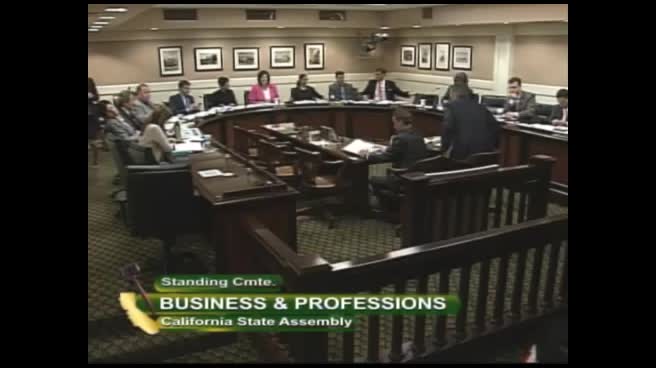 19MIN
Assembly Standing Committee on Business and Professions
Bill Author

Bill Co-Author(s):