SR 81
- Session Year: 2015-2016
- House: Senate
- Latest Version Date: 2016-06-24
WHEREAS, The state of Texas is widely considered the first state to begin Juneteenth celebrations. Informal observances have taken place there for over a century, and it has been an official state holiday in Texas since 1980. Thirty-nine states, including California since 2003, and the District of Columbia have recognized Juneteenth as either a state holiday or a state holiday observance; and
WHEREAS, Though President Abraham Lincoln issued the Emancipation Proclamation on September 22, 1862, to become effective January 1, 1863, it had minimal immediate effect on most slaves day-to-day lives, particularly in the Confederate States of America; and
WHEREAS, Texas, as a part of the Confederacy, was resistant to the Emancipation Proclamation. But on June 18, 1865, Union troops arrived in Galveston, Texas, to take possession of the state and enforce the emancipation of its slaves. Former slaves in Galveston rejoiced in the streets with jubilant celebrations. The following day, June 19th, became known as Juneteenth, a name derived from a portmanteau of the words June and nineteenth. Juneteenth celebrations began in Texas the following year; and
WHEREAS, For former slaves, the Juneteenth celebration was a time for reassuring each other, praying, and gathering remaining family members together. Juneteenth continued to be highly revered in Texas decades later, with many former slaves and descendants making an annual pilgrimage back to Galveston on this date; and
WHEREAS, Juneteenth education and celebrations declined in America in the early part of the 20th century. But the Civil Rights Movement of the 1950s and 1960s saw a resurgence of interest in Juneteenth, along with renewed community celebrations of the day; and
WHEREAS, On January 1, 1980, Juneteenth became an official state holiday in Texas through the efforts of Al Edwards, an African American former member of the Texas House of Representatives. That bill marked Juneteenth as the first emancipation celebration granted official state recognition. Representative Edwards has since actively sought to spread the observance of Juneteenth all across America; and
WHEREAS, In 1994, the era of the Modern Juneteenth Movement began when a group of Juneteenth leaders from across the country gathered in New Orleans, Louisiana, to work for greater national recognition of Juneteenth; and
WHEREAS, Today, Juneteenth commemorates African American freedom and emphasizes education and achievement. It is a day, a week, and in some areas, a month marked with celebrations, guest speakers, picnics, and family gatherings. It is a time for reflection and rejoicing. It is a time for assessment, self-improvement, and for planning the future; now, therefore, be it
Resolved by the Senate of the State of California, That the Senate encourages all Californians to join together in celebrating Juneteenth; and be it further
Resolved, That the Senate and the People of the State of California recognize that the Modern Juneteenth Movement continues to work to pass legislation in the United States Congress to establish Juneteenth Independence Day as a National Day of Observance; and be it further
Resolved, That the Secretary of the Senate transmit copies of this resolution to the author for appropriate distribution.
|
Date
|
Status
|
|---|---|
| Jun 15, 2016 | Introduced. Referred to Com. on RLS. |
| Jun 21, 2016 | From committee: Ordered to third reading. |
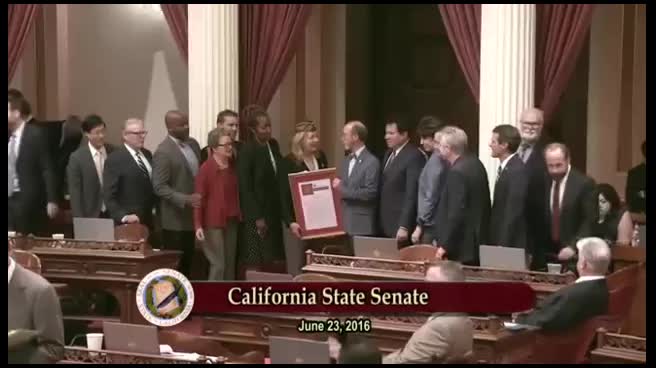
| Jun 23, 2016 | Read. Adopted. (Ayes 35. Noes 0. Page 4508.) |
| Jun 23, 2016 | Read. Adopted. (Ayes 35. Noes 0.) |
|
Date
|
Description
|
Location
|
Votes
|
|
|---|---|---|---|---|
| Jun 23, 2016 | Senate 3rd Reading SR81 Hall | Senate Floor |
Passed |
This list shows positions taken on this bill by organizations on the date displayed, which is linked to the original source.
Positions by individuals are not included.
Office of Senate Floor Analyses (916) 651-1520 Fax: (916) 327-4478 | SR 81 |
THIRD READING
Bill No: SR 81
Author: Hall (D), Mitchell (D), and Huff (R)
Introduced: 6/15/16
SUBJECT: Juneteenth Day celebrations
DIGEST:
This resolution encourages all Californians to join together in celebrating Juneteenth.
ANALYSIS: This resolution makes the following legislative findings:
- The state of Texas is widely considered the first state to begin Juneteenth celebrations. Informal observances have taken place there for over a century, and it has been an official state holiday in Texas since 1980. Thirty-nine states, including California since 2003, and the District of Columbia have recognized Juneteenth as either a state holiday or a state holiday observance.
- Though President Abraham Lincoln issued the Emancipation Proclamation on September 22, 1862, to become effective January 1, 1863, it had minimal immediate effect on most slaves’ day-to-day lives, particularly in the Confederate States of America.
- Texas, as a part of the Confederacy, was resistant to the Emancipation Proclamation. But on June 18, 1865, Union troops arrived in Galveston, Texas, to take possession of the state and enforce the emancipation of its slaves. Former slaves in Galveston rejoiced in the streets with jubilant celebrations. The following day, June 19th, became known as “Juneteenth,” a name derived from a portmanteau of the words “June” and “nineteenth.” Juneteenth celebrations began in Texas the following year.
- For former slaves, the Juneteenth celebration was a time for reassuring each other, praying, and gathering remaining family members together. Juneteenth continued to be highly revered in Texas decades later, with many former slaves and descendants making an annual pilgrimage back to Galveston on this date. Juneteenth education and celebrations declined in America in the early part of the 20th century. But the Civil Rights Movement of the 1950s and 1960s saw a resurgence of interest in Juneteenth, along with renewed community celebrations of the day.
- Today, Juneteenth commemorates African American freedom and emphasizes education and achievement. It is a day, a week, and in some areas, a month marked with celebrations, guest speakers, picnics, and family gatherings. It is a time for reflection and rejoicing. It is a time for assessment, self-improvement, and for planning the future.
This resolution encourages all Californians to join together in celebrating Juneteenth, and recognize that the “Modern Juneteenth Movement” continues to work to pass legislation in the United States Congress to establish Juneteenth Independence Day as a National Day of Observance.
Related/Prior Legislation
SR 78 (Huff, 2016) marks the 151st anniversary of Juneteenth. The resolution is currently in the Senate Rules Committee.
ACR 87 (Ridley-Thomas, Resolution Chapter 121, Statutes of 2015) recognized June 19, 2015, as the 150th anniversary of Juneteenth.
FISCAL EFFECT: Appropriation: No Fiscal Com.: No Local: No
None received
OPPOSITION: (Verified 6/20/16)
None received
Prepared by: Jonas Austin / SFA / (916) 651-1520
6/22/16 15:15:11
**** END ****
Discussed in Hearing
View Older Hearings



Bill Co-Author(s):