AB 1665: Telecommunications: California Advanced Services Fund.
- Session Year: 2017-2018
- House: Assembly
- Latest Version Date: 2017-10-15
Under existing law, the Public Utilities Commission has regulatory authority over public utilities, including telephone corporations. Existing law establishes, among other funds related to telecommunications, the California Advanced Services Fund (CASF) in the State Treasury. Existing law requires the commission to develop, implement, and administer the CASF to encourage deployment of high-quality advanced communications services to all Californians that will promote economic growth, job creation, and the substantial social benefits of advanced information and communications technologies, as provided in specified decisions of the commission and in the CASF statute. Existing law requires the commission to give priority to projects that provide last-mile broadband access to households that are unserved by an existing facility-based broadband provider. Existing law establishes that the goal of the program is, no later than December 31, 2015, to approve funding for infrastructure projects that will provide broadband access to no less than 98% of California households. Existing law authorizes the commission to collect a surcharge for deposit into the CASF not to exceed $315,000,000 in total and authorizes the surcharge until 2020. Existing law establishes 4 accounts, the Broadband Infrastructure Grant Account, the Rural and Urban Regional Broadband Consortia Grant Account, the Broadband Infrastructure and Revolving Loan Account, and the Broadband Public Housing Account, within the CASF and specifies the amount of moneys to be deposited into each account.
This bill would revise the goal of the program to provide that its goal is to approve funding by December 31, 2022, for infrastructure projects that will provide broadband access to no less than 98% of California households in each consortia region, as identified by the commission on or before January 1, 2017. The bill would eliminate the Broadband Infrastructure and Revolving Loan Account and would require the transfer of the remaining unencumbered moneys in that account as of January 1, 2018, and the deposit of moneys collected that would be owed to that account into the Broadband Infrastructure Grant Account. The bill would establish within the CASF the Broadband Adoption Account and would require specified amounts of moneys to be deposited into this new account, the Broadband Infrastructure Grant Account, and the Rural and Urban Regional Broadband Consortia Grant Account. The bill repeals the current authorization to collect up to $315,000,000 for deposit in the CASF at a rate of up to $25,000,000 per year through the 2020 calendar year, and instead would authorize the commission to collect $330,000,000 for deposit into the CASF beginning January 1, 2018, and continuing through the 2022 calendar year. The bill would revise the eligibility requirements for projects and project applicants for grants funded from the Broadband Infrastructure Grant Account. The bill would make moneys from the Rural and Urban Regional Broadband Consortia Grant Account available to facilitate the deployment of broadband infrastructure by assisting infrastructure grant applicants in the project development or grant application process. The bill would require recipients of those moneys to conduct an annual audit and to submit to the commission an annual report regarding activities funded by those moneys. The bill would make available moneys in the Broadband Adoption Account to specified entities for digital literacy training, public education, and outreach programs to increase broadband adoption by consumers.
Existing law requires the commission to conduct and report to the Legislature, by April 1, 2021, a final financial audit and a final performance audit of the CASF.
This bill would require the commission to conduct and report to the Legislature, by April 1, 2020, an interim financial audit and an interim performance audit. The bill would delay the date for the submission of the final audits to April 1, 2023.
Existing law requires the commission to annually report specified information relative to the CASF to the Legislature. Existing law repeals these reporting requirements on January 1, 2022.
This bill would revise the information specified for inclusion in the report. The bill would repeal these reporting requirements on January 1, 2024. The bill would require the commission to identify unserved areas and delineate the areas in the annual reports. The bill would require the commission to consult regional consortia, stakeholders, and consumers regarding priority areas and cost-effective strategies to achieve the broadband access goal through public workshops conducted at least annually no later than April 30 of each year.
Under existing law, a violation of the Public Utilities Act or any order, decision, rule, direction, demand, or requirement of the commission is a crime.
Because a violation of an order or decision of the commission implementing the bills requirements would be a crime, this bill would impose a state-mandated local program by creating a new crime.
The California Constitution requires the state to reimburse local agencies and school districts for certain costs mandated by the state. Statutory provisions establish procedures for making that reimbursement.
This bill would provide that no reimbursement is required by this act for a specified reason.
This bill would declare that it is to take effect immediately as an urgency statute.
Under existing law, the Public Utilities Commission has regulatory authority over public utilities, including telephone corporations. Existing law establishes, among other funds related to telecommunications, the California Advanced Services Fund (CASF) in the State Treasury. Existing law requires the commission to develop, implement, and administer the CASF to encourage deployment of high-quality advanced communications services to all Californians that will promote economic growth, job creation, and the substantial social benefits of advanced information and communications technologies, as provided in specified decisions of the commission and in the CASF statute. Existing law requires the commission to give priority to projects that provide last-mile broadband access to households that are unserved by an existing facilities-based facility-based broadband provider. Existing law establishes that the goal of the program is, no later than December 31, 2015, to approve funding for infrastructure projects that will provide broadband access to no less than 98% of California households. Existing law authorizes the commission to collect a surcharge for deposit into the CASF not to exceed $315,000,000 in total and authorizes the surcharge until 2020. Existing law establishes 4 accounts, the Broadband Infrastructure Grant Account, the Rural and Urban Regional Broadband Consortia Grant Account, the Broadband Infrastructure and Revolving Loan Account, and the Broadband Public Housing Account, within the CASF and specifies the amount of moneys to be deposited into each account.
This bill would revise the goal of the program to provide that its goal is to approve funding by December 31, 2022, for infrastructure projects that will provide broadband access to no less than 98% of California households in each consortia region, as identified by the commission, by December 31, 2022. commission on or before January 1, 2017. The bill would eliminate the Broadband Infrastructure and Revolving Loan Account and would require the transfer of the remaining unencumbered moneys in that account as of January 1, 2018, and the deposit of moneys collected that would be owed to that account into the Broadband Infrastructure Grant Account. The bill would establish within the CASF the Broadband Adoption Account and would require specified amounts of moneys to be deposited into this new account, the Broadband Infrastructure Grant Account, and the Rural and Urban Regional Broadband Consortia Grant Account. The bill repeals the current authorization to collect up to $315,000,000 for deposit in the CASF at a rate of up to $25,000,000 per year through the 2020 calendar year, and instead would authorize the commission to collect $330,000,000 for deposit into the CASF beginning January 1, 2018, and continuing through the 2022 calendar year. The bill would revise the eligibility requirements for projects and project applicants for grants funded from the Broadband Infrastructure Grant Account. The bill would make moneys from the Rural and Urban Regional Broadband Consortia Grant Account available to facilitate the deployment of broadband infrastructure by assisting infrastructure grant applicants in the project development or grant application process. The bill would require recipients of those moneys to conduct an annual audit and to submit to the commission an annual report regarding activities funded by those moneys. The bill would make available moneys in the Broadband Adoption Account to specified entities for digital literacy training, public education, and outreach programs to increase broadband adoption by consumers.
Existing law requires the commission to conduct and report to the Legislature, by April 1, 2021, a final financial audit and a final performance audit of the CASF.
This bill would require the commission to conduct and report to the Legislature, by April 1, 2020, an interim financial audit and an interim performance audit. The bill would extend the date for the submission of the final audits to April 1, 2023.
Existing law requires the commission to annually report specified information relative to the CASF to the Legislature. Existing law repeals these reporting requirements on January 1, 2022.
This bill would revise the information specified for inclusion in the report. The bill would repeal these reporting requirements on January 1, 2024. The bill would require the commission to identify unserved areas and delineate the areas in the annual reports. The bill would require the commission to consult regional consortia, stakeholders, and consumers regarding priority areas and cost-effective strategies to achieve the broadband access goal through public workshops conducted at least annually no later than April 30 of each year.
Under existing law, a violation of the Public Utilities Act or any order, decision, rule, direction, demand, or requirement of the commission is a crime.
Because a violation of an order or decision of the commission implementing the bills requirements would be a crime, this bill would impose a state-mandated local program by creating a new crime.
The California Constitution requires the state to reimburse local agencies and school districts for certain costs mandated by the state. Statutory provisions establish procedures for making that reimbursement.
This bill would provide that no reimbursement is required by this act for a specified reason.
This bill would declare that it is to take effect immediately as an urgency statute.
Under existing law, the Public Utilities Commission has regulatory authority over public utilities, including telephone corporations. Existing law establishes, among other funds related to telecommunications, the California Advanced Services Fund (CASF) in the State Treasury. Existing law requires the commission to develop, implement, and administer the CASF to encourage deployment of high-quality advanced communications services to all Californians that will promote economic growth, job creation, and the substantial social benefits of advanced information and communications technologies, as provided in specified decisions of the commission and in the CASF statute. Existing law requires the commission to give priority to projects that provide last-mile broadband access to households that are unserved by an existing facilities-based broadband provider. Existing law establishes that the goal of the program is, no later than December 31, 2015, to approve funding for infrastructure projects that will provide broadband access to no less than 98% of California households. Existing law authorizes the commission to collect a surcharge for deposit into the CASF not to exceed $315,000,000 in total and authorizes the surcharge until 2020. Existing law establishes 4 accounts, the Broadband Infrastructure Grant Account, the Rural and Urban Regional Broadband Consortia Grant Account, the Broadband Infrastructure and Revolving Loan Account, and the Broadband Public Housing Account, within the CASF and specifies the amount of moneys to be deposited into each account.
This bill would revise the goal of the program to provide that its goal is to approve funding for infrastructure projects that will provide broadband access to no less than 98% of California households in each consortia region, as identified by the commission, by December 31, 2022. The bill would eliminate the Broadband Infrastructure and Revolving Loan Account and would require the transfer of the remaining unencumbered moneys in that account as of January 1, 2018, and the deposit of moneys collected that would be owed to that account into the Broadband Infrastructure Grant Account. The bill would establish within the CASF the Broadband Adoption Account and would require specified amounts of moneys to be deposited into this new account, the Broadband Infrastructure Grant Account, and the Rural and Urban Regional Broadband Consortia Grant Account. The bill repeals the current authorization to collect up to $315,000,000 for deposit in the CASF at a rate of up to $25,000,000 per year through the 2020 calendar year, and instead would authorize the commission to collect $330,000,000 for deposit into the CASF beginning January 1, 2018, and continuing through the 2022 calendar year. The bill would revise the eligibility requirements for projects and project applicants for grants funded from the Broadband Infrastructure Grant Account. The bill would make moneys from the Rural and Urban Regional Broadband Consortia Grant Account available to facilitate the deployment of broadband infrastructure by assisting infrastructure grant applicants in the project development or grant application process. The bill would require recipients of those moneys to conduct an annual audit and to submit to the commission an annual report regarding activities funded by those moneys. The bill would make available moneys in the Broadband Adoption Account to specified entities for digital literacy training, public education, and outreach programs to increase broadband adoption by consumers.
Existing law requires the commission to conduct and report to the Legislature, by April 1, 2021, a final financial audit and a final performance audit of the CASF.
This bill would require the commission to conduct and report to the Legislature, by April 1, 2020, an interim financial audit and an interim performance audit. The bill would extend the date for the submission of the final audits to April 1, 2023.
Existing law requires the commission to annually report specified information relative to the CASF to the Legislature. Existing law repeals these reporting requirements on January 1, 2022.
This bill would revise the information specified for inclusion in the report. The bill would repeal these reporting requirements on January 1, 2024. The bill would require the commission to identify unserved areas and delineate the areas in the annual reports. The bill would require the commission to consult regional consortia, stakeholders, and consumers regarding priority areas and cost-effective strategies to achieve the broadband access goal through public workshops conducted at least annually no later than April 30 of each year.
This bill would include a change in state statute that would result in a taxpayer paying a higher tax within the meaning of Section 3 of Article XIIIA of the California Constitution, and thus would require for passage the approval of 2/3 of the membership of each house of the Legislature.Under existing law, a violation of the Public Utilities Act or any order, decision, rule, direction, demand, or requirement of the commission is a crime.
Because a violation of an order or decision of the commission implementing the bills requirements would be a crime, this bill would impose a state-mandated local program by creating a new crime.
The California Constitution requires the state to reimburse local agencies and school districts for certain costs mandated by the state. Statutory provisions establish procedures for making that reimbursement.
This bill would provide that no reimbursement is required by this act for a specified reason.
This bill would declare that it is to take effect immediately as an urgency statute.
Under existing law, the Public Utilities Commission has regulatory authority over public utilities, including telephone corporations. Existing law establishes, among other funds related to telecommunications, the California Advanced Services Fund (CASF) in the State Treasury. Existing law requires the commission to develop, implement, and administer the CASF to encourage deployment of high-quality advanced communications services to all Californians that will promote economic growth, job creation, and the substantial social benefits of advanced information and communications technologies, as provided in specified decisions of the commission and in the CASF statute. Existing law requires the commission to give priority to projects that provide last-mile broadband access to households that are unserved by an existing facilities-based broadband provider. Existing law establishes that the goal of the program is, no later than December 31, 2015, to approve funding for infrastructure projects that will provide broadband access to no less than 98% of California households. Existing law authorizes the commission to collect a surcharge for deposit into the CASF not to exceed $315,000,000 in total and authorizes the surcharge until 2020. Existing law establishes 4 accounts, the Broadband Infrastructure Grant Account, the Rural and Urban Regional Broadband Consortia Grant Account, the Broadband Infrastructure and Revolving Loan Account, and the Broadband Public Housing Account, within the CASF and specifies the amount of moneys to be deposited into each account.
This bill would revise the goal of the program to provide that its goal is to approve funding for infrastructure projects that will provide broadband access to no less than 98% of California households in each consortia region, as identified by the commission, by December 31, 2022. The bill would eliminate the Broadband Infrastructure and Revolving Loan Account and would require the transfer of the remaining unencumbered moneys in that account, account as of January 1, 2018, to an unspecified fund. The bill would require and the deposit of moneys collected that would be owed to that account into the Broadband Infrastructure Grant Account. The bill would establish within the CASF the Broadband Adoption Account and would require specified amounts of moneys to be deposited into this new account, the Broadband Infrastructure Grant Account, and the Rural and Urban Regional Broadband Consortia Grant Account. The bill repeals the current authorization to collect up to $315,000,000 for deposit in the CASF at a rate of up to $25,000,000 per year through the 2020 calendar year, and instead would authorize the commission to collect $330,000,000 for deposit into the CASF beginning January 1, 2018, and continuing through the 2022 calendar year. The bill would revise the eligibility requirements for projects and project applicants for grants funded from the Broadband Infrastructure Grant Account. The bill would make moneys from the Rural and Urban Regional Broadband Consortia Grant Account available to facilitate the deployment of broadband infrastructure by assisting infrastructure grant applicants in the project development or grant application process. The bill would require recipients of those moneys to conduct an annual audit and to submit to the commission an annual report regarding activities funded by those moneys. The bill would make available moneys in the Broadband Adoption Account to specified entities for digital literacy training, public education, and outreach programs to increase broadband adoption by consumers.
Existing law requires the commission to conduct and report to the Legislature, by April 1, 2021, a final financial audit and a final performance audit of the CASF.
This bill would require the commission to conduct and report to the Legislature, by April 1, 2020, an interim financial audit and an interim performance audit. The bill would extend the date for the submission of the final audits to April 1, 2023.
Existing law requires the commission to annually report specified information relative to the CASF to the Legislature. Existing law repeals these reporting requirements on January 1, 2022.
This bill would revise the information specified for inclusion in the report. The bill would repeal these reporting requirements on January 1, 2025. 2024. The bill would require the commission to identify priority unserved and underserved areas and delineate the priority areas in the annual reports. The bill would require the commission to consult regional consortia, stakeholders, and consumers regarding priority areas and cost-effective strategies to achieve the broadband access goal through public workshops conducted at least annually no later than April 30 of each year.
This bill would include a change in state statute that would result in a taxpayer paying a higher tax within the meaning of Section 3 of Article XIIIA of the California Constitution, and thus would require for passage the approval of 2/3 of the membership of each house of the Legislature.
Under existing law, a violation of the Public Utilities Act or any order, decision, rule, direction, demand, or requirement of the commission is a crime.
Because a violation of an order or decision of the commission implementing the bills requirements would be a crime, this bill would impose a state-mandated local program by creating a new crime.
The California Constitution requires the state to reimburse local agencies and school districts for certain costs mandated by the state. Statutory provisions establish procedures for making that reimbursement.
This bill would provide that no reimbursement is required by this act for a specified reason.
Under existing law, the Public Utilities Commission has regulatory authority over public utilities, including telephone corporations. Existing law establishes, among other funds related to telecommunications, the California Advanced Services Fund (CASF) in the State Treasury. Existing law requires the commission to develop, implement, and administer the CASF to encourage deployment of high-quality advanced communications services to all Californians that will promote economic growth, job creation, and the substantial social benefits of advanced information and communications technologies, as provided in specified decisions of the commission and in the CASF statute. Existing law requires the commission to give priority to projects that provide last-mile broadband access to households that are unserved by an existing facilities-based broadband provider. Existing law establishes that the goal of the program is, no later than December 31, 2015, to approve funding for infrastructure projects that will provide broadband access to no less than 98% of California households. Existing law authorizes the commission to collect a surcharge for deposit into the CASF not to exceed $315,000,000 in total and authorizes the surcharge until 2020. Existing law establishes 4 accounts accounts, the Broadband Infrastructure Grant Account, the Rural and Urban Regional Broadband Consortia Grant Account, the Broadband Infrastructure and Revolving Loan Account, and the Broadband Public Housing Account, within the CASF and specifies the amount of moneys to be deposited into each account.
This bill would retain that revise the goal of the program to provide that its goal is to approve funding for infrastructure projects that will provide broadband access to no less than 98% of California households, but would provide that this goal is to be achieved households in each consortia region, as identified by the commission, by December 31, 2023. 2022. The bill would eliminate the Broadband Infrastructure and Revolving Loan Account and would require the transfer of the remaining unencumbered moneys in that account, as of January 1, 2018, to an unspecified fund. The bill would require the deposit of moneys collected that would be owed to that account into the Broadband Infrastructure Grant Account. The bill establishes a 5th account would establish within the CASF, CASF the Broadband Adoption Account, Account and provides that an unspecified amount shall would require specified amounts of moneys to be deposited into each of the 5 accounts. this new account, the Broadband Infrastructure Grant Account, and the Rural and Urban Regional Broadband Consortia Grant Account. The bill repeals the current authorization to collect up to $315,000,000 for deposit in the CASF at a rate of up to $25,000,000 per year through the 2020 calendar year, and instead authorizes would authorize the commission to collect an unspecified amount $330,000,000 for deposit into the CASF beginning January 1, 2018, and continuing through the 2027 2022 calendar year. The bill would repeal funding and authority to expend specified sums for certain purposes from one of the CASF accounts, the Broadband Public Housing Account, and would authorize the expenditure of an unspecified amount of moneys from that account. The bill would revise the eligibility requirements for projects and project applicants for grants funded from the Broadband Infrastructure Grant Account. The bill would make moneys from the Rural and Urban Regional Broadband Consortia Grant Account available to facilitate the deployment of broadband infrastructure by assisting infrastructure grant applicants in the project development or grant application process. The bill would require recipients of those moneys to conduct an annual audit and to submit to the commission an annual report regarding activities funded by those moneys. The bill would make available moneys in the Broadband Adoption Account to specified entities for digital literacy training, public education, and outreach programs to increase broadband adoption by consumers.
Existing law requires the commission to conduct and report to the Legislature, by April 1, 2021, a final financial audit and a final performance audit of the CASF.
This bill would require the commission to conduct and report to the Legislature, by April 1, 2020, an interim financial audit and an interim performance audit. The bill would extend the date for the submission of the final audits to April 1, 2023.
Existing law requires the commission to annually report specified information relative to the CASF to the Legislature. Existing law repeals these reporting requirements on January 1, 2022.
This bill would instead require the commission to biennially report specified information relative to the CASF to the Legislature and would would revise the information specified for inclusion. inclusion in the report. The bill would repeal these reporting requirements on January 1, 2030. 2025. The bill would require the commission to identify priority unserved and underserved areas and delineate the priority areas in the biennial annual reports. The bill would require the commission to consult regional consortia, stakeholders, and consumers regarding priority areas and cost-effective strategies to achieve the broadband access goal through public workshops conducted at least annually no later than April 30 of each year.
This bill would include a change in state statute that would result in a taxpayer paying a higher tax within the meaning of Section 3 of Article XIIIA of the California Constitution, and thus would require for passage the approval of 2/3 of the membership of each house of the Legislature.
Under existing law, a violation of the Public Utilities Act or any order, decision, rule, direction, demand, or requirement of the commission is a crime.
Because a violation of an order or decision of the commission implementing the bills requirements would be a crime, this bill would impose a state-mandated local program by creating a new crime.
The California Constitution requires the state to reimburse local agencies and school districts for certain costs mandated by the state. Statutory provisions establish procedures for making that reimbursement.
This bill would provide that no reimbursement is required by this act for a specified reason.
Under existing law, the Public Utilities Commission has regulatory authority over public utilities, including telephone corporations. Existing law establishes, among other funds related to telecommunications, the California Advanced Services Fund (CASF) in the State Treasury. Existing law requires the commission to develop, implement, and administer the CASF to encourage deployment of high-quality advanced communications services to all Californians that will promote economic growth, job creation, and the substantial social benefits of advanced information and communications technologies, as provided in specified decisions of the commission and in the CASF statute. Existing law requires the commission to give priority to projects that provide last-mile broadband access to households that are unserved by an existing facilities-based broadband provider. Existing law establishes that the goal of the program is, no later than December 31, 2015, to approve funding for infrastructure projects that will provide broadband access to no less than 98% of California households. Existing law authorizes the commission to collect a surcharge for deposit into the CASF not to exceed $315,000,000 in total and authorizes the surcharge until 2020. Existing law establishes 4 accounts within the CASF and specifies the amount of moneys to be deposited into each account.
This bill would retain that the goal of the program is to approve funding for infrastructure projects that will provide broadband access to no less than 98% of California households, but would provide that this goal is to be achieved by December 31, 2023. The bill establishes a 5th account within the CASF, the Broadband Adoption Account, and provides that an unspecified amount shall be deposited into each of the 5 accounts. The bill repeals the current authorization to collect up to $315,000,000 for deposit in the CASF at a rate of up to $25,000,000 per year through the 2020 calendar year, and instead authorizes the commission to collect an unspecified amount for deposit into the CASF beginning January 1, 2018, and continuing through the 2027 calendar year. The bill would repeal funding and authority to expend specified sums for certain purposes from one of the CASF accounts, the Broadband Public Housing Account, and would authorize the expenditure of an unspecified amount of moneys from that account.
Existing law requires the commission to annually report specified information relative to the CASF to the Legislature. Existing law repeals these reporting requirements on January 1, 2022.
This bill would instead require the commission to biennially report specified information relative to the CASF to the Legislature and would revise the information specified for inclusion. The bill would repeal these reporting requirements on January 1, 2030. The bill would require the commission to identify priority unserved and underserved areas and delineate the priority areas in the biennial reports. The bill would require the commission to consult regional consortia, stakeholders, and consumers regarding priority areas and cost-effective strategies to achieve the broadband access goal through public workshops conducted at least annually no later than April 30 of each year.
This act shall be known, and may be cited, as the Internet for All Now Act.
SEC. 2.(a)The Legislature finds and declares both of the following:
(1)The availability of high-speed Internet access, referred to generically as broadband and including both wired and wireless technologies, is essential 21st century infrastructure for economic competitiveness and quality of life. Economic studies confirm that the use of broadband technologies increases economic productivity as a foundation for increased efficiency in organizational operations and enhanced profitability in business.
(2)Broadband infrastructure is also vital to the operation and management of other critical infrastructure, such as energy generation systems and the electrical grid, water supply systems, and public safety and emergency response networks. There is a need for world-class broadband infrastructure throughout California to support these major infrastructure investments, and thereby to protect lives, property, and the environment.
(b)It is the intent of the Legislature that California be a national leader and globally competitive in the deployment and adoption of broadband technology and in implementing quality universal access for all residents.
(c)It is the intent of the Legislature that California achieve the goal specified in paragraph (1) of subdivision (b) of Section 281 of the Public Utilities Code by fostering private investment, maximizing Californias ability to obtain available federal funds, and administering the California Advanced Services Fund to fund broadband infrastructure where private investments and federal funds are not available and not use moneys in that fund to overbuild the broadband infrastructure.
(d)It is the intent of the Legislature that the Public Utilities Commission develop strategies with recipients of moneys from the Connect America Fund to leverage those moneys to serve unserved areas identified in the April 2017 California Advanced Services Fund Annual Report and to leverage investments in anchor institutions to encourage cost-effective deployment to unserved households.
(e)It is the policy of the state to encourage collaboration among stakeholders and to promote public-private partnerships to harness the expertise and strengths of all partners to serve the public interest.
SEC. 3.Section 281 of the Public Utilities Code is amended to read:281.(a)The commission shall develop, implement, and administer the California Advanced Services Fund program to encourage deployment of high-quality advanced communications services to all Californians that will promote economic growth, job creation, and the substantial social benefits of advanced information and communications technologies, consistent with this section and with the statements of intent in Section 2 of the Internet For All Now Act (Assembly Bill 1665 of the 201718 Regular Session).
(b)(1)(A)The goal of the program is, no later than December 31, 2022, to approve funding for infrastructure projects that will provide broadband access to no less than 98 percent of California households in each consortia region, as identified by the commission on or before January 1, 2017. The commission shall be responsible for achieving the goals of the program.
(B)For purposes of this section, unserved household means a household for which no facility-based broadband provider offers broadband service at speeds of at least 6 megabits per second (mbps) downstream and one mbps upstream.
(2)In approving infrastructure projects, the commission shall do both of the following:
(A)Approve projects that provide last-mile broadband access to households that are unserved by an existing facility-based broadband provider, and, upon accomplishment of the goal of the program specified in paragraph (1), also approve projects pursuant to paragraph (15) of subdivision (f).
(B)(i)Give preference to projects in areas where Internet connectivity is available only through dial-up service that are not served by any form of wireline or wireless facility-based broadband service or areas with no Internet connectivity.
(ii)This subparagraph does not prohibit the commission from approving funding for projects outside of the areas specified in clause (i).
(c)The commission shall establish the following accounts within the fund:
(1)The Broadband Infrastructure Grant Account.
(2)The Rural and Urban Regional Broadband Consortia Grant Account.
(3)The Broadband Public Housing Account.
(4)The Broadband Adoption Account.
(d)(1)The commission shall transfer the moneys received by the commission from the surcharge imposed to fund the accounts to the Controller for deposit in the California Advanced Services Fund. Moneys collected shall be deposited in the following amounts in the following accounts:
(A)Three hundred million dollars ($300,000,000) into the Broadband Infrastructure Grant Account.
(B)Ten million dollars ($10,000,000) into the Rural and Urban Regional Broadband Consortia Grant Account.
(C)Twenty million dollars ($20,000,000) into the Broadband Adoption Account.
(2)All interest earned on moneys in the fund shall be deposited in the fund.
(3)The commission may collect a sum not to exceed three hundred thirty million dollars ($330,000,000) for a sum total of moneys collected by imposing the surcharge described in paragraph (1). The commission may collect the sum beginning with the calendar year starting on January 1, 2018, and continuing through the 2022 calendar year, in an amount not to exceed sixty-six million dollars ($66,000,000) per year, unless the commission determines that collecting a higher amount in any year will not result in an increase in the total amount of all surcharges collected from telephone customers that year.
(e)All moneys in the California Advanced Services Fund shall be available, upon appropriation by the Legislature, to the commission for the program administered by the commission pursuant to this section, including the costs incurred by the commission in developing, implementing, and administering the program and the fund.
(f)(1)The commission shall award grants from the Broadband Infrastructure Grant Account on a technology-neutral basis, including both wireline and wireless technology.
(2)The commission shall consult with regional consortia, stakeholders, local governments, existing facility-based broadband providers, and consumers regarding unserved areas and cost-effective strategies to achieve the broadband access goal through public workshops conducted at least annually no later than April 30 of each year through year 2022.
(3)The commission shall identify unserved rural and urban areas and delineate the areas in the annual report prepared pursuant to Section 914.7.
(4)(A)(i)The commission shall annually offer an existing facility-based broadband provider the opportunity to demonstrate that it will deploy broadband or upgrade existing facilities to a delineated unserved area within 180 days.
(ii)Except as provided in clause (iii), the commission shall not approve funding for a project to deploy broadband to a delineated unserved area if the existing facility-based broadband provider demonstrates to the commission, in response to the commissions annual offer, that it will deploy broadband or upgrade existing broadband service throughout the project area.
(iii)If the existing facility-based broadband provider is unable to complete the deployment of broadband within the delineated unserved area within 180 days, the provider shall provide the commission with information to demonstrate what progress has been made or challenges faced in completing the deployment. If the commission finds that the provider is making progress towards the completion of the deployment, the commission shall extend the time to complete the project beyond the 180 days. If the commission finds that the provider is not making progress towards completing the deployment, the delineated unserved area shall be eligible for funding pursuant to this subdivision.
(B)(i)Except for information specified in clause (ii), information submitted to the commission that includes the providers plans for future broadband deployment shall not be publicly disclosed.
(ii)The commission may publicly disclose information regarding the area designated for a broadband deployment, the number of households or locations to be served, and the estimated date by which the deployment will be completed.
(C)An existing facility-based broadband provider may, but is not required to, apply for funding from the Broadband Infrastructure Grant Account to make an upgrade pursuant to this subdivision.
(5)Projects eligible for grant awards shall meet all of the following requirements:
(A)The project deploys infrastructure capable of providing broadband access at speeds of a minimum of 10 megabits per second (mbps) downstream and one mbps upstream to unserved households in census blocks where no provider offers access at speeds of at least 6 mbps downstream and one mbps upstream.
(B)All or a significant portion of the project deploys last-mile infrastructure to provide service to unserved households. Projects that only deploy middle-mile infrastructure are not eligible for grant funding. For a project that includes funding for middle-mile infrastructure, the commission shall verify that the proposed middle-mile infrastructure is indispensable for accessing the last-mile infrastructure.
(C)(i)Except as provided in clause (ii), until July 1, 2020, the project is not located in a census block where an existing facility-based broadband provider has accepted federal funds for broadband deployment from Phase II of the Connect America Fund, unless the existing facility-based broadband provider has notified the commission before July 1, 2020, that it has completed its Connect America Fund deployment in the census block.
(ii)An existing facility-based broadband provider is eligible for a grant pursuant to this subdivision to supplement a grant pursuant to Phase II of the Connect America Fund to expand broadband service within identified census blocks, as needed.
(6)(A)An individual household or property owner shall be eligible to apply for a grant to offset the costs of connecting the household or property to an existing or proposed facility-based broadband provider. Any infrastructure built to connect a household or property with funds provided under this paragraph shall become the property of, and part of, the network of the facility-based broadband provider to which it is connected.
(B)(i)In approving a project pursuant to this paragraph, the commission shall consider limiting funding to households based on income so that funds are provided only to households that would not otherwise be able to afford a line extension to the property, limiting the amount of grants on a per-household basis, and requiring a percentage of the project to be paid by the household or the owner of the property.
(ii)The aggregate amount of grants awarded pursuant to this paragraph shall not exceed five million dollars ($5,000,000).
(7)An entity that is not a telephone corporation shall be eligible to apply to participate in the program administered by the commission pursuant to this section to provide access to broadband to an unserved household, if the entity otherwise meets the eligibility requirements and complies with program requirements established by the commission.
(8)The commission shall provide each applicant, and any party challenging an application, the opportunity to demonstrate actual levels of broadband service in the project area, which the commission shall consider in reviewing the application.
(9)A local governmental agency may be eligible for an infrastructure grant only if the infrastructure project is for an unserved household or business, the commission has conducted an open application process, and no other eligible entity applied.
(10)The commission shall establish a service list of interested parties to be notified of any California Advanced Services Fund applications. Any application and any amendment to an application for project funding shall be served to those on the service list and posted on the commissions Internet Web site at least 30 days before publishing the corresponding draft resolution.
(11)A grant awarded pursuant to this subdivision may include funding for the following costs consistent with paragraph (5) of subdivision (f):
(A)Costs directly related to the deployment of infrastructure.
(B)Costs to lease access to property or for Internet backhaul services for a period not to exceed five years.
(C)Cost incurred by an existing facility-based broadband provider to upgrade its existing facilities to provide for interconnection.
(12)A grant from the Broadband Infrastructure Grant Account shall not include funding for costs of broadband infrastructure already funded by the Connect America Fund program or other similar federal public program that funds that infrastructure. This paragraph does not apply to funding from the federal high-cost support programs that support operations, including High Cost Loop Support (HCLS), Connect America Fund-Broadband Loop Support (CAF-BLS), or the Alternative Connect America Cost Model (A-CAM).
(13)The commission may award grants to fund all or a portion of the project. The commission shall determine, on a case-by-case basis, the level of funding to be provided for a project and shall consider factors that include, but are not limited to, the location and accessibility of the area, the existence of communication facilities that may be upgraded to deploy broadband, and whether the project makes a significant contribution to achievement of the program goal.
(14)The commission may require each infrastructure grant applicant to indicate steps taken to first obtain any available funding from the Connect America Fund program or similar federal public programs that fund broadband infrastructure. This paragraph does not authorize the commission to reject a grant application on the basis that an applicant failed to seek project funding from the Connect America Fund program or another similar federal public program.
(15)Upon the accomplishment of the goal of the program specified in paragraph (1) of subdivision (b), not more than thirty million dollars ($30,000,000) of the moneys remaining in the Broadband Infrastructure Grant Account shall be available for infrastructure projects that provide last-mile broadband access to households to which no facility-based broadband provider offers broadband service at speeds of at least 10 mbps downstream and one mbps upstream.
(g)(1)Moneys in the Rural and Urban Regional Broadband Consortia Grant Account shall be available for grants to eligible consortia to facilitate deployment of broadband services by assisting infrastructure applicants in the project development or grant application process. An eligible consortium may include, as specified by the commission, representatives of organizations, including, but not limited to, local and regional government, public safety, elementary and secondary education, health care, libraries, postsecondary education, community-based organizations, tourism, parks and recreation, agricultural, business, workforce organizations, and air pollution control or air quality management districts, and is not required to have as its lead fiscal agent an entity with a certificate of public convenience and necessity.
(2)Each consortium shall conduct an annual audit of its expenditures for programs funded pursuant to this subdivision and shall submit to the commission an annual report that includes both of the following:
(A)A description of activities completed during the prior year, how each activity promotes the deployment of broadband services, and the cost associated with each activity.
(B)The number of project applications assisted.
(h)(1)All remaining moneys in the Broadband Infrastructure Revolving Loan Account that are unencumbered as of January 1, 2018, shall be transferred to the Broadband Infrastructure Grant Account.
(2)All repayments of loans funded by the former Broadband Infrastructure Revolving Loan Account shall be deposited into the Broadband Infrastructure Grant Account.
(i)(1)For purposes of this subdivision, the following terms have the following meanings:
(A)Publicly subsidized means either that the housing development receives financial assistance from the United States Department of Housing and Urban Development pursuant to an annual contribution contract or is financed with low-income housing tax credits, tax-exempt mortgage revenue bonds, general obligation bonds, or local, state, or federal loans or grants and the rents of the occupants, who are lower income households, do not exceed those prescribed by deed restrictions or regulatory agreements pursuant to the terms of the financing or financial assistance.
(B)Publicly supported community means a publicly subsidized multifamily housing development that is wholly owned by either of the following:
(i)A public housing agency that has been chartered by the state, or by any city or county in the state, and has been determined to be an eligible public housing agency by the United States Department of Housing and Urban Development.
(ii)An incorporated nonprofit organization as described in Section 501(c)(3) of the Internal Revenue Code (26 U.S.C. Sec. 501(c)(3)) that is exempt from taxation under Section 501(a) of that code (26 U.S.C. Sec. 501(a)), and that has received public funding to subsidize the construction or maintenance of housing occupied by residents whose annual income qualifies as low or very low income according to federal poverty guidelines.
(2)Moneys in the Broadband Public Housing Account shall be available for the commission to award grants and loans pursuant to this subdivision to an eligible publicly supported community if that entity otherwise meets eligibility requirements and complies with program requirements established by the commission.
(3)(A)Not more than twenty million dollars ($20,000,000) of the moneys deposited into the Broadband Public Housing Account on or before January 1, 2018, shall be available for grants and loans to a publicly supported community to finance a project to connect a broadband network to that publicly supported community. A publicly supported community may be an eligible applicant only if the publicly supported community can verify to the commission that the publicly supported community has not denied a right of access to any broadband provider that is willing to connect a broadband network to the facility for which the grant or loan is sought and the publicly supported community is unserved.
(B)(i)In its review of applications received pursuant to subparagraph (A), the commission shall award grants only to unserved housing developments, regardless of when the applicant filed its application.
(ii)For purposes of this subparagraph, a housing development is unserved when at least one housing unit within the housing development is not offered broadband Internet service.
(C)Only after all funds available pursuant to this paragraph in the Broadband Public Housing Account have been awarded may a publicly supported community otherwise eligible to submit an application for funding from the Broadband Public Housing Account submit an application for funding for these purposes from the Broadband Infrastructure Grant Account.
(4)(A)Not more than five million dollars ($5,000,000) of the moneys deposited into the Broadband Public Housing Account on or before January 1, 2018, shall be available for grants and loans to a publicly supported community to support programs designed to increase adoption rates for broadband services for residents of that publicly supported community. A publicly supported community may be eligible for funding for a broadband adoption program only if the residential units in the facility to be served have access to broadband services or will have access to broadband services at the time the funding for adoption is implemented.
(B)A publicly supported community may contract with other nonprofit or public agencies to assist in implementation of a broadband adoption program.
(C)Only after all funds available pursuant to this paragraph in the Broadband Public Housing Account have been awarded may a publicly supported community otherwise eligible to submit an application for funding from the Broadband Public Housing Account submit an application for funding for these purposes from the Broadband Adoption Grant Account pursuant to subdivision (j).
(5)To the extent feasible, the commission shall approve projects for funding from the Broadband Public Housing Account in a manner that reflects the statewide distribution of publicly supported communities.
(6)In reviewing a project application under this subdivision, the commission shall consider the availability of other funding sources for that project, any financial contribution from the broadband service provider to the project, the availability of any other public or private broadband adoption or deployment program, including tax credits and other incentives, and whether the applicant has sought funding from, or participated in, any reasonably available program. The commission may require an applicant to provide match funding, and shall not deny funding for a project solely because the applicant is receiving funding from another source.
(7)Any moneys in the Broadband Public Housing Account that have not been awarded pursuant to this subdivision by December 31, 2020, shall be transferred back to the Broadband Infrastructure Grant Account.
(j)(1)Moneys in the Broadband Adoption Account shall be available to the commission to award grants to increase publicly available or after-school broadband access and digital inclusion, such as grants for digital literacy training programs and public education to communities with limited broadband adoption, including low-income communities, senior communities, and communities facing socioeconomic barriers to broadband adoption.
(2)Eligible applicants are local governments, senior centers, schools, public libraries, nonprofit organizations, and community-based organizations with programs to increase publicly available or after-school broadband access and digital inclusion, such as digital literacy training programs.
(3)Payment pursuant to a grant for digital inclusion shall be based on digital inclusion metrics established by the commission that may include the number of residents trained, the number of residents served, or the actual verification of broadband subscriptions resulting from the program funded by the grant.
(4)The commission shall, in a new or existing proceeding, develop, by June 30, 2018, criteria for awarding grants and a process and methodology for verifying outcomes. The commission shall be prepared to accept applications for grants from the Broadband Adoption Account no later than July 1, 2018.
(5)The commission shall give preference to programs in communities with demonstrated low broadband access, including low-income communities, senior communities, and communities facing socioeconomic barriers to broadband adoption. In the proceeding specified in paragraph (4), the commission shall determine how best to prioritize projects for funding pursuant to this paragraph.
(6)Moneys awarded pursuant to this subdivision shall not be used to subsidize the costs of providing broadband service to households.
(k)The commission shall post on the homepage of the California Advanced Service Fund on its Internet Web site a list of all pending applications, application challenge deadlines, and notices of amendments to pending applications.
(l)The commission shall notify the appropriate policy committees of the Legislature on the date on which the goal specified in paragraph (1) of subdivision (b) is achieved.
SEC. 4.Section 912.2 of the Public Utilities Code is amended to read:912.2.(a)The commission shall conduct an interim financial audit and a final financial audit and an interim performance audit and a final performance audit of the implementation and effectiveness of the California Advanced Services Fund to ensure that funds have been expended in accordance with the approved terms of the grant awards and loan agreements pursuant to Section 281. The commission shall report its interim findings to the Legislature by April 1, 2020. The commission shall report its final findings to the Legislature by April 1, 2023. The reports shall also include an update to the maps in the final report of the California Broadband Task Force and data on the types and numbers of jobs created as a result of the program administered by the commission pursuant to Section 281.
(b)Pursuant to Section 10231.5 of the Government Code, this section is repealed on January 1, 2027.
SEC. 5.Section 914.7 of the Public Utilities Code is amended to read:914.7.(a)By April 1, 2019, and by April 1 of each year thereafter, until April 1, 2023, the commission shall provide a report to the Legislature that includes all of the following information:
(1)The remaining unserved areas in the state.
(2)The amount of funds expended from the California Advanced Services Fund in the prior year.
(3)The recipients of funds expended from the California Advanced Services Fund in the prior year.
(4)The geographic regions of the state affected by funds expended from the California Advanced Services Fund in the prior year, including information by county.
(5)The expected benefits to be derived from the fund expended from the California Advanced Services Fund in the prior year.
(6)Details on the status of each project funded through the California Advanced Services Fund and whether the project has been completed or the expected completion date of the project.
(7)Actual broadband adoption levels from funds expended from the California Advanced Services Fund in the prior year.
(8)The cost per household for each project.
(9)The number of formerly unserved households subscribing to broadband service in areas covered by projects funded by the California Advanced Services Fund.
(10)The number of subscriptions resulting from the broadband adoption program funded by the California Advanced Services Fund.
(11)An update on the expenditures from the California Advanced Services Fund, broadband adoption levels, the progress in achieving the goals of the program, and an accounting of the remaining unserved households in each region of the state as of December 31 of the immediately preceding year.
(12)The amount of funds expended from the California Advanced Services Fund to match federal funds.
(13)Addition details on efforts to leverage non-California Advanced Services Fund moneys.
(14)The status of the California Advanced Services Fund balance and the projected amount to be collected in each year through 2022 to fund approved projects.
(b)This section is repealed on January 1, 2024, and as of that date is repealed, unless a later enacted statute that is enacted before January 1, 2024, deletes or extends that date.
SEC. 6.No reimbursement is required by this act pursuant to Section 6 of Article XIIIB of the California Constitution because the only costs that may be incurred by a local agency or school district will be incurred because this act creates a new crime or infraction, eliminates a crime or infraction, or changes the penalty for a crime or infraction, within the meaning of Section 17556 of the Government Code, or changes the definition of a crime within the meaning of Section 6 of Article XIIIB of the California Constitution.
SEC. 7.This act is an urgency statute necessary for the immediate preservation of the public peace, health, or safety within the meaning of Article IV of the California Constitution and shall go into immediate effect. The facts constituting the necessity are:
To ensure that the Public Utilities Commission adopts the necessary orders or decisions to facilitate the achievement of the goal of providing broadband access to not less than 98 percent of California households in each consortia region at the earliest possible moment, it is necessary for this measure to take effect immediately.
This act shall be known, and may be cited, as the Internet for All Now Act.
SEC. 2.(a)The Legislature finds and declares both of the following:
(1)The availability of high-speed Internet access, referred to generically as broadband and including both wired and wireless technologies, is essential 21st century infrastructure for economic competitiveness and quality of life. Economic studies confirm that the use of broadband technologies increases economic productivity as a foundation for increased efficiency in organizational operations and enhanced profitability in business.
(2)Broadband infrastructure is also vital to the operation and management of other critical infrastructure, such as energy generation systems and the electrical grid, water supply systems, and public safety and emergency response networks. There is a need for world-class broadband infrastructure throughout California to support these major infrastructure investments, and thereby to protect lives, property, and the environment.
(b)It is the intent of the Legislature that California be a national leader and globally competitive in the deployment and adoption of broadband technology and in implementing quality universal access for all residents.
(c)It is the intent of the Legislature that California achieve the goal specified in paragraph (1) of subdivision (b) of Section 281 of the Public Utilities Code by fostering private investment, maximizing Californias ability to obtain available federal funds, and administering the California Advanced Services Fund to fund broadband infrastructure where private investments and federal funds are not available and not use moneys in that fund to overbuild the broadband infrastructure.
(d)It is the intent of the Legislature that the Public Utilities Commission develop strategies with recipients of moneys from the Connect America Fund to leverage those moneys to serve unserved areas identified in the April 2017 California Advanced Services Fund Annual Report and to leverage investments in anchor institutions to encourage cost-effective deployment to unserved households.
(c)(e)It is the policy of the state to encourage collaboration among stakeholders and to promote public-private partnerships to harness the expertise and strengths of all partners to serve the public interest.
SEC. 3.Section 281 of the Public Utilities Code is amended to read:281.(a)The commission shall develop, implement, and administer the California Advanced Services Fund program to encourage deployment of high-quality advanced communications services to all Californians that will promote economic growth, job creation, and the substantial social benefits of advanced information and communications technologies, consistent with this section. section and with the statements of intent in Section 2 of the Internet For All Now Act (Assembly Bill 1665 of the 201718 Regular Session).
(b)(1)(A)The goal of the program is, no later than December 31, 2022, to approve funding for infrastructure projects that will provide broadband access to no less than 98 percent of California households in each consortia region, as identified by the commission as of on or before January 1, 2017. The commission shall be responsible for achieving the goals of the program.
(B)For purposes of this section, unserved household means a household for which no facility-based broadband provider offers broadband service at speeds of at least 6 megabits per second (mbps) downstream and one mbps upstream.
(2)In approving infrastructure projects, the commission shall approve projects that provide last-mile broadband access to households that are unserved by an existing facilities-based broadband provider. The commission shall provide each applicant, and any party challenging an application, the opportunity to demonstrate actual levels of broadband service in the project area, which the commission shall consider in reviewing the application. do both of the following:
(A)Approve projects that provide last-mile broadband access to households that are unserved by an existing facility-based broadband provider, and, upon accomplishment of the goal of the program specified in paragraph (1), also approve projects pursuant to paragraph (15) of subdivision (f).
(B)(i)Give preference to projects in areas where Internet connectivity is available only through dial-up service that are not served by any form of wireline or wireless facility-based broadband service or areas with no Internet connectivity.
(ii)This subparagraph does not prohibit the commission from approving funding for projects outside of the areas specified in clause (i).
(c)The commission shall establish the following accounts within the fund:
(1)The Broadband Infrastructure Grant Account.
(2)The Rural and Urban Regional Broadband Consortia Grant Account.
(3)The Broadband Public Housing Account.
(4)The Broadband Adoption Account.
(d)(1)The commission shall transfer the moneys received by the commission from the surcharge imposed to fund the accounts to the Controller for deposit in the California Advanced Services Fund. Moneys collected shall be deposited in the following amounts in the following accounts:
(A)Three hundred million dollars ($300,000,000) into the Broadband Infrastructure Grant Account.
(B)Ten million dollars ($10,000,000) into the Rural and Urban Regional Broadband Consortia Grant Account.
(C)Twenty million dollars ($20,000,000) into the Broadband Adoption Account.
(2)All interest earned on moneys in the fund shall be deposited in the fund.
(3)The commission may collect a sum not to exceed three hundred thirty million dollars ($330,000,000) for a sum total of moneys collected by imposing the surcharge described in paragraph (1). The commission may collect the sum beginning with the calendar year starting on January 1, 2018, and continuing through the 2022 calendar year, in an amount not to exceed sixty-six million dollars ($66,000,000) per year, unless the commission determines that collecting a higher amount in any year will not result in an increase in the total amount of all surcharges collected from telephone customers that year.
(e)All moneys in the California Advanced Services Fund shall be available, upon appropriation by the Legislature, to the commission for the program administered by the commission pursuant to this section, including the costs incurred by the commission in developing, implementing, and administering the program and the fund.
(f)(1)The commission shall award grants from the Broadband Infrastructure Grant Account on a technology-neutral basis, including both wireline and wireless technology.
(2)The commission shall consult with regional consortia, stakeholders, local governments, existing facility-based broadband providers, and consumers regarding unserved areas and cost-effective strategies to achieve the broadband access goal through public workshops conducted at least annually no later than April 30 of each year through year 2022.
(3)The commission shall identify unserved rural and urban areas and delineate the areas in the annual report prepared pursuant to Section 914.7.
(4)(A)(i)The commission shall annually offer an existing facility-based broadband provider the opportunity to demonstrate that it will provide deploy broadband access or upgrade existing facilities to a delineated unserved area within a reasonable timeframe. The 180 days.
(ii)Except as provided in clause (iii), the commission shall not approve funding for a project providing to deploy broadband access to a delineated unserved area if the existing facility-based broadband provider demonstrates to the commission commission, in response to the commissions annual offer, that it will, within a reasonable timeframe, will deploy broadband or upgrade existing broadband service to provide broadband access throughout the project area.
(iii)If the existing facility-based broadband provider is unable to complete the deployment of broadband within the delineated unserved area within 180 days, the provider shall provide the commission with information to demonstrate what progress has been made or challenges faced in completing the deployment. If the commission finds that the provider is making progress towards the completion of the deployment, the commission shall extend the time to complete the project beyond the 180 days. If the commission finds that the provider is not making progress towards completing the deployment, the delineated unserved area shall be eligible for funding pursuant to this subdivision.
(B)Any (i)Except for information specified in clause (ii), information submitted to the commission that includes the providers plans for future broadband deployment shall not be publicly disclosed.
(ii)The commission may publicly disclose information regarding the area designated for a broadband deployment, the number of households or locations to be served, and the estimated date by which the deployment will be completed.
(C)An existing facility-based broadband provider may, but is not required to, apply for funding from the Broadband Infrastructure Grant Account to make an upgrade pursuant to this subdivision.
(D)(i)Except as provided in clause (ii), for an existing facility-based provider that is willing to upgrade facilities pursuant to this subdivision, a reasonable timeframe as used in subparagraph (A) shall be the timeframe that the commission would otherwise allow for the completion of a project funded pursuant to this subdivision.(ii)If an existing facility-based provider makes an upgrade pursuant to this subdivision with funding from the Connect America Fund program or similar federal public program funding broadband infrastructure, reasonable timeframe as used in subparagraph (A) shall be consistent with the upgrade deadlines associated with that program and with the construction deadlines applicable to projects funded by the Broadband Infrastructure Grant Account.(5)Projects eligible for grant awards shall meet both all of the following requirements:
(A)The project deploys infrastructure capable of providing broadband access at speeds of a minimum of 10 megabits per second (mps) (mbps) downstream and one mps mbps upstream to unserved households in census blocks where no provider offers access at speeds of at least 6 mps mbps downstream and one mps mbps upstream.
(B)All or a significant portion of the project deploys last-mile infrastructure to provide service to unserved households. Projects that only deploy middle-mile infrastructure are not eligible for grant funding. For a project that includes funding for middle-mile infrastructure, the commission shall verify that the proposed middle-mile infrastructure is indispensable for accessing the last-mile infrastructure.
(C)(i)Except as provided in clause (ii), until July 1, 2020, the project is not located in a census block where an existing facility-based broadband provider has accepted federal funds for broadband deployment from Phase II of the Connect America Fund, unless the existing facility-based broadband provider has notified the commission before July 1, 2020, that it has completed its Connect America Fund deployment in the census block.
(ii)An existing facility-based broadband provider is eligible for a grant pursuant to this subdivision to supplement a grant pursuant to Phase II of the Connect America Fund to expand broadband service within identified census blocks, as needed.
(6)(A)An individual household or property owner shall be eligible to apply for a grant to offset the costs of connecting the household or property to an existing or proposed facility-based broadband provider. Any infrastructure built to connect a household or property with funds provided under this paragraph shall become the property of, and part of, the network of the facility-based broadband provider to which it is connected.
(B)(i)In approving a project pursuant to this paragraph, the commission shall consider limiting funding to households based on income so that funds are provided only to households that would not otherwise be able to afford a line extension to the property, limiting the amount of grants on a per-household basis, and requiring a percentage of the project to be paid by the household or the owner of the property.
(ii)The aggregate amount of grants awarded pursuant to this paragraph shall not exceed five million dollars ($5,000,000).
(7)An entity that is not a telephone corporation shall be eligible to apply to participate in the program administered by the commission pursuant to this section to provide access to broadband to an unserved household, if the entity otherwise meets the eligibility requirements and complies with program requirements established by the commission.
(8)The commission shall provide each applicant, and any party challenging an application, the opportunity to demonstrate actual levels of broadband service in the project area, which the commission shall consider in reviewing the application.
(9)A local governmental agency may be eligible for an infrastructure grant only if the infrastructure project is for an unserved household or business, the commission has conducted an open application process, and no other eligible entity applied.
(10)The commission shall establish a service list of interested parties to be notified of any California Advanced Services Fund applications. Any application and any amendment to an application for project funding shall be served to those on the service list and posted on the commissions Internet Web site at least 30 days before publishing the corresponding draft resolution.
(11)A grant awarded pursuant to this subdivision may include funding for the following costs consistent with paragraph (5) of subdivision (f):
(A)Costs directly related to the deployment of infrastructure.
(B)Costs to lease access to property or for Internet backhaul services for a period not to exceed five years.
(C)Cost incurred by an existing facility-based broadband provider to upgrade its existing facilities to provide for interconnection.
(12)A grant from the Broadband Infrastructure Grant Account shall not include funding for costs of broadband infrastructure already funded by the Connect America Fund program or other similar federal public program that funds that infrastructure. This paragraph does not apply to funding from the federal high-cost support programs that support operations, including High Cost Loop Support (HCLS), Connect America Fund-Broadband Loop Support (CAF-BLS), or the Alternative Connect America Cost Model (A-CAM).
(13)The commission may award grants to fund all or a portion of the project. The commission shall determine, on a case-by-case basis, the level of funding to be provided for a project and shall consider factors that include, but are not limited to, the location and accessibility of the area, the existence of communication facilities that may be upgraded to deploy broadband, and whether the project makes a significant contribution to achievement of the program goal.
(14)The commission may require each infrastructure grant applicant to indicate steps taken to first obtain any available funding from the Connect America Fund program or similar federal public programs that fund broadband infrastructure. This paragraph does not authorize the commission to reject a grant application on the basis that an applicant failed to seek project funding from the Connect America Fund program or another similar federal public program.
(15)Upon the accomplishment of the goal of the program specified in paragraph (1) of subdivision (b), not more than thirty million dollars ($30,000,000) of the moneys remaining in the Broadband Infrastructure Grant Account shall be available for infrastructure projects that provide last-mile broadband access to households to which no facility-based broadband provider offers broadband service at speeds of at least 10 mbps downstream and one mbps upstream.
(g)(1)Moneys in the Rural and Urban Regional Broadband Consortia Grant Account shall be available for grants to eligible consortia to facilitate deployment of broadband services by assisting infrastructure applicants in the project development or grant application process. An eligible consortium may include, as specified by the commission, representatives of organizations, including, but not limited to, local and regional government, public safety, elementary and secondary education, health care, libraries, postsecondary education, community-based organizations, tourism, parks and recreation, agricultural, business, workforce organizations, and air pollution control or air quality management districts, and is not required to have as its lead fiscal agent an entity with a certificate of public convenience and necessity.
(2)Each consortium shall conduct an annual audit of its expenditures for programs funded pursuant to this subdivision and shall submit to the commission an annual report that includes both of the following:
(A)A description of activities completed during the prior year, how each activity promotes the deployment of broadband services, and the cost associated with each activity.
(B)The number of project applications assisted.
(h)(1)All remaining moneys in the Broadband Infrastructure Revolving Loan Account that are unencumbered as of January 1, 2018, shall be transferred to the Broadband Infrastructure Grant Account.
(2)All repayments of loans funded by the former Broadband Infrastructure Revolving Loan Account shall be deposited into the Broadband Infrastructure Grant Account.
(i)(1)For purposes of this subdivision, the following terms have the following meanings:
(A)Publicly subsidized means either that the housing development receives financial assistance from the United States Department of Housing and Urban Development pursuant to an annual contribution contract or is financed with low-income housing tax credits, tax-exempt mortgage revenue bonds, general obligation bonds, or local, state, or federal loans or grants and the rents of the occupants, who are lower income households, do not exceed those prescribed by deed restrictions or regulatory agreements pursuant to the terms of the financing or financial assistance.
(B)Publicly supported community means a publicly subsidized multifamily housing development that is wholly owned by either of the following:
(i)A public housing agency that has been chartered by the state, or by any city or county in the state, and has been determined to be an eligible public housing agency by the United States Department of Housing and Urban Development.
(ii)An incorporated nonprofit organization as described in Section 501(c)(3) of the Internal Revenue Code (26 U.S.C. Sec. 501(c)(3)) that is exempt from taxation under Section 501(a) of that code (26 U.S.C. Sec. 501(a)), and that has received public funding to subsidize the construction or maintenance of housing occupied by residents whose annual income qualifies as low or very low income according to federal poverty guidelines.
(2)Moneys in the Broadband Public Housing Account shall be available for the commission to award grants and loans pursuant to this subdivision to an eligible publicly supported community if that entity otherwise meets eligibility requirements and complies with program requirements established by the commission.
(3)(A)Not more than twenty million dollars ($20,000,000) of the moneys deposited into the Broadband Public Housing Account on or before January 1, 2018, shall be available for grants and loans to a publicly supported community to finance a project to connect a broadband network to that publicly supported community. A publicly supported community may be an eligible applicant only if the publicly supported community can verify to the commission that the publicly supported community has not denied a right of access to any broadband provider that is willing to connect a broadband network to the facility for which the grant or loan is sought and the publicly supported community is unserved.
(B)(i)In its review of applications received pursuant to subparagraph (A), the commission shall award grants only to unserved housing developments, regardless of when the applicant filed its application.
(ii)For purposes of this subparagraph, a housing development is unserved when at least one housing unit within the housing development is not offered broadband Internet service.
(C)Only after all funds available pursuant to this paragraph in the Broadband Public Housing Account have been awarded may a publicly supported community otherwise eligible to submit an application for funding from the Broadband Public Housing Account submit an application for funding for these purposes from the Broadband Infrastructure Grant Account.
(4)(A)Not more than five million dollars ($5,000,000) of the moneys deposited into the Broadband Public Housing Account on or before January 1, 2018, shall be available for grants and loans to a publicly supported community to support programs designed to increase adoption rates for broadband services for residents of that publicly supported community. A publicly supported community may be eligible for funding for a broadband adoption program only if the residential units in the facility to be served have access to broadband services or will have access to broadband services at the time the funding for adoption is implemented.
(B)A publicly supported community may contract with other nonprofit or public agencies to assist in implementation of a broadband adoption program.
(C)Only after all funds available pursuant to this paragraph in the Broadband Public Housing Account have been awarded may a publicly supported community otherwise eligible to submit an application for funding from the Broadband Public Housing Account submit an application for funding for these purposes from the Broadband Adoption Grant Account pursuant to subdivision (j).
(5)To the extent feasible, the commission shall approve projects for funding from the Broadband Public Housing Account in a manner that reflects the statewide distribution of publicly supported communities.
(6)In reviewing a project application under this subdivision, the commission shall consider the availability of other funding sources for that project, any financial contribution from the broadband service provider to the project, the availability of any other public or private broadband adoption or deployment program, including tax credits and other incentives, and whether the applicant has sought funding from, or participated in, any reasonably available program. The commission may require an applicant to provide match funding, and shall not deny funding for a project solely because the applicant is receiving funding from another source.
(7)Any moneys in the Broadband Public Housing Account that have not been awarded pursuant to this subdivision by December 31, 2020, shall be transferred back to the Broadband Infrastructure Grant Account.
(j)(1)Moneys in the Broadband Adoption Account shall be available to the commission to award grants for to increase publicly available or after-school broadband access and digital inclusion, such as grants for digital literacy training programs and public education and outreach programs to increase broadband adoption by consumers in low-income, disadvantaged communities, senior communities, schools, and public libraries. to communities with limited broadband adoption, including low-income communities, senior communities, and communities facing socioeconomic barriers to broadband adoption.
(2)Eligible applicants are local governments, senior centers, schools, public libraries, nonprofit organizations, and community-based organizations with programs to increase broadband adoption by providing public education, outreach, or digital literacy training. publicly available or after-school broadband access and digital inclusion, such as digital literacy training programs.
(3)Payment pursuant to a grant for digital inclusion shall be based on digital inclusion metrics established by the commission that may include the number of residents trained, the number of residents served, or the actual verification of broadband subscriptions resulting from the program funded by the grant.
(4)Payment pursuant to a grant for digital literacy programs shall be based on a participants verified completion of the program.(5)The commission shall give preference to applications for programs in low-income and disadvantaged communities.(6)(4)The commission shall shall, in a new or existing proceeding, develop, by June 30, 2018, criteria for awarding grants and a process and methodology for verifying broadband adoption based on new subscriptions. outcomes. The commission shall be prepared to accept applications for grants from the Broadband Adoption Account no later than July 1, 2018.
(5)The commission shall give preference to programs in communities with demonstrated low broadband access, including low-income communities, senior communities, and communities facing socioeconomic barriers to broadband adoption. In the proceeding specified in paragraph (4), the commission shall determine how best to prioritize projects for funding pursuant to this paragraph.
(7)(6)Moneys awarded pursuant to this subdivision shall not be used to subsidize the costs of providing broadband service to households.
(k)For purposes of this section, the following definitions apply:(1)Disadvantaged community means a community identified as disadvantaged pursuant to Section 39711 of the Health and Safety Code.(2)Low-income community means ____.(3)Unserved household means a household for which no facility-based provider offers broadband service at speeds of at least 6 mps downstream and 1 mps upstream.(k)The commission shall post on the homepage of the California Advanced Service Fund on its Internet Web site a list of all pending applications, application challenge deadlines, and notices of amendments to pending applications.
(l)The commission shall notify the appropriate policy committees of the Legislature on the date on which the goal specified in paragraph (1) of subdivision (b) is achieved.
SEC. 4.Section 912.2 of the Public Utilities Code is amended to read:912.2.(a)The commission shall conduct an interim financial audit and a final financial audit and an interim performance audit and a final performance audit of the implementation and effectiveness of the California Advanced Services Fund to ensure that funds have been expended in accordance with the approved terms of the grant awards and loan agreements pursuant to Section 281. The commission shall report its interim findings to the Legislature by April 1, 2020. The commission shall report its final findings to the Legislature by April 1, 2023. The reports shall also include an update to the maps in the final report of the California Broadband Task Force and data on the types and numbers of jobs created as a result of the program administered by the commission pursuant to Section 281.
(b)Pursuant to Section 10231.5 of the Government Code, this section is repealed on January 1, 2027.
SEC. 5.Section 914.7 of the Public Utilities Code is amended to read:914.7.(a)By April 1, 2019, and by April 1 of each year thereafter, until April 1, 2023, the commission shall provide a report to the Legislature that includes all of the following information:
(1)The remaining unserved areas in the state.
(2)The amount of funds expended from the California Advanced Services Fund in the prior year.
(3)The recipients of funds expended from the California Advanced Services Fund in the prior year.
(4)The geographic regions of the state affected by funds expended from the California Advanced Services Fund in the prior year, including information by county.
(5)The expected benefits to be derived from the fund expended from the California Advanced Services Fund in the prior year.
(6)Details on the status of each project funded through the California Advanced Services Fund and whether the project has been completed or the expected completion date of the project.
(7)Actual broadband adoption levels from funds expended from the California Advanced Services Fund in the prior year.
(8)The cost per household for each project.
(9)The number of formerly unserved households subscribing to broadband service in areas covered by projects funded by the California Advanced Services Fund.
(10)The number of subscriptions resulting from the broadband adoption program funded by the California Advanced Services Fund.
(11)An update on the expenditures from the California Advanced Services Fund, broadband adoption levels, the progress in achieving the goals of the program, and an accounting of the remaining unserved households in each region of the state as of December 31 of the immediately preceding year.
(12)The amount of funds expended from the California Advanced Services Fund to match federal funds.
(13)Addition details on efforts to leverage non-California Advanced Services Fund moneys.
(14)The status of the California Advanced Services Fund balance and the projected amount to be collected in each year through 2022 to fund approved projects.
(b)This section is repealed on January 1, 2024, and as of that date is repealed, unless a later enacted statute that is enacted before January 1, 2024, deletes or extends that date.
SEC. 6.No reimbursement is required by this act pursuant to Section 6 of Article XIIIB of the California Constitution because the only costs that may be incurred by a local agency or school district will be incurred because this act creates a new crime or infraction, eliminates a crime or infraction, or changes the penalty for a crime or infraction, within the meaning of Section 17556 of the Government Code, or changes the definition of a crime within the meaning of Section 6 of Article XIIIB of the California Constitution.
SEC. 7.This act is an urgency statute necessary for the immediate preservation of the public peace, health, or safety within the meaning of Article IV of the California Constitution and shall go into immediate effect. The facts constituting the necessity are:
To ensure that the Public Utilities Commission adopts the necessary orders or decisions to facilitate the achievement of the goal of providing broadband access to not less than 98 percent of California households in each consortia region at the earliest possible moment, it is necessary for this measure to take effect immediately.
This act shall be known, and may be cited, as the Internet for All Now Act.
SEC. 2.(a)The Legislature finds and declares both of the following:
(1)The availability of high-speed Internet access, referred to generically as broadband and including both wired and wireless technologies, is essential 21st century infrastructure for economic competitiveness and quality of life. Economic studies confirm that the use of broadband technologies increases economic productivity as a foundation for increased efficiency in organizational operations and enhanced profitability in business.
(2)Broadband infrastructure is also vital to the operation and management of other critical infrastructure, such as energy generation systems and the electrical grid, water supply systems, and public safety and emergency response networks. There is a need for world-class broadband infrastructure throughout California to support these major infrastructure investments, and thereby to protect lives, property, and the environment.
(b)It is the intent of the Legislature that California be a national leader and globally competitive in the deployment and adoption of broadband technology and in implementing quality universal access for all residents.
(c)It is the policy of the state to encourage collaboration among stakeholders and to promote public-private partnerships to harness the expertise and strengths of all partners to serve the public interest.
SEC. 3.Section 281 of the Public Utilities Code is amended to read:281.(a)The commission shall develop, implement, and administer the California Advanced Services Fund program to encourage deployment of high-quality advanced communications services to all Californians that will promote economic growth, job creation, and the substantial social benefits of advanced information and communications technologies, consistent with this section.
(b)(1)The goal of the program is, no later than December 31, 2022, to approve funding for infrastructure projects that will provide broadband access to no less than 98 percent of California households in each consortia region, as identified by the commission as of January 1, 2017. The commission shall be responsible for achieving the goals of the program.
(2)In approving infrastructure projects, the commission shall approve projects that provide last-mile broadband access to households that are unserved by an existing facilities-based broadband provider. The commission shall provide each applicant, and any party challenging an application, the opportunity to demonstrate actual levels of broadband service in the project area, which the commission shall consider in reviewing the application.
(c)The commission shall establish the following accounts within the fund:
(1)The Broadband Infrastructure Grant Account.
(2)The Rural and Urban Regional Broadband Consortia Grant Account.
(3)The Broadband Public Housing Account.
(4)The Broadband Adoption Account.
(d)(1)The commission shall transfer the moneys received by the commission from the surcharge imposed to fund the accounts to the Controller for deposit in the California Advanced Services Fund. Moneys collected shall be deposited in the following amounts in the following accounts:
(A)Three hundred million dollars ($300,000,000) into the Broadband Infrastructure Grant Account.
(B)Ten million dollars ($10,000,000) into the Rural and Urban Regional Broadband Consortia Grant Account.
(C)Twenty million dollars ($20,000,000) into the Broadband Adoption Account.
(2)All interest earned on moneys in the fund shall be deposited in the fund.
(3)The commission may collect a sum not to exceed three hundred thirty million dollars ($330,000,000) for a sum total of moneys collected by imposing the surcharge described in paragraph (1). The commission may collect the sum beginning with the calendar year starting on January 1, 2018, and continuing through the 2022 calendar year, in an amount not to exceed sixty-six million dollars ($66,000,000) per year, unless the commission determines that collecting a higher amount in any year will not result in an increase in the total amount of all surcharges collected from telephone customers that year.
(e)All moneys in the California Advanced Services Fund shall be available, upon appropriation by the Legislature, to the commission for the program administered by the commission pursuant to this section, including the costs incurred by the commission in developing, implementing, and administering the program and the fund.
(f)(1)The commission shall award grants from the Broadband Infrastructure Grant Account on a technology-neutral basis, including both wireline and wireless technology.
(2)The commission shall consult with regional consortia, stakeholders, local governments, existing facility-based providers, and consumers regarding areas and cost-effective strategies to achieve the broadband access goal through public workshops conducted at least annually no later than April 30 of each year through year 2022.
(3)The commission shall identify unserved areas and delineate the areas in the annual report prepared pursuant to Section 914.7.
(4)(A)The commission shall annually offer an existing facility-based provider the opportunity to demonstrate that it will provide broadband access to a delineated unserved area within a reasonable timeframe. The commission shall not approve funding for a project providing broadband access to a delineated unserved area if the existing facility-based provider demonstrates to the commission that it will, within a reasonable timeframe, upgrade existing service to provide broadband access throughout the project area.
(B)Any information submitted to the commission that includes the providers plans for future broadband deployment shall not be publicly disclosed.
(C)An existing facility-based provider may, but is not required to, apply for funding from the Broadband Infrastructure Grant Account to make an upgrade pursuant to this subdivision.
(D)(i)Except as provided in clause (ii), for an existing facility-based provider that is willing to upgrade facilities pursuant to this subdivision, a reasonable timeframe as used in subparagraph (A) shall be the timeframe that the commission would otherwise allow for the completion of a project funded pursuant to this subdivision.
(ii)If an existing facility-based provider makes an upgrade pursuant to this subdivision with funding from the Connect America Fund program or similar federal public program funding broadband infrastructure, reasonable timeframe as used in subparagraph (A) shall be consistent with the upgrade deadlines associated with that program and with the construction deadlines applicable to projects funded by the Broadband Infrastructure Grant Account.
(5)Projects eligible for grant awards shall meet both of the following requirements:
(A)The project deploys infrastructure capable of providing broadband access at speeds of a minimum of 10 megabits per second (mps) downstream and one mps upstream to unserved households in census blocks where no provider offers access at speeds of 6 mps downstream and one mps upstream.
(B)All or a significant portion of the project deploys last-mile infrastructure to provide service to unserved households. Projects that only deploy middle-mile infrastructure are not eligible for grant funding. For a project that includes funding for middle-mile infrastructure, the commission shall verify that the proposed middle-mile infrastructure is indispensable for accessing the last-mile infrastructure.
(6)An individual household or property owner shall be eligible to apply for a grant to offset the costs of connecting the household or property to an existing or proposed facility-based provider. Any infrastructure built to connect a household or property with funds provided under this paragraph shall become the property of, and part of, the network of the facility-based provider to which it is connected.
(7)An entity that is not a telephone corporation shall be eligible to apply to participate in the program administered by the commission pursuant to this section to provide access to broadband to an unserved household, if the entity otherwise meets the eligibility requirements and complies with program requirements established by the commission.
(8)The commission shall provide each applicant, and any party challenging an application, the opportunity to demonstrate actual levels of broadband service in the project area, which the commission shall consider in reviewing the application.
(9)A local governmental agency may be eligible for an infrastructure grant only if the infrastructure project is for an unserved household or business, the commission has conducted an open application process, and no other eligible entity applied.
(10)The commission shall establish a service list of interested parties to be notified of any California Advanced Services Fund applications. Any application and any amendment to an application for project funding shall be served to those on the service list and posted on the commissions Internet Web site at least 30 days before publishing the corresponding draft resolution.
(11)A grant awarded pursuant to this subdivision may include funding for the following costs consistent with paragraph (5) of subdivision (f):
(A)Costs directly related to the deployment of infrastructure.
(B)Costs to lease access to property or for Internet backhaul services for a period not to exceed five years.
(C)Cost incurred by an existing facility-based provider to upgrade its existing facilities to provide for interconnection.
(12)A grant from the Broadband Infrastructure Grant Account shall not include funding for costs of broadband infrastructure already funded by the Connect America Fund program or other similar federal public program that funds that infrastructure. This paragraph does not apply to funding from the federal high-cost support programs that support operations, including High Cost Loop Support (HCLS), Connect America Fund-Broadband Loop Support (CAF-BLS), or the Alternative Connect America Cost Model (A-CAM).
(13)The commission may award grants to fund all or a portion of the project. The commission shall determine, on a case-by-case basis, the level of funding to be provided for a project and shall consider factors that include, but are not limited to, the location and accessibility of the area, the existence of communication facilities that may be upgraded to deploy broadband, and whether the project makes a significant contribution to achievement of the program goal.
(14)The commission may require each infrastructure grant applicant to indicate steps taken to first obtain any available funding from the Connect America Fund program or similar federal public programs that fund broadband infrastructure. This paragraph does not authorize the commission to reject a grant application on the basis that an applicant failed to seek project funding from the Connect America Fund program or another similar federal public program.
(g)(1)Moneys in the Rural and Urban Regional Broadband Consortia Grant Account shall be available for grants to eligible consortia to facilitate deployment of broadband services by assisting infrastructure applicants in the project development or grant application process. An eligible consortium may include, as specified by the commission, representatives of organizations, including, but not limited to, local and regional government, public safety, elementary and secondary education, health care, libraries, postsecondary education, community-based organizations, tourism, parks and recreation, agricultural, business, workforce organizations, and air pollution control or air quality management districts, and is not required to have as its lead fiscal agent an entity with a certificate of public convenience and necessity.
(2)Each consortium shall conduct an annual audit of its expenditures for programs funded pursuant to this subdivision and shall submit to the commission an annual report that includes both of the following:
(A)A description of activities completed during the prior year, how each activity promotes the deployment of broadband services, and the cost associated with each activity.
(B)The number of project applications assisted.
(h)(1)All remaining moneys in the Broadband Infrastructure Revolving Loan Account that are unencumbered as of January 1, 2018, shall be transferred to the Broadband Infrastructure Grant Account.
(2)All repayments of loans funded by the former Broadband Infrastructure Revolving Loan Account shall be deposited into the Broadband Infrastructure Grant Account.
(i)(1)For purposes of this subdivision, the following terms have the following meanings:
(A)Publicly subsidized means either that the housing development receives financial assistance from the United States Department of Housing and Urban Development pursuant to an annual contribution contract or is financed with low-income housing tax credits, tax-exempt mortgage revenue bonds, general obligation bonds, or local, state, or federal loans or grants and the rents of the occupants, who are lower income households, do not exceed those prescribed by deed restrictions or regulatory agreements pursuant to the terms of the financing or financial assistance.
(B)Publicly supported community means a publicly subsidized multifamily housing development that is wholly owned by either of the following:
(i)A public housing agency that has been chartered by the state, or by any city or county in the state, and has been determined to be an eligible public housing agency by the United States Department of Housing and Urban Development.
(ii)An incorporated nonprofit organization as described in Section 501(c)(3) of the Internal Revenue Code (26 U.S.C. Sec. 501(c)(3)) that is exempt from taxation under Section 501(a) of that code (26 U.S.C. Sec. 501(a)), and that has received public funding to subsidize the construction or maintenance of housing occupied by residents whose annual income qualifies as low or very low income according to federal poverty guidelines.
(2)Moneys in the Broadband Public Housing Account shall be available for the commission to award grants and loans pursuant to this subdivision to an eligible publicly supported community if that entity otherwise meets eligibility requirements and complies with program requirements established by the commission.
(3)(A)Not more than twenty million dollars ($20,000,000) shall be available for grants and loans to a publicly supported community to finance a project to connect a broadband network to that publicly supported community. A publicly supported community may be an eligible applicant only if the publicly supported community can verify to the commission that the publicly supported community has not denied a right of access to any broadband provider that is willing to connect a broadband network to the facility for which the grant or loan is sought and the publicly supported community is unserved.
(B)(i)In its review of applications received pursuant to subparagraph (A), the commission shall award grants only to unserved housing developments, regardless of when the applicant filed its application.
(ii)For purposes of this subparagraph, a housing development is unserved when at least one housing unit within the housing development is not offered broadband Internet service.
(C)Only after all funds available pursuant to this paragraph in the Broadband Public Housing Account have been awarded may a publicly supported community otherwise eligible to submit an application for funding from the Broadband Public Housing Account submit an application for funding for these purposes from the Broadband Infrastructure Grant Account.
(4)(A)Not more than five million dollars ($5,000,000) shall be available for grants and loans to a publicly supported community to support programs designed to increase adoption rates for broadband services for residents of that publicly supported community. A publicly supported community may be eligible for funding for a broadband adoption program only if the residential units in the facility to be served have access to broadband services or will have access to broadband services at the time the funding for adoption is implemented.
(B)A publicly supported community may contract with other nonprofit or public agencies to assist in implementation of a broadband adoption program.
(C)Only after all funds available pursuant to this paragraph in the Broadband Public Housing Account have been awarded may a publicly supported community otherwise eligible to submit an application for funding from the Broadband Public Housing Account submit an application for funding for these purposes from the Broadband Adoption Grant Account pursuant to subdivision (j).
(5)To the extent feasible, the commission shall approve projects for funding from the Broadband Public Housing Account in a manner that reflects the statewide distribution of publicly supported communities.
(6)In reviewing a project application under this subdivision, the commission shall consider the availability of other funding sources for that project, any financial contribution from the broadband service provider to the project, the availability of any other public or private broadband adoption or deployment program, including tax credits and other incentives, and whether the applicant has sought funding from, or participated in, any reasonably available program. The commission may require an applicant to provide match funding, and shall not deny funding for a project solely because the applicant is receiving funding from another source.
(7)Any moneys in the Broadband Public Housing Account that have not been awarded pursuant to this subdivision by December 31, 2020, shall be transferred back to the Broadband Infrastructure Grant Account.
(j)(1)Moneys in the Broadband Adoption Account shall be available to the commission to award grants for digital literacy training programs and public education and outreach programs to increase broadband adoption by consumers in low-income, disadvantaged communities, senior communities, schools, and public libraries.
(2)Eligible applicants are schools, public libraries, nonprofit organizations, and community-based organizations with programs to increase broadband adoption by providing public education, outreach, or digital literacy training.
(3)Payment pursuant to a grant shall be based on the actual verification of broadband subscriptions resulting from the program funded by the grant.
(4)Payment pursuant to a grant for digital literacy programs shall be based on a participants verified completion of the program.
(5)The commission shall give preference to applications for programs in low-income and disadvantaged communities.
(6)The commission shall develop, by June 30, 2018, criteria for awarding grants and a process and methodology for verifying broadband adoption based on new subscriptions. The commission shall be prepared to accept applications for grants from the Broadband Adoption Account no later than July 1, 2018.
(7)Moneys awarded pursuant to this subdivision shall not be used to subsidize the costs of providing broadband service to households.
(k)For purposes of this section, the following definitions apply:
(1)Disadvantaged community means a community identified as disadvantaged pursuant to Section 39711 of the Health and Safety Code.
(2)Low-income community means ____.
(3)Unserved household means a household for which no facility-based provider offers broadband service at speeds of at least 6 mps downstream and 1 mps upstream.
SEC. 4.Section 912.2 of the Public Utilities Code is amended to read:912.2.(a)The commission shall conduct an interim financial audit and a final financial audit and an interim performance audit and a final performance audit of the implementation and effectiveness of the California Advanced Services Fund to ensure that funds have been expended in accordance with the approved terms of the grant awards and loan agreements pursuant to Section 281. The commission shall report its interim findings to the Legislature by April 1, 2020. The commission shall report its final findings to the Legislature by April 1, 2023. The reports shall also include an update to the maps in the final report of the California Broadband Task Force and data on the types and numbers of jobs created as a result of the program administered by the commission pursuant to Section 281.
(b)Pursuant to Section 10231.5 of the Government Code, this section is repealed on January 1, 2027.
SEC. 5.Section 914.7 of the Public Utilities Code is amended to read:914.7.(a)By April 1, 2019, and by April 1 of each year thereafter, until April 1, 2023, the commission shall provide a report to the Legislature that includes all of the following information:
(1)The remaining unserved areas in the state.
(2)The amount of funds expended from the California Advanced Services Fund in the prior year.
(3)The recipients of funds expended from the California Advanced Services Fund in the prior year.
(4)The geographic regions of the state affected by funds expended from the California Advanced Services Fund in the prior year, including information by county.
(5)The expected benefits to be derived from the fund expended from the California Advanced Services Fund in the prior year.
(6)Details on the status of each project funded through the California Advanced Services Fund and whether the project has been completed or the expected completion date of the project.
(7)Actual broadband adoption levels from funds expended from the California Advanced Services Fund in the prior year.
(8)The cost per household for each project.
(9)The number of formerly unserved households subscribing to broadband service in areas covered by projects funded by the California Advanced Services Fund.
(10)The number of subscriptions resulting from the broadband adoption program funded by the California Advanced Services Fund.
(11)An update on the expenditures from the California Advanced Services Fund, broadband adoption levels, the progress in achieving the goals of the program, and an accounting of the remaining unserved households in each region of the state as of December 31 of the immediately preceding year.
(12)The amount of funds expended from the California Advanced Services Fund to match federal funds.
(13)Addition details on efforts to leverage non-California Advanced Services Fund moneys.
(14)The status of the California Advanced Services Fund balance and the projected amount to be collected in each year through 2022 to fund approved projects.
(b)This section is repealed on January 1, 2024, and as of that date is repealed, unless a later enacted statute that is enacted before January 1, 2024, deletes or extends that date.
SEC. 6.No reimbursement is required by this act pursuant to Section 6 of Article XIIIB of the California Constitution because the only costs that may be incurred by a local agency or school district will be incurred because this act creates a new crime or infraction, eliminates a crime or infraction, or changes the penalty for a crime or infraction, within the meaning of Section 17556 of the Government Code, or changes the definition of a crime within the meaning of Section 6 of Article XIIIB of the California Constitution.
SEC. 7.This act is an urgency statute necessary for the immediate preservation of the public peace, health, or safety within the meaning of Article IV of the California Constitution and shall go into immediate effect. The facts constituting the necessity are:
To ensure that the Public Utilities Commission adopts the necessary orders or decisions to facilitate the achievement of the goal of providing broadband access to not less than 98 percent of California households in each consortia region at the earliest possible moment, it is necessary for this measure to take effect immediately.
This act shall be known, and may be cited, as the Internet for All Now Act.
SEC. 2.(a)The Legislature finds and declares all both of the following:
(a)(1)The availability of high-speed Internet access, referred to generically as broadband and including both wired and wireless technologies, is essential 21st century infrastructure for economic competitiveness and quality of life. Economic studies confirm that the use of broadband technologies increases economic productivity as a foundation for increased efficiency in organizational operations and enhanced profitability in business.
(b)(2)Broadband infrastructure is also vital to the operation and management of other critical infrastructure, such as energy generation systems and the electrical grid, water supply systems, and public safety and emergency response networks. There is a need for world-class broadband infrastructure throughout California to support these major infrastructure investments, and thereby to protect lives, property, and the environment.
(c)(b)It is the intent of the Legislature that California be a national leader and globally competitive in the deployment and adoption of broadband technology and to implement in implementing quality universal access for all residents.
(c)It is the policy of the state to encourage collaboration among stakeholders and to promote public-private partnerships to harness the expertise and strengths of all partners to serve the public interest.
SEC. 3.Section 281 of the Public Utilities Code is amended to read:281.(a)The commission shall develop, implement, and administer the California Advanced Services Fund program to encourage deployment of high-quality advanced communications services to all Californians that will promote economic growth, job creation, and the substantial social benefits of advanced information and communications technologies, consistent with this section.
(b)(1)The goal of the program is, no later than December 31, 2022, to approve funding for infrastructure projects that will provide broadband access to no less than 98 percent of California households in each consortia region, as identified by the commission. commission as of January 1, 2017. The commission shall be responsible for achieving the goals of the program.
(2)In approving infrastructure projects, the commission shall give priority to approve projects that provide last-mile broadband access to households that are unserved by an existing facilities-based broadband provider. The commission shall provide each applicant, and any party challenging an application, the opportunity to demonstrate actual levels of broadband service in the project area, which the commission shall consider in reviewing the application.
(c)The commission shall establish the following accounts within the fund:
(1)The Broadband Infrastructure Grant Account.
(2)The Rural and Urban Regional Broadband Consortia Grant Account.
(3)The Broadband Public Housing Account.
(4)The Broadband Adoption Account.
(d)(1)The commission shall transfer the moneys received by the commission from the surcharge imposed to fund the accounts to the Controller for deposit in the California Advanced Services Fund. Moneys collected shall be deposited in the following amounts in the following accounts:
(A)Three hundred million dollars ($300,000,000) into the Broadband Infrastructure Grant Account.
(B)Ten million dollars ($10,000,000) into the Rural and Urban Regional Broadband Consortia Grant Account.
(C)Twenty million dollars ($20,000,000) into the Broadband Adoption Account.
(2)All interest earned on moneys in the fund shall be deposited in the fund.
(3)The commission may collect a sum not to exceed three hundred thirty million dollars ($330,000,000) for a sum total of moneys collected by imposing the surcharge described in paragraph (1). The commission may collect the sum beginning with the calendar year starting on January 1, 2018, and continuing through the 2022 calendar year, in an amount not to exceed sixty-six million dollars ($66,000,000) per year, unless the commission determines that collecting a higher amount in any year will not result in an increase in the total amount of all surcharges collected from telephone customers that year.
(e)(1)All moneys in the California Advanced Services Fund shall be available, upon appropriation by the Legislature, to the commission for the program administered by the commission pursuant to this section, including the costs incurred by the commission in developing, implementing, and administering the program and the fund.
(2)(A)The commission shall be responsible for achieving the goals of the program. The(f)(1)The commission shall award grants from the Broadband Infrastructure Grant Account on a technology-neutral basis, including both wireline and wireless technology based on the objective functionality needs for the customers to be served in any specified project application. technology.
(2)The commission shall consult with regional consortia, stakeholders, local governments, existing facility-based providers, and consumers regarding areas and cost-effective strategies to achieve the broadband access goal through public workshops conducted at least annually no later than April 30 of each year through year 2022.
(3)The commission shall identify unserved areas and delineate the areas in the annual report prepared pursuant to Section 914.7.
(4)(A)The commission shall annually offer an existing facility-based provider the opportunity to demonstrate that it will provide broadband access to a delineated unserved area within a reasonable timeframe. The commission shall not approve funding for a project providing broadband access to a delineated unserved area if the existing facility-based provider demonstrates to the commission that it will, within a reasonable timeframe, upgrade existing service to provide broadband access throughout the project area.
(B)Any information submitted to the commission that includes the providers plans for future broadband deployment shall not be publicly disclosed.
(C)An existing facility-based provider may, but is not required to, apply for funding from the Broadband Infrastructure Grant Account to make an upgrade pursuant to this subdivision.
(D)(i)Except as provided in clause (ii), for an existing facility-based provider that is willing to upgrade facilities pursuant to this subdivision, a reasonable timeframe as used in subparagraph (A) shall be the timeframe that the commission would otherwise allow for the completion of a project funded pursuant to this subdivision.
(ii)If an existing facility-based provider makes an upgrade pursuant to this subdivision with funding from the Connect America Fund program or similar federal public program funding broadband infrastructure, reasonable timeframe as used in subparagraph (A) shall be consistent with the upgrade deadlines associated with that program and with the construction deadlines applicable to projects funded by the Broadband Infrastructure Grant Account.
(B)(5)Projects eligible for grant awards shall meet all both of the following requirements:
(i)(A)The project deploys infrastructure capable of providing broadband access at speeds of a minimum of 10 megabits per second (MPS) (mps) downstream and one MPS mps upstream to unserved households in census blocks where no provider offers access at speeds of 6 MPS mps downstream and one MPS mps upstream.
(ii)(B)All or a significant portion of the project deploys last-mile infrastructure to provide service to unserved households. Projects that only deploy middle-mile infrastructure are not eligible for grant funding. For a project that includes funding for middle-mile infrastructure, the commission shall verify that the proposed middle-mile infrastructure is indispensable for accessing the last-mile infrastructure.
(iii)The project is not receiving any federal funding, including funding from the Connect America Fund, for the deployment of the infrastructure. Grant funding awarded pursuant to this subdivision may be used, if needed, to leverage additional funding for the project.(C)The commission shall identify priority unserved and underserved areas and delineate the priority areas in the biennial reports prepared pursuant to Section 914.7.(D)The commission shall consult regional consortia, stakeholders, and consumers regarding priority areas and cost-effective strategies to achieve the broadband access goal through public workshops conducted at least annually no later than April 30 of each year.(3)(6)An individual household or property owner shall be eligible to apply for a grant to offset the costs of connecting the household or property to an existing or proposed facility-based provider. Recipients of grants pursuant to this paragraph shall be subject to the same obligations as other grant recipients. Any infrastructure built to connect a household or property with funds provided under this paragraph shall become the property of, and part of, the network of the facility-based provider to which it is connected.
(4)(7)An entity that is not a telephone corporation shall be eligible to apply to participate in the program administered by the commission pursuant to this section to provide access to broadband to an unserved or underserved household, as defined in commission Decision 12-02-015, household, if the entity otherwise meets the eligibility requirements and complies with program requirements established by the commission. These requirements shall include all of the following:
(A)That projects under this paragraph provide last-mile broadband access to households that are unserved by an existing facilities-based broadband provider and only receive funding to provide broadband access to households that are unserved or underserved, as defined in commission Decision 12-02-015.(B)That funding for a project providing broadband access to an underserved household shall not be approved until after any existing facilities-based provider has an opportunity to demonstrate to the commission that it will, within a reasonable timeframe, upgrade existing service. An existing facilities-based provider may, but is not required to, apply for funding under this section to make that upgrade.(C)That the(8)The commission shall provide each applicant, and any party challenging an application, the opportunity to demonstrate actual levels of broadband service in the project area, which the commission shall consider in reviewing the application.
(D)That a(9)A local governmental agency may be eligible for an infrastructure grant only if the infrastructure project is for an unserved household or business, the commission has conducted an open application process, and no other eligible entity applied.
(E)That the(10)The commission shall establish a service list of interested parties to be notified of any California Advanced Services Fund applications. Any application and any amendment to an application for project funding shall be served to those on the service list and posted on the commissions Internet Web site at least 30 days before publishing the corresponding draft resolution.
(5)Grants(11)A grant awarded pursuant to this subdivision may be used for both of the following: include funding for the following costs consistent with paragraph (5) of subdivision (f):
(A)Costs directly related to the deployment of last-mile infrastructure to provide access to households and upgrades to middle-mile infrastructure necessary to facilitate access by households, consistent with clause (ii) of subparagraph (B) of paragraph (2). infrastructure.
(B)Costs incurred by grant recipients to lease, for a period not to exceed five years, to lease access to property necessary for interconnection to households and reimbursement of expenses incurred by incumbent providers to accommodate connection with the grant recipients facilities. or for Internet backhaul services for a period not to exceed five years.
(C)Cost incurred by an existing facility-based provider to upgrade its existing facilities to provide for interconnection.
(12)A grant from the Broadband Infrastructure Grant Account shall not include funding for costs of broadband infrastructure already funded by the Connect America Fund program or other similar federal public program that funds that infrastructure. This paragraph does not apply to funding from the federal high-cost support programs that support operations, including High Cost Loop Support (HCLS), Connect America Fund-Broadband Loop Support (CAF-BLS), or the Alternative Connect America Cost Model (A-CAM).
(6)(13)The commission may award grants to fund all or a portion of the project. The commission shall determine, on a case-by-case basis, the level of funding to be provided for a project and shall consider factors that include, but are not limited to, the location and accessibility of the area, the existence of communication facilities that may be upgraded to deploy broadband, and whether the project makes a significant contribution to achievement of the program goal.
(14)The commission may require each infrastructure grant applicant to indicate steps taken to first obtain any available funding from the Connect America Fund program or similar federal public programs that fund broadband infrastructure. This paragraph does not authorize the commission to reject a grant application on the basis that an applicant failed to seek project funding from the Connect America Fund program or another similar federal public program.
(f)(g)(1)Moneys in the Rural and Urban Regional Broadband Consortia Grant Account shall be available for grants to eligible consortia to facilitate deployment of broadband services by assisting infrastructure applicants in the project development or grant application process. An eligible consortium may include, as specified by the commission, representatives of organizations, including, but not limited to, local and regional government, public safety, elementary and secondary education, health care, libraries, postsecondary education, community-based organizations, tourism, parks and recreation, agricultural, business, workforce organizations, and air pollution control or air quality management districts, and is not required to have as its lead fiscal agent an entity with a certificate of public convenience and necessity.
(2)Each consortium shall conduct an annual audit of its expenditures for programs funded pursuant to this subdivision and shall submit to the commission an annual report that includes both of the following:
(A)A description of activities completed during the prior year, how each activity promotes the deployment of broadband services, and the cost associated with each activity.
(B)The number of project applications assisted.
(g)(h)(1)All remaining moneys in the Broadband Infrastructure Revolving Loan Account that are unencumbered as of January 1, 2018, shall be transferred to the ____. Broadband Infrastructure Grant Account.
(2)All repayments of loans funded by the former Broadband Infrastructure Revolving Loan Account shall be deposited into the Broadband Infrastructure Grant Account.
(h)(i)(1)For purposes of this subdivision, the following terms have the following meanings:
(A)Publicly subsidized means either that the housing development receives financial assistance from the United States Department of Housing and Urban Development pursuant to an annual contribution contract or is financed with low-income housing tax credits, tax-exempt mortgage revenue bonds, general obligation bonds, or local, state, or federal loans or grants and the rents of the occupants, who are lower income households, do not exceed those prescribed by deed restrictions or regulatory agreements pursuant to the terms of the financing or financial assistance.
(B)Publicly supported community means a publicly subsidized multifamily housing development that is wholly owned by either of the following:
(i)A public housing agency that has been chartered by the state, or by any city or county in the state, and has been determined to be an eligible public housing agency by the United States Department of Housing and Urban Development.
(ii)An incorporated nonprofit organization as described in Section 501(c)(3) of the Internal Revenue Code (26 U.S.C. Sec. 501(c)(3)) that is exempt from taxation under Section 501(a) of that code (26 U.S.C. Sec. 501(a)), and that has received public funding to subsidize the construction or maintenance of housing occupied by residents whose annual income qualifies as low or very low income according to federal poverty guidelines.
(2)Moneys in the Broadband Public Housing Account shall be available for the commission to award grants and loans pursuant to this subdivision to an eligible publicly supported community if that entity otherwise meets eligibility requirements and complies with program requirements established by the commission.
(3)(A)Not more than twenty million dollars ($20,000,000) shall be available for grants and loans to a publicly supported community to finance a project to connect a broadband network to that publicly supported community. A publicly supported community may be an eligible applicant only if the publicly supported community can verify to the commission that the publicly supported community has not denied a right of access to any broadband provider that is willing to connect a broadband network to the facility for which the grant or loan is sought and the publically publicly supported community is unserved.
(B)(i)In its review of applications received pursuant to subparagraph (A), the commission shall award grants only to unserved housing developments. developments, regardless of when the applicant filed its application.
(ii)For purposes of this subparagraph, a housing development is unserved when at least one housing unit within the housing development is not offered broadband Internet service.
(C)Only after all funds available pursuant to this paragraph in the Broadband Public Housing Account have been awarded may a publicly supported community otherwise eligible to submit an application for funding from the Broadband Public Housing Account submit an application for funding for these purposes from the Broadband Infrastructure Grant Account.
(4)(A)Not more than five million dollars ($5,000,000) shall be available for grants and loans to a publicly supported community to support programs designed to increase adoption rates for broadband services for residents of that publicly supported community. A publicly supported community may be eligible for funding for a broadband adoption program only if the residential units in the facility to be served have access to broadband services or will have access to broadband services at the time the funding for adoption is implemented.
(B)A publicly supported community may contract with other nonprofit or public agencies to assist in implementation of a broadband adoption program.
(C)Only after all funds available pursuant to this paragraph in the Broadband Public Housing Account have been awarded may a publicly supported community otherwise eligible to submit an application for funding from the Broadband Public Housing Account submit an application for funding for these purposes from the Broadband Adoption Grant Account pursuant to subdivision (j).
(5)To the extent feasible, the commission shall approve projects for funding from the Broadband Public Housing Account in a manner that reflects the statewide distribution of publicly supported communities.
(6)In reviewing a project application under this subdivision, the commission shall consider the availability of other funding sources for that project, any financial contribution from the broadband service provider to the project, the availability of any other public or private broadband adoption or deployment program, including tax credits and other incentives, and whether the applicant has sought funding from, or participated in, any reasonably available program. The commission may require an applicant to provide match funding, and shall not deny funding for a project solely because the applicant is receiving funding from another source.
(7)Any moneys in the Broadband Public Housing Account that have not been awarded pursuant to this subdivision by December 31, 2020, shall be transferred back to the Broadband Infrastructure Grant Account.
(i)(1)For purposes of this section, the following definitions apply:(A)Disadvantaged communities means communities identified as disadvantaged communities pursuant to Section 39711 of the Health and Safety Code.(B)Low-income communities means ____.(2)( A)(j)(1)Moneys in the Broadband Adoption Account shall be available to the commission to award grants for digital literacy training programs and public education and outreach programs to increase broadband adoption by consumers. Payment pursuant to a grant shall be based on the actual verification of broadband adoption resulting from the program funded by the grant. consumers in low-income, disadvantaged communities, senior communities, schools, and public libraries.
(B)Moneys awarded pursuant to this subdivision shall not be used to subsidize the costs of providing broadband access to households.(3)(2)Eligible applicants are schools, public libraries, nonprofit organizations, and community-based organizations with programs to increase broadband adoption by providing public education, outreach, or digital literacy training.
(3)Payment pursuant to a grant shall be based on the actual verification of broadband subscriptions resulting from the program funded by the grant.
(4)Payment pursuant to a grant for digital literacy programs shall be based on a participants verified completion of the program.
(4)(5)The commission shall give preference to applications for programs in low-income and disadvantaged communities.
(5)(6)The commission shall develop develop, by June 30, 2018, criteria for awarding grants and a process and methodology for verifying broadband adoption based on new subscriptions. The commission shall be prepared to accept applications for grants from the Broadband Adoption Account no later than July 1, 2018.
(7)Moneys awarded pursuant to this subdivision shall not be used to subsidize the costs of providing broadband service to households.
(k)For purposes of this section, the following definitions apply:
(1)Disadvantaged community means a community identified as disadvantaged pursuant to Section 39711 of the Health and Safety Code.
(2)Low-income community means ____.
(3)Unserved household means a household for which no facility-based provider offers broadband service at speeds of at least 6 mps downstream and 1 mps upstream.
SEC. 4.Section 912.2 of the Public Utilities Code is amended to read:912.2.(a)The commission shall conduct an interim financial audit and a final financial audit and an interim performance audit and a final performance audit of the implementation and effectiveness of the California Advanced Services Fund to ensure that funds have been expended in accordance with the approved terms of the grant awards and loan agreements pursuant to Section 281. The commission shall report its interim findings to the Legislature by April 1, 2020. The commission shall report its final findings to the Legislature by April 1, 2023. The reports shall also include an update to the maps in the final report of the California Broadband Task Force and data on the types and numbers of jobs created as a result of the program administered by the commission pursuant to Section 281.
(b)Pursuant to Section 10231.5 of the Government Code, this section is repealed on January 1, 2027.
SEC. 5.Section 914.7 of the Public Utilities Code is amended to read:914.7.(a)By April 1, 2019, and by April 1 of each year thereafter, until April 1, 2023, the commission shall provide a report to the Legislature that includes all of the following information:
(1)The remaining unserved areas in the state.
(1)(2)The amount of funds expended from the California Advanced Services Fund in the prior year.
(2)(3)The recipients of funds expended from the California Advanced Services Fund in the prior year.
(3)(4)The geographic regions of the state affected by funds expended from the California Advanced Services Fund in the prior year. year, including information by county.
(5)The expected benefits to be derived from the fund expended from the California Advanced Services Fund in the prior year.
(6)Details on the status of each project funded through the California Advanced Services Fund and whether the project has been completed or the expected completion date of the project.
(7)Actual broadband adoption levels from funds expended from the California Advanced Services Fund in the prior year.
(8)The cost per household for each project.
(9)The number of formerly unserved households subscribing to broadband service in areas covered by projects funded by the California Advanced Services Fund.
(10)The number of subscriptions resulting from the broadband adoption program funded by the California Advanced Services Fund.
(4)The progress(11)An update on the expenditures from the California Advanced Services Fund, broadband adoption levels, the progress in achieving the goals of the program program, and an accounting of the remaining unserved and underserved households in each region of the state as of December 31 of the immediately preceding year.
(12)The amount of funds expended from the California Advanced Services Fund to match federal funds.
(13)Addition details on efforts to leverage non-California Advanced Services Fund moneys.
(14)The status of the California Advanced Services Fund balance and the projected amount to be collected in each year through 2022 to fund approved projects.
(b)This section is repealed on January 1, 2024, and as of that date is repealed, unless a later enacted statute that is enacted before January 1, 2024, deletes or extends that date.
SEC. 6.No reimbursement is required by this act pursuant to Section 6 of Article XIIIB of the California Constitution because the only costs that may be incurred by a local agency or school district will be incurred because this act creates a new crime or infraction, eliminates a crime or infraction, or changes the penalty for a crime or infraction, within the meaning of Section 17556 of the Government Code, or changes the definition of a crime within the meaning of Section 6 of Article XIIIB of the California Constitution.
This act shall be known, and may be cited, as the Internet for All Now Act.
SEC. 2.The Legislature finds and declares all of the following:
(a)The availability of high-speed Internet access, referred to generically as broadband and including both wired and wireless technologies, is essential 21st century infrastructure for economic competitiveness and quality of life. Economic studies confirm that the use of broadband technologies increases economic productivity as a foundation for increased efficiency in organizational operations and enhanced profitability in business.
(b)Broadband infrastructure is also vital to the operation and management of other critical infrastructure, such as energy generation systems and the electrical grid, water supply systems, and public safety and emergency response networks. There is a need for world-class broadband infrastructure throughout California to support these major infrastructure investments, and thereby to protect lives, property, and the environment.
(c)It is the intent of the Legislature that California be a national leader and globally competitive in the deployment and adoption of broadband technology and to implement quality universal access for all residents.
SEC. 3.Section 281 of the Public Utilities Code is amended to read:281.(a)The commission shall develop, implement, and administer the California Advanced Services Fund program to encourage deployment of high-quality advanced communications services to all Californians that will promote economic growth, job creation, and the substantial social benefits of advanced information and communications technologies, consistent with this section.
(b)(1)The goal of the program is, no later than December 31, 2023, 2022, to approve funding for infrastructure projects that will provide broadband access to no less than 98 percent of California households. households in each consortia region, as identified by the commission.
(2)In approving infrastructure projects, the commission shall give priority to projects that provide last-mile broadband access to households that are unserved by an existing facilities-based broadband provider. The commission shall provide each applicant, and any party challenging an application, the opportunity to demonstrate actual levels of broadband service in the project area, which the commission shall consider in reviewing the application.
(c)The commission shall establish the following accounts within the fund:
(1)The Broadband Infrastructure Grant Account.
(2)The Rural and Urban Regional Broadband Consortia Grant Account.
(3)The Broadband Infrastructure Revolving Loan Account.(4)(3)The Broadband Public Housing Account.
(5)(4)The Broadband Adoption Account.
(d)(1)The commission shall transfer the moneys received by the commission from the surcharge imposed to fund the accounts to the Controller for deposit in the California Advanced Services Fund. Moneys collected shall be deposited in the following amounts in the following accounts:
(A)____ Three hundred million dollars ($300,000,000) into the Broadband Infrastructure Grant Account.
(B)____ Ten million dollars ($10,000,000) into the Rural and Urban Regional Broadband Consortia Grant Account.
(C)____ into the Broadband Infrastructure Revolving Loan Account.(D)____ into the Broadband Public Housing Account.(E)____(C)Twenty million dollars ($20,000,000) into the Broadband Adoption Account.
(2)All interest earned on moneys in the fund shall be deposited in the fund.
(3)The commission may collect a sum not to exceed ____, three hundred thirty million dollars ($330,000,000) for a sum total of moneys collected by imposing the surcharge described in paragraph (1) not to exceed ____. (1). The commission may collect the sum beginning with the calendar year starting on January 1, 2018, and continuing through the 2027 2022 calendar year, in an amount not to exceed ___ sixty-six million dollars ($66,000,000) per year, unless the commission determines that collecting a higher amount in any year will not result in an increase in the total amount of all surcharges collected from telephone customers that year.
(e)(1)All moneys in the California Advanced Services Fund shall be available, upon appropriation by the Legislature, to the commission for the program administered by the commission pursuant to this section, including the costs incurred by the commission in developing, implementing, and administering the program and the fund.
(2)(A)The commission shall be responsible for achieving the goals of the program. The commission shall recognize that broadband advanced communications services include both wireline and wireless technologies, and that both shall be eligible for award grants from the Broadband Infrastructure Grant Account on a technology-neutral basis, including both wireline and wireless technology based on the objective functionality needs for the customers to be served in any specified project application.
(B)Projects eligible for grant awards shall meet all of the following requirements:
(i)The project deploys infrastructure capable of providing access at speeds of 10 megabits per second (MPS) downstream and one MPS upstream to households in census blocks where no provider offers access at speeds of 6 MPS downstream and one MPS upstream.
(ii)All or a portion of the project deploys last-mile infrastructure to provide service to households. Projects that only deploy middle-mile infrastructure are not eligible for grant funding.
(iii)The project is not receiving any federal funding, including funding from the Connect America Fund, for the deployment of the infrastructure. Grant funding awarded pursuant to this subdivision may be used, if needed, to leverage additional funding for the project.
(B)(C)The commission shall identify priority unserved and underserved areas and delineate the priority areas in the biennial reports prepared pursuant to Section 914.7.
(C)(D)The commission shall consult regional consortia, stakeholders, and consumers regarding priority areas and cost-effective strategies to achieve the broadband access goal through public workshops conducted at least annually no later than April 30 of each year.
(3)An individual household or property owner shall be eligible to apply for a grant to offset the costs of connecting the household or property to an existing or proposed facility-based provider. Recipients of grants pursuant to this paragraph shall be subject to the same obligations as other grant recipients.
(3)Notwithstanding subdivision (b) of Section 270, an(4)An entity that is not a telephone corporation shall be eligible to apply to participate in the program administered by the commission pursuant to this section to provide access to broadband to an unserved or underserved household, as defined in commission Decision 12-02-015, if the entity otherwise meets the eligibility requirements and complies with program requirements established by the commission. These requirements shall include all of the following:
(A)That projects under this paragraph provide last-mile broadband access to households that are unserved by an existing facilities-based broadband provider and only receive funding to provide broadband access to households that are unserved or underserved, as defined in commission Decision 12-02-015.
(B)That funding for a project providing broadband access to an underserved household shall not be approved until after any existing facilities-based provider has an opportunity to demonstrate to the commission that it will, within a reasonable timeframe, upgrade existing service. An existing facilities-based provider may, but is not required to, apply for funding under this section to make that upgrade.
(C)That the commission shall provide each applicant, and any party challenging an application, the opportunity to demonstrate actual levels of broadband service in the project area, which the commission shall consider in reviewing the application.
(D)That a local governmental agency may be eligible for an infrastructure grant only if the infrastructure project is for an unserved household or business, the commission has conducted an open application process, and no other eligible entity applied.
(E)That the commission shall establish a service list of interested parties to be notified of California Advanced Services Fund applications.
(5)Grants awarded pursuant to this subdivision may be used for both of the following:
(A)Costs directly related to the deployment of last-mile infrastructure to provide access to households and upgrades to middle-mile infrastructure necessary to facilitate access by households, consistent with clause (ii) of subparagraph (B) of paragraph (2).
(B)Costs incurred by grant recipients to lease, for a period not to exceed five years, access to property necessary for interconnection to households and reimbursement of expenses incurred by incumbent providers to accommodate connection with the grant recipients facilities.
(6)The commission may award grants to fund all or a portion of the project.
(f)(1)Moneys in the Rural and Urban Regional Broadband Consortia Grant Account shall be available for grants to eligible consortia to fund the cost of broadband facilitate deployment activities other than the capital cost of facilities, as specified by the commission. of broadband services by assisting infrastructure applicants in the project development or grant application process. An eligible consortium may include, as specified by the commission, representatives of organizations, including, but not limited to, local and regional government, public safety, elementary and secondary education, health care, libraries, postsecondary education, community-based organizations, tourism, parks and recreation, agricultural, business, workforce organizations, and air pollution control or air quality management districts, and is not required to have as its lead fiscal agent an entity with a certificate of public convenience and necessity.
(g)Moneys in the Broadband Infrastructure Revolving Loan Account shall be available to finance capital costs of broadband facilities not funded by a grant from the Broadband Infrastructure Grant Account. The commission shall periodically set interest rates on the loans based on surveys of existing financial markets.(2)Each consortium shall conduct an annual audit of its expenditures for programs funded pursuant to this subdivision and shall submit to the commission an annual report that includes both of the following:
(A)A description of activities completed during the prior year, how each activity promotes the deployment of broadband services, and the cost associated with each activity.
(B)The number of project applications assisted.
(g)(1)All remaining moneys in the Broadband Infrastructure Revolving Loan Account that are unencumbered as of January 1, 2018, shall be transferred to the ____.
(2)All repayments of loans funded by the former Broadband Infrastructure Revolving Loan Account shall be deposited into the Broadband Infrastructure Grant Account.
(h)(1)For purposes of this subdivision, the following terms have the following meanings:
(A)Publicly subsidized means either that the housing development receives financial assistance from the United States Department of Housing and Urban Development pursuant to an annual contribution contract or is financed with low-income housing tax credits, tax-exempt mortgage revenue bonds, general obligation bonds, or local, state, or federal loans or grants and the rents of the occupants, who are lower income households, do not exceed those prescribed by deed restrictions or regulatory agreements pursuant to the terms of the financing or financial assistance.
(B)Publicly supported community means a publicly subsidized multifamily housing development that is wholly owned by either of the following:
(i)A public housing agency that has been chartered by the state, or by any city or county in the state, and has been determined to be an eligible public housing agency by the United States Department of Housing and Urban Development.
(ii)An incorporated nonprofit organization as described in Section 501(c)(3) of the Internal Revenue Code (26 U.S.C. Sec. 501(c)(3)) that is exempt from taxation under Section 501(a) of that code (26 U.S.C. Sec. 501(a)), and that has received public funding to subsidize the construction or maintenance of housing occupied by residents whose annual income qualifies as low or very low income according to federal poverty guidelines.
(2)Notwithstanding subdivision (b) of Section 270, moneys Moneys in the Broadband Public Housing Account shall be available for the commission to award grants and loans pursuant to this subdivision to an eligible publicly supported community if that entity otherwise meets eligibility requirements and complies with program requirements established by the commission.
(3)(A)Not more than ____ twenty million dollars ($20,000,000) shall be available for grants and loans to a publicly supported community to finance a project to connect a broadband network to that publicly supported community. A publicly supported community may be an eligible applicant only if the publicly supported community can verify to the commission that the publicly supported community has not denied a right of access to any broadband provider that is willing to connect a broadband network to the facility for which the grant or loan is sought and the publically supported community is unserved.
(B)(i)In its review of applications received pursuant to subparagraph (A), the commission shall award grants only to unserved housing developments.
(ii)For purposes of this subparagraph, a housing development is unserved when at least one housing unit within the housing development is not offered broadband Internet service.
(4)(A)Not more than ____ five million dollars ($5,000,000) shall be available for grants and loans to a publicly supported community to support programs designed to increase adoption rates for broadband services for residents of that publicly supported community. A publicly supported community may be eligible for funding for a broadband adoption program only if the residential units in the facility to be served have access to broadband services or will have access to broadband services at the time the funding for adoption is implemented.
(B)A publicly supported community may contract with other nonprofit or public agencies to assist in implementation of a broadband adoption program.
(5)To the extent feasible, the commission shall approve projects for funding from the Broadband Public Housing Account in a manner that reflects the statewide distribution of publicly supported communities.
(6)In reviewing a project application under this subdivision, the commission shall consider the availability of other funding sources for that project, any financial contribution from the broadband service provider to the project, the availability of any other public or private broadband adoption or deployment program, including tax credits and other incentives, and whether the applicant has sought funding from, or participated in, any reasonably available program. The commission may require an applicant to provide match funding, and shall not deny funding for a project solely because the applicant is receiving funding from another source.
(7)Any moneys in the Broadband Public Housing Account that have not been awarded pursuant to this subdivision by December 31, 2020, shall be transferred back to the Broadband Infrastructure Grant Account.
(i)(1)For purposes of this section, the following definitions apply:
(A)Disadvantaged communities means communities identified as disadvantaged communities pursuant to Section 39711 of the Health and Safety Code.
(B)Low-income communities means ____.
(2)(A)Moneys in the Broadband Adoption Account shall be available to the commission to award grants for digital literacy training programs and public education and outreach programs to increase broadband adoption by consumers. Payment pursuant to a grant shall be based on the actual verification of broadband adoption resulting from the program funded by the grant.
(B)Moneys awarded pursuant to this subdivision shall not be used to subsidize the costs of providing broadband access to households.
(3)Eligible applicants are schools, public libraries, nonprofit organizations, and community-based organizations with programs to increase broadband adoption by providing public education, outreach, or digital literacy training.
(4)The commission shall give preference to applications for programs in low-income and disadvantaged communities.
(5)The commission shall develop criteria for awarding grants and a process and methodology for verifying broadband adoption based on new subscriptions.
SEC. 4.Section 912.2 of the Public Utilities Code is amended to read:912.2.(a)The commission shall conduct two an interim financial audits audit and a final financial audit and two an interim performance audits audit and a final performance audit of the implementation and effectiveness of the California Advanced Services Fund to ensure that funds have been expended in accordance with the approved terms of the grant awards and loan agreements pursuant to Section 281. The commission shall report its interim findings to the Legislature by April 1, 2011, and April 1, 2017. 2020. The commission shall report its final findings to the Legislature by April 1, 2021. 2023. The reports shall also include an update to the maps in the final report of the California Broadband Task Force and data on the types and numbers of jobs created as a result of the program administered by the commission pursuant to Section 281.
(b)Pursuant to Section 10231.5 of the Government Code, this section is repealed on January 1, 2022. 2027.
SEC. 4.SEC. 5.Section 914.7 of the Public Utilities Code is amended to read:914.7.(a)By April 1, 2019, and by April 1 of each odd-numbered year thereafter, until April 1, 2029, 2023, the commission shall provide a report to the Legislature that includes all of the following information:
(1)The amount of funds expended from the California Advanced Services Fund in the prior two calendar years and cumulatively to December 31 of the immediately preceding even-numbered calendar year.
(2)The recipients of funds expended from the California Advanced Services Fund in the prior two calendar years and cumulatively to December 31 of the immediately preceding even-numbered calendar year.
(3)The geographic regions of the state affected by funds expended from the California Advanced Services Fund in the prior two calendar years and cumulatively to December 31 of the immediately preceding even-numbered calendar year.
(4)The progress in achieving the goals of the program and an accounting of the remaining unserved and underserved households in each region of the state as of December 31 of the immediately preceding even-numbered calendar year.
(b)This section is repealed on January 1, 2030, 2024, and as of that date is repealed, unless a later enacted statute that is enacted before January 1, 2030, 2024, deletes or extends that date.
SEC. 6.No reimbursement is required by this act pursuant to Section 6 of Article XIIIB of the California Constitution because the only costs that may be incurred by a local agency or school district will be incurred because this act creates a new crime or infraction, eliminates a crime or infraction, or changes the penalty for a crime or infraction, within the meaning of Section 17556 of the Government Code, or changes the definition of a crime within the meaning of Section 6 of Article XIIIB of the California Constitution.
CORRECTIONS: Digest TextPage 3. Digest KeyPage 4. REVISIONS: HeadingLines 4 and 5.This act shall be known, and may be cited, as the Internet for All Now Act.
SEC. 2.The Legislature finds and declares all of the following:
(a)The availability of high-speed Internet access, referred to generically as broadband and including both wired and wireless technologies, is essential 21st century infrastructure for economic competitiveness and quality of life. Economic studies confirm that the use of broadband technologies increases economic productivity as a foundation for increased efficiency in organizational operations and enhanced profitability in business.
(b)Broadband infrastructure is also vital to the operation and management of other critical infrastructure, such as energy generation systems and the electrical grid, water supply systems, and public safety and emergency response networks. There is a need for world-class broadband infrastructure throughout California to support these major infrastructure investments, and thereby to protect lives, property, and the environment.
(c)It is the intent of the Legislature that California be a national leader and globally competitive in the deployment and adoption of broadband technology and to implement quality universal access for all residents.
SEC. 3.Section 281 of the Public Utilities Code is amended to read:281.(a)The commission shall develop, implement, and administer the California Advanced Services Fund program to encourage deployment of high-quality advanced communications services to all Californians that will promote economic growth, job creation, and the substantial social benefits of advanced information and communications technologies, consistent with this section.
(b)(1)The goal of the program is, no later than December 31, 2015, 2023, to approve funding for infrastructure projects that will provide broadband access to no less than 98 percent of California households.
(2)In approving infrastructure projects, the commission shall give priority to projects that provide last-mile broadband access to households that are unserved by an existing facilities-based broadband provider. The commission shall provide each applicant, and any party challenging an application, the opportunity to demonstrate actual levels of broadband service in the project area, which the commission shall consider in reviewing the application.
(c)The commission shall establish the following accounts within the fund:
(1)The Broadband Infrastructure Grant Account.
(2)The Rural and Urban Regional Broadband Consortia Grant Account.
(3)The Broadband Infrastructure Revolving Loan Account.
(4)The Broadband Public Housing Account.
(5)The Broadband Adoption Account.
(d)(1)All moneys collected by the surcharge authorized by the commission pursuant to Decision 07-12-054 shall be transmitted to the commission pursuant to a schedule established by the commission. The commission shall transfer the moneys received by the commission from the surcharge imposed to fund the accounts to the Controller for deposit in the California Advanced Services Fund. Moneys collected on and after January 1, 2011, shall be deposited in the following amounts in the following accounts:
(A)One hundred ninety million dollars ($190,000,000) ____ into the Broadband Infrastructure Grant Account.
(B)Fifteen million dollars ($15,000,000) ____ into the Rural and Urban Regional Broadband Consortia Grant Account.
(C)Ten million dollars ($10,000,000) ____ into the Broadband Infrastructure Revolving Loan Account.
(D)____ into the Broadband Public Housing Account.
(E)____ into the Broadband Adoption Account.
(2)All interest earned on moneys in the fund shall be deposited in the fund.
(3)The commission shall not collect moneys, by imposing the surcharge described in paragraph (1) for deposit in the fund, in an amount that exceeds one hundred million dollars ($100,000,000) before January 1, 2011. On and after January 1, 2011, the commission may collect an additional may collect a sum not to exceed two hundred fifteen million dollars ($215,000,000), ____, for a sum total of moneys collected by imposing the surcharge described in paragraph (1) not to exceed three hundred fifteen million dollars ($315,000,000). ____. The commission may collect the additional sum beginning with the calendar year starting on January 1, 2011, 2018, and continuing through the 2020 2027 calendar year, in an amount not to exceed twenty-five million dollars ($25,000,000) ___ per year, unless the commission determines that collecting a higher amount in any year will not result in an increase in the total amount of all surcharges collected from telephone customers that year.
(e)(1)All moneys in the California Advanced Services Fund shall be available, upon appropriation by the Legislature, to the commission for the program administered by the commission pursuant to this section, including the costs incurred by the commission in developing, implementing, and administering the program and the fund.
(2)Notwithstanding any other law and for the sole purpose of providing matching funds pursuant to the federal American Recovery and Reinvestment Act of 2009 (Public Law 111-5), any entity eligible for funding pursuant to that act shall be eligible to apply to participate in the program administered by the commission pursuant to this section, if that entity otherwise satisfies the eligibility requirements under that program. Nothing in this section shall impede the ability of an incumbent local exchange carrier, as defined by subsection (h) of Section 251 of Title 47 of the United States Code, that is regulated under a rate of return regulatory structure, to recover, in rate base, California infrastructure investment not provided through federal or state grant funds for facilities that provide broadband service and California intrastate voice service.(2)(A)The commission shall be responsible for achieving the goals of the program. The commission shall recognize that broadband advanced communications services include both wireline and wireless technologies, and that both shall be eligible for grants from the Broadband Infrastructure Grant Account based on the objective functionality needs for the customers to be served in any specified project application.
(B)The commission shall identify priority unserved and underserved areas and delineate the priority areas in the biennial reports prepared pursuant to Section 914.7.
(C)The commission shall consult regional consortia, stakeholders, and consumers regarding priority areas and cost-effective strategies to achieve the broadband access goal through public workshops conducted at least annually no later than April 30 of each year.
(3)Notwithstanding subdivision (b) of Section 270, an entity that is not a telephone corporation shall be eligible to apply to participate in the program administered by the commission pursuant to this section to provide access to broadband to an unserved or underserved household, as defined in commission Decision 12-02-015, if the entity otherwise meets the eligibility requirements and complies with program requirements established by the commission. These requirements shall include all of the following:
(A)That projects under this paragraph provide last-mile broadband access to households that are unserved by an existing facilities-based broadband provider and only receive funding to provide broadband access to households that are unserved or underserved, as defined in commission Decision 12-02-015.
(B)That funding for a project providing broadband access to an underserved household shall not be approved until after any existing facilities-based provider has an opportunity to demonstrate to the commission that it will, within a reasonable timeframe, upgrade existing service. An existing facilities-based provider may, but is not required to, apply for funding under this section to make that upgrade.
(C)That the commission shall provide each applicant, and any party challenging an application, the opportunity to demonstrate actual levels of broadband service in the project area, which the commission shall consider in reviewing the application.
(D)That a local governmental agency may be eligible for an infrastructure grant only if the infrastructure project is for an unserved household or business, the commission has conducted an open application process, and no other eligible entity applied.
(E)That the commission shall establish a service list of interested parties to be notified of California Advanced Services Fund applications.
(f)Moneys in the Rural and Urban Regional Broadband Consortia Grant Account shall be available for grants to eligible consortia to fund the cost of broadband deployment activities other than the capital cost of facilities, as specified by the commission. An eligible consortium may include, as specified by the commission, representatives of organizations, including, but not limited to, local and regional government, public safety, elementary and secondary education, health care, libraries, postsecondary education, community-based organizations, tourism, parks and recreation, agricultural, business, workforce organizations, and air pollution control or air quality management districts, and is not required to have as its lead fiscal agent an entity with a certificate of public convenience and necessity.
(g)Moneys in the Broadband Infrastructure Revolving Loan Account shall be available to finance capital costs of broadband facilities not funded by a grant from the Broadband Infrastructure Grant Account. The commission shall periodically set interest rates on the loans based on surveys of existing financial markets.
(h)(1)For purposes of this subdivision, the following terms have the following meanings:
(A)Publicly subsidized means either that the housing development receives financial assistance from the United States Department of Housing and Urban Development pursuant to an annual contribution contract or is financed with low-income housing tax credits, tax-exempt mortgage revenue bonds, general obligation bonds, or local, state, or federal loans or grants and the rents of the occupants, who are lower income households, do not exceed those prescribed by deed restrictions or regulatory agreements pursuant to the terms of the financing or financial assistance.
(B)Publicly supported community means a publicly subsidized multifamily housing development that is wholly owned by either of the following:
(i)A public housing agency that has been chartered by the state, or by any city or county in the state, and has been determined to be an eligible public housing agency by the United States Department of Housing and Urban Development.
(ii)An incorporated nonprofit organization as described in Section 501(c)(3) of the Internal Revenue Code (26 U.S.C. Sec. 501(c)(3)) that is exempt from taxation under Section 501(a) of that code (26 U.S.C. Sec. 501(a)), and that has received public funding to subsidize the construction or maintenance of housing occupied by residents whose annual income qualifies as low or very low income according to federal poverty guidelines.
(2)Notwithstanding subdivision (b) of Section 270, moneys in the Broadband Public Housing Account shall be available for the commission to award grants and loans pursuant to this subdivision to an eligible publicly supported community if that entity otherwise meets eligibility requirements and complies with program requirements established by the commission.
(3)(A)Not more than twenty million dollars ($20,000,000) ____ shall be available for grants and loans to a publicly supported community to finance a project to connect a broadband network to that publicly supported community. A publicly supported community may be an eligible applicant only if the publicly supported community can verify to the commission that the publicly supported community has not denied a right of access to any broadband provider that is willing to connect a broadband network to the facility for which the grant or loan is sought and the publically supported community is unserved.
(B)(i)In its review of applications received pursuant to subparagraph (A), the commission shall award grants only to unserved housing developments.
(ii)For purposes of this subparagraph, a housing development is unserved when at least one housing unit within the housing development is not offered broadband Internet service.
(4)(A)Not more than five million dollars ($5,000,000) ____ shall be available for grants and loans to a publicly supported community to support programs designed to increase adoption rates for broadband services for residents of that publicly supported community. A publicly supported community may be eligible for funding for a broadband adoption program only if the residential units in the facility to be served have access to broadband services or will have access to broadband services at the time the funding for adoption is implemented.
(B)A publicly supported community may contract with other nonprofit or public agencies to assist in implementation of a broadband adoption program.
(5)To the extent feasible, the commission shall approve projects for funding from the Broadband Public Housing Account in a manner that reflects the statewide distribution of publicly supported communities.
(6)In reviewing a project application under this subdivision, the commission shall consider the availability of other funding sources for that project, any financial contribution from the broadband service provider to the project, the availability of any other public or private broadband adoption or deployment program, including tax credits and other incentives, and whether the applicant has sought funding from, or participated in, any reasonably available program. The commission may require an applicant to provide match funding, and shall not deny funding for a project solely because the applicant is receiving funding from another source.
(7)(A)To provide funding for the purposes of this subdivision, the commission shall transfer to the Broadband Public Housing Account twenty million dollars ($20,000,000) from the Broadband Infrastructure Grant Account and five million dollars ($5,000,000) from the Broadband Infrastructure Revolving Loan Account. Any moneys in the Broadband Public Housing Account that have not been awarded pursuant to this subdivision by December 31, 2020, shall be transferred back to the Broadband Infrastructure Grant Account and Broadband Infrastructure Revolving Loan Account in proportion to the amount transferred from the respective accounts.(B)The commission shall transfer funds pursuant to subparagraph (A) only if the commission is otherwise authorized to collect funds for purposes of this section in excess of the total amount authorized pursuant to paragraph (3) of subdivision (d).SEC. 4.Section 914.7 of the Public Utilities Code is amended to read:914.7.(a)By April 1 of each year, 1, 2019, and by April 1 of each odd-numbered year thereafter, until April 1, 2029, the commission shall provide a report to the Legislature that includes all of the following information:
(1)The amount of funds expended from the California Advanced Services Fund in the prior year. two calendar years and cumulatively to December 31 of the immediately preceding even-numbered calendar year.
(2)The recipients of funds expended from the California Advanced Services Fund in the prior year. two calendar years and cumulatively to December 31 of the immediately preceding even-numbered calendar year.
(3)The geographic regions of the state affected by funds expended from the California Advanced Services Fund in the prior year, including information by county. two calendar years and cumulatively to December 31 of the immediately preceding even-numbered calendar year.
(4)The expected benefits to be derived from the funds expended from the California Advanced Services Fund in the prior year.(5)Details on the status of each project funded through the California Advanced Services Fund, whether the project has been completed, and, if applicable, the expected completion date of the project.(6)Actual broadband adoption levels from the funds expended from the California Advanced Services Fund in the prior year.(7)The amount of funds expended from the California Advanced Services Fund used to match federal funds.(8)Additional details on efforts to leverage non-California Advanced Services Fund funds.(9)An update on the expenditures from the California Advanced Services Fund and broadband adoption levels, and an accounting of remaining unserved and underserved households and areas of the state.(10)The status of the California Advanced Services Fund balance and the projected amount to be collected in each year through 2020 to fund approved projects.(4)The progress in achieving the goals of the program and an accounting of the remaining unserved and underserved households in each region of the state as of December 31 of the immediately preceding even-numbered calendar year.
(b)Pursuant to Section 10231.5 of the Government Code, this This section is repealed on January 1, 2022. 2030, and as of that date is repealed, unless a later enacted statute that is enacted before January 1, 2030, deletes or extends that date.
REVISIONS: HeadingLines 2 and 6.|
Date
|
Status
|
|---|---|
| Oct 15, 2017 | Chaptered by Secretary of State - Chapter 851, Statutes of 2017. |
| Oct 15, 2017 | Approved by the Governor. |
| Sep 26, 2017 | Enrolled and presented to the Governor at 3 p.m. |
| Sep 15, 2017 | Urgency clause adopted. Senate amendments concurred in. To Engrossing and Enrolling. |
| Sep 14, 2017 | In Assembly. Concurrence in Senate amendments pending. |
| Sep 13, 2017 | Read third time. Urgency clause adopted. Passed. Ordered to the Assembly. |
| Sep 11, 2017 | Read second time. Ordered to third reading. |
| Sep 8, 2017 | Read third time and amended. Ordered to second reading. |
| Sep 5, 2017 | Read second time. Ordered to third reading. |
| Sep 1, 2017 | In committee: Referred to APPR. suspense file. |
| Aug 29, 2017 | From committee: Do pass and re-refer to Com. on APPR. (Ayes 8. Noes 0.) (August 29). Re-referred to Com. on APPR. |
| Jul 17, 2017 | In committee: Set, second hearing. Hearing canceled at the request of author. |
| Jul 12, 2017 | From committee chair, with author's amendments: Amend, and re-refer to committee. Read second time, amended, and re-referred to Com. on E., U. & C. |
| Jul 10, 2017 | In committee: Set, first hearing. Hearing canceled at the request of author. |
| Jul 3, 2017 | From committee chair, with author's amendments: Amend, and re-refer to committee. Read second time, amended, and re-referred to Com. on E., U. & C. |
| Jun 28, 2017 | In committee: Hearing postponed by committee. |
| Jun 14, 2017 | Referred to Com. on E., U. & C. |
| Jun 5, 2017 | In Senate. Read first time. To Com. on RLS. for assignment. |
| Jun 1, 2017 | Read third time. Passed. Ordered to the Senate. (Ayes 67. Noes 5. Page 2061.) |
| May 30, 2017 | Read second time. Ordered to third reading. |
| May 26, 2017 | Coauthors revised. |
| May 17, 2017 | In committee: Set, first hearing. Referred to APPR. suspense file. |
| May 3, 2017 | Re-referred to Com. on APPR. |
| May 2, 2017 | Read second time and amended. |
| May 1, 2017 | From committee: Amend, and do pass as amended and re-refer to Com. on APPR. (Ayes 12. Noes 0.) (April 26). |
| Mar 21, 2017 | Coauthors revised. |
| Mar 16, 2017 | Referred to Com. on C. & C. |
| Feb 19, 2017 | From printer. May be heard in committee March 21. |
| Feb 17, 2017 | Read first time. To print. |
|
Date
|
Description
|
Location
|
Votes
|
|
|---|---|---|---|---|
| Sep 15, 2017 | AB 1665 GARCIA, E. Concurrence - Urgency Added | Assembly Floor |
Passed |
|
| Sep 14, 2017 | With recommendation: That Senate amendments be concurred in. | Assembly Standing Committee on Communications and Conveyance |
Passed |
|
| Sep 13, 2017 | Assembly 3rd Reading AB1665 Eduardo Garcia By Hueso Urgency Clause | Senate Floor |
Passed |
|
| Sep 1, 2017 | Do pass | Senate Standing Committee on Appropriations |
Passed |
|
| Sep 1, 2017 | Placed on suspense file | Senate Standing Committee on Appropriations |
Passed |
|
| Aug 29, 2017 | Do pass, but first be re-referred to the Committee on [Appropriations] | Senate Standing Committee on Energy, Utilities and Communications |
Passed |
|
| Jun 1, 2017 | AB 1665 GARCIA, E. Assembly Third Reading | Assembly Floor |
Passed |
|
| May 26, 2017 | Do pass. | Assembly Standing Committee on Appropriations |
Passed |
|
| Apr 26, 2017 | Do pass as amended and be re-referred to the Committee on [Appropriations] | Assembly Standing Committee on Communications and Conveyance |
Passed |
This list shows positions taken on this bill by organizations on the date displayed, which is linked to the original source.
Positions by individuals are not included.
|
Organization
|
Position
|
Date
|
|---|---|---|
| Access Sonoma Broadband | * Against | Aug 29, 2017 |
| Amador Tuolumne Community Action Agency | ** Support | Sep 12, 2017 |
| An individual | ** Support | Sep 12, 2017 |
| Anza Electric Cooperative, Inc. | ** Support | Sep 12, 2017 |
| At&T | ** Support | Sep 12, 2017 |
| Boyle Heights Arts Conservatory | ** Support | Sep 12, 2017 |
| brawley chamber of commerce | ** Support | Sep 12, 2017 |
| CalCom | ** Support | Sep 12, 2017 |
| California Cable & Telecommunications Association | ** Support | Sep 12, 2017 |
| California Catholic Conference | ** Support | Sep 12, 2017 |
| california central for rural policy | ** Against | Sep 12, 2017 |
| California Emerging Technology Fund | ** Support | Sep 12, 2017 |
| California Foundation For Independent Living Centers | ** Support | Sep 12, 2017 |
| California Partnership for the San Joaquin Valley | ** Support | Sep 12, 2017 |
| California State Association Of Counties | ** Against | Sep 12, 2017 |
| California State University, San Bernardino | ** Support | Sep 12, 2017 |
| california's independent telecommunications companies | ** Support | Sep 12, 2017 |
| California-Nevada Conference Of Operating Engineers | ** Support | Sep 12, 2017 |
| Central Coast Broadband Consortium | ** Against | Sep 12, 2017 |
| Central Sierra Connect Broadband Consortia | ** Support | Sep 12, 2017 |
| Central Sierra Connect Broadband Consortium | * For If Amend | Aug 29, 2017 |
| centro binacional para el desarrollo indigena oaxaqueno | ** Support | Sep 12, 2017 |
| Chicana | ** Support | Sep 12, 2017 |
| Chicana Latina Foundation | * Support | Apr 26, 2017 |
| City of Cathedral City | ** Support | Sep 12, 2017 |
| City Of Coachella | ** Support | Sep 12, 2017 |
| City Of Parlier | ** Support | Sep 12, 2017 |
| Coast Broadband Consortium | ** Against | Jul 14, 2017 |
| Coldwell Banker Borrego | ** Support | Sep 12, 2017 |
| Communications Workers of America, District 9 | ** Support | Sep 12, 2017 |
| Community Technology Network | ** Support | Sep 12, 2017 |
| Computer Using Educators | * Support | Apr 26, 2017 |
| Connect Joy Road Area | ** Against | Sep 12, 2017 |
| county of el dorado, supervisor frentzen | ** Support | Sep 12, 2017 |
| County of Riverside | ** Support | Sep 12, 2017 |
| County of San Bernardino | ** Support | Sep 12, 2017 |
| CSU | * Against | Aug 29, 2017 |
| CTIA, the Wireless Industry Association | * Support | Aug 29, 2017 |
| desert regional consortia | ** Support | Sep 12, 2017 |
| Doing What Matters for Jobs and the Economy | ** Support | Apr 25, 2017 |
| El Concilio Of San Mateo County | ** Support | Sep 12, 2017 |
| El Dorado County Board of Supervisors | ** Support | Apr 25, 2017 |
| First 5 Fresno County | ** Support | Sep 12, 2017 |
| First 5 Monterey County | ** Support | Sep 12, 2017 |
| Fresno County Economic Development Corporation | ** Support | Sep 12, 2017 |
| Frontier Communications | * Support | Aug 29, 2017 |
| Frontier Communications, Support If Amended | ** Support | Sep 12, 2017 |
| Great Harvest Community Center | ** Support | Sep 12, 2017 |
| Greenfield Communications, Inc. | ** Support | Sep 12, 2017 |
| Harris & Associates | ** Support | Sep 12, 2017 |
| High Desert Community Foundation | ** Support | Sep 12, 2017 |
| Humboldt County Board of Supervisors | ** Support | Apr 25, 2017 |
| Imperial County Board of Supervisors | ** Support | Sep 12, 2017 |
| Imperial Valley Economic Development Corporation | ** Support | Sep 12, 2017 |
| Indigena Community Organizing Project | ** Support | Sep 12, 2017 |
| Inland Congregations United for Change | ** Support | Sep 12, 2017 |
| Inland Empire Economic Partnership | ** Support | Sep 12, 2017 |
| Inland Empire United Way | ** Support | Sep 12, 2017 |
| Inyo Networks | ** Against | Sep 12, 2017 |
| Kern Community College District | ** Support | Sep 12, 2017 |
| la cuna de aztlan radio | ** Support | Sep 12, 2017 |
| Lake County Broadband Solutions | ** Support | Sep 12, 2017 |
| Latina Foundation | ** Support | Sep 12, 2017 |
| Los Angeles Community College District | ** Support | Sep 12, 2017 |
| Manchester Community Technologies, Inc. | ** Support | Sep 12, 2017 |
| Mendocino County Board of Supervisors | ** Against | Sep 12, 2017 |
| Mixteco | ** Support | Sep 12, 2017 |
| Mono County Board of Supervisors | ** Support | Sep 12, 2017 |
| Monterey County Business Council | ** Support | Sep 12, 2017 |
| National Public Lands News.com | ** Support | Sep 12, 2017 |
| Newberry Springs Community Alliance | ** Support | Sep 12, 2017 |
| North Bay | ** Against | Sep 12, 2017 |
| North Bay Leadership Council | ** Support | Sep 12, 2017 |
| North Bay-North Coast Broadband Consortium | * Against | Aug 29, 2017 |
| North Coast Broadband Consortium | ** Against | Sep 12, 2017 |
| ollin, inc. | ** Support | Sep 12, 2017 |
| One individual | ** Support | Apr 25, 2017 |
| peoples' self-help housing | ** Support | Sep 12, 2017 |
| Placer County Board of Supervisors | ** Support | Sep 12, 2017 |
| Pueblo y Salud, Inc. | ** Support | Sep 12, 2017 |
| Radio Bilingue | ** Support | Sep 12, 2017 |
| RCRC | * Against Unless Amend | Aug 29, 2017 |
| Reading and Beyond | ** Support | Sep 12, 2017 |
| Redwoods Community College District | ** Support | Sep 12, 2017 |
| Richard Design Associates, Inc. | ** Support | Sep 12, 2017 |
| Rural County Representatives of California | ** Against | Sep 12, 2017 |
| San Bernardino County Board of Supervisors | ** Support | Apr 25, 2017 |
| San Diego East County Economic Development Council | ** Support | Sep 12, 2017 |
| San Diego State University Imperial Valley | ** Support | Apr 25, 2017 |
| san diego state university-imperial valley | ** Support | Sep 12, 2017 |
| Sierra Business Council | ** Support | Sep 12, 2017 |
| SmartRiverside | ** Support | Sep 12, 2017 |
| Sonoma County Economic Development Board | ** Support | Jul 14, 2017 |
| Southeast Community Development Corporation | * Support | Apr 26, 2017 |
| Spiral Internet | ** Support | Sep 12, 2017 |
| Tahoe Prosperity Center | ** Support | Sep 12, 2017 |
| The Dahm Team Real Estate Company, Inc. | ** Support | Sep 12, 2017 |
| town of yucca valley | ** Support | Sep 12, 2017 |
| TruConnect Communications, Inc. | ** Support | Sep 12, 2017 |
| Tuolumne Community Action Agency- Central Sierra Connect Broadband Consortium | * Indeterminate | Apr 26, 2017 |
| Tuolumne County Board of Supervisors | ** Support | Apr 25, 2017 |
| united way bay area | ** Support | Sep 12, 2017 |
| United Way Fresno and Madera Counties | ** Support | Sep 12, 2017 |
| United Ways Of California | ** Support | Sep 12, 2017 |
| Valley Vision | ** Support | Sep 12, 2017 |
| Verizon Communications, Inc | * Support | Aug 29, 2017 |
| Winters Joint Unified School District | * Support | Apr 26, 2017 |
| Workforce Development Board of Madera County | ** Support | Sep 12, 2017 |
| Yuba Community College District | ** Support | Sep 12, 2017 |
CONCURRENCE IN SENATE AMENDMENTS
CSA2 Bill Id:AB 1665
Author:(Eduardo Garcia, et al.)
As Amended Ver:September 8, 2017
2/3 vote. Urgency
ASSEMBLY: | 67-5 | (June 1, 2017) | SENATE: | 34-2 | (September 13, 2017) |
COMMITTEE VOTE: | 12-0 | (September 14, 2017) | RECOMMENDATION: | concur |
(C. & C.)
Original Committee Reference: C. & C.
SUMMARY: Makes various change to the California Advanced Services Fund (CASF) including revising the goal of the program to approve funding for infrastructure projects that will provide broadband access to no less than 98% of California households in each consortia region, revises the eligibility requirements for projects and project applicants, creates the Broadband Adoption Account (Adoption Account) to increase broadband access and digital inclusion, and requires additional program audits and reporting.
The Senate amendments:
- Tasks the California Public Utilities Commission (CPUC) with achieving the goal of CASF, to approve funding for infrastructure projects that will provide broadband access to no less than 98% of California households in each consortia region, as identified by the CPUC on or before January 1, 2017.
- Requires the CPUC to give preference to projects in areas where Internet connectivity is available only through dial-up service that are not served by any form of wireline or wireless facility-based broadband service or areas with no Internet connectivity, as specified.
- Requires the CPUC to consult with regional consortia, stakeholders, local governments, existing broadband facility-based providers, and consumers regarding unserved areas and cost-effective strategies to achieve the broadband access goal through public workshops conducted at least annually no later than April 30 of each year through year 2022.
- Requires the CPUC to identify unserved rural and urban areas and delineate the areas in the annual report, as specified.
- Requires the CPUC to annually offer an existing facility-based broadband provider the opportunity to demonstrate that it will deploy broadband or upgrade existing facilities to a delineated unserved area within 180 days.
- Prohibits the CPUC from approving funding for a project to deploy broadband to a delineated unserved area if the existing facility-based broadband provider demonstrates to the CPUC, in response to the CPUC's annual offer, that it will deploy broadband or upgrade existing broadband service throughout the project area, as specified.
- Requires an existing facility-based broadband provider, if it is unable to complete the specified deployment of broadband within the delineated unserved area within 180 days, to provide the CPUC with information to demonstrate what progress has been made or challenges faced in completing the deployment. Requires the CPUC, if it finds that the provider is making process towards the completion of the deployment, to extend the time to complete the project beyond the 180 days. Specifies that if the CPUC finds that the provider is not making progress towards completing the deployment, the delineated unserved area shall be eligible for funding, as specified.
- Prohibits any information submitted to the CPUC that includes the provider's plans for future broadband deployment from being publicly disclosed, except information regarding the area designated for a broadband deployment, the number of households or locations to be served, and the estimated date by which the deployment will be completed.
- Requires any application and any amendment to an application for project funding to be served to those on the service list and posted on the CPUC's Internet Web site at least 30 days before publishing the corresponding draft resolution.
- Prohibits projects located in a census block where an existing facility-based broadband provider has accepted federal funds for broadband deployment from Phase II of the Connect American Fund (CAF), from being eligible for CASF grant awards, unless the existing facility-based broadband provider has notified the CPUC before July 1, 2020, that it has completed its CAF deployment in the census block.
- Specifies that an existing facility-based broadband provider is eligible for a grant, as specified, to supplement a grant pursuant to Phase II of CAF to expand broadband service within identified census blocks, as needed.
- Transfers all remaining moneys in the Broadband Infrastructure Revolving Loan Account (Loan Account) that are unencumbered as of January 1, 2018 into the Broadband Infrastructure Grant Account (Infrastructure Account).
- Upon the accomplishment of the goal of the program, authorizes no more than $30 million of the moneys remaining in the Infrastructure Account to be available for infrastructure projects that provide last-mile broadband access to households to which no facility-based broadband provider offers broadband service at speeds of at least 10 megabits per second (mbps) downstream and one mbps upstream.
- Requires the CPUC, in approving a project in which an individual household or property owner my apply for a grant to offset the costs of connecting the household or property to an existing or proposed facility-based broadband provider, to consider limiting funding to households based on income so that funds are provided only to households that would not otherwise be able to afford a line extension to the property, limiting the amount of grants on a per-household basis, and requiring a percentage of the project to be paid by the household or the owner of the property. Specifies that the aggregate amount of grants awarded for the specified purpose shall not exceed $5 million.
- Authorizes a publicly supported community otherwise eligible to submit an application for funding from the Broadband Public Housing Account (Public Housing Account) to submit an application for funding, as specified, from the Infrastructure Account or the Adoption Account, only after all funds available in the Public Housing Account have been awarded, as specified.
- Clarifies that moneys in the Adoption Account shall be available to the CPUC to award grants to increase publicly available or after-school broadband access and digital inclusion, such as grants for digital literacy training programs and public education to communities with limited broadband adoption, including low-income communities, senior communities, and communities facing socioeconomic barriers to broadband adoption, as specified.
- Requires the CPUC to include additional information regarding the status of the program in its annual report, as specified.
- Requires the CPUC to post on the homepage of CASF on its Internet Web site a list of all pending applications, application challenge deadlines, and notices of amendments to pending applications.
- Requires the CPUC to notify the appropriate policy committees of the Legislature on the date on which the specified program goal is achieved.
- Makes additional technical and clarifying changes.
- Adds an urgency clause.
EXISTING LAW:
- Establishes CASF and requires the CPUC to develop, implement, and administer CASF to encourage deployment of high-quality advanced communications services to all Californians that will promote economic growth, job creation, and the substantial social benefits of advanced information and communications technologies, consistent with this section. (Public Utilities Code (PUC) Section 281)
- Establishes the goal of CASF is to approve funding for infrastructure projects that will provide broadband access to no less than 98% of California households by December 31, 2015. (PUC Section 281)
- Requires the CPUC to establish the following accounts within CASF:
- The Infrastructure Account.
- The Rural and Urban Regional Broadband Consortia Grant Account (Consortia Account).
- The Loan Account.
- The Public Housing Account. (PUC Section 281)
- Authorizes the CPUC to collect a sum total of moneys, collected by imposing the specified surcharge, in an amount not to exceed $315 million until 2020; in an amount not to exceed $25 million per year, unless the CPUC determines that collecting a higher amount in any year will not result in an increase in the total amount of all surcharges collected from telephone customers that year. (PUC Section 281)
- Requires the CPUC to provide each applicant, and any party challenging an application, the opportunity to demonstrate actual levels of broadband service in the project area, which the CPUC shall consider in reviewing the application. (PUC Section 281)
- Requires moneys in the Consortia Account to be available for grants to eligible consortia to fund the cost of broadband deployment activities other than the capital cost of facilities, as specified by the CPUC. (PUC Section 281)
- Requires moneys in the Loan Account to be available to finance capital costs of broadband facilities not funded by a grant from the Infrastructure Account. (PUC Section 281)
- Requires moneys in the Public Housing Account to be available for the CPUC to award grants and loans, as specified, to an eligible publicly supported community if that entity otherwise meets eligibility requirements and complies with CASF requirements established by CPUC. (PUC Section 281)
- Requires the CPUC to provide a report to the Legislature on the status of CASF by April 1 of each year, as specified. (PUC Section 914.7)
- Requires the CPUC to conduct two interim financial audits and a final financial audit, and two interim performance audits and a final performance audit, of the implementation and effectiveness of CASF to ensure that funds have been expended in accordance with the approved terms of the grant awards and loan agreements, as specified. (PUC Section 912.2)
FISCAL EFFECT: According to the Senate Appropriations Committee, this bill would have costs not to exceed $66 million annually in calendar years 2018-2022 (a total of $330 million) to fund broadband roll-out allocated as follows:
- $300 million into the Infrastructure Account
- $10 million into the Consortia Account
- $20 million into the Broadband Adoption Account
In addition, this bill would have approximately $4.5 million in costs to the CPUC for five staff positions, environmental review, and consulting fees.
COMMENTS:
- Authors Statement: According to the author, "Internet access should be treated as a right, not a luxury. It is a basic necessity to access education, health care and economic opportunity. This bill will ensure vulnerable communities across the state are not left behind in the 21st century."
- Background: SB 1193 (Padilla) Chapter 393, Statutes of 2008, established CASF and gave the CPUC authority to assess a surcharge on communication service ratepayers receiving intrastate telecommunication services to fund the program. As of December 2016, CASF surcharge rate is set at 0%, as all authorized funds have been collected.
- Current Status of CASF: Currently, the CPUC is authorized to collect $315 million for CASF through 2020, but not to exceed $25 million per year, unless the CPUC determines that collecting a higher amount in any year will not result in an increase in the total amount of all surcharges collected from telephone customers that year. CASF funding is allocated into four accounts, the Infrastructure Account, the Consortia Account, the Loan Account, and the Public Housing Account. As of January 2017, the status of each CASF account is as follows:
Infrastructure Account: Authorizes to collect $270 million to fund capital costs of broadband infrastructure projects in unserved and underserved areas. Approximately $153 million has been awarded for 58 approved projects. Six additional projects are pending at a cost of approximately $71 million if approved.
Consortia Account: Authorized to collect $15 million to fund the cost of broadband deployment activities other than the capital cost of facilities. Approximately $12 million has been awarded for 29 consortia groups. Five additional applications are pending at a cost of approximately $1.4 million if approved.
Loan Account: Authorized to collect $5 million to provide supplemental financing for projects that are also applying for funds from the Infrastructure Account. Approximately $600,000 has been awarded for three approved projects. One additional project is pending at a cost of approximately $243,000 if approved.
Public Housing Account: Authorized to collect $25 million to provide grants and loans dedicated to broadband access and adoption in publicly supported housing communities. Approximately $9.3 million has been awarded for 332 approved projects. 256 additional applications are pending at a cost of approximately $10 million if approved.
This bill authorizes the CPUC to collect $330 million from telephone user surcharges for deposit in CASF beginning on January 1, 2018 and continuing through the 2022 calendar year, as specified. In addition, this bill makes additional changes to CASF including, revising the goal of the program to approve funding for infrastructure projects that will provide broadband access to no less than 98% of California households in each consortia region, as specified, revises the eligibility requirements for projects and project applicants, eliminates the Loan Account, creates the Adoption Account to provide funding to increase publicly available or after-school broadband access and digital inclusion, and requires additional program audits and reporting.
- Right of First Refusal and Challenge: Existing law requires the CPUC to provide each applicant, and any party challenging an application, the opportunity to demonstrate actual levels of broadband service in the project area, which the CPUC considers in reviewing an application. This challenge process occurs after an application has been filed and has often resulted in frustration amongst program participants who may have spent years and resources developing a CASF application only to find out after the application has been submitted that an incumbent provider has, or intends, to build in the same area resulting in the CPUC denying their application. Inversely, some incumbent providers argue that the way the CPUC administers the challenge process still results in projects being approved that overbuild their service areas.
This bill creates a right of first refusal process by requiring the CPUC to annually offer an incumbent provider the opportunity to demonstrate that it will deploy broadband or upgrade existing facilities to a delineated unserved area within 180 days, and the CPUC shall not approve funding for projects in those areas. If the provider is unable to complete the specified projects within 180 days, the CPUC may extend the time to complete the project if it finds that the provider is making progress toward the completion of the deployment; if not, the areas will then be eligible for CASF funding. This process creates greater certainty for the CPUC and prospective CASF applicants prior to an application being submitted, and potentially helps reduce the number of CASF applications that might overbuild incumbent provider areas.
- Connect America Fund (CAF): is a program established by the Federal Communications Commission to expand access to voice and broadband services through funding to local telephone companies to subsidize the cost of building new network infrastructure or performing network upgrades to provide voice and broadband services in areas where they are unavailable. Companies that accepted CAF Phase II funds have six years to plan and provide broadband to consumers. CAF Phase II providers must complete deployment by 2020. One of the challenges with the CASF program has been the low participation rate from incumbent providers, combined with concerns amongst incumbent providers that CASF funds are used to overbuild their service areas. The availability of CAF funds provides an opportunity for incumbent providers to increase their participation in the CASF program by supplementing CAF project areas with CASF grants, while preventing overbuild.
This bill prohibits projects located in CAF areas, from being eligible for CASF grant awards, unless the provider has notified the CPUC before July 1, 2020, that it has completed its CAF deployment in the area, as specified. This bill specifies that the incumbent provider is eligible for a CASF grant to supplement a CAF project within identified census blocks, as needed.
Analysis Prepared by: Edmond Cheung / C. & C. / (916) 319-2637 FN: 0002389
CONCURRENCE IN SENATE AMENDMENTS
CSA1 Bill Id:AB 1665
Author:(Eduardo Garcia, et al.)
As Amended Ver:September 8, 2017
2/3 vote. Urgency
ASSEMBLY: | 67-5 | (June 1, 2017) | SENATE: | 34-2 | (September 13, 2017) |
Original Committee Reference: C. & C.
SUMMARY: Makes various change to the California Advanced Services Fund (CASF) including revising the goal of the program to approve funding for infrastructure projects that will provide broadband access to no less than 98% of California households in each consortia region, revises the eligibility requirements for projects and project applicants, creates the Broadband Adoption Account (Adoption Account) to increase broadband access and digital inclusion, and requires additional program audits and reporting.
The Senate amendments:
- Tasks the California Public Utilities Commission (CPUC) with achieving the goal of CASF, to approve funding for infrastructure projects that will provide broadband access to no less than 98% of California households in each consortia region, as identified by the CPUC on or before January 1, 2017.
- Requires the CPUC to give preference to projects in areas where Internet connectivity is available only through dial-up service that are not served by any form of wireline or wireless facility-based broadband service or areas with no Internet connectivity, as specified.
- Requires the CPUC to consult with regional consortia, stakeholders, local governments, existing broadband facility-based providers, and consumers regarding unserved areas and cost-effective strategies to achieve the broadband access goal through public workshops conducted at least annually no later than April 30 of each year through year 2022.
- Requires the CPUC to identify unserved rural and urban areas and delineate the areas in the annual report, as specified.
- Requires the CPUC to annually offer an existing facility-based broadband provider the opportunity to demonstrate that it will deploy broadband or upgrade existing facilities to a delineated unserved area within 180 days.
- Prohibits the CPUC from approving funding for a project to deploy broadband to a delineated unserved area if the existing facility-based broadband provider demonstrates to the CPUC, in response to the CPUC's annual offer, that it will deploy broadband or upgrade existing broadband service throughout the project area, as specified.
- Requires an existing facility-based broadband provider, if it is unable to complete the specified deployment of broadband within the delineated unserved area within 180 days, to provide the CPUC with information to demonstrate what progress has been made or challenges faced in completing the deployment. Requires the CPUC, if it finds that the provider is making process towards the completion of the deployment, to extend the time to complete the project beyond the 180 days. Specifies that if the CPUC finds that the provider is not making progress towards completing the deployment, the delineated unserved area shall be eligible for funding, as specified.
- Prohibits any information submitted to the CPUC that includes the provider's plans for future broadband deployment from being publicly disclosed, except information regarding the area designated for a broadband deployment, the number of households or locations to be served, and the estimated date by which the deployment will be completed.
- Requires any application and any amendment to an application for project funding to be served to those on the service list and posted on the CPUC's Internet Web site at least 30 days before publishing the corresponding draft resolution.
- Prohibits projects located in a census block where an existing facility-based broadband provider has accepted federal funds for broadband deployment from Phase II of the Connect American Fund (CAF), from being eligible for CASF grant awards, unless the existing facility-based broadband provider has notified the CPUC before July 1, 2020, that it has completed its CAF deployment in the census block.
- Specifies that an existing facility-based broadband provider is eligible for a grant, as specified, to supplement a grant pursuant to Phase II of CAF to expand broadband service within identified census blocks, as needed.
- Transfers all remaining moneys in the Broadband Infrastructure Revolving Loan Account (Loan Account) that are unencumbered as of January 1, 2018 into the Broadband Infrastructure Grant Account (Infrastructure Account).
- Upon the accomplishment of the goal of the program, authorizes no more than $30 million of the moneys remaining in the Infrastructure Account to be available for infrastructure projects that provide last-mile broadband access to households to which no facility-based broadband provider offers broadband service at speeds of at least 10 megabits per second (mbps) downstream and one mbps upstream.
- Requires the CPUC, in approving a project in which an individual household or property owner my apply for a grant to offset the costs of connecting the household or property to an existing or proposed facility-based broadband provider, to consider limiting funding to households based on income so that funds are provided only to households that would not otherwise be able to afford a line extension to the property, limiting the amount of grants on a per-household basis, and requiring a percentage of the project to be paid by the household or the owner of the property. Specifies that the aggregate amount of grants awarded for the specified purpose shall not exceed $5 million.
- Authorizes a publicly supported community otherwise eligible to submit an application for funding from the Broadband Public Housing Account (Public Housing Account) to submit an application for funding, as specified, from the Infrastructure Account or the Adoption Account, only after all funds available in the Public Housing Account have been awarded, as specified.
- Clarifies that moneys in the Adoption Account shall be available to the CPUC to award grants to increase publicly available or after-school broadband access and digital inclusion, such as grants for digital literacy training programs and public education to communities with limited broadband adoption, including low-income communities, senior communities, and communities facing socioeconomic barriers to broadband adoption, as specified.
- Requires the CPUC to include additional information regarding the status of the program in its annual report, as specified.
- Requires the CPUC to post on the homepage of CASF on its Internet Web site a list of all pending applications, application challenge deadlines, and notices of amendments to pending applications.
- Requires the CPUC to notify the appropriate policy committees of the Legislature on the date on which the specified program goal is achieved.
- Makes additional technical and clarifying changes.
- Adds an urgency clause.
EXISTING LAW:
- Establishes CASF and requires the CPUC to develop, implement, and administer CASF to encourage deployment of high-quality advanced communications services to all Californians that will promote economic growth, job creation, and the substantial social benefits of advanced information and communications technologies, consistent with this section. (Public Utilities Code (PUC) Section 281)
- Establishes the goal of CASF is to approve funding for infrastructure projects that will provide broadband access to no less than 98% of California households by December 31, 2015. (PUC Section 281)
- Requires the CPUC to establish the following accounts within CASF:
- The Infrastructure Account.
- The Rural and Urban Regional Broadband Consortia Grant Account (Consortia Account).
- The Loan Account.
- The Public Housing Account. (PUC Section 281)
- Authorizes the CPUC to collect a sum total of moneys, collected by imposing the specified surcharge, in an amount not to exceed $315 million until 2020; in an amount not to exceed $25 million per year, unless the CPUC determines that collecting a higher amount in any year will not result in an increase in the total amount of all surcharges collected from telephone customers that year. (PUC Section 281)
- Requires the CPUC to provide each applicant, and any party challenging an application, the opportunity to demonstrate actual levels of broadband service in the project area, which the CPUC shall consider in reviewing the application. (PUC Section 281)
- Requires moneys in the Consortia Account to be available for grants to eligible consortia to fund the cost of broadband deployment activities other than the capital cost of facilities, as specified by the CPUC. (PUC Section 281)
- Requires moneys in the Loan Account to be available to finance capital costs of broadband facilities not funded by a grant from the Infrastructure Account. (PUC Section 281)
- Requires moneys in the Public Housing Account to be available for the CPUC to award grants and loans, as specified, to an eligible publicly supported community if that entity otherwise meets eligibility requirements and complies with CASF requirements established by CPUC. (PUC Section 281)
- Requires the CPUC to provide a report to the Legislature on the status of CASF by April 1 of each year, as specified. (PUC Section 914.7)
- Requires the CPUC to conduct two interim financial audits and a final financial audit, and two interim performance audits and a final performance audit, of the implementation and effectiveness of CASF to ensure that funds have been expended in accordance with the approved terms of the grant awards and loan agreements, as specified. (PUC Section 912.2)
FISCAL EFFECT: According to the Senate Appropriations Committee, this bill would have costs not to exceed $66 million annually in calendar years 2018-2022 (a total of $330 million) to fund broadband roll-out allocated as follows:
- $300 million into the Infrastructure Account
- $10 million into the Consortia Account
- $20 million into the Broadband Adoption Account
In addition, this bill would have approximately $4.5 million in costs to the CPUC for five staff positions, environmental review, and consulting fees.
COMMENTS:
- Authors Statement: According to the author, "Internet access should be treated as a right, not a luxury. It is a basic necessity to access education, health care and economic opportunity. This bill will ensure vulnerable communities across the state are not left behind in the 21st century."
- Background: SB 1193 (Padilla) Chapter 393, Statutes of 2008, established CASF and gave the CPUC authority to assess a surcharge on communication service ratepayers receiving intrastate telecommunication services to fund the program. As of December 2016, CASF surcharge rate is set at zero percent, as all authorized funds have been collected.
- Current Status of CASF: Currently, the CPUC is authorized to collect $315 million for CASF through 2020, but not to exceed $25 million per year, unless the CPUC determines that collecting a higher amount in any year will not result in an increase in the total amount of all surcharges collected from telephone customers that year. CASF funding is allocated into four accounts, the Infrastructure Account, the Consortia Account, the Loan Account, and the Public Housing Account. As of January 2017, the status of each CASF account is as follows:
Infrastructure Account: Authorizes to collect $270 million to fund capital costs of broadband infrastructure projects in unserved and underserved areas. Approximately $153 million has been awarded for 58 approved projects. Six additional projects are pending at a cost of approximately $71 million if approved.
Consortia Account: Authorized to collect $15 million to fund the cost of broadband deployment activities other than the capital cost of facilities. Approximately $12 million has been awarded for 29 consortia groups. Five additional applications are pending at a cost of approximately $1.4 million if approved.
Loan Account: Authorized to collect $5 million to provide supplemental financing for projects that are also applying for funds from the Infrastructure Account. Approximately $600,000 has been awarded for three approved projects. One additional project is pending at a cost of approximately $243,000 if approved.
Public Housing Account: Authorized to collect $25 million to provide grants and loans dedicated to broadband access and adoption in publicly supported housing communities. Approximately $9.3 million has been awarded for 332 approved projects. 256 additional applications are pending at a cost of approximately $10 million if approved.
This bill authorizes the CPUC to collect $330 million from telephone user surcharges for deposit in CASF beginning on January 1, 2018 and continuing through the 2022 calendar year, as specified. In addition, this bill makes additional changes to CASF including, revising the goal of the program to approve funding for infrastructure projects that will provide broadband access to no less than 98% of California households in each consortia region, as specified, revises the eligibility requirements for projects and project applicants, eliminates the Loan Account, creates the Adoption Account to provide funding to increase publicly available or after-school broadband access and digital inclusion, and requires additional program audits and reporting.
- Right of First Refusal and Challenge: Existing law requires the CPUC to provide each applicant, and any party challenging an application, the opportunity to demonstrate actual levels of broadband service in the project area, which the CPUC considers in reviewing an application. This challenge process occurs after an application has been filed and has often resulted in frustration amongst program participants who may have spent years and resources developing a CASF application only to find out after the application has been submitted that an incumbent provider has, or intends, to build in the same area resulting in the CPUC denying their application. Inversely, some incumbent providers argue that the way the CPUC administers the challenge process still results in projects being approved that overbuild their service areas.
This bill creates a right of first refusal process by requiring the CPUC to annually offer an incumbent provider the opportunity to demonstrate that it will deploy broadband or upgrade existing facilities to a delineated unserved area within 180 days, and the CPUC shall not approve funding for projects in those areas. If the provider is unable to complete the specified projects within 180 days, the CPUC may extend the time to complete the project if it finds that the provider is making progress toward the completion of the deployment; if not, the areas will then be eligible for CASF funding. This process creates greater certainty for the CPUC and prospective CASF applicants prior to an application being submitted, and potentially helps reduce the number of CASF applications that might overbuild incumbent provider areas.
- Connect America Fund: CAF is a program established by the Federal Communications Commission to expand access to voice and broadband services through funding to local telephone companies to subsidize the cost of building new network infrastructure or performing network upgrades to provide voice and broadband services in areas where they are unavailable. Companies that accepted CAF Phase II funds have six years to plan and provide broadband to consumers. CAF Phase II providers must complete deployment by 2020. One of the challenges with the CASF program has been the low participation rate from incumbent providers, combined with concerns amongst incumbent providers that CASF funds are used to overbuild their service areas. The availability of CAF funds provides an opportunity for incumbent providers to increase their participation in the CASF program by supplementing CAF project areas with CASF grants, while preventing overbuild.
This bill prohibits projects located in CAF areas, from being eligible for CASF grant awards, unless the provider has notified the CPUC before July 1, 2020, that it has completed its CAF deployment in the area, as specified. This bill specifies that the incumbent provider is eligible for a CASF grant to supplement a CAF project within identified census blocks, as needed.
Analysis Prepared by: Edmond Cheung / C. & C. / (916) 319-2637 FN: 0002312
Office of Senate Floor Analyses (916) 651-1520 Fax: (916) 327-4478 | AB |
THIRD READING
Bill No: AB 1665
Amended: 9/8/17 in Senate
SENATE ENERGY, U. & C. COMMITTEE: 8-0, 8/29/17
AYES: Hueso, Bradford, Hertzberg, Hill, Skinner, Stern, Vidak, Wiener
NO VOTE RECORDED: Morrell, Cannella, McGuire
SENATE APPROPRIATIONS COMMITTEE: 7-0, 9/1/17
AYES: Lara, Bates, Beall, Bradford, Hill, Nielsen, Wiener
ASSEMBLY FLOOR: 67-5, 6/1/17 - See last page for vote
SOURCE: California Emerging Technology Fund
DIGEST:
This bill authorizes the California Public Utilities Commission (CPUC) to collect an additional $330 million, via a $66 million annual surcharge on all intrastate telephone users, beginning January 1, 2018 through 2022, for deposit into an existing program to address the digital divide, known as the California Advanced Services Fund (CASF) program. This bill makes numerous changes to the program, including: replacing the existing program goal from a statewide goal to a regional goal in order to target funding for broadband access to largely rural areas; establishes an adoption account; and makes numerous changes to limit and target funding for broadband infrastructure deployment.
Senate Floor Amendments of 9/8/17 incorporate some of the amendments committed to by the author when the bill was heard in policy committee and includes additional amendments negotiated with the Administration. Specifically, the amendments adjust an incumbent provider’s annual first right of refusal to build in an area by requiring that such a claim is demonstrated to the California Public Utilities Commission (CPUC) within 180 days. Additionally, the amends provide the CPUC the authority to disclose information regarding the area designated for broadband deployment by a provider. The amendments further restrict CASF funds to deploy grants for build-outs in areas were federal funds are paying for build-outs through the Connect America Fund (CAF), unless a provider has notified the CPUC that it has completed its CAF build-out. The amendments also limit funding for line extensions to properties based on the income of the household, a cap on the amount of funds per household and an overall limit on the amount that can be used for this purpose. The amendments also reflect the committee amendments to recraft the Adoption Account to better serve communities known to have low broadband adoption by providing grants to support digital inclusion activities, including training and access to broadband at publicly available public-serving institutions.
Existing law:
- Establishes CASF and requires the California Public Utilities Commission (CPUC) to develop, implement, and administer CASF to encourage deployment of high-quality advanced communications services to all Californians that will promote economic growth, job creation, and the substantial social benefits of advanced information and communications technologies, consistent with this section.
- Establishes the goal of CASF is to approve funding for infrastructure projects that will provide broadband access to no less than 98 percent of California households by December 31, 2015.
- Requires the CPUC to establish the following accounts within CASF:
- The Broadband Infrastructure Grant Account (Infrastructure Account).
- The Rural and Urban Regional Broadband Consortia Grant Account (Consortia Account).
- The Broadband Infrastructure Revolving Loan Account (Loan Account).
- The Broadband Public Housing Account (Public Housing Account).
- Authorizes the CPUC to collect a sum total of monies, collected by imposing the specified surcharge, in an amount not to exceed $315 million until 2020; in an amount not to exceed $25 million per year, unless CPUC determines that collecting a higher amount in any year will not result in an increase in the total amount of all surcharges collected from telephone customers that year. (Public Utilities Code §281)
This bill:
- Authorizes the CPUC to collect up to $330 million beginning January 1, 2018 through the 2022 calendar year, in an amount not to exceed $66 million dollars per year and requires the monies collected to be allocated, as follows: $300 million into the Infrastructure Account, $10 million into the Consortia Account, and $20 million into the Broadband Adoption Account.
- Extends the date of the CASF goal from 2015 to 2022 and modifies the goal to approve funding for broadband infrastructure projects that will provide broadband access to no less than 98 percent of California households in each consortia region, as identified by the CPUC as of January 1, 2017, instead of 98 percent statewide.
- Requires the CPUC to annually offer an existing facility-based provider the opportunity to demonstrate that it will provide broadband access to a delineated unserved area within 180 days of first making such a claim and prohibits the CPUC from approving funding for a project in those areas, unless the CPUC finds the provider is not making progress.
- Prohibits the CPUC from publicly disclosing any information submitted to the CPUC that includes the provider’s plans for future broadband deployment, except for information regarding the designated area, the number of households or locations to be served, and the estimated date by which the deployment will be completed.
- Requires projects eligible for grant awards to meet both of the following requirements: (a) deploy infrastructure capable of providing broadband access at speeds of a minimum of 10 megabits per second (Mbps) downstream and 1 Mbps upstream to unserved households in census blocks where no provider offers access at speeds of 6 Mbps downstream and 1 Mbps upstream; and (b) all or a significant portion of the project deploys last-mile infrastructure to provide service to unserved households. Prohibits projects that only deploy middle-mile infrastructure from being eligible for grant funding. Until July 1, 2020, the project is not located in a census block where an existing facility-based broadband provider has accepted federal funds for broadband deployment from CAF, unless the facility-based provider has notified the CPUC that it has completed its CAF deployment.
- Requires an individual household or property owner to be eligible to apply for a grant to offset the costs of connecting the household or property to an existing or proposed facility-based provider and requires the line to become the property of, and part of, the network of the facility-based provider to which it is connected, if they meet the income eligibility and agree to other requirements.
- Authorizes a CASF grant to include funding for the following costs: directly related to the deployment of infrastructure, lease access to property or for Internet backhaul services for a period not to exceed five years and incurred by an existing facility-based provider to upgrade its existing facilities to provide for interconnection.
- Prohibits a grant funded by CASF from including costs of broadband infrastructure already funded by the Connect America Fund (CAF)program or other similar federal public program that funds that infrastructure, unless the provider has notified the CPUC before July 1, 2020 that it has completed its CAF deployment in that census block or the CASF grant is used to supplement the CAF build-out in order to reach more households.
- Authorizes no more than $30 million from the Infrastructure Account may be used to fund projects that provide last-mile broadband access to households to which no facility-based provider offers broadband service at speeds of at least 10 mbps downstream and one mbps upstream.
- Requires that moneys in the Broadband Adoption Account are to be available to the CPUC to award grants to increase publicly available or after-school broadband access and digital inclusion, such as grants for digital literacy training programs and public education to communities with limited broadband adoption, including low-income communities, senior communities, and communities facing socioeconomic barriers to broadband adoption.
(See Senate Energy, Utilities and Communications Committee Analysis for thorough analysis)
Background
About the California Advanced Service Fund (CASF). The CPUC established the CASF program in 2007 and it was codified by SB 1193 (Padilla, Chapter 393, Statutes of 2008) as a new universal service program to encourage deployment of broadband services to all Californians. The CASF provides grants to bridge the "digital divide" in areas that are unserved and underserved by broadband service in the state in order to provide access to no less than 98 percent of California households by December 31, 2015. An "unserved" area is an area that is not served by any form of wireline or wireless facilities-based broadband, such that internet connectivity is available only through dial-up service. An "underserved" area is an area where broadband is available, but no wireline or wireless facilities-based provider offers service at advertised data transfer speeds of at least 6 Mbps download and 1.5 Mbps upload.
Current CASF Program Surcharge. CASF is funded by a surcharge rate on revenues collected by telecommunications carriers from end-users of intrastate services. Currently, the CPUC is authorized to collect $315 million for CASF through 2020, but not to exceed $25 million per year. As of December 2016, the CASF surcharge rate is set at 0 percent, as all authorized funds have been collected.
This bill. This bill authorizes the collection of an additional $330 million for CASF over the next five years and allocate the funds to three CASF accounts: $300 million for the Infrastructure Account, $10 million for Consortia Account, and $20 million for a new Broadband Adoption Account.
98 percent goal – Statewide vs. by Regional Consortia. This bill would alter the current CASF goal by reducing the eligibility speed to 6 Mbps/1 Mbps from the current 6 Mbps/1.5 Mbps and exclude CAF II areas, as well as, areas where incumbent providers claim they plan to deploy service. Based on the analysis by the CPUC, the eligible households for this program may be reduced from just over 300,000 households to between about 20,000 to roughly 127,000 households. Such a change would benefit mostly rural areas that have not met the 98 percent goal, as well as, Orange County. (See Senate Energy, Utilities and Communications Analysis for a table detailing the percentage of households with the broadband access speed noted in this by bill by region.)
Surcharge. Based on the previous surcharge rates, the $66 million per year authorized in this bill may be about a 0.50 surcharge rate on telephone users. While broadband connectivity for those who lack it is of pressing need, as noted above, there are many other efforts to address broadband access that have not been realized.
State’s top digital divide issue - $20 Million of $330 Million. This bill establishes an Adoption Account and funds it with $20 million to assist with digital inclusion through literacy and training, including for areas that may already have infrastructure access, but lack knowledge or understanding about the Internet. Without question, the need for broadband access is a major challenge for communities across all Legislative districts.
Right of first refusal. This bill attempts to maximize CASF funding in order to ensure the most efficient use of the funds. In consideration of the costs associated with these projects, efforts to appropriately leverage and maximize funds are appropriate. As such, this bill allows incumbent providers to make a claim for areas where they plan to build and require the providers to demonstrate they are making progress on these projects with 180 days.
Line extension. This bill allows an individual property owner to apply for an infrastructure grant in order to build a line extension to their property. The author argues that such cases may be warranted when a driveway is very long, or the property is far from the community. This bill also states that in cases when a property owner is awarded funds for a line extension, the line becomes the property of the provider providing the service. As such, it would be much simpler to have the provider include the line extension in their application for a CASF grant, rather than encouraging property owners to apply for these funds themselves. However, this bill now includes an income means eligibility requirement to ensure these funds only benefit a household who can not already afford the line. The bill also caps the amount that can be used from the Infrastructure Account for this purpose to no more than $5 million.
Author commits to amendments. When this bill was heard in the Senate Energy, Utilities and Communications Committee, the author provided a letter to the chair and members committing to a number of the proposed committee amendments. Due to the Appropriations Committee deadlines, those amendments were deferred to be taken on the floor and most have now been incorporated or they were negotiated with Administration to alter the committee amendment. They include:
- Intent language to note the need to maximize the use of private investment and maximize California’s draw of federal funds, and use CASF Infrastructure funds largely to fund projects to deploy broadband service where private investment and federal funds are not available.
- Allow CAF build-outs the time to be completed (until no later than July 1, 2020) and preclude CASF grants in these locations until that time, unless a provider has notified the CPUC that its projects are completed in any of CAF identified census blocks.
- Intent language to encourage leveraging of CAF build-outs in order to reach as many unserved CASF-eligible households as possible. The bill also includes explicit language authorizing the use of the funds for this purpose, but only for providers who have accepted CAF funds to extend to these areas who may now also access CASF funds to reach additional households.
- Sunset the 6 Mbps/1Mbps speed eligibility once the 98 percent goal per region has been achieved. Authorize $30 million to be used to serve regions with service speeds between 6/1 and 10/1.
- Slow the surcharge collection schedule to $33 million per year over 10 years. The authors negotiated with the CPUC to maintain the current collection schedule with approval from the committee staff.
- Amend the direction for the Adoption program to allow for access to broadband service by supporting grants to community-serving institutions, including libraries, cities, community-based organizations, in order to help address the need for broadband access.
- Direct the CPUC to establish a proceeding to determine how best to prioritize Adoption Fund projects with consideration for the criteria, including: the income of the community being served and existing access to service.
- Adopt parameters on the provisions that allow individuals to apply for funds to extend a line to their property, including: requiring an income based means test, a limit to the amount of the CASF funds available for this purpose, a per household limit and a limit to the amount of funds per property owner that may be used for this purpose.
- Clarify that the CPUC may only encourage a CASF applicant to seek federal funding from programs for which they are eligible to apply.
- Allow for the public release of specified provider build-out information, including areas designated for deployment, the number of households or locations to be served, and estimated completion date of the deployment.
- Require the CPUC to ensure that it is prominently displaying a list of all pending CASF applications, application challenge deadlines, and notice of amendments to pending applications.
FISCAL EFFECT: Appropriation: Fiscal Com.: Local:
According to the Senate Committee on Appropriations:
- Up to exceed $66 million (CASF) annually in calendar years 2018-2022 (a total of $330 million) to fund broadband roll-out allocated as follows:
- $300 million into the Infrastructure Account
- $10 million into the Consortia Account
- $20 million into the Broadband Adoption Account
- Approximately $4.5 million (CASF) in costs to the CPUC for five staff positions, environmental review, and consulting fees.
California Emerging Technology Fund (source)
Amador Tuolumne Community Action Agency
Anza Electric Cooperative, Inc.
AT&T
Boyle Heights Arts Conservatory
Brawley Chamber of Commerce
CalCom
California Cable & Telecommunications Association
California Catholic Conference
California Foundation for Independent Living Centers
California Partnership for the San Joaquin Valley
California State University, San Bernardino
California’s Independent Telecommunications Companies
California-Nevada Conference of Operating Engineers
Central Sierra Connect Broadband Consortia
Centro Binacional para el Desarrollo Indigena Oaxaqueño
Chicana/Latina Foundation
City of Cathedral City
City of Coachella
City of Parlier
Coldwell Banker Borrego
Communications Workers of America, District 9
Community Technology Network
County of El Dorado, Supervisor Frentzen
County of Riverside
County of San Bernardino
Desert Regional Consortia
El Concilio of San Mateo County
First 5 Fresno County
First 5 Monterey County
Fresno County Economic Development Corporation
Frontier Communications, support if amended
Great Harvest Community Center
Greenfield Communications, Inc.
Harris & Associates
High Desert Community Foundation
Imperial County Board of Supervisors
Imperial Valley Economic Development Corporation
Inland Congregations United for Change
Inland Empire Economic Partnership
Inland Empire United Way
Kern Community College District
La Cuna De Aztlan Radio
Lake County Broadband Solutions
Los Angeles Community College District
Manchester Community Technologies, Inc.
Mixteco/Indigena Community Organizing Project
Mono County Board of Supervisors
Monterey County Business Council
National Public Lands News.com
Newberry Springs Community Alliance
North Bay Leadership Council
Office of Community and Economic Development at Fresno State
Ollin, Inc.
Peoples’ Self-Help Housing
Placer County Board of Supervisors
Pueblo y Salud, Inc.
Radio Bilingue
Reading and Beyond
Redwoods Community College District
Richard Design Associates, Inc.
San Diego East County Economic Development Council
San Diego State University-Imperial Valley
Sierra Business Council
SmartRiverside
Spiral Internet
Tahoe Prosperity Center
The Dahm Team Real Estate Company, Inc.
Town of Yucca Valley
TruConnect Communications, Inc.
United Way Bay Area
United Way Fresno and Madera Counties
United Ways of California
Valley Vision
Workforce Development Board of Madera County
Yuba Community College District
An Individual
California Central for Rural Policy
California State Association of Counties
Central Coast Broadband Consortium
Connect Joy Road Area
Inyo Networks
Mendocino County Board of Supervisors
North Bay/North coast Broadband Consortium
Rural County Representatives of California
ARGUMENTS IN SUPPORT: The Internet for All Now Act is a landmark piece of legislation to ensure California continues to be a national leader in Digital Inclusion. Internet access should be treated as a right, not a luxury. It is a basic necessity to access education, health care and economic opportunity. AB 1665 extends the CASF and authorizes additional collections of a modest surcharge on telephone bills to support broadband infrastructure deployment and adoption in unserved and disadvantaged communities to ensure broadband is accessible to no less than 98 percent of households per region in California. Although California is a powerhouse of technology and innovation, the digital divide is still evident in rural communicates and low-income neighborhoods across the state. Too many Californians—especially people of color, people living in rural areas and in areas with high poverty rates—do not have access to this crucial broadband technology. AB 1665 will ensure vulnerable communities across the state are not left behind in the 21st century.
ARGUMENTS IN OPPOSITION: In expressing their opposition to this bill, the Central Coast Broadband Consortium (CCBC) oppose the provisions of this bill that prescribe the eligibility speed of 6 Mbps down/1 Mbps up and lock it and the 10 Mbps/1 Mbps program standard into statute. They argue that these standards are not supportive of the speeds Californians need. They also express opposition to this bill’s inclusion of an incumbent provider’s first right of refusal that would exclude independent service providers. Moreover, the CCBC oppose the prohibition of funding middle mile projects which they believe have been the “greatest successes of CASF program” by introducing competitive, market-based dynamic for middle mile projects. The CCBC urge that these technical decisions should be deferred to the CPUC.
ASSEMBLY FLOOR: 67-5, 6/1/17
AYES: Acosta, Aguiar-Curry, Arambula, Baker, Berman, Bloom, Bocanegra, Bonta, Burke, Caballero, Calderon, Cervantes, Chau, Chiu, Chu, Cooley, Cooper, Dababneh, Dahle, Daly, Eggman, Flora, Fong, Frazier, Friedman, Gallagher, Cristina Garcia, Eduardo Garcia, Gipson, Gloria, Gomez, Gonzalez Fletcher, Gray, Grayson, Holden, Irwin, Jones-Sawyer, Kalra, Lackey, Levine, Limón, Low, Maienschein, Mathis, Mayes, McCarty, Medina, Mullin, Muratsuchi, Nazarian, Obernolte, O'Donnell, Quirk, Quirk-Silva, Reyes, Ridley-Thomas, Rodriguez, Rubio, Salas, Santiago, Mark Stone, Thurmond, Ting, Waldron, Weber, Wood, Rendon
NOES: Travis Allen, Chávez, Chen, Harper, Melendez
NO VOTE RECORDED: Bigelow, Brough, Choi, Cunningham, Kiley, Patterson, Steinorth, Voepel
9/12/17 9:26:43
**** END ****
Office of Senate Floor Analyses (916) 651-1520 Fax: (916) 327-4478 | AB |
THIRD READING
Bill No: AB 1665
:
SENATE ENERGY, U. & C. COMMITTEE: 8-0, 8/29/17
AYES: Hueso, Bradford, Hertzberg, Hill, Skinner, Stern, Vidak, Wiener
NO VOTE RECORDED: Morrell, Cannella, McGuire
SENATE APPROPRIATIONS COMMITTEE: 7-0, 9/1/17
AYES: Lara, Bates, Beall, Bradford, Hill, Nielsen, Wiener
ASSEMBLY FLOOR: 67-5, 6/1/17 - See last page for vote
SOURCE: California Emerging Technology Fund
DIGEST:
This bill authorizes the California Public Utilities Commission (CPUC) to collect an additional $330 million, via a $66 million annual surcharge on all intrastate telephone users, beginning January 1, 2018 through 2022, for deposit into an existing program to address the digital divide, known as the California Advanced Services Fund (CASF) program. This bill makes numerous changes to the program, including: replacing the existing program goal from a statewide goal to a regional goal in order to target funding for broadband access to largely rural areas; establishes an adoption account; and makes numerous changes to limit and target funding for broadband infrastructure deployment.
Existing law:
- Establishes CASF and requires the California Public Utilities Commission (CPUC) to develop, implement, and administer CASF to encourage deployment of high-quality advanced communications services to all Californians that will promote economic growth, job creation, and the substantial social benefits of advanced information and communications technologies, consistent with this section.
- Establishes the goal of CASF is to approve funding for infrastructure projects that will provide broadband access to no less than 98 percent of California households by December 31, 2015.
- Requires the CPUC to establish the following accounts within CASF:
- The Broadband Infrastructure Grant Account (Infrastructure Account).
- The Rural and Urban Regional Broadband Consortia Grant Account (Consortia Account).
- The Broadband Infrastructure Revolving Loan Account (Loan Account).
- The Broadband Public Housing Account (Public Housing Account).
- Authorizes the CPUC to collect a sum total of monies, collected by imposing the specified surcharge, in an amount not to exceed $315 million until 2020; in an amount not to exceed $25 million per year, unless CPUC determines that collecting a higher amount in any year will not result in an increase in the total amount of all surcharges collected from telephone customers that year. (Public Utilities Code §281)
This bill:
- Authorizes the CPUC to collect up to $330 million beginning January 1, 2018 through the 2022 calendar year, in an amount not to exceed $66 million dollars per year and requires the monies collected to be allocated, as follows: $300 million into the Infrastructure Account, $10 million into the Consortia Account, and $20 million into the Broadband Adoption Account.
- Extends the date of the CASF goal from 2015 to 2022 and modifies the goal to approve funding for broadband infrastructure projects that will provide broadband access to no less than 98 percent of California households in each consortia region, as identified by the CPUC as of January 1, 2017, instead of 98 percent statewide.
- Requires the CPUC to annually offer an existing facility-based provider the opportunity to demonstrate that it will provide broadband access to a delineated unserved area within a reasonable timeframe and prohibits the CPUC from approving funding for a project in those areas.
- Prohibits the CPUC from publicly disclosing any information submitted to the CPUC that includes the provider’s plans for future broadband deployment.
- Requires projects eligible for grant awards to meet both of the following requirements: (a) deploy infrastructure capable of providing broadband access at speeds of a minimum of 10 megabits per second (Mbps) downstream and 1 Mbps upstream to unserved households in census blocks where no provider offers access at speeds of 6 Mbps downstream and 1 Mbps upstream; and (b) all or a significant portion of the project deploys last-mile infrastructure to provide service to unserved households. Prohibits projects that only deploy middle-mile infrastructure from being eligible for grant funding.
- Requires an individual household or property owner to be eligible to apply for a grant to offset the costs of connecting the household or property to an existing or proposed facility-based provider and requires the line to become the property of, and part of, the network of the facility-based provider to which it is connected.
- Authorizes a CASF grant to include funding for the following costs: directly related to the deployment of infrastructure, lease access to property or for Internet backhaul services for a period not to exceed five years and incurred by an existing facility-based provider to upgrade its existing facilities to provide for interconnection.
- Prohibits a grant funded by CASF from including costs of broadband infrastructure already funded by the Connect America Fund program or other similar federal public program that funds that infrastructure. Explicitly states this provision does not apply to funding from specified federal programs.
- Requires that moneys in the Broadband Adoption Account are to be available to the CPUC to award grants for digital literacy training programs and public education and outreach programs to increase broadband adoption by consumers in low-income, disadvantaged communities, senior communities, schools, and public libraries.
(See Senate Energy, Utilities and Communications Committee Analysis for thorough analysis)
Background
About the California Advanced Service Fund (CASF). The CPUC established the CASF program in 2007 and it was codified by SB 1193 (Padilla, Chapter 393, Statutes of 2008) as a new universal service program to encourage deployment of broadband services to all Californians. The CASF provides grants to bridge the "digital divide" in areas that are unserved and underserved by broadband service in the state in order to provide access to no less than 98 percent of California households by December 31, 2015. An "unserved" area is an area that is not served by any form of wireline or wireless facilities-based broadband, such that internet connectivity is available only through dial-up service. An "underserved" area is an area where broadband is available, but no wireline or wireless facilities-based provider offers service at advertised data transfer speeds of at least 6 Mbps download and 1.5 Mbps upload.
Current CASF Program Surcharge. CASF is funded by a surcharge rate on revenues collected by telecommunications carriers from end-users of intrastate services. Currently, the CPUC is authorized to collect $315 million for CASF through 2020, but not to exceed $25 million per year. As of December 2016, the CASF surcharge rate is set at 0 percent, as all authorized funds have been collected.
CASF account status. As of January 2017, the status of each CASF account is as follows:
- Infrastructure Account: Authorized to collect $270 million to fund capital costs of broadband infrastructure projects in unserved and underserved areas. Approximately $153 million has been awarded for 58 approved projects. Fund balance, if pending applications are awarded: $34, 257,543.
- Loan Account: Authorized to collect $5 million to provide supplemental financing for projects that are also applying for funds from the Infrastructure Account. Approximately $600,000 has been awarded for three approved projects. Fund balance, if the pending application is awarded: $3,464,018.
- Consortia Account: Authorized to collect $15 million to fund the cost of broadband deployment activities other than the capital cost of facilities. Regional consortia serve as the umbrella organization, coordinating efforts across public, private and community-based organization to increase broadband deployment, access and adoption. Fund balance, if pending application is awarded: $795,942.
- Public Housing Account: Authorized to collect $25 million to provide grants and loans dedicated to broadband access and adoption in publicly supported housing communities. Approved infrastructure grants expected to provide free or low-cost connectivity to 17,430 public housing units. Remaining funds are transferred back to the Infrastructure Account and Loan Account by December 31, 2020. Fund balance, if pending applications are awarded: $5,477,569.
CASF goal– broadband access to 98 percent households statewide – nearly accomplished. California has nearly met the CASF goal to provide broadband access to 98 percent households statewide. According to the CPUC’s 2016 annual report, 95.2 percent of California households have wireline broadband availability at served speeds and 97.6 percent of California households have combined wireline and wireless broadband availability at served speeds. The CPUC estimates that with respect to wireline availability, California remains approximately 359,000 households, or 2.8 percent, of meeting its 98 percent served goal. With combined technologies – fixed wireless and mobile – there remain just 0.4 percentage points from reaching the 98 percent goal, representing 57,768 households.
CASF digital divide – rural deployment lags, but is more expensive. The 98 percent statewide goal has largely been met for households in urban areas, but lags for households in rural areas, with approximately 47 percent of the rural areas served by wireline. However, costs to deploy to rural communities are much higher than for urban areas, since the low population density results in the cost per household calculation that must spread costs among a more limited number of households. Therefore, efforts to reach the 98 percent goal – whether statewide or regional – will likely come at a much higher per household average cost than in the past, generally $1,500 per household. As such, one may expect to yield much less bang for each future CASF buck as the remaining unserved communities are generally remote and isolated.
Provider commitments for broadband build-outs. The CPUC’s approval of service provider license transfers to Frontier (from the purchase of Verizon wireline services) and Charter (from its 2016 merger with Time Warner Cable) include build-out requirements that will assist with broadband deployment in the state. However, it is currently unclear whether these build-out commitments will completely help meet the current 98 percent CASF goal.
Connect America Fund (CAF). The Connect America Fund (CAF) is a program established by the Federal Communications Commission to expand access to voice and broadband services through funding to local telephone companies to subsidize the cost of building new network infrastructure or performing network upgrades to provide voice and broadband services in areas where they are unavailable. Companies that accept CAF II funds, including AT&T, Consolidated Communications, Frontier (including those from former Verizon landline), have six years to plan and provide broadband to consumers. Companies that accept CAF funds must offer broadband at speeds of at least 10 Mbps/1 Mbps.
This bill. This bill authorizes the collection of an additional $330 million for CASF over the next five years and allocate the funds to three CASF accounts: $300 million for the Infrastructure Account, $10 million for Consortia Account, and $20 million for a new Broadband Adoption Account.
98 percent goal – Statewide vs. by Regional Consortia. This bill would alter the current CASF goal by reducing the eligibility speed to 6 Mbps/1 Mbps from the current 6 Mbps/1.5 Mbps and exclude CAF II areas, as well as, areas where incumbent providers claim they plan to deploy service. Based on the analysis by the CPUC, the eligible households for this program may be reduced from just over 300,000 households to between about 20,000 to roughly 127,000 households. Such a change would benefit mostly rural areas that have not met the 98 percent goal, as well as, Orange County. (See Senate Energy, Utilities and Communications Analysis for a table detailing the percentage of households with the broadband access speed noted in this by bill by region.)
Surcharge. Based on the previous surcharge rates, the $66 million per year authorized in this bill may be about a 0.50 surcharge rate on telephone users. While broadband connectivity for those who lack it is of pressing need, as noted above, there are many other efforts to address broadband access that have not been realized.
State’s top digital divide issue - $20 Million of $330 Million. This bill establishes an Adoption Account and funds it with $20 million to assist with digital inclusion through literacy and training, including for areas that may already have infrastructure access, but lack knowledge or understanding about the Internet. Without question, the need for broadband access is a major challenge for communities across all Legislative districts. Based on research by the Pew Research Center factors that affect broadband access include: income, educational attainment, age, language (including limited English language proficiency) and cost of service. As such, this bill appropriately includes income as an important criteria for prioritizing Adoption projects. However, this bill relies on subscription of broadband service as a metric for success. Unfortunately, if income is a barrier, as it is well-documented to be, subscription of service would be limiting for many households. This bill does not define low-income and it also includes a definition for disadvantaged community that includes environmental factors, along with socioeconomic vulnerabilities, that may not be applicable in this issue area.
Right of first refusal. This bill attempts to maximize CASF funding in order to ensure the most efficient use of the funds. In consideration of the costs associated with these projects, efforts to appropriately leverage and maximize funds are appropriate. However, this bill includes provisions that allow incumbent providers the right of first refusal to prevent CASF from funding an area where a provider plans to build-out within a “reasonable time period.” As such, this bill allows incumbents to make a claim for these areas, however, there is no penalty for failing to upgrade facilities if those build-outs never materialize. Communities lacking access should not be held hostage to a company’s wishful thinking. Therefore, the CPUC may need more tools to enforce these provisions and ensure that a provider’s claims are demonstrated sooner than a couple of years, in order to allow these communities to pursue grants from CASF.
Line extension. This bill allows an individual property owner to apply for an infrastructure grant in order to build a line extension to their property. The author argues that such cases may be warranted when a driveway is very long, or the property is far from the community. This bill also states that in cases when a property owner is awarded funds for a line extension, the line becomes the property of the provider providing the service. As such, it would be much simpler to have the provider include the line extension in their application for a CASF grant, rather than encouraging property owners to apply for these funds themselves. This bill doesn’t include an income means, so these funds could be benefitting someone who can already afford the line, but is choosing not to pay for it. This bill also does not cap the amount that can be used from the Infrastructure Account for this purpose.
Public release of provider’s plans. This bill prohibits the public release of a provider’s plans for future broadband deployment. However, a well-administered CASF program requires the release of some information related to a provider’s build-out plans in order to avoid over-builds and encourage other willing project developers from building in these remaining unserved areas.
Author commits to amendments. When this bill was heard in the Senate Energy, Utilities and Communications Committee, the author provided a letter to the chair and members committing to a number of the proposed committee amendments. Due to the Appropriations Committee deadlines, those amendments were deferred to be taken on the floor. They include:
- Intent language to note the need to to maximize the use of private investment and maximize California’s draw of federal funds, and use CASF Infrastructure funds largely to fund projects to deploy broadband service where private investment and federal funds are not available.
- Allow CAF build-outs the time to be completed (until no later than July 1, 2020) and preclude CASF grants in these locations until that time, unless a provider has notified the CPUC that its projects are completed in any of CAF identified census blocks.
- Intent language to encourage leveraging of CAF build-outs in order to reach as many unserved CASF areas as possible.
- Sunset the 6 Mbps/1Mbps speed eligibility once the 98 percent goal per region has been achieved. Authorize $30 million to be used to serve regions with service speeds between 6/1 and 10/1.
- Slow the surcharge collection schedule to $33 million per year over 10 years.
- Amend the direction for the Adoption program to allow for access to broadband service by supporting grants to community-serving institutions, including libraries, cities, community-based organizations, in order to help address the need for broadband access.
- Direct the CPUC to establish a proceeding to determine how best to prioritize Adoption Fund projects with consideration for the criteria, including: the income of the community being served and existing access to service.
- Adopt parameters on the provisions that allow individuals to apply for funds to extend a line to their property, including: requiring an income based means test, a limit to the amount of the CASF funds available for this purpose, a per household limit and a limit to the amount of funds per property owner that may be used for this purpose.
- Clarify that the CPUC may only encourage a CASF applicant to seek federal funding from programs for which they are eligible to apply.
- Allow for the public release of specified provider build-out information, including area designated for deployment, the number of households or locations to be served, and estimated completion date of the deployment.
- Require the CPUC to ensure that it is prominently displaying a list of all pending CASF applications, application challenge deadlines, and notice of amendments to pending applications.
FISCAL EFFECT: Appropriation: Fiscal Com.: Local:
According to the Senate Committee on Appropriations:
- Up to exceed $66 million (CASF) annually in calendar years 2018-2022 (a total of $330 million) to fund broadband roll-out allocated as follows:
- $300 million into the Infrastructure Account
- $10 million into the Consortia Account
- $20 million into the Broadband Adoption Account
- Approximately $4.5 million (CASF) in costs to the CPUC for five staff positions, environmental review, and consulting fees.
California Emerging Technology Fund (source)
Amador Tuolumne Community Action Agency
Anza Electric Cooperative, Inc.
AT&T
Boyle Heights Arts Conservatory
Brawley Chamber of Commerce
CalCom
California Cable & Telecommunications Association
California Catholic Conference
California Foundation for Independent Living Centers
California Partnership for the San Joaquin Valley
California State University, San Bernardino
California’s Independent Telecommunications Companies
California-Nevada Conference of Operating Engineers
Central Sierra Connect Broadband Consortia
Centro Binacional para el Desarrollo Indigena Oaxaqueño
Chicana/Latina Foundation
City of Cathedral City
City of Coachella
City of Parlier
Coldwell Banker Borrego
Communications Workers of America, District 9
Community Technology Network
County of El Dorado, Supervisor Frentzen
County of Riverside
County of San Bernardino
Desert Regional Consortia
El Concilio of San Mateo County
First 5 Fresno County
First 5 Monterey County
Fresno County Economic Development Corporation
Frontier Communications, support if amended
Great Harvest Community Center
Greenfield Communications, Inc.
Harris & Associates
High Desert Community Foundation
Imperial County Board of Supervisors
Imperial Valley Economic Development Corporation
Inland Congregations United for Change
Inland Empire Economic Partnership
Inland Empire United Way
Kern Community College District
La Cuna De Aztlan Radio
Lake County Broadband Solutions
Los Angeles Community College District
Manchester Community Technologies, Inc.
Mixteco/Indigena Community Organizing Project
Mono County Board of Supervisors
Monterey County Business Council
National Public Lands News.com
Newberry Springs Community Alliance
North Bay Leadership Council
Office of Community and Economic Development at Fresno State
Ollin, Inc.
Peoples’ Self-Help Housing
Placer County Board of Supervisors
Pueblo y Salud, Inc.
Radio Bilingue
Reading and Beyond
Redwoods Community College District
Richard Design Associates, Inc.
San Diego East County Economic Development Council
San Diego State University-Imperial Valley
Sierra Business Council
SmartRiverside
Spiral Internet
Tahoe Prosperity Center
The Dahm Team Real Estate Company, Inc.
Town of Yucca Valley
TruConnect Communications, Inc.
United Way Bay Area
United Way Fresno and Madera Counties
United Ways of California
Valley Vision
Workforce Development Board of Madera County
Yuba Community College District
An Individual
California Central for Rural Policy
California State Association of Counties
Central Coast Broadband Consortium
Connect Joy Road Area
Inyo Networks
Mendocino County Board of Supervisors
North Bay/North coast Broadband Consortium
Rural County Representatives of California
ARGUMENTS IN SUPPORT: The Internet for All Now Act is a landmark piece of legislation to ensure California continues to be a national leader in Digital Inclusion. Internet access should be treated as a right, not a luxury. It is a basic necessity to access education, health care and economic opportunity. AB 1665 extends the CASF and authorizes additional collections of a modest surcharge on telephone bills to support broadband infrastructure deployment and adoption in unserved and disadvantaged communities to ensure broadband is accessible to no less than 98 percent of households per region in California. Although California is a powerhouse of technology and innovation, the digital divide is still evident in rural communicates and low-income neighborhoods across the state. Too many Californians—especially people of color, people living in rural areas and in areas with high poverty rates—do not have access to this crucial broadband technology. AB 1665 will ensure vulnerable communities across the state are not left behind in the 21st century.
ARGUMENTS IN OPPOSITION: In expressing their opposition to this bill, the Central Coast Broadband Consortium (CCBC) oppose the provisions of this bill that prescribe the eligibility speed of 6 Mbps down/1 Mbps up and lock it and the 10 Mbps/1 Mbps program standard into statute. They argue that these standards are not supportive of the speeds Californians need. They also express opposition to this bill’s inclusion of an incumbent provider’s first right of refusal that would exclude independent service providers. Moreover, the CCBC oppose the prohibition of funding middle mile projects which they believe have been the “greatest successes of CASF program” by introducing competitive, market-based dynamic for middle mile projects. The CCBC urge that these technical decisions should be deferred to the CPUC.
ASSEMBLY FLOOR: 67-5, 6/1/17
AYES: Acosta, Aguiar-Curry, Arambula, Baker, Berman, Bloom, Bocanegra, Bonta, Burke, Caballero, Calderon, Cervantes, Chau, Chiu, Chu, Cooley, Cooper, Dababneh, Dahle, Daly, Eggman, Flora, Fong, Frazier, Friedman, Gallagher, Cristina Garcia, Eduardo Garcia, Gipson, Gloria, Gomez, Gonzalez Fletcher, Gray, Grayson, Holden, Irwin, Jones-Sawyer, Kalra, Lackey, Levine, Limón, Low, Maienschein, Mathis, Mayes, McCarty, Medina, Mullin, Muratsuchi, Nazarian, Obernolte, O'Donnell, Quirk, Quirk-Silva, Reyes, Ridley-Thomas, Rodriguez, Rubio, Salas, Santiago, Mark Stone, Thurmond, Ting, Waldron, Weber, Wood, Rendon
NOES: Travis Allen, Chávez, Chen, Harper, Melendez
NO VOTE RECORDED: Bigelow, Brough, Choi, Cunningham, Kiley, Patterson, Steinorth, Voepel
9/2/17 15:32:00
**** END ****
SENATE COMMITTEE ON APPROPRIATIONS
Senator Ricardo Lara, Chair
2017 - 2018 Regular Session
AB 1665 (Eduardo Garcia) - Telecommunications: California Advanced Services Fund
Version: July 12, 2017 | Policy Vote: E., U., & C. 8 - 0 |
Urgency: Yes | Mandate: Yes |
Hearing Date: September 1, 2017 | Consultant: Narisha Bonakdar |
This bill meets the criteria for referral to the Suspense File.
Bill Summary:
AB 1665 makes numerous changes to the California Advanced Services Fund (CASF) program to address the digital divide.
Fiscal Impact:
- Up to exceed $66 million (CASF) annually in calendar years 2018-2022 (a total of $330 million) to fund broadband roll-out allocated as follows:
- $300 million into the Infrastructure Account
- $10 million into the Consortia Account
- $20 million into the Broadband Adoption Account
- Approximately $4.5 million (CASF) in costs to the California Public Utilities Commission (CPUC) for five staff positions, environmental review, and consulting fees.
Background:
California Advanced Service Fund (CASF). The CPUC established the CASF program to encourage deployment of broadband services to all Californians that will promote economic growth, job creation, and substantial social benefits of advanced information and communications technologies. The CASF provides grants to bridge the "digital divide" in unserved areas (not served by any form of wireline or wireless facilities-based broadband) and underserved areas (no service at advertised data transfer speeds of at least 6 Mbps download and 1.5 Mbps upload). The program intends that no less than 98 percent of California households have access to broadband services by December 31, 2015. According to the CPUC’s 2016 annual report, statewide, 95.2 percent of California households have wireline broadband availability at served speeds and 97.6 percent of California households have combined wireline and wireless broadband availability at served speeds.
Statute requires the CPUC to prioritize CASF investments to unserved areas, followed by underserved areas. Current law requires CPUC to prioritize projects that provide last-mile broadband access to households that are unserved. The CPUC has established a maximum grant award limit of 70 percent of total costs for projects in unserved areas, and 60 percent of total costs for projects in underserved areas. Although there is no prohibition on the authority for the CPUC to award grants of up to 100 percent of the total costs for projects; the CPUC has established such limits to ensure applicants are invested in projects.
Current CASF Program Surcharge. Currently, the CPUC is authorized to collect $315 million for CASF through 2020, but not to exceed $25 million per year, unless CPUC determines that collecting a higher amount in any year will not result in an increase in the total amount of all surcharges collected from telephone customers that year. CASF is funded by a surcharge rate on revenues collected by telecommunications carriers from end-users of intrastate services. As of December 2016, the CASF surcharge rate is set at 0 percent, as all authorized funds have been collected.
CASF Account Status. CASF funding is allocated into four accounts. As of January 2017, the status of each account is as follows (NOTE: fund balance in parenthesis assumes pending applications are awarded):
Infrastructure Account ($34, 257,543): Authorized to collect $270 million to fund capital costs of broadband infrastructure projects in unserved and underserved areas. Approximately $153 million has been awarded for 58 approved projects. Six additional projects are pending at a cost of approximately $71 million if approved. Cost per household of all approved “last mile” projects is $1,644. Approved “last-mile” projects will build facilities to 57,846 households; 44 percent of the 15,887 already built connections subscribe to broadband service.
Loan Account ($3,464,018): Authorized to collect $5 million to provide supplemental financing for projects that are also applying for funds from the Infrastructure Account. Approximately $600,000 has been awarded for three approved projects. One additional project is pending at a cost of approximately $243,000 if approved. Loans are provided for up to 20 percent of total project cost, with a maximum amount of $500,000.
Consortia Account ($795,942): Authorized to collect $15 million to fund the cost of broadband deployment activities other than the capital cost of facilities. Regional consortia serve as the umbrella organization, coordinating efforts across public, private and community-based organization to increase deployment, access and adoption. Just over $13 million has been awarded to consortia groups, 17 for prior rounds and 16 for the new round (with four approved in January), covering 54 of 58 counties.
Public Housing Account ($5,477,569): Authorized to collect $25 million to provide grants and loans dedicated to broadband access and adoption in publicly supported housing communities. Approved infrastructure grants expected to provide free or low-cost connectivity to 17,430 public housing units. Nearly all applications received are for housing communities that already have access to broadband services and wired units. Also provides grants and loans to publicly supported housing communities to support programs designated to increase adoption rates for broadband services for residents, including on-site digital literacy training. Approximately $9.3 million has been awarded for 332 approved projects (275 infrastructure and 57 adoption). As of February, there are 256 additional applications (155 infrastructure and 101 adoption) pending at a cost of approximately $10 million if approved. Remaining funds are transferred back to the Infrastructure Account and Loan Account by December 31, 2020.
Proposed Law:
This bill:
- Extends the date of the CASF goal from 2015 to 2022 and modifies the goal to approve funding for broadband infrastructure projects that will provide broadband access to no less than 98 percent of California households in each consortia region, as identified by the CPUC as of January 1, 2017, instead of 98 percent statewide.
- Specifies requirements for the CPUC in implementing the program.
- Requires projects eligible for grant awards to meet both of the following requirements:
- The project deploys infrastructure capable of providing broadband access at speeds of a minimum of 10 megabits per second (Mbps) downstream and 1 Mbps upstream to unserved households in census blocks where no provider offers access at speeds of 6 Mbps downstream and 1 Mbps upstream.
- All or a significant portion of the project deploys last-mile infrastructure to provide service to unserved households. Prohibits projects that only deploy middle-mile infrastructure from being eligible for grant funding. Requires the CPUC, for projects that include funding for middle-mile infrastructure, to verify that the proposed middle-mile infrastructure is indispensable for accessing the last-mile infrastructure.
- Requires an individual household or property owner to be eligible to apply for a grant to offset the costs of connecting the household or property to an existing or proposed facility-based provider. Requires that any infrastructure built to connect a household or property with funds provided under this paragraph to become the property of, and part of, the network of the facility-based provider to which it is connected.
- Requires any application and any amendment to an application for project funding to be served to those on the service list and posted on the CPUC’s internet web site at least 30 days before publishing the corresponding draft resolution.
- Authorizes a CASF grant to include funding for the following costs:
- Costs directly related to the deployment of infrastructure.
- Costs to lease access to property or for Internet backhaul services for a period not to exceed five years.
- Cost incurred by an existing facility-based provider to upgrade its existing facilities to provide for interconnection.
- Prohibits a grant funded by CASF from including costs of broadband infrastructure already funded by the Connect America Fund program or other similar federal public program that funds that infrastructure. Explicitly states this provision does not apply to funding from the federal high-cost support programs that support operation, including High Cost Loop Support, Connect America Fund- Broadband Loop Support (CAF-BLS), or the Alternative Connect America Cost Model (A-CAM).
- Authorizes the CPUC to award grants to fund all or a portion of the project on a case-by-case basis, with consideration for specified factors.
- Requires that moneys in the Broadband Adoption Account are to be available to the CPUC to award grants for digital literacy training programs and public education and outreach programs to increase broadband adoption by consumers in low-income, disadvantaged communities, senior communities, schools, and public libraries.
- Eligible applicants are schools, public libraries, nonprofit organizations, and community-based organizations with program to increase broadband adoption by providing public education, outreach, or digital literacy training.
- Requires payment for an adoption grant is to be based on the actual verification of broadband subscriptions.
- Requires payment for a grant for digital literacy programs is to be based on a participant’s verified completion of the program.
- Requires the CPUC to give preference to applications for program in low-income and disadvantaged communities.
- Requires the CPUC to develop, by June 30, 2018, criteria for awarding grants and a process and methodology for verifying broadband adoption based on new subscriptions. Requires the CPUC to be prepared to accept applications for grants from the Broadband Adoption Account no later than July 1, 2018.
- Makes changes to the report to the Legislature, including: moves the reporting date to April 1, 2019, thereby not requiring a report in 2018, information regarding the remaining unserved areas in the state, the expected benefits to be derived from the fund expended from the CASF in the prior year, the cost per household for each project, and other specified information.
Related Legislation:
SB 1193 (Padilla, Chapter 393, Statutes of 2008) established CASF and gave CPUC authority to assess a surcharge on communication service ratepayers (wireline, wireless, and voice over internet protocol customers) receiving intrastate telecommunication services to fund the program.
SB 1040 (Padilla, Chapter 317, Statutes of 2010) extended CASF indefinitely, established subaccounts within CASF, and increased CASF funding to $225 million.
SB 740 (Padilla, Chapter 522, Statutes of 2013) authorized an additional $90 million funding for a CASF grant subaccount. Currently, the CASF program has a total authorized funding of $315 million to be collected in surcharges through the year 2020.
AB 1299 (Bradford, Chapter 507, Statutes of 2013) required the CPUC to fund grants for the deployment and adoption of broadband services in publicly supported communities using the Public Housing Account established within the CASF, utilizing $25 million mostly from the CASF Infrastructure Account.
AB 1262 (Wood, Chapter 242, Statutes of 2015) reallocated $5 million from the CASF Loan Account to the Consortia Account.
SB 745 (Hueso, Chapter 710, Statutes of 2016) extended the date remaining funds from the Public Housing Account are transferred back to other Accounts from December 31, 2016, to December 31, 2020, and limits eligibility to unserved public housing developments. The bill made additional changes, including information required in the CPUC CASF annual report to the Legislature, and others.
Staff Comments:
CPUC estimates $4.5 million in costs. According to the CPUC, the CASF state operations expense for the current fiscal year is approximately $4.4 million, including direct and indirect staff costs, staff travel costs, contract and personnel services for loan underwriting and servicing, contract and personnel services for broadband mapping and related operating costs, contract and personnel services for audits, and Prepaid Mobile Telephony Surcharge cost.
SENATE COMMITTEE ON ENERGY, UTILITIES AND COMMUNICATIONS
Senator Ben Hueso, Chair
2017 - 2018 Regular
Bill No: Hearing Date: 8/29/2017
Author: | |||
Version: | As Amended | ||
Urgency: | Yes | Fiscal: | |
Consultant: | |||
SUBJECT:
DIGEST: This bill makes numerous changes to an existing program to address the digital divide, the California Advanced Services Fund (CASF) program, including: repealing the existing program goal and funding authorization to instead authorize the CPUC to collect an additional $330 million, via a $66 million annual surcharge on telephone bills, for deposit into the CASF beginning January 1, 2018 through 2022, and adjust the program goal to provide broadband access to no less than 98 percent of California households in each consortia region.
ANALYSIS:
Existing law:
- Finds and declares that the policies for telecommunications in California include to:
- continue our universal service commitment by assuring the continued affordability and widespread availability of high-quality telecommunications services to all Californians and
- focus efforts on providing educational institutions, health care institutions, community-based organizations, and governmental institutions with access to advanced telecommunications services in recognition of their economic and societal impact. (Public Utilities Code §709)
- Establishes CASF and requires the California Public Utilities Commission (CPUC) to develop, implement, and administer CASF to encourage deployment of high-quality advanced communications services to all Californians that will promote economic growth, job creation, and the substantial social benefits of advanced information and communications technologies, consistent with this section.
- Establishes the goal of CASF is to approve funding for infrastructure projects that will provide broadband access to no less than 98 percent of California households by December 31, 2015.
- Requires the CPUC, in approving infrastructure projects, to give priority to projects that provide last-mile broadband access to households that are unserved by an existing facilities-based broadband provider.
- Requires the CPUC to establish the following accounts within CASF:
- The Broadband Infrastructure Grant Account (Infrastructure Account).
- The Rural and Urban Regional Broadband Consortia Grant Account (Consortia Account).
- The Broadband Infrastructure Revolving Loan Account (Loan Account).
- The Broadband Public Housing Account (Public Housing Account).
- Authorizes the CPUC to collect a sum total of monies, collected by imposing the specified surcharge, in an amount not to exceed $315 million until 2020; in an amount not to exceed $25 million per year, unless CPUC determines that collecting a higher amount in any year will not result in an increase in the total amount of all surcharges collected from telephone customers that year.
- Requires monies in the Consortia Account to be available for grants to eligible consortia to fund the cost of broadband deployment activities other than the capital cost of facilities, as specified by CPUC.
- Specifies that an eligible consortium may include, as specified by the CPUC, representatives of organizations, including, but not limited to, local and regional government, public safety, elementary and secondary education, health care, libraries, postsecondary education, community-based organizations, tourism, parks and recreation, agricultural, business, workforce organizations, and air pollution control or air quality management districts, as specified.
- Requires monies in the Loan Account to be available to finance capital costs of broadband facilities not funded by a grant from the Infrastructure Account.
- Requires monies in the Public Housing Account to be available for the CPUC to award grants and loans, as specified, to an eligible publicly supported community if that entity otherwise meets eligibility requirements and complies with CASF requirements established by the CPUC.
- Requires any monies in the Public Housing Account that have not been awarded, as specified, by December 31, 2020, to be transferred back to the Infrastructure Account and Loan Account in proportion to the amount transferred from the respective accounts.
(Public Utilities Code §281)
- Requires the CPUC to conduct two interim financial audits and a final financial audit and two interim performance audits and a final performance audit of the implementation and effectiveness of CASF to ensure that funds have been expended in accordance with the approved terms of the grant awards and loan agreements, as specified. (Public Utilities Code §912.2)
- Requires the CPUC to provide a report to the Legislature by April 1st of each year, as specified. (Public Utilities Code §914.7)
This bill:
- Finds and declares that the availability of high-speed internet access is essential 21st century infrastructure and vital to the operation and management of other critical infrastructure, among other declarations.
- Authorizes the CPUC to collect up to $330 million beginning January 1, 2018 through the 2022 calendar year, in an amount not to exceed $66 million dollars per year.
- Requires the $330 million collected to be allocated, as follows:
- $300 million into the Infrastructure Account
- $10 million into the Consortia Account
- $20 million into the Broadband Adoption Account
- Extends the date of the CASF goal from 2015 to 2022 and modifies the goal to approve funding for broadband infrastructure projects that will provide broadband access to no less than 98 percent of California households in each consortia region, as identified by the CPUC as of January 1, 2017, instead of 98 percent statewide.
- Requires the CPUC to be responsible for achieving the goals of the program.
- Creates the Broadband Adoption Account within CASF and eliminates the Loan Account.
- Requires the CPUC to approve projects that provide last-mile broadband access to households that are unserved, thereby eliminating funding for middle-mile projects.
- Explicitly requires the CPUC to award grants from the Infrastructure Account on a technology-neutral basis, including both wireline and wireless technology.
- Requires the CPUC to consult with regional consortia, stakeholders, local governments, existing facility-based providers, and consumers regarding areas and cost-effective strategies to achieve the broadband access goal through public workshops conducted at least annually no later than April 30th of each year through 2022.
- Requires the CPUC to identify unserved areas and delineate the areas in the annual report prepared pursuant to 914.7.
- Requires the CPUC to annually offer an existing facility-based provider the opportunity to demonstrate that it will provide broadband access to a delineated unserved area within a reasonable timeframe.
- Prohibits the CPUC from approving funding for a project providing broadband access to a delineated unserved area if the existing facility-based provider demonstrates to the CPUC that it will, within a reasonable timeframe, upgrade the existing service to provide broadband access throughout the project area.
- Prohibits the CPUC from publicly disclosing any information submitted to the CPUC that includes the provider’s plans for future broadband deployment.
- Authorizes, but does not require, an existing facility-based provider to apply for funding from the Infrastructure Account to make an upgrade.
- Defines “reasonable timeframe” to be either: (1) the timeframe that the CPUC would otherwise allow for the completion of a project funded by this subdivision or (2) if an existing facility-based provider makes an upgrade with funding from the Connect America Fund program or similar federal public program funding broadband infrastructure to be consistent with the upgrade deadlines associated with that program and with the construction deadlines applicable to projects funded by the Broadband Infrastructure.
- Requires projects eligible for grant awards to meet both of the following requirements:
- The project deploys infrastructure capable of providing broadband access at speeds of a minimum of 10 megabits per second (Mbps) downstream and 1 Mbps upstream to unserved households in census blocks where no provider offers access at speeds of 6 Mbps downstream and 1 Mbps upstream.
- All or a significant portion of the project deploys last-mile infrastructure to provide service to unserved households. Prohibits projects that only deploy middle-mile infrastructure from being eligible for grant funding. Requires the CPUC, for projects that include funding for middle-mile infrastructure, to verify that the proposed middle-mile infrastructure is indispensable for accessing the last-mile infrastructure.
- Requires an individual household or property owner to be eligible to apply for a grant to offset the costs of connecting the household or property to an existing or proposed facility-based provider. Requires that any infrastructure built to connect a household or property with funds provided under this paragraph to become the property of, and part of, the network of the facility-based provider to which it is connected.
- Requires any application and any amendment to an application for project funding to be served to those on the service list and posted on the CPUC’s internet web site at least 30 days before publishing the corresponding draft resolution.
- Authorizes a CASF grant to include funding for the following costs:
- Costs directly related to the deployment of infrastructure.
- Costs to lease access to property or for Internet backhaul services for a period not to exceed five years.
- Cost incurred by an existing facility-based provider to upgrade its existing facilities to provide for interconnection.
- Prohibits a grant funded by CASF from including costs of broadband infrastructure already funded by the Connect America Fund program or other similar federal public program that funds that infrastructure. Explicitly states this provision does not apply to funding from the federal high-cost support programs that support operation, including High Cost Loop Support, Connect America Fund- Broadband Loop Support (CAF-BLS), or the Alternative Connect America Cost Model (A-CAM).
- Authorizes the CPUC to award grants to fund all or a portion of the project on a case-by-case basis, with consideration for specified factors.
- Authorize the CPUC to require each infrastructure grant applicant to indicate steps taken to first obtain any available funding from the Connect America Fund program or similar federal public programs.
- Requires that monies in the Consortia Account are available for grants to eligible consortia to facilitate deployment of broadband service by assisting infrastructure applicants in the project development or grant application process.
- Requires each consortium to conduct an annual audit of its expenditures for programs funded and to submit to the CPUC an annual report that includes specified information regarding the number of project applications assisted, costs, other activities.
- Requires all monies in the Loan Account that are unencumbered as of January 1, 2018 to be transferred to the Infrastructure Account, including all repayments of loans.
- Authorizes a publicly supported community eligible for funding via the Public Housing Account, only after all funds available for the Public Housing Account have been awarded, to submit an application for funding from the Infrastructure Account.
- Authorizes a publicly supported community eligible for funding via the Public Housing Account for adoption activities, only after all funds available for the Public Housing Account have been awarded, to submit an application for funding from the Broadband Adoption Grant Account.
- Requires that moneys in the Broadband Adoption Account are to be available to the CPUC to award grants for digital literacy training programs and public education and outreach programs to increase broadband adoption by consumers in low-income, disadvantaged communities, senior communities, schools, and public libraries.
- Eligible applicants are schools, public libraries, nonprofit organizations, and community-based organizations with program to increase broadband adoption by providing public education, outreach, or digital literacy training.
- Requires payment for an adoption grant is to be based on the actual verification of broadband subscriptions.
- Requires payment for a grant for digital literacy programs is to be based on a participant’s verified completion of the program.
- Requires the CPUC to give preference to applications for program in low-income and disadvantaged communities.
- Requires the CPUC to develop, by June 30, 2018, criteria for awarding grants and a process and methodology for verifying broadband adoption based on new subscriptions. Requires the CPUC to be prepared to accept applications for grants from the Broadband Adoption Account no later than July 1, 2018.
- Makes changes to the report to the Legislature, including: moves the reporting date to April 1, 2019, thereby not requiring a report in 2018, information regarding the remaining unserved areas in the state, the expected benefits to be derived from the fund expended from the CASF in the prior year, the cost per household for each project, and other specified information.
Background
About the California Advanced Service Fund (CASF). The CPUC established the CASF program in Decision 07-12-054 in 2017 and it was soon after codified by SB 1193 (Padilla, Chapter 393, Statutes of 2008) as a new universal service program to encourage deployment of broadband services to all Californians that will promote economic growth, job creation, and substantial social benefits of advanced information and communications technologies. The CASF provides grants to bridge the "digital divide" in areas that are unserved and underserved by broadband service in the state in order to provide access to no less than 98 percent of California households by December 31, 2015. An "unserved" area is an area that is not served by any form of wireline or wireless facilities-based broadband, such that internet connectivity is available only through dial-up service. An "underserved" area is an area where broadband is available, but no wireline or wireless facilities-based provider offers service at advertised data transfer speeds of at least 6 Mbps download and 1.5 Mbps upload. Statute requires the CPUC to prioritize CASF investments to unserved areas, followed by underserved areas. Current law requires CPUC to prioritize projects that provide last-mile broadband access to households that are unserved. The CPUC has established a maximum grant award limit of 70 percent of total costs for projects in unserved areas, and 60 percent of total costs for projects in underserved areas. Although there is no prohibition on the authority for the CPUC to award grants of up to 100 percent of the total costs for projects; the CPUC has established such limits to ensure applicants are invested in projects.
Current CASF Program Surcharge. Currently, the CPUC is authorized to collect $315 million for CASF through 2020, but not to exceed $25 million per year, unless CPUC determines that collecting a higher amount in any year will not result in an increase in the total amount of all surcharges collected from telephone customers that year. CASF is funded by a surcharge rate on revenues collected by telecommunications carriers from end-users of intrastate services. As of December 2016, the CASF surcharge rate is set at 0 percent, as all authorized funds have been collected.
Table 1 below illustrates the surcharge collection rate history for CASF.
TABLE 1: CASF Surcharge Collection (Source: CPUC Resolution T-17536)
Year | Surcharge Rate | Surcharge Collection | Running Total |
FY 2008 and 2009 | 0.25% | $116 million | $116 million |
FY 2010 | 0.00% | $0 | $116 million |
FY 2011 | 0.14% | $11.2 million | $127.2 million |
FY 2012 | 0.14% | $23.6 million | $150.8 million |
FY 2013 | 0.164% | $33.6 million | $184.4 million |
FY 2014 | 0.464% | $60.5 million | $244.9 million |
FY 2015 | 0.464% | $56.1 million | $301 million |
FY 2016 (through November) | 0.464% | $22.5 million | $323.5 million |
Total | $323.5 million | ||
CASF Account Status. CASF funding is allocated into four accounts, the Infrastructure Account, the Consortia Account, the Loan Account, and the Public Housing Account. As of January 2017, the status of each CASF account is as follows:
Infrastructure Account: Authorized to collect $270 million to fund capital costs of broadband infrastructure projects in unserved and underserved areas. Approximately $153 million has been awarded for 58 approved projects. Six additional projects are pending at a cost of approximately $71 million if approved. Cost per household of all approved “last mile” projects is $1,644. Approved “last-mile” projects will build facilities to 57,846 households; 44 percent of the 15,887 already built connections subscribe to broadband service. Fund balance, if pending applications are awarded: $34, 257,543.
Loan Account: Authorized to collect $5 million to provide supplemental financing for projects that are also applying for funds from the Infrastructure Account. Approximately $600,000 has been awarded for three approved projects. One additional project is pending at a cost of approximately $243,000 if approved. Loans are provided for up to 20 percent of total project cost, with a maximum amount of $500,000. Fund balance, if the pending application is awarded: $3,464,018.
Consortia Account: Authorized to collect $15 million to fund the cost of broadband deployment activities other than the capital cost of facilities. Regional consortia serve as the umbrella organization, coordinating efforts across public, private and community-based organization to increase deployment, access and adoption. Just over $13 million has been awarded to consortia groups, 17 for prior rounds and 16 for the new round (with four approved in January), covering 54 of 58 counties. Fund balance, if pending application is awarded: $795,942.
Public Housing Account: Authorized to collect $25 million to provide grants and loans dedicated to broadband access and adoption in publicly supported housing communities. Approved infrastructure grants expected to provide free or low-cost connectivity to 17,430 public housing units. Nearly all applications received are for housing communities that already have access to broadband services and wired units. Also provides grants and loans to publicly supported housing communities to support programs designated to increase adoption rates for broadband services for residents, including on-site digital literacy training. Approximately $9.3 million has been awarded for 332 approved projects (275 infrastructure and 57 adoption). As of February, there are 256 additional applications (155 infrastructure and 101 adoption) pending at a cost of approximately $10 million if approved. Remaining funds are transferred back to the Infrastructure Account and Loan Account by December 31, 2020. Fund balance, if pending applications are awarded: $5,477,569.
CASF Goal Nearly Accomplished – Broadband Access to 98 Percent Households Statewide. As of the end of last year, California has nearly met the CASF goal to provide broadband access to 98 percent households statewide. According to the CPUC’s 2016 annual report, statewide, 95.2 percent of California households have wireline broadband availability at served speeds and 97.6 percent of California households have combined wireline and wireless broadband availability at served speeds. The CPUC estimates that with respect to wireline availability, California remains approximately 359,000 households, or 2.8 percent, of meeting its 98 percent served goal. With combined technologies – fixed wireless and mobile – there remain just 0.4 percentage points from reaching the 98 percent goal, representing 57,768 households. However, fixed wireless providers do not guarantee availability to all households within a census block. Rough terrain and prevalence of trees can further reduce availability of served speeds by fixed wireless providers.
CASF Digital Divide – Rural Deployment Lags. The statewide percentage numbers for served households mask the urban and rural digital divide illustrated in the table below. The 98 percent statewide goal has largely been met for households in urban areas, but lags for households in rural areas, with approximately 47 percent of the rural areas served by wireline.
Table 2. Percentage of Rural and Urban Household Availability by Technology
(Source: CPUC 2016 CASF Annual Report to the Legislature)
Statewide Households Served | Urban Households Served | Rural Households Served | |
Wireline | 95.2% | 97.9% | 46.5% |
Fixed Wireless | 30.6% | - | - |
Mobile | 7.8% | 7.7% | 9.9% |
Combined Technologies | 97.6% | - | - |
The rural versus urban divide is further underscored by “served” broadband status by county, which identifies only six counties – all with large populations and high population density – that exceed the 98 percent goal. These counties are: Alameda, Contra Costa, Los Angeles, San Francisco, San Mateo, and Ventura. The majority of the state’s counties have broadband access to 75 percent and above households. However, there are several rural counties that lag much further behind, although with much smaller populations and generally very low population density, in particular: Amador (4.5%), Mono (18.8%), Sierra (0%), Trinity (24.8%), Modoc (41.6%), and Plumas (26.7%). Costs to deploy to rural communities are much higher than for urban areas, since the low population density results in the cost per household calculation that must spread costs among a more limited number of households. Therefore, efforts to reach the 98 percent goal – whether statewide or regional – will likely come at a much higher per household average cost than in the past, generally $1,500 per household. Although, it’s important to note that some CASF infrastructure build-outs have already come at a whopping $23,000 per household. However, such a high price tag should generally not occur since that cost is unsustainable for this program. Nonetheless, it’s important for the members of the Legislature to expect to yield much less bang for each future CASF buck as the remaining unserved communities are generally remote and isolated. However, recognizing the limited funding and need to maximize the efficient use of funds, the author and committee may wish to include intent language that Legislature intends to maximize the use of private investment and maximize California’s draw of federal funds, and use CASF Infrastructure funds largely to fund projects to deploy broadband service where private investment and federal funds are not available.
Provider Commitments for Broadband Build-outs. The CPUC’s approval of service provider license transfers to Frontier (from the purchase of Verizon wireline services) and Charter (from its 2016 merger with Time Warner Cable) include build-out requirements that will assist with broadband deployment in the state – including in rural areas. However, it is currently unclear whether these build-out commitments will completely help meet the 98 percent CASF goal, as some commitments require improvements in existing service areas that may already be deemed served under CASF. Additionally, there seems to generally be less visibility on the progress of these outstanding commitments. The Legislature would be well-suited to ensure better monitoring and oversight of these provider commitments.
Connect America Fund (CAF). The Connect America Fund (CAF) is a program established by the Federal Communications Commission to expand access to voice and broadband services through funding to local telephone companies to subsidize the cost of building new network infrastructure or performing network upgrades to provide voice and broadband services in areas where they are unavailable. Companies that accept CAF II funds, including AT&T, Consolidated Communications, Frontier (including those from former Verizon landline), have six years to plan and provide broadband to consumers. Companies that accept CAF funds must meet certain requirements for voice and broadband services, including offering broadband at speeds of at least 10 Mbps/1 Mbps. Carriers receiving CAF support must build-out broadband infrastructure to 40 percent of funded locations by the end of 2017, 60 percent by end of 2018, and 100 percent by the end of 2020. AT&T will receive $60 million annually through 2020 to provide access to over 141,000 locations. Frontier will receive $38 million annually through 2020 to provide access to over 90,000 locations. However, CAF II commitments extend to “eligible locations” and do not necessarily include connectivity for all households in those locations. Furthermore, the program’s upload speed is 500Kbps below the CASF upload speed standard of 1.5 Mpbs. However, CAF II build-outs require regularly reporting that provides the CPUC and stakeholders visibility on the progress of the projects. In recognition that state funds should be maximized and utilized efficiently, the author and committee may wish to amend thIS bill to provide CAF build-outs the time to be completed (until no later than July 1, 2020) and preclude CASF grants in these locations until that time, unless a provider has notified the CPUC that its projects are completed in any of CAF identified census blocks. Additionally, this bill should provide intent language to encourage leveraging of CAF build-outs in order to reach as many unserved CASF areas as possible.
CPUC Attempts to Prioritize Unserved Areas. In February 2017, the CPUC released a preliminary staff white paper, “High Impact Areas for Broadband Availability,” for public comment, which identified areas throughout the state for deploying broadband infrastructure. The CPUC staff offered a new approach in the staff white paper to ensure a uniform methodology for identification of areas and to provide greater focus in light of limited remaining CASF infrastructure grant program funds. The CPUC employed the following criteria to identify the high impact areas that would provide the biggest bang for the CASF buck: sufficient potential for subscribers to maintain a network, relatively high household density, presence of unserved households, lack of significant competition, and lack of challenging terrain that would drive up deployment costs. The preliminary white paper identified 46 areas of interest and proposed to narrow these to 13 high impact areas. As of this analysis, the CPUC staff have held a public workshop and solicited public comments on the preliminary white paper. The CPUC has since developed further recommendations to streamline and improve the impact and reach of the program with the existing funds, including a staff workshop in May where they considered several different policies. However, the timing of this bill has affected the CPUC’s adoption of any changes to the program.
This Bill. This bill would authorize the collection of an additional $330 million for CASF over the next five years and allocate the funds to three CASF accounts: $300 million for the Infrastructure Account, $10 million for Consortia Account, and $20 million for a new Broadband Adoption Account.
98 Percent Goal – Statewide vs. by Regional Consortia. This bill would alter the current CASF goal by reducing the eligibility speed to 6 Mbps/1 Mbps from the current 6 Mbps/1.5 Mbps and exclude CAF II areas, as well as, areas where incumbent providers claim they plan to deploy service. Based on the analysis by the CPUC, the eligible households for this program may be reduced from just over 300,000 households to between about 20,000 to roughly 127,000 households. Such a change would benefit mostly rural areas that have not met the 98 percent goal, as well as, Orange County. This goal would preclude Bay Area, East Bay, Pacific Coast, Los Angeles, and the Inland Empire (Riveride and San Bernardino). However, it’s important to note that the regional consortia are not all constructed alike – as they each represent a varied number of population, counties, and geographic territory. In fact, no two consortia are the same. Therefore, such a goal is also quite arbitrary and has its own shortcomings, where more densely populated areas that meet the “unserved” definition may not qualify for CASF grants, even if those projects would be more cost-effective on a per household basis (such as communities in Riverside County) as compared to those in the most remote areas. Additionally, in a regional consortia constructed of several counties, there may be some counties that exceed the 98 percent goal, but would still qualify for CASF grants, perhaps at the detriment of other counties within the same regional consortia, as could be the case in San Diego which could result in grants in San Diego County but not in Imperial County to meet the 98 percent goal. However, if the goal as proposed in this bill remains, the committee may wish to preclude the approval of grants in regional consortia that have already met the 98 percent goal in order to ensure the state meets the goal as directed in this bill and avoid a need for additional funding in the future in order to attain the same goal. Conversely, the author and committee may wish to adjust the goal by increasing the speed eligibility to 10:1, in order to provide for more eligible households, approximately 20,000 more, but limit the amount available for these build-outs to no more than $30 million of the funds in the Infrastructure Account, thereby supporting a minimum level of speed for more communities but minimizing over-builds.
CASF-eligible Households, excluding CAF II, at 6/1 or Greater (Source: CPUC CD Staff Draft Proposal May 17, 2017) | |||||||
Consortium | Total HH | HH > 6/1 or CAF II, wireless | % Served Wireline/ Wireless | HH to Get to 98% | HH> 6/1 or CAF II Wireline only | %Served Wireline Only | HH to Get to 98% |
Bay Area | 1,248,443 | 1,247,360 | 99.92 | - | 1,227,785 | 98.35 | - |
Capital Area | 655,740 | 654,547 | 99.82 | - | 636,207 | 97.02 | 6,419 |
Central Coast | 240,806 | 231,541 | 96.0 | 4,449 | 229,175 | 95.17 | 6,814 |
Central Sierra | 63,416 | 61,198 | 96.5 | 949 | 57,835 | 91.20 | 4,313 |
East Bay | 1,109,698 | 1,103,509 | 99.44 | - | 1,091,817 | 98.39 | - |
Eastern Sierra | 13,889 | 13,096 | 94.3 | 515 | 12,583 | 90.60 | 1,028 |
Gold Country | 250,964 | 248,849 | 99.16 | - | 229,853 | 91.59 | 16,091 |
Inland Empire | 1,344,217 | 1,329,353 | 98.9 | - | 1,328,739 | 98.85 | - |
Los Angeles | 3,308,022 | 3,301,377 | 99.89 | - | 3,300,908 | 99.78 | - |
North Bay North Coast | 379,571 | 373,723 | 98.46 | - | 364,827 | 96.11 | 7,153 |
North East | 224,746 | 220,927 | 98.31 | - | 185,051 | 82.34 | 35,200 |
Orange County | 1,024,810 | 990,987 | 96.7 | 13,327 | 990,967 | 96.70 | 13,347 |
Pacific Coast | 523,007 | 514,258 | 98.33 | - | 513,724 | 98.23 | - |
Redwood Coast | 71,526 | 69,873 | 97.69 | 223 | 63,802 | 89.20 | 6,293 |
San Diego (Imperial) | 1,175,840 | 1,153,235 | 98.08 | - | 1,148,683 | 97.70 | 3,641 |
San Joaquin | 1,263,434 | 1,252,910 | 99.17 | - | 1,217,662 | 96.38 | 20,503 |
Upstate | 43,819 | 42,746 | 97.56 | 197 | 36,604 | 83.53 | 6,339 |
Grand Total | 12,941,948 | 12,809,487 | 99.99 | 19,660 | 12,636,222 | 97.64 | 127,141 |
Surcharge. Based on the previous surcharge rates, the $66 million per year authorized in this bill may be about a 0.50 surcharge rate on telephone users. While broadband connectivity for those who lack it is of pressing need, as noted above, there are many other efforts to address broadband access that have not been realized. If this committee would prefer a slower collection schedule to allow for CAF and commitment build-outs to play out, it may wish to recommend a lower level of annual collection, in line with the existing program, around $33 million per year, over a ten year horizon, instead of the five years proposed in this bill.
Adjustments to Accounts. This bill appropriately dissolves the Broadband Loan Account which had little activity. However, this bill does not include any new funding for the Public Housing Account. Instead, this bill provides that when remaining funds from the Public Housing Account are expended, applicants can apply for funding from the Infrastructure Account. However, the lack of clarity has raised concerns that the Infrastructure Account funds will be used up by public housing applications and concerns by public housing applicants that there won’t be any future funding. In order to provide more clarity for all parties, the author and committee may wish to be explicit about the allocation amount to the Public Housing Account, $25 million of the moneys proposed in the Infrastructure Account.
State’s Top Digital Divide Issue. This bill establishes an Adoption Account and funds it with $20 million to assist with digital inclusion through literacy and training, including for areas that may already have infrastructure access, but lack knowledge or understanding about the Internet. Without question, this is a likely a major challenge for communities across all Legislative districts. A recent Pew Research Center report showed that adoption of technology for adult learning in both personal and job-related activities varies by people’s socio-economic status, their race and ethnicity, and their level of access to home broadband and smartphones. Another report showed that some users are unable to make the internet and mobile devices function adequately for key activities such as looking for jobs. Based on research by Pew, as well as, the California Emerging Technology Fund (sponsor of this bill), factors that contribute to a person’s digital access and literacy include: income, educational attainment, age, language (including preference for Spanish speaking), and cost of service. As such this bill appropriately includes income as an important criteria for prioritizing Adoption projects. However, this bill relies on subscription of broadband service as a metric for success. Unfortunately, if income is a barrier, as it is well-documented to be, subscription of service would be limiting for many households. Instead, the author and committee should amend the direction for the Adoption program to allow for access to broadband service by supporting grants to anchor institutions, including libraries, cities, community-based organizations, in order to help address the need for access outside of school, for adults and children. This bill does not define low-income and it also includes a definition for disadvantaged community that includes environmental factors, along with socioeconomic vulnerabilities, that may not be applicable in this issue area. Instead, the author and committee may wish to direct the CPUC to establish a proceeding to determine how best to prioritize Adoption Fund projects with consideration for the criteria mentioned above, most especially the income of the community being served, existing access to service, and include other performance metrics, beyond subscription of service.
Right of First Refusal. This bill attempts to maximize CASF funding, in order to ensure the most efficient use of the funds. In consideration of the costs associated with these projects, efforts to appropriately leverage and maximize funds are appropriate. However, this bill includes provisions that allow incumbent providers to the right of first refusal to prevent CASF grant from funding an area they plan to build out within a “reasonable time period.” While it would not be wise to fund projects in areas where other projects may be funded by others, this bill allows incumbents to make a claim for these areas but have no penalty for failing to upgrade facilities if those build-outs never materialize, as can be the case. Although assessing a penalty may be difficult, communities lacking access should not be held hostage to a company’s wishful thinking. This bill appropriately provides the CPUC with the authority to determine if the build-out plans are within a reasonable timeframe. However, the CPUC may need more tools to enforce these provisions and ensure that a provider’s claims (outside of CAF II build-outs) are demonstrated sooner than a couple of years, in order to ensure communities are not held hostage by these claims and allow these communities to pursue grants from CASF.
Line Extension. This bill allows an individual property owner to apply for an infrastructure grant in order to build a line extension to their property. The author argues that such cases may be warranted when a driveway is very long, or the property is far from the community. This bill also states that in cases when a property owner is awarded funds for a line extension, the line becomes the property of the provider providing the service. As such, it would be much simpler to have the provider include the line extension in their application for a CASF grant, rather than encouraging property owners to apply for these funds themselves. This bill doesn’t include an income means, so these funds could be benefitting someone who can already afford the line, but is choosing not to pay for it. This bill also does not cap the amount that can be used from the Infrastructure Account for this purpose. The author and committee may wish to delete this provision. Should the author and committee not delete this provision, the amount for this purpose should be capped at no more than $5 million total and require an income means for any grant distributed for this purpose, and require the CPUC to adopt a cap on the amount spent per household, including requiring a percentage to be paid by the landowner.
Commitments for Service as a Condition of Award. When a CASF grant is awarded, providers must commit to a fixed rate of service for a specified time period. Such a condition seems reasonable considering the CASF award is paying for the majority, if not all, of the capital costs for the infrastructure build out.
Leveraging Funds. This bill appropriately authorizes the CPUC to encourage applicants to demonstrate attempts to secure funding from other sources, in particular federal programs. However, some providers may not be eligible for some federal funds. Therefore, the author and committee may wish to amend this bill to account for the applicant’s pursuit for federal funds for which they are eligible for.
Public Release of Provider’s Plans. This bill prohibits the public release of a provider’s plans for future broadband deployment. However, a well-administered CASF program requires the release of some information related to a provider’s plans for future broadband deployment in order to avoid over-builds and encourage other willing project developers from applying for project funding in areas where incumbent provider may not wish to build. As such, the author and committee may wish to amend this bill to allow for the public release of specified information, including area designated for deployment, the number of households or locations to be served, name of the provider and estimated completion date of the deployment.
Public Display of CASF Applications. Additionally, the author and committee may wish to require the CPUC to ensure that it is prominently displaying a list of all pending CASF applications, application challenge deadlines, and notice of amendments to pending applications.
Prior/Related Legislation
SB 1193 (Padilla, Chapter 393, Statutes of 2008) established CASF and gave CPUC authority to assess a surcharge on communication service ratepayers (wireline, wireless, and voice over internet protocol customers) receiving intrastate telecommunication services to fund the program.
SB 1040 (Padilla, Chapter 317, Statutes of 2010) extended CASF indefinitely, established subaccounts within CASF, and increased CASF funding to $225 million.
SB 740 (Padilla, Chapter 522, Statutes of 2013) authorized an additional $90 million funding for a CASF grant subaccount. Currently, the CASF program has a total authorized funding of $315 million to be collected in surcharges through the year 2020.
AB 1299 (Bradford, Chapter 507, Statutes of 2013) required the CPUC to fund grants for the deployment and adoption of broadband services in publicly supported communities using the Public Housing Account established within the CASF, utilizing $25 million mostly from the CASF Infrastructure Account.
AB 1262 (Wood, Chapter 242, Statutes of 2015) reallocated $5 million from the CASF Loan Account to the Consortia Account.
SB 745 (Hueso, Chapter 710, Statutes of 2016) extended the date remaining funds from the Public Housing Account are transferred back to other Accounts from December 31, 2016, to December 31, 2020, and limits eligibility to unserved public housing developments. The bill made additional changes, including information required in the CPUC CASF annual report to the Legislature, and others.
FISCAL EFFECT: Appropriation: Fiscal Com.: Local:
SUPPORT:
California Emerging Technology Fund (Source)
Anza Electric Cooperative, Inc.
AT&T
Boyle Heights Arts Conservatory
Brawley Chamber of Commerce
CalCom
California Cable & Telecommunications Association
California Catholic Conference
California Partnership for the San Joaquin Valley
California State University, San Bernardino
California’s Independent Telecommunications Companies
California-Nevada Conference of Operating Engineers
Centro Binacional para el Desarrollo Indigena Oaxaqueño
City of Cathedral City
City of Coachella
City of Parlier
Coldwell Banker Borrego
Communications Workers of America, District 9
County of El Dorado, Supervisor Frentzen
County of Riverside
County of San Bernardino
Desert Regional Consortia
First 5 Fresno County
First 5 Monterey County
Fresno County Economic Development Corporation
Frontier Communications, support if amended
Great Harvest Community Center
Greenfield Communications, Inc.
Harris & Associates
High Desert Community Foundation
Imperial County Board of Supervisors
Inland Congregations United for Change
Inland Empire Economic Partnership
Inland Empire United Way
Kern Community College District
La Cuna De Aztlan Radio
Lake County Broadband Solutions
Los Angeles Community College District
Mixteco/Indigena Community Organizing Project
Mono County Board of Supervisors
National Public Lands News.com
Newberry Springs Community Alliance
North Bay Leadership Council
Office of Community and Economic Development at Fresno State
Ollin, Inc.
Peoples’ Self-Help Housing
Placer County Board of Supervisors
Pueblo y Salud, Inc.
Reading and Beyond
Redwoods Community College District
Richard Design Associates, Inc.
San Diego East County Economic Development Council
San Diego State University-Imperial Valley
SmartRiverside
Spiral Internet
The Dahm Team Real Estate Company, Inc.
Town of Yucca Valley
TruConnect Communications, Inc.
United Way Bay Area
United Ways of California
Workforce Development Board of Madera County
Yuba Community College District
An Individual
OPPOSITION:
California Central for Rural Policy
California State Association of Counties
Central Coast Broadband Consortium
Connect Joy Road Area
Inyo Networks
Mendocino County Board of Supervisors
North Bay/North coast Broadband Consortium
Rural County Representatives of California
ARGUMENTS IN SUPPORT: According to the author:
The Internet for All Now Act is a landmark piece of legislation to ensure California continues to be a national leader in Digital Inclusion. Internet access should be treated as a right, not a luxury. It is a basic necessity to access education, health care and economic opportunity. AB 1665 extends the CASF and authorizes additional collections of a modest surcharge on telephone bills to support broadband infrastructure deployment and adoption in unserved and disadvantaged communities to ensure broadband is accessible to no less than 98 percent of households per region in California. Although California is a powerhouse of technology and innovation, the digital divide is still evident in rural communicates and low-income neighborhoods across the state. Too many Californians—especially people of color, people living in rural areas and in areas with high poverty rates—do not have access to this crucial broadband technology. AB 1665 will ensure vulnerable communities across the state are not left behind in the 21st century.
ARGUMENTS IN OPPOSITION: In expressing their opposition to this bill, the Central Coast Broadband Consortium (CCBC) states their support for the CASF program but oppose the provisions of this bill that prescribe the eligibility speed of 6 Mbps down/1 Mbps up and lock it and the 10 Mbps/1 Mbps program standard into statute. They argue that the federal standards are not supportive of the speeds Californians need. They also express opposition to this bill’s inclusion of an incumbent provider’s first right of refusal that would exclude independent service providers. Moreover, the CCBC oppose the prohibition of funding middle mile projects which they believe have been the “greatest successes of CASF program” by introducing competitive, market-based dynamic for middle mile projects. The CCBC urge that these technical decisions should be deferred to the CPUC.
-- END --
SENATE COMMITTEE ON ENERGY, UTILITIES AND COMMUNICATIONS
Senator Ben Hueso, Chair
2017 - 2018 Regular
Bill No: AB 1665 Hearing Date: 7/18/2017
Author: | Eduardo Garcia | ||
Version: | 7/12/2017 As Amended | ||
Urgency: | Yes | Fiscal: | Yes |
Consultant: | Nidia Bautista | ||
SUBJECT: Telecommunications: California Advanced Services Fund
DIGEST: This bill makes numerous changes to an existing program to address the digital divide, the California Advanced Services Fund (CASF) program, including: repealing the existing program goal and funding authorization to instead authorize the CPUC to collect an additional $330 million, via a $66 million annual surcharge on telephone bills, for deposit into the CASF beginning January 1, 2018 through 2022, and adjust the program goal to provide broadband access to no less than 98 percent of California households in each consortia region.
ANALYSIS:
Existing law:
- Finds and declares that the policies for telecommunications in California include to:
- continue our universal service commitment by assuring the continued affordability and widespread availability of high-quality telecommunications services to all Californians and
- focus efforts on providing educational institutions, health care institutions, community-based organizations, and governmental institutions with access to advanced telecommunications services in recognition of their economic and societal impact. (Public Utilities Code §709)
- Establishes CASF and requires the California Public Utilities Commission (CPUC) to develop, implement, and administer CASF to encourage deployment of high-quality advanced communications services to all Californians that will promote economic growth, job creation, and the substantial social benefits of advanced information and communications technologies, consistent with this section.
- Establishes the goal of CASF is to approve funding for infrastructure projects that will provide broadband access to no less than 98 percent of California households by December 31, 2015.
- Requires the CPUC, in approving infrastructure projects, to give priority to projects that provide last-mile broadband access to households that are unserved by an existing facilities-based broadband provider.
- Requires the CPUC to establish the following accounts within CASF:
- The Broadband Infrastructure Grant Account (Infrastructure Account).
- The Rural and Urban Regional Broadband Consortia Grant Account (Consortia Account).
- The Broadband Infrastructure Revolving Loan Account (Loan Account).
- The Broadband Public Housing Account (Public Housing Account).
- Authorizes the CPUC to collect a sum total of monies, collected by imposing the specified surcharge, in an amount not to exceed $315 million until 2020; in an amount not to exceed $25 million per year, unless CPUC determines that collecting a higher amount in any year will not result in an increase in the total amount of all surcharges collected from telephone customers that year.
- Requires monies in the Consortia Account to be available for grants to eligible consortia to fund the cost of broadband deployment activities other than the capital cost of facilities, as specified by CPUC.
- Specifies that an eligible consortium may include, as specified by the CPUC, representatives of organizations, including, but not limited to, local and regional government, public safety, elementary and secondary education, health care, libraries, postsecondary education, community-based organizations, tourism, parks and recreation, agricultural, business, workforce organizations, and air pollution control or air quality management districts, as specified.
- Requires monies in the Loan Account to be available to finance capital costs of broadband facilities not funded by a grant from the Infrastructure Account.
- Requires monies in the Public Housing Account to be available for the CPUC to award grants and loans, as specified, to an eligible publicly supported community if that entity otherwise meets eligibility requirements and complies with CASF requirements established by the CPUC.
- Requires any monies in the Public Housing Account that have not been awarded, as specified, by December 31, 2020, to be transferred back to the Infrastructure Account and Loan Account in proportion to the amount transferred from the respective accounts.
(Public Utilities Code §281)
- Requires the CPUC to conduct two interim financial audits and a final financial audit and two interim performance audits and a final performance audit of the implementation and effectiveness of CASF to ensure that funds have been expended in accordance with the approved terms of the grant awards and loan agreements, as specified. (Public Utilities Code §912.2)
- Requires the CPUC to provide a report to the Legislature by April 1st of each year, as specified. (Public Utilities Code §914.7)
This bill:
- Finds and declares that the availability of high-speed internet access is essential 21st century infrastructure and vital to the operation and management of other critical infrastructure, among other declarations.
- Authorizes the CPUC to collect up to $330 million beginning January 1, 2018 through the 2022 calendar year, in an amount not to exceed $66 million dollars per year.
- Requires the $330 million collected to be allocated, as follows:
- $300 million into the Infrastructure Account
- $10 million into the Consortia Account
- $20 million into the Broadband Adoption Account
- Extends the date of the CASF goal from 2015 to 2022 and modifies the goal to approve funding for broadband infrastructure projects that will provide broadband access to no less than 98 percent of California households in each consortia region, as identified by the CPUC as of January 1, 2017, instead of 98 percent statewide.
- Requires the CPUC to be responsible for achieving the goals of the program.
- Creates the Broadband Adoption Account within CASF and eliminates the Loan Account.
- Requires the CPUC to approve projects that provide last-mile broadband access to households that are unserved, thereby eliminating funding for middle-mile projects.
- Explicitly requires the CPUC to award grants from the Infrastructure Account on a technology-neutral basis, including both wireline and wireless technology.
- Requires the CPUC to consult with regional consortia, stakeholders, local governments, existing facility-based providers, and consumers regarding areas and cost-effective strategies to achieve the broadband access goal through public workshops conducted at least annually no later than April 30th of each year through 2022.
- Requires the CPUC to identify unserved areas and delineate the areas in the annual report prepared pursuant to 914.7.
- Requires the CPUC to annually offer an existing facility-based provider the opportunity to demonstrate that it will provide broadband access to a delineated unserved area within a reasonable timeframe.
- Prohibits the CPUC from approving funding for a project providing broadband access to a delineated unserved area if the existing facility-based provider demonstrates to the CPUC that it will, within a reasonable timeframe, upgrade the existing service to provide broadband access throughout the project area.
- Prohibits the CPUC from publicly disclosing any information submitted to the CPUC that includes the provider’s plans for future broadband deployment.
- Authorizes, but does not require, an existing facility-based provider to apply for funding from the Infrastructure Account to make an upgrade.
- Defines “reasonable timeframe” to be either: (1) the timeframe that the CPUC would otherwise allow for the completion of a project funded by this subdivision or (2) if an existing facility-based provider makes an upgrade with funding from the Connect America Fund program or similar federal public program funding broadband infrastructure to be consistent with the upgrade deadlines associated with that program and with the construction deadlines applicable to projects funded by the Broadband Infrastructure.
- Requires projects eligible for grant awards to meet both of the following requirements:
- The project deploys infrastructure capable of providing broadband access at speeds of a minimum of 10 megabits per second (Mbps) downstream and 1 Mbps upstream to unserved households in census blocks where no provider offers access at speeds of 6 Mbps downstream and 1 Mbps upstream.
- All or a significant portion of the project deploys last-mile infrastructure to provide service to unserved households. Prohibits projects that only deploy middle-mile infrastructure from being eligible for grant funding. Requires the CPUC, for projects that include funding for middle-mile infrastructure, to verify that the proposed middle-mile infrastructure is indispensable for accessing the last-mile infrastructure.
- Requires an individual household or property owner to be eligible to apply for a grant to offset the costs of connecting the household or property to an existing or proposed facility-based provider. Requires that any infrastructure built to connect a household or property with funds provided under this paragraph to become the property of, and part of, the network of the facility-based provider to which it is connected.
- Requires any application and any amendment to an application for project funding to be served to those on the service list and posted on the CPUC’s internet web site at least 30 days before publishing the corresponding draft resolution.
- Authorizes a CASF grant to include funding for the following costs:
- Costs directly related to the deployment of infrastructure.
- Costs to lease access to property or for Internet backhaul services for a period not to exceed five years.
- Cost incurred by an existing facility-based provider to upgrade its existing facilities to provide for interconnection.
- Prohibits a grant funded by CASF from including costs of broadband infrastructure already funded by the Connect America Fund program or other similar federal public program that funds that infrastructure. Explicitly states this provision does not apply to funding from the federal high-cost support programs that support operation, including High Cost Loop Support, Connect America Fund- Broadband Loop Support (CAF-BLS), or the Alternative Connect America Cost Model (A-CAM).
- Authorizes the CPUC to award grants to fund all or a portion of the project on a case-by-case basis, with consideration for specified factors.
- Authorize the CPUC to require each infrastructure grant applicant to indicate steps taken to first obtain any available funding from the Connect America Fund program or similar federal public programs.
- Requires that monies in the Consortia Account are available for grants to eligible consortia to facilitate deployment of broadband service by assisting infrastructure applicants in the project development or grant application process.
- Requires each consortium to conduct an annual audit of its expenditures for programs funded and to submit to the CPUC an annual report that includes specified information regarding the number of project applications assisted, costs, other activities.
- Requires all monies in the Loan Account that are unencumbered as of January 1, 2018 to be transferred to the Infrastructure Account, including all repayments of loans.
- Authorizes a publicly supported community eligible for funding via the Public Housing Account, only after all funds available for the Public Housing Account have been awarded, to submit an application for funding from the Infrastructure Account.
- Authorizes a publicly supported community eligible for funding via the Public Housing Account for adoption activities, only after all funds available for the Public Housing Account have been awarded, to submit an application for funding from the Broadband Adoption Grant Account.
- Requires that moneys in the Broadband Adoption Account are to be available to the CPUC to award grants for digital literacy training programs and public education and outreach programs to increase broadband adoption by consumers in low-income, disadvantaged communities, senior communities, schools, and public libraries.
- Eligible applicants are schools, public libraries, nonprofit organizations, and community-based organizations with program to increase broadband adoption by providing public education, outreach, or digital literacy training.
- Requires payment for an adoption grant is to be based on the actual verification of broadband subscriptions.
- Requires payment for a grant for digital literacy programs is to be based on a participant’s verified completion of the program.
- Requires the CPUC to give preference to applications for program in low-income and disadvantaged communities.
- Requires the CPUC to develop, by June 30, 2018, criteria for awarding grants and a process and methodology for verifying broadband adoption based on new subscriptions. Requires the CPUC to be prepared to accept applications for grants from the Broadband Adoption Account no later than July 1, 2018.
- Makes changes to the report to the Legislature, including: moves the reporting date to April 1, 2019, thereby not requiring a report in 2018, information regarding the remaining unserved areas in the state, the expected benefits to be derived from the fund expended from the CASF in the prior year, the cost per household for each project, and other specified information.
Background
About the California Advanced Service Fund (CASF). The CPUC established the CASF program in Decision 07-12-054 in 2017 and it was soon after codified by SB 1193 (Padilla, Chapter 393, Statutes of 2008) as a new universal service program to encourage deployment of broadband services to all Californians that will promote economic growth, job creation, and substantial social benefits of advanced information and communications technologies. The CASF provides grants to bridge the "digital divide" in areas that are unserved and underserved by broadband service in the state in order to provide access to no less than 98 percent of California households by December 31, 2015. An "unserved" area is an area that is not served by any form of wireline or wireless facilities-based broadband, such that internet connectivity is available only through dial-up service. An "underserved" area is an area where broadband is available, but no wireline or wireless facilities-based provider offers service at advertised data transfer speeds of at least 6 Mbps download and 1.5 Mbps upload. Statute requires the CPUC to prioritize CASF investments to unserved areas, followed by underserved areas. Current law requires CPUC to prioritize projects that provide last-mile broadband access to households that are unserved. The CPUC has established a maximum grant award limit of 70 percent of total costs for projects in unserved areas, and 60 percent of total costs for projects in underserved areas. Although there is no prohibition on the authority for the CPUC to award grants of up to 100 percent of the total costs for projects; the CPUC has established such limits to ensure applicants are invested in projects.
Current CASF Program Surcharge. Currently, the CPUC is authorized to collect $315 million for CASF through 2020, but not to exceed $25 million per year, unless CPUC determines that collecting a higher amount in any year will not result in an increase in the total amount of all surcharges collected from telephone customers that year. CASF is funded by a surcharge rate on revenues collected by telecommunications carriers from end-users of intrastate services. As of December 2016, the CASF surcharge rate is set at 0 percent, as all authorized funds have been collected.
Table 1 below illustrates the surcharge collection rate history for CASF.
TABLE 1: CASF Surcharge Collection (Source: CPUC Resolution T-17536)
Year | Surcharge Rate | Surcharge Collection | Running Total |
FY 2008 and 2009 | 0.25% | $116 million | $116 million |
FY 2010 | 0.00% | $0 | $116 million |
FY 2011 | 0.14% | $11.2 million | $127.2 million |
FY 2012 | 0.14% | $23.6 million | $150.8 million |
FY 2013 | 0.164% | $33.6 million | $184.4 million |
FY 2014 | 0.464% | $60.5 million | $244.9 million |
FY 2015 | 0.464% | $56.1 million | $301 million |
FY 2016 (through November) | 0.464% | $22.5 million | $323.5 million |
Total | $323.5 million | ||
CASF Account Status. CASF funding is allocated into four accounts, the Infrastructure Account, the Consortia Account, the Loan Account, and the Public Housing Account. As of January 2017, the status of each CASF account is as follows:
Infrastructure Account: Authorized to collect $270 million to fund capital costs of broadband infrastructure projects in unserved and underserved areas. Approximately $153 million has been awarded for 58 approved projects. Six additional projects are pending at a cost of approximately $71 million if approved. Cost per household of all approved “last mile” projects is $1,644. Approved “last-mile” projects will build facilities to 57,846 households; 44 percent of the 15,887 already built connections subscribe to broadband service. Fund balance, if pending applications are awarded: $34, 257,543.
Loan Account: Authorized to collect $5 million to provide supplemental financing for projects that are also applying for funds from the Infrastructure Account. Approximately $600,000 has been awarded for three approved projects. One additional project is pending at a cost of approximately $243,000 if approved. Loans are provided for up to 20 percent of total project cost, with a maximum amount of $500,000. Fund balance, if the pending application is awarded: $3,464,018.
Consortia Account: Authorized to collect $15 million to fund the cost of broadband deployment activities other than the capital cost of facilities. Regional consortia serve as the umbrella organization, coordinating efforts across public, private and community-based organization to increase deployment, access and adoption. Just over $13 million has been awarded to consortia groups, 17 for prior rounds and 16 for the new round (with four approved in January), covering 54 of 58 counties. Fund balance, if pending application is awarded: $795,942.
Public Housing Account: Authorized to collect $25 million to provide grants and loans dedicated to broadband access and adoption in publicly supported housing communities. Approved infrastructure grants expected to provide free or low-cost connectivity to 17,430 public housing units. Nearly all applications received are for housing communities that already have access to broadband services and wired units. Also provides grants and loans to publicly supported housing communities to support programs designated to increase adoption rates for broadband services for residents, including on-site digital literacy training. Approximately $9.3 million has been awarded for 332 approved projects (275 infrastructure and 57 adoption). As of February, there are 256 additional applications (155 infrastructure and 101 adoption) pending at a cost of approximately $10 million if approved. Remaining funds are transferred back to the Infrastructure Account and Loan Account by December 31, 2020. Fund balance, if pending applications are awarded: $5,477,569.
Progress Toward CASF Goal – Broadband Access to 98 Percent Households. As of the end of last year, California has not met the CASF goal to provide broadband access to 98 percent households statewide. According to the CPUC’s 2016 annual report, statewide, 95.2 percent of California households have wireline broadband availability at served speeds and 97.6 percent of California households have combined wireline and wireless broadband availability at served speeds. The CPUC estimates that with respect to wireline availability, California remains approximately 359,000 households, or 2.8 percent, of meeting its 98 percent served goal. With combined technologies – fixed wireless and mobile – there remain just 0.4 percentage points from reaching the 98 percent goal, representing 57,768 households. However, fixed wireless providers do not guarantee availability to all households within a census block. Rough terrain and prevalence of trees can further reduce availability of served speeds by fixed wireless providers.
CASF Digital Divide – Rural Deployment Lags. The statewide percentage numbers for served households mask the urban and rural digital divide illustrated in the table below. The 98 percent statewide goal has largely been met for household in urban areas, but lags for households in rural areas, with approximately 47 percent of the rural areas served by wireline.
Table 2. Percentage of Rural and Urban Household Availability by Technology
(Source: CPUC 2016 CASF Annual Report to the Legislature)
Statewide Households Served | Urban Households Served | Rural Households Served | |
Wireline | 95.2% | 97.9% | 46.5% |
Fixed Wireless | 30.6% | - | - |
Mobile | 7.8% | 7.7% | 9.9% |
Combined Technologies | 97.6% | - | - |
The rural versus urban divide is further underscored by served broadband status by county, which identifies only six counties – all with large populations and high population density – that exceed the 98 percent goal. These counties are: Alameda, Contra Costa, Los Angeles, San Francisco, San Mateo, and Ventura. The majority of the state’s counties have broadband access to 75 percent and above households. However, there are several rural counties that lag much further behind, although with much smaller populations and low population density, in particular: Amador (4.5%), Mono (18.8%), Sierra (0%), Trinity (24.8%), Modoc (41.6%), and Plumas (26.7%). Costs to deploy to rural communities are much higher than for urban areas, since the low population density results in the cost per household calculation that must spread costs among a more limited number of households. Therefore, efforts to reach the 98 percent goal – whether statewide or regional – will likely come at a much higher per household cost than in the past. As a result, one should expect that to yield less bang for each CASF buck.
Provider Commitments for Broadband Build-outs. The CPUC’s approval of service provider license transfers to Frontier (from the purchase of Verizon wireline services) and Charter (from its 2016 merger with Time Warner Cable) include build-out requirements that will assist with broadband deployment in the state – including in rural areas. However, it is currently unclear whether these build-out commitments will completely meet the 98 percent CASF goal, as some commitments require improvements in existing service areas that may already be deemed served under CASF.
Connect America Fund (CAF). The Connect America Fund (CAF) is a program established by the Federal Communications Commission to expand access to voice and broadband services through funding to local telephone companies to subsidize the cost of building new network infrastructure or performing network upgrades to provide voice and broadband services in areas where they are unavailable. Companies that accept CAF II funds, including AT&T, Consolidated Communications, Frontier (including those from former Verizon landline), have six years to plan and provide broadband to consumers. Companies that accept CAF funds must meet certain requirements for voice and broadband services, including offering broadband at speeds of at least 10 Mbps/1 Mbps. Carriers receiving CAF support must build out broadband to 40 percent of funded locations by the end of 2017, 60 percent by end of 2018, and 100 percent by the end of 2020. AT&T will receive $60 million annually through 2020 to provide access to over 141,000 locations. Frontier will receive $38 million annually through 2020 to provide access to over 90,000 locations. However, CAF II commitments extend to “eligible locations” and do not include all households. Furthermore, the program’s upload speed is 500Kbps below the CASF upload speed standard of 1.5 Mpbs.
CPUC Issues Draft White Paper. In February 2017, the CPUC released a preliminary staff white paper, “High Impact Areas for Broadband Availability,” for public comment, which identified areas throughout the state for deploying broadband infrastructure. The CPUC staff offered a new approach in the staff white paper to ensure a uniform methodology for identification of areas and to provide greater focus in light of limited remaining CASF infrastructure grant program funds. The CPUC employed the following criteria to identify the high impact areas that would provide the biggest bang for the CASF buck: sufficient potential for subscribers to maintain a network, relatively high household density, presence of unserved households, lack of significant competition, and lack of challenging terrain that would drive up deployment costs. The preliminary white paper identified 46 areas of interest and proposed to narrow these to 13 high impact areas. As of this analysis, the CPUC staff have held a public workshop and solicited public comments on the preliminary white paper. The CPUC has since developed further recommendations to streamline and improve the impact and reach of the program with the existing funds.
This Bill. This bill would authorize the collection of an additional $330 million for CASF over the next five years and allocate the funds to three CASF accounts: $300 million for the Infrastructure Account, $10 million for Consortia Account, and $20 million for a new Broadband Adoption Account.
Goal. This bill would alter the current CASF goal by reducing the eligibility speed to 6 Mbps/1 Mbps from the current 6 Mbps/1.5 Mbps and exclude CAF II areas, as well as, areas where incumbent providers claim they plan to deploy service. Based on the analysis by the CPUC, the eligible households for this program may be reduced from just over 300,000 to about 20,000. If these numbers hold true, $300 million to provide broadband service to 20,000 households would be $15,000 per household. A much higher average rate compared to the roughly $1,500 per household number currently averaged for last-mile CASF projects. If this goal remains, the committee may wish to recommend reducing the amount collected for the Infrastructure Account rather significantly, since it is unclear whether $300 million would be necessary. Conversely, the author and committee may wish to adjust the goal, perhaps by increasing the speed eligibility to 10:1, in order to provide for more eligible households.
Source: CPUC Analysis
Speed (Mbps) | Technology | CAF II | Eligible Households |
6/1.5 | Wireline | Currently not excluded | 619K |
6/1.5 | Wireline &Wireless | Currently not excluded | 306K |
6/1.5 | Wireline & Wireless | CAF II Areas Excluded | 148K |
10/1 | Wireline &Wireless | CAF II Areas Excluded | 44K |
6/1 | Wireline &Wireless | CAF II Areas Excluded | 20K |
CASF-eligible Households, excluding CAF II, and Wireline and Wireless at 6/1 or Greater (Source: CPUC CD Staff Draft Proposal May 17, 2017) | ||||
Consortium | Total HH | HH > 6/1 or CAF II | Percentage Served | HH to Get to 98% |
Bay Area | 1,248,443 | 1,247,360 | 99.92 |
|
Capital Area | 655,740 | 654,547 | 99.82 |
|
Central Coast | 240,806 | 231,541 | 96.0 | 4,449 |
Central Sierra | 63,416 | 61,198 | 96.5 | 949 |
East Bay | 1,109,698 | 1,103,509 | 99.44 |
|
Eastern Sierra | 13,889 | 13,096 | 94.3 | 515 |
Gold Country | 250,964 | 248,849 | 99.16 |
|
Inland Empire | 1,344,217 | 1,329,353 | 98.9 |
|
Los Angeles | 3,308,022 | 3,301,377 | 99.89 |
|
North Bay North Coast | 379,571 | 373,723 | 98.46 |
|
North East | 224,746 | 220,927 | 98.31 |
|
Orange County | 1,024,810 | 990,987 | 96.7 | 13,327 |
Pacific Coast | 523,007 | 514,258 | 98.33 |
|
Redwood Coast | 71,526 | 69,873 | 97.69 | 223 |
San Diego | 1,175,840 | 1,153,235 | 98.08 |
|
San Joaquin | 1,263,434 | 1,252,910 | 99.17 |
|
Upstate | 43,819 | 42,746 | 97.56 | 197 |
Grand Total | 12,941,948 | 12,809,487 | 99.99 | 19,660 |
Surcharge. Based on the previous surcharge rates, the $66 million per year authorized in this bill may be about a 0.50 surcharge rate on telephone users. While broadband connectivity for those who lack it is of pressing need, as noted above, there are many other efforts to address broadband access that have not been realized. If this committee would prefer a slower collection schedule, it may wish to recommend a lower level of collection, in line with the existing program, around $33 million per year.
Adjustments to Accounts. This bill appropriately dissolves the Broadband Loan Account which had little activity. However, this bill does not include any new funding for the Public Housing Account. Instead, this bill provides that when remaining funds from the Public Housing Account are expended, applicants can apply for funding from the Infrastructure Account. However, the lack of clarity has raised concerns that the Infrastructure Account funds will be used up by public housing applications and by public housing applicants that there won’t be any future funding. In order to provide more clarity, the author and committee may wish to be explicit about the allocation amount to the Public Housing Account. This bill establishes an Adoption Account to assist with digital inclusion through literacy and training, including for areas that may already have infrastructure access, but lack knowledge or understanding about the Internet. A recent Pew Research Center report showed that adoption of technology for adult learning in both personal and job-related activities varies by people’s socio-economic status, their race and ethnicity, and their level of access to home broadband and smartphones. Another report showed that some users are unable to make the internet and mobile devices function adequately for key activities such as looking for jobs. Based on research by Pew, as well as, the California Emerging Technology Fund (sponsor of this bill), factors that contribute to a person’s digital access and literacy include: income, educational attainment, age, language (including preference for Spanish speaking), and cost of service. As such this bill appropriately includes income as an important criteria for prioritizing Adoption projects. However, this bill does not define low-income and it also includes a definition for disadvantaged community that includes environmental factors, along with socioeconomic vulnerabilities, that may not be applicable in this issue area. Instead, the author and committee may wish to direct the CPUC to establish a proceeding to determine how best to prioritize Adoption Fund projects with consideration for the criteria mentioned above, most especially the income of the community being served.
Right of First Refusal. This bill attempts to maximize CASF funding, in order to ensure the most efficient use of the funds. In consideration of the costs associated with these projects, efforts to appropriately leverage and maximize funds are appropriate. However, this bill includes provisions that allow incumbent providers to the right of first refusal to prevent CASF grant from funding an area they plan to build out within a “reasonable time period.” While it would not be wise to fund projects in areas where other projects may be funded by others, this bill allows incumbents to make a claim for these areas but have no penalty for failing to upgrade facilities, if those build outs never materialize, as can be the case. Although assessing a penalty may be difficult, communities lacking access should not be held hostage to a company’s wishful thinking. This bill appropriately provides the CPUC with the authority to determine if the build-out plans are within a reasonable timeframe. However, the CPUC may need more tools to enforce these provisions or other options to ensure build-outs for anchor institutions in these communities.
Line Extension. This bill allows an individual property owner to apply for an infrastructure grant in order to build a line extension to their property. The author argues that such cases may be warranted when a driveway is very long, or the property is far from the community. This bill also states that in cases when a property owner is awarded funds for a line extension, the line becomes the property of the provider providing the service. As such, it would be much simpler to have the provider include the line extension in their application for a grant, rather than encouraging property owners to apply for these funds themselves. This bill doesn’t include an income means, so these funds could be benefitting someone who can already afford the line, but is choosing not to pay for it. This bill also does not cap the amount that can be used from the Infrastructure Account for this purpose. The author and committee may wish to delete this provision.
Commitments for Service as a Condition of Award. When a CASF grant is awarded, providers must commit to a fixed rate of service for a specified time period. Such a condition seems reasonable considering the CASF award is paying for the majority, if not all, of the capital costs for the infrastructure build out.
Leveraging Funds. This bill appropriately authorizes the CPUC to encourage applicants to demonstrate attempts to secure funding from other sources, in particular federal programs. However, some providers may not be eligible for some federal funds. Therefore, the author and committee may wish to amend this bill to account for the applicant’s pursuit for federal funds that they are eligible for.
Prior/Related Legislation
SB 1193 (Padilla, Chapter 393, Statutes of 2008) established CASF and gave CPUC authority to assess a surcharge on communication service ratepayers (wireline, wireless, and voice over internet protocol customers) receiving intrastate telecommunication services to fund the program.
SB 1040 (Padilla, Chapter 317, Statutes of 2010) extended CASF indefinitely, established subaccounts within CASF, and increased CASF funding to $225 million.
SB 740 (Padilla, Chapter 522, Statutes of 2013) authorized an additional $90 million funding for a CASF grant subaccount. Currently, the CASF program has a total authorized funding of $315 million to be collected in surcharges through the year 2020.
AB 1299 (Bradford, Chapter 507, Statutes of 2013) required the CPUC to fund grants for the deployment and adoption of broadband services in publicly supported communities using the Public Housing Account established within the CASF, utilizing $25 million mostly from the CASF Infrastructure Account.
AB 1262 (Wood, Chapter 242, Statutes of 2015) reallocated $5 million from the CASF Loan Account to the Consortia Account.
SB 745 (Hueso, Chapter 710, Statutes of 2016) extended the date remaining funds from the Public Housing Account are transferred back to other Accounts from December 31, 2016, to December 31, 2020, and limits eligibility to unserved public housing developments. The bill made additional changes, including information required in the CPUC CASF annual report to the Legislature, and others.
FISCAL EFFECT: Appropriation: No Fiscal Com.: Yes Local: Yes
SUPPORT:
California Emerging Technology Fund (Source)
Access Sonoma Broadband
Anza Electric Cooperative, Inc.
AT&T
Boyle Heights Arts Conservatory
Brawley Chamber of Commerce
CalCom
California Cable & Telecommunications Association
California Catholic Conference
California Partnership for the San Joaquin Valley
California State University, San Bernardino
California’s Independent Telecommunications Companies
California-Nevada Conference of Operating Engineers
Centro Binacional para el Desarrollo Indigena Oaxaqueño
City of Cathedral City
City of Coachella
City of Parlier
Coldwell Banker Borrego
Communications Workers of America, District 9
County of El Dorado, Supervisor Frentzen
County of Riverside
County of San Bernardino
Desert Regional Consortia
First 5 Fresno County
First 5 Monterey County
Fresno County Economic Development Corporation
Frontier Communications
Great Harvest Community Center
Greenfield Communications, Inc.
Harris & Associates
High Desert Community Foundation
Imperial County Board of Supervisors
Inland Congregations United for Change
Inland Empire Economic Partnership
Inland Empire United Way
Kern Community College District
La Cuna De Aztlan Radio
Lake County Broadband Solutions
Los Angeles Community College District
Mixteco/Indigena Community Organizing Project
Mono County Board of Supervisors
National Public Lands News.com
Newberry Springs Community Alliance
Office of Community and Economic Development at Fresno State
Ollin, Inc.
Peoples’ Self-Help Housing
Placer County Board of Supervisors
Pueblo y Salud, Inc.
Reading and Beyond
Redwoods Community College District
Richard Design Associates, Inc.
San Diego East County Economic Development Council
San Diego State University-Imperial Valley
SmartRiverside
Sonoma County Economic Development Board
Spiral Internet
The Dahm Team Real Estate Company, Inc.
Town of Yucca Valley
TruConnect Communications, Inc.
United Way Bay Area
United Ways of California, if amended
Workforce Development Board of Madera County
Yuba Community College District
An Individual
OPPOSITION:
California Central for Rural Policy
Coast Broadband Consortium
Inyo Networks
Mendocino County Board of Supervisors
North Bay/North coast Broadband Consortium
ARGUMENTS IN SUPPORT: According to the author:
The Internet for All Now Act is a landmark piece of legislation to ensure California continues to be a national leader in Digital Inclusion. Internet access should be treated as a right, not a luxury. It is a basic necessity to access education, health care and economic opportunity. AB 1665 extends the CASF and authorizes additional collections of a modest surcharge on telephone bills to support broadband infrastructure deployment and adoption in unserved and disadvantaged communities to ensure broadband is accessible to no less than 98 percent of households per region in California. Although California is a powerhouse of technology and innovation, the digital divide is still evident in rural communicates and low-income neighborhoods across the state. Too many Californians—especially people of color, people living in rural areas and in areas with high poverty rates—do not have access to this crucial broadband technology. AB 1665 will ensure vulnerable communities across the state are not left behind in the 21st century.
ARGUMENTS IN OPPOSITION: In expressing their opposition to this bill, the Central Coast Broadband Consortium (CCBC) states their support for the CASF program but oppose the provisions of this bill that prescribe the eligibility speed of 6 Mbps down/1 Mbps up and lock it and the 10 Mbps/1 Mbps program standard into statute. They argue that the federal standards are not supportive of the speeds Californians need. They also express opposition to this bill’s inclusion of an incumbent provider’s first right of refusal that would exclude independent service providers. Moreover, the CCBC oppose the prohibition of funding middle mile projects which they believe have been the “greatest successes of CASF program” by introducing competitive, market-based dynamic for middle mile projects. The CCBC urge that these technical decisions should be deferred to the CPUC.
-- END --
SENATE COMMITTEE ON ENERGY, UTILITIES AND COMMUNICATIONS
Senator Ben Hueso, Chair
2017 - 2018 Regular
Bill No: AB 1665 Hearing Date: 7/10/2017
Author: | Eduardo Garcia | ||
Version: | 7/3/2017 As Amended | ||
Urgency: | No | Fiscal: | Yes |
Consultant: | Nidia Bautista | ||
SUBJECT: Telecommunications: California Advanced Services Fund
DIGEST: This bill would make numerous changes to an existing program to address the digital divide, the California Advanced Services Fund (CASF) program, including: repealing the existing program goal and funding authorization to instead authorize the California Public Utilities Commission (CPUC) to collect an additional $330 million, via a $66 million annual surcharge on telephone bills, for deposit into the CASF beginning January 1, 2018 through 2022, and adjust the program goal to provide broadband access to no less than 98% of California households in each consortia region.
ANALYSIS:
Existing law:
- Finds and declares that the policies for telecommunications in California include to:
- continue our universal service commitment by assuring the continued affordability and widespread availability of high-quality telecommunications services to all Californians and
- focus efforts on providing educational institutions, health care institutions, community-based organizations, and governmental institutions with access to advanced telecommunications services in recognition of their economic and societal impact. (Public Utilities Code § 709)
- Establishes CASF and requires the CPUC to develop, implement, and administer CASF to encourage deployment of high-quality advanced communications services to all Californians that will promote economic growth, job creation, and the substantial social benefits of advanced information and communications technologies, consistent with this section.
- Establishes the goal of CASF is to approve funding for infrastructure projects that will provide broadband access to no less than 98 percent of California households by December 31, 2015.
- Requires the CPUC, in approving infrastructure projects, to give priority to projects that provide last-mile broadband access to households that are unserved by an existing facilities-based broadband provider.
- Requires the CPUC to establish the following accounts within CASF:
- The Infrastructure Account.
- The Rural and Urban Regional Broadband Consortia Grant Account (Consortia Account).
- The Broadband Infrastructure Revolving Loan Account (Loan Account).
- The Broadband Public Housing Account (Public Housing Account).
- Authorizes the CPUC to collect a sum total of moneys, collected by imposing the specified surcharge, in an amount not to exceed $315 million until 2020; in an amount not to exceed $25 million per year, unless CPUC determines that collecting a higher amount in any year will not result in an increase in the total amount of all surcharges collected from telephone customers that year.
- Requires moneys in the Consortia Account to be available for grants to eligible consortia to fund the cost of broadband deployment activities other than the capital cost of facilities, as specified by CPUC.
- Specifies that an eligible consortium may include, as specified by the CPUC, representatives of organizations, including, but not limited to, local and regional government, public safety, elementary and secondary education, health care, libraries, postsecondary education, community-based organizations, tourism, parks and recreation, agricultural, business, workforce organizations, and air pollution control or air quality management districts, as specified.
- Requires moneys in the Loan Account to be available to finance capital costs of broadband facilities not funded by a grant from the Infrastructure Account.
- Requires moneys in the Broadband Public Housing Account to be available for the CPUC to award grants and loans, as specified, to an eligible publicly supported community if that entity otherwise meets eligibility requirements and complies with CASF requirements established by the CPUC.
- Requires any moneys in the Public Housing Account that have not been awarded, as specified, by December 31, 2020, to be transferred back to the Infrastructure Account and Loan Account in proportion to the amount transferred from the respective accounts.
(Public Utilities Code § 281)
- Requires the CPUC to conduct two interim financial audits and a final financial audit and two interim performance audits and a final performance audit of the implementation and effectiveness of CASF to ensure that funds have been expended in accordance with the approved terms of the grant awards and loan agreements, as specified. (Public Utilities Code § 912.2)
- Requires the CPUC to provide a report to the Legislature by April 1 of each year, as specified. (Public Utilities Code § 914.7)
This bill:
- Finds and declares that the availability of high-speed internet access is essential 21st century infrastructure and vital to the operation and management of other critical infrastructure, among other declarations.
- Authorizes the CPUC to collect up to $330 million beginning January 1, 2018 through the 2022 calendar year, in an amount not to exceed $66 million dollars per year.
- Requires the $330 million collected to be allocated, as follows:
- $300 million into the Broadband Infrastructure Grant Account
- $10 million into the Rural and Urban Regional Broadband Consortia Grant Account
- $20 million into the Broadband Adoption Account
- Extends the date of the CASF goal from 2015 to 2022 and modifies the goal to approve funding for broadband infrastructure projects that will provide broadband access to no less than 98 percent of California households in each consortia region, as identified by the CPUC as of January 1, 2017, instead of 98 percent statewide.
- Requires the CPUC to be responsible for achieving the goals of the program.
- Creates the Broadband Adoption Account within CASF and eliminates the Broadband Infrastructure Revolving Loan Account.
- Requires the CPUC to approve projects that provide last-mile broadband access to households that are unserved, thereby eliminating funding for middle-mile projects.
- Explicitly requires the CPUC to award grants from the Broadband Infrastructure Grant Account on a technology-neutral basis, including both wireline and wireless technology.
- Requires the CPUC to consult with regional consortia, stakeholders, local governments, existing facility-based providers, and consumers regarding areas and cost-effective strategies to achieve the broadband access goal through public workshops conducted at least annually no later than April 30 of each year through 2022.
- Requires the CPUC to identify unserved areas and delineate the areas in the annual report prepared pursuant to 914.7.
- Requires the CPUC to annually offer an existing facility-based provider the opportunity to demonstrate that it will provide broadband access to a delineated unserved area within a reasonable timeframe.
- Prohibits the CPUC from approving funding for a project providing broadband access to a delineated unserved area if the existing facility-based provider demonstrates to the CPUC that it will, within a reasonable timeframe, upgrade the existing service to provide broadband access throughout the project area.
- Prohibits the CPUC from publicly disclosing any information submitted to the CPUC that includes the provider’s plans for future broadband deployment.
- Authorizes, but does not require, an existing facility-based provider to apply for funding from the Broadband Infrastructure Grant Account to make an upgrade.
- Defines “reasonable timeframe” to be either: (1) the timeframe that the CPUC would otherwise allow for the completion of a project funded by this subdivision or (2) if an existing facility-based provider makes an upgrade with funding from the Connect America Fund program or similar federal public program funding broadband infrastructure to be consistent with the upgrade deadlines associated with that program and with the construction deadlines applicable to projects funded by the Broadband Infrastructure.
- Requires projects eligible for grant awards to meet both of the following requirements:
- The project deploys infrastructure capable of providing broadband access at speeds of a minimum of 10 megabits per second (mbps) downstream and one mbps upstream to unserved households in census blocks where no provider offers access at speeds of 6 mbps downstream and one mbps upstream.
- All or a significant portion of the project deploys last-mile infrastructure to provide service to unserved households. Prohibits projects that only deploy middle-mile infrastructure from being eligible for grant funding. Requires the CPUC, for projects that include funding for middle-mile infrastructure, to verify that the proposed middle-mile infrastructure is indispensable for accessing the last-mile infrastructure.
- Requires an individual household or property owner to be eligible to apply for a grant to offset the costs of connecting the household or property to an existing or proposed facility-based provider. Requires that any infrastructure built to connect a household or property with funds provided under this paragraph to become the property of, and part of, the network of the facility-based provider to which it is connected.
- Requires any application and any amendment to an application for project funding to be served to those on the service list and posted on the CPUC’s internet web site at least 30 days before publishing the corresponding draft resolution.
- Authorizes a CASF grant to include funding for the following costs:
- Costs directly related to the deployment of infrastructure.
- Costs to lease access to property or for Internet backhaul services for a period not to exceed five years.
- Cost incurred by an existing facility-based provider to upgrade its existing facilities to provide for interconnection.
- Prohibits a grant funded by CASF from including costs of broadband infrastructure already funded by the Connect America Fund program or other similar federal public program that funds that infrastructure. Explicitly states this provision does not apply to funding from the federal high-cost support programs that support operation, including High Cost Loop Support, Connect America Fund- Broadband Loop Support (CAF-BLS), or the Alternative Connect America Cost Model (A-CAM).
- Authorizes the CPUC to award grants to fund all or a portion of the project on a case-by-case basis, with consideration for specified factors.
- Authorize the CPUC to require each infrastructure grant applicant to indicate steps taken to first obtain any available funding from the Connect America Fund program or similar federal public programs.
- Requires that moneys in the Rural and Urban Regional Broadband Consortia Grant are available for grants to eligible consortia to facilitate deployment of broadband service by assisting infrastructure applicants in the project development or grant application process.
- Requires each consortium to conduct an annual audit of its expenditures for programs funded and to submit to the CPUC an annual report that includes specified information regarding the number of project applications assisted, costs, other activities.
- Requires all moneys in the Broadband Infrastructure Revolving Loan Account that are unencumbered as of January 1, 2018 to be transferred to the Broadband Infrastructure Grant Account, including all repayments of loans.
- Authorizes a publicly supported community eligible for funding via the Broadband Public Housing Account, only after all funds available for the Public Housing Account have been awarded, to submit an application for funding from the Broadband Infrastructure Grant Account.
- Authorizes a publicly supported community eligible for funding via the Broadband Public Housing Account for adoption activities, only after all funds available for the Public Housing Account have been awarded, to submit an application for funding from the Broadband Adoption Grant Account.
- Requires that moneys in the Broadband Adoption Account are to be available to the CPUC to award grants for digital literacy training programs and public education and outreach programs to increase broadband adoption by consumers in low-income, disadvantaged communities, senior communities, schools, and public libraries.
- Eligible applicants are schools, public libraries, nonprofit organizations, and community-based organizations with program to increase broadband adoption by providing public education, outreach, or digital literacy training.
- Requires payment for an adoption grant is to be based on the actual verification of broadband subscriptions.
- Requires payment for a grant for digital literacy programs is to be based on a participant’s verified completion of the program.
- Requires the CPUC to give preference to applications for program in low-income and disadvantaged communities.
- Requires the CPUC to develop, by June 30, 2018, criteria for awarding grants and a process and methodology for verifying broadband adoption based on new subscriptions. Requires the CPUC to be prepared to accept applications for grants from the Broadband Adoption Account no later than July 1, 2018.
- Makes changes to the report to the Legislature, including: moves the reporting date to April 1, 2019, thereby not requiring a report in 2018, information regarding the remaining unserved areas in the state, the expected benefits to be derived from the fund expended from the CASF in the prior year, the cost per household for each project, and other specified information.
Background
About the California Advanced Service Fund (CASF). The CPUC established the CASF program in Decision 07-12-054 in 2017 and it was soon after codified by SB 1193 (Padilla, Chapter 393, Statutes of 2008) as a new universal service program to encourage deployment of broadband services to all Californians that will promote economic growth, job creation, and substantial social benefits of advanced information and communications technologies. The CASF provides grants to bridge the "digital divide" in areas that are unserved and underserved by broadband service in the state in order to provide access to no less than 98% of California households by December 31, 2015. An "unserved" area is an area that is not served by any form of wireline or wireless facilities-based broadband, such that internet connectivity is available only through dial-up service. An "underserved" area is an area where broadband is available, but no wireline or wireless facilities-based provider offers service at advertised data transfer speeds of at least six megabits per second download and 1.5 megabits per second upload. Statute requires the CPUC to prioritize CASF investments to unserved areas, followed by underserved areas. Current law requires CPUC to prioritize projects that provide last-mile broadband access to households that are unserved. The CPUC has established a maximum grant award limit of 70% of total costs for projects in unserved areas, and 60% of total costs for projects in underserved areas. Although there is no prohibition on the authority for the CPUC to award grants of up to 100% of the total costs for projects; the CPUC has established such limits to ensure applicants are invested in projects.
Current CASF Program Surcharge. Currently, the CPUC is authorized to collect $315 million for CASF through 2020, but not to exceed $25 million per year, unless CPUC determines that collecting a higher amount in any year will not result in an increase in the total amount of all surcharges collected from telephone customers that year. CASF is funded by a surcharge rate on revenues collected by telecommunications carriers from end-users of intrastate services. Table 1 below illustrates the surcharge collection rate history for CASF. As of December 2016, the CASF surcharge rate is set at 0%, as all authorized funds have been collected.
Table 1 below illustrates the surcharge collection rate history for CASF.
TABLE 1: CASF Surcharge Collection (Source: CPUC Resolution T-17536)
Year | Surcharge Rate | Surcharge Collection | Running Total |
FY 2008 and 2009 | 0.25% | $116 million | $116 million |
FY 2010 | 0.00% | $0 | $116 million |
FY 2011 | 0.14% | $11.2 million | $127.2 million |
FY 2012 | 0.14% | $23.6 million | $150.8 million |
FY 2013 | 0.164% | $33.6 million | $184.4 million |
FY 2014 | 0.464% | $60.5 million | $244.9 million |
FY 2015 | 0.464% | $56.1 million | $301 million |
FY 2016 (through November) | 0.464% | $22.5 million | $323.5 million |
Total | $323.5 million | ||
CASF Account Status. CASF funding is allocated into four accounts, the Infrastructure Account, the Consortia Account, the Loan Account, and the Public Housing Account. As of January 2017, the status of each CASF account is as follows:
Infrastructure Account: Authorized to collect $270 million to fund capital costs of broadband infrastructure projects in unserved and underserved areas. Approximately $153 million has been awarded for 58 approved projects. Six additional projects are pending at a cost of approximately $71 million if approved. Coast per household of all approved “last mile” projects is $1,644. Approved “last-mile” projects will build facilities to 57,846 households; 44% of the 15,887 already built connections subscribe to broadband service. Fund balance, if pending applications are awarded: $34, 257,543.
Loan Account: Authorized to collect $5 million to provide supplemental financing for projects that are also applying for funds from the Infrastructure Account. Approximately $600,000 has been awarded for three approved projects. One additional project is pending at a cost of approximately $243,000 if approved. Loans are provided for up to 20% of total project cost, with a maximum amount of $500,000. Fund balance, if the pending application is awarded: $3,464,018.
Consortia Account: Authorized to collect $15 million to fund the cost of broadband deployment activities other than the capital cost of facilities. Regional consortia serve as the umbrella organization, coordinating efforts across public, private and community-based organization to increase deployment, access and adoption. Just over $13 million has been awarded to consortia groups, 17 for prior rounds and 16 for the new round (with four approved in January), covering 54 of 58 counties. Fund balance, if pending application is awarded: $795,942.
Public Housing Account: Authorized to collect $25 million to provide grants and loans dedicated to broadband access and adoption in publicly supported housing communities. Approved infrastructure grants expected to provide free or low-cost connectivity to 17,430 public housing units. Nearly all applications received are for housing communities that already have access to broadband services and wired units. Also provides grants and loans to publicly supported housing communities to support programs designated to increase adoption rates for broadband services for residents, including on-site digital literacy training. Approximately $9.3 million has been awarded for 332 approved projects (275 infrastructure and 57 adoption). As of February, there are 256 additional applications (155 infrastructure and 101 adoption) pending at a cost of approximately $10 million if approved. Remaining funds are transferred back to the Infrastructure Account and Loan Account by December 31, 2020. Fund balance, if pending applications are awarded: $5,477,569.
Progress Toward CASF Goal – Broadband Access to 98% Households. As of the end of last year, California has not met the CASF goal to provide broadband access to 98 percent households statewide. According to the CPUC’s 2016 annual report, statewide, 95.2% of California households have wireline broadband availability at served speeds and 97.6% of California households have combined wireline and wireless broadband availability at served speeds. The CPUC estimates that with respect to wireline availability, California remains approximately 359,000 households, or 2.8 percent, of meeting its 98 percent served goal. With combined technologies – fixed wireless and mobile – there remain just 0.4 percentage points from reaching the 98 percent goal, representing 57,768 households. However, fixed wireless providers do not guarantee availability to all households within a census block. Rough terrain and prevalence of trees can further reduce availability of served speeds by fixed wireless providers.
CASF Digital Divide – Rural Deployment Lags. The statewide percentage numbers for served households mask the urban and rural digital divide illustrated in the table below. The 98 percent statewide goal has largely been met for household in urban areas, but lags for households in rural areas, with approximately 47 percent of the rural areas served by wireline.
Table 2. Percentage of Rural and Urban Household Availability by Technology
(Source: CPUC 2016 CASF Annual Report to the Legislature)
% Statewide Households Served | % Urban Households Served | %Rural Households Served | |
Wireline | 95.2 | 97.9 | 46.5 |
Fixed Wireless | 30.6 | - | - |
Mobile | 7.8 | 7.7 | 9.9 |
Combined Technologies | 97.6 | - | - |
The rural versus urban divide is further underscored by served broadband status by county, which identifies only six counties – all with large populations and high population density – that exceed the 98 percent goal. These counties are: Alameda, Contra Costa, Los Angeles, San Francisco, San Mateo, and Ventura. The majority of the state’s counties have broadband access to 75 percent and above households. However, there are several rural counties that lag much further behind, although with much smaller populations and low population density, in particular: Amador (4.5%), Mono (18.8%), Sierra (0%), Trinity (24.8%), Modoc (41.6%), and Plumas (26.7%). Costs to deploy to rural communities are much higher than for urban areas, since the low population density results in the cost per household calculation that must spread costs among a more limited number of households. Therefore, efforts to reach the 98 percent goal – whether statewide or regional – will likely come at a much higher per household cost than in the past. As a result, one should expect that to yield less bang for each CASF buck.
Provider Commitments for Broadband Build-outs. The CPUC’s approval of service provider license transfers to Frontier (from the purchase of Verizon wireline services) and Charter (from its 2016 merger with Time Warner Cable) include build-out requirements that will assist with broadband deployment in the state – including in rural areas. However, it is currently unclear whether these build-out commitments will completely meet the 98 percent CASF goal, as some commitments require improvements in existing service areas that may already be deemed served under CASF.
Connect America Fund (CAF). The Connect America Fund (CAF) is a program established by the Federal Communications Commission to expand access to voice and broadband services through funding to local telephone companies to subsidize the cost of building new network infrastructure or performing network upgrades to provide voice and broadband services in areas where they are unavailable. Companies that accept CAF II funds, including AT&T, Consolidated Communications, Frontier (including those from former Verizon landline), have six years to plan and provide broadband to consumers. Companies that accept CAF funds must meet certain requirements for voice and broadband services, including offering broadband at speeds of at least 10Mbps/1Mbps. Carriers receiving CAF support must build out broadband to 40 percent of funded locations by the end of 2017, 60 percent by end of 2018, and 100 percent by the end of 2020. AT&T will receive $60 million annually through 2020 to provide access to over 141,000 locations. Frontier will receive $45 million annually through 2020 to provide access to over 90, 000 locations. However, CAF II commitments extend to “eligible locations” and do not include all households. Furthermore, the program’s upload speed is 500Kbps below the CASF upload speed standard of 1.5Mpbs.
CPUC Issues Draft White Paper. In February 2017, the CPUC released a preliminary staff white paper, “High Impact Areas for Broadband Availability,” for public comment, which identified areas throughout the state for deploying broadband infrastructure. The CPUC staff offered a new approach in the staff white paper to ensure a uniform methodology for identification of areas and to provide greater focus in light of limited remaining CASF infrastructure grant program funds. The CPUC employed the following criteria to identify the high impact areas that would provide the biggest bang for the CASF buck: sufficient potential for subscribers to maintain a network, relatively high household density, presence of unserved households, lack of significant competition, and lack of challenging terrain that would drive up deployment costs. The preliminary white paper identified 46 areas of interest and proposed to narrow these to thirteen high impact areas. As of this analysis, the CPUC staff have held a public workshop and solicited public comments on the preliminary white paper.
This Bill. This bill would authorize the collection of an additional $330 million for CASF over the next five years and allocate the funds to three CASF accounts: $300 million for the Infrastructure Account, $10 million for Regional Consortia Account, and $20 million for a new Broadband Adoption Account.
Goal. This bill would alter the current CASF goal by reducing the eligibility speed to 6 Mbps/1 Mbps from the current 6 Mbps/1.5Mbps and exclude CAF II areas, as well as, areas where incumbent providers claim they plan to deploy service. Based on the analysis by the CPUC, the eligible households for this program may be reduced from just over 300,000 to about 20,000. If these numbers hold true, $300 million to provide broadband service to 20,000 households would be $15,000 per household. A much higher average rate compared to the roughly $1,500 per household number currently averaged for last-mile CASF projects. If this goal remains, the committee may wish to recommend reducing the amount collected for the Infrastructure Account rather significantly, since it is unclear whether $300 million would be necessary. Conversely, the author and committee may wish to adjust the goal to provide for more eligible households.
Source: CPUC Analysis
Speed (Mbps) | Technology | CAF II | Eligible Households |
6/1.5 | Wireline | Currently not excluded | 619K |
6/1.5 | Wireline &Wireless | Currently not excluded | 306K |
6/1.5 | Wireline & Wireless | CAFII Areas Excluded | 148K |
10/1 | Wireline &Wireless | CAF II Areas Excluded | 44K |
6/1 | Wireline &Wireless | CAF II Areas Excluded | 20K |
Surcharge. Based on the previous surcharge rates, the $66 million per year authorized in this bill may be about a 0.50 surcharge rate on telephone users. While broadband connectivity for those who lack it is of pressing need, as noted above, there are many other efforts to address broadband access that have not been realized. If the committee would prefer a slower collection schedule, it may wish to recommend a lower level of collection, in line with the existing program, around $33 million per year.
Adjustments to Accounts. This bill appropriately dissolves the Broadband Loan Account which had little activity. However, the bill does not include any new funding for the Public Housing Account. Instead, the bill provides that when remaining funds from the Public Housing Account are expended, applicants can apply for funding from the Infrastructure Account. However, the lack of clarity has raised concerns that the Infrastructure Account funds will be used up by public housing applications and by public housing applicants that there won’t be any future funding. In order to provide more clarity, the author and committee may wish to be explicit about the allocation amount to the Public Housing Account. This bill establishes an Adoption Account to assist with digital inclusion through literacy and training, including for areas that may already have infrastructure access, but lack knowledge or understanding about the Internet. A recent Pew Research Center report showed that adoption of technology for adult learning in both personal and job-related activities varies by people’s socio-economic status, their race and ethnicity, and their level of access to home broadband and smartphones. Another report showed that some users are unable to make the internet and mobile devices function adequately for key activities such as looking for jobs. Based on research by Pew, as well as, the California Emerging Technology Fund (sponsor of this bill), factors that contribute to a person’s digital access and literacy include: income, educational attainment, age, language (including preference for Spanish speaking), and cost of service. As such this bill appropriately includes income as an important criteria for prioritizing Adoption projects. However, the bill does not define low-income and it also includes a definition for disadvantaged community that includes environmental factors, along with socioeconomic vulnerabilities, that may not be applicable in this issue area. Instead, the author and committee may wish to direct the CPUC to establish a proceeding to determine how best to prioritize Adoption Fund projects with consideration for the criteria mentioned above, most especially the income of the community being served.
Right of First Refusal. This bill attempts to maximize CASF funding, in order to ensure the most efficient use of the funds. In consideration of the costs associated with these projects, efforts to appropriately leverage and maximize funds are appropriate. However, the bill includes provisions that allow incumbent providers to the right of first refusal to prevent CASF grant from funding an area they plan to build out within a “reasonable time period.” While it would not be wise to fund projects in areas where other projects may be funded by others, the bill allows incumbents to make a claim for these areas but have no penalty for failing to upgrade facilities, if those build outs never materialize, as can be the case. Although assessing a penalty may be difficult, communities lacking access should not be held hostage to a company’s wishful thinking. The bill appropriately provides the CPUC with the authority to determine if the build-out plans are within a reasonable timeframe. However, the CPUC may need more tools to enforce these provisions or other options to ensure build-outs for anchor institutions in these communities.
Line extension. This bill allows an individual property owner to apply for an infrastructure grant in order to build a line extension to their property. The author argues that such cases may be warranted when a driveway is very long, or the property is far from the community. The bill also states that in cases when a property owner is awarded funds for a line extension, the line becomes the property of the provider providing the service. As such, it would be much simpler to have the provider include the line extension in their application for a grant, rather than encouraging property owners to apply for these funds themselves. The bill doesn’t include an income means, so these funds could be benefitting someone who can already afford the line, but is choosing not to pay for it. The bill also does not cap the amount that can be used from the Infrastructure Account for this purpose. The author and committee may wish to delete this provision.
Commitments for Service as a Condition of Award. When a CASF grant is awarded, providers must commit to a fixed rate of service for a specified time period. Such a condition seems reasonable considering the CASF award is paying for the majority, if not all, of the capital costs for the infrastructure build out.
Leveraging Funds. This bill appropriately authorizes the CPUC to encourage applicants to demonstrate attempts to secure funding from other sources, in particular federal programs. However, some providers may not be eligible for some federal funds. Therefore, the author and committee may wish to amend the bill to account for the applicant’s pursuit for federal funds that they are eligible for.
Prior/Related Legislation
SB 1193 (Padilla, Chapter 393, Statutes of 2008) established CASF and gave CPUC authority to assess a surcharge on communication service ratepayers (wireline, wireless, and voice over internet protocol customers) receiving intrastate telecommunication services to fund the program.
SB 1040 (Padilla, Chapter 317, Statutes of 2010) extended CASF indefinitely, established subaccounts within CASF, and increased CASF funding to $225 million.
SB 740 (Padilla, Chapter 522, Statutes of 2013) authorized an additional $90 million funding for a CASF grant subaccount. Currently, the CASF program has a total authorized funding of $315 million to be collected in surcharges through the year 2020.
AB 1299 (Bradford, Chapter 507, Statutes of 2013) required the CPUC to fund grants for the deployment and adoption of broadband services in publicly supported communities using the Broadband Public Housing Account (Housing Account) established within the California Advanced Services Fund (CASF), utilizing $25 million mostly from the CASF Infrastructure Grant Account.
AB 1262 (Wood, Chapter 242, Statutes of 2015) reallocated $5 million from the CASF Loan Account to the Consortia Account.
SB 745 (Hueso, Chapter 710, Statutes of 2016) extended the date remaining funds from the Public Housing Account are transferred back to other Accounts from December 31, 2016, to December 31, 2020, and limits eligibility to unserved public housing developments. This bill made additional changes, including information required in the CPUC CASF annual report to the Legislature, and others.
FISCAL EFFECT: Appropriation: No Fiscal Com.: Yes Local: Yes
SUPPORT:
California Emerging Technology Fund (Source)
Access Sonoma Broadband
Anza Electric Cooperative, Inc.
AT&T
Boyle Heights Arts Conservatory
Brawley Chamber of Commerce
CalCom
California Cable & Telecommunications Association
California Catholic Conference
California Partnership for the San Joaquin Valley
California State University, San Bernardino
California’s Independent Telecommunications Companies
California-Nevada Conference of Operating Engineers
Centro Binacional para el Desarrollo Indigena Oaxaqueño
City of Cathedral City
City of Coachella
City of Parlier
Coldwell Banker Borrego
Communications Workers of America, District 9
County of El Dorado, Supervisor Frentzen
County of Riverside
County of San Bernardino
Desert Regional Consortia
First 5 Fresno County
First 5 Monterey County
Fresno County Economic Development Corporation
Frontier Communications
Great Harvest Community Center
Greenfield Communications, Inc.
Harris & Associates
High Desert Community Foundation
Imperial County Board of Supervisors
Inland Congregations United for Change
Inland Empire Economic Partnership
Inland Empire United Way
Kern Community College District
La Cuna De Aztlan Radio
Lake County Broadband Solutions
Los Angeles Community College District
Mixteco/Indigena Community Organizing Project
Mono County Board of Supervisors
National Public Lands News.com
Newberry Springs Community Alliance
Office of Community and Economic Development at Fresno State
Ollin, Inc.
Peoples’ Self-Help Housing
Placer County Board of Supervisors
Pueblo y Salud, Inc.
Reading and Beyond
Redwoods Community College District
Richard Design Associates, Inc.
San Diego East County Economic Development Council
San Diego State University-Imperial Valley
SmartRiverside
Sonoma County Economic Development Board
Spiral Internet
The Dahm Team Real Estate Company, Inc.
TruConnect Communications, Inc.
United Way Bay Area
United Ways of California
Workforce Development Board of Madera County
Yuba Community College District
An Individual
OPPOSITION:
Central Coast Broadband Consortium
ARGUMENTS IN SUPPORT: According to the author:
The Internet for All Now Act is a landmark piece of legislation to ensure California continues to be a national leader in Digital Inclusion. Internet access should be treated as a right, not a luxury. It is a basic necessity to access education, health care and economic opportunity. AB 1665 extends the California Advanced Services Fund (CASF) and authorizes additional collections of a modest surcharge on telephone bills to support broadband infrastructure deployment and adoption in unserved and disadvantaged communities to ensure broadband is accessible to no less than 98% of households per region in California. Although California is a powerhouse of technology and innovation, the digital divide is still evident in rural communicates and low-income neighborhoods across the state. Too many Californians—especially people of color, people living in rural areas and in areas with high poverty rates—do not have access to this crucial broadband technology. AB 1665 will ensure vulnerable communities across the state are not left behind in the 21st century.
ARGUMENTS IN OPPOSITION: In expressing their opposition to the bill, the Central Coast Broadband Consortium (CCBC) states their support for the CASF program but oppose the provisions of this bill that prescribe the eligibility speed of 6Mbps down/1Mbps up and lock it and the 10 Mbps/1Mbps program standard into statute. They argue that the federal standards are not supportive of the speeds Californians need. They also express opposition to the bill’s inclusion of an incumbent provider’s first right of refusal that would exclude independent service providers. Moreover, the CCBC oppose the prohibition of funding middle mile projects which they believe have been the “greatest successes of CASF program” by introducing competitive, market-based dynamic for middle mile projects. The CCBC urge that these technical decisions should be deferred to the CPUC.
-- END --
ASSEMBLY THIRD READING
ATR Bill Id:
Author:(Eduardo Garcia, et al.)
As Amended Ver:May 2, 2017
2/3
Committee | Votes | Ayes | Noes |
Communications | 12-0 | Santiago, Obernolte, Bonta, Cervantes, Dababneh, Eduardo Garcia, Holden, Lackey, Low, Maienschein, Rodriguez, Wood | |
Appropriations | 15-1 | Gonzalez Fletcher, Bigelow, Bloom, Bocanegra, Bonta, Calderon, McCarty, Quirk, Fong, Friedman, Eduardo Garcia, Gray, Muratsuchi, Obernolte, Reyes | Brough |
SUMMARY: Makes various changes to the California Advanced Services Fund (CASF). Specifically, this bill:
- Authorizes the California Public Utilities Commission (CPUC) to collect $330 million from telephone user surcharges for deposit into CASF, beginning on January 1, 2018 and continuing through the 2022 calendar year, as specified.
- Revises the eligibility requirements for CASF projects and project applicants, as specified.
- Revises the goal of the CASF program to approve funding for infrastructure projects that will provide broadband access to no less than 98% of California households in each consortia region, as identified by CPUC, by December 31, 2022.
- Requires CPUC to be responsible for achieving the goals of CASF program and to award grants from the Broadband Infrastructure Grant Account (Infrastructure Account) on a technology-neutral basis, as specified.
- Requires CPUC to identify priority unserved and underserved areas and delineate the priority areas in the specified reports.
- Eliminates the Broadband Infrastructure and Revolving Loan Account (Loan Account).
- Creates the Broadband Adoption Account (Adoption Account) to provide funding for digital literacy training programs and public education and outreach, as specified.
- Requires recipients of grants from the Rural and Urban Regional Broadband Consortia Grant Account (Consortia Account) to conduct annual audits and submit an annual report to CPUC, as specified.
- Requires CPUC to annually report to the Legislature until April 1, 2023, and provide performance and financial audits on April 1, 2020 and April 1, 2023, as specified.
FISCAL EFFECT: According to the Assembly Appropriations Committee, this bill would have increased California Advances Services surcharge of $330 million transferred into the following accounts:
- Infrastructure Account: $300 million
- Consortia Account: $10 million
- Adoption Account: $20 million
In addition, this bill would have increased annual CPUC administrative costs of approximately $800,000 to extend five positions and increased annual contract of $2.5 million with consultants for technical analysis and California Environmental Quality Act review.
COMMENTS:
- Authors Statement: According to the author, "Internet access should be treated as a right, not a luxury. It is a basic necessity to access education, health care and economic opportunity. This bill will ensure vulnerable communities across the state are not left behind in the 21st century."
- Background: SB 1193 (Padilla) Chapter 393, Statutes of 2008, established CASF and gave CPUC authority to assess a surcharge on communication service ratepayers (wireline, wireless, and voice over internet protocol customers) receiving intrastate telecommunication services to fund the program. As of December 2016, CASF surcharge rate is set at 0%, as all authorized funds have been collected.
- Current Status of CASF: Currently, CPUC is authorized to collect $315 million for CASF through 2020, but not to exceed $25 million per year, unless CPUC determines that collecting a higher amount in any year will not result in an increase in the total amount of all surcharges collected from telephone customers that year. CASF funding is allocated into four accounts, the Infrastructure Account, the Consortia Account, the Loan Account, and the Broadband Public Housing Account (Public Housing Account). As of January 2017, the status of each CASF account is as follows:
Infrastructure Account: Authorizes to collect $270 million to fund capital costs of broadband infrastructure projects in unserved and underserved areas. Approximately $153 million has been awarded for 58 approved projects. Six additional projects are pending at a cost of approximately $71 million if approved.
Consortia Account: Authorized to collect $15 million to fund the cost of broadband deployment activities other than the capital cost of facilities. Approximately $12 million has been awarded for 29 consortia groups. Five additional applications are pending at a cost of approximately $1.4 million if approved.
Loan Account: Authorized to collect $5 million to provide supplemental financing for projects that are also applying for funds from the Infrastructure Account. Approximately $600,000 has been awarded for three approved projects. One additional project is pending at a cost of approximately $243,000 if approved.
Public Housing Account: Authorized to collect $25 million to provide grants and loans dedicated to broadband access and adoption in publicly supported housing communities. Approximately $9.3 million has been awarded for 332 approved projects. 256 additional applications are pending at a cost of approximately $10 million if approved. Remaining funds are transferred back to the Infrastructure Account and Loan Account by December 31, 2020.
- Connect America Fund: The Connect America Fund (CAF) is a program established by the Federal Communications Commission to expand access to voice and broadband services through funding to local telephone companies to subsidize the cost of building new network infrastructure or performing network upgrades to provide voice and broadband services in areas where they are unavailable. Companies that accepted CAF funds have six years to plan and provide broadband to consumers. The availability of CAF funds provides an opportunity for providers to build to threshold speeds higher than those currently required under CASF
This bill authorizes CPUC to collect $330 million from telephone user surcharges for deposit in CASF beginning on January 1, 2018 and continuing through the 2022 calendar year, as specified. In addition, this bill makes additional changes to CASF including, revising the goal of the program to approve funding for infrastructure projects that will provide broadband access to no less than 98% of California households in each consortia region, as specified, revises the eligibility requirements for projects and project applicants, eliminates the Loan Account, creates the Adoption Account to provide funding for digital literacy training programs and public education and outreach, and requires additional program audits and reporting.
Analysis Prepared by: Edmond Cheung / C. & C. / (916) 319-2637 FN: 0000671
Date of Hearing: May 17, 2017
ASSEMBLY COMMITTEE ON APPROPRIATIONS
Lorena Gonzalez Fletcher, Chair
ABPCA Bill Id:AB 1665
Author:(Eduardo Garcia) – As Amended Ver:May 2, 2017
Policy Committee: | Communications and Conveyance | Vote: | 12 - 0 |
|
| ||
|
|
Urgency: No State Mandated Local Program: Yes Reimbursable: No
SUMMARY:
This bill authorizes the California Public Utilities Commission (PUC) to collect $330 million from telephone user surcharges for deposit in the California Advanced Services Fund (CASF), beginning on January 1, 2018 and continuing through the 2022 calendar year. This collection amount must not exceed $26 million each year, unless the PUC determines that collecting a higher amount in any year will not result in an increase in the total amount of all surcharges collected from telephone customers that year. Additionally, this bill:
- Revises the goal of the program to approve funding for infrastructure projects that will provide broadband access to no less than 98% of California households in each consortia region, as identified by the PUC, by December 31, 2022.
- Revises the eligibility requirements for projects and project applicants, as specified.
- Requires the PUC to identify priority unserved and underserved areas and delineate the priority areas in the required reports.
- Eliminates the Broadband Infrastructure and Revolving Loan Account and creates the Broadband Adoption Account to provide funding for digital literacy training programs and public education and outreach.
- Requires recipients of Consortia Grants to conduct annual audits and submit an annual report to the PUC.
- Requires the PUC to annually report to the Legislature until April 1, 2023, and provide performance and financial audits on April 1, 2020 and April 1, 2023.
FISCAL EFFECT:
- Increased California Advances Services surcharge of $330 million transferred into the following accounts:
- Broadband Infrastructure Grant Account: $300 million
- Rural and Urban Regional Broadband Consortia Grant Account: $10 million
- Broadband Adoption Account: $20 million
- Increased annual PUC administrative costs of approximately $800,000 to extend five positions and increased annual contract of $2.5 million with consultants for technical analysis and CEQA review.
COMMENTS:
- Purpose. According to the author, “Internet access should be treated as a right, not a luxury. It is a basic necessity to access education, health care and economic opportunity. This bill will ensure vulnerable communities across the state are not left behind in the 21st century.”
- Background. SB 1193 (Padilla) Chapter 393, Statutes of 2008, established the CASF and gave the PUC authority to assess a surcharge on communication service ratepayers (wireline, wireless, and voice over internet protocol customers) receiving intrastate telecommunication services to fund the program.
The PUC is authorized to collect $315 million for CASF through 2020, but not to exceed $25 million per year, unless it determines that collecting a higher amount in any year will not result in an increase in the total amount of all surcharges (CASF and other surcharges) collected from telephone customers that year. CASF funding is allocated into four accounts, the Infrastructure Account, the Consortia Account, the Loan Account, and the Public Housing Account. As of January 2017, the status of each CASF account is as follows:
- Broadband Infrastructure Grant Account:
Authorized to collect $270 million to fund capital costs of broadband infrastructure projects in unserved and underserved areas. Approximately $153 million has been awarded for 58 approved projects. Six additional projects are pending at a cost of approximately $71 million if approved.
- Broadband Infrastructure Revolving Loan Account:
Authorized to collect $5 million to provide supplemental financing for projects that are also applying for funds from the Infrastructure Account. Approximately $600,000 has been awarded for three approved projects. One additional project is pending at a cost of approximately $243,000 if approved. Up to 20% of total project cost is eligible for financing. Applicant and project eligibility is the same as the Infrastructure Grant Account.
- Rural and Urban Regional Broadband Consortia Grant Account:
Authorized to collect $15 million to fund the cost of broadband deployment activities other than the capital cost of facilities. Approximately $12 million has been awarded for 29 consortia groups. Five additional applications are pending at a cost of approximately $1.4 million if approved.
- Broadband Public Housing Account:
Authorized to collect $25 million to provide grants and loans dedicated to broadband access and adoption in publicly supported housing communities. Approximately $9.3 million has been awarded for 332 approved projects. 256 additional applications are pending at a cost of approximately $10 million if approved. Remaining funds are transferred back to the Infrastructure Account and Loan Account by December 31, 2020.
- Connect America Fund. The Connect America Fund (CAF) is a program established by the Federal Communications Commission to expand access to voice and broadband services through funding to local telephone companies to subsidize the cost of building new network infrastructure or performing network upgrades to provide voice and broadband services in areas where they are unavailable. Companies that accepted CAF monies, including AT&T, Consolidated Communications, Frontier, and Verizon, have six years to plan and provide broadband to consumers. The availability of CAF monies provides an opportunity for providers to build to threshold speeds higher than those currently required under CASF.
- Arguments in Support. According to the United Way of California, “The availability of high-speed Internet access […] is essential 21st century infrastructure for economic competitiveness and quality of life. Economic studies confirm that the use of broadband technologies increases economic productivity as a foundation for increased efficiency in organizational operations and enhanced profitability in business. However, too many Californians – especially people of color, people living in rural areas and people living in areas with high poverty rates – do not have access to this crucial broadband technology. This bill will ensure vulnerable communities across the state are not left behind in the 21st century.”
Frontier Communications supports the goal of this bill but is requesting further amendments to ensure this bill is used to leverage state and CAF monies and does not result in customers potentially paying twice for broadband in the same area. Frontier is requesting amendments to prohibit the award of CASF grants for any project that overbuilds a broadband project deployed with specified CAF or other public funding.
Some of Frontier's requested amendments were taken in the Communications and Conveyance Committee, however, Frontier is still requesting amendments to prohibit the awarding of CASF grants for projects that overbuild broadband projects and also to require CASF applicants to indicate any steps taken to obtain available federal funding.
Analysis Prepared by: Jennifer Galehouse / APPR. / (916) 319-2081
Date of Hearing: April 26, 2017
ASSEMBLY COMMITTEE ON COMMUNICATIONS AND CONVEYANCE
Miguel Santiago, Chair
ABPCA Bill Id:AB 1665 (
Author:Eduardo Garcia) – As Introduced Ver:February 17, 2017
SUBJECT: Telecommunications: California Advanced Services Fund
SUMMARY: Makes various changes to the California Advanced Services Fund (CASF). Specifically, this bill:
- Authorizes the California Public Utilities Commission (CPUC) to collect an unspecified amount, beginning on January 1, 2018, and continuing through the 2027 calendar year, not to exceed an unspecified amount each year, unless the CPUC determines that collecting a higher amount in any year will not result in an increase in the total amount of all surcharges collected from telephone customers that year.
- Requires CPUC to transfer unspecified amounts of moneys received from the surcharge imposed to fund the accounts in CASF.
- Extends the date for the goal of CASF to approve funding for infrastructure projects that will provide broadband access to no less than 98 percent of California households from December 31, 2015, to December 31, 2023.
- Creates the Broadband Adoption Account (Adoption Account) within CASF.
- Requires CPUC to be responsible for achieving the goals of CASF.
- Requires CPUC to recognize that broadband advanced communications services include both wireline and wireless technologies, and that both shall be eligible for grants from the Broadband Infrastructure Account (Infrastructure Account) based on the objective functionality needs for the customers to be served in any specified project application.
- Requires CPUC to identify priority unserved and underserved areas and delineate the priority areas in the biennial reports, as specified.
- Requires CPUC to consult regional consortia, stakeholders, and consumers regarding priority areas and cost-effective strategies to achieve the broadband access goals through public workshops conducted at least annually no later than April 30 of each year.
- Requires CPUC to provide a report to the Legislature by April 1, 2019, and April 1 of each odd-numbered year thereafter, as specified.
- Sunsets the CASF on January 1, 2030.
- Makes additional minor and technical changes.
EXISTING LAW:
- Establishes CASF and requires CPUC to develop, implement, and administer CASF to encourage deployment of high-quality advanced communications services to all Californians that will promote economic growth, job creation, and the substantial social benefits of advanced information and communications technologies, consistent with this section. (Public Utilities Code (PUC) Section 281)
- Establishes the goal of CASF is to approve funding for infrastructure projects that will provide broadband access to no less than 98 percent of California households by December 31, 2015. (PUC Section 281)
- Requires CPUC, in approving infrastructure projects, to give priority to projects that provide last-mile broadband access to households that are unserved by an existing facilities-based broadband provider. (PUC Section 281)
- Requires CPUC to establish the following accounts within CASF:
- The Infrastructure Account.
- The Rural and Urban Regional Broadband Consortia Grant Account (Consortia Account).
- The Broadband Infrastructure Revolving Loan Account (Loan Account).
- The Broadband Public Housing Account (Public Housing Account). (PUC Section 281)
- Authorizes CPUC to collect a sum total of moneys, collected by imposing the specified surcharge, in an amount not to exceed $315 million until 2020; in an amount not to exceed $25 million per year, unless CPUC determines that collecting a higher amount in any year will not result in an increase in the total amount of all surcharges collected from telephone customers that year. (PUC Section 281)
- Requires moneys in the Consortia Account to be available for grants to eligible consortia to fund the cost of broadband deployment activities other than the capital cost of facilities, as specified by CPUC. (PUC Section 281)
- Specifies that an eligible consortium may include, as specified by CPUC, representatives of organizations, including, but not limited to, local and regional government, public safety, elementary and secondary education, health care, libraries, postsecondary education, community-based organizations, tourism, parks and recreation, agricultural, business, workforce organizations, and air pollution control or air quality management districts, as specified. (PUC Section 281)
- Requires moneys in the Loan Account to be available to finance capital costs of broadband facilities not funded by a grant from the Infrastructure Account. (PUC Section 281)
- Requires moneys in the Broadband Public Housing Account to be available for CPUC to award grants and loans, as specified, to an eligible publicly supported community if that entity otherwise meets eligibility requirements and complies with CASF requirements established by CPUC. (PUC Section 281)
- Requires any moneys in the Public Housing Account that have not been awarded, as specified, by December 31, 2020, to be transferred back to the Infrastructure Account and Loan Account in proportion to the amount transferred from the respective accounts. (PUC Section 281)
- Requires CPUC to provide a report to the Legislature by April 1 of each year, as specified. (PUC Section 914.7)
- Requires CPUC to conduct two interim financial audits and a final financial audit and two interim performance audits and a final performance audit of the implementation and effectiveness of CASF to ensure that funds have been expended in accordance with the approved terms of the grant awards and loan agreements, as specified. (PUC Section 912.2)
FISCAL EFFECT: Unknown. This bill has been keyed fiscal by the Legislative Counsel.
COMMENTS:
- Authors Statement: According to the author, “Internet access should be treated as a right, not a luxury. It is a basic necessity to access education, health care and economic opportunity. This bill will ensure vulnerable communities across the state are not left behind in the 21st century.”
- Background: CASF is a universal service program created by CPUC and statutorily established by the Legislature through SB 1193 (Padilla) Chapter 393, Statutes of 2008, to encourage the deployment of broadband services in unserved and underserved areas of the state. The CASF is funded through a surcharge collected on all telecommunication end-users. As of December 2016, the CASF surcharge rate is set at 0%, as all authorized funds have been collected.
- Current Status of CASF: Currently, CPUC is authorized to collect $315 million for CASF through 2020, but not to exceed $25 million per year, unless CPUC determines that collecting a higher amount in any year will not result in an increase in the total amount of all surcharges collected from telephone customers that year. CASF funding is allocated into four accounts, the Infrastructure Account, the Consortia Account, the Loan Account, and the Public Housing Account. As of January 2017, the status of each CASF account is as follows:
Infrastructure Account: Authorizes to collect $270 million to fund capital costs of broadband infrastructure projects in unserved and underserved areas. Approximately $153 million has been awarded for 58 approved projects. Six additional projects are pending at a cost of approximately $71 million if approved.
Loan Account: Authorized to collect $5 million to provide supplemental financing for projects that are also applying for funds from the Infrastructure Account. Approximately $600,000 has been awarded for three approved projects. One additional project is pending at a cost of approximately $243,000 if approved.
Consortia Account: Authorized to collect $15 million to fund the cost of broadband deployment activities other than the capital cost of facilities. Approximately $12 million has been awarded for 29 consortia groups. Five additional applications are pending at a cost of approximately $1.4 million if approved.
Public Housing Account: Authorized to collect $25 million to provide grants and loans dedicated to broadband access and adoption in publicly supported housing communities. Approximately $9.3 million has been awarded for 332 approved projects. 256 additional applications are pending at a cost of approximately $10 million if approved. Remaining funds are transferred back to the Infrastructure Account and Loan Account by December 31, 2020.
- CASF Infrastructure Account: The infrastructure account provides funding for the capital costs of broadband infrastructure projects in unserved and underserved areas throughout the state. An unserved area is an area that is not served by any form of wireline or wireless facilities based broadband, except dial-up. The CPUC defines an underserved area as an area where broadband service is lower than 6 megabits per second (Mbps)/1.5Mbps. Current law requires CPUC to prioritize projects that provide last-mile broadband access to households that are unserved. The CPUC has established a maximum grant award limit of 70% of total costs for projects in unserved areas, and 60% of total costs for projects in underserved areas. Although there is no prohibition on the authority for the CPUC to award grants of up to 100% of the total costs for projects; the CPUC has established such limits to ensure applicants are invested in projects by having “skin in the game.”
Arguably since the creation of CASF, most areas that have been served by CASF funds are projects in which applicants feel that their cost, combined with CASF funds, warrant an investment in deploying broadband in such areas. However, this leaves most of the remaining unserved areas of state, mostly in rural and small communities, still without broadband connectivity due to the lack of investment by providers who feel that the difficulties associated with deploying and maintaining such a network in the area for a limited amount of potential customers, even combined with CASF funds, would not result in a positive return on investment. Arguably, the remaining unserved households potentially are households in which even a 70% total cost CASF grant still does not provide enough incentive for a provider to build. Hence, CPUC should consider awarding grants that offer funding for 100% of total costs when warranted.
The author may wish to consider an amendment to specify that the CPUC has the discretion to award grants up to 100% of total costs for projects.
In addition, in order to provide greater incentive for providers to apply for CASF to reach the remaining unserved households, CASF funds should be made available for the cost directly related to the deployment of last-mile infrastructure as well as recurring cost associated with leasing property where existing infrastructure are located for a specified period of time. In addition, in situations where there may be households still unable to be served due to structural or physical impediments related to their property, such residential properties owners should be able to apply for CASF funds in order to access service, subject to the same obligations as any other applicant.
The author may wish to consider an amendment to authorize CASF funds to be used for the deployment of broadband infrastructure and recurring costs related to deployment, and authorize individual household property owners to be eligible to apply for funds.
- Connect America Fund: The Connect America Fund (CAF) is a program established by the Federal Communications Commission to expand access to voice and broadband services through funding to local telephone companies to subsidize the cost of building new network infrastructure or performing network upgrades to provide voice and broadband services in areas where they are unavailable. Companies that accepted CAF funds, including AT&T, Consolidated Communications, Frontier, and Verizon, have six years to plan and provide broadband to consumers. Companies that accept CAF funds must meet certain requirements for voice and broadband services, including offering broadband at speeds of at least 10Mbps/1Mbps. The availability of CAF funds provides an opportunity for providers to build to threshold speeds higher than those currently required under CASF. To maximize the benefits of CAF funds, CASF projects should be conformed to CAF requirements, by establishing CASF eligibility for projects where no providers offer access to 6Mbps/1Mbps or greater speeds, with priority still maintained for unserved households, and requiring applicants to commit to building infrastructure capable of providing access at speeds of 10Mbps/1Mbps to households in eligible areas consistent with CAF criterias.
The author may wish to consider an amendment to establish CASF eligibility for areas where no provider offer access to 6Mbps/1Mbps or greater, and require applicants to build infrastructure at speeds of 10Mbps/1Mbps to households in eligible areas.
Although CASF funds should be made available to leverage any federal funds to promote broadband deployment, there are concerns that providers may be able to use CASF funds to overbuild existing areas where a provider is already building facilities with CAF funds. CASF funds should be used for areas where no providers are currently building and not to overbuild areas where a provider has already received CAF funds.
The author may wish to consider an amendment prohibiting the use of CASF funds for any project that overbuilds service area where a provider has expanded broadband with funding from CAF.
- Project Eligibility: Currently, priority is given to CASF projects that provide last-mile broadband access to households that are unserved by an existing facilities-based broadband provider. There have been concerns that CASF projects have been approved that do not provide last-mile access to households. Arguably, CASF funds should be used to provide last-mile broadband access to actual households. Access to middle-mile infrastructure is essential to providing last-mile access, however, CASF funds should not be used to build middle-mile infrastructure that do not connect or provide last-mile access to households.
The author may wish to consider an amendment to specify that CASF projects must include provisions to serve to last-mile households.
In addition, although there is no prohibition on the CPUC to limit projects to certain technologies, there are concerns that the CPUC prioritizes wireline projects because of its reliability compared to other non-wireline technologies, such as wireless or satellite. It is less cost effective to build wireline infrastructure in certain areas of the state relative to non-wireline options, including areas which are still unserved.
The author may wish to consider an amendment specifying that the CPUC shall award grants on a technology-neutral basis.
Furthermore, in February 2017, the CPUC released a staff white paper which identified areas throughout the state for deploying broadband infrastructure. Currently, the CPUC accepts project proposals at any time. However, an impediment to the success of the CASF has been the current application process in which the CPUC waits for applicants to apply. CPUC should take an active role in identify projects areas and expediting the approval process in order to reach the remaining unserved households throughout the state. This bill requires CPUC to be responsible for achieving the goals of CASF, and requires it to identify priority unserved and underserved areas, as specified.
- Goals: Currently, the goal of CASF is to approve funding for infrastructure projects that will provide broadband access to no less than 98 percent of California households statewide by December 31, 2015. However, CPUC was unable to meet that goal by the specified date. As of December 2016, CPUC estimates that 95 percent of households statewide have wireline broadband access at served speeds, with 98 percent of households statewide in urban areas being served, but only 47 percent of households in rural areas. When considering access to non-wireline technology as well, the CPUC estimates that 97 percent of households statewide have access to broadband at served speeds.
When the number of households statewide is disaggregated to Consortia regions, there exist noticeable differences between urban and rural areas. For example, approximately 99% of households in the Los Angeles County Regional Broadband Consortium are served, compared to only approximately 54% of households in the Eastern Sierra Connect Regional Consortia. Other Consortia regions include, approximately 75% of households served in the Northeast California Connect Consortium, 76% in the Redwood Coast Connect Regional Consortia, and 54% in the Upstate California Connect Consortium.
The discrepancy between urban and rural areas creates greater inequality and issues over the digital divide. The CPUC could potentially reach a goal of 98 percent statewide, while leaving thousands of households throughout the state still without broadband access. Continued efforts to bridge the digital divide are essential to promoting economic prosperity and improving the quality of life for all Californians. The CPUC estimates that there are approximately 360,000 unserved households statewide that need to be reached in order to reach a 98% statewide goal. That number increases to approximately 424,000 if applied to each Consortia regions. However, there are existing investments being made through CAF funds, as well as builds being done by Frontier and Charter that will reduce the number of unserved households.
The author may wish to consider an amendment to authorize the CPUC to collect an additional $300 million for the Infrastructure Account over five years.
The author may wish to consider an amendment to establish a goal for CASF to provide broadband access to no less than 98% of households per Consortia Region.
- CASF Loan Account: The Loan Account provides supplemental financing for projects also receiving Infrastructure Grant funding. Applicants may receive loans of up to 20% of total project cost ($500,000 maximum). Since its inception, the Loan Account has been undersubscribed to. In 2015, the Legislature passed AB 1262 (Wood) Chapter 242, Statutes of 2015, which reallocated $5 million from the Loan Account into the Consortia Account.
The author may wish to consider an amendment to eliminate the loan account.
- CASF Consortia Account: The Consortia Account provides funding to eligible consortia to fund the cost of broadband deployment activities other than the capital cost of facilities. Regional consortiums serve as the umbrella organization, coordinating efforts between public, private, and community-based organizations, to increase deployment, access, and adoption of broadband. Eligible consortium may include representatives from local and regional governments, public safety, elementary and secondary education, health care, libraries, postsecondary education, community-based organizations, tourism, parks and recreation, agricultural, business, workforce organizations, and air pollution control or air quality management districts.
Regional Consortia’s assist the CPUC in achieving the goals of CASF through a variety of methods including, facilitating and supporting applicants in the project development or grant application process, conducting digital literacy training to promote broadband adoption, and informing communities about available resources. Consortia’s report back to the CPUC on their activities and how approved funds are being spent. However, there are concerns that the availability of such information is not readily transparent, and that some funds have been approved by CPUC for purposes outside the original intend of the Consortia Account when CASF was first established.
The author may wish to consider an amendment to authorize CPUC to collect an additional $10 million for the Consortia Account over five years.
The author may wish to consider an amendment to subject regional consortia’s to audits and provide an annual report specifying certain activities.
- CASF Adoption Account: In addition to having broadband access, broadband adoption – the percentage of households actually using broadband in areas where it is available – is a critical component of creating greater digital inclusion and bridging the digital divide amongst every segment of our population. By removing barriers to allow individuals to access broadband, as well as increasing awareness and purpose for the use of broadband, more people will be afforded the opportunity to improve their quality of life and promote economic prosperity.
In addition, students are one of the most critical segment of our population in which increasing broadband adoptions is critical in order for them to learn the necessary skills for the future. Students without competent digital literacy are at greater risk of falling behind in academic achievement which can create digital inequalities that can evolve into future disparities in academic achievements and career success. Hence, it is critical that students today have the digital literacy that will result in greater broadband adoption amongst future populations. This bill creates a new Adoption Account within CASF.
The author may wish to consider an amendment to authorize the CPUC to collect $20 million for the Adoption Account over five years to award grants for digital literacy training programs and public education and outreach programs to increase broadband adoption by consumers.
- Suggested Amendment:
281. (a) The commission shall develop, implement, and administer the California Advanced Services Fund program to encourage deployment of high-quality advanced communications services to all Californians that will promote economic growth, job creation, and the substantial social benefits of advanced information and communications technologies, consistent with this section.
(b) (1) The goal of the program is, no later than December 31, 2023 2022, to approve funding for infrastructure projects that will provide broadband access to no less than 98 percent of California households households in each consortia region, as identified by the commission.
(2) In approving infrastructure projects, the commission shall give priority to projects that provide last-mile broadband access to households that are unserved by an existing facilities-based broadband provider. The commission shall provide each applicant, and any party challenging an application, the opportunity to demonstrate actual levels of broadband service in the project area, which the commission shall consider in reviewing the application.
(c) The commission shall establish the following accounts within the fund:
(1) The Broadband Infrastructure Grant Account.
(2) The Rural and Urban Regional Broadband Consortia Grant Account.
(3) The Broadband Infrastructure Revolving Loan Account.
(4) The Broadband Public Housing Account.
(5) The Broadband Adoption Account.
(d) (1) The commission shall transfer the moneys received by the commission from the surcharge imposed to fund the accounts to the Controller for deposit in the California Advanced Services Fund. Moneys collected shall be deposited in the following amounts in the following accounts:
(A) ____ Three hundred million dollars ($300,000,000) into the Broadband Infrastructure Grant Account.
(B) ____ Ten million dollars ($10,000,000) into the Rural and Urban Regional Broadband Consortia Grant Account.
(C) ____ into the Broadband Infrastructure Revolving Loan Account.
(D) ____ into the Broadband Public Housing Account.
(C) ___ Twenty million dollars ($20,000,000) into the Broadband Adoption Account.
(2) All interest earned on moneys in the fund shall be deposited in the fund.
(3) The commission may collect a sum not to exceed ____ three hundred thirty million dollars ($330,000,000), for a sum total of moneys collected by imposing the surcharge described in paragraph (1) not to exceed ____. The commission may collect the sum beginning with the calendar year starting on January 1, 2018, and continuing through the 2027 2022 calendar year, in an amount not to exceed ___ sixty-six million dollars ($66,000,000) per year, unless the commission determines that collecting a higher amount in any year will not result in an increase in the total amount of all surcharges collected from telephone customers that year.
(e) (1) All moneys in the California Advanced Services Fund shall be available, upon appropriation by the Legislature, to the commission for the program administered by the commission pursuant to this section, including the costs incurred by the commission in developing, implementing, and administering the program and the fund.
(2) (A) The commission shall be responsible for achieving the goals of the program. The commission shall recognize that broadband advanced communications services include both wireline and wireless technologies, and that both shall be eligible for award grants from the Broadband Infrastructure Grant Account on a technology-neutral basis, including both wireline and wireless technology based on the objective functionality needs for the customers to be served in any specified project application.
(B) Projects eligible for grants awards shall meet all of the following requirements:
(i) The project deploys infrastructure capable of providing access at speeds of 10 megabits per second (MPS) downstream and one MPS upstream to households in census blocks where no provider offers access at speeds of 6 MPS downstream and one MPS upstream.
(ii) All or a portion of the project deploys last-mile infrastructure to provide service to households. Projects that only deploy middle-mile infrastructure are not eligible for grant funding.
(iii) The project is not receiving any federal funding, including funding from the Connect America Fund, for the deployment of the infrastructure. Grant funding awarded pursuant to this subdivision may be used, if needed, to leverage additional funding for the project.
(B) (C) The commission shall identify priority unserved and underserved areas and delineate the priority areas in the biennial reports prepared pursuant to Section 914.7.
(C) (D) The commission shall consult regional consortia, stakeholders, and consumers regarding priority areas and cost-effective strategies to achieve the broadband access goal through public workshops conducted at least annually no later than April 30 of each year.
(3) An individual household or property owner shall be eligible to apply for a grant to offset the costs of connecting the household or property to an existing or proposed facility-based provider. Recipients of grant pursuant to this paragraph shall be subject to the same obligations as other grant recipients.
(3) (4) Notwithstanding subdivision (b) of Section 270, an An entity that is not a telephone corporation shall be eligible to apply to participate in the program administered by the commission pursuant to this section to provide access to broadband to an unserved or underserved household, as defined in commission Decision 12-02-015, if the entity otherwise meets the eligibility requirements and complies with program requirements established by the commission. These requirements shall include all of the following:
(A) That projects under this paragraph provide last-mile broadband access to households that are unserved by an existing facilities-based broadband provider and only receive funding to provide broadband access to households that are unserved or underserved, as defined in commission Decision 12-02-015.
(B) That funding for a project providing broadband access to an underserved household shall not be approved until after any existing facilities-based provider has an opportunity to demonstrate to the commission that it will, within a reasonable timeframe, upgrade existing service. An existing facilities-based provider may, but is not required to, apply for funding under this section to make that upgrade.
(C) That the commission shall provide each applicant, and any party challenging an application, the opportunity to demonstrate actual levels of broadband service in the project area, which the commission shall consider in reviewing the application.
(D) That a local governmental agency may be eligible for an infrastructure grant only if the infrastructure project is for an unserved household or business, the commission has conducted an open application process, and no other eligible entity applied.
(E) That the commission shall establish a service list of interested parties to be notified of California Advanced Services Fund applications.
(5) Grants awarded pursuant to this subdivision may be used for both of the following:
(A) Cost directly related to the deployment of last-mile infrastructure to provide access to households and upgrades to middle-mile infrastructure necessary to facilitate access by households, consistent with clause (ii) of subparagraph (B) of paragraph (2).
(B) Cost incurred by grant recipients to lease, for a period not to exceed five years, access to property necessary for interconnection to households and reimbursement of expenses incurred by incumbent providers to accommodate connection with the grant recipients’ facilities.
(6) The commission may award grants to fund all or a portion of the project.
(f) (1) Moneys in the Rural and Urban Regional Broadband Consortia Grant Account shall be available for grants to eligible consortia to fund the cost of broadband facilitate deployment activities other than the capital cost of facilities, as specified by the commission. of broadband services by assisting infrastructure applicants in the project development or grant application process. An eligible consortium may include, as specified by the commission, representatives of organizations, including, but not limited to, local and regional government, public safety, elementary and secondary education, health care, libraries, postsecondary education, community-based organizations, tourism, parks and recreation, agricultural, business, workforce organizations, and air pollution control or air quality management districts, and is not required to have as its lead fiscal agent an entity with a certificate of public convenience and necessity.
(2) Each consortium shall conduct an annual audit of its expenditures for programs funded pursuant to this subdivision and shall submit to the commission an annual report that includes both of the following:
(A) A description of activities completed during the prior year, how each activity promotes the deployment of broadband services, and the cost associated with each activity.
(B) The number of project applications assisted.
(g) Moneys in the Broadband Infrastructure Revolving Loan Account shall be available to finance capital costs of broadband facilities not funded by a grant from the Broadband Infrastructure Grant Account. The commission shall periodically set interest rates on the loans based on surveys of existing financial markets.
(g) (1) All remaining moneys in the Broadband Infrastructure Revolving Loan Account that are unencumbered as of Jan 1, 2018, shall be transferred to the ____.
(2) All repayments of loans funded by the former Broadband infrastructure Revolving Loan Account shall be deposited into the Broadband Infrastructure Grant Account.
(h) (1) For purposes of this subdivision, the following terms have the following meanings:
(A) “Publicly subsidized” means either that the housing development receives financial assistance from the United States Department of Housing and Urban Development pursuant to an annual contribution contract or is financed with low-income housing tax credits, tax-exempt mortgage revenue bonds, general obligation bonds, or local, state, or federal loans or grants and the rents of the occupants, who are lower income households, do not exceed those prescribed by deed restrictions or regulatory agreements pursuant to the terms of the financing or financial assistance.
(B) “Publicly supported community” means a publicly subsidized multifamily housing development that is wholly owned by either of the following:
(i) A public housing agency that has been chartered by the state, or by any city or county in the state, and has been determined to be an eligible public housing agency by the United States Department of Housing and Urban Development.
(ii) An incorporated nonprofit organization as described in Section 501(c)(3) of the Internal Revenue Code (26 U.S.C. Sec. 501(c)(3)) that is exempt from taxation under Section 501(a) of that code (26 U.S.C. Sec. 501(a)), and that has received public funding to subsidize the construction or maintenance of housing occupied by residents whose annual income qualifies as “low” or “very low” income according to federal poverty guidelines.
(2) Notwithstanding subdivision (b) of Section 270, moneys Moneys in the Broadband Public Housing Account shall be available for the commission to award grants and loans pursuant to this subdivision to an eligible publicly supported community if that entity otherwise meets eligibility requirements and complies with program requirements established by the commission.
(3) (A) Not more than ___ twenty million dollars ($20,000,000) shall be available for grants and loans to a publicly supported community to finance a project to connect a broadband network to that publicly supported community. A publicly supported community may be an eligible applicant only if the publicly supported community can verify to the commission that the publicly supported community has not denied a right of access to any broadband provider that is willing to connect a broadband network to the facility for which the grant or loan is sought and the publically supported community is unserved.
(B) (i) In its review of applications received pursuant to subparagraph (A), the commission shall award grants only to unserved housing developments.
(ii) For purposes of this subparagraph, a housing development is unserved when at least one housing unit within the housing development is not offered broadband Internet service.
(4) (A) Not more than ___ five million dollars ($5,000,000) shall be available for grants and loans to a publicly supported community to support programs designed to increase adoption rates for broadband services for residents of that publicly supported community. A publicly supported community may be eligible for funding for a broadband adoption program only if the residential units in the facility to be served have access to broadband services or will have access to broadband services at the time the funding for adoption is implemented.
(B) A publicly supported community may contract with other nonprofit or public agencies to assist in implementation of a broadband adoption program.
(5) To the extent feasible, the commission shall approve projects for funding from the Broadband Public Housing Account in a manner that reflects the statewide distribution of publicly supported communities.
(6) In reviewing a project application under this subdivision, the commission shall consider the availability of other funding sources for that project, any financial contribution from the broadband service provider to the project, the availability of any other public or private broadband adoption or deployment program, including tax credits and other incentives, and whether the applicant has sought funding from, or participated in, any reasonably available program. The commission may require an applicant to provide match funding, and shall not deny funding for a project solely because the applicant is receiving funding from another source.
(7) Any moneys in the Broadband Public Housing Account that have not been awarded pursuant to this subdivision by December 31, 2020, shall be transferred back to the Broadband Infrastructure Grant Account.
(i) (1) For purposes of this section, the following definitions apply:
(A)“Disadvantaged communities” means communities identified as disadvantaged communities pursuant to Section 39711 of the Health and Safety Code.
(B) “Low-income communities” mean ___.
(2)(A) Moneys in the Broadband Adoption Account shall be available to the commission to award grants for digital literacy training programs and public education and outreach programs to increase broadband adoption by consumers. Payment pursuant to a grant shall be based on the actual verification of broadband adoption resulting from the program funded by the grant.
(B) Moneys awarded pursuant to this subdivision shall not be used to subsidize the costs of providing broadband access to households.
(3) Eligible applicants are schools, public libraries, nonprofit organizations, and community-based organizations with programs to increase broadband adoption by providing public education, outreach, or digital literacy training.
(4) The commission shall give preference to applications for programs in low-income and disadvantaged communities.
(5) The commission shall develop criteria for awarding grants and a process and methodology for verifying broadband adoption based on new subscriptions.
912.2. (a)The commission shall conduct two an interim financial audits audit and a final financial audit and two an interim performance audits audit and a final performance audit of the implementation and effectiveness of the California Advanced Services Fund to ensure that funds have been expended in accordance with the approved terms of the grant awards and loan agreements pursuant to Section 281. The commission shall report its interim findings to the Legislature by April 1, 2011, and April 1, 2017 2020. The commission shall report its final findings to the Legislature by April 1, 2021 2023. The reports shall also include an update to the maps in the final report of the California Broadband Task Force and data on the types and numbers of jobs created as a result of the program administered by the commission pursuant to Section 281.
(b) Pursuant to Section 10231.5 of the Government Code, this section is repealed on January 1, 2022 2027.
914.7. (a) By April 1, 2019, and by April 1 of each odd-numbered year thereafter, until April 1, 2029 2023, the commission shall provide a report to the Legislature that includes all of the following information:
(1) The amount of funds expended from the California Advanced Services Fund in the prior two calendar years and cumulatively to December 31 of the immediately preceding even-numbered calendar year.
(2) The recipients of funds expended from the California Advanced Services Fund in the prior two calendar years and cumulatively to December 31 of the immediately preceding even-numbered calendar year.
(3) The geographic regions of the state affected by funds expended from the California Advanced Services Fund in the prior two calendar years and cumulatively to December 31 of the immediately preceding even-numbered calendar year.
(4) The progress in achieving the goals of the program and an accounting of the remaining unserved and underserved households in each region of the state as of December 31 of the immediately preceding even-numbered calendar year.
(b) This section is repealed on January 1, 2030 2024, and as of that date is repealed, unless a later enacted statute that is enacted before January 1, 2030 2024, deletes or extends that date.
- Arguments in Support: According to the United Way of California, “The availability of high-speed Internet access […] is essential 21st century infrastructure for economic competitiveness and quality of life. Economic studies confirm that the use of broadband technologies increases economic productivity as a foundation for increased efficiency in organizational operations and enhanced profitability in business. Broadband infrastructure also is vital to the operation and management of other critical infrastructure, such as energy generation systems and the power grid, water supply systems, and public safety and emergency response networks. However, too many Californians – especially people of color, people living in rural areas and people living in areas with high poverty rates – do not have access to this crucial broadband technology […] Internet access should be treated as a right, not a luxury. It is a basic necessity to access education, health care and economic opportunity. This bill will ensure vulnerable communities across the state are not left behind in the 21st century.”
- Prior Legislation: AB 1262 (Wood) of 2015 reallocates $5 million from the CASF Loan Account to the Consortia Account. Status: Chaptered by the Secretary of State - Chapter 242, Statutes of 2015.
SB 1193 (Padilla) of 2008 creates CASF to fund the cost of deploying broadband Internet facilities to unserved and underserved areas of the state. Status: Chaptered by the Secretary of State – Chapter 393, Statutes of 2008.
REGISTERED SUPPORT / OPPOSITION:
Support
Access Sonoma Broadband
Anza Electric Cooperative, Inc.
AT&T (if amended)
Binational Center for the Development of Oaxacan Indigenous Communities
Boyle Heights Arts Conservatory
California Cable and Telecommunications Association (in concept)
California Foundation for Independent Living Center
California Partnership for the San Joaquin Valley
California State University, San Bernardino
California-Nevada Conference of Operating Engineers
City of Cathedral City
City of Coachella
City of Parlier
Coldwell Banker Borrego
County of Riverside
Doing What Matters for Jobs and the Economy
El Dorado County Board of Supervisors
First 5 Monterey County
First 5 Fresno County
Frontier Communications (if amended)
Great Harvest Community Center
Greenfield Communications, Inc.
Harris & Associates
High Desert Community Foundation
Humboldt County Board of Supervisors
Inland Congregations United for Change
Inland Empire Economic Partnership
Inland Empire United Way 211 San Bernardino County
La Cuna De Aztlan Radio – KERU 88.5 FM
Lake County Broadband Solutions
Mixteco/Indigena Community Organizing Project
Mono County Board of Supervisors
National Public Lands News.com
Newberry Springs Community Alliance
Office of Community and Economic Development at Fresno State University
Placer County Board of Supervisors
Reading and Beyond
Richard Design Associates, Inc.
San Bernardino County Board of Supervisors
San Diego East County Economic Development Council
San Diego State University Imperial Valley
Smart Riverside
Sonoma County Economic Development Board
Spiral Internet
The Dahm Team Real Estate Company, Inc.
TruConnect Communications, Inc.
Tuolumne County Board of Supervisors
United Ways of California
Workforce Development Board of Madera County
One Individual
Opposition
None on file.
Analysis Prepared by: Edmond Cheung / C. & C. / (916) 319-2637
Discussed in Hearing
 7MIN
Assembly Floor
 14MIN
Assembly Standing Committee on Communications and Conveyance
 6MIN
Senate Floor
 1H
Senate Standing Committee on Appropriations
 47MIN
Senate Standing Committee on Energy, Utilities and Communications
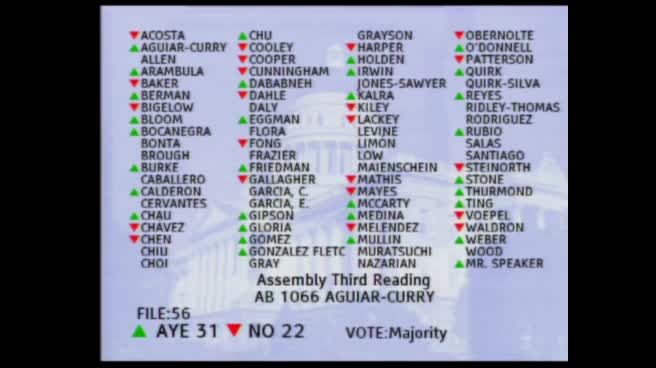 22MIN
Assembly Floor
 1H
Assembly Standing Committee on Appropriations
 42MIN
Assembly Standing Committee on Communications and Conveyance
Bill Author