AB 1740: Budget Deficit Savings Account.
- Session Year: 2017-2018
- House: Assembly
- Latest Version Date: 2018-04-17
Existing law establishes the various funds in the State Treasury, including the Special Fund for Economic Uncertainties.
This bill would establish the Budget Deficit Savings Account in the State Treasury and would provide that funds in the reserve shall be available only for specified purposes, for appropriation by the Legislature in fiscal years in which there is a state budget deficit, as provided.
Existing law provides that under an open policy, the measure of indemnity in fire insurance is the expense to the insured of replacing the thing lost or injured in its condition at the time of the injury, with the expense being computed as of the time of the commencement of the fire. Existing law also provides that under an open policy that requires payment of actual cash value, the measure of the actual cash value recovery, in whole or partial settlement of the claim, is, in the case of a total loss to the structure, the policy limit or the fair market value of the structure, whichever is less, and, in the case of a partial loss to the structure or loss to its contents, the amount it would cost the insured to repair, rebuild, or replace the thing lost or injured less a fair and reasonable deduction for physical depreciation based upon its condition at the time of the injury or the policy limit, whichever is less.This bill would delete the provisions regarding the actual cash value of the claim of total loss to the structure and would instead require that the actual cash value of the claim, for either a total or partial loss to the structure or its contents, be the amount it would cost the insured to repair, rebuild, or replace the thing lost or injured less a fair and reasonable deduction for physical depreciation based upon its condition at the time of the injury or the policy limit, whichever is less.Existing law provides that under an open policy, the measure of indemnity in fire insurance is the expense to the insured of replacing the thing lost or injured in its condition at the time of the injury, with the expense being computed as of the time of the commencement of the fire. Existing law also provides that under an open policy that requires payment of actual cash value, the measure of the actual cash value recovery, in whole or partial settlement of the claim, is, in the case of a total loss to the structure, the policy limit or the fair market value of the structure, whichever is less, and, in the case of a partial loss to the structure or loss to its contents, the amount it would cost the insured to repair, rebuild, or replace the thing lost or injured less a fair and reasonable deduction for physical depreciation based upon its condition at the time of the injury or the policy limit, whichever is less.
This bill would delete the provisions regarding the actual cash value of the claim of total loss to the structure and would instead require that the actual cash value of the claim, for either a total or partial loss to the structure or its contents, be the amount it would cost the insured to repair, rebuild, or replace the thing lost or injured less a fair and reasonable deduction for physical depreciation based upon its condition at the time of the injury or the policy limit, whichever is less.
The Legislature finds and declares all of the following:
(a)California revenue losses associated with the last three recessions totaled roughly $40 billion in the early 1990s recession, $80 billion in the 2000s dot-com bust, and $115 billion in the Great Recession.
(b)In 2014, the people of the great State of California overwhelmingly supported Proposition 2, a measure to repay debt and protect the state from the negative effects of economic downturns by depositing surplus revenue into the Budget Stabilization Account.
(c)Counterintuitively, filling the Budget Stabilization Account to its maximum capacity today may restrict the states ability to build more reserves in the future.
(d)Several economists, including the Legislative Analyst and the Department of Finance, have indicated that another downturn in Californias economy is looming.
(e)Establishing the Budget Deficit Savings Account will allow the state yet another mechanism to prepare in advance of a recession, thus further mitigating the impacts of state revenue losses.
SEC. 2.Article 7.8 (commencing with Section 16419.5) is added to Chapter 2 of Part 2 of Division 4 of Title 2 of the Government Code, to read:7.8.Budget Deficit Savings Account16419.5.(a)The Budget Deficit Savings Account is hereby created in the State Treasury.
(b)(1)Funds may be deposited in the Budget Deficit Savings Account by the annual Budget Act, a bill relating to the budget, or any other measure.
(2)Funds deposited in the Budget Deficit Savings Account shall be funds that are not required to meet any obligation pursuant to Proposition 98.
(3)Funds may be deposited in the Budget Deficit Savings Account only after the constitutionally required debt payments and contributions to the Budget Stabilization Account have been met.
(4)A deposit of funds in the Budget Deficit Savings Account shall take place on October 1st of that fiscal year.
(c)(1)Funds in the Budget Deficit Savings Account shall be available for appropriation by the Legislature only in fiscal years in which there is a state budget deficit.
(2)An appropriation from the Budget Deficit Savings Account shall not exceed 50 percent of the funds in the reserve.
(3)Funds in the Budget Deficit Savings Account shall only be used to maintain existing budget funding levels during a state budget deficit and only upon appropriation by the Legislature.
(d)Upon the Governors proclamation declaring a budget emergency and identifying the conditions constituting the emergency, the Legislature may pass a bill that does either of the following:
(1)Returns funds that have been transferred to the Budget Deficit Savings Account to the General Fund for appropriation to address the budget emergency.
(2)Not more than 50 percent of the balance in the Budget Deficit Savings Account may be returned to the General Fund for appropriation pursuant to paragraph (1) in any fiscal year, unless funds in the Budget Deficit Savings Account have been returned to the General Fund for appropriation in the immediately preceding fiscal year.
(e)Any amount in the Budget Deficit Savings Account shall not be included as General Fund revenues for purposes of Sections 6051.4 and 6051.45 of the Revenue and Taxation Code.
16419.6.For purposes of this article, state budget deficit means a determination by the Governor that estimated resources are inadequate to fund General Fund expenditures for the current or ensuing fiscal year, after setting aside funds for the reserve for liquidation of encumbrances, at a level equal to the highest amount of total General Fund expenditures estimated at the time of enactment of any of the three most recent Budget Acts, adjusted for both of the following:
(a)The annual percentage change in the cost of living for the state, as measured by the California Consumer Price Index.
(b)The annual percentage growth in the civilian population of the state pursuant to subdivision (b) of Section 7901.
SECTION 1.Section 2051 of the Insurance Code is amended to read:2051.(a)Under an open policy, the measure of indemnity in fire insurance is the expense to the insured of replacing the thing lost or injured in its condition at the time of the injury, the expense being computed as of the time of the commencement of the fire.(b)Under an open policy that requires payment of actual cash value, the measure of the actual cash value recovery, in whole or partial settlement of the claim, for either a total or partial loss to the structure or its contents, shall be the amount it would cost the insured to repair, rebuild, or replace the thing lost or injured less a fair and reasonable deduction for physical depreciation based upon its condition at the time of the injury or the policy limit, whichever is less. In case of a partial loss to the structure, a deduction for physical depreciation shall apply only to components of a structure that are normally subject to repair and replacement during the useful life of that structure.(a)Under an open policy, the measure of indemnity in fire insurance is the expense to the insured of replacing the thing lost or injured in its condition at the time of the injury, the expense being computed as of the time of the commencement of the fire.
(b)Under an open policy that requires payment of actual cash value, the measure of the actual cash value recovery, in whole or partial settlement of the claim, shall be determined as follows:
(1)In case of total loss to the structure, the policy limit or the fair market value of the structure, whichever is less.(2)In case of a partial loss to the structure, or loss to its contents, claim, for either a total or partial loss to the structure or its contents, shall be the amount it would cost the insured to repair, rebuild, or replace the thing lost or injured less a fair and reasonable deduction for physical depreciation based upon its condition at the time of the injury or the policy limit, whichever is less. In case of a partial loss to the structure, a deduction for physical depreciation shall apply only to components of a structure that are normally subject to repair and replacement during the useful life of that structure.
|
Date
|
Status
|
|---|---|
| Apr 26, 2018 | From committee: Be re-referred to Com. on BUDGET. Re-referred. (Ayes 8. Noes 0.) (April 26). Re-referred to Com. on BUDGET. |
| Apr 19, 2018 | Re-referred to Com. on RLS. pursuant to Assembly Rule 96. |
| Apr 18, 2018 | Re-referred to Com. on INS. |
| Apr 4, 2018 | In committee: Set, first hearing. Hearing canceled at the request of author. |
| Apr 17, 2018 | From committee chair, with author's amendments: Amend, and re-refer to Com. on INS. Read second time and amended. |
| Jan 16, 2018 | Referred to Com. on INS. |
| Jan 4, 2018 | From printer. May be heard in committee February 3. |
| Jan 3, 2018 | Read first time. To print. |
|
Date
|
Description
|
Location
|
Votes
|
|
|---|---|---|---|---|
| Apr 26, 2018 | Be re-referred to the Committee on [Budget] | Assembly Standing Committee on Rules |
Passed |
This list shows positions taken on this bill by organizations on the date displayed, which is linked to the original source.
Positions by individuals are not included.
Date of Hearing: May 3, 2018
ASSEMBLY COMMITTEE ON BUDGET
Philip Y. Ting, Chair
ABPCA Bill Id:AB 1740 (
Author:Daly) – As Amended Ver:April 17, 2018
SUBJECT: Budget Deficit Savings Account
SUMMARY: Establishes the Budget Deficit Savings Account and sets certain statutory terms for its use. Specifically, this bill:
- Creates a new account, called the Budget Deficit Savings Account that shall receive a deposit every October 1st from revenue that is not designated for Proposition 98 purposes.
- Stipulates that funds deposited in this account can only be transferred to the General Fund in a year with a budget deficit.
- Defines a budget deficit as estimated resources are inadequate to fund General Fund expenditures for the current or ensuing fiscal year, after setting accounting or encumbrances and adjusting for population growth and inflation.
- Requires the Governor to make the determination of deficit.
- Limits transfer in one year to half of the balance of the Budget Deficit Savings Account.
- States that funds in the Budget Deficit Savings Account are not considered General Fund for purpose of the sales tax reduction triggers in Government Code.
EXISTING LAW: Proposition 58 of 2002 created the Budget Stabilization Account (BSA), a restricted special fund reserve. The rules of the deposits and withdraws for this fund were changed significantly by Proposition 2 of 2014. Under the requirements of Proposition 2, the State was required to deposit 1.5 percent of General Fund revenues into the rainy day fund, plus certain capital gains revenues. These deposits could only be suspended during a fiscal emergency, as declared by the Governor and agreed to by the Legislature. Deposits continue into the BSA until the fund reaches 10 percent of General Fund. Funds can only be withdrawn from the BSA during a budget deficit, and only half of the funds may be withdrawn from the account in a single fiscal year.
The 1980‑81 Budget Act established within the General Fund the Reserve for Economic Uncertainties. In 1985, the fund was renamed the Special Fund for Economic Uncertainties (SFEU). This fund is the main reserve fund for the state budget. Government code has two statutes that trigger reductions in the state’s sales tax rate if balances in the SFEU reach a certain threshold. Under either statute, the state’s sales tax rate would automatically decline by one‑quarter cent for one calendar year reducing the SFEU by the same amount. Under the first statute, the trigger would occur if the Director of Finance projects the SFEU to exceed about 4 percent of General Fund revenues in the prior and current year. Under the second statute, the trigger would occur if (1) the “General Fund reserve” exceeds about 3 percent of revenues and (2) actual General Fund revenues between May 1st and September 30th exceed the administration’s forecasted amounts.
FISCAL EFFECT: Creation of this account does not have any cost, however, to the extent funds are deposited in the account these funds would only be available during a budget deficit.
COMMENTS: On March 7, 2018, the Legislative Analyst’s Office released a report entitled Building Reserves to Prepare for a Recession which discussed the State’s financial reserve levels and compared them to simulations of a projected economic contraction. The report noted that the proposed combined reserve balance of the SFEU and the BSA of $15.7 billion in the Governor’s 2018 budget proposal was on par with the level of reserves maintained by other States. However, the report noted the State would need far more than that to weather a mild to moderate recession without cut or revenue increases, which could result in a net shortfall of between $20 to $40 billion over a number of years. The current cap on the BSA of 10 percent, combined with the sale tax reductions triggers in the SFEU mean that the State could only set aside a maximum of somewhere between $17.5 billion to $18.9 billion. The report suggested the Legislature contemplate creating a new reserve account to allow the State to save more than the BSA and SFEU caps.
The author of this bill argue that AB 1740 provides a mechanism to address the gap in savings. The Budget Deficit Savings Account would provide the Legislature with an additional mechanism to set funding aside beyond the current caps.
Since the rules for withdrawing funds from the Budget Deficit Savings Account and the Budget Stabilization Account are identical, this proposal doubles down on a reserve mechanism that has yet to be tested in a downturn. The committee may wish to consider if the State would benefit from some differentiation between the two funds—perhaps allowing the Budget Deficit Savings Account to be more of a “first line of defense” in a downturn or conversely a “reserve of last resort” to compliment the large rainy day fund. In addition, if the uses of this fund were broader, for example, for use for natural disasters as well as downturns, it could be more responsive to risk to California beyond economic downturns.
Since this proposal intends to create a fund that will accrue a large balance over several years, the State will want the ability to use this balance for cash management purposes as part of the Pooled Money Investment system within the State. This proposal does not specify how cash balances are treated for cash management purposes, while Government Code 16310 states that all funds are cash borrowable unless explicitly prohibited, it is normal practice to declare the intent when created a new special fund.
The author’s offices states that the hope is that this new fund will be part of the 2018-19 budget plan. Since that could not occur before this bill could be chaptered, the committee may wish to refer this issue to Subcommittee 4 for consideration in the budget package. Acceptance of such a referral would result in incorporating this concept in the Assembly’s 2018-19 budget plan in lieu of advancing this bill.
REGISTERED SUPPORT / OPPOSITION:
None on file.
Analysis Prepared by: Christian Griffith / BUDGET / (916) 319-2099
Discussed in Hearing
 28MIN
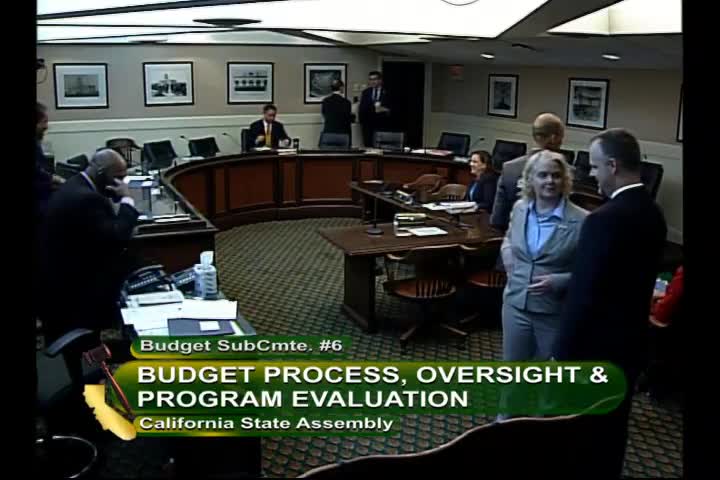
Assembly Budget Subcommittee No. 6 on Budget Process Oversight and Program Evaluation
Bill Author








Bill Co-Author(s):