AB 2224: Vehicles: narrow track vehicles.
- Session Year: 2017-2018
- House: Assembly
- Latest Version Date: 2018-04-25
Under existing law, upon application for an original drivers license, except student licenses, the Department of Motor Vehicles shall require an examination of the applicant. Existing law requires an applicant for a drivers license to submit to an examination appropriate to the type of motor vehicle or combination of vehicles the applicant desires a license to drive.
This bill would include narrow track vehicles in the list of class C vehicles subject to the licensing provisions described above. The bill would define a narrow track vehicle as a fully enclosed motor vehicle with three 3 or four 4 wheels that does not exceed 40 inches in width. width, and that conforms with all applicable federal motor vehicle safety standards, as specified. The bill would also define a short narrow track vehicle as a narrow track vehicle that does not exceed 102 inches in length.
Existing law authorizes the Department of Transportation and local authorities to designate certain highway lanes for the exclusive or preferential use of high-occupancy vehicles (HOVs), requires the department or local authorities to place signage advising motorists of the rules governing the use of those lanes, and prohibits the use of those lanes by motorists other than in conformity with the posted rules. Existing law provides a limited exemption allowing specified vehicles, including blood transport vehicles and motorcycles, to use HOV lanes. Existing law places specified conditions on the authority of a blood transport vehicle to use these exclusive or preferential lanes.
This bill would place the same conditions on the authority of a narrow track vehicles use of these exclusive or preferential lanes as those applied to blood transport vehicles. The bill would include narrow track vehicles in the HOV lane exemption described above only until January 1, 2027.
Existing law authorizes the Department of the California Highway Patrol to develop educational guidelines relating to lane splitting in a manner that would ensure the safety of the motorcyclist, drivers, and passengers, as specified. Existing law defines lane splitting for these purposes as driving a motorcycle that has 2 wheels in contact with the ground between rows of stopped or moving vehicles in the same lane, as specified.
This bill would revise the definition of lane splitting and expand the provisions described above to include narrow track vehicles.
This bill would require authorize a local authority that regulates motorcycle parking to regulate parking for short narrow track vehicles, as defined, in the same manner, as specified. The bill would also make technical, nonsubstantive changes.
Under existing law, upon application for an original drivers license, except student licenses, the Department of Motor Vehicles shall require an examination of the applicant. Existing law requires an applicant for a drivers license to submit to an examination appropriate to the type of motor vehicle or combination of vehicles the applicant desires a license to drive.
This bill would include narrow track vehicles in the list of class C vehicles subject to the licensing provisions described above. The bill would define a narrow track vehicle as a fully enclosed motor vehicle with three or four wheels that does not exceed 40 inches in width. The bill would also define a short narrow track vehicle as a narrow track vehicle that does not exceed 102 inches in length.
Existing law authorizes the Department of Transportation and local authorities to designate certain highway lanes for the exclusive or preferential use of high-occupancy vehicles (HOVs), requires the department or local authorities to place signage advising motorists of the rules governing the use of those lanes, and prohibits the use of those lanes by motorists other than in conformity with the posted rules. Existing law provides a limited exemption allowing specified vehicles, including blood transport vehicles and motorcycles, to use HOV lanes. Existing law places specified conditions on the authority of a blood transport vehicle to use these exclusive or preferential lanes.
This bill would place the same conditions on the authority of a narrow track vehicles use of these exclusive or preferential lanes as those applied to blood transport vehicles. The bill would include narrow track vehicles in the HOV lane exemption described above. above only until January 1, 2027.
This bill would express the intent of the Legislature to encourage local authorities require a local authority that regulates motorcycle parking to regulate parking for short narrow track vehicles vehicles, as defined, in the same manner as motorcycles, for purposes of standing, stopping, and parking. manner, as specified. The bill would also make technical, nonsubstantive changes.
Under existing law, upon application for an original drivers license, except student licenses, the Department of Motor Vehicles shall require an examination of the applicant. Existing law requires an applicant for a drivers license to submit to an examination appropriate to the type of motor vehicle or combination of vehicles the applicant desires a license to drive.
This bill would include narrow track vehicles in the list of class C vehicles subject to the licensing provisions described above. The bill would define a narrow track vehicle as a fully enclosed motor vehicle with three or four wheels that does exceed 40 inches in width. The bill would also define a short narrow track vehicle as a narrow track vehicle that does not exceed 102 inches in length.
Existing law authorizes the Department of Transportation and local authorities to designate certain highway lanes for the exclusive or preferential use of high-occupancy vehicles (HOVs), requires the department or local authorities to place signage advising motorists of the rules governing the use of those lanes, and prohibits the use of those lanes by motorists other than in conformity with the posted rules. Existing law provides a limited exemption allowing specified vehicles, including motorcycles, to use HOV lanes.
This bill would include narrow track vehicles in the HOV lane exemption described above.
This bill would express the intent of the Legislature to encourage local authorities to regulate short narrow track vehicles in the same manner as motorcycles, for purposes of standing, stopping, and parking. The bill would also make technical, nonsubstantive changes.
A muffler is a device consisting of a series of chambers or baffle plates, or other mechanical design, for the purpose of receiving exhaust gas from an internal combustion engine, and reducing noise.
SEC. 2.Section 425 of the Vehicle Code is repealed.SEC. 3.Section 425 is added to the Vehicle Code, to read:425.(a)A narrow track vehicle is a fully enclosed motor vehicle with three or four wheels that does not exceed 40 inches in width. width, and that conforms to all applicable federal motor vehicle safety standards established pursuant to Chapter 301 (commencing with Section 30101) of Part A of Subtitle VI of Title 49 of the United States Code.
(b)A short narrow track vehicle is a narrow track vehicle that does not exceed 102 inches in length.
SEC. 4.Section 12804.9 of the Vehicle Code is amended to read:12804.9.(a)(1)The examination shall include all of the following:
(A)A test of the applicants knowledge and understanding of the provisions of this code governing the operation of vehicles upon the highways.
(B)A test of the applicants ability to read and understand simple English used in highway traffic and directional signs.
(C)A test of the applicants understanding of traffic signs and signals, including the bikeway signs, markers, and traffic control devices established by the Department of Transportation.
(D)An actual demonstration of the applicants ability to exercise ordinary and reasonable control in operating a motor vehicle by driving it under the supervision of an examining officer. The applicant shall submit to an examination appropriate to the type of motor vehicle or combination of vehicles he or she desires a license to drive, except that the department may waive the driving test part of the examination for any applicant who submits a license issued by another state, territory, or possession of the United States, the District of Columbia, or the Commonwealth of Puerto Rico if the department verifies through any acknowledged national driver record data source that there are no stops, holds, or other impediments to its issuance. The examining officer may request to see evidence of financial responsibility for the vehicle prior to supervising the demonstration of the applicants ability to operate the vehicle. The examining officer may refuse to examine an applicant who is unable to provide proof of financial responsibility for the vehicle, unless proof of financial responsibility is not required by this code.
(E)A test of the hearing and eyesight of the applicant, and of other matters that may be necessary to determine the applicants mental and physical fitness to operate a motor vehicle upon the highways, and whether any grounds exist for refusal of a license under this code.
(2)(A)Before a class A or class B drivers license, or class C drivers license with a commercial endorsement, may be issued or renewed, the applicant shall have in his or her driver record a valid report of a medical examination of the applicant given not more than two years prior to the date of the application by a health care professional. As used in this paragraph, health care professional means a person who is licensed, certified, or registered in accordance with applicable state laws and regulations to practice medicine and perform physical examinations in the United States. Health care professionals are doctors of medicine, doctors of osteopathy, physician assistants, and registered advanced practice nurses, or doctors of chiropractic who are clinically competent to perform the medical examination presently required of motor carrier drivers by the United States Department of Transportation. The report shall be on a form approved by the department. In establishing the requirements, consideration may be given to the standards presently required of motor carrier drivers by the Federal Motor Carrier Safety Administration.
(B)The department may accept a federal waiver of one or more physical qualification standards if the waiver is accompanied by a report of a nonqualifying medical examination for a class A or class B drivers license, or class C drivers license with a commercial endorsement, pursuant to Section 391.41(a)(3)(ii) of Subpart E of Part 391 of Title 49 of the Code of Federal Regulations.
(3)A physical defect of the applicant that, in the opinion of the department, is compensated for to ensure safe driving ability, shall not prevent the issuance of a license to the applicant.
(b)In accordance with the following classifications, an applicant for a drivers license shall be required to submit to an examination appropriate to the type of motor vehicle or combination of vehicles the applicant desires a license to drive:
(1)Class A includes the following:
(A)Except as provided in subparagraph (H) of paragraph (3), a combination of vehicles, if a vehicle being towed has a gross vehicle weight rating or gross vehicle weight of more than 10,000 pounds.
(B)A vehicle towing more than one vehicle.
(C)A trailer bus.
(D)The operation of all vehicles under class B and class C.
(2)Class B includes the following:
(A)Except as provided in subparagraph (H) of paragraph (3), a single vehicle with a gross vehicle weight rating or gross vehicle weight of more than 26,000 pounds.
(B)A single vehicle with three or more axles, except any three-axle vehicle weighing less than 6,000 pounds.
(C)A bus with a gross vehicle weight rating or gross vehicle weight of more than 26,000 pounds, except a trailer bus.
(D)A farm labor vehicle.
(E)A single vehicle with three or more axles or a gross vehicle weight rating or gross vehicle weight of more than 26,000 pounds towing another vehicle with a gross vehicle weight rating or gross vehicle weight of 10,000 pounds or less.
(F)A house car over 40 feet in length, excluding safety devices and safety bumpers.
(G)The operation of all vehicles covered under class C.
(3)Class C includes the following:
(A)A two-axle vehicle with a gross vehicle weight rating or gross vehicle weight of 26,000 pounds or less, including when the vehicle is towing a trailer or semitrailer with a gross vehicle weight rating or gross vehicle weight of 10,000 pounds or less.
(B)Notwithstanding subparagraph (A), a two-axle vehicle weighing 4,000 pounds or more unladen when towing a trailer coach not exceeding 9,000 pounds gross.
(C)A house car of 40 feet in length or less.
(D)A three-axle vehicle weighing 6,000 pounds gross or less.
(E)A house car of 40 feet in length or less or a vehicle towing another vehicle with a gross vehicle weight rating of 10,000 pounds or less, including when a tow dolly is used. A person driving a vehicle may not tow another vehicle in violation of Section 21715.
(F)(i)A two-axle vehicle weighing 4,000 pounds or more unladen when towing either a trailer coach or a fifth-wheel travel trailer not exceeding 10,000 pounds gross vehicle weight rating, when the towing of the trailer is not for compensation.
(ii)A two-axle vehicle weighing 4,000 pounds or more unladen when towing a fifth-wheel travel trailer exceeding 10,000 pounds, but not exceeding 15,000 pounds, gross vehicle weight rating, when the towing of the trailer is not for compensation, and if the person has passed a specialized written examination provided by the department relating to the knowledge of this code and other safety aspects governing the towing of recreational vehicles upon the highway.
The authority to operate combinations of vehicles under this subparagraph may be granted by endorsement on a class C license upon completion of that written examination.
(G)A vehicle or combination of vehicles with a gross combination weight rating or a gross vehicle weight rating, as those terms are defined in subdivisions (j) and (k), respectively, of Section 15210, of 26,000 pounds or less, if all of the following conditions are met:
(i)Is operated by a farmer, an employee of a farmer, or an instructor credentialed in agriculture as part of an instructional program in agriculture at the high school, community college, or university level.
(ii)Is used exclusively in the conduct of agricultural operations.
(iii)Is not used in the capacity of a for-hire carrier or for compensation.
(H)Firefighting equipment, provided that the equipment is operated by a person who holds a firefighter endorsement pursuant to Section 12804.11.
(I)A motorized scooter.
(J)A bus with a gross vehicle weight rating or gross vehicle weight of 26,000 pounds or less, except a trailer bus.
(K) Class C does not include a two-wheel motorcycle or a two-wheel motor-driven cycle.
(L)A narrow track vehicle, as defined in Section 425.
(4)Class M1. A two-wheel motorcycle or a motor-driven cycle. Authority to operate a vehicle included in a class M1 license may be granted by endorsement on a class A, B, or C license upon completion of an appropriate examination.
(5)(A)Class M2 includes the following:
(i)A motorized bicycle or moped, or a bicycle with an attached motor, except an electric bicycle as described in subdivision (a) of Section 312.5.
(ii)A motorized scooter.
(B)Authority to operate vehicles included in class M2 may be granted by endorsement on a class A, B, or C license upon completion of an appropriate examination, except that no endorsement is required for a motorized scooter. Persons holding a class M1 license or endorsement may operate vehicles included in class M2 without further examination.
(c)A drivers license or driver certificate is not valid for operating a commercial motor vehicle, as defined in subdivision (b) of Section 15210, any other motor vehicle defined in paragraph (1) or (2) of subdivision (b), or any other vehicle requiring a driver to hold any driver certificate or any drivers license endorsement under Section 15275, unless a medical certificate approved by the department that has been issued within two years of the date of the operation of that vehicle and a copy of the medical examination report from which the certificate was issued is on file with the department. Otherwise, the license is valid only for operating class C vehicles that are not commercial vehicles, as defined in subdivision (b) of Section 15210, and for operating class M1 or M2 vehicles, if so endorsed, that are not commercial vehicles, as defined in subdivision (b) of Section 15210.
(d)A license or driver certificate issued prior to the enactment of Chapter 7 (commencing with Section 15200) is valid to operate the class or type of vehicles specified under the law in existence prior to that enactment until the license or certificate expires or is otherwise suspended, revoked, or canceled. Upon application for renewal or replacement of a drivers license, endorsement, or certificate required to operate a commercial motor vehicle, a valid medical certificate on a form approved by the department shall be submitted to the department.
(e)The department may accept a certificate of driving skill that is issued by an employer, authorized by the department to issue a certificate under Section 15250, of the applicant, in lieu of a driving test, on class A or B applications, if the applicant has first qualified for a class C license and has met the other examination requirements for the license for which he or she is applying. The certificate may be submitted as evidence of the applicants skill in the operation of the types of equipment covered by the license for which he or she is applying.
(f)The department may accept a certificate of competence in lieu of a driving test on class M1 or M2 applications, when the certificate is issued by a law enforcement agency for its officers who operate class M1 or M2 vehicles in their duties, if the applicant has met the other examination requirements for the license for which he or she is applying.
(g)The department may accept a certificate of satisfactory completion of a motorcyclist training program approved by the commissioner pursuant to Section 2932 in lieu of a driving test on class M1 or M2 applications, if the applicant has met the other examination requirements for the license for which he or she is applying. The department shall review and approve the written and driving test used by a program to determine whether the program may issue a certificate of completion.
(h)Notwithstanding subdivision (b), a person holding a valid California drivers license of any class may operate a short-term rental motorized bicycle without taking any special examination for the operation of a motorized bicycle, and without having a class M2 endorsement on that license. As used in this subdivision, short-term means 48 hours or less.
(i)A person under 21 years of age shall not be issued a class M1 or M2 license or endorsement unless he or she provides evidence satisfactory to the department of completion of a novice motorcycle safety training program that is operated pursuant to Article 2 (commencing with Section 2930) of Chapter 5 of Division 2.
(j)A driver of a vanpool vehicle may operate with a class C license but shall possess evidence of a medical examination required for a class B license when operating vanpool vehicles. In order to be eligible to drive the vanpool vehicle, the driver shall keep in the vanpool vehicle a statement, signed under penalty of perjury, that he or she has not been convicted of reckless driving, drunk driving, or a hit-and-run offense in the last five years.
SEC. 5.Section 21655.5 of the Vehicle Code is amended to read:21655.5.(a)The Department of Transportation and local authorities, with respect to highways under their respective jurisdictions, may authorize or permit exclusive or preferential use of highway lanes for high-occupancy vehicles. Prior to establishing the lanes, competent engineering estimates shall be made of the effect of the lanes on safety, congestion, and highway capacity.
(b)The Department of Transportation and local authorities, with respect to highways under their respective jurisdictions, shall place and maintain, or cause to be placed and maintained, signs and other official traffic control devices to designate the exclusive or preferential lanes, to advise motorists of the applicable vehicle occupancy levels, and, except where ramp metering and bypass lanes are regulated with the activation of traffic signals, to advise motorists of the hours of high-occupancy vehicle usage. A person shall not drive a vehicle upon those lanes except in conformity with the instructions imparted by the official traffic control devices. A motorcycle, a narrow track vehicle, a mass transit vehicle, a blood transport vehicle that is clearly and identifiably marked as such on all sides of the vehicle, or a paratransit vehicle that is clearly and identifiably marked on all sides of the vehicle with the name of the paratransit provider may be operated upon those exclusive or preferential use lanes unless specifically prohibited by a traffic control device.
(c)When responding to an existing emergency or breakdown in which a mass transit vehicle is blocking an exclusive or preferential use lane, a clearly marked mass transit vehicle, mass transit supervisors vehicle, or mass transit maintenance vehicle that is responding to the emergency or breakdown may be operated in the segment of the exclusive or preferential use lane being blocked by the mass transit vehicle, regardless of the number of persons in the vehicle responding to the emergency or breakdown, if both vehicles are owned or operated by the same agency, and that agency provides public mass transit services.
(d)For purposes of this section, the following definitions apply:
(1)Blood transport vehicle means a vehicle owned and operated by the American Red Cross or a blood bank that is transporting blood between collection points and hospitals or storage centers.
(2)Mass transit vehicle means a transit bus regularly used to transport paying passengers in mass transit service.
(3)Paratransit vehicle as defined in Section 462.
(4)Narrow track vehicle as defined in Section 425.
(e)It is the intent of the Legislature, in amending this section, to stimulate and encourage the development of ways and means of relieving traffic congestion on California highways and, at the same time, to encourage individual citizens to pool their vehicular resources and thereby conserve fuel and lessen emission of air pollutants.
(f)The provisions of this section regarding mass transit vehicles and paratransit vehicles shall only apply if the Director of Transportation determines that the application will not subject the state to a reduction in the amount of federal aid for highways.
(g)The authority for a blood transport vehicle or a narrow track vehicle to use exclusive or preferential lanes in accordance with subdivision (b) shall only be operative under either of the following circumstances:
(1)The Director of Transportation determines that the use of those lanes by those vehicles will not cause a reduction of federal aid funds for highways or otherwise be inconsistent with federal law or regulations, or with any agreement between the state and a federal agency or department, and the director posts that determination on the Department of Transportations Internet Web site.
(2)The Federal Highway Administration of the United States Department of Transportation, upon the request of the director, makes that determination and the director posts the determination on the Department of Transportations Internet Web site.
(h)Notwithstanding any other provision of this section, this section shall not be implemented with respect to narrow track vehicles commencing January 1, 2027.
SEC. 6.Section 21658.1 of the Vehicle Code is amended to read:21658.1.(a)For the purposes of this section, lane splitting means driving a motorcycle, as defined in Section 400, that has two wheels in contact with the ground, either of the following vehicles between rows of stopped or moving vehicles in the same lane, including on both divided and undivided streets, roads, or highways. highways:
(1)A narrow track vehicle, as defined in 425.
(2)A motorcycle, as defined in Section 400, that has two wheels in contact with the ground.
(b)The Department of the California Highway Patrol may develop educational guidelines relating to lane splitting in a manner that would ensure the safety of the motorcyclist driver of a narrow track vehicle or motorcycle and the drivers and passengers of the surrounding vehicles.
(c)In developing guidelines pursuant to this section, the department shall consult with agencies and organizations with an interest in road safety and motorcyclist behavior, including, but not limited to, all of the following:
(1)The Department of Motor Vehicles.
(2)The Department of Transportation.
(3)The Office of Traffic Safety.
(4)A motorcycle organization focused on motorcyclist safety.
SEC. 6.SEC. 7.Section 22527 is added to the Vehicle Code, to read:22527.A local authority that regulates motorcycle parking shall, may, by ordinance or resolution, regulate the parking for short narrow track vehicles, as defined in Section 425, in the same manner. The ordinance or resolution shall not apply until signs or markings giving adequate notice thereof have been placed.
A muffler is a device consisting of a series of chambers or baffle plates, or other mechanical design, for the purpose of receiving exhaust gas from an internal combustion engine, and reducing noise.
SEC. 2.Section 425 of the Vehicle Code is repealed.SEC. 3.Section 425 is added to the Vehicle Code, to read:425.(a)A narrow track vehicle is a fully enclosed motor vehicle with three or four wheels that does not exceed 40 inches in width.
(b)A short narrow track vehicle is a narrow track vehicle that does not exceed 102 inches in length.
SEC. 4.Section 12804.9 of the Vehicle Code is amended to read:12804.9.(a)(1)The examination shall include all of the following:
(A)A test of the applicants knowledge and understanding of the provisions of this code governing the operation of vehicles upon the highways.
(B)A test of the applicants ability to read and understand simple English used in highway traffic and directional signs.
(C)A test of the applicants understanding of traffic signs and signals, including the bikeway signs, markers, and traffic control devices established by the Department of Transportation.
(D)An actual demonstration of the applicants ability to exercise ordinary and reasonable control in operating a motor vehicle by driving it under the supervision of an examining officer. The applicant shall submit to an examination appropriate to the type of motor vehicle or combination of vehicles he or she desires a license to drive, except that the department may waive the driving test part of the examination for any applicant who submits a license issued by another state, territory, or possession of the United States, the District of Columbia, or the Commonwealth of Puerto Rico if the department verifies through any acknowledged national driver record data source that there are no stops, holds, or other impediments to its issuance. The examining officer may request to see evidence of financial responsibility for the vehicle prior to supervising the demonstration of the applicants ability to operate the vehicle. The examining officer may refuse to examine an applicant who is unable to provide proof of financial responsibility for the vehicle, unless proof of financial responsibility is not required by this code.
(E)A test of the hearing and eyesight of the applicant, and of other matters that may be necessary to determine the applicants mental and physical fitness to operate a motor vehicle upon the highways, and whether any grounds exist for refusal of a license under this code.
(2)(A)Before a class A or class B drivers license, or class C drivers license with a commercial endorsement, may be issued or renewed, the applicant shall have in his or her driver record a valid report of a medical examination of the applicant given not more than two years prior to the date of the application by a health care professional. As used in this paragraph, health care professional means a person who is licensed, certified, or registered in accordance with applicable state laws and regulations to practice medicine and perform physical examinations in the United States. Health care professionals are doctors of medicine, doctors of osteopathy, physician assistants, and registered advanced practice nurses, or doctors of chiropractic who are clinically competent to perform the medical examination presently required of motor carrier drivers by the United States Department of Transportation. The report shall be on a form approved by the department. In establishing the requirements, consideration may be given to the standards presently required of motor carrier drivers by the Federal Motor Carrier Safety Administration.
(B)The department may accept a federal waiver of one or more physical qualification standards if the waiver is accompanied by a report of a nonqualifying medical examination for a class A or class B drivers license, or class C drivers license with a commercial endorsement, pursuant to Section 391.41(a)(3)(ii) of Subpart E of Part 391 of Title 49 of the Code of Federal Regulations.
(3)A physical defect of the applicant that, in the opinion of the department, is compensated for to ensure safe driving ability, shall not prevent the issuance of a license to the applicant.
(b)In accordance with the following classifications, an applicant for a drivers license shall be required to submit to an examination appropriate to the type of motor vehicle or combination of vehicles the applicant desires a license to drive:
(1)Class A includes the following:
(A)Except as provided in subparagraph (H) of paragraph (3), a combination of vehicles, if a vehicle being towed has a gross vehicle weight rating or gross vehicle weight of more than 10,000 pounds.
(B)A vehicle towing more than one vehicle.
(C)A trailer bus.
(D)The operation of all vehicles under class B and class C.
(2)Class B includes the following:
(A)Except as provided in subparagraph (H) of paragraph (3), a single vehicle with a gross vehicle weight rating or gross vehicle weight of more than 26,000 pounds.
(B)A single vehicle with three or more axles, except any three-axle vehicle weighing less than 6,000 pounds.
(C)A bus with a gross vehicle weight rating or gross vehicle weight of more than 26,000 pounds, except a trailer bus.
(D)A farm labor vehicle.
(E)A single vehicle with three or more axles or a gross vehicle weight rating or gross vehicle weight of more than 26,000 pounds towing another vehicle with a gross vehicle weight rating or gross vehicle weight of 10,000 pounds or less.
(F)A house car over 40 feet in length, excluding safety devices and safety bumpers.
(G)The operation of all vehicles covered under class C.
(3)Class C includes the following:
(A)A two-axle vehicle with a gross vehicle weight rating or gross vehicle weight of 26,000 pounds or less, including when the vehicle is towing a trailer or semitrailer with a gross vehicle weight rating or gross vehicle weight of 10,000 pounds or less.
(B)Notwithstanding subparagraph (A), a two-axle vehicle weighing 4,000 pounds or more unladen when towing a trailer coach not exceeding 9,000 pounds gross.
(C)A house car of 40 feet in length or less.
(D)A three-axle vehicle weighing 6,000 pounds gross or less.
(E)A house car of 40 feet in length or less or a vehicle towing another vehicle with a gross vehicle weight rating of 10,000 pounds or less, including when a tow dolly is used. A person driving a vehicle may not tow another vehicle in violation of Section 21715.
(F)(i)A two-axle vehicle weighing 4,000 pounds or more unladen when towing either a trailer coach or a fifth-wheel travel trailer not exceeding 10,000 pounds gross vehicle weight rating, when the towing of the trailer is not for compensation.
(ii)A two-axle vehicle weighing 4,000 pounds or more unladen when towing a fifth-wheel travel trailer exceeding 10,000 pounds, but not exceeding 15,000 pounds, gross vehicle weight rating, when the towing of the trailer is not for compensation, and if the person has passed a specialized written examination provided by the department relating to the knowledge of this code and other safety aspects governing the towing of recreational vehicles upon the highway.
The authority to operate combinations of vehicles under this subparagraph may be granted by endorsement on a class C license upon completion of that written examination.
(G)A vehicle or combination of vehicles with a gross combination weight rating or a gross vehicle weight rating, as those terms are defined in subdivisions (j) and (k), respectively, of Section 15210, of 26,000 pounds or less, if all of the following conditions are met:
(i)Is operated by a farmer, an employee of a farmer, or an instructor credentialed in agriculture as part of an instructional program in agriculture at the high school, community college, or university level.
(ii)Is used exclusively in the conduct of agricultural operations.
(iii)Is not used in the capacity of a for-hire carrier or for compensation.
(H)Firefighting equipment, provided that the equipment is operated by a person who holds a firefighter endorsement pursuant to Section 12804.11.
(I)A motorized scooter.
(J)A bus with a gross vehicle weight rating or gross vehicle weight of 26,000 pounds or less, except a trailer bus.
(K) Class C does not include a two-wheel motorcycle or a two-wheel motor-driven cycle.
(L)A narrow track vehicle, as defined in Section 425.
(4)Class M1. A two-wheel motorcycle or a motor-driven cycle. Authority to operate a vehicle included in a class M1 license may be granted by endorsement on a class A, B, or C license upon completion of an appropriate examination.
(5)(A)Class M2 includes the following:
(i)A motorized bicycle or moped, or a bicycle with an attached motor, except an electric bicycle as described in subdivision (a) of Section 312.5.
(ii)A motorized scooter.
(B)Authority to operate vehicles included in class M2 may be granted by endorsement on a class A, B, or C license upon completion of an appropriate examination, except that no endorsement is required for a motorized scooter. Persons holding a class M1 license or endorsement may operate vehicles included in class M2 without further examination.
(c)A drivers license or driver certificate is not valid for operating a commercial motor vehicle, as defined in subdivision (b) of Section 15210, any other motor vehicle defined in paragraph (1) or (2) of subdivision (b), or any other vehicle requiring a driver to hold any driver certificate or any drivers license endorsement under Section 15275, unless a medical certificate approved by the department that has been issued within two years of the date of the operation of that vehicle and a copy of the medical examination report from which the certificate was issued is on file with the department. Otherwise, the license is valid only for operating class C vehicles that are not commercial vehicles, as defined in subdivision (b) of Section 15210, and for operating class M1 or M2 vehicles, if so endorsed, that are not commercial vehicles, as defined in subdivision (b) of Section 15210.
(d)A license or driver certificate issued prior to the enactment of Chapter 7 (commencing with Section 15200) is valid to operate the class or type of vehicles specified under the law in existence prior to that enactment until the license or certificate expires or is otherwise suspended, revoked, or canceled. Upon application for renewal or replacement of a drivers license, endorsement, or certificate required to operate a commercial motor vehicle, a valid medical certificate on a form approved by the department shall be submitted to the department.
(e)The department may accept a certificate of driving skill that is issued by an employer, authorized by the department to issue a certificate under Section 15250, of the applicant, in lieu of a driving test, on class A or B applications, if the applicant has first qualified for a class C license and has met the other examination requirements for the license for which he or she is applying. The certificate may be submitted as evidence of the applicants skill in the operation of the types of equipment covered by the license for which he or she is applying.
(f)The department may accept a certificate of competence in lieu of a driving test on class M1 or M2 applications, when the certificate is issued by a law enforcement agency for its officers who operate class M1 or M2 vehicles in their duties, if the applicant has met the other examination requirements for the license for which he or she is applying.
(g)The department may accept a certificate of satisfactory completion of a motorcyclist training program approved by the commissioner pursuant to Section 2932 in lieu of a driving test on class M1 or M2 applications, if the applicant has met the other examination requirements for the license for which he or she is applying. The department shall review and approve the written and driving test used by a program to determine whether the program may issue a certificate of completion.
(h)Notwithstanding subdivision (b), a person holding a valid California drivers license of any class may operate a short-term rental motorized bicycle without taking any special examination for the operation of a motorized bicycle, and without having a class M2 endorsement on that license. As used in this subdivision, short-term means 48 hours or less.
(i)A person under 21 years of age shall not be issued a class M1 or M2 license or endorsement unless he or she provides evidence satisfactory to the department of completion of a novice motorcycle safety training program that is operated pursuant to Article 2 (commencing with Section 2930) of Chapter 5 of Division 2.
(j)A driver of a vanpool vehicle may operate with a class C license but shall possess evidence of a medical examination required for a class B license when operating vanpool vehicles. In order to be eligible to drive the vanpool vehicle, the driver shall keep in the vanpool vehicle a statement, signed under penalty of perjury, that he or she has not been convicted of reckless driving, drunk driving, or a hit-and-run offense in the last five years.
SEC. 5.Section 21655.5 of the Vehicle Code is amended to read:21655.5.(a)The Department of Transportation and local authorities, with respect to highways under their respective jurisdictions, may authorize or permit exclusive or preferential use of highway lanes for high-occupancy vehicles. Prior to establishing the lanes, competent engineering estimates shall be made of the effect of the lanes on safety, congestion, and highway capacity.
(b)The Department of Transportation and local authorities, with respect to highways under their respective jurisdictions, shall place and maintain, or cause to be placed and maintained, signs and other official traffic control devices to designate the exclusive or preferential lanes, to advise motorists of the applicable vehicle occupancy levels, and, except where ramp metering and bypass lanes are regulated with the activation of traffic signals, to advise motorists of the hours of high-occupancy vehicle usage. A person shall not drive a vehicle upon those lanes except in conformity with the instructions imparted by the official traffic control devices. A motorcycle, a narrow track vehicle, a mass transit vehicle, a blood transport vehicle that is clearly and identifiably marked as such on all sides of the vehicle, or a paratransit vehicle that is clearly and identifiably marked on all sides of the vehicle with the name of the paratransit provider may be operated upon those exclusive or preferential use lanes unless specifically prohibited by a traffic control device.
(c)When responding to an existing emergency or breakdown in which a mass transit vehicle is blocking an exclusive or preferential use lane, a clearly marked mass transit vehicle, mass transit supervisors vehicle, or mass transit maintenance vehicle that is responding to the emergency or breakdown may be operated in the segment of the exclusive or preferential use lane being blocked by the mass transit vehicle, regardless of the number of persons in the vehicle responding to the emergency or breakdown, if both vehicles are owned or operated by the same agency, and that agency provides public mass transit services.
(d)For purposes of this section, the following definitions apply:
(1)Blood transport vehicle means a vehicle owned and operated by the American Red Cross or a blood bank that is transporting blood between collection points and hospitals or storage centers.
(2)Mass transit vehicle means a transit bus regularly used to transport paying passengers in mass transit service.
(3)Paratransit vehicle as defined in Section 462.
(4)Narrow track vehicle as defined in Section 425.
(e)It is the intent of the Legislature, in amending this section, to stimulate and encourage the development of ways and means of relieving traffic congestion on California highways and, at the same time, to encourage individual citizens to pool their vehicular resources and thereby conserve fuel and lessen emission of air pollutants.
(f)The provisions of this section regarding mass transit vehicles and paratransit vehicles shall only apply if the Director of Transportation determines that the application will not subject the state to a reduction in the amount of federal aid for highways.
(g)The authority for a blood transport vehicle or a narrow track vehicle to use exclusive or preferential lanes in accordance with subdivision (b) shall only be operative under either of the following circumstances:
(1)The Director of Transportation determines that the use of those lanes by those vehicles will not cause a reduction of federal aid funds for highways or otherwise be inconsistent with federal law or regulations, or with any agreement between the state and a federal agency or department, and the director posts that determination on the Department of Transportations Internet Web site.
(2)The Federal Highway Administration of the United States Department of Transportation, upon the request of the director, makes that determination and the director posts the determination on the Department of Transportations Internet Web site.
(h)Notwithstanding any other provision of this section, this section shall not be implemented with respect to narrow track vehicles commencing January 1, 2027.
SEC. 6.Section 22527 is added to the Vehicle Code, to read:22527.It is the intent of the Legislature to encourage local authorities to regulate A local authority that regulates motorcycle parking shall, by ordinance or resolution, regulate the parking for short narrow track vehicles, as defined in Section 425, in the same manner as motorcycles, for purposes of this chapter. manner. The ordinance or resolution shall not apply until signs or markings giving adequate notice thereof have been placed.
A muffler is a device consisting of a series of chambers or baffle plates, or other mechanical design, for the purpose of receiving exhaust gas from an internal combustion engine, and reducing noise.
SEC. 2.Section 425 of the Vehicle Code is repealed.425.A muffler is a device consisting of a series of chambers or baffle plates, or other mechanical design, for the purpose of receiving exhaust gas from an internal combustion engine, and effective in reducing noise.SEC. 3.Section 425 is added to the Vehicle Code, to read:425.(a)A narrow track vehicle is a fully enclosed motor vehicle with three or four wheels that does exceed 40 inches in width.
(b)A short narrow track vehicle is a narrow track vehicle that does not exceed 102 inches in length.
SEC. 4.Section 12804.9 of the Vehicle Code is amended to read:12804.9.(a)(1)The examination shall include all of the following:
(A)A test of the applicants knowledge and understanding of the provisions of this code governing the operation of vehicles upon the highways.
(B)A test of the applicants ability to read and understand simple English used in highway traffic and directional signs.
(C)A test of the applicants understanding of traffic signs and signals, including the bikeway signs, markers, and traffic control devices established by the Department of Transportation.
(D)An actual demonstration of the applicants ability to exercise ordinary and reasonable control in operating a motor vehicle by driving it under the supervision of an examining officer. The applicant shall submit to an examination appropriate to the type of motor vehicle or combination of vehicles he or she desires a license to drive, except that the department may waive the driving test part of the examination for any applicant who submits a license issued by another state, territory, or possession of the United States, the District of Columbia, or the Commonwealth of Puerto Rico if the department verifies through any acknowledged national driver record data source that there are no stops, holds, or other impediments to its issuance. The examining officer may request to see evidence of financial responsibility for the vehicle prior to supervising the demonstration of the applicants ability to operate the vehicle. The examining officer may refuse to examine an applicant who is unable to provide proof of financial responsibility for the vehicle, unless proof of financial responsibility is not required by this code.
(E)A test of the hearing and eyesight of the applicant, and of other matters that may be necessary to determine the applicants mental and physical fitness to operate a motor vehicle upon the highways, and whether any grounds exist for refusal of a license under this code.
(2)(A)Before a class A or class B drivers license, or class C drivers license with a commercial endorsement, may be issued or renewed, the applicant shall have in his or her driver record a valid report of a medical examination of the applicant given not more than two years prior to the date of the application by a health care professional. As used in this paragraph, health care professional means a person who is licensed, certified, or registered in accordance with applicable state laws and regulations to practice medicine and perform physical examinations in the United States. Health care professionals are doctors of medicine, doctors of osteopathy, physician assistants, and registered advanced practice nurses, or doctors of chiropractic who are clinically competent to perform the medical examination presently required of motor carrier drivers by the United States Department of Transportation. The report shall be on a form approved by the department. In establishing the requirements, consideration may be given to the standards presently required of motor carrier drivers by the Federal Motor Carrier Safety Administration.
(B)The department may accept a federal waiver of one or more physical qualification standards if the waiver is accompanied by a report of a nonqualifying medical examination for a class A or class B drivers license, or class C drivers license with a commercial endorsement, pursuant to Section 391.41(a)(3)(ii) of Subpart E of Part 391 of Title 49 of the Code of Federal Regulations.
(3)A physical defect of the applicant that, in the opinion of the department, is compensated for to ensure safe driving ability, shall not prevent the issuance of a license to the applicant.
(b)In accordance with the following classifications, an applicant for a drivers license shall be required to submit to an examination appropriate to the type of motor vehicle or combination of vehicles the applicant desires a license to drive:
(1)Class A includes the following:
(A)Except as provided in subparagraph (H) of paragraph (3), a combination of vehicles, if a vehicle being towed has a gross vehicle weight rating or gross vehicle weight of more than 10,000 pounds.
(B)A vehicle towing more than one vehicle.
(C)A trailer bus.
(D)The operation of all vehicles under class B and class C.
(2)Class B includes the following:
(A)Except as provided in subparagraph (H) of paragraph (3), a single vehicle with a gross vehicle weight rating or gross vehicle weight of more than 26,000 pounds.
(B)A single vehicle with three or more axles, except any three-axle vehicle weighing less than 6,000 pounds.
(C)A bus with a gross vehicle weight rating or gross vehicle weight of more than 26,000 pounds, except a trailer bus.
(D)A farm labor vehicle.
(E)A single vehicle with three or more axles or a gross vehicle weight rating or gross vehicle weight of more than 26,000 pounds towing another vehicle with a gross vehicle weight rating or gross vehicle weight of 10,000 pounds or less.
(F)A house car over 40 feet in length, excluding safety devices and safety bumpers.
(G)The operation of all vehicles covered under class C.
(3)Class C includes the following:
(A)A two-axle vehicle with a gross vehicle weight rating or gross vehicle weight of 26,000 pounds or less, including when the vehicle is towing a trailer or semitrailer with a gross vehicle weight rating or gross vehicle weight of 10,000 pounds or less.
(B)Notwithstanding subparagraph (A), a two-axle vehicle weighing 4,000 pounds or more unladen when towing a trailer coach not exceeding 9,000 pounds gross.
(C)A house car of 40 feet in length or less.
(D)A three-axle vehicle weighing 6,000 pounds gross or less.
(E)A house car of 40 feet in length or less or a vehicle towing another vehicle with a gross vehicle weight rating of 10,000 pounds or less, including when a tow dolly is used. A person driving a vehicle may not tow another vehicle in violation of Section 21715.
(F)(i)A two-axle vehicle weighing 4,000 pounds or more unladen when towing either a trailer coach or a fifth-wheel travel trailer not exceeding 10,000 pounds gross vehicle weight rating, when the towing of the trailer is not for compensation.
(ii)A two-axle vehicle weighing 4,000 pounds or more unladen when towing a fifth-wheel travel trailer exceeding 10,000 pounds, but not exceeding 15,000 pounds, gross vehicle weight rating, when the towing of the trailer is not for compensation, and if the person has passed a specialized written examination provided by the department relating to the knowledge of this code and other safety aspects governing the towing of recreational vehicles upon the highway.
The authority to operate combinations of vehicles under this subparagraph may be granted by endorsement on a class C license upon completion of that written examination.
(G)A vehicle or combination of vehicles with a gross combination weight rating or a gross vehicle weight rating, as those terms are defined in subdivisions (j) and (k), respectively, of Section 15210, of 26,000 pounds or less, if all of the following conditions are met:
(i)Is operated by a farmer, an employee of a farmer, or an instructor credentialed in agriculture as part of an instructional program in agriculture at the high school, community college, or university level.
(ii)Is used exclusively in the conduct of agricultural operations.
(iii)Is not used in the capacity of a for-hire carrier or for compensation.
(H)Firefighting equipment, provided that the equipment is operated by a person who holds a firefighter endorsement pursuant to Section 12804.11.
(I)A motorized scooter.
(J)A bus with a gross vehicle weight rating or gross vehicle weight of 26,000 pounds or less, except a trailer bus.
(K) Class C does not include a two-wheel motorcycle or a two-wheel motor-driven cycle.
(L)A narrow track vehicle, as defined in Section 425.
(4)Class M1. A two-wheel motorcycle or a motor-driven cycle. Authority to operate a vehicle included in a class M1 license may be granted by endorsement on a class A, B, or C license upon completion of an appropriate examination.
(5)(A)Class M2 includes the following:
(i)A motorized bicycle or moped, or a bicycle with an attached motor, except an electric bicycle as described in subdivision (a) of Section 312.5.
(ii)A motorized scooter.
(B)Authority to operate vehicles included in class M2 may be granted by endorsement on a class A, B, or C license upon completion of an appropriate examination, except that no endorsement is required for a motorized scooter. Persons holding a class M1 license or endorsement may operate vehicles included in class M2 without further examination.
(c)A drivers license or driver certificate is not valid for operating a commercial motor vehicle, as defined in subdivision (b) of Section 15210, any other motor vehicle defined in paragraph (1) or (2) of subdivision (b), or any other vehicle requiring a driver to hold any driver certificate or any drivers license endorsement under Section 15275, unless a medical certificate approved by the department that has been issued within two years of the date of the operation of that vehicle and a copy of the medical examination report from which the certificate was issued is on file with the department. Otherwise, the license is valid only for operating class C vehicles that are not commercial vehicles, as defined in subdivision (b) of Section 15210, and for operating class M1 or M2 vehicles, if so endorsed, that are not commercial vehicles, as defined in subdivision (b) of Section 15210.
(d)A license or driver certificate issued prior to the enactment of Chapter 7 (commencing with Section 15200) is valid to operate the class or type of vehicles specified under the law in existence prior to that enactment until the license or certificate expires or is otherwise suspended, revoked, or canceled. Upon application for renewal or replacement of a drivers license, endorsement, or certificate required to operate a commercial motor vehicle, a valid medical certificate on a form approved by the department shall be submitted to the department.
(e)The department may accept a certificate of driving skill that is issued by an employer, authorized by the department to issue a certificate under Section 15250, of the applicant, in lieu of a driving test, on class A or B applications, if the applicant has first qualified for a class C license and has met the other examination requirements for the license for which he or she is applying. The certificate may be submitted as evidence of the applicants skill in the operation of the types of equipment covered by the license for which he or she is applying.
(f)The department may accept a certificate of competence in lieu of a driving test on class M1 or M2 applications, when the certificate is issued by a law enforcement agency for its officers who operate class M1 or M2 vehicles in their duties, if the applicant has met the other examination requirements for the license for which he or she is applying.
(g)The department may accept a certificate of satisfactory completion of a motorcyclist training program approved by the commissioner pursuant to Section 2932 in lieu of a driving test on class M1 or M2 applications, if the applicant has met the other examination requirements for the license for which he or she is applying. The department shall review and approve the written and driving test used by a program to determine whether the program may issue a certificate of completion.
(h)Notwithstanding subdivision (b), a person holding a valid California drivers license of any class may operate a short-term rental motorized bicycle without taking any special examination for the operation of a motorized bicycle, and without having a class M2 endorsement on that license. As used in this subdivision, short-term means 48 hours or less.
(i)A person under 21 years of age shall not be issued a class M1 or M2 license or endorsement unless he or she provides evidence satisfactory to the department of completion of a novice motorcycle safety training program that is operated pursuant to Article 2 (commencing with Section 2930) of Chapter 5 of Division 2.
(j)A driver of a vanpool vehicle may operate with a class C license but shall possess evidence of a medical examination required for a class B license when operating vanpool vehicles. In order to be eligible to drive the vanpool vehicle, the driver shall keep in the vanpool vehicle a statement, signed under penalty of perjury, that he or she has not been convicted of reckless driving, drunk driving, or a hit-and-run offense in the last five years.
SEC. 5.Section 21655.5 of the Vehicle Code is amended to read:21655.5.(a)The Department of Transportation and local authorities, with respect to highways under their respective jurisdictions, may authorize or permit exclusive or preferential use of highway lanes for high-occupancy vehicles. Prior to establishing the lanes, competent engineering estimates shall be made of the effect of the lanes on safety, congestion, and highway capacity.
(b)The Department of Transportation and local authorities, with respect to highways under their respective jurisdictions, shall place and maintain, or cause to be placed and maintained, signs and other official traffic control devices to designate the exclusive or preferential lanes, to advise motorists of the applicable vehicle occupancy levels, and, except where ramp metering and bypass lanes are regulated with the activation of traffic signals, to advise motorists of the hours of high-occupancy vehicle usage. A person shall not drive a vehicle upon those lanes except in conformity with the instructions imparted by the official traffic control devices. A motorcycle, a narrow track vehicle, a mass transit vehicle, a blood transport vehicle that is clearly and identifiably marked as such on all sides of the vehicle, or a paratransit vehicle that is clearly and identifiably marked on all sides of the vehicle with the name of the paratransit provider may be operated upon those exclusive or preferential use lanes unless specifically prohibited by a traffic control device.
(c)When responding to an existing emergency or breakdown in which a mass transit vehicle is blocking an exclusive or preferential use lane, a clearly marked mass transit vehicle, mass transit supervisors vehicle, or mass transit maintenance vehicle that is responding to the emergency or breakdown may be operated in the segment of the exclusive or preferential use lane being blocked by the mass transit vehicle, regardless of the number of persons in the vehicle responding to the emergency or breakdown, if both vehicles are owned or operated by the same agency, and that agency provides public mass transit services.
(d)For purposes of this section, the following definitions apply:
(1)Blood transport vehicle means a vehicle owned and operated by the American Red Cross or a blood bank that is transporting blood between collection points and hospitals or storage centers.
(2)Mass transit vehicle means a transit bus regularly used to transport paying passengers in mass transit service.
(3)Paratransit vehicle as defined in Section 462.
(4)Narrow track vehicle as defined in Section 425.
(e)It is the intent of the Legislature, in amending this section, to stimulate and encourage the development of ways and means of relieving traffic congestion on California highways and, at the same time, to encourage individual citizens to pool their vehicular resources and thereby conserve fuel and lessen emission of air pollutants.
(f)The provisions of this section regarding mass transit vehicles and paratransit vehicles shall only apply if the Director of Transportation determines that the application will not subject the state to a reduction in the amount of federal aid for highways.
(g)The authority for a blood transport vehicle to use exclusive or preferential lanes in accordance with subdivision (b) shall only be operative under either of the following circumstances:
(1)The Director of Transportation determines that the use of those lanes by those vehicles will not cause a reduction of federal aid funds for highways or otherwise be inconsistent with federal law or regulations, or with any agreement between the state and a federal agency or department, and the director posts that determination on the Department of Transportations Internet Web site.
(2)The Federal Highway Administration of the United States Department of Transportation, upon the request of the director, makes that determination and the director posts the determination on the Department of Transportations Internet Web site.
SEC. 6.Section 22527 is added to the Vehicle Code, to read:22527.It is the intent of the Legislature to encourage local authorities to regulate short narrow track vehicles, as defined in Section 425, in the same manner as motorcycles, for purposes of this chapter.
|
Date
|
Status
|
|---|---|
| May 25, 2018 | In committee: Held under submission. |
| May 9, 2018 | In committee: Set, first hearing. Referred to APPR. suspense file. |
| Apr 26, 2018 | Re-referred to Com. on APPR. |
| Apr 25, 2018 | Read second time and amended. |
| Apr 24, 2018 | From committee: Amend, and do pass as amended and re-refer to Com. on APPR. (Ayes 11. Noes 1.) (April 23). |
| Apr 16, 2018 | In committee: Set, first hearing. Hearing canceled at the request of author. |
| Apr 11, 2018 | Re-referred to Com. on TRANS. |
| Apr 10, 2018 | From committee chair, with author's amendments: Amend, and re-refer to Com. on TRANS. Read second time and amended. |
| Mar 1, 2018 | Referred to Com. on TRANS. |
| Feb 13, 2018 | From printer. May be heard in committee March 15. |
| Feb 12, 2018 | Read first time. To print. |
|
Date
|
Description
|
Location
|
Votes
|
|
|---|---|---|---|---|
| Apr 23, 2018 | Do pass as amended and be re-referred to the Committee on [Appropriations] | Assembly Standing Committee on Transportation |
Passed |
This list shows positions taken on this bill by organizations on the date displayed, which is linked to the original source.
Positions by individuals are not included.
|
Organization
|
Position
|
Date
|
|---|---|---|
| Commuter Cars Corporation | ** Support | Apr 20, 2018 |
Date of Hearing: May 9, 2018
ASSEMBLY COMMITTEE ON APPROPRIATIONS
Lorena Gonzalez Fletcher, Chair
ABPCA Bill Id:AB 2224
Author:(Mullin) – As Amended Ver:April 25, 2018
Policy Committee: | Transportation | Vote: | 11 - 1 |
|
| ||
|
|
Urgency: No State Mandated Local Program: No Reimbursable: No
SUMMARY:
This bill defines “narrow track vehicle” in state law and requires Caltrans and local agencies to allow these vehicles access to high-occupancy vehicle (HOV) lanes and motorcycle parking spaces. Specifically, this bill:
- Defines “narrow track vehicle” as a fully enclosed motor vehicle with three or four wheels that does not exceed 40 inches in width and a “short narrow track vehicle” as a narrow track vehicle that does not exceed 102 inches in length.
- Allows operators of narrow track vehicles, until January 1, 2027, to access HOV lanes without meeting the posted occupancy requirements if either of the following circumstances occur:
- California Department of Transportation (Caltrans) determines that the use of HOV lanes by narrow track vehicles will not cause a loss of federal highway funding or is not inconsistent with federal law or regulations.
- The Federal Highway Administration (FHWA) makes a determination that the use of HOV lanes by narrow track vehicles will not cause a loss of federal highway funding or is not inconsistent with federal law or regulations.
- Allows a local authority that regulates motorcycle parking to also regulate the parking for short narrow track vehicles.
- Includes narrow track vehicles in the list of vehicle types requiring an operator to have a Class C driver’s license.
FISCAL EFFECT:
- Significant onetime costs (Motor Vehicle Account (MVA)), in the range of a few hundred thousand dollars, for CHP to produce educational materials related to lane-splitting for narrow track vehicles. These costs include contracting with an academic institution for the research information necessary to develop educational guidelines and staffing costs to develop the educational materials and manage the research contract.
- Minor costs (MVA) for DMV to update forms and publications, develop procedures, and distribute informational memos.
COMMENTS:
- Background and purpose. A narrow track vehicle is essentially a car about as wide as an average adult. Innovations in electric motors and safety mechanisms have enabled several manufacturers to begin developing and producing these types of vehicles including Nissan, Toyota, Alpha Motors and startups like Commuter Cars. The author states that this bill provides the necessary regulatory parameters for the accelerated adoption of a class of vehicles that can provide a safe, efficient transportation option that mitigates traffic congestion, parking scarcity, pollution and fossil fuel consumption.
- Allowing lane-splitting may expose state to liability. This bill includes narrow track vehicle drivers in certain benefits currently applicable to motorcycle riders, such as allowing lane splitting, specialized parking, and access to HOV lanes without meeting occupancy requirements. However, narrow track vehicles are not motorcycles. These vehicles have less maneuverability than motorcycles and look more like small cars. Because of these factors, allowing narrow track vehicles to lane-split—a maneuver authorized for motorcyclists where the rider will share the lane with another vehicle while passing that vehicle—could have unintended safety consequences that expose the state to liability. This is because narrow track vehicles do not have the same versatility in maneuvering around other vehicles and, therefore, may be more likely to cause an accident while attempting to lane-split. In addition, drivers of other vehicles likely will not expect a vehicle that looks like a car in their rearview mirror to attempt to share a lane while passing them. As a result, drivers of other vehicles may engage in defensive or reactionary driving maneuvers if the driver of a narrow track vehicle attempts to pass them while lane-splitting. To the extent that narrow track vehicles result in increased accidents from lane-splitting, by allowing this potentially unsafe driving maneuver the state may face increased liability related to traffic accidents on state highways.
Analysis Prepared by: Jessica Peters / APPR. / (916) 319-2081
Date of Hearing: April 23, 2018
ASSEMBLY COMMITTEE ON TRANSPORTATION
Jim Frazier, Chair
ABPCA Bill Id:AB 2224 (
Author:Mullin) – As Amended Ver:April 10, 2018
SUBJECT: Vehicles: narrow track vehicles
SUMMARY: Defines narrow track vehicle in statute and allows operators of these vehicles to access high-occupancy vehicle (HOV) lanes without meeting posted occupancy requirements. Specifically, this bill:
- Defines “narrow track vehicle” as a fully enclosed motor vehicle with three or four wheels that does not exceed 40 inches in width.
- Defines “short narrow track vehicle” as a narrow track vehicle that does not exceed 102 inches in length.
- Allows operators of narrow track vehicles, until January 1, 2027, to access HOV lanes without meeting the posted occupancy requirements if either of the following circumstances occur:
- California Department of Transportation (Caltrans) determines that the use of HOV lanes by narrow track vehicles will not cause a loss of federal highway funding or is not inconsistent with federal law or regulations.
- The Federal Highway Administration (FHWA) makes a determination that the use of HOV lanes by narrow track vehicles will not cause a loss of federal highway funding or is not inconsistent with federal law or regulations.
- Requires all parking regulations in the state related to motorcycles to also apply to short narrow track vehicles once signs or markings to that affect have been placed.
- Includes “narrow track vehicle” in the list of vehicle types requiring an operator to have a Class C driver’s license.
EXISTING LAW:
- Defines a wide variety of types of vehicle including, but not limited to, armored car, autoette, blood transport vehicle, camp trailer, collector motor vehicle, electric bicycle, electrically motorized board, gantry truck, golf cart, house car, motorcycle, motorized scooter, pocket bike, snowmobile, station wagon, schoolbus, tour bus, and youth bus.
- Authorizes Caltrans and local authorities, with respect to highways under their respective jurisdictions, to permit preferential use of highway lanes for HOVs, under specific conditions.
- Permits motorcycles, certain low- and zero-emission vehicles, public transit buses, bus maintenance vehicles (when responding to an existing emergency or breakdown), paratransit vehicles, and blood transport vehicles to use HOV lanes, regardless of occupancy level.
- Requires drivers on public streets and highways to have valid driver’s licenses for the operation of specific types of vehicles.
- Requires the driver of a motor vehicle to drive entirely within a single lane and not move from the lane until the movement can be made with reasonable safety.
- Requires the driver of a motor vehicle to not follow another vehicle closer than is reasonable and prudent, having due regard for the speed of the vehicles and traffic conditions.
- Defines “lane splitting” as driving a motorcycle between rows of stopped or moving vehicles in the same lane.
FISCAL EFFECT: Unknown
COMMENTS: Over the years, the Legislature has enacted various vehicle and traffic laws in order to ensure the safe movement of people and goods throughout the state. As vehicles change and new technologies are implemented, the state updates its laws to attempt to reflect the changes. For example, since 1977 state law has prohibited the use of motorized skateboards in California. This prohibition came about in response to skateboards that were being equipped with loud, polluting gas motors and that had no brakes or other safety features. Because technologies have improved since the 1970s, motorized skateboards today are a very different product. The boards are difficult to distinguish from regular skateboards while in use, are silent and produce no emissions, and include brakes. In response to the changing technology, the Legislature passed and Governor Brown signed into law AB 604 (Olsen), Chapter 777, Statutes of 2015, which enables the use of "electrically motorized skateboards" under certain conditions.
This bill, similarly attempts to update state law to reflect a new type of vehicle made possible by improved technologies. A narrow track vehicle is essentially a thin car about as wide as an average adult driver. Innovations in electric motors and safety mechanisms have enabled several manufacturers to begin developing and producing these types of vehicles including Nissan, Toyota, Alpha Motors and startups like Commuter Cars.
The author states that this bill provides the necessary regulatory parameters for the accelerated adoption of a class of vehicles that can provide a safe, efficient transportation option that mitigates traffic congestion, parking scarcity, pollution and fossil fuel consumption. As long as these vehicles include all the required safety features (e.g. headlights, seat belts, bumpers) and licensing, they can be driven legally on the roads today. What this bill does is specifically define a narrow track vehicle in law and then attempt to give them some of the benefits current law already bestows upon motorcycles because of their similar size dimensions.
It is important to note, however, that narrow track vehicles are not motorcycles. While the dimensions are generally similar, experts argue that motorcycle maneuverability is far superior to that of these cars because of the way they can lean, turn, and squeeze through spaces when necessary. Proponents point to the fact that some of these narrow track vehicles can lean to some degree much like motorcycles, but it is not clear if these models can handle as versatilely as motorcycles. This bill provides some benefits to narrow track vehicles that are currently enjoyed by motorcycles, including access to HOV lanes and motorcycle parking spots. This bill does not authorize narrow track vehicles to engage in certain driving actions reserved for motorcycles, such as lane splitting or lane sharing.
HOV Lanes. The primary purpose of an HOV lane is to increase the total number of people moved through a congested corridor by offering two kinds of incentives: a savings in travel time and a reliable and predictable travel time. Because HOV lanes carry vehicles with a higher number of occupants, they may move significantly more people during congested periods, even when the number of vehicles that use the HOV lane is lower than on the adjoining general-purpose lanes.
State and regional transportation agencies are required to ensure that federally-supported highway and transit projects do not cause new air quality violations, worsen existing violations, or delay timely attainment of air quality standards. Consequently, when transportation agencies identify a need to add highway capacity, their options are limited. They often rely on the addition of HOV lanes, which are generally considered a viable solution to adding highway capacity in air quality non-attainment areas – i.e., where air quality is worse than the national ambient air quality standards.
HOV lanes work best where significant roadway congestion exists during peak periods. Optimum HOV lane usage is generally considered to be about 1,650 vehicles per hour. In contrast, mixed-flow lanes are generally expected optimally to carry between 1,800 and 2,000 vehicles per hour. Experience with HOV lanes from around the country has shown a positive relationship between ridership and travel time savings, suggesting that, as congestion grows, the travelers' willingness to carpool or ride on a bus that uses an HOV lane also grows.
According to a report by Caltrans released in October of 2017, the performance of 68% of the miles of the state’s HOV lanes have degraded below acceptable federal standards. By federal definition, an HOV lane is considered degraded if the average speed of traffic during morning or evening weekday peak commute hour periods is less than 45 miles per hour (mph) for more than 10% of the time over a consecutive 180-day period. In this condition, the state’s HOV lane network is not accomplishing its goals, and the state runs the risk of losing federal highway funds if it cannot address this issue.
HOV lane degradation occurs when too many vehicles access the lane and the congestion causes slowdowns similar to the congestion experienced in the other highway general purpose lanes. Data suggests that the high number of vehicles in HOV lanes is not the result of an increase in carpoolers, but is caused by a combination of factors, such as single-occupant drivers illegally driving in the restricted lanes. Another factor involved is the number of clean air vehicles with legal access to the lanes through the state’s clean air sticker program, which allows drivers of vehicles that run on electricity or other alternative fuels to use the HOV lane without meeting the minimum occupancy requirements. According to the Department of Motor Vehicles, it has issued clean air vehicle decals to over 300,000 vehicles by the end of 2017, which is up from less than 70,000 statewide in 2012.
Committee comments:
- Despite previous legislative proposals, access to HOV lanes is generally restricted to vehicles that have two or more occupants, except in cases where access by a single-occupant vehicle furthers one or both of the two primary goals of the HOV lane system - i.e., congestion relief and air quality improvement. Reasons for restricting access to the lanes by other categories of vehicles, despite laudable goals, have included limited HOV lane capacity and non-compliance with federal law.
Regarding the issue of limited capacity in the lanes (which causes operation of the lanes to degrade), Caltrans has been wrestling with strategies to improve HOV lane performance, at the direction of the FHWA, for a number of years. In December 2016, Caltrans submitted to FHWA an action plan to remedy the state’s HOV lane degradation. That plan called for, among other strategies, increased enforcement, improved incident management response times, improved vehicle detection, and improved motorist compliance. FHWA responded to Caltrans' proposed action plan, indicating that the plan did not adequately provide "proactive or tangible strategies to affect immediate mitigation for bringing the facilities into compliance or at least leading towards that goal." As a result, Caltrans will be considering other options to improve HOV lane performance, such as raising vehicle occupancy levels.
The author suggests that this bill will not have a significant impact on operation of HOV lanes because there are very few narrow track vehicles currently in operation. The stated intent of this bill, however, is to encourage production and use of these vehicles in California. Presumably, if this bill is successful, there will be more narrow track vehicles operating in the state soon. This bill includes an eight-year sunset for access to HOV lanes in the state in order to give the Legislature the opportunity to reassess the impacts these vehicles are having on HOV lane performance.
- Under existing federal law, FHWA may be able to withhold 10% of transportation funds (which amount to about $350 million annually) for failure to comply with laws that govern federal-aid highways. FHWA may find that this bill does not comply with federal law in two areas: a) because it would allow vehicles that are not authorized under federal law to access HOV lanes; and b) because allowing narrow track vehicles to access these lanes will add to California's existing HOV degradation problem.
This bill protects against the loss of federal transportation funding, however, by conditioning implementation on a determination by Caltrans that there will not be a reduction in federal transportation funds.
- One of the arguments the author makes in favor of narrow track vehicles is that wide adoption of these cars will help address congestion because you could fit more of them than full size cars in existing highway rights-of-way. This would only be true if a) lanes were restriped to safely accommodate these smaller cars (and therefore more lanes could be added to the existing roadway) or b) these cars are authorized to share existing lanes and travel side-by-side. It would seem that there would have to be a significant number of these cars on the road for Caltrans to restripe highways to accommodate them. Alternatively, it seems at best ill-advised and at worst dangerous to authorize these vehicles to drive in tandem, sharing lanes. So it is unclear what level of congestion relief can be expected from increased adoption of these cars.
Committee concern: This bill will likely set an unfortunate precedent whereby other groups representing various types of vehicles will likely seek similar legislation for HOV access. To illustrate, previous attempts to grant access to HOV lanes include AB 497 (Block) of 2009 that would have allowed physicians to use HOV lanes regardless of occupancy when traveling in response to an emergency call and SB 406 (Leyva), Chapter 392, Statutes of 2017, which allows blood transport vehicles to use HOV lanes regardless of occupancy.
In particular, programs which include a vehicle type in the list of vehicles that can access HOV lanes in order to incentivize the adoption of that vehicle can become very difficult to end. In 1999, the Legislature began the clean air vehicle sticker program as a way to encourage the purchase and adoption of clean air vehicles, and because of its popularity this program continues today despite the fact that there are so many of these vehicles on the road in California that they are contributing to the degradation of HOV lane performance and putting the state at risk of losing federal highway funding.
Prior legislation: AB 544 (Bloom), Chapter 630, Statutes of 2017, reconstituted the clean air vehicle HOV lane access program.
SB 406 (Leyva), Chapter 392, Statutes of 2017, allowed blood transport vehicles to use HOV lanes regardless of occupancy.
AB 51 (Quirk), Chapter 141, Statutes of 2016, defined lane splitting and authorized the California Highway Patrol to develop educational guidelines related to safe lane splitting.
AB 2272 (Fuentes), Chapter 672, Statutes of 2008, allowed a fully enclosed 3-wheeled motor vehicle to use HOV lanes regardless of occupancy.
REGISTERED SUPPORT / OPPOSITION:
Support
Commuter Cars Corporation
Opposition
None on file
Analysis Prepared by: Eric Thronson / TRANS. / (916) 319-2093
Date of Hearing: April 16, 2018
ASSEMBLY COMMITTEE ON TRANSPORTATION
Jim Frazier, Chair
ABPCA Bill Id:AB 2224 (
Author:Mullin) – As Amended Ver:April 10, 2018
SUBJECT: Vehicles: narrow track vehicles
SUMMARY: Defines narrow track vehicle in statute and allows operators of these vehicles to access high-occupancy vehicle (HOV) lanes without meeting posted occupancy requirements. Specifically, this bill:
- Defines “narrow track vehicle” as a fully enclosed motor vehicle with three or four wheels that does not exceed 40 inches in width.
- Defines “short narrow track vehicle” as a narrow track vehicle that does not exceed 102 inches in length.
- Allows operators of narrow track vehicles, until January 1, 2027, to access HOV lanes without meeting the posted occupancy requirements if either of the following circumstances occur:
- California Department of Transportation (Caltrans) determines that the use of HOV lanes by narrow track vehicles will not cause a loss of federal highway funding or is not inconsistent with federal law or regulations.
- The Federal Highway Administration (FHWA) makes a determination that the use of HOV lanes by narrow track vehicles will not cause a loss of federal highway funding or is not inconsistent with federal law or regulations.
- Requires all parking regulations in the state related to motorcycles to also apply to short narrow track vehicles once signs or markings to that affect have been placed.
- Includes “narrow track vehicle” in the list of vehicle types requiring an operator to have a Class C driver’s license.
EXISTING LAW:
- Defines a wide variety of types of vehicle including, but not limited to, armored car, autoette, blood transport vehicle, camp trailer, collector motor vehicle, electric bicycle, electrically motorized board, gantry truck, golf cart, house car, motorcycle, motorized scooter, pocket bike, snowmobile, station wagon, schoolbus, tour bus, and youth bus.
- Authorizes Caltrans and local authorities, with respect to highways under their respective jurisdictions, to permit preferential use of highway lanes for HOVs, under specific conditions.
- Permits motorcycles, certain low- and zero-emission vehicles, public transit buses, bus maintenance vehicles (when responding to an existing emergency or breakdown), paratransit vehicles, and blood transport vehicles to use HOV lanes, regardless of occupancy level.
- Requires drivers on public streets and highways to have valid driver’s licenses for the operation of specific types of vehicles.
- Requires the driver of a motor vehicle to drive entirely within a single lane and not move from the lane until the movement can be made with reasonable safety.
- Requires the driver of a motor vehicle to not follow another vehicle closer than is reasonable and prudent, having due regard for the speed of the vehicles and traffic conditions.
- Defines “lane splitting” as driving a motorcycle between rows of stopped or moving vehicles in the same lane.
FISCAL EFFECT: Unknown
COMMENTS: Over the years, the Legislature has enacted various vehicle and traffic laws in order to ensure the safe movement of people and goods throughout the state. As vehicles change and new technologies are implemented, the state updates its laws to attempt to reflect the changes. For example, since 1977 state law has prohibited the use of motorized skateboards in California. This prohibition came about in response to skateboards that were being equipped with loud, polluting gas motors and that had no brakes or other safety features. Because technologies have improved since the 1970s, motorized skateboards today are a very different product. The boards are difficult to distinguish from regular skateboards while in use, are silent and produce no emissions, and include brakes. In response to the changing technology, the Legislature passed and Governor Brown signed into law AB 604 (Olsen), Chapter 777, Statutes of 2015, which enables the use of "electrically motorized skateboards" under certain conditions.
This bill, similarly attempts to update state law to reflect a new type of vehicle made possible by improved technologies. A narrow track vehicle is essentially a thin car about as wide as an average adult driver. Innovations in electric motors and safety mechanisms have enabled several manufacturers to begin developing and producing these types of vehicles including Nissan, Toyota, Alpha Motors and startups like Commuter Cars.
The author states that this bill provides the necessary regulatory parameters for the accelerated adoption of a class of vehicles that can provide a safe, efficient transportation option that mitigates traffic congestion, parking scarcity, pollution and fossil fuel consumption. As long as these vehicles include all the required safety features (e.g. headlights, seat belts, bumpers) and licensing, they can be driven legally on the roads today. What this bill does is specifically define a narrow track vehicle in law and then attempt to give them some of the benefits current law already bestows upon motorcycles because of their similar size dimensions.
It is important to note, however, that narrow track vehicles are not motorcycles. While the dimensions are generally similar, experts argue that motorcycle maneuverability is far superior to that of these cars because of the way they can lean, turn, and squeeze through spaces when necessary. Proponents point to the fact that some of these narrow track vehicles can lean to some degree much like motorcycles, but it is not clear if these models can handle as versatilely as motorcycles. This bill provides some benefits to narrow track vehicles that are currently enjoyed by motorcycles, including access to HOV lanes and motorcycle parking spots. This bill does not authorize narrow track vehicles to engage in certain driving actions reserved for motorcycles, such as lane splitting or lane sharing.
HOV Lanes. The primary purpose of an HOV lane is to increase the total number of people moved through a congested corridor by offering two kinds of incentives: a savings in travel time and a reliable and predictable travel time. Because HOV lanes carry vehicles with a higher number of occupants, they may move significantly more people during congested periods, even when the number of vehicles that use the HOV lane is lower than on the adjoining general-purpose lanes.
State and regional transportation agencies are required to ensure that federally-supported highway and transit projects do not cause new air quality violations, worsen existing violations, or delay timely attainment of air quality standards. Consequently, when transportation agencies identify a need to add highway capacity, their options are limited. They often rely on the addition of HOV lanes, which are generally considered a viable solution to adding highway capacity in air quality non-attainment areas – i.e., where air quality is worse than the national ambient air quality standards.
HOV lanes work best where significant roadway congestion exists during peak periods. Optimum HOV lane usage is generally considered to be about 1,650 vehicles per hour. In contrast, mixed-flow lanes are generally expected optimally to carry between 1,800 and 2,000 vehicles per hour. Experience with HOV lanes from around the country has shown a positive relationship between ridership and travel time savings, suggesting that, as congestion grows, the travelers' willingness to carpool or ride on a bus that uses an HOV lane also grows.
According to a report by Caltrans released in October of 2017, the performance of 68% of the miles of the state’s HOV lanes have degraded below acceptable federal standards. By federal definition, an HOV lane is considered degraded if the average speed of traffic during morning or evening weekday peak commute hour periods is less than 45 miles per hour (mph) for more than 10% of the time over a consecutive 180-day period. In this condition, the state’s HOV lane network is not accomplishing its goals, and the state runs the risk of losing federal highway funds if it cannot address this issue.
HOV lane degradation occurs when too many vehicles access the lane and the congestion causes slowdowns similar to the congestion experienced in the other highway general purpose lanes. Data suggests that the high number of vehicles in HOV lanes is not the result of an increase in carpoolers, but is caused by a combination of factors, such as single-occupant drivers illegally driving in the restricted lanes. Another factor involved is the number of clean air vehicles with legal access to the lanes through the state’s clean air sticker program, which allows drivers of vehicles that run on electricity or other alternative fuels to use the HOV lane without meeting the minimum occupancy requirements. According to the Department of Motor Vehicles, it has issued clean air vehicle decals to over 300,000 vehicles by the end of 2017, which is up from less than 70,000 statewide in 2012.
Committee comments:
- Despite previous legislative proposals, access to HOV lanes is generally restricted to vehicles that have two or more occupants, except in cases where access by a single-occupant vehicle furthers one or both of the two primary goals of the HOV lane system - i.e., congestion relief and air quality improvement. Reasons for restricting access to the lanes by other categories of vehicles, despite laudable goals, have included limited HOV lane capacity and non-compliance with federal law.
Regarding the issue of limited capacity in the lanes (which causes operation of the lanes to degrade), Caltrans has been wrestling with strategies to improve HOV lane performance, at the direction of the FHWA, for a number of years. In December 2016, Caltrans submitted to FHWA an action plan to remedy the state’s HOV lane degradation. That plan called for, among other strategies, increased enforcement, improved incident management response times, improved vehicle detection, and improved motorist compliance. FHWA responded to Caltrans' proposed action plan, indicating that the plan did not adequately provide "proactive or tangible strategies to affect immediate mitigation for bringing the facilities into compliance or at least leading towards that goal." As a result, Caltrans will be considering other options to improve HOV lane performance, such as raising vehicle occupancy levels.
The author suggests that this bill will not have a significant impact on operation of HOV lanes because there are very few narrow track vehicles currently in operation. The stated intent of this bill, however, is to encourage production and use of these vehicles in California. Presumably, if this bill is successful, there will be more narrow track vehicles operating in the state soon. This bill includes an eight-year sunset for access to HOV lanes in the state in order to give the Legislature the opportunity to reassess the impacts these vehicles are having on HOV lane performance.
- Under existing federal law, FHWA may be able to withhold 10% of transportation funds (which amount to about $350 million annually) for failure to comply with laws that govern federal-aid highways. FHWA may find that this bill does not comply with federal law in two areas: a) because it would allow vehicles that are not authorized under federal law to access HOV lanes; and b) because allowing narrow track vehicles to access these lanes will add to California's existing HOV degradation problem.
This bill protects against the loss of federal transportation funding, however, by conditioning implementation on a determination by Caltrans that there will not be a reduction in federal transportation funds.
- One of the arguments the author makes in favor of narrow track vehicles is that wide adoption of these cars will help address congestion because you could fit more of them than full size cars in existing highway rights-of-way. This would only be true if a) lanes were restriped to safely accommodate these smaller cars (and therefore more lanes could be added to the existing roadway) or b) these cars are authorized to share existing lanes and travel side-by-side. It would seem that there would have to be a significant number of these cars on the road for Caltrans to restripe highways to accommodate them. Alternatively, it seems at best ill-advised and at worst dangerous to authorize these vehicles to drive in tandem, sharing lanes. So it is unclear what level of congestion relief can be expected from increased adoption of these cars.
Committee concern: This bill will likely set an unfortunate precedent whereby other groups representing various types of vehicles will likely seek similar legislation for HOV access. To illustrate, previous attempts to grant access to HOV lanes include AB 497 (Block) of 2009 that would have allowed physicians to use HOV lanes regardless of occupancy when traveling in response to an emergency call and SB 406 (Leyva), Chapter 392, Statutes of 2017, which allows blood transport vehicles to use HOV lanes regardless of occupancy.
In particular, programs which include a vehicle type in the list of vehicles that can access HOV lanes in order to incentivize the adoption of that vehicle can become very difficult to end. In 1999, the Legislature began the clean air vehicle sticker program as a way to encourage the purchase and adoption of clean air vehicles, and because of its popularity this program continues today despite the fact that there are so many of these vehicles on the road in California that they are contributing to the degradation of HOV lane performance and putting the state at risk of losing federal highway funding.
Prior legislation: AB 544 (Bloom), Chapter 630, Statutes of 2017, reconstituted the clean air vehicle HOV lane access program.
SB 406 (Leyva), Chapter 392, Statutes of 2017, allowed blood transport vehicles to use HOV lanes regardless of occupancy.
AB 51 (Quirk), Chapter 141, Statutes of 2016, defined lane splitting and authorized the California Highway Patrol to develop educational guidelines related to safe lane splitting.
AB 2272 (Fuentes), Chapter 672, Statutes of 2008, allowed a fully enclosed 3-wheeled motor vehicle to use HOV lanes regardless of occupancy.
REGISTERED SUPPORT / OPPOSITION:
Support
Commuter Cars Corporation
Opposition
None on file
Analysis Prepared by: Eric Thronson / TRANS. / (916) 319-2093
Discussed in Hearing
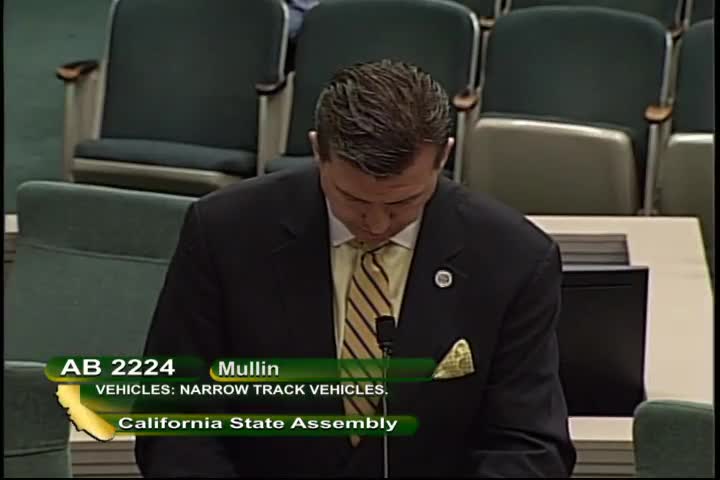 8MIN
Assembly Standing Committee on Transportation
Bill Author

Bill Co-Author(s):