AB 3079: Transportation Corridors Enhancement Account: project selection: California Port Efficiency Program.
- Session Year: 2017-2018
- House: Assembly
- Latest Version Date: 2018-04-17
Existing law creates the Trade Corridor Enhancement Account in the State Transportation Fund to receive revenues attributable to 50% of a $0.20 per gallon increase in the diesel fuel excise tax imposed by the Road Repair and Accountability Act of 2017 for corridor-based freight projects nominated by local agencies and the state. Existing law makes these funds and certain federal funds apportioned to the state available upon appropriation for allocation by the California Transportation Commission for trade infrastructure improvement projects that meet specified requirements. Existing law requires the commission to allocate 60% of available funds to projects nominated by regional transportation agencies and other local agencies, with the remaining 40% of available funds to be allocated specified percentages of available funds to projects nominated by regional transportation agencies and the Department of Transportation. In adopting a program of projects, existing law requires the commission to prioritize projects jointly nominated and jointly funded by the state and local agencies.
This bill would require the commission to allocate not less than 10% of the funds that are required to be allocated to projects nominated by the department to projects nominated pursuant to the California Port Efficiency Program, which this bill would create. create the California Port Efficiency Program to fund projects that improve velocity, throughput, and reliability of port operations, as defined. The program would require the department to nominate select projects proposed by port authorities and regional transportation agencies that most effectively improve velocity, throughput, and reliability of port operations.
Existing law creates the Trade Corridor Enhancement Account to receive revenues attributable to 50% of a $0.20 per gallon increase in the diesel fuel excise tax imposed by the Road Repair and Accountability Act of 2017 for corridor-based freight projects nominated by local agencies and the state. Existing law makes these funds and certain federal funds apportioned to the state available upon appropriation for allocation by the California Transportation Commission for trade infrastructure improvement projects that meet specified requirements. Existing law requires the commission to allocate 60% of available funds to projects nominated by regional transportation agencies and other local agencies, with the remaining 40% of available funds to be allocated to projects nominated by the Department of Transportation. In adopting a program of projects, existing law requires the commission to prioritize projects jointly nominated and jointly funded by the state and local agencies.
This bill would require the commission to allocate not less than 10% of the funds that are required to be allocated to projects nominated by the department to projects nominated pursuant to the California Port Efficiency Program, which this bill would create. The program would require the department to nominate projects proposed by port authorities and regional transportation agencies that most effectively improve velocity, throughput, and reliability of port operations.
Existing law provides for the formation of post districts and prescribes procedures for the formation and operation of those districts. Under existing law, a post district is governed by a board of port commissioners, comprised as specified. This bill would declare the intent of the Legislature to enact legislation relating to public ports in California.Existing law provides for the formation of post districts and prescribes procedures for the formation and operation of those districts. Under existing law, a post district is governed by a board of port commissioners, comprised as specified.
This bill would declare the intent of the Legislature to enact legislation relating to public ports in California.
(a)The California Port Efficiency Program is hereby created to establish a process to nominate projects for purposes of clause (ii) of subparagraph (B) of paragraph (1) of subdivision (e) of Section 2192. fund projects that improve velocity, throughput, and reliability of port operations, as defined in subdivision (g) of Section 2192. The department shall select projects for nomination from projects proposed by eligible applicants described in subdivision (c) that most effectively improve velocity, throughput, and reliability of port operations.
(b)Projects eligible for nomination selection pursuant to this section include, but are not limited to, the following:
(1)Deployment of digital industrial infrastructure to facilitate and streamline the exchange of data between supply chain participants.
(2)Projects designed to reduce truck visit times including, but not limited to, appointment systems and truck parking facilities.
(c)Only a regional transportation agency or port authority may propose a project for nomination for selection to the department pursuant to this section.
(d)Projects nominated proposed pursuant to this section shall comply with the requirements set forth in Section 2192.
(a)The following revenues shall be allocated for infrastructure projects pursuant to this section:
(1)The revenues deposited in the Trade Corridors Enhancement Account pursuant to Section 2192.4, except for those revenues in the account that were appropriated by Senate Bill 132 of the 201718 Regular Session (Chapter 7 of the Statutes of 2017).
(2)An amount of federal funds equal to the amount of revenue apportioned to the state under Section 167 of Title 23 of the United States Code from the national highway freight programs, pursuant to the federal Fixing Americas Surface Transportation Act (FAST Act, Public Law 114-94).
(b)The funding described in subdivision (a) shall be available upon appropriation for allocation by the California Transportation Commission for infrastructure improvements in this state on federally designated Trade Corridors of National and Regional Significance, on the Primary Freight Network, and along other corridors that have a high volume of freight movement, as determined by the commission and as identified in the state freight plan developed pursuant to Section 13978.8 of the Government Code. Projects eligible for funding shall be included in an adopted regional transportation plan. Projects within the boundaries of a metropolitan planning organization shall be included in an adopted regional transportation plan that includes a sustainable communities strategy determined by the State Air Resources Board to achieve the regions greenhouse gas emissions reduction targets. In developing guidelines for implementing this section, the commission shall (1) apply the guiding principles, to the maximum extent practicable, in the California Sustainable Freight Action Plan released in July 2016 pursuant to Executive Order B-32-15, and (2) consult the state freight plan and the applicable port master plan.
(c)Eligible projects for these funds include, but are not limited to, all of the following:
(1)Highway improvements to more efficiently accommodate the movement of freight, particularly for ingress and egress to and from the states land ports of entry, rail terminals, and seaports, including navigable inland waterways used to transport freight between seaports, land ports of entry, and airports, and to relieve traffic congestion along major trade or goods movement corridors.
(2)Freight rail system improvements to enhance the ability to move goods from seaports, land ports of entry, and airports to warehousing and distribution centers throughout California, including projects that separate rail lines from highway or local road traffic, improve freight rail mobility, and other projects that improve the safety, efficiency, and capacity of the rail freight system.
(3)Projects to enhance the capacity and efficiency of ports, except that funds available under this section shall not be allocated to a project that includes the purchase of fully automated cargo handling equipment. For the purposes of this paragraph, fully automated means equipment that is remotely operated or remotely monitored, with or without the exercise of human intervention or control. Nothing in this paragraph shall prohibit the use of funds available pursuant to this section for a project that includes the purchase of human-operated zero-emission equipment, human-operated near-zero-emission equipment, and infrastructure supporting that human-operated equipment. Furthermore, nothing in this section shall prohibit the purchase of devices that support that human-operated equipment, including equipment to evaluate the utilization and environmental benefits of that human-operated equipment.
(4)Truck corridor improvements, including dedicated truck facilities or truck toll facilities, including the mitigation of the emissions from trucks or these facilities.
(5)Border access improvements that enhance goods movement between California and Mexico and that maximize the states ability to access funds made available to the state by federal law.
(6)Surface transportation, local road, and connector road improvements to effectively facilitate the movement of goods, particularly for ingress and egress to and from the states land ports of entry, airports, and seaports, to relieve traffic congestion along major trade or goods movement corridors.
(d)Projects funded with revenues identified in paragraph (1) of subdivision (a) shall be consistent with Article XIX of the California Constitution.
(e)(1)In adopting the program of projects to be funded with funds described in subdivision (a), the commission shall evaluate the total potential economic and noneconomic benefits of the program of projects to Californias economy, environment, and public health. The evaluation shall specifically assess localized impacts in disadvantaged communities. The commission shall consult with the agencies identified in Executive Order B-32-15 and metropolitan planning organizations in order to utilize the appropriate models, techniques, and methods to develop the parameters for evaluating the program of projects. The commission shall allocate the funding from subdivision (a) for trade infrastructure improvements as follows:
(A)Sixty percent of the funds shall be available for projects nominated by regional transportation agencies and other public agencies, including counties, cities, and port authorities, in consultation with the department. The commission shall provide reasonable geographic targets for funding allocations without constraining what an agency may propose or what the commission may approve.
(B)(i)Forty percent of the funds shall be available for projects nominated by the department, in consultation with regional transportation agencies.
(ii)Of the amount allocated pursuant to this subparagraph, not less than 10 percent of these funds shall be available for projects nominated by the department pursuant to Section 2192.5.
(2)In adopting a program of projects pursuant to paragraph (1), the commission shall prioritize projects jointly nominated and jointly funded by the state and local agencies. In considering geographic balance for the overall program, the commission may adjust the corridor-based targets in subparagraph (A) of paragraph (1) to account for projects programmed pursuant to subparagraph (B) of paragraph (1).
(f)(1)The commission shall adopt guidelines, including a transparent process to evaluate projects and to allocate the funding described in subdivision (a) for trade infrastructure improvements in a manner that (1) addresses the states most urgent needs, (2) balances the demands of various land ports of entry, seaports, and airports, (3) places emphasis on projects that improve trade corridor mobility and safety while reducing emissions of diesel particulates, greenhouse gases, and other pollutants and reducing other negative community impacts, especially in disadvantaged communities, (4) makes a significant contribution to the states economy, (5) recognizes the key role of the state in project identification, (6) supports integrating statewide goods movement priorities in a corridor approach, and (7) includes disadvantaged communities measures, as established by the California Environmental Protection Agency pursuant to Section 39711 of the Health and Safety Code, and other tools the commission determines, for evaluating benefits or costs for disadvantaged communities and low-income communities. Project nominations shall include either a quantitative or qualitative assessment of the benefits the project is expected to achieve relative to the evaluation criteria.
(2)The guidelines adopted pursuant to paragraph (1) may include streamlining of project delivery by authorizing regional transportation agencies and other public agencies to seek commission approval of a letter of no prejudice that allows the agency to expend its own funds for a project programmed in a future year of the adopted program of projects, in advance of allocation of funds to the project by the commission, and to be reimbursed at a later time for eligible expenditures. A letter of no prejudice shall only be available to local or regional transportation agencies for moneys that have been identified for future allocation to the applicant agency. Moneys designated for the program shall only be reimbursed when there is funding available in an amount sufficient to make the reimbursement.
(g)In addition, the commission shall also consider the following factors when allocating these funds:
(1)Velocity, which means the speed by which large cargo would travel from the land port of entry or seaport through the distribution system.
(2)Throughput, which means the volume of cargo that would move from the land port of entry or seaport through the distribution system.
(3)Reliability, which means a reasonably consistent and predictable amount of time for cargo to travel from one point to another on any given day or at any given time in California.
(4)Congestion reduction, which means the reduction in recurrent daily hours of delay to be achieved.
(h)For purposes of this section, the following terms have the following meanings:
(1)Disadvantaged communities are those communities identified by the California Environmental Protection Agency pursuant to Section 39711 of the Health and Safety Code.
(2)Low-income communities are census tracts with median household incomes at or below 80 percent of the statewide median income or with median household incomes at or below the threshold designated as low income by the Department of Housing and Community Developments list of state income limits adopted pursuant to Section 50093 of the Health and Safety Code.
(i)It is the intent of the Legislature for the commission to adopt an initial program of projects utilizing the state and federal funds described in subdivision (a) for eligible projects as soon as practicable and no later than May 17, 2018.
SEC. 2.Section 2192.5 is added to the Streets and Highways Code, to read:2192.5.(a)The California Port Efficiency Program is hereby created to establish a process to nominate projects for purposes of clause (ii) of subparagraph (B) of paragraph (1) of subdivision (e) of Section 2192. The department shall select projects for nomination from projects proposed by eligible applicants described in subdivision (c) that most effectively improve velocity, throughput, and reliability of port operations.
(b)Projects eligible for nomination pursuant to this section include, but are not limited to, the following:
(1)Deployment of digital industrial infrastructure to facilitate and streamline the exchange of data between supply chain participants.
(2)Projects designed to reduce truck visit times including, but not limited to, appointment systems and truck parking facilities.
(c)Only a regional transportation agency or port authority may propose a project for nomination to the department pursuant to this section.
(d)Projects nominated pursuant to this section shall comply with the requirements set forth in Section 2192.
SECTION 1.It is the intent of the Legislature to enact legislation relating to public ports in California.It is the intent of the Legislature to enact legislation relating to public ports in California.
|
Date
|
Status
|
|---|---|
| May 25, 2018 | In committee: Held under submission. |
| May 9, 2018 | In committee: Set, first hearing. Referred to APPR. suspense file. |
| Apr 24, 2018 | From committee: Do pass and re-refer to Com. on APPR. (Ayes 14. Noes 0.) (April 23). Re-referred to Com. on APPR. |
| Apr 18, 2018 | Re-referred to Com. on TRANS. |
| Apr 17, 2018 | From committee chair, with author's amendments: Amend, and re-refer to Com. on TRANS. Read second time and amended. |
| Apr 2, 2018 | Re-referred to Com. on TRANS. |
| Mar 22, 2018 | Referred to Com. on TRANS. |
| Feb 17, 2018 | From printer. May be heard in committee March 19. |
| Feb 16, 2018 | Read first time. To print. |
|
Date
|
Description
|
Location
|
Votes
|
|
|---|---|---|---|---|
| Apr 23, 2018 | Do pass and be re-referred to the Committee on [Appropriations] | Assembly Standing Committee on Transportation |
Passed |
This list shows positions taken on this bill by organizations on the date displayed, which is linked to the original source.
Positions by individuals are not included.
|
Organization
|
Position
|
Date
|
|---|---|---|
| California Trucking Association | * Support | Apr 23, 2018 |
| Port of Los Angeles | * Indeterminate | Apr 23, 2018 |
Date of Hearing: May 9, 2018
ASSEMBLY COMMITTEE ON APPROPRIATIONS
Lorena Gonzalez Fletcher, Chair
ABPCA Bill Id:AB 3079
Author:(O'Donnell) – As Amended Ver:April 17, 2018
Policy Committee: | Transportation | Vote: | 14 - 0 |
Urgency: No State Mandated Local Program: No Reimbursable: No
SUMMARY:
This bill creates the California Port Efficiency Program (CPEP) within the California Department of Transportation (Caltrans) and defines eligible projects for the program. Specifically, this bill:
- Creates the CPEP to fund projects that improve velocity, throughput, and reliability of port operations, as defined.
- Requires Caltrans to select projects for the CPEP that most effectively result in the program’s objectives.
- Defines eligible projects for the CPEP to include, but not be limited to:
- Deployment of digital industrial infrastructure to facilitate and streamline the exchange of data between supply chain participants.
- Projects designed to reduce truck visit times including, but not limited to, appointment systems and truck parking facilities.
- Restricts eligible applicants to regional transportation agencies or port authorities.
- Requires projects proposed for the CPEP to comply with the requirements for the Trade Corridor Enhancement Program.
FISCAL EFFECT:
- GF cost pressure in the millions to tens of millions of dollars annually to fund port improvement projects.
- GF costs to Caltrans in the range of several hundreds of thousands of dollars annually to administer the program.
COMMENTS:
- Background. In 2006, voters approved Proposition 1B authorizing the state to sell $20 billion in general obligation bonds, including $2 billion in onetime funding for trade corridor projects. The Proposition 1B funds have been fully allocated to various goods movement corridor projects throughout the state. SB 1 (Beall), Chapter 5, Statutes of 2017, establishes the Trade Corridor Enhancement Program (TCEP) as an ongoing program to fund goods movement and freight-related projects. SB1 allocates $300 million annually to TCEP.
- Purpose. The author states that, in order for ports to successfully engage in the global marketplace, prepare for an expected surge in cargo, and meet sustainability goals, they will need new ways to achieve efficiencies that speed their operations and the flow of cargo. The author contends that while ports have undergone modernization over the last several years, and will continue to do so, the state must prioritize and advance projects that strategically improve the efficiency and overall performance of California ports. The author intends this bill to provide the framework necessary for the state to partner with ports and deliver the resources needed for strategic improvements in port efficiency.
Analysis Prepared by: Jessica Peters / APPR. / (916) 319-2081
Date of Hearing: April 23, 2018
ASSEMBLY COMMITTEE ON TRANSPORTATION
Jim Frazier, Chair
ABPCA Bill Id:AB 3079 (
Author:O'Donnell) – As Amended Ver:April 17, 2018
SUBJECT: California Port Efficiency Program
SUMMARY: Creates the California Port Efficiency Program (CPEP) and defines eligible projects for the program. Specifically, this bill:
- Creates the CPEP to fund projects that improve velocity, throughput, and reliability of port operations, as defined.
- Requires the California Department of Transportation (Caltrans) to select projects for the CPEP that most effectively result in the program’s objectives.
- Defines eligible projects for the CPEP to include, but not be limited to:
- Deployment of digital industrial infrastructure to facilitate and streamline the exchange of data between supply chain participants; and,
- Projects designed to reduce truck visit times including, but not limited to, appointment systems and truck parking facilities.
- Restricts eligible applicants to regional transportation agencies or port authorities.
- Requires projects proposed for the CPEP to comply with the requirements for the Trade Corridor Enhancement Program.
EXISTING LAW:
- Enacts Proposition 1B, the Highway Safety, Traffic Reduction, Air Quality, and Port Security Bond Act of 2006. This bond act authorized $2 billion for the Trade Corridor Improvement Fund (TCIF) Program, administered by the California Transportation Commission (CTC).
- Combines existing federal and state freight funding for CTC to administer the Trade Corridor Enhancement Program in order to fund trade corridor improvements consistent with various statutory requirements.
FISCAL EFFECT: Unknown
COMMENTS: The successful and efficient movement of goods around and through California is critical to the state’s economy. In fact, about one-third of California’s $2.2 trillion economy is made up of freight-dependent industries, and more than 5 million jobs are tied to these industries.
Further, California is the nation’s largest gateway for international trade and domestic commerce. Together, the Ports of Los Angeles and Long Beach facilitate the trade of 14.1 million containers annually, making the complex the fifth largest seaport in the world. Overall, California’s 11 public ports are integral to the success and dominance of the state’s freight system.
Despite their status as the strongest in the nation, California ports face a number of efficiency challenges, including increased trade volumes, the deployment of larger ships, and industry complexity. Specific impacts on port efficiency include: carriers’ increasing use of megaships on California port calls; inefficient infrastructure; inadequate intermodal connectors at various gateways; and poor communication among shippers, terminals, ocean carriers, and land transport companies.
Coupled with these challenges is the fact that ports in other states are fiercely fighting for California’s economic activity. The expanded Panama Canal now allows for larger vessels to pass through its channel, thereby giving high-volume Pacific shipments easier access to East Coast ports. Additionally, Southern California ports face greater pressure than any other port complex in the country to reduce health risks and GHG emissions, with state law aiming to reduce GHG emissions and improving air quality. Given these state directives, the mayors of the ports’ respective cities have pledged to move toward a goal of zero and near-zero emissions, increasing the cost of doing business with the ports.
Recognizing the importance of goods movement to California, the Legislature has taken a number of steps to facilitate freight corridor development. For example in 2006, as part of Proposition 1B, the Legislature dedicated $2 billion to the TCIF, a program funding infrastructure improvements along federally designated "Trade Corridors of National Significance" and other corridors within the state that have a high volume of freight movement. In SB 1 (Beall), Chapter 5, Statutes of 2017, the Legislature dedicated $300 million per year to a new program called the Trade Corridor Enhancement Program in order to fund trade corridor improvements.
The author states that, in order for ports to successfully engage in the global marketplace, prepare for the expected surge in cargo, and meet sustainability goals, they will need new ways to achieve efficiencies that speed their operations and the flow of cargo. While ports have undergone modernization over the last several years, and will continue to do so, the state must prioritize and advance projects that strategically improve the efficiency and overall performance of California ports. This bill provides the framework necessary for the state to partner with ports and deliver the resources needed for strategic improvements in port efficiency.
Committee Comment: This bill creates a new program specifically dedicated to improving the efficiency of the state’s port operations; the CPEP focuses on improving the port’s throughput and reliability of cargo movement. While these types of projects are generally eligible for various state freight programs, this niche issue may not always compete well against large, transformative infrastructure projects. Projects involving freight movement such as cargo data sharing and truck scheduling could have profound efficiency and air quality impacts, and therefore creating a focused program for these types of projects seems like a reasonable proposal.
Prior Legislation: SB 103 (Senate Budget and Fiscal Review), Chapter 103, Statutes of 2017, created the Trade Corridor Enhancement Program to fund freight transportation infrastructure projects.
AB 531 (O’Donnell) of 2015, would have established the Southern California Port Joint Powers Authority with the power to plan, develop, and implement projects and measures necessary to alleviate congestion in the Ports of Los Angeles and Long Beach. AB 531 was referred to the Senate Transportation and Housing Committee but was not heard at the request of the author.
AB 2041 (Lowenthal) of 2004, would have established the Port Congestion Management District and authorized the board to collect fees on commercial vehicles operating in the Ports of Los Angeles and Long Beach between 8:00 a.m. and 5:00 p.m., Monday through Friday. AB 2041 was held on the Senate Appropriations Committee suspense file.
REGISTERED SUPPORT / OPPOSITION:
Support
California Trucking Association
Opposition
None on file
Analysis Prepared by: Eric Thronson / TRANS. / (916) 319-2093
Discussed in Hearing
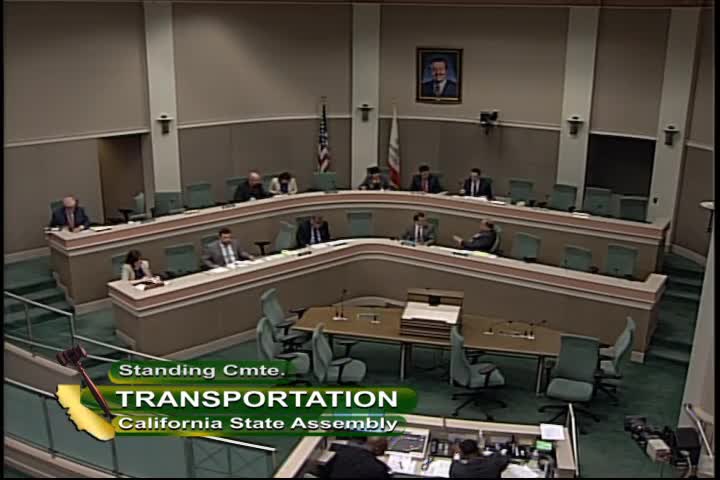 5MIN
Assembly Standing Committee on Transportation
Bill Author

Bill Co-Author(s):