AB 65: Transportation bond debt service.
- Session Year: 2017-2018
- House: Assembly
- Latest Version Date: 2018-01-03
Existing law imposes weight fees on the registration of commercial motor vehicles and provides for the deposit of net weight fee revenues into the State Highway Account. Existing law provides for the monthly transfer of certain weight fee revenues from the State Highway Account to the Transportation Debt Service Fund to reimburse the General Fund for payment of debt service on general obligation bonds issued for transportation purposes or to redeem or retire those bonds. Existing law also provides for the transfer of certain weight fee revenues to the Transportation Bond Direct Payment Account for direct payment of debt service on designated bonds, which are defined to be certain transportation general obligation bonds issued pursuant to Proposition 1B of 2006. Existing law also requires loans of remaining weight fee revenues to the General Fund in any fiscal year to the extent the revenues are not needed for bond debt service purposes or to redeem or retire those bonds, with the loans to be repaid when the revenues are later needed for those bond debt service purposes.
This bill would delete the requirement to loan any remaining weight fee revenues to the General Fund in a fiscal year in which all of the weight fee revenues are not needed for payment of debt service on general obligation bonds issued for transportation purposes, or to redeem or retire those bonds.
Existing law provides for transfer of certain vehicle weight fee revenues to the Transportation Debt Service Fund to reimburse the General Fund for payment of current year debt service on general obligation bonds issued for transportation purposes, including bonds issued for high-speed rail and associated purposes pursuant to the Safe, Reliable High-Speed Passenger Train Bond Act for the 21st Century (Proposition 1A of 2008).
This bill would specifically exclude from payment under these provisions the debt service for Proposition 1A bonds.
(a)(1)The Transportation Debt Service Fund is hereby created in the State Treasury. Moneys in the fund shall be dedicated to all of the following purposes:
(A)Payment of debt service with respect to designated bonds, as defined in subdivision (c) of Section 16773, and as further provided in paragraph (3) and subdivision (b).
(B)To reimburse the General Fund for debt service with respect to bonds.
(C)To redeem or retire bonds, pursuant to Section 16774, maturing in a subsequent fiscal year.
(2)The bonds eligible under subparagraph (B) or (C) of paragraph (1) include bonds issued pursuant to the Clean Air and Transportation Improvement Act of 1990 (Part 11.5 (commencing with Section 99600) of Division 10 of the Public Utilities Code), the Passenger Rail and Clean Air Bond Act of 1990 (Chapter 17 (commencing with Section 2701) of Division 3 of the Streets and Highways Code), and the Seismic Retrofit Bond Act of 1996 (Chapter 12.48 (commencing with Section 8879) of Division 1 of Title 2), and nondesignated bonds under Proposition 1B, as defined in subdivision (c) of Section 16773.
(3)(A)The Transportation Bond Direct Payment Account is hereby created in the State Treasury, as a subaccount within the Transportation Debt Service Fund, for the purpose of directly paying the debt service, as defined in paragraph (4), of designated bonds of Proposition 1B, as defined in subdivision (c) of Section 16773. Notwithstanding Section 13340, moneys in the Transportation Bond Direct Payment Account are continuously appropriated for payment of debt service with respect to designated bonds as provided in subdivision (c) of Section 16773. So long as any designated bonds remain outstanding, the moneys in the Transportation Bond Direct Payment Account may not be used for any other purpose, and may not be borrowed by or available for transfer to the General Fund pursuant to Section 16310 or any similar law, or to the General Cash Revolving Fund pursuant to Section 16381 or any similar law.
(B)Once the Treasurer makes a certification that payment of debt service with respect to all designated bonds has been paid or provided for, any remaining moneys in the Transportation Bond Direct Payment Account shall be transferred back to the Transportation Debt Service Fund.
(C)The moneys in the Transportation Bond Direct Payment Account shall be invested in the Surplus Money Investment Fund, and all investment earnings shall accrue to the account.
(D)The Controller may establish subaccounts within the Transportation Bond Direct Payment Account as may be required by the resolution, indenture, or other documents governing any designated bonds.
(4)For purposes of this subdivision and subdivision (b), and subdivision (c) of Section 16773, debt service means payment of all of the following costs and expenses with respect to any designated bond:
(A)The principal of and interest on the bonds.
(B)Amounts payable as the result of tender on any bonds, as described in clause (iv) of subparagraph (B) of paragraph (1) of subdivision (d) of Section 16731.
(C)Amounts payable under any contractual obligation of the state to repay advances and pay interest thereon under a credit enhancement or liquidity agreement as described in clause (iv) of subparagraph (B) of paragraph (1) of subdivision (d) of Section 16731.
(D)Any amount owed by the state to a counterparty after any offset for payments owed to the state on any hedging contract as described in subparagraph (A) of paragraph (2) of subdivision (d) of Section 16731.
(b)From the moneys transferred to the fund pursuant to paragraph (2) or (3) of subdivision (c) of Section 9400.4 of the Vehicle Code, there shall first be deposited into the Transportation Bond Direct Payment Account in each month sufficient funds to equal the amount designated in a certificate submitted by the Treasurer to the Controller and the Director of Finance at the start of each fiscal year, and as may be modified by the Treasurer thereafter upon issuance of any new issue of designated bonds or upon change in circumstances that requires such a modification. This certificate shall be calculated by the Treasurer to identify, for each month, the amount necessary to fund all of the debt service with respect to all designated bonds. This calculation shall be done in a manner provided in the resolution, indenture, or other documents governing the designated bonds. In the event that transfers to the Transportation Bond Direct Payment Account in any month are less than the amounts required in the Treasurers certificate, the shortfall shall carry over to be part of the required payment in the succeeding month or months.
(c)The state hereby covenants with the holders from time to time of any designated bonds that it will not alter, amend, or restrict the provisions of subdivision (c) of Section 16773 of the Government Code, or Sections 9400, 9400.1, 9400.4, and 42205 of the Vehicle Code, which provide directly or indirectly for the transfer of weight fees to the Transportation Debt Service Fund or the Transportation Bond Direct Payment Account, or subdivisions (a) and (b) of this section, or reduce the rate of imposition of vehicle weight fees under Sections 9400 and 9400.1 of the Vehicle Code as they existed on the date of the first issuance of any designated bonds, if that alteration, amendment, restriction, or reduction would result in projected weight fees for the next fiscal year determined by the Director of Finance being less than two times the maximum annual debt service with respect to all outstanding designated bonds, as such calculation is determined pursuant to the resolution, indenture, or other documents governing the designated bonds. The state may include this covenant in the resolution, indenture, or other documents governing the designated bonds.
(d)Once the required monthly deposit, including makeup of any shortfalls from any prior month, has been made pursuant to subdivision (b), from moneys transferred to the fund pursuant to paragraph (2) or (3) of subdivision (c) of Section 9400.4 of the Vehicle Code, or pursuant to Section 16965.1 or 63048.67, 16965.1, the Controller shall transfer as an expenditure reduction to the General Fund any amount necessary to offset the cost of current year debt service payments made from the General Fund with respect to any bonds issued pursuant to Proposition 192 (1996) and three-quarters of the amount of current year debt service payments made from the General Fund with respect to any nondesignated bonds, as defined in subdivision (c) of Section 16773, issued pursuant to Proposition 1B (2006). In the alternative, these funds may also be used to redeem or retire the applicable bonds, pursuant to Section 16774, maturing in a subsequent fiscal year as directed by the Director of Finance.
(e)From moneys transferred to the fund pursuant to Section 183.1 of the Streets and Highways Code, the Controller shall transfer as an expenditure reduction to the General Fund any amount necessary to offset the cost of current year debt service payments made from the General Fund with respect to any bonds issued pursuant to Proposition 116 (1990). In the alternative, these funds may also be used to redeem or retire the applicable bonds, pursuant to Section 16774, maturing in a subsequent fiscal year as directed by the Director of Finance.
(f)Once the required monthly deposit, including makeup of any shortfalls from any prior month, has been made pursuant to subdivision (b), from moneys transferred to the fund pursuant to paragraph (2) or (3) of subdivision (c) of Section 9400.4 of the Vehicle Code, or pursuant to Section 16965.1 or 63048.67, 16965.1, the Controller shall transfer as an expenditure reduction to the General Fund any amount necessary to offset the eligible cost of current year debt service payments made from the General Fund with respect to any bonds issued pursuant to Proposition 108 (1990) and one-quarter of the amount of current year debt service payments made from the General Fund with respect to any nondesignated bonds, as defined in subdivision (c) of Section 16773, issued pursuant to Proposition 1B (2006). The Department of Finance shall notify the Controller by July 30 of every year of the percentage of debt service that is expected to be paid in that fiscal year with respect to bond-funded projects that qualify as eligible guideway projects consistent with the requirements applicable to the expenditure of revenues under Article XIX of the California Constitution, and the Controller shall make payments only for those eligible projects. In the alternative, these funds may also be used to redeem or retire the applicable bonds, pursuant to Section 16774, maturing in a subsequent fiscal year as directed by the Director of Finance.
(g)On or before the second business day following the date on which transfers are made to the Transportation Debt Service Fund, and after the required monthly deposits for that month, including makeup of any shortfalls from any prior month, have been made to the Transportation Bond Direct Payment Account, the Controller shall transfer the funds designated for reimbursement of bond debt service with respect to nondesignated bonds, as defined in subdivision (c) of Section 16773, and other bonds identified in subdivisions (d), (e), and (f) in that month from the fund to the General Fund pursuant to this section.
SEC. 2.Section 9400.4 of the Vehicle Code is amended to read:9400.4.Weight fee revenue deposited into the State Highway Account pursuant to subdivision (e) of Section 9400.1 and subdivision (a) of Section 42205 net of amounts appropriated for other purposes pursuant to subdivision (b) of Section 42205, and weight fee revenues deposited directly into the Transportation Debt Service Fund pursuant to subdivision (e) of Section 9400.1 and subdivision (a) of Section 42205, as applicable, shall be used as follows:
(a)For the 201011 fiscal year, seven hundred fifty-six million three hundred ninety-six thousand dollars ($756,396,000) is hereby appropriated from weight fee revenues in the State Highway Account for transfer to the General Fund as transportation bond debt service reimbursement and loans as follows:
(1)The Controller shall transfer all weight fee revenues deposited into the State Highway Account in any month to the Transportation Debt Service Fund for transfer to the General Fund as reimbursement for debt service costs until all of the debt service paid on transportation bonds for projects that the Director of Finance indicates qualify for reimbursement as provided for in Section 16965 of the Government Code have been reimbursed.
(2)After the Director of Finance has notified the Controller that all debt service costs for the 201011 fiscal year have been reimbursed, the Controller shall transfer any remaining monthly weight fee revenues in the State Highway Account to the General Fund as a loan until the full amount appropriated in this subdivision has been transferred to the General Fund. The Director of Finance may repay any remaining portion of the outstanding balance of this loan in any year in which the Director of Finance determines the funds are needed to reimburse the General Fund for current year transportation bond debt service or to redeem or retire those bonds, pursuant to Section 16774 of the Government Code, maturing in a subsequent fiscal year, provided that the loans shall be repaid no later than June 30, 2021. All funds loaned pursuant to this section, upon repayment to the State Highway Account, shall be immediately transferred by the Controller to the Transportation Debt Service Fund for use pursuant to Section 16965 of the Government Code.
(3)By June 15, 2011, the Director of Finance in consultation with the Treasurer shall notify the Controller regarding the final amount of debt service paid from the General Fund during the 201011 fiscal year pursuant to Section 16965 of the Government Code and shall direct the Controller to reverse and adjust any transfers made as debt service reimbursements or loans so that a maximum amount of transfers are made for debt service reimbursements and with any loan amounts limited to the difference between this amount and the total amount appropriated in this subdivision. The total amount of weight fee revenues transferred from the State Highway Account for the 201011 fiscal year shall not be greater than the total amount of weight fee revenues deposited into the State Highway Account for that year.
(4)With respect to transfers or portions of transfers that cannot be made in any given month if weight fee revenues are insufficient, the first weight fee revenues available in the following month or months shall be used to complete the transfers for the previous month or months prior to making additional transfers for later months.
(b)For the 201112 fiscal year, all revenue generated from weight fees in the State Highway Account, as determined by Sections 9400.1 and 42205, excluding an amount equal to the loan of forty-three million seven hundred thousand dollars ($43,700,000) authorized pursuant to Item 2660-013-0042 of Section 2.00 of the Budget Act of 2011, is hereby appropriated for transfer to the General Fund as debt service reimbursement and loans as follows:
(1)The Controller shall transfer all weight fee revenues deposited into the State Highway Account in any month to the Transportation Debt Service Fund for transfer to the General Fund as reimbursement for debt service costs until all of the debt service paid on transportation bonds for projects that the Director of Finance indicates qualify for reimbursement as provided for in Section 16965 of the Government Code have been reimbursed.
(2)After the Director of Finance has notified the Controller that all debt service costs for the 201112 fiscal year have been reimbursed, the Controller shall transfer any remaining weight fee revenues for that fiscal year in the State Highway Account to the General Fund as a loan until all weight fee revenues for that fiscal year appropriated in this subdivision have been transferred to the General Fund, excluding forty-two million dollars ($42,000,000), which shall be transferred to the General Fund as a loan on July 1, 2012. The Director of Finance may repay any portion of the balance of this loan in any year in which the Director of Finance determines the funds are needed to reimburse the General Fund for current year transportation bond debt service or to redeem or retire those bonds, pursuant to Section 16774 of the Government Code, maturing in a subsequent year, provided that the loans shall be repaid no later than June 30, 2021. All funds loaned pursuant to this section, upon repayment to the State Highway Account, shall be immediately transferred by the Controller to the Transportation Debt Service Fund for use pursuant to Section 16965 of the Government Code.
(3)By June 15, 2012, the Director of Finance in consultation with the Treasurer shall notify the Controller regarding the final amount of debt service paid from the General Fund during the 201112 fiscal year pursuant to Section 16965 of the Government Code and shall direct the Controller to reverse and adjust any transfers made as debt service reimbursements or loans so that a maximum amount of transfers are made for debt service reimbursements and with any loan amounts limited to the difference between this amount and the total amount appropriated in this subdivision. The total amount of weight fee revenues transferred from the State Highway Account for the 201112 fiscal year shall not be greater than the total amount of weight fee revenues deposited into the State Highway Account in that year.
(4)With respect to transfers or portions of transfers that cannot be made in any given month if weight fee revenues are insufficient, the first weight fee revenues available in the following month or months shall be used to complete the transfers for the previous month or months prior to making additional transfers for later months.
(c)(1)(A)Until the month of first issuance of designated bonds as defined in subdivision (c) of Section 16773 of the Government Code, and at any time thereafter that a Treasurers certification pursuant to subparagraph (B) of paragraph (3) of subdivision (a) of Section 16965 of the Government Code applies, all weight fee revenues subject to this section in any month shall be transferred from the State Highway Account to the Transportation Debt Service Fund.
(B)Except as provided in paragraph (3), or when subparagraph (A) applies pursuant to a Treasurers certification, upon the first issuance of designated bonds, as defined in subdivision (c) of Section 16773 of the Government Code, starting in the month following that first issuance, all weight fee revenues received by the Controller from the first day through the 14th day of every month shall be transferred from the State Highway Account to the Transportation Debt Service Fund.
(C)All funds transferred pursuant to subparagraphs (A) and (B) are hereby appropriated for transfer to the General Fund by the Controller as reimbursement for debt service costs paid with respect to eligible bonds described in subparagraph (A) of paragraph (2) of subdivision (a) of Section 16965 of the Government Code, until all debt service that the Director of Finance indicates qualifies for reimbursement as provided for in subdivision (d), (e), or (f) of Section 16965 of the Government Code has been reimbursed, or to redeem or retire bonds, pursuant to Section 16774 of the Government Code, as referenced in subdivision (d), (e), or (f) of Section 16965 of the Government Code, that are maturing in a subsequent year. After the Director of Finance has notified the Controller that all debt service costs for the fiscal year have been reimbursed, the Controller shall transfer any remaining revenue generated from weight fees subject to this section for that fiscal year in the State Highway Account to the General Fund as a loan. The Director of Finance may repay any portion of the balance of this loan in any year in which the Director of Finance determines that the funds are needed to reimburse the General Fund for current year transportation bond debt service or to redeem or retire those bonds pursuant to Section 16774 of the Government Code, maturing in a future fiscal year, provided that the loans shall be repaid no later than June 30, 2021. All funds loaned pursuant to this section, upon repayment to the State Highway Account, shall be immediately transferred by the Controller to the Transportation Debt Service Fund for use pursuant to Section 16965 of the Government Code. By June 15 of each year, the Director of Finance, in consultation with the Treasurer, shall notify the Controller regarding the final amount of debt service paid from the General Fund during that fiscal year pursuant to subdivision (d), (e), or (f) of Section 16965 of the Government Code and shall direct the Controller to reverse or adjust any transfers made as debt service reimbursements or loans so that a maximum amount of transfers are made for debt service reimbursements and with any loan amounts limited to the difference between this amount and the total amount of revenue for that fiscal year generated from weight fees, as determined by Sections 9400.1 and 42205. Code. The total amount of weight fee revenues transferred from the State Highway Account in any fiscal year shall not be greater than the total amount of weight fee revenues deposited into the State Highway Account in that year.
(2)Starting in the month following the first issuance of any designated bonds, unless a Treasurers certification pursuant to subparagraph (B) of paragraph (3) of subdivision (a) of Section 16965 of the Government Code applies, all weight fee revenues subject to this section that are received by the Controller from the 15th day of every month, or the first business day thereafter if not a business day, through the last day of the month shall be deposited directly in the Transportation Debt Service Fund and are hereby appropriated for transfer as follows:
(A)First, to the Transportation Bond Direct Payment Account as set forth in subdivision (b) of Section 16965 of the Government Code, to provide for payment of debt service with respect to designated bonds.
(B)Thereafter, as provided in subparagraph (C) of paragraph (1).
(3)Notwithstanding paragraphs (1) and (2), if by the last day of a month the transfer for that month relating to designated bonds required by the Treasurers certificate described in subdivision (b) of Section 16965 of the Government Code has not been made due to insufficient weight fee revenue, weight fee revenue shall continue to be transferred pursuant to paragraph (2) beginning with the first day of the subsequent month and continuing every day until such time as sufficient revenue for full compliance with the certificate has been transferred.
(4)Except as otherwise provided in paragraph (1), (2), or (3), with respect to any transfers or portions of transfers that cannot be made in any given month if weight fee revenues are insufficient, the first weight fee revenues available in the following month or months shall be used to complete the transfers for the previous month or months prior to making additional transfers for later months.
(a)(1)The Transportation Debt Service Fund is hereby created in the State Treasury. Moneys in the fund shall be dedicated to all of the following purposes:
(A)Payment of debt service with respect to designated bonds, as defined in subdivision (c) of Section 16773, and as further provided in paragraph (3) and subdivision (b).
(B)To reimburse the General Fund for debt service with respect to bonds.
(C)To redeem or retire bonds, pursuant to Section 16774, maturing in a subsequent fiscal year.
(2)The bonds eligible under subparagraph (B) or (C) of paragraph (1) include bonds issued pursuant to the Clean Air and Transportation Improvement Act of 1990 (Part 11.5 (commencing with Section 99600) of Division 10 of the Public Utilities Code), the Passenger Rail and Clean Air Bond Act of 1990 (Chapter 17 (commencing with Section 2701) of Division 3 of the Streets and Highways Code), and the Seismic Retrofit Bond Act of 1996 (Chapter 12.48 (commencing with Section 8879) of Division 1 of Title 2), and the Safe, Reliable High-Speed Passenger Train Bond Act for the 21st Century (Chapter 20 (commencing with Section 2704) of Division 3 of the Streets and Highways Code), and nondesignated bonds under Proposition 1B, as defined in subdivision (c) of Section 16773.
(3)(A)The Transportation Bond Direct Payment Account is hereby created in the State Treasury, as a subaccount within the Transportation Debt Service Fund, for the purpose of directly paying the debt service, as defined in paragraph (4), of designated bonds of Proposition 1B, as defined in subdivision (c) of Section 16773. Notwithstanding Section 13340, moneys in the Transportation Bond Direct Payment Account are continuously appropriated for payment of debt service with respect to designated bonds as provided in subdivision (c) of Section 16773. So long as any designated bonds remain outstanding, the moneys in the Transportation Bond Direct Payment Account may not be used for any other purpose, and may not be borrowed by or available for transfer to the General Fund pursuant to Section 16310 or any similar law, or to the General Cash Revolving Fund pursuant to Section 16381 or any similar law.
(B)Once the Treasurer makes a certification that payment of debt service with respect to all designated bonds has been paid or provided for, any remaining moneys in the Transportation Bond Direct Payment Account shall be transferred back to the Transportation Debt Service Fund.
(C)The moneys in the Transportation Bond Direct Payment Account shall be invested in the Surplus Money Investment Fund, and all investment earnings shall accrue to the account.
(D)The Controller may establish subaccounts within the Transportation Bond Direct Payment Account as may be required by the resolution, indenture, or other documents governing any designated bonds.
(4)For purposes of this subdivision and subdivision (b), and subdivision (c) of Section 16773, debt service means payment of all of the following costs and expenses with respect to any designated bond:
(A)The principal of and interest on the bonds.
(B)Amounts payable as the result of tender on any bonds, as described in clause (iv) of subparagraph (B) of paragraph (1) of subdivision (d) of Section 16731.
(C)Amounts payable under any contractual obligation of the state to repay advances and pay interest thereon under a credit enhancement or liquidity agreement as described in clause (iv) of subparagraph (B) of paragraph (1) of subdivision (d) of Section 16731.
(D)Any amount owed by the state to a counterparty after any offset for payments owed to the state on any hedging contract as described in subparagraph (A) of paragraph (2) of subdivision (d) of Section 16731.
(b)From the moneys transferred to the fund pursuant to paragraph (2) or (3) of subdivision (c) of Section 9400.4 of the Vehicle Code, there shall first be deposited into the Transportation Bond Direct Payment Account in each month sufficient funds to equal the amount designated in a certificate submitted by the Treasurer to the Controller and the Director of Finance at the start of each fiscal year, and as may be modified by the Treasurer thereafter upon issuance of any new issue of designated bonds or upon change in circumstances that requires such a modification. This certificate shall be calculated by the Treasurer to identify, for each month, the amount necessary to fund all of the debt service with respect to all designated bonds. This calculation shall be done in a manner provided in the resolution, indenture, or other documents governing the designated bonds. In the event that transfers to the Transportation Bond Direct Payment Account in any month are less than the amounts required in the Treasurers certificate, the shortfall shall carry over to be part of the required payment in the succeeding month or months.
(c)The state hereby covenants with the holders from time to time of any designated bonds that it will not alter, amend, or restrict the provisions of subdivision (c) of Section 16773 of the Government Code, or Sections 9400, 9400.1, 9400.4, and 42205 of the Vehicle Code, which provide directly or indirectly for the transfer of weight fees to the Transportation Debt Service Fund or the Transportation Bond Direct Payment Account, or subdivisions (a) and (b) of this section, or reduce the rate of imposition of vehicle weight fees under Sections 9400 and 9400.1 of the Vehicle Code as they existed on the date of the first issuance of any designated bonds, if that alteration, amendment, restriction, or reduction would result in projected weight fees for the next fiscal year determined by the Director of Finance being less than two times the maximum annual debt service with respect to all outstanding designated bonds, as such calculation is determined pursuant to the resolution, indenture, or other documents governing the designated bonds. The state may include this covenant in the resolution, indenture, or other documents governing the designated bonds.
(d)Once the required monthly deposit, including makeup of any shortfalls from any prior month, has been made pursuant to subdivision (b), from moneys transferred to the fund pursuant to paragraph (2) or (3) of subdivision (c) of Section 9400.4 of the Vehicle Code, or pursuant to Section 16965.1 or 63048.67, the Controller shall transfer as an expenditure reduction to the General Fund any amount necessary to offset the cost of current year debt service payments made from the General Fund with respect to any bonds issued pursuant to Proposition 192 (1996) and three-quarters of the amount of current year debt service payments made from the General Fund with respect to any nondesignated bonds, as defined in subdivision (c) of Section 16773, issued pursuant to Proposition 1B (2006). In the alternative, these funds may also be used to redeem or retire the applicable bonds, pursuant to Section 16774, maturing in a subsequent fiscal year as directed by the Director of Finance.
(e)From moneys transferred to the fund pursuant to Section 183.1 of the Streets and Highways Code, the Controller shall transfer as an expenditure reduction to the General Fund any amount necessary to offset the cost of current year debt service payments made from the General Fund with respect to any bonds issued pursuant to Proposition 116 (1990). In the alternative, these funds may also be used to redeem or retire the applicable bonds, pursuant to Section 16774, maturing in a subsequent fiscal year as directed by the Director of Finance.
(f)Once the required monthly deposit, including makeup of any shortfalls from any prior month, has been made pursuant to subdivision (b), from moneys transferred to the fund pursuant to paragraph (2) or (3) of subdivision (c) of Section 9400.4 of the Vehicle Code, or pursuant to Section 16965.1 or 63048.67, the Controller shall transfer as an expenditure reduction to the General Fund any amount necessary to offset the eligible cost of current year debt service payments made from the General Fund with respect to any bonds issued pursuant to Proposition 108 (1990) and Proposition 1A (2008), and one-quarter of the amount of current year debt service payments made from the General Fund with respect to any nondesignated bonds, as defined in subdivision (c) of Section 16773, issued pursuant to Proposition 1B (2006). The Department of Finance shall notify the Controller by July 30 of every year of the percentage of debt service that is expected to be paid in that fiscal year with respect to bond-funded projects that qualify as eligible guideway projects consistent with the requirements applicable to the expenditure of revenues under Article XIX of the California Constitution, and the Controller shall make payments only for those eligible projects. In the alternative, these funds may also be used to redeem or retire the applicable bonds, pursuant to Section 16774, maturing in a subsequent fiscal year as directed by the Director of Finance.
(g)On or before the second business day following the date on which transfers are made to the Transportation Debt Service Fund, and after the required monthly deposits for that month, including makeup of any shortfalls from any prior month, have been made to the Transportation Bond Direct Payment Account, the Controller shall transfer the funds designated for reimbursement of bond debt service with respect to nondesignated bonds, as defined in subdivision (c) of Section 16773, and other bonds identified in subdivisions (d), (e), and (f) in that month from the fund to the General Fund pursuant to this section.
|
Date
|
Status
|
|---|---|
| Feb 1, 2018 | From committee: Filed with the Chief Clerk pursuant to Joint Rule 56. |
| Jan 31, 2018 | Died pursuant to Art. IV, Sec. 10(c) of the Constitution. |
| Jan 8, 2018 | In committee: Set, first hearing. Failed passage. |
| Jan 4, 2018 | Re-referred to Com. on TRANS. |
| Jan 3, 2018 | From committee chair, with author's amendments: Amend, and re-refer to Com. on TRANS. Read second time and amended. |
| Jan 19, 2017 | Referred to Com. on TRANS. |
| Jan 4, 2017 | Read first time. |
| Dec 14, 2016 | From printer. May be heard in committee January 13. |
| Dec 13, 2016 | Introduced. To print. |
|
Date
|
Description
|
Location
|
Votes
|
|
|---|---|---|---|---|
| Jan 8, 2018 | Do pass and be re-referred to the Committee on [Appropriations] | Assembly Standing Committee on Transportation |
Failed |
This list shows positions taken on this bill by organizations on the date displayed, which is linked to the original source.
Positions by individuals are not included.
|
Organization
|
Position
|
Date
|
|---|---|---|
| Association Of California High Speed Trains | * Against | Jan 8, 2018 |
| California Alliance for Jobs | * Against | Jan 8, 2018 |
| California Conference Of Machinists | * Against | Jan 8, 2018 |
| California Delivery Association | ** Support | Jan 5, 2018 |
| California Labor Federation Alliance | * Against | Jan 8, 2018 |
| Howard Jarvis Taxpayers Association | * Support | Jan 8, 2018 |
| Save Angeles Forest For Everyone | ** Support | Jan 5, 2018 |
| State Building & Construction Trades Council Of California | * Against | Jan 8, 2018 |
| State Building & Construction Trades Council Of California | * Support | Jan 8, 2018 |
Date of Hearing: January 8, 2018
ASSEMBLY COMMITTEE ON TRANSPORTATION
Jim Frazier, Chair
ABPCA Bill Id:AB 65 (
Author:Patterson) – As Amended Ver:January 3, 2018
SUBJECT: Transportation bond debt service
SUMMARY: Prohibits the payment of debt service on bonds issued for high-speed rail purposes, pursuant to the Safe, Reliable High-Speed Passenger Train Bond Act for the 21st Century (Proposition 1A of 2008), with truck weight fee revenues. Also deletes the loaning of excess weight fee revenues to the General Fund for future transportation debt service payments.
EXISTING LAW:
- Establishes the California High-Speed Rail Authority (Authority) and vests with it the responsibility to develop and implement a high-speed rail system in California.
- Authorizes the sale of $9 billion in general obligation bonds to partially fund the development and construction of California's high-speed rail system.
- Authorizes the expenditure of an additional $950 million in general obligation bonds for capital projects on other passenger rail lines to provide connectivity to the high-speed rail system as well as for capacity enhancements and safety improvements to those lines.
- Requires the Authority to complete and submit to the Legislature funding plans and financial analyses prior to requesting an appropriation of bond funds for eligible capital costs and prior to committing bond proceeds for expenditure for construction, real property and equipment acquisition.
- Appropriates $1.1 billion of the $9 billion in high-speed rail bonds for use on bookend projects, including projects in the San Francisco Bay Area (Caltrain), and the Los Angeles region.
FISCAL EFFECT: The estimate for Proposition 1A debt service is $313 million for the
2018-19 fiscal year. This debt service would have to be paid by the General Fund. Additionally, this bill would not allow loans of excess weight fees for payment of future debt service, which could require additional monies from the General Fund to cover yearly transportation debt service costs.
COMMENTS:
Background: In 2008, voters approved Proposition 1A, the Safe, Reliable, High-Speed Passenger Train Bond Act, a $9.95 billion general obligation bond to fund the proposed California high-speed rail project and related improvements. As envisioned at the time of the ballot measure, the project was to consist of an 800-mile dedicated high-speed passenger rail system capable of speeds up to 220 miles per hour, initially serving the major metropolitan market of San Francisco through the Central Valley into Los Angeles and Anaheim (Phase 1), with service eventually extended to Sacramento, the Inland Empire, and San Diego (Phase II).
When the bonds were approved in 2008, according to the Authority’s Business Plan, costs for the entire project were estimated to be $33 billion, to be paid by a mix of state bonds, federal grants, and private investments. The debt service on the $9.95 billion bond was estimated to be $650 million per year for 30 years. Since then, estimated costs for the project have risen markedly. The Authority's most recent business plan estimates costs for Phase 1 to be $64 billion using the blended approach of relying in part on existing tracks in the Bay Area and parts of Los Angeles. Furthermore, federal contributions to date are limited to $3.3 billion and there have been no private investments.
In 2012, the Legislature passed and Governor Brown signed into law SB 1029 (Committee on Budget and Fiscal Review), Chapter 152, Statutes of 2012, to appropriate $8 billion to the Authority ($4.7 billion in Proposition 1A state bond funds and $3.3 billion in federal funds) to initiate construction of the high-speed rail project. This amount included $1.1 billion of Proposition 1A bond funding for the bookend projects in the San Francisco Peninsula and the Los Angeles Basin.
In May 2016, the Authority approved the 2016 Business Plan which switched the focus of the Initial Operating Segment (IOS) from the Los Angeles Basin to Northern California with a terminus in San Jose. The business plan also adjusted the cost estimates for Phase I down from $68 billion to $64 billion.
Numerous court cases have been litigated related to the issuance of the Proposition 1A bonds, which has slowed the sale of the bonds for use on construction for both the Central Valley segment and the bookend projects. In January 2017, the Authority submitted funding plans to the Department of Finance and the Joint Legislative Budget Committee for the Central Valley segment, the first segment of high-speed rail, and the Caltrain electrification project, a bookend project in the San Francisco Bay Area. In June 2017, the Authority also submitted a funding plan for the Rosecrans – Marquardt rail grade separation project, a bookend project in the Los Angeles region. The so-called “funding plan (d),” is required by Proposition 1A prior to any expenditure of bond funds for capital construction and must contained specific elements, including details of funding for and construction cost projections for the segment.
Following the submission of the funding plans for the Central Valley and Caltrain, a lawsuit was immediately filed to block the issuance of the bonds citing that the funding plans did not meet the standards in Proposition 1A. Although the court denied a request for a temporary restraining order to stop the sale of Proportion 1A bonds, the court case is still pending.
To date, the state has sold roughly $2 billion in Proposition 1A bonds to fund the high speed rail and bookend projects, and over $600 million for connectivity projects. As mentioned, the Department of Finance estimates that the bond debt service for Proposition 1A bonds will be approximately $313 million in the 2018-19 fiscal year. As the remaining Proposition 1A bonds are appropriated and cleared of legal hurdles for sale by the state, the debt service costs will likely increase.
Gas Tax Swap and Debt Service: Currently, the debt on Proposition 1A bonds, and other transportation-related bonds, is being paid with weight fees in order to alleviate the responsibility of the General Fund to pay the debt service. The use of weight fees to pay this debt service is part of a larger budgetary and statutory arrangement referred to as the "Gas Tax Swap," (Swap). ABX8 6 (Committee on Budget), Chapter 11, Statutes of 2010, enacted the original Swap. ABX8 6 eliminated the sales tax on gasoline and replaced it with an increase in gasoline excise tax, called the Price Based Excise Tax (PBET), designed to generate an equivalent amount of revenue. The PBET was set at 17.3 cents per gallon at the time of passage and the Swap included a mechanism requiring the Board of Equalization (BOE), to adjust that amount annually to equal the amount that would have been generated by the sales tax on gasoline. The original Swap created a new, non-General Fund revenue stream from the PBET to repay the General Fund's cost of debt service on transportation bonds.
Later in 2010, voters approved Proposition 22, which further restricted the state’s use of certain state and local funds. Specifically, the proposition prohibits excise tax revenues from being used for General Fund relief, including paying debt service on transportation bonds. Additionally, in 2010, voters also approved Proposition 26, which required that any state tax increase approved by a majority vote in 2010 be subject to reenactment with a two-thirds vote.
As a result of these restrictions, the provisions of the newly-enacted Swap were in jeopardy. In response, the Legislature passed by a 2/3 vote and Governor Brown signed a reconstituted Swap, AB 105 (Committee on Budget), Chapter 6, Statutes of 2012. Under the reenacted swap, weight fee revenue, rather than excise tax revenue, is used to provide General Fund relief for debt service on transportation bonds, which is allowable under the State Constitution.
Additionally, a subsequent budget bill authorized the loaning or “banking” of weight fee revenue for future transportation debt service payments. In essence, if all weight fee revenue is not needed for debt service payments, the additional amount is loaned to the General Fund. The Department of Finance can then utilize these “banked” funds in future years when the weight fee revenue would not cover the full debt service amount. There is approximately $1.4 billion in weight fees “banked” as of the 2017-18 fiscal year.
This bill restricts the state from using weight fee revenues to pay for Proposition 1A debt service. This change results in General Fund revenues funding all future Proposition 1A bond debt service. Additionally, this bill would delete the ability to “bank” weight fee revenues to pay for future debt service. Therefore, if more weight fee revenue is collected than is needed for transportation debt service, the remaining weight fee revenue would be retained in the State Highway Account and distributed by the statutory formula for the PBET of 44% for the State Transportation Improvement Program (STIP), 44% for Local Streets and Roads, and 12% for the State Highway Operations Protection Program (SHOPP).
According to the author, “AB 65 seeks to prevent money intended for California’s deteriorating roads and highways from being siphoned away from roads to fund high-speed rail debt. There is a well-documented need for improvement on California’s roads, highways and infrastructure and the weight fee diversion exasperates the funding shortfall. Another funding diversion away from roads and highways will be devastating to California’s infrastructure.” He further states that, “April of this year marked the first sale of bonds being sold for construction purposes, … and, by beginning the sale and spending of Prop 1A funds under existing law, Californians will suffer even more by continuing the diversion of resources for infrastructure on our highways and roads by approximately $650 million per year for the next 30 years, the estimated cost from the ballot summary for principle and debt payments. Other than transportation, no other general obligation bonds are funded through special funds.”
Writing in opposition to the bill, The California Labor Federation states, “This bill is yet another effort to stop this historic public works project by removing a payment source for debt service on a bond approved by a majority of voters in this state. High-speed rail is the most cost efficient public investment option available to bring our transportation system into the modern era, similar to many other countries with economies such as California.”
REGISTERED SUPPORT / OPPOSITION:
(Letters submitted for the December 13, 2016 version of the bill)
Support
California Delivery Association
Howard Jarvis Taxpayers Association
Save Angeles Forest for Everyone
Opposition
California Labor Federation
Analysis Prepared by: Melissa White / TRANS. / (916) 319-2093
Discussed in Hearing
 15MIN
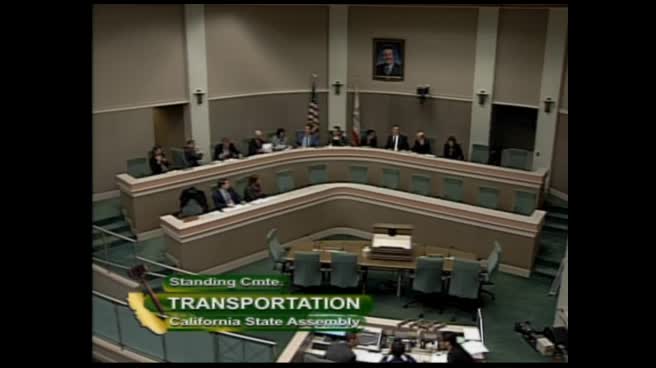
Assembly Standing Committee on Transportation
Bill Author

Bill Co-Author(s):