AB 1058: Controlled substances: fentanyl.
- Session Year: 2023-2024
- House: Assembly
- Latest Version Date: 2023-02-15
Current Status:
Failed
(2024-02-01: From committee: Filed with the Chief Clerk pursuant to Joint Rule 56.)
Introduced
In Committee
First Chamber
In Committee
Second Chamber
Enacted
Existing law classifies controlled substances into 5 schedules and places the greatest restrictions and penalties on the use of those substances placed in Schedule I. Existing law classifies the drug fentanyl in Schedule II. Existing law makes possession of a controlled substance for the purposes of sale of the substance punishable by imprisonment in a county jail for a period of 2, 3, or 4 years. Existing law makes transportation and sales of a controlled substances punishable by imprisonment in a county jail for a period of 3, 4, or 5 years and transportation to a noncontiguous county within the state punishable by imprisonment in a county jail for a period of 3, 6, or 9 years.
This bill would increase the above-described penalties, as specified, if the controlled substance involved was more than more than 28.35 grams of fentanyl, more than 28.35 grams of an analog of fentanyl, a substance containing more than 28.35 grams of fentanyl, or a substance containing more than 28.35 grams of an analog of fentanyl. By increasing the penalty for a crime, this bill would impose a state-mandated local program.
The California Constitution requires the state to reimburse local agencies and school districts for certain costs mandated by the state. Statutory provisions establish procedures for making that reimbursement.
This bill would provide that no reimbursement is required by this act for a specified reason.
(a)Except as provided in subdivision (b) and as otherwise provided in this division, every a person who possesses for sale or purchases for purposes of sale (1) any controlled substance specified in subdivision (b), (c), or (e) of Section 11054, specified in paragraph (14), (15), or (20) of subdivision (d) of Section 11054, or specified in subdivision (b) or (c) of Section 11055, or specified in subdivision (h) of Section 11056, or (2) any controlled substance classified in Schedule III, IV, or V which is a narcotic drug, shall be punished by imprisonment pursuant to subdivision (h) of Section 1170 of the Penal Code for two, three, or four years.
(b)Notwithstanding subdivision (a), a person who possesses for sale or purchases for purposes of sale more than 28.35 grams of fentanyl, more than 28.35 grams of an analog of fentanyl, a substance containing more than 28.35 grams of fentanyl, or a substance containing more than 28.35 grams of an analog of fentanyl shall be punished by imprisonment pursuant to subdivision (h) of Section 1170 of the Penal Code for four, five, or six years.
SEC. 2.Section 11352 of the Health and Safety Code is amended to read:11352.(a)Except as provided in subdivision (c) and as otherwise provided in this division, every a person who transports, imports into this state, sells, furnishes, administers, or gives away, or offers to transport, import into this state, sell, furnish, administer, or give away, or attempts to import into this state or transport (1) any controlled substance specified in subdivision (b), (c), or (e), or paragraph (1) of subdivision (f) of Section 11054, specified in paragraph (14), (15), or (20) of subdivision (d) of Section 11054, or specified in subdivision (b) or (c) of Section 11055, or specified in subdivision (h) of Section 11056, or (2) any controlled substance classified in Schedule III, IV, or V which is a narcotic drug, unless upon the written prescription of a physician, dentist, podiatrist, or veterinarian licensed to practice in this state, shall be punished by imprisonment pursuant to subdivision (h) of Section 1170 of the Penal Code for three, four, or five years.
(b)Notwithstanding the penalty provisions of subdivision (a), any (a) and except as provided in paragraph (2) of subdivision (c), a person who transports any controlled substances specified in subdivision (a) within this state from one county to another noncontiguous county shall be punished by imprisonment pursuant to subdivision (h) of Section 1170 of the Penal Code for three, six, or nine years.
(c)(1)Notwithstanding subdivision (a), a person who transports, imports into this state, sells, furnishes, administers, or gives away, or offers to transport, import into this state, sell, furnish, administer, or give away, or attempts to import into this state or transport more than 28.35 grams of fentanyl, more than 28.35 grams of an analog of fentanyl, a substance containing more than 28.35 grams of fentanyl, or a substance containing more than 28.35 grams of an analog of fentanyl shall be punished by imprisonment pursuant to subdivision (h) of Section 1170 of the Penal Code for seven, eight, or nine years.
(2)Notwithstanding subdivision (b), a person who transports more than 28.35 grams of fentanyl, more than 28.35 grams of an analog of fentanyl, a substance containing more than 28.35 grams of fentanyl, or a substance containing more than 28.35 grams of an analog of fentanyl within this state from one county to another noncontiguous county shall be punished by imprisonment pursuant to subdivision (h) of Section 1170 of the Penal Code for 7, 10, or 13 years.
(c)(d)For purposes of this section, transports means to transport for sale.
(d)(e)This section does not preclude or limit the prosecution of an individual for aiding and abetting the commission of, or conspiring to commit, or acting as an accessory to, any act prohibited by this section.
SEC. 3.No reimbursement is required by this act pursuant to Section 6 of Article XIIIB of the California Constitution because the only costs that may be incurred by a local agency or school district will be incurred because this act creates a new crime or infraction, eliminates a crime or infraction, or changes the penalty for a crime or infraction, within the meaning of Section 17556 of the Government Code, or changes the definition of a crime within the meaning of Section 6 of Article XIIIB of the California Constitution.
|
Date
|
Status
|
|---|---|
| Feb 1, 2024 | From committee: Filed with the Chief Clerk pursuant to Joint Rule 56. |
| Jan 31, 2024 | Died pursuant to Art. IV, Sec. 10(c) of the Constitution. |
| Apr 27, 2023 | In committee: Reconsideration granted. |
| Apr 27, 2023 | In committee: Set, first hearing. Failed passage. |
| Mar 23, 2023 | In committee: Hearing postponed by committee. |
| Mar 2, 2023 | Referred to Com. on PUB. S. |
| Feb 16, 2023 | From printer. May be heard in committee March 18. |
| Feb 15, 2023 | Read first time. To print. |
|
Date
|
Description
|
Location
|
Votes
|
|
|---|---|---|---|---|
| Apr 27, 2023 | Reconsideration. | Assembly Standing Committee on Public Safety |
Passed |
|
| Apr 27, 2023 | Do pass and be re-referred to the Committee on [Appropriations] | Assembly Standing Committee on Public Safety |
Failed |
This list shows positions taken on this bill by organizations on the date displayed, which is linked to the original source.
Positions by individuals are not included.
|
Organization
|
Position
|
Date
|
|---|---|---|
| Aclu California Action | * Against | Apr 27, 2023 |
| Alameda County Narcotics Task Force | * Support | Apr 27, 2023 |
| Alameda County Public Defender's Office | * Against | Apr 27, 2023 |
| All of Us or None | * Against | Apr 27, 2023 |
| Anti Recidivism Coalition | * Against | Apr 27, 2023 |
| Arrive Alive California | * Support | Apr 27, 2023 |
| Arrive Alive California | * Support | Apr 27, 2023 |
| Association For Los Angeles Deputy Sheriffs | * Support | Apr 27, 2023 |
| Broken No More | * Against | Apr 27, 2023 |
| Broken No More | ** Against | |
| California Alliance for Youth and Community Justice | ** Against | |
| California Attorneys For Criminal Justice | * Against | Apr 27, 2023 |
| California District Attorney Association | * Support | Apr 27, 2023 |
| California for Safety and Justice | * Against | Apr 27, 2023 |
| California Immigrant Policy Center | ** Against | |
| California Peace Officers Association | ** Support | Apr 27, 2023 |
| California Police Chiefs Association | * Support | Apr 27, 2023 |
| California Public defender's office | * Against | Apr 27, 2023 |
| California Public defender's office | * Support | Apr 27, 2023 |
| California Public defender's office | * Against | Apr 27, 2023 |
| California Public Defenders Association | ** Against | |
| California State Sheriff's Association | * Support | Apr 27, 2023 |
| Clovis Unified School District | ** Support | |
| Communities United for Restorative Justice | * Against | Apr 27, 2023 |
| Community Healers | * Against | Apr 27, 2023 |
| Crime Victims United | * Support | Apr 27, 2023 |
| Drug Policy Alliance | * Against | Apr 27, 2023 |
| Ella Baker Center For Human Rights | * Against | Apr 27, 2023 |
| Fresno County Board of Supervisors | * Support | Apr 27, 2023 |
| Fresno County District Attorney | * Support | Apr 27, 2023 |
| Fresno County District Attorneys Office | ** Support | |
| Fresno County Superintendent of Schools | ** Support | |
| Fresno Police Department | * Support | Apr 27, 2023 |
| Friends Committee on Legislation | * Against | Apr 27, 2023 |
| health rate 360 | * Against | Apr 27, 2023 |
| Initiate Justice | * Against | Apr 27, 2023 |
| Inside Garden | * Against | Apr 27, 2023 |
| Inside Garden | * Support | Apr 27, 2023 |
| Legal Services for Prisoners and Children | * Against | Apr 27, 2023 |
| Legal Services for Prisoners with Children | * Against | Apr 27, 2023 |
| National Harm Reduction Coalition | ** Against | |
| Orange County Board of Supervisors | * Support | Apr 27, 2023 |
| Orange County District Attorney | ** Support | |
| PAIN | * Support | Apr 27, 2023 |
| Pain Parents & Addicts in Need | ** Support | |
| Peace Officers Research Association Of California | ** Support | |
| Sacramento District Attorney's Office | * Support | Apr 27, 2023 |
| San Francisco Public Defender | * Against | Apr 27, 2023 |
| San Francisco Public Defender | * Support | Apr 27, 2023 |
| Sister Warriors Freedom Coalition | * Against | Apr 27, 2023 |
| Smart Justice California | * Support | Apr 27, 2023 |
| Smart Justice California | * Against | Apr 27, 2023 |
| Statewide Association of Criminal Defense Lawyers | * Against | Apr 27, 2023 |
| The Gubbio Project | ** Against | |
| The Sidewalk Project | ** Against | |
| transitions clinic network | ** Against | |
| UCLA School of Medicine | * Against | Apr 27, 2023 |
| Young Women's Freedom Center | * Against | Apr 27, 2023 |
Date of Hearing: April 27, 2023
Counsel: Andrew Ironside
ASSEMBLY COMMITTEE ON
Reginald Byron Jones-Sawyer, Sr., Chair
ABPCA Bill Id:
Author:() – As Ver:
SUMMARY:
Increases the penalties for drug trafficking of fentanyl, an analog of fentanyl, or a substance containing fentanyl or an analog of fentanyl, if the amount of fentanyl weighs more than 28.35 grams. Specifically, this bill:
- Increases the punishment for a person who possess or purchases for purposes of sale more than 28.35 grams of fentanyl or analog of fentanyl, or a substance containing more than 28.35 grams of fentanyl or an analog of fentanyl, from two, three, or four years imprisonment in county jail to four, five, or six years.
- Increases the punishment for a person who transports, imports into this state, sells, furnishes, administers, or gives away, or who offers or attempts to transport, import into this state, sell, furnish, administer or give away, more than 28.35 grams of fentanyl or analog of fentanyl, or substance containing more than 28.35 grams of fentanyl or an analog of fentanyl from three, six, or nine years imprisonment in county jail to seven, eight, or nine years.
- Increases the punishment for a person who transports more than 28.35 grams of fentanyl or an analog of fentanyl, or a substance containing more than 28.35 grams of fentanyl or an analog of fentanyl, within this state from one county to another noncontiguous county from 3, 6, or 9 years imprisonment in county jail to 7, 10, or 13 years.
EXISTING LAW:
- Provides the following penalties for trafficking of cocaine, cocaine base, heroin and specified opiates, including fentanyl:
- Possession for sale is punishable by imprisonment for two, three, or four years in the county jail (Health & Saf. Code, § 11351);
- Sale is punishable by imprisonment for three, four, or five years in county jail. Sale includes any transfer or distribution (Health & Saf. Code, § 11352.); and,
- Transportation of fentanyl, to a noncontiguous county, for purposes of sale is punishable by imprisonment for three, six, or nine years in the county jail (Health & Saf. Code, § 11352.).
- Possession for sale is punishable by imprisonment for two, three, or four years in the county jail (Health & Saf. Code, § 11351);
- Provides that, except as specified, the term "controlled substance analog" means either of the following:
- A substance the chemical structure of which is substantially similar to the chemical structure of specified controlled substances; or,
- A substance which has, is represented as having, or is intended to have a stimulant, depressant, or hallucinogenic effect on the central nervous system that is substantially similar to, or greater than, the stimulant, depressant, or hallucinogenic effect on the central nervous system of specified controlled substances. (Health & Saf. Code, § 11401, subd. (b)(1) & (2).)
- A substance the chemical structure of which is substantially similar to the chemical structure of specified controlled substances; or,
- Specifies that the term "controlled substance analog" does not mean “any substance for which there is an approved new drug application as specified under the federal Food, Drug, and Cosmetic Act or which is generally recognized as safe and effective as specified by the federal Food, Drug, and Cosmetic Act.” (Health & Saf. Code, § 11401, subd. (c)(1).)
- Provides the following additional sentencing enhancements based on the weight of a substance containing heroin, cocaine base, or cocaine possessed for sale or sold.
- 1 kilogram = 3 years
- 4 kilograms = 5 years
- 10 kilograms = 10 years
- 20 kilograms = 15 years
- 40 kilograms = 20 years
- 80 kilograms = 25 years. (Health and Saf. Code, § 11370.4, subd. (a).)
- 1 kilogram = 3 years
- States that in addition to the term of imprisonment provided by law for persons convicted of violating specified drug trafficking crimes, the trial court may impose a fine not exceeding $20,000 for each offense. (Health & Saf. Code, § 11372, subd. (a).)
- Specifies that a person receiving an additional prison term for trafficking more than a kilogram of a substance containing heroin, cocaine base, or cocaine may, in addition, be fined by an amount not exceeding $1,000,000 for each offense. (Health & Saf. Code, § 11372, subd. (b).)
- Provides that a person receiving an additional prison term for trafficking more than four kilograms of a substance containing heroin, cocaine base, or cocaine may, in addition, be fined by an amount not to exceed $4,000,000 for each offense. (Health & Saf. Code, § 11372, subd. (c).)
FISCAL EFFECT:
Unknown
COMMENTS:
- Author's Statement: According to the author, “AB 1058 modernizes the penalty structure for the fentanyl drug market by restructuring the penalty for those in possession of 28.35 grams or more. This bill would specifically target dealers while simultaneously avoiding addicted victims. The weight limit was selected after working with a local Drug Enforcement Agency agent who specializes in targeting dealers.”
- Harsher Sentences for Drug Trafficking Unlikely to Reduce Drug Use or Deter Criminal Conduct: In California, the number of deaths involving opioids, and fentanyl in particular, has increased significantly over the course of the last decade. Between 2012 and 2018, opioid-related overdose deaths increased by 42%; fentanyl overdose deaths increased by more than 800%—from 82 to 786. (CDPH, Overdose Prevention Initiative <https://www.cdph.ca.gov/Programs/CCDPHP/DCDIC/SACB/Pages/PrescriptionDrugOverdoseProgram.aspx?msclkid=99f1af92b9e411ec97e3e1fe58cde884> [last viewed Mar. 7, 2023].) In 2021, there were 21,016 emergency room visits resulting from an opioid overdose, 7,176 opioid-related overdose deaths, and 5,961 overdose deaths from fentanyl. (CDPH, California Overdose Surveillance Dashboard < https://skylab.cdph.ca.gov/ODdash/?tab=Home> [last visited Mar. 7, 2023].).
This bill attempts to reduce the number of people dying of overdoses involving fentanyl by deterring people who traffic fentanyl with a sentencing enhancement ranging from three to 13 years based on the amount. However, ample research on the impact of increasing penalties for drug offenses on criminal behavior has called into question the effectiveness of such measures. In a report examining the relationship between prison terms and drug misuse, PEW Charitable Trusts found “[n]o relationship between drug imprisonment rates and states’ drug problems,” finding that “high rates of drug imprisonment did not translate into lower rates of drug use, arrests, or overdose deaths.” (PEW, More Imprisonment Does Not Reduce State Drug Problems (Mar. 2018) p. 5 <https://www.pewtrusts.org/-/media/assets/2018/03/pspp_more_imprisonment_does_not_reduce_state_drug_problems.pdf> [last viewed Feb. 6, 2023]; see generally, Przybylski, Correctional and Sentencing Reform for Drug Offenders (Sept. 2009) < http://www.ccjrc.org/wp-content/uploads/2016/02/Correctional_and_Sentencing_Reform_for_Drug_Offenders.pdf> [last visited Mar. 20, 2023].) Put differently, imprisoning more people for longer periods of time for drug trafficking offenses is unlikely to reduce the risk of illicit drugs in our communities.
Unduly long sentences are counterproductive for public safety and contribute to the dynamic of diminishing returns as the incarcerated population expands. (Long-Term Sentences: Time to Reconsider the Scale of Punishment, 87 UMKC L.Rev. 1 (Nov. 5, 2018).) According to the U.S. Department of Justice, “Laws and policies designed to deter crime by focusing mainly on increasing the severity of punishment are ineffective partly because criminals know little about the sanctions for specific crimes. More severe punishments do not ‘chasten’ individuals convicted of crimes, and prisons may exacerbate recidivism.” (National Institute of Justice, U.S. Department of Justice, Five Things About Deterrence (June 5, 2016) <https://nij.ojp.gov/topics/articles/five-things-about-deterrence> [last visited Feb. 2, 2023.]) Increasingly punitive sentences add little to the deterrent effect of the criminal justice system; and mass incarceration diverts resources from program and policy initiatives that hold the potential for greater impact on public safety. (Long-Term Sentence, supra.)
Harsher sentences for drug trafficking offenses specifically may be particularly ineffective, in part because of the nature of illicit drug markets. As the National Research Council explains:
For several categories of offenders, an incapacitation strategy of crime prevention can misfire because most or all of those sent to prison are rapidly replaced in the criminal networks in which they participate. Street-level drug trafficking is the paradigm case. Drug dealing is part of a complex illegal market with low barriers to entry. Net earnings are low, and probabilities of eventual arrest and imprisonment are high… Drug policy research has nonetheless shown consistently that arrested dealers are quickly replaced by new recruits….
Despite the risks of drug dealing and the low average profits, many young disadvantaged people with little social capital and limited life chances sell drugs on street corners because it appears to present opportunities not otherwise available. However, [they] … overestimate the benefits of that activity and underestimate the risks. This perception is compounded by peer influences, social pressures, and deviant role models provided by successful dealers who live affluent lives and…avoid arrest… Arrests and imprisonments of easily replaceable offenders create illicit “opportunities” for others.
(Cmte. On Causes and Consequence of High Rates of Incarceration, National Research Council, The Growth of Incarceration in the United States: Exploring Causes and Consequences (2014) p. 146 <https://nap.nationalacademies.org/catalog/18613/the-growth-of-incarceration-in-the-united-states-exploring-causes> [last viewed Apr. 25, 2023].)
More recently, the Council on Criminal Justice reviewed the evidence on the effect of harsher punishments on criminal behavior and came to the same conclusion. It reported:
The empirical evidence on selective incapacitation suggests that long sentences may produce short- and long-term public safety benefits for individuals engaged in violent offending, but may produce the opposite effect for those engaged in drug-related offending…where an incarcerated individual is quickly replaced by a new recruit. This “replacement effect” occurs—and undermines the overall crime-reducing effects of incapacitation—when there is “demand” for a particular criminal activity. The illicit drug business offers the most obvious example: when someone who plays a role in a drug trafficking organization is incarcerated, someone else must take his or her place.
One study found that incarcerating street-level drug dealers fueled their replacement by younger and more violent individuals. Additional research replicated these findings through an examination of the public safety impact of California’s three strikes law from 1994, when the law was implemented, to 1998. This work found short- and long-term decreases in most types of crime, but also found that imprisoning chronic drug offenders had no impact on the drug crime rate. The authors hypothesized that incarcerating chronic drug offenders did not result in an incapacitation effect because “when one drug offender is jailed, there is another (and perhaps more than just one other) ready to take his or her place.” Additional analyses further indicate that incarcerating people for drug trafficking may result in increased crimes rates in general and increased rates of violent crime, specifically, because of organizational destabilization and the need for new recruits to prove themselves.
(Long Sentences Task Force, Council on Criminal Justice, The Impact of Long Sentences on Public Safety: A Complex Relationship (Nov. 2022) p. 8 https://counciloncj.org/wp-content/uploads/2022/11/Impact-of-Long-Sentences-on-Public-Safety.pdf [last visited Apr. 24, 2023] [internal citations omitted] [emphasis added].)
Additionally, as the Council on Criminal Justice’s report notes, the harsher punishments for drug offenses may actually do harm. For example, they may push persons selling and using drugs to engage in riskier behaviors. (See Friedman et al., Relationships of deterrence and law enforcement to drug-related harms among drug injectors in US metropolitan areas (2006) AIDS Vol 20 No 1.)
According to PEW, “[A] large body of prior research…cast[s] doubt on the theory that stiffer prison terms deter drug misuse, distribution, and other drug-law violations.” (PEW, supra.) PEW concludes:
Putting more drug-law violators behind bars for longer periods of time has generated enormous costs for taxpayers, but it has not yielded a convincing public safety return on those investments. Instead, more imprisonment for drug offenders has meant limited funds are siphoned away from programs, practices, and policies that have been proved to reduce drug use and crime. (Ibid.)
Based on this research, one might reasonably question whether increasing the penalties for drug trafficking fentanyl would meaningfully impact the drug’s availability or the number of deaths resulting from its illicit fentanyl use.
- The Scope of the Enhancement: Proponents argue that this bill “would specifically target dealers while simultaneously avoiding addicted victims.” This assumes, of course, that people who sell drugs are not also “addicted victims.” In fact, persons who participate in the drug trade often are themselves people who use drugs.
According to the National Research Council: “Facing limited opportunities in legal labor markets and already in contact with drug-selling networks, users provide a ready low-wage labor pool for illegal markets.” (https://nap.nationalacademies.org/read/12976/chapter/4 - 24). According to a Bureau of Justice Statistics report, 70% of persons serving time in state prison for drug trafficking offenses used drugs in the month before the offense, and 42.3% of those persons had been using drugs at the time of their offense. (Bureau of Justice Statistics, Special Report: Drug Use and Dependence, State and Federal Prisoners, 2004 (Oct. 2006) a p. 5 <https://bjs.ojp.gov/content/pub/pdf/dudsfp04.pdf> [last visited Mar. 20, 2023].) According to one study, “[Street-involved youth implicated in the drug trade] appear to be motivated by drug dependence,” finding: “Among participants who reported drug dealing, 263 (85.6%) individuals stated that the main reason that they sold drugs was to pay for their personal drug use.” (Werb et al., Risks surrounding drug trade involvement among street-involved youth, Am. J. Drug Alcohol Abuse (2008) < https://pubmed.ncbi.nlm.nih.gov/19016187/> [last visited Feb. 2, 2023].) Still another found that “White youths who misused prescription drugs were three times more likely to sell drugs, compared to White youths who did not misuse prescription drugs.” (Floyd et al., Adolescent Drug Dealing and Race/Ethnicity: A Population-Based study of the Differential Impact on Substance Use on Involvement in Drug Trade, Amer. J. of Drug & Alcohol Abuse, Vol. 36, No. 2 (Mar. 2010) <https://www.ncbi.nlm.nih.gov/pmc/articles/PMC2871399/ - R7> [last visited Mar. 17, 2022].)
Will the threat of a three-year enhancement effectively deter somebody already at a relatively high risk of death from illicit drug use? - This Bill’s Potential Impact on California’s Jail Population: Realignment began in October 2011. Since that time county jails have had oversight over most non-serious, non-violent, non-sexual felons and parolees who violate their parole. Before realignment, the maximum sentence in county jail was one year. Now that lower-level felons serve sentences in county jail, a portion of the jail population is serving sentences that are much longer than one year. Those factors related to realignment have served to increase population pressure on county jails.
In February 2021, the Public Policy Institute of California (PPIC) published a report discussing population impacts on California jails related to Realignment, Proposition 47 (Prop 47), and the effects of the COVID-19 pandemic. After realignment, the jail population began to rise; as of October 2014, the month before the passage of Proposition 47, it stood at roughly 82,000 inmates, a gain of 14% from 2011. (Lofstrom & Martin, California’s County Jails (Feb. 2021) <http://www.ppic.org/publication/californias-county-jails/>)[last viewed Mar. 21, 2022].)
Voters approved Prop 47 in November 2014, reclassifying several property and drug crimes from felonies to misdemeanors. Prop 47 had an immediate and lasting impact on jail populations: the average daily population dropped by almost 10,000 between October 2014 and January 2015. The jail population remained relatively flat between January 2015 and the onset of the COVID-19 pandemic. By February 2020, the average daily jail population had dropped to about 69,000, although that population grew by roughly 7,200 persons May and September 2020. California currently has the capacity to house 79,000 persons in long-term county jail facilities. (Lofstrom & Martin, California’s County Jails (Feb. 2021) <http://www.ppic.org/publication/californias-county-jails/>)[last viewed Mar. 21, 2022].)
Moreover, even before realignment, many county jails were struggling with overcrowding. Indeed, “[p]rior to the passage of realignment, many counties were already operating under court-imposed population caps, and others had very little extra capacity in their jail systems.” (Lofstrom et al., Impact of Realignment on County Jail Populations, Public Policy Institute of California (June 2013) p. 7 <https://www.ppic.org/wp-content/uploads/content/pubs/report/R_613MLR.pdf> [last visited Mar. 17, 2023].)
This bill would dramatically increase sentences for individuals convicted of specified criminal offenses involving fentanyl. Many of the individuals sentenced pursuant to the provisions of this bill would serve their sentences in county jail, potentially straining already overcrowded facilities. Some will nonetheless serve prison sentences based on prior convictions. - Argument in Support: According to the County of Fresno, “In 2021, fentanyl overdoses became the leading cause of death for adults between the ages of 18 and 45. In California, fentanyl was responsible for 36% of all drug-related deaths. On average, over 150 people die every day from overdoses related to synthetic opioids like fentanyl and its analogs.
“Under existing law, addicted victims are treated the same as their dealers who were carrying over a thousand pills when they were detained. Given the lethality of the drug, this number of pills brings with it a serious threat to the public.
“AB 1058 seeks to modernize the penalty structure for the fentanyl drug market by restructuring the penalty for those in possession of 28.35 grams or more. This bill would specifically target dealers while simultaneously avoiding addicted victims.” - Argument in Opposition: According to the Ella Baker Center for Human Rights, “Specifically, AB 1058 would amend Health & Safety Codes 11351 and 11352 to increase the number of years a person would be incarcerated should they be convicted of possession for sale of fentanyl (HSC 11351), or sale, transportation, furnishing, administering or giving away fentanyl, if the weight was more than 28.35 grams (HSC 11352). The upper penalty for violation of HSC 11351 would be six years, and the upper penalty for HSC 11352 would be 13 years, if fentanyl were transported from one county to another noncontiguous county.
“We are in the midst of a tragic increase in drug overdose deaths. Thousands of lives are lost in California every year – each one leaving an irreparable rift in the hearts and lives of their families and friends. To prevent future death and suffering California should implement evidence-based solutions to prevent avoidable deaths. California needs to invest more in substance use disorder treatment and harm reduction, rather than pursuing expensive and unproductive incarceration policies.
“What health benefit do the people of California get from punishing people with many more years of incarceration? Research has established that persons leaving prisons are far, are more likely to die of a drug overdose than the general population. And there is no research that we are aware of that shows that long sentences reduce the availability of drugs, or reduce drug harms. On the contrary, available research finds that long sentences have negligible public safety benefit, and measurable negative effects on families and communities.
“Furthermore, our state and local budgets are not unlimited – we should not lock them up in failed policies. The approximate per capita cost of a year in a California state prison is now over $112,600. The approximate cost of a year of methadone treatment for an opioid dependent person is $6,552. The approximate cost of buprenorphine treatment is less than $6,000. It would be healthier, safer and better for public safety to send an additional 17 people to methadone treatment, or 19 people to buprenorphine treatment, than to incarcerate one person for an additional year. Funding a robust, voluntary drug treatment system is a far more intelligent investment.
“The war on drugs failed us, failed families, and failed communities. While incarcerating millions of Americans, drugs became more widely available, stronger, and cheaper than ever before. It seems completely irrational to expand on that failed policy.” - Related Legislation:
- AB 955 (Petrie-Norris), would provide that a person who sells fentanyl on a social media platform in California shall be punished by imprisonment for a period of three, six, or nine years in county jail. AB 955 will be heard today in this committee.
- AB 675 (Soria), would add a substance containing a heroin analog, a substance containing fentanyl, and a substance containing a fentanyl analog to the list of controlled substances for which possession of those substances while armed with a loaded and operable firearm is a felony punishable in state prison by two, three, or four years. AB 675 will be heard today in this committee.
- AB 701 (Villapudua), would impose an additional enhancement when a person is convicted of specified drug offenses involving fentanyl, including sale, possession for sale, and transportation, when the substance containing fentanyl exceeds a specified weight. AB 701 failed passage in this committee and was granted reconsideration.
- AB 18 (Joe Patterson), would require the court to advise a person convicted of specified drug offenses that they could be charged with voluntary manslaughter or murder if they manufacture or distribute controlled substances in the future and somebody dies as a result. AB 18 failed passage in this committee and was granted reconsideration.
- SB 237 (Grove), would increase the punishment for drug trafficking fentanyl. SB 237 failed passage in the Senate Public Safety Committee and was granted reconsideration.
- SB 62 (J. Nguyen), would apply existing weight enhancements increasing the penalty and fine for trafficking substances containing heroin, cocaine base, and cocaine to fentanyl. SB 62 failed passage in the Senate Public Safety Committee and was granted reconsideration.
- SB 44 (Umberg), is substantially similar to AB 18 (Joe Patterson). SB 44 is up for reconsideration in the Senate Public Safety Committee.
- AB 955 (Petrie-Norris), would provide that a person who sells fentanyl on a social media platform in California shall be punished by imprisonment for a period of three, six, or nine years in county jail. AB 955 will be heard today in this committee.
- Prior Legislation:
- AB 1955 (Nguyen), of the 2021-2022 Legislative Session, was identical to AB 701. AB 1955 failed passage in this committee.
- AB 1351 (Petrie-Norris), of the 2021-2022 Legislative Session, was identical to AB 701. AB 1351 was not heard in this committee.
- AB 2975 (Petrie-Norris), of the 2019-2020 Legislative Session, was identical to AB 701. AB 2975 was not heard in this committee.
- AB 2405 (Patterson), of the 2017-2018 Legislative Session, would have classified carfentanil in Schedule II of the drug schedule and increase penalties for trafficking in carfentanil. AB 2405 failed passage in this committee.
- AB 2467 (Patterson), of the 2017-2018 Legislative Session would have increased the punishment for specified drug crimes involving fentanyl. SB 2467 failed passage in this committee.
- AB 3105 (Waldron), of the 2017-2018 Legislative Session, would have made sale of fentanyl punishable by a term of 10 years to life in a case involving 20 grams or more of a mixture or substance containing a detectable amount of fentanyl, as defined, or 5 grams or more of a mixture or substance containing an analogue. AB 3105 failed passage in this committee.
- SB 176 (Bates), of the 2017-2018 Legislative Session, would have classified carfentanil in Schedule II and would have applied the weight enhancement to a substance containing carfentanil or fentanyl. SB 176 failed passage in the Senate Public Safety Committee.
- SB 1103 (Bates), of the 2017-2018 Legislative Session, was substantially similar to AB 701. SB 1103 failed passage in the Senate Public Safety Committee.
- SB 1323 (Bates), of the 2015-2016 Legislative Session, would have applied the weight enhancement for possession for sale, or sale, of specified drugs, to fentanyl. SB 1323 was held on the Assembly Appropriations Committee Suspense File.
- AB 1955 (Nguyen), of the 2021-2022 Legislative Session, was identical to AB 701. AB 1955 failed passage in this committee.
REGISTERED SUPPORT / OPPOSITION:
Support
California District Attorneys Association
California Police Chiefs Association
California State Sheriffs' Association
Clovis Unified School District
County of Fresno
Fresno County District Attorney's Office
Fresno County Superintendent of Schools
Fresno Police Department
Orange County District Attorney
Orange; County of
Pain Parents & Addicts in Need
Peace Officers Research Association of California (PORAC)
6 Private Individuals
Oppose
Broken No More
California Alliance for Youth and Community Justice
California Attorneys for Criminal Justice
California Immigrant Policy Center
California Public Defenders Association (CPDA)
Californians for Safety and Justice
Communities United for Restorative Youth Justice (CURYJ)
Drug Policy Alliance
Ella Baker Center for Human Right
Ella Baker Center for Human Rights
Initiate Justice
Initiate Justice Action
Legal Services for Prisoners With Children
National Harm Reduction Coalition
San Francisco Public Defender
Sister Warriors Freedom Coalition
The Gubbio Project
The Sidewalk Project
Transitions Clinic Network
Young Women's Freedom Center
Analysis Prepared by:
Discussed in Hearing
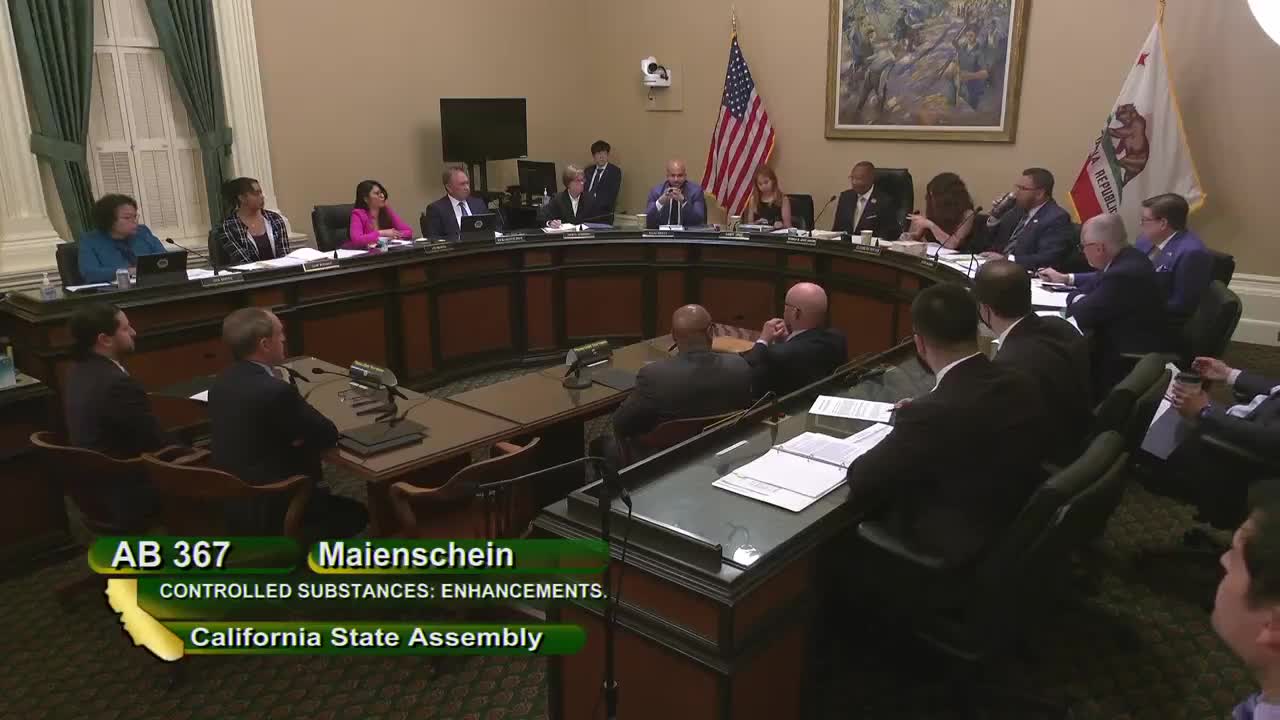 55MIN
Assembly Standing Committee on Public Safety
Bill Author

Bill Co-Author(s):
