AB 1229: Unincorporated associations: decentralized nonprofit associations.
- Session Year: 2023-2024
- House: Assembly
- Latest Version Date: 2023-03-23
Current Status:
Failed
(2024-02-01: From committee: Filed with the Chief Clerk pursuant to Joint Rule 56.)
Introduced
In Committee
First Chamber
In Committee
Second Chamber
Enacted
What does this bill do?
This bill creates a new legal category called a “decentralized nonprofit association” for groups of at least 100 people whose governance or operations rely on blockchain or similar distributed ledgers, and sets basic rules for how they operate. It lets these groups use blockchain and smart contracts for voting and decisions, allows members to transfer membership rights, limits members’, administrators’, and agents’ personal liability for the group’s debts except in specific situations (for example, signed assumption of responsibility or wrongful acts), and allows some business activity with rules on profit use.
The summary is provided by generative AI which can make mistakes. For original language, please view the details in the table below.
Existing law sets forth certain requirements and other provisions applicable to unincorporated associations, including nonprofit associations, as those terms are defined.
This bill would add provisions governing decentralized nonprofit associations, defined as an unincorporated association consisting of at least 100 members with a primary common purpose other than to operate a business for profit whose governance and operations are reliant, in full or in part, on a blockchain or other distributed ledger technology, as defined. Under the bill, an action against a decentralized nonprofit association may be brought in the county where it has appointed an agent for service of process. The bill would authorize a member of a decentralized nonprofit association to transfer their membership interest or rights. The bill provides that a member, administrator, or agent is not liable for a debt, obligation, or liability of the decentralized nonprofit association, including a contractual liability, unless specified conditions are met.
This bill would state the intent of the Legislature to enact legislation to create a category within existing statutes related to unincorporated associations and nonprofit associations appropriate for the decentralized operations of blockchain networks and smart contract protocols.Existing law sets forth certain requirements and other provisions applicable to unincorporated associations, including nonprofit associations, as those terms are defined.
This bill would state the intent of the Legislature to enact legislation to create a category within existing statutes related to unincorporated associations and nonprofit associations appropriate for the decentralized operations of blockchain networks and smart contract protocols.
For purposes of this part, the following definitions apply:
(a)(1)Administrator means a member authorized by the governing principles of the decentralized nonprofit association to fulfill specific administrative or operational tasks at the direction of the membership.
(2)An administrator is an agent of the decentralized nonprofit association for purposes of this title, except as provided in this part.
(3)An administrator has no authority to act on behalf of the decentralized nonprofit association other than the specific authorization granted in the selection process.
(b)(1)Decentralized nonprofit association means an unincorporated association consisting of at least 100 members with a primary common purpose other than to operate a business for profit whose governance and operations are reliant, in full or in part, on a blockchain or other distributed ledger technology.
(2)A decentralized nonprofit association may carry on a business for profit and apply the profit that results from the business activity to an activity in which it may lawfully engage.
(c)(1)Digital asset means an electronic record in which a person has a right or interest.
(2)A digital asset does not include the recorded underlying asset unless the asset is itself an electronic record.
(d)Distributed ledger technology means a distributed ledger protocol, including a designated regulatory model of software that governs the rules, operations, and communication between intersection and connection points in a telecommunication network, and supporting infrastructure, including computer software or hardware, that utilize or enable a distributed ledger, including blockchain, that uses a distributed, shared, and replicated ledger, whether it be public or private or permissioned or permissionless, and that may include the use of digital assets as a medium of electronic exchange.
(e)Governing document means a constitution, articles of association, bylaws, or other writing that governs the purpose or operation of an unincorporated association or the rights or obligations of its members, including information inscribed on a blockchain or other distributed ledger technology that is retrievable in a perceivable form.
(f)Record means information that is inscribed on a tangible medium or that is stored in an electronic or other medium and is retrievable in a perceivable form, including information inscribed on blockchain or other distributed ledger technology.
(g)Smart contract means an event-driven computer program that executes on blockchain or other distributed ledger technology used to automate transactions that include, but are not limited to, any of the following:
(1)Taking custody over and instructing a transfer of assets on a ledger.
(2)Creating and transmitting a digital asset.
(3)Synchronizing information.
(4)Authenticating user rights and conveying access to a software application.
2.General Provisions21510.In addition to establishing venue under any legally recognized method, venue of an action against a decentralized nonprofit association may be brought in the county where it has appointed an agent for service of process.
21511.Except as otherwise provided in the decentralized nonprofit associations governing document, a members interest or any right thereunder is freely transferable to another person. The conveyance of a membership interest or other property shall confer upon the recipient a voting right within the decentralized nonprofit association.
3.Liability21520.A member, administrator, or agent of a decentralized nonprofit association is not liable for a debt, obligation, or liability of the association solely by reason of being a member, administrator, or agent.
21521.A member of a decentralized nonprofit association is not liable for a contractual obligation of the association unless one of the following conditions is satisfied:
(a)The member expressly assumes personal responsibility for the obligation in a signed writing that specifically identifies the obligation assumed.
(b)The member expressly authorizes or ratifies the specific contract, as evidenced by a writing. This subdivision does not apply if the member authorizes or ratifies a contract solely in the members capacity as an administrator or agent of the association.
(c)With notice of the contract, the member receives a benefit under the contract. Liability under this subdivision is limited to the value of the benefit received.
(d)The member executes the contract without disclosing that the member is acting on behalf of the association.
(e)The member executes the contract without authority to execute the contract.
21522.An administrator or agent of a decentralized nonprofit association is not liable for a contractual obligation of the decentralized nonprofit association unless one of the following conditions is satisfied:
(a)The administrator or agent expressly assumes responsibility for the obligation in a signed writing that specifically identifies the contractual obligation assumed.
(b)The administrator or agent executes a contract without disclosing that the administrator or agent is acting on behalf of the decentralized nonprofit association.
(c)The administrator or agent executes the contract without the authority to execute the contract.
21523.(a)A member, administrator, or agent of a decentralized nonprofit association shall be liable for injury, damage, or harm caused by an act or omission of the decentralized nonprofit association or an act or omission of an administrator or agent of the decentralized nonprofit association, if one of the following conditions is satisfied:
(1)The member, administrator, or agent expressly assumes liability for injury, damage, or harm caused by particular conduct and that conduct causes the injury, damage, or harm.
(2)The member, administrator, or agent engages in tortious conduct that causes the injury, damage, or harm.
(3)The member, administrator, or agent is otherwise liable under any other legal basis.
(b)This section provides a nonexclusive list of existing grounds for liability and does not foreclose any common law grounds for liability.
21524.Notwithstanding any other provision of this part, a member, administrator, or person in control of a decentralized nonprofit association may be subject to liability for a debt, obligation, or liability of the decentralized nonprofit association under common law principles governing alter ego liability of shareholders of a corporation, taking into account the differences between a nonprofit association and a corporation.
21525.Nothing in this chapter limits application of the Uniform Voidable Transactions Act (Chapter 1 (commencing with Section 3439) of Title 2 of Part 2 of Division 4 of the Civil Code).
4.Governance21530.(a)A decentralized nonprofit association may provide for its governance, in whole or in part, through blockchain or other distributed ledger technology, including a smart contract.
(b)The governing document for a decentralized nonprofit association may do either of the following:
(1)Specify whether any blockchain or other distributed ledger technology utilized or enabled by the decentralized nonprofit association will be fully immutable or subject to change by the decentralized nonprofit association and whether the ledger will be fully or partially public or private, including the extent of a members access to information.
(2)Adopt voting procedures, which may include a smart contract deployed to a blockchain or other distributed ledger technology, that provide for any of the following:
(A)Proposals from administrators or members in the decentralized nonprofit association for upgrades, modifications, or additions to software systems or protocols.
(B)Other proposed changes to the decentralized nonprofit associations governing document.
(C)Any other matters of governance or activities within the purpose of the decentralized nonprofit association.
21531.In accordance with its governing document, a decentralized nonprofit association may do either of the following:
(a)Adopt a reasonable algorithmic means for establishing consensus for the validation of records, establishing requirements, processes, or procedures for conducting operations, or making organizational decisions with respect to the distributed ledger technology used by the decentralized nonprofit association.
(b)In accordance with any procedure specified pursuant to Section 21530, modify the consensus mechanism, requirements, processes, or procedures, or substitute a new consensus mechanism, requirement, process, or procedure.
21532.(a)A decentralized nonprofit association may carry on a business for profit and apply a profit that results from the business activity in accordance with subdivision (c).
(b)Except as otherwise provided in subdivision (c), a decentralized nonprofit association may not pay dividends or distribute any part of its income or profits to its members or administrators.
(c)A decentralized nonprofit association may do the following:
(1)Pay reasonable compensation or reimburse reasonable expenses to its members, administrators, and persons outside the organization for services rendered, including with respect to the administration and operation of the decentralized nonprofit association, which may include, but is not limited to, the provision of collateral for the self-insurance of the decentralized nonprofit association, voting, and participation.
(2)Confer benefits on its members or administrators in conformity with its common nonprofit purpose or purposes.
(3)Repurchase membership interests to the extent authorized by its governing document.
(4)Make distributions of property to members upon winding up and termination to the extent permitted by its governing document.
SECTION 1.It is the intent of the Legislature to enact legislation to create a category within existing statutes related to unincorporated associations and nonprofit associations appropriate for the decentralized operations of blockchain networks and smart contract protocols.It is the intent of the Legislature to enact legislation to create a category within existing statutes related to unincorporated associations and nonprofit associations appropriate for the decentralized operations of blockchain networks and smart contract protocols.
|
Date
|
Status
|
|---|---|
| Feb 1, 2024 | From committee: Filed with the Chief Clerk pursuant to Joint Rule 56. |
| Jan 31, 2024 | Died pursuant to Art. IV, Sec. 10(c) of the Constitution. |
| Apr 25, 2023 | From committee: Do pass and re-refer to Com. on JUD. (Ayes 10. Noes 1.) (April 24). Re-referred to Com. on JUD. |
| Mar 27, 2023 | Re-referred to Com. on B. & F. |
| Mar 23, 2023 | From committee chair, with author's amendments: Amend, and re-refer to Com. on B. & F. Read second time and amended. |
| Mar 23, 2023 | Referred to Coms. on B. & F. and JUD. |
| Feb 17, 2023 | From printer. May be heard in committee March 19. |
| Feb 16, 2023 | Read first time. To print. |
|
Date
|
Description
|
Location
|
Votes
|
|
|---|---|---|---|---|
| Apr 24, 2023 | Do pass and be re-referred to the Committee on [Judiciary] | Assembly Standing Committee on Banking and Finance |
Passed |
This list shows positions taken on this bill by organizations on the date displayed, which is linked to the original source.
Positions by individuals are not included.
|
Organization
|
Position
|
Date
|
|---|---|---|
| A16z | ** Support | |
| Ah Capital Management LLC Aka A16Z | * Support | Apr 24, 2023 |
| Blockchain Advocacy Coalition | ** Support | |
| Blockchain Advocacy Coalition | * Support | Apr 24, 2023 |
Date of Hearing: April 24, 2023
ASSEMBLY COMMITTEE ON BANKING AND FINANCE
Timothy Grayson, Chair
ABPCA Bill Id:AB 1229 (
Author:Haney) – As Amended Ver:March 23, 2023
SUBJECT: Unincorporated associations: decentralized nonprofit associations
SUMMARY: Establishes a business entity structure called a decentralized nonprofit association (DNPA) and establishes rules around governance and liability for DNPA members, administrators, and agents.
Specifically, this bill:
- Defines “Decentralized nonprofit association” as an unincorporated association consisting of at least 100 members with a primary common purpose other than to operate a business for profit whose governance and operations are reliant, in full or in part, on a blockchain or other distributed ledger technology (DLT), as defined. A DNPA may carry on a business for profit and apply the profit that results from the business activity to an activity in which it may lawfully engage.
- Specifies that in addition to establishing venue under any legally recognized method, the venue of an action against a DNPA may be brought in the county where it has appointed an agent for service of process.
- Authorizes a DNPA to carry on a business for profit and apply a profit in the following ways:
- Pay reasonable compensation or reimburse reasonable expenses to members, administrators, and persons outside the organization for services rendered, such as collateral for insurance.
- Confer benefits to its members or administrators in conformity with its common nonprofit purpose or purposes.
- Repurchase membership interest to the extent authorized by its governing document.
- Make distributions of property to members upon winding up and termination to the extent permitted by the governing document.
- Specifies that unless otherwise provided in the DNPA’s governing document, a member’s interest or any right thereunder is freely transferable to another person. The conveyance of a membership interest or other property will confer a voting right within the DNPA.
- Specifies that a member, administrator, or agent of a DNPA is not liable for a debt, obligation, or liability of the association solely by reason of being a member, administrator, or agent.
- Specifies that a DNPA member, administrator, or agent is not liable for a contractual obligation of the association unless they do one of the following:
- Expressly assume personal responsibility for the obligation in a signed writing that specifically identifies the obligation assumed.
- Expressly authorize or ratify the specific contract, as evidenced by a writing. This does not apply if the member authorizes or ratifies a contract solely in the member’s capacity as an administrator or agent of the association.
- In the case of a member and with the notice of the contract, receives a benefit under the contract, and liability, in this case, is limited to the value of the benefits received. This does not apply to an administrator or agent.
- Execute the contract without disclosing that the member, administrator, or agent is acting on behalf of the association
- They execute the contract without the authority to execute the contract.
- Specifies that a DNPA’s member, administrator, or agent is liable for injury, damage, or harm caused by an act or omission of the DNPA or an omission of an administrator or an agent of the DNPA, if they do one of the following:
- Expressly assume liability for injury, damage, or harm caused by particular conduct and that conduct causes the injury, damage, or harm.
- Engage in tortious conduct that causes injury, damage, or harm.
- Are otherwise liable under any other legal basis.
- Notwithstanding any other provision of this part, a member, administrator, or person in control of a decentralized nonprofit association may be subject to liability for a debt, obligation, or liability of the decentralized nonprofit association under common law principles governing alter ego liability of shareholders of a corporation, taking into account the differences between a nonprofit association and a corporation.
- Authorizes a DNPA to provide for its governance through blockchain or other DLT, including a smart contract, as defined.
- Authorizes a DNPA’s governance document to do the following:
- Specify whether any blockchain or other DLT used or enabled by the DNPA will be fully immutable or subject to change by the DNPA and whether the ledger will be fully or partially public or private, including the extent of a member’s access to information.
- Adopt voting procedures, which may include a smart contract deployed to a blockchain or other DLT, that provides for any of the following:
- Proposals from administrators or members in the DNPA for upgrades, modifications, or additions to software systems or protocols.
- Other proposed changes to the DNPA’s governing document.
- Any other matters of governance or activities within the purpose of the DNPA.
- Authorizes a DNPA to do the following in accordance with its governing document:
- Adopt a reasonable algorithmic means for establishing consensus for the validation of records, establishing requirements, processes, or procedures for conducting operations, or making organizational decisions with respect to the DNPA’s use of DLT.
- Modify the consensus mechanism, requirements, processes, or procedures, or substitute a new consensus mechanism, requirement, process, or procedure.
EXISTING STATE LAW:
- Establishes the rights and responsibilities of unincorporated nonprofit associations and their members, officers, and directors (Corp. Code Sec. 18000 et seq.).
- Establishes that a member, director, or agent of an unincorporated nonprofit association (UNA) is not liable for a debt, obligation, or liability of the association solely by reason of being a member, director, officer, or agent, among other provisions limiting liability for members, directors, officers, or agents (Corp. Code Sec. 18605 - 18640).
FISCAL EFFECT: Unknown. This bill is keyed non-fiscal by Legislative Counsel.
COMMENTS:
- Purpose.
According to the author:
For the last 175 years California has been at the forefront of technology and innovation. Our willingness to embrace new science and new technologies has led us to become the 5th largest economy in the world. But technology and progress keep moving forward and California is now facing the serious threat of losing our tech industry to states like Utah and Arizona that have embraced web3 as the future. This bill will keep California competitive by creating a framework for legitimate crypto and block chain companies to form here in California, by defining a clear regulatory approach to web3 companies’ formation and taxation.
- What is a DAO?
A DAO is a nonprofit or for-profit organization that uses blockchain technology to record and maintain the organization’s rules and management. A DAO is often characterized as a member-owned community without any central leadership, and members collectively make decisions on the DAO’s direction.
A DAO can take on many forms and try to achieve a variety of goals, but they typically all share some core key features. First, the DAO’s structure and governance rules are encoded in “smart contracts,” which allow for some automation in the DAO’s operations. For example, a DAO formed as a charity could rely on a smart contract to help ensure that funds are distributed in a predefined manner. Second, the organization’s transactions are recorded on the blockchain, which provides transparency to its members. Finally, “governance tokens” grant members voting powers over major decisions that affect the future of the organization. These tokens are usually purchased by members as part of the DAO’s initial capital raise.
Because of these features, DAOs often lack traditional managerial roles such as a CEO and they typically do not have a physical location or even a traditional bank account. Moreover, DAOs try to grant anonymity to their members, and membership often crosses jurisdictional borders. And, the number of DAOs is growing. According to the World Economic Forum, the number of DAO participants grew from 13,000 to 1.7 million people worldwide in 2021 alone.[1]
While DAOs are relatively new, they are seen by advocates as having the potential to fundamentally shape how people come together for a common purpose. In an article posted on the Coinbase website, authors Justin Mart and Connor Dempsey argue that what the internet did for communication, “DAOs can do for capital.”[2] Because of their structure and lack of geographic boundaries, DAOs can start up quickly for members to pursue a common purpose. For example, ConstitutionDAO was an effort to purchase an original copy of the US Constitution, and the DAO raised over $40 million from 17,000 contributors in less than one week.
- What are the critiques of DAOs?
As excitement for DAOs has grown, so have skepticism and concern. Critiques of DAOs include:
- A DAO is not actually decentralized.
Critics point out that in most cases, the use of governance tokens in decision-making allows a small number of people to exercise significant control over the direction of the organization. According to a 2022 Chainanalysis report, less than 1% of token holders of ten major DAOs controlled 90% of the voting power.[3]
The outsized influence of a core group of token holders has played a crucial role in perpetuating regulators’ skepticism of the DAO model. In the eyes of regulators, the features that make a DAO special also serve to crudely mask the typical characteristics of any business organization, such as the presence of managerial roles.
As an example, the SEC’s 2017 enforcement action against “The DAO,” a DAO formed in 2016, determined that the organization’s investors relied on “the managerial and entrepreneurial efforts” of a core group of token holders.[4]
- A DAO is susceptible to hacks and scams.
DAOs and their members have been victims of several high-profile hacks, security breaches, or scams. Because of the anonymity of members and the reliance on coding and smart contracts for core functions, DAOs seem to be especially susceptible to these events.[5] For example, the bZx protocol, which was used by crypto asset traders to engage in complex crypto transactions, was a victim of a $55 million hack after one of the DAO’s developers fell for an email phishing scam.
The bZx example is just one of many. “The DAO,” the organization mentioned in the preceding comment, saw a significant share of the $150 million it raised stolen by hackers.[6] Other events include the $120 million in criminal transactions at Badger DAO, or the loss of $13.4 million at Deus Finance DAO as a result of a security breach.
- A DAO can be a vector for money laundering and illicit finance.
Because a DAO’s token holders are anonymous and a DAO can be embedded in a number of finance operations, DAOs seem to play a role in global criminal activity. An April 2023 report by the US Treasury titled Illicit Finance Risk Assessment of Decentralized Finance explores in detail how DAOs, as participants in the broader DeFi ecosystem, can help perpetuate money laundering or criminal activity.[7] (Importantly, the Treasury report reiterates that the volume of money laundering with fiat money dwarfs decentralized finance-related illicit finance activities.)
- Legal troubles accumulate
In recent years, DAOs and their members have faced a number of unfavorable enforcement actions and legal rulings that jeopardize the prospect that the purest vision of the DAO – a truly decentralized, anonymous, and frictionless collective – will prevail.
In September 2022, the Commodities Futures Trading Commission (CFTC) filed a civil enforcement action against Ookie DAO (a successor to bZx DAO, mentioned earlier) on charges of running an unregistered futures trading facility and failing to comply with federal rules around customer identification (“Know Your Customer”). The CFTC alleged that Ookie DAO was an unincorporated association, and CFTC served the entire DAO at once by posting the lawsuit on a public forum and through a chat bot.
Another lawsuit related to bZx also explores whether individual DAO members can be held liable for the DAOs actions. Following the hack and loss of funds described in Comment #3, bZx investors filed a class action lawsuit, alleging the DAO was a general partnership that lacked basic cybersecurity protocols. In March 2023, a federal judge in California denied motions attempting to excuse bZx DAO members from liability.[8]
The above examples highlight the tension at the heart of AB 1229’s DNPA proposal. DAO members argue they should not be held individually liable for a DAO’s actions, but in the absence of any formalized business structure, regulators and the courts appear to agree these organizations function as general partnerships with “decentralized” features.
- Why not become a limited liability company (LLC)?
Recent enforcement actions and litigation have explored whether a DAO functions as a general partnership, meaning the individual and anonymous members of the DAO face unlimited liability for debts and lawsuits. However, there are other business entity structures designed specifically to limit liability for members.
Under current law, a DAO can form as an LLC, which grants members limited liability protection. But according to stakeholders, the LLC structure can present several practical problems for DAOs. Chief among those problems is the lack of anonymity: often LLCs must keep certain information to comply with rules and tax reporting, and most DAOs do not know the identity of their token holders. Moreover, the federal Corporate Transparency Act (CTA), an anti-money laundering initiative that was passed in 2020 as part of the National Defense Authorization Act of 2020, imposes new requirements related to a company’s beneficial ownership, and the CTA’s provisions are expected to apply to LLCs once final rulemaking is finished. This lack of anonymity and the potential application of the CTA to DAO LLCs may prove fundamentally at odds with DAOs whose member anonymity is a priority.
Other states have explored modifying their laws to accommodate a blockchain-based or decentralized LLC. For example, Wyoming’s DAO law clarifies that a DAO can use the LLC legal entity if the DAO meets certain requirements, such as maintaining a registered agent for service of process. However, it is unclear if these state laws can overcome some of the inherent drawbacks of the LLC entity structure for some types of decentralized organizations.
- AB 1229’s proposed “decentralized nonprofit association.”
AB 1229 provides clarity to a DAO operating similarly to an unincorporated nonprofit association. An unincorporated nonprofit association can be a social club, homeowners association, political group, religious society, or other similar group. An unincorporated nonprofit association is not a nonprofit corporation, which is formed with the primary goal of benefitting the public. Although some unincorporated associations are legally sophisticated, others are small, informal groups.
Given that DAOs often function as investment clubs or mechanisms to raise capital, an immediate question is: why is a nonprofit model an appropriate first step to provide legal clarity to decentralized organizations on issues around governance and member liability?
In response to this question, supporters clarify this bill will likely apply to a “protocol DAO,” which is a kind of DAO that governs a decentralized protocol or decentralized application.
Supporters draw parallels between a protocol DAO and a homeowner’s association operating as an unincorporated nonprofit. The purpose of a homeowner’s association is to “protect neighborhood standards by enforcing the codes and covenants of the community,” and any increase in the value of members’ homes is incidental to the association’s primary purpose and does not rise to the level of for-profit activity. Supporters argue that similarly, the primary purpose of a protocol DAO is to create and vote on governance proposals that control smart contracts and direct the actions of the DAO treasury to “foster the development and growth of a decentralized ecosystem.”[9]
Supporters contend that under a DNPA, profit distributions would be made in such a way to demonstrate the nonprofit intent:
Many DAO protocols utilize staking and liquidity mining that generate profits, which are reinvested within the protocols or paid out as expenses necessary for the protocol to function. Although these activities must be addressed for the purposes of income tax payment and tax reporting, their existence appears to be within the activity described in the UUNAA [Uniform Unincorporated Nonprofit Association Act] comment section.
Similarly, taxable events within the treasuries would reasonably be included within the furtherance of its nonprofit objectives as the existence and activities of the treasuries is demonstrative of the DAOs not for-profit intent. Where the UUNAA is restrictive on DAO activities involves distributions of profits for the members’ own use, which would be disqualifying of the organization being a UNA. If a DAO were to make distributions of profits to its members in a manner inconsistent with its nonprofit purpose, it would not maintain the liability limitations of a registered UNA.
- Additional comments.
AB 1229 proposes a bespoke nonprofit organization structure tailored to DAO-like features such as the use of governance tokens and smart contracts to shape the organization’s decision-making. In theory, protocol DAOs formed as DNPAs could support the expansion of other decentralized applications, a role similar to early internet functions that laid the foundation for the tech economy.
It is unclear if AB 1229 would help achieve these goals, but the passage of this bill could serve as an endorsement of DAOs at a time when the federal regulatory and policy responses are moving to reign in DAOs operating in an unlawful manner. Recent CFTC actions suggest that national regulators are evaluating DAOs as traditional business organizations with nifty decentralized features.
If California legislation serves as a model for other states, policymakers should be aware of the critiques and concerns of DAOs, such as the prevalence of hacks, frauds, and scams and the lopsided power dynamics. And, if the federal CTA and its anti-money laundering provisions do not apply to a DNPA because of the lack of filing requirement, these concerns could become even more relevant.
REGISTERED SUPPORT / OPPOSITION:
Support
A16z (Sponsor)
Blockchain Advocacy Coalition
Opposition
None on file.
Analysis Prepared by: Luke Reidenbach / B. & F. / (916) 319-3081
https://www.weforum.org/agenda/2022/06/are-dao-the-business-structures-of-the-future/ ↑
https://www.coinbase.com/learn/market-updates/around-the-block-issue-21 ↑
Chainalysis, Dissecting the DAO: Web3 Ownership is Surprisingly Concentrated (June 27, 2022), available at: https://blog.chainalysis.com/reports/web3-daos-2022. ↑
Report of Investigation Pursuant to Section 21(a) of the Securities Exchange Act of 1934: The DAO (July 2017), available at https://www.sec.gov/litigation/investreport/34-81207.pdf. ↑
Greg Noone, “Can DAOs survive an onslaught of cybercrime?” TechMonitor (July 2022), available at: https://techmonitor.ai/focus/daos-cybercrime-dao-hacks. ↑
Klint Finley, “A $50 Million Hack Just Showed That the DAO Was All Too Human,” Wired magazine, (June 2016), available at: https://www.wired.com/2016/06/50-million-hack-just-showed-dao-human/ ↑
Illicit Finance Risk Assessment of Decentralized Finance, US Treasury Department (April 2023), available at: https://home.treasury.gov/system/files/136/DeFi-Risk-Full-Review.pdf ↑
Matthew Bultman, “Crypto Hack Victims Can Sue bZx DAO as Partnership, Judge Says,” Bloomberg Law (March 2023), available at: https://news.bloomberglaw.com/securities-law/crypto-hack-victims-can-sue-bzx-dao-as-partnership-judge-says ↑
David Kerr and Miles Jennings, “A Legal Framework for Decentralized Autonomous Organizations (June 2022), available at: https://api.a16zcrypto.com/wp-content/uploads/2022/06/dao-legal-framework-part-1.pdf ↑
Discussed in Hearing
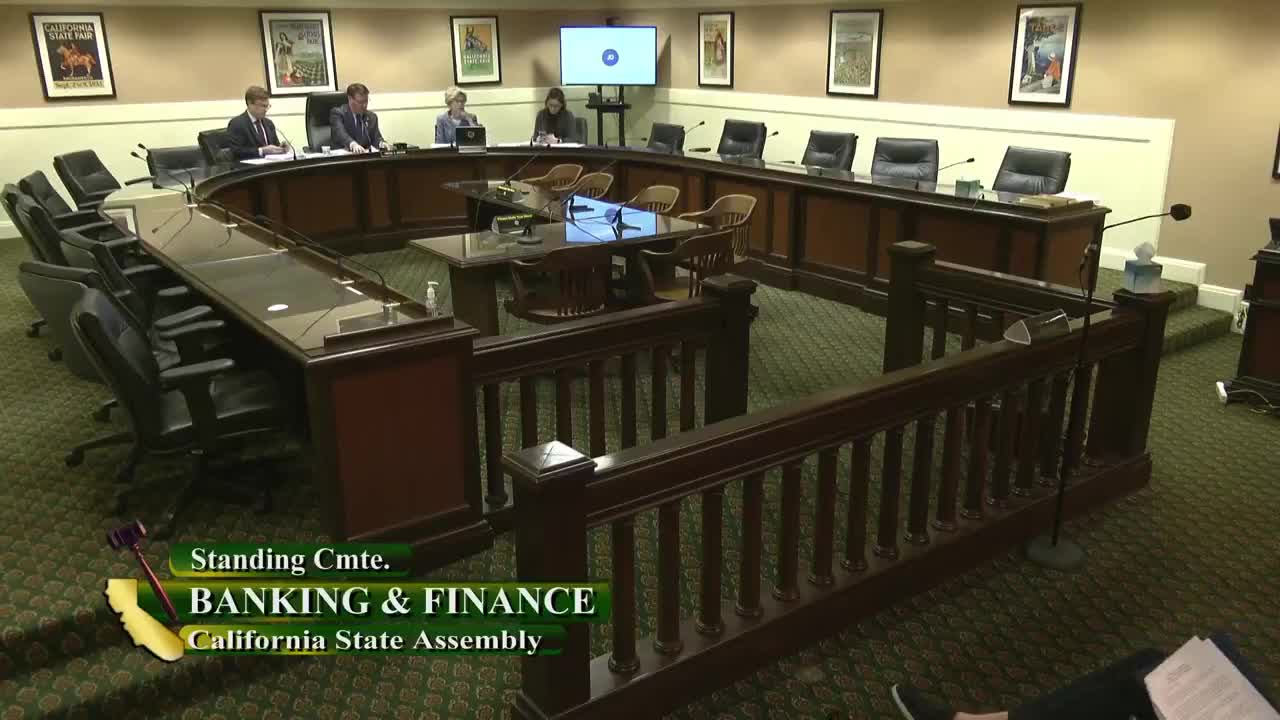 31MIN
Assembly Standing Committee on Banking and Finance
Bill Author

Bill Co-Author(s):