AB 1232: Department of Food and Agriculture: resilient and higher welfare grant program.
- Session Year: 2023-2024
- House: Assembly
- Latest Version Date: 2023-04-12
Current Status:
Failed
(2024-02-01: From committee: Filed with the Chief Clerk pursuant to Joint Rule 56.)
Introduced
In Committee
First Chamber
In Committee
Second Chamber
Enacted
Existing law requires the Department of Food and Agriculture to promote and protect the agricultural industry of the state. Existing law, the Cannella Environmental Farming Act of 1995, requires the department to establish and oversee an environmental farming program to provide incentives to farmers whose practices promote the well-being of ecosystems, air quality, and wildlife and their habitat.
This bill would require the department to establish and administer a resilient and higher-welfare higher welfare grant program to support the implementation of higher standards of care and more climate-smart farming practices by providing education materials, outreach, and incentives to producers and processors seeking to improve farm animal welfare and increase capacity to meet growing demand for higher-welfare higher welfare and welfare-certified products, to comply with regulatory requirements, and to make necessary climate adaptations. The bill would require the department to establish an annual competitive grant application process that enables producers and processors seeking to improve farm animal welfare to apply to the department for financial assistance and to give priority to certain applications. The bill would require the department to conduct outreach and education to producers and processors with regard to the program and to publish an annual a report on or before January 1, 2029, on its internet website summarizing the results of the program.
Existing law requires the Department of Food and Agriculture to promote and protect the agricultural industry of the state. Existing law, the Cannella Environmental Farming Act of 1995, requires the department to establish and oversee an environmental farming program to provide incentives to farmers whose practices promote the well-being of ecosystems, air quality, and wildlife and their habitat.
This bill would require the department to establish and administer a resilient and higher-welfare grant program to support the implementation of higher standards of care and more climate-smart farming practices by providing education materials, outreach, and incentives to producers and processors seeking to improve farm animal welfare and increase capacity to meet growing demand for higher-welfare and welfare-certified products, to comply with regulatory requirements, and to make necessary climate adaptations. The bill would require the department to establish an annual competitive grant application process that enables producers and processors seeking to improve farm animal welfare to apply to the department for financial assistance and to give priority to certain applications. The bill would require the department to conduct outreach and education to producers and processors with regard to the program and to publish an annual report on its internet website summarizing the results of the program.
It is the intent of the Legislature that the department, in administering the program established pursuant to this article, seek to support the implementation and expansion of improved farm animal care and climate-smart farming practices, prioritizing limited resource and socially disadvantaged farmers or ranchers, by providing incentives to eligible entities.
541.Unless the context otherwise requires, the definitions in this article govern the construction of this article:
(a)Animal welfare certification means a value-added certification program offered by an organization or agency that uses independent, on-farm auditors to routinely assess a producers compliance with specific farm animal care standards, recognized by the secretary as meeting all of the following criteria:
(1)Publicly available certification protocol and standards.
(2)Standards that do all of the following:
(A)Exceed conventional industry standards, based on industry guidelines.
(B)Prohibit routine caging, crating, and tethering of animals.
(C)Include, at a minimum, provisions for space allowance, environmental enrichment, ability to engage in natural behaviors, pain control and physical alterations, animal handling and transport, and responsible antibiotic use where antibiotics are used only for the purpose of treating sick or injured animals or controlling diagnosed outbreaks of disease.
(3)Auditors with no vested or financial interest in audit outcomes who possess a background in animal care science, or have received equivalent training, and are able to recognize and apply established farm animal care standards and protocols.
(4)A requirement for producers to comply with 100 percent of standards to receive certification.
(b)BIPOC advisory committee means the Black, Indigenous, and People of Color Farmer Advisory Committee established by the department.
(c)Higher welfare means the result of practices that do all of the following:
(1)Exceed conventional industry standards, based on industry guidelines.
(2)Prohibit routine caging, crating, and tethering of animals.
(3)Include, at a minimum, provisions for space allowance, environmental enrichment, ability to engage in natural behaviors, pain control and physical alterations, animal handling and transport, and responsible antibiotic use where antibiotics are used only for the purpose of treating sick or injured animals or controlling diagnosed outbreaks of disease disease.
(d)Limited resource farmer or rancher has the same definition as in Section 760.107 of Title 7 of the Code of Federal Regulations.
(e)Processor means any small or very small mobile livestock or poultry slaughter operation where state or federal inspection is maintained.
(f)Producer means any person who raises livestock or poultry for meat, eggs, dairy, or fiber, without limit to property ownership or minimum acreage of production.
(g)Socially disadvantaged farmer or rancher has the same meaning as defined in Section 512.
(h)Welfare-certified producer means any producer currently participating in one or more animal welfare certifications.
542.(a)The department shall, in coordination with the BIPOC advisory committee, establish and administer a resilient and higher-welfare higher welfare grant program. The department shall ensure the program does both of the following:
(1)Seeks to support the implementation of higher standards of care and more climate-smart farming practices by providing education materials, outreach, and incentives, including grants, to producers and processors seeking to improve farm animal welfare and increase capacity to meet growing demand for higher-welfare higher welfare and welfare-certified products, to comply with regulatory requirements, to make necessary climate adaptations, or any combination of these things.
(2)Aligns with the Farmer Equity Act of 2017 (Article 6 (commencing with Section 510)).
(b)(1)The department shall establish an annual competitive grant application process that enables producers and processors seeking to improve farm animal welfare to apply to the department for financial assistance.
(2)A person, group of individuals, nonprofit organization, or tribal government entity shall be eligible to submit a grant application under the program as a producer if it meets both of the following conditions:
(A)The individual or entity leases, rents, or owns land in California regardless of whether the land is publicly owned or privately owned or is tribal land.
(B)The individual or entity raises livestock or uses indigenous Indigenous livestock production practices, or both of these things, on land described in subparagraph (A) and is seeking to improve farm animal welfare and increase capacity to meet growing demand for higher-welfare higher welfare and welfare-certified products, to comply with regulatory requirements, or to make necessary climate adaptations, or any combination of these things.
(3)A person, group of individuals, nonprofit organization, or tribal government entity shall be eligible to submit a grant application under the program as a processor if it processes livestock in California and is seeking to improve farm animal welfare and increase capacity to meet growing demand for higher-welfare higher welfare and welfare-certified products, to comply with regulatory requirements, or to make necessary climate adaptations, or any combination of these things.
(c)The department shall award grants for costs associated with improving farm animal welfare to meet increasing demand for higher-welfare higher welfare and welfare-certified products, comply with welfare-based regulatory requirements, meet climate impact needs, achieve or maintain participation in an animal welfare certification program, or any combination of these things. These costs may include any of the following:
(1)Auditing and certification fees required for animal welfare certification.
(2)On-farm improvements required by a producer to meet the standards of an animal welfare certification program or welfare-based regulation, including, but not limited to, all of the following:
(A)Infrastructure improvements related to providing animals with access to the outdoors or pasture, including purchasing or constructing fencing, mobile and permanent housing or shelter, seeds and starts, soil building supplies, compost and compost structure supplies, mulch, organic fertilizer and pest control, hedgerow and ecosystem enhancement planting and design, and water lines and irrigation structures for watering outdoor animals.
(B)Infrastructure improvements related to providing animals with cage- and crate-free, enriched indoor environments, including purchasing or constructing enrichment materials to encourage species-specific natural behaviors like nesting, rooting, scratching, dustbathing, wallowing, and foraging, and infrastructure to enable free movement of animals indoors, improve ventilation, and provide natural light.
(C)Infrastructure improvements related to increasing the capacity of existing welfare-certified producers operations to meet increasing consumer, retailer, and institutional demand for products carrying one or more animal welfare certifications, including purchasing or constructing more or larger animal housing infrastructure, more efficient feeding equipment, and animal handling infrastructure.
(3)On-farm improvements required to safeguard animal welfare and help animals adapt to increasing climate impacts such as extreme heat, drought, wildfires, and flooding. These on-farm improvements include, but are not limited to, infrastructure improvements to increase outdoor shade and shelter access, integrate drought-resistant grasses on grazing or pastureland, transition to pasture-based management, improve or expand watering systems, improve indoor ventilation, and provide structure hardening.
(4)Improvements related to expanding access to higher-welfare higher welfare processing facilities, including, but not limited to, any of the following:
(A)Purchasing or constructing mobile processing facilities.
(B)Purchasing equipment to improve animal handling and slaughter, including controlled atmosphere stunning infrastructure and technology.
(C)Implementing humane handling and slaughter trainings for workers that are accessible in all relevant and culturally appropriate languages.
(5)Labor or consulting costs, or both, associated with a project to improve farm animal welfare.
(6)Rent or leasing fees associated with an operations expansion of outdoor access or transition to pasture-based management.
543.(a)In awarding grants pursuant to this article, the department shall give first priority to applications for projects that occur in and benefit disadvantaged communities identified pursuant to Section 39711 of the Health and Safety Code and to applications from small and midsize farms and socially disadvantaged farmers or ranchers. for projects that occur in and benefit vulnerable communities, as defined in subdivision (d) of Section 71340 of the Public Resources Code.
(b)After giving priority pursuant to subdivision (a), the department shall give next priority to grants for costs associated with achieving or maintaining participation in an animal welfare certification program or meeting welfare-based regulations.
(c)The department shall make available not less than 15 percent of the funds made available to the program for the purposes of animal welfare training and certification support, financial and farm planning, communication support, program recruitment, recordkeeping support, application process support, and translation support to limited resource and socially disadvantaged farmers or ranchers, as well as developing capacity and expertise of technical assistance providers to support limited resource and socially disadvantaged farmers or ranchers to enhance animal welfare practices.
544.The department shall, in coordination with the BIPOC advisory committee, conduct outreach and education for producers and processors regarding the potential of the producer or processor under this article to request financial assistance with the costs associated with achieving or maintaining participation in an animal welfare certification program. In conducting the education and outreach, the department shall specify how a producer or processor may request financial assistance and be accessible by non-English speakers, including translation, interpretation, or captioning of outreach materials and events.
545.(a)The department shall publish an annual a report on or before January 1, 2029, summarizing all of the following information with regard to the program established pursuant to this article:
(1)The number and demographics of producers and processors requesting financial assistance.
(2)The number and demographics of producers and processors receiving financial assistance.
(3)The number and species of livestock that were involved in projects that received financial assistance.
(4)The projects for which the assistance was provided.
(5)The level of alignment with the Farmer Equity Act of 2017 (Article 6 (commencing with Section 510)).
(6)The amount of assistance provided to each producer and processor in dollars.
(7)The total amount of assistance provided in dollars.
(8)The results of outreach and education efforts by the department.
(b)The department shall post the report published pursuant to subdivision (a) on its internet website.
It is the intent of the Legislature that the department, in administering the program established pursuant to this article, seek to support the implementation and expansion of improved farm animal care and climate-smart farming practices, prioritizing limited resource and socially disadvantaged farmers or ranchers, by providing incentives to eligible entities.
541.Unless the context otherwise requires, the definitions in this article govern the construction of this article:
(a)Animal welfare certification means a value-added certification program offered by an organization or agency that uses independent, on-farm auditors to routinely assess a producers compliance with specific farm animal care standards, recognized by the secretary as meeting all of the following criteria:
(1)Publicly available certification protocol and standards.
(2)Standards that do all of the following:
(A)Exceed conventional industry standards, based on industry guidelines.
(B)Prohibit routine caging, crating, and tethering of animals.
(C)Include, at a minimum, provisions for space allowance, environmental enrichment, ability to engage in natural behaviors, pain control and physical alterations, animal handling and transport, and responsible antibiotic use where antibiotics are used only for the purpose of treating sick or injured animals or controlling diagnosed outbreaks of disease.
(3)Auditors with no vested or financial interest in audit outcomes who possess a background in animal care science, or have received equivalent training, and are able to recognize and apply established farm animal care standards and protocols.
(4)A requirement for producers to comply with 100 percent of standards to receive certification.
(b)BIPOC advisory committee means the Black, Indigenous, and People of Color Farmer Advisory Committee established by the department.
(c)Higher welfare means the result of practices that do all of the following:
(1)Exceed conventional industry standards, based on industry guidelines.
(2)Prohibit routine caging, crating, and tethering of animals.
(3)Include, at a minimum, provisions for space allowance, environmental enrichment, ability to engage in natural behaviors, pain control and physical alterations, animal handling and transport, and responsible antibiotic use where antibiotics are used only for the purpose of treating sick or injured animals or controlling diagnosed outbreaks of disease
(d)Limited resource farmer or rancher has the same definition as in Section 760.107 of Title 7 of the Code of Federal Regulations.
(e)Processor means any small or very small mobile livestock or poultry slaughter operation where state or federal inspection is maintained.
(f)Producer means any person who raises livestock or poultry for meat, eggs, dairy, or fiber, without limit to property ownership or minimum acreage of production.
(g)Socially disadvantaged farmer or rancher has the same meaning as defined in Section 512.
(h)Welfare-certified producer means any producer currently participating in one or more animal welfare certifications.
542.(a)The department shall, in coordination with the BIPOC advisory committee, establish and administer a resilient and higher-welfare grant program. The department shall ensure the program does both of the following:
(1)Seeks to support the implementation of higher standards of care and more climate-smart farming practices by providing education materials, outreach, and incentives, including grants, to producers and processors seeking to improve farm animal welfare and increase capacity to meet growing demand for higher-welfare and welfare-certified products, to comply with regulatory requirements, to make necessary climate adaptations, or any combination of these things.
(2)Aligns with the Farmer Equity Act of 2017 (Article 6 (commencing with Section 510)).
(b)(1)The department shall establish an annual competitive grant application process that enables producers and processors seeking to improve farm animal welfare to apply to the department for financial assistance.
(2)A person, group of individuals, nonprofit organization, or tribal government entity shall be eligible to submit a grant application under the program as a producer if it meets both of the following conditions:
(A)The individual or entity leases, rents, or owns land in California regardless of whether the land is publicly owned or privately owned or is tribal land.
(B)The individual or entity raises livestock or uses indigenous livestock production practices, or both of these things, on land described in subparagraph (A) and is seeking to improve farm animal welfare and increase capacity to meet growing demand for higher-welfare and welfare-certified products, to comply with regulatory requirements, or to make necessary climate adaptations, or any combination of these things.
(3)A person, group of individuals, nonprofit organization, or tribal government entity shall be eligible to submit a grant application under the program as a processor if it processes livestock in California and is seeking to improve farm animal welfare and increase capacity to meet growing demand for higher-welfare and welfare-certified products, to comply with regulatory requirements, or to make necessary climate adaptations, or any combination of these things.
(c)The department shall award grants for costs associated with improving farm animal welfare to meet increasing demand for higher-welfare and welfare-certified products, comply with welfare-based regulatory requirements, meet climate impact needs, achieve or maintain participation in an animal welfare certification program, or any combination of these things. These costs may include any of the following:
(1)Auditing and certification fees required for animal welfare certification.
(2)On-farm improvements required by a producer to meet the standards of an animal welfare certification program or welfare-based regulation, including, but not limited to, all of the following:
(A)Infrastructure improvements related to providing animals with access to the outdoors or pasture, including purchasing or constructing fencing, mobile and permanent housing or shelter, seeds and starts, soil building supplies, compost and compost structure supplies, mulch, organic fertilizer and pest control, hedgerow and ecosystem enhancement planting and design, and water lines and irrigation structures for watering outdoor animals.
(B)Infrastructure improvements related to providing animals with cage- and crate-free, enriched indoor environments, including purchasing or constructing enrichment materials to encourage species-specific natural behaviors like nesting, rooting, scratching, dustbathing, wallowing, and foraging, and infrastructure to enable free movement of animals indoors, improve ventilation, and provide natural light.
(C)Infrastructure improvements related to increasing the capacity of existing welfare-certified producers operations to meet increasing consumer, retailer, and institutional demand for products carrying one or more animal welfare certifications, including purchasing or constructing more or larger animal housing infrastructure, more efficient feeding equipment, and animal handling infrastructure.
(3)On-farm improvements required to safeguard animal welfare and help animals adapt to increasing climate impacts such as extreme heat, drought, wildfires, and flooding. These on-farm improvements include, but are not limited to, infrastructure improvements to increase outdoor shade and shelter access, integrate drought-resistant grasses on grazing or pastureland, transition to pasture-based management, improve or expand watering systems, improve indoor ventilation, and provide structure hardening.
(4)Improvements related to expanding access to higher-welfare processing facilities, including, but not limited to, any of the following:
(A)Purchasing or constructing mobile processing facilities.
(B)Purchasing equipment to improve animal handling and slaughter, including controlled atmosphere stunning infrastructure and technology.
(C)Implementing humane handling and slaughter trainings for workers that are accessible in all relevant and culturally appropriate languages.
(5)Labor or consulting costs, or both, associated with a project to improve farm animal welfare.
(6)Rent or leasing fees associated with an operations expansion of outdoor access or transition to pasture-based management.
543.(a)In awarding grants pursuant to this article, the department shall give first priority to applications for projects that occur in and benefit disadvantaged communities identified pursuant to Section 39711 of the Health and Safety Code and to applications from small and midsize farms and socially disadvantaged farmers or ranchers.
(b)After giving priority pursuant to subdivision (a), the department shall give next priority to grants for costs associated with achieving or maintaining participation in an animal welfare certification program or meeting welfare-based regulations.
(c)The department shall make available not less than 15 percent of the funds made available to the program for the purposes of animal welfare training and certification support, financial and farm planning, communication support, program recruitment, recordkeeping support, application process support, and translation support to limited resource and socially disadvantaged farmers or ranchers, as well as developing capacity and expertise of technical assistance providers to support limited resource and socially disadvantaged farmers or ranchers to enhance animal welfare practices.
544.The department shall, in coordination with the BIPOC advisory committee, conduct outreach and education for producers and processors regarding the potential of the producer or processor under this article to request financial assistance with the costs associated with achieving or maintaining participation in an animal welfare certification program. In conducting the education and outreach, the department shall specify how a producer or processor may request financial assistance and be accessible by non-English speakers, including translation, interpretation, or captioning of outreach materials and events.
545.(a)The department shall publish an annual report summarizing all of the following information with regard to the program established pursuant to this article:
(1)The number and demographics of producers and processors requesting financial assistance.
(2)The number and demographics of producers and processors receiving financial assistance.
(3)The number and species of livestock that were involved in projects that received financial assistance.
(4)The projects for which the assistance was provided.
(5)The level of alignment with the Farmer Equity Act of 2017 (Article 6 (commencing with Section 510)).
(6)The amount of assistance provided to each producer and processor in dollars.
(7)The total amount of assistance provided in dollars.
(8)The results of outreach and education efforts by the department.
(b)The department shall post the report published pursuant to subdivision (a) on its internet website.
|
Date
|
Status
|
|---|---|
| Feb 1, 2024 | From committee: Filed with the Chief Clerk pursuant to Joint Rule 56. |
| Jan 31, 2024 | Died pursuant to Art. IV, Sec. 10(c) of the Constitution. |
| May 18, 2023 | In committee: Held under submission. |
| May 3, 2023 | In committee: Set, first hearing. Referred to APPR. suspense file. |
| Apr 19, 2023 | From committee: Do pass and re-refer to Com. on APPR. (Ayes 8. Noes 0.) (April 19). Re-referred to Com. on APPR. |
| Apr 17, 2023 | Re-referred to Com. on AGRI. |
| Apr 12, 2023 | From committee chair, with author's amendments: Amend, and re-refer to Com. on AGRI. Read second time and amended. |
| Mar 2, 2023 | Referred to Com. on AGRI. |
| Feb 17, 2023 | From printer. May be heard in committee March 19. |
| Feb 16, 2023 | Read first time. To print. |
|
Date
|
Description
|
Location
|
Votes
|
|
|---|---|---|---|---|
| Apr 19, 2023 | Do pass and be re-referred to the Committee on [Appropriations] | Assembly Standing Committee on Agriculture |
Passed |
This list shows positions taken on this bill by organizations on the date displayed, which is linked to the original source.
Positions by individuals are not included.
|
Organization
|
Position
|
Date
|
|---|---|---|
| A Greener World | ** Support | |
| American Society for the Prevention of Cruelty to Animals (ASPCA) | * Support | Apr 19, 2023 |
| Animal Legal Defense Fund | * Support | Apr 19, 2023 |
| California Cattlemen'S Association | ** Against | |
| California Farm Bureau Federation | ** Against | |
| California Veterinary Medical Association | * Neutral | Apr 19, 2023 |
| Campaign for Family Farms and the Environment | ** Support | |
| Center for Good Food Purchasing | ** Support | |
| Community Alliance With Family Farmers | ** Support | |
| Compassion in World Farming | ** Support | |
| Farm Action Fund | ** Support | |
| Food & Water Watch | ** Support | |
| Food Animal Concerns Trust | ** Support | |
| Food Chain Workers Alliance | ** Support | |
| Friends Of The Earth | ** Support | |
| Heal Food Alliance | ** Support | |
| Healthcare without Harm | ** Support | |
| Humane League; the | ** Against | |
| Humane Society Of The United States, The | * Support | Apr 19, 2023 |
| Johns Hopkins Center for a Livable Future | ** Support | |
| Llano Seco Meats | * Support | Apr 19, 2023 |
| Los Angeles Food Policy Council | ** Support | |
| Social Compassion and Legislation | * Against Unless Amend | Apr 19, 2023 |
| Socially Responsible Agriculture Project | ** Support | |
| World Animal Protection | ** Support |
Date of Hearing: May 3, 2023
ASSEMBLY COMMITTEE ON APPROPRIATIONS
Chris Holden, Chair
ABPCA Bill Id:AB 1232
Author:(Connolly) – As Amended Ver:April 12, 2023
Policy Committee: | Agriculture | Vote: | 8 - 0 |
|
| ||
|
|
Urgency: No State Mandated Local Program: No Reimbursable: No
SUMMARY:
This bill requires the California Department of Food and Agriculture (CDFA) to establish a new grant program for producers and processors seeking to improve farm animal welfare and adopt more climate-smart farming practices.
Specifically, this bill:
- Requires CDFA, in coordination with its Black, Indigenous, and People of Color (BIPOC) Advisory Committee, to establish and administer a resilient and higher welfare (RHW) grant program, ensuring the program (a) supports the implementation of higher standards of care and more climate-smart farming practices by providing education materials, outreach, and incentives, including annual grants, to producers and processors seeking to improve farm animal welfare and increase capacity to meet growing demand for higher-welfare and welfare-certified products, to comply with welfare-based regulatory requirements, to make necessary climate adaptations, to achieve or maintain participation in an animal welfare certification program, or any combination of these purposes and (b) aligns with the Farmer Equity Act of 2017.
- Prescribes how CDFA must prioritize applications and requires CDFA to make at least 15% of funds available to support limited resource and socially disadvantaged farmers or ranchers as well as conduct specified outreach and education.
- Requires CDFA, by January 1, 2029, to publish a report on the RHW grant program.
FISCAL EFFECT:
1) CDFA estimates ongoing annual costs ranging from $750,000 to $900,000 (General Fund) for five positions to establish and administer the new grant program, create program guidelines, coordinate public workshops, comply with the reporting requirement, and oversee grant agreements and fund expenditures.
2) Cost pressures of an unknown but potentially significant amount, possibly in the hundreds of thousands of dollars to tens of millions of dollars, to provide grants under the new program (General Fund, special fund, or bond funds).
COMMENTS:
1) Purpose. According to the author:
With the overwhelming passage of Proposition 12 in 2018, California voters established minimum requirements for farmers to provide adequate space for hens, pigs, and calves and eliminated extreme confinement of farm animals. As Prop 12 comes into effect, disadvantaged farmers, who are also the most vulnerable to climate impacts, need assistance to keep up with changing farming practices and tap into this growing demand for higher-welfare and welfare-certified animal products. AB 1232 will help close the gap in the supply of local, welfare-certified producers and ensure our most vulnerable farmers and ranchers are receiving the support they need to be competitive in these new markets.
2) Background. According to the supporters of this bill:
Increasing public concern for the welfare of farm animals and the planet is driving the transition to more transparent, humane, and sustainable farming systems. Consumers are looking for assurances about where their food comes from and how animals are raised, and more are turning to independent animal welfare certifications to provide that verification.
On November 6, 2018, California voters approved Proposition 12, the Farm Animal Confinement Initiative, which requires that veal calves, breeding pigs, and egg-laying hens (covered animals) be housed in confinement systems that comply with specific minimum standards for freedom of movement, cage-free design, and minimum floor space. The law, among other things, prohibits a farm owner or operator from knowingly causing any covered animal to be confined in a cruel manner and prohibits a business owner or operator from knowingly engaging in the sale within the state of products from covered animals confined in a cruel manner. In September 2022, CDFA finalized the regulations implementing Proposition 12.
In addition to corporate commitments to higher-welfare sourcing, public institutions across the country have adopted the Good Food Purchasing Program (GFPP), which strives to create a “transparent and equitable food system” built on five core values, including animal welfare. In California, the City of Los Angeles, Los Angeles Unified School District, Oakland Unified School District, San Diego's Escondido Union School District, and San Francisco Unified School District have all adopted GFPP. The author intends for this bill to help producers verify their higher-welfare practices and meet the growing demand from consumers for more humane farming methods.
In addition to incentives related to higher animal welfare, the bill’s grant program is to support climate-smart farming practices, but the bill does not identify a funding source. The state already administers and funds a variety of climate-smart agriculture programs, the majority of which are significantly oversubscribed. In response to a multibillion dollar budget shortfall, the Governor’s January budget for fiscal year 2023-24 proposes reductions and delays to several grant programs, including $40 million in cuts to the State Water Efficiency and Enhancement Program, $15 million in cuts to the Healthy Soils Program, and $22 million in cuts to the Conservation Agriculture Planning Grants Program.
Analysis Prepared by: Nikita Koraddi / APPR. / (916) 319-2081
Date of Hearing: April 19, 2023
ASSEMBLY COMMITTEE ON AGRICULTURE
Robert Rivas, Chair
ABPCA Bill Id:AB 1232
Author:Connolly – As Amended Ver:April 12, 2023
SUBJECT: Department of Food and Agriculture: resilient and higher welfare grant program
SUMMARY: This bill would establish a resilient and higher welfare grant program (RHWG program), within the Department of Food and Agriculture (CDFA), to support the implementation of higher standards of care and more climate-smart farming practices as specified. Furthermore, require CDFA to establish a competitive grant application program that help producers and processors seeking to improve farm animal welfare. Specifically, this bill:
- Defines the following:
- “Animal welfare certification” means a value-added certification program offered by an organization or agency that uses independent, on-farm auditors to routinely assess a producer’s compliance with specific farm animal care standards, recognized by the secretary of CDFA as meeting all of the following criteria:
- Publicly available certification protocol and standards.
- Standards that do all of the following:
- Exceed conventional industry standards, based on industry guidelines.
- Prohibit routine caging, crating, and tethering of animals.
- Include, at a minimum, provisions for space allowance, environmental enrichment, and ability to engage in natural behaviors, pain control and physical alterations, animal handling and transport, and responsible antibiotic use where antibiotics are used only for the purpose of treating sick or injured animals or controlling diagnosed outbreaks of disease.
- Auditors with no vested or financial interest in audit outcomes who possess a background in animal care science, or have received equivalent training.
- A requirement for producers to comply with 100 percent of standards to receive certification.
- Publicly available certification protocol and standards.
- “BIPOC advisory committee” means the Black, Indigenous, and People of Color Farmer Advisory Committee established by CDFA.
- “Higher welfare” means the result of practices that do all of the following:
- Exceed conventional industry standards, based on industry guidelines.
- Prohibit routine caging, crating, and tethering of animals.
- Include, at a minimum, provisions for space allowance, environmental enrichment, ability to engage in natural behaviors, pain control and physical alterations, animal handling and transport, and responsible antibiotic use where antibiotics are used only for the purpose of treating sick or injured animals or controlling diagnosed outbreaks of disease
- “Limited resource farmer or rancher (LRFR)” has the same definition as in Section 760.107 of Title 7 of the Code of Federal Regulations.
- “Processor” means any small or very small mobile livestock or poultry slaughter operation where state or federal inspection is maintained.
- “Producer” means any person who raises livestock or poultry for meat, eggs, dairy, or fiber, without limit to property ownership or minimum acreage of production.
. - “Socially disadvantaged farmer or rancher (SDFR)” has the same meaning as defined in Section 512.
- “Welfare-certified producer” means any producer currently participating in one or more animal welfare certifications.
- “Animal welfare certification” means a value-added certification program offered by an organization or agency that uses independent, on-farm auditors to routinely assess a producer’s compliance with specific farm animal care standards, recognized by the secretary of CDFA as meeting all of the following criteria:
- Requires CDFA, in coordination with the BIPOC advisory committee, to establish and administer a RHWG program, ensuring the program does both of the following:
- Seeks to support the implementation of higher standards of care and more climate-smart farming practices by providing education materials, outreach, and incentives, including grants, to producers and processors seeking to improve farm animal welfare and increase capacity to meet growing demand for higher-welfare and welfare-certified products, to comply with regulatory requirements, to make necessary climate adaptations, or any combination of these things.
- Aligns with the Farmer Equity Act of 2017.
- Seeks to support the implementation of higher standards of care and more climate-smart farming practices by providing education materials, outreach, and incentives, including grants, to producers and processors seeking to improve farm animal welfare and increase capacity to meet growing demand for higher-welfare and welfare-certified products, to comply with regulatory requirements, to make necessary climate adaptations, or any combination of these things.
- Requires CDFA to establish an annual competitive grant application process that for producers and processors seeking to improve farm animal welfare to apply to the department for financial assistance.
- A person, group of individuals, nonprofit organization, or tribal government entity shall be eligible to submit a grant application under the program as a producer if it meets both of the following conditions:
- The individual or entity leases, rents, or owns land in California regardless of whether the land is publicly owned or privately owned or is tribal land.
- The individual or entity raises livestock or uses indigenous livestock production practices, or both of these things, is seeking to improve farm animal welfare as specified.
- The individual or entity leases, rents, or owns land in California regardless of whether the land is publicly owned or privately owned or is tribal land.
- A person, group of individuals, nonprofit organization, or tribal government entity shall be eligible to submit a grant application under the program as a processor if it processes livestock in California and is seeking to improve farm animal welfare and increase capacity to meet growing demand for higher-welfare and welfare-certified products, to comply with regulatory requirements, or to make necessary climate adaptations, or any combination of these things.
- Requires CDFA to award grants for costs associated with improving farm animal welfare, comply with welfare-based regulatory requirements, meet climate impact needs, achieve or maintain participation in an animal welfare certification program, or any combination of these things. These costs may include any of the following:
- Auditing and certification fees required for animal welfare certification.
- On-farm improvements required by a producer to meet the standards of an animal welfare certification program or welfare-based regulation, including, but not limited to, all of the following:
- Infrastructure improvements related to providing animals with access to the outdoors or pastures, as specified.
- Infrastructure improvements related to providing animals with cage- and crate-free, enriched indoor environments, as specified.
- Infrastructure improvements related to increasing the capacity of existing welfare-certified producers’ operations, as specified.
- On-farm improvements required to safeguard animal welfare and help animals adapt to increasing climate impacts, as specified.
- Improvements related to expanding access to higher-welfare processing facilities, including, but not limited to, any of the following:
- Purchasing or constructing mobile processing facilities.
- Purchasing equipment to improve animal handling and slaughter, including controlled atmosphere stunning infrastructure and technology.
- Implementing humane handling and slaughter trainings for workers that are accessible in all relevant and culturally appropriate languages.
- Purchasing or constructing mobile processing facilities.
- Labor or consulting costs, or both, associated with a project to improve farm animal welfare.
- Rent or leasing fees associated with an operation’s expansion of outdoor access or transition to pasture-based management.
- Infrastructure improvements related to providing animals with access to the outdoors or pastures, as specified.
- Auditing and certification fees required for animal welfare certification.
- A person, group of individuals, nonprofit organization, or tribal government entity shall be eligible to submit a grant application under the program as a producer if it meets both of the following conditions:
- Requires CDFA to prioritize grant as follows:
- Project that occur in and benefit vulnerable communities, as specified,
- Grants associated with achieving and maintaining the goals of RHWG program, and then,
- At least 15% of funds in the RHWG program for technical assistance for LRFR and SDFR, as specified.
- Requires CDFA, in coordination with BIPOC advisory committee, to conduct outreach and education, as specified.
- Requires CDFA, by 2029, to release a report on the effectiveness of the RHWG program, as specified.
EXISTING LAW:
- Establishes CDFA and charges it with various duties and obligations. Food and Agriculture code (FAC) 101-105
- Requires CDFA to establish and oversee an environmental farming program to provide incentives to farmers whose practices promote the well-being of ecosystems, air quality, and wildlife and their habitat. FAC 560 – 570
- Requires that covered animals be housed in confinement systems that comply with minimum standards for freedom of movement, cage-free design, and minimum floor space, and identifies covered animals to include veal calves, breeding pigs and egg-laying hens. Health and Safety Code 25990–25994
FISCAL EFFECT: Unknown
COMMENTS: On November 6, 2018, California voters approved Proposition 12, the Farm Animal Confinement Initiative, which amended animal welfare laws from Proposition 2 (2008). This law requires that covered animals be housed in confinement systems that comply with specific minimum standards for freedom of movement, cage-free design, and minimum floor space, and identifies covered animals to include veal calves, breeding pigs and egg-laying hens, as specified. The law prohibits a farm owner or operator from knowingly causing any covered animal to be confined in a cruel manner, as specified, and prohibits a business owner or operator from knowingly engaging in the sale within the state of shell eggs, liquid eggs, whole pork meat or whole veal meat, as defined, from covered animals confined in a cruel manner. In September of 2022, CDFA finalizes the regulation around this issue. Proposition 12 did not establish a structure for resources or support for farmers and ranchers required to make on-farm improvements to meet these requirements.
According to the author, consumers are increasingly interested in, and willing to pay more for, animal products from farms using more humane animal husbandry practices. Public institutions, as part of broader food procurement policies like the Good Food Purchasing Program (GFPP), are increasingly sourcing welfare-certified animal products. Fourteen California school districts, including Los Angeles, Oakland, San Diego, and San Francisco- representing over $145 million in purchasing power- have adopted GFPP and are actively seeking to source from welfare-certified farmers in California. Some California farmers are already tapping into these markets for animal welfare-certified products, but there is a gap in the supply of local, welfare-certified producers to meet growing demand.
This bill prioritizes SDFRs, as well as producers in disadvantaged communities. SDFRs recognize the shifting consumer interest toward higher welfare practices, but frequently lack the resources required to make the on-farm improvements necessary to meet the growing demand. These farmers and ranchers are also the most vulnerable to climate impacts. This bill will help socially disadvantaged farmers and ranchers continue to serve their communities with additional access to growing markets with demand for higher welfare and welfare-certified products, helping to ensure that as the market shifts, California’s most vulnerable producers are not left behind.
Supporters state the urgency with which we need to transition our farm system toward more resilient, sustainable, and humane systems cannot be overstated. The passage of this bill will help California producers adopt necessary on-farm improvements to achieve welfare certifications, making them more competitive in the marketplace, increasing the amount of local, certified products available in California, and helping the state meet its existing goal to support more climate-smart agricultural practices. The establishment of this Program could not come at a more opportune time.
The California Cattlemen’s Association (CCA) and the California Farm Bureau (CAFB) expressed concerns that this bill is unlikely to benefit California producers. Development of a state-administered animal welfare grant program risks harming California beef producers, allows grantees to “double dip” in economic incentives, disadvantaging non-participants, and would establish a new climate-smart agriculture program at a time when the state is failing to sufficiently fund existing such programs.
The California Veterinary Medical Association (CVMA) has asked for a clarifying amendment to this bill. CVMA points out that language relating to antibiotic use conflict with FAC 14401-2. This bill does not allow, in its definition of judicious use of antibiotics, preventive use to address an elevated risk of contraction of a particular disease or infection. In 2015, SB 27 (Hill) Chapter 758, statues of 2015, became law and now serves as landmark legislation, used as a model throughout the country on the judicious use of antibiotics. As such, CVAM asks for the following amendment:
On pages 2 and 3 that states: “physical alterations, animal handling and transport, and responsible antibiotic use as defined in Sections 14401 and 14402 of the Food and Agriculture Code. where antibiotics are used only for the purpose of treating sick or injured animals or controlling diagnosed outbreaks of disease.”
Opponents state they could support the bill if it was amended. “As organizations whose purpose include protecting farmed animals, we are encouraged to see the recognition for the plight of farmed animals that this bill represents. Farmed animals, particularly “factory” farmed animals, which represent 99% of all farm animals raised for food in the United States, face some of the most horrific conditions imaginable. While we ultimately believe a transition away from animal agriculture to farming specialty crops is the most efficient way to end the suffering of farmed animals and positively impact the environment, substantially higher protections than those currently accepted as industry standard are needed in the interim.” This bill could help be a guide for the industry to move in a more compassionate direction, but without being a vehicle for the animal agriculture industry to mislead the public on its farming practices and the conditions in which the animals were raised – an advertising practice known as “humanewashing.”
Opponents have asked for the following amendments to the bill:
- Include language which ensures "exceeding industry standards", as referenced in the definitions of “animal welfare certification” and “higher welfare”, establishes minimum acceptable higher welfare standards for the target species, such as pain control for castration, dehorning, and debeaking. These standards should be meaningful and substantially exceed industry standards.
- Include language which ensures “climate adaptations” prioritize the welfare of the animal rather than subsidize other portions of the operation, such as land modifications that make land suitable for farming that otherwise would not be.
- Include language which prohibits CAFO permit holders, entities or individuals who are seeking a CAFO permit, or “dual producers” from grant eligibility.
- Delete section 542(c) (2) (C).
- Include language that expands grant eligibility to farmers who seek to transition to growing specialty crops or other non-animal agriculture activities.
- Delete the language “integrate drought resistant grasses or transition to pasture-based management” in section 542(c) (3).
- Include language to ensure annual reports require information with regard to how the animals benefited from the program.
- Include a 3-year sunset provision.
REGISTERED SUPPORT / OPPOSITION:
Support
American Society for the Prevention of Cruelty to Animals
A Greener World
Animal Legal Defense Fund
Campaign for Family Farms and the Environment
Center for Good Food Purchasing
Compassion in World Farming
Community Alliance with Family Farmers
Farm Action Fund
Food & Water Watch
Food Animal Concerns Trust
Food Chain Workers Alliance
Friends of the Earth
Heal Food Alliance
Healthcare without Harm
Humane Society of the United States; the
Johns Hopkins Center for a Livable Future
Los Angeles Food Policy Council
Socially Responsible Agriculture Project
World Animal Protection
Oppose Unless Amended
Humane League; the
Social Compassion in Legislation
Other
California Cattlemen's Association
California Farm Bureau Federation
California Veterinary Medical Association
Analysis Prepared by: Victor Francovich / AGRI. / (916) 319-2084
Discussed in Hearing
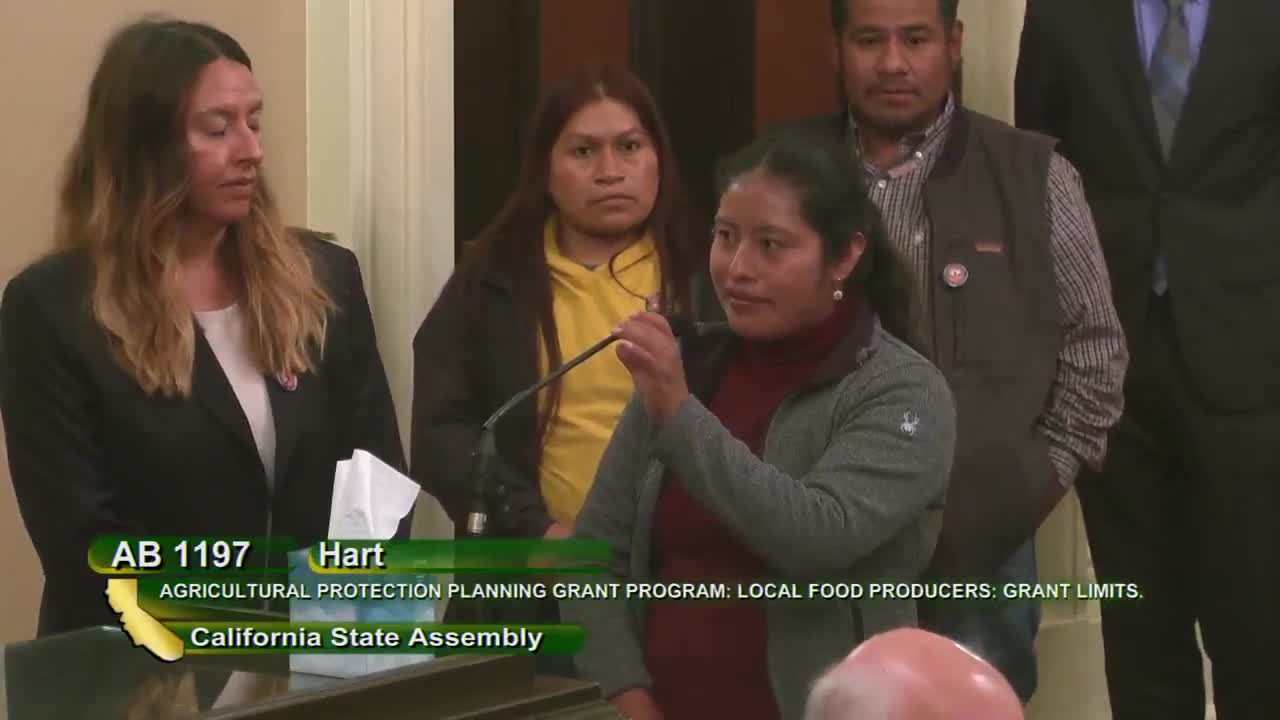 12MIN
Assembly Standing Committee on Agriculture
Bill Author


