AB 14: Personal Income Tax: credit: childcare costs.
- Session Year: 2023-2024
- House: Assembly
- Latest Version Date: 2023-03-02
Current Status:
Failed
(2024-02-01: From committee: Filed with the Chief Clerk pursuant to Joint Rule 56.)
Introduced
In Committee
First Chamber
In Committee
Second Chamber
Enacted
What does this bill do?
The bill creates a state income tax credit for taxpayers who qualify for California’s child and dependent care credit to cover childcare costs paid in California for tax years 2025 through 2029. The credit is limited each year to the lesser of $500 or the federal child care credit amount minus any existing California credit, can be carried forward up to seven years if unused, and requires the Franchise Tax Board to report how many taxpayers claim it and the average credit amount.
The summary is provided by generative AI which can make mistakes. For original language, please view the details in the table below.
The Personal Income Tax Law allows various credits against the taxes imposed by that law. That law, in modified conformity to federal income tax law, authorizes a credit for household and dependent care expenses necessary for gainful employment, as provided.
This bill would allow a credit against those taxes for each taxable year beginning on or after January 1, 2025, and before January 1, 2030, in an amount equal to childcare costs, as defined, paid or incurred by the qualified taxpayer in this state. The bill would limit the total credit for each taxable year, as specified.
Existing law requires any bill authorizing a new tax expenditure, as defined, to include tax credits, to contain, among other things, specific goals, purposes, and objectives that the tax credit will achieve, detailed performance indicators, and data collection requirements.
This bill would include findings and reporting requirements in compliance with this requirement.
This bill would take effect immediately as a tax levy.
The Personal Income Tax Law and the Corporation Tax Law, in conformity with federal income tax law, generally define gross income as income from whatever source derived, except as specifically excluded. Those laws also provide various exclusions and deductions from gross income, including exclusions and deductions for specified contributions to health savings accounts and medical savings accounts, as defined.This bill would state the intention of the Legislature to enact legislation that would establish similar tax-preferred savings and investment accounts for childcare expenses.The Personal Income Tax Law and the Corporation Tax Law, in conformity with federal income tax law, generally define gross income as income from whatever source derived, except as specifically excluded. Those laws also provide various exclusions and deductions from gross income, including exclusions and deductions for specified contributions to health savings accounts and medical savings accounts, as defined.
This bill would state the intention of the Legislature to enact legislation that would establish similar tax-preferred savings and investment accounts for childcare expenses.
(a)For each taxable year beginning on or after January 1, 2025, and before January 1, 2030, there shall be allowed a credit against the net tax, as defined in Section 17039, to a qualified taxpayer in an amount equal to childcare costs paid or incurred by the qualified taxpayer in this state. The total credit for a qualified taxpayer for each taxable year shall not exceed the lesser of the following:
(1)Five hundred dollars ($500).
(2)The amount of the allowable federal credit under Section 21 of the Internal Revenue Code less the amount of the credit claimed under Section 17052.6 for the applicable taxable year.
(b)For purposes of this section, the following definitions apply:
(1)Childcare costs mean employment-related expenses, within the meaning of Section 21 of the Internal Revenue Code, but limited to expenses for household services and care provided in this state, as described in Section 17052.6.
(2)Qualified taxpayer means a taxpayer who is qualified to receive the credit under Section 17052.6.
(c)In the case where the credit allowed by this section exceeds the net tax, the excess may be carried over to reduce the net tax in the following year, and the succeeding seven years if necessary, until the credit is exhausted.
(d)The Franchise Tax Board may prescribe rules, guidelines, or procedures necessary or appropriate to carry out the purposes of this section, including any guidelines regarding the allocation of the credit allowed under this section.
(e)(1)The Legislature finds and declares all of the following:
(A)Childcare costs are a major expense for families, with California ranked third in the nation for the cost of infant care.
(B)The average cost of infant care is $1,412 per month. Care for a four-year-old child is expected to be $956 per month.
(C)For many families, childcare costs are second only to housing.
(D)According to the Economic Policy Institute, which focuses on the needs of low- and middle-income workers, childcare may cost more than college in California.
(E)Californias current Child and Dependent Care Expenses Credit, which allows taxpayers to reduce their tax liability by a percentage of their eligible childcare expenses and can be claimed by families who pay for care in order to work or look for work, does not cover enough of the cost of childcare.
(2)For purposes of complying with Section 41, the Legislature finds and declares that the goal, purpose, and objective of the tax credit allowed by this section, hereafter the credit, is to help families with the cost of childcare.
(3)The performance indicators to measure whether the credit meets the goal, purpose, and objective stated in subdivision (b) are as follows:
(A)The number of taxpayers claiming the credit.
(B)The average credit amount on tax returns claiming the credit.
(4)The Franchise Tax Board shall have the following data collection and reporting requirements:
(A)Notwithstanding Section 19542, the board shall prepare a written report that includes data on the performance indicators described in subdivision (c).
(B)The report shall be provided to the Legislature by June 1, 2029, in compliance with Section 9795 of the Government Code.
(f)This section shall remain in effect only until December 1, 2030, and as of that date is repealed. However, any unused credit may continue to be carried forward, as provided in subdivision (c), until the credit is exhausted.
SEC. 2.This act provides for a tax levy within the meaning of Article IV of the California Constitution and shall go into immediate effect.
SECTION 1.It is the intent of the Legislature to enact legislation that would provide for tax-preferred childcare savings and investment accounts to allow families to save for childcare expenses, often one of the largest expenses for a family.It is the intent of the Legislature to enact legislation that would provide for tax-preferred childcare savings and investment accounts to allow families to save for childcare expenses, often one of the largest expenses for a family.
|
Date
|
Status
|
|---|---|
| Feb 1, 2024 | From committee: Filed with the Chief Clerk pursuant to Joint Rule 56. |
| Jan 31, 2024 | Died pursuant to Art. IV, Sec. 10(c) of the Constitution. |
| May 1, 2023 | In committee: Set, second hearing. Held under submission. |
| Mar 21, 2023 | In committee: Set, first hearing. Referred to REV. & TAX. suspense file. |
| Mar 6, 2023 | Re-referred to Com. on REV. & TAX. |
| Mar 2, 2023 | From committee chair, with author's amendments: Amend, and re-refer to Com. on REV. & TAX. Read second time and amended. |
| Mar 2, 2023 | Referred to Com. on REV. & TAX. |
| Dec 6, 2022 | From printer. May be heard in committee January 5. |
| Dec 5, 2022 | Read first time. To print. |
This list shows positions taken on this bill by organizations on the date displayed, which is linked to the original source.
Positions by individuals are not included.
|
Organization
|
Position
|
Date
|
|---|---|---|
| California Tax Reform Association | ** Against | |
| Care.com | ** Support |
Date of Hearing: May 1, 2023
ASSEMBLY COMMITTEE ON REVENUE AND TAXATION
Jacqui Irwin, Chair
ABPCA Bill Id:AB 14 (
Author:Davies) – As Amended Ver:March 2, 2023
SUSPENSE
Majority vote. Tax levy. Fiscal committee.
SUBJECT: Personal Income Tax: credit: childcare costs
SUMMARY: Allows, under the Personal Income Tax (PIT) Law, an additional credit for taxpayers who qualify for the existing Federal child and dependent care expense credit, as specified. Specifically, this bill:
- Allows, for taxable years beginning on or after January 1, 2025, and before January 1, 2030, a credit under the PIT Law equal to the "childcare costs" paid or incurred by a "qualified taxpayer" in California, not to exceed the lesser of either:
- $500; or,
- The amount of the allowable Federal child and dependent care credit minus the amount claimed by the taxpayer for the California child and dependent care expense credit.
- Provides that, in cases where the credit allowed by this bill exceeds the taxpayer's tax liability, the excess credit amount may be carried over for up to eight years, until the credit is exhausted.
- Defines "childcare costs" as employment-related expenses for care or services rendered in California, consistent with the existing California child and dependent care expense credit.
- Defines a "qualified taxpayer" as a taxpayer who qualifies for the existing California child and dependent care expense credit.
- Sunsets the credit's statutory provisions on December 1, 2030, but provides that any unused credits may continue to be carried forward until the credit is exhausted.
- Finds and declares the following for the purposes of satisfying the requirements of Revenue & Taxation Code (R&TC) Section 41:
- The specific goals, purposes, and objectives of this bill are to help families with the cost of childcare.
- To measure whether this bill achieves its intended purpose, the Franchise Tax Board (FTB) shall prepare a written report on the following:
- The number of taxpayers claiming the credit; and,
- The average credit amount on tax returns claiming the credit.
- Takes immediate effect as a tax levy.
EXISTING FEDERAL LAW:
- Allows a credit equal to the applicable percentage of qualifying expenses for household and dependent care services necessary for gainful employment. This credit is often referred to as the Child and Dependent Care Expense Credit (Internal Revenue Code (IRC), Section 21).
- Provides, for purposes of the Child and Dependent Care Expense Credit, all of the following:
- The percentage of work-related expenses allowed as a credit depends on the taxpayer's income (and their spouse's income in the case of a joint return) and decreases as the taxpayer's adjusted gross income (AGI) increases. The maximum percentage of work-related expenses allowed as a credit for 2023 is 35 percent and is provided to qualifying taxpayers with an AGI of $15,000 or less. The minimum percentage of work-related expenses allowed as a credit is 20 percent and is provided to qualifying taxpayers with an AGI of $43,000 or greater.
- The amount of employment-related expenses incurred during any taxable year that may be taken into account shall not exceed:
- $3,000 if there is one qualifying individual with respect to the taxpayer for such taxable year; or,
- $6,000 if there are two or more qualifying individuals with respect to the taxpayer for such taxable year.
- $3,000 if there is one qualifying individual with respect to the taxpayer for such taxable year; or,
- Any dependent care benefits that a taxpayer deducts or excludes from their income, including employer-provided care such as on-site daycare, must be subtracted from the maximum allowable Federal credit amount that corresponds to the taxpayer's AGI.
- The amount of employment-related expenses incurred during any taxable year that may be taken into account shall not exceed the individual's earned income for such year, if filing a separate return, or the lesser of the individual and spouse's earned income for such year, if filing a joint return.
- Taxpayers are required to provide identifying information for service providers, including their name, address, and taxpayer identification number, in order to claim expenses incurred to provide care to a qualifying individual.
- The percentage of work-related expenses allowed as a credit depends on the taxpayer's income (and their spouse's income in the case of a joint return) and decreases as the taxpayer's adjusted gross income (AGI) increases. The maximum percentage of work-related expenses allowed as a credit for 2023 is 35 percent and is provided to qualifying taxpayers with an AGI of $15,000 or less. The minimum percentage of work-related expenses allowed as a credit is 20 percent and is provided to qualifying taxpayers with an AGI of $43,000 or greater.
- Defines, for purposes of the Child and Dependent Care Expense Credit, the following terms:
- A "qualified individual" is defined as:
- A dependent of the taxpayer who is under the age of 13 when the care or services are received;
- A dependent of the taxpayer who is physically or mentally incapable of caring for himself or herself and who has the same principal place of abode as the taxpayer for more than one-half of such taxable year; or,
- The spouse of the taxpayer, if the spouse is physically or mentally incapable of caring for himself or herself and who has the same principal place of abode as the taxpayer for more than one-half of such taxable year.
- A dependent of the taxpayer who is under the age of 13 when the care or services are received;
- "Employment-related expenses" are defined as amounts paid for household services and care of qualifying individuals only if such expenses are incurred to enable the taxpayer to be gainfully employed for any period for which there are one or more qualifying individuals with respect to the taxpayer.
- A "qualified individual" is defined as:
EXISTING STATE LAW:
- Allows, under the PIT Law, a credit amount equal to a certain percentage of the Federal child and dependent care expense credit, depending on the taxpayer's AGI. (R&TC 17052.6)
- For taxable years beginning on or after January 1, 2003, taxpayers are eligible for the following credits based on their AGI:
- Taxpayers with an AGI of $40,000 or less are eligible for a credit amount equal to 50 percent of the Federal credit amount;
- Taxpayers with an AGI over $40,000 but not over $70,000 are eligible for a credit amount equal to 43 percent of the Federal credit amount; and,
- Taxpayers with an AGI over $70,000 but not over $100,000 are eligible for a credit amount equal to 34 percent of the Federal credit amount.
- For taxable years beginning on or after January 1, 2003, taxpayers are eligible for the following credits based on their AGI:
- Provides that taxpayers with an AGI over $100,000 are not eligible to claim the credit.
- Conforms to the IRC definition of "employment-related expenses" but specifies that the credit applies to services or care provided within California.
- Requires any bill authorizing a new credit to contain all of the following:
- Specific goals, purposes, and objectives that the tax credit will achieve;
- Detailed performance indicators for the Legislature to use when measuring whether the tax credit meets the goals, purposes, and objectives stated in the bill; and,
- Data collection requirements to enable the Legislature to determine whether the tax credit is meeting, failing to meet, or exceeding those specific goals, purposes, and objectives. The requirements shall include the specific data and baseline measurements to be collected and remitted in each year the credit is in effect, for the Legislature to measure the change in performance indicators, and the specific taxpayers, state agencies, or other entities required to collect and remit data. (R&TC Section 41.)
FISCAL EFFECT: The FTB estimates General Fund revenue losses of $28 million in fiscal year (FY) 2024-25 and $55 million in FY 2025-26.
COMMENTS:
- The author has provided the following statement in support of this bill:
All across California, parents are struggling with the high costs of gas, food and housing expenses. In order to afford to live in California, many parents and families work longer hours or sometimes double jobs. In order to do this, they need help via childcare services. But this too comes at a high-cost. AB 14 is a common-sense measure to help families pay for some of the expenses they incur when it comes to putting their child in care. At a time when we have seen record inflation the past two-years, this is a modest approach to help ease the high cost-of-living in California.
- Care.com, writing in support of the bill, notes, in part:
Too many families in California continue to fall through care “gaps.” These gaps force parents, too many of them women, out of the workforce, forfeiting career opportunities that could further stabilize their family’s economic position – leading to lifelong impacts for the affected children. These are families that fall victim to the “care cliff” – those with jobs but still can’t afford care because they make too much (even one dollar over the threshold cap) to qualify for subsidized care but not enough to cover the total cost of their dependent care needs out of pocket. One of the most effective tools for working- and middle-class families to help reduce the cost of care and offer more choice is smart and thoughtful tax policy – like a modernized Employer-Provided Child Care Credit, an enhanced Child and Dependent Care Tax Credit and creative pre-tax or tax-preferred accounts for dependent care.
- The California Tax Reform Association, writing in opposition to the bill, notes, in part:
Currently, both state and federal law allow credits against income tax liabilities for child and dependent care costs. AB 14, as written, references the same eligible individuals in determining who would qualify for this new, additional credit. It is unclear in doing so if the author simply wishes to provide an additional credit to the same population, or if the intent is to assist a population of parents and guardians who are not currently receiving any relief. The latter group would not be eligible under the current definitions of the bill… As written and given the lack of clarity on the credits intended recipients, it is questionable as to whether AB 14 is the right approach to addressing childcare availability and access.
- Committee Staff Comments:
- What is a "tax expenditure"? Existing law provides various credits, deductions, exclusions, and exemptions for particular taxpayer groups. In the late 1960s, U.S. Treasury officials began arguing that these features of the tax law should be referred to as "expenditures" since they are generally enacted to accomplish some governmental purpose and there is a determinable cost associated with each (in the form of foregone revenues).
As the Department of Finance notes in its annual Tax Expenditure Report, there are several key differences between tax expenditures and direct expenditures. First, tax expenditures are typically reviewed less frequently than direct expenditures. Second, there is generally no control over the amount of revenue losses associated with any given tax expenditure. Finally, it should also be noted that, once enacted, it takes a two-thirds vote to rescind an existing tax expenditure absent a sunset date. This effectively results in a "one-way ratchet" whereby tax expenditures can be conferred by majority vote, but cannot be rescinded, irrespective of their efficacy or cost, without a supermajority vote.
- What problem is this bill attempting to solve? According to the author, childcare costs are a major expense for families in California, often exceeding the tuition costs at an in-state four-year public college. According to the Economic Policy Institute, the average annual cost of infant care in California is $16,945 – or $1,412 per month – and the average annual cost of childcare for a four-year-old is $11,475 – or $956 per month. These figures place California 3rd out of 50 states and the District of Columbia for most expensive infant care.[1] Families with two or more children face even greater costs for childcare.
- Workforce participation declined in large part due to a lack of affordable childcare: According to the Richmond Federal Reserve, from March to April 2020, women's labor force participation (LFP) fell 2.5 percentage points.[2] For women without a bachelor's degree, LFP declined 7.5 percentage points in March/April 2020, suggesting that those with less formal education were affected most strongly by the COVID-19 pandemic. Due to stay-at-home orders and schools switching to remote learning in March 2020, at-home childcare became a necessity and many families reacted by having women caregivers reallocate their time from paid work towards childcare and education.[3] While much of the initial drop recovered quickly, it still remains notably below the rate prior to the pandemic.
- Duplicating existing credits: As described above, both Federal and California law allow credits against income tax liabilities for child and dependent care costs. As currently drafted, this bill references the definitions in these existing credits to determine which taxpayers and expenses would qualify. Instead of creating an additional tax credit with identical requirements, the Committee may wish to consider whether a more straightforward approach would be to simply increase the percentage of the Federal credit that the taxpayer could claim for purposes of the California credit. Alternatively, a separate credit with different eligibility requirements may help provide relief to taxpayers that do not currently stand to benefit from the existing credits.
- Prior legislation:
- AB 2803 (Valladares), of the 2021-22 Legislative Session, would have provided a credit under the PIT Law and Corporation Tax Law for contributions paid or incurred by an employer for qualified care for their employees' dependents. AB 2803 did not pass this Committee.
- AB 24 (Burke), of the 2019-20 Legislative Session, would have provided a refundable Targeted Child Tax Credit equal to the gap between the deep poverty threshold and a household's net resources. AB 24 did not pass the Assembly Appropriations Committee.
- AB 2803 (Valladares), of the 2021-22 Legislative Session, would have provided a credit under the PIT Law and Corporation Tax Law for contributions paid or incurred by an employer for qualified care for their employees' dependents. AB 2803 did not pass this Committee.
- What problem is this bill attempting to solve? According to the author, childcare costs are a major expense for families in California, often exceeding the tuition costs at an in-state four-year public college. According to the Economic Policy Institute, the average annual cost of infant care in California is $16,945 – or $1,412 per month – and the average annual cost of childcare for a four-year-old is $11,475 – or $956 per month. These figures place California 3rd out of 50 states and the District of Columbia for most expensive infant care.[1] Families with two or more children face even greater costs for childcare.
REGISTERED SUPPORT / OPPOSITION:
Support
Care.com
Opposition
California Tax Reform Association
Analysis Prepared by: Wesley Whitaker / REV. & TAX. / (916) 319-2098
"Childcare Costs in the United States: California," Economic Policy Institute. https://www.epi.org/child-care-costs-in-the-united-states/#/CA. ↑
Athreya and Latham, "The Pandemic, Child Care and Women's Labor Force Participation." Federal Reserve Bank of Richmond Economic Brief (May 2022), No. 22-16. https://www.richmondfed.org/publications/research/economic_brief/2022/eb_22-16. ↑
Garcia and Cowan, "The Impact of U.S. School Closures on Labor Market Outcomes during the COVID-19 Pandemic," National Bureau of Economic Research (NBER), Working Paper 29641 (October 2022). https://www.nber.org/papers/w29641. ↑
Date of Hearing: March 20, 2023
ASSEMBLY COMMITTEE ON REVENUE AND TAXATION
Jacqui Irwin, Chair
ABPCA Bill Id:AB 14 (
Author:Davies) – As Amended Ver:March 2, 2023
Majority vote. Tax levy. Fiscal committee.
SUBJECT: Personal Income Tax: credit: childcare costs
SUMMARY: Allows, under the Personal Income Tax (PIT) Law, an additional credit for taxpayers who qualify for the existing Federal child and dependent care expense credit, as specified. Specifically, this bill:
- Allows, for taxable years beginning on or after January 1, 2025, and before January 1, 2030, a credit under the PIT Law equal to the "childcare costs" paid or incurred by a "qualified taxpayer" in California, not to exceed the lesser of either:
- $500; or,
- The amount of the allowable Federal child and dependent care credit minus the amount claimed by the taxpayer for the California child and dependent care expense credit.
- Provides that, in cases where the credit allowed by this bill exceeds the taxpayer's tax liability, the excess credit amount may be carried over for up to eight years, until the credit is exhausted.
- Defines "childcare costs" as employment-related expenses for care or services rendered in California, consistent with the existing California child and dependent care expense credit.
- Defines a "qualified taxpayer" as a taxpayer who qualifies for the existing California child and dependent care expense credit.
- Sunsets the credit's statutory provisions on December 1, 2030, but provides that any unused credits may continue to be carried forward until the credit is exhausted.
- Finds and declares the following for the purposes of satisfying the requirements of Revenue & Taxation Code (R&TC) Section 41:
- The specific goals, purposes, and objectives of this bill are to help families with the cost of childcare.
- To measure whether this bill achieves its intended purpose, the Franchise Tax Board (FTB) shall prepare a written report on the following:
- The number of taxpayers claiming the credit; and,
- The average credit amount on tax returns claiming the credit.
- Takes immediate effect as a tax levy.
EXISTING FEDERAL LAW:
- Allows a credit equal to the applicable percentage of qualifying expenses for household and dependent care services necessary for gainful employment. This credit is often referred to as the Child and Dependent Care Expense Credit (Internal Revenue Code (IRC), Section 21).
- Provides, for purposes of the Child and Dependent Care Expense Credit, all of the following:
- The percentage of work-related expenses allowed as a credit depends on the taxpayer's income (and their spouse's income in the case of a joint return) and decreases as the taxpayer's adjusted gross income (AGI) increases. The maximum percentage of work-related expenses allowed as a credit for 2023 is 35 percent and is provided to qualifying taxpayers with an AGI of $15,000 or less. The minimum percentage of work-related expenses allowed as a credit is 20 percent and is provided to qualifying taxpayers with an AGI of $43,000 or greater.
- The amount of employment-related expenses incurred during any taxable year that may be taken into account shall not exceed:
- $3,000 if there is one qualifying individual with respect to the taxpayer for such taxable year; or,
- $6,000 if there are two or more qualifying individuals with respect to the taxpayer for such taxable year.
- $3,000 if there is one qualifying individual with respect to the taxpayer for such taxable year; or,
- Any dependent care benefits that a taxpayer deducts or excludes from their income, including employer-provided care such as on-site daycare, must be subtracted from the maximum allowable Federal credit amount that corresponds to the taxpayer's AGI.
- The amount of employment-related expenses incurred during any taxable year that may be taken into account shall not exceed the individual's earned income for such year, if filing a separate return, or the lesser of the individual and spouse's earned income for such year, if filing a joint return.
- Taxpayers are required to provide identifying information for service providers, including their name, address, and taxpayer identification number, in order to claim expenses incurred to provide care to a qualifying individual.
- The percentage of work-related expenses allowed as a credit depends on the taxpayer's income (and their spouse's income in the case of a joint return) and decreases as the taxpayer's adjusted gross income (AGI) increases. The maximum percentage of work-related expenses allowed as a credit for 2023 is 35 percent and is provided to qualifying taxpayers with an AGI of $15,000 or less. The minimum percentage of work-related expenses allowed as a credit is 20 percent and is provided to qualifying taxpayers with an AGI of $43,000 or greater.
- Defines, for purposes of the Child and Dependent Care Expense Credit, the following terms:
- A "qualified individual" is defined as:
- A dependent of the taxpayer who is under the age of 13 when the care or services are received;
- A dependent of the taxpayer who is physically or mentally incapable of caring for himself or herself and who has the same principal place of abode as the taxpayer for more than one-half of such taxable year; or,
- The spouse of the taxpayer, if the spouse is physically or mentally incapable of caring for himself or herself and who has the same principal place of abode as the taxpayer for more than one-half of such taxable year.
- A dependent of the taxpayer who is under the age of 13 when the care or services are received;
- "Employment-related expenses" are defined as amounts paid for household services and care of qualifying individuals only if such expenses are incurred to enable the taxpayer to be gainfully employed for any period for which there are one or more qualifying individuals with respect to the taxpayer.
- A "qualified individual" is defined as:
EXISTING STATE LAW:
- Allows, under the PIT Law, a credit amount equal to a certain percentage of the Federal child and dependent care expense credit, depending on the taxpayer's AGI. (R&TC 17052.6)
- For taxable years beginning on or after January 1, 2003, taxpayers are eligible for the following credits based on their AGI:
- Taxpayers with an AGI of $40,000 or less are eligible for a credit amount equal to 50 percent of the Federal credit amount;
- Taxpayers with an AGI over $40,000 but not over $70,000 are eligible for a credit amount equal to 43 percent of the Federal credit amount; and,
- Taxpayers with an AGI over $70,000 but not over $100,000 are eligible for a credit amount equal to 34 percent of the Federal credit amount.
- For taxable years beginning on or after January 1, 2003, taxpayers are eligible for the following credits based on their AGI:
- Provides that taxpayers with an AGI over $100,000 are not eligible to claim the credit.
- Conforms to the IRC definition of "employment-related expenses" but specifies that the credit applies to services or care provided within California.
- Requires any bill authorizing a new credit to contain all of the following:
- Specific goals, purposes, and objectives that the tax credit will achieve;
- Detailed performance indicators for the Legislature to use when measuring whether the tax credit meets the goals, purposes, and objectives stated in the bill; and,
- Data collection requirements to enable the Legislature to determine whether the tax credit is meeting, failing to meet, or exceeding those specific goals, purposes, and objectives. The requirements shall include the specific data and baseline measurements to be collected and remitted in each year the credit is in effect, for the Legislature to measure the change in performance indicators, and the specific taxpayers, state agencies, or other entities required to collect and remit data. (R&TC Section 41.)
FISCAL EFFECT: The FTB estimates General Fund revenue losses of $28 million in fiscal year (FY) 2024-25 and $55 million in FY 2025-26.
COMMENTS:
- The author has provided the following statement in support of this bill:
All across California, parents are struggling with the high costs of gas, food and housing expenses. In order to afford to live in California, many parents and families work longer hours or sometimes double jobs. In order to do this, they need help via childcare services. But this too comes at a high-cost. AB 14 is a common-sense measure to help families pay for some of the expenses they incur when it comes to putting their child in care. At a time when we have seen record inflation the past two-years, this is a modest approach to help ease the high cost-of-living in California.
- Committee Staff Comments:
- What is a "tax expenditure"? Existing law provides various credits, deductions, exclusions, and exemptions for particular taxpayer groups. In the late 1960s, U.S. Treasury officials began arguing that these features of the tax law should be referred to as "expenditures" since they are generally enacted to accomplish some governmental purpose and there is a determinable cost associated with each (in the form of foregone revenues).
As the Department of Finance notes in its annual Tax Expenditure Report, there are several key differences between tax expenditures and direct expenditures. First, tax expenditures are typically reviewed less frequently than direct expenditures. Second, there is generally no control over the amount of revenue losses associated with any given tax expenditure. Finally, it should also be noted that, once enacted, it takes a two-thirds vote to rescind an existing tax expenditure absent a sunset date. This effectively results in a "one-way ratchet" whereby tax expenditures can be conferred by majority vote, but cannot be rescinded, irrespective of their efficacy or cost, without a supermajority vote.
- What problem is this bill attempting to solve? According to the author, childcare costs are a major expense for families in California, often exceeding the tuition costs at an in-state four-year public college. According to the Economic Policy Institute, the average annual cost of infant care in California is $16,945 – or $1,412 per month – and the average annual cost of childcare for a four-year-old is $11,475 – or $956 per month. These figures place California 3rd out of 50 states and the District of Columbia for most expensive infant care.[1] Families with two or more children face even greater costs for childcare.
- Workforce participation declined in large part due to a lack of affordable childcare: According to the Richmond Federal Reserve, from March to April 2020, women's labor force participation (LFP) fell 2.5 percentage points.[2] For women without a bachelor's degree, LFP declined 7.5 percentage points in March/April 2020, suggesting that those with less formal education were affected most strongly by the COVID-19 pandemic. Due to stay-at-home orders and schools switching to remote learning in March 2020, at-home childcare became a necessity and many families reacted by having women caregivers reallocate their time from paid work towards childcare and education.[3] While much of the initial drop recovered quickly, it still remains notably below the rate prior to the pandemic.
- Duplicating existing credits: As described above, both Federal and California law allow credits against income tax liabilities for child and dependent care costs. As currently drafted, this bill references the definitions in these existing credits to determine which taxpayers and expenses would qualify. Instead of creating an additional tax credit with identical requirements, the Committee may wish to consider whether a more straightforward approach would be to simply increase the percentage of the Federal credit that the taxpayer could claim for purposes of the California credit. Alternatively, a separate credit with different eligibility requirements may help provide relief to taxpayers that do not currently stand to benefit from the existing credits.
- Prior legislation:
- AB 2803 (Valladares), of the 2021-22 Legislative Session, would have provided a credit under the PIT Law and Corporation Tax Law for contributions paid or incurred by an employer for qualified care for their employees' dependents. AB 2803 did not pass this Committee.
- AB 24 (Burke), of the 2019-20 Legislative Session, would have provided a refundable Targeted Child Tax Credit equal to the gap between the deep poverty threshold and a household's net resources. AB 24 did not pass the Assembly Appropriations Committee.
- AB 2803 (Valladares), of the 2021-22 Legislative Session, would have provided a credit under the PIT Law and Corporation Tax Law for contributions paid or incurred by an employer for qualified care for their employees' dependents. AB 2803 did not pass this Committee.
- What problem is this bill attempting to solve? According to the author, childcare costs are a major expense for families in California, often exceeding the tuition costs at an in-state four-year public college. According to the Economic Policy Institute, the average annual cost of infant care in California is $16,945 – or $1,412 per month – and the average annual cost of childcare for a four-year-old is $11,475 – or $956 per month. These figures place California 3rd out of 50 states and the District of Columbia for most expensive infant care.[1] Families with two or more children face even greater costs for childcare.
REGISTERED SUPPORT / OPPOSITION:
Support
None on file
Opposition
None on file
Analysis Prepared by: Wesley Whitaker / REV. & TAX. / (916) 319-2098
"Childcare Costs in the United States: California," Economic Policy Institute. https://www.epi.org/child-care-costs-in-the-united-states/#/CA. ↑
Athreya and Latham, "The Pandemic, Child Care and Women's Labor Force Participation." Federal Reserve Bank of Richmond Economic Brief (May 2022), No. 22-16. https://www.richmondfed.org/publications/research/economic_brief/2022/eb_22-16. ↑
Garcia and Cowan, "The Impact of U.S. School Closures on Labor Market Outcomes during the COVID-19 Pandemic," National Bureau of Economic Research (NBER), Working Paper 29641 (October 2022). https://www.nber.org/papers/w29641. ↑
Discussed in Hearing
 2MIN
Senate Floor
 4MIN
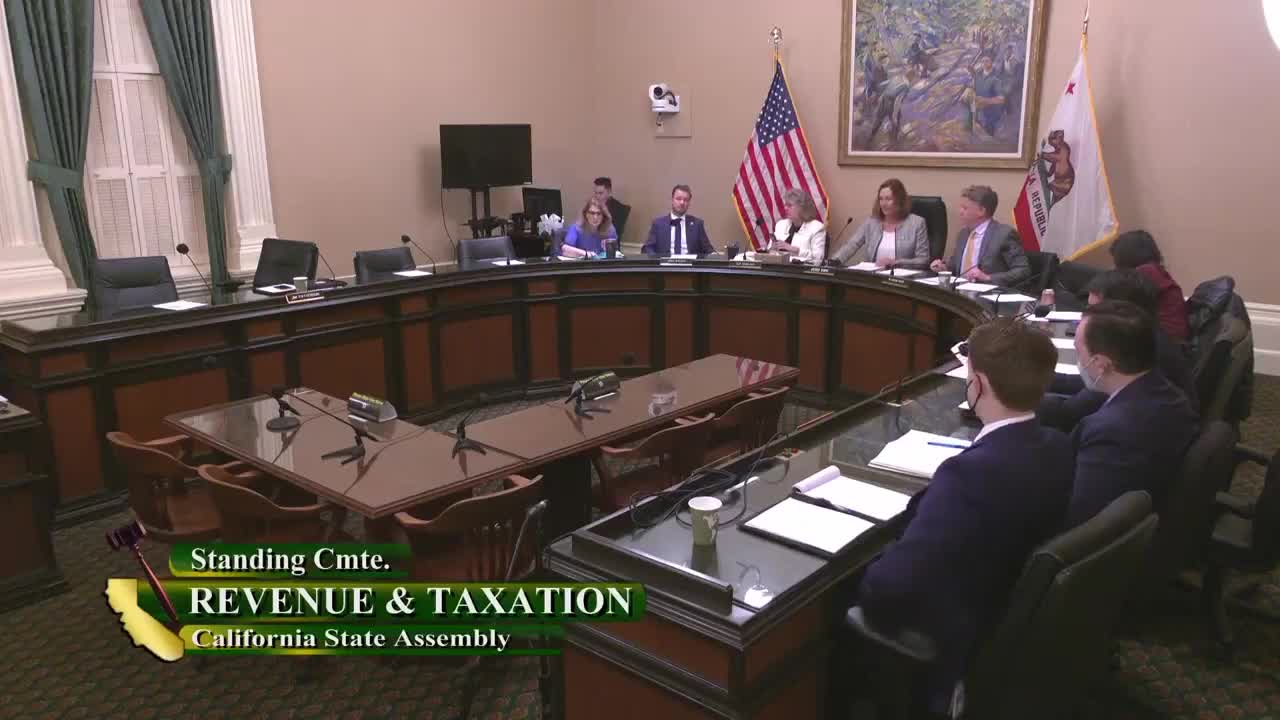
Assembly Standing Committee on Revenue and Taxation


Bill Co-Author(s):