AB 260: Community colleges: part-time employees.
- Session Year: 2023-2024
- House: Assembly
- Latest Version Date: 2023-01-19
Current Status:
Failed
(2024-02-01: From committee: Filed with the Chief Clerk pursuant to Joint Rule 56.)
Introduced
In Committee
First Chamber
In Committee
Second Chamber
Enacted
What does this bill do?
The bill requires part-time instructors at California community colleges and adult schools to be paid a pro rata share of full‑time pay — their pay must match the same ratio as the hours they work compared with full‑time employees with similar duties. It also requires districts to negotiate pay, rehiring preference, and regular evaluations for part‑time faculty, and it leaves existing union contracts in place until they expire or are renewed.
The summary is provided by generative AI which can make mistakes. For original language, please view the details in the table below.
Existing law establishes the California Community Colleges under the administration of the Board of Governors of the California Community Colleges. Existing law authorizes the establishment of community college districts under the administration of community college governing boards, and authorizes these districts to provide instruction at community college campuses throughout the state. Existing law authorizes these districts to establish compensation levels for academic employees, as provided.
Existing law requires community college districts, as a condition of receiving funding allocated for the Student Success and Support Program, to negotiate in good faith with the exclusive representatives for part-time, temporary faculty, the terms of reemployment preference for part-time, temporary faculty assignments based on minimum standards up to the range of 60% to 67% of a full-time equivalent load and a regular evaluation process for part-time, temporary faculty, as specified. Existing law establishes procedures for community college districts to demonstrate compliance with these requirements.
This bill would require persons who are employed to teach adult or community college classes part time, as provided, to receive compensation in at least an amount that bears the same ratio to the amount provided to full-time employees as the time actually served by those part-time employees bears to the time actually served by full-time employees with comparable duties. The bill would impose this pay requirement upon the expiration or renewal of existing collective bargaining agreements, as provided.
This bill would also require community college districts, as a condition of receiving funds allocated for the Student Success and Support Program in the annual Budget Act, to commence the negotiation of terms of compensation consistent with the proportional pay requirement for part-time employees, as well as terms governing reemployment preferences and evaluation processes, no later than the expiration of any negotiated agreement in effect on January 1, 2024, and for any community college district that does not have a collective bargaining agreement in effect as of January 1, 2024, on January 1, 2024.
The Legislature finds and declares all of the following:
(a)The California Community College system is the largest higher education system in the world and serves the most diverse student body in the nation and the world.
(b)The Legislature has taken steps to improve student success, ensure equity, and provide students with the resources needed to complete their college degrees and certificates.
(c)Part-time faculty comprise approximately 70 percent of the faculty at Californias community colleges, and teach approximately 50 percent of the classes; these employees endeavor to fulfill the intent of the Legislature in improving student success.
(d)In 1968, the Education Code was amended to create part-time faculty positions to fill emergency, temporary needs in Californias community colleges; however, part-time faculty have become a permanent fixture in Californias college system and many of these professionals have been teaching on temporary contracts for decades at the same institutions.
(e)The result of an excessive number of part-time community college faculty means that many faculty are working multiple jobs to earn a living, are not provided adequate space on campus to meet with students, are not included in the shared governance work that informs the college decisions and curriculum, and are not compensated for required professional development established by the Legislature.
(f)The California Community Colleges Chancellors Office has determined that part-time faculty members across the state are paid, on average, one half as much as full-time faculty members per hour for comparable duties.
(g)The Legislature must act to ensure the faculty at our Community Colleges are treated with dignity and respect, and faculty are provided good jobs to support their families. Without immediate action, the success of students attending California community colleges is compromised.
SEC. 2.Section 87482.3 of the Education Code is amended to read:87482.3.(a)(1)As a condition of receiving funds allocated for the Student Success and Support Program in the annual Budget Act, on or after July 1, 2017, community college districts that do not have a collective bargaining agreement with part-time, temporary faculty in effect as of January 1, 2017, shall commence negotiations negotiate with the exclusive representatives bargaining representative for part-time, temporary faculty regarding the terms and conditions required by subdivision (b). The parties shall negotiate these rights for part-time, temporary faculty. (b) as follows:
(A)A community college district that does not have a collective bargaining agreement with part-time, temporary faculty in effect as of January 1, 2024, shall commence negotiations on January 1, 2024.
(B)A community college district that has a collective bargaining agreement with part-time, temporary faculty in effect as of January 1, 2024, shall commence negotiations no later than the expiration date of the collective bargaining agreement.
(C)The parties shall negotiate these rights for part-time, temporary faculty.
(2)It is the intent of the Legislature that both of the following shall occur:
(A)The adoption of provisions in compliance with subdivision (b) shall be included as part of the usual and customary negotiations between the community college district and the exclusive representative for part-time, temporary faculty.
(B)(i)A community college district shall establish minimum standards for the terms of reemployment preference for part-time, temporary faculty assignments through the negotiation process between the community college district and the exclusive representative for part-time, temporary faculty. These standards shall include all of the following:
(I)The length of time part-time, temporary faculty have served at the community college or district.
(II)The number of courses part-time, temporary faculty have taught at the community college or district.
(III)The evaluations of temporary faculty conducted pursuant to Section 87663 and other related methods of evaluation that can reliably be used to assess educational impact of temporary faculty as it relates to student success.
(IV)The availability, willingness, and expertise of part-time, temporary faculty to teach specific classes or take on specific assignments that are necessary for student instruction or services.
(ii)Additional standards may be considered and established through the negotiation process, as necessary.
(iii)Standards established pursuant to clause (ii) shall reflect the processes and procedures for both of the following:
(I)Assigning part-time, temporary faculty to teach courses or staff nonclassroom assignments.
(II)Evaluating part-time, temporary faculty.
(b)As a condition of receiving funds allocated for the Student Success and Support Program in the annual Budget Act and except as provided in subdivision (d), a community college district described in subparagraph (A) or (B) of paragraph (1) of subdivision (a) and the exclusive representative of the part-time, temporary faculty shall negotiate in good faith all of the following:
(1)The terms of reemployment preference for part-time, temporary faculty assignments based on the minimum standards up to the range of 60 to 67 percent of a full-time equivalent load. These terms shall also contain policies for termination, including, but not limited to, the evaluation process negotiated pursuant to paragraph (2).
(2)A regular evaluation process for part-time, temporary faculty pursuant to the requirements of Section 87663.
(3)Adoption of terms of compensation consistent with the requirement that persons who are employed to teach adult or community college classes for fewer than the hours per week considered a full-time assignment for regular employees having comparable duties shall receive compensation in at least an amount that bears the same ratio to the amount provided to full-time employees as the time actually served by those part-time employees bears to the time actually served by full-time employees with comparable duties, pursuant to Section 87815.5.
(c)A community college district that has a collective bargaining agreement in effect as of July 1, 2017, 2024, that has satisfied the requirements of subdivision (b), and that executes a signed written agreement with the exclusive representative of the part-time, temporary faculty acknowledging implementation of subdivision (b), shall be deemed to be in compliance with this section while the bargaining agreement is in effect.
(d)In all cases, part-time faculty assignments shall be temporary in nature, contingent on enrollment and funding, and subject to program changes, and no part-time faculty member shall have reasonable assurance of continued employment at any point, irrespective of the status, length of service, or reemployment preference of that part-time, temporary faculty member.
SEC. 3.Section 87815.5 is added to the Education Code, to read:87815.5.(a)Notwithstanding any other law, persons who are employed to teach adult or community college classes for fewer than the hours per week considered a full-time assignment for regular employees having comparable duties shall receive compensation in at least an amount that bears the same ratio to the amount provided full-time employees as the time actually served by those part-time employees bears to the time actually served by full-time employees with comparable duties.
(b) If the provisions of this section are in conflict with the terms of a collective bargaining agreement in effect before January 1, 2024, the provisions of this section do not apply to the community college district and part-time, temporary faculty subject to that agreement until the expiration or renewal of the agreement.
REVISIONS: HeadingLine 1.|
Date
|
Status
|
|---|---|
| Feb 1, 2024 | From committee: Filed with the Chief Clerk pursuant to Joint Rule 56. |
| Jan 31, 2024 | Died pursuant to Art. IV, Sec. 10(c) of the Constitution. |
| May 18, 2023 | In committee: Held under submission. |
| May 3, 2023 | In committee: Set, first hearing. Referred to APPR. suspense file. |
| Apr 19, 2023 | Coauthors revised. |
| Apr 19, 2023 | From committee: Do pass and re-refer to Com. on APPR. (Ayes 9. Noes 0.) (April 18). Re-referred to Com. on APPR. |
| Feb 2, 2023 | Referred to Com. on HIGHER ED. |
| Jan 20, 2023 | From printer. May be heard in committee February 19. |
| Jan 19, 2023 | Read first time. To print. |
|
Date
|
Description
|
Location
|
Votes
|
|
|---|---|---|---|---|
| Apr 18, 2023 | Do pass and be re-referred to the Committee on [Appropriations] | Assembly Standing Committee on Higher Education |
Passed |
This list shows positions taken on this bill by organizations on the date displayed, which is linked to the original source.
Positions by individuals are not included.
|
Organization
|
Position
|
Date
|
|---|---|---|
| American Association of University Women San Jose | ** Support | |
| Association Of California Community College Administrators | ** Against | |
| California Community College Independence | * Support | Apr 18, 2023 |
| California Community Colleges Chancellor's Office | * Support | Apr 18, 2023 |
| California Teachers Association | * Support | Apr 18, 2023 |
| Community College League of California | * Against | Apr 18, 2023 |
| Days for Girls International | ** Support | |
| Faculty Association of the California Community Colleges | * Support | Apr 18, 2023 |
| GENup | ** Support | |
| Student Center for California Community Colleges | * Support | Apr 18, 2023 |
Date of Hearing: May 3, 2023
ASSEMBLY COMMITTEE ON APPROPRIATIONS
Chris Holden, Chair
ABPCA Bill Id:AB 260
Author:(Santiago) – As Introduced Ver:January 19, 2023
Policy Committee: | Higher Education | Vote: | 9 - 0 |
|
| ||
|
|
Urgency: No State Mandated Local Program: No Reimbursable: No
SUMMARY:
This bill establishes a minimum level of compensation for part-time, temporary California Community College (CCC) faculty members.
Specifically, this bill:
- Requires each CCC district, as a condition of receiving funds allocated for the Student Success and Support Program (SSSP), to pay part-time, temporary faculty members who teach adult or CCC courses an average amount that is at least equal to the average pay of full-time faculty when computed on an hourly basis.
- Requires a CCC district that does not have a collective bargaining agreement with part-time, temporary faculty members in effect as of January 1, 2024, to commence negotiations upon the effective date of this measure with an exclusive bargaining representative for part-time, temporary faculty members.
- Requires a CCC district that has a collective bargaining agreement with part-time, temporary faculty members in effect as of January 1, 2024, to commence negotiations no later than the expiration date of the collective bargaining agreement with an exclusive bargaining representative for part-time, temporary faculty members.
FISCAL EFFECT:
Ongoing Proposition 98 General Fund costs, potentially in the hundreds of millions of dollars annually, to CCCs to increase compensation for part-time, temporary faculty members.
According to a report by the California Federation of Teachers (CFT), the average hourly pay for a part-time, temporary faculty member in 2019-20 was about $22.94 less than that of a full-time faculty member at step 1 on the salary schedule. Assuming the average part-time, temporary faculty teaches nine units a semester for two semesters (a total of 315 hours per CFT), the annual cost would be $7,226 per part-time, temporary faculty member, or $267 million for 37,000 part-time, temporary faculty members.
COMMENTS:
- Purpose. According to the author:
Currently, part-time faculty comprise 70% of community college faculty and teach approximately 50% of classes across the system. As a result, many California Community College (CCC) administrators are exploiting part-time faculty on their campuses as a cost-savings measure, which hurts part-time faculty, impedes full-time faculty hiring, and most importantly, negatively impacts the students they serve.
- Background. Full-time CCC faculty members receive a salary based on seniority, teaching load, prep time for classes they will teach, grading, curriculum development, program review and development, office hours, and committee work. Compensation is negotiated through collective bargaining with each CCC district.
Part-time, temporary CCC faculty member pay is largely based on the number of units a faculty member teaches, though a member may also receive additional hourly pay for office hours, flex time, or committee work. Part-time, temporary faculty member compensation is negotiated through collective bargaining with each CCC district. When calculated on an hourly basis, part-time, temporary faculty earn less than full-time faculty with equivalent years of experience and workload.
CCCs employ about 18,000 full-time faculty members and about 37,000 part-time, temporary faculty members.
SSSP program was established to provide ongoing funding to CCCs for student support in admissions, orientation, assessment, counseling and student follow up. In 2018, this program and the Student Success for Basic Skills program were consolidated into the new Student Equity and Achievement Program (SEAP). The 2022-23 budget provides $524 million for SEAP.
This bill would make a CCC’s receipt of SEAP funds contingent on implementing its provisions.
- Prior Legislation. AB 1752 (Santiago), of the 2021-2022 Legislative Session, was identical to this bill. AB 1752 was held in this committee.
AB 1856 (Medina), of the 2021-22 Legislative Session, would have increased the number of minimum hours as compared to a full-time faculty member that a part-time faculty member can teach at a CCC district, from 67% to 85%. The bill was vetoed.
Analysis Prepared by: Natasha Collins / APPR. / (916) 319-2081
Date of Hearing: April 18, 2023
ASSEMBLY COMMITTEE ON HIGHER EDUCATION
Mike Fong, Chair
ABPCA Bill Id:AB 260 (
Author:Santiago) – As Introduced Ver:January 19, 2023
SUBJECT: Community colleges: part-time employees
SUMMARY: Requires California Community College districts (CCDs) to begin negotiations with part-time faculty by January 1, 2024, for the purposes of adopting terms of compensation of at least the same ratio as compensation for full-time faculty for comparable duties to ensure pay parity for part-time faculty. Specifically, this bill:
- Updates existing provisions regarding collective bargaining agreements CCDs must enter into with community college part-time faculty in order to receive funds from the Student Success and Support Program (SSSP). Specifically, if a CCD does not have a collective bargaining agreement in place by January 1, 2024, they will begin negotiations on January 1, 2024; but, if the CCD has a current collective bargaining agreement in place, the district will begin negotiations once the existing collective bargaining agreement has expired.
- Updates the minimum standards for collective bargaining agreements entered into by CCDs in (1), to include an additional condition regarding the compensation of part-time faculty. Specifically, the minimum compensation for part-time faculty will be an amount that bears the same ratio to the amount provided to full-time employees, as the time actually served by those part-time employees bears to the time actually served by full-time employees with comparable duties.
- Specifies that a CCD that has a collective bargaining agreement in effect as of July 1, 2024, that has satisfied the requirements of (2), and executes a signed written agreement with the exclusive representative of the part-time, temporary faculty acknowledging implementation of (2), will be deemed in compliance with the provisions while the bargaining agreement is in effect.
- Establishes minimum compensation standards for part-time faculty. The minimum compensation standard for part-time faculty will bear the same ratio to the amount provided to full-time employees as the time actually served by those part-time employees bears to the time actually served by full-time employees with comparable duties. Stipulates should the above be in conflict with existing collective bargaining agreements in effect before January 1, 2024, the provisions do not apply until the renewal of the agreement.
- Makes legislative findings and declarations relative to part-time faculty and the California Community College system (CCC), including, but not limited to:
- Part-time faculty comprise 70% of the faculty at CCCs and teach approximately 50% of the course loads at community colleges;
- The result of an excessive number of part-time CCC faculty has led to part-time faculty working multiple jobs to earn a living, and part-time faculty not being included in the shared governance of college decisions and not being paid for the required professional development established by the Legislature; and,
- The Legislature must act to ensure that faculty are treated with dignity and respect and are provided good jobs to support their families.
EXISTING LAW:
- Establishes the California Community Colleges (CCC) under the administration of the Board of Governors of the CCC, as one of the segments of public postsecondary education in this state. The CCC shall be comprised of community college districts (EDC) Section 70900).
- Establishes that CCC districts are under the control of a board of trustees, known as the governing board, who has the authority to establish, maintain, operate, and govern one or more community colleges, within its district as specified (EDC Section 70902).
- Establishes the SSSP for the purpose of encouraging the matriculation of students towards their educational goals. Specifically funding allocated through the program to districts is to be used for the following:
- Orientation services designed to provide students with information on campus procedures, academic expectations, financial assistance, and other matters the district deems appropriate;
- Assessment before course registration, as defined;
- Counseling and other educational planning services including, but not limited to:
- Assisting students in exploring educational and career interests, and identifying educational objectives including degree obtainment;
- Developing an educational plan leading to course selection that lead to the conferral of a degree or certificate that is aligned with the student’s educational goal;
- Referrals to special support services, including but not limited to financial aid, health services, foster youth services, and disabled student services; and,
- Evaluation of each student’s progress and referrals for academic interventions, as defined (EDC Section 78212).
- Defines faculty as employees of a community college district who are employed in an academic position that is not designated as supervisory or management, as defined. Faculty include, but are not limited to, instructors, librarians, counselors, community college health services professionals, handicapped student programs and services professionals, extended opportunity programs, and service professionals, and people employed in a position prior to July 1, 1990 that required nonsupervisory, non-management community college certification qualifications (EDC Section 87003 (a)).
- Requires that a person in an academic position who serves less than a full school year will receive a salary compensation equal to the amount that bears the ratio to the established annual salary for the position as the number of working days they served or were required to be present by the governing board. Notwithstanding any other provision, a person in an academic position who serves a complete semester will receive no less than one-half of the established annual salary for the position. In the event the person dies during the school year, their state will be entitled to receive the salary that bears the same ratio to the established annual salary for the position as the number of working days the person served plus any dates the governing board required them to be present, minus any salary paid prior to the person’s death (EDC Section 87815).
- Conditions the receipt of funds from the SSSP by July 1, 2017, upon the requirement that if a CCD does not have a collective bargaining agreement with part-time faculty, the CCD must enter into negotiations with the exclusive representatives for part-time, temporary faculty and must agree to specified terms and conditions (see (7)).
- Specifies, it is the intent of the Legislature for the collective bargaining agreements established in (6) will have the following:
- Provision regarding the salary conditions for part-time faculty as described in (7);
- Provisions pertaining to the minimum standards for the term of reemployment preferences for part-time faculty assignments. If the aforementioned standards are negotiated then they will include:
- The length of time part-time, temporary faculty have served at the college or district;
- The length of time part-time, temporary faculty have taught at a college or district;
- The evaluations of temporary faculty conducted in accordance with Education Code (EDC) Section 87663 and other related methods of evaluation that can be used to assess the educational impact of the faculty member as it relates to student success; and,
- The availability, willingness, and expertise of part-time faculty to teach specific classes or take on specific assignments that are necessary for student instruction or services.
- Any additional standards that are established through the negotiations between the CCD and part-time faculty representatives; and,
- Standards that reflect the process and procedures for the following:
- Assigning part-time faculty to teach courses or staff non-classroom assignments.
- Evaluating part-time faculty.
- Specifies, it is the intent of the Legislature for the collective bargaining agreements established in (6) will have the following:
- Sets the minimum conditions for terms of a collective bargaining agreement as established in (6) to include:
- Terms of reemployment preference for part-time faculty assigned based on the minimum standards up to the range of 60 to 67 percent of a full-time equivalent load. These terms will include policies for termination including but not limited to the evaluation process established below (b).
- A regular evaluation process for part-time faculty pursuant to the requirements, as specified.
- Authorizes that if a CCD has a collective bargaining agreement in effect as of July 1, 2017, and is in full compliance with (7), and executes a signed written agreement with the exclusive representation of part-time faculty acknowledging the implementation of the above then the CCD will be in compliance with the provision while the bargaining agreement is in effect.
- Clarifies in all cases, part-time faculty will be temporary in nature, contingent on enrollment and funding, and are subject to program changes. No part-time faculty member will have reasonable assurance of continued employment, irrespective of the status, length of service or reemployment preferences of the part-time faculty member (EDC Section 87482.3).
FISCAL EFFECT: Unknown, however, this bill is identical to AB 1752 (Santiago, 2022) and therefore the cost analyses may be comparable for the two measures. The Assembly Appropriations Committee found that AB 1752 (Santiago, 2022) would cost the state potential upwards of $537 million depending on the salary steps of the faculty.
COMMENTS: Need for the measure. As expressed by the author, “in 1968, California Education Code was revised to create part-time faculty to fill emergency, temporary needs in community colleges. However, contrary to the labels of “temporary” and “adjunct/unnecessary,” rooted in the Education Code, part-time faculty have become a permanent fixture in the college system. Many of these professionals have been teaching on temporary contracts for decades at the same institutions.”
The author further expands that, “currently, part-time faculty comprise 70% of community college faculty and teach approximately 50% of classes across the system. As a result, many California Community College (CCC) administrators are exploiting part-time faculty on their campuses as a cost-savings measure, which hurts part-time faculty, impedes full-time faculty hiring, and most importantly, negatively impacts the students they serve.”
Part-time faculty at the CCC. The CCC is the largest two-year system in the United States and educates 1.8 million students between 116 campuses located throughout the state. There is at least one community college in each of the 58 counties in California. The 115 college campuses are divided into 72 districts governed by local governing boards with locally elected trustees. Calbright is governed by the Board of Governors, which is the statewide governing board for all 116 colleges and 73 districts. Each of the local governing boards employs both part-time and full-time faculty to fulfill the academic duties of the colleges within the geographical boundary of the district the local governing board oversees.
In fall 2022, the CCC system employed 17,616 full-time faculty and 36,121 part-time faculty. Part-time faculty comprised of 67.2% of the academic workforce employed by the CCC system. According to annual reports compiled by the Chancellor’s Office, full-time faculty (tenured or tenure track) received an average compensation of $114,630 in 2022. Committee Staff will note data regarding part-time faculty salaries was not available from faculty compensation reports compiled by the CCC Chancellor’s Office Management Information System DataMart. However, in a recent audit conducted by the California State Auditor on part-time and full-time faculty, it was found that part-time faculty on average made $45,000.
A part-time faculty at the CCC system is an academic individual who meets the minimum education requirements to teach a specific subject and has a course load that is 60 to 67% less than a full-time faculty. Unlike the course load which determines whether a community college student is full-time, the number of courses determining whether a faculty is considered full-time is not dictated by the Education Code, nor is it explained by the California Code of Regulations. Instead, each district determines the definition of full-time course workload through collective bargaining agreements.
According to the Chronicle for Higher Education article entitled “Community College FAQ: You Teach How Many Classes?” on average, a community college professor teaches a course load of ten courses in a year, or five for each semester. Therefore, one could postulate that based on the restriction in the Education Code, a part-time professor at a CCC would be permitted to teach up to six courses in an academic year, or three per semester.
Collective bargaining agreements. As previously mentioned, local governing boards of CCDs enter into collective bargaining agreements with faculty and staff for the duties required for the operation of a CCD. A collective bargaining agreement by definition is a legal document with terms and conditions set forth by the two parties who enter into the agreement. In the case of community college faculty agreements, the parties entering into the agreement are the union representatives of the community college faculty and the local governing board of the community college. According to the Chancellor’s Office of the CCC, each of the 73 districts have collective bargaining agreements with part-time faculty. Furthermore, as part of the annual Student Equity and Achievement Program submissions (including the SSSP), districts are required to self-certify if they are complying with all relevant statutes to receive funding which includes having a collective bargaining agreement with part-time faculty. Some colleges such as Los Rios and Los Angeles CCDs have collective bargaining agreements with part-time faculty that are combined with full-time faculty. Other CCDs such as Allan Hancock and State Center CCDs have separate collective bargaining agreements for part-time faculty. Contents of collective bargaining agreements vary per district. Committee Staff examined multiple collective bargaining agreements from CCDs across the state and most included compensation schedules, workload requirements, and requirements for personnel records.
Part-time faculty compensation is typically based on the number of units they teach. Depending on the collective bargaining agreement, part-time faculty may also be paid for professional development, professional time (grading, classroom preparation, curriculum writing, and/or answering student emails), office hours, and college governance committee work. However, this is entirely based on the negotiations within the collective bargaining agreement and it may not be scaled to represent the ratio of work required of the part-time faculty when compared to the salary paid to full-time faculty for the same type of work.
Comparable duties. AB 260 (Santiago) does not define comparable duties. In the California Code of Regulations Title 5 Section 53309, comparable duties is mentioned when determining the definition of a full-time faculty for purposes of determining whether a CCD has fulfilled the statutory requirement of 75% of its faculty being full-time. The duties of a full-time faculty member are defined in a collective bargaining agreement. For example, the Los Angeles CCD requires full-time faculty to maintain a 33.5 and 39 hours teaching schedule or service schedule per week, complete five hours of office hours, and have four professional development days. Full-time faculty must participate in at least one college, district, or departmental committee and complete minimum hours for professional development. However, part-time faculty are only expected to teach 67% of the same course load as full-time faculty, and are required to offer 3.5 hours of office hours. Comparable duties for this collective bargaining agreement are limited to teaching hours/course load and office hour requirements of both the part-time and full-time faculty. Despite the differences in duration or minimum required hours, both course load and office hours are listed as requirements for full-time and part-time faculty. Therefore AB 260 (Santiago) would require part-time faculty to be paid the same rate per hour as full-time faculty for their office and teaching hours as it seeks to provide pay parity for comparable duties between full-time and part-time faculty.
Working conditions of part-time faculty. In February 2022, EdSource, published an investigation on the working conditions of part-time faculty at CCC. The expose was a three-part series on the difficulties of the piecemeal conditions of a part-time faculty professor. Specifically part one of the series, “The gig workers of California community college face worsening conditions” highlighted that:
“Working semester-by-semester with little to no job security especially now as pandemic-driven enrollment drops are costing jobs, adjuncts often take gigs at multiple college districts to cobble together something akin to full-time employment but at pay rates vastly lower than full-time professors…Despite their numbers, they have little collective clout because they work under individual local contracts with no statewide standards, negotiated with locally-elected boards of trustees. Pay, health insurance – if they get it – compensation for office hours, class preparation, and grading, vary widely.”1
AB 206 (Santiago) seeks to rectify this lack of continuity across the state by providing minimum requirements for collective bargaining agreements for part-time faculty and requiring they receive equal compensation to their full-time counterparts for the same ratio of work obligations.
Arguments in support. As explained by the California Teachers Association, “pay parity is a systemic indicator of something deeper and more important. Research shows that students perform better in a variety of ways when they are served holistically at their campuses by professors who not only teach their courses but also have consistent office hours, office space, involvement in shared governance activities, and are an overall part of the fabric of the college.
AB 260 (Santiago) will memorialize California’s commitment to the principle that all persons should be given equal opportunity for employment, promotion, and compensation, including equal pay for comparable worth.”
Arguments in opposition. As expressed by the California Community College Administrators, “AB 260 would encroach on the local autonomy of CCDs by mandating part-time faculty payment requirements that should be handled in negotiations with district labor partners at the bargaining table. Additionally, the “comparable duties” language is ambiguous as many districts would argue that the duties of part-time faculty are not comparable with the duties of full-time faculty. Finally, the bill could also have significant cost implications for CCDs, and if they do not comply then they are punished with losing their SSSP funding. As currently written, this bill would infringe upon the collective bargaining process and create a new costly mandate for districts who are facing tightened budgets and increased cost pressures all while the state economy is softening.”
Committee comments. AB 260 (Santiago) provides parity between part-time and full-time faculty by making sure part-time faculty are compensated for the work they complete at the same rate per hour as full-time faculty who engage in the same duties. An audit conducted by the California State Auditor in February 2023 entitled “California Community College, Increasing Full-time Faculty and Diversity Remains a Challenge,” explored the differences between part-time and full-time faculty. Part-time faculty are given fewer required responsibilities in a CCD’s collective bargaining agreement when compared to full-time faculty. Committee staff explored collective bargaining agreements from CCDs throughout the state and of the five examined, none required part-time faculty to complete obligations beyond their course load and office hours.
The audit found that many part-time faculty teach at multiple locations, and therefore are unable to participate in academic or campus community activities beyond the required hours in the classroom. AB 260 (Santiago) does not change the duties assigned to full-time faculty and part-time faculty. The duties will remain part of the collective bargaining process. AB 260 (Santiago) requires CCDs to pay part-time faculty the same salary and benefits as a full-time faculty prorated in accordance with the part-time faculty workload as compared to the workload of full-time faculty.
AB 260 (Santiago) states if a collective bargaining agreement has duties assigned to part-time faculty that are also assigned to full-time faculty then the part-time faculty must be compensated for their work at a rate equal to the amount of a full-time faculty, based on the ratio of the part-time work obligation as it compares to the ratio of the full-time work obligation.
Moving forward, the author may wish to define comparable work as collective bargaining agreements run the gamut as to the workload requirements of part-time faculty, and specifically, the measure as written, may not result in part-time faculty being required to complete the prorated portion of the same work requirements as full-time faculty.
Additionally, Education Code Section 87482.6 set an intention by the Legislature for CCD to hire enough full-time faculty to teach at least 75% of all credit instruction taught at community colleges. Additionally, the code section requires the CCC Board of Governors to adopt regulations requiring CCD to use portions of their funds to increase the base number of full-time faculty over the prior year in proportion to the amount of growth in full-time students. As highlighted by the State Auditor’s report, decreases in full-time enrollment at the CCC, has resulted in a lower full-time faculty obligation number as described above. AB 260 (Santiago) seeks to increase the pay parity between full-time faculty and part-time faculty and since the pay differential between the two parties is significant, it is possible that by creating pay parity, CCD will hire more full-time faculty as the pay differential will be less.
Finally, the SSSP provides ongoing funding to CCDs for student support services such as multiple measures for placement into transfer-level math and English, orientation, counseling, and student follow-up. AB 1809, Chapter 33, Statutes of 2019, consolidated the SSSP and another program the Student Success for Basic Skills, into a block grant, known as the Student Equity and Achievement Program (SEAP). In the 2022-2023 budget year, the SEAP received $534.9 million in state funding.
Moving forward, the author should consider changing the requirement for part-time collective bargaining agreements to be in place before funds from the SSSP are allocated and instead require the agreements to be in place before the funds from the SEAP are allocated as SSSP is now a part of SEAP.
Similar and previous legislation.
AB 1190 (Irwin) heard on April 18 in the Assembly Committee on Higher Education, would require a CCD to begin negotiations with part-time faculty by January 1, 2024, for the purposes of adopting terms of compensation for office hours.
AB 1752 (Santiago, 2022), held in the Assembly Committee on Appropriations, and identical to the proposed language of this bill.
AB 1856 (Medina, 2022), vetoed by the Governor, would have increased the number of minimum hours a part-time faculty member can teach at a CCD from 67% to 85%. In his veto message, the Governor expressed:
This bill amends statute relating to part-time faculty at the California Community Colleges, including redefining a community college part-time faculty course load as not to exceed 85 percent of the hours of a full-time assignment, rather than not to exceed 67 percent.
As part of my veto message last year for Assembly Bill 375, I made a commitment to supporting community college part-time faculty in the Governor's Budget. This commitment is reflected in the 2022 Budget Act that provides $200 million in ongoing funding to incentivize community colleges to provide health insurance for part-time faculty at the community colleges.
The bill is premature as it is unknown how many community college part-time faculty will benefit from the $200 million now available to districts, which will have a direct impact on the fiscal estimate of this proposed policy change. The bill is estimated to create $26 million to an excess of $150 million of Proposition 98 General Fund cost pressures not reflected in the state's current fiscal plan. For these reasons, I am returning this bill without my signature.
AB 1269 (C. Garcia), held in Assembly Committee on Appropriations, would have required the CCCCO, by July 1, 2023, to conduct a comprehensive study of part-time faculty.
REGISTERED SUPPORT / OPPOSITION:
Support
American Association of University Women (AAUW) San Jose
California Teachers Association
Days for Girls International
Faculty Association of California Community Colleges
Genup
Individuals - (19) in Total
Student Senate for California Community Colleges
Oppose
Association of California Community College Administrators
Analysis Prepared by: Ellen Cesaretti-Monroy / HIGHER ED. / (916) 319-3960
Discussed in Hearing
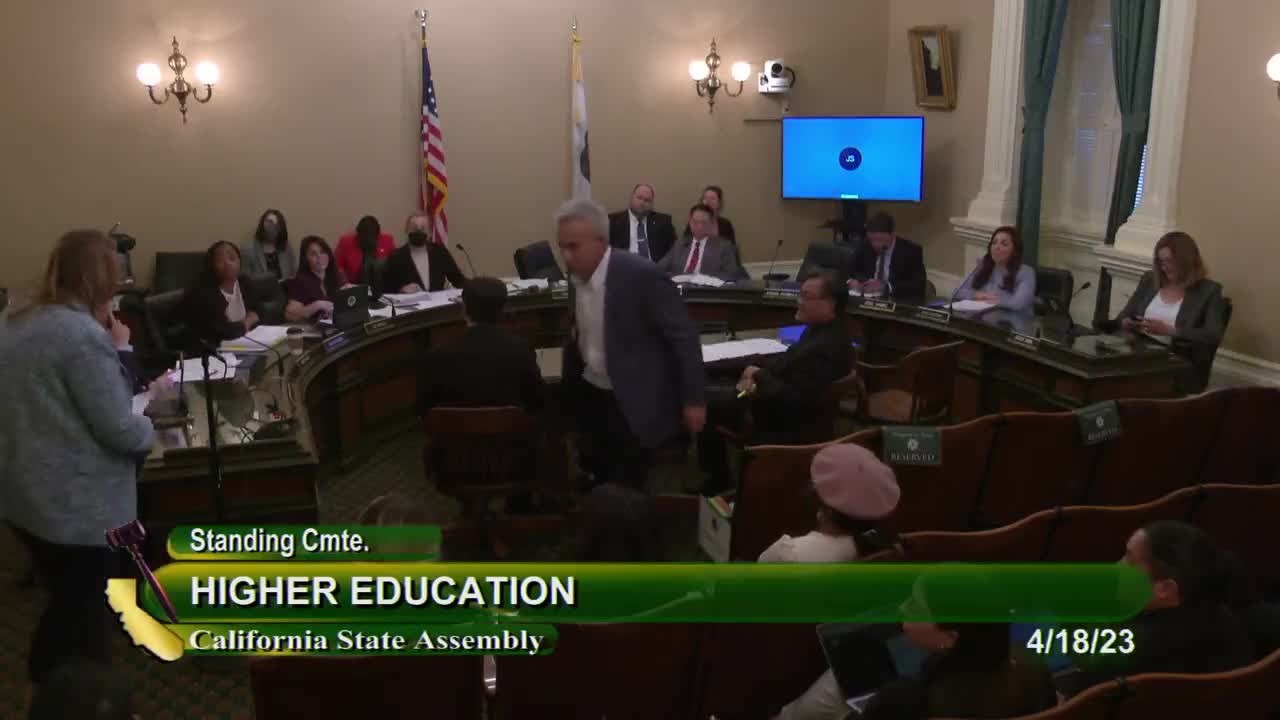 8MIN
Assembly Standing Committee on Higher Education


Bill Co-Author(s):