AB 263: Public postsecondary education: pilot program for free cost of education: working group.
- Session Year: 2023-2024
- House: Assembly
- Latest Version Date: 2023-01-19
Current Status:
Failed
(2024-02-01: From committee: Filed with the Chief Clerk pursuant to Joint Rule 56.)
Introduced
In Committee
First Chamber
In Committee
Second Chamber
Enacted
Under existing law, the segments of public postsecondary education in the state are the University of California, which is administered by the Regents of the University of California, the California State University, which is administered by the Trustees of the California State University, and the California Community Colleges, which is administered by the Board of Governors of the California Community Colleges.
This bill would require the Student Aid Commission to convene a working group until July 1, 2026, consisting of representatives from the State Department of Education, the Board of Governors of the California Community Colleges, the Trustees of the California State University, the Regents of the University of California, and faculty, staff, and students from the California Community Colleges, the California State University, and the University of California to research and develop recommendations for the creation of a pilot program, as specified, that would cover the cost of postsecondary education in the state by replacing the system of charging students tuition and fees, and addressing additional expenses associated with attendance at a public postsecondary institution. The bill would require, on or before July 1, 2026, the working group to submit a report to the Legislature on the pilot program, including information identified by the working group such as the public postsecondary institutions that would participate in the pilot program, the length of the pilot program, and available funding sources for the duration of the pilot program. The bill would repeal these provisions on January 1, 2027.
(a)(1)The Student Aid Commission shall convene, until July 1, 2026, a working group consisting of representatives from the department, the Board of Governors of the California Community Colleges, the Trustees of the California State University, the Regents of the University of California, and faculty, staff, and students from the California Community Colleges, the California State University, and the University of California to research and develop recommendations for the creation of a pilot program that would cover the cost of postsecondary education in the state by replacing the system of charging students tuition and fees, and addressing additional expenses associated with attendance at a public postsecondary institution.
(2)The representatives of each participating entity described in paragraph (1) shall be selected internally by the participating entity.
(b)The working group shall consider feedback and insight from nonprofit stakeholder groups with extensive knowledge of college affordability models and approaches and allow participation from these groups in nonmember roles.
(c)For purposes of the consideration of the working group, the pilot program to be created shall allow students who are residents of the state and who qualify for admission to a public postsecondary institution to enroll in that institution without paying for the cost of education. The working group shall also prioritize the needs of students with the greatest financial need, as determined by the working group.
(d)The working group shall do all of the following:
(1)Identify one or more public postsecondary institutions, including specific campuses of the California Community Colleges, the California State University, and the University of California, for participation in the pilot program.
(2)Determine the length of the pilot program.
(3)Determine a funding source that would be available for the duration of the pilot program.
(4)Identify how the pilot program would complement existing financial aid programs, such as the Cal Grant Program (Chapter 1.7 (commencing with Section 69430) of Part 42).
(e)The working group shall submit to the Legislature, on or before July 1, 2026, in compliance with Section 9795 of the Government Code, a report that outlines recommendations for the proposed pilot program, including the information described in subdivision (d).
(f) This section shall remain in effect only until January 1, 2027, and as of that date is repealed.
|
Date
|
Status
|
|---|---|
| Feb 1, 2024 | From committee: Filed with the Chief Clerk pursuant to Joint Rule 56. |
| Jan 31, 2024 | Died pursuant to Art. IV, Sec. 10(c) of the Constitution. |
| May 18, 2023 | In committee: Held under submission. |
| Apr 26, 2023 | In committee: Set, first hearing. Referred to APPR. suspense file. |
| Apr 12, 2023 | From committee: Do pass and re-refer to Com. on APPR. (Ayes 10. Noes 1.) (April 11). Re-referred to Com. on APPR. |
| Feb 2, 2023 | Referred to Com. on HIGHER ED. |
| Jan 20, 2023 | From printer. May be heard in committee February 19. |
| Jan 19, 2023 | Read first time. To print. |
|
Date
|
Description
|
Location
|
Votes
|
|
|---|---|---|---|---|
| Apr 11, 2023 | Do pass and be re-referred to the Committee on [Appropriations] | Assembly Standing Committee on Higher Education |
Passed |
This list shows positions taken on this bill by organizations on the date displayed, which is linked to the original source.
Positions by individuals are not included.
|
Organization
|
Position
|
Date
|
|---|---|---|
| Go Public Schools | ** Support |
Date of Hearing: April 26, 2023
ASSEMBLY COMMITTEE ON APPROPRIATIONS
Chris Holden, Chair
ABPCA Bill Id:AB 263
Author:(Jones-Sawyer) – As Introduced Ver:January 19, 2023
Policy Committee: | Higher Education | Vote: | 10 - 1 |
|
| ||
|
|
Urgency: No State Mandated Local Program: No Reimbursable: No
SUMMARY:
This bill requires the California Student Aid Commission (CSAC) to convene a working group to research and develop recommendations for a program to cover the total costs of postsecondary education in the state.
Specifically, the bill requires, until January 1, 2026, CSAC to convene the working group to research and develop recommendations for the creation of a pilot program to cover the total costs of postsecondary education by replacing the system of charging students tuition and fees and addressing other expenses to attend a public college or university in California. The workgroup is to consist of representatives from the California Department of Education (CDE), the California Community Colleges (CCC) Board of Governors, the California State University (CSU) Trustees, the University of California (UC) Regents, and students, faculty, and staff from the CCC, CSU, and the UC. The working group is to submit a report with its recommendations by July 1, 2026. The workgroup is to identify one or more public postsecondary institutions, including specific campuses of the CCC, the CSU, and the UC, to participate in the pilot program; determine the length of the pilot; determine a funding source for the pilot; and identify how the pilot would complement other financial aid programs.
FISCAL EFFECT:
- One-time General Fund costs to CSAC of about $444,000 over a two-year period to convene and organize the workgroup and report to the Legislature.
- One-time General Fund costs to the CCC Chancellor’s Office of about $50,000 to participate in the workgroup.
- Minor and absorbable General Fund costs to CDE, UC, and CSU to participate in the workgroup.
COMMENTS:
- Purpose. According to the author:
Living expenses, transportation, and other relatable expenditures experienced by college students have increased due to inflation. So, having cost-free college would alleviate these hardships so that the student can be fully present in their studies, graduate, and become contributing taxpayers in a higher economic demographic makes sense to the governance of California, especially in light of how the state collects revenue through taxes-personal income, sales, and corporate taxes.
- Financial Aid. CSAC administers the Cal Grant program, the state’s largest need-based financial aid program. CSAC awards Cal Grants totaling over $2 billion General Fund annually to undergraduate students with financial need who meet certain eligibility criteria and attend CCC, CSU, and UC, and some private institutions. A student may receive a Cal Grant for up to four years of full-time college attendance. Cal Grant awards may provide aid for both tuition and fees and other expenses associated with higher education.
Federal Pell Grants provide additional aid to students with financial need, with a maximum of $6,895 per year for six years to students with the greatest financial need. Students can use Pell Grants to help pay for any tuition and fees or other expenses associated with higher education.
In addition, CCC, CSU, and UC each provide financial aid to students with financial need attending their institutions. CCC also waives tuition to any first-time, full-time resident student, regardless of financial need.
This bill would create a workgroup to research and develop recommendations for the creation of a pilot program to cover the total costs of postsecondary education in the state.
- Prior Legislation. AB 295 (Jones-Sawyer), of the 2021-2022 Legislative Session, was almost identical to this bill. AB 295 was held on the Senate Appropriations Committee’s suspense file.
AB 1970 (Jones-Sawyer), of the 2019-20 Legislative Session, was similar to this bill. The bill was held in the Assembly Higher Education Committee.
Analysis Prepared by: Natasha Collins / APPR. / (916) 319-2081
Date of Hearing: April 11, 2023
ASSEMBLY COMMITTEE ON HIGHER EDUCATION
Mike Fong, Chair
ABPCA Bill Id:AB 263 (
Author:Jones-Sawyer) – As Introduced Ver:January 19, 2023
SUBJECT: Public postsecondary education: pilot program for free cost of education: working group.
SUMMARY: Requires the California Student Aid Commission (CSAC) to convene a working group until July 1, 2026, to research and develop recommendations for the creation of a pilot program that would cover the costs of postsecondary education in the state by replacing the system of charging students tuition and fees, and addressing additional expenses associated with attendance at a public postsecondary institution. Specifically, this bill:
- Requires the CSAC must convene a working group, until July 1, 2026.
- Mandates that the working group, as enumerated in (1) above, shall consist of representatives from the California Department of Education (CDE), the California Community Colleges (CCC) Board of Governors (BOG), the California State University (CSU) Trustees, the University of California (UC) Regents, and students, faculty, and staff from the CCC, CSU, and the UC.
- Requires the working group, per (1) above, to research and develop recommendations for the creation of a pilot program that would cover the cost of postsecondary education in the state by replacing the system of charging students tuition and fees, and addressing additional expenses associated with attendance at a public postsecondary institution.
- Stipulates that the representatives of each participating entity (as enumerated in (2), above), shall be selected internally by the participating entity.
- Requires the working group, per (1) above, to consider feedback and insight from nonprofit stakeholder groups with extensive knowledge of college affordability models and approaches, and allow participation from these groups in nonmember roles.
- Stipulates that for purposes of the consideration of the working group, the pilot program to be created shall allow students who are residents of the state and who qualify for admission to a public postsecondary institution, to enroll in that institution without paying for the cost of education.
- Stipulates that the working group shall also prioritize the needs of students with the greatest financial need, as determined by the working group.
- Mandates the working group must do all of the following:
- Identify one or more public postsecondary institutions, including specific campuses of the CCC, CSU, and the UC, for participation in the pilot program;
- Determine the length of the pilot program;
- Determine a funding source that would be available for the duration of the pilot program; and,
- Identify how the pilot program would complement existing financial aid programs, such as the Cal Grant Program.
- Requires the working group to submit to the Legislature, on or before July 1, 2026, a report that outlines recommendations for the proposed pilot program.
- Repeals the provision of this measure on January 1, 2027.
EXISTING LAW:
Federal law.
- Defines “cost of attendance” as:
- Tuition and fees normally assessed, including costs for required equipment, materials, or supplies;
- An allowance for books, supplies, transportation, and miscellaneous personal expenses including a rented or purchased computer;
- An allowance, as determined by the institution, for room and board costs, as specified;
- For students enrolled less than half-time, tuition and fees and an allowance for specified costs; and,
- Allowances for students who are engaged in work-study are incarcerated, have dependents, or are disabled (United States Code (USC), Title 20, Section 1087ll).
- Provides federal financial aid, known as the Pell Grant, to students who demonstrate financial need. The Pell Grant award can be used for tuition and fees, books, and supplies, transportation, and living expenses for the equivalent of up to six years of full-time enrollment. The maximum Pell Grant for 2022-2023 is $6,895 (USC, Title 20, Section 1070).
State law.
- Establishes the CSAC for the purpose of administering specified student financial aid programs (Education Code (EC) Section 69510, et seq.)
- Establishes the Cal Grant program, administered by the CSAC, to provide grants to financially needy students to attend a college or university. The Cal Grant programs include both the entitlement and the competitive Cal Grant awards. The programs consists of the Cal Grant A, Cal Grant B, and Cal Grant C programs and eligibility is based upon financial need, grade point average (GPA), California residency, and other criteria. Maximum award amounts for CSU and UC are established in the annual Budget Act and have traditionally covered all systemwide tuition and fees. Supplemental Cal Grant awards programs are available to students with dependent child(ren) and former and current foster youth attending CSU, UC, or a CCC to assist with non-tuition costs such as living expenses (EC Sections 69430 – 69433 and Sections 69465 - 69470).
- Establishes, commencing in the 2024 – 2025 fiscal year, if General Fund moneys over the multiyear forecasts are available to support ongoing augmentations and actions, and if funding is provided in the annual Budget Act, The Cal Grant Reform Act. Under the Act, the Cal Grant 2 and Cal Grant 4 programs are created. The Cal Grant 2 is for community college students, and provides non-tuition support that grows annually with inflation. The Cal Grant 4 program is for students at the UC, CSU, and other institutions. The Act also states legislative intent that UC and CSU use institutional aid to cover non-tuition costs for their students (EC Sections 69424, 69425, and 69428).
- Establishes the Middle Class Scholarship (MCS) Program to offset a portion of tuition costs for students attending the UC and the CSU. Students with family income and assets up to $201,000 may be eligible. Starting in the 2022-2023, MCS awards may be used to cover the total cost of attendance at UC and CSU (EC Section 70020, et seq.).
- Establishes the Community Colleges Student Success Completion Grant, which
supplements the Cal Grant B access award by up to $1,298 annually for students enrolled in 12, 13, or 14 units per semester, and up to $4,000 annually for students taking 15 or more units per semester (EC Section 88930.).
- Authorizes the UC and CSU, and requires the CCC to collect fees from students attending their postsecondary education institutions (EC Section 89700).
FISCAL EFFECT: Unknown
COMMENTS: Need for this measure. According to the author, “the rise of poor and minority undergraduates have been most pronounced in public two-year colleges and the least selective four-year colleges and universities.”
The author states, “as such, offering cost-free college to disenfranchised communities would eliminate inequities by creating pathways of first generation students into CSU and UC.”
Further, the author contends that, “living expenses, transportation, and other relatable expenditures experienced by college students have increased due to inflation. So, having cost-free college would alleviate these hardships so that the student can be fully present in their studies, graduate, and become contributing taxpayers in a higher economic demographic makes sense to the governance of California, especially in light of how the state collects revenue through taxes-personal income, sales, and corporate taxes.”
Background on affordability in California. According to California Competes, for the 6.8 million Californians ages 25–54 with a high school education but no associate’s or bachelor’s degree, employment prospects are increasingly limited—particularly since the onset of the COVID-19 pandemic, which disrupted plans for future education, employers’ expectations, available positions, and more. At the same time, the state needs an additional 2.4 million residents with college degrees by 2025 to meet the anticipated demand for skilled workers with critical industry credentials. The Institute for College Access and Success notes that a student's ability to pay for college is a major factor in enrollment and completion of a degree program; significant unmet need results in students being less likely to enroll and, once enrolled, low-income students are also less likely to complete their degree program. Financial aid plays a vital role in leveling the playing field and increasing access, retention, and completion rates.
According to Public Policy Institute of California (PPIC) December 2021 report, “Keeping College Affordable for California Students,” this state has a long history of making college affordable. Recently, the state has combined higher tuition with more financial aid to cover tuition for students most in need of financial assistance. After tuition rose dramatically during the Great Recession, Legislators made incremental, targeted investments to address the growing cost of college, focusing, in part, on students with the most financial need and middle-class students.
The PPIC report found that, “California’s robust student aid program, coupled with federal and institutional grants, ensures that the majority of California public college students do not pay tuition.” Further, the report stated that, “traditionally, state financial aid programs have subsidized tuition at public four-year colleges to ensure that all students in California have the opportunity to pursue higher education.” According to PPIC, “this strategy has kept tuition relatively affordable.”
Federal, state, and institutional student aid. United States citizens and eligible noncitizens can apply for federal and state financial aid by completing the Free Application for Federal Student Aid (FAFSA). Undocumented California residents, who meet nonresident exemption criteria, can apply for California state aid by completing the California Dream Act Application.
On the federal side, the Pell Grant provides a maximum of $6,895 per year for six years to students with the greatest financial need. Students can use Pell Grants to help pay for any tuition, housing, or other college costs. The federal government also provides non-grant aid in the form of subsidized loans, loan forgiveness programs, and work-study.
On the state side, California provides most grant aid to students through Cal Grants: the 2021–22 state budget removed age and time-of-enrollment requirements for community college students, enabling an additional 99,000 to receive Cal Grants in 2021–22. Next year, these requirements will also be removed for UC and CSU students; according to the PPIC, this is likely to increase eligibility in those systems by about 40,000 students.
- Cal Grant A (which provides funding to low-income and middle-income students) covers four years of full tuition and fees at a tuition charging institution (or $9,358 of nonprofit independent college and university tuition per year).
- Cal Grant B (which provides funding to low-income students) covers three years of full tuition and fees plus an Access Award at a tuition charging institution. While the tuition and fee award amount is only offered during sophomore through senior years, during their first year, students receive the Access Award amount.
In 2022-23, the Access Award portion of Cal Grant B will increase from $1,600 to $2,000. Eligible students who transfer to the UC or the CSU from a community college and who meet requirements can also get Cal Grants A or B.
- Cal Grant C provides tuition and non-tuition coverage to mostly community college students enrolled in career education programs.
Additionally, California also provides assistance through the MCS program. The MCS program offsets a portion of tuition costs for students attending the UC and the CSU. Students with family income and assets up to $201,000 may be eligible. Commencing in the 2022-2023, MCS awards may be used to cover the total cost of attendance at UC and CSU.
On the institutional aid side, the UC’s Blue and Gold Opportunity Plan ensures that students whose family incomes are below $80,000 do not pay tuition by covering the tuition owed after federal, state, and local aid has been accounted for. Additionally, the CSU has a similar program, called the State University Grant (SUG). Systemwide, the priority is to award a SUG at least equal to the amount of the State University Fee ($5,742 for undergraduates; $6,660 for students in teaching credential programs; and $7,176 for graduate and postbaccalaureate students) to eligible students who apply for financial aid by March 2; who have an Expected Family Contribution (EFC) of $4,000 or less; and who are not receiving a Cal Grant or other award designated to cover fees.
Further, California’s independent colleges and universities also provide varying amounts of institutional aid to their eligible students.
Committee comments. The Legislature in recent years has made college affordability one of its top priorities. While college affordability is nuanced, the Legislature’s view of affordability has taken into account the total cost of attendance, not just tuition; whereby, via recent legislative attempts, financial aid modernization and simplification proposals have undergone various iterations and have had several policy and informational legislative hearings. During this ongoing process, the stated goal of the Legislature has been that it seeks to create a path toward debt free college for its students.
This measure seeks to create a working group to consider the creation of a pilot program, as specified, that would cover the cost of attending a campus of the UC, CSU, or CCC, by replacing the system of charging students tuition and fees, and additional expenses for enrollment at any public postsecondary institution. However, as currently drafted, there remain several policy concerns, including, but not limited to, the following:
- While CSAC is mandated to convene the working group, who will pay for the working group?
- Often times working groups are convened and issue reports all within six months to a year.
As currently drafted, the measure appears to have the working group convened potentially from 2024–2026. It is unclear why the measure requires CSAC to convene the working group for an extended period of time.
- As currently drafted, the measure requires that the working group, in researching the pilot program, “shall allow students who are residents of the state and who qualify for admission to a public postsecondary institution to enroll in that institution without paying for the cost of education. The working group shall also prioritize the needs of students with the greatest financial need, as determined by the working group.”
What about California’s Dreamers? This State already covers the tuition and fees, and sometimes additional costs of college attendance for all eligible Dreamers. Under this proposal, it would appear that Dreamers would not be eligible to participate.
Further, this State, and campuses with institutional aid, already cover tuition and fees and often times additional costs associated with college attendance, for students with the greatest need to attend college. It is unclear how this measure would enhance students with the greatest financial need as many are already attending college for “free.”
Often times institutional aid is encumbered or ear marked specifically for students’ tuition, fees, and other costs associated with their college experience.
What happens to the campuses institutional aid?
- Absent the California Postsecondary Education Commission, is CSAC the appropriate entity to convene the working group?
- What is the role that CDE would provide to this working group?
- The measure calls for the BOG, Trustees, and Regents to have representation on the working group, while BOG, Trustees, and Regents hold an array of knowledge about higher education issues and challenges, said entities do not necessarily have expertise in college affordability. It is presently unclear why the aforementioned entities would serve on the working group.
Would it be more efficient to have the systemwide subject experts for the Offices of the CCC Chancellor, the CSU Chancellor and the UC President serve on the working group?
- As currently drafted, the measure requires the working group to “consider feedback and insight from nonprofit stakeholder groups with extensive knowledge of college affordability models and approaches and allow participation from these groups in nonmember roles.”
Who determines which nonprofit stakeholder groups will participate? Will entities from California’s independent colleges and universities have representation? What does a nonmember role entail?
- This measure requires that the working group identify at least one campus of the CCC, CSU, and UC to participate in the pilot program.
However, it is unclear how the working group would identify appropriate campuses to participate. Additionally, what happens if the selected campus does not wish to participate?
- While there is a continuing need for individuals to earn a college degree, there remains a need for students to earn certificates and badges that allow them to enter into the workforce and earn livable wages.
This bill is silent as to whether or not students who choose to earn a career technical education related badge or certificate from an accredited institution would also be eligible to attend CCC or trade school for “free.”
Moving forward, the author should work with all appropriate Legislative policy and budget committees in order to establish specificity and desired goals and outcomes that are feasible and not in conflict with other established Legislative priorities around the area of college affordability and financial aid.
Prior legislation. AB 295 (Jones-Sawyer) of 2021-2022, which was held on the Suspense File in the Senate Committee on Appropriations, required the CSAC to convene, until July 1, 2025, a working group to research and develop recommendations for the creation of a pilot program that would cover the cost of postsecondary education at a public postsecondary institution.
AB 1970 (Jones-Sawyer) of 2020, which was held by this Committee, was substantially similar to AB 295 (as described above).
AB 1456 (Jones-Sawyer) of 2014, which was which was held in Senate Rules Committee, required the CSAC and the Legislative Analyst's Office (LAO) to conduct a study of the effects of enacting legislation to establish a "Pay it Forward, Pay it Back Pilot Program".
HR 49 (Jones-Sawyer) of 2014, which was which was held in Senate Rules Committee, encouraged the LAO as the lead, and the CSAC to conduct a study, as specified, on the effects of enacting a "Pay it Forward, Pay it Back Pilot Program” as an alternative to existing student financial aid programs.
REGISTERED SUPPORT / OPPOSITION:
Support
Go Public Schools
Opposition
None on file.
Analysis Prepared by: Jeanice Warden / HIGHER ED. / (916) 319-3960
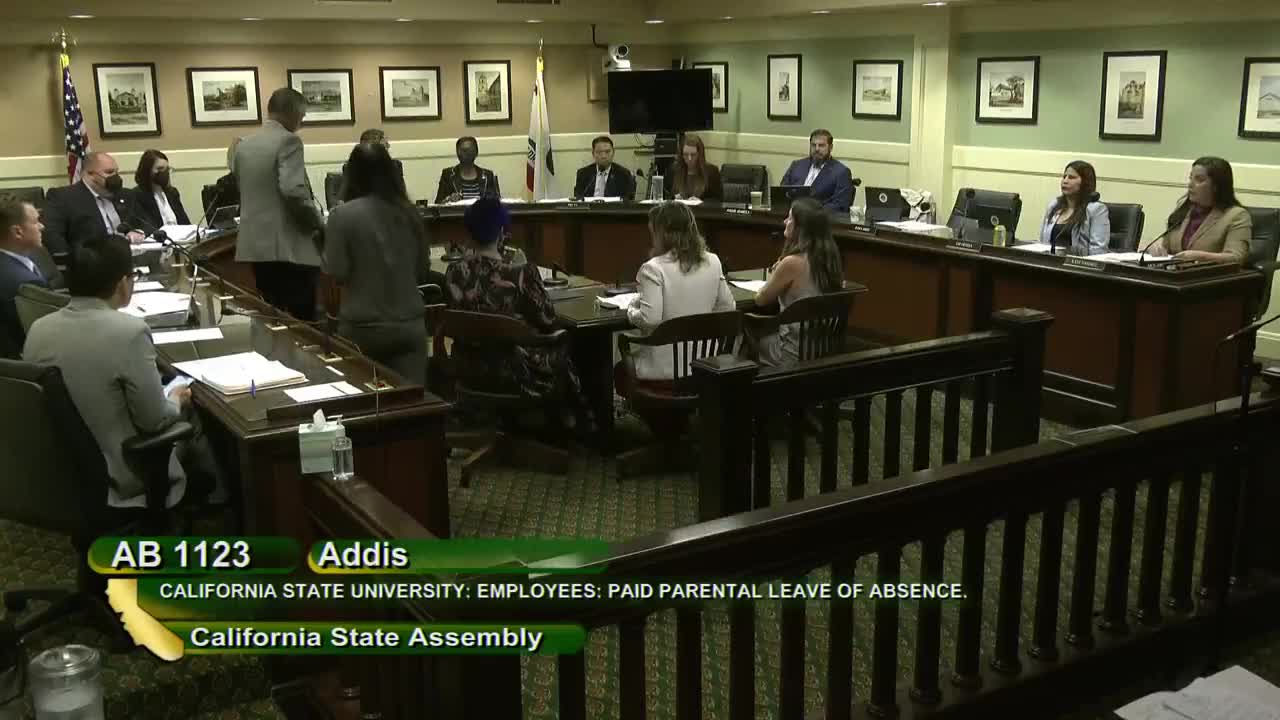
Discussed in Hearing
 6MIN
Assembly Standing Committee on Higher Education
Bill Author

Bill Co-Author(s):