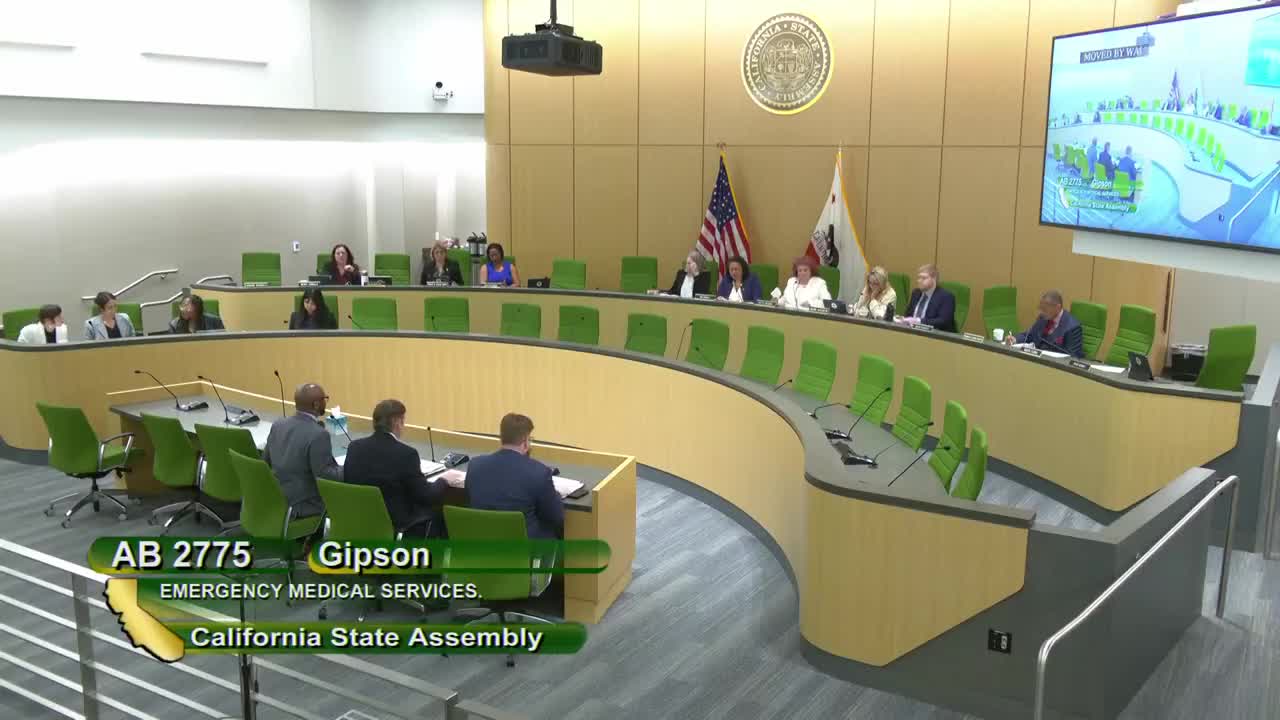
AB 2775: Emergency medical services.
- Session Year: 2023-2024
- House: Assembly
- Latest Version Date: 2024-04-01
Current Status:
Failed
(2024-05-16: Joint Rule 62(a), file notice suspended. (Page 5215.))
Introduced
In Committee
First Chamber
In Committee
Second Chamber
Enacted
Existing law, the Emergency Medical Services System and the Prehospital Emergency Medical Care Personnel Act, governs local emergency medical services (EMS) systems. The act establishes the Emergency Medical Services Authority (authority), which is responsible for the coordination and integration of all emergency medical services. Existing law requires the authority to develop planning and implementation guidelines for EMS systems that address specified components, including the assessment of hospital and critical care centers and data collection and evaluation.
This bill would authorize the authority to develop planning and implementation guidelines for the use of telehealth, within existing authority, in EMS systems. The bill would also authorize the authority to develop guidelines for the collection of data regarding the use of telehealth in EMS systems, as specified.
Existing law establishes, establishes within the act, until January 1, 2031, the Community Paramedicine or Triage to Alternate Destination Act of 2020. Existing law states that it is the intent of the Legislature, among other things, that local emergency medical services (EMS) EMS agencies be authorized to develop a community paramedicine or triage to alternate destination program to improve patient care and community health. Existing law states that it is the intent of the Legislature to monitor and evaluate implementation of community paramedicine and triage to alternate destination programs by local EMS agencies in California and determine whether these programs should be modified or extended before the program ends.
This bill would make a technical conforming change to these provisions.
Existing law establishes, until January 1, 2031, the Community Paramedicine or Triage to Alternate Destination Act of 2020. Existing law states that it is the intent of the Legislature, among other things, that local emergency medical services (EMS) agencies be authorized to develop a community paramedicine or triage to alternate destination program to improve patient care and community health. Existing law states that it is the intent of the Legislature to monitor and evaluate implementation of community paramedicine and triage to alternate destination programs by local EMS agencies in California and determine whether these programs should be modified or extended before the program ends.
This bill would make a technical conforming change to these provisions.
(a)The authority shall develop planning and implementation guidelines for emergency medical services systems which address the following components:
(a)(1)Manpower and training.
(b)(2)Communications.
(c)(3)Transportation.
(d)(4)Assessment of hospitals and critical care centers.
(e)(5)System organization and management.
(f)(6)Data collection and evaluation.
(g)(7)Public information and education.
(h)(8)Disaster response.
(b)(1)The authority may develop planning and implementation guidelines for the use of telehealth, within existing authority, in emergency medical services systems.
(2)The authority may develop planning and implementation guidelines for collection of data regarding the use of telehealth in emergency medical services systems operating within existing authority.
(3)The authority shall consider the existing data collection systems, including those required under paragraph (5) of subdivision (c) of Section 1830, Section 1797.227, and the California Emergency Medical Services Information System.
SECTION 1.SEC. 2.Section 1801 of the Health and Safety Code is amended to read:1801.(a)It is the intent of the Legislature to establish state standards that govern the implementation of community paramedicine or triage to alternate destination programs by local EMS agencies in California.
(b)It is the intent of the Legislature that community paramedicine or triage to alternate destination programs be community-focused extensions of the traditional emergency response and transportation paramedic model that has developed over the last 50 years and be recognized as an emerging model of care created to meet an unmet need in Californias communities.
(c)It is the intent of the Legislature to improve the health of individuals in their communities by authorizing licensed paramedics, working under expert medical oversight, to deliver community paramedicine or triage to alternate destination services in California utilizing existing providers, promoting continuity of care, and maximizing existing efficiencies within the first response and emergency medical services system.
(d)It is the intent of the Legislature that a community paramedicine or triage to alternate destination program achieve all of the following:
(1)Improve coordination among providers of medical services, behavioral health services, and social services.
(2)Preserve and protect the underlying 911 emergency medical services delivery system.
(3)Preserve, protect, and deliver the highest level of patient care to every Californian.
(4)Preserve and protect the current health care workforce and empower local health care systems to provide care more effectively and efficiently.
(e)It is the intent of the Legislature that an alternate destination facility participating as part of an approved program always be staffed by a health care professional with a higher scope of practice, such as, at minimum, a registered nurse.
(f)It is the intent of the Legislature that the delivery of community paramedicine or triage to alternate destination services is a public good to be delivered in a manner that promotes the continuity of both care and providers. It is the intent of the Legislature that the delivery of these services be coordinate and consistent with, and complementary to, the existing first response and emergency medical response system in place within the jurisdiction of the local EMS agency.
(g)It is the intent of the Legislature that a community paramedicine or triage to alternate destination program be designed to improve community health and be implemented in a fashion that respects the current emergency medical system and its providers, and the health care delivery system. In furtherance of the public interest and good, agencies that provide first response services are well positioned to deliver care under a community paramedicine or triage to alternate destination program.
(h)It is the intent of the Legislature that the development of any community paramedicine or triage to alternate destination program reflect input from all practitioners of appropriate medical authorities, including, but not limited to, medical directors, physicians, nurses, mental health professionals, first responder paramedics, hospitals, and other entities within the emergency medical response system.
(i)It is the intent of the Legislature that local EMS agencies be authorized to develop a community paramedicine or triage to alternate destination program to improve patient care and community health. A community paramedicine or triage to alternate destination program should not be used to replace or eliminate health care workers, reduce personnel costs, harm the working conditions of emergency medical and health care workers, or otherwise compromise the emergency medical response or health care system. The highest priority of any community paramedicine or triage to alternate destination program shall be improving patient care.
(j)It is the intent of the Legislature to monitor and evaluate implementation of community paramedicine and triage to alternate destination programs by local EMS agencies in California and determine whether these programs should be modified or extended before the January 1, 2031, sunset date of this chapter.
(a)It is the intent of the Legislature to establish state standards that govern the implementation of community paramedicine or triage to alternate destination programs by local EMS agencies in California.
(b)It is the intent of the Legislature that community paramedicine or triage to alternate destination programs be community-focused extensions of the traditional emergency response and transportation paramedic model that has developed over the last 50 years and be recognized as an emerging model of care created to meet an unmet need in Californias communities.
(c)It is the intent of the Legislature to improve the health of individuals in their communities by authorizing licensed paramedics, working under expert medical oversight, to deliver community paramedicine or triage to alternate destination services in California utilizing existing providers, promoting continuity of care, and maximizing existing efficiencies within the first response and emergency medical services system.
(d)It is the intent of the Legislature that a community paramedicine or triage to alternate destination program achieve all of the following:
(1)Improve coordination among providers of medical services, behavioral health services, and social services.
(2)Preserve and protect the underlying 911 emergency medical services delivery system.
(3)Preserve, protect, and deliver the highest level of patient care to every Californian.
(4)Preserve and protect the current health care workforce and empower local health care systems to provide care more effectively and efficiently.
(e)It is the intent of the Legislature that an alternate destination facility participating as part of an approved program always be staffed by a health care professional with a higher scope of practice, such as, at minimum, a registered nurse.
(f)It is the intent of the Legislature that the delivery of community paramedicine or triage to alternate destination services is a public good to be delivered in a manner that promotes the continuity of both care and providers. It is the intent of the Legislature that the delivery of these services be coordinate and consistent with, and complementary to, the existing first response and emergency medical response system in place within the jurisdiction of the local EMS agency.
(g)It is the intent of the Legislature that a community paramedicine or triage to alternate destination program be designed to improve community health and be implemented in a fashion that respects the current emergency medical system and its providers, and the health care delivery system. In furtherance of the public interest and good, agencies that provide first response services are well positioned to deliver care under a community paramedicine or triage to alternate destination program.
(h)It is the intent of the Legislature that the development of any community paramedicine or triage to alternate destination program reflect input from all practitioners of appropriate medical authorities, including, but not limited to, medical directors, physicians, nurses, mental health professionals, first responder paramedics, hospitals, and other entities within the emergency medical response system.
(i)It is the intent of the Legislature that local EMS agencies be authorized to develop a community paramedicine or triage to alternate destination program to improve patient care and community health. A community paramedicine or triage to alternate destination program should not be used to replace or eliminate health care workers, reduce personnel costs, harm the working conditions of emergency medical and health care workers, or otherwise compromise the emergency medical response or health care system. The highest priority of any community paramedicine or triage to alternate destination program shall be improving patient care.
(j)It is the intent of the Legislature to monitor and evaluate implementation of community paramedicine and triage to alternate destination programs by local EMS agencies in California and determine whether these programs should be modified or extended before the January 1, 2024, 2031, sunset date of this chapter.
|
Date
|
Status
|
|---|---|
| May 16, 2024 | In committee: Held under submission. |
| May 16, 2024 | Joint Rule 62(a), file notice suspended. (Page 5215.) |
| May 15, 2024 | In committee: Set, first hearing. Referred to APPR. suspense file. |
| Apr 17, 2024 | From committee: Do pass and re-refer to Com. on APPR. (Ayes 16. Noes 0.) (April 16). Re-referred to Com. on APPR. |
| Apr 2, 2024 | Re-referred to Com. on HEALTH. |
| Apr 1, 2024 | From committee chair, with author's amendments: Amend, and re-refer to Com. on HEALTH. Read second time and amended. |
| Mar 11, 2024 | Referred to Com. on HEALTH. |
| Feb 16, 2024 | From printer. May be heard in committee March 17. |
| Feb 15, 2024 | Read first time. To print. |
|
Date
|
Description
|
Location
|
Votes
|
|
|---|---|---|---|---|
| Apr 16, 2024 | Do pass and be re-referred to the Committee on [Appropriations] | Assembly Standing Committee on Health |
Passed |
This list shows positions taken on this bill by organizations on the date displayed, which is linked to the original source.
Positions by individuals are not included.
|
Organization
|
Position
|
Date
|
|---|---|---|
| American College of Emergency Physicians | * Support | Apr 16, 2024 |
| California Professional Firefighters | * Support | Apr 16, 2024 |
| MLK Community Healthcare | * Support | Apr 16, 2024 |
Date of Hearing: May 15, 2024
ASSEMBLY COMMITTEE ON APPROPRIATIONS
Buffy Wicks, Chair
ABPCA Bill Id:AB 2775
Author:(Gipson) – As Amended Ver:April 1, 2024
Policy Committee: | Health | Vote: | 16 - 0 |
|
| ||
|
|
Urgency: No State Mandated Local Program: No Reimbursable: No
SUMMARY:
This bill authorizes the Emergency Medical Services Authority (EMSA) to collect data and develop guidelines regarding the use of telehealth in emergency medical services (EMS) systems and requires EMSA to consider the existing data collection systems and the California Emergency Medical Services Information System.
FISCAL EFFECT:
General Fund cost pressures of nearly $1.5 million over three years to EMSA. To collect data and develop guidelines as this bill authorizes, EMSA estimates it will need to hire three full-time staff at a cost of $493,000 per year for three years (General Fund). EMSA anticipates this bill could significantly affect the revision of planning and implementation guidelines, which will, in turn, affect regulations and many guidance documents. EMSA states revising each document takes an average of four to six months with stakeholder input, and revising a regulation takes about a year. The new staff will function as leadership for the new unit, establish reporting requirements for telehealth programs, incorporate telehealth into quality assurance programs at state and local EMS agency (LEMSA) level, review telehealth EMS plan initial and annual submissions from the 34 LEMSAs, work with other division subject matter experts on program functionality for telehealth, prepare reports from the EMS information system, develop and implement monthly telehealth program tracking tools, and monitor quality assurance processes.
According to the Legislative Analyst’s Office, the General Fund faces a structural deficit in the tens of billions of dollars over the next several fiscal years.
COMMENTS:
- Purpose. This bill is sponsored by California Professional Firefighters and the California Chapter of the American College of Emergency Physicians. According to the author:
Today's existing healthcare model of directing all transports to hospitals has created congestion in Emergency Departments. Community Paramedicine can play an important role in improving California's healthcare delivery system and is an innovative model of care. This bill would ensure that the legislature maintains oversight of the community paramedicine programs created in AB 767. These programs aim to improve the effectiveness and efficiency of healthcare delivery by using specially trained paramedics in partnership with other healthcare providers to address the needs of local healthcare systems.
- Background. In November of 2014, the Office of Statewide Health Planning and Development (now the Department of Health Care Access and Information (HCAI)) approved an application from EMSA to establish Health Workforce Pilot Project (HWPP) #173 to test different concepts of community paramedicine. Initially, HWPP #173 encompassed 13 sites testing six concepts, with more sites added over the ensuing years, including a seventh concept testing transport of patients to a sobering center. HWPP #173 was extended multiple times and tested three alternate destinations concepts: behavioral health, where paramedics responding to 911 calls offer to transport people who have behavioral health needs but no emergency medical needs to a mental health crisis center instead of an emergency department (ED); alternate destination – urgent care, where paramedics responding to 911 calls offer people with low-acuity medical conditions transport to an urgent care center instead of an ED; and alternate destination – sobering center, where paramedics offer people who are acutely intoxicated but do not have acute medical or mental health needs transport directly to a sobering center for monitoring instead of an ED.
- Related Legislation.
AB 767 (Gipson), Chapter 270, Statutes of 2023, adds short-term, post discharge follow-up for persons recently discharged from a hospital to the list of eligible community paramedicine services, requires EMSA to amend existing regulations to include that service, and extends the sunset date of the community paramedicine program from January 1, 2024, to January 1, 2031.
AB 2700 (Gabriel) requires the state to survey and analyze the facilities in each county that could serve as an alternate destination facility. Requires EMSA to publish a report that provides each LEMSA with the current number, capacity and type of alternate destination facilities. Requires a LEMSAs, in consultation with the county, to develop an alternate destination facility plan with protocols for transporting an individual to an alternate destination facility instead of ED. AB 2700 is pending in this committee. - Prior Legislation. AB 1544 (Gipson), Chapter 138, Statutes of 2020, created the Community Paramedicine or Triage to Alternate Destination Act and required EMSA to adopt regulations and included a provision that extended the sunset on the pilot programs under HWPP #173 to January 1, 2031. Regulations were finalized October 31, 2022.
Analysis Prepared by: Allegra Kim / APPR. / (916) 319-2081
Date of Hearing: April 16, 2024
ASSEMBLY COMMITTEE ON HEALTH
Mia Bonta, Chair
ABPCA Bill Id:AB 2775
Author:((Gipson) – As Amended Ver:April 1, 2024
SUBJECT: Emergency medical services.
SUMMARY: Authorizes the Emergency Medical Services Authority (EMSA) to develop planning and implementation guidelines for the use of telehealth, within existing authority, in emergency medical services (EMS) systems. Authorizes EMSA to develop guidelines for the collection of data regarding the use of telehealth in EMS systems and requires EMSA to consider existing data collection systems, including the California Emergency Medical Services Information System (CEMSIS).
EXISTING LAW:
- Establishes EMSA, which is responsible for the coordination and integration of all state activities concerning EMS, including the establishment of minimum standards, policies, and procedures. [Health and Safety Code (HSC) §1797.100, et seq.]
- Authorizes counties to develop an EMS program and designate a local EMS agency (LEMSA) responsible for planning and implementing an EMS system, which includes day-to-day EMS system operations. [HSC §1797.200, et seq.]
- Requires an emergency medical care provider to do both of the following when collecting and submitting data to a LEMSA:
- Use an electronic health record system that exports data in a format that is compliant with the current versions of CEMSIS and the National Emergency Medical Services Information System (NEMSIS) standards and includes those data elements that are required by the LEMSA; and,
- Ensure that the electronic health record system can be integrated with the LEMSA’s data system, so that the LEMSA may collect data from the provider. [HSC § 1797.227]
- Defines "Emergency Medical Technician-Paramedic," "EMT-P," "paramedic" or "mobile intensive care paramedic" as an individual whose scope of practice includes the ability to provide advanced life support, as specified, including administering specified medications. EMT-Ps are licensed and regulated at the state level through EMSA. [HSC §1797.84]
- Establishes the Health Workforce Pilot Projects (HWPP) in the Department of Health Care Access and Information (HCAI) which states legislative findings that experimentation with new kinds and combinations of health care delivery systems is desirable and that for purposes of this experimentation, a select number of publicly evaluated HWPPs should be exempt from the healing arts practices acts. [HSC §128125, et seq.]
- Permits HCAI to designate HWPPs as approved projects where the projects are sponsored by community hospitals or clinics, nonprofit educational institutions, or governmental agencies engaged in health or education activities. Permits a trainee (defined as a person being taught health care skills) in an approved project to perform health care services under the supervision of a supervisor (someone who is already licensed to provide the health care services) where the general scope of the services has been approved by HCAI. [HSC §128135 and §128140]
- Establishes the Community Paramedicine or Triage to Alternate Destination Act of 2020. Defines “community paramedicine program” as consisting of one of two specialties: providing directly observed therapy to persons with tuberculosis in collaboration with a public health agency; and, providing case management services to frequent EMS users in collaboration with, and by providing referral to, existing appropriate community resources. Defines “triage to alternate destination” as consisting of three specialties: providing care and comfort services to hospice patients in their homes in response to 911 calls; providing patients with advanced life support triage and assessment by a triage paramedic and transportation to an alternate destination facility, which can include an authorized mental health facility or an authorized sobering center; and, providing transport services for patients who identify as veterans and desire transport to a local veterans administration emergency department (ED) for treatment. [HSC §1800 et seq.]
- Requires EMSA to develop regulations that establish minimum standards for the development of a community paramedicine or triage to alternate destination program, and requires the Commission on EMS to review and approve the regulations. Requires the regulations to be based upon, and informed by, the Community Paramedicine Pilot Program under HWPP #173, and the protocols and operation of the pilot projects approved under HWPP #173. [HSC §1830]
- Defines “telehealth” to mean the mode of delivering health care services and public health via information and communication technologies to facilitate the diagnosis, consultation, treatment, education, care management, and self-management of a patient’s health care. Includes synchronous interactions and asynchronous store and forward transfers. [Business and Professions Code § 2290.5 (a)(6)]
FISCAL EFFECT: Unknown. This bill has not yet been analyzed by a fiscal committee.
COMMENTS:
- PURPOSE OF THIS BILL. According to the author, today's existing healthcare model of directing all transports to hospitals has created congestion in EDs. Community Paramedicine can play an important role in improving California's healthcare delivery system and is an innovative model of care. This bill would ensure that the Legislature maintains oversight of the community paramedicine programs created in AB 767 (Gipson) Chapter 270, Statutes of 2023. These programs aim to improve the effectiveness and efficiency of healthcare delivery by using specially trained paramedics in partnership with other healthcare providers to address the needs of local healthcare systems.
- BACKGROUND.
- The Community Paramedicine or Triage to Alternate Destination Act. In November of 2014, the Office of Statewide Health Planning and Development (which has since been merged into HCAI) approved an application from EMSA to establish HWPP #173, to test different concepts of community paramedicine. Initially, HWPP #173 encompassed 13 sites testing six concepts, with more sites added over the ensuring years, including a seventh concept testing transporting patients to a sobering center. HWPP #173 was extended multiple times, and over the years, some sites were added while other pilot project sites were shut down. The following are the concepts that were tested by this pilot project:
- Post-Discharge Short-Term Follow-Up, intended to provide home-based follow up care to people recently discharged from a hospital due to a chronic condition;
- Frequent EMS Users, intended to provide case management to frequent 911 callers and frequent visitors to EDs by connecting them with primary care, behavioral health, housing, and social services;
- Directly Observed Therapy for Tuberculosis, where the paramedic dispensed medication and observed patients taking them to assure effective treatment;
- Hospice, where paramedics, in response to 911 calls, collaborated with hospice agency nurses, patients, and family members to treat patients in their homes, according to their wishes, instead of transporting to an ED;
- Alternate Destination – Behavioral Health, where paramedics, in response to 911 calls, offer to transport people who have behavioral health needs but no emergency medical needs to a mental health crisis center instead of an ED;
- Alternate Destination – Urgent Care, where paramedics, responding to 911 calls, offer people with low-acuity medical conditions transport to an urgent care center instead of an ED; and,
- Alternate Destination – Sobering Center, where paramedics, in response to 911 calls, offer people who are acutely intoxicated but do not have acute medical or mental health needs transport directly to a sobering center for monitoring instead of an ED.
- The Community Paramedicine or Triage to Alternate Destination Act. In November of 2014, the Office of Statewide Health Planning and Development (which has since been merged into HCAI) approved an application from EMSA to establish HWPP #173, to test different concepts of community paramedicine. Initially, HWPP #173 encompassed 13 sites testing six concepts, with more sites added over the ensuring years, including a seventh concept testing transporting patients to a sobering center. HWPP #173 was extended multiple times, and over the years, some sites were added while other pilot project sites were shut down. The following are the concepts that were tested by this pilot project:
After several legislative attempts to authorize these concepts in statute to make them permanent, AB 1544 (Gipson), Chapter 138, Statutes of 2020, was signed into law in 2020, creating the Community Paramedicine or Triage to Alternate Destination Act. Of the seven concepts, all were included in AB 1544 except for two: Alternate Destination – Urgent Care, which was not included because all project sites testing this concept had closed down; and Post-Discharge, Short-Term Follow-up, which had mixed results in early test sites. While Post-Discharge, Short-Term Follow-up was not included as part of the Community Paramedicine or Triage to Alternate Destination Act, AB 1544 did include a provision permitting the two remaining pilot project sites in that specialty at the time, Solano County and the City of Alameda (since closed down), to continue operating until January 1, 2024.
AB 1544 required EMSA to adopt regulations implementing the bill, and included a provision that permitted the existing pilot programs to continue operating while the regulations were being developed until up to one year after EMSA adopted the regulations. Once the regulations were adopted, EMSA could approve additional community paramedic or alternative destination programs that were developed by LEMSAs, and the existing pilot programs would have to be approved to continue after the initial year. However, regulations were not finalized until October 31, 2022, and because the entire program was scheduled to sunset in January of 2024, no new programs were added, and some pilot project sites are no longer operating. AB 1544 extended the sunset on these pilot programs to January 1, 2031.
AB 767 added short-term, post discharge follow-up for persons recently discharged from a hospital to the list of eligible community paramedicine services, requires EMSA to amend existing regulations to include that service, and extends the sunset date of the community paramedicine program from January 1, 2024, to January 1, 2031.
During the discussion around AB 767 technical assistance was provided by EMSA that raised the issue of telehealth use in the field by deploying higher medical authorities operating within their scope of practice. After review of the issue, EMSA recommended that they be authorized to develop guidelines to ensure consistency in system design and data collection across EMS systems in California.
- NEMSIS and CEMSIS. NEMSIS was formed in 2001 by the National Association of State EMS Directors, in conjunction with the National Highway Traffic Safety Administration and the Trauma/EMS Systems program of the Health Resources and Services Administration’s Maternal Child Health Bureau, in order to develop a national EMS database. NEMSIS is the national repository that will be used to potentially store EMS data from every state in the nation, and was developed to help states collect more standardized elements to allow submission to the national database.
CEMSIS is a demonstration project for improving EMS data analysis across California. CEMSIS offers a secure, centralized data system for collecting data about individual EMS requests, patients treated at hospitals, and EMS provider organizations. CEMSIS uses the NEMSIS standard for how patient care information resulting from a 9-1-1 call for emergency assistance is collected. Thirty-three of California’s 34 LEMSAs currently send a variety of local data collections to CEMSIS on a voluntary basis, and in return, these local agencies gain access to digital tools for running comprehensive reports on their own data at no cost.
- SUPPORT. The California Professional Firefighters (CPF) are a cosponsor of this bill and state that the healthcare needs of Californians have changed dramatically in recent years, compounded by the COVID-19 pandemic as well as the behavioral health and homelessness crises. Many people now rely on both emergency medical care and the ED of the hospital for their primary medical care, resulting in overcrowding and long delays that lead to impacts across the emergency system. In order to manage these needs, new paradigms of medical care have developed in order to divert cases from the ED that can be effectively treated elsewhere, as well as connecting patients with needed services to reduce hospital readmissions and future 911 calls. Fire departments throughout California have been at the forefront of these efforts, piloting and implementing community paramedicine and triage to alternate destination programs as well as developing mobile integrated health units to meet their community members where they are needed.
CPF notes that providing access to medical professional and advice via telehealth with fully licensed physicians gives another tool to paramedics in the field to reduce unnecessary transports to EDs. Whether it is writing a refill for a necessary prescription or confirming transport to a specialized psychiatric unit that can provide the appropriate treatment for a behavioral health crisis, telemedicine offers flexibility and additional options for emergency medical services providers. CPF concludes that by developing enhanced data collection systems, this bill will strengthen consistency in use of telehealth to ensure the highest quality of patient care.
The California Chapter of the American College of Emergency Physicians (California ACEP) is also a cosponsor and states that this bill continues to build on California’s commitment to providing safe, high quality community paramedicine services by clarifying EMSA’s authority to develop guidelines surrounding telemedicine, including considering data collection systems used in community paramedicine. With these guidelines in place, the utilization of telemedicine would operate under consistent guidance across systems, improving access to care. Community paramedicine is an innovative model of care that when implemented thoughtfully can improve access and reduce healthcare costs. California ACEP concludes that this bill allows for consistent guidance statewide to maintain standards for patient safety and quality care.
- OPPOSE UNLESS AMENDED. Association of Regional Center Agencies (ARCA) is opposed to this bill unless it is amended and states that this bill would move the sunset back on the expansion of a program allowing paramedics to triage individuals and, when appropriate, transport them to mental health facilities (or sobering centers). But for individuals with developmental disabilities, a physical health crisis may seem solely behavioral. For instance, a person with non-verbal autism may have a ruptured appendix, causing a severe behavioral crisis that, in itself, would warrant use of this program’s triage provisions. But with the underlying physical issue remaining undiagnosed, the chance to avert permanent injury or death may be missed.
County-specific protocols state that if a reliable exam cannot be obtained through clear and coherent communication with the patient, they shall be transported to an emergency department. We continue to believe this mandate should be built into this statewide program, and urge the inclusion of a new subdivision within Health and Safety Code as follows:
§ 1831(f) A requirement that when a reliable exam cannot be obtained, including due to communication barriers, the patient shall only be transported to an emergency department.
With this change, ARCA believes existing county guidance can be made uniform and statewide, the safety of individuals with developmental disabilities can be better protected, and the worthy core intent of triage to alternate destinations can be retained.
- RELATED LEGISLATION. AB 2700 (Gabriel) requires the state to survey and analyze the facilities in each county that could serve as an alternate destination facility. Requires EMSA to publish a report that provides each LEMSA with the current number, capacity and type of alternate destination facilities. Requires a LEMSAs, in consultation with the county, to develop an alternate destination facility plan with protocols for transporting an individual to an alternate destination facility instead of ED. AB 2700 is pending a hearing in the Assembly Emergency Management Committee.
- PREVIOUS LEGISLATION.
- AB 767 adds short-term, post discharge follow-up for persons recently discharged from a hospital to the list of eligible community paramedicine services and requires EMSA to amend existing regulations to include that service. Extends the sunset date of the community paramedicine program from January 1, 2024, to January 1, 2031.
- AB 1544 establishes the Community Paramedicine or Triage to Alternate Destination Act of 2020, which permits LEMSAs, with approval by EMSA, to develop programs to provide community paramedic or triage to alternate destination services in one of the following specialties: i) providing directly observed tuberculosis therapy; ii) providing case management services to frequent emergency medical services users; iii) providing hospice services to treat patients in their homes; and, iv) providing patients with transport to an alternate destination, which can either be an authorized mental health facility, or an authorized sobering center.
- AB 767 adds short-term, post discharge follow-up for persons recently discharged from a hospital to the list of eligible community paramedicine services and requires EMSA to amend existing regulations to include that service. Extends the sunset date of the community paramedicine program from January 1, 2024, to January 1, 2031.
REGISTERED SUPPORT / OPPOSITION:
Support
California Chapter of The American College of Emergency Physicians (cosponsor)
California Professional Firefighters (cosponsor)
Opposition
None on file.
Analysis Prepared by: Lara Flynn / HEALTH / (916) 319-2097
Bill Author
Bill Co-Author(s):