AB 294: Personal Income Tax Law: Corporation Tax Law: wildfires: exclusions.
- Session Year: 2023-2024
- House: Assembly
- Latest Version Date: 2023-04-12
Current Status:
Failed
(2024-02-01: From committee: Filed with the Chief Clerk pursuant to Joint Rule 56.)
Introduced
In Committee
First Chamber
In Committee
Second Chamber
Enacted
What does this bill do?
This bill lets people and businesses who own, live in, or operate in areas of California damaged by wildfires exclude from their state income tax any settlement money received to replace property damaged or destroyed by those wildfires. It also requires settlement administrators to provide documentation of payments if requested and includes findings that the exclusions prevent undue hardship.
The summary is provided by generative AI which can make mistakes. For original language, please view the details in the table below.
The Personal Income Tax Law and the Corporation Tax Law, in conformity with federal income tax law, generally defines gross income as income from whatever source derived, except as specifically excluded, and provides various exclusions from gross income.
This bill would, for taxable years beginning on or after January 1, 2022, and before January 1, 2027, provide an exclusion from gross income for any qualified taxpayer, as defined, for amounts received for costs and losses associated with wildfires or natural disaster, wildfires, as provided.
Existing law requires a bill authorizing a new tax expenditure to contain, among other things, specific goals, purposes, and objectives the tax expenditure will achieve, detailed performance indicators, and data collection requirements.
This bill would include additional information required for any bill authorizing a new tax expenditure.
This bill would make findings and declarations related to a gift of public funds.
The Personal Income Tax Law and the Corporation Tax Law, in conformity with federal income tax law, generally defines gross income as income from whatever source derived, except as specifically excluded, and provides various exclusions from gross income.
This bill would, for taxable years beginning on or after January 1, 2022, provide an exclusion from gross income for any qualified taxpayer, as defined, for amounts received for costs and losses associated with wildfires or natural disaster, as provided.
This bill would make findings and declarations related to a gift of public funds.
(a)For taxable years beginning on or after January 1, 2022, and before January 1, 2027, gross income does not include any qualified amount received by a qualified taxpayer.
(b)For purposes of this section:
(1)Qualified amount means any amount received in settlement by a qualified taxpayer to replace property damaged or destroyed by fire or natural disaster. wildfire if the property damaged or destroyed is located in an area of California damaged by the wildfire.
(2)Qualified taxpayer means any of the following:
(A)Any taxpayer that owns real property located in an area damaged by a wildfire or natural disaster who paid and incurred expenses and received amounts from a settlement arising out of or pursuant to the fire or natural disaster. who paid or incurred expenses, and received amounts from a settlement, arising out of or pursuant to the wildfire.
(B)Any taxpayer that resides within an area damaged by a wildfire or natural disaster who paid and incurred expenses and received amounts from a settlement arising out of or pursuant to the fire or natural disaster. who paid or incurred expenses, and received amounts from a settlement, arising out of or pursuant to the wildfire.
(C)Any taxpayer that has a place of business within an area damaged by a wildfire or natural disaster who paid and incurred expenses and received amounts from a settlement arising out of or pursuant to the fire or natural disaster. who paid or incurred expenses, and received amounts from a settlement, arising out of or pursuant to the wildfire.
(3)Settlement entity means the entity entity, approved by a class action settlement administrator, making the settlement payment to a qualified taxpayer.
(c)The settlement entity shall provide, upon request by the Franchise Tax Board, Board or qualified taxpayer, documentation of the settlement payments in the form and manner requested by the Franchise Tax Board. Board or the qualified taxpayer who may provide the documentation to the Franchise Tax Board upon request.
(d)(1)For the purpose of complying with Section 41, as it relates to the exclusion provided by this section and Section 24309.4, the Legislature finds and declares that the purpose of the exclusion is to provide essential relief to individuals who have suffered injury, loss, inconvenience, and expenses resulting from devastating wildfires and other natural disasters.
(2)(A)By November 1, 2027, the Franchise Tax Board shall deliver to the Legislature a written report, in accordance with Section 9795 of the Government Code, that includes both of the following:
(i)The number of qualified taxpayers that excluded qualified amounts from gross income, as those terms are used in this act, as a result of the tax expenditure allowed by this act.
(ii)The aggregate amount of those settlement payments arising out of the wildfires and natural disasters.
(B)The disclosure provisions of this paragraph shall be treated as an exception to Section 19542.
(e)This section shall remain in effect only until December 1, 2027, and as of that date is repealed.
SEC. 2.Section 24309.4 is added to the Revenue and Taxation Code, to read:24309.4.(a)For taxable years beginning on or after January 1, 2022, and before January 1, 2027, gross income does not include any qualified amount received by a qualified taxpayer.
(b)For purposes of this section:
(1)Qualified amount means any amount received in settlement by a qualified taxpayer to replace property damaged or destroyed by fire or natural disaster. wildfire if the property damaged or destroyed is located in an area of California damaged by the wildfire.
(2)Qualified taxpayer means either of the following:
(A)Any taxpayer that owns real property located in an area damaged by a wildfire or natural disaster who paid and incurred expenses and received amounts from a settlement arising out of or pursuant to the fire or natural disaster. who paid or incurred expenses, and received amounts from a settlement, arising out of or pursuant to the wildfire.
(B)Any taxpayer that has a place of business within an area damaged by a wildfire or natural disaster who paid and incurred expenses and received amounts from a settlement arising out of or pursuant to the fire or natural disaster. who paid or incurred expenses, and received amounts from a settlement, arising out of or pursuant to the wildfire.
(3)Settlement entity means the entity entity, approved by a class action settlement administrator, making the settlement payment to a qualified taxpayer.
(c)The settlement entity shall provide, upon request by the Franchise Tax Board, Board or qualified taxpayer, documentation of the settlement payments in the form and manner requested by the Franchise Tax Board. Board or the qualified taxpayer who may provide the documentation to the Franchise Tax Board upon request.
(d)This section shall remain in effect only until December 1, 2027, and as of that date is repealed.
SEC. 3.The Legislature hereby finds and declares that the exclusions authorized by Sections 17139 and 24309.4 of the Revenue and Taxation Code, as added by this act, serve the public purpose of preventing undue hardship to taxpayers who reside, or used to reside, in parts of California devastated by recent wildfires, and do not constitute a gift of public funds within the meaning of Section 6 of Article XVI of the California Constitution.
(a)For taxable years beginning on or after January 1, 2022, gross income does not include any qualified amount received by a qualified taxpayer.
(b)For purposes of this section:
(1)Qualified amount means any amount received in settlement by a qualified taxpayer to replace property damaged or destroyed by fire or natural disaster.
(2)Qualified taxpayer means any of the following:
(A)Any taxpayer that owns real property located in an area damaged by a wildfire or natural disaster who paid and incurred expenses and received amounts from a settlement arising out of or pursuant to the fire or natural disaster.
(B)Any taxpayer that resides within an area damaged by a wildfire or natural disaster who paid and incurred expenses and received amounts from a settlement arising out of or pursuant to the fire or natural disaster.
(C)Any taxpayer that has a place of business within an area damaged by a wildfire or natural disaster who paid and incurred expenses and received amounts from a settlement arising out of or pursuant to the fire or natural disaster.
(3)Settlement entity means the entity making the settlement payment to a qualified taxpayer.
(c)The settlement entity shall provide, upon request by the Franchise Tax Board, documentation of the settlement payments in the form and manner requested by the Franchise Tax Board.
SEC. 2.Section 24309.4 is added to the Revenue and Taxation Code, to read:24309.4.(a)For taxable years beginning on or after January 1, 2022, gross income does not include any qualified amount received by a qualified taxpayer.
(b)For purposes of this section:
(1)Qualified amount means any amount received in settlement by a qualified taxpayer to replace property damaged or destroyed by fire or natural disaster.
(2)Qualified taxpayer means either of the following:
(A)Any taxpayer that owns real property located in an area damaged by a wildfire or natural disaster who paid and incurred expenses and received amounts from a settlement arising out of or pursuant to the fire or natural disaster.
(B)Any taxpayer that has a place of business within an area damaged by a wildfire or natural disaster who paid and incurred expenses and received amounts from a settlement arising out of or pursuant to the fire or natural disaster.
(3)Settlement entity means the entity making the settlement payment to a qualified taxpayer.
(c)The settlement entity shall provide, upon request by the Franchise Tax Board, documentation of the settlement payments in the form and manner requested by the Franchise Tax Board.
SEC. 3.The Legislature hereby finds and declares that the exclusions authorized by Sections 17139 and 24309.4 of the Revenue and Taxation Code, as added by this act, serve the public purpose of preventing undue hardship to taxpayers who reside, or used to reside, in parts of California devastated by recent wildfires, and do not constitute a gift of public funds within the meaning of Section 6 of Article XVI of the California Constitution.
|
Date
|
Status
|
|---|---|
| Feb 1, 2024 | From committee: Filed with the Chief Clerk pursuant to Joint Rule 56. |
| Jan 31, 2024 | Died pursuant to Art. IV, Sec. 10(c) of the Constitution. |
| May 18, 2023 | In committee: Held under submission. |
| May 3, 2023 | In committee: Set, first hearing. Referred to APPR. suspense file. |
| Apr 25, 2023 | From committee: Do pass and re-refer to Com. on APPR. (Ayes 11. Noes 0.) (April 24). Re-referred to Com. on APPR. |
| Apr 17, 2023 | Re-referred to Com. on REV. & TAX. |
| Apr 12, 2023 | From committee chair, with author's amendments: Amend, and re-refer to Com. on REV. & TAX. Read second time and amended. |
| Mar 21, 2023 | In committee: Set, second hearing. Referred to REV. & TAX. suspense file. |
| Mar 14, 2023 | In committee: Set, first hearing. Hearing canceled at the request of author. |
| Feb 2, 2023 | Referred to Com. on REV. & TAX. |
| Jan 26, 2023 | From printer. May be heard in committee February 25. |
| Jan 25, 2023 | Read first time. To print. |
|
Date
|
Description
|
Location
|
Votes
|
|
|---|---|---|---|---|
| Apr 24, 2023 | Do pass and be re-referred to the Committee on [Appropriations] | Assembly Standing Committee on Revenue and Taxation |
Passed |
This list shows positions taken on this bill by organizations on the date displayed, which is linked to the original source.
Positions by individuals are not included.
|
Organization
|
Position
|
Date
|
|---|---|---|
| California Apartment Association | ** Support | |
| California Farm Bureau Federation | ** Support | |
| California Tax Reform Association | * Against | Mar 20, 2023 |
| Howard Jarvis Taxpayers Association | ** Support | |
| Orange County | * Support | Mar 20, 2023 |
| Orange County Fire Authority | ** Support | Mar 20, 2023 |
Date of Hearing: May 3, 2023
ASSEMBLY COMMITTEE ON APPROPRIATIONS
Chris Holden, Chair
ABPCA Bill Id:AB 294
Author:(Petrie-Norris) – As Amended Ver:April 12, 2023
Policy Committee: | Revenue and Taxation | Vote: | 11 - 0 |
|
| ||
|
|
Urgency: No State Mandated Local Program: No Reimbursable: No
SUMMARY:
This bill excludes from gross income under the Personal Income Tax and Corporation Tax Law, for taxable years beginning January 1, 2022, and before January 1, 2027, any amount received in settlement by a qualified taxpayer to replace property damaged or destroyed by a wildfire in California.
The qualified taxpayer must own real property, reside, or have a place of business within the area damaged by a wildfire. The settlement entity must provide, upon request by the Franchise Tax Board (FTB) or qualified taxpayer, documentation of the settlement payments in the form and manner requested by FTB or qualified taxpayer.
This bill states the goal of creating the income exclusion and requires, by November 1, 2027, FTB to provide a report to the Legislature with specified income exclusion data.
FISCAL EFFECT:
- Annual General Fund (GF) revenue loss of an unknown, but potentially significant amount, likely in the millions of dollars, given the increasing occurrence and severity of wildfires in California. To calculate the revenue impact, the frequency of wildfires and the dollar amounts arising from settlement payouts from these wildfires must be known. Both factors are difficult to predict. However, FTB assumes approximately $50,000 in GF revenue loss for every $1 million in qualified settlement income excluded.
- Costs of an unknown amount to FTB to administer the exclusion, update existing informational materials and systems, and provide the report.
COMMENTS:
- Purpose. The author cites recently enacted legislation excluding specified settlement amounts from gross income for the victims of wildfires found to be caused by Pacific Gas and Electric (PG&E) and Southern California Edison (SCE) as evidence that “the Legislature and the Governor have spoken and agree that wildfire victims should not be punished by having to pay taxes on a settlement that should be used to help rebuild their life.” According to the author, wildfires will continue to be a threat in the foreseen future, so “when those tragedies strike and victims receive a settlement as a result, we shouldn’t require yet another bill to exempt those victims from paying taxes.”
- Support and Opposition. This bill is supported by the Howard Jarvis Taxpayers Association, which argues this bill puts “an end to the natural disaster whack-a-mole of previous legislation by stating, once and for all, that victims of wildfires…are exempt from state gross income tax for any amount received in settlement to replace property damaged or destroyed by those disasters.” This bill is also supported by other business associations and the Consumer Attorneys.
This bill is opposed by the California Tax Reform Association (CTRA), which notes “Our position on this measure is due both to its breadth, as written, and the overall impact of that breadth in relation to the pending budget deficit.” In comparison, CTRA notes it declined to take a position on similar, but more narrowly crafted, legislation last year.
- Background.
Recent California Wildfires. According to the Department of Forestry and Fire Protection, 15 of the 20 most destructive wildfires in California history have occurred in the last decade. Additionally, nine of the 20 have been attributed to faulty power lines and electrical equipment.
Treatment of Settlement Funds. Existing federal and state laws generally exclude amounts received in a settlement from gross income. However, exceptions include punitive damages and amounts resulting from emotional distress, unless the emotional distress results from physical injury or sickness. Attorney’s fees resulting from a settlement must also be included in the taxpayer’s calculation of gross income under specified circumstances. This bill allows a qualified taxpayer to exclude from gross income amounts received in settlement to replace property damaged or destroyed by a wildfire in California. By excluding such compensation from a wildfire victim’s gross income, this bill creates a new tax expenditure.
The New Normal. Last year, two measures were signed into law to provide a similar income exclusion for specific wildfire victims. AB 1249 (Gallagher), Chapter 749, Statutes of 2022, allowed taxpayers to exclude settlement amounts received from PG&E’s Fire Victims Trust arising from the 2015 Butte Fire, 2017 North Bay Fires and 2018 Camp Fire. SB 1246 (Stern), Chapter 841, Statutes of 2022, allowed a taxpayer to exclude settlement amounts received from SCE relating to the 2017 Thomas Fire and 2018 Woolsey Fire. In signing these measures, Governor Newsom included the following signing message:
The Legislature approved these bills with an overwhelming, bipartisan vote. In signing this bill, I expect that building the associated revenue reductions of over $200 million into the budget framework is equally supported. In the future, measures such as this should be included as part of the Budget Act.
Whereas last year’s measures provided an exclusion for income already received from a wildfire settlement, this bill anticipates the exclusion of prospective settlement income for past or future wildfires, the amount of which is unknown. Last year’s measures stemmed from wildfires declared disasters by both the federal and state governments caused by investor-owned utilities. This bill applies to settlement amounts from all wildfires, which is the intent of the author. Last year’s measures excluded all settlement amounts from income, such as the amount received for emotional distress, whereas this bill excludes the settlement amount received to replace property damaged or destroyed by the wildfire only. The author intends to amend this bill to exclude all settlement amounts.
- Related Legislation. SB 370 (McGuire) excludes from gross income settlement amounts received in connection with the 2019 Kincade Fire. SB 370 is pending on the Senate Committee on Appropriations’ suspense file.
SB 542 (Dahle) excludes from gross income settlement amounts received to replace property damaged or destroyed by the 2020 Zogg Fire. SB 542 is pending on the Senate Committee on Appropriations’ suspense file.
Analysis Prepared by: Irene Ho / APPR. / (916) 319-2081
Date of Hearing: April 24, 2023
ASSEMBLY COMMITTEE ON REVENUE AND TAXATION
Jacqui Irwin, Chair
ABPCA Bill Id:AB 294 (
Author:Petrie-Norris) – As Amended Ver:April 12, 2023
SUSPENSE
Majority vote. Fiscal committee.
SUBJECT: Personal Income Tax Law: Corporation Tax Law: wildfires: exclusions
SUMMARY: Excludes, for taxable years beginning on or after January 1, 2022, and before January 1, 2027, from gross income, under the Personal Income Tax (PIT) Law and the Corporation Tax (CT) Law, amounts received in settlement by a "qualified taxpayer" to replace property damaged or destroyed by a wildfire occurring in California. Specifically, this bill:
- Excludes from gross income, for taxable years beginning on or after January 1, 2022, and before January 1, 2027, any "qualified amount" received by a "qualified taxpayer," under the PIT Law and the CT Law.
- Defines a "qualified amount" as any amount received in settlement by a "qualified taxpayer" to replace property damaged or destroyed by wildfire if the property damaged or destroyed is located in an area of California damaged by wildfire.
- Defines a "qualified taxpayer" as any taxpayer that owns real property located in, or has a business located within, an area damaged a by wildfire who paid or incurred expenses, and received amounts from a settlement, arising out of or pursuant to the wildfire.
- Includes within the definition of a "qualified taxpayer," under the PIT Law provisions, any taxpayer that resides within an area damaged by a wildfire who paid or incurred expenses, and received amounts from a settlement, arising out of or pursuant to the wildfire.
- Requires a "settlement entity" to provide, upon request by the Franchise Tax Board (FTB), or qualified taxpayer, documentation of the settlement payments in the form and manner requested by the FTB or the qualified taxpayer who may provide the documentation to the FTB upon request.
- Defines a "settlement entity" as the entity approved by a class action settlement administrator that is making the settlement payment to a qualified taxpayer.
- Finds and declares, for the purposes of complying with Revenue and Taxation Code (R&TC) Section 41, that the purpose of this exclusion is to provide essential relief to individuals who have suffered injury, loss, inconvenience, and expenses resulting from devastating wildfires and other natural disasters.
- Requires the FTB to submit a report to the Legislature by November 1, 2027, that includes the number of qualified taxpayers that excluded qualified amounts from gross income, pursuant to this bill's exclusion, and the aggregate amount of settlement payments arising out of the wildfires and natural disasters.
- Treats the disclosure provisions of this bill's report as an exception to the existing prohibition on the unauthorized disclosure of taxpayer information.
- Finds and declares that this bill's exclusion serves the public purpose of preventing undue hardship to taxpayers who reside, or used to reside, in parts of California devastated by recent wildfires, and does not constitute a gift of public funds, as defined in Section 6 of Article XVI of the California Constitution.
- Repeals this bill's provisions beginning on December 1, 2027.
EXISTING FEDERAL LAW:
- Provides that gross income includes all income from whatever source derived, unless specifically excluded.
- Excludes from gross income amounts received as a qualified disaster relief payment, as defined, in presidentially declared disaster areas. (Internal Revenue Code (IRC) Section 139.)
- Authorizes a deduction equal to the amount of loss attributable to a federally declared disaster, to the extent those amounts are not reimbursed from other sources. (IRC Section 165.)
- Excludes from gross income amounts of damages, other than punitive damages, received in a settlement on account of personal physical injuries or physical sickness. (IRC Section 104.)
EXISTING STATE LAW:
- Conforms, with certain modifications, to the federal treatment of qualified disaster payments, and settlement amounts related to personal physical injuries or sickness.
- Provides a corresponding state disaster loss deduction, mirrored on the federal disaster loss deduction, for disasters in areas of the state for which the Governor has declared a state of emergency. (R&TC Section 17207.14.)
- Excludes from gross income settlement amounts received by qualifying taxpayers resulting from specified wildfires. (R&TC Sections 17138.5, 17138.6, 24309.3, and 24309.1.)
FISCAL EFFECT: The FTB notes that:
Because it is difficult to predict the frequency of these disasters and the settlement amounts paid to qualified taxpayers, the revenue impact is unknown. However, it is assumed that for every $1 million in settlement income … and applying an average tax rate of 5%, the estimated revenue loss would be approximately $50,000.
COMMENTS:
- The author has provided the following statement in support of this bill:
Wildfires have become an unfortunate reality in California. In some incidences, a financial settlement between a third party, who may have been responsible for all or part of the disaster, and the fire victims themselves may be reached. The funds in these settlements are an essential component to help those victims recover and rebuild. For example, in 2019, PG&E announced a $13.5 billion settlement with wildfire victims and their families from three major Northern California fires: 2015 Butte Fire, the 2017 North Bay Fires, which included the Tubbs and Nuns fires, and the 2018 Camp Fire. Just last year, the Governor signed AB 1249 (Gallagher), Chapter 749, Statutes of 2022, which excluded from gross income for state tax purposes any amount received by those wildfire victims in the settlement claims. Additionally, SB 1246 (Stern), Chapter 841, Statutes of 2022, was also signed into law that exempted from state income tax the amount received by victims from another wildfire settlement with Southern California Edison, connected to the 2017 Thomas and 2018 Woolsey fires.
Clearly, the Legislature and the Governor have spoken and agree that wildfire victims should not be punished by having to pay taxes on a settlement that should be used to help rebuild their life. The only reason this money even exists is because a tragedy occurred that was not the fault of the victims.
The unfortunate reality is that wildfires – as well as other disasters - will continue to be a threat in the foreseen future. And, when those tragedies strike and victims receive a settlement as a result, we shouldn't require yet another bill to exempt those victims from paying taxes.
- The Howard Jarvis Taxpayers Association, writing in support of this bill, states, in part:
While some claims are already nontaxable under California law, real property (for victims who were insured), emotional distress, business loss and personal injury claims are taxable because they qualify as gross income. Over the last few years several bills, like SB 1246 (2022), AB 1249 (2022) and AB 50 (2011), have sought to address this issue by exempting settlements paid out related to specific incidents.
AB 294 improves upon this by putting an end to the natural disaster whack-a-mole of previous legislation by stating, once and for all, that victims of wildfires and other natural disasters are exempt from state gross income tax for any amount received in settlement to replace property damaged or destroyed by those disasters.
- Committee Staff Comments:
- California wildfires: California has seen a sharp increase in the severity and frequency of wildfires in the last two decades. According to the Cal Fire, 15 of the 20 most destructive wildfires in California's history have occurred in the last decade. Additionally, 9 of those 20 most destructive wildfires have been attributed to faulty power lines and electrical equipment.
- Treatment of settlement awards: Generally, federal and state law allows for the exclusion from gross income of amounts received in a settlement, other than punitive damages, which result from personal physical injuries or physical sickness. However, amounts resulting from emotional distress are included when calculating gross income, unless the emotional distress is the result of physical injury or sickness. Additionally, federal and state law generally require inclusion of attorney's fees resulting from a settlement in the calculation of gross income. Payments received as a reimbursement of costs are excluded from gross income; however, to the extent that any settlement payment exceeds costs paid or incurred in connection with the event that caused the settlement, those amounts may be taxable income. Therefore, some portions of the disbursements issued from qualifying settlements may be included in gross income. This bill excludes all amounts received in settlements resulting from a fire or natural disaster when calculating a taxpayer's gross income.
- Tax treatment of federal disaster areas: Federal and state law allow a deduction of losses sustained in federally declared disaster areas. Both the Woolsey and Thomas fires were declared major disasters by the federal government, and unreimbursed losses sustained in those areas as a result of those fires are eligible to be deducted by taxpayers. Generally, higher income taxpayers derive a greater benefit from deductions. In addition to the deduction of qualified losses, taxpayers may exclude from gross income amounts of disaster relief payments issued for areas subject to a federally declared disaster. This bill excludes from gross income any amounts received by a qualified taxpayer as settlement related to a fire or natural disaster.
- This all seems familiar: Last Legislative Session, this Committee heard and approved AB 1249 (Gallagher), Chapter 749, Statutes of 2022, and SB 1246 (Stern),
Chapter 841, Statutes of 2022, which authorized a gross income exclusion for amounts received in settlement from specified wildfires. AB 1249 was prompted by a previous bill, AB 50 (Hill), Chapter 18, Statutes of 2011, which excluded from gross income amounts of disaster relief payments issued to victims of the San Bruno pipeline explosion. That explosion was not declared a federal disaster, and disaster relief payments received by victims could not be excluded from gross income. To the extent any fire or natural disaster qualifying for this bill's exclusion is declared a federal disaster area, disaster relief payments to taxpayers impacted by that fire or natural disaster would generally be excluded from gross income.
Upon signing AB 1249 and SB 1246, Governor Newsom included a message related to these bills, stating that, in part, "In signing this bill, I expect that building the associated revenue reduction of over $200 million into the budget framework is equally supported. In the future, measures such as this should be included as part of the Budget Act."
- Out of conformity: Generally, California conforms, with certain modifications, to the IRC. Conformity promotes taxpayer compliance by reducing confusion and eases administration of tax law. This bill provides a gross income exclusion for which there is no similar provision in federal statute, thereby bringing California further out of conformity with federal law.
- What is a "tax expenditure"? Existing law provides various credits, deductions, exclusions, and exemptions for particular taxpayer groups. In the late 1960s, United States Treasury officials began arguing that these features of the tax law should be referred to as "expenditures" since they are generally enacted to accomplish some governmental purpose and there is a determinable cost associated with each of them (in the form of forgone revenues). This bill would authorize taxpayers to exclude amounts received in settlements related to fires and natural disasters.
- Committee's tax expenditure policy: SB 1335 (Leno), Chapter 845, Statutes of 2014, added R&TC Section 41, which recognized that the Legislature should apply the same level of review used for government spending programs to tax credits introduced on or after January 1, 2015. AB 263 (Burke), Chapter 743, Statutes of 2019, extended the requirements in R&TC Section 41 to all tax expenditure measures under the PIT Law, the CT Law, and the Sales and Use Tax Law introduced on or after January 1, 2020. A tax expenditure proposal must outline specific goals, purposes, and objectives that the tax expenditure will achieve, along with detailed performance indicators for the Legislature to use when measuring whether the tax expenditure meets those stated goals, purposes, and objectives. In addition to the R&TC Section 41 requirements, this Committee's policy also requires that all tax expenditure proposals contain an appropriate sunset provision to be eligible for a vote[1]. Sunsets are required because eliminating a tax expenditure generally requires a 2/3rd vote. These requirements must be satisfied before a bill can receive a vote in this Committee. This bill contains a five-year sunset and complies with the requirements of R&TC Section 41.
- Related legislation: SB 370 (McGuire) excludes from gross income settlement amounts received by a qualified taxpayer related to the Kincade Fire and authorize refunds of tax previously paid on these amounts. SB 370 is currently pending in the Senate Committee on Appropriations.
- Prior legislation:
- SB 1246 (Stern), Chapter 841, Statutes of 2022, excluded from gross income, under the PIT Law and the CT Law, settlement amounts received by qualifying taxpayers related to the Thomas or Woolsey Fires.
- AB 1249 (Gallagher), Chapter 749, Statutes of 2022, excluded from gross income, under the PIT Law and the CT Law, settlement amounts disbursed from the Fire Victims Trust to qualified taxpayers related to the Butte Fire, North Bay Fires, or the Camp Fire.
- AB 50 (Hill), Chapter 18, Statutes of 2011, required that the 2011 San Bruno natural gas pipeline explosion be treated as a qualifying disaster for the purposes of the disaster relief payment gross income exclusion.
REGISTERED SUPPORT / OPPOSITION:
Support
California Farm Bureau Federation
Opposition
None on file
Analysis Prepared by: Harrison Bowlby / REV. & TAX. / (916) 319-2098
An "appropriate sunset provision" shall mean five years, except in the case of a tax expenditure measure providing relief to California veterans, in which case "appropriate sunset provision" shall mean 10 years. ↑
Date of Hearing: March 20, 2023
ASSEMBLY COMMITTEE ON REVENUE AND TAXATION
Jacqui Irwin, Chair
ABPCA Bill Id:AB 294 (
Author:Petrie-Norris) – As Introduced Ver:January 25, 2023
Majority vote. Fiscal committee.
SUBJECT: Personal Income Tax Law: Corporation Tax Law: wildfires: exclusions
SUMMARY: Excludes from gross income, under the Personal Income Tax (PIT) Law and the Corporation Tax (CT) Law, amounts received in settlement by a "qualified taxpayer" to replace property damaged or destroyed by a fire or natural disaster, for taxable years on or after January 1, 2022. Specifically, this bill:
- Excludes from gross income, for taxable years beginning on or after January 1, 2022, any "qualified amount" received by a "qualified taxpayer," under the PIT Law and the CT Law.
- Defines a "qualified amount" as any amount received in settlement by a "qualified taxpayer" to replace property damaged or destroyed by fire or natural disaster.
- Defines a "qualified taxpayer" as any taxpayer that owns real property located in, or has a business located within, an area damaged a by wildfire or natural disaster who paid and incurred expenses and received amounts from a settlement arising out of or pursuant to the fire or natural disaster.
- Includes within the definition of a "qualified taxpayer," under the PIT Law provisions, any taxpayer that resides within an area damaged by a wildfire or natural disaster who paid and incurred expenses and received amounts from a settlement arising out of or pursuant to the fire or natural disaster.
- Requires a "settlement entity" to provide, upon request by the Franchise Tax Board (FTB), documentation of the settlement payments in the form and manner requested by the FTB.
- Defines a "settlement entity" as the entity making the settlement payment to a qualified taxpayer.
- Finds and declares that this bill's exclusion serves the public purpose of preventing undue hardship to taxpayers who reside, or used to reside, in parts of California devastated by recent wildfires, and does not constitute a gift of public funds, as defined in Section 6 of Article XVI of the California Constitution.
EXISTING FEDERAL LAW:
- Provides that gross income includes all income from whatever source derived, unless specifically excluded.
- Excludes from gross income amounts received as a qualified disaster relief payment, as defined, in presidentially declared disaster areas. (Internal Revenue Code (IRC) Section 139).
- Authorizes a deduction equal to the amount of loss attributable to a federally declared disaster, to the extent those amounts are not reimbursed from other sources (IRC Section 165).
- Excludes from gross income amounts of damages, other than punitive damages, received in a settlement on account of personal physical injuries or physical sickness (IRC Section 104).
EXISTING STATE LAW:
- Conforms, with certain modifications, to the federal treatment of qualified disaster payments, and settlement amounts related to personal physical injuries or sickness.
- Provides a corresponding state disaster loss deduction, mirrored on the federal disaster loss deduction, for disasters in areas of the state for which the Governor has declared a state of emergency. (R&TC Section 17207.14.)
- Excludes from gross income settlement amounts received by qualifying taxpayers resulting from specified wildfires. (R&TC Sections 17138.5, 17138.6, 24309.3, and 24309.1.)
FISCAL EFFECT: The FTB notes that:
Because it is difficult to predict the frequency of these disasters and the settlement amounts paid to qualified taxpayers, the revenue impact is unknown. However, it is assumed that for every $1 million in settlement income…and applying an average tax rate of 5%, the estimated revenue loss would be approximately $50,000.
COMMENTS:
- The author has provided the following statement in support of this bill:
Wildfires have become an unfortunate reality in California. In some incidences, a financial settlement between a third party, who may have been responsible for all or part of the disaster, and the fire victims themselves may be reached. The funds in these settlements are an essential component to help those victims recover and rebuild. For example, in 2019, PG&E announced a $13.5 billion settlement with wildfire victims and their families from three major Northern California fires: 2015 Butte Fire, the 2017 North Bay Fires, which included the Tubbs and Nuns fires, and the 2018 Camp Fire. Just last year, the Governor signed AB 1249 (Gallagher), Chapter 749, Statutes of 2022, which excluded from gross income for state tax purposes any amount received by those wildfire victims in the settlement claims. Additionally, SB 1246 (Stern), Chapter 841, Statutes of 2022, was also signed into law that exempted from state income tax the amount received by victims from another wildfire settlement with Southern California Edison, connected to the 2017 Thomas and 2018 Woolsey fires.
Clearly, the Legislature and the Governor have spoken and agree that wildfire victims should not be punished by having to pay taxes on a settlement that should be used to help rebuild their life. The only reason this money even exists is because a tragedy occurred that was not the fault of the victims.
The unfortunate reality is that wildfires – as well as other disasters - will continue to be a threat in the foreseen future. And, when those tragedies strike and victims receive a settlement as a result, we shouldn’t require yet another bill to exempt those victims from paying taxes.
- The Howard Jarvis Taxpayers Association, writing in support of this bill, states, in part:
While some claims are already nontaxable under California law, real property (for victims who were insured), emotional distress, business loss and personal injury claims are taxable because they qualify as gross income. Over the last few years several bills, like SB 1246 (2022), AB 1249 (2022) and AB 50 (2011), have sought to address this issue by exempting settlements paid out related to specific incidents.
AB 294 improves upon this by putting an end to the natural disaster whack-a-mole of previous legislation by stating, once and for all, that victims of wildfires and other natural disasters are exempt from state gross income tax for any amount received in settlement to replace property damaged or destroyed by those disasters.
- Committee Staff Comments:
- California wildfires: California has seen a sharp increase in the severity and frequency of wildfires in the last two decades. According to the Cal Fire, 15 of the 20 most destructive wildfires in California's history have occurred in the last decade. Additionally, 9 of those 20 most destructive wildfires have been attributed to faulty power lines and electrical equipment.
- Treatment of settlement awards: Generally, federal and state law allows for the exclusion from gross income of amounts received in a settlement, other than punitive damages, which result from personal physical injuries or physical sickness. However, amounts resulting from emotional distress are included when calculating gross income, unless the emotional distress is the result of physical injury or sickness. Additionally, federal and state law generally require inclusion of attorney's fees resulting from a settlement in the calculation of gross income. Payments received as a reimbursement of costs are excluded from gross income; however, to the extent that any settlement payment exceeds costs paid or incurred in connection with the event that caused the settlement, those amounts may be taxable income. Therefore, some portions of the disbursements issued from qualifying settlements may be included in gross income. This bill excludes all amounts received in settlements resulting from a fire or natural disaster when calculating a taxpayer's gross income.
- Tax treatment of federal disaster areas: Federal and state law allow a deduction of losses sustained in federally declared disaster areas. Both the Woolsey and Thomas fires were declared major disasters by the federal government, and unreimbursed losses sustained in those areas as a result of those fires are eligible to be deducted by taxpayers. Generally, higher income taxpayers derive a greater benefit from deductions. In addition to the deduction of qualified losses, taxpayers may exclude from gross income amounts of disaster relief payments issued for areas subject to a federally declared disaster. This bill excludes from gross income any amounts received by a qualified taxpayer as settlement related to a fire or natural disaster.
- This all seems familiar: Last Legislative Session, this Committee heard and approved AB 1249 (Gallagher), Chapter 749, Statutes of 2022, and SB 1246 (Stern),
Chapter 841, Statutes of 2022, which authorized a gross income exclusion for amounts received in settlement from specified wildfires. AB 1249 was prompted by a previous bill, AB 50 (Hill), Chapter 18, Statutes of 2020, which excluded from gross income amounts of disaster relief payments issued to victims of the San Bruno pipeline explosion. That explosion was not declared a federal disaster, and disaster relief payments received by victims could not be excluded from gross income. To the extent any fire or natural disaster qualifying for this bill's exclusion is declared a federal disaster area, disaster relief payments to taxpayers impacted by that fire or natural disaster would generally be excluded from gross income.
Upon signing AB 1249 and SB 1246, Governor Newsom included a message related to these bills, stating that, in part, "In signing this bill, I expect that building the associated revenue reduction of over $200 million into the budget framework is equally supported. In the future, measures such as this should be included as part of the Budget Act."
- Unclear drafting and undefined terms: As currently drafted, this bill does not specify whether a wildfire, fire, or natural disaster must occur in this state in order to qualify for this bill's exclusion. If this is not the intent, the author and Committee may wish to amend this bill.
Additionally, this bill provides that a qualified amount is an amount received in settlement to replace property damaged or destroyed by fire or natural disaster, but defines a qualified taxpayer as one that has property in an area damaged by a wildfire or natural disaster and who received settlement amounts that arise from a fire or natural disaster. This bill is unclear regarding what types of fires would qualify for this bill's exclusion. Does property need to have been damaged or destroyed by a wildfire, or could it be any fire? The author and Committee may wish to amend this bill to provide greater clarity to the FTB and taxpayers.
Finally, this bill does not define a natural disaster. Generally, existing law defines an eligible disaster loss deduction as a loss resulting from any disaster impacting an area that has been declared in a state of emergency by the Governor. The author and Committee may wish to amend this bill to define a natural disaster in a manner consistent with existing law.
- Out of conformity: Generally, California conforms, with certain modifications, to the IRC. Conformity promotes taxpayer compliance by reducing confusion and eases administration of tax law. This bill provides a gross income exclusion for which there is no similar provision in federal statute, thereby bringing California further out of conformity with federal law.
- What is a "tax expenditure"? Existing law provides various credits, deductions, exclusions, and exemptions for particular taxpayer groups. In the late 1960s, United States Treasury officials began arguing that these features of the tax law should be referred to as "expenditures" since they are generally enacted to accomplish some governmental purpose and there is a determinable cost associated with each of them (in the form of forgone revenues). This bill would authorize taxpayers to exclude amounts received in settlements related to fires and natural disasters.
- Committee's tax expenditure policy: SB 1335 (Leno), Chapter 845, Statutes of 2014, added R&TC Section 41, which recognized that the Legislature should apply the same level of review used for government spending programs to tax credits introduced on or after January 1, 2015. AB 263 (Burke), Chapter 743, Statutes of 2019, extended the requirements in R&TC Section 41 to all tax expenditure measures under the PIT Law, the CT Law, and the Sales and Use Tax Law introduced on or after January 1, 2020. A tax expenditure proposal must outline specific goals, purposes, and objectives that the tax expenditure will achieve, along with detailed performance indicators for the Legislature to use when measuring whether the tax expenditure meets those stated goals, purposes, and objectives. In addition to the R&TC Section 41 requirements, this Committee's policy also requires that all tax expenditure proposals contain an appropriate sunset provision to be eligible for a vote[1]. Sunsets are required because eliminating a tax expenditure generally requires a 2/3rd vote. These requirements must be satisfied before a bill can receive a vote in this Committee. This bill does not contain a five-year sunset nor does it comply with the requirements of R&TC Section 41.
- FTB considerations: The FTB has noted the following considerations in its analysis of this bill.
- Implementation considerations: The FTB notes that this bill uses the undefined terms, "natural disaster" and "settlement entity" and states that, absent definitions to clarify these terms, this bill could lead to confusion for taxpayers.
The FTB additionally notes that this bill requires the settlement entity to provide documentation to the FTB on request. However, an individual taxpayer would have income excluded as a result of this bill and would be the entity subject to an audit. The FTB suggests amending this bill to require the settlement entity provide a statement to the taxpayer that may subsequently be provided to the FTB on request.
- Technical consideration: The FTB suggests the phrase "paid and incurred" on Page 2, Lines 10, 14, 18, and 37 and on Page 3, Line 2, be replaced with the phrase "paid or incurred" for clarity and consistency with other provisions of the R&TC.
- Related legislation: SB 370 (McGuire) excludes from gross income settlement amounts received by a qualified taxpayer related to the Kincade Fire and authorize refunds of tax previously paid on these amounts. SB 370 is currently pending hearing by the Senate Committee on Governance and Finance.
- Prior legislation:
- SB 1246 (Stern), Chapter 841, Statutes of 2022, excluded from gross income, under the PIT Law and the CT Law, settlement amounts received by qualifying taxpayers related to the Thomas or Woolsey Fires.
- AB 1249 (Gallagher), Chapter 749, Statutes of 2022, excluded from gross income, under the PIT Law and the CT Law, settlement amounts disbursed from the Fire Victims Trust to qualified taxpayers related to the Butte Fire, North Bay Fires, or the Camp Fire.
- AB 50 (Hill), Chapter 18, Statutes of 2011, required that the 2011 San Bruno natural gas pipeline explosion be treated as a qualifying disaster for the purposes of the disaster relief payment gross income exclusion.
REGISTERED SUPPORT / OPPOSITION:
Support
California Apartment Association
California Farm Bureau Federation
Howard Jarvis Taxpayers Association
Opposition
None on file
Analysis Prepared by: Harrison Bowlby / REV. & TAX. / (916) 319-2098
An "appropriate sunset provision" shall mean five years, except in the case of a tax expenditure measure providing relief to California veterans, in which case "appropriate sunset provision" shall mean 10 years. ↑
Discussed in Hearing
 5MIN
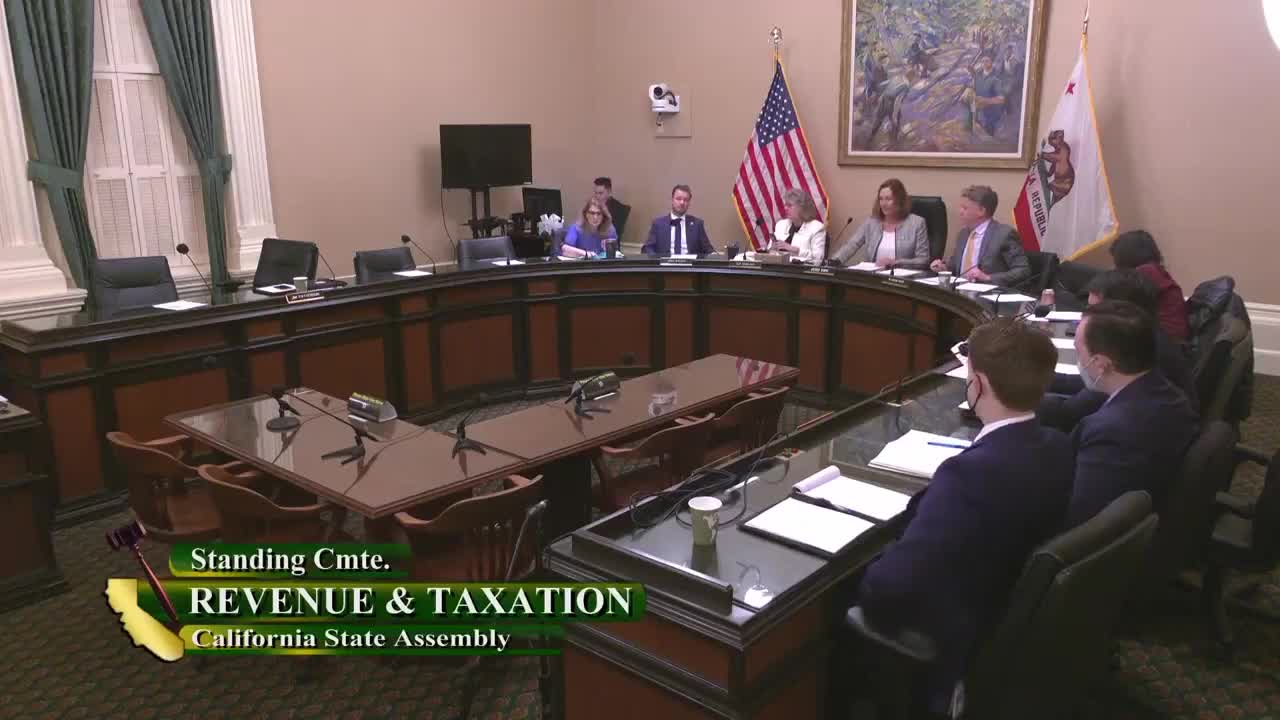
Assembly Standing Committee on Revenue and Taxation
Bill Author

Bill Co-Author(s):