AB 3056: Agricultural workers: overtime compensation.
- Session Year: 2023-2024
- House: Assembly
- Latest Version Date: 2024-04-08
Current Status:
Failed
(2024-04-18: In committee: Set, first hearing. Failed passage. Reconsideration granted.)
Introduced
In Committee
First Chamber
In Committee
Second Chamber
Enacted
What does this bill do?
The bill changes when agricultural (farm) workers must be paid overtime by keeping a phased schedule of daily and weekly hour limits and requiring time-and-a-half pay for hours over those limits, but sets the final weekly cutoff at 48 hours instead of 40. It also preserves later compliance dates for employers with 25 or fewer employees.
The summary is provided by generative AI which can make mistakes. For original language, please view the details in the table below.
Existing law sets wage, hour, meal break requirements, and other working conditions for employees and requires an employer to pay overtime wages as specified to an employee who works in excess of a workday or workweek, as defined, and imposes criminal penalties for the violation of these requirements. Existing law, the Phase-In Overtime for Agricultural Workers Act of 2016, imposes a schedule that phases in overtime requirements for agricultural workers each year, over the course of 4 years, from 2019 to 2022, inclusive. Existing law provides employers who employ 25 or fewer employees an additional 3 years to comply with the phasing in of these overtime requirements. In this regard, existing law requires a person employed in an agricultural occupation to receive 1 1/2 times their regular rate of pay for the hours they worked in excess of certain numbers in a workday or workweek, depending on the year and the size of the employer. law, beginning on January 1, 2022, and January 1, 2025, in the case of smaller employers, prohibits any person employed in an agricultural occupation from being employed more than 8 hours in a work day or 40 hours in a work week unless they receive 1 1/2 times their regular rate of pay for the excess hours they worked.
This bill would delete the provision that, beginning on January 1, 2021, and January 1, 2024, in the case of smaller employers, decreased the number of hours worked before that overtime rate of pay becomes applicable from 9 to 8 1/2 hours in a workday and from 50 to 45 hours in a workweek. The bill would also delete the provision that, beginning on January 1, 2022, and January 1, 2025, in the case of smaller employers, further decreases those hours to 8 hours in a workday and 40 hours in a workweek. increase the number of hours worked in a work week before that overtime rate of pay becomes applicable from 40 to 48 hours in a workweek.
Existing law sets wage, hour, meal break requirements, and other working conditions for employees and requires an employer to pay overtime wages as specified to an employee who works in excess of a workday or workweek, as defined, and imposes criminal penalties for the violation of these requirements. Existing law, the Phase-In Overtime for Agricultural Workers Act of 2016, imposes a schedule that phases in overtime requirements for agricultural workers each year, over the course of 4 years, from 2019 to 2022, inclusive. Existing law provides employers who employ 25 or fewer employees an additional 3 years to comply with the phasing in of these overtime requirements. In this regard, existing law requires a person employed in an agricultural occupation to receive 1 1/2 times their regular rate of pay for the hours they worked in excess of certain numbers in a workday or workweek, depending on the year and the size of the employer.
This bill would delete the provision that, beginning on January 1, 2021, and January 1, 2024, in the case of smaller employers, decreased the number of hours worked before that overtime rate of pay becomes applicable from 9 to 8 1/2 hours in a workday and from 50 to 45 hours in a workweek. The bill would also delete the provision that, beginning on January 1, 2022, and January 1, 2025, in the case of smaller employers, further decreases those hours to 8 hours in a workday and 40 hours in a workweek.
Notwithstanding any other provision of law, including Chapter 1 (commencing with Section 500):
(a)(1)Commencing January 1, 2019, except as provided in paragraph (2), any person employed in an agricultural occupation shall not be employed more than nine and one-half hours in any one workday or work in excess of 55 hours in any one workweek, unless the employee receives one and one-half times that employees regular rate of pay for all hours worked over nine and one-half hours in any workday or over 55 hours in any workweek.
(2)This subdivision shall apply to an employer who employs 25 or fewer employees commencing January 1, 2022.
(b)(1)Commencing January 1, 2020, except as provided in paragraph (2), any person employed in an agricultural occupation shall not be employed more than nine hours in any one workday or work in excess of 50 hours in any one workweek, unless the employee receives one and one-half times that employees regular rate of pay for all hours worked over nine hours in any workday or over 50 hours in any workweek.
(2)This subdivision shall apply to an employer who employs 25 or fewer employees commencing January 1, 2023.
(c)(1)Commencing January 1, 2021, except as provided in paragraph (2), any person employed in an agricultural occupation shall not be employed more than eight and one-half hours in any one workday or work in excess of 45 hours in any one workweek, unless the employee receives one and one-half times that employees regular rate of pay for all hours worked over eight and one-half hours in any workday or over 45 hours in any workweek.
(2)This subdivision shall apply to an employer who employs 25 or fewer employees commencing January 1, 2024.
(d)(1)Commencing January 1, 2022, except as provided in paragraph (2), any person employed in an agricultural occupation shall not be employed more than eight hours in any one workday or work in excess of 48 hours in any one workweek, unless the employee receives one and one-half times that employees regular rate of pay for all hours worked over eight hours in any workday or over 48 hours in any workweek.
(2)This subdivision shall apply to an employer who employs 25 or fewer employees commencing January 1, 2025.
Notwithstanding any other provision of law, including Chapter 1 (commencing with Section 500):
(a)(1)Commencing January 1, 2019, except as provided in paragraph (2), any person employed in an agricultural occupation shall not be employed more than nine and one-half hours in any one workday or work in excess of 55 hours in any one workweek, unless the employee receives one and one-half times that employees regular rate of pay for all hours worked over nine and one-half hours in any workday or over 55 hours in any workweek.
(2)This subdivision shall apply to an employer who employs 25 or fewer employees commencing January 1, 2022.
(b)(1)Commencing January 1, 2020, except as provided in paragraph (2), any person employed in an agricultural occupation shall not be employed more than nine hours in any one workday or work in excess of 50 hours in any one workweek, unless the employee receives one and one-half times that employees regular rate of pay for all hours worked over nine hours in any workday or over 50 hours in any workweek.
(2)This subdivision shall apply to an employer who employs 25 or fewer employees commencing January 1, 2023.
(c)(1)Commencing January 1, 2021, except as provided in paragraph (2), any person employed in an agricultural occupation shall not be employed more than eight and one-half hours in any one workday or work in excess of 45 hours in any one workweek, unless the employee receives one and one-half times that employees regular rate of pay for all hours worked over eight and one-half hours in any workday or over 45 hours in any workweek.(2)This subdivision shall apply to an employer who employs 25 or fewer employees commencing January 1, 2024.(d)(1)Commencing January 1, 2022, except as provided in paragraph (2), any person employed in an agricultural occupation shall not be employed more than eight hours in any one workday or work in excess of 40 hours in any one workweek, unless the employee receives one and one-half times that employees regular rate of pay for all hours worked over eight hours in any workday or over 40 hours in any workweek.(2)This subdivision shall apply to an employer who employs 25 or fewer employees commencing January 1, 2025.|
Date
|
Status
|
|---|---|
| Apr 18, 2024 | In committee: Set, first hearing. Failed passage. Reconsideration granted. |
| Apr 9, 2024 | Re-referred to Com. on L. & E. |
| Apr 8, 2024 | From committee chair, with author's amendments: Amend, and re-refer to Com. on L. & E. Read second time and amended. |
| Mar 11, 2024 | Referred to Com. on L. & E. |
| Feb 17, 2024 | From printer. May be heard in committee March 18. |
| Feb 16, 2024 | Read first time. To print. |
|
Date
|
Description
|
Location
|
Votes
|
|
|---|---|---|---|---|
| Apr 17, 2024 | Reconsideration. | Assembly Standing Committee on Labor and Employment |
Passed |
|
| Apr 17, 2024 | Do pass and be re-referred to the Committee on [Appropriations] | Assembly Standing Committee on Labor and Employment |
Failed |
This list shows positions taken on this bill by organizations on the date displayed, which is linked to the original source.
Positions by individuals are not included.
|
Organization
|
Position
|
Date
|
|---|---|---|
| Agricultural Council Of California | * Support | Apr 17, 2024 |
| Association Of California Egg Farmers | ** Support | Apr 17, 2024 |
| California Agricultural Aircraft Association | ** Support | Apr 17, 2024 |
| California Association of Wine Grape Growers | * Support | Apr 17, 2024 |
| California Avocados | ** Support | Apr 17, 2024 |
| California Bean Shippers Association | ** Support | Apr 17, 2024 |
| California Chamber Of Commerce | * Support | Apr 17, 2024 |
| California Cotton Ginners and Growers Association | ** Support | Apr 17, 2024 |
| California Farm Bureau | ** Support | Apr 17, 2024 |
| California Food and Farming Network | * Against | Apr 17, 2024 |
| California Fresh Fruit Association | ** Support | Apr 17, 2024 |
| California Pear Association | ** Support | Apr 17, 2024 |
| California Rural Legal Assistance Foundation | ** Against | |
| California State Beekeepers Association | * Support | Apr 17, 2024 |
| California Strawberry Commission | * Support | Apr 17, 2024 |
| California Teamsters | * Against | Apr 17, 2024 |
| Californians for Pesticide Reform | * Against | Apr 17, 2024 |
| Central California Environmental Justice Network | * Against | Apr 17, 2024 |
| Central Coast Alliance United for a Sustainable Economy | * Against | Apr 17, 2024 |
| Centro Binacional del Desarrollo | * Against | Apr 17, 2024 |
| Grower-Shipper Association of Central California | * Support | Apr 17, 2024 |
| Grower-Shipper Association of San Luis Obipso | * Support | Apr 17, 2024 |
| Grower-Shipper Association of Santa Barbara | * Support | Apr 17, 2024 |
| Latino Coalition for Healthy California | * Against | Apr 17, 2024 |
| Nisei Farmers League | ** Support | |
| Numerous individuals | ** Support | |
| Pacific Egg and Poultry Association | * Support | Apr 17, 2024 |
| Pesticide Action Network | * Against | Apr 17, 2024 |
| The Wine Institute | * Support | Apr 17, 2024 |
| Unión de Campesinos | * Against | Apr 17, 2024 |
| Unión de Campesinos | * Indeterminate | Apr 17, 2024 |
| United Farm Workers | ** Against | |
| United Food And Commercial Workers (Ufcw) | * Against | Apr 17, 2024 |
| Ventura County Ag Association | * Support | Apr 17, 2024 |
| Western AG Processors Association | * Support | Apr 17, 2024 |
| Western Grow Association | * Support | Apr 17, 2024 |
| Wheat Growers Association | * Support | Apr 17, 2024 |
Date of Hearing: April 17, 2024
ASSEMBLY COMMITTEE ON LABOR AND EMPLOYMENT
Liz Ortega, Chair
ABPCA Bill Id:AB 3056 (
Author:Gallagher) – As Amended Ver:April 8, 2024
SUBJECT: Agricultural workers: overtime compensation
SUMMARY: Repeals a provision of the phase-in of overtime for agricultural workers so that workers shall only be entitled to one-half times their regular rate of pay for all hours worked over 48 hours in any workweek.
EXISTING LAW:
- Establishes the Phase-In Overtime for Agricultural Workers Act of 2016 to provide a four year implementation schedule for larger employers and a three year delay for smaller employers. The schedule is as follows:
- Commencing January 1, 2019, agricultural workers shall not be employed more than nine and one-half hours in any one workday or work in excess of 55 hours in any one workweek, unless the employee receives one and one-half times that employee’s regular rate of pay for all hours worked over nine and one-half hours in any workday or over 55 hours in any workweek.
- This part shall apply to an employer who employs 25 or fewer employees commencing January 1, 2022.
- Commencing January 1, 2020, agricultural workers shall not be employed more than nine hours in any one workday or work in excess of 50 hours in any one workweek, unless the employee receives one and one-half times that employee’s regular rate of pay for all hours worked over nine hours in any workday or over 50 hours in any workweek.
- This part shall apply to an employer who employs 25 or fewer employees commencing January 1, 2023.
- Commencing January 1, 2021, agricultural workers shall not be employed more than eight and one-half hours in any one workday or work in excess of 45 hours in any one workweek, unless the employee receives one and one-half times that employee’s regular rate of pay for all hours worked over eight and one-half hours in any workday or over 45 hours in any workweek.
- This part shall apply to an employer who employs 25 or fewer employees commencing January 1, 2024.
- Commencing January 1, 2022, agricultural workers shall not be employed more than eight hours in any one workday or work in excess of 40 hours in any one workweek, unless the employee receives one and one-half times that employee’s regular rate of pay for all hours worked over eight hours in any workday or over 40 hours in any workweek.
- This part shall apply to an employer who employs 25 or fewer employees commencing January 1, 2025. Labor Code §860 et seq.
- Commencing January 1, 2019, agricultural workers shall not be employed more than nine and one-half hours in any one workday or work in excess of 55 hours in any one workweek, unless the employee receives one and one-half times that employee’s regular rate of pay for all hours worked over nine and one-half hours in any workday or over 55 hours in any workweek.
- Defines “employed in an agricultural occupation” to mean any of the following described occupations:
- The preparation, care, and treatment of farm land, pipeline, or ditches, including leveling for agricultural purposes, plowing, discing, and fertilizing the soil;
- The sowing and planting of any agricultural or horticultural commodity;
- The care of any agricultural or horticultural commodity; as used in this subdivision, “care” includes, but is not limited to, cultivation, irrigation, weed control, thinning, heating, pruning, or tying, fumigating, spraying, and dusting;
- The harvesting of any agricultural or horticultural commodity, including but not limited to, picking, cutting, threshing, mowing, knocking off, field chopping, bunching, baling, balling, field packing, and placing in field containers or in the vehicle in which the commodity will be hauled, and transportation on the farm or to a place of first processing or distribution;
- The assembly and storage of any agricultural or horticultural commodity, including but not limited to, loading, road siding, banking, stacking, binding, and piling;
- The raising, feeding and management of livestock, fur bearing animals, poultry, fish, mollusks, and insects, including but not limited to herding, housing, hatching, milking, shearing, handling eggs, and extracting honey;
- The harvesting of fish, as defined, for commercial sale;
- The conservation, improvement or maintenance of such farm and its tools and equipment. Industrial Welfare Commission Wage Order #14 (2)(D).
FISCAL EFFECT: Unknown
COMMENTS: California’s farm workers are some of the lowest paid workers in the state. According to a recent farm worker health study that interviewed over 1,200 farm workers, their median personal wages were $16,000 a year and a fourth of the respondents earned less than $10,000.[1] In addition, as much research has shown, farm workers are highly susceptible to wage theft, with one in five respondents reporting not being paid wages they earned by an employer.[2]
Historically, farm workers have been excluded from overtime protections despite engaging in physically demanding work that is often outdoors. Notwithstanding the passage of the Federal Labor Standards Act (FLSA) in 1938, and the granting of overtime to many U.S. workers, farm workers continued to labor without these protections. Even when Congress amended the FLSA in 1966 to extend minimum wage protections to most farm workers, it did not extend overtime to them and as many historians argue, continued to perpetuate the racial underpinnings of the Act.
The continued denial of overtime for these workers on the federal level has had significant socio-economic impacts. “First, farmworkers were, as a class, denied the monetary benefits that come with overtime pay—time and a half. The availability of overtime pay has a significant impact on workers’ annual earnings. Second, farmworkers were denied the quality-of-life benefits that can come with maximum hours protection. Historically, the overtime premium pay requirement was intended to be a disincentive in many sectors for employers to require workers to labor for more than 40 hours per week, allowing workers the opportunity to have basic work-life balance, to pursue other activities, and to invest in their children’s care and education outside work hours.
Overtime also can prevent workers from being subjected to unsafe conditions for overly long periods of time. Farmworkers in particular labor in dangerous conditions that expose them to extreme temperatures, require them to work with heavy machinery and carry burdensome loads, and expose them to dangerous chemicals and pesticides. But the FLSA’s continued exclusion of farmworkers from overtime pay enables and incentivizes farms to require farmworkers to labor from sunrise to sunset, regardless of the hours required or the toll that places on farmworkers’ bodies and family lives.”[3]
As the author points out, California ended the exclusion from overtime for farm workers with a phased-in approach under AB 1066 in 2016. Similarly, states such as Colorado, Hawaii, Minnesota, New York, Washington, and most recently, Oregon, have passed laws granting farm workers some level of overtime protection. On the federal level, U.S. Senator Alex Padilla (D-CA) and U.S. Rep. Raul M. Grijalva (D-AZ) re-introduced the “Fairness for Farm Workers Act” in July 2023 to incrementally grant farm workers overtime protections based on the size of their employer.
According to the author, “In 2016, AB 1066 eliminated exemptions for agricultural workers from California's overtime wage law. This law requires farmworkers to receive overtime pay after eight work hours in a day or after 40 work hours in a week by 2022. This approach failed to recognize the distinct nature of agricultural work, characterized by its seasonal aspects, reliance on natural factors, and handling of perishable goods. Additionally, most farmers are price takers and are unable to raise their prices in response to government mandates.
While well intentioned, the law has resulted in workers losing hours and wages. Recent research showed that workers lost a total of 15,000 to 45,000 work hours and $6 to $9 million in wages within the first two years of implementation.
AB 3056 ensures fair compensation for workers while safeguarding the long-term viability of California's agricultural sector by mandating overtime pay for agricultural employees working more than nine hours in a workday or in excess of 50 hours in a workweek, which is stricter than the pre-AB 1066 requirement of 10 hours in a workday and 60 hours in a workweek.”
The author continues, “AB 3056 promotes equity solutions and maximizes benefits for underserved and marginalized communities by ensuring fair compensation and protecting worker rights. It addresses unintended negative consequences of previous legislation, aiming to restore lost hours and wages incurred due to AB 1066. Additionally, the bill preserves jobs while considering the unique challenges faced by farmers, who are price takers and are unable to raise their prices in response to government mandates.
An analysis by the Oregon Farm Bureau concluded that the workers most impacted by overtime laws are also the most marginalized. The data indicates that the most likely to benefit may be more skilled/higher paid agricultural workers such as equipment operators. However, the impact on lower skill jobs is likely lost wages due to fewer hours, or even jobs being eliminated.”
Committee Comments
The author alleges “that recent research showed that workers lost a total of 15,000 to 45,000 work hours and $6 to $9 million in wages within the first two years of implementation [of AB 1066].” The research the author relies upon, by Professor Alexandra Hill, can be questioned on the basis that it is not comprehensive—covering only two years out of a four-year implementation schedule—and that the researcher herself suggests that further investigation is warranted.[4]
In March 2024, the UC Merced Community and Labor Center released findings that run counter to Professor Hill’s conclusion. The Center’s analysis of data from the American Community Survey found that average hours worked decreased and average pay increased for California’s farm workers from 2017 to 2022.[5] Specifically, “In 2017, California farmworkers earned an average of $18,827 per year, and in 2018 that figure was $19,964. Following the passage of California farmworker overtime protections in 2019, average earnings increased to $21,863. By 2022, that figure had increased to $24,871.
At the same time, the average number of hours worked among farmworkers has steadily decreased. In 2017, California farmworkers worked an average of 42.7 hours per week. In 2019, that figure remained virtually unchanged, at 42.3 hours per week.”[6]
Arguments in Support
A coalition of individuals are in support and states, “Proponents of AB 1066 claimed it would result in higher incomes for California agricultural workers. Unfortunately, this has not been the case. A recent study by Professor Alexandra Hill with the UC Berkeley Department of Agricultural and Resource Economics showed that agricultural employees on average have experienced a decrease in worker hours and wages. Dr. Hill estimates that agricultural workers lost a total of 15,000 to 45,000 work hours and $6 to $9 million in wages within the first two years of implementation of AB 1066. Dr. Hill is currently building on this work using more recent data. The data through 2022 corroborate her initial findings and show that workers continued losing hours and income.
The reason for this is simple: California agricultural producers already bear some of the highest production costs in the world and compete with producers from states and nations with much lower production costs in markets where they cannot dictate the prices of their produce. California agricultural producers have no means to recover the additional production cost imposed by AB 1066 and as a result can no longer offer employees work hours they could prior to its implementation.”
Arguments in Opposition
The United Farm Workers is opposed and states, “California’s farm worker overtime law took a phase-in approach to ensure all farm workers reach overtime pay parity with every other California worker receiving overtime pay after 8 hours and 40 hours per week.
A 2024 UC Merced Community and Labor Center analysis of 2017-2022 IPUMS-American Community Survey data found that by 2022, after the full implementation of the farm worker overtime law, California farm workers averaging over 40 hours per week had average annual earnings of $32,417 per year—more than one third (38%) higher earnings than in 2018 ($23,377), right before the law’s implementation.
AB 3056 proposes a reversal of that progress.”
Prior Legislation
AB 1066 (Gonzalez) Chapter 313, Statutes of 2016 enacts the Phase-In Overtime for Agricultural Workers Act of 2016, as specified.
AB 2757 of 2016 would have enacted the Phase-In Overtime for Agricultural Workers Act of 2016, as specified. The measure failed on Assembly Third Reading.
AB 1313 (Allen) of 2011 would have made the daily overtime requirements of current law that require overtime for hours worked in excess of eight in one workday applicable to agricultural employees, as specified. The measure failed on Concurrence in Senate Amendments.
SB 1121 (Florez) of 2010 this bill would have withdrawn the exemption on agricultural workers from overtime and meal period requirements. The measure was vetoed by the Governor.
REGISTERED SUPPORT / OPPOSITION:
Support
California Farm Bureau Federation
California State Beekeepers Association
Nisei Farmers League
Numerous Individuals
Opposition
California Rural Legal Assistance Foundation
United Farm Workers
Analysis Prepared by: Megan Lane / L. & E. /
Community and Labor Center, UC Merced, “Farmworker Health in California,” 2022, p. 18, 30. ↑
Ibid. at 7. ↑
“From Excluded to Essential: Tracing the Racist Exclusion of Farmworkers, Domestic Workers, and Tipped Workers from the Fair Labor Standards Act,” Testimony of Rebecca Dixon of the National Employment Law Project at the Hearing before the U.S. House of Representatives Education and Labor Committee, Workforce Protections Subcommittee, May 3, 2021. ↑
Hill, Alexandra E. 2023. “California’s Overtime Law for Agricultural Workers: What Happened to Worker Hours and Pay?” ARE Update 27(1): 1–4. ↑
UC Merced, Community and Labor Center, Fact Sheet: California Farmworker Earnings After Overtime Protections,” March 2024. ↑
Ibid. at 1. ↑
Date of Hearing: April 17, 2024
ASSEMBLY COMMITTEE ON LABOR AND EMPLOYMENT
Liz Ortega, Chair
ABPCA Bill Id:AB 3056 (
Author:Gallagher) – As Amended Ver:April 8, 2024
SUBJECT: Agricultural workers: overtime compensation
SUMMARY: Repeals a provision of the phase-in of overtime for agricultural workers so that workers shall only be entitled to one-half times their regular rate of pay for all hours worked over 48 hours in any workweek.
EXISTING LAW:
- Establishes the Phase-In Overtime for Agricultural Workers Act of 2016 to provide a four year implementation schedule for larger employers and a three year delay for smaller employers. The schedule is as follows:
- Commencing January 1, 2019, agricultural workers shall not be employed more than nine and one-half hours in any one workday or work in excess of 55 hours in any one workweek, unless the employee receives one and one-half times that employee’s regular rate of pay for all hours worked over nine and one-half hours in any workday or over 55 hours in any workweek.
- This part shall apply to an employer who employs 25 or fewer employees commencing January 1, 2022.
- Commencing January 1, 2020, agricultural workers shall not be employed more than nine hours in any one workday or work in excess of 50 hours in any one workweek, unless the employee receives one and one-half times that employee’s regular rate of pay for all hours worked over nine hours in any workday or over 50 hours in any workweek.
- This part shall apply to an employer who employs 25 or fewer employees commencing January 1, 2023.
- Commencing January 1, 2021, agricultural workers shall not be employed more than eight and one-half hours in any one workday or work in excess of 45 hours in any one workweek, unless the employee receives one and one-half times that employee’s regular rate of pay for all hours worked over eight and one-half hours in any workday or over 45 hours in any workweek.
- This part shall apply to an employer who employs 25 or fewer employees commencing January 1, 2024.
- Commencing January 1, 2022, agricultural workers shall not be employed more than eight hours in any one workday or work in excess of 40 hours in any one workweek, unless the employee receives one and one-half times that employee’s regular rate of pay for all hours worked over eight hours in any workday or over 40 hours in any workweek.
- This part shall apply to an employer who employs 25 or fewer employees commencing January 1, 2025. Labor Code §860 et seq.
- Commencing January 1, 2019, agricultural workers shall not be employed more than nine and one-half hours in any one workday or work in excess of 55 hours in any one workweek, unless the employee receives one and one-half times that employee’s regular rate of pay for all hours worked over nine and one-half hours in any workday or over 55 hours in any workweek.
- Defines “employed in an agricultural occupation” to mean any of the following described occupations:
- The preparation, care, and treatment of farm land, pipeline, or ditches, including leveling for agricultural purposes, plowing, discing, and fertilizing the soil;
- The sowing and planting of any agricultural or horticultural commodity;
- The care of any agricultural or horticultural commodity; as used in this subdivision, “care” includes, but is not limited to, cultivation, irrigation, weed control, thinning, heating, pruning, or tying, fumigating, spraying, and dusting;
- The harvesting of any agricultural or horticultural commodity, including but not limited to, picking, cutting, threshing, mowing, knocking off, field chopping, bunching, baling, balling, field packing, and placing in field containers or in the vehicle in which the commodity will be hauled, and transportation on the farm or to a place of first processing or distribution;
- The assembly and storage of any agricultural or horticultural commodity, including but not limited to, loading, road siding, banking, stacking, binding, and piling;
- The raising, feeding and management of livestock, fur bearing animals, poultry, fish, mollusks, and insects, including but not limited to herding, housing, hatching, milking, shearing, handling eggs, and extracting honey;
- The harvesting of fish, as defined, for commercial sale;
- The conservation, improvement or maintenance of such farm and its tools and equipment. Industrial Welfare Commission Wage Order #14 (2)(D).
FISCAL EFFECT: Unknown
COMMENTS: California’s farm workers are some of the lowest paid workers in the state. According to a recent farm worker health study that interviewed over 1,200 farm workers, their median personal wages were $16,000 a year and a fourth of the respondents earned less than $10,000.[1] In addition, as much research has shown, farm workers are highly susceptible to wage theft, with one in five respondents reporting not being paid wages they earned by an employer.[2]
Historically, farm workers have been excluded from overtime protections despite engaging in physically demanding work that is often outdoors. Notwithstanding the passage of the Federal Labor Standards Act (FLSA) in 1938, and the granting of overtime to many U.S. workers, farm workers continued to labor without these protections. Even when Congress amended the FLSA in 1966 to extend minimum wage protections to most farm workers, it did not extend overtime to them and as many historians argue, continued to perpetuate the racial underpinnings of the Act.
The continued denial of overtime for these workers on the federal level has had significant socio-economic impacts. “First, farmworkers were, as a class, denied the monetary benefits that come with overtime pay—time and a half. The availability of overtime pay has a significant impact on workers’ annual earnings. Second, farmworkers were denied the quality-of-life benefits that can come with maximum hours protection. Historically, the overtime premium pay requirement was intended to be a disincentive in many sectors for employers to require workers to labor for more than 40 hours per week, allowing workers the opportunity to have basic work-life balance, to pursue other activities, and to invest in their children’s care and education outside work hours.
Overtime also can prevent workers from being subjected to unsafe conditions for overly long periods of time. Farmworkers in particular labor in dangerous conditions that expose them to extreme temperatures, require them to work with heavy machinery and carry burdensome loads, and expose them to dangerous chemicals and pesticides. But the FLSA’s continued exclusion of farmworkers from overtime pay enables and incentivizes farms to require farmworkers to labor from sunrise to sunset, regardless of the hours required or the toll that places on farmworkers’ bodies and family lives.”[3]
As the author points out, California ended the exclusion from overtime for farm workers with a phased-in approach under AB 1066 in 2016. Similarly, states such as Colorado, Hawaii, Minnesota, New York, Washington, and most recently, Oregon, have passed laws granting farm workers some level of overtime protection. On the federal level, U.S. Senator Alex Padilla (D-CA) and U.S. Rep. Raul M. Grijalva (D-AZ) re-introduced the “Fairness for Farm Workers Act” in July 2023 to incrementally grant farm workers overtime protections based on the size of their employer.
According to the author, “In 2016, AB 1066 eliminated exemptions for agricultural workers from California's overtime wage law. This law requires farmworkers to receive overtime pay after eight work hours in a day or after 40 work hours in a week by 2022. This approach failed to recognize the distinct nature of agricultural work, characterized by its seasonal aspects, reliance on natural factors, and handling of perishable goods. Additionally, most farmers are price takers and are unable to raise their prices in response to government mandates.
While well intentioned, the law has resulted in workers losing hours and wages. Recent research showed that workers lost a total of 15,000 to 45,000 work hours and $6 to $9 million in wages within the first two years of implementation.
AB 3056 ensures fair compensation for workers while safeguarding the long-term viability of California's agricultural sector by mandating overtime pay for agricultural employees working more than nine hours in a workday or in excess of 50 hours in a workweek, which is stricter than the pre-AB 1066 requirement of 10 hours in a workday and 60 hours in a workweek.”
The author continues, “AB 3056 promotes equity solutions and maximizes benefits for underserved and marginalized communities by ensuring fair compensation and protecting worker rights. It addresses unintended negative consequences of previous legislation, aiming to restore lost hours and wages incurred due to AB 1066. Additionally, the bill preserves jobs while considering the unique challenges faced by farmers, who are price takers and are unable to raise their prices in response to government mandates.
An analysis by the Oregon Farm Bureau concluded that the workers most impacted by overtime laws are also the most marginalized. The data indicates that the most likely to benefit may be more skilled/higher paid agricultural workers such as equipment operators. However, the impact on lower skill jobs is likely lost wages due to fewer hours, or even jobs being eliminated.”
Committee Comments
The author alleges “that recent research showed that workers lost a total of 15,000 to 45,000 work hours and $6 to $9 million in wages within the first two years of implementation [of AB 1066].” The research the author relies upon, by Professor Alexandra Hill, can be questioned on the basis that it is not comprehensive—covering only two years out of a four-year implementation schedule—and that the researcher herself suggests that further investigation is warranted.[4]
In March 2024, the UC Merced Community and Labor Center released findings that run counter to Professor Hill’s conclusion. The Center’s analysis of data from the American Community Survey found that average hours worked decreased and average pay increased for California’s farm workers from 2017 to 2022.[5] Specifically, “In 2017, California farmworkers earned an average of $18,827 per year, and in 2018 that figure was $19,964. Following the passage of California farmworker overtime protections in 2019, average earnings increased to $21,863. By 2022, that figure had increased to $24,871.
At the same time, the average number of hours worked among farmworkers has steadily decreased. In 2017, California farmworkers worked an average of 42.7 hours per week. In 2019, that figure remained virtually unchanged, at 42.3 hours per week.”[6]
Arguments in Support
A coalition of individuals are in support and states, “Proponents of AB 1066 claimed it would result in higher incomes for California agricultural workers. nfortunately, this has not been the case. A recent study by Professor Alexandra Hill with the UC Berkeley Department of Agricultural and Resource Economics showed that agricultural employees on average have experienced a decrease in worker hours and wages. Dr. Hill estimates that agricultural workers lost a total of 15,000 to 45,000 work hours and $6 to $9 million in wages within the first two years of implementation of AB 1066. Dr. Hill is currently building on this work using more recent data. The data through 2022 corroborate her initial findings and show that workers continued losing hours and income.
The reason for this is simple: California agricultural producers already bear some of the highest production costs in the world and compete with producers from states and nations with much lower production costs in markets where they cannot dictate the prices of their produce. California agricultural producers have no means to recover the additional production cost imposed by AB 1066 and as a result can no longer offer employees work hours they could prior to its implementation.”
Arguments in Opposition
The United Farm Workers is opposed and states, “California’s farm worker overtime law took a phase-in approach to ensure all farm workers reach overtime pay parity with every other California worker receiving overtime pay after 8 hours and 40 hours per week.
A 2024 UC Merced Community and Labor Center analysis of 2017-2022 IPUMS-American Community Survey data found that by 2022, after the full implementation of the farm worker overtime law, California farm workers averaging over 40 hours per week had average annual earnings of $32,417 per year—more than one third (38%) higher earnings than in 2018 ($23,377), right before the law’s implementation.
AB 3056 proposes a reversal of that progress.”
Prior Legislation
AB 1066 (Gonzalez) Chapter 313, Statutes of 2016 enacts the Phase-In Overtime for Agricultural Workers Act of 2016, as specified.
AB 2757 of 2016 would have enacted the Phase-In Overtime for Agricultural Workers Act of 2016, as specified. The measure failed on Assembly Third Reading.
AB 1313 (Allen) of 2011 would have made the daily overtime requirements of current law that require overtime for hours worked in excess of eight in one workday applicable to agricultural employees, as specified. The measure failed on Concurrence in Senate Amendments.
SB 1121 (Florez) of 2010 this bill would have withdrawn the exemption on agricultural workers from overtime and meal period requirements. The measure was vetoed by the Governor.
REGISTERED SUPPORT / OPPOSITION:
Support
California Farm Bureau Federation
California State Beekeepers Association
Nisei Farmers League
Numerous Individuals
Opposition
California Rural Legal Assistance Foundation
United Farm Workers
Analysis Prepared by: Megan Lane / L. & E. /
Community and Labor Center, UC Merced, “Farmworker Health in California,” 2022, p. 18, 30. ↑
Ibid. at 7. ↑
“From Excluded to Essential: Tracing the Racist Exclusion of Farmworkers, Domestic Workers, and Tipped Workers from the Fair Labor Standards Act,” Testimony of Rebecca Dixon of the National Employment Law Project at the Hearing before the U.S. House of Representatives Education and Labor Committee, Workforce Protections Subcommittee, May 3, 2021. ↑
Hill, Alexandra E. 2023. “California’s Overtime Law for Agricultural Workers: What Happened to Worker Hours and Pay?” ARE Update 27(1): 1–4. ↑
UC Merced, Community and Labor Center, Fact Sheet: California Farmworker Earnings After Overtime Protections,” March 2024. ↑
Ibid. at 1. ↑
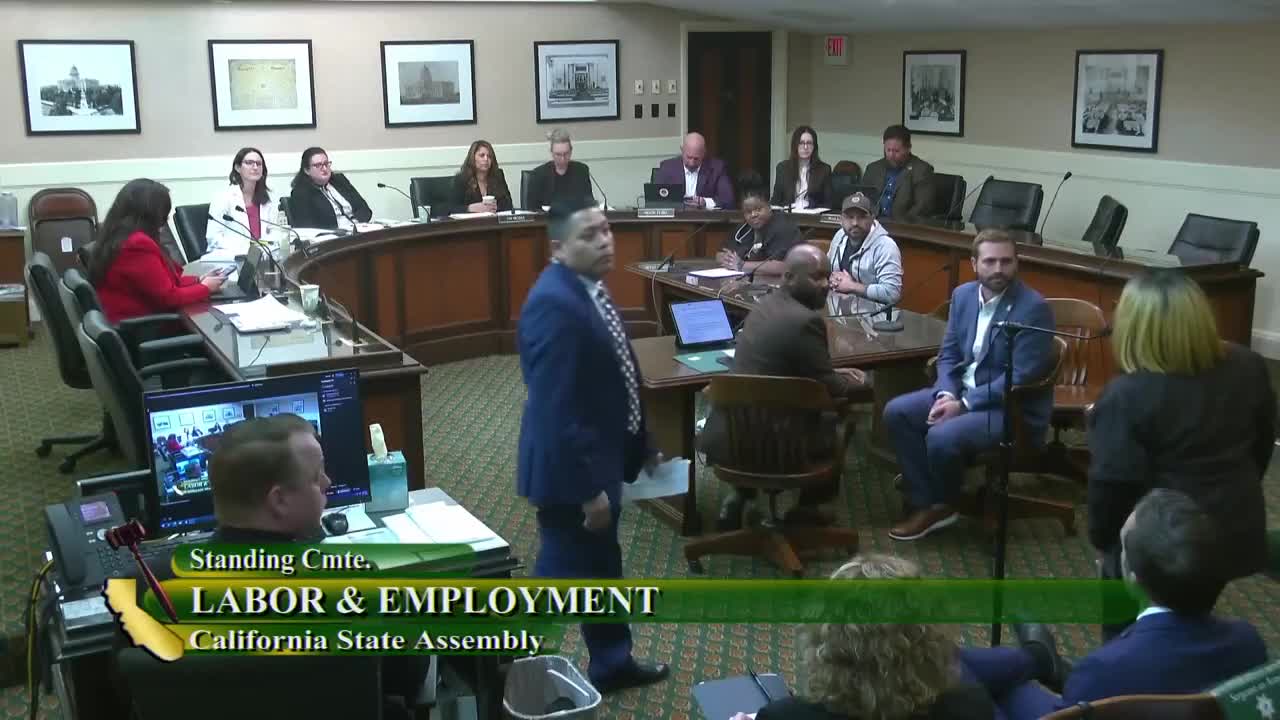
Discussed in Hearing
 31MIN
Assembly Standing Committee on Labor and Employment
Bill Author