AB 395: California Community College Guided Pathways Grant Program.
- Session Year: 2023-2024
- House: Assembly
- Latest Version Date: 2023-03-09
Current Status:
Failed
(2024-02-01: From committee: Filed with the Chief Clerk pursuant to Joint Rule 56.)
Introduced
In Committee
First Chamber
In Committee
Second Chamber
Enacted
Existing law establishes the California Community College Guided Pathways Grant Program under the administration of the office of the Chancellor of the California Community Colleges and requires the chancellors office to distribute grants, upon appropriation by the Legislature, to community colleges that satisfy certain requirements, including, among other requirements, integration of existing student-success programs and development of clearly structured, coherent guided pathways programs, as defined.
This bill, on or before August 1, 2024, and on or before August 1 of every even-numbered year thereafter, would require each community college to develop an educational plan, as provided, to provide a detailed sequence of courses for each degree, certificate, diploma, or license, or any other form of transfer to a postsecondary educational institution, offered by the community college and ensure that the community college offers the courses required for a degree, certificate, diploma, or license, or any other pathway of transfer to a postsecondary educational institution, in a consistent manner to ensure students can plan their academic futures. The bill, on or before June 1, 2025, and on or before June 1 of every even-numbered year thereafter, would require the chancellors office to submit a report to the Director of Finance and the Legislature, based on the educational plans received from community colleges, as specified, that includes a summary of the educational plans and related information, as provided. By imposing new duties on community college districts, the bill would impose a state-mandated local program.
The California Constitution requires the state to reimburse local agencies and school districts for certain costs mandated by the state. Statutory provisions establish procedures for making that reimbursement.
This bill would provide that, if the Commission on State Mandates determines that the bill contains costs mandated by the state, reimbursement for those costs shall be made pursuant to the statutory provisions noted above.
Existing law establishes the California Community Colleges, under the administration of the Board of Governors of the California Community Colleges, as one of the segments of public postsecondary education in this state. Existing law, the Seymour-Campbell Student Success Act of 2012, provides that the purpose of the act is to increase California community college student access and success by providing effective core matriculation services of orientation, assessment and placement, counseling, and other education planning services, and academic interventions.This bill would state the intent of the Legislature to enact subsequent legislation relating to student matriculation and assessment at the California Community Colleges.Existing law establishes the California Community Colleges, under the administration of the Board of Governors of the California Community Colleges, as one of the segments of public postsecondary education in this state. Existing law, the Seymour-Campbell Student Success Act of 2012, provides that the purpose of the act is to increase California community college student access and success by providing effective core matriculation services of orientation, assessment and placement, counseling, and other education planning services, and academic interventions.
This bill would state the intent of the Legislature to enact subsequent legislation relating to student matriculation and assessment at the California Community Colleges.
(a)As used in this section, the following definitions apply:
(1)Education program means a planned sequence of courses leading to a degree, certificate, diploma, or license, or any other pathway of transfer to a postsecondary educational institution.
(2)Postsecondary educational institution means a campus of the University of California or the California State University, an institution of higher education, as defined in Section 66010, a private postsecondary educational institution, as defined in Section 94858, or any other four-year institution of higher education offering a baccalaureate degree program.
(3)Sequence of courses means the courses required to successfully complete a degree, certificate, diploma, or license, or any other pathway of transfer to a postsecondary educational institution.
(4)Time to completion means the number of semesters or quarters required for a student attending a community college full time who maintains good academic standing to successfully complete a degree, certificate, diploma, or license, or any other pathway of transfer to a postsecondary educational institution.
(b)On or before August 1, 2024, and on or before August 1 of every even-numbered year thereafter, each community college, in collaboration with the governing board of the community college district that maintains the community college and the academic senate of the community college or the community college district, shall develop an educational plan for the next two consecutive academic years for the community college. An educational plan shall be modified and brought up to date annually, as deemed necessary by the governing board of the community college district. On or before December 1, 2024, and on or before December 1 of every even-numbered year thereafter, the educational plan shall be made available to the public on the community colleges internet website. Each educational plan shall provide a detailed sequence of courses for each degree, certificate, diploma, or license, or any other form of transfer to a postsecondary educational institution, offered by the community college, and ensure that the community college offers the courses required for a degree, certificate, diploma, or license, or any other pathway of transfer to a postsecondary educational institution, in a consistent manner to ensure students can plan their academic futures. Each educational plan shall include, but is not limited to, both of the following:
(1)A catalog of courses offered by the community college for the semesters or quarters of the two consecutive academic years required in the educational plan.
(2)(A)The sequence of courses required by the community college to successfully complete each degree, certificate, diploma, or license, or any other pathway of transfer to a postsecondary educational institution, offered by the community college for the two consecutive academic years required in the educational plan.
(B)The sequence of courses shall be offered in a manner that ensures each course required for a degree, certificate, diploma, or license, or any other pathway of transfer to a postsecondary educational institution, is offered to students at least once annually, or, if the time to completion is less than one academic year, at least once within the allotted time to completion.
(c)(1)On or before January 1, 2025, and on or before January 1 of every even-numbered year thereafter, the educational plan created pursuant to subdivision (b) shall be submitted to the chancellors office.
(2)On or before June 1, 2025, and on or before June 1 of every even-numbered year thereafter, the chancellors office shall submit a report to the Director of Finance and the Legislature, pursuant to Section 9795 of the Government Code, that includes a summary of the educational plans received by the chancellors office pursuant to paragraph (1). The report shall include, but is not limited to, all of the following:
(A)A summary of each community colleges progress in implementing subdivision (b).
(B)A determination of whether each community colleges course offerings align with the educational plan and time to completion for each degree, certificate, diploma, or license, or any other pathway of transfer to a postsecondary educational institution, offered by the community college.
(C)Any recommendations on statutory or regulatory changes to improve the ability of community colleges to implement subdivision (b).
(d)This section does not require a student to successfully complete any degree, certificate, diploma, license, or other pathway of transfer to a postsecondary educational institution within two academic years.
(e)Community colleges may use funding appropriated for purposes of this part and the Student Equity and Achievement Program established pursuant to Section 78222 to implement this section.
SEC. 2.If the Commission on State Mandates determines that this act contains costs mandated by the state, reimbursement to local agencies and school districts for those costs shall be made pursuant to Part 7 (commencing with Section 17500) of Division 4 of Title 2 of the Government Code.
SECTION 1.It is the intent of the Legislature to enact subsequent legislation relating to student matriculation and assessment at the California Community Colleges.It is the intent of the Legislature to enact subsequent legislation relating to student matriculation and assessment at the California Community Colleges.
|
Date
|
Status
|
|---|---|
| Feb 1, 2024 | From committee: Filed with the Chief Clerk pursuant to Joint Rule 56. |
| Jan 31, 2024 | Died pursuant to Art. IV, Sec. 10(c) of the Constitution. |
| May 18, 2023 | In committee: Held under submission. |
| May 3, 2023 | In committee: Set, first hearing. Referred to APPR. suspense file. |
| Apr 19, 2023 | From committee: Do pass and re-refer to Com. on APPR. (Ayes 11. Noes 0.) (April 18). Re-referred to Com. on APPR. |
| Mar 13, 2023 | Re-referred to Com. on HIGHER ED. |
| Mar 9, 2023 | From committee chair, with author's amendments: Amend, and re-refer to Com. on HIGHER ED. Read second time and amended. |
| Mar 9, 2023 | Referred to Com. on HIGHER ED. |
| Feb 3, 2023 | From printer. May be heard in committee March 5. |
| Feb 2, 2023 | Read first time. To print. |
|
Date
|
Description
|
Location
|
Votes
|
|
|---|---|---|---|---|
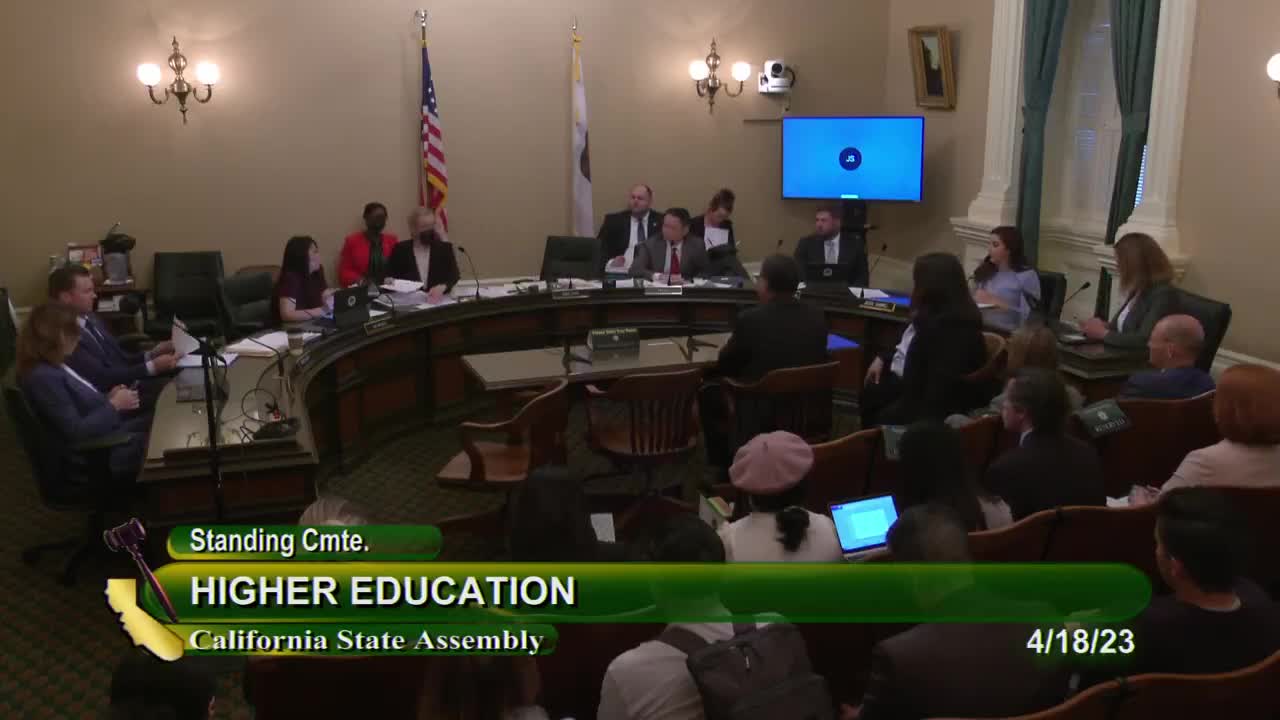
| Apr 18, 2023 | Do pass and be re-referred to the Committee on [Appropriations] | Assembly Standing Committee on Higher Education |
Passed |
This list shows positions taken on this bill by organizations on the date displayed, which is linked to the original source.
Positions by individuals are not included.
|
Organization
|
Position
|
Date
|
|---|---|---|
| California Association of Latino Community College Trustees and Administrators | * Support | Apr 18, 2023 |
| Cerritos Community College | * Support | Apr 18, 2023 |
| Cerritos Community College | * Support | Apr 18, 2023 |
Date of Hearing: May 3, 2023
ASSEMBLY COMMITTEE ON APPROPRIATIONS
Chris Holden, Chair
ABPCA Bill Id:AB 395
Author:(Reyes) – As Amended Ver:March 9, 2023
Policy Committee: | Higher Education | Vote: | 11 - 0 |
|
| ||
|
|
Urgency: No State Mandated Local Program: Yes Reimbursable: Yes
SUMMARY:
This bill requires each California Community College (CCC) to develop an education plan for course sequences and course offerings for the next two consecutive academic years and to offer these courses at least annually. The bill also requires the CCC Chancellor’s Office to report certain information about the education plans to the Legislature.
Specifically, the CCC is to develop the education plan by August 1, 2024, and every even year thereafter. The education plan is to include (a) a catalog of courses offered by the CCC for the next two consecutive years of semesters or quarters, and (b) the sequence of courses required by the CCC for every degree, certificate, diploma, license, or any other pathway of transfer to a postsecondary educational institution offered by the CCC. The bill requires a CCC to offer the sequence of courses developed in the education plan at least once annually, or, if the time to completion is less than one year, at least once within the allotted time to completion
The bill also requires CCCs to provide the plan to the CCC Chancellor’s Office by January 1, 2025, and every even year thereafter. The bill requires the Chancellor’s Office to submit a report to the Legislature by June 1, 2025, and every even year thereafter, that contains (a) a summary of the education plans submitted, (b) a determination of whether each CCC’s course offerings align with the education plan and time to completion, and (c) any recommendations to improve (b).
FISCAL EFFECT:
- Ongoing General Fund costs to the CCC Chancellor’s Office in the tens of thousands of dollars to submit a summary report to the Legislature by June 1, 2025, and every even year thereafter.
- Ongoing Proposition 98 General Fund costs to CCCs, potentially in the hundreds of millions of dollars annually, to develop the education plan by August 1, 2024, and every even year thereafter; offer certain courses annually to students if they do not already; and provide the plan to the CCC Chancellor’s Office by January 1, 2025, and every even year thereafter.
According to the CCC Chancellor’s Office, these costs consist of:
- Between $195,500 and $460,000 for CCCs to develop the education plan and update it every even year thereafter.
- About $245 million to hire additional faculty to teach additional courses at 115 CCCs. 54,754 more courses that would need to be offered on an annual cycle to meet the requirements associated with this bill. Assuming a college hires a part-time faculty member ($82.98 hourly rate) to teach a three-unit course (54 class hours) for each of the remaining 54,754 courses, costs would be $245.3 million.
(c) Between $2.4 million and $3.2 million for CCCs to collect, evaluate, and report specified data regarding their educational plan.
The state would need to reimburse these costs to CCC, if the Commission on State Mandates determines the bill’s requirements to be a reimbursable state mandate.
COMMENTS:
- Purpose. According to the author:
California Community Colleges play a key role in connecting California students, especially first-generation college students and those from low-income backgrounds, to well-paying careers and four-year universities. But two-year completion rates remain low, especially for our Latino, Black, and Indigenous students. AB 395 supports students’ goals of earning their degrees and certificates within two years by requiring colleges to take concrete steps to make this timeline possible.
- Prior Legislation. AB 2738 (Reyes), of the 2021-2022 Legislative Session, would have required CCC to make information available regarding course schedules and degree completion rates. It also would have required CCC to either offer a courses associated with a degree or certificate within a specified timeframe or report to the public and the CCC Chancellor’s Office the reasons why a college is not able to provide the course within the specified timeframe. The bill was held in the Senate Appropriations Committee.
Analysis Prepared by: Natasha Collins / APPR. / (916) 319-2081
Date of Hearing: April 18, 2023
ASSEMBLY COMMITTEE ON HIGHER EDUCATION
Mike Fong, Chair
ABPCA Bill Id:AB 395 (
Author:Reyes) – As Amended Ver:March 9, 2023
SUBJECT: California Community College Guided Pathways Grant Program
SUMMARY: Requires community colleges by August 1, 2024, and every even year thereafter, to develop an education plan for course sequences and course offerings for the next two consecutive academic years. Requires community colleges to provide the education plan to the Chancellor’s Office of the California Community Colleges (CCC) by January 1, 2025, and every even year thereafter, and requires the Chancellor’s Office to submit a summary report to the Legislature by June 1, 2025, and every even year thereafter. Specifically, this bill:
- Requires by August 1, 2024, and by August 1, of every even year that follows, for a community college to develop an educational plan for the next two consecutive academic years, in collaboration with its local governing board and either the community colleges’ academic senate or the community college districts (CCD) academic senate. Stipulates each educational plan established in (1) will include, but is not limited to, the following:
- A catalog of courses offered by the community college for the semester or quarters of the two consecutive academic years required by the educational plan;
- The sequence of courses required by the community college for every degree, certificate, diploma, license, or any other pathway of transfer to a postsecondary educational institution offered by the community college; and,
- Each course required in the sequence of courses mentioned in (b) will be offered at least once annually or if the time to completion for the degree, certificate, diploma, license, or any other pathway of transfer to a postsecondary educational institution takes less than one year, at least once within the allotted time to completion.
- Requires by December 1, 2024, and by December 1, of every even year that follows, the educational plan created pursuant to (1) will be published on the community college’s website.
- Requires by January 1, 2025, and by January 1, in every even-numbered year thereafter, the educational plan pursuant to (1) will be submitted to the Chancellor’s office of the CCC. By June 1, 2025, and by June 1, in every even-numbered year thereafter, the Chancellor’s Office of the CCC will submit a summary report on the educational plans to the Director of Finance and the Legislature. The summary report from the Chancellor’s Office will include, but is not limited to:
- A summary of each community college’s progress in implementing the educational plan pursuant to (1);
- A determination of whether each community college’s course offering is aligned with the educational plan and time to completion for each degree, certificate, diploma, license, or any other pathway of transfer to a postsecondary educational institution, offered by the community college; and,
- Any recommendation on statutory or regulatory changes to improve the ability of community colleges to implement (1).
- Clarifies that nothing in this measure requires a student to successfully complete any degree, certificate, diploma, license, or any other pathway to transfer to a postsecondary educational institution, within two academic years.
- Authorizes community colleges to use funding appropriated in the Student Equity and Achievement program established pursuant to Education Code Section 78222 to accomplish the above.
- Defines the following:
- “Education program” as a planned sequence of courses leading to a degree, certificate, diploma, license, or any other pathway of transfer to a postsecondary educational institution;
- “Postsecondary educational institution” is a campus of the University of California, the California State University, an independent university as defined in Education Code Section 66010, and a private postsecondary institution as defined in Education Code Section 94858, or any other four-year institution of higher education offering a baccalaureate degree program;
- “Sequence of courses” as the courses required to successfully complete a degree, certificate, diploma, license, or any other pathway of transfer to a postsecondary educational institution; and,
- “Time to completion” as the number of semesters or quarters required for a student attending a community college full-time, who maintains good academic standing, to successfully complete a degree, certificate, diploma, license, or any other pathway of transfer to a postsecondary educational institution.
- Establishes, if the Commission on State Mandates determines that this bill contains costs mandated by the state, the state shall reimburse the applicable entities.
EXISTING LAW:
- Establishes the CCC under the administration of the Board of Governors the CCC, as one of the segments of public postsecondary education in California. The CCC shall be comprised of community college districts (Education Code (EDC) Section 70900).
- Establishes that CCC districts are under the control of a board of trustees, known as the governing board, who has the authority to establish, maintain, operate, and govern one or more community colleges, within its district as specified. Permits districts to establish policies for and the approval of courses of instruction and educational programs (EDC Section 70902).
- Establishes the Student Equity and Achievement Program (SEAP) at the CCC by which funds are allocated to CCC districts to advance the systemwide goal of eliminating existing achievement gaps and boosting the academic achievement of all students.
- Districts that receive funding from the SEAP must do the following:
- Maintain a student equity plan as defined to ensure equal educational opportunities and to promote student success for all students; and,
- Provide student matriculation services, as defined, which follows the guidelines established by CCC Chancellor’s Office; and,
- Adopt and implement policies consistent with the requirements pertaining to the use of assessment instruments as established by the Board of Governors and the Legislature in Education Code Section 78213.
- Requires the district to provide a report to the CCC Chancellor’s Office by January 1 of each year detailing how the allocated funding was utilized and an assessment of the district’s progress in meeting the following goals:
- Implementing activities and practices pursuant to the California Community College Guided Pathways Grant Program; and,
- Ensuring students complete their educational goals and a defined course of study; and,
- Provide quality curriculum, instruction, and support services to students who enter college deficient in English and mathematics to ensure these students complete a course of study in a timely manner.
- Establishes the regulations by which the CCC Chancellor’s Office is to distribute funds allocated by the annual Budget Act for the SEAP to CCC districts. Requires the CCC Chancellor’s Office to submit a report to the Legislature and the Department of Finance by April 1 of each year with a summary of the district reports referenced above (iv).
- Requires all CCC districts that receive funds for the SEAP to meet the requirements established by Education Code Section 78214 and Section 87482.3 (Education Code Section 78222).
- Districts that receive funding from the SEAP must do the following:
FISCAL EFFECT: Unknown
COMMENTS: Need for the measure. As delineated by the author, “ California Community Colleges play a key role in connecting California students, especially first-generation college students and those from low-income backgrounds, to well-paying careers and four-year universities. But two-year completion rates remain low, especially for our Latino, Black, and Indigenous students. AB 395 supports students’ goals of earning their degrees and certificates within two years by requiring colleges to take concrete steps to make this timeline possible. This bill ensures accountability and transparency of information by requiring community colleges to publish course sequences for every associate’s degree and certificate, as well as disaggregated data regarding completion rates. AB 395 will provide students with the resources to achieve their academic goals.”
California community colleges (CCC). California is home to the largest and most diverse postsecondary education system in the United States. The 1960 Master Plan for Higher Education (Master Plan), established the tripartite system with the hopes of creating three systems of higher education to educate and prepare California’s workforce. The CCC was created out of the Master Plan as California’s open-access college system, whose mission is to provide workforce vocational education, two-year degrees, and degrees for transfer to students throughout the state.
There are 116 community colleges, with at least one in every county in California. The colleges are divided into geographical regions, known as districts, and governed by a locally elected governing board. There are 73 community college districts, and the entire system is overseen by the Board of Governors and the CCC Chancellor’s office. The Board of Governors sets policy and provides guidance to the 73 community college districts, and the Chancellor’s Office, acts as the chief executive officer enacting the vision of the Board of Governors.
Vision for Success and Guided Pathways. In 2017, the CCC Governing Board adopted the Vision for Success, a comprehensive framework to improve community college student outcomes by closing achievement gaps, increasing degree and certificate attainment, increasing transfers to four-year institutions, and reducing excess unit accumulation. Essentially, the Vision for Success set targeted benchmarks and goals for the CCC in terms of student success and has acted as a guiding beacon for financial and educational policy decisions for the CCC since its implementation.
One of the educational initiatives implemented by the Vision for Success was the “Guided Pathways Program”. In the 2017-2018 Budget Act, the Legislature invested $150 million in one-time funds, to assist CCCs in scaling up the Guided Pathways Program with the intention that all community colleges would use the Guided Pathways Program within five years or by 2023. According to Education Code Section 88921, the Guided Pathways Grant Program is administered by the Chancellor’s Office, and the funds have been allotted to community colleges for the following purposes:
- Integration of existing student-success programs and services;
- Building capacity at community colleges for data analysis, leadership, planning, and implementation related to institutional change; and,
- Developing a clearly structured, coherent guided pathways program for all entering students for purposes of improving student outcomes, reducing time to degree, and increasing the ability of students to obtain high-paying jobs.
The grants allocated to community colleges for the above purpose were meant to assist community colleges in implementing the Guided Pathways Program. At its core, the Guided Pathways Program is meant to provide students with clearly articulated curricular pathways to employment and further education. The Guided Pathways program has four main objectives:
- Clarify paths to students’ educational end goals:
- Simplify student choices with default program maps that show students a clear pathway to degree or certificate attainment, and employment in fields of importance in the region where the community college is located;
- Provide students with advising and support services that help the student transition from high school into the major of their choice, and assist the student in developing a comprehensive academic plan leading to a degree, certificate, diploma, license, or any other pathway of transfer to a postsecondary educational institution;
- Establish transfer pathways to optimize the applicability of community college credits to four-year university majors; and,
- Help students choose and enter an educational pathway by:
- Bridging K-12 to higher education by ensuring early remediation in the final year of high school;
- Redesigning traditional remediation; and,
- Help students stay on an academic path by doing the following:
- Implement procedures and systems to monitor students progress toward completing their academic plan, identify students who are at risk of not progressing, and intervene promptly with advising and academic supports to help those students resume progress or revise their plan;
- Embed academic and nonacademic supports throughout the student’s chosen academic program to promote learning and persistence; and,
- Ensure students are learning by doing the following:
- Establish program-level learning outcomes that are aligned with successful employment in a given field and apply the results of the outcomes to prove the effectiveness of instruction across the program;
- Integrate group projects, internships, and other applied learning experiences to enhance instruction and student success in courses across programs of study; and,
- Ensure incorporation of effective teaching practices throughout the pathways.
Specifically, the model produced by Guided Pathways Program would provide all students with a set of clear course-taking patterns that promote informed enrollment decisions that align with the student’s chosen educational goal. Additionally, the Guided Pathways Program include support services and interventions for students who are falling behind their articulated educational pathway. Therefore, the Guided Pathways Program should have provided the sequence of courses as provided in AB 395 (Reyes).
If the author is concerned with the implementation of the Guided Pathways program and wishes to ensure detailed course sequences are available for students, they may wish to request a state audit instead of a reporting requirement in the Education Code.
While the Guided Pathways Program may have created detailed course maps and educational pathways for students, the program did not dictate to the districts how often a course is offered. So while a student may be given a detailed roadmap of how to obtain a degree, the courses may not always be provided by the community college. AB 395 (Reyes) seeks to not only provide students with an articulated sequence of courses for each degree and certificate offered by community colleges, but to also ensure the courses are offered in a timely manner so that the student may graduate on time.
Student Equity and Achievement Program (SAEP) and Program Pathways Mapper. In addition to funding the Guided Pathways Program, the 2017-2018 Budget Act established the SAEP as an additional funding source to support the community colleges in implementing Guided Pathways Program and the Vision for Success. This program consolidated the Basic Skills Initiative, Student Equity, and the Student Success and Support Program. As part of consolidating these programs, community colleges would maintain an equity plan, provide matriculation services, adopt placement policies, and provide all students with an educational plan.
Ideally, an educational plan would be a roadmap for a student on how to achieve their intended degree or educational outcome. According to the CCC Chancellor’s Office Management Information System DataMart, in fall 2022, 338,729 of the 1,285,731 students who attended courses at the CCC utilized the educational plan services, and 445,821 used the academic counseling services. Therefore, there is a significant pool of the student population who are not utilizing services provided by the SAEP and may benefit from having course offerings and schedules available two years in advance as required by AB 395 (Reyes). Not only would the availability of course offerings reduce the burden on academic advisors, but these advisors could also be re-tasked to assist in staging academic interventions for students who are failing to make progress on their educational goals.
In the 2022-2023 Budget Act, the State allocated $25 million in one-time funding to acquire, onboard, and implement software, known as Program Pathways Mapper. According to the software’s website, Program Pathways Mapper, “takes the guesswork out of scheduling by providing a clear path to each degree or certificate offered by the college.” Students select a field of study, then a major, then the type of degree they want (transfer or associate), and then Program Pathways Mapper shows them the courses they should take each semester until they achieve their goal. Bakersfield College collected data on student outcomes of those who used Program Pathways Mapper and found that Latinx students increased on-path course taking by 18 percentage points, and Black students increased on-path course taking by 15 percentage points. According to the Chancellor’s Office, 38 community colleges are using Program Pathway Mapper. While Program Pathways Mapper is an effective tool for students in assisting them to determine which courses to take. However, the software program does not guarantee the courses will always be offered in a timely manner in order for the student to graduate with a degree in two years. AB 395 (Reyes) builds upon the work of the SAEP and the Program Pathways Mapper, by putting into place the final piece, a guarantee that the courses necessary for graduation will be available each year or more depending on the time it takes to earn the degree or certificate.
Course offerings and schedules. Currently, nothing in the Education Code nor in the California Code of Regulations dictates how often a community college is to offer a course. Due to the myriad of factors that may influence how often or how many courses are offered for a specific program, the discretion is left to the individual community colleges. Factors influencing course offerings include the availability of qualified faculty, student enrollment in a course, and the overall operational budgets of the campus. Collective Bargaining Agreements determine the number of courses each faculty member will teach and the maximum and minimum number of students per course. However, Committee Staff examined collective bargaining agreements of multiple community college districts and did not find course catalogs, nor agreements on how often courses will be offered. According to the Academic Senate of the California Community Colleges, while local practices may vary, course offerings are often developed collaboratively between faculty from academic departments and the administration of the college. AB 395 (Reyes) provides transparency to the course catalog process and requires in state law that community colleges offer courses annually for any degree, certificate, or transfer pathway offered by the college. AB 395 (Reyes) impacts collective bargaining as it would no longer permit courses to close due to low enrollment. AB 395 (Reyes) could require courses to be offered even if there is low enrollment due to the educational plan created pursuant to the measure.
CCCs are required by State and Federal law to be accredited by a regional accreditor in order to maintain their financial aid status, and to operate in the State as a public higher education institution. The Accrediting Commission for Community and Junior Colleges, Western Association of Schools and Colleges (ACCJC), accredits community colleges in California. According to the ACCJC, a community college must provide course requirements for each certificate and degree in order for the college to maintain accreditation. Furthermore, the ACCJC eligibility requirements for accreditation, as adopted on June 2014, require an institution to schedule courses in a manner that allow students to complete certificate and degree programs within a period of time consistent with established expectations in higher education. The question is then posed as to what is the established expectation in higher education for degree and certificates offered at community colleges?
The California State Legislature has decreed the expectations for students to graduate from a community college within two years since AB 19 (Santiago), Chapter 735, Statute of 2017, provides students who attend community college with two years of tuition-free college. Since AB 19 (Santiago) was heralded as the measure that made attendance at community colleges free, one would assume every degree or certificate at the community college could be completed within two years. According to the CCC Chancellor’s Office Success Tracker identified for the 2017-2018 cohort, 10% of students had earned an associate degree in three years. AB 395 (Reyes) establishes in code the time to degree expectation for all community college students of two years and tasks the community colleges with building upon the Vision for Success by requiring the colleges to offer courses each year that will help students complete their chosen degree or certificate. Currently, a full-time student at a community college is a student who takes a course load of 12 units each semester. The majority of associate degrees or associate degrees for transfer have 60 units. Therefore, a full-time student would graduate within two years and a half years. Attempts have been made by the Legislature to raise the unit load for full-time from 12 units to 15 units which would result in community college students graduating on time. However, each attempt has been met with significant pushback from the educational field, since the federal definition of full-time students, for purposes of eligibility for financial aid, is 12 units each semester.
Committee comments. While duplicative in nature of a myriad of programs implemented or being implemented by the CCC, AB 395 (Reyes) does set a new standard for the minimum number of times a course must be offered by a college. Some contend AB 395 (Reyes) interferes with the collective bargaining process by establishing a minimum number of courses to be offered in a given year. However, AB 395 (Reyes) appears to provide consistency not only for students but for faculty. Courses will no longer be canceled if the number of students enrolled does not match the minimum number required as the courses must be offered at least once a year. Faculty will be able to plan their course loads years in advance due to the production of out-year course scheduling.
AB 395 (Reyes) does remove local control from community college governing boards and the community colleges themselves. AB 395 (Reyes) goes beyond the accreditation requirements for ACCJC by specifying the number of times a course must be offered and defining “time to completion” for degrees, certificates, and transfer pathways. However, by removing the local control, AB 395 (Reyes) sets a statewide standard for course catalogs and course offerings at community colleges and removes the guessing game for students and faculty as to whether a course will be available for the student.
Moving forward the author may wish to change the reporting requirements for reports from the CCDs to the Chancellor’s Office and from the Chancellor’s Office to the Legislature and Director of Finance every odd year to match the cycle intended by the law so that the report coincides with the newest version of the report.
Previous legislation. AB 2738 (Reyes 2022), as held in the Senate Committee on Appropriations, would have required CCC to make information available regarding course schedules and degree completion rates and to either offer courses associated with degrees and certificates within a specified timeline or report to the public and the CCC Chancellor’s Office the reasons why a college is not able to provide the course within a specified timeframe.
REGISTERED SUPPORT / OPPOSITION:
Support
None on file.
Opposition
None on file.
Analysis Prepared by: Ellen Cesaretti-Monroy / HIGHER ED. / (916) 319-3960
Discussed in Hearing
 10MIN
Assembly Standing Committee on Higher Education
Bill Author

Bill Co-Author(s):