AB 639: Foreign driver’s licenses.
- Session Year: 2023-2024
- House: Assembly
- Latest Version Date: 2023-02-09
Current Status:
Failed
(2024-02-01: From committee: Filed with the Chief Clerk pursuant to Joint Rule 56.)
Introduced
In Committee
First Chamber
In Committee
Second Chamber
Enacted
Existing law prohibits a person from having in the persons possession or otherwise under the persons control more than one drivers license. Existing law prohibits the Department of Motor Vehicles from issuing a drivers license, or renewing a drivers license, of a person who holds a valid drivers license issued by a foreign jurisdiction unless the license has been surrendered to the department, or is lost or destroyed. Except as specified, existing law requires the department to require an applicant for an original drivers license to submit satisfactory proof of California residency and that the applicants presence in the United States is authorized under federal law.
Existing law requires the department, upon application for an original drivers license, except a student license, to require an examination of the applicant. Existing law requires the examination to test, among other things, the applicants knowledge and understanding of the provisions of the Vehicle Code governing the operation of vehicles upon the highways, an actual demonstration of the applicants ability to exercise ordinary and reasonable control in operating a motor vehicle by driving it under the supervision of an examining officer, and a test of the hearing and eyesight of the applicant, as specified. Existing law authorizes the department to waive the driving test part of the examination for an applicant who submits a license issued by another state, territory, or possession of the United States, the District of Columbia, or the Commonwealth of Puerto Rico if the department verifies through any acknowledged national driver record data source that there are no stops, holds, or other impediments to its issuance.
This bill would authorize the department, for purposes of the issuance of a noncommercial class C drivers license, to the extent not prohibited by federal law or treaty, to waive the driving test part of the examination for an applicant who submits a drivers license issued by a foreign nation, as defined, under specified conditions, including a requirement that the foreign nation, in a memorandum of understanding, extends the same reciprocal privilege relating to the issuance of a drivers license to a person who holds a valid California drivers license. The bill would require an applicant to be 18 years of age or older, to submit satisfactory proof of California residency and specified documents issued by the foreign nation, and to have no stops, holds, or other impediments to issuance in the persons driving record. The bill would specify that an applicant may submit a drivers license issued by a foreign nation that is equivalent to a noncommercial or a commercial class A, class B, or class C California drivers license, but would require the California drivers license issued by the department to the applicant to be a noncommercial class C drivers license only.
(a)(1)The examination shall include all of the following:
(A)A test of the applicants knowledge and understanding of the provisions of this code governing the operation of vehicles upon the highways.
(B)A test of the applicants ability to read and understand simple English used in highway traffic and directional signs.
(C)A test of the applicants understanding of traffic signs and signals, including the bikeway signs, markers, and traffic control devices established by the Department of Transportation.
(D)An actual demonstration of the applicants ability to exercise ordinary and reasonable control in operating a motor vehicle by driving it under the supervision of an examining officer. The applicant shall submit to an examination appropriate to the type of motor vehicle or combination of vehicles the applicant desires a license to drive, except that the department may waive the driving test part of the examination for any applicant who submits a license issued by another state, territory, or possession of the United States, the District of Columbia, or the Commonwealth of Puerto Rico if the department verifies through any acknowledged national driver record data source that there are no stops, holds, or other impediments to its issuance. The examining officer may request to see evidence of financial responsibility for the vehicle before supervising the demonstration of the applicants ability to operate the vehicle. The examining officer may refuse to examine an applicant who is unable to provide proof of financial responsibility for the vehicle, unless proof of financial responsibility is not required by this code.
(E)A test of the hearing and eyesight of the applicant, and of other matters that may be necessary to determine the applicants mental and physical fitness of the applicant to operate a motor vehicle upon the highways, and whether any grounds exist for refusal of a license under this code.
(2)(A)Before a class A or class B drivers license, or class C drivers license with a commercial endorsement, may be issued or renewed, the applicant shall have in the applicants driver record a valid report of a medical examination of the applicant given not more than two years before the date of the application by a health care professional. As used in this paragraph, health care professional means a person who is licensed, certified, or registered in accordance with applicable state laws and regulations to practice medicine and perform physical examinations in the United States. Health care professionals are doctors of medicine, doctors of osteopathy, physician assistants, and registered advanced practice nurses, or doctors of chiropractic who are clinically competent to perform the medical examination presently required of motor carrier drivers by the United States Department of Transportation. The report shall be on a form approved by the department. In establishing the requirements, consideration may be given to the standards presently required of motor carrier drivers by the Federal Motor Carrier Safety Administration.
(B)The department may accept a federal waiver of one or more physical qualification standards if the waiver is accompanied by a report of a nonqualifying medical examination for a class A or class B drivers license, or class C drivers license with a commercial endorsement, pursuant to Section 391.41(a)(3)(ii) of Subpart E of Part 391 of Title 49 of the Code of Federal Regulations.
(3)A physical defect of the applicant that, in the opinion of the department, is compensated for to ensure safe driving ability, shall not prevent the issuance of a license to the applicant.
(b)In accordance with the following classifications, an applicant for a drivers license shall be required to submit to an examination appropriate to the type of motor vehicle or combination of vehicles the applicant desires a license to drive:
(1)Class A includes the following:
(A)Except as provided in subparagraph (H) of paragraph (3), a combination of vehicles, if a vehicle being towed has a gross vehicle weight rating or gross vehicle weight of more than 10,000 pounds.
(B)A vehicle towing more than one vehicle.
(C)A trailer bus.
(D)The operation of all vehicles under class B and class C.
(2)Class B includes the following:
(A)Except as provided in subparagraph (H) of paragraph (3), a single vehicle with a gross vehicle weight rating or gross vehicle weight of more than 26,000 pounds.
(B)A single vehicle with three or more axles, except any three-axle vehicle weighing less than 6,000 pounds.
(C)A bus with a gross vehicle weight rating or gross vehicle weight of more than 26,000 pounds, except a trailer bus.
(D)A farm labor vehicle.
(E)A single vehicle with three or more axles or a gross vehicle weight rating or gross vehicle weight of more than 26,000 pounds towing another vehicle with a gross vehicle weight rating or gross vehicle weight of 10,000 pounds or less.
(F)A house car over 40 feet in length, excluding safety devices and safety bumpers.
(G)The operation of all vehicles covered under class C.
(3)Class C includes the following:
(A)A two-axle vehicle with a gross vehicle weight rating or gross vehicle weight of 26,000 pounds or less, including when the vehicle is towing a trailer or semitrailer with a gross vehicle weight rating or gross vehicle weight of 10,000 pounds or less.
(B)Notwithstanding subparagraph (A), a two-axle vehicle weighing 4,000 pounds or more unladen when towing a trailer coach not exceeding 9,000 pounds gross.
(C)A house car of 40 feet in length or less.
(D)A three-axle vehicle weighing 6,000 pounds gross or less.
(E)A house car of 40 feet in length or less or a vehicle towing another vehicle with a gross vehicle weight rating of 10,000 pounds or less, including when a tow dolly is used. A person driving a vehicle may not tow another vehicle in violation of Section 21715.
(F)(i)A two-axle vehicle weighing 4,000 pounds or more unladen when towing either a trailer coach or a fifth-wheel travel trailer not exceeding 10,000 pounds gross vehicle weight rating, when the towing of the trailer is not for compensation.
(ii)A two-axle vehicle weighing 4,000 pounds or more unladen when towing a fifth-wheel travel trailer exceeding 10,000 pounds, but not exceeding 15,000 pounds, gross vehicle weight rating, when the towing of the trailer is not for compensation, and if the person has passed a specialized written examination provided by the department relating to the knowledge of this code and other safety aspects governing the towing of recreational vehicles upon the highway.
(iii)The authority to operate combinations of vehicles under this subparagraph may be granted by endorsement on a class C license upon completion of that written examination.
(G)A vehicle or combination of vehicles with a gross combination weight rating or a gross vehicle weight rating, as those terms are defined in subdivisions (j) and (k), respectively, of Section 15210, of 26,000 pounds or less, if all of the following conditions are met:
(i)Is operated by a farmer, an employee of a farmer, or an instructor credentialed in agriculture as part of an instructional program in agriculture at the high school, community college, or university level.
(ii)Is used exclusively in the conduct of agricultural operations.
(iii)Is not used in the capacity of a for-hire carrier or for compensation.
(H)Firefighting equipment, provided that the equipment is operated by a person who holds a firefighter endorsement pursuant to Section 12804.11.
(I)A motorized scooter.
(J)A bus with a gross vehicle weight rating or gross vehicle weight of 26,000 pounds or less, except a trailer bus.
(K)Class C does not include a two-wheel motorcycle or a two-wheel motor-driven cycle.
(4)Class M1. A two-wheel motorcycle or a motor-driven cycle. Authority to operate a vehicle included in a class M1 license may be granted by endorsement on a class A, B, or C license upon completion of an appropriate examination.
(5)(A)Class M2 includes a motorized bicycle or moped, or a bicycle with an attached motor, except an electric bicycle as described in subdivision (a) of Section 312.5.
(B)Authority to operate vehicles included in class M2 may be granted by endorsement on a class A, B, or C license upon completion of an appropriate examination. Persons holding a class M1 license or endorsement may operate vehicles included in class M2 without further examination.
(c)A drivers license or driver certificate is not valid for operating a commercial motor vehicle, as defined in subdivision (b) of Section 15210, any other motor vehicle defined in paragraph (1) or (2) of subdivision (b), or any other vehicle requiring a driver to hold any driver certificate or any drivers license endorsement under Section 15275, unless a medical certificate approved by the department that has been issued within two years of the date of the operation of that vehicle and a copy of the medical examination report from which the certificate was issued is on file with the department. Otherwise, the license is valid only for operating class C vehicles that are not commercial vehicles, as defined in subdivision (b) of Section 15210, and for operating class M1 or M2 vehicles, if so endorsed, that are not commercial vehicles, as defined in subdivision (b) of Section 15210.
(d)A license or driver certificate issued before the enactment of Chapter 7 (commencing with Section 15200) is valid to operate the class or type of vehicles specified under the law in existence before that enactment until the license or certificate expires or is otherwise suspended, revoked, or canceled. Upon application for renewal or replacement of a drivers license, endorsement, or certificate required to operate a commercial motor vehicle, a valid medical certificate on a form approved by the department shall be submitted to the department.
(e)The department may accept a certificate of driving skill that is issued by an employer, authorized by the department to issue a certificate under Section 15250, of the applicant, in lieu of a driving test, on class A or B applications, if the applicant has first qualified for a class C license and has met the other examination requirements for the license for which the applicant is applying. The certificate may be submitted as evidence of the applicants skill in the operation of the types of equipment covered by the license for which the applicant is applying.
(f)The department may accept a certificate of competence in lieu of a driving test on class M1 or M2 applications, when the certificate is issued by a law enforcement agency for its officers who operate class M1 or M2 vehicles in their duties, if the applicant has met the other examination requirements for the license for which the applicant is applying.
(g)The department may accept a certificate of satisfactory completion of a motorcyclist training program approved by the commissioner pursuant to Section 2932 in lieu of a driving test on class M1 or M2 applications, if the applicant has met the other examination requirements for the license for which the applicant is applying. The department shall review and approve the written and driving test used by a program to determine whether the program may issue a certificate of completion.
(h)Notwithstanding subdivision (b), a person holding a valid California drivers license of any class may operate a short-term rental motorized bicycle without taking any special examination for the operation of a motorized bicycle, and without having a class M2 endorsement on that license. As used in this subdivision, short-term means 48 hours or less.
(i)A person under 21 years of age shall not be issued a class M1 or M2 license or endorsement unless the person provides evidence satisfactory to the department of completion of a novice motorcycle safety training program that is operated pursuant to Article 2 (commencing with Section 2930) of Chapter 5 of Division 2.
(j)A driver of a vanpool vehicle may operate with a class C license but shall possess evidence of a medical examination required for a class B license when operating vanpool vehicles. In order to be eligible to drive the vanpool vehicle, the driver shall keep in the vanpool vehicle a statement, signed under penalty of perjury, that the driver has not been convicted of reckless driving, drunk driving, or a hit-and-run offense in the last five years.
(k)(1)For purposes of the issuance of a noncommercial class C drivers license, notwithstanding subparagraph (D) of paragraph (1) of subdivision (a), and to the extent not prohibited by federal law or treaty, the department may waive the driving test part of the examination for an applicant who submits a drivers license issued by a foreign nation under all of the following conditions:
(A)The department has determined the driving examination required by the foreign nation is substantially similar to the driving examination required by the department.
(B)The foreign nation, in a memorandum of understanding, extends the same reciprocal privilege relating to the issuance of a drivers license to a person who holds a valid California drivers license.
(C)The department verifies through the applicants abstract of driving record provided pursuant to subparagraph (D) that there are no stops, holds, or other impediments to the issuance of a drivers license.
(D)The applicant has submitted a copy of the applicants foreign drivers license and an abstract of the applicants foreign driving record covering no less than the previous five years, issued by the appropriate government entity from the foreign nation and, if applicable, the English translation of the drivers license and abstract of driving record. These documents shall all be notarized by a consulate general of the issuing foreign nation in this state.
(E)The applicant is 18 years of age or older.
(F)The applicant has submitted satisfactory proof of California residency.
(G)The drivers license issued by the foreign nation has been surrendered to the department or has been destroyed.
(2)For purposes of this subdivision, an applicant may submit a drivers license issued by a foreign nation that is equivalent to a noncommercial or a commercial class A, class B, or class C California drivers license, but the California drivers license issued by the department to the applicant shall be a noncommercial class C drivers license only.
(3)For purposes of this subdivision, foreign nation means any jurisdiction other than a state, territory, or possession of the United States, the District of Columbia, or the Commonwealth of Puerto Rico.
(k)(l)This section shall remain in effect only until January 1, 2027, and as of that date is repealed.
SEC. 2.Section 12804.9 of the Vehicle Code, as added by Section 2 of Chapter 610 of the Statutes of 2021, is amended to read:12804.9.(a)(1)The examination shall include all of the following:
(A)A test of the applicants knowledge and understanding of the provisions of this code governing the operation of vehicles upon the highways.
(B)A test of the applicants ability to read and understand simple English used in highway traffic and directional signs.
(C)A test of the applicants understanding of traffic signs and signals, including the bikeway signs, markers, and traffic control devices established by the Department of Transportation.
(D)An actual demonstration of the applicants ability to exercise ordinary and reasonable control in operating a motor vehicle by driving it under the supervision of an examining officer. The applicant shall submit to an examination appropriate to the type of motor vehicle or combination of vehicles the applicant desires a license to drive, except that the department may waive the driving test part of the examination for any applicant who submits a license issued by another state, territory, or possession of the United States, the District of Columbia, or the Commonwealth of Puerto Rico if the department verifies through any acknowledged national driver record data source that there are no stops, holds, or other impediments to its issuance. The examining officer may request to see evidence of financial responsibility for the vehicle before supervising the demonstration of the applicants ability to operate the vehicle. The examining officer may refuse to examine an applicant who is unable to provide proof of financial responsibility for the vehicle, unless proof of financial responsibility is not required by this code.
(E)A test of the hearing and eyesight of the applicant, and of other matters that may be necessary to determine the applicants mental and physical fitness of the applicant to operate a motor vehicle upon the highways, and whether any grounds exist for refusal of a license under this code.
(2)(A)Before a class A or class B drivers license, or class C drivers license with a commercial endorsement, may be issued or renewed, the applicant shall have in the applicants driver record a valid report of a medical examination of the applicant given not more than two years before the date of the application by a health care professional. As used in this paragraph, health care professional means a person who is licensed, certified, or registered in accordance with applicable state laws and regulations to practice medicine and perform physical examinations in the United States. Health care professionals are doctors of medicine, doctors of osteopathy, physician assistants, and registered advanced practice nurses, or doctors of chiropractic who are clinically competent to perform the medical examination presently required of motor carrier drivers by the United States Department of Transportation. The report shall be on a form approved by the department. In establishing the requirements, consideration may be given to the standards presently required of motor carrier drivers by the Federal Motor Carrier Safety Administration.
(B)The department may accept a federal waiver of one or more physical qualification standards if the waiver is accompanied by a report of a nonqualifying medical examination for a class A or class B drivers license, or class C drivers license with a commercial endorsement, pursuant to Section 391.41(a)(3)(ii) of Subpart E of Part 391 of Title 49 of the Code of Federal Regulations.
(3)A physical defect of the applicant that, in the opinion of the department, is compensated for to ensure safe driving ability, shall not prevent the issuance of a license to the applicant.
(b)In accordance with the following classifications, an applicant for a drivers license shall be required to submit to an examination appropriate to the type of motor vehicle or combination of vehicles the applicant desires a license to drive:
(1)Class A includes the following:
(A)Except as provided in subparagraph (H) of paragraph (3), a combination of vehicles, if a vehicle being towed has a gross vehicle weight rating or gross vehicle weight of more than 10,000 pounds.
(B)A vehicle towing more than one vehicle.
(C)A trailer bus.
(D)The operation of all vehicles under class B and class C.
(2)Class B includes the following:
(A)Except as provided in subparagraph (H) of paragraph (3), a single vehicle with a gross vehicle weight rating or gross vehicle weight of more than 26,000 pounds.
(B)A single vehicle with three or more axles, except any three-axle vehicle weighing less than 6,000 pounds.
(C)A bus with a gross vehicle weight rating or gross vehicle weight of more than 26,000 pounds, except a trailer bus.
(D)A farm labor vehicle.
(E)A single vehicle with three or more axles or a gross vehicle weight rating or gross vehicle weight of more than 26,000 pounds towing another vehicle with a gross vehicle weight rating or gross vehicle weight of 10,000 pounds or less.
(F)A house car over 40 feet in length, excluding safety devices and safety bumpers.
(G)The operation of all vehicles covered under class C.
(3)Class C includes the following:
(A)A two-axle vehicle with a gross vehicle weight rating or gross vehicle weight of 26,000 pounds or less, including when the vehicle is towing a trailer or semitrailer with a gross vehicle weight rating or gross vehicle weight of 10,000 pounds or less.
(B)Notwithstanding subparagraph (A), a two-axle vehicle weighing 4,000 pounds or more unladen when towing a trailer coach not exceeding 9,000 pounds gross.
(C)A house car of 40 feet in length or less.
(D)A three-axle vehicle weighing 6,000 pounds gross or less.
(E)A house car of 40 feet in length or less or a vehicle towing another vehicle with a gross vehicle weight rating of 10,000 pounds or less, including when a tow dolly is used. A person driving a vehicle may not tow another vehicle in violation of Section 21715.
(F)(i)A two-axle vehicle when towing a trailer exceeding 10,000 pounds, but not exceeding 15,000 pounds gross vehicle weight rating or gross vehicle weight, if all of the following conditions are met:
(I)The towing of the trailer is not for compensation or commercial purposes.
(II)The trailer is coupled to the towing vehicle by a bed-mounted gooseneck hitch or a fifth-wheel and kingpin connection.
(III)The trailer is used exclusively for recreational purposes.
(IV)The trailer is used for the transportation of property or human habitation, or both.
(V)The person has passed a specialized written examination provided by the department relating to the knowledge of this code and other safety aspects governing the towing of recreational vehicles upon the highway.
(ii)A vehicle towing a fifth-wheel travel trailer exceeding 10,000 pounds, but not exceeding 15,000 pounds, gross vehicle weight rating or gross vehicle weight, when the towing of the trailer is not for compensation, and if the person has passed a specialized written examination provided by the department relating to the knowledge of this code and other safety aspects governing the towing of recreational vehicles upon the highway.
(iii)The authority to operate combinations of vehicles under this subparagraph may be granted by endorsement on a class C license upon completion of that written examination.
(G)A vehicle or combination of vehicles with a gross combination weight rating or a gross vehicle weight rating, as those terms are defined in subdivisions (j) and (k), respectively, of Section 15210, of 26,000 pounds or less, if all of the following conditions are met:
(i)Is operated by a farmer, an employee of a farmer, or an instructor credentialed in agriculture as part of an instructional program in agriculture at the high school, community college, or university level.
(ii)Is used exclusively in the conduct of agricultural operations.
(iii)Is not used in the capacity of a for-hire carrier or for compensation.
(H)Firefighting equipment, provided that the equipment is operated by a person who holds a firefighter endorsement pursuant to Section 12804.11.
(I)A motorized scooter.
(J)A bus with a gross vehicle weight rating or gross vehicle weight of 26,000 pounds or less, except a trailer bus.
(K)Class C does not include a two-wheel motorcycle or a two-wheel motor-driven cycle.
(4)Class M1. A two-wheel motorcycle or a motor-driven cycle. Authority to operate a vehicle included in a class M1 license may be granted by endorsement on a class A, B, or C license upon completion of an appropriate examination.
(5)(A)Class M2 includes a motorized bicycle or moped, or a bicycle with an attached motor, except an electric bicycle as described in subdivision (a) of Section 312.5.
(B)Authority to operate vehicles included in class M2 may be granted by endorsement on a class A, B, or C license upon completion of an appropriate examination. Persons holding a class M1 license or endorsement may operate vehicles included in class M2 without further examination.
(c)A drivers license or driver certificate is not valid for operating a commercial motor vehicle, as defined in subdivision (b) of Section 15210, any other motor vehicle defined in paragraph (1) or (2) of subdivision (b), or any other vehicle requiring a driver to hold any driver certificate or any drivers license endorsement under Section 15275, unless a medical certificate approved by the department that has been issued within two years of the date of the operation of that vehicle and a copy of the medical examination report from which the certificate was issued is on file with the department. Otherwise, the license is valid only for operating class C vehicles that are not commercial vehicles, as defined in subdivision (b) of Section 15210, and for operating class M1 or M2 vehicles, if so endorsed, that are not commercial vehicles, as defined in subdivision (b) of Section 15210.
(d)A license or driver certificate issued before the enactment of Chapter 7 (commencing with Section 15200) is valid to operate the class or type of vehicles specified under the law in existence before that enactment until the license or certificate expires or is otherwise suspended, revoked, or canceled. Upon application for renewal or replacement of a drivers license, endorsement, or certificate required to operate a commercial motor vehicle, a valid medical certificate on a form approved by the department shall be submitted to the department.
(e)The department may accept a certificate of driving skill that is issued by an employer, authorized by the department to issue a certificate under Section 15250, of the applicant, in lieu of a driving test, on class A or B applications, if the applicant has first qualified for a class C license and has met the other examination requirements for the license for which the applicant is applying. The certificate may be submitted as evidence of the applicants skill in the operation of the types of equipment covered by the license for which the applicant is applying.
(f)The department may accept a certificate of competence in lieu of a driving test on class M1 or M2 applications, when the certificate is issued by a law enforcement agency for its officers who operate class M1 or M2 vehicles in their duties, if the applicant has met the other examination requirements for the license for which the applicant is applying.
(g)The department may accept a certificate of satisfactory completion of a motorcyclist training program approved by the commissioner pursuant to Section 2932 in lieu of a driving test on class M1 or M2 applications, if the applicant has met the other examination requirements for the license for which the applicant is applying. The department shall review and approve the written and driving test used by a program to determine whether the program may issue a certificate of completion.
(h)Notwithstanding subdivision (b), a person holding a valid California drivers license of any class may operate a short-term rental motorized bicycle without taking any special examination for the operation of a motorized bicycle, and without having a class M2 endorsement on that license. As used in this subdivision, short-term means 48 hours or less.
(i)A person under 21 years of age shall not be issued a class M1 or M2 license or endorsement unless the person provides evidence satisfactory to the department of completion of a novice motorcycle safety training program that is operated pursuant to Article 2 (commencing with Section 2930) of Chapter 5 of Division 2.
(j)A driver of a vanpool vehicle may operate with a class C license but shall possess evidence of a medical examination required for a class B license when operating vanpool vehicles. In order to be eligible to drive the vanpool vehicle, the driver shall keep in the vanpool vehicle a statement, signed under penalty of perjury, that the driver has not been convicted of reckless driving, drunk driving, or a hit-and-run offense in the last five years.
(k)(1)For purposes of the issuance of a noncommercial class C drivers license, notwithstanding subparagraph (D) of paragraph (1) of subdivision (a), and to the extent not prohibited by federal law or treaty, the department may waive the driving test part of the examination for an applicant who submits a drivers license issued by a foreign nation under all of the following conditions:
(A)The department has determined the driving examination required by the foreign nation is substantially similar to the driving examination required by the department.
(B)The foreign nation, in a memorandum of understanding, extends the same reciprocal privilege relating to the issuance of a drivers license to a person who holds a valid California drivers license.
(C)The department verifies through the applicants abstract of driving record provided pursuant to subparagraph (D) that there are no stops, holds, or other impediments to the issuance of a drivers license.
(D)The applicant has submitted a copy of the applicants foreign drivers license and an abstract of the applicants foreign driving record covering no less than the previous five years, issued by the appropriate government entity from the foreign nation and, if applicable, the English translation of the drivers license and abstract of driving record. These documents shall all be notarized by a consulate general of the issuing foreign nation in this state.
(E)The applicant is 18 years of age or older.
(F)The applicant has submitted satisfactory proof of California residency.
(G)The drivers license issued by the foreign nation has been surrendered to the department or has been destroyed.
(2)For purposes of this subdivision, an applicant may submit a drivers license issued by a foreign nation that is equivalent to a noncommercial or a commercial class A, class B, or class C California drivers license, but the California drivers license issued by the department to the applicant shall be a noncommercial class C drivers license only.
(3)For purposes of this subdivision, foreign nation means any jurisdiction other than a state, territory, or possession of the United States, the District of Columbia, or the Commonwealth of Puerto Rico.
(k)(l)This section shall become operative on January 1, 2027.
|
Date
|
Status
|
|---|---|
| Feb 1, 2024 | From committee: Filed with the Chief Clerk pursuant to Joint Rule 56. |
| Jan 31, 2024 | Died pursuant to Art. IV, Sec. 10(c) of the Constitution. |
| May 18, 2023 | In committee: Held under submission. |
| May 10, 2023 | In committee: Set, first hearing. Referred to APPR. suspense file. |
| May 3, 2023 | In committee: Hearing postponed by committee. |
| Apr 26, 2023 | In committee: Hearing postponed by committee. |
| Mar 14, 2023 | From committee: Do pass and re-refer to Com. on APPR. (Ayes 10. Noes 1.) (March 13). Re-referred to Com. on APPR. |
| Feb 17, 2023 | Referred to Com. on TRANS. |
| Feb 10, 2023 | From printer. May be heard in committee March 12. |
| Feb 9, 2023 | Read first time. To print. |
|
Date
|
Description
|
Location
|
Votes
|
|
|---|---|---|---|---|
| Mar 13, 2023 | Do pass and be re-referred to the Committee on [Appropriations] | Assembly Standing Committee on Transportation |
Passed |
This list shows positions taken on this bill by organizations on the date displayed, which is linked to the original source.
Positions by individuals are not included.
|
Organization
|
Position
|
Date
|
|---|---|---|
| Consul General of Japan | * Support | Mar 13, 2023 |
| Consul General of Korea | * Support | Mar 13, 2023 |
| Japanese Chamber Of Commerce Of Northern California | * Support | Mar 13, 2023 |
| UC Davis Medical Center | * Support | Mar 13, 2023 |
Date of Hearing: May 10, 2023
ASSEMBLY COMMITTEE ON APPROPRIATIONS
Chris Holden, Chair
ABPCA Bill Id:AB 639
Author:(Low) – As Introduced Ver:February 9, 2023
Policy Committee: | Transportation | Vote: | 10 - 1 |
|
| ||
|
|
Urgency: No State Mandated Local Program: No Reimbursable: No
SUMMARY:
This bill authorizes the Department of Motor Vehicles (DMV) to waive the driving test part of the examination for a noncommercial driver’s license (DL) for a holder of a DL issued by a foreign nation if certain conditions are met.
These conditions include, among other things: (a) DMV’s determination the driving examination required by the foreign nation is substantially similar to the driving examination required by DMV; (b) the foreign nation, in a memorandum of understanding, extends the same reciprocal privilege relating to the issuance of a DL to a person who holds a valid California DL; (c) DMV determines the applicant’s record has no stops, holds or other impediments to the issuance of a DL; and (d) the applicant has submitted to DMV a copy of the applicant’s foreign DL and an abstract of the applicant’s foreign driving record covering no less than the previous five years.
FISCAL EFFECT:
To implement this bill, DMV will need to promulgate regulations regarding the reciprocal acceptance of a foreign DL. In addition, DMV will need to revise manuals, publications and forms, update DMV’s website and pay for translation services. Finally, DMV would need to modify its electronic DL application.
DMV anticipates costs of approximately $340,000 in fiscal year (FY) 2023-24, $145,000 in FY 2024-25, $290,000 in FY 2025-26, and $360,000 in FY 2026-27 and ongoing each year thereafter. DMV’s costs may be greater if a large number of countries or their states and provinces want to participate, as AB 639 requires DMV to determine whether the driving examination required by each foreign nation wanting to participate in the program is substantially similar to the driving examination required by DMV.
COMMENTS:
- Background. U.S. residents from other states and foreign nationals are allowed to drive in California without a California DL if they are visiting the state and have a DL from their home state or country. Once someone becomes a resident of California, they are required to have a California DL in order to drive in this state. New residents from out-of-state are required to take the written examination on the rules of the road and pass a visual and hearing examination in order to obtain a California DL. The applicant may have to take a behind-the-wheel portion of the DL exam, but the exam can be waived by DMV if the department verifies the applicant’s driving record from another state, territory or possession of the United States does not have any stops, holds or other impediments on their license. An applicant must surrender their out-of-state license in order to receive their California DL. Foreign nationals are required to take both the written and behind-the-wheel portion of the exam to obtain a California DL.
This bill makes the process for obtaining a California DL for a foreign national who becomes a California resident more aligned with the process by which new California residents from other U.S. states may obtain a California DL. According to the author:
We have to ask ourselves why California — a state that embraces immigration more than any other state in the country — has failed to lead when it comes to the Department of Motor Vehicles and foreign drivers. States like Massachusetts, Vermont, Iowa, Michigan and even Texas have reciprocity agreements with countries that allow their residents to obtain a driver’s license without being subjected to excessive delays and red tape. The pandemic has only exacerbated the situation, proving that we need to streamline the process and allow people to get on the road in a safe and thoughtful manner.
- Prior Legislation. The Legislature has considered and, ultimately, rejected several bills that, similar to this bill, would have allowed the holder of DL issued by a foreign nation to receive a California DL without completing the driving portion of the DL exam. Those bills are
- AB 723 (Low), of the 2021-22 Legislative Session, and AB 269 (Quirk-Silva), of the 2019-20 Legislative Session, both of which this committee held on its suspense file.
- SB 1360 (Portantino), of the 2017-18 Legislative Session, which was not taken up for a vote and died on the Assembly floor.
Analysis Prepared by: Jay Dickenson / APPR. / (916) 319-2081
Date of Hearing: March 13, 2023
ASSEMBLY COMMITTEE ON TRANSPORTATION
Laura Friedman, Chair
ABPCA Bill Id:AB 639 (
Author:Low) – As Introduced Ver:February 9, 2023
SUBJECT: Foreign driver’s licenses
SUMMARY: Allows a person with a driver's license from a foreign nation to be exempt from taking the behind-the-wheel examination when applying for a California driver's license, as specified. Specifically, this bill:
- Allows the Department of Motor Vehicles (DMV) to waive the behind-the-wheel portion of the driver’s license examination for a foreign national seeking a Class C license if it has found that he or she has an equivalent Class A, B or C driver’s license from a country with a substantially similar driving examination to its own and that country has signed a memorandum of understanding that it will reciprocate the same benefit to California drivers.
- Requires an applicant requesting a California driver's license with a driver's license from a foreign nation that is seeking the behind-the-wheel exemption to meet the following criteria:
- Be 18 years of age or older;
- Submit satisfactory proof of California residency;
- Submit a notarized copy of the foreign driver's license and a five year driving record translated into English and notarized by the consulate general of the foreign nation within California; and,
- Surrender their foreign driver's license to DMV.
- Restricts DMV to only waive the behind-the-wheel portion of the exam if it verifies that the applicant does not have any stops, holds, or other impediments on the individual’s foreign driver’s license.
EXISTING LAW:
- Permits a person over the age of 16 and is a resident of a foreign nation who possesses a driver's license from that nation to operate a motor vehicle within California without obtaining a driver's license from DMV for 10 days, or 30 days if over the age of 18. (Vehicle Code (VEH) 12503 and 12504)
- Prohibits a person who is a resident in California from possessing more than one driver's license and further requires a person to surrender their driver's license from a foreign jurisdiction prior to being issued a driver's license from DMV. (VEH 12511)
- Requires an applicant for an original driver's license to take and pass an examination which tests the applicant’s knowledge of California’s rules of the road, demonstrate their ability to satisfactorily control and operate a motor vehicle, and pass a visual and hearing exam. (VEH 12804.9)
- Allows DMV to waive the behind-the-wheel portion of a driver's license examination if the department verifies the applicant’s driving record from another state, territory, or possession of the United States does not have any stops, holds, or other impediments. (VEH 12804.9)
- Requires an applicant to provide satisfactory proof of California residency when applying for an original driver's license. (VEH 12804.9)
- Provides that an individual with a Class C license may drive a 2-axle vehicle with a gross vehicle weight rating of 26,000 pounds or less, a 3-axle vehicle weighing 6,000 pounds gross or less, a motorized scooter, or any housecar 40 feet or less. (VEH 12804.9)
FISCAL EFFECT: Unknown
COMMENTS: Americans from other states and foreign nationals are allowed to drive in California without a California driver’s license if they are visiting the state and have a driver’s license from their home state or country. California does not require visitors from a foreign nation to have an International Driver’s Permit (IDP), also mistakenly referred to as an International Driver’s License, in order to drive in the state of California. An IDP is a document that translates individual’s driver’s licenses into 19 different languages and is often required when visiting other countries.
Once someone becomes a resident of California, they are required to have a California driver’s license in order to drive in this state. New residents from out-of-state are required to take the written examination on the rules of the road and pass a visual and hearing examination in order to obtain a California driver’s license. They may have to take a behind-the-wheel portion of the driver’s license exam, but that exam can be waived by DMV if the department verifies the applicant’s driving record from another state, territory, or possession of the United States and does not have any stops, holds, or other impediments on their license. A licensee must surrender their out-of-state license in order to receive their California driver’s license.
Foreign nationals, regardless of their country of origin, are required to take both the written and behind-the-wheel portion of the exam to obtain a California driver’s license.
According to the author, “We have to ask ourselves why California — a state that embraces immigration more than any other state in the country — has failed to lead when it comes to the Department of Motor Vehicles and foreign drivers. States like Massachusetts, Vermont, Iowa, Michigan and even Texas have reciprocity agreements with countries that allow their residents to obtain a driver’s license without being subjected to excessive delays and red tape. The pandemic has only exacerbated the situation, proving that we need to streamline the process and allow people to get on the road in a safe and thoughtful manner.”
This bill takes several steps to protect public safety. While it allows foreign nationals to have the driving portion of DMV’s exam waived, they must still pass the written exam and take the visual and hearing examination.
Further, a foreign country’s residents will only be able to have their driving examination waived if DMV has made a finding that the foreign countries driving examination is substantially similar to its own and that country has signed a memorandum of understanding that they will provide the same treatment for California licensees in their territories.
If the DMV has verified that the foreign nation has a substantially similar behind-the-wheel examination and a memorandum of understanding has been signed, DMV must then verify that there are no stops, holds, or other impediments to the issuance of an applicant’s existing license before it can waive the behind-the-wheel examination. DMV must also receive a copy of the individuals driving record for the last five years, translated into English, and a copy of his or her license translated into English, and both must be notarized by the consulate general’s office of the country of origin in California. In addition, while a driver from a foreign nation can submit a commercial or non-commercial Class A, B or C license to have their examination waived, they will only be able to receive a non-commercial Class C license. Finally, the licensee will have to surrender their existing driver’s license to DMV for destruction.
By having five years’ worth of driving records, DMV will be able to assess any equivalent negligent operator points onto the individual’s license as if they had committed the driving offense in California. DMV also does this for drivers from other states who exchange their license for a California driver’s license.
Committee concerns: The Motor Vehicle Account (MVA), the primary funding source for DMV, remains structurally imbalanced. Although the MVA is projected to have a positive fund balance through the next three fiscal years, in 2023-24, 2024-25, 2025-26, expenditures are anticipated to outpace revenues, reducing the fund balance from $515 million in 2021-22 to $10 million in 2025-26. The structural imbalance remains even though all future DMV and California Highway Patrol capital outlay costs are being shifted away from the MVA to the General Fund in an attempt to keep the fund solvent. By 2026-2027, the MVA is projected to run a $314 million deficit.
Previous Legislation:
AB 723 (Low) of 2021 was identical to this bill. That bill died in Assembly Appropriations Committee.
AB 269 (Quirk-Silva) of 2019 was sustainably similar to this bill. AB 269 was held in the Assembly Appropriations Committee.
SB 1360 (Portantino) of 2018 was substantially similar to this bill. SB 1360 was not taken up for a vote and died on the Assembly floor.
REGISTERED SUPPORT / OPPOSITION:
Support
None on file
Opposition
None on file
Analysis Prepared by: David Sforza / TRANS. / (916) 319-2093
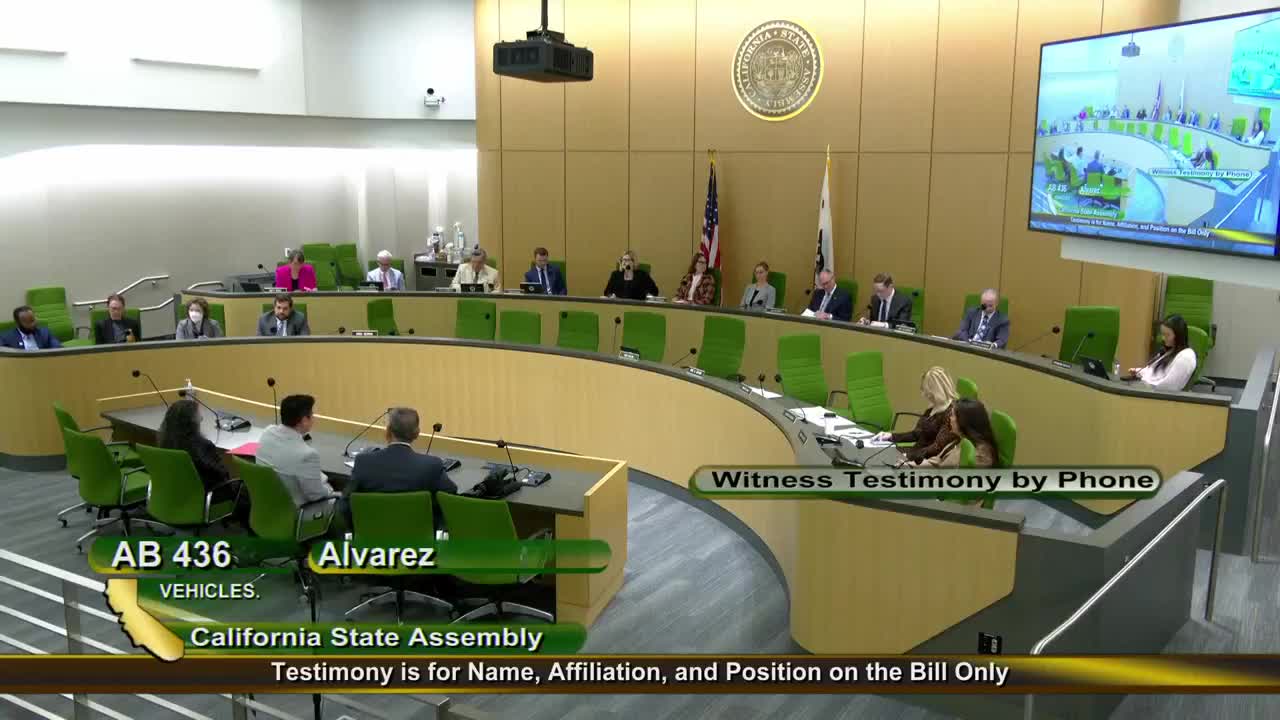
Discussed in Hearing
 10MIN
Assembly Standing Committee on Transportation
Bill Author

Bill Co-Author(s):