AB 1122: Pupil instruction: dual enrollment.
- Session Year: 2025-2026
- House: Assembly
- Latest Version Date: 2025-04-10
Current Status:
Failed
(2026-02-02: From committee: Filed with the Chief Clerk pursuant to Joint Rule 56.)
Introduced
In Committee
Awaiting First Chamber Vote
Passed First Chamber
In Committee
Awaiting Second Chamber Vote
Passed Second Chamber
Enacted
Existing law authorizes the governing board of a school district to authorize a pupil who meets specified criteria to attend community college as a special part-time or full-time student. Existing law authorizes a community college district to admit to any community college under its jurisdiction as a special part-time or full-time student a pupil who is eligible to attend community college under these provisions.
This bill would require, commencing with the 202930 academic year, a local educational agency serving high school pupils that does not have an existing dual enrollment program to establish a dual enrollment program through a formal partnership or agreement with the governing board of a community college district, as provided. The bill would encourage require a local educational agency that does not have an existing dual enrollment program to establish a formal partnership through an existing program, including a College and Career Access Pathways partnership or an early or middle college high school, as specified. The bill would require courses offered through a dual enrollment program pursuant to these provisions to lead to a degree, credential, certificate, or transfer. To the extent the bill would impose additional duties on local educational agencies and community college districts, the bill would impose a state-mandated local program.
The California Constitution requires the state to reimburse local agencies and school districts for certain costs mandated by the state. Statutory provisions establish procedures for making that reimbursement.
This bill would provide that, if the Commission on State Mandates determines that the bill contains costs mandated by the state, reimbursement for those costs shall be made pursuant to the statutory provisions noted above.
Existing law authorizes the governing board of a school district to authorize a pupil who meets specified criteria to attend community college as a special part-time or full-time student. Existing law authorizes a community college district to admit to any community college under its jurisdiction as a special part-time or full-time student a pupil who is eligible to attend community college under these provisions.
This bill would require, commencing with the 202930 academic year, a local educational agency serving high school pupils that does not have an existing dual enrollment program to establish a dual enrollment program through a formal partnership or agreement with the governing board of a community college district, as provided. The bill would encourage a local educational agency that does not have an existing dual enrollment program to establish a formal partnership through an existing program, including a College and Career Access Pathways partnership or an early or middle college high school, as specified. The bill would require courses offered through a dual enrollment program pursuant to these provisions to lead to a degree, credential, certificate, or transfer. To the extent the bill would impose additional duties on local educational agencies and community college districts, the bill would impose a state-mandated local program.
The California Constitution requires the state to reimburse local agencies and school districts for certain costs mandated by the state. Statutory provisions establish procedures for making that reimbursement.
This bill would provide that, if the Commission on State Mandates determines that the bill contains costs mandated by the state, reimbursement for those costs shall be made pursuant to the statutory provisions noted above.
(a)The Legislature finds and declares all of the following:
(1)Dual enrollment is an equity-based solution to increasing a college-attending culture for pupils across the state.
(2)Data has demonstrated that dual enrollment programs increase postsecondary degree attainment and therefore, increasing dual enrollment opportunities will help achieve the Governors goal of 70 percent postsecondary degree and certificate attainment among working-aged Californians by 2030.
(3)According to the Public Policy Institute of California (PPIC), 82 percent of pupils who participate in a College and Career Access Pathway (CCAP) partnership enroll in college within one year of graduating from high school, compared to the state average of 66 percent. They also found that CCAP students obtain associate degrees or certificates at higher rates than nondual enrollees. Moreover, the PPIC found that the average first-year grade point average in community colleges is much higher among CCAP students than nondual enrollees but lower than peers from other dual enrollment programs. They also found that CCAP students complete gateway transfer-level mathematics and English courses at a higher rate than pupils who did not participate in dual enrollment programs.
(4)In 2022, the Governor issued a roadmap with terms and conditions that the community colleges must comply with through the 202627 fiscal year. The Governor included two goals related to dual enrollment, as follows:
(A)Increase the percentage of elementary and secondary education pupils who graduate with 12 or more college units earned through dual enrollment by 15 percent.
(B)Close equity gaps in access to dual enrollment programs.
(5)In 2023, the Governor issued an executive order that requested educational agencies and others to work together to support student pathways and career success through the Master Plan for Career Education with three goals centered on (A) career pathways, (B) hands-on learning and real-life learning, and (C) universal access and affordability.
(6)The Governor describes the purposes of the Master Plan for Career Education as a strategic move to align state education and workforce development programs with the needs of the future economy. It aims to streamline those programs regionally and across state agencies and ensure that Californias students and adult learners have affordable access to needed educational and career development opportunities throughout their working lives.
(7)In 2024, the Chancellor of the California Community Colleges and the Board of Governors of the California Community Colleges approved Vision 2030: A Roadmap for California Community Colleges, a collaborative action plan that provides focus, equity, and direction to our community colleges. Within its framework, its 9th grade strategy works toward a future where all California high school pupils enroll in community college transfer, career, or apprenticeship pathways and complete high school with at least 12 units of dual enrollment credit.
(b)To fulfill the goals outlined in the Governors community college roadmap, the goals for the Master Plan for Career Education, and the California Community Colleges Vision 2030, it is the intent of the Legislature to reform dual enrollment programs in California to accomplish both of the following:
(1)Close equity gaps in access and successful outcomes for elementary and secondary education pupils.
(2)Have every school district provide dual enrollment opportunities for elementary and secondary education pupils by 2030.
SEC. 2.Section 76005 is added to the Education Code, immediately following Section 76004, to read:76005.(a)Commencing with the 202930 academic year, a local educational agency serving high school pupils that does not have an existing dual enrollment program shall establish a dual enrollment program through a formal partnership or agreement with the governing board of a community college district, with the goal of developing seamless pathways from high school to community college postsecondary educational institutions and helping high school pupils achieve college and career readiness.
(b)If a local educational agency does not have an existing dual enrollment program, the local educational agency is encouraged to shall establish a formal partnership through an existing program, including a College and Career Access Pathways partnership, consistent with the requirements of Section 76004, an early college high school, as described in Section 11302, or a middle college high school, as described in Section 11300.
(c)Courses offered through a dual enrollment program pursuant to this section shall lead to a degree, credential, certificate, or transfer.SEC. 3.If the Commission on State Mandates determines that this act contains costs mandated by the state, reimbursement to local agencies and school districts for those costs shall be made pursuant to Part 7 (commencing with Section 17500) of Division 4 of Title 2 of the Government Code.
(a)The Legislature finds and declares all of the following:
(1)Dual enrollment is an equity-based solution to increasing a college-attending culture for pupils across the state.
(2)Data has demonstrated that dual enrollment programs increase postsecondary degree attainment and therefore, increasing dual enrollment opportunities will help achieve the Governors goal of 70 percent postsecondary degree and certificate attainment among working-aged Californians by 2030.
(3)According to the Public Policy Institute of California (PPIC), 82 percent of pupils who participate in a College and Career Access Pathway (CCAP) partnership enroll in college within one year of graduating from high school, compared to the state average of 66 percent. They also found that CCAP students obtain associate degrees or certificates at higher rates than nondual enrollees. Moreover, PPIC found that the average first-year grade point average in community colleges is much higher among CCAP students than nondual enrollees but lower than peers from other dual enrollment programs. They also found that CCAP students complete gateway transfer-level mathematics and English courses at a higher rate than pupils who did not participate in dual enrollment programs.
(4)In 2022, the Governor issued a roadmap with terms and conditions that the community colleges must comply with through the 202627 fiscal year. The Governor included two goals related to dual enrollment, as follows:
(A)Increase the percentage of elementary and secondary education pupils who graduate with 12 or more college units earned through dual enrollment by 15 percent.
(B)Close equity gaps in access to dual enrollment programs.
(5)In 2023, the Governor issued an executive order that requested educational agencies and others to work together to support student pathways and career success through the Master Plan for Career Education with three goals centered on (A) career pathways, (B) hands-on learning and real-life learning, and (C) universal access and affordability.
(6)The Governor describes the purposes of the Master Plan for Career Education as a strategic move to align state education and workforce development programs with the needs of the future economy. It aims to streamline those programs regionally and across state agencies and ensure that Californias students and adult learners have affordable access to needed educational and career development opportunities throughout their working lives.
(7)In 2024, the Chancellor of the California Community Colleges and the Board of Governors of the California Community Colleges approved Vision 2030: A Roadmap for California Community Colleges, a collaborative action plan that provides focus, equity, and direction to our community colleges. Within its framework, its 9th grade strategy works toward a future where all California high school pupils enroll in community college transfer, career, or apprenticeship pathways and complete high school with at least 12 units of dual enrollment credit.
(b)To fulfill the goals outlined in the Governors community college roadmap, the goals for the Master Plan for Career Education, and the California Community Colleges Vision 2030, it is the intent of the Legislature to reform dual enrollment programs in California to accomplish both of the following:
(1)Close equity gaps in access and successful outcomes for elementary and secondary education pupils.
(2)Have every school district provide dual enrollment opportunities for elementary and secondary education pupils by 2030.
SEC. 2.Section 76005 is added to the Education Code, immediately following Section 76004, to read:76005.(a)Commencing with the 202930 academic year, a local educational agency serving high school pupils that does not have an existing dual enrollment program shall establish a dual enrollment program through a formal partnership or agreement with the governing board of a community college district, with the goal of developing seamless pathways from high school to community college and helping high school pupils achieve college and career readiness.
(b)If a local educational agency does not have an existing dual enrollment program, the local educational agency is encouraged to establish a formal partnership through an existing program, including a College and Career Access Pathways partnership, consistent with the requirements of Section 76004, an early college high school, as described in Section 11302, or a middle college high school, as described in Section 11300.
(c)Courses offered through a dual enrollment program pursuant to this section shall lead to a degree, credential, certificate, or transfer.
SEC. 3.If the Commission on State Mandates determines that this act contains costs mandated by the state, reimbursement to local agencies and school districts for those costs shall be made pursuant to Part 7 (commencing with Section 17500) of Division 4 of Title 2 of the Government Code.
|
Date
|
Status
|
|---|---|
| Feb 2, 2026 | From committee: Filed with the Chief Clerk pursuant to Joint Rule 56. |
| Jan 31, 2026 | Died pursuant to Art. IV, Sec. 10(c) of the Constitution. |
| Apr 30, 2025 | In committee: Set, first hearing. Hearing canceled at the request of author. |
| Apr 21, 2025 | Re-referred to Com. on ED. |
| Apr 10, 2025 | Read second time and amended. |
| Apr 9, 2025 | From committee: Amend, and do pass as amended and re-refer to Com. on ED. (Ayes 9. Noes 0.) (April 8). |
| Mar 10, 2025 | Referred to Coms. on HIGHER ED. and ED. |
| Feb 21, 2025 | From printer. May be heard in committee March 23. |
| Feb 20, 2025 | Read first time. To print. |
|
Date
|
Description
|
Location
|
Votes
|
|
|---|---|---|---|---|
| Apr 8, 2025 | Do pass as amended and be re-referred to the Committee on [Education] | Assembly Standing Committee on Higher Education |
Passed |
This list shows positions taken on this bill by organizations on the date displayed, which is linked to the original source.
Positions by individuals are not included.
|
Organization
|
Position
|
Date
|
|---|---|---|
| AdvancED Consulting, LLC | ** Support | |
| Alameda County Office Of Education | ** Support | |
| Alliance for A Better Community | ** Support | |
| California Chamber Of Commerce | ** Support | |
| California High School District Coalition | ** Support | |
| California State PTA | ** Support | |
| Campaign For College Opportunity | ** Support | |
| Career Ladders Project | ** Support | |
| CFT- a Union of Educators & Classified Professionals, Aft, Afl-cio | ** Against | |
| Go Public Schools | ** Support | |
| Hispanas Organized for Political Equality | ** Support | |
| Ignite | ** Support | |
| Los Angeles United Methodist Urban Foundation | ** Support | |
| Mt. San Jacinto Community College District | ** Support | |
| NextGen California | ** Support | |
| Norco College | ** Support | |
| Oceanside Unified School District | ** Support | |
| Reach Higher Riverside | ** Support | |
| The Education Trust - West | ** Support |
Date of Hearing: April 8, 2025
ASSEMBLY COMMITTEE ON HIGHER EDUCATION
Mike Fong, Chair
ABPCA Bill Id:AB 1122 (
Author:Bryan) – As Introduced Ver:February 20, 2025
[Note: This bill is double referred to the Assembly Education Committee and will be heard by that Committee as it related to issues under its jurisdiction.]
SUBJECT: Pupil instruction: dual enrollment
SUMMARY: Creates a statewide mandate where by academic year 2029-2030, every local education agency (LEA), which serves high school students, will be required to offer a dual enrollment program in partnership with a community college district. Specifically, this bill:
- Mandates by the academic year 2029-2030 for every high school student serving LEA to have dual enrollment partnership or agreement with the local governing board of a community college. The intention of the dual enrollment program is to provide seamless pathways from high school to community college and to help students achieve college and career readiness.
- Encourages local education agencies without an existing dual enrollment program, to meet the mandate required by (1) by establishing either College and Career Access Pathways (CCAP) partnerships, early college high schools, or middle college high schools.
- Requires courses offered through a dual enrollment program required by (1) to lead to a degree, credential, certificate, or transfer.
- Makes multiple Legislative findings and declarations pertaining to dual enrollment, including, but not limited to the following:
- Dual enrollment is an equity-based solution to increasing college-attending culture for pupils across the state;
- In 2022, the Governor issued a roadmap with terms and conditions for community colleges, including increasing dual enrollment participation by 15% and a mandate to close equity gaps in access to dual enrollment programs;
- In 2023, the Governor issued an executive order that requested education agencies and others to work together to establish a Career Education master plan; and,
- To fulfil the goals outlined in the Governor’s Community College roadmap, the goals for the Career Education master plan, and the California Community Colleges Vision 2030, the Legislature intends to reform dual enrollment.
EXISTING LAW:
- Requires the California Community Colleges (CCC) and the State Department of Education (CDE) to collaborate with each other and their respective local community colleges and local school district to create and maintain middle college high schools; whose purpose is to select at-promise high school pupils who are performing below their academic potential and place them in an alternative high school located on a community college campus in order to reduce the likelihood that they will drop out of school prior graduation (Education Code (EDC) Section 11300 and 11301).
- Establishes the early college high school as small, autonomous high schools that blends high school and college into a coherent educational program through partnerships with either a local CCC, the California State University (CSU), or the University of California (UC) whose purpose is to allow pupils to earn a high school diploma and up to two years of college credit in four years or less (EDC Section 11302).
- Permits the enrollment of special-part time and special full-time students at the community college (also known as dual enrollment students). If a CCC district declines the enrollment of a special part-time or full-time student, the district governing board must provide a reason for the denial in writing within 60 days. The attendance of a student at a community college as a special part-time and full-time student is authorized attendance that the CCC may collect appointment for as defined. Permits special-part time student to enroll in up to 11 units per semester. The CCC district that enrolls a special part-time or full-time student will assign low registration priority to the students unless the student is a middle college high school student (EDC Section 76001).
- Authorizes a community college district to enter into a CCAP partnership agreement, with a governing board of a school or charter school district or a county office of education and outlines specific requirements for participation in the CCAP partnership agreements by the CCC and the local school or charter school district. The purpose of the partnership is to offer or expand dual enrollment opportunities for pupil who may not be college bound or who are underrepresented in higher education. Permits special part-time students participating in the CCAP partnership to receive priority enrollment, enroll in up to 15 course, and receive fee waivers for specified fees. The goal of the partnership is to offer courses which develop seamless pathways from high school to community college for career technical education or the preparation for transfer, improve high school graduation rates, and/or help pupils achieve college and career readiness (EDC Section 76004).
FISCAL EFFECT: Unknown.
COMMENTS: Author’s intent. As stated by the author, “investing in dual enrollment is an investment in the future workforce and economy of California. By removing barriers and expanding access, this legislation fosters a more equitable, educated, and competitive California. Establishing structured pathways, including dual enrollment, guarantees that students from all backgrounds have the opportunity to succeed in higher education and beyond.”
Dual enrollment. As stated by the Education Trust – West, “dual enrollment programs can be a game-changer for students, allowing them to experience college-level coursework while still in high school, paving the way for a smoother transition to higher education.”[1] But what is dual enrollment and how effective is it in providing game – changing opportunities to high school students?
Dual enrollment is any partnership between a college or university and a high school that results in the offering of college courses to high school students. Dual enrollment participation has greatly expanded since the 1990s and now nearly 82% of high school students nationwide attend a school that offers some form of dual enrollment.[2]
The purpose of dual enrollment is two-fold: (1) to expand access to higher education by providing high school students a unique opportunity to engage in college coursework; and (2) to shorten time to degree.
While still an emerging program, dual enrollment students have stronger postsecondary education outcomes when compared to non-dual enrollment students.[3] According to the Columbia University, Community College Research Center, a higher percentage of dual enrollment students graduated with a bachelor’s degree when compared with non-dual enrollment students.2 In California, 80% of dual enrollment students attended college within one year of graduating high school and 24% completed a college degree.3
Neither national nor state law requires the offering of dual enrollment; and yet, nearly every state has its own method for offering dual enrollment to high school students.
Dual enrollment modalities in California. In academic year 2022-2023, there were 255,635 high school student enrolled in dual enrollment programs in California.[4] The high school graduating class of 2023 took an average of three dual enrollment courses and earned over 2,400 college credentials.[5] Dual enrollment has existed as a college-credit program in California since the 1970s; however, it has only been in the last two decades that dual enrollment has expanded in both course offerings and participation.
In California, there are four types of dual enrollment programs authorized by the Education Code: traditional dual enrollment pathways, early college high schools, middle college high schools, and college and career access pathways (CCAP).
Committee staff acknowledge a fifth type of dual enrollment, a high school student who elects to take college courses on their own. However, this type of dual enrollment would not count towards dual credit (high school and college credit for the course).
A traditional dual enrollment, outlined in EDC Section 48800 – 48802, permits a high school student to attend a CCC as a special part-time or full-time student on the recommendation of the high school principal. A student can take up to 11 units per term and the high school receives full funding (full average daily attendance) for a student that enrolls in 240 minutes of high school coursework, while colleges can claim apportionment funding. How students divides their time and the structure of the programs vary by school district and CCC. For example, a CCC might enter a formal partnership with a high school district, or a student may take a college-level course independently. The total number of “traditional dual enrollment pathways” is unknown in California.
A middle college high school (MCHS), created by EDC section 11300-11301, are standalone high schools located on a CCC campus. These alternative high schools are designed for at-risk youth who “are performing below their academic potential” to earn a high school diploma and an associate degree. MCHS provide effective support services, small class sizes, and the opportunity for a student to concurrently enroll in college classes at a minor cost to students. Courses offered, as part of an MCHS, must be either be (1) degree-applicable and transferable or (2) career education (CTE) courses that are applicable to a certificate. MCHS operated by K-12 districts must offer 180 days of instruction per year, with 64,800 instructional minutes each day, and must be scheduled for at least a minimum of 180 minutes each day if the student is a special part-time community college student. Community colleges may claim full-time equivalent funding for the same student. The CDE has 29 different high schools listed as a MCHS.[6] Committee staff acknowledge middle college programs have begun to manifest on high school campuses as an autonomous program for high school students.
An early college high school (ECHS), created by EDC Section 11302, are partnerships between a secondary high school and either a CCC, a CSU, or a UC. The partnership enables high school students to earn a high school diploma and up to two years of college credit in four years. ECHS are a standalone high schools (like the middle college high schools), or are an autonomous program offered on a high school campus. ECHS operated by K-12 districts must offer 180 days of instruction per year, with 64,800 instructional minutes each day, and must be scheduled for at least a minimum of 180 minutes each day if the student is a special part-time community college student or is an 11 or 12 grade student who is enrolled in part-time classes at a CSU or UC campus. Students, enrolled in an ECHS, are on track to earn their high school diploma and either: (1) an associate’s degree or (2) the Intersegmental General Education Transfer Curriculum transfer certificate. The partnering college or university can also claim full-time equivalent funding for the student. The CDE has 26 schools listed as having an ECHS.[7]
AB 288 (Holden), Chapter 618, Statutes of 2015, established CCAP partnerships. The purpose of CCAP partnerships is to improve collaboration between K-12 and community college districts in the provision of dual enrollment courses with the goal of increasing college access and equity. K-12 districts partner with their local CCC to do the following:
- Provide students with a seamless educational pathway from high school to the CCC for a student to complete either the certification or degree they began through dual enrollment;
- Improve high school graduation rates; and,
- Help high school students achieve college and career readiness.
EDC Section 76004 provides an articulated plan by which high schools and community colleges agree to offer community college courses to high school students on either a high school or a college campus. The courses are offered during the K-12 school day and are provided free of charge to students. Students can participate in up to 15 units per semester. EDC Section 76004 provides guidelines for what CCAP agreements between K-12 and CCC districts should contain; however, the day-to-day specifics for the program and the type of courses offered are details left to the negotiations between the high school and CCC districts. Unlike the early and middle college high schools, CCAP partnerships are not eligible for reduced average daily attendance. Students must be enrolled in 240 minutes a day for in order for the high school to receive “full funding” through the average daily attendance calculations. According to the latest report from the CCC Chancellor’s Office, in 2021-2022 academic year, there were 74 CCAP partnerships with 67,914 high school students enrolled in college courses.
While California has a robust and diverse offering of dual enrollment programs, overall participation in dual enrollment continues to be less than other states nationwide.
Dual enrollment participation in California. Despite having an array of programmatic options, including programs targeting underrepresented students, California continues to lag behind other states in terms of dual enrollment participation. With 8% of the high school population enrolled in dual enrollment programs, California is in the bottom tier of states.[8]
In May 2022, the Governor announced the executive was entering into fiscal agreements with each public postsecondary education segment where in exchange for annual increases in funding, the segment would meet a set of goals. For the community colleges, one of the set goals was to increase dual enrollment participation by 15% from 2022 to 2027.[9]
In the 2024 State of the System, the Chancellor of the CCC reported, “dual enrollment is up over 24%” with a total enrollment figure of 289,906 for the 2023-2024 academic year.[10] The Chancellor states in a CCC publication that the “California Community Colleges is working toward a future in which all California students have the opportunity to graduate from high school with at least 12 college credits.”[11]
Overall participation in dual enrollment has increased, however the Public Policy Institute of California (PPIC) found participation in certain regions of the state is growing faster than other regions. Specifically, “in 2023, the Los Angeles/Orange County region was home to the most dual enrollees (29%), followed by the Bay Area (21%) and the San Joaquin Valley (15%).”[12] Statistical variations in participation are not just isolated to the regions of California, but also extend to the demographics of participating students. The PPIC found that:
“access to dual enrollment has historically been uneven and marked by racial/ethnic disparities. Black students—who make up 5% of the class of 2023—are underrepresented in dual enrollment. Latino students—who make up 56% of the class of 2023—are underrepresented overall but better represented in CCAP (55%).”12
Additionally, the academic outcomes of those who participate in dual enrollment vary across demographic groups and geographical regions. The same equity gaps in participation exist in credit completion with Black and Latinx students both completing less college credits than their Asian peers.12 For the class of 2023 the following are the outcomes by geographical region:
Region of the State | Average credits completed | % of completing 12 or more units | # college credentials awarded | # of associate degrees awarded: |
Central Valley/Mother Lode | 10 | 5% | 683 | 469 |
Inland Empire/Desert | 8 | 4% | 285 | 137 |
Los Angeles/Orange County | 7 | 3% | 814 | 426 |
North/Far North | 8 | 3% | 122 | 97 |
San Diego/Imperial | 7 | 1% | 22 | 0 |
San Francisco/Bay Area | 8 | 3% | 3030 | 205 |
South Central Coast | 9 | 3% | 209 | 164 |
Source: PPIC12
A contributing factor to the variations in participation both in demographic groups and across the state, is the lack of a statewide mandate requiring high school districts to offer dual enrollment. In a 50 state comparison, the Education Commission of the States found that 31 states have a mandate requiring high schools to provide dual enrollment courses.[13] The majority of the states with mandates had higher rates of dual enrollment participation than California.[14]
AB 1122 (Bryan) would have California join the ranks of other states by instituting a statewide mandate requiring high school districts to enter into agreements with community colleges for the purpose of offering dual enrollment courses to high school students.
Arguments in support. As corroborated by the Campaign for College Opportunity, Ed Trust West, and the Career Ladders Project, “AB 1122 builds on California’s ongoing efforts, including the Governor’s 2022 Community Colleges Roadmap, the California Community Colleges Vision 2030, and the goals highlighted in the Governor's Master Plan for Career Education, which sets ambitious goals for expanding dual enrollment and addressing equity gaps. By passing this legislation, we are setting up a policy framework by which California can make meaningful progress toward the Governor’s 2030 goal of 70% postsecondary degree and certificate attainment while also providing flexibility to districts on how to meet those goals and honor its commitment to equity in education. Paired with other legislative and budget proposals that will strengthen access to resources for dual enrollment programs, AB 1122 will put California on the path to joining the ranks of 22 other states that guarantee universal access to dual enrollment.”
Arguments in opposition. The California Affiliate of the AFT, AFL-CIO, respectfully opposes the measure as, “mandating formal agreements for dual enrollment programs could disrupt these constructive negotiations. When disagreements occur, one party may feel pressured to give up what they believe is best for students merely to comply with creating an agreement, in order to comply with state law. In rural districts where there is an absence of an adjacent community college campus, students would rely on online courses or instruction by high school teachers. The current staffing shortages in rural schools could further limit the availability of teachers meeting CCAP standards. Additionally, inadequate broadband access may restrict student participation in online courses. While it is our hope that sufficient broadband access and qualified high school teachers will be available, the absence of these essential resources could prevent students from accessing the resources that make voluntary CCAP agreements successful.”
Committee comments. The Assembly Higher Education (AHED) Committee held an oversight hearing on November 06, 2023 to understand the benefits and hindrances of the dual enrollment programs. During the hearing, the AHED Committee heard from researchers, practitioners, and from both the California Department of Education and the Chancellor’s Office as to how the state could assist in expanding dual enrollment opportunities for high school students throughout the state. Providing additional guidance and streamlining CCAP programs was a point of discussion; however, providing universal access through a statewide mandate was not a solution suggested during the hearing.
“The State Policymaker Strategy Development Guide,” published by the Community College Research Center at Columbia University, it is recommended by States to consider legislation that sets a statewide goal, establishes a method to measure the progress towards the goal, and rethinks the eligibility criteria for who can access dual enrollment. In 2022, the Governor set a measurable goal of increasing the percentage of high school students who graduate with 12 or more college units by 15%. According to the PPIC, 3% of the high school graduating class of 2023 obtained 12 or more dual enrollment credits.[15] In order to have meaningful progress on the Governor’s goal, additional dual enrollment participation is required.
By establishing a statewide mandate, AB 1122 (Bryan) would create universal access and therefore eliminates one of the known barriers to participation for students. However, AB 1122 (Bryan) does not address any of the existing concerns regarding the lack of resources for dual enrollment programs. In fact, AB 1122 (Bryan) could exasperate some of the concerns raised during the AHED Oversight Hearing on Dual Enrollment. AB 1122 (Bryan) does not provide guardrails for how dual enrollment programs are to be established other than the K-12 school district must enter into an agreement with a community college district. There is no guarantee the newly required partnerships will:
- Have qualified instructors available to teach the dual enrollment courses;
- Have courses which are A-G certified or eligible for high school credit;
- Have courses that are transferable to the CSU and UC; and,
- Provide academic resources to help student succeed.
In order to provide K-12 districts with maximum flexibility in meeting the requirement and to address the concern the expansion will result in a hodge – podge of different partnerships, the Committee has suggested and the author has agreed to the following amendments:
- Amends Section 76005 subdivision (a) to read as follows:
(a) Commencing with the 2029–30 academic year, a local educational agency serving high school pupils that does not have an existing dual enrollment program shall establish a dual enrollment program through a formal partnership or agreement with the governing board of a community college district, with the goal of developing seamless pathways from high school to community college postsecondary educational institutions and helping high school pupils achieve college and career readiness.
- Amends Section 76005 subdivision (b) to read as follows:
(b) If a local educational agency does not have an existing dual enrollment program, the local educational agency is encouraged to shall establish a formal partnership through an existing program, including a College and Career Access Pathways partnership, consistent with the requirements of Section 76004, an early college high school, as described in Section 11302, or a middle college high school, as described in Section 11300.
REGISTERED SUPPORT / OPPOSITION:
Support
Advanced Consulting, LLC
Alameda County Office of Education
Alliance for A Better Community
California Chamber of Commerce
California High School District Coalition
California State PTA
Campaign for College Opportunity
Career Ladders Project
Go Public Schools
Hispanas Organized for Political Equality
Ignite
Los Angeles United Methodist Urban Foundation
Mt. San Jacinto Community College District
Nextgen California
Norco College
Oceanside Unified School District
Reach Higher Riverside
The Education Trust - West
Oppose
Cft- a Union of Educators & Classified Professionals, Aft, Afl-cio
Analysis Prepared by: Ellen Cesaretti-Monroy / HIGHER ED. / (916) 319-3960
https://west.edtrust.org/removing-barriers-to-college-access-success/ ↑
https://ccrc.tc.columbia.edu/publications/understanding-dual-enrollment.html ↑
https://ccrc.tc.columbia.edu/dual-enrollment.html ↑
https://ccrc.tc.columbia.edu/easyblog/how-many-students-are-taking-dual-enrollment-courses-in-high-school-new-national-state-and-college-level-data.html ↑
https://www.ppic.org/publication/fact-sheet-dual-enrollment-in-california/ ↑
https://www.cde.ca.gov/SchoolDirectory/districtschool?allsearch=middle%20college&simplesearch=Y&page=1&tab=1 ↑
https://www.cde.ca.gov/SchoolDirectory/districtschool?allSearch=early+college&multif=&simpleSearch=Y&sax=true ↑
https://ccrc.tc.columbia.edu/easyblog/how-many-students-are-taking-dual-enrollment-courses-in-high-school-new-national-state-and-college-level-data.html ↑
https://dof.ca.gov/wp-content/uploads/sites/352/Programs/Education/CCC-Roadmap-May-2022.pdf ↑
https://www.cccco.edu/-/media/CCCCO-Website/docs/report/2024-fall-interim-state-of-the-system-report.pdf ↑
https://www.cccco.edu/-/media/CCCCO-Website/docs/general/monograph-on-dual-enrollment-at-california-community-colleges-july-2024-final-a11y.pdf ↑
https://www.ppic.org/publication/fact-sheet-dual-enrollment-in-california/ ↑
https://reports.ecs.org/comparisons/dual-concurrent-enrollment-2022 ↑
https://ccrc.tc.columbia.edu/easyblog/how-many-students-are-taking-dual-enrollment-courses-in-high-school-new-national-state-and-college-level-data.html ↑
https://www.ppic.org/publication/fact-sheet-dual-enrollment-in-california/ ↑
Discussed in Hearing
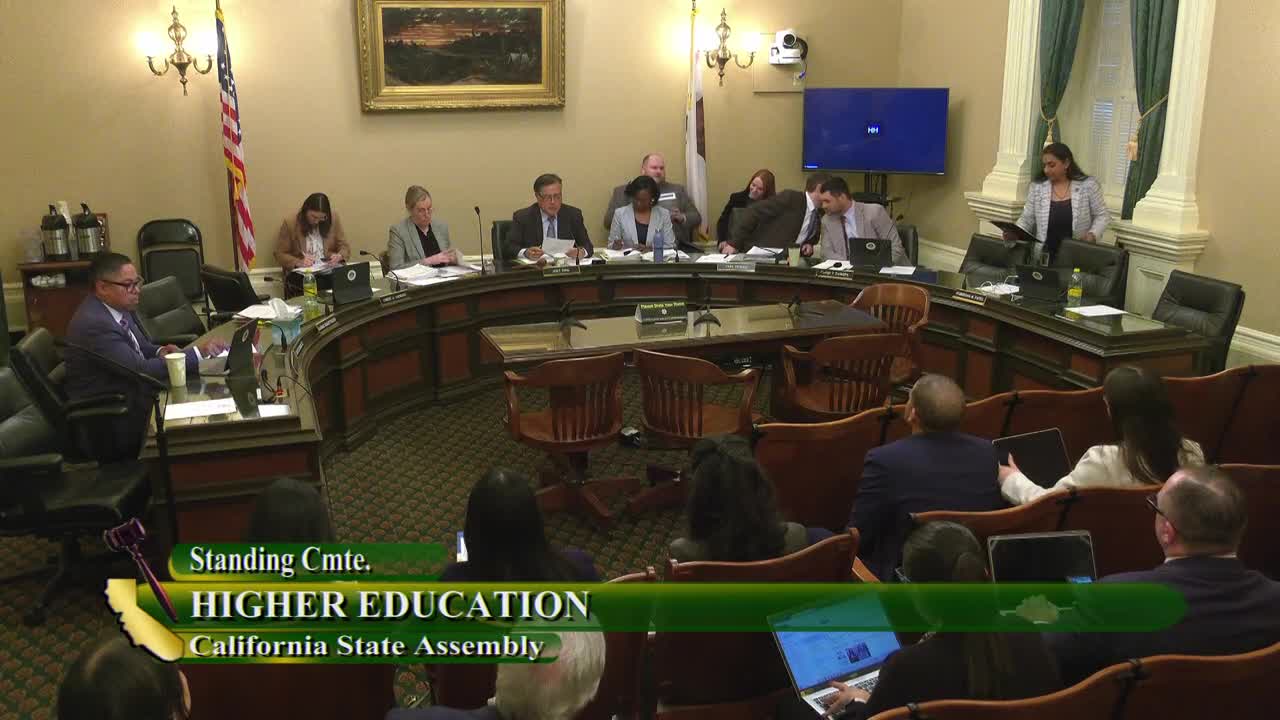 15MIN
Assembly Standing Committee on Higher Education
Bill Author