AB 1212: University of California: faculty and employee housing.
- Session Year: 2025-2026
- House: Assembly
- Latest Version Date: 2025-02-21
Current Status:
Failed
(2026-02-02: From committee: Filed with the Chief Clerk pursuant to Joint Rule 56.)
Introduced
In Committee
Awaiting First Chamber Vote
Passed First Chamber
In Committee
Awaiting Second Chamber Vote
Passed Second Chamber
Enacted
What does this bill do?
This bill lets the University of California create programs to build, buy, fix up, and preserve affordable rental housing for UC faculty and employees. UC campuses, medical centers, or developers receiving local or state funds or affordable-housing tax credits may reserve or prioritize units on UC-owned land for UC faculty and staff. Campuses may also allow local public employees to live in that housing but may give UC employees priority, and the housing must meet existing affordable-housing rules.
The summary is provided by generative AI which can make mistakes. For original language, please view the details in the table below.
Existing law authorizes a school district and the California State University (CSU) to establish and implement programs that address the housing needs of teachers or faculty, as applicable, and school district or CSU employees who face challenges in securing affordable housing, as specified. The act provides that it specifically creates a state policy supporting housing for teachers and school district employees, and for faculty and CSU employees, as described by specified federal law and permits school districts, CSU campuses, and developers in receipt of local or state funds or tax credits designated for affordable rental housing to restrict occupancy to teachers and school district employees, or faculty and CSU employees, as applicable, on land owned by school districts or the CSU, so long as that housing does not violate any other applicable laws. Existing law defines various terms for these purposes.
This bill would authorize the University of California to establish and implement a similar program to the school district and CSU programs described above to address the housing needs of University of California faculty or employees who face challenges in securing affordable housing, as specified. The bill would provide that it specifically creates a state policy supporting housing for University of California faculty or campus or medical center employees as described by specified federal law and permits the University of California campuses or medical centers, or developers, in receipt of local or state funds or tax credits designated for affordable rental housing to restrict occupancy to University of California faculty or employees on land owned by the University of California or an auxiliary enterprise, as defined, so long as that housing does not violate any other applicable laws. The bill would define various terms for these purposes.
This part may be cited as the University of California Faculty and Employee Housing Act of 2025.
53621.(a)The purpose of this part is to facilitate the acquisition, construction, rehabilitation, and preservation of affordable rental housing for University of California faculty and employees to allow them to access and maintain housing stability.
(b)A program established under this part shall be restricted to University of California faculty and employees, except that a University of California campus may allow local public employees or other members of the public to occupy housing created through this part, subject to applicable laws and regulations.
(c)A University of California campus may prioritize University of California employees over local public employees or other members of the public to occupy housing.
53622.As used in this part:
(a)Affordable rental housing means a rental housing development with a majority of its rents restricted to levels that are affordable to persons and families of low or moderate income.
(b)Auxiliary enterprise means an entity operated by, or affiliated with, the University of California that supports and enhances the instructional, research, and public service programs of the university.
(c)University of California faculty or employee means any person employed by a University of California campus or medical center, including, but not limited to, faculty and staff.
(d)Local public employees includes employees of a city, county, city and county, charter city, charter county, charter city and county, special district, or any combination thereof.
(e)Persons and families of low or moderate income has the same meaning as defined in Section 50093.
(f)Rental housing development means a structure or set of structures with common financing, ownership, and management with one or more dwelling units, including efficiency units. No more than one of the dwelling units may be occupied as a primary residence by a person or household who is the owner of the structure or structures.
53623.The University of California may establish and implement programs that address the housing needs of University of California faculty or employees who face challenges in securing affordable housing. To the extent feasible, a University of California campus may establish and implement programs that, among other things, do any of the following:
(a)Leverage federal, state, and local public, private, and nonprofit programs and fiscal resources available to housing developers.
(b)Promote public and private partnerships.
(c)Foster innovative financing opportunities.
53624.This part specifically creates a state policy supporting housing for University of California faculty or employees as described in Section 42(g)(9) of the Internal Revenue Code, and, further, permits the University of California and developers in receipt of local or state funds or tax credits designated for affordable rental housing to restrict occupancy to University of California faculty or employees on land owned by the Regents of the University of California or a University of California auxiliary enterprise, including permitting University of California campuses and medical centers, and developers, in receipt of tax credits designated for affordable rental housing to retain the right to prioritize and restrict occupancy on land owned by the Regents of the University of California or a University of California auxiliary enterprise to faculty or employees of the University of California, so long as that housing does not violate any other applicable laws.
SEC. 2.The provisions of this act are severable. If any provision of this act or its application is held invalid, that invalidity shall not affect other provisions or applications that can be given effect without the invalid provision or application.
|
Date
|
Status
|
|---|---|
| Feb 2, 2026 | From committee: Filed with the Chief Clerk pursuant to Joint Rule 56. |
| Jan 31, 2026 | Died pursuant to Art. IV, Sec. 10(c) of the Constitution. |
| Apr 29, 2025 | In committee: Set, first hearing. Hearing canceled at the request of author. |
| Apr 9, 2025 | From committee: Do pass and re-refer to Com. on H. & C.D. (Ayes 8. Noes 1.) (April 8). Re-referred to Com. on H. & C.D. |
| Mar 13, 2025 | Referred to Coms. on HIGHER ED. and H. & C.D. |
| Feb 24, 2025 | Read first time. |
| Feb 22, 2025 | From printer. May be heard in committee March 24. |
| Feb 21, 2025 | Introduced. To print. |
|
Date
|
Description
|
Location
|
Votes
|
|
|---|---|---|---|---|
| Apr 8, 2025 | Do pass and be re-referred to the Committee on [Housing and Community Development] | Assembly Standing Committee on Higher Education |
Passed |
This list shows positions taken on this bill by organizations on the date displayed, which is linked to the original source.
Positions by individuals are not included.
|
Organization
|
Position
|
Date
|
|---|---|---|
| California Apartment Association | ** Support | |
| California Chamber Of Commerce | ** Support | |
| California Federation of Teachers, AFT, AFL-CIO | ** Support | |
| University of California | ** Support |
Date of Hearing: April 8, 2025
ASSEMBLY COMMITTEE ON HIGHER EDUCATION
Mike Fong, Chair
ABPCA Bill Id:AB 1212 (
Author:Patel) – As Introduced Ver:February 21, 2025
[Note: This bill is double referred to the Assembly Committee on Housing and Community Development and will be heard by that Committee as it relates to issues under its jurisdiction.]
SUBJECT: University of California: faculty and employee housing.
SUMMARY: Establishes the University of California (UC) Faculty and Employee Housing Act of 2025 (Act). Specifically, this bill:
- Seeks to facilitate the acquisition, construction, rehabilitation, and preservation of affordable rental housing for UC faculty and employees to allow them to access and maintain housing stability.
- Stipulates that a program established under the Act must be restricted to UC faculty and employees, except that a UC campus may allow local public employees or other members of the public to occupy housing created through the Act, as specified.
- Authorizes a UC campus to prioritize UC employees over local public employees or other members of the public to occupy housing.
- Authorizes the UC to establish and implement programs that address the housing needs of UC faculty or employees who face challenges in securing affordable housing. To the extent feasible, a UC campus may establish and implement programs that, in part, do any of the following:
- Leverage federal, state, and local public, private, and nonprofit programs and fiscal resources available to housing developers;
- Promote public and private partnerships; and,
- Foster innovative financing opportunities.
- Creates a state policy supporting housing for UC faculty or employees as specified, and, permits the UC and developers in receipt of local or state funds or tax credits designated for affordable rental housing to restrict occupancy to UC faculty or employees on land owned by the UC Regents or a UC auxiliary enterprise, including permitting UC campuses and medical centers, and developers, in receipt of tax credits designated for affordable rental housing to retain the right to prioritize and restrict occupancy on land owned by the UC Regents or a UC auxiliary enterprise to faculty or employees of the UC, so long as that housing does not violate any other applicable laws.
- Makes the provisions of the Act severable. If any provision of this act or its application is held invalid, that invalidity shall not affect other provisions or applications that can be given effect without the invalid provision or application.
- Defines the following for purposes of the Act:
- “Affordable rental housing” means a rental housing development with a majority of its rents restricted to levels that are affordable to persons and families of low or moderate income;
- “Auxiliary enterprise” means an entity operated by, or affiliated with, the UC that supports and enhances the instructional, research, and public service programs of the UC;
- “UC faculty or employee” means any person employed by a UC campus or medical center, including, but not limited to, faculty and staff;
- “Local public employees” includes employees of a city, county, city and county, charter city, charter county, charter city and county, special district, or any combination thereof;
- “Persons and families of low or moderate income” has the same meaning, as defined in Section 50093 of the Health and Safety Code (HSC);
- “Rental housing development” means a structure or set of structures with common financing, ownership, and management with one or more dwelling units, including efficiency units. No more than one of the dwelling units may be occupied as a primary residence by a person or household who is the owner of the structure or structures.
EXISTING LAW: Federal law. Provides that a low-income housing tax credit (LIHTC) project does not fail to meet the general public use requirement solely because of occupancy restrictions or preferences that favor tenants: (1) With special needs; (2) Who are members of a specified group under a Federal program or state program or policy that supports housing for such a specified group; or, (3) Who are involved in artistic or literary activities (Internal Revenue Code Section 42(g)(9).
State law.
- Establishes the UC as a public trust to be administered by the Regents of the UC; and, grants the Regents full powers of organization and government, subject only to such legislative control as may be necessary to insure security of its funds, compliance with the terms of its endowments, statutory requirements around competitive bidding and contracts, sales of property and the purchase of materials, goods and services (Article IX, Section (9)(a) of the California Constitution).
- Establishes the Teacher Housing Act of 2016 to facilitate the acquisition, construction, rehabilitation, and preservation of affordable rental housing for teachers and school district employees and to allow teachers or school district employees to access and maintain housing stability;
- Provides that a program developed under the Teacher Housing Act of 2016 must be limited to teachers and school district employees;
- Defines “affordable rental housing” to mean housing of five or more units in which a majority of the rents are restricted to level that affordable to person and families of low or moderate income;
- Defines “teacher or school district employee” to mean a person employed by a unified school district, an elementary school district, or a high school, including, but not limited to, certificated or classified staff
- Allows a school district to establish and implement a program that addresses housing needs of teachers and school district employees who face challenges securing affordable housing, by:
- Leveraging federal, state, local public, private, nonprofit programs and fiscal resources available to housing developers;
- Promoting public and private partnerships; and,
- Fostering innovative financing options.
- Creates a state policy supporting housing for teachers and school district employees pursuant to existing federal law (see federal law above) and permits school districts and developers in receipt of local or state funds or tax credits for affordable housing to restrict occupancy to teachers and school district employees on land owned by school districts, provided that no other laws are violated (HSC Section 53571).
- Establishes the Community College Faculty and Employee Housing Act of 2022 to allow a community college district to establish and implement programs that address the housing needs of community college district employees and faculty who face challenges in securing affordable housing (HSC Section 53580).
- Creates a state policy supporting housing for community college employees and faculty as described in existing federal law (see federal law above) to allow the following:
- A community college district and a developer in receipt of local or state funds or tax credits designated for affordable rental housing to restrict occupancy to community college district employees or faculty on land owned by the community college district; and,
- A developer in receipt of tax credits designated for affordable rental housing to retain the right to prioritize and restrict occupancy on land owned by community college district to employees and faculty so long as that housing does not violate any other applicable laws (HSC Section 53584).
- Establishes the CSU Faculty and Employee Housing Act of 2024 in order to facilitate the acquisition, construction, rehabilitation, and preservation of affordable rental housing for faculty and CSU employees to allow them to access and maintain housing stability. Stipulates that a program established under the Act must be restricted to faculty CSU employees, except that a CSU campus may allow local public employees or other members of the public to occupy housing, as specified, subject to applicable laws and regulations. Authorizes a CSU campus to prioritize CSU employees over local public employees or other members of the public to occupy housing (HSC Section 53610, et seq.).
- Defines “persons and families of low or moderate income” to mean persons and families whose income does not exceed 120% of area median income, adjusted for family size by the department in accordance with adjustment factors adopted and amended from time to time by the United States Department of Housing and Urban Development, as specified. However, the agency and the department jointly, or either acting with the concurrence of the Secretary of Business, Consumer Services and Housing, may permit the agency to use higher income limitations in designated geographic areas of the state, upon a determination that 120% of the median income in the particular geographic area is too low to qualify a substantial number of persons and families of low or moderate income who can afford rental or home purchase of housing financed, as specified, without subsidy (HSC Section 50093).
FISCAL EFFECT: Unknown
COMMENTS: Need for the measure. According to the author, “California is struggling with both affordability and scarcity of housing. A group that is heavily effected is employers and their employees. A lack of housing makes hiring and recruiting difficult. By allowing the University of California [UC] to build housing for faculty on the land it owns we extend an existing statute the California State University system enjoys and expand it to the UC.”
Committee Staff understands that a lack of access to affordable housing has potentially resulted in a greater difficulty in recruitment and retention of diverse, faculty and staff at the UC who may be considering other career opportunities, or leaving California altogether.
Low Income Housing Tax Credits (LIHTC). Most affordable housing created in the State is funded in part by federal and state LIHTC. The LIHTC are used to develop housing for households that make up to 80% of the area median income (AMI). California receives an allocation of federal tax credits each year based on a per-resident formula. In 1987, the Legislature authorized the creation of a state LIHTC program to augment the federal tax credit program. The state tax credit program has an ongoing statutory authorization of $70 million. The 2019-20, 2020-21, and 2021-23 Annual Budget Acts all authorized an additional $500 million for state tax credits.
Generally, under federal Internal Revenue Service (IRS) rules, if a residential unit is provided for only a member of a social organization or provided by an employer for its employees, the unit is not for use by the general public and is not eligible for federal LIHTC. However, federal IRS law also states that a qualified LIHTC project does not fail to meet the general public use requirement solely because of occupancy restrictions or preferences that favor tenants: (1) with special needs; (2) who are members of a specified group under a federal program or a state program or policy that supports housing for such a specified group; or, (3) who are involved in artistic or literary activities.
According to information provided by the author, the UC estimates, from data submitted to Human Resources and US Census level zip code data, that there are at least 57,000 staff and 11,000 academic employees that are part of households that would qualify as LIHTC tenants.
Further, according to data provided by the author, while the UC has more workforce housing than many comparable institutions, the UC only has approximately 3,200 units for over 200,000 employees. The UC units are also not distributed evenly among the campuses, with half of said units located in UC at Irvine.
Committee Staff understands that historically, UC’s portfolio has not been focused on low-income employees, but this measure enables UC to do such. UC campuses are located in some of the most expensive areas of California, where communities are underserved by the LIHTC program. Traditionally, LIHTC projects have been concentrated in lower-resource areas, whereas placing them in high-resource communities could offer greater benefits to residents. UC’s LIHTC projects would prioritize leasing to UC tenants first, but any remaining LIHTC units would be made available to the general public.
Teacher Housing Act of 2016. SB 1413 (Leno), Chapter 732, Statutes of 2016, established the Teacher Housing Act of 2016 to facilitate the acquisition, construction, rehabilitation, and preservation of affordable housing for teachers and school employees. School districts are authorized to establish and implement programs that address the housing needs of teachers and school district employees by leveraging funding sources including state, federal, local, public, private and resources available to housing developers, promoting public and private partnerships, and fostering innovative financing opportunities. SB 1413 also created a state policy supporting the use of federal and state LIHTC to fund housing for teachers and school district employees on land owned by the school district and permitting school districts to restrict occupancy to teachers and school district employees.
The intent of SB 1413 was to provide express state statutory authority to permit school districts to construct housing on their property and limit the occupancy to teachers and school districts employees. By declaring a state policy supporting housing for teachers/school district employees, these housing projects could qualify under federal law as general public housing and therefore be eligible for both federal and state LIHTCs.
AB 3308 (Gabriel), Chapter 199, Statutes of 2020, further amended the Act to make clear that school districts could still access LIHTC if the school district restricts occupancy of housing constructed on their land to their own employees, but at their discretion offers the housing to other public employees.
Further, AB 1719 (Ward), Chapter 640, Statutes of 2022, established the California Community College (CCC) Faculty and Employee Housing Act of 2022, creating a state policy to allow developers that receive LIHTC to restrict occupancy to faculty and community college district employees on land owned by community college districts.
Additionally, AB 2005 (Ward), Chapter 558, Statutes of 2024, in part, established the California State University (CSU) Faculty and Employee Housing Act of 2024.
This measure appears to bring parity to UC faculty and staff with that of CSU and CCC faculty and staff.
Arguments in support. According to the UC, sponsors of this measure, “California is experiencing an affordable housing crisis. UC faculty and staff are not immune to the impacts of this crisis. This bill would allow the UC to potentially build affordable housing specifically for our staff and faculty, which would help the UC better recruit and retain them. Additionally, this bill would allow the state to add important housing stock to the regions where a UC campus exists and builds these projects. UC is committed to being an employer of choice. This bill would provide one more tool - workforce housing - to attract, recruit and retain its workforce.”
Prior legislation. AB 2005 (Ward), Chapter 558, Statutes of 2024, in part, establishes the CSU Faculty and Employee Housing Act of 2024.
AB 1719 (Ward), Chapter 640, Statutes of 2022, established the Community College Faculty and Employee Housing Act of 2022 to allow community colleges and developers in receive of LIHTC to limit occupancy of affordable housing constructed using LIHTC to faculty and employees of community colleges.
AB 3308 (Gabriel), Chapter 199, Statutes of 2020, amended the Teacher Housing Act of 2016 to make clear that school districts could restrict occupancy of housing constructed on their land to their own employees but at their discretion can open up the housing to other public employees.
SB 1413 (Leno), Chapter 732, Statutes of 2016, established the Teacher Housing Act of 2016 and to allow a school district to establish and implement programs that address the housing needs of teachers and school district employees who face challenges in securing affordable housing. In addition, to allow housing developments to use LIHTC to build housing restricted to teachers and employees of school districts.
REGISTERED SUPPORT / OPPOSITION:
Support
California Apartment Association
California Chamber of Commerce
California Federation of Teachers, AFT, AFL-CIO
University of California (Sponsor)
Opposition
None on file.
Analysis Prepared by: Jeanice Warden / HIGHER ED. / (916) 319-3960
Discussed in Hearing
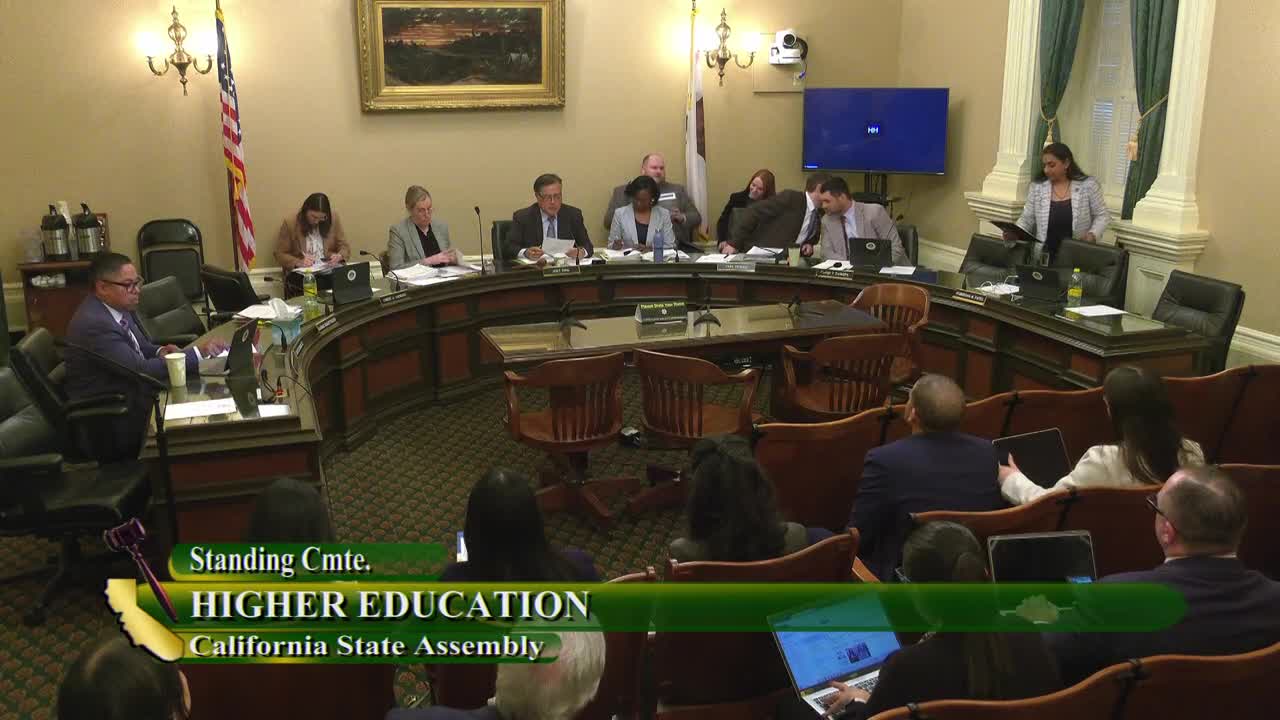 13MIN
Assembly Standing Committee on Higher Education
Bill Author

Bill Co-Author(s):