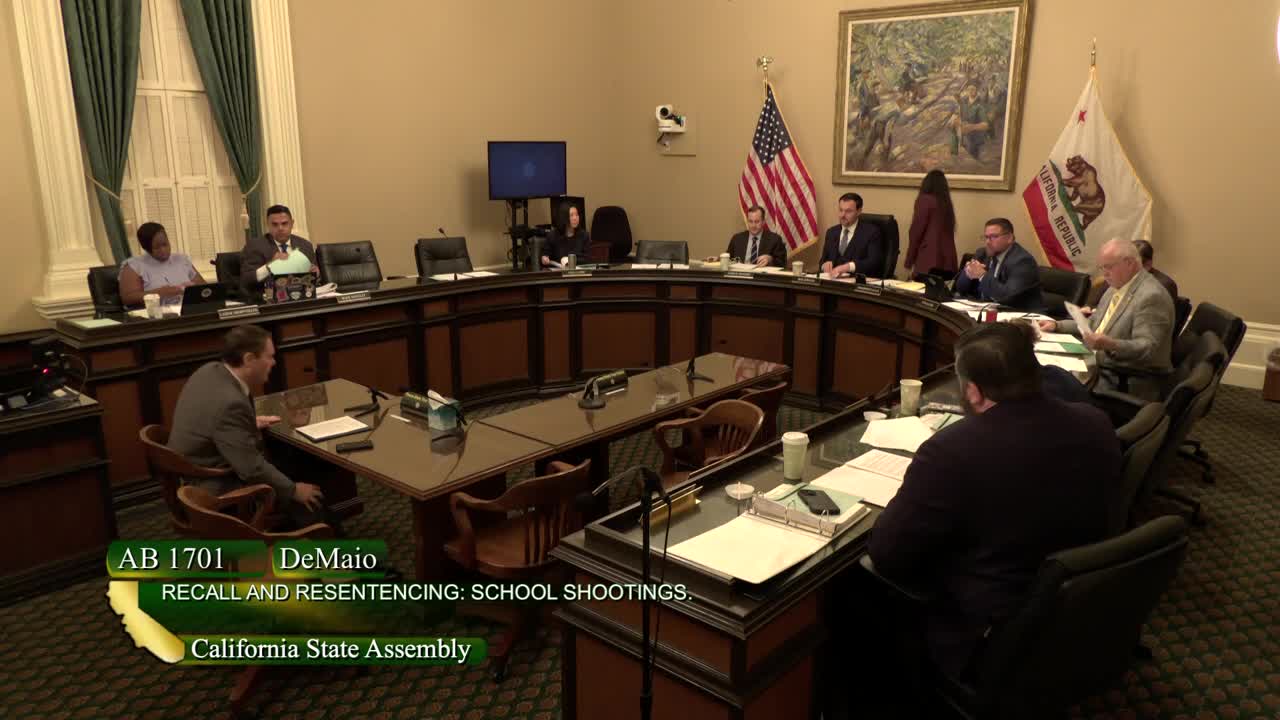
AB 1701: Recall and resentencing: school shootings.
- Session Year: 2025-2026
- House: Assembly
- Latest Version Date: 2026-02-04
Current Status:
Failed
(2026-04-20: From committee: Without further action pursuant to Joint Rule 62(a).)
Introduced
In Committee
Awaiting First Chamber Vote
Passed First Chamber
In Committee
Awaiting Second Chamber Vote
Passed Second Chamber
Enacted
What does this bill do?
This bill prevents people who were under 18 when they committed a school shooting from asking a court to recall and reconsider a life‑without‑parole sentence. It defines a school shooting as intentionally firing a gun in a school zone that kills or seriously injures someone or is intended to kill or seriously harm more than one person, and it excludes accidental discharges, lawful police shootings, and other lawful activities.
The summary is provided by generative AI which can make mistakes. For original language, please view the details in the table below.
Existing law allows a person sentenced to life imprisonment without the possibility of parole who was under 18 years of age at the time of the offense to petition the court for recall of their sentence and resentencing, as specified. Existing law prohibits a person from seeking recall and resentencing pursuant to these provisions if it is pleaded and proved that the person committed certain offenses and the victim was a public safety official, including any law enforcement personnel.
This bill would additionally prohibit a person from seeking recall and resentencing pursuant to these provisions for an offense that meets the definition of a school shooting, as defined.
(a)(1)The Legislature finds and declares that the purpose of sentencing is public safety and to reduce recidivism achieved through punishment, rehabilitation, and restorative justice. When a sentence includes incarceration, the deprivation of liberty satisfies the punishment purpose of sentencing. Therefore, the carceral system should not, except as incidental to justifiable separation or the maintenance of discipline, aggravate the suffering inherent while experiencing imprisonment. The essential purpose of incarceration is rehabilitation and successful community reintegration achieved through education, treatment, and active participation in rehabilitative and restorative justice programs. This purpose is best served by terms that are proportionate to the seriousness of the offense with provision for uniformity in the sentences of people incarcerated for committing the same offense under similar circumstances. These purposes can be achieved only if the period of imprisonment is used to ensure, so far as possible, the promotion of personal growth for all residents and the reintegration of a person into society upon release so that they can lead a law-abiding and self-supporting life, reducing recidivism.
(2)The Legislature further finds and declares that programs should be available for incarcerated persons, including, but not limited to, educational, rehabilitative, and restorative justice programs that are designed to promote behavioral change and to prepare all incarcerated persons for successful reentry into the community. The Legislature encourages the development of policies and programs designed to educate and rehabilitate all incarcerated persons. These programs, activities, and services should be delivered in line with the individual treatment needs of incarcerated persons.
(3)In any case in which the sentence prescribed by statute for a person convicted of a public offense is a term of imprisonment in the state prison, or a term pursuant to subdivision (h), of any specification of three time periods, the court shall sentence the defendant to one of the terms of imprisonment specified unless the convicted person is given any other disposition provided by law, including a fine, jail, probation, or the suspension of imposition or execution of sentence or is sentenced pursuant to subdivision (b) of Section 1168 because they had committed their crime prior to July 1, 1977. In sentencing the convicted person, the court shall apply the sentencing rules of the Judicial Council. The court, unless it determines that there are circumstances in mitigation of the sentence prescribed, shall also impose any other term that it is required by law to impose as an additional term. Nothing in this article shall affect any provision of law that imposes the death penalty, that authorizes or restricts the granting of probation or suspending the execution or imposition of sentence, or expressly provides for imprisonment in the state prison for life, except as provided in subdivision (d). In any case in which the amount of preimprisonment credit under Section 2900.5 or any other provision of law is equal to or exceeds any sentence imposed pursuant to this chapter, except for a remaining portion of mandatory supervision imposed pursuant to subparagraph (B) of paragraph (5) of subdivision (h), the entire sentence shall be deemed to have been served, except for the remaining period of mandatory supervision, and the defendant shall not be actually delivered to the custody of the secretary or the county correctional administrator. The court shall advise the defendant that they shall serve an applicable period of parole, postrelease community supervision, or mandatory supervision and order the defendant to report to the parole or probation office closest to the defendants last legal residence, unless the in-custody credits equal the total sentence, including both confinement time and the period of parole, postrelease community supervision, or mandatory supervision. The sentence shall be deemed a separate prior prison term or a sentence of imprisonment in a county jail under subdivision (h) for purposes of Section 667.5, and a copy of the judgment and other necessary documentation shall be forwarded to the secretary.
(b)(1)When a judgment of imprisonment is to be imposed and the statute specifies three possible terms, the court shall, in its sound discretion, order imposition of a sentence not to exceed the middle term, except as otherwise provided in paragraph (2).
(2)The court may impose a sentence exceeding the middle term only when there are circumstances in aggravation of the crime that justify the imposition of a term of imprisonment exceeding the middle term and the facts underlying those circumstances have been stipulated to by the defendant or have been found true beyond a reasonable doubt at trial by the jury or by the judge in a court trial. Except where evidence supporting an aggravating circumstance is admissible to prove or defend against the charged offense or enhancement at trial, or it is otherwise authorized by law, upon request of a defendant, trial on the circumstances in aggravation alleged in the indictment or information shall be bifurcated from the trial of charges and enhancements. The jury shall not be informed of the bifurcated allegations until there has been a conviction of a felony offense.
(3)Notwithstanding paragraphs (1) and (2), the court may consider the defendants prior convictions in determining sentencing based on a certified record of conviction without submitting the prior convictions to a jury. This paragraph does not apply to enhancements imposed on prior convictions.
(4)At least four days prior to the time set for imposition of judgment, either party or the victim, or the family of the victim if the victim is deceased, may submit a statement in aggravation or mitigation to dispute facts in the record or the probation officers report or to present additional facts. The court may consider the record in the case, the probation officers report, other reports, including reports received pursuant to Section 1203.03, and statements in aggravation or mitigation submitted by the prosecution, the defendant, or the victim, or the family of the victim if the victim is deceased, and any further evidence introduced at the sentencing hearing.
(5)The court shall set forth on the record the facts and reasons for choosing the sentence imposed. The court may not impose an upper term by using the fact of any enhancement upon which sentence is imposed under any provision of law. A term of imprisonment shall not be specified if imposition of sentence is suspended.
(6)Notwithstanding paragraph (1), and unless the court finds that the aggravating circumstances outweigh the mitigating circumstances that imposition of the lower term would be contrary to the interests of justice, the court shall order imposition of the lower term if any of the following was a contributing factor in the commission of the offense:
(A)The person has experienced psychological, physical, or childhood trauma, including, but not limited to, abuse, neglect, exploitation, or sexual violence.
(B)The person is a youth or was a youth as defined under subdivision (b) of Section 1016.7 at the time of the commission of the offense.
(C)Prior to the instant offense, or at the time of the commission of the offense, the person is or was a victim of intimate partner violence or human trafficking.
(7)Paragraph (6) does not preclude the court from imposing the lower term even if there is no evidence of those circumstances listed in paragraph (6) present.
(c)The court shall state the reasons for its sentence choice on the record at the time of sentencing. The court shall also inform the defendant that as part of the sentence after expiration of the term they may be on parole for a period as provided in Section 3000 or 3000.08 or postrelease community supervision for a period as provided in Section 3451.
(d)(1)(A)When a defendant who was under 18 years of age at the time of the commission of the offense for which the defendant was sentenced to imprisonment for life without the possibility of parole has been incarcerated for at least 15 years, the defendant may submit to the sentencing court a petition for recall and resentencing.
(B)Notwithstanding subparagraph (A), this paragraph shall not apply to defendants sentenced to life without parole for an offense where it was pled and proved that the defendant tortured, as described in Section 206, their victim or the victim was a public safety official, including any law enforcement personnel mentioned in Chapter 4.5 (commencing with Section 830) of Title 3, or any firefighter as described in Section 245.1, as well as any other officer in any segment of law enforcement who is employed by the federal government, the state, or any of its political subdivisions.
(C)Notwithstanding subparagraph (A), this paragraph shall not apply to defendants sentenced to life without parole for an offense that meets the definition of a school shooting, as defined in paragraph (14).
(2)The defendant shall file the original petition with the sentencing court. A copy of the petition shall be served on the agency that prosecuted the case. The petition shall include the defendants statement that the defendant was under 18 years of age at the time of the crime and was sentenced to life in prison without the possibility of parole, the defendants statement describing their remorse and work towards rehabilitation, and the defendants statement that one of the following is true:
(A)The defendant was convicted pursuant to felony murder or aiding and abetting murder provisions of law.
(B)The defendant does not have juvenile felony adjudications for assault or other felony crimes with a significant potential for personal harm to victims prior to the offense for which the sentence is being considered for recall.
(C)The defendant committed the offense with at least one adult codefendant.
(D)The defendant has performed acts that tend to indicate rehabilitation or the potential for rehabilitation, including, but not limited to, availing themselves of rehabilitative, educational, or vocational programs, if those programs have been available at their classification level and facility, using self-study for self-improvement, or showing evidence of remorse.
(3)If any of the information required in paragraph (2) is missing from the petition, or if proof of service on the prosecuting agency is not provided, the court shall return the petition to the defendant and advise the defendant that the matter cannot be considered without the missing information.
(4)A reply to the petition, if any, shall be filed with the court within 60 days of the date on which the prosecuting agency was served with the petition unless a continuance is granted for good cause.
(5)If the court finds by a preponderance of the evidence that one or more of the statements specified in subparagraphs (A) to (D), inclusive, of paragraph (2) is true, the court shall recall the sentence and commitment previously ordered and hold a hearing to resentence the defendant in the same manner as if the defendant had not previously been sentenced, provided that the new sentence, if any, is not greater than the initial sentence. Victims, or victim family members if the victim is deceased, shall retain the rights to participate in the hearing.
(6)The factors that the court may consider when determining whether to resentence the defendant to a term of imprisonment with the possibility of parole include, but are not limited to, the following:
(A)The defendant was convicted pursuant to felony murder or aiding and abetting murder provisions of law.
(B)The defendant does not have juvenile felony adjudications for assault or other felony crimes with a significant potential for personal harm to victims prior to the offense for which the defendant was sentenced to life without the possibility of parole.
(C)The defendant committed the offense with at least one adult codefendant.
(D)Prior to the offense for which the defendant was sentenced to life without the possibility of parole, the defendant had insufficient adult support or supervision and had suffered from psychological or physical trauma or significant stress.
(E)The defendant suffers from cognitive limitations due to mental illness, developmental disabilities, or other factors that did not constitute a defense but influenced the defendants involvement in the offense.
(F)The defendant has performed acts that tend to indicate rehabilitation or the potential for rehabilitation, including, but not limited to, availing themselves of rehabilitative, educational, or vocational programs, if those programs have been available at their classification level and facility, using self-study for self-improvement, or showing evidence of remorse.
(G)The defendant has maintained family ties or connections with others through letter writing, calls, or visits or has eliminated contact with individuals outside of prison who are currently involved with crime.
(H)The defendant has had no disciplinary actions for violent activities in the last five years in which the defendant was determined to be the aggressor.
(7)The court shall have the discretion to resentence the defendant in the same manner as if the defendant had not previously been sentenced, provided that the new sentence, if any, is not greater than the initial sentence. The discretion of the court shall be exercised in consideration of the criteria in paragraph (6). Victims, or victim family members if the victim is deceased, shall be notified of the resentencing hearing and shall retain their rights to participate in the hearing.
(8)Notwithstanding paragraph (7), the court may also resentence the defendant to a term that is less than the initial sentence if any of the following were a contributing factor in the commission of the alleged offense:
(A)The person has experienced psychological, physical, or childhood trauma, including, but not limited to, abuse, neglect, exploitation, or sexual violence.
(B)The person is a youth or was a youth as defined under subdivision (b) of Section 1016.7 at the time of the commission of the offense.
(C)Prior to the instant offense, or at the time of the commission of the offense, the person is or was a victim of intimate partner violence or human trafficking.
(9)Paragraph (8) does not prohibit the court from resentencing the defendant to a term that is less than the initial sentence, even if none of the circumstances listed in paragraph (8) are present.
(10)If the sentence is not recalled or the defendant is resentenced to imprisonment for life without the possibility of parole, the defendant may submit another petition for recall and resentencing to the sentencing court when the defendant has been committed to the custody of the department for at least 20 years. If the sentence is not recalled or the defendant is resentenced to imprisonment for life without the possibility of parole under that petition, the defendant may file another petition after having served 24 years. The final petition may be submitted, and the response to that petition shall be determined, during the 25th year of the defendants sentence.
(11)In addition to the criteria in paragraph (6), the court may consider any other criteria that the court deems relevant to its decision, so long as the court identifies them on the record, provides a statement of reasons for adopting them, and states why the defendant does or does not satisfy the criteria.
(12)This subdivision shall have retroactive application.
(13)Nothing in this paragraph is intended to diminish or abrogate any rights or remedies otherwise available to the defendant.
(14)(A)For the purposes of this subdivision, a school shooting means an incident in which a person personally and intentionally discharges a firearm, as defined in Section 16520, within a school zone, as defined in Section 626.9, and one or more of the following conditions is met:
(i)The discharge of the firearm results in the death of any person.
(ii)The discharge of the firearm results in great bodily injury, as defined in Section 12022.7, to any person.
(iii)The firearm is discharged with the intent to kill or cause great bodily injury to more than one person, whether injury or death occurs.
(B)School shooting does not include any of the following:
(i)The lawful discharge of a firearm by a peace officer acting within the scope of employment.
(ii)An accidental or negligent discharge of a firearm absent intent to cause death or great bodily injury.
(iii)Lawful activities expressly exempted under Section 626.9.
(C)For purposes of this paragraph, a person acts personally and intentionally if the person directly performs the act of discharging the firearm with knowledge of the facts constituting the offense.
(e)Notwithstanding subdivision (a), the court may recall and resentence an incarcerated person pursuant to the compassionate release program set forth in Section 1172.2.
(f)Notwithstanding any other provision of this section, for purposes of paragraph (3) of subdivision (h), an allegation that a defendant is eligible for state prison due to a prior or current conviction, sentence enhancement, or because the defendant is required to register as a sex offender shall not be subject to dismissal pursuant to Section 1385.
(g)A sentence to the state prison for a determinate term for which only one term is specified is a sentence to state prison under this section.
(h)(1)Except as provided in paragraph (3), a felony punishable pursuant to this subdivision where the term is not specified in the underlying offense shall be punishable by a term of imprisonment in a county jail for 16 months, or two or three years.
(2)Except as provided in paragraph (3), a felony punishable pursuant to this subdivision shall be punishable by imprisonment in a county jail for the term described in the underlying offense.
(3)Notwithstanding paragraphs (1) and (2), where the defendant (A) has a prior or current felony conviction for a serious felony described in subdivision (c) of Section 1192.7 or a prior or current conviction for a violent felony described in subdivision (c) of Section 667.5, (B) has a prior felony conviction in another jurisdiction for an offense that has all the elements of a serious felony described in subdivision (c) of Section 1192.7 or a violent felony described in subdivision (c) of Section 667.5, (C) is required to register as a sex offender pursuant to Chapter 5.5 (commencing with Section 290) of Title 9 of Part 1, or (D) is convicted of a crime and as part of the sentence an enhancement pursuant to Section 186.11 is imposed, an executed sentence for a felony punishable pursuant to this subdivision shall be served in the state prison.
(4)Nothing in this subdivision shall be construed to prevent other dispositions authorized by law, including pretrial diversion, deferred entry of judgment, or an order granting probation pursuant to Section 1203.1.
(5)(A)Unless the court finds, in the interest of justice, that it is not appropriate in a particular case, the court, when imposing a sentence pursuant to paragraph (1) or (2), shall suspend execution of a concluding portion of the term for a period selected at the courts discretion.
(B)The portion of a defendants sentenced term that is suspended pursuant to this paragraph shall be known as mandatory supervision, and, unless otherwise ordered by the court, shall commence upon release from physical custody or an alternative custody program, whichever is later. During the period of mandatory supervision, the defendant shall be supervised by the county probation officer in accordance with the terms, conditions, and procedures generally applicable to persons placed on probation for the remaining unserved portion of the sentence imposed by the court. The period of supervision shall be mandatory and may not be earlier terminated, except by court order. Any proceeding to revoke or modify mandatory supervision under this subparagraph shall be conducted pursuant to either subdivisions (a) and (b) of Section 1203.2 or Section 1203.3. During the period when the defendant is under that supervision, unless in actual custody related to the sentence imposed by the court, the defendant shall be entitled to only actual time credit against the term of imprisonment imposed by the court. Any time period that is suspended because a person has absconded shall not be credited toward the period of supervision. A defendant who is subject to search or seizure as part of the terms and conditions of mandatory supervision, is subject to search or seizure only by a probation officer or other peace officer.
(6)When the court is imposing a judgment pursuant to this subdivision concurrent or consecutive to a judgment or judgments previously imposed pursuant to this subdivision in another county or counties, the court rendering the second or other subsequent judgment shall determine the county or counties of incarceration and supervision of the defendant.
(7)The sentencing changes made by the act that added this subdivision shall be applied prospectively to any person sentenced on or after October 1, 2011.
(8)The sentencing changes made to paragraph (5) by the act that added this paragraph shall become effective and operative on January 1, 2015, and shall be applied prospectively to any person sentenced on or after January 1, 2015.
(9)Notwithstanding the separate punishment for any enhancement, any enhancement shall be punishable in a county jail or state prison as required by the underlying offense and not as would be required by the enhancement. The intent of the Legislature in enacting this paragraph is to abrogate the holding in People v. Vega (2014) 222 Cal.App.4th 1374, that if an enhancement specifies service of sentence in state prison, the entire sentence is served in state prison, even if the punishment for the underlying offense is a term of imprisonment in the county jail.
|
Date
|
Status
|
|---|---|
| Apr 20, 2026 | From committee: Without further action pursuant to Joint Rule 62(a). |
| Mar 10, 2026 | In committee: Set, first hearing. Failed passage. |
| Feb 23, 2026 | Referred to Com. on PUB. S. |
| Feb 5, 2026 | From printer. May be heard in committee March 7. |
| Feb 4, 2026 | Read first time. To print. |
|
Date
|
Description
|
Location
|
Votes
|
|
|---|---|---|---|---|
| Mar 10, 2026 | Do pass and be re-referred to the Committee on [Appropriations] | Assembly Standing Committee on Public Safety |
Failed |
This list shows positions taken on this bill by organizations on the date displayed, which is linked to the original source.
Positions by individuals are not included.
|
Organization
|
Position
|
Date
|
|---|---|---|
| Aclu California Action | ** Against | |
| Alliance for Boys and Men of Color | ** Against | |
| California Alliance for Youth and Community Justice | ** Against | |
| California Association Of Highway Patrolmen | ** Support | |
| California Attorneys For Criminal Justice | ** Against | |
| California Civil Liberties Advocacy | ** Support | |
| California Public Defenders Association | ** Against | |
| California Youth Defender Center | ** Against | |
| Californians United for a Responsible Budget | ** Against | |
| Center on Juvenile and Criminal Justice | ** Against | |
| Communities United for Restorative Youth Justice (CURYJ) | ** Against | |
| Ella Baker Center For Human Rights | ** Against | |
| Freedom 4 Youth | ** Against | |
| Fresh Lifelines for Youth | ** Against | |
| Fresno County Public Defender's Office | ** Against | |
| Friends Committee On Legislation Of California | ** Against | |
| Human Rights Watch | ** Against | |
| Initiate Justice | ** Against | |
| Justice2jobs Coalition | ** Against | |
| LA Defensa | ** Against | |
| Local 148 La County Public Defenders Union | ** Against | |
| National Center for Youth Law (NCYL) | ** Against | |
| Peace and Justice Law Center | ** Against | |
| Peace Officers Research Association of California (PORAC) | ** Support | |
| Peace United Church of Christ, Prophets of Hope Ministry | ** Against | |
| Riverside County Sheriff's Office | ** Support | |
| San Francisco Public Defender | ** Against | |
| Santa Cruz Barrios Unidos | ** Against | |
| Sister Warriors Freedom Coalition | ** Against | |
| Smart Justice California A Project Of Beyond Impact | ** Against | |
| The California Youth Justice Project | ** Against | |
| The W. Haywood Burns Institute | ** Against | |
| Youth Alliance | ** Against | |
| Youth Forward | ** Against |
Date of Hearing:
Deputy Chief Counsel: Stella Choe
ASSEMBLY COMMITTEE ON PUBLIC SAFETY
Nick Schultz, Chair
ABPCA Bill Id:AB 1701
Author:(DeMaio) – As Introduced Ver:February 4, 2026
SUMMARY:
Prohibits a person sentenced to life without the possibility of parole (LWOP) for a crime committed while the person was under the age of 18 from seeking recall and resentencing if the offense for which they were convicted meets the definition of a school shooting, as defined by this bill. Specifically, this bill:
- Defines “school shooting” for purposes of this bill to mean an incident in which a person personally and intentionally discharges a “firearm,” as defined in existing law, within a “school zone,” as defined in existing law, and one or more of the following conditions is met:
- The discharge of the firearm results in the death of any person;
- The discharge of the firearm results in “great bodily injury,” as defined in existing law; or,
- The firearm is discharged with the intent to kill or cause great bodily injury to more than one person, whether injury or death occurs.
- Provides that “school shooting” does not include any of the following:
- The lawful discharge of a firearm by a peace officer acting within the scope of employment;
- An accidental or negligent discharge of a firearm absent intent to cause death or great bodily injury; or,
- Lawful activities expressly exempted under Penal Code section 626.9.
- States, for the purposes of this bill, a person acts “personally and intentionally” if “the person directly performs the act of discharging the firearm with knowledge of the facts constituting the offense.”
EXISTING LAW:
- States that the penalty for a defendant who is found guilty of murder in the first degree is death or LWOP if one or more of the following special circumstances has been found to be true:
- The murder was intentional and carried out for financial gain;
- The defendant was convicted previously of first- or second-degree murder;
- The defendant, in the present proceeding, has been convicted of more than one offense of first- or second-degree murder;
- The murder was committed by means of a destructive device planted, hidden or concealed in any place, area, dwelling, building or structure;
- The murder was committed to avoid arrest or make an escape;
- The murder was committed by means of a destructive device that the defendant mailed or delivered, or attempted to mail or deliver;
- The victim was a peace officer who was intentionally killed while performing his/her duties and the defendant knew or should have known that; or the peace officer/former peace officer was intentionally killed in retaliation for performing his/her duties;
- The victim was a federal law enforcement officer who was intentionally killed;
- The victim was a firefighter who was intentionally killed while performing his/her duties;
- The victim was a witness to a crime and was intentionally killed to prevent his/her testimony, or killed in retaliation for testifying;
- The victim was a local, state or federal prosecutor murdered in retaliation for, or to prevent the performance of, official duties;
- The victim was a local, state, or federal judge murdered in retaliation for, or to prevent the performance of, official duties;
- The victim was an elected or appointed official of local, state or federal government murdered in retaliation for, or to prevent the performance of, official duties;
- The murder was especially heinous, atrocious, or cruel, "manifesting exceptional depravity." "Manifesting exceptional depravity" is defined as "a conscienceless or pitiless crime that is unnecessarily torturous";
- The defendant intentionally killed the victim while lying in wait;
- The victim was intentionally killed because of his or her race, color, religion, nationality, or country of origin;
- The murder was committed while the defendant was engaged in, or was an accomplice to, the commission of, attempted commission of, or immediate flight after, committing or attempting to commit the following crimes: robbery; kidnapping; rape; sodomy; lewd or lascivious act on a child under the age of 14; oral copulation; burglary; arson; train wrecking; mayhem; rape by instrument; carjacking; torture; poison; the victim was a local, state or federal juror murdered in retaliation for, or to prevent the performance of his/her official duties; and, the murder was perpetrated by discharging a firearm from a vehicle;
- The murder was intentional and involved the infliction of torture;
- The defendant intentionally killed the victim by the administration of poison;
- The victim was a juror and the murder was intentionally carried out in retaliation for, or to prevent the performance of, the victim's duties as a juror;
- The murder was intentional and committed by discharging a firearm from a motor vehicle; and,
- The defendant intentionally killed the victim while actively participating in a criminal street gang and the murder was carried out to further the activities of the gang. (Pen. Code, § 190.2.)
- Prohibits the imposition of the death penalty upon any person who is under the age of 18 at the time of the commission of the crime. The burden of proof as to the age of such person shall be upon the defendant. (Pen. Code, § 190.5.)
- Provides that the penalty for a defendant found guilty of murder in the first degree, in any case in which one or more special circumstances has been found true, who was 16 years of age or older and under the age of 18 years at the time of the commission of the crime, shall be a sentence of LWOP or, at the discretion of the court, 25 years to life. (Pen. Code, § 190.5.)
- Allows an inmate serving a sentence of LWOP for an offense that was committed when the inmate was under 18 years of age to petition the court to have that sentence recalled and to be resentenced if the inmate has served at least 15 years of their sentence and meets certain other specified criteria. (Pen. Code, § 1170, subd. (d)(1).)
- Excludes from the recall and resentencing process for persons sentenced to LWOP for offenses committed when the person was under 18 years of age where it was pled and proved that the defendant tortured their victim, or the victim was a public safety official, including a law enforcement personnel or a firefighter. (Pen. Code, § 1170, subd. (d)(1)(B).)
- Provides that if the court finds by a preponderance of the evidence that one or more of the statements provided by the defendant, as specified, is true, the court shall recall the sentence and commitment previously ordered and hold a hearing to resentence the defendant in the same manner as if the defendant had not previously been sentenced, provided that the new sentence, if any, is not greater than the initial sentence. Victims or victims’ family members shall retain rights to participate in the hearing. (Pen. Code, § 1170, subd. (d)(5).)
- States that the factors the court may consider when determining whether to resentence the defendant to a life term include, but are not limited to, the following:
- The defendant was convicted pursuant to felony murder or aiding and abetting murder provisions of law;
- The defendant does not have juvenile felony adjudications for assault or other felony crimes with a significant potential for personal harm to victims prior to the offense for which the defendant was sentenced to LWOP;
- The defendant committed the offense with at least one adult codefendant;
- Prior to the offense for which the defendant was sentenced to LWOP, the defendant had insufficient adult support or supervision and had suffered from psychological or physical trauma or significant stress;
- The defendant suffers from cognitive limitations due to mental illness, developmental disabilities, or other factors that did not constitute a defense but influenced the defendant’s involvement in the offense;
- The defendant has performed acts that tend to indicate rehabilitation or the potential for rehabilitation, including, but not limited to, availing themselves of rehabilitative, educational, or vocational programs, if those programs have been available at their classification level and facility, using self-study for self-improvement, or showing evidence of remorse;
- The defendant has maintained family ties or connections with others through letter writing, calls, or visits or has eliminated contact with individuals outside of prison who are currently involved with crime; and,
- The defendant has had no disciplinary actions for violent activities in the last five years in which the defendant was determined to be the aggressor. (Pen. Code, § 1170, subd. (d)(6).)
- States that a defendant whose sentence is not recalled or the defendant is resentenced to LWOP, may submit another petition when the defendant has served at least 20 years. If that petition is denied or the defendant is resentenced to LWOP under the new petition, the defendant may file another petition after having served 24 years. The final petition may be submitted during the 25th year of the defendant’s sentence. (Pen. Code, § 1170, subd. (d)(10).)
- Establishes the Youthful Offender Parole Program which provides an incarcerated person the opportunity for a parole hearing before the Board of Parole Hearings (BPH) for crimes committed before the age of 25, after having served 15, 20, or 25 years of incarceration depending on their controlling offense. (Pen. Code, § 3051.)
- Provides that a youth offender parole hearing is a hearing by BPH for the purpose of reviewing the parole suitability of any prisoner who was 25 years of age or younger, or was under 18 years of age and sentenced to LWOP, at the time of the controlling offense. (Pen. Code, § 3051, subd. (a)(1).)
- Specifies the following timeline for youth offender parole hearings to occur:
- A person who was convicted of a controlling offense that was committed when the person was 25 years of age or younger and for which the sentence is a determinate sentence shall be eligible for release on parole at a youth offender parole hearing during the person’s 15th year of incarceration;
- A person who was convicted of a controlling offense that was committed when the person was 25 years of age or younger and for which the sentence is a life term of less than 25 years to life shall be eligible for release on parole at a youth offender parole hearing during the person’s 20th year of incarceration;
- A person who was convicted of a controlling offense that was committed when the person was 25 years of age or younger and for which the sentence is a life term of 25 years to life shall be eligible for release on parole at a youth offender parole hearing during the person’s 25th year of incarceration; and,
- A person who was convicted of a controlling offense that was committed before the person had attained 18 years of age and for which the sentence is life without the possibility of parole shall be eligible for release on parole at a youth offender parole hearing during the person’s 25th year of incarceration. (Pen. Code, § 3051, subd. (b).)
- States that in assessing growth and maturity, psychological evaluations and risk assessment instruments, if used by BPH, shall be administered by licensed psychologists employed by the board and shall take into consideration the diminished culpability of youth as compared to that of adults, the hallmark features of youth, and any subsequent growth and increased maturity of the individual. (Pen. Code, § 3051, subd. (f)(1).)
- Defines “School zone,” for purposes of the Gun-Free School Zone Act of 1995, to mean “an area in, or on the grounds of, a public or private school providing instruction in kindergarten or grades 1 to 12, inclusive, or within a distance of 1,000 feet from the grounds of the public or private school.” (Pen. Code, § 626.9, subd. (e)(4).)
- Prohibits a person from possessing a firearm in a place that the person knows, or reasonably should know, is a school zone, as defined above, and punishes the conduct as either a misdemeanor or county-jail eligible felony depending on the circumstances, except as specified. (Pen. Code, § 626.9, subd. (f).)
FISCAL EFFECT:
Unknown
COMMENTS:
- Author's Statement: According to the author, “The law currently allows for criminals who were sentenced to life without parole as a juvenile to be eligible for resentencing and recall but has very few exceptions to this policy. Recently, a school shooter has been granted this privilege, shocking the very community he terrorized years ago. Californians must feel protected by our judicial system, and allowing for resentencing for a man who committed one of the worst acts of violence does the very opposite. It is essential that school shooters are not granted the privilege to be resentenced and recalled when given the necessary sentences for their horrible crime.”
- Eighth Amendment’s Prohibition on Cruel and Unusual Punishment and Sentencing of Juveniles: The Eighth Amendment to the United States Constitution states that “[e]xcessive bail shall not be required, nor excessive fines imposed, nor cruel and unusual punishments inflicted.” (U.S. Const., 8th Amend.) California’s constitution contains a similar prohibition: “Cruel or unusual punishment may not be inflicted or excessive fines imposed.” (Cal. Const., art. 1, § 17.)
For over two decades, the United States Supreme Court has distinguished the constitutionally permissible punishment of juvenile offenders from adults. In 2005, the United States Supreme Court ruled that persons who were under the age of 18 at the time of the offense are ineligible for the death penalty, reasoning that death is a disproportionately severe punishment for any offender under 18, in violation of the Eighth Amendment. (Roper v. Simmons (2005) 543 U.S. 551.) Penal Code section 190.5 codified the holding of Roper and stated the penalty for a person 16 to 18 years of age convicted of first-degree murder with special circumstances is either LWOP or, at the court’s discretion, 25-years-to-life. (Pen. Code, § 190.5, subd. (b).)
In 2010, the United States Supreme Court ruled that it is unconstitutional to sentence a youth who did not commit homicide to LWOP. (See Graham v. Florida (2010) 560 U.S. 48.) The Court discussed the fundamental differences between a juvenile and adult offender and reasserted its findings from Roper that juveniles have lessened culpability than adults due to those differences. The Court stated that “life without parole is an especially harsh punishment for a juvenile,” noting that a juvenile offender “will on average serve more years and a greater percentage of his life in prison than an adult offender.” (Graham, supra, 560 U.S. at p. 70.) However, the Court stressed that “while the Eighth Amendment forbids a State from imposing a sentence of life without parole sentence on a juvenile nonhomicide offender, it does not require the State to release that offender during his natural life. Those who commit truly horrifying crimes as juveniles may turn out to be irredeemable and thus deserving of incarceration for the duration of their lives. The Eighth Amendment does not foreclose the possibility that persons convicted of nonhomicide crimes committed before adulthood will remain behind bars for life. It does forbid States from making the judgment at the outset that those offenders never will be fit to reenter society.” (Id. at p. 75.)
In 2012, the United States Supreme Court in Miller v. Alabama (2012) 567 U.S. 460, held that it is unconstitutional for states to mandate a sentence of LWOP for juveniles convicted of homicide. “Such mandatory penalties, by their nature, preclude a sentencer from taking account of an offender's age and the wealth of characteristics and circumstances attendant to it. Under these schemes, every juvenile will receive the same sentence as every other--the 17-year-old and the 14-year-old, the shooter and the accomplice, the child from a stable household and the child from a chaotic and abusive one. And still worse, each juvenile . . . will receive the same sentence as the vast majority of adults committing similar homicide offenses--but really, as Graham noted, a greater sentence than those adults will serve. (Miller, supra, 567 U.S. at pp. 476-477.) Following Miller, the United States Supreme Court held that Miller’s prohibition on mandatory LWOP for juvenile offenders must be applied retroactively in all cases. (Montgomery v. Louisiana (2016 577 U.S. 190, 206.)
The California Supreme Court, relying on Miller, concluded that sentencing a juvenile offender for a term of years with a parole eligibility date that falls outside the juvenile offender’s natural life expectancy constitutes cruel and unusual punishment in violation of the Eighth Amendment. (People v. Caballero (2012) 55 Cal.4th 262, 268.) The Court stated that "the state may not deprive [juveniles] at sentencing of a meaningful opportunity to demonstrate their rehabilitation and fitness to reenter society in the future." (Ibid.) Caballero had received a 110-to-life sentence (three consecutive life terms) for attempted murder. While the court in Caballero pointed out that these incarcerated persons may file petitions for writs of habeas corpus in the trial court, the court also urged the Legislature to establish a parole eligibility mechanism for an individual sentenced to a de facto life term for crimes committed as a juvenile.
Roper, Miller, Graham, and Caballero establish that minors are constitutionally different from adults and emphasized that the distinctive attributes of youth diminish the penological justifications for imposing the harshest sentences on juvenile offenders, even when they commit the most serious crimes.[1] Notably, these decisions do not support crime-specific exclusions from their findings on the distinctive attributes of youth that mitigate criminal culpability.
- Overview of Existing Laws on Resentencing and Parole Process for Youthful Offenders: In accordance with the decisions of the United States Supreme Court and California Supreme Court discussed above, SB 9 (Yee)[2] was signed into law in 2012 to provide juveniles sentenced to LWOP a mechanism for recall and resentencing. Pursuant to SB 9, a person who was under 18 years of age at the time of committing an offense for which the person was sentenced to LWOP could, after serving at least 15 years in prison, petition the court for recall and resentencing. If a resentencing hearing is granted, the court has the discretion whether to resentence the petitioner to a lower sentence or let the LWOP sentence remain. If granted a lower sentence, the petitioner must still serve the minimum sentence before being eligible for parole consideration and obtain approval of the parole board and the Governor prior to release on parole. A broader version of SB 9 made it through much of the legislative process in 2011 but due to intense opposition by law enforcement and victims groups the bill failed passage on the Assembly Floor. The bill was held over until the following year and amended to add exclusions for persons sentenced to LWOP for an offense where they tortured their victim or the victim was a public safety official.[3] The bill passed the Legislature in the more limited form and was signed by the Governor in 2012.
A few years later, SB 1084 (Hancock)[4] modified the resentencing law to clarify when a youthful offender could petition for recall and resentencing, the standard by which the court is to review the petition, and that a petitioner who does not have their sentence recalled or is resentenced to LWOP can submit another petition after a specified number of years.
After creating the judicial mechanism to resentence youthful offenders from LWOP to a life sentence with the possibility of parole, the Legislature established Youthful Offender Parole, which provides a parole process for inmates sentenced to lengthy prison terms for crimes committed when they were under 18 years of age.[5] This process applies to inmates serving both indeterminate sentences and determinate sentences. In 2015, youthful offender parole was amended to apply to inmates who were under the age of 23 at the time those crimes were committed based on neurological research that “shows that cognitive brain development continues well beyond age 18 and into early adulthood. For boys and young men in particular, this process continues into the mid-20s. The parts of the brain that are still developing during this process affect judgment and decision-making, and are highly relevant to criminal behavior and culpability.”[6] In 2017, youthful offender parole was amended to apply to inmates who were 25 years of age or younger at the time of the offense.[7] Also in 2017, youthful offender parole was amended to apply to persons sentenced to LWOP for crimes committed prior to turning 18 years of age.[8]
The LWOP recall and resentencing law and the Youthful Offender Parole process are two separate processes with some overlap. The recall and resentencing law provides incarcerated persons sentenced to LWOP for crimes committed prior to turning 18 an opportunity for recall and resentencing after serving 15 years. The Youthful Offender Parole process provides persons sentenced to a life sentence for crimes committed prior to turning 26 and persons sentenced to LWOP for crimes committed prior to turning 18. Excluded from both the recall and sentencing law and youth offender parole are persons who committed their offense between the ages of 18 to 25 for which they were sentenced to LWOP.
- Equal Protection Considerations: The equal protection clause requires that “all persons similarly situated should be treated alike.” (Ibid. (citing Cleburne v. Cleburne Living Center, Inc. (1985) 473 U.S. 432, 439).) The “requirement of equal protection ensures that the government does not treat a group of people unequally without some justification.” (Ibid. (citing People v. Chatman (2018) 4 Cal.5th 277, 288 (Chatman).) The court stated:
The degree of justification required to satisfy equal protection depends on the type of unequal treatment at issue. Courts apply heightened scrutiny when a challenged statute or other regulation involves a suspect classification such as race, or a fundamental right such as the right to vote … But when a statute involves neither a suspect classification nor a fundamental right, “the general rule is that legislation is presumed to be valid and will be sustained if the classification drawn by the statute is rationally related to a legitimate state interest.” A court applying this standard finds “a denial of equal protection only if there is no rational relationship between a disparity in treatment and some legitimate government purpose.” (Ibid.) (Internal citations omitted.)
As discussed in Note 2, the body of case law that mandates that juveniles be treated differently than adults based on their lessened culpability and increased opportunity for rehabilitation does not hinge on the commission of specific crimes. The Court has acknowledged that these remedies should be available for people who committed the most serious offenses, including first degree murder and use of a firearm. While existing law contains carve-outs for persons who tortured their victim or whose victims are specified public safety officials, it is unclear whether these crime-specific exclusions would be upheld if challenged based on equal protection.
- Effect of this Legislation: Only a juvenile convicted of first-degree murder with special circumstances, as specified, may be sentenced to a term of LWOP or, in the alternative, a term of years sentence of 25-years-to-life. (Pen. Code, § 190.5, subd. (b).) “First-degree murder” is defined as all murder perpetrated by means of a destructive device or explosive; a weapon of mass destruction; knowing use of ammunition designed primarily to penetrate metal or armor; poison; lying in wait; torture; or by any other kind of willful, deliberate, and premeditated killing; or which is committed in the perpetration of, or attempt to perpetrate, arson, rape, carjacking, robbery, burglary, mayhem, kidnapping, train wrecking; or any act punishable as a violent sex offense, as specified; or any murder which is perpetrated by means of discharging a firearm from a motor vehicle, intentionally at another person outside of the vehicle with the intent to inflict death. (Pen. Code, § 189.) One of the enumerated special circumstances must be proven in addition to the elements of first-degree murder in order to sentence a defendant to a term of LWOP. (Pen. Code, § 190.2, subd. (a).)
Under existing law, a person is not eligible for recall and resentencing if the special circumstance that was proven to authorize a sentence of LWOP was either torture of the victim or that the victim was a peace officer. (Pen. Code, § 1170, subd. (d)(1)(B).) This bill adds a person convicted of a “school shooting” as being excluded and defines “school shooting” to mean “an incident in which a person personally and intentionally discharges a firearm, as defined in Section 16520, within a school zone, as defined in Section 626.9, and one or more of the following conditions is met: the discharge of the firearm results in the death of any person, the discharge of the firearm results in great bodily injury to any person; or the firearm is discharged with the intent to kill or cause great bodily injury to more than one person, whether injury or death occurs.”
Many of the circumstances that would meet the bill’s definition of a “school shooting” are not eligible for an LWOP for juvenile offenders. Any crime short of homicide cannot result in a sentence of LWOP for a person who committed the offense as a minor. (Pen. Code, § 190.5, subd. (b); Graham, supra.) Arguably, an existing special circumstance that could apply to a mass shooting is if the person is convicted of more than one offense of murder in the first or second degree. (Pen. Code, § 190.2, subd. (a)(3).) However, even if the bill were amended to apply to an existing LWOP eligible offense, it is unclear how the courts reviewing a petition for recall and resentencing would practically determine whether the murders occurred during a school shooting since that is not a fact that would have been plead and proved during the original proceedings.
- Impetus for this Bill: In 2001, 15-year-old Charles Andy Williams committed a mass shooting at a high school in Santee, California killing two students and wounding 13 others. In 2002, Williams was charged as an adult and he pleaded guilty to two counts of murder and 13 counts of attempted murder and was sentenced to 50 years-to-life in prison. He became eligible for parole in September 2024 but was found unsuitable for release by the parole board.[9]
In January of this year, a judge granted Williams’ petition for recall and resentencing relying on a ruling out of the Fourth District Court of Appeal (Division One) that found a sentence of 50-year-to-life for a juvenile offender was the functional equivalent of LWOP and that excluding someone with his type of sentence from the recall and resentencing law violates equal protection. (People v. Heard (2022) 83 Cal.App.5th 608.)[10] In 2025, the Fourth District Court of Appeal (Division Two) clarified that Heard’s reasoning does not apply to a request for resentencing if the defendant was eligible for youth offender parole under the sentence imposed. (People v. Superior Court (Valdez) (2025) 108 Cal.App.5th 791.)
In Valdez, defendant was sentenced in 2000 to LWOP for a murder he committed at the age of 17. In 2018, he petitioned the court for resentencing under the juvenile LWOP recall and resentencing law and was resentenced to a term of 50-years-to-life. After the Heard decision, Valdez petitioned the court arguing that his new sentence of 50-years-to-life was the functional equivalent of LWOP and thus under Heard he should be resentenced again. The court rejected this argument without deciding whether Heard was correctly decided because the defendant’s petition was pursuant to a different subparagraph in the recall and resentencing law which is limited to persons who either (1) were denied relief in a previous petition or 2) were granted relief and resentenced to LWOP. (See Pen. Code, § 1170, subd. (d)(10).) The court held that under that provision, Valdez was not resentenced to the functional equivalent of LWOP, citing an earlier ruling by the California Supreme Court. (Id. at p. 801, citing People v. Franklin (2016) 63 Cal.4th 261, 279.)
Similarly, the Second District Court of Appeal recently held that the defendant who was sentenced to 79-years-to-life sentence was not serving the functional equivalent of LWOP for purposes of the recall and resentencing law because of the availability of a youth offender parole hearing. (People v. Lara (2025) 115 Cal.App.5th 484.) The court noted that both published and unpublished Court of Appeal decisions have been inconsistent and determined that Heard was not controlling. (Id. at p. 488.) The same issue is pending before the California Supreme Court. (People v. Munoz, review granted June 25, 2025, S290828.)
Williams was sentenced to a life sentence for a crime committed when he was under 25 years of age, thus he would be eligible for youth offender parole after being incarcerated for 25 years. If found unsuitable, the parole board is authorized to set the next hearing for 15, 10, 7, 5, or 3 years.
The district attorney handling the resentencing matter has announced they will appeal the superior court’s ruling to grant recall.[11] Based on the case law on this issue, their appeal may prove to be successful. Additionally, because the issue is currently pending review by our Supreme Court, the Legislature may want to wait to see the outcome which may make the issue moot.
- Argument in Support: According to California Association of Highway Patrolmen, “AB 1701 would prohibit a person from seeking recall and resentencing for an offense that meets the definition of a school shooting.
“All mass shootings are heinous crimes that should, at a minimum, be enforced to the furthest extent of the law. Recall and resentencing policies were designed to address over-incarceration and provide second chances in appropriate cases. They were not intended for individuals who commit premeditated mass casualty attacks on children and educators.
“AB 1701 strengthens Californians’ confidence that the state will impose firm and lasting consequences for acts of mass violence.”
- Argument in Opposition: According to Center on Juvenile and Criminal Justice, “Existing law under Penal Code section 1170(d)(1) permits a person sentenced to life without the possibility of parole for an offense committed while under 18 years of age to petition for recall and resentencing after serving at least 15 years. This provision reflects California’s recognition of evolving constitutional principles governing juvenile sentencing, including the United States Supreme Court’s holdings that youth are constitutionally different from adults for purposes of sentencing, and that individualized review is required before permanently condemning a youth to die in prison.
“Current law already contains limited and specific exclusions from eligibility. AB 1701 would add an additional categorical exclusion for the newly defined offense of “school shooting.” By creating a new categorical bar to recall and resentencing, AB 1701 departs from the individualized review framework that underlies Penal Code section 1170(d)(1). The existing statute requires courts to consider specific factors related to youth culpability, trauma, cognitive development, rehabilitation, and growth. It does not guarantee release; instead, it merely guarantees an opportunity for judicial review. AB 1701 would remove that opportunity based solely on offense classification, without regard to the individual’s age, role, circumstance, maturity, or subsequent rehabilitation.
“California’s resentencing framework for youth serving life without parole was enacted in response to evolving constitutional standards and a clear legislative determination that youth have a unique capacity for change. The statute carefully balances accountability, victim participation, and judicial discretion. Courts have, and should continue to retain, full authority to deny resentencing where appropriate. AB 1701 disrupts that balance by replacing individualized assessment with a categorical exclusion driven by the offense label.
“Moreover, the definition of ‘school shooting’ set forth in the bill is broad and would apply even when no injury results, and to any case in the 1000-foot zone surrounding every school. While such offenses are unquestionably grave, the constitutional framework governing juvenile sentencing does not permit permanent punishment decisions to rest solely on offense type without meaningful consideration of youth-related mitigating factors. AB 1701 risks violating established constitutional principles requiring individualized sentencing for youth.
“California has undertaken significant efforts to align its sentencing laws with constitutional mandates and evidence-based understandings of adolescent development. Penal Code section 1170(d)(1) represents a crucial component of that effort. By carving out an additional categorical exclusion, AB 1701 moves away from the individualized, developmentally informed approach that the legislature has previously endorsed.”
- Related Legislation: AB 1959 (Patel), in relevant part, would prohibit a defendant from seeking recall and resentencing for a crime committed when the person was under the age of 18 if the defendant has been convicted or more than one offense of murder in the first or second degree, the offense constitutes a mass shooting, or the offense was committed in a school zone or on the property of a place of worship. AB 1959 is pending referral.
- Prior Legislation:
- AB 1523 (McKinnor), of the 2023-2024 Legislative Session, would have made a person who was convicted of a controlling offense that was committed when the person was 25 years of age or younger and for which the sentence is a life term of less than 25 years to life or a life term of 25 years to life eligible for release on parole at a youth offender hearing by the board during the person’s 15th year of incarceration. AB 1523 was never heard in Committee.
- AB 665 (Gallagher), of the 2019-2020 Legislative Session, would have prohibited a youthful offender parole hearing or recall and resentencing for any person that was sentenced to LWOP for a crime committed before they were 18 if the person was found irreparably corrupt or incapable of rehabilitation at the time of sentencing or resentencing. AB 665 failed passage in this committee.
- AB 1641 (Kiley), of the 2019-2020 Legislative Session, would have made youth offender parole hearings inapplicable to a person convicted of murder in the first or second degree or a murder that was committed after the person had attained 18 years of age. AB 1641 was never heard in Committee.
- SB 481 (Durazo), of the 2021-22 Legislative Session, would have authorized a court to dismiss a special circumstance in cases where a person was sentenced to LWOP. SB 481 was ordered to the inactive file.
- AB 965 (Stone), Chapter 577, Statutes of 2019, required a person’s youth offender parole hearing to occur within 6 months of the first year they become eligible for a youth offender parole hearing.
- AB 1308 (Stone), Chapter 675, Statutes of 2017, expanded the youth offender parole process to persons who committed their crimes when they were 25 years of age or younger.
- SB 394 (Lara), Chapter 684, Statutes of 2017, made a person who was convicted of an offense that was committed before the age of 18 and for which a sentence of LWOP has been imposed eligible for youth offender parole hearing during their 25th year of incarceration and required BPH to complete, by July 1, 2020, all hearings for individuals who are or will be entitled to have their parole suitability considered at a youth offender parole hearing.
- SB 1084 (Hancock), Chapter 867, Statutes of 2016, made technical clarifying changes to the recall and resentencing law enacted by SB 9 (Yee), Chapter 828, Statutes of 2012.
- SB 261 (Hancock), Chapter 471, Statutes of 2015, expanded the youth offender parole process to apply to those who committed their crimes before the age of 23.
- SB 260 (Hancock), Chapter 312, Statutes of 2013, established a process for BPH to conduct youth offender parole hearings for inmates who committed their crimes prior to the age of 18, except inmates sentenced under the Three Strikes law or One Strike Sex Offense Law, or sentenced to LWOP.
- SB 9 (Yee), Chapter 828, Statutes of 2012, authorized an inmate who was under 18 years of age at the time of committing an offense for which they were sentenced to LWOP to petition the sentencing court for recall and resentencing, except inmates who tortured their victim or whose victim was a public safety official.
REGISTERED SUPPORT / OPPOSITION:
Support
California Association of Highway Patrolmen
California Civil Liberties Advocacy
Peace Officers Research Association of California (PORAC)
Riverside County Sheriff's Office
Opposition
ACLU California Action
Alliance for Boys and Men of Color
California Alliance for Youth and Community Justice
California Attorneys for Criminal Justice
California Public Defenders Association
California Youth Defender Center
Californians United for a Responsible Budget
Center on Juvenile and Criminal Justice
Communities United for Restorative Youth Justice (CURYJ)
Ella Baker Center for Human Rights
Freedom 4 Youth
Fresh Lifelines for Youth
Fresno County Public Defender's Office
Friends Committee on Legislation of California
Human Rights Watch
Initiate Justice
Justice2jobs Coalition
LA Defensa
Local 148 LA County Public Defenders Union
National Center for Youth Law (NCYL)
Peace and Justice Law Center
Peace United Church of Christ, Prophets of Hope Ministry
San Francisco Public Defender
Santa Cruz Barrios Unidos
Sister Warriors Freedom Coalition
Smart Justice California, a Project of Beyond Impact
The California Youth Justice Project
The W. Haywood Burns Institute
Youth Alliance
Youth Forward
1 Private Individual
Analysis Prepared by:
Stella Choe / PUB. S. / (916) 319-3744
Roper involved burglary and murder in the first degree. Graham involved armed burglary and armed robbery. Miller involved murder and aggravated robbery. Caballero involved attempted murder. ↑
Chapter 828, Statutes of 2012; Pen. Code, § 1170, subd. (d).) ↑
Assem. Amend to Sen. Bill No. 9 (2011-2012 Reg. Sess.) July 2, 2012. ↑
Chapter 867, Statutes of 2016. ↑
SB 260 (Hancock), Chapter 312, Statutes of 2013.; Pen. Code, § 3051. ↑
SB 261 (Hancock), Chapter 471, Statutes of 2015; Assem. Com. on Public Safety, Analysis of Sen. Bill 261 (2015-2016 Reg. Sess.) as amended June 1, 2015, p. 2. ↑
AB 1308 (Stone), Chapter 675, Statutes of 2017. ↑
SB 394 (Lara), Chapter 684, Statutes of 2017; see In re Kirchner (2017) 2 Cal.5th 1040, 1049-1052 [Section 1170, subd. (d)(2), which provides an avenue for juvenile offenders serving LWOP terms to seek resentencing, does not provide an adequate remedy at law for Miller error; the inquiry under § 1170, subd. (d)(2), is not designed to address Miller error, and will not necessarily provide a defendant with the lawful sentence that Miller requires.].) ↑
See https://www.courthousenews.com/25-years-later-san-diego-area-high-school-shooter-eyes-release/ [accessed Feb. 24, 2026]. ↑
California Supreme Court in People v. Franklin (2016) 63 Cal.4th 261) held that a mandatory sentence of 50-to-life is not the functional equivalent of LWOP if the defendant is eligible for youth offender parole. Heard acknowledged Franklin but stated that this does not change the fact that a person’s sentence was a de facto LWOP sentence when it was imposed and that is the relevant inquiry because Penal Code Section 1170, subdivisions (d)(1)(A) refers to the offense for which defendant “was sentenced.” (Id. at p. 629.).) ↑
Supra, fn. 9. ↑
Discussed in Hearing
 24MIN
Assembly Standing Committee on Public Safety
Bill Author

Bill Co-Author(s):