AB 475: Prisons and jails: employment of inmates.
- Session Year: 2025-2026
- House: Assembly
- Latest Version Date: 2025-03-10
Current Status:
Failed
(2026-02-02: From committee: Filed with the Chief Clerk pursuant to Joint Rule 56.)
Introduced
In Committee
Awaiting First Chamber Vote
Passed First Chamber
In Committee
Awaiting Second Chamber Vote
Passed Second Chamber
Enacted
Existing law requires the Department of Corrections and Rehabilitation (CDCR) to require each able-bodied inmate, including a condemned inmate, to work as prescribed by CDCR regulations. Existing CDCR regulations require each inmate to participate in 8 hours a day of programming, including labor, education, counseling, physical fitness, and other programs, 5 days per week. Under existing CDCR regulations, an inmate who fails to participate as required is subject to a loss of privileges, including the earning of good conduct credit.
Existing law also authorizes a board of supervisors or city council, through an order, to require all persons confined in a county or city jail, industrial farm, or road camp, as specified, to perform labor on the public works or ways in the county or city, respectively, and to engage in the prevention and suppression of forest, brush, and grass fires upon lands within the county or city, respectively.
This bill would no longer require CDCR to require each able-bodied inmate to work and, instead, would require CDCR to develop a voluntary work program and to prescribe rules and regulations regarding voluntary work assignments for CDCR inmates, including the wages for work assignments, and would require wages for work assignments in county and city jail programs to be set by local ordinance. The bill would, on and after January 1, 2027, prohibit CDCR from requiring incarcerated persons, except as specified, to work. By requiring local authorities to pass a local ordinance to set compensation for county and city jail programs, this bill would create a state-mandated local program.
The California Constitution requires the state to reimburse local agencies and school districts for certain costs mandated by the state. Statutory provisions establish procedures for making that reimbursement.
This bill would provide that, if the Commission on State Mandates determines that the bill contains costs mandated by the state, reimbursement for those costs shall be made pursuant to the statutory provisions noted above.
Existing law requires the Department of Corrections and Rehabilitation (CDCR) to require each able-bodied inmate, including a condemned inmate, to work as prescribed by CDCR regulations. Existing CDCR regulations require each inmate to participate in 8 hours a day of programming, including labor, education, counseling, physical fitness, and other programs, 5 days per week. Under existing CDCR regulations, an inmate who fails to participate as required is subject to a loss of privileges, including the earning of good conduct credit.
Existing law also authorizes a board of supervisors or city council, through an order, to require all persons confined in a county or city jail, industrial farm, or road camp, as specified, to perform labor on the public works or ways in the county or city, respectively, and to engage in the prevention and suppression of forest, brush, and grass fires upon lands within the county or city, respectively.
This bill would no longer require CDCR to require each able-bodied inmate to work and, instead, would require CDCR to develop a voluntary work program and to prescribe rules and regulations regarding voluntary work assignments for CDCR inmates, including the wages for work assignments, and would require wages for work assignments in county and city jail programs to be set by local ordinance. By requiring local authorities to pass a local ordinance to set compensation for county and city jail programs, this bill would create a state-mandated local program.
The California Constitution requires the state to reimburse local agencies and school districts for certain costs mandated by the state. Statutory provisions establish procedures for making that reimbursement.
This bill would provide that, if the Commission on State Mandates determines that the bill contains costs mandated by the state, reimbursement for those costs shall be made pursuant to the statutory provisions noted above.
(a)(1)The Department of Corrections and Rehabilitation shall develop a voluntary work program and prescribe the rules and regulations regarding voluntary work assignments for individuals incarcerated in facilities operated by the department.
(2)Except as otherwise provided in Section 2700.1, the department, on and after January 1, 2027, shall not require incarcerated persons to work.
(3)Any work performed by an incarcerated person after January 1, 2027, except those persons described in Section 2700.1, shall be through a voluntary work program.
(b)(1) Notwithstanding any state law or local ordinance governing minimum wages, compensation for any work assignment in state prison shall be set by regulations promulgated by the Secretary of the Department of Corrections and Rehabilitation.
(2)Notwithstanding any state law or local ordinance governing minimum wages, compensation for any work assignment in county and city jail programs shall be set by local ordinance.
(c)Whenever by any statute a price is required to be fixed for any services to be performed in connection with the work program of the department, the compensation paid to incarcerated persons shall be included as an item of cost in fixing the final statutory price.
(d)Incarcerated persons not engaged on work programs under the jurisdiction of the Prison Industry Authority, but who are engaged in productive labor outside of such programs may be compensated in like manner. The compensation of those persons shall be paid either out of funds appropriated by the Legislature for that purpose or out of such other funds available to the department for expenditure, as the Director of Finance may direct.
(e)When an incarcerated person escapes, the secretary shall determine what portion of that persons earnings shall be forfeited and the forfeiture shall be deposited in the State Treasury in a fund known as the Inmate Welfare Fund.
SEC. 2.If the Commission on State Mandates determines that this act contains costs mandated by the state, reimbursement to local agencies and school districts for those costs shall be made pursuant to Part 7 (commencing with Section 17500) of Division 4 of Title 2 of the Government Code.
(a)The Department of Corrections and Rehabilitation shall develop a voluntary work program and prescribe the rules and regulations regarding voluntary work assignments for individuals incarcerated in facilities operated by the department. The
(b)(1) Department of Corrections shall require of every able-bodied prisoner imprisoned in any state prison as many hours of faithful labor in each day and every day during his or her term of imprisonment as shall be prescribed by the rules and regulations of the Director of Corrections. Notwithstanding any state law or local ordinance governing minimum wages, compensation for any work assignment in state prison shall be set by regulations promulgated by the Secretary of the Department of Corrections and Rehabilitation.
(2)Notwithstanding any state law or local ordinance governing minimum wages, compensation for any work assignment in county and city jail programs shall be set by local ordinance.
(c)Whenever by any statute a price is required to be fixed for any services to be performed in connection with the work program of the Department of Corrections, department, the compensation paid to prisoners incarcerated persons shall be included as an item of cost in fixing the final statutory price.
Prisoners(d)Incarcerated persons not engaged on work programs under the jurisdiction of the Prison Industry Authority, but who are engaged in productive labor outside of such programs may be compensated in like manner. The compensation of such prisoners those persons shall be paid either out of funds appropriated by the Legislature for that purpose or out of such other funds available to the Department of Corrections department for expenditure, as the Director of Finance may direct.
When any prisoner
(e)When an incarcerated person escapes, the director secretary shall determine what portion of his or her that persons earnings shall be forfeited and such the forfeiture shall be deposited in the State Treasury in a fund known as the Inmate Welfare Fund of the Department of Corrections. Fund.
SEC. 2.If the Commission on State Mandates determines that this act contains costs mandated by the state, reimbursement to local agencies and school districts for those costs shall be made pursuant to Part 7 (commencing with Section 17500) of Division 4 of Title 2 of the Government Code.
|
Date
|
Status
|
|---|---|
| Feb 2, 2026 | From committee: Filed with the Chief Clerk pursuant to Joint Rule 56. |
| Jan 31, 2026 | Died pursuant to Art. IV, Sec. 10(c) of the Constitution. |
| May 23, 2025 | In committee: Held under submission. |
| Apr 23, 2025 | In committee: Set, first hearing. Referred to suspense file. |
| Mar 26, 2025 | From committee: Do pass and re-refer to Com. on APPR. (Ayes 6. Noes 1.) (March 25). Re-referred to Com. on APPR. |
| Mar 11, 2025 | Re-referred to Com. on PUB. S. |
| Mar 10, 2025 | From committee chair, with author's amendments: Amend, and re-refer to Com. on PUB. S. Read second time and amended. |
| Feb 24, 2025 | Referred to Com. on PUB. S. |
| Feb 11, 2025 | From printer. May be heard in committee March 13. |
| Feb 10, 2025 | Read first time. To print. |
|
Date
|
Description
|
Location
|
Votes
|
|
|---|---|---|---|---|
| Mar 25, 2025 | Do pass and be re-referred to the Committee on [Appropriations] | Assembly Standing Committee on Public Safety |
Passed |
This list shows positions taken on this bill by organizations on the date displayed, which is linked to the original source.
Positions by individuals are not included.
|
Organization
|
Position
|
Date
|
|---|---|---|
| A New Way of Life Re-Entry Project | ** Support | |
| Anti-Recidivism Coalition | ** Support | |
| California Public Defenders Association | ** Support | |
| Greater Sacramento Urban League | ** Support | |
| Grip Training Institute | ** Support |
Date of Hearing: April 23, 2025
ASSEMBLY COMMITTEE ON APPROPRIATIONS
Buffy Wicks, Chair
ABPCA Bill Id:AB 475
Author:(Wilson) – As Amended Ver:March 10, 2025
Policy Committee: | Public Safety | Vote: | 6 - 1 |
|
| ||
|
|
Urgency: No State Mandated Local Program: Yes Reimbursable: Yes
SUMMARY:
This bill eliminates mandatory work assignments for most people incarcerated by the California Department of Corrections and Rehabilitation (CDCR) and instead requires CDCR to develop a voluntary work program.
Specifically, this bill:
- Beginning January 1, 2027, prohibits CDCR from requiring a person incarcerated in a CDCR facility to work, except for an incarcerated person sentenced to death.
- Requires CDCR to develop a voluntary work program and prescribe rules and regulations for voluntary work assignments in CDCR facilities.
- Specifies that compensation for any work assignment in state prisons shall be set by CDCR regulations.
- Specifies that compensation for any work assignment in a city or county jail shall be set by local ordinance.
FISCAL EFFECT:
- Costs (General Fund) to CDCR, possibly in the millions of dollars annually or higher. At minimum, CDCR anticipates a substantial short-term workload to revise its regulations to create a framework for voluntary work assignments. Long-term fiscal impact to CDCR will depend in large part on the proportion of the incarcerated population that chooses not to work in the future. If a significant number of incarcerated people choose not to work, CDCR may need to increase pay rates for incarcerated people, hire additional staff, or contract for services currently performed by incarcerated people.
- Potentially reimbursable costs (local funds, General Funds) to each municipality that must pass an ordinance to govern compensation for work assignments in its jails. General Fund costs will depend on whether the duties imposed by this bill constitute a reimbursable state mandate, as determined by the Commission on State Mandates.
COMMENTS:
- Purpose. According to the author:
For the first time in our state history, this bill would require that all work assignments for incarcerated individuals is voluntary and they would not be subject to discipline for refusing a work assignment, allowing for greater participation in rehabilitative services and helping to restore dignity and bodily autonomy to incarcerated individuals…AB 475 is a step toward a more just criminal justice system—one that holds people accountable, while valuing work as a pathway to rehabilitation rather than a condition of confinement.
- Background. The 13th Amendment of the United States Constitution prohibits slavery and involuntary servitude unless involuntary servitude is imposed as punishment for a crime. The California Constitution contains the same prohibition and the same exception. Accordingly, people incarcerated in prisons and jails in California may be compelled to work. Under CDCR regulations, an incarcerated person who refuses or otherwise fails to complete a work assignment is subject to disciplinary action and prison officials may limit or revoke privileges like visitation, canteen purchases, or access to recreation.
Pay scales for most people incarcerated in CDCR range from $0.16 to $0.74 per hour. Incarcerated people working in conservation camps and the Prison Industry Authority receive higher wages, though they are still well below the minimum wage for non-incarcerated people in California. The labor of incarcerated people is incorporated into many aspects of the prison system’s daily operations. In CDCR, incarcerated people are responsible for cooking in facility kitchens, completing clerical work for prison staff, delivering goods and paperwork within the facility, and performing custodial work and maintenance on the facilities.
This bill eliminates CDCR’s existing statutory authority to require incarcerated people to work and instead requires CDCR to establish a voluntary work program. This will result in an initial increase in workload to CDCR to establish the program, and may result in increased costs in the future for compensating incarcerated people at a higher rate, additional CDCR staffing, or additional contracting for services to ensure continuity of operations at prison facilities if a significant proportion of the incarcerated population chooses not to work under the new program.
- Related Legislation. ACA 6 (Wilson) amends the California constitution to prohibit slavery in all forms. ACA 6 is pending referral in the Assembly.
- Prior Legislation. AB 628 (Wilson), Chapter 54, Statutes of 2024, was substantially the same as AB 475, but was contingent upon approval of ACA 8, of the 2023-24 Legislative Session, by the voters. ACA 8 would have amended the California constitution to prohibit slavery in all forms, but the measure was rejected by the voters in November 2024.
Analysis Prepared by: Annika Carlson / APPR. / (916) 319-2081
Date of Hearing: March 25, 2025
Counsel: Dustin Weber
ASSEMBLY COMMITTEE ON
Nick Schultz, Chair
ABPCA Bill Id:
Author:() – As Ver:
SUMMARY:
Requires the California Department of Corrections and Rehabilitation (CDCR) to develop a voluntary work program, eliminate mandatory work, and make all work voluntary for incarcerated persons not on death row. Specifically, this bill:
Requires CDCR to develop a voluntary work program for incarcerated people, including developing rules and regulations for voluntary work assignments.
- Prohibits CDCR, beginning on January 1, 2027, from requiring incarcerated persons to work, and requires any work performed by an incarcerated person to be through a voluntary work program, except as specified.
- States that compensation for persons incarcerated in state prisons shall be set by regulations developed by the CDCR Secretary.
- Establishes that compensation for persons incarcerated in city and county jails shall be set by local ordinance.
- Makes technical, nonsubstantive changes to the law.
EXISTING LAW:
- Provides that neither slavery nor involuntary servitude, except as a punishment for crime whereof the party shall have been duly convicted, shall exist within the United States, or any place subject to their jurisdiction. (U.S. Const., 13th Amend.)
- Prohibits involuntary servitude except to punish crime. (Cal. Const., art. I, § 6.)
- Authorizes the Secretary of CDCR to enter into contracts with public entities, nonprofit or for-profit organizations, and businesses for the purpose of conducting programs which use the labor of incarcerated individuals. (Cal. Const., art. XIV, § 5.)
- Requires every able-bodied person incarcerated in CDCR to work every day for compensation and under regulations set by the CDCR Director. (Pen. Code, § 2700.)
- Authorizes the CDCR Director to determine the amount of compensation forfeited when an inmate escapes custody. (Pen. Code, § 2700.)
- Authorizes Boards of Supervisors to compensate each person confined in or committed to a county jail up to two dollars for every eight hours of work. (Pen. Code, § 4019.3.)
- Authorizes CDCR to require inmates to work for various institutions, as defined, except those under the jurisdiction of the Prison Industry Authority (PIA), and requires inmates to render emergency services for the preservation of life and property. (Pen. Code, § 2701, subds. (a)-(b).)
FISCAL EFFECT:
Unknown
COMMENTS:
- Author's Statement: According to the author, “I am proud to introduce AB 475, a bill that upholds dignity, fairness, and opportunity for incarcerated individuals. For the first time in our state history, this bill would require that all work assignments for incarcerated individuals is voluntary and they would not be subject to discipline for refusing a work assignment, allowing for greater participation in rehabilitative services and helping to restore dignity and bodily autonomy to incarcerated individuals. AB 475 promotes economic justice and better prepares individuals for reintegration into society, and reflects our commitment to humane corrections policies. AB 475 is a step toward a more just criminal justice system—one that holds people accountable, while valuing work as a pathway to rehabilitation rather than a condition of confinement.”
- Effect of the Bill: This bill would remove the work requirement for every able-bodied incarcerated person and replace it with a voluntary work program for all incarcerated persons, except death-eligible incarcerated persons subject to Proposition 66’s passage in 2016.[1]
This bill likely would upend the existing structure of prison and jail work by creating a bifurcated working population. Under current law, incarcerated persons are unable to refuse work or decline a work assignment without risking significant punishment.[2] Incarcerated persons can be assigned to work instead of participating in rehabilitative programming without their consent. (Cal. Code Regs., tit. 15, § 3040, subd. (g).) By authorizing essentially all incarcerated persons to work only on a volunteer basis, but leaving the death-eligible population under different rules, one result of this bill likely would be some reimagining and reorganizing of CDCR’s existing work programs and processes. The overall impact on CDCR from any potential reorganization, however, remains unclear.
This bill would eliminate the requirement to work, including prohibiting CDCR from punishing an incarcerated person for declining a work assignment. CDCR would retain the ability, however, to reward an incarcerated person who voluntarily works with various privileges and credits.
Supporters of the bill argue that volunteer work programs are less regressive and more humane relative to compulsory work programs. As one scholar noted, “The exploitative dynamics [of forced prison labor] are rooted in slavery . . . which relies on inhumane, regressive forms of revenue generation and masks the true costs of incarceration.”[3]
Making work voluntary could also promote improved rehabilitation and public safety outcomes by increasing developing marketable job skills and lowering re-offense rates. One national program that requires voluntary workers and payment of relatively higher wages, the Prison Industry Enhancement Certification Program (PIECP), has demonstrated voluntary work programs can achieve these outcomes.[4] Data gathered from the program showed PIECP participants returned to the job market quicker after release and reoffended less compared to their counterparts who were not able to access the program.[5] The California Legislature has stated many times its commitment to rehabilitating incarcerated persons. In one section it states, “The purpose of incarceration is rehabilitation and successful community reintegration achieved through education, treatment, and active participation in rehabilitative and restorative justice programs.” (Pen. Code, § 1170, subd. (a)(1).) Requiring voluntary work could help advance these goals.
While the bill’s requirement to change the existing model of mandatory work for every able-bodied incarcerated person to voluntary work for incarcerated persons likely will require some adjustments, the potential benefits to incarcerated persons and society could also positively affect public safety.
- Inmate Labor and the Courts: This bill would mandate that essentially all work done by incarcerated persons be part of a voluntary work program, which could create tension with the United States and California Constitutions.
The U.S. Supreme Court has referred to the confinement exception on the Thirteenth Amendment’s ban on involuntary servitude as an “express exception.” (United States v. Kozminski (1988) 487 U.S. 931, 942 [abrogated by statute on other grounds].) The Ninth Circuit stated the plain language of the Thirteenth Amendment does not prohibit prison labor, even in private prisons. (Nielsen v. Thornell (2024No. 22-15302) F.4th [2024 WL 3334998].) Our Supreme Court last year found inmates in county jails, who had not been convicted, have no claim to minimum wage or overtime pay because, among other things, they are “confined” within the meaning of the statute defining a locality’s right to pay them no more than two dollars for every eight hours worked. (Ruelas v. County of Alameda (2024) 15 Cal.5th 968.)
Given federal and state courts have consistently found it permissible to subject incarcerated persons to involuntary servitude under U.S. and California Constitutions, it is unclear whether this bill’s change to California’s Penal Code will be enforceable without a statewide constitutional amendment establishing that involuntary servitude is never permitted.
CDCR could plausibly challenge this law in courts arguing their authority under the applicable constitutional provisions supersedes the bill’s statutory requirements. With this possibility, enforcement of this bill could ultimately require passage of ACA 6 (See Related Legislation), which would prohibit involuntary servitude.
- Argument in Support: According to the California Public Defenders Association (CPDA), “Current law requires the Department of Corrections and Rehabilitation (CDCR) to compel incarcerated people to participate in 8 hours a day of programming, including labor, education, counseling, physical fitness, and other programs, 5 days per week. Under existing CDCR regulations, an incarcerated person who fails to participate as required is subject to a loss of privileges, including the earning of good conduct credit.
“AB 475 would require CDCR to develop a voluntary work program instead of a mandatory program. It would also establish rules for voluntary work assignments, including setting wages for incarcerated people. Similarly, AB 475 would require local authorities to pass a local ordinance to set compensation for county and city jail programs.
“AB 475 aligns with the values that CPDA members uphold every day in courts across California where they fight to protect the constitutional rights of the overlooked or marginalized. The bill reflects a commitment to creating a more just system, one that provides equal opportunities for rehabilitation and keeps the human dignity of every individual at the forefront of legal proceedings. Allowing people to be coerced into labor while incarcerated perpetuates a system of exploitation that dehumanizes individuals and disproportionately impacts communities of color. Prohibiting involuntary servitude in all forms is a significant step in reversing this harmful cycle.”
- Related Legislation:
- ACA 6 (Wilson) would remove language from the California Constitution that allows involuntary servitude as punishment for a crime. ACA 6 is pending referral to the Assembly Rules Committee.
- AB 1144 (McKinnor) would authorize incarcerated persons 55 years of age or older, except those sentenced to death, in state prison or county jail to elect whether to continue to work, reduce the number of hours worked, or retire. AB 1144 is pending hearing in this committee.
- Prior Legislation:
- ACA 8 (Wilson), of the 2023-24 Legislative Session, was substantially similar to ACA 6. ACA 8 was rejected by the voters.
- AB 628 (Wilson), of the 2023-24 Legislative Session, was substantially similar to this bill, except that AB 628 was made contingent on the passage of ACA 8. AB 628 was approved by the Governor but failed to become law when the voters rejected ACA 8.
- ACA 3 (Kamlager), of the 2021-22 Legislative Session, was substantially similar to ACA 6. ACA 3 died on the Senate inactive file.
REGISTERED SUPPORT / OPPOSITION:
Support
A New Way of Life Re-entry Project
Anti-recidivism Coalition
California Public Defenders Association (CPDA)
Greater Sacramento Urban League
Grip Training Institute
Opposition
None on file.
Analysis Prepared by:
Proposition 66. Death Penalty. Procedures. Initiative Statute (July 18, 2016) Legislative Analyst’s Office <https://lao.ca.gov/ballot/2016/Prop66-110816.pdf> [as of Mar. 19, 2025] (inter alia, specifying that every person under a sentence of death must work while in state prison, subject to state regulations.). ↑
What to Expect, California Department of Corrections and Rehabilitation <https://www.cdcr.ca.gov/ombuds/ombuds/entering-a-prison-faqs/> [as of Mar. 17, 2025]. ↑
Mast, Forced Prison Labor in the “Land of the Free” (Jan. 16, 2025) Economic Policy Institute <https://www.epi.org/publication/rooted-racism-prison-labor/> [as of Mar. 17, 2025]. ↑
Prison Industry Enhancement Certification Program, Bureau of Justice Assistance (Aug. 2018) <https://bja.ojp.gov/sites/g/files/xyckuh186/files/Publications/PIECP-Program-Brief_2018.pdf> [as of Mar. 19, 2025]. ↑
Ibid. ↑
Discussed in Hearing
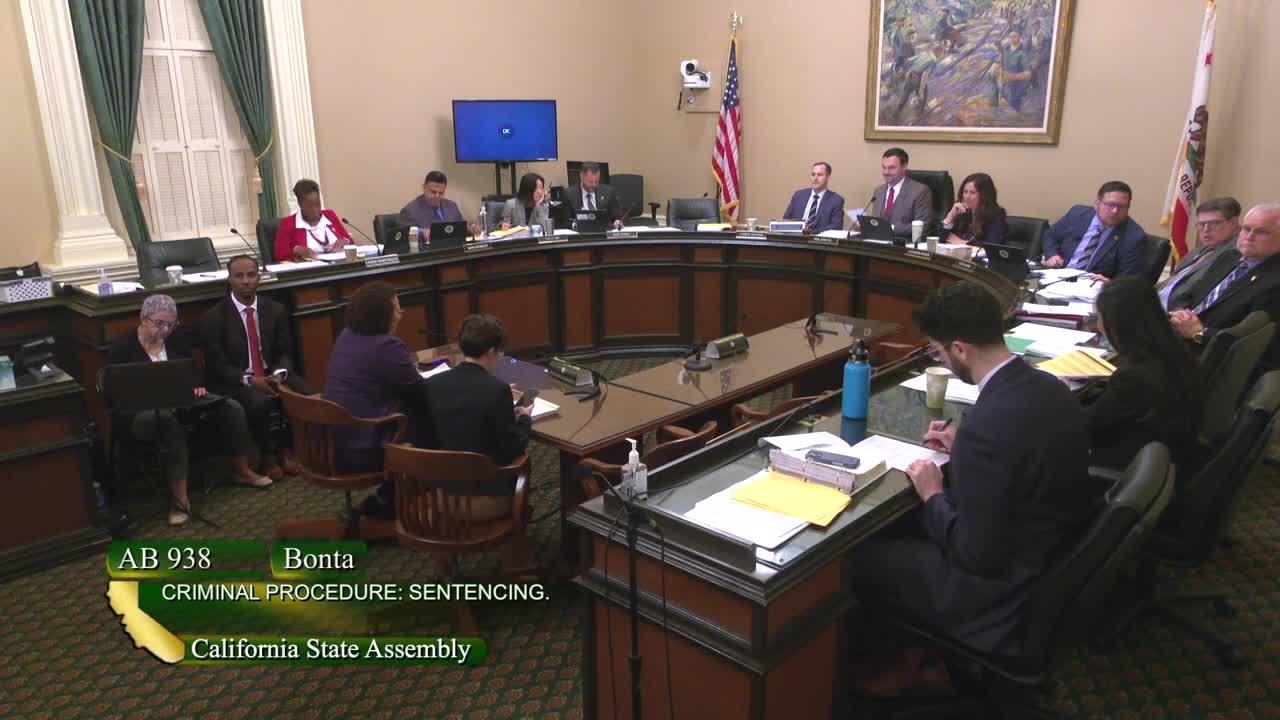 16MIN
Assembly Standing Committee on Public Safety
Bill Author

Bill Co-Author(s):