AB 530: California State University: fiscal transparency.
- Session Year: 2025-2026
- House: Assembly
- Latest Version Date: 2025-02-11
Current Status:
Failed
(2026-02-02: From committee: Filed with the Chief Clerk pursuant to Joint Rule 56.)
Introduced
In Committee
Awaiting First Chamber Vote
Passed First Chamber
In Committee
Awaiting Second Chamber Vote
Passed Second Chamber
Enacted
Existing law establishes the California State University, under the administration of the Trustees of the California State University, as one of the segments of public postsecondary education in the state. Existing law requires the trustees to control and expend all money appropriated for the support and maintenance of the university.
This bill, the California State University Transparency Act of 2025, would require the California State University, on or before July 1, 2027, to include on its internet website certain information about each expenditure of state funds, as defined, by the California State University for expenditures that exceed $10,000, in a format that allows the public to search and aggregate that information, and to also include on its internet website, among other things, the capability for a user to give input to the California State University regarding the utility of the information and to give recommendations to the California State University for improvements to the manner in which the information is provided on the internet website.
This article shall be known, and may be cited, as the California State University Transparency Act of 2025.
89765.5.For purposes of this article, expenditure of state funds means the expenditure or transfer of any state funds by the California State University in an amount that exceeds ten thousand dollars ($10,000) in the form of, including, but not limited to, any of the following:
(a)Grants.
(b)Contracts.
(c)Subcontracts.
(d)Purchase orders.
(e)Investments.
89766.(a)On or before July 1, 2027, the California State University shall include on its internet website, accessible to the public at no cost, and in a manner that allows the public to search and aggregate information on the expenditure of state funds, all of the following:
(1)(A)Except as provided in subparagraph (B), for each expenditure of state funds, information on the expenditure that includes, but is not limited to, all of the following information:
(i)The name and address of each office or business entity that receives funds, or other fund recipient. The information disclosed pursuant to this subparagraph shall not include the name of an individual person.
(ii)The amount of the expenditure.
(iii)The type of transaction.
(iv)The identity of the department, office, or other entity of the California State University making the expenditure.
(v)The program and type of expenditure.
(vi)A description of the purpose of the expenditure.
(vii)A description of any item purchased pursuant to the expenditure.
(viii)Any other information deemed relevant by the Department of Finance or the Governors office.
(B)For each expenditure that is a transfer of state funds in the form of investments, information on the investments that includes only the total amount of the transfer and the source of the funds.
(2)The capability for a user to view information on the internet website in a format that is searchable and the capability for a user to download and manage that information with appropriate software.
(3)The capability for a user to give input to the California State University regarding the utility of the information.
(4)The capability for a user to give recommendations to the California State University for improvements to the manner in which the information is provided on the internet website.
(b)On or before July 1, 2027, the California State Universitys internet website shall include information on the expenditure of state funds for the 202627 fiscal year. On and after July 1, 2027, the internet website shall be updated monthly to include information on the expenditure of state funds for the most recently completed month.
(c)The California State University shall fully cooperate with the Department of Finance and the Governors office in compiling and providing all information necessary to comply with this section.
(d)This section does not require the disclosure of confidential information or the disclosure of information that is otherwise exempt from disclosure under state or federal law.
|
Date
|
Status
|
|---|---|
| Feb 2, 2026 | From committee: Filed with the Chief Clerk pursuant to Joint Rule 56. |
| Jan 31, 2026 | Died pursuant to Art. IV, Sec. 10(c) of the Constitution. |
| May 23, 2025 | In committee: Held under submission. |
| Apr 23, 2025 | In committee: Set, first hearing. Referred to suspense file. |
| Mar 19, 2025 | From committee: Do pass and re-refer to Com. on APPR. (Ayes 9. Noes 0.) (March 18). Re-referred to Com. on APPR. |
| Feb 24, 2025 | Referred to Com. on HIGHER ED. |
| Feb 12, 2025 | From printer. May be heard in committee March 14. |
| Feb 11, 2025 | Read first time. To print. |
|
Date
|
Description
|
Location
|
Votes
|
|
|---|---|---|---|---|
| Mar 18, 2025 | Do pass and be re-referred to the Committee on [Appropriations] | Assembly Standing Committee on Higher Education |
Passed |
This list shows positions taken on this bill by organizations on the date displayed, which is linked to the original source.
Positions by individuals are not included.
|
Organization
|
Position
|
Date
|
|---|---|---|
| California Faculty Association | ** Support | |
| California State University, Office Of The Chancellor | ** Against |
Date of Hearing: April 23, 2025
ASSEMBLY COMMITTEE ON APPROPRIATIONS
Buffy Wicks, Chair
ABPCA Bill Id:AB 530
Author:(Hart) – As Introduced Ver:February 11, 2025
Policy Committee: | Higher Education | Vote: | 9 - 0 |
|
| ||
|
|
Urgency: No State Mandated Local Program: No Reimbursable: No
SUMMARY:
This bill requires the California State University (CSU) to include on its website, on or before July 1, 2027, certain information about each expenditure of state funds, as defined, for expenditures exceeding $10,000, in an aggregated and searchable format available to the public, updated monthly.
Specifically, this bill requires the CSU to publish state fund expenditure information on or before July 1, 2027, beginning with expenditures for the 2026-27 fiscal year, and requires the university to update the information monthly to account for expenditures from the most recently completed month. This bill defines “expenditure of state funds” as the expenditure or transfer of any state funds in the CSU exceeding $10,000 including, but not limited to grants, contracts, subcontracts, purchase orders, and investments. The bill also requires the expenditure information include, but not be limited to, (a) name and address of each office or business entity that receives funds, or other fund recipient (excluding the name of an individual person), (b) amount of expenditure, (c) type of transaction, (d) identity of the department, office, or other entity of the CSU making the expenditure, (e) program source for the expenditure, (f) purpose of the expenditure, (g) description of the item purchased, and (h) any other information deemed relevant by the Department of Finance or the Governor’s office. Lastly, the bill requires that the internet website allow users to download the information and to provide feedback regarding how the information is provided and its utility.
FISCAL EFFECT:
One-time costs of $2 million and $1.6 million ongoing (both General Fund) to the CSU campuses to (a) purchase software licenses required to accommodate the level of detail by the bill for each transaction, by month, (b) hire staff to develop and maintain reporting standards and provide technical assistance, (c) provide quarterly trainings in the initial year of implementation and ongoing technical support, and (d) acquire an investment manager custom reporting tool to provide information required for investment transactions.
COMMENTS:
- Purpose. According to the author:
AB 530 is a critical step toward ensuring transparency, accountability, and trust in the use of public dollars at one of California’s most prestigious higher education institutions, the CSU. By making detailed expenditure information publicly available and accessible, the bill will enable the Legislature and the public to better understand how State funds are being spent. AB 530 ensures that State funding is being allocated effectively to support the core mission of the CSU—prioritizing students, faculty, and staff.
- Background.
Recent Concern over CSU Financial Oversight. An audit report released by the State Auditor in May of 2020 found that the CSU campuses have significantly increased mandatory student fees since 2011-12, in response to the tuition freezes the Legislature and Governor negotiated with the CSU as part of the annual state budget process, during which the Legislature increased state funding to the CSU system. However, the report found that the CSU’s approach to managing mandatory fees did not ensure adequate accountability.
Although campuses must obtain approval from the CSU Office of the Chancellor to establish new mandatory fees, campus presidents did not need approval to increase the amount of existing fees. In addition, the Chancellor’s Office’s system-wide fee policy contained only vague requirements that allow campuses to request approval for proposed mandatory fees or increase existing fees without justifying specific fee amounts. The State Auditor found that campuses did not sufficiently justify their needs when determining and setting the amount of proposed fees or increases to existing fees. Campuses also did not sufficiently demonstrate that they had no other way to pay for those needs.
Some CSU Financial Information Already Available. The CSU maintains a Financial Transparency Portal that provides aggregate data on expenditures of $50,000 or more over the past five fiscal years. This portal categorizes expenditures by program (such as instruction, institutional support, and student services) and by expense type (including salaries, benefits, and student financial aid). However, the website reporting the bill proposes would include more granular transparency measures, and lower the expenditure reporting threshold to $10,000.
- Prior Legislation. AB 2447 (Valencia), of the 2023-24 Legislative Session, proposed substantially similar requirements to this bill, but with an expenditure threshold of $25,000. The bill was vetoed by the Governor who cited the existing portal maintained by the CSU and concerns over the additional cost pressures the bill would place on the CSU budget simultaneous with ongoing state appropriations reductions.
Analysis Prepared by: Aaron Heredia / APPR. / (916) 319-2081
Date of Hearing: March 18, 2025
ASSEMBLY COMMITTEE ON HIGHER EDUCATION
Mike Fong, Chair
ABPCA Bill Id:AB 530 (
Author:Hart) – As Introduced Ver:February 11, 2025
SUBJECT: California State University: fiscal transparency
SUMMARY: Requires the California State University (CSU) to include on their website, on or before July 1, 2027, certain information about each expenditure of state funds, as defined, for expenditures that exceed $10,000, in a format that allows the public to search and aggregate that information as specified. Specifically, this bill:
- Establishes the CSU Transparency Act of 2025.
- Defines “expenditure of state funds” means the expenditure or transfer of any state funds by the CSU in an amount that exceeds ten thousand dollars ($10,000) in the form of, including, but not limited to, any of the following:
- Grants;
- Contracts;
- Subcontracts;
- Purchase orders; and,
- Investments.
- Requires that on or before July 1, 2027, the CSU must include on its internet website, accessible to the public at no cost, and in a manner that allows the public to search and aggregate information on the expenditure of state funds, all of the following:
- For each expenditure of state funds, information on the expenditure that includes, but is not limited to, all of the following information:
- The name and address of each office or business entity that receives funds, or other fund recipient. The information disclosed must not include the name of an individual person;
- The amount of the expenditure;
- The type of transaction;
- The identity of the department, office, or other entity of the CSU making the expenditure;
- The program source for the expenditure;
- A description of the purpose of the expenditure;
- A description of any item purchased pursuant to the expenditure; and,
- Any other information deemed relevant by the Department of Finance or the Governor’s office.
- For each expenditure that is a transfer of state funds in the form of investments, information on the investments that includes only the total amount of the transfer and the source of the funds.
- The capability for a user to view information on the internet website in a format that is searchable and the capability for a user to download and manage that information with appropriate software.
- The capability for a user to give input to the CSU regarding the utility of the information.
- The capability for a user to give recommendations to the CSU for improvements to the manner in which the information is provided on the internet website.
- For each expenditure of state funds, information on the expenditure that includes, but is not limited to, all of the following information:
- Requires that, on or before July 1, 2027, the California State University’s internet website shall include information on the expenditure of state funds for the 2026–27 fiscal year. On and after July 1, 2027, the internet website must be updated monthly to include information on the expenditure of state funds for the most recently completed month.
- Requires the CSU to fully cooperate with the Department of Finance and the Governor’s Office in compiling and providing all information necessary to comply with this section.
- Specifies that provisions of the measure do not require the disclosure of confidential information or the disclosure of information that is otherwise exempt from disclosure under state or federal law.
EXISTING LAW:
- Confers upon the CSU Board of Trustees the powers, duties, and functions with respect to the management, administration, control of the CSU system and provides that the Trustees are responsible for the rule of government of their appointees and employees. (Education Code (EDC) Sections 66606 and 89500, et seq.).
- Requires the CSU Trustees to control and expend all money appropriated for the support and maintenance of the CSU, and all money received as donations, as specified. (EDC Section 89750).
- Requires that the CSU Board of Trustees receive an investment performance report quarterly, and must distribute an annual report to the Legislature. (EDC Section 89726)
FISCAL EFFECT: Unknown.
COMMENTS: According to the author, “AB 530 is a critical step toward ensuring transparency, accountability, and trust in the use of public dollars at one of California’s most prestigious higher education institutions, the CSU. By making detailed expenditure information publicly available and accessible, the bill will enable the Legislature and the public to better understand how State funds are being spent. AB 530 ensures that State funding is being allocated effectively to support the core mission of the CSU—prioritizing students, faculty, and staff.
CSU Audit. In May of 2020, the State Auditor released audit report 2019-114 titled California State University: The Mandatory Fees Its Campuses Charge Receive Little Oversight Yet They Represent an Increasing Financial Burden to Students. The report found that the growth in mandatory fees has made the CSU campuses increasingly expensive for students. Since academic year 2011–12, the Trustees have increased tuition by only $270, or 5%, in academic year 2017–18, from $5,472 to $5,742. This stability in tuition costs is largely the result of the tuition freezes the Legislature and Governor negotiated with the CSU as part of the annual state budget process, during which the Legislature increased state funding to the CSU system. In contrast, from academic years 2011–12 through 2019–20, total mandatory fees on average across all 23 CSU campuses increased from $1,047 to $1,633, or 56%.
The report also found that CSU’s approach to managing mandatory fees did not ensure adequate accountability. Although campuses must obtain approval from the CSU Office of the Chancellor to establish new mandatory fees, campus presidents did not need approval to increase the amount of existing fees. In addition, the Chancellor’s Office’s systemwide fee policy contained only vague requirements that allow campuses to request approval for proposed mandatory fees or increase existing fees without justifying specific fee amounts. As a result, the State Auditor found that campuses did not sufficiently justify their needs when determining and setting the amount of proposed fees or increases to existing fees. Campuses also did not sufficiently demonstrate that they had no other way to pay for those needs.
Arguments in support. The California Faculty Association, the sponsors of AB 530 (Hart), wrote that “the CSU system, with an operating budget of $8.5 billion for the fiscal year 2024-25, receives substantial funding from the state General Fund, tuition and mandatory fees, and California State Lottery Ticket sales, among other sources. Despite the critical role that these funds play in supporting the CSU's operating costs—including instruction, academic support, student services, and financial aid—a state audit released in May 2020 highlighted a concerning lack of oversight on the expenditures of mandatory fees, which have been a financial burden to students. These fees, not covered by financial aid grants and scholarships, contribute to the financial strain on students and their families, many of whom resort to paying these fees out of pocket or through student loans. The audit's findings, coupled with the CSU Board of Trustees' recent decision to approve a system-wide tuition hike, underscore the urgent need for greater financial transparency to ensure that the funds are being used effectively to support the CSU's core functions.”
“AB 530 addresses this need by requiring the CSU to track and publicly disclose expenditures of state that exceed $10,000, including grants, contracts, subcontracts, purchase orders, investments, and any expenditure from a reserve account. This level of transparency will empower students, parents, taxpayers, and legislators to see how allocated state funds are spent and assess the outcomes of these expenditures.
Arguments in opposition. The CSU Chancellor’s Office wrote that, “the CSU shares the author’s goal for transparency and accountability and demonstrates this shared priority through our Transparency & Accountability website. The public is currently able to track all expenditures over $50,000, view annual financial statements and external financial audit reports, and utilize a financial transparency portal that allows one to customize CSU finance searches by year, campus and fund.
“However, the CSU remains opposed to AB 530 as it includes a number of provisions that would be incredibly difficult to implement and would provide little to no public benefit. As an example, the requirement to report expenditures in excess of $10,000 would result in approximately over 30,000 data points, which is why the CSU currently reports expenditures over $50,000. Additionally, AB 530 contains a provision that would allow the Department of Finance and the Governor’s Office to request any information they choose to be included in the published expenditures. This provision lacks specificity and is subject to change, preventing the CSU from knowing what information should be captured to satisfy the provisions of this bill. Lastly, the bill treats investments as expenditures which is not appropriate or feasible. The CSU is required by law to invest in mutual funds, under which transactions are made constantly by a fund manager. Therefore, we would not be able to produce the same required content for expenditures monthly as required under this bill for investment transactions via mutual funds.”
Committee comments. As part of an existing effort to maintain financial transparency, CSU maintains a Financial Transparency Portal that provides aggregate data on expenditures of $50,000 or more over the past five fiscal years. This portal categorizes expenditures by program (such as instruction, institutional support, and student services) and by expense type (including salaries, benefits, and student financial aid).
Given that CSU is already using these categories in their existing reports, the implementation of the provisions proposed by this bill may not significantly create more work from CSU. The current categorization system is comprehensive and mostly aligns with the proposed requirements of the bill. While the proposed website reporting would include more granular transparency measures, and lower the expenditure reporting threshold to $10,000, the committee may wish to consider if the proposal will yield significantly more detail beyond what is already available through the existing Financial Transparency Portal.
Prior legislation. AB 2447 (Valencia), of 2024, Requires the California State University (CSU) to develop and maintain, on or before July 1, 2026, a fiscal transparency internet website that allows the public to search and aggregate information on the expenditures and transfers of funds by the CSU in amounts that exceed $25,000, as specified.
The measure was vetoed by the Governor, who wrote that “this bill requires the California State University (CSU) to develop and maintain a fiscal transparency website displaying expenditures and transfers of state funds in amounts greater than $25,000 by July 1, 2026. The CSU voluntarily maintains a Fiscal Transparency Portal, accessible to the public, that provides data largely consistent with this bill. The existing database presents aggregate data on expenditures of $50,000 or more over the past five fiscal years, broken down by program and by expense type. Including additional transactions greater than $25,000 would place additional cost pressures on the CSU budget at a time when the system is preparing to implement ongoing state appropriations reductions.”
“In partnership with the Legislature this year, my Administration has enacted a balanced budget that avoids deep program cuts to vital services and protected investments in education, health care, climate, public safety, housing, and social service programs that millions of Californians rely on. It is important to remain disciplined when considering bills with significant fiscal implications that are not included in the budget, such as this measure.”
REGISTERED SUPPORT / OPPOSITION:
Support
California Faculty Association (Sponsor)
Opposition
California State University, Office of the Chancellor
Analysis Prepared by: Kevin J. Powers / HIGHER ED. / (916) 319-3960
Date of Hearing: March 18, 2025
ASSEMBLY COMMITTEE ON HIGHER EDUCATION
Mike Fong, Chair
ABPCA Bill Id:AB 530 (
Author:Hart) – As Introduced Ver:February 11, 2025
SUBJECT: California State University: fiscal transparency
SUMMARY: Requires the California State University (CSU) to develop and maintain, on or before July 1, 2027, a fiscal transparency internet website that allows the public to search and aggregate information on the expenditures and transfers of funds by the CSU in amounts that exceed $10,000, as specified. Specifically, this bill:
- Establishes the CSU Transparency Act of 2025.
- Defines “expenditure of state funds” means the expenditure or transfer of any state funds by the CSU in an amount that exceeds ten thousand dollars ($10,000) in the form of, including, but not limited to, any of the following:
- Grants;
- Contracts;
- Subcontracts;
- Purchase orders; and,
- Investments.
- Requires that on or before July 1, 2027, the CSU must include on its internet website, accessible to the public at no cost, and in a manner that allows the public to search and aggregate information on the expenditure of state funds, all of the following:
- For each expenditure of state funds, information on the expenditure that includes, but is not limited to, all of the following information:
- The name and address of each office or business entity that receives funds, or other fund recipient. The information disclosed must not include the name of an individual person;
- The amount of the expenditure;
- The type of transaction;
- The identity of the department, office, or other entity of the CSU making the expenditure;
- The program source for the expenditure;
- A description of the purpose of the expenditure;
- A description of any item purchased pursuant to the expenditure; and,
- Any other information deemed relevant by the Department of Finance or the Governor’s office.
- For each expenditure that is a transfer of state funds in the form of investments, information on the investments that includes only the total amount of the transfer and the source of the funds.
- The capability for a user to view information on the internet website in a format that is searchable and the capability for a user to download and manage that information with appropriate software.
- The capability for a user to give input to the CSU regarding the utility of the information.
- The capability for a user to give recommendations to the CSU for improvements to the manner in which the information is provided on the internet website.
- For each expenditure of state funds, information on the expenditure that includes, but is not limited to, all of the following information:
- Requires that, on or before July 1, 2027, the California State University’s internet website shall include information on the expenditure of state funds for the 2026–27 fiscal year. On and after July 1, 2027, the internet website shall be updated monthly to include information on the expenditure of state funds for the most recently completed month.
- Requires the CSU to fully cooperate with the Department of Finance and the Governor’s Office in compiling and providing all information necessary to comply with this section.
- Specifies that provisions of the measure do not require the disclosure of confidential information or the disclosure of information that is otherwise exempt from disclosure under state or federal law.
EXISTING LAW:
- Confers upon the CSU Board of Trustees the powers, duties, and functions with respect to the management, administration, control of the CSU system and provides that the Trustees are responsible for the rule of government of their appointees and employees. (Education Code (EDC) Sections 66606 and 89500, et seq.).
- Requires the CSU Trustees to control and expend all money appropriated for the support and maintenance of the CSU, and all money received as donations, as specified. (EDC Section 89750).
- Requires that the CSU Board of Trustees receive an investment performance report quarterly, and must distribute an annual report to the Legislature. (EDC Section 89726)
FISCAL EFFECT: Unknown.
COMMENTS: According to the author, “AB 530 is a critical step toward ensuring transparency, accountability, and trust in the use of public dollars at one of California’s most prestigious higher education institutions, the CSU. By making detailed expenditure information publicly available and accessible, the bill will enable the Legislature and the public to better understand how State funds are being spent. AB 530 ensures that State funding is being allocated effectively to support the core mission of the CSU—prioritizing students, faculty, and staff.
CSU Audit. In May of 2020, the State Auditor released audit report 2019-114 titled California State University: The Mandatory Fees Its Campuses Charge Receive Little Oversight Yet They Represent an Increasing Financial Burden to Students. The report found that the growth in mandatory fees has made the CSU campuses increasingly expensive for students. Since academic year 2011–12, the Trustees have increased tuition by only $270, or 5%, in academic year 2017–18, from $5,472 to $5,742. This stability in tuition costs is largely the result of the tuition freezes the Legislature and Governor negotiated with the CSU as part of the annual state budget process, during which the Legislature increased state funding to the CSU system. In contrast, from academic years 2011–12 through 2019–20, total mandatory fees on average across all 23 CSU campuses increased from $1,047 to $1,633, or 56%.
The report also found that CSU’s approach to managing mandatory fees did not ensure adequate accountability. Although campuses must obtain approval from the CSU Office of the Chancellor to establish new mandatory fees, campus presidents did not need approval to increase the amount of existing fees. In addition, the Chancellor’s Office’s systemwide fee policy contained only vague requirements that allow campuses to request approval for proposed mandatory fees or increase existing fees without justifying specific fee amounts. As a result, the State Auditor found that campuses did not sufficiently justify their needs when determining and setting the amount of proposed fees or increases to existing fees. Campuses also did not sufficiently demonstrate that they had no other way to pay for those needs.
Arguments in support. The California Faculty Association, the sponsors of AB 530 (Hart), wrote that “the CSU system, with an operating budget of $8.5 billion for the fiscal year 2024-25, receives substantial funding from the state General Fund, tuition and mandatory fees, and California State Lottery Ticket sales, among other sources. Despite the critical role that these funds play in supporting the CSU's operating costs—including instruction, academic support, student services, and financial aid—a state audit released in May 2020 highlighted a concerning lack of oversight on the expenditures of mandatory fees, which have been a financial burden to students. These fees, not covered by financial aid grants and scholarships, contribute to the financial strain on students and their families, many of whom resort to paying these fees out of pocket or through student loans. The audit's findings, coupled with the CSU Board of Trustees' recent decision to approve a system-wide tuition hike, underscore the urgent need for greater financial transparency to ensure that the funds are being used effectively to support the CSU's core functions.”
“AB 530 addresses this need by requiring the CSU to track and publicly disclose expenditures of state that exceed $10,000, including grants, contracts, subcontracts, purchase orders, investments, and any expenditure from a reserve account. This level of transparency will empower students, parents, taxpayers, and legislators to see how allocated state funds are spent and assess the outcomes of these expenditures.
Arguments in opposition. The CSU Chancellor’s Office wrote that, “the CSU shares the author’s goal for transparency and accountability and demonstrates this shared priority through our Transparency & Accountability website. The public is currently able to track all expenditures over $50,000, view annual financial statements and external financial audit reports, and utilize a financial transparency portal that allows one to customize CSU finance searches by year, campus and fund.
“However, the CSU remains opposed to AB 530 as it includes a number of provisions that would be incredibly difficult to implement and would provide little to no public benefit. As an example, the requirement to report expenditures in excess of $10,000 would result in approximately over 30,000 data points, which is why the CSU currently reports expenditures over $50,000. Additionally, AB 530 contains a provision that would allow the Department of Finance and the Governor’s Office to request any information they choose to be included in the published expenditures. This provision lacks specificity and is subject to change, preventing the CSU from knowing what information should be captured to satisfy the provisions of this bill. Lastly, the bill treats investments as expenditures which is not appropriate or feasible. The CSU is required by law to invest in mutual funds, under which transactions are made constantly by a fund manager. Therefore, we would not be able to produce the same required content for expenditures monthly as required under this bill for investment transactions via mutual funds.”
Committee comments. As part of an existing effort to maintain financial transparency, CSU already maintains a Financial Transparency Portal that provides aggregate data on expenditures of $50,000 or more over the past five fiscal years. This portal categorizes expenditures by program (such as instruction, institutional support, and student services) and by expense type (including salaries, benefits, and student financial aid).
Given that CSU is already using these categories in their existing reports, the implementation of the new website proposed by this bill does may not significantly more work from CSU. The current categorization system is comprehensive and mostly aligns with the proposed requirements of the bill. While the proposed website would include more granular transparency measures, and lower the expenditure reporting threshold to $10,000, the committee may wish to consider if the proposal will yield significantly more detail beyond what is already available through the existing Financial Transparency Portal.
Prior legislation. AB 2447 (Valencia), of 2024, Requires the California State University (CSU) to develop and maintain, on or before July 1, 2026, a fiscal transparency internet website that allows the public to search and aggregate information on the expenditures and transfers of funds by the CSU in amounts that exceed $25,000, as specified.
The measure was vetoed by the Governor, who wrote that “this bill requires the California State University (CSU) to develop and maintain a fiscal transparency website displaying expenditures and transfers of state funds in amounts greater than $25,000 by July 1, 2026. The CSU voluntarily maintains a Fiscal Transparency Portal, accessible to the public, that provides data largely consistent with this bill. The existing database presents aggregate data on expenditures of $50,000 or more over the past five fiscal years, broken down by program and by expense type. Including additional transactions greater than $25,000 would place additional cost pressures on the CSU budget at a time when the system is preparing to implement ongoing state appropriations reductions.”
“In partnership with the Legislature this year, my Administration has enacted a balanced budget that avoids deep program cuts to vital services and protected investments in education, health care, climate, public safety, housing, and social service programs that millions of Californians rely on. It is important to remain disciplined when considering bills with significant fiscal implications that are not included in the budget, such as this measure.”
REGISTERED SUPPORT / OPPOSITION:
Support
California Faculty Association (Sponsor)
Opposition
California State University, Office of the Chancellor
Analysis Prepared by: Kevin J. Powers / HIGHER ED. / (916) 319-3960
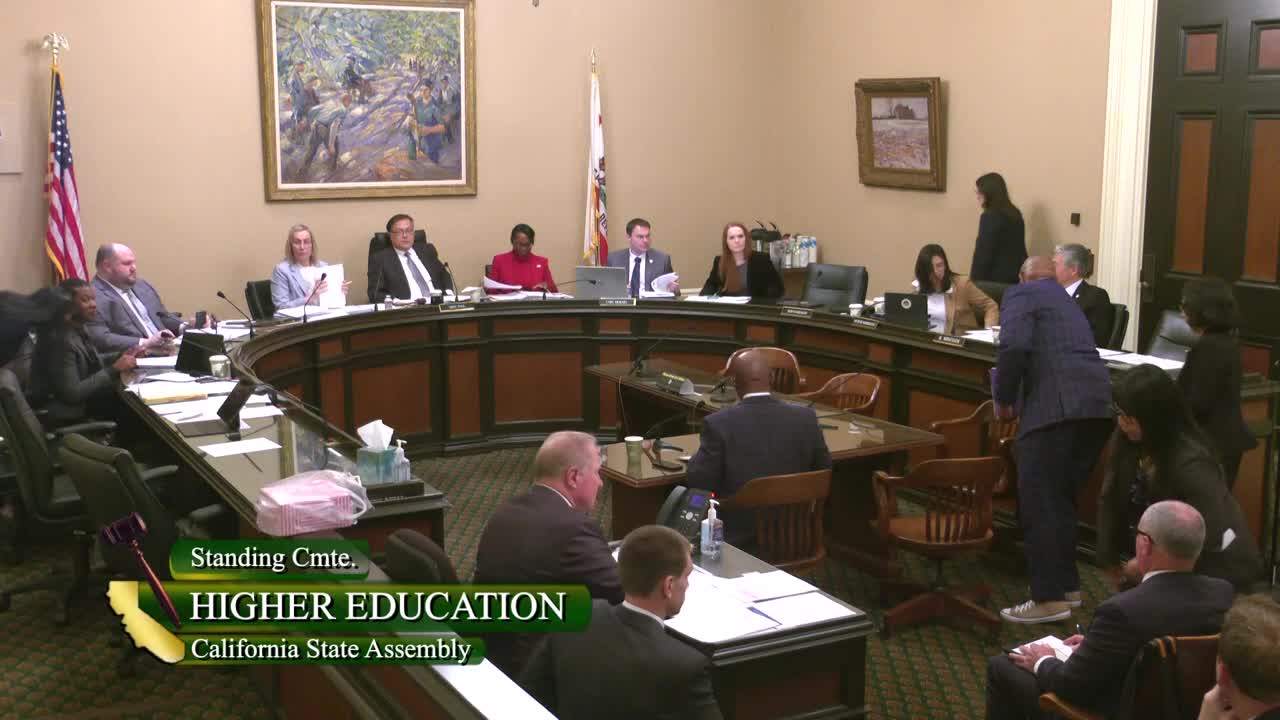
Discussed in Hearing
 9MIN
Assembly Standing Committee on Higher Education
Bill Author

Bill Co-Author(s):