AB 758: Wildfire: vegetation management.
- Session Year: 2025-2026
- House: Assembly
- Latest Version Date: 2025-04-08
Current Status:
Failed
(2025-05-15: From committee: Without further action pursuant to Joint Rule 62(a).)
Introduced
In Committee
Awaiting First Chamber Vote
Passed First Chamber
In Committee
Awaiting Second Chamber Vote
Passed Second Chamber
Enacted
Existing law establishes in the Natural Resources Agency the Department of Forestry and Fire Protection, and requires the department to be responsible for, among other things, fire protection and prevention, as provided. Existing law describes state responsibility areas as areas of the state in which the financial responsibility of preventing and suppressing fires has been determined by the State Board of Forestry and Fire Protection to be primarily the responsibility of the department. Existing law requires the State Fire Marshal to classify lands within state responsibility areas into fire hazard severity zones and, by regulation, designate fire hazard severity zones and assign to each zone a rating reflecting the degree of severity of fire hazard that is expected to prevail in the zone, as provided. Existing law also requires the State Fire Marshal to identify areas of the state that are local responsibility areas where a local government or district is responsible for fire protection as moderate, high, and very high fire hazard severity zones based on specified criteria. Existing law requires a local agency to designate, by ordinance, fire hazard severity zones in its jurisdiction within 120 days of receiving recommendations from the State Fire Marshal, as described above.
This bill would, on or before January 1, 2028, and every 2 years thereafter, require the department or a local entity, as defined, entity to conduct an assessment, as provided, of all public lands, as defined, for which they are primarily undeveloped public lands for which it is primarily responsible for preventing and suppressing fires to ensure that the public land is not a severe fire hazard, as defined. hazard. The bill would require this assessment to be posted on the departments and local entities entitys internet website and would require a local entity conducting the assessment to submit the its assessment to the department. The bill would require all of these lands, on or before January 1, 2028, to have 200-foot firebreaks on all borders with private property.
This bill would, when the state or a local government acquires private undeveloped land, require the department or a local entity that is primarily responsible for preventing and suppressing fires on that land to create a plan on how the land will be managed with regard to fire prevention, and to report the cost of keeping the land managed. The bill would require the department and the local entity to post this information on its respective internet website and would require a local entity preparing this information to submit it to the department. The bill would also require all public lands, as defined, to have 200 foot firebreaks on all borders with private property. To
To the extent that this bill would impose new duties on local government agencies, the bill would create a state-mandated local program.
The California Constitution requires the state to reimburse local agencies and school districts for certain costs mandated by the state. Statutory provisions establish procedures for making that reimbursement.
This bill would provide that, if the Commission on State Mandates determines that the bill contains costs mandated by the state, reimbursement for those costs shall be made pursuant to the statutory provisions noted above.
Existing law establishes in the Natural Resources Agency the Department of Forestry and Fire Protection, and requires the department to be responsible for, among other things, fire protection and prevention, as provided. Existing law describes state responsibility areas as areas of the state in which the financial responsibility of preventing and suppressing fires has been determined by the State Board of Forestry and Fire Protection to be primarily the responsibility of the department. Existing law requires the State Fire Marshal to classify lands within state responsibility areas into fire hazard severity zones and, by regulation, designate fire hazard severity zones and assign to each zone a rating reflecting the degree of severity of fire hazard that is expected to prevail in the zone, as provided. Existing law also requires the State Fire Marshal to identify areas of the state that are local responsibility areas where a local government or district is responsible for fire protection as moderate, high, and very high fire hazard severity zones based on specified criteria. Existing law requires a local agency to designate, by ordinance, fire hazard severity zones in its jurisdiction within 120 days of receiving recommendations from the State Fire Marshal, as described above.
This bill would, on or before January 1, 2028, and every 2 years thereafter, require the department or a local entity, as defined, to conduct an assessment, as provided, of all public lands, as defined, for which they are primarily responsible for preventing and suppressing fires to ensure that the public land is not a severe fire hazard, as defined. The bill would require this assessment to be posted on the departments and local entities internet website and would require a local entity conducting the assessment to submit the assessment to the department.
This bill would, when the state or a local government acquires private land, require the department or a local entity that is primarily responsible for preventing and suppressing fires on that land to create a plan on how the land will be managed with regard to fire prevention, and to report the cost of keeping the land managed. The bill would require the department and the local entity to post this information on its respective internet website and would require a local entity preparing this information to submit it to the department. The bill would also require all public lands, as defined, to have 200 foot firebreaks on all borders with private property. To the extent that this bill would impose new duties on local government agencies, the bill would create a state-mandated local program.
The California Constitution requires the state to reimburse local agencies and school districts for certain costs mandated by the state. Statutory provisions establish procedures for making that reimbursement.
This bill would provide that, if the Commission on State Mandates determines that the bill contains costs mandated by the state, reimbursement for those costs shall be made pursuant to the statutory provisions noted above.
Existing law creates, within the office of the Governor, the Office of Emergency Services which, under the Director of Emergency Services, coordinates disaster response, emergency planning, emergency preparedness, disaster recovery, disaster mitigation, and homeland security activities.This bill would state the intent of the Legislature to enact subsequent legislation to improve emergency preparedness, response, and recovery.Existing law creates, within the office of the Governor, the Office of Emergency Services which, under the Director of Emergency Services, coordinates disaster response, emergency planning, emergency preparedness, disaster recovery, disaster mitigation, and homeland security activities.
This bill would state the intent of the Legislature to enact subsequent legislation to improve emergency preparedness, response, and recovery.
For purposes of this article, the following terms shall apply:
(a)Fire break means a gap in vegetation or other combustible material that acts as a barrier to slow or stop brush fire or wildfire.
(b)Local entity means a city, county, city or county, or other local jurisdiction with fire prevention and suppression authority.
(c)Public land means undeveloped land under the control of the department or a local entity.
(d)Severe fire hazard means land designated as a moderate, high, or very high fire hazard severity zone as identified by the State Fire Marshal pursuant to Section 4202 of this code and Section 51178 of the Government Code or as identified by a local agency pursuant to Section 51179 of the Government Code.
4138.5.This article shall be known, and may be cited, as the Force State and Local Government to Be Firewise Neighbors Act.
4139.(a)(1)On or before January 1, 2028, and every two years thereafter, the department or a local entity shall conduct an assessment on all public lands for which they are it is primarily responsible for preventing and suppressing fires pursuant Sections 4102 and 4125 to ensure that the public land is not a severe fire hazard.
(2)The assessment shall include all of the following:
(A)Information on the vegetation management plan, including, but not limited to, what and how often vegetation management is currently being done.
(B)Information on the cost of vegetation management described in subparagraph (A).
(b)The department and the local entity shall post the assessment pursuant to paragraph (1) of subdivision (a) on its respective internet website. If a local entity prepares the assessment, the local entity shall also submit its assessment to the department.
4139.5.(a)When the state or a local government acquires private land undeveloped land, the department or a local entity that is primarily responsible for preventing and suppressing fires pursuant to Section 4125 shall, within one year of acquisition, do both of the following:
(1)Create a plan on how the land will be managed with regard to fire prevention.
(2)Report the cost of keeping the land managed.
(b)The department or the local entity shall post the information pursuant to subdivision (a) on its respective internet website. If a local entity prepares the information, the local entity shall also submit this information to the department.
4140.All On or before January 1, 2028, all public lands shall have a 200 foot firebreak on all borders with privately owned land.
SEC. 2.If the Commission on State Mandates determines that this act contains costs mandated by the state, reimbursement to local agencies and school districts for those costs shall be made pursuant to Part 7 (commencing with Section 17500) of Division 4 of Title 2 of the Government Code.
For purposes of this article, the following terms shall apply:
(a)Fire break means a gap in vegetation or other combustible material that acts as a barrier to slow or stop brush fire or wildfire.
(b)Local entity means a city, county, city or county, or other local jurisdiction with fire prevention and suppression authority.
(c)Public land means undeveloped land under the control of the department or a local entity.
(d)Severe fire hazard means land designated as a moderate, high, or very high fire hazard severity zone as identified by the State Fire Marshal pursuant to Section 4202 of this code and Section 51178 of the Government Code or as identified by a local agency pursuant to Section 51179 of the Government Code.
4139.(a)(1)On or before January 1, 2028, and every two years thereafter, the department or a local entity shall conduct an assessment on all public lands for which they are primarily responsible for preventing and suppressing fires pursuant Sections 4102 and 4125 to ensure that the public land is not a severe fire hazard.
(2)The assessment shall include all of the following:
(A)Information on the vegetation management plan, including, but not limited to, what and how often vegetation management is currently being done.
(B)Information on the cost of vegetation management described in subparagraph (A).
(b)The department and the local entity shall post the assessment pursuant to paragraph (1) of subdivision (a) on its respective internet website. If a local entity prepares the assessment, the local entity shall also submit its assessment to the department.
4139.5.(a)When the state or a local government acquires private land the department or a local entity that is primarily responsible for preventing and suppressing fires pursuant to Section 4125 shall, within one year of acquisition, do both of the following:
(1)Create a plan on how the land will be managed with regard to fire prevention.
(2)Report the cost of keeping the land managed.
(b)The department or the local entity shall post the information pursuant to subdivision (a) on its respective internet website. If a local entity prepares the information, the local entity shall also submit this information to the department.
4140.All public lands shall have a 200 foot firebreak on all borders with privately owned land.
SEC. 2.If the Commission on State Mandates determines that this act contains costs mandated by the state, reimbursement to local agencies and school districts for those costs shall be made pursuant to Part 7 (commencing with Section 17500) of Division 4 of Title 2 of the Government Code.
SECTION 1.It is the intent of the Legislature to enact subsequent legislation to improve emergency preparedness, response, and recovery.It is the intent of the Legislature to enact subsequent legislation to improve emergency preparedness, response, and recovery.
|
Date
|
Status
|
|---|---|
| May 15, 2025 | From committee: Without further action pursuant to Joint Rule 62(a). |
| Apr 21, 2025 | In committee: Set, first hearing. Failed passage. |
| Apr 9, 2025 | Re-referred to Com. on NAT. RES. |
| Apr 8, 2025 | From committee chair, with author's amendments: Amend, and re-refer to Com. on NAT. RES. Read second time and amended. |
| Apr 2, 2025 | Re-referred to Com. on NAT. RES. |
| Apr 1, 2025 | From committee chair, with author's amendments: Amend, and re-refer to Com. on NAT. RES. Read second time and amended. |
| Mar 28, 2025 | Referred to Coms. on NAT. RES. and E.M. |
| Feb 19, 2025 | From printer. May be heard in committee March 21. |
| Feb 18, 2025 | Read first time. To print. |
|
Date
|
Description
|
Location
|
Votes
|
|
|---|---|---|---|---|
| Apr 21, 2025 | Do pass as amended and be re-referred to the Committee on [Emergency Management] | Assembly Standing Committee on Natural Resources |
Failed |
This list shows positions taken on this bill by organizations on the date displayed, which is linked to the original source.
Positions by individuals are not included.
Date of Hearing: April 21, 2025
ASSEMBLY COMMITTEE ON NATURAL RESOURCES
Isaac G. Bryan, Chair
ABPCA Bill Id:AB 758 (
Author:DeMaio) – As Amended Ver:April 8, 2025
SUBJECT: Wildfire: vegetation management
SUMMARY: Requires the Department of Forestry and Fire Protection (CAL FIRE) or a local entity to conduct an assessment of all undeveloped public lands for which it is primarily responsible for preventing and suppressing fires and to ensure that the public land is not a severe fire hazard. Requires all of these lands, on or before January 1, 2028, to have 200-foot firebreaks on all borders with private property.
EXISTING LAW:
- Establishes the State Fire Marshal (SFM) as an entity within CAL FIRE to foster, promote, and develop ways and means of protecting life and property against fire and panic. (Health & Safety Code 13100 – 13100.1)
- Requires the SFM, by regulation, to designate fire hazard severity zones (FHSZs) and assign to each zone a rating reflecting the degree of severity of fire hazard that is expected to prevail in the zone. Provides that no designation of a zone and assignment of a rating shall be adopted by the SFM until the proposed regulation has been transmitted to the board of supervisors of the county in which the zone is located at least 45 days before the adoption of the proposed regulation and a public hearing has been held in that county during that 45-day period. (Public Resources Code (PRC) 4203)
- Requires the Board of Forestry and Fire Protection (Board) to classify all lands within the state, without regard to any classification of lands made by or for any federal agency or purpose, for the purpose of determining areas in which the financial responsibility of preventing and suppressing fires is primarily the responsibility of the state. The prevention and suppression of fires in all areas that are not so classified is primarily the responsibility of local or federal agencies, as the case may be. (PRC 4125)
- Requires the Board to periodically update regulations for fuel breaks and greenbelts near communities to provide greater fire safety for the perimeters to all residential, commercial, and industrial building construction within state responsibility areas and lands classified and designated as very high fire hazard severity zone. These regulations shall include measures to preserve undeveloped ridgelines to reduce fire risk and improve fire protection. (PRC 4290)
- Defines “fuel break” as a strip of modified fuel to provide a line from which to work in the control of fire. (PRC 4528 (e))
THIS BILL:
- Defines the following terms:
- “Fire break” as a gap in vegetation or other combustible material that acts as a barrier to slow or stop brush fire or wildfire.
- “Local entity” as a city, county, city or county, or other local jurisdiction with fire prevention and suppression authority.
- “Public land” as undeveloped land under the control of CAL FIRE or a local entity.
- “Severe fire hazard” as land designated as a moderate, high, or very high fire hazard severity zone as identified by the SFM pursuant to Section 4202 of the PRC and Section 51178 of the Government Code or as identified by a local agency pursuant to Section 51179 of the Government Code.
- Establishes the Force State and Local Government to Be Firewise Neighbors Act.
- Requires, on or before January 1, 2028, and every two years thereafter, CAL FIRE or a local entity to conduct an assessment on all public lands for which it is primarily responsible for preventing and suppressing fires to ensure that the public land is not a severe fire hazard.
- Requires the assessment to include all of the following:
- Information on the vegetation management plan, including, but not limited to, what and how often vegetation management is currently being done; and,
- Information on the cost of vegetation management.
- Requires CAL FIRE or the local entity to post the assessment on its respective internet website. If a local entity prepares the assessment, the local entity shall also submit its assessment to CALFIRE.
- Requires, when the state or a local government acquires undeveloped land, that entity, within one year of acquisition, do both of the following:
- Create a plan on how the land will be managed with regard to fire prevention; and,
- Report the cost of keeping the land managed.
- Requires CAL FIRE or the local entity to post the information on its respective internet website. If a local entity prepares the information, the local entity shall also submit this information to CAL FIRE.
- Requires, on or before January 1, 2028, all public lands to have a 200 foot firebreak on all borders with privately owned land.
- Provides that if the Commission on State Mandates determines that this act contains costs mandated by the state, reimbursement to local agencies and school districts for those costs shall be made.
FISCAL EFFECT: Unknown
COMMENTS:
- Author’s statement:
Currently, Californians are encouraged to manage vegetation on their property in order to decrease fire risk and prevent the spread of wildfires. However, private citizens are not the only ones who should be managing vegetation on their properties. AB 758 will increase fire prevention measures through requiring the state and local governments to properly manage vegetation on publicly owned land, and require assessments be done to ensure the management is done properly including 200 foot fire breaks adjacent to private property.
- Fire suppression responsibilities. There are 33 million acres of forested lands in California. The Board of Forestry is responsible for classifying all lands within the state not on federal lands for the purpose of determining areas in which the financial responsibility of preventing and suppressing fires is primarily the responsibility of the state. The SFM classifies lands in tiered FHSZs (moderate, high, and very high) based on the severity of fire hazard that is expected to prevail in those areas. FHSZ maps evaluate “hazard” based on the physical conditions that create a likelihood and expected fire behavior over a 30 to 50-year period without considering mitigation measures such as home hardening, defensible space, vegetation management, or fuel reduction efforts.
The financial responsibility for preventing and suppressing fires is divided into three areas: Local Responsibility Areas (LRA), State Responsibility Areas (SRA), and Federal Responsibility Areas (FRA). LRA, which includes incorporated cities, cultivated agricultural lands, and portions of the desert, covers 1/5 of California. SRA, which includes forested lands with certain types of rural developments, covers about 1/3 of the state (13.3 million acres). The FRA covers more than half of the state (nearly 19 million acres).
Total spending on CAL FIRE fire protection, resource management, and fire prevention has grown from $800 million in 2005-06 to $4.1 billion in 2024-25. Spending on fire prevention makes up a much smaller share of department spending but has increased in recent years with the addition of spending from the Greenhouse Gas Reduction Fund and the climate packages of 2021 and 2022.
- Fire prevention assessments. This bill requires CAL FIRE or a local entity to assess lands for which each respective entity is primarily responsible for preventing and suppressing fires. The assessment would contain information on the vegetation management plan, including, but not limited to, what and how often vegetation management is currently being done, and information on the cost of vegetation management.
- Fire prevention planning. This bill requires CAL FIRE or a local entity to, within one year of undeveloped land acquisition, to create a plan on how the land will be managed with regard to fire prevention and report the cost of keeping the land managed.
The state has many plans for managing lands in the SRA to prevent fire, including the Wildfire and Forest Resilience Task Force’s action plan to increase the pace and scale of forest management. That action plan builds on the California Fire Plan, a road map for reducing the risk of wildfire.
There are serval fire hazard planning requirements local agencies are currently required to meet. As part of the general plan, local governments are required to have a Safety Element for the protection of the community from any unreasonable risks associated with various geologic hazards and natural disasters, such as earthquakes, dam failures, mudslides, floods, and wildland and urban fires. The safety element is required to address evacuation routes, minimum road widths, and clearances around structures, as those items relate to identified fire and geologic hazards. Safety Elements must be updated to address SRA and very high fire hazard severity zones (VHFHSZs) and must include information about wildfire hazards, as well as goals, policies, and objectives and feasible implementation measures for the protection of the community from the unreasonable risk of wildfire. Additionally, when the state shares FHSZ maps with the counties, local agencies are required to adopt a local ordinance recognizing that fire hazard. Finally, before approving a tentative subdivision map or parcel map within a SRA or VHFHSZ, a city or county must make certain findings. Those findings include that the subdivision is consistent with CAL FIRE regulations and that fire protection and suppression services are available for that subdivision.
It is unclear what additional value this bill would provide to the state’s existing comprehensive planning requirements.
- Fire breaks. A fuel break is generally wide strip of land on which vegetation has been modified so that a fire burning into it can be more readily controlled. Fuel breaks are not designed to stop fire spread, especially during periods of strong winds when fire brands can be blown across these linear features. However, fuel breaks do provide opportunities for firefighting success under less extreme fire weather conditions by providing areas of lower fireline intensities, improved firefighter access, and enhanced fireline production rates.
There are common design, construction, and environmental protection standards that CAL FIRE considers for all fuel breaks, including fuel break width and length as follows:
The fuel break width and length must be sufficient to reduce fire spread and intensity. Width on level ground will vary based on fuel types; i.e., short widths are generally required in grasses (approx. 150 feet) and longer widths are required on forested sites (approx. 300 feet). Variation in width is largely determined by vegetation type, slope, access, and other site specific needs and objectives. Fuel break length will generally be designed to match the length of the ignition source to the extent feasible, such as along a road or highway.
To ensure environmental protection when designing and constructing fuel breaks, CAL FIRE uses the standard protection practice of identifying and avoiding sensitive resources. There is a great deal of flexibility in fuel break design and adjusting a fuel break location or time of construction is often all that is needed to avoid sensitive resources. For instance, known sites of rare, threatened, or endangered plants or animals shall not be disturbed, threatened, or damaged during the construction of a fuel break, and fuel break construction shall avoid damaging or otherwise disturbing significant archaeological or historical sites.
The bill requires all public lands to have a 200 foot firebreak on all borders with privately owned land. It does not provide any nuance to that requirement; therefore, the environmental protections required by CAL FIRE wouldn’t apply placing environmentally sensitive lands and habitats are risk.
- Committee amendments. The committee may wish to consider amending the bill to remove the firebreak requirement by deleting 4138 (a) and 4140.
- Double referral. This bill is also referred to the Assembly Emergency Management Committee.
REGISTERED SUPPORT / OPPOSITION:
Support
None on file
Opposition
None on file
Analysis Prepared by: Paige Brokaw / NAT. RES. /
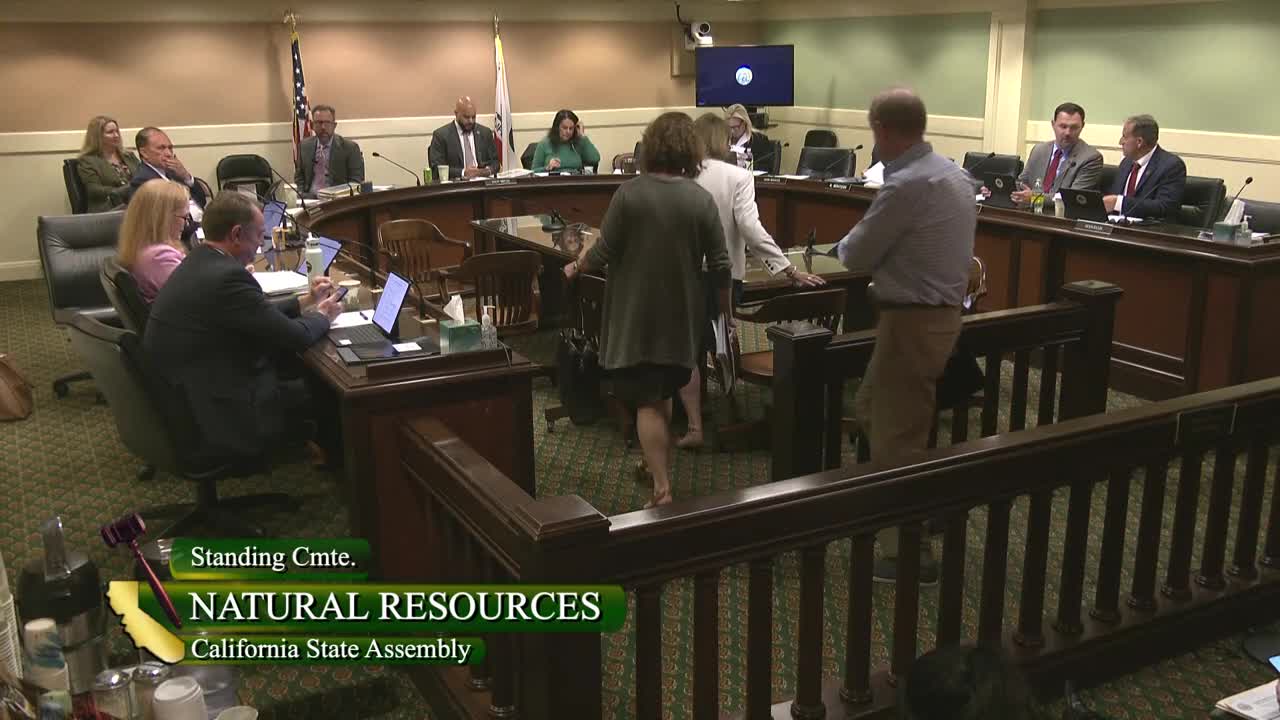
Discussed in Hearing
 13MIN
Assembly Standing Committee on Natural Resources
Bill Author

Bill Co-Author(s):