SB 1070: Crimes: disturbing religious worship.
- Session Year: 2025-2026
- House: Senate
- Latest Version Date: 2026-02-13
Current Status:
In Progress
(2026-03-24: From committee: Do pass and re-refer to Com. on APPR. (Ayes 1. Noes 5.) (March 24). Re-referred to Com. on APPR.)
Introduced
In Committee
Awaiting First Chamber Vote
Passed First Chamber
In Committee
Awaiting Second Chamber Vote
Passed Second Chamber
Enacted
What does this bill do?
The bill makes intentionally disturbing a religious service at a tax‑exempt place of worship punishable either as a misdemeanor or, in some cases, as a felony (a more serious crime) with fines up to $5,000 and county jail time of 16 months, or two or three years. It also lets courts require 50–80 hours of community service instead of jail or a fine, and requires 120–160 hours of community service for people with a prior conviction for this offense or a related disturbance.
The summary is provided by generative AI which can make mistakes. For original language, please view the details in the table below.
Existing law makes it a crime to intentionally disturb or disquiet an assemblage of people met for religious worship by profane discourse, rude or indecent behavior, or by any unnecessary noise. Existing law makes a violation of this crime a misdemeanor punishable by a fine not exceeding $1,000, by imprisonment in a county jail for a period not exceeding one year, or by both that fine and imprisonment.
This bill would additionally make a violation of the above-described crime a felony punishable by a fine not exceeding $5,000, by imprisonment in a county jail for 16 months, or 2 or 3 years, or by both that fine and imprisonment. By making an existing crime punishable as either a misdemeanor or a felony, the bill would impose a state-mandated local program.
The California Constitution requires the state to reimburse local agencies and school districts for certain costs mandated by the state. Statutory provisions establish procedures for making that reimbursement.
This bill would provide that no reimbursement is required by this act for a specified reason.
(a)Every person who intentionally disturbs or disquiets any assemblage of people met for religious worship at a tax-exempt place of worship, by profane discourse, rude or indecent behavior, or by any unnecessary noise, either within the place where the meeting is held, or so near it as to disturb the order and solemnity of the meeting, is guilty of a misdemeanor punishable by a fine not exceeding one thousand dollars ($1,000), or by imprisonment in a county jail for a period not exceeding one year, or by both that fine and imprisonment. imprisonment, or is guilty of a felony punishable by a fine not exceeding five thousand dollars ($5,000), or by imprisonment in a county jail for 16 months, or two or three years, or by both that fine and imprisonment.
(b)A court may require performance of community service of not less than 50 hours and not exceeding 80 hours as an alternative to imprisonment or a fine.
(c)In addition to the penalty set forth in subdivision (a), a person who has suffered a previous conviction of a violation of this section or Section 403, shall be required to perform community service of not less than 120 hours and not exceeding 160 hours.
(d)The existence of any fact which would bring a person under subdivision (c) or (d) shall be alleged in the complaint, information, or indictment and either:
(1)Admitted by the defendant in open court.
(2)Found to be true by a jury trying the issue of guilt.
(3)Found to be true by the court where guilt is established by a plea of guilty or nolo contendere.
(4)Found to be true by trial by the court sitting without a jury.
(e)Upon conviction of any person under this section for disturbances of religious worship, the court may, in accordance with the performance of community service imposed under this section, consistent with public safety interests and with the victims consent, order the defendant to perform a portion of, or all of, the required community service at the place where the disturbance of religious worship occurred.
(f)The court may waive the mandatory minimum requirements for community service whenever it is in the interest of justice to do so. When a waiver is granted, the court shall state on the record all reasons supporting the waiver.
SEC. 2.No reimbursement is required by this act pursuant to Section 6 of Article XIIIB of the California Constitution because the only costs that may be incurred by a local agency or school district will be incurred because this act creates a new crime or infraction, eliminates a crime or infraction, or changes the penalty for a crime or infraction, within the meaning of Section 17556 of the Government Code, or changes the definition of a crime within the meaning of Section 6 of Article XIIIB of the California Constitution.
|
Date
|
Status
|
|---|---|
| Mar 24, 2026 | From committee: Do pass and re-refer to Com. on APPR. (Ayes 1. Noes 5.) (March 24). Re-referred to Com. on APPR. |
| Mar 24, 2026 | March 24 hearing: Reconsideration granted. (Ayes 6. Noes 0.) |
| Mar 24, 2026 | March 24 set for first hearing. Failed passage in committee. (Ayes 1. Noes 5. Page 3661.) Reconsideration granted. |
| Mar 24, 2026 | March 24 set for first hearing. Failed passage in committee. (Ayes 1. Noes 5.) Reconsideration granted. |
| Mar 10, 2026 | Set for hearing March 24. |
| Feb 26, 2026 | Referred to Com. on PUB. S. |
| Feb 17, 2026 | From printer. May be acted upon on or after March 16. |
| Feb 13, 2026 | Introduced. Read first time. To Com. on RLS. for assignment. To print. |
|
Date
|
Description
|
Location
|
Votes
|
|
|---|---|---|---|---|
| Mar 24, 2026 | [03-24-2026] hearing: Motion to Reconsider. [Reconsideration Granted.] | Senate Standing Committee on Public Safety |
Passed |
|
| Mar 24, 2026 | [First] hearing set for [03-25-2026]: Failed passage in Committee. Reconsideration granted | Senate Standing Committee on Public Safety |
Passed |
|
| Mar 24, 2026 | Do pass, but first be re-referred to the Committee on [Appropriations] | Senate Standing Committee on Public Safety |
Failed |
This list shows positions taken on this bill by organizations on the date displayed, which is linked to the original source.
Positions by individuals are not included.
|
Organization
|
Position
|
Date
|
|---|---|---|
| Aclu California Action | ** Against | |
| California Baptist for Biblical Values | ** Support | |
| California Family Council | ** Support | |
| California Public Defenders Association | ** Against | |
| Californians United for a Responsible Budget | ** Against | |
| Destiny Christian Church | ** Support | |
| Ella Baker Center For Human Rights | ** Against | |
| Empowering Marginalized Asian Communities | ** Against | |
| Freedom for Immigrants | ** Against | |
| Friends Committee On Legislation Of California | ** Against | |
| Initiate Justice | ** Against | |
| Justice2jobs Coalition | ** Against | |
| LA Defensa | ** Against | |
| Legal Services for Prisoner with Children | ** Against | |
| Local 148 Los Angeles County Public Defender’s Union | ** Against | |
| Riverside County Sheriff’s Office | ** Support | |
| San Francisco Public Defender | ** Against | |
| Sister Warriors Freedom Coalition | ** Against | |
| Smart Justice California | ** Against | |
| south bay people power | ** Against | |
| THE AMERICAN COUNCIL | ** Support | |
| The California Baptist Capitol Ministry | ** Support |
SENATE COMMITTEE ON PUBLIC SAFETY
Senator Jesse Arreguín, Chair
2025 - 2026 Regular
Bill No: SB 1070 Hearing Date: March 24, 2026
Author: | Grove | ||
Version: | February 13, 2026 | ||
Urgency: | No | Fiscal: | Yes |
Consultant: | AB | ||
Subject: Crimes: disturbing religious worship
HISTORY
Source: The American Council
Prior Legislation: SB 19 (Rubio), Ch. 594, Stats. of 2025
AB 2282 (Bauer-Kahan), Ch. 397, Stats. of 2022
AB 3103 (Ferguson), Ch. 401, Stats. of 1994
SB 2483 (Russell), Ch. 822, Stats. of 1990
Support: California Baptist for Biblical Values; California Family Council; Destiny Christian Church; Riverside County Sheriff’s Office; The California Baptist Capitol Ministry; The American Council; 2 Individuals
Opposition: ACLU California Action; California Public Defenders Association; Californians United for a Responsible Budget; Ella Baker Center for Human Rights; Empowering Marginalized Asian Communities; Freedom for Immigrants; Friends Committee on Legislation of California; Initiate Justice; Justice2Jobs Coalition; LA Defensa; Legal Services for Prisoner with Children; Local 148 Los Angeles County Public Defender’s Union; San Francisco Public Defender; Sister Warriors Freedom Coalition; Smart Justice California; South Bay People Power; 9 Individuals
PURPOSE
The purpose of this bill is to make it a felony to intentionally disturb or disquiet an assemblage of people met for religious worship by profane discourse, rude, or indecent behavior, or by unnecessary noise.
Existing law provides that Congress shall make no law respecting an establishment of religion, or prohibiting the free exercise thereof. (U.S. Const, 1st Amend.)
Existing law provides that the free exercise and enjoyment of religion without discrimination or preference are guaranteed, and that the Legislature of the State of California shall make no law respecting an establishment of religion. (Cal. Const, Art. 1, § 3.)
Existing federal law makes it a crime to intentionally damage or destroy religious real property because of the religious character of that property or to intentionally obstruct, by force or threat of force, including by threat of force against religious real property, any person in the enjoyment of that person’s free exercise of religious beliefs, or attempts to do so. (18 U.S.C. § 247, subd. (a).)
Existing federal law provides that a violation of the above prohibition is punishable under specified circumstances as a felony and in all other cases as a misdemeanor. (18 U.S.C. § 247, subd. (d).)
Existing federal law provides that whoever by force or threat of force or by physical obstruction, intentionally injures, intimidates or interferes with or attempts to injure, intimidate or interfere with any person lawfully exercising or seeking to exercise the First Amendment right of religious freedom at a place of worship shall be subject to specified criminal penalties and civil remedies, as specified. (18 U.S.C. § 248, subds. (a)(2), (b).)
Existing law establishes a legislative finding and declaration that it is the right of every person regardless of actual or perceived disability, gender, gender identity, gender expression, nationality, race or ethnicity, religion, sexual orientation, or association with a person or group with these actual or perceived characteristics, to be secure and protected from fear, intimidation, and physical harm caused by the activities of violent groups and individuals. (Pen. Code, §11410, subd. (a).)
Existing law establishes that the Legislature recognizes the constitutional right of every citizen to harbor and express beliefs on any subject whatsoever and to associate with others who share similar beliefs, but also that the advocacy of unlawful violent acts by groups against other persons or groups under circumstances where death or great bodily injury is likely to result is not constitutionally protected, poses a threat to public order and safety, and should be subject to criminal and civil sanctions. (Ibid.)
Existing law makes it a wobbler for any person hangs a noose, as specified, on the property of a place of worship for the purpose of terrorizing a person who attends it, works at it, or is otherwise associated with it. (Pen. Code, § 11411, subd. (b).)
Existing law makes it a wobbler for any person to display a sign, mark, symbol, emblem or other physical impression including, but not limited to, a Nazi swastika, on the property of a place of worship for the purpose of terrorizing a person who attends it, works at it, or is otherwise associated with it. (Pen. Code, § 11411, subd. (c).)
Existing law makes it a wobbler for a person to burn or desecrate a cross or other religious symbol, knowing it to be a religious symbol, on the property of a place of worship for the purpose of terrorizing a person who attends it, works at it, or is otherwise associated with it. (Pen. Code, § 11411, subd. (d).)
Existing law provides that any person who, with intent to cause, attempts to cause or causes another to refrain from exercising his or her religion or from engaging in a religious service by means of a threat, directly communicated to such person, to inflict an unlawful injury upon any person or property, and it reasonably appears to the recipient of the threat that such threat could be carried out is guilty of a felony. (Pen. Code, § 11412.)
Existing law provides that, except as provided, any person who willfully threatens, by any means, including, but not limited to, an image or threat posted or published on an internet web page, to commit a crime that will result in death or great bodily injury to another person or persons at any number of specified locations, including a house of worship, with specific intent that the statement is to be taken as a threat, even if there is no intent of actually carrying it out, if the threat on its face and under the circumstances in which it is made is so unequivocal, unconditional, immediate, and specific as to convey to the person or persons threatened a gravity of purpose and an immediate prospect of execution of the threat, and if that threat causes a person or persons to reasonably be in sustained fear for their own safety or the safety of others at these locations, shall be guilty of a crime, punishable as a wobbler. (Pen. Code, § 422.3.)
Existing law defines “hate crime” as a criminal act committed, in whole or in part, because of one or more specified actual or perceived characteristics of the victim, including the victim’s religion., where “religion” is defined as including all aspects of religious belief, observance, and practice and includes agnosticism and atheism. (Pen. Code, §§ 422.55, 422.56, subd. (g).)
Existing law provides that a person, whether or not acting under color of law, shall not, by force or threat of force, willfully injure, intimidate, interfere with, oppress, or threaten any other person in the free exercise or enjoyment of a right or privilege secured by the Constitution or laws of this state or by the Constitution or laws of the United States in whole or in part because of one or more of the actual or perceived characteristics of the victim, including the victim’s religion. (Pen. Code, § 422.6, subd. (a).)
Existing law provides that a person, whether or not acting under color of law, shall not knowingly deface, damage, or destroy the real or personal property of any other person for the purpose of intimidating or interfering with the free exercise or enjoyment of a right or privilege secured by the Constitution or laws of this state or by the Constitution or laws of the United States, in whole or in part because of one or more of the actual or perceived characteristics of the victim, including the victim’s religion. (Pen. Code, § 422.6, subd. (b).)
Existing law provides that a hate crime, as specified, is punishable as an aggravated misdemeanor (including a maximum of one year in county jail and maximum fine of $5,000, or both), or as a realigned felony, and that the defendant must perform a minimum of 400 hours of community service, as specified. (Pen. Code, § 422.6, subd. (c).)
Existing law provides that an individual who commits a misdemeanor that is also proven to be a hate crime is subject to a wobbler for the commission of that offense under any of the following circumstances:
- The crime against the person of another either includes the present ability to commit a violent injury or causes actual physical injury.
- The crime against property causes damage in excess of nine hundred fifty dollars ($950).
- The person charged with a crime under this section has been convicted previously of a violation of a hate crime or conspiracy to commit a hate crime. (Pen. Code, § 422.7.)
Existing law provides that except in specified cases, a person who commits a felony that is a hate crime or attempts to commit a felony that is a hate crime, shall receive an additional term of one, two, or three years in the state prison, at the court’s discretion, as provided. (Pen. Code, § 422.75.)
Existing law provides that in the case of any person who is convicted of any offense against the person or property of another individual private institution, or public agency, committed because of the victim’s actual or perceived religion, as specified, or for any hate crime, the court, absent compelling circumstances stated on the record, shall make an order protecting the victim, or known immediate family or domestic partner of the victim, from further acts of violence, threats, stalking, or harassment by the defendant, including any stay-away conditions the court deems appropriate, and shall make obedience of that order a condition of the defendant’s probation, as specified. (Pen. Code, § 422.85.)
Existing law provides that any person who knowingly commits any act of vandalism to a church, synagogue, mosque, temple, building owned and occupied by a religious educational institution, or other place primarily used as a place of worship where religious services are regularly conducted or a cemetery is guilty of a wobbler, as specified. (Pen. Code, §594.3.)
Existing law makes it a misdemeanor to willfully disturb or break up any assembly or meeting that is not unlawful in character, as specified. (Pen. Code, § 403.)
Existing law provides that every person who intentionally disturbs or disquiets any assemblage of people met for religious worship at a tax-exempt place of worship, by profane discourse, rude or indecent behavior, or by any unnecessary noise, either within the place where the meeting is held, or so near it as to disturb the order and solemnity of the meeting, is guilty of a misdemeanor punishable by a fine not exceeding one thousand dollars ($1,000), or by imprisonment in a county jail for a period not exceeding one year, or by both that fine and imprisonment. (Pen. Code, § 302, subd. (a).)
Existing law provides that a court may require performance of community service not less than 50 hours and not exceeding 80 hours as an alternative to imprisonment or a fine. (Pen. Code, § 302, subd. (b).)
Existing law provides that in addition to the misdemeanor penalty, a person who has suffered a previous conviction of a violation of this crime or another specified crime shall be required to perform community service not less than 120 hours and not exceeding 160 hours. (Pen. Code, § 302, subd. (c).)
Existing law specifies that the existence of a prior conviction shall be alleged in the complaint, information or indictment, and either admitted in open court, found to be true by a jury trying the issue of guilt, found to be true by the court where guilt is established by a plea of guilty or nolo contendere, or found to be true by trial by the court sitting without a jury. (Pen. Code, § 302, subd. (d).)
Existing law provides that upon conviction of any person for disturbances of religious worship, the court may order the defendant to perform a portion of, or all of, the required community service at the place where the disturbance of religious worship occurred. (Pen. Code, § 302, subd. (e).)
Existing law permits the court to waive mandatory minimum requirements for community service in the interest of justice, as specified. (Pen. Code, § 302, subd. (f).)
This bill provides that the crime of intentionally disturbing or disquieting any assemblage of people met for religious worship at a tax-exempt place of worship, by profane discourse, rude or indecent behavior, or by any unnecessary noise, either within the place where the meeting is held, or so near it as to disturb the order and solemnity of the meeting is also punishable as a felony by a fine not exceeding $5,000, or by imprisonment in county jail for 16 months, two years or three years, or by a both that fine and imprisonment.
COMMENTS
- Need for This Bill
According to the author:
With more and more aggressive disruptions targeting religious gatherings across California and nationwide, we must act to safeguard the constitutional rights to free exercise of religion and peaceful assembly. […] This bill treats ALL places of worship as the sacred spaces they are by allowing courts to use their discretion to charge perpetrators with a felony for serious or repeated conduct that interrupts worship.
- Existing Criminal Law Related to Religious Freedom
In 1994, President Clinton signed the Freedom of Access to Clinic Entrances (FACE) Act, which prohibits the use of physical force, threat of physical force, or physical obstruction to intentionally injure, intimidate, interfere with or attempt to injure, intimidate or interfere with any person who is obtaining an abortion or exercising or trying to exercise their First Amendment right of religious freedom at a place of religious worship.[1] The FACE Act has been subject to considerable debate recently as President Trump’s Department of Justice has begun using the law – traditionally deployed almost exclusively to protect patients and staff at abortion clinics – to safeguard the exercise of religious freedom. Although threats to abortion providers and patients have become no less prevalent, the Department of Justice issued a memo soon after President Trump took office stating that “future abortion-related FACE Act prosecutions and civil actions will be permitted only in extraordinary circumstances, or in cases presenting significant aggravating factors.”[2] The Trump Administration has pivoted to enforcing the law’s other provision prohibiting interference with the exercise of religious freedom, including the recent prosecution of pro-Palestinian protesters whose demonstrations resulted in a clash with pro-Israel counterprotesters in New Jersey. FACE Act charges were also recently brought against a group of individuals protesting a church in Minneapolis. Controversially, two journalists were also charged under the statute, despite being unassociated with the protestors.[3]
California law safeguards the free exercise of religion and religious worship through a robust and well-established set of criminal statutes addressing a wide range of conduct. As will be discussed in greater depth throughout this analysis, Penal Code Section 302 (hereinafter “Section 302”), makes it a misdemeanor to intentionally disturb a religious meeting, while a separate but related provision makes it a wobbler to knowingly commit an act of vandalism to a place of worship.[4] Existing law also imposes significant penalties for threats related to the exercise of religion, including a felony for attempting to cause or causing another to refrain from exercising their religion or from engaging in a religious service by means of a threat to inflict injury upon person or property.[5] A more recent criminal threat statute, enacted last year by SB 19 (Rubio), Chapter 594, Statutes of 2025, provides that any person who willfully threatens to commit a crime that will result in death or great bodily injury to another person or persons at a house of worship (as well as many other specified locations), with specific intent that the statement is to be taken as a threat, even if there is no intent of actually carrying it out, is guilty of a wobbler, provided other facts are true about the content of the threat and its impact on the recipient.[6]
Perhaps the most comprehensive and well-defined criminal protections for religious freedom in California are its hate crime statutes, which include both standalone offenses and sentencing enhancements for specific conduct. Existing law defines “hate crime” as a criminal act committed, in whole or in part, because of one or more specified actual or perceived characteristics of the victim, including the victim’s religion, where “religion” is defined as including all aspects of religious belief, observance, and practice and includes agnosticism and atheism.[7] The criminal statutes include a standalone wobbler prohibiting the use of force or threat of force to willfully injure, intimidate, interfere with, oppress, or threaten any other person in the free exercise or enjoyment of a constitutional right, as well as an enhancement that allows other misdemeanors, if motivated by religious animus (or any other desire to interfere with constitutional rights), to be charged as felonies.[8] Yet another provision adds up to three additional years to felony hate crime sentences for specified aggravating conduct, such as acting in concert, using a firearm in the commission of the offense, or having a prior hate crime conviction.[9]
- Effect of This Bill
As mentioned in the previous comment, existing law makes it a misdemeanor to intentionally disturb a religious assembly. The actual language of Section 302 is much more specific, imposing liability on any person who “intentionally disturbs or disquiets any assemblage of people met for religious worship at a tax-exempt place of worship, by profane discourse, rude or indecent behavior, or by any unnecessary noise, either within the place where the meeting is held, or so near it as to disturb the order and solemnity of the meeting.” The crime of disturbing a religious assembly is an aggravated misdemeanor, punishable by imprisonment in county jail for up to a year or a fine of up to $1,000, or both the fine and imprisonment. However, the statute permits a court to impose a sentence of community service between 50 and 80 hours (or between 120 and 160 hours if the defendant has a prior conviction), in lieu of imprisonment or fine, and even permits the court to waive the minimum community service requirements whenever it is in the interest of justice to do so.[10] This bill allows Section 302 to be charged as a felony, punishable by a fine of up to $5,000 or imprisonment in county jail for 16 months, 2 years or 3 years, or by both the fine and jail time.
Section 302 was originally enacted when the Penal Code was codified in 1872, and the statute has only been amended twice in the last few decades.[11] Data regarding the frequency of Section 302 arrests or charges, both at the statewide or local level, is not publicly available, but information obtained by committee staff reveals that over the past 10 years, the Los Angeles District Attorney’s Office has filed a Section 302 charge in only 9 cases, nearly all of which involved more serious charges or the later addition of a Section 302 charge as part of the disposition. If this is at all indicative of a broader statewide trend, the reason is likely pragmatic: given a choice between two or more criminal charges that apply to the conduct at issue, prosecutors often pursue the option with the simplest legal requirements. Put another way, prosecutors will regularly opt for ‘general intent’ crimes with straightforward language and fewer elements over crimes with ‘specific intent’ requirements and more complicated elements.[12]
Although Section 302 appears to be a general intent crime, it still includes several legalistic and abstruse elements, requiring prosecutors to prove that an individual “intentionally disturbed or disquieted” a religious assembly by “profane discourse, rude or indecent behavior, or by any unnecessary noise,” either in the meeting place, “or so near as to disturb the solemnity of the meeting.” Admittedly, this language could include truly heinous conduct that is certainly worthy of criminal punishment, but it could also be interpreted to encompass far less culpable conduct that an ordinary person would not think rose to the level of criminal behavior. This is especially salient because, as a general intent crime, a prosecutor need only prove that the accused intended to engage in the proscribed conduct, not that they engaged in the conduct with the specific intent to disturb or disquiet the religious assembly. Thus, the central question that the Committee should consider is, given the subjectivity and potential breadth of the conduct described therein, and the existence of a host of other, more well-defined criminal statutes – including several felonies – protecting religious freedom,[13] is it appropriate or necessary to impose felony punishment for a violation of Section 302?
- Constitutional Considerations
Void for Vagueness
Certain statutes that lack sufficient clarity or specificity may be too vague to pass constitutional muster, and thereby rendered void upon a constitutional challenge, a doctrine known as “void for vagueness.”[14] A law is subject to constitutional scrutiny for vagueness when people “of common intelligence must necessarily guess at its meaning and differ as to its application.”[15] Vague criminal statutes raise due process concerns, and the Supreme Court has long held the view that “the void-for-vagueness doctrine requires that a penal statute define the criminal offense with sufficient definiteness that ordinary people can understand what conduct is prohibited and in a manner that does not encourage arbitrary and discriminatory treatment.”[16] When vague laws potentially infringe on constitutionally protected expressive conduct, courts require statutes to be especially clear about what is and is not proscribed. As the Supreme Court explained in Grayned v. City of Rockford (1972) 408 U.S. 104, 109, “where a vague statute abuts upon sensitive areas of basic First Amendment freedoms, it operates to inhibit the exercise of those freedoms. Uncertain meanings inevitably lead citizens to steer far wider of the unlawful zone … than if the boundaries of the forbidden areas were clearly marked.” The underlying concern is that vague laws, particularly criminal laws, will have a chilling effect on expressive conduct.
Only one published case was identified in which a court, the Los Angeles County Superior Court, scrutinized Section 302 under the void for vagueness doctrine. In People v. Cruz (1972) 25 Cal.App.3d Supp. 1, the appellants were convicted of Section 302 and other charges arising out of the actions of about 300 persons marching, chanting slogans, and breaking into St. Basil’s Catholic Church on Wilshire Boulevard on Christmas Eve, 1969. The court in that case observed that the charge in the criminal complaint was narrower than the statute under which it was brought, alleging that the willful disturbance of the assemblage occurred by “rude behavior and unnecessary noise,” conduct which the trial judge instructed the jury was synonymous with that prohibited by Penal Code Section 415 (disturbing the peace).[17] The court in Cruz thus limited its vagueness analysis only to “rude behavior and unnecessary noise,” which it ultimately held was not overly vague under the circumstances.[18] While Cruz provides some guidance, the narrow scope of its analysis and specific procedural history suggest that it does not immunize Section 302 from vagueness scrutiny, especially if the penalty is elevated to a felony.
First Amendment
The First Amendment to the United States Constitution provides that, “Congress shall make no law . . . abridging the freedom of speech.” The California Constitution also protects free speech: “Every person may freely speak, write and publish his or her sentiments on all subjects, being responsible for the abuse of this right. A law may not restrain or abridge liberty of speech or press.”[19] Moreover, “as a general matter, the First Amendment means that government has no power to restrict expression because of its message, its ideas, its subject matter, or its content.”[20] However, “the rights of free speech and assembly, while fundamental in our democratic society, still do not mean that everyone with opinions or beliefs to express may address a group at any public place and at any time. […] A group of demonstrators could not insist upon the right to cordon off a street, or entrance to a public or private building, and allow no one to pass who did not agree to listen to their exhortations.”[21] To be sure, the Supreme Court has been clear that violence, such as a physical assault, is not protected by the First Amendment, and has opined that “other types of potentially expressive activities that produce special harms distinct from their communicative impact…are entitled to no constitutional protection.”[22]
It should be noted that the First Amendment does not apply to all types of speech, and the Supreme Court has recognized categories of speech that the government may regulate given their conduct, provided it does so evenhandedly. So called “unprotected speech” includes obscenity, defamation, incitement, “fighting words,” speech integral to criminal conduct, and true threats, among various other categories.[23] Additionally, while the First Amendment’s protection is
strongest in a “public forum,” such as a public street, sidewalk or town square, the Supreme Court has rejected arguments that the First Amendment requires private property owners to accommodate speech, and indeed has never held that a trespasser or uninvited guest may exercise general rights of free speech on private property.[24] It is also well-established that the First Amendment does not guarantee a right to trespass on private property, or to physically block access to private property as a means of protest.[25] However, this principle has limits, as the Court made clear in Marsh v. Alabama (1946) 326 U.S. 501, 506, where it reasoned that “the more an owner, for his advantage, opens up his property for use by the public in general, the more do his rights become circumscribed by the statutory and constitutional rights of those who use it.”
Another relevant element of the First Amendment analysis is whether the speech being regulated is “content neutral,” or “content based,”—i.e., targeting a particular type of speech. A law is content neutral when it “serves purposes unrelated to the content of the expression.”[26] On the other hand, a law is content based when the proscribed speech is “defined solely on the basis of the content of the suppressed speech.”[27] If a restriction on speech is determined to be content based, it will be subject to strict scrutiny.[28] A restriction is content based “if it require[s] ‘enforcement authorities’ to ‘examine the content of the message that is conveyed to determine whether’ a violation has occurred.”[29] Content-based restrictions subject to strict scrutiny are “presumptively unconstitutional.”[30] A restriction can survive strict scrutiny only if it uses the least-restrictive means available to achieve a compelling government purpose.[31] While the expression constituting “unnecessary noise” for Section 302 purposes may be content neutral, the speech constituting “rude or indecent behavior” is more evidently content based, a challenge to which would require the government to show that the statute serves a compelling interest and is narrowly tailored to achieve it.
Although it does not appear that the courts have weighed in on whether Section 302 passes First Amendment muster – and such a definitive determination is beyond the scope of this analysis – the author and Committee should consider the First Amendment implications of elevating the statute’s penalty to a possible felony. Centrally, will the bill have an undue chilling effect on free expression (including both speech and assembly, as well as freedom of the press) in public fora adjacent to religious assemblies? Is a felony penalty narrowly tailored enough to serve the government’s interest in preventing the disturbance of religious assemblies? Is such an interest ‘compelling’?
- Argument in Support
According to the California Family Council:
The First Amendment to the United States Constitution protects the free exercise of religion, including the right of faith communities to assemble and worship without interference. When individuals deliberately disrupt services, they are not committing a minor offense; they are interfering with a fundamental constitutional right. California’s current misdemeanor framework for this offense does not reflect the seriousness of this conduct.
Incidents of organized intimidation, aggressive interruptions, and targeted harassment of congregants have increased in recent years. A national report documented more than 415 hostile acts against churches in 2024, with California reporting the highest number: 40 incidents. When the maximum penalty is a misdemeanor, there is little deterrent. SB 1070 provides prosecutors with appropriate tools to hold offenders accountable and signals that attacks on places of worship will not be treated as minor infractions.
Churches are not venues for political rallies or protest stages. They are sacred spaces where families gather to worship God in peace. When agitators intentionally invade or obstruct services, they are not exercising free speech. They are trampling on the religious liberty of others. California must send a clear message that worship services will be protected. SB 1070 applies equally to all religious communities across California, affirming that every congregation is entitled to gather and worship free from intentional interference.
- Argument in Opposition
ACLU California Action writes:
On its face, Penal Code Section 302 is an unconstitutional, content-based regulation. A law is content-based when it applies to “particular speech because of the topic discussed or the idea or message expressed.” Penal Code Section 302 criminalizes a person for “profane discourse,” “rude or indecent behavior,” or “unnecessary noise.” Each raises individual questions of unconstitutionality. For example, the word “profane” is defined as “not concerned with religious or religious purposes” or “not holy because unconsecrated, impure, or defiled.” To judge whether an individual violated Penal Code Section 302, a court must inappropriately weigh the content of the individual’s message. Similarly, Penal Code Section 302’s criminalization of “rude or indecent behavior” and “unnecessary noise” may cause a court to weigh an individual’s expressive conduct, such as wearing a jacket with an image that is offensive to religious observers or chanting a message that is offensive to religious observers, to determine if the individual was being “rude” or if the noise they were making was “unnecessary.” As one California court stated, “[t]he possibility that speech may be ‘undesirable’ or ‘unpopular’ is not an acceptable basis for the government to curtail speech which is otherwise protected by the First Amendment.” The Legislature must not build upon Penal Code Section 302 due to its underlying constitutional issues.
Notably, existing laws address the situations motivating SB 1070. For example, the federal law, through the FACE Act, prohibits individuals from intimidating or interfering with any person’s lawful exercise of their right to religion at a place of worship. Additionally, in unfortunate situations involving assault or battery, state tort law allows for compensation.
Lastly, by increasing the criminal penalties in Penal Code Section 302, SB 1070 goes against existing public safety research. Extensive research has shown that increased sentences do not deter or prevent crime. This is a sentiment reflected by the U.S Department of Justice’s National Institute of Justice guidance that “laws and policies designed to deter crime by focusing mainly on increasing the severity of punishment are ineffective partly because criminals know little about the sanctions for specific crimes.”
-- END –
18 U.S.C. §§ 247, 248. Although the impetus for the law was violence against abortion clinics and providers, a fraught legislative conflict resulted in a Republican-sponsored clause being added that provided for penalties for disruptions of worship services. See “What to know about the civil rights charges Don Lemon faces for covering church protest in Minnesota.” Associated Press. 30 January 2026. Don Lemon and another reporter face federal charges in Minnesota church protest | AP News ↑
“FACE Act Charging Policy.” Memorandum from the Chief of Staff to the Attorney General. United States Department of Justice, Office of the Attorney General. 24 January 2025. FACE Act Charging Policy; For statistics regarding threats to abortion providers and patients, see NAF 2024 Violence & Disruption Report, NAF 2024 Violence & Disruption Statistics. ↑
What to Know About the ‘Abortion Clinic’ Law Being Used to Charge Don Lemon.” New York Times. 30 January 2026. What to Know About the ‘Abortion Clinic’ Law Being Used to Charge Don Lemon - The New York Times ↑
Pen. Code, § 594.3. ↑
Pen. Code, § 14412 ↑
Pen. Code, § 422.3. ↑
Pen. Code, § 422.55 ↑
Pen. Code, §§ 422.6, 422.7 ↑
Pen. Code, § 422.75 ↑
Pen. Code, §302, subds. (a), (b), (c), (f). ↑
See AB 3103 (Ferguson), Ch. 401, Stats. of 1994, and SB 2483 (Russell), Ch. 822, Stats. of 1990 ↑
Fundamentally, ‘general intent’ crimes require the prosecutor to prove that the accused acted willfully to commit the physical act of the crime, while ‘specific intent crimes require prosecutors to prove both the commission of the act and a specific mental state or intent to cause harm. For more information on general vs. specific intent, see CALCRIM Jury Instructions 250-255. criminal-law-calcrim.pdf ↑
Not to mention the many other potentially applicable criminal statutes unrelated to religious practice that a prosecutor could bring to bear on someone engaged in this conduct, such as vandalism, trespassing, assault, and disturbing the peace. ↑
Cantwell v. Connecticut (1940) 310 U.S. 296, 308. ↑
Connally v. Gen. Const. Co. (1926) 269 U.S. 385. ↑
Kolender v. Lawson (1983) 461 U.S. 362. ↑
People. V. Cruz, infra, at 11. ↑
Id. ↑
U.S. Const., 1st Amend., Section 1; Cal. Const., art. I, § 2. ↑
Ashcroft v. American Civil Liberties Union (2002) 535 U.S. 564, 573. ↑
Cox v. La (1965) 379 U.S. 536, 554-555. ↑
Wisconsin v. Mitchell (1993) 508 U.S. 476, 484; Roberts v. United States Jaycees (1984) 409 U.S. 609, 628. ↑
Miller v. California (1973) 413 U.S. 15, 24; Gertz v. Robert Welch (1974) 418 U.S. 323; Chaplinsky v. United States (1942) 315 U.S. 568, 574; Brandenburg v. Ohio (1969) 395 U.S. 444, 447; Giboney v. Empire Storage& Ice Co. (1949) 336 U.S. 490, 498. ↑
Perry Education Association v Perry Local Educators’ Association (1983) 460 U.S. 37; Lloyd Corp. v. Tanner (1972) 407 U.S. 551, 567-568. ↑
Nat’l Org. for Women v. Operation Rescue (1994) 37 F.3d 646, 655. ↑
Ward v. Rock Against Racism (1989) 491 U.S. 781, 791. ↑
FCC v. League of Women Voters (1984) 468 U.S. 364, 383. ↑
McCullen v. Coakley (2014) 573 U.S. 464, 478. ↑
Id. at p. 479. ↑
Reed v. Town of Gilbert (2015) 135 S.Ct. 2218, 2226 (Reed). ↑
United States v. Playboy Entertainment Group (2000) 529 U.S. 803, 813. ↑
Discussed in Hearing
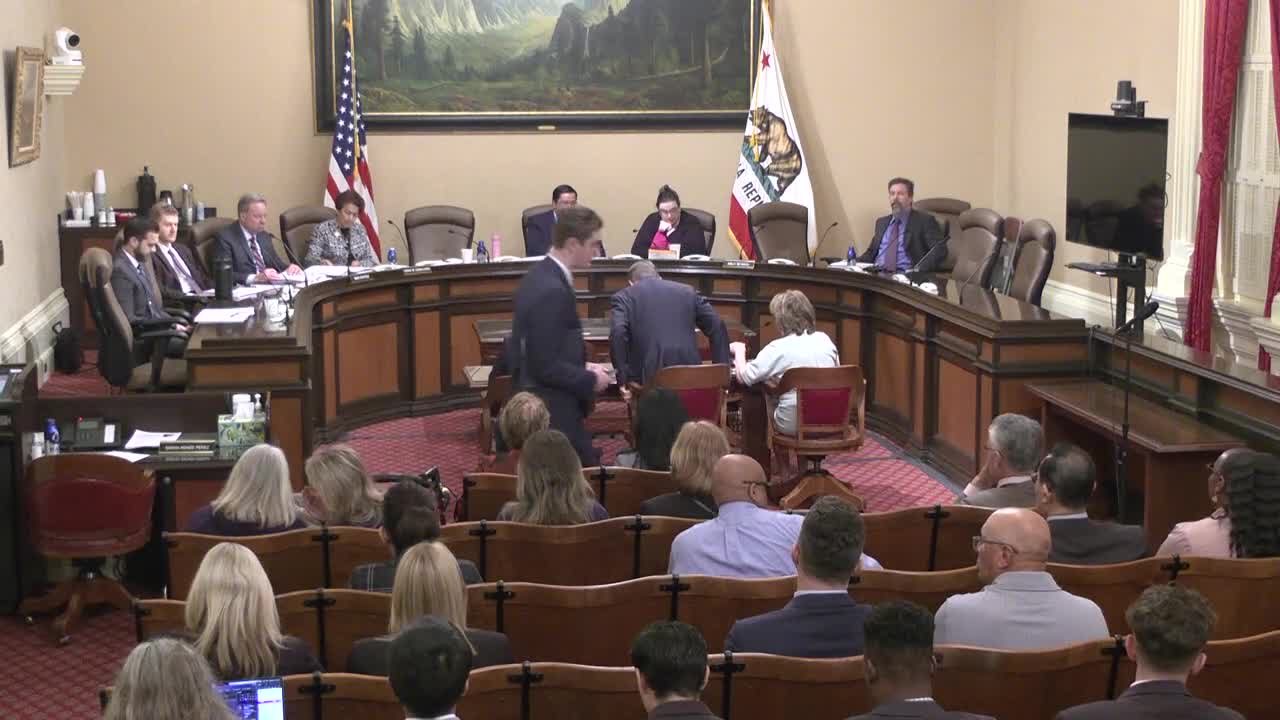 32MIN
Senate Standing Committee on Public Safety
Bill Author