SB 319: Criminal justice statistics: reporting.
- Session Year: 2025-2026
- House: Senate
- Latest Version Date: 2025-04-24
Current Status:
Failed
(2026-02-02: Returned to Secretary of Senate pursuant to Joint Rule 56.)
Introduced
In Committee
Awaiting First Chamber Vote
Passed First Chamber
In Committee
Awaiting Second Chamber Vote
Passed Second Chamber
Enacted
What does this bill do?
This bill requires the California Department of Justice to collect and publish monthly, county-level statistics on convictions for petty theft and possession of a hard drug, showing counts and whether each conviction was a misdemeanor or a felony. It also requires counties to report detailed annual spending on sheriffs, probation, and court activities and requires superior courts to submit data on diversion programs, treatment services, diagnoses, discharges, and judicial review outcomes for people charged under those laws, with results broken down by race and gender, and directs the Judicial Council to publish an annual report.
The summary is provided by generative AI which can make mistakes. For original language, please view the details in the table below.
Existing law requires the Judicial Council to collect and maintain statistics, and to publish them at least on a yearly basis, about the compliance of the superior court of each county and each branch court with the standards for the timely disposition of cases, as specified.
Existing law requires criminal justice agencies to compile records and data, including a summary of arrests, pretrial proceedings, the nature and disposition of criminal charges, sentencing, incarceration, rehabilitation, and release, about criminal offenders. Existing law requires agencies to report this information to the Department of Justice for each arrest made.
This bill would require the Department of Justice to publish collect and publish, as specified, on its internet website annual statistical reports providing monthly information for each county related to convictions of certain statutes pertaining to, among other things, petty theft and possession of narcotics, a hard drug, including, by month, the number of people convicted of these statutes and, for each conviction, whether the conviction was classified as a misdemeanor or a felony.
This bill would also require every county to submit to the department specified data and information, including the countys annual allocation and expenditure of state and federal funds on sheriff, probation, and court activities, by category and specific grant program, including reimbursement. The bill would require the department department, commencing on January 1, 2027, to post this data and information on its internet website.
This bill would require, for each person charged with the same certain statutes above, under a certain statute pertaining to possession of a hard drug, each superior court to submit specified metrics to the Judicial Council, including the outcome Council. For each person charged under the above provisions, the bill would require each superior court to submit the outcomes of judicial review proceedings mandated by those statutes. The statutes, as specified, to the Judicial Council. Commencing January 1, 2027, the bill would require the Judicial Council to publish an annual report related to the specified metrics on its internet website.
By requiring counties to submit specified data to the Department of Justice, this bill would create a state-mandated local program.
The California Constitution requires the state to reimburse local agencies and school districts for certain costs mandated by the state. Statutory provisions establish procedures for making that reimbursement.
This bill would provide that, if the Commission on State Mandates determines that the bill contains costs mandated by the state, reimbursement for those costs shall be made pursuant to the statutory provisions noted above.
Existing law requires the Judicial Council to collect and maintain statistics, and to publish them at least on a yearly basis, about the compliance of the superior court of each county and each branch court with the standards for the timely disposition of cases, as specified.
Existing law requires criminal justice agencies to compile records and data, including a summary of arrests, pretrial proceedings, the nature and disposition of criminal charges, sentencing, incarceration, rehabilitation, and release, about criminal offenders. Existing law requires agencies to report this information to the Department of Justice for each arrest made.
This bill would require the Department of Justice to publish on its internet website annual statistical reports providing monthly information for each county related to convictions of certain statutes pertaining to, among other things, theft and possession of narcotics, including, by month, the number of people convicted of these statutes and, for each conviction, whether the conviction was classified as a misdemeanor or a felony.
This bill would also require every county to submit to the department specified data and information, including the countys annual allocation and expenditure of state and federal funds on sheriff, probation, and court activities, by category and specific grant program, including reimbursement. The bill would require the department to post this data and information on its internet website.
This bill would require, for each person charged with the same certain statutes above, each superior court to submit specified metrics to the Judicial Council, including the outcome of judicial review proceedings mandated by those statutes. The bill would require the Judicial Council to publish an annual report related to the specified metrics on its internet website.
By requiring counties to submit specified data to the Department of Justice, this bill would create a state-mandated local program.
The California Constitution requires the state to reimburse local agencies and school districts for certain costs mandated by the state. Statutory provisions establish procedures for making that reimbursement.
This bill would provide that, if the Commission on State Mandates determines that the bill contains costs mandated by the state, reimbursement for those costs shall be made pursuant to the statutory provisions noted above.
Existing law makes it a crime to engage in money laundering, defined as conducting a transaction involving a monetary instrument of specified value through a financial institution with the specific intent to promote or facilitate criminal activity or knowing that the monetary instrument represents the proceeds of or is derived from the proceeds of criminal activity.This bill would make technical, nonsubstantive changes to that provision.Existing law makes it a crime to engage in money laundering, defined as conducting a transaction involving a monetary instrument of specified value through a financial institution with the specific intent to promote or facilitate criminal activity or knowing that the monetary instrument represents the proceeds of or is derived from the proceeds of criminal activity.
This bill would make technical, nonsubstantive changes to that provision.
(a)(1)The Commencing January 1, 2026, the Department of Justice shall collect every data element in this subdivision. Commencing March 1, 2026, and January 1 each year thereafter beginning in 2027, the Department of Justice shall publish annual statistical reports providing monthly information for each county related to convictions of Section 666.1 of this code and Section 11395 of the Health and Safety Code as they pertain to all of the following:
(A)By month, the number of people convicted of violations of Section 666.1 of this code and Section 11395 of the Health and Safety Code and, for each conviction, whether the conviction was classified as a misdemeanor or a felony.
(B)By month, the number of people convicted of a violation of Section 666.1 with a prior conviction for a violation of Section 666.1.
(C)By month, the number of people convicted of a violation of Section 11395 of the Health and Safety Code with a prior conviction for a violation of Section 11395 of the Health and Safety Code.
(D)For each conviction of Section 666.1 of this code and Section 11395 of the Health and Safety Code, the number of people convicted who had two or more convictions for offenses referred to in paragraph (2) of subdivision (a) of Section 666.1 and subdivision (c) of Section 11395 of the Health and Safety Code in the last year, the last 3 years, the last 5 years, the last 10 years, and the last 20 years.
(E)For each conviction of Section 666.1 of this code and Section 11395 of the Health and Safety Code, by month, the number of people with 2, 3, 4, 5, 6, 7, 8, 9, and 10 or more prior convictions.
(2)The department shall post the information submitted pursuant to paragraph (1) on its internet website.
(b)(1)Every Commencing January 1, 2026, every county shall submit to the Department of Justice the following data and information that shall be submitted in a form, manner, and in accordance with timelines prescribed by the department:
(A)The countys annual allocation and expenditure of state and federal funds on sheriff, probation, and court activities, by category and specific grant program, including any reimbursements.
(B)The amount of annual and cumulative unspent state and federal funds in accounts related to sheriff, probation, and court activities, including funds in a reserve account, by category and specific grant program, including any reimbursements.
(C)The countys annual expenditure of county general funds and other funds, by category, on sheriff, probation, and court activities.
(D)The fund sources and amounts spent annually as the nonfederal share for Medi-Cal, including specialty mental health services and substance use disorder treatment services, by category.
(E)All administrative costs associated with sheriff, probation probation, and court activities, by category.
(F)All contracted sheriff, probation, and court services, and the cost of those contracted services, by category.
(2)The Commencing January 1, 2027, the department shall post the information received pursuant to paragraph (1) on its internet website.
(c)(1)For Commencing January 1, 2026, for each person charged with an offense under Section 666.1 and for each person charged with an offense under Section 11395 of the Health and Safety Code, each superior court shall submit all of the following metrics to the Judicial Council:
(A)By month, the number of people diverted to a program pursuant to Section 11395 of the Health and Safety Code, program, disaggregated by race and gender.
(B)The average daily enrollment in those programs, disaggregated by race and gender.
(C)By month, the number of people discharged from those programs, disaggregated by race, gender, and type of discharge, including, but not limited to, successful completion or unsuccessful termination. For unsuccessful terminations, the report shall indicate the reason for termination, including, but not limited to, not benefitting from treatment, not amenable to treatment, refused treatment, or convicted of a crime committed after treatment started.
(D)By month, the number of people who received services billed to Medi-Cal that were ordered or related to their involvement in a program described in subdivision (a), and the types of services or benefits received in a manner consistent with Current Procedural Terminology or the Healthcare Common Procedure Coding System, disaggregated by race and gender.
(E)The number of people who received services billed to Medi-Cal or private payees not billed to Medi-Cal that were ordered or related to their involvement in a program described in subdivision (a) subparagraph (A) and the types of services or benefits received in a manner consistent with Current Procedural Terminology or the Healthcare Common Procedure Coding System, disaggregated by race, gender, and payee.
(F)The total number of treatment hours billed to Medi-Cal for all participants in programs described in subdivision (a), disaggregated by service description, provider type, and procedure code, and the source of funds for the nonfederal share of Medi-Cal.
(G)The mental health or substance use disorder diagnosis, or both, for individuals diverted to a program.
(H)The outcome of judicial review proceedings mandated by subdivision (c) of Section 666.1 and subdivision (f) of Section 11395 of the Health and Safety Code.(2)Commencing January 1, 2026, for each person charged with an offense under Section 666.1 and for each person charged with an offense under Section 11395 of the Health and Safety Code, each superior court shall submit to Judicial Council the outcomes of judicial review proceedings mandated by subdivision (c) of Section 666.1 and subdivision (f) of Section 11395 of the Health and Safety Code, disaggregated by race and gender.
(2)The(3)Commencing January 1, 2027, the Judicial Council shall publish an annual report containing the metrics in subparagraphs (A) to (H), (G), inclusive, of paragraph (1) and the information received pursuant to paragraph (2) on its internet website.
SEC. 2.If the Commission on State Mandates determines that this act contains costs mandated by the state, reimbursement to local agencies and school districts for those costs shall be made pursuant to Part 7 (commencing with Section 17500) of Division 4 of Title 2 of the Government Code.
(a)(1)The Department of Justice shall publish annual statistical reports providing monthly information for each county related to convictions of Section 666.1 of this code and Section 11395 of the Health and Safety Code as they pertain to all of the following:
(A)By month, the number of people convicted of violations of Section 666.1 of this code and Section 11395 of the Health and Safety Code and, for each conviction, whether the conviction was classified as a misdemeanor or a felony.
(B)By month, the number of people convicted of a violation of Section 666.1 with a prior conviction for a violation of Section 666.1.
(C)By month, the number of people convicted of a violation of Section 11395 of the Health and Safety Code with a prior conviction for a violation of Section 11395 of the Health and Safety Code.
(D)For each conviction of Section 666.1 of this code and Section 11395 of the Health and Safety Code, the number of people convicted who had two or more convictions for offenses referred to in paragraph (2) of subdivision (a) of Section 666.1 and subdivision (c) of Section 11395 of the Health and Safety Code in the last year, the last 3 years, the last 5 years, the last 10 years, and the last 20 years.
(E)For each conviction of Section 666.1 of this code and Section 11395 of the Health and Safety Code, by month, the number of people with 2, 3, 4, 5, 6, 7, 8, 9, and 10 or more prior convictions.
(2)The department shall post the information submitted pursuant to paragraph (1) on its internet website.
(b)(1)Every county shall submit to the Department of Justice the following data and information that shall be submitted in a form, manner, and in accordance with timelines prescribed by the department:
(A)The countys annual allocation and expenditure of state and federal funds on sheriff, probation, and court activities, by category and specific grant program, including any reimbursements.
(B)The amount of annual and cumulative unspent state and federal funds in accounts related to sheriff, probation, and court activities, including funds in a reserve account, by category and specific grant program, including any reimbursements.
(C)The countys annual expenditure of county general funds and other funds, by category, on sheriff, probation, and court activities.
(D)The fund sources and amounts spent annually as the nonfederal share for Medi-Cal, including specialty mental health services and substance use disorder treatment services, by category.
(E)All administrative costs associated with sheriff, probation and court activities, by category.
(F)All contracted sheriff, probation, and court services, and the cost of those contracted services, by category.
(2)The department shall post the information received pursuant to paragraph (1) on its internet website.
(c)(1)For each person charged with an offense under Section 666.1 and for each person charged with an offense under Section 11395 of the Health and Safety Code, each superior court shall submit all of the following metrics to the Judicial Council:
(A)By month, the number of people diverted to a program pursuant to Section 11395 of the Health and Safety Code, disaggregated by race and gender.
(B)The average daily enrollment in those programs, disaggregated by race and gender.
(C)By month, the number of people discharged from those programs, disaggregated by race, gender, and type of discharge, including, but not limited to, successful completion or unsuccessful termination. For unsuccessful terminations, the report shall indicate the reason for termination, including, but not limited to, not benefitting from treatment, not amenable to treatment, refused treatment, or convicted of a crime committed after treatment started.
(D)By month, the number of people who received services billed to Medi-Cal that were ordered or related to their involvement in a program described in subdivision (a), and the types of services or benefits received in a manner consistent with Current Procedural Terminology or the Healthcare Common Procedure Coding System, disaggregated by race and gender.
(E)The number of people who received services billed to Medi-Cal or private payees not billed to Medi-Cal that were ordered or related to their involvement in a program described in subdivision (a) and the types of services or benefits received in a manner consistent with Current Procedural Terminology or the Healthcare Common Procedure Coding System, disaggregated by race, gender, and payee.
(F)The total number of treatment hours billed to Medi-Cal for all participants in programs described in subdivision (a), disaggregated by service description, provider type, and procedure code, and the source of funds for the nonfederal share of Medi-Cal.
(G)The mental health or substance use disorder diagnosis, or both, for individuals diverted to a program.
(H)The outcome of judicial review proceedings mandated by subdivision (c) of Section 666.1 and subdivision (f) of Section 11395 of the Health and Safety Code.
(2)The Judicial Council shall publish an annual report containing the metrics in subparagraphs (A) to (H), inclusive, of paragraph (1) on its internet website.
SEC. 2.If the Commission on State Mandates determines that this act contains costs mandated by the state, reimbursement to local agencies and school districts for those costs shall be made pursuant to Part 7 (commencing with Section 17500) of Division 4 of Title 2 of the Government Code.
SECTION 1.Section 186.10 of the Penal Code is amended to read:186.10.(a)A person who conducts or attempts to conduct a transaction or more than one transaction within a seven-day period involving a monetary instrument or instruments of a total value exceeding five thousand dollars ($5,000), or a total value exceeding twenty-five thousand dollars ($25,000) within a 30-day period, through one or more financial institutions either (1) with the specific intent to promote, manage, establish, carry on, or facilitate the promotion, management, establishment, or carrying on of criminal activity, or (2) knowing that the monetary instrument represents the proceeds of, or is derived directly or indirectly from the proceeds of, criminal activity, is guilty of the crime of money laundering. The aggregation periods do not create an obligation for financial institutions to record, report, create, or implement tracking systems or otherwise monitor transactions involving monetary instruments in any time period. In consideration of the constitutional right to counsel afforded by the Sixth Amendment to the United States Constitution and Section 15 of Article I of the California Constitution, if a case involves an attorney who accepts a fee for representing a client in a criminal investigation or proceeding, the prosecution shall additionally be required to prove that the monetary instrument was accepted by the attorney with the intent to disguise or aid in disguising the source of the funds or the nature of the criminal activity.A violation of this section shall be punished by imprisonment in a county jail for not more than one year or pursuant to subdivision (h) of Section 1170, by a fine of not more than two hundred fifty thousand dollars ($250,000) or twice the value of the property transacted, whichever is greater, or by both that imprisonment and fine. However, for a second or subsequent conviction for a violation of this section, the maximum fine that may be imposed is five hundred thousand dollars ($500,000) or five times the value of the property transacted, whichever is greater.(b)Notwithstanding any other law, for purposes of this section, each individual transaction conducted in excess of five thousand dollars ($5,000), each series of transactions conducted within a seven-day period that total in excess of five thousand dollars ($5,000), or each series of transactions conducted within a 30-day period that total in excess of twenty-five thousand dollars ($25,000), shall constitute a separate, punishable offense.(c)(1)A person who is punished under subdivision (a) by imprisonment pursuant to subdivision (h) of Section 1170 shall also be subject to an additional term of imprisonment pursuant to subdivision (h) of Section 1170 as follows:(A)If the value of the transaction or transactions exceeds fifty thousand dollars ($50,000) but is less than one hundred fifty thousand dollars ($150,000), the court, in addition to and consecutive to the felony punishment otherwise imposed pursuant to this section, shall impose an additional term of imprisonment of one year.(B)If the value of the transaction or transactions exceeds one hundred fifty thousand dollars ($150,000) but is less than one million dollars ($1,000,000), the court, in addition to and consecutive to the felony punishment otherwise imposed pursuant to this section, shall impose an additional term of imprisonment of two years.(C)If the value of the transaction or transactions exceeds one million dollars ($1,000,000), but is less than two million five hundred thousand dollars ($2,500,000), the court, in addition to and consecutive to the felony punishment otherwise imposed pursuant to this section, shall impose an additional term of imprisonment of three years.(D)If the value of the transaction or transactions exceeds two million five hundred thousand dollars ($2,500,000), the court, in addition to and consecutive to the felony punishment otherwise prescribed by this section, shall impose an additional term of imprisonment of four years.(2)(A)An additional term of imprisonment as provided for in this subdivision shall not be imposed unless the facts of a transaction or transactions, or attempted transaction or transactions, of a value described in paragraph (1), are charged in the accusatory pleading, and are either admitted to by the defendant or are found to be true by the trier of fact.(B)An additional term of imprisonment as provided for in this subdivision may be imposed with respect to an accusatory pleading charging multiple violations of this section, regardless of whether any single violation charged in that pleading involves a transaction or attempted transaction of a value covered by paragraph (1), if the violations charged in that pleading arise from a common scheme or plan and the aggregate value of the alleged transactions or attempted transactions is of a value covered by paragraph (1).(d)All pleadings under this section shall remain subject to the rules of joinder and severance stated in Section 954.(a)Any A person who conducts or attempts to conduct a transaction or more than one transaction within a seven-day period involving a monetary instrument or instruments of a total value exceeding five thousand dollars ($5,000), or a total value exceeding twenty-five thousand dollars ($25,000) within a 30-day period, through one or more financial institutions either (1) with the specific intent to promote, manage, establish, carry on, or facilitate the promotion, management, establishment, or carrying on of any criminal activity, or (2) knowing that the monetary instrument represents the proceeds of, or is derived directly or indirectly from the proceeds of, criminal activity, is guilty of the crime of money laundering. The aggregation periods do not create an obligation for financial institutions to record, report, create, or implement tracking systems or otherwise monitor transactions involving monetary instruments in any time period. In consideration of the constitutional right to counsel afforded by the Sixth Amendment to the United States Constitution and Section 15 of Article I of the California Constitution, when if a case involves an attorney who accepts a fee for representing a client in a criminal investigation or proceeding, the prosecution shall additionally be required to prove that the monetary instrument was accepted by the attorney with the intent to disguise or aid in disguising the source of the funds or the nature of the criminal activity.
A violation of this section shall be punished by imprisonment in a county jail for not more than one year or pursuant to subdivision (h) of Section 1170, by a fine of not more than two hundred fifty thousand dollars ($250,000) or twice the value of the property transacted, whichever is greater, or by both that imprisonment and fine. However, for a second or subsequent conviction for a violation of this section, the maximum fine that may be imposed is five hundred thousand dollars ($500,000) or five times the value of the property transacted, whichever is greater.
(b)Notwithstanding any other law, for purposes of this section, each individual transaction conducted in excess of five thousand dollars ($5,000), each series of transactions conducted within a seven-day period that total in excess of five thousand dollars ($5,000), or each series of transactions conducted within a 30-day period that total in excess of twenty-five thousand dollars ($25,000), shall constitute a separate, punishable offense.
(c)(1)Any A person who is punished under subdivision (a) by imprisonment pursuant to subdivision (h) of Section 1170 shall also be subject to an additional term of imprisonment pursuant to subdivision (h) of Section 1170 as follows:
(A)If the value of the transaction or transactions exceeds fifty thousand dollars ($50,000) but is less than one hundred fifty thousand dollars ($150,000), the court, in addition to and consecutive to the felony punishment otherwise imposed pursuant to this section, shall impose an additional term of imprisonment of one year.
(B)If the value of the transaction or transactions exceeds one hundred fifty thousand dollars ($150,000) but is less than one million dollars ($1,000,000), the court, in addition to and consecutive to the felony punishment otherwise imposed pursuant to this section, shall impose an additional term of imprisonment of two years.
(C)If the value of the transaction or transactions exceeds one million dollars ($1,000,000), but is less than two million five hundred thousand dollars ($2,500,000), the court, in addition to and consecutive to the felony punishment otherwise imposed pursuant to this section, shall impose an additional term of imprisonment of three years.
(D)If the value of the transaction or transactions exceeds two million five hundred thousand dollars ($2,500,000), the court, in addition to and consecutive to the felony punishment otherwise prescribed by this section, shall impose an additional term of imprisonment of four years.
(2)(A)An additional term of imprisonment as provided for in this subdivision shall not be imposed unless the facts of a transaction or transactions, or attempted transaction or transactions, of a value described in paragraph (1), are charged in the accusatory pleading, and are either admitted to by the defendant or are found to be true by the trier of fact.
(B)An additional term of imprisonment as provided for in this subdivision may be imposed with respect to an accusatory pleading charging multiple violations of this section, regardless of whether any single violation charged in that pleading involves a transaction or attempted transaction of a value covered by paragraph (1), if the violations charged in that pleading arise from a common scheme or plan and the aggregate value of the alleged transactions or attempted transactions is of a value covered by paragraph (1).
(d)All pleadings under this section shall remain subject to the rules of joinder and severance stated in Section 954.
|
Date
|
Status
|
|---|---|
| Feb 2, 2026 | Returned to Secretary of Senate pursuant to Joint Rule 56. |
| May 23, 2025 | May 23 hearing: Held in committee and under submission. |
| May 16, 2025 | Set for hearing May 23. |
| May 5, 2025 | May 5 hearing: Placed on APPR. suspense file. |
| Apr 29, 2025 | Set for hearing May 5. |
| Apr 24, 2025 | Read second time and amended. Re-referred to Com. on APPR. |
| Apr 23, 2025 | From committee: Do pass as amended and re-refer to Com. on APPR. (Ayes 5. Noes 0. Page 841.) (April 22). |
| Apr 9, 2025 | Set for hearing April 22. |
| Apr 2, 2025 | Re-referred to Com. on PUB. S. |
| Mar 26, 2025 | From committee with author's amendments. Read second time and amended. Re-referred to Com. on RLS. |
| Feb 19, 2025 | Referred to Com. on RLS. |
| Feb 12, 2025 | From printer. May be acted upon on or after March 14. |
| Feb 11, 2025 | Introduced. Read first time. To Com. on RLS. for assignment. To print. |
|
Date
|
Description
|
Location
|
Votes
|
|
|---|---|---|---|---|
| May 5, 2025 | Placed on suspense file | Senate Standing Committee on Appropriations |
Passed |
|
| Apr 22, 2025 | Do pass as amended, but first amend, and re-refer to the Committee on [Appropriations] | Senate Standing Committee on Public Safety |
Passed |
This list shows positions taken on this bill by organizations on the date displayed, which is linked to the original source.
Positions by individuals are not included.
|
Organization
|
Position
|
Date
|
|---|---|---|
| Aclu California Action | ** Support | |
| All of Us or None | ** Support | |
| Cal Voices | ** Support | |
| California Consortium of Addiction Programs and Professionals | ** Support | |
| California Council Of Community Behavioral Health Agencies | ** Support | |
| Californians United for a Responsible Budget | ** Support | |
| Courage California | ** Support | |
| Drug Policy Alliance | ** Support | |
| Ella Baker Center For Human Rights | ** Support | |
| Initiate Justice | ** Support | |
| LA Defensa | ** Support | |
| Legal Services for Prisoners with Children | ** Support | |
| NAMI Contra Costa | ** Support | |
| Prosecutors Alliance Action | ** Support | |
| Sister Warriors Freedom Coalition | ** Support | |
| Smart Justice California | ** Support | |
| Steinberg Institute | ** Support | |
| The Kennedy Forum | ** Support | |
| Vera Institute Of Justice | ** Support |
SENATE COMMITTEE ON
Senator Anna Caballero, Chair
2025 - 2026 Regular Session
SB 319 (Ashby) - Criminal justice statistics: reporting
Version: | Policy Vote: |
Urgency: | Mandate: |
Hearing Date: | Consultant: |
Bill Summary:
SB 319 requires the Department of Justice (DOJ), Judicial Council, and counties to publish statistics related to convictions for specified theft and drug offenses.
Fiscal Impact:
- DOJ: Unknown, potentially significant costs pressures to the DOJ (General Fund) to publish annual statistics as required by this bill,
- Judicial Council: Judicial Council indicates that this bill would create unknown, significant court and Judicial Council workload impacts.
- Counties: Unknown, potentially significant costs (local funds, General Fund) to counties to comply with the reporting requirements in this bill, potentially in the millions of dollars annually. The California Constitution requires the state to reimburse local agencies for certain costs mandated by the state. To the extent the Commission on State Mandates determines that the provisions of this bill create a new program or impose a higher level of service on counties may claim reimbursement of those costs.
Background:
Proposition 36, the Drug and Theft Crime Penalties and Treatment-Mandated Felonies Initiative, was approved by the voters on November 5, 2024 and went into effect in December of 2024. Proposition 36 increased penalties and allow felony charges for certain theft and drug offenses.
Specifically, Proposition 36 made theft a felony if the person has two or more past convictions for specified theft crimes. Proposition 36 allows certain individuals to be charged with a “treatment-mandated felony” rather than a misdemeanor when they are arrested for possession of specified controlled substances and have two or more prior convictions for specified drug offenses.
Proposition 36 is not funded. It does not provide a new revenue source to pay for the increased expenses of incarceration or for the treatment-mandated felony programs. The measure was criticized for significantly driving up state prison costs, cutting funding for behavioral health treatment and other critical services, and potentially pushing more Californians into homelessness.[1] The LAO estimates that the ongoing increase in state costs from Proposition 36 will likely range from several tens of millions of dollars to the low hundreds of millions of dollars, due to a larger prison population and an increase in state court workload.[2] State and local leaders now must look to other funding sources to budget for the unfunded costs imposed by Proposition 36. Notably, with the passage of Proposition 36, Proposition 47 savings will substantially decrease. Proposition 36 will reduce the amounts in the Safe Neighborhood and Schools Fund and the Second Chance Fund that can be spent on mental health and drug treatment, school truancy and dropout prevention, and victim services. This reduction will likely be in the low tens of millions of dollars annually.[3]
Proposed Law:
- Requires the DOJ to publish on its internet website annual statistical reports providing monthly information for each county related to convictions of repeat thefts and treatment mandated felonies, per the following:
- By month, the number of people convicted of each offense, and for each conviction, whether the conviction was a misdemeanor or felony;
- By month, the number of people convicted with a prior conviction for that offense;
- For each conviction, the number of people convicted who had two or more convictions for other specified offenses in the last year, the last 3 years, the last 5 years, the last 10 years, and the last 20 years; and,
- For each conviction, by month, the number of people with 2, 3, 4, 5, 6, 7, 8, 9 and 10 or more prior convictions.
- Requires every county to submit to the DOJ the following data and information that shall be submitted in a form, manner and in accordance with timelines prescribed by the DOJ:
- The county’s annual allocation and expenditure of state and federal funds on sheriff, probation, and court activities, by category and specific grant program, including any reimbursements;
- The amount of annual and cumulative unspent state and federal funds in accounts related to sheriff, probation, and court activities, including funds in a reserve account, by category and specific grant program, including any reimbursements;
- The county’s annual expenditure of county general funds and other funds, by category, on sheriff, probation, and court activities;
- The fund sources and amounts spent annually as the nonfederal share for Medi-Cal, including specialty mental health services and substance use disorder treatment services, by category;
- All administrative costs associated with sheriff, probation and court activities, by category; and
- All contracted sheriff, probation, and court services, and the cost of those contracted services, by category.
- Requires the DOJ to post the information above on its internet website.
- Requires each superior court to submit all of the following metrics to the Judicial Council for each person charged with a repeat theft and treatment mandated felony:
- By month, the number of people diverted to a program disaggregated by race and gender;
- The average daily enrollment in those programs, disaggregated by race and gender;
- By month, the number of people discharged from those programs, disaggregated by race, gender, and type of discharge, including, but not limited to, successful completion or unsuccessful termination. For unsuccessful terminations, the report shall indicate the reason for termination, including, but not limited to, not benefitting from treatment, not amenable to treatment, refused treatment, or convicted of a crime committed after treatment started;
- By month, the number of people who received services billed to Medi-Cal that were ordered or related to their involvement in a program, and the types of services or benefits received in a manner consistent with Current Procedural Terminology or the Healthcare Common Procedure Coding System, disaggregated by race and gender;
- The number of people who received services billed to Medi-Cal or private payees not billed to Medi-Cal that were ordered or related to their involvement in a program and the types of services or benefits received in a manner consistent with Current Procedural Terminology or the Healthcare Common Procedure Coding System, disaggregated by race, gender, and payee;
- The total number of treatment hours billed to Medi-Cal for all participants in programs, disaggregated by service description, provider type, and procedure code, and the source of funds for the nonfederal share of Medi-Cal;
- The mental health or substance use disorder diagnosis, or both, for individuals diverted to a program; and,
- The outcome of specified judicial review proceedings.
- Requires Judicial Council to publish an annual report containing the metrics above on its internet website.
Staff Comments:
Proposition 36, while unfunded, made changes that will costs tens of millions of dollars. This bill attempts to create transparency as to the way that these public dollars are allocated. However, there are concerns about the intended use of the data that would be collected by this bill, protecting sensitive and confidential information, whether information related to Medi-cal should be in the court’s case management system, and whether the significant cost of collecting and reporting data could instead fund treatment and services. Further, as currently drafted it Judicial Council and the counties would likely not have sufficient resources to comply with this bill.
-- END --
California Budget &Policy Center, Understanding Proposition 36. Available at: https://calbudgetcenter.org/resources/understanding-proposition-36/; See also, SOS, Official Voter Guide for Proposition 36 [CON Arguments stating Proposition 36 “…wastes billions on prisons, while slashing crucial funding for victims, crime prevention, treatment, and rehabilitation”]. Available at: https://voterguide.sos.ca.gov/propositions/36/. ↑
LAO, Analysis of Proposition 36. Available at: https://lao.ca.gov/BallotAnalysis/Proposition?number=36&year=2024. In a 2025 letter to the Senate Budget Committee, the author of this bill estimates Proposition 36 will cost counties statewide at least $250 million to implement annually. (See, Senator Umberg’s Letter to Senate Committee on Budget & Fiscal Review, Re: $250 Million in Funding to Implement Proposition 36 Statewide.) ↑
Ibid. ↑
SENATE COMMITTEE ON PUBLIC SAFETY
Senator Jesse Arreguín, Chair
2025 - 2026 Regular
Bill No: SB 319 Hearing Date: April 22, 2025
Author: | Ashby | ||
Version: | March 26, 2025 | ||
Urgency: | No | Fiscal: | Yes |
Consultant: | AB | ||
Subject: Criminal justice statistics: reporting
HISTORY
Source: Californians for Safety and Justice; Steinberg Institute
Prior Legislation: Proposition 36, as approved by the voters on November 5, 2024
AB 327 (Jones-Sawyer), held in Assembly Appropriations, 2023
AB 2418 (Kalra), Ch. 787, Stats. of 2022
AB 2524 (Irwin), Ch. 418, Stats. of 2016
Support: ACLU California Action; All of Us or None; California Council of Community Behavioral Health Agencies; Cal Voices; California Consortium of Addiction Programs and Professionals; Californians United for A Responsible Budget; Courage California; Drug Policy Alliance; Ella Baker Center for Human Rights; Initiate Justice; LA Defensa; Legal Services for Prisoners With Children; Nami Contra Costa; Prosecutors Alliance Action; Sister Warriors Freedom Coalition; Smart Justice California; Steinberg Institute; The Kennedy Forum; Vera Institute of Justice
Opposition: None known
PURPOSE
The purpose of this bill is to require the Department of Justice (DOJ) to publish statistics related to convictions for specified theft and narcotics crimes in each county; to require counties to submit specified law enforcement funding data to the DOJ, which must post the data; and to require the superior court of each county in the state to submit to the Judicial Council certain metrics related to specified theft and narcotics crimes.
Existing law authorizes the Judicial Council to prescribe the methods, means and standards for electronic collection of data related to court administration, practice and procedure. (Gov. Code, § 68500.1.)
Existing law requires the Judicial Council to adopt standards of timely disposition for the processing and disposition of civil and criminal actions, as specified. (Gov. Code, § 68603.)
Existing law requires the Judicial Council to collect and maintain statistics, and to publish them on a yearly basis, regarding the compliance of the superior court of each county and of each branch court with the standards of timely disposition adopted pursuant to the above provision. In collecting and publishing these statistics, the Judicial Council shall measure the time required for the resolution of civil cases from the filing of the first document invoking court jurisdiction, and for the resolution of criminal cases from the date of arrest, including a separate measurement in felony cases from the first appearance in superior court. The Judicial Council shall report its findings and recommendations to the Legislature in a biennial Report on the State of California’s Civil and Criminal Justice Systems. (Gov. Code, § 68604.)
Existing law requires the Department of Justice (DOJ) to do the following:
- Collect all data necessary for the work of the DOJ from all persons and agencies;
- Prepare and distribute to all those persons and agencies cards, forms, or electronic means used in reporting data, and in addition include items of information needed by federal bureaus or departments;
- Recommend the form and content of records that must be kept by those persons and agencies;
- Instruct those persons and agencies in the installation, maintenance, and use of those records;
- Process, tabulate, analyze, and interpret the data collected;
- Supply federal bureaus or departments engaged in the collection of national criminal statistic data at their request;
- Make available to the public, through the DOJ’s OpenJustice Web portal, information relating to criminal statistics, to be updated at least once a year; the Attorney General may approve reports on special aspects of criminal statistics;
- Periodically review the requirements of units government using criminal justice statistics, and to make recommendations for changes; and,
- Evaluate, on an annual basis, the progress of California’s transition from summary crime reporting to incident based reporting, as specified. (Pen. Code, § 13010.)
Existing law provides that the information published on the OpenJustice Web portal shall contain statistics showing all of the following:
- The amount and the types of offenses known to the public authorities;
- The personal and social characteristics of criminals and delinquents;
- The administrative actions taken by law enforcement, judicial, penal, and correctional agencies or institutions, including those in the juvenile justice system, in dealing with criminals or delinquents; and,
- The administrative actions taken by law enforcement, prosecutorial, judicial, penal, and correctional agencies or institutions, including those in the juvenile justice system, in dealing with minors who are the subject of a petition in the juvenile court to transfer their case to an adult criminal court or whose cases are directly filed or otherwise initiated in an adult criminal court.
- Specified data regarding civilian complaints. (Pen. Code, § 13012, subd. (a).)
- The amount and the types of offenses known to the public authorities;
Existing law requires the DOJ to maintain a data set, updated annually, that contains the number of crimes reported, number of clearances, and clearance rates in California as reported by individual law enforcement agencies, which shall be made available through the OpenJustice Web portal. (Pen. Code, § 13013.)
Existing law requires every city marshal, chief of police, railroad and steamship police, sheriff, coroner, district attorney, city attorney and city prosecutor having criminal jurisdiction, probation officer, county board of parole commissioners, work furlough administrator, the Department of Justice, Health and Welfare Agency, Department of Corrections, Department of Youth Authority, Youthful Offender Parole Board, Board of Prison Terms, State Department of Health, Department of Benefit Payments, State Fire Marshal, Liquor Control Administrator, constituent agencies of the State Department of Investment, and every other person or agency dealing with crimes or criminals or with delinquency or delinquents, when requested by the Attorney General:
- To install and maintain records needed for the correct reporting of statistical data as required.
- To report statistical data to the DOJ at those times and in the manner that the AG prescribes.
- To give to the AG, or their agent, access to such statistical data. (Pen. Code, § 13020.)
Existing law requires criminal justice agencies, as defined, to collect and record criminal offender record information in the form of specified standard data elements. (Pen. Code, § 13125.)
Existing law requires criminal justice agencies to report specified information to the DOJ regarding each arrest made by the agency, and requires superior courts that dispose of a case for which an arrest was required to be reported to the DOJ to ensure that specified data is reported to the DOJ regarding disposition of the case. (Pen. Code, §§ 13150, 13151.)
Existing law requires any local criminal justice agency to furnish summary criminal history information, as defined, to a host of specified entities, as provided. (Pen. Code, § 13330.)
Existing law, the Justice Data Accountability and Transparency Act (JDATA), requires that beginning March 1, 2027, every statewide agency shall collect numerous specified data elements for cases in which a decision to reject charges or initiate criminal proceedings by way of complaint or indictment has been made by that agency from that date forward. (Pen. Code, § 13370, subd. (d)(2).)
Existing law, pursuant to JDATA, requires every agency statewide, beginning June 1, 2027, at the direction of the DOJ, to begin transmitting required data elements to DOJ, as specified, and requires the DOJ to begin collecting and aggregating these data elements in order to publish data from those agencies by June 1, 2028. (Pen. Code, § 13370, subd. (d)(3)-(4).)
Existing law establishes the Treatment-Mandated Felony Act (TMFA). (Health & Saf. Code, § 11395, subd. (a).)
Existing law requires a person who possesses a hard drug, except as specified, to be punished by imprisonment in a county jail for not more than one year or pursuant to subdivision (h) of Section 1170 of the Penal Code, except as provided. Provides that a second or subsequent conviction is punishable by imprisonment in the county jail not exceeding one year or by imprisonment in the state prison. (Health & Saf. Code, § 11395, subd. (b)(1).)
Existing law prohibits a person from being sentenced to jail or prison pursuant to the TMFA unless a court determines that the person is not eligible or suitable for treatment or that any other circumstance, as described, applies to that person. (Health & Saf. Code, § 11395, subd. (b)(2).)
Existing law provides that a person who has two or more prior convictions for specified theft offenses and who is convicted of petty theft or shoplifting, is punishable by imprisonment in county jail for up to one year, or by 16 months, or two or three years, and makes a second or subsequent conviction of petty theft with two priors punishable by imprisonment in the county jail not exceeding one year or by imprisonment in state prison. (Pen. Code, § 666.1, subd. (a).)
This bill requires the DOJ to publish on its internet website annual statistical reports providing monthly information for each county related to convictions of Penal Code Section 666.1 (hereinafter, “666.1”) and Health and Safety Code Section 11395 (hereinafter, “11395”) per the following:
- By month, the number of people convicted of each offense, and for each conviction, whether the conviction was a misdemeanor or felony.
- By month, the number of people convicted of 666.1 with a prior conviction for that offense.
- By month, the number of people convicted of 11395 with a prior conviction for that offense.
- For each conviction of 666.1 and 11395, the number of people convicted who had two or more convictions for other specified offenses in the last year, the last 3 years, the last 5 years, the last 10 years, and the last 20 years.
- For each conviction of 666.1 and 11395, by month, the number of people with 2, 3, 4, 5, 6, 7, 8, 9 and 10 or more prior convictions.
This bill requires every county to submit to the DOJ the following data and information that shall be submitted in a form, manner and in accordance with timelines prescribed by the DOJ:
- The county’s annual allocation and expenditure of state and federal funds on sheriff, probation, and court activities, by category and specific grant program, including any reimbursements.
- The amount of annual and cumulative unspent state and federal funds in accounts related to sheriff, probation, and court activities, including funds in a reserve account, by category and specific grant program, including any reimbursements.
- The county’s annual expenditure of county general funds and other funds, by category, on sheriff, probation, and court activities.
- The fund sources and amounts spent annually as the nonfederal share for Medi-Cal, including specialty mental health services and substance use disorder treatment services, by category.
- All administrative costs associated with sheriff, probation and court activities, by category.
- All contracted sheriff, probation, and court services, and the cost of those contracted services, by category.
This bill requires the DOJ to post the information above on its internet website.
This bill requires each superior court to submit all of the following metrics to the Judicial Council for each person charged with an offense under 666.1 or 11395:
- By month, the number of people diverted to a program pursuant to 11395, disaggregated by race and gender.
- The average daily enrollment in those programs, disaggregated by race and gender.
- By month, the number of people discharged from those programs, disaggregated by race, gender, and type of discharge, including, but not limited to, successful completion or unsuccessful termination. For unsuccessful terminations, the report shall indicate the reason for termination, including, but not limited to, not benefitting from treatment, not amenable to treatment, refused treatment, or convicted of a crime committed after treatment started.
- By month, the number of people who received services billed to Medi-Cal that were ordered or related to their involvement in a program ordered pursuant to 11395, and the types of services or benefits received in a manner consistent with Current Procedural Terminology or the Healthcare Common Procedure Coding System, disaggregated by race and gender.
- The number of people who received services billed to Medi-Cal or private payees not billed to Medi-Cal that were ordered or related to their involvement in a program pursuant to 11395 and the types of services or benefits received in a manner consistent with Current Procedural Terminology or the Healthcare Common Procedure Coding System, disaggregated by race, gender, and payee.
- The total number of treatment hours billed to Medi-Cal for all participants in programs ordered pursuant to 11395, disaggregated by service description, provider type, and procedure code, and the source of funds for the nonfederal share of Medi-Cal.
- The mental health or substance use disorder diagnosis, or both, for individuals diverted to a program.
- The outcome of specified judicial review proceedings mandated by 666.1 and 11395.
This bill requires Judicial Council to publish an annual report containing the metrics above on its internet website.
COMMENTS
- Need for This Bill
According to the Author:
SB 319 is a transparency bill. It will provide accountability and oversight as the state endeavors to implement Proposition 36. The voters of California used the ballot process to make an unequivocal statement about the future implementation of criminal proceedings and mental health services relative to judicial processes in our court and correctional system. Proposition 36 calls for reforms that will cost tens of millions of dollars. SB 319 seeks to make sure those dollars create the outcomes desired by the people who voted to enact these reforms.
SB 319 requires the Superior Courts, the Department of Justice, and counties to collect and report key data to ensure the outcomes of Proposition 36 are in line with the costing and stated goals of the people of California. This includes reporting costs associated with operating mandated felony programs, the number of individuals referred to and enrolled in felony programs, and costing data to ensure the state and local governments leverage all available existing financial resources to implement Proposition 36.
- Proposition 36 and Treatment-Mandated Felonies
Proposition 36, the Drug and Theft Crime Penalties and Treatment-Mandated Felonies Initiative, was approved by the voters on November 5, 2024 and went into effect in December of 2024. Prop 36 repealed parts of Proposition 47 (a measure passed by voters in 2014 which reduced certain theft and drug offenses from felonies to misdemeanors) and amended existing law to increase penalties and allow felony charges for certain theft and drug offenses. Specifically, and of particular relevance to this bill, while theft of items worth $950 or less is generally a misdemeanor, Prop 36 made that crime a felony if the person has two or more past convictions for specified theft crimes (such as shoplifting, burglary or carjacking). The sentence for a first conviction of this crime is either a misdemeanor or realigned felony, while a second or subsequent conviction is punishable as a misdemeanor or state prison felony.[1]
Another relevant provision of Prop 36 allows certain individuals to be charged with a “treatment-mandated felony” rather than a misdemeanor when they are arrested for possession of specified controlled substances and have two or more prior convictions for specified drug offenses.[2] The treatment-mandated felony allows a person charged under its provisions to complete a treatment program in lieu of serving time in jail or prison.[3] A person charged with a treatment-mandated offense must be given an opportunity to elect treatment, and a person who agrees to accept treatment must plead guilty or no contest.[4]
Prop 36 spells out the specific process courts, prosecuting agencies, treatment providers and offenders must follow for treatment-mandated felonies. Initially, upon or subsequent to arraignment, the court must order a drug addiction expert to conduct a substance abuse and mental health evaluation of the defendant, and the expert must submit a report of the evaluation to the court and parties. A treatment program may include drug treatment, mental health treatment, job training, and any other conditions related to treatment or a successful outcome for the defendant that the court finds appropriate. The court is required to hold regular progress hearings but the frequency of those hearings is not provided in the statute.
Upon successful completion of the treatment program, the recommendation of the treatment program, and the motion of the defendant, prosecuting attorney, court, or the probation department, the court is required to dismiss the charge against the defendant. However, Prop 36 specifies that if at any time it appears that the defendant is performing unsatisfactorily in the program, is not benefiting from treatment, is not amenable to treatment, has refused treatment, or has been convicted of a crime that was committed since starting treatment, the prosecutor, probation department, or court on its own may make a motion for entry of judgment and sentencing. If the judgment is imposed and the defendant is sentenced, the defendant can be sentenced up to 3 years in county jail for a first offense if charged as a felony and up to 3 years in state prison for any subsequent offense. If charged as a misdemeanor, the punishment is up to one year in a county jail.[5]
The Author argues that Prop 36 failed to provide the funding and guidance necessary to adequately implement its treatment-mandated felony-related requirements:
While state-level data on substance use disorder prevalence is limited, national estimates suggest that over 60% of incarcerated individuals have a substance use disorder. Proposition 36 did not, however, include any additional funding for treatment programs or provide guidelines for program design. […] As treatment needs continue to rise, local resources will be stretched thinner. Proposition 36 eliminates the Proposition 47 investment program […] that reduced low-level drug property crimes [which] will result in the loss of tens of millions of local public safety dollars designated for mental health and substance use treatment.
This criticism echoes the concerns of other legislators of both parties who emphasize the need for a dedicated funding stream to operationalize Prop 36’s provisions. Senator Tom Umberg (D –Santa Ana) is requesting $250 million annually and Senator Roger Niello (R –Fair Oaks), on behalf of his Republican colleagues, is requesting $400 million per year. This funding would primarily be funneled to the local agencies responsible for implementing Prop 36, including law enforcement agencies, probation departments, behavioral health agencies, and others that handle related administrative functions.[6]
- DOJ-Related Data Collection and Publication Requirements
The past decade has seen several legislative efforts focused on the aggregation and publication of crime data for the purposes of increasing accountability and transparency. These efforts to modernize statewide systems of data collection and representation began in earnest with the DOJ’s creation of the OpenJustice portal in 2015, and the Legislature’s passage of the OpenJustice Data Act of 2016 (AB 2524, Irwin, Ch. 418, Stats. of 2016).[7] These reforms leveraged statistical data maintained by the DOJ and other public datasets to create a dynamic, user-friendly dashboard that presented crime statistics in a more digestible format.[8] Local governments followed the state’s lead in embracing data transparency: in 2018, the San Francisco DA launched a public data dashboard on arrests, prosecutions and trials, and in 2021, the Yolo County DA launched “Commons,” a publicly accessible website offering information on race, age, gender and other data on criminal cases in the county.[9]
Existing California law requires local criminal justice agencies[10] to store criminal offender record information in the form of a long list of specific data elements, including an offender’s personal identifying information and nearly every discrete action that could be taken related to their criminal case.[11] Further, existing law requires criminal justice agencies to report these data elements as well as other information, including arrest info, reasons for the disposition of a case by a superior court, and admission and release dates from detention facilities to the DOJ in a specified manner.[12] In 2022, the Legislature passed AB 2418 (Kalra), Ch. 787, Stats. of 2022, the Justice Data Accountability and Transparency Act (JDATA), which requires prosecuting agencies in all of California’s 58 counties to collect and transmit specified data regarding criminal cases to DOJ, which must aggregate, verify and publish the data.[13] However, it should be noted that AB 2418 was not funded, and that its operation is contingent upon an adequate appropriation by the Legislature for that purpose.
Conviction Data
This bill establishes two DOJ-related data collection and publication requirements. The first of these provisions requires the DOJ to publish annual statistical reports providing monthly information – which local agencies are already required to submit to DOJ under existing law – for each county related to convictions of Section 666.1 of the Penal Code (petty theft with two priors) and Section 11395 of the Health and Safety Code (treatment-mandated felony). Under this provision, among other required data, the DOJ is required to publish two discrete data sets that may be redundant or duplicative: first, for each conviction of the crimes above, the number of people convicted who had two or more prior convictions for specified offenses in the last year, 3 years, 5 years, 10 years and 20 years; second, for each conviction of the crimes above, the number of people with between 2 and 10 prior convictions, disaggregated. The data represented by these two categories certainly overlaps, and it is unclear what value the separate publication of these data sets would lend.
It is also worth noting the much of the data that DOJ is required to publish under this provision must also be published pursuant to JDATA, which also requires DOJ to publish conviction-related data elements on a monthly basis. Under JDATA, local prosecuting agencies must submit 54 discrete data elements (some with sub-elements) for each case filed and declined to file, including the specific charges filed, and DOJ is responsible for identifying prior convictions for each defendant in those cases.[14] However, because JDATA is currently unfunded, the statutory duplication presented by this bill may not ultimately be problematic.
Another issue raised by this provision is the timing of publication. Specifically, the bill requires DOJ to publish “annual statistical reports,” and since the bill does not specify an alternative effective date, the measure, if signed, would go into effect on January 1, 2026. Does this mean that the first report is required to be published on the DOJ’s website by that date? The Author and Committee may wish to clarify this timeline and provide DOJ time to aggregate and prepare the presentation of the required data.
Funding Data
The second DOJ-related data provision in the bill requires every county in the state to submit to the DOJ certain funding information for specified law enforcement, court operations, and healthcare services, which the DOJ must publish on its website. Some of the required data sets, however, raise practical questions that the Author and Committee may wish to consider. Specifically, each of the data sets that must be collected by counties and submitted to DOJ under this provision requires that the data be organized “by category,” but it is unclear exactly what categories are intended to be captured. To give an example, one required data sets requires counties to report “all administrative costs associated with sheriff, probation and court activities, by category.” Does “category” in this sentence refer to sheriff, probation and court activities, or different categories of administrative cost? What does “administrative costs” include? What if counties interpret these requirements differently and, as a result, the DOJ receives data sets that are completely inconsistent with each other?
- Judicial Council Data Collection and Publication Requirements
The Judicial Council is the policymaking body of California’s court system and is responsible for “ensuring the consistent, independent, impartial, and accessible administration of justice” in the state.[15] Under the California Constitution, the Judicial Council is required to survey the condition and business of California’s courts, and as part of this mandate, the Council regularly collects and publishes data on a variety of topics, including workload, demographics, filing volumes, court officer data, and others.[16] The Judicial Council’s latest strategic plan emphasizes the entity’s role in “developing meaningful and useful measures of performance, collecting and analyzing data on those measures, reporting the results to the public on a regular basis, and implementing changes to maximize efficiency and effectiveness.”[17]
This bill provides that for each person charged with an offense under Penal Code Section 666.1 or Health and Safety Code Section 11395, each county’s superior court must submit specified information to Judicial Council regarding substance abuse treatment programs and related health services data. As a general comment, the data sets required under this provision raise the same policy issue mentioned above regarding other provisions of the bill – that is, the different data sets include specific data elements, such as “type of discharge” and “provider type” that lend themselves to varying interpretations. The Author should work with Judicial Council, which must ultimately publish the required data, to ensure that the required data elements can be easily understood by both that entity and the reporting superior courts. Additionally, the same timeline considerations mentioned above in connection with the DOJ-related provisions are relevant here, and should be considered in determining an operative date for the Judicial Council-related collection and reporting requirements.
- Argument in Support
According to the Steinberg Institute, one of the bill’s sponsors:
SB 319 directly supports the implementation of Proposition 36 by requiring superior courts and the Department of Justice to collect and report key data, including treatment enrollment, program success metrics, and financial expenditures. These insights will ensure that resources are used effectively, treatment services are accessible, and policymakers can make adjustments based on evidence rather than assumption. Additionally, with the reduction of Proposition 47 funding, it is more important than ever to ensure that existing financial resources are leveraged efficiently to support treatment and rehabilitation efforts.
This bill is a critical part of the Steinberg Institute’s Vision 2030, our ambitious roadmap for transforming California’s mental health and substance use treatment systems. A core pillar of this vision is ensuring that individuals involved in the justice system receive timely, effective treatment rather than cycling through incarceration without support. SB 319 is a critical step toward achieving this goal by establishing the transparency and accountability needed to strengthen treatment-based interventions. By requiring comprehensive data collection on funding and outcomes, SB 319 will help state and local leaders build a justice system that prioritizes rehabilitation, reduces recidivism, and promotes long-term recovery
-- END –
Pen. Code, § 666.1 ↑
Health & Saf. Code, §11395; though called a “treatment-mandated felony,” this crime may be charged as a misdemeanor or felony. ↑
Health & Saf. Code, § 11395, subds. (b) & (c). ↑
Health & Saf. Code, § 11395, subds. (b)(2) & (d)(1)(A) ↑
Health & Saf. Code, § 11395, subd. (d)(1)-(4). ↑
“California lawmakers ask for millions for Prop. 36. The true cost is still unknown.” 7 April 2025. The Sacramento Bee. California lawmakers ask for millions for Prop. 36. The true cost is still unknown ↑
Existing law prior to these actions required DOJ to collect and present crime statistics from local jurisdictions to the Legislature (see Penal Code §§ 13010 et. seq), but many believed that differences in local data reporting and the static, point-in-time publication process rendered that framework inadequate. ↑
The portal can be accessed here: https://openjustice.doj.ca.gov/ ↑
See San Francisco’s dashboard here: Data Dashboards – San Francisco District Attorney; and Yolo County’s dashboard here: Commons Data Transparency Portal | Yolo County District Attorney ↑
Defined as “agencies at all levels of government which perform as their principal function activities which either relate to the apprehension, prosecution, adjudication, incarceration, or correction of criminal offenders or to the collection, storage, dissemination or usage of criminal offender record information. See Pen. Code § 13101. ↑
Pen. Code, § 13125 ↑
Pen. Code, §§ 13150 – 13177. ↑
Pen. Code, § 13370. Under JDATA, data collection begins in March 2027, and the first data will be published by June 2028. ↑
Pen. Code, § 13370, subds. (e), (f). ↑
Cal. Const., Art. VI, § 6. For the Judicial Council’s latest court statistics report, see 2025-court-statistics-report.pdf ↑
“The Strategic Plan for California’s Judicial Branch.” Strategic Plan Companion 2023.pdf, at p. 3. ↑
Discussed in Hearing
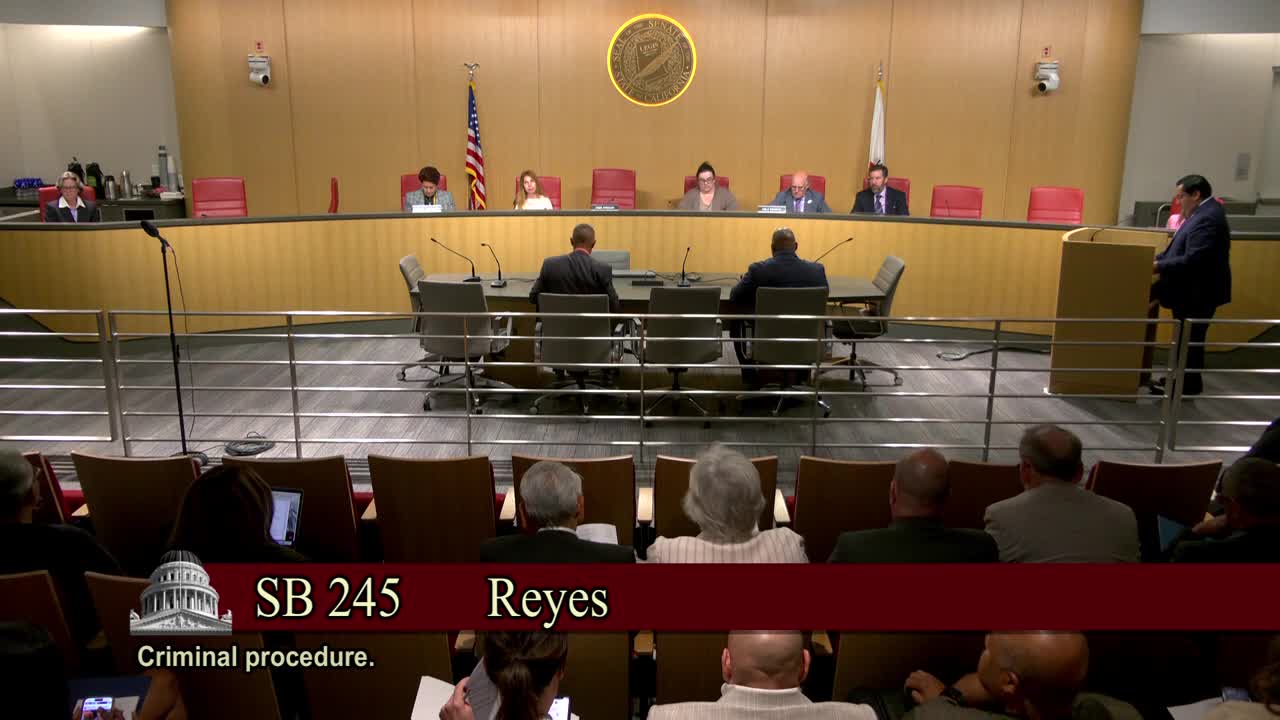 11MIN
Senate Standing Committee on Public Safety
Bill Author
Bill Co-Author(s):