SB 554: Law enforcement: immigration enforcement.
- Session Year: 2025-2026
- House: Senate
- Latest Version Date: 2025-04-21
Current Status:
Failed
(2026-02-02: Returned to Secretary of Senate pursuant to Joint Rule 62(a).)
Introduced
In Committee
Awaiting First Chamber Vote
Passed First Chamber
In Committee
Awaiting Second Chamber Vote
Passed Second Chamber
Enacted
Existing law, the California Values Act, generally prohibits California law enforcement agencies from investigating, interrogating, detaining, detecting, or arresting persons for immigration enforcement purposes, including providing information regarding a persons release date or responding to requests for notification by providing release dates or other information, as specified. Existing law provides that responses are never required, but are permitted, provided that they do not violate any local law or policy. Existing law provides the above-described prohibition does not prevent a California law enforcement agency from performing certain limited exceptions to this prohibition that do not violate any policy of the law enforcement agency or any local law or policy of the jurisdiction in which the agency is operating. Existing law provides a law enforcement official with discretion to cooperate with immigration authorities only if doing so would not violate any federal, state, or local law, or local policy, and where permitted by the California Values Act.
This bill would instead provide that responses relating to a persons release date, as described above, are permitted. required. The bill would instead require a California law enforcement agency to perform certain limited exceptions to the prohibition, as specified. The bill would prohibit a local agency, as defined, from enacting an ordinance that would impose any additional prohibitions other than those described above on California law enforcement agencies related to immigration enforcement. The bill would deem void an ordinance enacted by a local agency prior to January 1, 2026, that violates the above-described provisions. The bill would instead require a law enforcement official to cooperate with immigration authorities only if doing so would not violate any federal or state law or policy, and where permitted by the California Values Act. By imposing new duties on local agencies, this bill would impose a state-mandated local program.
The bill would include findings that changes proposed by this bill address a matter of statewide concern rather than a municipal affair and, therefore, apply to all cities, including charter cities.The California Constitution requires the state to reimburse local agencies and school districts for certain costs mandated by the state. Statutory provisions establish procedures for making that reimbursement.
This bill would provide that, if the Commission on State Mandates determines that the bill contains costs mandated by the state, reimbursement for those costs shall be made pursuant to the statutory provisions noted above.
Existing law, the California Values Act, generally prohibits California law enforcement agencies from investigating, interrogating, detaining, detecting, or arresting persons for immigration enforcement purposes, including providing information regarding a persons release date or responding to requests for notification by providing release dates or other information, as specified. Existing law provides that responses are never required, but are permitted, provided that they do not violate any local law or policy. Existing law provides the above-described prohibition does not prevent a California law enforcement agency from performing certain limited exceptions to this prohibition that do not violate any policy of the law enforcement agency or any local law or policy of the jurisdiction in which the agency is operating. Existing law provides a law enforcement official with discretion to cooperate with immigration authorities only if doing so would not violate any federal, state, or local law, or local policy, and where permitted by the California Values Act.
This bill would instead provide that responses relating to a persons release date, as described above, are permitted. The bill would instead require a California law enforcement agency to perform certain limited exceptions to the prohibition, as described above. specified. The bill would prohibit a local agency, as defined, from enacting an ordinance that would impose any additional prohibitions other than those described above on California law enforcement agencies related to immigration enforcement. The bill would deem void an ordinance enacted by a local agency prior to January 1, 2026, that violates the above-described provisions. The bill would instead require a law enforcement official to cooperate with immigration authorities only if doing so would not violate any federal, state, or local law, or local policy, federal or state law or policy, and where permitted by the California Values Act. By imposing new duties on local agencies, this bill would impose a state-mandated local program.
The bill would include findings that changes proposed by this bill address a matter of statewide concern rather than a municipal affair and, therefore, apply to all cities, including charter cities.
The California Constitution requires the state to reimburse local agencies and school districts for certain costs mandated by the state. Statutory provisions establish procedures for making that reimbursement.
This bill would provide that, if the Commission on State Mandates determines that the bill contains costs mandated by the state, reimbursement for those costs shall be made pursuant to the statutory provisions noted above.
Existing law, the California Values Act, generally prohibits California law enforcement agencies from investigating, interrogating, detaining, detecting, or arresting persons for immigration enforcement purposes, including providing information regarding a persons release date or responding to requests for notification by providing release dates or other information, as specified. Existing law provides that responses are never required, but are permitted, provided that they do not violate any local law or policy. Existing law provides the above-described prohibition does not prevent a California law enforcement agency from performing certain limited exceptions to this prohibition that do not violate any policy of the law enforcement agency or any local law or policy of the jurisdiction in which the agency is operating. Existing law provides a law enforcement official with discretion to cooperate with immigration authorities only if doing so would not violate any federal, state, or local law, or local policy, and where permitted by the California Values Act.
This bill would instead provide that responses relating to a persons release date, as described above, are permitted. The bill would instead require a California law enforcement agency to perform certain limited exceptions to the prohibition, as described above. The bill would prohibit a local agency, as defined, from enacting an ordinance that would impose any additional prohibitions other than those described above on California law enforcement agencies related to immigration enforcement. The bill would instead require a law enforcement official to cooperate with immigration authorities only if doing so would not violate any federal, state, or local law, or local policy, and where permitted by the California Values Act. By imposing new duties on local agencies, this bill would impose a state-mandated local program.
The bill would include findings that changes proposed by this bill address a matter of statewide concern rather than a municipal affair and, therefore, apply to all cities, including charter cities.
The California Constitution requires the state to reimburse local agencies and school districts for certain costs mandated by the state. Statutory provisions establish procedures for making that reimbursement.
This bill would provide that, if the Commission on State Mandates determines that the bill contains costs mandated by the state, reimbursement for those costs shall be made pursuant to the statutory provisions noted above.
(a)A law enforcement official shall cooperate with immigration authorities only if doing so would not violate any federal or state law or policy, and where permitted by the California Values Act (Chapter 17.25 (commencing with Section 7284)). Additionally, the specific activities described in subparagraph (C) of paragraph (1) of subdivision (a) of, and in paragraph (4) of subdivision (a) of, Section 7284.6 shall only occur under the following circumstances:
(1)The individual has been convicted of a serious or violent felony identified in subdivision (c) of Section 1192.7 of, or subdivision (c) of Section 667.5 of, the Penal Code.
(2)The individual has been convicted of a felony punishable by imprisonment in the state prison.
(3)The individual has been convicted within the past five years of a misdemeanor for a crime that is punishable as either a misdemeanor or a felony for, or has been convicted within the last 15 years of a felony for, any of the following offenses:
(A)Assault, as specified in, but not limited to, Sections 217.1, 220, 240, 241.1, 241.4, 241.7, 244, 244.5, 245, 245.2, 245.3, 245.5, 4500, and 4501 of the Penal Code.
(B)Battery, as specified in, but not limited to, Sections 242, 243.1, 243.3, 243.4, 243.6, 243.7, 243.9, 273.5, 347, 4501.1, and 4501.5 of the Penal Code.
(C)Use of threats, as specified in, but not limited to, Sections 71, 76, 139, 140, 422, 601, and 11418.5 of the Penal Code.
(D)Sexual abuse, sexual exploitation, or crimes endangering children, as specified in, but not limited to, Sections 266, 266a, 266b, 266c, 266d, 266f, 266g, 266h, 266i, 266j, 267, 269, 288, 288.5, 311.1, 311.3, 311.4, 311.10, 311.11, and 647.6 of the Penal Code.
(E)Child abuse or endangerment, as specified in, but not limited to, Sections 270, 271, 271a, 273a, 273ab, 273d, 273.4, and 278 of the Penal Code.
(F)Burglary, robbery, theft, fraud, forgery, or embezzlement, as specified in, but not limited to, Sections 211, 215, 459, 463, 470, 476, 487, 496, 503, 518, 530.5, 532, and 550 of the Penal Code.
(G)Driving under the influence of alcohol or drugs, but only for a conviction that is a felony.
(H)Obstruction of justice, as specified in, but not limited to, Sections 69, 95, 95.1, 136.1, and 148.10 of the Penal Code.
(I)Bribery, as specified in, but not limited to, Sections 67, 67.5, 68, 74, 85, 86, 92, 93, 137, 138, and 165 of the Penal Code.
(J)Escape, as specified in, but not limited to, Sections 107, 109, 110, 4530, 4530.5, 4532, 4533, 4534, 4535, and 4536 of the Penal Code.
(K)Unlawful possession or use of a weapon, firearm, explosive device, or weapon of mass destruction, as specified in, but not limited to, Sections 171b, 171c, 171d, 246, 246.3, 247, 417, 417.3, 417.6, 417.8, 4574, 11418, 11418.1, 12021.5, 12022, 12022.2, 12022.3, 12022.4, 12022.5, 12022.53, 12022.55, 18745, 18750, and 18755 of, and subdivisions (c) and (d) of Section 26100 of, the Penal Code.
(L)Possession of an unlawful deadly weapon, under the Deadly Weapons Recodification Act of 2010 (Part 6 (commencing with Section 16000) of the Penal Code).
(M)An offense involving the felony possession, sale, distribution, manufacture, or trafficking of controlled substances.
(N)Vandalism with prior convictions, as specified in, but not limited to, Section 594.7 of the Penal Code.
(O)Gang-related offenses, as specified in, but not limited to, Sections 186.22, 186.26, and 186.28 of the Penal Code.
(P)An attempt, as defined in Section 664 of, or a conspiracy, as defined in Section 182 of, the Penal Code, to commit an offense specified in this section.
(Q)A crime resulting in death, or involving the personal infliction of great bodily injury, as specified in, but not limited to, subdivision (d) of Section 245.6 of, and Sections 187, 191.5, 192, 192.5, 12022.7, 12022.8, and 12022.9 of, the Penal Code.
(R)Possession or use of a firearm in the commission of an offense.
(S)An offense that would require the individual to register as a sex offender pursuant to Section 290, 290.002, or 290.006 of the Penal Code.
(T)False imprisonment, slavery, and human trafficking, as specified in, but not limited to, Sections 181, 210.5, 236, 236.1, and 4503 of the Penal Code.
(U)Criminal profiteering and money laundering, as specified in, but not limited to, Sections 186.2, 186.9, and 186.10 of the Penal Code.
(V)Torture and mayhem, as specified in, but not limited to, Section 203 of the Penal Code.
(W)A crime threatening the public safety, as specified in, but not limited to, Sections 219, 219.1, 219.2, 247.5, 404, 404.6, 405a, 451, and 11413 of the Penal Code.
(X)Elder and dependent adult abuse, as specified in, but not limited to, Section 368 of the Penal Code.
(Y)A hate crime, as specified in, but not limited to, Section 422.55 of the Penal Code.
(Z)Stalking, as specified in, but not limited to, Section 646.9 of the Penal Code.
(AA)Soliciting the commission of a crime, as specified in, but not limited to, subdivision (c) of Section 286 of, and Sections 653j and 653.23 of, the Penal Code.
(AB)An offense committed while on bail or released on their own recognizance, as specified in, but not limited to, Section 12022.1 of the Penal Code.
(AC)Rape, sodomy, oral copulation, or sexual penetration, as specified in, but not limited to, paragraphs (2) and (6) of subdivision (a) of Section 261 of, paragraphs (1) and (4) of subdivision (a) of Section 262 of, Section 264.1 of, subdivisions (c) and (d) of Section 286 of, subdivisions (c) and (d) of Section 287 or of former Section 288a of, and subdivisions (a) and (j) of Section 289 of, the Penal Code.
(AD)Kidnapping, as specified in, but not limited to, Sections 207, 209, and 209.5 of the Penal Code.
(AE)A violation of subdivision (c) of Section 20001 of the Vehicle Code.
(4)The individual is a current registrant on the California Sex and Arson Registry.
(5)The individual has been convicted of a federal crime that meets the definition of an aggravated felony as set forth in subparagraphs (A) to (P), inclusive, of paragraph (43) of subsection (a) of Section 101 of the federal Immigration and Nationality Act (8 U.S.C. Sec. 1101), or is identified by the United States Department of Homeland Securitys Immigration and Customs Enforcement as the subject of an outstanding federal felony arrest warrant.
(6)In no case shall cooperation occur pursuant to this section for individuals arrested, detained, or convicted of misdemeanors that were previously felonies, or were previously crimes punishable as either misdemeanors or felonies, prior to passage of the Safe Neighborhoods and Schools Act of 2014 as it amended the Penal Code.
(b)In cases in which the individual is arrested and taken before a magistrate on a charge involving a serious or violent felony, as identified in subdivision (c) of Section 1192.7 or subdivision (c) of Section 667.5 of the Penal Code, respectively, or a felony that is punishable by imprisonment in state prison, and the magistrate makes a finding of probable cause as to that charge pursuant to Section 872 of the Penal Code, a law enforcement official shall cooperate with immigration officials pursuant to subparagraph (C) of paragraph (1) of subdivision (a) of Section 7284.6.
SEC. 2.Section 7284.6 of the Government Code is amended to read:7284.6.(a)California law enforcement agencies shall not:
(1)Use agency or department moneys or personnel to investigate, interrogate, detain, detect, or arrest persons for immigration enforcement purposes, including any of the following:
(A)Inquiring into an individuals immigration status.
(B)Detaining an individual on the basis of a hold request.
(C)Providing information regarding a persons release date or responding to requests for notification by providing release dates or other information unless that information is available to the public, or is in response to a notification request from immigration authorities in accordance with Section 7282.5. Responses are permitted required under this subdivision.
(D)Providing personal information, as defined in Section 1798.3 of the Civil Code, about an individual, including, but not limited to, the individuals home address or work address unless that information is available to the public.
(E)Making or intentionally participating in arrests based on civil immigration warrants.
(F)Assisting immigration authorities in the activities described in Section 1357(a)(3) of Title 8 of the United States Code.
(G)Performing the functions of an immigration officer, whether pursuant to Section 1357(g) of Title 8 of the United States Code or any other law, regulation, or policy, whether formal or informal.
(2)Place peace officers under the supervision of federal agencies or employ peace officers deputized as special federal officers or special federal deputies for purposes of immigration enforcement. All peace officers remain subject to California law governing conduct of peace officers and the policies of the employing agency.
(3)Use immigration authorities as interpreters for law enforcement matters relating to individuals in agency or department custody.
(4)Transfer an individual to immigration authorities unless authorized by a judicial warrant or judicial probable cause determination, or in accordance with Section 7282.5.
(5)Provide office space exclusively dedicated for immigration authorities for use within a city or county law enforcement facility.
(6)Contract with the federal government for use of California law enforcement agency facilities to house individuals as federal detainees for purposes of civil immigration custody, except pursuant to Chapter 17.8 (commencing with Section 7310).
(b)Notwithstanding the limitations in subdivision (a), a California law enforcement agency shall perform all of the following:
(1)Investigating, enforcing, or detaining upon reasonable suspicion of, or arresting for a violation of, Section 1326(a) of Title 8 of the United States Code that may be subject to the enhancement specified in Section 1326(b)(2) of Title 8 of the United States Code and that is detected during an unrelated law enforcement activity. Transfers to immigration authorities are permitted under this subsection only in accordance with paragraph (4) of subdivision (a).
(2)Responding to a request from immigration authorities for information about a specific persons criminal history, including previous criminal arrests, convictions, or similar criminal history information accessed through the California Law Enforcement Telecommunications System (CLETS), where otherwise permitted by state law.
(3)Conducting enforcement or investigative duties associated with a joint law enforcement task force, including the sharing of confidential information with other law enforcement agencies for purposes of task force investigations, so long as the following conditions are met:
(A)The primary purpose of the joint law enforcement task force is not immigration enforcement, as defined in subdivision (f) of Section 7284.4.
(B)The enforcement or investigative duties are primarily related to a violation of state or federal law unrelated to immigration enforcement.
(4)Making inquiries into information necessary to certify an individual who has been identified as a potential crime or trafficking victim for a T or U Visa pursuant to Section 1101(a)(15)(T) or 1101(a)(15)(U) of Title 8 of the United States Code or to comply with Section 922(d)(5) of Title 18 of the United States Code.
(5)Giving immigration authorities access to interview an individual in agency or department custody. All interview access shall comply with requirements of the TRUTH Act (Chapter 17.2 (commencing with Section 7283)).
(c)(1)If a California law enforcement agency chooses to participate in a joint law enforcement task force, for which a California law enforcement agency has agreed to dedicate personnel or resources on an ongoing basis, it shall submit a report annually to the Department of Justice, as specified by the Attorney General. The law enforcement agency shall report the following information, if known, for each task force of which it is a member:
(A)The purpose of the task force.
(B)The federal, state, and local law enforcement agencies involved.
(C)The total number of arrests made during the reporting period.
(D)The number of people arrested for immigration enforcement purposes.
(2)All law enforcement agencies shall report annually to the Department of Justice, in a manner specified by the Attorney General, the number of transfers pursuant to paragraph (4) of subdivision (a), and the offense that allowed for the transfer pursuant to paragraph (4) of subdivision (a).
(3)All records described in this subdivision shall be public records for purposes of the California Public Records Act (Division 10 (commencing with Section 7920.000)), including the exemptions provided by that act and, as permitted under that act, personal identifying information may be redacted prior to public disclosure. To the extent that disclosure of a particular item of information would endanger the safety of a person involved in an investigation, or would endanger the successful completion of the investigation or a related investigation, that information shall not be disclosed.
(4)If more than one California law enforcement agency is participating in a joint task force that meets the reporting requirement pursuant to this section, the joint task force shall designate a local or state agency responsible for completing the reporting requirement.
(d)The Attorney General, by March 1, 2019, and annually thereafter, shall report on the total number of arrests made by joint law enforcement task forces, and the total number of arrests made for the purpose of immigration enforcement by all task force participants, including federal law enforcement agencies. To the extent that disclosure of a particular item of information would endanger the safety of a person involved in an investigation, or would endanger the successful completion of the investigation or a related investigation, that information shall not be included in the Attorney Generals report. The Attorney General shall post the reports required by this subdivision on the Attorney Generals internet website.
(e)This section does not prohibit or restrict any government entity or official from sending to, or receiving from, federal immigration authorities, information regarding the citizenship or immigration status, lawful or unlawful, of an individual, or from requesting from federal immigration authorities immigration status information, lawful or unlawful, of any individual, or maintaining or exchanging that information with any other federal, state, or local government entity, pursuant to Sections 1373 and 1644 of Title 8 of the United States Code.
(f)Nothing in this section shall prohibit a California law enforcement agency from asserting its own jurisdiction over criminal law enforcement matters.
SEC. 3.Section 7284.7 is added to the Government Code, to read:7284.7.(a)A local agency shall not enact an ordinance that would impose any additional prohibitions other than those in this chapter on California law enforcement agencies related to immigration enforcement.(b)An ordinance enacted by a local agency prior to January 1, 2026, that violates this section shall be deemed void. (c)For purposes of this section, local agency has the same meaning as defined in Section 54951.SEC. 4.The Legislature finds and declares that Sections 1, 2, and 3 of this act amending Sections 7282.5 and 7284.6 of, and adding Section 7284.7 to, the Government Code address a matter of statewide concern rather than a municipal affair as that term is used in Section 5 of Article XI of the California Constitution. Therefore, Sections 1, 2, and 3 of this act apply to all cities, including charter cities.SEC. 5.SEC. 3.If the Commission on State Mandates determines that this act contains costs mandated by the state, reimbursement to local agencies and school districts for those costs shall be made pursuant to Part 7 (commencing with Section 17500) of Division 4 of Title 2 of the Government Code.
(a)A law enforcement official shall cooperate with immigration authorities only if doing so would not violate any federal, state, or local law, or local policy, federal or state law or policy, and where permitted by the California Values Act (Chapter 17.25 (commencing with Section 7284)). Additionally, the specific activities described in subparagraph (C) of paragraph (1) of subdivision (a) of, and in paragraph (4) of subdivision (a) of, Section 7284.6 shall only occur under the following circumstances:
(1)The individual has been convicted of a serious or violent felony identified in subdivision (c) of Section 1192.7 of, or subdivision (c) of Section 667.5 of, the Penal Code.
(2)The individual has been convicted of a felony punishable by imprisonment in the state prison.
(3)The individual has been convicted within the past five years of a misdemeanor for a crime that is punishable as either a misdemeanor or a felony for, or has been convicted within the last 15 years of a felony for, any of the following offenses:
(A)Assault, as specified in, but not limited to, Sections 217.1, 220, 240, 241.1, 241.4, 241.7, 244, 244.5, 245, 245.2, 245.3, 245.5, 4500, and 4501 of the Penal Code.
(B)Battery, as specified in, but not limited to, Sections 242, 243.1, 243.3, 243.4, 243.6, 243.7, 243.9, 273.5, 347, 4501.1, and 4501.5 of the Penal Code.
(C)Use of threats, as specified in, but not limited to, Sections 71, 76, 139, 140, 422, 601, and 11418.5 of the Penal Code.
(D)Sexual abuse, sexual exploitation, or crimes endangering children, as specified in, but not limited to, Sections 266, 266a, 266b, 266c, 266d, 266f, 266g, 266h, 266i, 266j, 267, 269, 288, 288.5, 311.1, 311.3, 311.4, 311.10, 311.11, and 647.6 of the Penal Code.
(E)Child abuse or endangerment, as specified in, but not limited to, Sections 270, 271, 271a, 273a, 273ab, 273d, 273.4, and 278 of the Penal Code.
(F)Burglary, robbery, theft, fraud, forgery, or embezzlement, as specified in, but not limited to, Sections 211, 215, 459, 463, 470, 476, 487, 496, 503, 518, 530.5, 532, and 550 of the Penal Code.
(G)Driving under the influence of alcohol or drugs, but only for a conviction that is a felony.
(H)Obstruction of justice, as specified in, but not limited to, Sections 69, 95, 95.1, 136.1, and 148.10 of the Penal Code.
(I)Bribery, as specified in, but not limited to, Sections 67, 67.5, 68, 74, 85, 86, 92, 93, 137, 138, and 165 of the Penal Code.
(J)Escape, as specified in, but not limited to, Sections 107, 109, 110, 4530, 4530.5, 4532, 4533, 4534, 4535, and 4536 of the Penal Code.
(K)Unlawful possession or use of a weapon, firearm, explosive device, or weapon of mass destruction, as specified in, but not limited to, Sections 171b, 171c, 171d, 246, 246.3, 247, 417, 417.3, 417.6, 417.8, 4574, 11418, 11418.1, 12021.5, 12022, 12022.2, 12022.3, 12022.4, 12022.5, 12022.53, 12022.55, 18745, 18750, and 18755 of, and subdivisions (c) and (d) of Section 26100 of, the Penal Code.
(L)Possession of an unlawful deadly weapon, under the Deadly Weapons Recodification Act of 2010 (Part 6 (commencing with Section 16000) of the Penal Code).
(M)An offense involving the felony possession, sale, distribution, manufacture, or trafficking of controlled substances.
(N)Vandalism with prior convictions, as specified in, but not limited to, Section 594.7 of the Penal Code.
(O)Gang-related offenses, as specified in, but not limited to, Sections 186.22, 186.26, and 186.28 of the Penal Code.
(P)An attempt, as defined in Section 664 of, or a conspiracy, as defined in Section 182 of, the Penal Code, to commit an offense specified in this section.
(Q)A crime resulting in death, or involving the personal infliction of great bodily injury, as specified in, but not limited to, subdivision (d) of Section 245.6 of, and Sections 187, 191.5, 192, 192.5, 12022.7, 12022.8, and 12022.9 of, the Penal Code.
(R)Possession or use of a firearm in the commission of an offense.
(S)An offense that would require the individual to register as a sex offender pursuant to Section 290, 290.002, or 290.006 of the Penal Code.
(T)False imprisonment, slavery, and human trafficking, as specified in, but not limited to, Sections 181, 210.5, 236, 236.1, and 4503 of the Penal Code.
(U)Criminal profiteering and money laundering, as specified in, but not limited to, Sections 186.2, 186.9, and 186.10 of the Penal Code.
(V)Torture and mayhem, as specified in, but not limited to, Section 203 of the Penal Code.
(W)A crime threatening the public safety, as specified in, but not limited to, Sections 219, 219.1, 219.2, 247.5, 404, 404.6, 405a, 451, and 11413 of the Penal Code.
(X)Elder and dependent adult abuse, as specified in, but not limited to, Section 368 of the Penal Code.
(Y)A hate crime, as specified in, but not limited to, Section 422.55 of the Penal Code.
(Z)Stalking, as specified in, but not limited to, Section 646.9 of the Penal Code.
(AA)Soliciting the commission of a crime, as specified in, but not limited to, subdivision (c) of Section 286 of, and Sections 653j and 653.23 of, the Penal Code.
(AB)An offense committed while on bail or released on their own recognizance, as specified in, but not limited to, Section 12022.1 of the Penal Code.
(AC)Rape, sodomy, oral copulation, or sexual penetration, as specified in, but not limited to, paragraphs (2) and (6) of subdivision (a) of Section 261 of, paragraphs (1) and (4) of subdivision (a) of Section 262 of, Section 264.1 of, subdivisions (c) and (d) of Section 286 of, subdivisions (c) and (d) of Section 287 or of former Section 288a of, and subdivisions (a) and (j) of Section 289 of, the Penal Code.
(AD)Kidnapping, as specified in, but not limited to, Sections 207, 209, and 209.5 of the Penal Code.
(AE)A violation of subdivision (c) of Section 20001 of the Vehicle Code.
(4)The individual is a current registrant on the California Sex and Arson Registry.
(5)The individual has been convicted of a federal crime that meets the definition of an aggravated felony as set forth in subparagraphs (A) to (P), inclusive, of paragraph (43) of subsection (a) of Section 101 of the federal Immigration and Nationality Act (8 U.S.C. Sec. 1101), or is identified by the United States Department of Homeland Securitys Immigration and Customs Enforcement as the subject of an outstanding federal felony arrest warrant.
(6)In no case shall cooperation occur pursuant to this section for individuals arrested, detained, or convicted of misdemeanors that were previously felonies, or were previously crimes punishable as either misdemeanors or felonies, prior to passage of the Safe Neighborhoods and Schools Act of 2014 as it amended the Penal Code.
(b)In cases in which the individual is arrested and taken before a magistrate on a charge involving a serious or violent felony, as identified in subdivision (c) of Section 1192.7 or subdivision (c) of Section 667.5 of the Penal Code, respectively, or a felony that is punishable by imprisonment in state prison, and the magistrate makes a finding of probable cause as to that charge pursuant to Section 872 of the Penal Code, a law enforcement official shall additionally have discretion to cooperate with immigration officials pursuant to subparagraph (C) of paragraph (1) of subdivision (a) of Section 7284.6.
SEC. 2.Section 7284.6 of the Government Code is amended to read:7284.6.(a)California law enforcement agencies shall not:
(1)Use agency or department moneys or personnel to investigate, interrogate, detain, detect, or arrest persons for immigration enforcement purposes, including any of the following:
(A)Inquiring into an individuals immigration status.
(B)Detaining an individual on the basis of a hold request.
(C)Providing information regarding a persons release date or responding to requests for notification by providing release dates or other information unless that information is available to the public, or is in response to a notification request from immigration authorities in accordance with Section 7282.5. Responses are permitted under this subdivision.
(D)Providing personal information, as defined in Section 1798.3 of the Civil Code, about an individual, including, but not limited to, the individuals home address or work address unless that information is available to the public.
(E)Making or intentionally participating in arrests based on civil immigration warrants.
(F)Assisting immigration authorities in the activities described in Section 1357(a)(3) of Title 8 of the United States Code.
(G)Performing the functions of an immigration officer, whether pursuant to Section 1357(g) of Title 8 of the United States Code or any other law, regulation, or policy, whether formal or informal.
(2)Place peace officers under the supervision of federal agencies or employ peace officers deputized as special federal officers or special federal deputies for purposes of immigration enforcement. All peace officers remain subject to California law governing conduct of peace officers and the policies of the employing agency.
(3)Use immigration authorities as interpreters for law enforcement matters relating to individuals in agency or department custody.
(4)Transfer an individual to immigration authorities unless authorized by a judicial warrant or judicial probable cause determination, or in accordance with Section 7282.5.
(5)Provide office space exclusively dedicated for immigration authorities for use within a city or county law enforcement facility.
(6)Contract with the federal government for use of California law enforcement agency facilities to house individuals as federal detainees for purposes of civil immigration custody, except pursuant to Chapter 17.8 (commencing with Section 7310).
(b)Notwithstanding the limitations in subdivision (a), a California law enforcement agency shall perform all of the following that does not violate any policy of the law enforcement agency or any local law or policy of the jurisdiction in which the agency is operating: following:
(1)Investigating, enforcing, or detaining upon reasonable suspicion of, or arresting for a violation of, Section 1326(a) of Title 8 of the United States Code that may be subject to the enhancement specified in Section 1326(b)(2) of Title 8 of the United States Code and that is detected during an unrelated law enforcement activity. Transfers to immigration authorities are permitted under this subsection only in accordance with paragraph (4) of subdivision (a).
(2)Responding to a request from immigration authorities for information about a specific persons criminal history, including previous criminal arrests, convictions, or similar criminal history information accessed through the California Law Enforcement Telecommunications System (CLETS), where otherwise permitted by state law.
(3)Conducting enforcement or investigative duties associated with a joint law enforcement task force, including the sharing of confidential information with other law enforcement agencies for purposes of task force investigations, so long as the following conditions are met:
(A)The primary purpose of the joint law enforcement task force is not immigration enforcement, as defined in subdivision (f) of Section 7284.4.
(B)The enforcement or investigative duties are primarily related to a violation of state or federal law unrelated to immigration enforcement.
(C)Participation in the task force by a California law enforcement agency does not violate any local law or policy to which it is otherwise subject.(4)Making inquiries into information necessary to certify an individual who has been identified as a potential crime or trafficking victim for a T or U Visa pursuant to Section 1101(a)(15)(T) or 1101(a)(15)(U) of Title 8 of the United States Code or to comply with Section 922(d)(5) of Title 18 of the United States Code.
(5)Giving immigration authorities access to interview an individual in agency or department custody. All interview access shall comply with requirements of the TRUTH Act (Chapter 17.2 (commencing with Section 7283)).
(c)(1)If a California law enforcement agency chooses to participate in a joint law enforcement task force, for which a California law enforcement agency has agreed to dedicate personnel or resources on an ongoing basis, it shall submit a report annually to the Department of Justice, as specified by the Attorney General. The law enforcement agency shall report the following information, if known, for each task force of which it is a member:
(A)The purpose of the task force.
(B)The federal, state, and local law enforcement agencies involved.
(C)The total number of arrests made during the reporting period.
(D)The number of people arrested for immigration enforcement purposes.
(2)All law enforcement agencies shall report annually to the Department of Justice, in a manner specified by the Attorney General, the number of transfers pursuant to paragraph (4) of subdivision (a), and the offense that allowed for the transfer pursuant to paragraph (4) of subdivision (a).
(3)All records described in this subdivision shall be public records for purposes of the California Public Records Act (Division 10 (commencing with Section 7920.000)), including the exemptions provided by that act and, as permitted under that act, personal identifying information may be redacted prior to public disclosure. To the extent that disclosure of a particular item of information would endanger the safety of a person involved in an investigation, or would endanger the successful completion of the investigation or a related investigation, that information shall not be disclosed.
(4)If more than one California law enforcement agency is participating in a joint task force that meets the reporting requirement pursuant to this section, the joint task force shall designate a local or state agency responsible for completing the reporting requirement.
(d)The Attorney General, by March 1, 2019, and annually thereafter, shall report on the total number of arrests made by joint law enforcement task forces, and the total number of arrests made for the purpose of immigration enforcement by all task force participants, including federal law enforcement agencies. To the extent that disclosure of a particular item of information would endanger the safety of a person involved in an investigation, or would endanger the successful completion of the investigation or a related investigation, that information shall not be included in the Attorney Generals report. The Attorney General shall post the reports required by this subdivision on the Attorney Generals internet website.
(e)This section does not prohibit or restrict any government entity or official from sending to, or receiving from, federal immigration authorities, information regarding the citizenship or immigration status, lawful or unlawful, of an individual, or from requesting from federal immigration authorities immigration status information, lawful or unlawful, of any individual, or maintaining or exchanging that information with any other federal, state, or local government entity, pursuant to Sections 1373 and 1644 of Title 8 of the United States Code.
(f)Nothing in this section shall prohibit a California law enforcement agency from asserting its own jurisdiction over criminal law enforcement matters.
SEC. 3.Section 7284.7 is added to the Government Code, to read:7284.7.(a)A local agency shall not enact an ordinance that would impose any additional prohibitions other than those in this chapter on California law enforcement agencies related to immigration enforcement.
(b)An ordinance enacted by a local agency prior to January 1, 2026, that violates this section shall be deemed void.
(b)(c)For purposes of this section, local agency has the same meaning as defined in Section 54951.
SEC. 4.The Legislature finds and declares that Sections 1, 2, and 3 of this act amending Sections 7282.5 and 7284.6 of, and adding Section 7284.7 to, the Government Code address a matter of statewide concern rather than a municipal affair as that term is used in Section 5 of Article XI of the California Constitution. Therefore, Sections 1, 2, and 3 of this act apply to all cities, including charter cities.
SEC. 5.If the Commission on State Mandates determines that this act contains costs mandated by the state, reimbursement to local agencies and school districts for those costs shall be made pursuant to Part 7 (commencing with Section 17500) of Division 4 of Title 2 of the Government Code.
(a)A law enforcement official shall have discretion to cooperate with immigration authorities only if doing so would not violate any federal, state, or local law, or local policy, and where permitted by the California Values Act (Chapter 17.25 (commencing with Section 7284)). Additionally, the specific activities described in subparagraph (C) of paragraph (1) of subdivision (a) of, and in paragraph (4) of subdivision (a) of, Section 7284.6 shall only occur under the following circumstances:
(1)The individual has been convicted of a serious or violent felony identified in subdivision (c) of Section 1192.7 of, or subdivision (c) of Section 667.5 of, the Penal Code.
(2)The individual has been convicted of a felony punishable by imprisonment in the state prison.
(3)The individual has been convicted within the past five years of a misdemeanor for a crime that is punishable as either a misdemeanor or a felony for, or has been convicted within the last 15 years of a felony for, any of the following offenses:
(A)Assault, as specified in, but not limited to, Sections 217.1, 220, 240, 241.1, 241.4, 241.7, 244, 244.5, 245, 245.2, 245.3, 245.5, 4500, and 4501 of the Penal Code.
(B)Battery, as specified in, but not limited to, Sections 242, 243.1, 243.3, 243.4, 243.6, 243.7, 243.9, 273.5, 347, 4501.1, and 4501.5 of the Penal Code.
(C)Use of threats, as specified in, but not limited to, Sections 71, 76, 139, 140, 422, 601, and 11418.5 of the Penal Code.
(D)Sexual abuse, sexual exploitation, or crimes endangering children, as specified in, but not limited to, Sections 266, 266a, 266b, 266c, 266d, 266f, 266g, 266h, 266i, 266j, 267, 269, 288, 288.5, 311.1, 311.3, 311.4, 311.10, 311.11, and 647.6 of the Penal Code.
(E)Child abuse or endangerment, as specified in, but not limited to, Sections 270, 271, 271a, 273a, 273ab, 273d, 273.4, and 278 of the Penal Code.
(F)Burglary, robbery, theft, fraud, forgery, or embezzlement, as specified in, but not limited to, Sections 211, 215, 459, 463, 470, 476, 487, 496, 503, 518, 530.5, 532, and 550 of the Penal Code.
(G)Driving under the influence of alcohol or drugs, but only for a conviction that is a felony.
(H)Obstruction of justice, as specified in, but not limited to, Sections 69, 95, 95.1, 136.1, and 148.10 of the Penal Code.
(I)Bribery, as specified in, but not limited to, Sections 67, 67.5, 68, 74, 85, 86, 92, 93, 137, 138, and 165 of the Penal Code.
(J)Escape, as specified in, but not limited to, Sections 107, 109, 110, 4530, 4530.5, 4532, 4533, 4534, 4535, and 4536 of the Penal Code.
(K)Unlawful possession or use of a weapon, firearm, explosive device, or weapon of mass destruction, as specified in, but not limited to, Sections 171b, 171c, 171d, 246, 246.3, 247, 417, 417.3, 417.6, 417.8, 4574, 11418, 11418.1, 12021.5, 12022, 12022.2, 12022.3, 12022.4, 12022.5, 12022.53, 12022.55, 18745, 18750, and 18755 of, and subdivisions (c) and (d) of Section 26100 of, the Penal Code.
(L)Possession of an unlawful deadly weapon, under the Deadly Weapons Recodification Act of 2010 (Part 6 (commencing with Section 16000) of the Penal Code).
(M)An offense involving the felony possession, sale, distribution, manufacture, or trafficking of controlled substances.
(N)Vandalism with prior convictions, as specified in, but not limited to, Section 594.7 of the Penal Code.
(O)Gang-related offenses, as specified in, but not limited to, Sections 186.22, 186.26, and 186.28 of the Penal Code.
(P)An attempt, as defined in Section 664 of, or a conspiracy, as defined in Section 182 of, the Penal Code, to commit an offense specified in this section.
(Q)A crime resulting in death, or involving the personal infliction of great bodily injury, as specified in, but not limited to, subdivision (d) of Section 245.6 of, and Sections 187, 191.5, 192, 192.5, 12022.7, 12022.8, and 12022.9 of, the Penal Code.
(R)Possession or use of a firearm in the commission of an offense.
(S)An offense that would require the individual to register as a sex offender pursuant to Section 290, 290.002, or 290.006 of the Penal Code.
(T)False imprisonment, slavery, and human trafficking, as specified in, but not limited to, Sections 181, 210.5, 236, 236.1, and 4503 of the Penal Code.
(U)Criminal profiteering and money laundering, as specified in, but not limited to, Sections 186.2, 186.9, and 186.10 of the Penal Code.
(V)Torture and mayhem, as specified in, but not limited to, Section 203 of the Penal Code.
(W)A crime threatening the public safety, as specified in, but not limited to, Sections 219, 219.1, 219.2, 247.5, 404, 404.6, 405a, 451, and 11413 of the Penal Code.
(X)Elder and dependent adult abuse, as specified in, but not limited to, Section 368 of the Penal Code.
(Y)A hate crime, as specified in, but not limited to, Section 422.55 of the Penal Code.
(Z)Stalking, as specified in, but not limited to, Section 646.9 of the Penal Code.
(AA)Soliciting the commission of a crime, as specified in, but not limited to, subdivision (c) of Section 286 of, and Sections 653j and 653.23 of, the Penal Code.
(AB)An offense committed while on bail or released on his or her their own recognizance, as specified in, but not limited to, Section 12022.1 of the Penal Code.
(AC)Rape, sodomy, oral copulation, or sexual penetration, as specified in, but not limited to, paragraphs (2) and (6) of subdivision (a) of Section 261 of, paragraphs (1) and (4) of subdivision (a) of Section 262 of, Section 264.1 of, subdivisions (c) and (d) of Section 286 of, subdivisions (c) and (d) of Section 287 or of former Section 288a of, and subdivisions (a) and (j) of Section 289 of, the Penal Code.
(AD)Kidnapping, as specified in, but not limited to, Sections 207, 209, and 209.5 of the Penal Code.
(AE)A violation of subdivision (c) of Section 20001 of the Vehicle Code.
(4)The individual is a current registrant on the California Sex and Arson Registry.
(5)The individual has been convicted of a federal crime that meets the definition of an aggravated felony as set forth in subparagraphs (A) to (P), inclusive, of paragraph (43) of subsection (a) of Section 101 of the federal Immigration and Nationality Act (8 U.S.C. Sec. 1101), or is identified by the United States Department of Homeland Securitys Immigration and Customs Enforcement as the subject of an outstanding federal felony arrest warrant.
(6)In no case shall cooperation occur pursuant to this section for individuals arrested, detained, or convicted of misdemeanors that were previously felonies, or were previously crimes punishable as either misdemeanors or felonies, prior to passage of the Safe Neighborhoods and Schools Act of 2014 as it amended the Penal Code.
(b)In cases in which the individual is arrested and taken before a magistrate on a charge involving a serious or violent felony, as identified in subdivision (c) of Section 1192.7 or subdivision (c) of Section 667.5 of the Penal Code, respectively, or a felony that is punishable by imprisonment in state prison, and the magistrate makes a finding of probable cause as to that charge pursuant to Section 872 of the Penal Code, a law enforcement official shall additionally have discretion to cooperate with immigration officials pursuant to subparagraph (C) of paragraph (1) of subdivision (a) of Section 7284.6.
SEC. 2.Section 7284.6 of the Government Code is amended to read:7284.6.(a)California law enforcement agencies shall not:
(1)Use agency or department moneys or personnel to investigate, interrogate, detain, detect, or arrest persons for immigration enforcement purposes, including any of the following:
(A)Inquiring into an individuals immigration status.
(B)Detaining an individual on the basis of a hold request.
(C)Providing information regarding a persons release date or responding to requests for notification by providing release dates or other information unless that information is available to the public, or is in response to a notification request from immigration authorities in accordance with Section 7282.5. Responses are never required, but are permitted under this subdivision, provided that they do not violate any local law or policy. subdivision.
(D)Providing personal information, as defined in Section 1798.3 of the Civil Code, about an individual, including, but not limited to, the individuals home address or work address unless that information is available to the public.
(E)Making or intentionally participating in arrests based on civil immigration warrants.
(F)Assisting immigration authorities in the activities described in Section 1357(a)(3) of Title 8 of the United States Code.
(G)Performing the functions of an immigration officer, whether pursuant to Section 1357(g) of Title 8 of the United States Code or any other law, regulation, or policy, whether formal or informal.
(2)Place peace officers under the supervision of federal agencies or employ peace officers deputized as special federal officers or special federal deputies for purposes of immigration enforcement. All peace officers remain subject to California law governing conduct of peace officers and the policies of the employing agency.
(3)Use immigration authorities as interpreters for law enforcement matters relating to individuals in agency or department custody.
(4)Transfer an individual to immigration authorities unless authorized by a judicial warrant or judicial probable cause determination, or in accordance with Section 7282.5.
(5)Provide office space exclusively dedicated for immigration authorities for use within a city or county law enforcement facility.
(6)Contract with the federal government for use of California law enforcement agency facilities to house individuals as federal detainees for purposes of civil immigration custody, except pursuant to Chapter 17.8 (commencing with Section 7310).
(b)Notwithstanding the limitations in subdivision (a), this section does not prevent any a California law enforcement agency from doing any shall perform all of the following that does not violate any policy of the law enforcement agency or any local law or policy of the jurisdiction in which the agency is operating:
(1)Investigating, enforcing, or detaining upon reasonable suspicion of, or arresting for a violation of, Section 1326(a) of Title 8 of the United States Code that may be subject to the enhancement specified in Section 1326(b)(2) of Title 8 of the United States Code and that is detected during an unrelated law enforcement activity. Transfers to immigration authorities are permitted under this subsection only in accordance with paragraph (4) of subdivision (a).
(2)Responding to a request from immigration authorities for information about a specific persons criminal history, including previous criminal arrests, convictions, or similar criminal history information accessed through the California Law Enforcement Telecommunications System (CLETS), where otherwise permitted by state law.
(3)Conducting enforcement or investigative duties associated with a joint law enforcement task force, including the sharing of confidential information with other law enforcement agencies for purposes of task force investigations, so long as the following conditions are met:
(A)The primary purpose of the joint law enforcement task force is not immigration enforcement, as defined in subdivision (f) of Section 7284.4.
(B)The enforcement or investigative duties are primarily related to a violation of state or federal law unrelated to immigration enforcement.
(C)Participation in the task force by a California law enforcement agency does not violate any local law or policy to which it is otherwise subject.
(4)Making inquiries into information necessary to certify an individual who has been identified as a potential crime or trafficking victim for a T or U Visa pursuant to Section 1101(a)(15)(T) or 1101(a)(15)(U) of Title 8 of the United States Code or to comply with Section 922(d)(5) of Title 18 of the United States Code.
(5)Giving immigration authorities access to interview an individual in agency or department custody. All interview access shall comply with requirements of the TRUTH Act (Chapter 17.2 (commencing with Section 7283)).
(c)(1)If a California law enforcement agency chooses to participate in a joint law enforcement task force, for which a California law enforcement agency has agreed to dedicate personnel or resources on an ongoing basis, it shall submit a report annually to the Department of Justice, as specified by the Attorney General. The law enforcement agency shall report the following information, if known, for each task force of which it is a member:
(A)The purpose of the task force.
(B)The federal, state, and local law enforcement agencies involved.
(C)The total number of arrests made during the reporting period.
(D)The number of people arrested for immigration enforcement purposes.
(2)All law enforcement agencies shall report annually to the Department of Justice, in a manner specified by the Attorney General, the number of transfers pursuant to paragraph (4) of subdivision (a), and the offense that allowed for the transfer pursuant to paragraph (4) of subdivision (a).
(3)All records described in this subdivision shall be public records for purposes of the California Public Records Act (Division 10 (commencing with Section 7920.000)), including the exemptions provided by that act and, as permitted under that act, personal identifying information may be redacted prior to public disclosure. To the extent that disclosure of a particular item of information would endanger the safety of a person involved in an investigation, or would endanger the successful completion of the investigation or a related investigation, that information shall not be disclosed.
(4)If more than one California law enforcement agency is participating in a joint task force that meets the reporting requirement pursuant to this section, the joint task force shall designate a local or state agency responsible for completing the reporting requirement.
(d)The Attorney General, by March 1, 2019, and annually thereafter, shall report on the total number of arrests made by joint law enforcement task forces, and the total number of arrests made for the purpose of immigration enforcement by all task force participants, including federal law enforcement agencies. To the extent that disclosure of a particular item of information would endanger the safety of a person involved in an investigation, or would endanger the successful completion of the investigation or a related investigation, that information shall not be included in the Attorney Generals report. The Attorney General shall post the reports required by this subdivision on the Attorney Generals internet website.
(e)This section does not prohibit or restrict any government entity or official from sending to, or receiving from, federal immigration authorities, information regarding the citizenship or immigration status, lawful or unlawful, of an individual, or from requesting from federal immigration authorities immigration status information, lawful or unlawful, of any individual, or maintaining or exchanging that information with any other federal, state, or local government entity, pursuant to Sections 1373 and 1644 of Title 8 of the United States Code.
(f)Nothing in this section shall prohibit a California law enforcement agency from asserting its own jurisdiction over criminal law enforcement matters.
SEC. 3.Section 7284.7 is added to the Government Code, to read:7284.7.(a)A local agency shall not enact an ordinance that would impose any additional prohibitions other than those in this chapter on California law enforcement agencies related to immigration enforcement.
(b)For purposes of this section, local agency has the same meaning as defined in Section 54951.
SEC. 4.The Legislature finds and declares that Sections 1, 2, and 3 of this act amending Sections 7282.5 and 7284.6 of, and adding Section 7284.7 to, the Government Code address a matter of statewide concern rather than a municipal affair as that term is used in Section 5 of Article XI of the California Constitution. Therefore, Sections 1, 2, and 3 of this act apply to all cities, including charter cities.
SEC. 5.If the Commission on State Mandates determines that this act contains costs mandated by the state, reimbursement to local agencies and school districts for those costs shall be made pursuant to Part 7 (commencing with Section 17500) of Division 4 of Title 2 of the Government Code.
|
Date
|
Status
|
|---|---|
| Feb 2, 2026 | Returned to Secretary of Senate pursuant to Joint Rule 62(a). |
| Apr 30, 2025 | April 29 set for second hearing. Failed passage in committee. (Ayes 1. Noes 5. Page 945.) |
| Apr 21, 2025 | From committee with author's amendments. Read second time and amended. Re-referred to Com. on PUB. S. |
| Apr 17, 2025 | Set for hearing April 29. |
| Apr 16, 2025 | April 22 set for first hearing canceled at the request of author. |
| Apr 9, 2025 | Set for hearing April 22. |
| Mar 24, 2025 | From committee with author's amendments. Read second time and amended. Re-referred to Com. on PUB. S. |
| Mar 19, 2025 | Referred to Coms. on PUB. S. and L. GOV. |
| Feb 21, 2025 | From printer. May be acted upon on or after March 23. |
| Feb 20, 2025 | Introduced. Read first time. To Com. on RLS. for assignment. To print. |
|
Date
|
Description
|
Location
|
Votes
|
|
|---|---|---|---|---|
| Apr 29, 2025 | Do pass, but first be re-referred to the Committee on [Local Government] | Senate Standing Committee on Public Safety |
Failed |
This list shows positions taken on this bill by organizations on the date displayed, which is linked to the original source.
Positions by individuals are not included.
|
Organization
|
Position
|
Date
|
|---|---|---|
| 1 individual | ** Against | |
| Aclu California Action | ** Against | |
| Alianza | ** Against | |
| All of Us or None | ** Against | |
| Alliance for Boys and Men of Color | ** Against | |
| Alliance San Diego | ** Against | |
| Anti Police-Terror Project | ** Against | |
| Asian Americans Advancing Justice Southern California | ** Against | |
| Asian Law Caucus | ** Against | |
| Asian Prisoner Support Committee | ** Against | |
| Bend the Arc: Jewish Action California | ** Against | |
| Buen Vecino | ** Against | |
| California Civil Liberties Advocacy | ** Against | |
| California Coalition for Women Prisoners | ** Against | |
| California Immigrant Policy Center | ** Against | |
| California Public Defenders Association | ** Against | |
| Californians United for a Responsible Budget | ** Against | |
| Center for Human Rights and Constitutional Law | ** Against | |
| Center for Immigration Law and Policy At UCLA Law | ** Against | |
| Chinese for Affirmative Action | ** Against | |
| Coalition for Humane Immigrant Rights | ** Against | |
| Communities United for Restorative Youth Justice | ** Against | |
| Council on American-Islamic Relations, California | ** Against | |
| Disability Rights California | ** Against | |
| Ella Baker Center For Human Rights | ** Against | |
| Empowering Marginalized Asian Communities | ** Against | |
| Fixin San Mateo County | ** Against | |
| Fresno County Supervisor Nathan Magsig | ** Support | |
| Fresno Unified School District | ** Against | |
| Harbor Institute for Immigrant and Economic Justice | ** Against | |
| Human Impact Partners | ** Against | |
| Immigrant Legal Resource Center | ** Against | |
| Initiate Justice | ** Against | |
| Initiate Justice Action | ** Against | |
| Interfaith Movement for Human Integrity | ** Against | |
| Justice At Last | ** Against | |
| Kehilla Community Synagogue | ** Against | |
| LA County Public Defenders Union, Local 148 | ** Against | |
| LA Defensa | ** Against | |
| La Raza Centro Legal | ** Against | |
| Legal Services for Children | ** Against | |
| Legal Services for Prisoners with Children | ** Against | |
| Matlin Legal | ** Against | |
| Mission Action | ** Against | |
| National Day Laborer Organizing Network | ** Against | |
| New Light Wellness | ** Against | |
| Oakland Privacy | ** Against | |
| Orange County Equality Coalition | ** Against | |
| pacifica social justice | ** Against | |
| San Francisco Peninsula People Power | ** Against | |
| San Francisco Public Defender | ** Against | |
| Secure Justice | ** Against | |
| Silicon Valley Debug | ** Against | |
| Sister Warriors Freedom Coalition | ** Against | |
| Smart Justice California | ** Against | |
| south bay people power | ** Against | |
| Southeast Asia Resource Action Center | ** Against | |
| Stop AAPI Hate Coalition | ** Against | |
| Surj San Mateo | ** Against | |
| The Social Justice Ministry of the Live Oak Unitarian Universalist Congregation of Goleta, CA | ** Against | |
| Unitarian Universalist Fellowship of Redwood City, Social Action Committee | ** Against | |
| Universidad Popular | ** Against | |
| Vera Institute Of Justice | ** Against | |
| western center on law & poverty | ** Against |
SENATE COMMITTEE ON PUBLIC SAFETY
Senator Jesse Arreguín, Chair
2025 - 2026 Regular
Bill No: SB 554 Hearing Date: April 29, 2025
Author: | Jones | ||
Version: | April 21, 2025 | ||
Urgency: | No | Fiscal: | Yes |
Consultant: | SU | ||
Subject: Law enforcement: immigration enforcement
HISTORY
Source: Author
Prior Legislation: AB 2209 (Sanchez), failed in Assembly Public Safety, 2024
SB 1219 (Gaines), failed in Senate Public Safety, 2018
AB 2948 (Allen), failed in Assembly Public Safety, 2018
AB 2931 (Patterson), failed in Assembly Public Safety, 2018
AB 298 (Gallagher), failed in Assembly Public Safety, 2017
AB 1252 (Allen), failed in Assembly Public Safety, 2017
SB 54 (De Leon), Ch. 495, Stats. of 2017
AB 2792 (Bonta), Ch. 768, Stats. of 2016
AB 4 (Ammiano), Ch. 570, Stats. of 2013
Support: Fresno County Supervisor Nathan Magsig; 700+ individuals
Opposition: ACLU California Action; Alianza; All of US or None; Alliance for Boys and Men of Color; Alliance San Diego; Anti Police-Terror Project; Asian Americans Advancing Justice-Southern California; Asian Law Caucus; Asian Prisoner Support Committee; Bend the Arc: Jewish Action, California; Buen Vecino; California Civil Liberties Advocacy; California Coalition for Women Prisoners; California Immigrant Policy Center; California Public Defenders Association; Californians United for a Responsible Budget; Center for Human Rights and Constitutional Law; Center for Immigration Law and Policy at UCLA Law; Chinese for Affirmative Action; Coalition for Humane Immigrant Rights; Communities United for Restorative Youth Justice; Council on American-Islamic Relations, California; Disability Rights California; Ella Baker Center for Human Rights; Empowering Marginalized Asian Communities; Fixin San Mateo County; Fresno Unified School District; Harbor Institute for Immigrant and Economic Justice; Human Impact Partners; Immigrant Legal Resource Center; Initiate Justice; Initiate Justice Action; Interfaith Movement for Human Integrity; Justice At Last; Kehilla Community Synagogue; La Defensa; La Raza Centro Legal; Legal Services for Children; Legal Services for Prisoners With Children; LA County Public Defenders Union, Local 148; Matlin Legal; Mission Action; National Day Laborer Organizing Network; New Light Wellness; Oakland Privacy; Orange County Equality Coalition; Pacifica Social Justice; San Francisco Peninsula People Power; San Francisco Public Defender; Secure Justice; Silicon Valley Debug; Sister Warriors Freedom Coalition; Smart Justice California; South Bay People Power; Southeast Asia Resource Action Center; Stop AAPI Hate Coalition; SURJ San Mateo; The Social Justice Ministry of the Live Oak Unitarian Universalist Congregation of Goleta, CA; Unitarian Universalist Fellowship of Redwood City, Social Action Committee; Universidad Popular; Vera Institute of Justice; Western Center on Law & Poverty; 1 individual
PURPOSE
The purpose of this bill is to eliminate the requirement that California law enforcement agencies (LEAs) comply with local law and policy on cooperating with immigration authorities, and to require LEAs to cooperate with immigration authorities in some instances in which state law gives them discretion to do so.
Existing federal law prohibits the federal government from “conscripting” the states to enforce federal regulatory programs. (U.S. Const. Tenth Amend.)
Existing federal law states that notwithstanding any provision of federal, state, or local law, no state or local government entity may be prohibited, or in any way restricted, from sending to or receiving from the Immigration and Naturalization Service information regarding the immigration status, lawful or unlawful, of an alien in the United States. (8 USC § 1644.)
Existing law prohibits LEAs from using resources to investigate, interrogate, detain, detect, or arrest people for immigration enforcement purposes. The provisions are commonly known as the Values Act. Restrictions include:
- Inquiring into an individual's immigration status;
- Detaining a person based on a hold request from US Customs and Immigration Enforcement (ICE);
- Providing information regarding a person’s release date or responding to requests for notification by providing release dates or other information unless that information is available to the public;
- Providing personal information, as specified, including, but not limited to, name, social security number, home or work addresses, unless that information is available to the public;
- Arresting a person based on a civil immigration warrant;
- Participating in border patrol activities, including warrantless searches;
- Performing the functions of an immigration agent whether through agreements known as 287(g) agreements, or any program that deputizes police as immigration agents;
- Using immigration agents as interpreters;
- Transferring an individual to immigration authorities unless authorized by a judicial warrant or judicial probable cause determination, or except as otherwise specified;
- Providing office space exclusively for immigration authorities in a city or county law enforcement facility; and,
- Entering into a contract, after June 15, 2017, with the federal government to house or detain adult or minor non-citizens in a locked detention facility for purposes of immigration custody. (Gov. Code, § 7284.6, subd. (a).)
Existing law expressly authorizes law enforcement agencies to cooperate with immigration authorities in some instances including:
- Investigating, enforcing, or detaining upon reasonable suspicion of, or arresting an individual for the federal offense of reentry into the United States, as specified;
- Responding to a request from immigration authorities for information about a specific person’s criminal history;
- Participating in a joint law enforcement task force as long as immigration enforcement is not the primary focus of the task force;
- Making inquiries into information necessary to certify an individual who has been identified as a potential crime or trafficking victim for a T or U Visa;
- Giving immigration authorities access to interview an individual in their custody; and conducting enforcement or investigative duties associated with a joint law enforcement task force, as specified. (Gov. Code, § 7284.6, subd. (b).)
Existing law establishes standards for responding to immigration holds and describes the circumstances under which a LEA has discretion to respond to transfer and notification requests from immigration authorities. These provisions are known as the Trust Act. LEAs cannot honor transfer and notification requests unless one of the following apply:
- The individual has been convicted of a serious or violent felony, as specified;
- The individual has been convicted of any felony which is punishable by imprisonment in state prison;
- The individual has been convicted within the last five years of a misdemeanor for a crime that is punishable either as a felony or misdemeanor (a wobbler);
- The individual has been convicted within the past 15 years for any one of a list of specified felonies, including an offense involving the felony possession, sale, distribution, manufacture, or trafficking of controlled substances;
- The individual is a current registrant on the California Sex and Arson Registry;
- The individual has been convicted of a federal crime that meets the definition of an aggravated felony as specified in the federal Immigration and Nationality Act;
- The individual is identified by ICE as the subject of an outstanding federal felony arrest warrant for any federal crime; or,
- The individual is arrested on a charge involving a serious or violent felony, as specified, or a felony that is punishable by imprisonment in state prison, and a magistrate makes a finding of probable cause as to that charge. (Gov. Code, § 7282.5.)
Existing law requires the California Department of Corrections and Rehabilitation (CDCR) to identify individuals in its custody who may be subject to deportation within 90 days of intake into the prison system. (Pen. Code, § 5025.)
Existing law requires CDCR to cooperate with the Department of Homeland Security (DHS) by providing the use of prison facilities, transportation, and general support, as needed, for the purposes of conducting and expediting deportation hearings and subsequent placement of deportation holds on undocumented immigrants who are incarcerated in state prison. (Pen. Code, § 5026.)
Existing law provides individuals who are in the custody of local LEAs with information about their procedural and legal rights in the event that immigration authorities want to contact them. These provision are commonly known as the Truth Act. (Gov. Code, §§ 7283, 7283.1, & 7283.2.)
This bill eliminates discretion, and instead requires, a LEA to cooperate with immigration authorities for purposes of responding to immigration hold requests if doing so would not violate any federal or state law or policy, and where permitted by the California Values Act, irrespective of local law or policy.
This bill eliminates discretion, and instead requires cooperation with immigration authorities when a person has been arrested for a serious or violent felony, or a felony punishable by imprisonment in prison, and is taken before a magistrate who makes a finding of probable cause.
This bill eliminates discretion, and instead requires, a LEA to cooperate with immigration authorities for purposes of responding to an immigration authority’s requests for notification regarding a person’s date of release from custody
This bill eliminates discretion, and instead requires, LEAs to perform all of the following, irrespective of local law or LEA policy:
- Investigating, enforcing, or detaining upon reasonable suspicion of, or arresting an individual for the federal offense of reentry into the United States, as specified;
- Responding to a request from immigration authorities for information about a specific person’s criminal history, including previous criminal arrests, convictions, or similar criminal history information accessed through the California Law Enforcement Telecommunications System (CLETS), where otherwise permitted by state law;
- Conducting enforcement or investigative duties associated with a joint law enforcement task force, including the sharing of confidential information with other law enforcement agencies for purposes of task force investigations, so long as specified conditions are met;
- Making inquiries into information necessary to certify an individual who has been identified as a potential crime or trafficking victim for a T or U Visa; and,
- Giving immigration authorities access to interview an individual in agency or department custody.
COMMENTS
- Need for This Bill
According to the author:
SB 554 provides a necessary update to the California Values Act while maintaining all existing restrictions on state and local engagement with Immigration and Customs Enforcement (ICE). This bill mandates that law enforcement share information with federal agents in cases involving serious violent crimes where current law simply allows for it.
Under SB 54 (2017), local agencies may cooperate with immigration officials for individuals convicted of violent felonies, child abuse, weapons offenses, and other significant crimes. SB 554 would mandate that law enforcement provide that information to federal immigration authorities.
In some jurisdictions, many local agencies choose not to exercise their right to cooperate on cases involving these serious and violent crimes. As a result, federal immigration officers are forced to enter neighborhoods, workplaces, and other public areas to locate these individuals, often leading to “collateral arrests” where undocumented individuals are detained alongside violent offenders. These collateral arrests often include parents, children, and others with no criminal history.
By refusing to cooperate with immigration officers under any circumstances, these policies unintentionally push federal immigration enforcement into the broader community, increasing the risk of unintended consequences and indiscriminate arrests. SB 554 addresses these concerns by ensuring that local-federal cooperation remains consistent throughout the state and ensures that violent offenders are not shielded from federal immigration authorities, putting the community at risk both from these violent criminals and from the possibility of collateral arrest and deportation.
- Heightened Concerns of Intimidation of Immigrants
President Trump vowed to carry out the largest deportation program during his second term as President. On January 20, 2025, the President issued an order titled “Protecting the American People Against Invasion.” The order states that “[i]t is the policy of the United States to faithfully execute the immigration laws against all inadmissible and removable aliens, particularly those aliens who threaten the safety or security of the American people. Further, it is the policy of the United States to achieve the total and efficient enforcement of those laws, including through lawful incentives and detention capabilities.” (https://www.whitehouse.gov/presidential-actions/2025/01/protecting-the-american-people-against-invasion/ [as of April 15, 2025].) The provisions of this order include:
- Directing the DHS to set enforcement priorities, emphasizing criminal histories (§§ 4 and 5);
- Directing Homeland Security Investigations to prioritize immigration enforcement (§ 4);
- Establishing Homeland Security Task Forces in each state (§ 6);
- Requiring all noncitizens, including and especially undocumented individuals, to register with DHS, with civil and criminal penalties for failure to register (§ 7);
- Collecting civil fines and penalties from undocumented individuals, such as for unlawful entry or attempted unlawful entry, and from anyone assisting with unlawful entry (§ 8);
- Expanding the use of expedited removal (§ 9);
- Building more detention facilities (§ 10);
- Encouraging federal/state cooperation regarding immigration enforcement, such as 287(g) immigration enforcement agreements (§ 11) and requiring the sharing of information between the federal government and state/local governments (§ 18);
- Encouraging removable individuals to avail themselves of Voluntary Departure (§ 12);
- Establishing visa bonds, for nonimmigrant visa applicants (§ 14);
- Reestablishing the Victims Of Immigration Crime Engagement (VOICE) office, regarding victims of criminal offenses committed by noncitizens (§ 15);
- Limiting the grant of humanitarian parole (§ 16(a));
- Limiting Temporary Protected Status (TPS) (§ 16(b));
- Restricting the availability of employment authorization documents (work permits) for undocumented people (§ 16(c));
- Denying federal funds for sanctuary cities (§ 17);
- Reviewing federal grants to nonprofits helping undocumented/removable people, and freezing funding pending review (§ 19);
- Denying public benefits to undocumented individuals (§ 20); and,
- Hiring more U.S. ICE and Customs and Border Patrol officers (§ 21).
On January 25, 2025, ICE field offices were told that each office must detain at least 75 noncitizens every day, or more than 1,800 per day nationwide. (See Washington Post, Trump Officials Issue Quotas to ICE Officers to Ramp up Arrests, January 26, 2025, https://www.washingtonpost.com/immigration/2025/01/26/ice-arrests-raids-trump-quota/ [as of April 15, 2025].) To hold more detainees, the Trump Administration opened Guantanamo Bay and sent detained individuals there in February. (M. Lee, AP News, Immigration Officials Defend Authority to Hold Migrants at Guantanamo Bay, March 10, 2025, https://apnews.com/article/us-immigration-detention-guantanamo-bay-d4fe8f0d051e0cd7e3f04ce02c8e7564 [as of April 15, 2025].) The Trump Administration has also started sending detained individuals to a mega prison in El Salvador. (M. Aleman, AP News, Venezuelan Migrants Deported by the US Ended up in a Salvadoran Prison. This is Their Legal Status, March 25, 2025, https://apnews.com/article/el-salvador-trump-tren-de-aragua-venezuela-dde4259e5dcd502101b7b8fbd3c03659 [as of April 15, 2025].) This includes one individual with protected legal status, who has been ordered returned by a court, while the administration ignores that order. (J. Gerstein, Politico, Trump Administration Contends it has no Duty to Return Illegally Deported Man to US, April 13, 2025, https://www.politico.com/news/2025/04/13/abrego-garcia-el-salvador-trump-administration-00288502 [as of April 15, 2025].) In addition, President Trump has suggested sending American citizens convicted of crimes to be incarcerated in El Salvador. (N. Riccardi, AP News, Trump Says He Wants to Imprison US Citizens in El Salvador. That’s Likely Illegal, April 15, 2025 https://apnews.com/article/trump-citizens-prison-el-salvador-illegal-79113d0ccefefd1f7d8e51c3a4c3defd [as of April 22, 2025].)
It is against this backdrop that this bill seeks to require more LEA cooperation with immigration authorities and ignore relevant local ordinances on point.
- Cooperation with Immigration Authorities
The Values Act, which became effective on January 1, 2018, limits the involvement of state and local law enforcement agencies in federal immigration enforcement. It prohibits law enforcement agencies (including school police and security departments) from using resources to investigate, interrogate, detain, detect, or arrest people for immigration enforcement purposes. It also places limitations on the ways in which law enforcement agencies can collaborate with federal task forces that involve elements of immigration enforcement.
The Values Act was an expansion of prior state law, the TRUST Act which prohibited law enforcement from honoring federal immigration holds unless the detainee had a criminal history involving a serious or violent felony.
The Values Act contains some exceptions that allow law enforcement agencies to cooperate with immigration authorities. Under the Values Act, law enforcement is allowed to engage with immigration authorities in the following circumstances:
- Provide a person’s release date or personal information, as specified, if such information is available to the public;
- Respond to notification and transfer requests when the individual had been convicted of specified crimes which reflected a higher public safety danger and are on the serious end of the criminal spectrum. Specifically, those crimes include serious and violent felonies, as well as offenses requiring an individual to register as a sex offender;
- Make inquiries into information necessary to certify an individual for a visa for a victim of domestic violence and human trafficking;
- Respond to a request from immigration authorities for information about a person’s criminal history;
- Participate with a joint law enforcement task force, as long as the primary purpose of the task force is not immigration enforcement; or,
- Give immigration authorities access to interview an individual in agency custody as long as the interview access complied with the requirements of the TRUTH Act.
This bill removes discretion of LEAs to cooperate with immigration authorities, and instead requires cooperation in the following instances: investigating, enforcing, or detaining a person the federal offense of reentry into the United States, as specified; respond to a request from immigration authorities for information about a specific person’s criminal history, where otherwise permitted by state law; conducting enforcement or investigative duties associated with a joint law enforcement task force, so long as the primary purpose is not immigration enforcement; inquiring into information necessary to certify an individual for a T or U Visa; and giving immigration authorities access to interview an individual in agency or department custody, as long is there is compliance with the TRUTH Act.
- Responding to Immigration Hold, Notification, and Transfer Requests
LEAs are never required to respond to requests from immigration authorities to maintain custody of an individual currently in their custody beyond the time they would otherwise be eligible for release in order to facilitate transfer to immigration authorities. However, under the Values Act, LEAs have discretion to honor these requests if certain conditions are satisfied. These conditions include convictions for specified criminal offenses, or arrests for other specified criminal offenses in which a magistrate has made a finding of probable cause as to the charge. (Gov. Code, § 7282.5.)
This bill eliminates that discretion, and instead requires, a LEA to cooperate with immigration authorities for purposes of responding to immigration hold requests if doing so would not violate any federal or state law or policy, and where permitted by the California Values Act, irrespective of what local law or policy might say. This bill specifies that in cases in which an individual is arrested and taken before a magistrate on a charge involving a serious or violent felony or a felony that is punishable by imprisonment in state prison, and the magistrate makes a finding of probable cause as to that charge, LEAs are required to respond to a request for notification regarding a person’s release date.
- Compliance with Local Ordinances or Policy
Existing law provides that LEAs can cooperate with immigration authorities only if doing so does not violate any federal, state, or local law or policy. (See Gov. Code, §§ 7282.5, subd. (a), 7284.6, subds. (a)(1)(C) & (b).) Consequently, some jurisdictions have implemented policies that go beyond state law and further limit cooperation with immigration authorities.
For example, San Francisco has had a “City and County Refuge Ordinance” since 1989, which has been updated several times, and which limits cooperation with immigration authorities. (https://www.sf.gov/information--sanctuary-city-ordinance [as of April 15, 2025].) The County of Santa Clara has a policy which states that “No county personnel, property, or data will be made available to immigration enforcement agents unless they have a federal warrant.” (https://d3.santaclaracounty.gov/know-your-rights [as of April 15, 2025].) In February of this year, the Santa Clara County Sheriff’s Office purged outdated language in its policy manual to reflect what had been superceded by county immigration policy. (R. Salonga, Santa Clara County Sheriff Purges Outdated Immigration Policy from its Books, Mercury News, Feb. 20, 2025, https://www.mercurynews.com/2025/02/18/santa-clara-county-sheriff-purges-outdated-immigration-policy-from-its-books/ [as of April 15, 2025].) In November 2024, the Los Angeles City Council adopted a “sanctuary city” ordinance that prohibits the use of city resources, property or personnel from being used for any federal immigration enforcement, including cooperating with federal immigration agents in execution of their duties. It would also prohibit Los Angeles officials and agencies from sharing data, either directly or indirectly, with immigration authorities. (H. Jeong, Los Angeles Passes Sanctuary City Ordinance to Protect
Immigrants, Nov. 19, 2024 < https://www.nbclosangeles.com/news/local/los-angeles-sanctuary-city-ordiance-city-council-immigration-trump/3564407/ [as of April 15, 2025].) Other jurisdictions which have local policies on cooperation with immigration authorities that extends beyond state law include Alameda, San Mateo, and San Diego, to name a few. In these jurisdictions, local policies control.
The vote of the San Diego County Board of Supervisors in December of 2024, to deny aid on immigration enforcement was the impetus for this bill. A proposal to repeal the San Diego County policy recently failed on March 11, 2025. (https://www.cbs8.com/article/news/local/vote-to-remove-san-diego-county-from-the-list-of-sanctuary-jurisdiction-fails/509-0a58c107-a53e-4fba-aeca-d689c4de1f70, [as of April 24, 2025].)
This bill eliminates the contingencies on LEA cooperation with ICE being in accordance with local law or policy, thereby essentially rendering these local ordinances and policies moot.
- Argument in Support
According to Supervisor Nathan Magsig, Fresno County Board of Supervisors, District Five:
The arguments supporting SB 554 are undeniably compelling, directly addressing critical public safety concerns. A primary strength of this bill lies in its ability to prioritize public safety by facilitating the removal of serious criminals from our communities, regardless of immigration status. By focusing on individuals convicted of specific, severe offenses, SB 554 empowers law enforcement to effectively address those who pose a direct threat. Moreover, the bill's emphasis on improved information sharing between local and federal authorities, including the sharing of release date information, will enable more efficient tracking and apprehension of dangerous individuals, preventing their reintroduction into our neighborhoods. This proactive approach is essential for significantly reducing the potential for reoffending and ensuring the safety of our citizens.
Furthermore, SB 554 provides much-needed clarity and consistency for local law enforcement agencies. By establishing a statewide standard, the bill eliminates the current confusion and ambiguity surrounding illegal immigration enforcement responsibilities. This uniformity is crucial for ensuring that all communities across the state adhere to the same standards, allowing law enforcement agencies to operate effectively without the burden of conflicting local ordinances. This clarity will also serve to mitigate potential legal liability for these agencies, providing them with a clear framework for action.
Additionally, by restricting local jurisdictions from enacting further limitations on cooperation with U.S. Immigration and Customs Enforcement, SB 554 upholds state law and ensures that statewide policies are not undermined. This is of paramount importance for maintaining a consistent and effective approach to public safety across California. A fragmented approach, where local ordinances contradict state law, undermines the very purpose of statewide policy.
Finally, the specific provisions within SB 554 are essential for protecting public safety and improving communication between agencies. The mandated cooperation in specific cases, combined with the clarification of release date sharing permissibility, are vital tools that will enable law enforcement to effectively address threats to our communities.
- Argument in Opposition
According to the Immigrant Legal Resource Center:
In a time when immigrants and their loved ones are facing widespread fear from the current presidential administration, SB 554 would not only exacerbate fear, but roll back years of local progress that promotes building strong, and safe communities….
The CA Values Act is a good law, but it’s also a compromise with a long list of exceptions that permit local governments to turn community members over to ICE based on their conviction (and in some cases, before a conviction). These many exceptions mean local governments are still at risk of violating due process and can be exposed to significant liability. That’s why local governments across the state, including the counties of Santa Clara, San Francisco, Alameda, Contra Costa, Marin, San Mateo, San Diego, Santa Cruz, Los Angeles, and Humboldt have enacted stronger protections to uphold due process and to keep families together. SB 554 would erase these policies, overriding the will of the local elected officials, including police and sheriffs. Further, millions of counties' limited local tax dollars would be used to collude with immigration enforcement agencies….
Sen. Jones wants to use our local and state tax dollars to turn more Californians over to the Trump administration. The same federal administration that brazenly defied a judge’s order and renditioned people to a mega-prison in El Salvador notorious for torture and other human rights violations without a shred of due process. ICE and a group of extreme sheriffs will exploit any weakening of our state law to target our immigrant neighbors broadly, and they won’t stop there. There’s nothing to stop ICE from asking police and sheriffs from detaining people for ICE who are citizens. And many people are surprised to learn that ICE often targets permanent residents for deportation.
-- END –
Discussed in Hearing
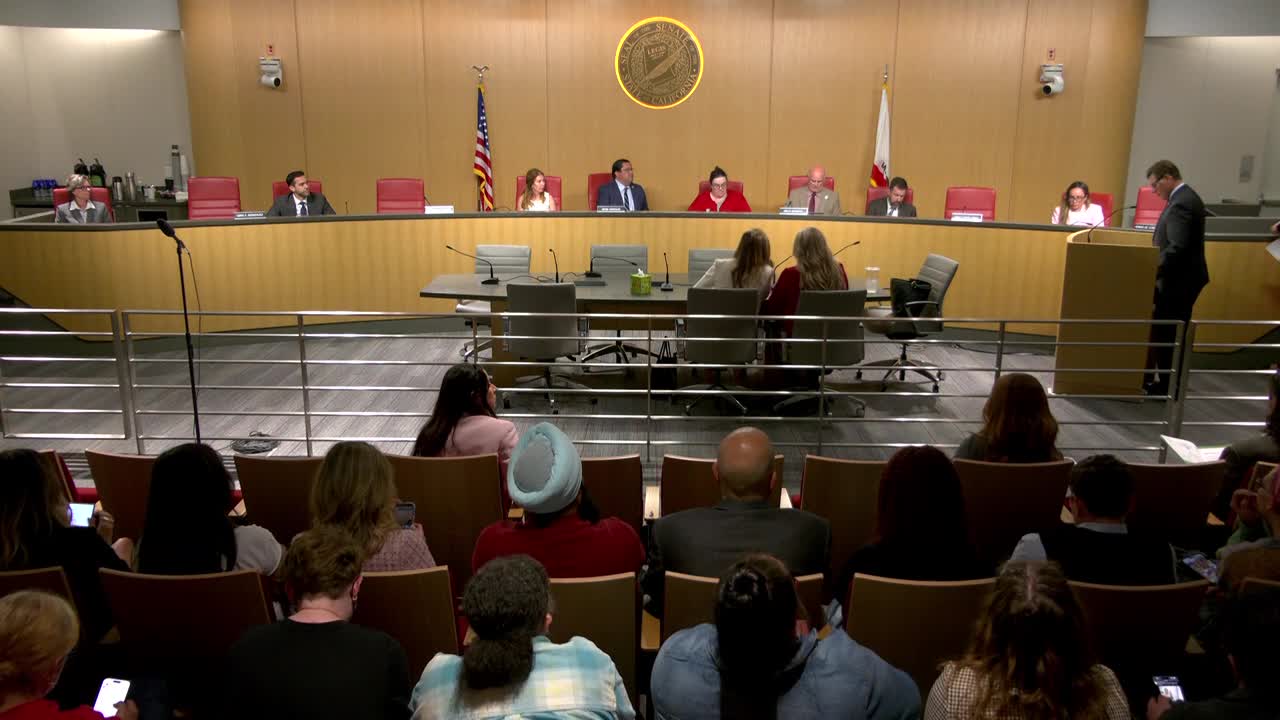 48MIN
Senate Standing Committee on Public Safety
Bill Author