SB 636: Electrical or gas corporations: deferment of payments: hardship.
- Session Year: 2025-2026
- House: Senate
- Latest Version Date: 2025-04-10
Current Status:
Failed
(2026-02-02: Returned to Secretary of Senate pursuant to Joint Rule 56.)
Introduced
In Committee
Awaiting First Chamber Vote
Passed First Chamber
In Committee
Awaiting Second Chamber Vote
Passed Second Chamber
Enacted
What does this bill do?
This bill bars electric and gas companies from shutting off service for three months for residential customers on the CARE or FERA discount programs who make a hardship request because of a family death, loss of full‑time work within 60 days, needed medical care, or damage from a governor‑declared wildfire or other natural disaster. During the three‑month deferment customers won’t be charged interest or extra fees, and when it ends they must join the utility’s arrearage management program or another eligible payment plan; they cannot get another three‑month deferment within 18 months.
The summary is provided by generative AI which can make mistakes. For original language, please view the details in the table below.
Existing law vests the Public Utilities Commission with regulatory jurisdiction over public utilities, including electrical corporations and gas corporations. Existing law prohibits an electrical or gas corporation from disconnecting service for nonpayment by a residential customer receiving a medical baseline allowance, financially unable to pay for service within the normal payment period, willing to enter into an amortization agreement with the corporation with respect to all charges that the customer is unable to pay, and meets certain other requirements.
This bill would prohibit an electrical or gas corporation from disconnecting service of a customer for 6 3 months, if the customer meets certain requirements, as provided. The bill would require the corporation to grant that customer a 6-month 3-month deferment for any and all payments due from the date that the deferment is granted. Upon the expiration of the deferment period, the bill would require the customer to enroll in the electrical or gas corporations arrearage management program or be enrolled in an available payment plan for which the customer is eligible, if the customer is not eligible for the arrearage management plan, for any and all debts on the customers account. The bill would prohibit a customer who participates in the payment deferral from being eligible for a subsequent 3-month payment deferral within 18 months of their participation in the payment deferral. The bill would authorize the commission to adopt rules to implement these provisions.
Under existing law, a violation of the Public Utilities Act or an order, decision, rule, direction, demand, or requirement of the commission is a crime.
Because the provisions of this bill would be a part of the act, a violation of which, or a violation of an order, decision, rule, direction, demand, or requirement of the commission implementing those provisions, would be a crime, the bill would impose a state-mandated local program.
The California Constitution requires the state to reimburse local agencies and school districts for certain costs mandated by the state. Statutory provisions establish procedures for making that reimbursement.
This bill would provide that no reimbursement is required by this act for a specified reason.
Existing law vests the Public Utilities Commission with regulatory jurisdiction over public utilities, including electrical corporations and gas corporations. Existing law prohibits an electrical or gas corporation from disconnecting service for nonpayment by a residential customer receiving a medical baseline allowance, financially unable to pay for service within the normal payment period, willing to enter into an amortization agreement with the corporation with respect to all charges that the customer is unable to pay, and meets certain other requirements.
This bill would prohibit an electrical or gas corporation from disconnecting service of a customer who for 6 months, if the customer meets certain criteria, including making a hardship request based on certain circumstances, requirements, as provided. The bill would require the corporation to grant that customer a 6-month deferment for any and all payments due from the date that the deferment is granted. Upon the expiration of the deferment period, the bill would require the corporation customer to enroll the customer into its in the electrical or gas corporations arrearage management program or be enrolled in an available payment plan for which the customer is eligible, if the customer is not eligible for the arrearage management plan, for any and all debts on the customers account. The bill would authorize the commission to adopt rules to implement these provisions.
Under existing law, a violation of the Public Utilities Act or an order, decision, rule, direction, demand, or requirement of the commission is a crime.
Because the provisions of this bill would be a part of the act, a violation of which, or a violation of an order, decision, rule, direction, demand, or requirement of the commission implementing those provisions, would be a crime, the bill would impose a state-mandated local program.
The California Constitution requires the state to reimburse local agencies and school districts for certain costs mandated by the state. Statutory provisions establish procedures for making that reimbursement.
This bill would provide that no reimbursement is required by this act for a specified reason.
Existing law vests the Public Utilities Commission with regulatory jurisdiction over public utilities, including electrical corporations and gas corporations. Existing law prohibits an electrical or gas corporation from disconnecting service for nonpayment by a residential customer receiving a medical baseline allowance, financially unable to pay for service within the normal payment period, willing to enter into an amortization agreement with the corporation with respect to all charges that the customer is unable to pay, and meets certain other requirements.
This bill would prohibit an electrical or gas corporation from disconnecting service of a customer who meets certain criteria, including making a hardship request based on certain circumstances, as provided. The bill would require the corporation to grant that customer a 6-month deferment for any and all payments due from the date that the deferment is granted. Upon the expiration of the deferment period, the bill would require the corporation to enroll the customer into its arrearage management program for any and all debts on the customers account. The bill would authorize the commission to adopt rules to implement these provisions.
Under existing law, a violation of the Public Utilities Act or an order, decision, rule, direction, demand, or requirement of the commission is a crime.
Because the provisions of this bill would be a part of the act, a violation of which, or a violation of an order, decision, rule, direction, demand, or requirement of the commission implementing those provisions, would be a crime, the bill would impose a state-mandated local program.
The California Constitution requires the state to reimburse local agencies and school districts for certain costs mandated by the state. Statutory provisions establish procedures for making that reimbursement.
This bill would provide that no reimbursement is required by this act for a specified reason.
(a)An electrical or gas corporation shall not disconnect service of a customer for six three months, subject to the provisions of this section, if the customer meets all of the following requirements:
(1)The customer is enrolled in the California Alternative Rates for Energy program or the Family Electric Rate Assistance program at the time of the hardship request.
(2)The customer makes a hardship request pursuant to applicable rules adopted by the commission.
(3)The customers hardship request is due to a hardship that is any of the of the following:
(A)A death in the family or of someone living within the same residence.
(B)The loss of full-time employment within 60 days of the hardship request.
(C)Medical care of the customer, a family member, or someone living within the same residence.
(D)The customers residence, employment, or education is impacted by a wildfire or other natural disaster declared by the Governor to be an emergency pursuant to Section 8558 of the Government Code.
(b)An electrical or gas corporation shall grant to a customer who meets the requirements of subdivision (a), a six-month three-month deferment of any and all payments due from the date of the deferment until the end of the six-month three-month period.
(c)At the conclusion of the six-month three-month deferment period, the eligible customers shall enroll in the arrearage management program of the electrical or gas corporation for any and all debts on the customers account. If the customers are not eligible for the arrearage management program, they will be enrolled in an available payment plan for which they are eligible.
(d)During the six-month three-month deferment period, the customer shall not be charged any interest or additional fees for requesting the deferment.
(e)An electrical or gas corporation shall not request any supportive documents pertaining to the basis of the hardship request. A customer shall be permitted to self-attest.(f)(e)This section is in addition to other relief or debt forgiveness that may be applicable.
(f)A customer who participates in the payment deferral shall not be eligible for a subsequent three-month payment deferral within 18 months of their participation in the payment deferral.
(g)The commission may adopt rules to implement this section.
SEC. 2.No reimbursement is required by this act pursuant to Section 6 of Article XIIIB of the California Constitution because the only costs that may be incurred by a local agency or school district will be incurred because this act creates a new crime or infraction, eliminates a crime or infraction, or changes the penalty for a crime or infraction, within the meaning of Section 17556 of the Government Code, or changes the definition of a crime within the meaning of Section 6 of Article XIIIB of the California Constitution.
(a)An electrical or gas corporation shall not disconnect service of a customer for six months, subject to the provisions of this section, if the customer meets all of the following criteria are met: requirements:
(1)The customer is enrolled in the California Alternative Rates for Energy program or the Family Electric Rate Assistance program at the time of the hardship request.
(1)(2)The customer makes a hardship request pursuant to applicable rules adopted by the commission.
(2)The customer is enrolled in the California Alternative Rates for Energy program or the Family Electric Rate Assistance program at the time of the hardship request.(3)The customers hardship request is due to a hardship that is any of the of the following:
(A)A death in the family or of someone living within the same residence.
(B)The loss of full-time employment within 60 days of the hardship request.
(C)Medical care of the customer, a family member, or someone living within the same residence.
(D)The customers residence, employment, or education is impacted by a wildfire or other natural disaster declared by the Governor to be an emergency pursuant to the California Emergency Services Act (Chapter 7 (commencing with Section 8550) of Division 1 of Title 2 of the Government Code). Section 8558 of the Government Code.
(b)(1)An electrical or gas corporation shall grant to a customer who meets the requirements of subdivision (a), a six-month deferment of any and all payments due from the date the deferment is granted. until the end of the six-month period.
(2)The customer shall not be charged any interest or additional fees for the hardship request.(3)The customer shall be permitted to self-attest to, and the electrical or gas corporation shall not require the customer to submit any supportive document for, the basis of the hardship.(c)Upon the expiration At the conclusion of the six-month deferment period, the electrical or gas corporation shall eligible customers shall enroll the customer into its in the arrearage management program of the electrical or gas corporation for any and all debts on the customers account. If the customers are not eligible for the arrearage management program, they will be enrolled in an available payment plan for which they are eligible.
(d)During the six-month deferment period, the customer shall not be charged any interest or additional fees for requesting the deferment.
(e)An electrical or gas corporation shall not request any supportive documents pertaining to the basis of the hardship request. A customer shall be permitted to self-attest.
(d)(f)This section is in addition to other relief or debt forgiveness that may be applicable.
(e)(g)The commission may adopt rules to implement this section.
SEC. 2.No reimbursement is required by this act pursuant to Section 6 of Article XIIIB of the California Constitution because the only costs that may be incurred by a local agency or school district will be incurred because this act creates a new crime or infraction, eliminates a crime or infraction, or changes the penalty for a crime or infraction, within the meaning of Section 17556 of the Government Code, or changes the definition of a crime within the meaning of Section 6 of Article XIIIB of the California Constitution.
(a)An electrical or gas corporation shall not disconnect service of a customer if all of the following criteria are met:
(1)The customer makes a hardship request pursuant to applicable rules adopted by the commission.
(2)The customer is enrolled in the California Alternative Rates for Energy program or the Family Electric Rate Assistance program at the time of the hardship request.
(3)The customers hardship request is due to a hardship that is any of the of the following:
(A)A death in the family or of someone living within the same residence.
(B)The loss of full-time employment within 60 days of the hardship request.
(C)Medical care of the customer, a family member, or someone living within the same residence.
(D)The customers residence, employment, or education is impacted by a wildfire or other natural disaster declared by the Governor to be an emergency pursuant to the California Emergency Services Act (Chapter 7 (commencing with Section 8550) of Division 1 of Title 2 of the Government Code).
(b)(1)An electrical or gas corporation shall grant to a customer who meets the requirements of subdivision (a), a six-month deferment of any and all payments due from the date the deferment is granted.
(2)The customer shall not be charged any interest or additional fees for the hardship request.
(3)The customer shall be permitted to self-attest to, and the electrical or gas corporation shall not require the customer to submit any supportive document for, the basis of the hardship.
(c)Upon the expiration of the six-month deferment period, the electrical or gas corporation shall enroll the customer into its arrearage management program for any and all debts on the customers account.
(d)This section is in addition to other relief or debt forgiveness that may be applicable.
(e)The commission may adopt rules to implement this section.
SEC. 2.No reimbursement is required by this act pursuant to Section 6 of Article XIIIB of the California Constitution because the only costs that may be incurred by a local agency or school district will be incurred because this act creates a new crime or infraction, eliminates a crime or infraction, or changes the penalty for a crime or infraction, within the meaning of Section 17556 of the Government Code, or changes the definition of a crime within the meaning of Section 6 of Article XIIIB of the California Constitution.
|
Date
|
Status
|
|---|---|
| Feb 2, 2026 | Returned to Secretary of Senate pursuant to Joint Rule 56. |
| May 23, 2025 | May 23 hearing: Held in committee and under submission. |
| May 16, 2025 | Set for hearing May 23. |
| Apr 28, 2025 | April 28 hearing: Placed on APPR. suspense file. |
| Apr 17, 2025 | Set for hearing April 28. |
| Apr 10, 2025 | Read second time and amended. Re-referred to Com. on APPR. |
| Apr 9, 2025 | From committee: Do pass as amended and re-refer to Com. on APPR. (Ayes 13. Noes 3. Page 681.) (April 7). |
| Mar 24, 2025 | From committee with author's amendments. Read second time and amended. Re-referred to Com. on E., U & C. |
| Mar 24, 2025 | Set for hearing April 7. |
| Mar 5, 2025 | Referred to Com. on E., U & C. |
| Feb 21, 2025 | From printer. May be acted upon on or after March 23. |
| Feb 20, 2025 | Introduced. Read first time. To Com. on RLS. for assignment. To print. |
|
Date
|
Description
|
Location
|
Votes
|
|
|---|---|---|---|---|
| Apr 28, 2025 | Placed on suspense file | Senate Standing Committee on Appropriations |
Passed |
|
| Apr 7, 2025 | Do pass as amended, but first amend, and re-refer to the Committee on [Appropriations] | Senate Standing Committee on Energy, Utilities and Communications |
Passed |
This list shows positions taken on this bill by organizations on the date displayed, which is linked to the original source.
Positions by individuals are not included.
|
Organization
|
Position
|
Date
|
|---|---|---|
| Pacific Gas And Electric Company | ** Against | |
| San Diego Gas and Electric Company | ** Against | |
| Smart Justice California | ** Support | |
| Southern California Edison | ** Against | |
| Southern California Gas Company | ** Against | |
| The Utility Reform Network | ** Support |
SENATE COMMITTEE ON
Senator Anna Caballero, Chair
2025 - 2026 Regular Session
SB 636 (Menjivar) - Electrical or gas corporations: deferment of payments: hardship
Version: | Policy Vote: |
Urgency: | Mandate: |
Hearing Date: | Consultant: |
Bill Summary:
This bill would prohibit an electrical or gas corporation from disconnecting service of a customer for three months, if the customer is participating in low-income assistance programs and is experiencing certain hardships, as specified.
Fiscal Impact:
- Potential ongoing costs of an unknown amount (various funds) to the state as an energy utility ratepayer. The State of California is an electricity and gas customer, purchasing roughly one percent of electricity and four percent of natural gas sold in-state. As such, the state incurs costs when energy rates increase. To the extent that the prohibition on disconnecting service as proposed by this bill leads to lower payments from some households than otherwise would occur, it could increase the total amount that must be recovered from other energy customers, including the state as a ratepayer.
- The California Public Utilities Commission (CPUC) anticipates any costs would be minor and absorbable.
Background:
The process of disconnecting service due to nonpayment by an electrical or gas corporation is governed by existing statutory minimum timeline requirements, the practices that were adopted in CPUC Rulemaking 10-02-005, and reflected in Tariff Rule 11 for electric utilities and Rule 9 for gas utilities. In general, the rules require a utility to mail a 15-day written notice to the customer for disconnection due to non-payment. The second step requires a 48-hour written notice mailed to the customer, including an in-person visit for customers on life support or other life-threatening medical condition. Lastly, the utility makes an outbound call on the day of the scheduled disconnection, but before disconnecting service, in order to offer a payment plan option.
There are several programs that provide eligible utility ratepayers with utility bill assistance. They include:
- CARE program – The CARE program provides a discount of up to 35% reduction in utility bills to low-income ratepayers whose income falls below 200% of the federal poverty guidelines.
- FERA program – For household incomes that slightly exceeds the CARE program eligibility, the program provides an 18% line-item discount on electric bills for households whose income falls between 200 and 250% of federal poverty guidelines.
- Medical baseline allowance – Per statute, utilities are required to provide additional baseline allowance of electric or gas service for customers facing life-threatening conditions or on life support. Electric and gas corporations currently administer medical baseline, and, as such, have existing processes for identifying these customers, including requiring physicians and other medical personnel to certify as to the medical condition. Customers on medical baseline are also provided the opportunity to amortize their bill payment, for a period up to 12 months, in order to avoid disconnection of service.
- Payment plan options – In addition to rate assistance programs, utilities provide ratepayers payment plan options that can spread the costs of their bills over a limited time period, generally three months to twelve months, depending on the utility and circumstances.
- Low Income Home Energy Assistance program (LIHEAP) – Federal energy assistance program that helps low-income customers heat their homes. In addition to weatherization services, the program provides one-time assistance funds for ratepayers facing a utility disconnection. The U.S. Congress appropriates funding for LIHEAP, including over $4 billion for 2025, most of which has been sent to states to administer the program. However, recent Trump administration actions, including the recent firing of LIHEAP staff, raise concerns about the ability of the program to provide this critical safety net in future years.
- Energy Savings Assistance (ESA) program – Additionally, there are assistance programs to help reduce energy costs through weatherization improvements and appliance rebates for customers on CARE and FERA.
SB 598 (Hueso, Chapter 362, Statutes of 2017). Prior to the COVID-19 pandemic, the number of utility disconnections due to nonpayment had been trending upwards among the four largest utilities–Pacific Gas & Electric (PG&E), San Diego Gas & Electric (SDG&E), Southern California Edison (SCE), and Southern California Gas Company (SoCalGas). In response to the rise of electric and gas utility disconnections due to nonpayment, the Legislature passed SB 598. The bill prohibited electrical and gas corporations from disconnecting service due to nonpayment from customers facing life-threatening medical conditions when the customer is financially unable to pay for service within the normal payment period and is willing to enter into an amortization agreement. The bill also required the CPUC to adopt rules, policies and regulations with the goal of reducing the statewide level of gas and electric utility service disconnections for nonpayment by residential customers. Additionally, SB 598 required consideration of utility disconnections in utility general rate cases and required the CPUC to submit a report to the Legislature on residential gas and electric service disconnections.
CPUC Rulemaking 18-07-005. In response to SB 598, in July 2018, the CPUC opened a rulemaking proceeding (R. 18-07-005), Order Instituting Rulemaking to Consider New Approaches to Disconnections and Reconnections to Improve Energy Access and Contain Costs. The proceeding has been very active and robust, with many stakeholders participating, including ratepayer organizations, utilities, community choice aggregators, and organizations representing particular stakeholders. The primary goal of the proceeding is to reduce residential disconnections and improve reconnection processes. Within the proceeding there have been several CPUC decisions to require new policies and new pilot programs to address electric and gas residential utility disconnections.
State budget allocates arrearage funding. In 2021 and 2022, the Legislature allocated nearly $2.2 billion to fund the California Arrearages Payment Program to address California energy customer bill arrearages accrued between March 4, 2020 and June 15, 2021.
Proposed Law:
This bill would prohibit an electrical or gas corporation from disconnecting service of a customer for three months, if the customer is participating in low-income assistance programs and is experiencing certain hardships, as specified. In particular, this bill would:
- Prohibit an electrical or gas corporation from disconnecting service of a customer for three months, if the customer experiences specified hardships and meets certain requirements:
- The customer is enrolled in CARE or FERA at the time of the hardship.
- The customer makes a hardship request pursuant to applicable rules adopted by the CPUC.
- The customer’s hardship is due to: a death in the family or residence, the loss of full-time employment within 60 days of the request, medical care of the customer or family member, or the customer’s residence is impacted by wildfire or other natural disaster.
- Require electrical and gas corporations to grant that customer a three-month deferment for any and all payments due from the date that the deferment is granted.
- Require the customer, upon the expiration of the deferment period, to enroll in the electrical or gas corporation’s arrearage management program or be enrolled in an available payment plan for which the customer is eligible, if the customer is not eligible for the arrearage management plan, for any and all debts on the customer’s account.
- Specify that a customer who participates in the payment deferral shall not be eligible for a subsequent three-month payment deferral within 18 months of their participation in the payment deferral.
- Authorize CPUC to adopt rules to implement these provisions.
Related Legislation:
SB 332 (Wahab) of the current legislative session, among its many provisions, would prohibit electric and gas IOUs and POUs from disconnecting customers due to nonpayment when customers meet specified criteria, including whether they are pregnant, have a minor in the home, or someone in the home is 65 years or older.
SB 1142 (Menjivar, Chapter 600, Statutes of 2024) proposed policies related to disconnection of electric and gas utility service, including requiring the CPUC, on or before July 1, 2025, to determine whether to direct electrical and gas corporations to take into account a customer’s ability to pay before terminating or reconnecting services.
SB 1130 (Bradford, Chapter 457, Statutes of 2024) expanded eligibility for the FERA discount program to households with fewer than three members and required specified reporting by electrical corporations about enrollment in the program.
SB 1135 (Bradford, Chapter 413, Statutes of 2018) codified the requirements of an existing low-income electric rate discount program, known as the FERA program, for eligible customers of the state’s three largest electrical corporations and increased the program discount from 12% to 18 % line-item discount on a customer’s electric utility bill.
SB 598 (Hueso, Chapter 362, Statutes of 2017) required the CPUC to adopt rules, policies and regulations with the goal of reducing the statewide level of gas and electric utility service disconnections for nonpayment by residential customers and extends special considerations to residential customers who have specified medical conditions or who have a member of the household with those conditions.
AB 327 (Perea, Chapter 611, Statutes of 2013) restructured the rate design for residential electric customers, including directing the CPUC to establish a discount between 30% and 35% to eligible customers of the large IOUs.
Staff Comments:
The opportunities to provide assistance to customers who are low-income and experience unexpected hardships can serve as an important lifeline for these households. The Utility Reform Network (TURN), the sponsor of this bill, notes that this may also help preserve housing for affected families. However, the potential costs that are needed to sustain such support would necessarily be collected from other customers. As noted above, the CPUC has a very active proceeding on avoiding disconnections due to nonpayment, including piloting various programs and payment plans. The bill sponsor, TURN, is among many other active participants within that proceeding. They note the proceeding is not scoped to include consideration of payment deferments, including as proposed by this bill. The electric and gas IOUs opposed to this bill note the lack of guardrails in this bill to protect nonparticipating customers from costs stemming from the payment deferrals, particularly if combined with assistance from the AMP. Amendments taken in the Senate Energy, Utilities, & Communications committee replace a six-month timeframe with a three month payment deferral, remove the self-attestation language, and limit the customers’ ability to use the payment deferral to no more than once every three years in an effort to limit potential ratepayer impacts.
-- END --
SENATE COMMITTEE ON ENERGY, UTILITIES AND COMMUNICATIONS
Senator Josh Becker, Chair
2025 - 2026 Regular
Bill No: SB 636 Hearing Date: 4/7/2025
Author: | Menjivar | ||
Version: | 3/24/2025 Amended | ||
Urgency: | No | Fiscal: | Yes |
Consultant: | Nidia Bautista | ||
SUBJECT: Electrical or gas corporations: deferment of payments: hardship
DIGEST: This bill prohibits an electrical or gas corporation from disconnecting service of a customer for six months, if the customer is participating in specified low-income assistance programs and is experiencing specified hardships.
ANALYSIS:
Existing law:
- Establishes and vests the California Public Utilities Commission (CPUC) with regulatory authority over public utilities, including electrical and gas corporations. (Article XII of the California Constitution)
- Requires that only an electrical corporation or publicly owned electric utility that provides physical service to the affected customer has the authority to physically disconnect or reconnect a customer from the transmission or distribution grid. Requires that physical disconnection by electrical corporations subject to the CPUC’s jurisdiction occur only in accordance with protocols established by the CPUC. Authorizes the CPUC to adopt additional residential and small commercial consumer protection standards that are in the public interest. (Public Utilities Code §394.4(b))
- Requires the CPUC to develop policies, rules, or regulations with a goal of reducing, by January 1, 2024, the statewide level of gas and electric service disconnections due to nonpayment by residential customers. (Public Utilities Code §718)
- Requires the CPUC to establish a standard limited allowance in addition to the baseline quantity and higher energy allocation of gas and electricity for residential customers dependent on life-support equipment and patients being treated for a life-threatening illness or who have a compromised immune system, if a licensed physician or other specified medical personnel certifies in writing to the ability that the additional heating or cooling allowance is medically necessary to sustain life or prevent deterioration of the person’s medical condition, often referred to as the Medical Baseline Allowance program. (Public Utilities Code §739 (2)(c))
- Establishes the California Alternate Rates for Energy (CARE) program for assistance to low-income electric and gas customers with annual household incomes that are no greater than 200% of the federal poverty guideline levels to ensure low-income ratepayers are not jeopardized or overburdened by monthly energy expenditures. Requires the CARE discount for electrical corporations with 100,000 or more customer accounts in California is not less than 30% or more than 35% of the revenues that would have been produced for the same billed usage by non-CARE customers and requires the entire discount to be provided in the form of a reduction in the overall bill for the eligible CARE customer. (Public Utilities Code §739.1)
- Requires the CPUC to continue a program of assistance to residential customers of the state’s three largest electrical corporations consisting of households of three or more persons with total household annual gross income levels between 200% and 250% of the federal poverty guideline level, which is referred to as the Family Electric Rate Assistance (FERA) program. Requires the FERA program discount to be an 18% line-item discount applied to an eligible customer’s bill calculated at the applicable rate for the billing period. (Public Utilities Code §739.12)
- Requires the CPUC, in order to protect customers from unwarranted disconnection of necessary electric and gas services, to require all electrical and gas utilities through which CARE program rates are available to conduct several actions to increase penetration of the CARE program, including:
- Offer individual payment arrangements that allow customers to pay amounts due over a reasonable period of time, not to exceed 12 months.
- Prohibit disconnection of customers that have made, and are in compliance with, payment arrangements offered by an electric or gas utility or for amounts due in which the utility receives a commitment pledge, letter of intent, purchase order, or other notification that a provider of energy assistance is forwarding payment sufficient to prevent disconnection.
- Advise residential customers about enrollment in the levelizing payment program in conjunction with completion of payment arrangements. (Public Utilities Code §739.4)
- Prohibits an electrical and gas corporation from terminating residential service for nonpayment of a delinquent account unless the corporation first gives notice of the delinquency and impending termination and prohibits an electrical and gas corporation from terminating residential service for nonpayment of a delinquent account: during an investigation of a customer dispute or complaint; when a customer has been granted an extension of the period for payment of a bill; and when a licensed physician or other medical personnel certifies that to do so will be life threatening to the customer and the customer is financially unable to pay for the service within the normal payment period and is willing to enter into an amortization agreement with the corporation. (Public Utilities Code §779)
- Requires every electrical and gas corporation to allow every residential customer at least 19 days from the date of mailing its bill for services, postage prepaid, for payment of the charges demanded. Prohibits a corporation from terminating service for nonpayment of a delinquent account unless the corporation first gives notice of the delinquency and impending termination, at least 10 days prior to the proposed termination, by means of a notice mailed, postage prepaid, to the customer to whom the service is billed, not earlier than 19 days from the date of mailing the corporation’s bill for service, and the 10-day period shall not commence until five days after the mailing of the notice. (Public Utilities Code §779.1)
- Requires every corporation to make a reasonable attempt to contact an adult person residing at the premises of the customer by telephone or personal contact at least 24 hours prior to any termination of service, except when not possible, the corporation shall give a notice of termination of service at least 48 hours prior to termination. (Public Utilities Code §779.1)
- Requires electrical and gas corporations when deciding whether to require a new residential applicant to deposit a sum of money with the corporation prior to establishing an account and furnishing service to be based solely upon the credit worthiness of the applicant. (Public Utilities Code §779.5)
- Prohibits electrical and gas corporations from terminating service due to delinquency in payment of its charges on any Saturday, Sunday, legal holiday, or at any time during which the business offices of the corporation are not open to the public. (Public Utilities Code §780)
- Requires the CPUC, by July 1, 2025, to determine whether to direct electrical and gas corporations to take into account a customer’s ability to pay before terminating service due to nonpayment and other circumstances. Requires the CPUC to consider whether to limit the amount an electrical corporation can collect up to an amount specified by the CPUC. (Public Utilities Code§ 779.7)
This bill:
- Prohibits an electrical or gas corporation from disconnecting service of a customer for six months, if the customer experiences specified hardships and meets certain requirements:
- The customer is enrolled in CARE or FERA at the time of the hardship.
- The customer makes a hardship request pursuant to applicable rules adopted by the CPUC.
- The customer’s hardship is due to: a death in the family or residence, the loss of full-time employment within 60 days of the request, medical care of the customer or family member, or the customer’s residence is impacted by wildfire or other natural disaster.
- Requires electrical and gas corporations to grant that customer a six-month deferment for any and all payments due from the date that the deferment is granted.
- Requires the customer, upon the expiration of the deferment period, to enroll in the electrical or gas corporation’s arrearage management program or be enrolled in an available payment plan for which the customer is eligible, if the customer is not eligible for the arrearage management plan, for any and all debts on the customer’s account.
- Authorizes CPUC to adopt rules to implement these provisions.
Background
Process for disconnecting electric and gas utility service. The process of disconnecting service due to nonpayment by an electrical or gas corporation is governed by existing statutory minimum timeline requirements, the practices that were adopted in CPUC Rulemaking 10-02-005, and reflected in Tariff Rule 11 for electric utilities and Rule 9 for gas utilities. In general, the rules require a utility to mail a 15-day written notice to the customer for disconnection due to non-payment. The second step requires a 48-hour written notice mailed to the customer, including an in-person visit for customers on life support or other life-threatening medical condition. Lastly, the utility makes an outbound call on the day of the scheduled disconnection, but before disconnecting service, in order to offer a payment plan option.
Utility bill assistance. There are several programs that provide eligible utility ratepayers with utility bill assistance. They include:
- CARE program – The CARE program provides a discount of up to 35% reduction in utility bills to low-income ratepayers whose income falls below 200% of the federal poverty guidelines.
- FERA program – For household incomes that slightly exceeds the CARE program eligibility, the program provides an 18% line-item discount on electric bills for households whose income falls between 200 and 250% of federal poverty guidelines.
- Medical baseline allowance – Per statute, utilities are required to provide additional baseline allowance of electric or gas service for customers facing life-threatening conditions or on life support. Electric and gas corporations currently administer medical baseline, and, as such, have existing processes for identifying these customers, including requiring physicians and other medical personnel to certify as to the medical condition. Customers on medical baseline are also provided the opportunity to amortize their bill payment, for a period up to 12 months, in order to avoid disconnection of service.
- Payment plan options – In addition to rate assistance programs, utilities provide ratepayers payment plan options that can spread the costs of their bills over a limited time period, generally three months to twelve months, depending on the utility and circumstances.
- Low Income Home Energy Assistance program (LIHEAP) – Federal energy assistance program that helps low-income customers heat their homes. In addition to weatherization services, the program provides one-time assistance funds for ratepayers facing a utility disconnection. The U.S. Congress appropriates funding for LIHEAP, including over $4 billion for 2025, most of which has been sent to states to administer the program. However, recent Trump administration actions, including the recent firing of LIHEAP staff, raise concerns about the ability of the program to provide this critical safety net in future years.
- Energy Savings Assistance (ESA) program – Additionally, there are assistance programs to help reduce energy costs through weatherization improvements and appliance rebates for customers on CARE and FERA.
SB 598 (Hueso, Chapter 362, Statutes of 2017). Prior to the COVID-19 pandemic, the number of utility disconnections due to nonpayment had been trending upwards among the four largest utilities–Pacific Gas & Electric (PG&E), San Diego Gas & Electric (SDG&E), Southern California Edison (SCE), and Southern California Gas Company (SoCalGas). In response to the rise of electric and gas utility disconnections due to nonpayment, the Legislature passed SB 598. The bill prohibited electrical and gas corporations from disconnecting service due to nonpayment from customers facing life-threatening medical conditions when the customer is financially unable to pay for service within the normal payment period and is willing to enter into an amortization agreement. The bill also required the CPUC to adopt rules, policies and regulations with the goal of reducing the statewide level of gas and electric utility service disconnections for nonpayment by residential customers. Additionally, SB 598 required consideration of utility disconnections in utility general rate cases and required the CPUC to submit a report to the Legislature on residential gas and electric service disconnections.
CPUC Rulemaking 18-07-005. In response to SB 598, in July 2018, the CPUC opened a rulemaking proceeding (R. 18-07-005), Order Instituting Rulemaking to Consider New Approaches to Disconnections and Reconnections to Improve Energy Access and Contain Costs. The proceeding has been very active and robust, with many stakeholders participating, including ratepayer organizations, utilities, community choice aggregators, and organizations representing particular stakeholders. The primary goal of the proceeding is to reduce residential disconnections and improve reconnection processes. Within the proceeding there have been several CPUC decisions to require new policies and new pilot programs to address electric and gas residential utility disconnections. Overlapping the timing of these decisions are related policies to address the COVID-19 pandemic. Specifically:
- Decision (D.) 18-12-013 – established interim rules to reduce residential disconnections by the large utilities. These policies included a cap on disconnections based on 2017 recorded levels; extension of extreme weather conditions to 72 hours; and expanded the definition of vulnerable customers.
- Executive Order (E.O.) N-33-20 – Beginning in March 2020, as the COVID-19 pandemic disrupted life across the globe, interim policies were put in place that included an E.O. by the Governor directing utilities and the CPUC to implement emergency customer protections to address the public health crisis.
- CPUC Resolution M-4842 – In April 2020, the CPUC adopted resolution M-4842 ratifying the emergency customer protections to address the COVID-19 emergency, including a moratorium on electric and gas disconnections.
- CPUC D. 20-06-003 – In June 2020, the CPUC adopted ongoing rules to reduce residential disconnections by the large utilities. The decision also requires large utilities to enroll eligible customers in all applicable utility programs, required payment plans of 12-month periods, and prohibits disconnections if a customer has a LIHEAP pledge for assistance. The decision also prohibits electrical and gas corporations from requiring service deposits or reestablishment of service deposit and precluded utilities from charging reconnection fees. The decision also created an Arrearage Management Plan (AMP) that gives customers the opportunity for a payment plan option that retires debt. The decision also mandated an enforcement program.
- CPUC Resolution M-4849 – In February 2021, the CPUC adopted resolution M-4849 which extended the moratorium on disconnections due to nonpayment until June 30, 2021.
- CPUC D. 21-06-036 – In June 2021, the CPUC extended the moratorium until September 30, 2021 and ordered all electric and gas utilities to automatically enroll residential and small business customers with arrearages more than 60 days past due in long-term payment plans (referred to as COVID payment plans).
- State Budget allocates arrearage funding – In 2021 and 2022, the Legislature allocated nearly $2.2 billion to fund the California Arrearages Payment Program (CAPP) to address California energy customer bill arrearages accrued between March 4, 2020 and June 15, 2021.
- CPUC D. 21-10-012 – In October 2021, the CPUC approved a Percentage of Income Payment Plans (PIPP) pilot programs for the large energy utilities.
- CPUC D. 22-04-037 – In April 2022, the CPUC decision required the development of a Community-Based Organization Arrears Case Management Pilot Program.
- CPUC D. 22-08-037 – In August 2022, the CPUC approved a decision to address residential disconnection protections for the small jurisdictional electrical and gas corporations.
- CPUC D. 22-08-049 – In August 2023, the CPUC adopted a decision that required the large utilities to offer 24-month payment plans to residential customers until October 1, 2026, extends the AMP program to October 1, 2026, and authorized a study of the eligible population for the Medical Baseline program in the large utilities’ service territories.
- Currently, the CPUC is in the midst of considering the requirements from SB 1142 (Menjivar, Chapter 600, Statutes of 2024) which required the CPUC, on or before July 1, 2025, to determine whether to direct electrical and gas corporations to take into account a customer’s ability to pay before terminating or reconnecting services and whether to cap the amount the corporation can collect from the customer.
More on CPUC programs adopted in the above decisions to help customers:
AMP. CPUC requires utilities to administer an AMP program that allow customers with utility debt to make on-time payments, after 12 on-time payments, the customer’s debt (arrearage) will be fully forgiven. The program is available to CARE and FERA customers who are protected from utility disconnection while participating AMP. Participants can have a maximum of $8,000 of utility debt forgiven, per successful completion of the AMP program. Arrears must be at least 90 days with electric customers having more than $500 of debt and gas customers $250 minimum in arrears. AMP is extended to October 1, 2026. Afterwards, the CPUC will initiate a proceeding to consider whether to continue, terminate, or modify the program, informed by an evaluation of the program.
PIPP pilot program. The goal of the PIPP pilot program is to test whether a PIPP program can; (i) reduce the number of low-income households at risk of disconnection, (ii) encourage participation in energy savings ad energy management programs, (iii) increase access to essential levels of energy service, (iv) control program costs. CPUC ordered large utilities to implement pilot programs to reduce residential disconnection of electric and gas service. A PIPP is a program that sets a participant’s utility bill payment amounts at an affordable percentage of the participant’s monthly income. Participants receive a monthly bill cap for current electricity and gas charges based on four percent of their household’s monthly income tiers: 0-100% of Federal Poverty Guidelines, and 101-200% of Federal Poverty Guidelines. The CPUC directed utilities to enroll a total of 15,000 participants for 48 months to test whether a PIPP program can reduce the number of low-income households at risk of disconnection, encourage participation in energy saving and energy management programs, increase access to essential levels of energy service, and control program costs. The CPUC has required an evaluation of the PIPP to assess whether it is effective at meeting the program’s goals.
Payment Plans extended to 24-Months. CPUC D. 22-08-049 required large utilities to offer 24-month payment plans to eligible residential customers until October 1, 2026. Eligible residential customers should be defined as customers with unpaid bills at least 60 days past due and who are not enrolled in a payment plan, a net energy metering tariff, levelized billing, budget billing, or automatic billing. Allows customers to miss two payments before being removed from the payment plan, missed payment amounts will be amortized and added to the remaining payments, utilities shall not disconnect any residential customers who is current on both monthly bills and the 24-month payment plan, a utility may offer the 24-month payment plan to customers to fulfill the requirements of D. 20-06-003, and a customer may elect to participate in the 24-month payment plan more than once.
Comments
Need for this bill. The author and sponsor of this bill contends that many households in California live on the margins and are vulnerable to the financial impacts of unexpected hardships, including death in the household, hospitalization, job loss, and natural disasters. They contend that these customers would benefit from this bill’s provisions to defer payments for six months when they endure a hardship. They argue this is assistance that is also necessary to maintain the customer’s home, as many renters must maintain utility service to continue renting their dwelling per their lease agreements with the landlords. The sponsor and author note that customer arrearages among the state’s four large electric and gas IOUs have increased 24% 2019, and are up seven percent just in the last year. Approximately 4.3325 million households were in arrears in 2023 – over a million more than in 2019.
Rate payer impacts. The opportunities to provide assistance to customers who are low-income and experience unexpected hardships can serve as an important lifeline for these households. As the sponsor notes, this may also help preserve housing for affected families. However, the potential costs that are needed to sustain such support would necessarily be collected from other customers. As noted above, the CPUC has a very active proceeding on avoiding disconnections due to nonpayment, including piloting various programs and payment plans. The Utility Reform Network (TURN), the sponsor of this bill, is among many other active participants within that proceeding. They note the proceeding is not scoped to include consideration of payment deferments, including as proposed by this bill. The electric and gas IOUs opposed to this bill note the lack of guardrails in this bill to protect nonparticipating customers from costs stemming from the payment deferrals, particularly if combined with assistance from the AMP. They have also raised concerns about the administrative challenges with collecting and maintaining customer information related to the experienced hardships, but also raise concerns about this bill requiring customer self-attestation as to these hardships.
Need for amendments. The author and committee members may wish to amend this bill to provide additional guardrails in order to reduce the risk of increasing costs on nonparticipating customers. Specifically, the author and committee may wish to amend this bill in the following ways:
- Replace the six month timeframe with three month payment deferral.
- Remove the self-attestation language.
- Limit the customers’ ability to use the payment deferral to no more than once every three years.
Prior/Related Legislation
SB 332 (Wahab) of the current legislative session, among its many provisions, prohibits electric and gas IOUs and POUs from disconnecting customers due to nonpayment when customers meet specified criteria, including whether they are pregnant, have a minor in the home, or someone in the home is 65 years or older.
SB 1142 (Menjivar, Chapter 600, Statutes of 2024) proposed policies related to disconnection of electric and gas utility service, including requiring the CPUC, on or before July 1, 2025, to determine whether to direct electrical and gas corporations to take into account a customer’s ability to pay before terminating or reconnecting services.
SB 1130 (Bradford, Chapter 457, Statutes of 2024) expanded eligibility for the FERA discount program to households with fewer than three members and required specified reporting by electrical corporations about enrollment in the program.
SB 1135 (Bradford, Chapter 413, Statutes of 2018) codified the requirements of an existing low-income electric rate discount program, known as the FERA program, for eligible customers of the state’s three largest electrical corporations and increased the program discount from 12% to 18 % line-item discount on a customer’s electric utility bill.
SB 598 (Hueso, Chapter 362, Statutes of 2017) required the CPUC to adopt rules, policies and regulations with the goal of reducing the statewide level of gas and electric utility service disconnections for nonpayment by residential customers and extends special considerations to residential customers who have specified medical conditions or who have a member of the household with those conditions.
AB 327 (Perea, Chapter 611, Statutes of 2013) restructured the rate design for residential electric customers, including directing the CPUC to establish a discount between 30% and 35% to eligible customers of the large IOUs.
FISCAL EFFECT: Appropriation: No Fiscal Com.: Yes Local: Yes
SUPPORT:
The Utility Reform Network (Sponsor)
Smart Justice California
OPPOSITION:
Pacific Gas and Electric Company
San Diego Gas and Electric Company
Southern California Edison
Southern California Gas Company
ARGUMENTS IN SUPPORT: According to TURN:
With the high cost of living in California, many households live so close to the margins that a hospitalization, job loss, or funeral expenses, for example, can make it nearly impossible to make ends meet. At TURN, we are often contacted by customers whose ability to pay their utility bill comes with a tradeoff of other necessities, such as groceries, medicine, medical care, childcare and transportation. If these customers experience a hardship, they will be unable to pay their utility bill and will be at risk of disconnection, and the health and safety consequences that are associated with living without power. In California, a state with 44% renter occupied housing, standard lease agreements assign responsibility for maintaining utility payments to the tenant. If a lease states that the tenant is responsible for paying gas and electric utilities, then being disconnected from utility service for nonpayment is a violation of the lease and grounds for eviction. The relationship between utility disconnections and housing insecurity is why SB 636 is so important. By providing immediate relief when a customer experiences serious hardship, SB 636 will help customers avoid disconnection, and in turn, reduce housing insecurity and homelessness.
ARGUMENTS IN OPPOSITION: The joint IOUs opposed to this bill argue this bill is duplicative, unnecessary, and lacks guardrails to protect nonparticipating customers. They state:
The Joint Utilities work with customers to find solutions that help them avoid disconnection of service. The goal of any policy change related to this issue should be to address the overall cost of energy in a holistic manner, improve a customers' ability to effectively manage and decrease their arrearages and likelihood of future potential disconnections, and mitigate unintended consequences with fraudulent hardship requests. SB 636 fails at solving these issues and for these reasons, the Joint Utilities oppose this bill and respectfully urge a ‘No’ vote.
-- END --
Discussed in Hearing
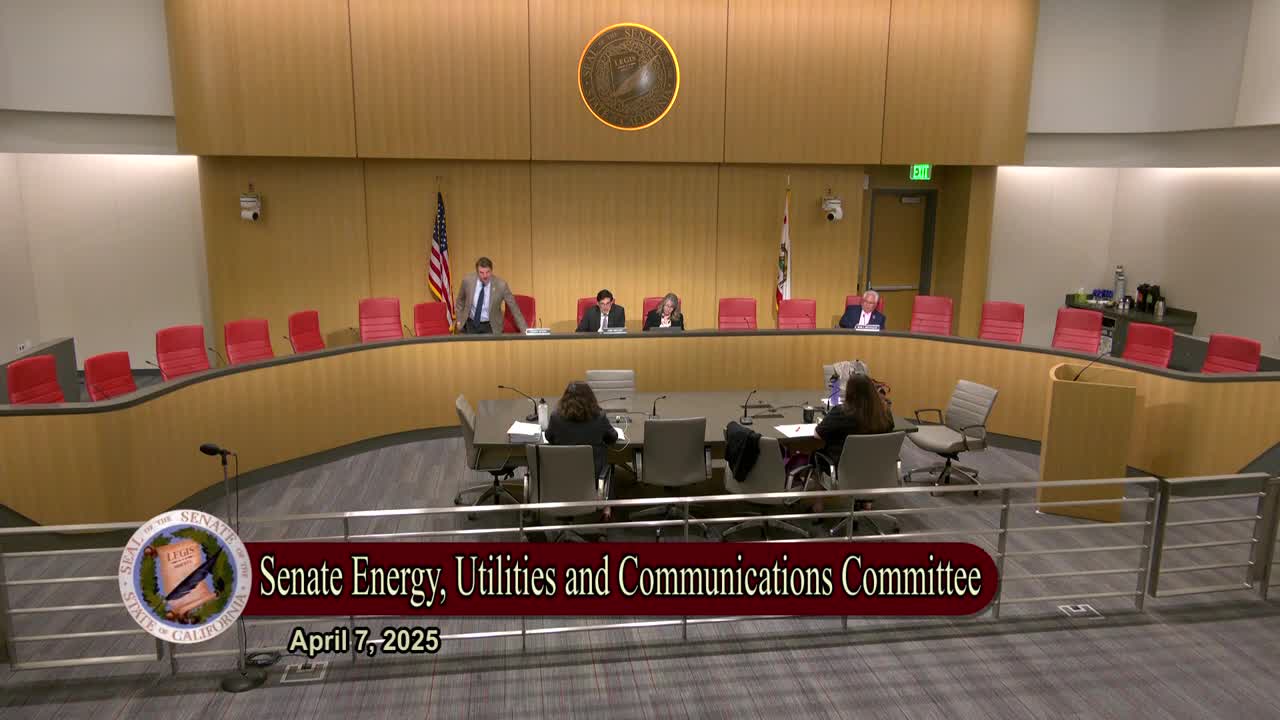 15MIN
Senate Standing Committee on Energy, Utilities and Communications
Bill Author
Bill Co-Author(s):