SB 986: Major regulations.
- Session Year: 2025-2026
- House: Senate
- Latest Version Date: 2026-04-15
Current Status:
In Progress
(2026-05-14: May 14 hearing: Held in committee and under submission.)
Introduced
In Committee
Awaiting First Chamber Vote
Passed First Chamber
In Committee
Awaiting Second Chamber Vote
Passed Second Chamber
Enacted
What does this bill do?
The bill gives the Legislature new oversight of “major regulations” (rules with an economic impact over $50 million) by requiring agencies to send rulemaking materials to both houses and pausing a major rule’s effect while the Legislature reviews it for 60 business days. The Legislature must hold an informational hearing, may reject a major rule by concurrent resolution (a resolution adopted by both houses), and the Office of Administrative Law must identify major rules and prepare its own economic impact analysis.
The summary is provided by generative AI which can make mistakes. For original language, please view the details in the table below.
(1)Existing law, known as the Administrative Procedure Act (APA), governs the procedures for the adoption, amendment, or repeal of regulations by state agencies and for the review of those regulatory actions by the Office of Administrative Law (OAL). The APA requires a state agency proposing to adopt, amend, or repeal an administrative regulation to, among other things, assess the potential for adverse economic impact on California business enterprises and individuals, and requires a state agency proposing to adopt, amend, or repeal a major regulation to prepare and submit to the Department of Finance for review, a standardized regulatory impact analysis, as provided. The APA defines major regulation, for purposes of the act, to mean any proposed adoption, amendment, or repeal of a regulation subject to review by the OAL that will have an economic impact on California business enterprises and individuals in an amount exceeding $50,000,000, as provided. The APA provides exceptions for emergency regulations in the case of a situation that calls for immediate action to avoid serious harm to the public peace, health, safety, or general welfare.
This bill would prohibit a major regulation from taking effect until the Legislature enacts a law to approve the regulation, submission to, and expiration of a 60-day review period by, the Legislature, except as provided for emergency regulations. The bill would, prior to the expiration of the 60-day review period, require the Legislature to hold an informational hearing on the major regulation. The bill would authorize the Legislature to reject a major regulation during the review period by adoption of a concurrent resolution, and would prohibit a major regulation that has been rejected from taking effect, as specified. If the Legislature fails to enact does not adopt a law to approve concurrent resolution rejecting the regulation or does not vote on the regulation within 60 days of receiving the regulation from the office, within the 60-day review period, the bill would require that the regulation be deemed disapproved. become effective.
(2)The APA requires every agency subject to its provisions to prepare, submit to the OAL with the notice of proposed action, as specified, and make available to the public upon request, specified information, including an initial statement of reasons for proposing the adoption, amendment, or repeal of a regulation. The APA requires a state agency proposing to adopt, amend, or repeal a major regulation to satisfy additional requirements, including by requiring the state agency to prepare a standardized regulatory impact analysis in the manner prescribed by the Department of Finance, as specified. The APA requires the OAL to review all regulations adopted, amended, or repealed and submitted to it for publication in the California Code of Regulations Supplement and for transmittal to the Secretary of State and make determinations using all of the specified standards, including necessity.
This bill would require every agency subject to its provisions to also submit the above-described specified information to the Legislature and would remove the condition that the information be prepared, submitted, and made available upon request. The bill would require the notice of proposed action to include a determination of whether the regulation is a major regulation, as specified, and would require the standardized regulatory impact analysis for a major regulation to address, among other things, the estimated effect on state revenue. The bill would additionally require the OAL to use the standard of economic impact to make determinations and would require the OAL to make an independent determination as to whether the proposed regulation is a major regulation, as provided. For each major regulation, the bill would require the OAL to produce an independent regulatory impact analysis conducted in the same manner and including the same considerations as the above-described standardized regulatory impact analysis and would require the OAL to submit that analysis to the Legislature and the major regulation for approval or disapproval.
(1)Existing law, known as the Administrative Procedure Act (APA), governs the procedures for the adoption, amendment, or repeal of regulations by state agencies and for the review of those regulatory actions by the Office of Administrative Law (OAL). The APA requires a state agency proposing to adopt, amend, or repeal an administrative regulation to, among other things, assess the potential for adverse economic impact on California business enterprises and individuals, and requires a state agency proposing to adopt, amend, or repeal a major regulation to prepare and submit to the Department of Finance for review, a standardized regulatory impact analysis, as provided. The APA defines major regulation, for purposes of the act, to mean any proposed adoption, amendment, or repeal of a regulation subject to review by the OAL that will have an economic impact on California business enterprises and individuals in an amount exceeding $50,000,000, as provided. The APA provides exceptions for emergency regulations in the case of a situation that calls for immediate action to avoid serious harm to the public peace, health, safety, or general welfare.
This bill would prohibit a major regulation from taking effect until the Legislature enacts a law to approve the regulation, except as provided for emergency regulations. If the Legislature fails to enact a law to approve the regulation or does not vote on the regulation within 60 days of receiving the regulation from the office, the bill would require that the regulation be deemed disapproved.
(2)The APA requires every agency subject to its provisions to prepare, submit to the OAL with the notice of proposed action, as specified, and make available to the public upon request, specified information, including, including an initial statement of reasons for proposing the adoption, amendment, or repeal of a regulation. The APA requires a state agency proposing to adopt, amend, or repeal a major regulation to satisfy additional requirements, including by requiring the state agency to prepare a standardized regulatory impact analysis in the manner prescribed by the Department of Finance, as specified. The APA requires the OAL to review all regulations adopted, amended, or repealed and submitted to it for publication in the California Code of Regulations Supplement and for transmittal to the Secretary of State and make determinations using all of the specified standards, including necessity.
This bill would require every agency subject to its provisions to also submit the above-described specified information to the Legislature and would remove the condition that the information be prepared, submitted, and made available upon request. The bill would require the notice of proposed action to include a determination of whether the regulation is a major regulation, as specified, and would require the standardized regulatory impact analysis for a major regulation to address, among other things, the estimated effect on state revenue. The bill would additionally require the OAL to use the standard of economic impact to make determinations and would require the OAL to make an independent determination as to whether the proposed regulation is a major regulation, as provided. For each major regulation, the bill would require the OAL to produce an independent regulatory impact analysis conducted in the same manner and including the same considerations as the above-described standardized regulatory impact analysis, analysis and would require the OAL to submit that analysis to the Legislature and the major regulation for approval or disapproval.
(3)The APA authorizes any interested person to obtain a judicial declaration as to the validity of any regulation or order of repeal by bringing an action for declaratory relief, as specified. In any action for declaratory relief brought with respect to a regulation or order of repeal, the APA prohibits a court from considering the approval of a regulation or order of repeal by the OAL or the Governors overruling of a decision of the OAL disapproving a regulation or order of repeal. The APA authorizes a court to consider only specified evidence, including any evidence relevant to whether a regulation used by an agency is required to be adopted under the provisions of the APA.This bill would authorize a court to consider the agencys determination of whether a regulation is a major regulation that requires legislative approval under the provisions of this bill.(1)Existing law, known as the Administrative Procedure Act (APA), governs the procedures for the adoption, amendment, or repeal of regulations by state agencies and for the review of those regulatory actions by the Office of Administrative Law (OAL). The APA requires a state agency proposing to adopt, amend, or repeal an administrative regulation to, among other things, assess the potential for adverse economic impact on California business enterprises and individuals, and requires a state agency proposing to adopt, amend, or repeal a major regulation to prepare and submit to the Department of Finance for review, a standardized regulatory impact analysis, as provided. The APA defines major regulation, for purposes of the act, to mean any proposed adoption, amendment, or repeal of a regulation subject to review by the OAL that will have an economic impact on California business enterprises and individuals in an amount exceeding $50,000,000, as provided. The APA provides exceptions for emergency regulations in the case of a situation that calls for immediate action to avoid serious harm to the public peace, health, safety, or general welfare.
This bill would prohibit a major regulation from taking effect until the Legislature enacts a law to approve the regulation, except as provided for emergency regulations. If the Legislature fails to enact a law to approve the regulation or does not vote on the regulation within 60 days of receiving the regulation from the office, the bill would require that the regulation be deemed disapproved.
(2)The APA requires every agency subject to its provisions to prepare, submit to the OAL with the notice of proposed action, as specified, and make available to the public upon request, specified information, including, an initial statement of reasons for proposing the adoption, amendment, or repeal of a regulation. The APA requires a state agency proposing to adopt, amend, or repeal a major regulation to satisfy additional requirements, including by requiring the state agency to prepare a standardized regulatory impact analysis in the manner prescribed by the Department of Finance, as specified. The APA requires the OAL to review all regulations adopted, amended, or repealed and submitted to it for publication in the California Code of Regulations Supplement and for transmittal to the Secretary of State and make determinations using all of the specified standards, including necessity.
This bill would require every agency subject to its provisions to also submit the above-described specified information to the Legislature and would remove the condition that the information be prepared, submitted, and made available upon request. The bill would require the notice of proposed action to include a determination of whether the regulation is a major regulation, as specified, and would require the standardized regulatory impact analysis for a major regulation to address, among other things, the estimated effect on state revenue. The bill would additionally require the OAL to use the standard of economic impact to make determinations and would require the OAL to make an independent determination as to whether the proposed regulation is a major regulation, as provided. For each major regulation, the bill would require the OAL to produce an independent regulatory impact analysis conducted in the same manner and including the same considerations as the above-described standardized regulatory impact analysis, and would require the OAL to submit that analysis to the Legislature and the major regulation for approval or disapproval.
(3)The APA authorizes any interested person to obtain a judicial declaration as to the validity of any regulation or order of repeal by bringing an action for declaratory relief, as specified. In any action for declaratory relief brought with respect to a regulation or order of repeal, the APA prohibits a court from considering the approval of a regulation or order of repeal by the OAL or the Governors overruling of a decision of the OAL disapproving a regulation or order of repeal. The APA authorizes a court to consider only specified evidence, including any evidence relevant to whether a regulation used by an agency is required to be adopted under the provisions of the APA.
This bill would authorize a court to consider the agencys determination of whether a regulation is a major regulation that requires legislative approval under the provisions of this bill.
Every agency subject to this chapter shall prepare, submit to the office and each house of the Legislature with the notice of the proposed action as described in Section 11346.5, and make available to the public all of the following:
(a)A copy of the express terms of the proposed regulation.
(1)The agency shall draft the regulation in plain, straightforward language, avoiding technical terms as much as possible, and using a coherent and easily readable style. The agency shall draft the regulation in plain English.
(2)The agency shall include a notation following the express terms of each California Code of Regulations section, listing the specific statutes or other provisions of law authorizing the adoption of the regulation and listing the specific statutes or other provisions of law being implemented, interpreted, or made specific by that section in the California Code of Regulations.
(3)The agency shall use underline or italics to indicate additions to, and strikeout to indicate deletions from, the California Code of Regulations.
(b)An initial statement of reasons for proposing the adoption, amendment, or repeal of a regulation. This statement of reasons shall include, but not be limited to, all of the following:
(1)A statement of the specific purpose of each adoption, amendment, or repeal, the problem the agency intends to address, and the rationale for the determination by the agency that each adoption, amendment, or repeal is reasonably necessary to carry out the purpose and address the problem for which it is proposed. The statement shall enumerate the benefits anticipated from the regulatory action, including the benefits or goals provided in the authorizing statute. These benefits may include, to the extent applicable, nonmonetary benefits such as the protection of public health and safety, worker safety, or the environment, the prevention of discrimination, the promotion of fairness or social equity, and the increase in openness and transparency in business and government, among other things. Where the adoption or amendment of a regulation would mandate the use of specific technologies or equipment, a statement of the reasons why the agency believes these mandates or prescriptive standards are required.
(2)(A)For a regulation that is not a major regulation, the economic impact assessment required by subdivision (b) of Section 11346.3.
(B)For a major regulation proposed on or after November 1, 2013, the standardized regulatory impact analysis required by subdivision (c) of Section 11346.3.
(3)An identification of each technical, theoretical, and empirical study, report, or similar document, if any, upon which the agency relies in proposing the adoption, amendment, or repeal of a regulation.
(4)(A)A description of reasonable alternatives to the regulation and the agencys reasons for rejecting those alternatives. Reasonable alternatives to be considered include, but are not limited to, alternatives that are proposed as less burdensome and equally effective in achieving the purposes of the regulation in a manner that ensures full compliance with the authorizing statute or other law being implemented or made specific by the proposed regulation. In the case of a regulation that would mandate the use of specific technologies or equipment or prescribe specific actions or procedures, the imposition of performance standards shall be considered as an alternative.
(B)A description of reasonable alternatives to the regulation that would lessen any adverse impact on small business and the agencys reasons for rejecting those alternatives.
(C)Notwithstanding subparagraph (A) or (B), an agency is not required to artificially construct alternatives or describe unreasonable alternatives.
(5)(A)Facts, evidence, documents, testimony, or other evidence on which the agency relies to support an initial determination that the action will not have a significant adverse economic impact on business.
(B)(i)If a proposed regulation is a building standard, the initial statement of reasons shall include the estimated cost of compliance, the estimated potential benefits, and the related assumptions used to determine the estimates.
(ii)The model codes adopted pursuant to Section 18928 of the Health and Safety Code shall be exempt from the requirements of this subparagraph. However, if an interested party has made a request in writing to the agency, at least 30 days before the submittal of the initial statement of reasons, to examine a specific section for purposes of estimating the cost of compliance and the potential benefits for that section, and including the related assumptions used to determine the estimates, then the agency shall comply with the requirements of this subparagraph with regard to that requested section.
(6)A department, board, or commission within the Environmental Protection Agency, the Natural Resources Agency, or the Office of the State Fire Marshal shall describe its efforts, in connection with a proposed rulemaking action, to avoid unnecessary duplication or conflicts with federal regulations contained in the Code of Federal Regulations addressing the same issues. These agencies may adopt regulations different from federal regulations contained in the Code of Federal Regulations addressing the same issues upon a finding of one or more of the following justifications:
(A)The differing state regulations are authorized by law.
(B)The cost of differing state regulations is justified by the benefit to human health, public safety, public welfare, or the environment.
(c)A state agency that adopts or amends a regulation mandated by federal law or regulations, the provisions of which are identical to a previously adopted or amended federal regulation, shall be deemed to have complied with subdivision (b) if a statement to the effect that a federally mandated regulation or amendment to a regulation is being proposed, together with a citation to where an explanation of the regulation can be found, is included in the notice of proposed adoption or amendment prepared pursuant to Section 11346.5. However, the agency shall comply fully with this chapter with respect to any provisions in the regulation that the agency proposes to adopt or amend that are different from the corresponding provisions of the federal regulation.
(d)This section shall be inoperative from January 1, 2012, until January 1, 2014.
SEC. 2.Section 11346.3 of the Government Code is amended to read:11346.3.(a)A state agency proposing to adopt, amend, or repeal any administrative regulation shall assess the potential for adverse economic impact on California business enterprises and individuals, avoiding the imposition of unnecessary or unreasonable regulations or reporting, recordkeeping, or compliance requirements. For purposes of this subdivision, assessing the potential for adverse economic impact shall require agencies, when proposing to adopt, amend, or repeal a regulation, to adhere to the following requirements, to the extent that these requirements do not conflict with other state or federal laws:
(1)The proposed adoption, amendment, or repeal of a regulation shall be based on adequate information concerning the need for, and consequences of, proposed governmental action.
(2)The state agency, before submitting a proposal to adopt, amend, or repeal a regulation to the office, shall consider the proposals impact on business, with consideration of industries affected including the ability of California businesses to compete with businesses in other states. For purposes of evaluating the impact on the ability of California businesses to compete with businesses in other states, an agency shall consider, but not be limited to, information supplied by interested parties.
(3)An economic impact assessment prepared pursuant to this subdivision for a proposed regulation that is not a major regulation or that is a major regulation proposed before November 1, 2013, shall be prepared in accordance with subdivision (b), and shall be included in the initial statement of reasons as required by Section 11346.2. An economic assessment prepared pursuant to this subdivision for a major regulation proposed on or after November 1, 2013, shall be prepared in accordance with subdivision (c), and shall be included in the initial statement of reasons as required by Section 11346.2.
(b)(1)A state agency proposing to adopt, amend, or repeal a regulation that is not a major regulation or that is a major regulation proposed before November 1, 2013, shall prepare an economic impact assessment that assesses whether and to what extent it will affect the following:
(A)The creation or elimination of jobs within the state.
(B)The creation of new businesses or the elimination of existing businesses within the state.
(C)The expansion of businesses currently doing business within the state.
(D)The benefits of the regulation to the health and welfare of California residents, worker safety, and the states environment.
(2)This subdivision does not apply to the University of California, the college named in Section 92200 of the Education Code, or the Fair Political Practices Commission.
(3)Information required from a state agency for the purpose of completing the assessment may come from existing state publications.
(4)(A)For purposes of conducting the economic impact assessment pursuant to this subdivision, a state agency may use the consolidated definition of small business in subparagraph (B) in order to determine the number of small businesses within the economy, a specific industry sector, or geographic region. The state agency shall clearly identify the use of the consolidated small business definition in its rulemaking package.
(B)For the exclusive purpose of undertaking the economic impact assessment, a small business means a business that is all of the following:
(i)Independently owned and operated.
(ii)Not dominant in its field of operation.
(iii)Has fewer than 100 employees.
(C)Subparagraph (A) shall not apply to a regulation adopted by the Department of Insurance that applies to an insurance company.
(c)(1)Each state agency proposing to adopt, amend, or repeal a major regulation on or after November 1, 2013, shall prepare a standardized regulatory impact analysis in the manner prescribed by the Department of Finance pursuant to Section 11346.36. The standardized regulatory impact analysis shall address all of the following:
(A)The creation or elimination of jobs within the state.
(B)The creation of new businesses or the elimination of existing businesses within the state.
(C)The competitive advantages or disadvantages for businesses currently doing business within the state.
(D)The estimated effect on state revenue, including the increase or decrease of investment in the state.
(E)The incentives for innovation in products, materials, or processes.
(F)The benefits of the regulations, including, but not limited to, benefits to the health, safety, and welfare of California residents, worker safety, and the states environment and quality of life, among any other benefits identified by the agency.
(G)The estimated cost savings or financial benefits to society.
(H)The estimated compliance costs for regulated entities, including secondary or indirect costs.
(I)The estimated effect on state expenditures, including estimated administrative expenses.
(J)The estimated opportunity cost, including the cost of compliance as a result of the removal of private capital from the market.
(K)The sources consulted, key assumptions, and sources of uncertainty.
(2)This subdivision shall not apply to the University of California, the college named in Section 92200 of the Education Code, or the Fair Political Practices Commission.
(3)Information required from state agencies for the purpose of completing the analysis may be derived from existing state, federal, or academic publications.
(d)Any administrative regulation adopted on or after January 1, 1993, that requires a report shall not apply to businesses, unless the state agency adopting the regulation makes a finding that it is necessary for the health, safety, or welfare of the people of the state that the regulation apply to businesses.
(e)Analyses conducted pursuant to this section are intended to provide agencies and the public with tools to determine whether the regulatory proposal is an efficient and effective means of implementing the policy decisions enacted in statute or by other provisions of law in the least burdensome manner. Regulatory impact analyses shall inform the agencies and the public of the economic consequences of regulatory choices, not reassess statutory policy. The baseline for the regulatory analysis shall be the most cost-effective set of regulatory measures that are equally effective in achieving the purpose of the regulation in a manner that ensures full compliance with the authorizing statute or other law being implemented or made specific by the proposed regulation.
(f)Each state agency proposing to adopt, amend, or repeal a major regulation on or after November 1, 2013, and that has prepared a standardized regulatory impact analysis pursuant to subdivision (c), shall submit that analysis to the Department of Finance upon completion. The department shall comment, within 30 days of receiving that analysis, on the extent to which the analysis adheres to the regulations adopted pursuant to Section 11346.36. Upon receiving the comments from the department, the agency may update its analysis to reflect any comments received from the department and shall summarize the comments and the response of the agency along with a statement of the results of the updated analysis for the statement required by paragraph (10) of subdivision (a) of Section 11346.5.
SEC. 3.Section 11346.5 of the Government Code is amended to read:11346.5.(a)The notice of proposed adoption, amendment, or repeal of a regulation shall include the following:
(1)A statement of the time, place, and nature of proceedings for adoption, amendment, or repeal of the regulation.
(2)Reference to the authority under which the regulation is proposed and a reference to the particular code sections or other provisions of law that are being implemented, interpreted, or made specific.
(3)An informative digest drafted in plain English in a format similar to the Legislative Counsels digest on legislative bills. The informative digest shall include the following:
(A)A concise and clear summary of existing laws and regulations, if any, related directly to the proposed action and of the effect of the proposed action.
(B)If the proposed action differs substantially from an existing comparable federal regulation or statute, a brief description of the significant differences and the full citation of the federal regulations or statutes.
(C)A policy statement overview explaining the broad objectives of the regulation and the specific benefits anticipated by the proposed adoption, amendment, or repeal of a regulation, including, to the extent applicable, nonmonetary benefits such as the protection of public health and safety, worker safety, or the environment, the prevention of discrimination, the promotion of fairness or social equity, and the increase in openness and transparency in business and government, among other things.
(D)An evaluation of whether the proposed regulation is inconsistent or incompatible with existing state regulations.
(4)Any other matters as are prescribed by statute applicable to the specific state agency or to any specific regulation or class of regulations.
(5)A determination as to whether the regulation imposes a mandate on local agencies or school districts and, if so, whether the mandate requires state reimbursement pursuant to Part 7 (commencing with Section 17500) of Division 4.
(6)An estimate, prepared in accordance with instructions adopted by the Department of Finance, of the cost or savings to any state agency, the cost to any local agency or school district that is required to be reimbursed under Part 7 (commencing with Section 17500) of Division 4, other nondiscretionary cost or savings imposed on local agencies, and the cost or savings in federal funding to the state.
For purposes of this paragraph, cost or savings means additional costs or savings, both direct and indirect, that a public agency necessarily incurs in reasonable compliance with regulations.
(7)If a state agency, in proposing to adopt, amend, or repeal any administrative regulation, makes an initial determination that the action may have a significant, statewide adverse economic impact directly affecting business, including the ability of California businesses to compete with businesses in other states, it shall include the following information in the notice of proposed action:
(A)Identification of the types of businesses that would be affected.
(B)A description of the projected reporting, recordkeeping, and other compliance requirements that would result from the proposed action.
(C)The following statement: The (name of agency) has made an initial determination that the (adoption/amendment/repeal) of this regulation may have a significant, statewide adverse economic impact directly affecting business, including the ability of California businesses to compete with businesses in other states. The (name of agency) (has/has not) considered proposed alternatives that would lessen any adverse economic impact on business and invites you to submit proposals. Submissions may include the following considerations:
(i)The establishment of differing compliance or reporting requirements or timetables that take into account the resources available to businesses.
(ii)Consolidation or simplification of compliance and reporting requirements for businesses.
(iii)The use of performance standards rather than prescriptive standards.
(iv)Exemption or partial exemption from the regulatory requirements for businesses.
(8)If a state agency, in adopting, amending, or repealing any administrative regulation, makes an initial determination that the action will not have a significant, statewide adverse economic impact directly affecting business, including the ability of California businesses to compete with businesses in other states, it shall make a declaration to that effect in the notice of proposed action. In making this declaration, the agency shall provide in the record facts, evidence, documents, testimony, or other evidence upon which the agency relies to support its initial determination.
An agencys initial determination and declaration that a proposed adoption, amendment, or repeal of a regulation may have or will not have a significant, adverse impact on businesses, including the ability of California businesses to compete with businesses in other states, shall not be grounds for the office to refuse to publish the notice of proposed action.
(9)A description of all cost impacts, known to the agency at the time the notice of proposed action is submitted to the office, that a representative private person or business would necessarily incur in reasonable compliance with the proposed action.
If no cost impacts are known to the agency, it shall state the following:
The agency is not aware of any cost impacts that a representative private person or business would necessarily incur in reasonable compliance with the proposed action.
(10)A determination of whether the regulation is a major regulation, including an explanation of why it presumptively is or is not a major regulation, a statement of the results of the economic impact assessment required by subdivision (b) of Section 11346.3 or the standardized regulatory impact analysis if required by subdivision (c) of Section 11346.3, a summary of any comments submitted to the agency pursuant to subdivision (f) of Section 11346.3 and the agencys response to those comments.
(11)The finding prescribed by subdivision (d) of Section 11346.3, if required.
(12)(A)A statement that the action would have a significant effect on housing costs, if a state agency, in adopting, amending, or repealing any administrative regulation, makes an initial determination that the action would have that effect.
(B)The agency officer designated in paragraph (14) shall make available to the public, upon request, the agencys evaluation, if any, of the effect of the proposed regulatory action on housing costs.
(C)The statement described in subparagraph (A) shall also include the estimated costs of compliance and potential benefits of a building standard, if any, that were included in the initial statement of reasons.
(D)For purposes of model codes adopted pursuant to Section 18928 of the Health and Safety Code, the agency shall comply with the requirements of this paragraph only if an interested party has made a request to the agency to examine a specific section for purposes of estimating the costs of compliance and potential benefits for that section, as described in Section 11346.2.
(13)A statement that the adopting agency must determine that no reasonable alternative considered by the agency or that has otherwise been identified and brought to the attention of the agency would be more effective in carrying out the purpose for which the action is proposed, would be as effective and less burdensome to affected private persons than the proposed action, or would be more cost effective to affected private persons and equally effective in implementing the statutory policy or other provision of law. For a major regulation, as defined by Section 11342.548, proposed on or after November 1, 2013, the statement shall be based, in part, upon the standardized regulatory impact analysis of the proposed regulation, as required by Section 11346.3, as well as upon the benefits of the proposed regulation identified pursuant to subparagraph (C) of paragraph (3).
(14)The name and telephone number of the agency representative and designated backup contact person to whom inquiries concerning the proposed administrative action may be directed.
(15)The date by which comments submitted in writing must be received to present statements, arguments, or contentions in writing relating to the proposed action in order for them to be considered by the state agency before it adopts, amends, or repeals a regulation.
(16)Reference to the fact that the agency proposing the action has prepared a statement of the reasons for the proposed action, has available all the information upon which its proposal is based, and has available the express terms of the proposed action, pursuant to subdivision (b).
(17)A statement that if a public hearing is not scheduled, any interested person or his or her their duly authorized representative may request, no later than 15 days prior to the close of the written comment period, a public hearing pursuant to Section 11346.8.
(18)A statement indicating that the full text of a regulation changed pursuant to Section 11346.8 will be available for at least 15 days prior to the date on which the agency adopts, amends, or repeals the resulting regulation.
(19)A statement explaining how to obtain a copy of the final statement of reasons once it has been prepared pursuant to subdivision (a) of Section 11346.9.
(20)If the agency maintains an Internet Web site internet website or other similar forum for the electronic publication or distribution of written material, a statement explaining how materials published or distributed through that forum can be accessed.
(21)If the proposed regulation is subject to Section 11346.6, a statement that the agency shall provide, upon request, a description of the proposed changes included in the proposed action, in the manner provided by Section 11346.6, to accommodate a person with a visual or other disability for which effective communication is required under state or federal law and that providing the description of proposed changes may require extending the period of public comment for the proposed action.
(b)The agency representative designated in paragraph (14) of subdivision (a) shall make available to the public upon request the express terms of the proposed action. The representative shall also make available to the public upon request the location of public records, including reports, documentation, and other materials, related to the proposed action. If the representative receives an inquiry regarding the proposed action that the representative cannot answer, the representative shall refer the inquiry to another person in the agency for a prompt response.
(c)This section shall not be construed in any manner that results in the invalidation of a regulation because of the alleged inadequacy of the notice content or the summary or cost estimates, or the alleged inadequacy or inaccuracy of the housing cost estimates, if there has been substantial compliance with those requirements.
SEC. 4.Section 11346.10 is added to the Government Code, to read:11346.10.(a)Except as provided under Section 11346.1, a major regulation shall not take effect until the Legislature enacts a law to approve the regulation. If the Legislature fails to enact a law to approve the regulation or does not vote on the regulation within 60 days of receiving the regulation from the office, the regulation shall be deemed disapproved.(b)If the Governor determines that is in the best interests of the state for a major regulation to take effect during a time when the Legislature is not in session, it is the intent of the Legislature that the Governor cause the Legislature, pursuant to subdivision (b) of Section 3 of Article IV of the California Constitution, to assemble in special session for the sole purpose of voting to approve or disapprove the proposed major regulation. In such case, the Legislature shall work in good faith to schedule the vote promptly as the situation requires.SEC. 5.Section 11349.1 of the Government Code is amended to read:11349.1.(a)The office shall review all regulations adopted, amended, or repealed pursuant to the procedure specified in Article 5 (commencing with Section 11346) and submitted to it for publication in the California Code of Regulations Supplement and for transmittal to the Secretary of State and make determinations using all of the following standards:(1)Necessity.(2)Authority.(3)Clarity.(4)Consistency.(5)Reference.(6)Nonduplication.(7)Economic impact.In reviewing regulations pursuant to this section, the office shall restrict its review to the regulation and the record of the rulemaking proceeding. The office shall approve the regulation or order of repeal if it complies with the standards set forth in this section and with this chapter.(b)In reviewing proposed regulations for the criteria in subdivision (a), the office may consider the clarity of the proposed regulation in the context of related regulations already in existence.(c)The office shall adopt regulations governing the procedures it uses in reviewing regulations submitted to it. The regulations shall provide for an orderly review and shall specify the methods, standards, presumptions, and principles the office uses, and the limitations it observes, in reviewing regulations to establish compliance with the standards specified in subdivision (a). The regulations adopted by the office shall ensure that it does not substitute its judgment for that of the rulemaking agency as expressed in the substantive content of adopted regulations.(d)The office shall return any regulation subject to this chapter to the adopting agency if any of the following occur:(1)The adopting agency has not prepared the estimate required by paragraph (6) of subdivision (a) of Section 11346.5 and has not included the data used and calculations made and the summary report of the estimate in the file of the rulemaking.(2)The agency has not complied with Section 11346.3. Noncompliance means that the agency failed to complete the economic impact assessment or standardized regulatory impact analysis required by Section 11346.3 or failed to include the assessment or analysis in the file of the rulemaking proceeding as required by Section 11347.3.(3)The adopting agency has prepared the estimate required by paragraph (6) of subdivision (a) of Section 11346.5, the estimate indicates that the regulation will result in a cost to local agencies or school districts that is required to be reimbursed under Part 7 (commencing with Section 17500) of Division 4, and the adopting agency fails to do any of the following:(A)Cite an item in the Budget Act for the fiscal year in which the regulation will go into effect as the source from which the Controller may pay the claims of local agencies or school districts.(B)Cite an accompanying bill appropriating funds as the source from which the Controller may pay the claims of local agencies or school districts.(C)Attach a letter or other documentation from the Department of Finance which states that the Department of Finance has approved a request by the agency that funds be included in the Budget Bill for the next following fiscal year to reimburse local agencies or school districts for the costs mandated by the regulation.(D)Attach a letter or other documentation from the Department of Finance which states that the Department of Finance has authorized the augmentation of the amount available for expenditure under the agencys appropriation in the Budget Act which is for reimbursement pursuant to Part 7 (commencing with Section 17500) of Division 4 to local agencies or school districts from the unencumbered balances of other appropriations in the Budget Act and that this augmentation is sufficient to reimburse local agencies or school districts for their costs mandated by the regulation.(4)The proposed regulation conflicts with an existing state regulation and the agency has not identified the manner in which the conflict may be resolved.(5)The agency did not make the alternatives determination as required by paragraph (4) of subdivision (a) of Section 11346.9.(e)The office shall notify the Department of Finance of all regulations returned pursuant to subdivision (d).(f)The office shall return a rulemaking file to the submitting agency if the file does not comply with subdivisions (a) and (b) of Section 11347.3. Within three state working days of the receipt of a rulemaking file, the office shall notify the submitting agency of any deficiency identified. If no notice of deficiency is mailed to the adopting agency within that time, a rulemaking file shall be deemed submitted as of the date of its original receipt by the office. A rulemaking file shall not be deemed submitted until each deficiency identified under this subdivision has been corrected.(g)Notwithstanding any other law, return of the regulation to the adopting agency by the office pursuant to this section is the exclusive remedy for a failure to comply with subdivision (c) of Section 11346.3 or paragraph (10) of subdivision (a) of Section 11346.5.(h)When reviewing a regulation pursuant to this section, the office shall make an independent determination as to whether the proposed regulation is a major regulation that requires legislative approval before it can take effect. The offices determination that a proposed regulation is a major regulation shall be made public to provide notice that the regulation might not be in effect without legislative approval.(i)For each major regulation, the office shall produce an independent regulatory impact analysis conducted in the same manner and including the same considerations as the regulatory impact analysis required by Section 11346.3.SEC. 6.Section 11349.3 of the Government Code is amended to read:11349.3.(a)(1)If the office determines that a regulation is not a major regulation, the office shall either approve a regulation submitted to it for review and transmit it to the Secretary of State for filing or disapprove it within 30 working days after the regulation has been submitted to the office for review. If the office fails to act within 30 days, the regulation shall be deemed to have been approved and the office shall transmit it to the Secretary of State for filing.(2)If the office determines that a regulation is a major regulation, the office shall submit the major regulation to the Legislature for approval or disapproval pursuant to Section 11346.10 and its independent regulatory impact analysis required by Section 11349.1.(b)If the office disapproves a regulation, it shall return it to the adopting agency within the 30-day period specified in subdivision (a) accompanied by a notice specifying the reasons for disapproval. Within seven calendar days of the issuance of the notice, the office shall provide the adopting agency with a written decision detailing the reasons for disapproval. No regulation shall be disapproved except for failure to comply with the standards set forth in Section 11349.1 or for failure to comply with this chapter.(c)If an agency determines, on its own initiative, that a regulation submitted pursuant to subdivision (a) should be returned by the office prior to completion of the offices review, it may request the return of the regulation. All requests for the return of a regulation shall be memorialized in writing by the submitting agency no later than one week following the request. Any regulation returned pursuant to this subdivision shall be resubmitted to the office for review within the one-year period specified in subdivision (b) of Section 11346.4 or shall comply with Article 5 (commencing with Section 11346) prior to resubmission.(d)The office shall not initiate the return of a regulation pursuant to subdivision (c) as an alternative to disapproval pursuant to subdivision (b).SEC. 4.Section 11346.10 is added to the Government Code, to read:11346.10.(a)For purposes of this section, major regulation has the same meaning as that term is defined in Section 11342.548.
(b)Notwithstanding any other law, a state agency that adopts a major regulation shall, within five calendar days of approval by the office, submit the final approved regulation to the Legislature in compliance with Section 9795.
(1)A state agency shall notify the Legislature of the major regulation at least 15 days prior to submission pursuant to this subdivision.
(2)Notwithstanding subdivision (a) of Section 11349.3, a major regulation submitted to the Legislature pursuant to this subdivision shall not become effective until the expiration of the review period described in subdivision (c).
(c)The Legislature shall have 60 business days from the date of receipt of the major regulation to review the regulation and may, by concurrent resolution, reject the regulation. The period of review shall be tolled for days when the Legislature is not in session and for days when the Legislature is in recess.
(1)The Legislature shall hold an informational hearing on a major regulation submitted pursuant to subdivision (b) before the expiration of the period specified in this subdivision.
(2)A concurrent resolution rejecting a major regulation pursuant to this subdivision shall include a statement with an explanation for the rejection.
(d)If the Legislature adopts a concurrent resolution rejecting the major regulation within the period specified in subdivision (c), all of the following shall apply.
(1)The regulation shall not become effective.
(2)The regulation shall be returned to the adopting state agency for further consideration.
(3)The adopting state agency may revise and resubmit the regulation in accordance with this chapter.
(e)If the Legislature does not adopt a concurrent resolution rejecting the major regulation within the period specified in subdivision (c), the regulation shall become effective as provided by law.
(f)This section shall not apply to emergency regulations adopted pursuant to Section 11346.1.
(g)The review process established by this section is intended to provide legislative oversight and shall not be construed to impair the authority of the office to review regulations for compliance with this chapter.
Every agency subject to this chapter shall prepare, submit to the office and each house of the Legislature with the notice of the proposed action as described in Section 11346.5, and make available to the public all of the following:
(a)A copy of the express terms of the proposed regulation.
(1)The agency shall draft the regulation in plain, straightforward language, avoiding technical terms as much as possible, and using a coherent and easily readable style. The agency shall draft the regulation in plain English.
(2)The agency shall include a notation following the express terms of each California Code of Regulations section, listing the specific statutes or other provisions of law authorizing the adoption of the regulation and listing the specific statutes or other provisions of law being implemented, interpreted, or made specific by that section in the California Code of Regulations.
(3)The agency shall use underline or italics to indicate additions to, and strikeout to indicate deletions from, the California Code of Regulations.
(b)An initial statement of reasons for proposing the adoption, amendment, or repeal of a regulation. This statement of reasons shall include, but not be limited to, all of the following:
(1)A statement of the specific purpose of each adoption, amendment, or repeal, the problem the agency intends to address, and the rationale for the determination by the agency that each adoption, amendment, or repeal is reasonably necessary to carry out the purpose and address the problem for which it is proposed. The statement shall enumerate the benefits anticipated from the regulatory action, including the benefits or goals provided in the authorizing statute. These benefits may include, to the extent applicable, nonmonetary benefits such as the protection of public health and safety, worker safety, or the environment, the prevention of discrimination, the promotion of fairness or social equity, and the increase in openness and transparency in business and government, among other things. Where the adoption or amendment of a regulation would mandate the use of specific technologies or equipment, a statement of the reasons why the agency believes these mandates or prescriptive standards are required.
(2)(A)For a regulation that is not a major regulation, the economic impact assessment required by subdivision (b) of Section 11346.3.
(B)For a major regulation proposed on or after November 1, 2013, the standardized regulatory impact analysis required by subdivision (c) of Section 11346.3.
(3)An identification of each technical, theoretical, and empirical study, report, or similar document, if any, upon which the agency relies in proposing the adoption, amendment, or repeal of a regulation.
(4)(A)A description of reasonable alternatives to the regulation and the agencys reasons for rejecting those alternatives. Reasonable alternatives to be considered include, but are not limited to, alternatives that are proposed as less burdensome and equally effective in achieving the purposes of the regulation in a manner that ensures full compliance with the authorizing statute or other law being implemented or made specific by the proposed regulation. In the case of a regulation that would mandate the use of specific technologies or equipment or prescribe specific actions or procedures, the imposition of performance standards shall be considered as an alternative.
(B)A description of reasonable alternatives to the regulation that would lessen any adverse impact on small business and the agencys reasons for rejecting those alternatives.
(C)Notwithstanding subparagraph (A) or (B), an agency is not required to artificially construct alternatives or describe unreasonable alternatives.
(5)(A)Facts, evidence, documents, testimony, or other evidence on which the agency relies to support an initial determination that the action will not have a significant adverse economic impact on business.
(B)(i)If a proposed regulation is a building standard, the initial statement of reasons shall include the estimated cost of compliance, the estimated potential benefits, and the related assumptions used to determine the estimates.
(ii)The model codes adopted pursuant to Section 18928 of the Health and Safety Code shall be exempt from the requirements of this subparagraph. However, if an interested party has made a request in writing to the agency, at least 30 days before the submittal of the initial statement of reasons, to examine a specific section for purposes of estimating the cost of compliance and the potential benefits for that section, and including the related assumptions used to determine the estimates, then the agency shall comply with the requirements of this subparagraph with regard to that requested section.
(6)A department, board, or commission within the Environmental Protection Agency, the Natural Resources Agency, or the Office of the State Fire Marshal shall describe its efforts, in connection with a proposed rulemaking action, to avoid unnecessary duplication or conflicts with federal regulations contained in the Code of Federal Regulations addressing the same issues. These agencies may adopt regulations different from federal regulations contained in the Code of Federal Regulations addressing the same issues upon a finding of one or more of the following justifications:
(A)The differing state regulations are authorized by law.
(B)The cost of differing state regulations is justified by the benefit to human health, public safety, public welfare, or the environment.
(c)A state agency that adopts or amends a regulation mandated by federal law or regulations, the provisions of which are identical to a previously adopted or amended federal regulation, shall be deemed to have complied with subdivision (b) if a statement to the effect that a federally mandated regulation or amendment to a regulation is being proposed, together with a citation to where an explanation of the regulation can be found, is included in the notice of proposed adoption or amendment prepared pursuant to Section 11346.5. However, the agency shall comply fully with this chapter with respect to any provisions in the regulation that the agency proposes to adopt or amend that are different from the corresponding provisions of the federal regulation.
(d)This section shall be inoperative from January 1, 2012, until January 1, 2014.
SEC. 2.Section 11346.3 of the Government Code is amended to read:11346.3.(a)A state agency proposing to adopt, amend, or repeal any administrative regulation shall assess the potential for adverse economic impact on California business enterprises and individuals, avoiding the imposition of unnecessary or unreasonable regulations or reporting, recordkeeping, or compliance requirements. For purposes of this subdivision, assessing the potential for adverse economic impact shall require agencies, when proposing to adopt, amend, or repeal a regulation, to adhere to the following requirements, to the extent that these requirements do not conflict with other state or federal laws:
(1)The proposed adoption, amendment, or repeal of a regulation shall be based on adequate information concerning the need for, and consequences of, proposed governmental action.
(2)The state agency, before submitting a proposal to adopt, amend, or repeal a regulation to the office, shall consider the proposals impact on business, with consideration of industries affected including the ability of California businesses to compete with businesses in other states. For purposes of evaluating the impact on the ability of California businesses to compete with businesses in other states, an agency shall consider, but not be limited to, information supplied by interested parties.
(3)An economic impact assessment prepared pursuant to this subdivision for a proposed regulation that is not a major regulation or that is a major regulation proposed before November 1, 2013, shall be prepared in accordance with subdivision (b), and shall be included in the initial statement of reasons as required by Section 11346.2. An economic assessment prepared pursuant to this subdivision for a major regulation proposed on or after November 1, 2013, shall be prepared in accordance with subdivision (c), and shall be included in the initial statement of reasons as required by Section 11346.2.
(b)(1)A state agency proposing to adopt, amend, or repeal a regulation that is not a major regulation or that is a major regulation proposed before November 1, 2013, shall prepare an economic impact assessment that assesses whether and to what extent it will affect the following:
(A)The creation or elimination of jobs within the state.
(B)The creation of new businesses or the elimination of existing businesses within the state.
(C)The expansion of businesses currently doing business within the state.
(D)The benefits of the regulation to the health and welfare of California residents, worker safety, and the states environment.
(2)This subdivision does not apply to the University of California, the college named in Section 92200 of the Education Code, or the Fair Political Practices Commission.
(3)Information required from a state agency for the purpose of completing the assessment may come from existing state publications.
(4)(A)For purposes of conducting the economic impact assessment pursuant to this subdivision, a state agency may use the consolidated definition of small business in subparagraph (B) in order to determine the number of small businesses within the economy, a specific industry sector, or geographic region. The state agency shall clearly identify the use of the consolidated small business definition in its rulemaking package.
(B)For the exclusive purpose of undertaking the economic impact assessment, a small business means a business that is all of the following:
(i)Independently owned and operated.
(ii)Not dominant in its field of operation.
(iii)Has fewer than 100 employees.
(C)Subparagraph (A) shall not apply to a regulation adopted by the Department of Insurance that applies to an insurance company.
(c)(1)Each state agency proposing to adopt, amend, or repeal a major regulation on or after November 1, 2013, shall prepare a standardized regulatory impact analysis in the manner prescribed by the Department of Finance pursuant to Section 11346.36. The standardized regulatory impact analysis shall address all of the following:
(A)The creation or elimination of jobs within the state.
(B)The creation of new businesses or the elimination of existing businesses within the state.
(C)The competitive advantages or disadvantages for businesses currently doing business within the state.
(D)The estimated effect on state revenue, including the increase or decrease of investment in the state.
(E)The incentives for innovation in products, materials, or processes.
(F)The benefits of the regulations, including, but not limited to, benefits to the health, safety, and welfare of California residents, worker safety, and the states environment and quality of life, among any other benefits identified by the agency.
(G)The estimated cost savings or financial benefits to society.
(H)The estimated compliance costs for regulated entities, including secondary or indirect costs.
(I)The estimated effect on state expenditures, including estimated administrative expenses.
(J)The estimated opportunity cost, including the cost of compliance as a result of the removal of private capital from the market.
(K)The sources consulted, key assumptions, and sources of uncertainty.
(2)This subdivision shall not apply to the University of California, the college named in Section 92200 of the Education Code, or the Fair Political Practices Commission.
(3)Information required from state agencies for the purpose of completing the analysis may be derived from existing state, federal, or academic publications.
(d)Any administrative regulation adopted on or after January 1, 1993, that requires a report shall not apply to businesses, unless the state agency adopting the regulation makes a finding that it is necessary for the health, safety, or welfare of the people of the state that the regulation apply to businesses.
(e)Analyses conducted pursuant to this section are intended to provide agencies and the public with tools to determine whether the regulatory proposal is an efficient and effective means of implementing the policy decisions enacted in statute or by other provisions of law in the least burdensome manner. Regulatory impact analyses shall inform the agencies and the public of the economic consequences of regulatory choices, not reassess statutory policy. The baseline for the regulatory analysis shall be the most cost-effective set of regulatory measures that are equally effective in achieving the purpose of the regulation in a manner that ensures full compliance with the authorizing statute or other law being implemented or made specific by the proposed regulation.
(f)Each state agency proposing to adopt, amend, or repeal a major regulation on or after November 1, 2013, and that has prepared a standardized regulatory impact analysis pursuant to subdivision (c), shall submit that analysis to the Department of Finance upon completion. The department shall comment, within 30 days of receiving that analysis, on the extent to which the analysis adheres to the regulations adopted pursuant to Section 11346.36. Upon receiving the comments from the department, the agency may update its analysis to reflect any comments received from the department and shall summarize the comments and the response of the agency along with a statement of the results of the updated analysis for the statement required by paragraph (10) of subdivision (a) of Section 11346.5.
SEC. 3.Section 11346.5 of the Government Code is amended to read:11346.5.(a)The notice of proposed adoption, amendment, or repeal of a regulation shall include the following:
(1)A statement of the time, place, and nature of proceedings for adoption, amendment, or repeal of the regulation.
(2)Reference to the authority under which the regulation is proposed and a reference to the particular code sections or other provisions of law that are being implemented, interpreted, or made specific.
(3)An informative digest drafted in plain English in a format similar to the Legislative Counsels digest on legislative bills. The informative digest shall include the following:
(A)A concise and clear summary of existing laws and regulations, if any, related directly to the proposed action and of the effect of the proposed action.
(B)If the proposed action differs substantially from an existing comparable federal regulation or statute, a brief description of the significant differences and the full citation of the federal regulations or statutes.
(C)A policy statement overview explaining the broad objectives of the regulation and the specific benefits anticipated by the proposed adoption, amendment, or repeal of a regulation, including, to the extent applicable, nonmonetary benefits such as the protection of public health and safety, worker safety, or the environment, the prevention of discrimination, the promotion of fairness or social equity, and the increase in openness and transparency in business and government, among other things.
(D)An evaluation of whether the proposed regulation is inconsistent or incompatible with existing state regulations.
(4)Any other matters as are prescribed by statute applicable to the specific state agency or to any specific regulation or class of regulations.
(5)A determination as to whether the regulation imposes a mandate on local agencies or school districts and, if so, whether the mandate requires state reimbursement pursuant to Part 7 (commencing with Section 17500) of Division 4.
(6)An estimate, prepared in accordance with instructions adopted by the Department of Finance, of the cost or savings to any state agency, the cost to any local agency or school district that is required to be reimbursed under Part 7 (commencing with Section 17500) of Division 4, other nondiscretionary cost or savings imposed on local agencies, and the cost or savings in federal funding to the state.
For purposes of this paragraph, cost or savings means additional costs or savings, both direct and indirect, that a public agency necessarily incurs in reasonable compliance with regulations.
(7)If a state agency, in proposing to adopt, amend, or repeal any administrative regulation, makes an initial determination that the action may have a significant, statewide adverse economic impact directly affecting business, including the ability of California businesses to compete with businesses in other states, it shall include the following information in the notice of proposed action:
(A)Identification of the types of businesses that would be affected.
(B)A description of the projected reporting, recordkeeping, and other compliance requirements that would result from the proposed action.
(C)The following statement: The (name of agency) has made an initial determination that the (adoption/amendment/repeal) of this regulation may have a significant, statewide adverse economic impact directly affecting business, including the ability of California businesses to compete with businesses in other states. The (name of agency) (has/has not) considered proposed alternatives that would lessen any adverse economic impact on business and invites you to submit proposals. Submissions may include the following considerations:
(i)The establishment of differing compliance or reporting requirements or timetables that take into account the resources available to businesses.
(ii)Consolidation or simplification of compliance and reporting requirements for businesses.
(iii)The use of performance standards rather than prescriptive standards.
(iv)Exemption or partial exemption from the regulatory requirements for businesses.
(8)If a state agency, in adopting, amending, or repealing any administrative regulation, makes an initial determination that the action will not have a significant, statewide adverse economic impact directly affecting business, including the ability of California businesses to compete with businesses in other states, it shall make a declaration to that effect in the notice of proposed action. In making this declaration, the agency shall provide in the record facts, evidence, documents, testimony, or other evidence upon which the agency relies to support its initial determination.
An agencys initial determination and declaration that a proposed adoption, amendment, or repeal of a regulation may have or will not have a significant, adverse impact on businesses, including the ability of California businesses to compete with businesses in other states, shall not be grounds for the office to refuse to publish the notice of proposed action.
(9)A description of all cost impacts, known to the agency at the time the notice of proposed action is submitted to the office, that a representative private person or business would necessarily incur in reasonable compliance with the proposed action.
If no cost impacts are known to the agency, it shall state the following:
The agency is not aware of any cost impacts that a representative private person or business would necessarily incur in reasonable compliance with the proposed action.
(10)A determination of whether the regulation is a major regulation, including an explanation of why it presumptively is or is not a major regulation, a statement of the results of the economic impact assessment required by subdivision (b) of Section 11346.3 or the standardized regulatory impact analysis if required by subdivision (c) of Section 11346.3, a summary of any comments submitted to the agency pursuant to subdivision (f) of Section 11346.3 and the agencys response to those comments.
(11)The finding prescribed by subdivision (d) of Section 11346.3, if required.
(12)(A)A statement that the action would have a significant effect on housing costs, if a state agency, in adopting, amending, or repealing any administrative regulation, makes an initial determination that the action would have that effect.
(B)The agency officer designated in paragraph (14) shall make available to the public, upon request, the agencys evaluation, if any, of the effect of the proposed regulatory action on housing costs.
(C)The statement described in subparagraph (A) shall also include the estimated costs of compliance and potential benefits of a building standard, if any, that were included in the initial statement of reasons.
(D)For purposes of model codes adopted pursuant to Section 18928 of the Health and Safety Code, the agency shall comply with the requirements of this paragraph only if an interested party has made a request to the agency to examine a specific section for purposes of estimating the costs of compliance and potential benefits for that section, as described in Section 11346.2.
(13)A statement that the adopting agency must determine that no reasonable alternative considered by the agency or that has otherwise been identified and brought to the attention of the agency would be more effective in carrying out the purpose for which the action is proposed, would be as effective and less burdensome to affected private persons than the proposed action, or would be more cost effective to affected private persons and equally effective in implementing the statutory policy or other provision of law. For a major regulation, as defined by Section 11342.548, proposed on or after November 1, 2013, the statement shall be based, in part, upon the standardized regulatory impact analysis of the proposed regulation, as required by Section 11346.3, as well as upon the benefits of the proposed regulation identified pursuant to subparagraph (C) of paragraph (3).
(14)The name and telephone number of the agency representative and designated backup contact person to whom inquiries concerning the proposed administrative action may be directed.
(15)The date by which comments submitted in writing must be received to present statements, arguments, or contentions in writing relating to the proposed action in order for them to be considered by the state agency before it adopts, amends, or repeals a regulation.
(16)Reference to the fact that the agency proposing the action has prepared a statement of the reasons for the proposed action, has available all the information upon which its proposal is based, and has available the express terms of the proposed action, pursuant to subdivision (b).
(17)A statement that if a public hearing is not scheduled, any interested person or his or her duly authorized representative may request, no later than 15 days prior to the close of the written comment period, a public hearing pursuant to Section 11346.8.
(18)A statement indicating that the full text of a regulation changed pursuant to Section 11346.8 will be available for at least 15 days prior to the date on which the agency adopts, amends, or repeals the resulting regulation.
(19)A statement explaining how to obtain a copy of the final statement of reasons once it has been prepared pursuant to subdivision (a) of Section 11346.9.
(20)If the agency maintains an Internet Web site or other similar forum for the electronic publication or distribution of written material, a statement explaining how materials published or distributed through that forum can be accessed.
(21)If the proposed regulation is subject to Section 11346.6, a statement that the agency shall provide, upon request, a description of the proposed changes included in the proposed action, in the manner provided by Section 11346.6, to accommodate a person with a visual or other disability for which effective communication is required under state or federal law and that providing the description of proposed changes may require extending the period of public comment for the proposed action.
(b)The agency representative designated in paragraph (14) of subdivision (a) shall make available to the public upon request the express terms of the proposed action. The representative shall also make available to the public upon request the location of public records, including reports, documentation, and other materials, related to the proposed action. If the representative receives an inquiry regarding the proposed action that the representative cannot answer, the representative shall refer the inquiry to another person in the agency for a prompt response.
(c)This section shall not be construed in any manner that results in the invalidation of a regulation because of the alleged inadequacy of the notice content or the summary or cost estimates, or the alleged inadequacy or inaccuracy of the housing cost estimates, if there has been substantial compliance with those requirements.
SEC. 4.Section 11346.10 is added to the Government Code, to read:11346.10.(a)Except as provided under Section 11346.1, a major regulation shall not take effect until the Legislature enacts a law to approve the regulation. If the Legislature fails to enact a law to approve the regulation or does not vote on the regulation within 60 days of receiving the regulation from the office, the regulation shall be deemed disapproved.
(b)If the Governor determines that is in the best interests of the state for a major regulation to take effect during a time when the Legislature is not in session, it is the intent of the Legislature that the Governor cause the Legislature, pursuant to subdivision (b) of Section 3 of Article IV of the California Constitution, to assemble in special session for the sole purpose of voting to approve or disapprove the proposed major regulation. In such case, the Legislature shall work in good faith to schedule the vote promptly as the situation requires.
SEC. 5.Section 11349.1 of the Government Code is amended to read:11349.1.(a)The office shall review all regulations adopted, amended, or repealed pursuant to the procedure specified in Article 5 (commencing with Section 11346) and submitted to it for publication in the California Code of Regulations Supplement and for transmittal to the Secretary of State and make determinations using all of the following standards:
(1)Necessity.
(2)Authority.
(3)Clarity.
(4)Consistency.
(5)Reference.
(6)Nonduplication.
(7)Economic impact.
In reviewing regulations pursuant to this section, the office shall restrict its review to the regulation and the record of the rulemaking proceeding. The office shall approve the regulation or order of repeal if it complies with the standards set forth in this section and with this chapter.
(b)In reviewing proposed regulations for the criteria in subdivision (a), the office may consider the clarity of the proposed regulation in the context of related regulations already in existence.
(c)The office shall adopt regulations governing the procedures it uses in reviewing regulations submitted to it. The regulations shall provide for an orderly review and shall specify the methods, standards, presumptions, and principles the office uses, and the limitations it observes, in reviewing regulations to establish compliance with the standards specified in subdivision (a). The regulations adopted by the office shall ensure that it does not substitute its judgment for that of the rulemaking agency as expressed in the substantive content of adopted regulations.
(d)The office shall return any regulation subject to this chapter to the adopting agency if any of the following occur:
(1)The adopting agency has not prepared the estimate required by paragraph (6) of subdivision (a) of Section 11346.5 and has not included the data used and calculations made and the summary report of the estimate in the file of the rulemaking.
(2)The agency has not complied with Section 11346.3. Noncompliance means that the agency failed to complete the economic impact assessment or standardized regulatory impact analysis required by Section 11346.3 or failed to include the assessment or analysis in the file of the rulemaking proceeding as required by Section 11347.3.
(3)The adopting agency has prepared the estimate required by paragraph (6) of subdivision (a) of Section 11346.5, the estimate indicates that the regulation will result in a cost to local agencies or school districts that is required to be reimbursed under Part 7 (commencing with Section 17500) of Division 4, and the adopting agency fails to do any of the following:
(A)Cite an item in the Budget Act for the fiscal year in which the regulation will go into effect as the source from which the Controller may pay the claims of local agencies or school districts.
(B)Cite an accompanying bill appropriating funds as the source from which the Controller may pay the claims of local agencies or school districts.
(C)Attach a letter or other documentation from the Department of Finance which states that the Department of Finance has approved a request by the agency that funds be included in the Budget Bill for the next following fiscal year to reimburse local agencies or school districts for the costs mandated by the regulation.
(D)Attach a letter or other documentation from the Department of Finance which states that the Department of Finance has authorized the augmentation of the amount available for expenditure under the agencys appropriation in the Budget Act which is for reimbursement pursuant to Part 7 (commencing with Section 17500) of Division 4 to local agencies or school districts from the unencumbered balances of other appropriations in the Budget Act and that this augmentation is sufficient to reimburse local agencies or school districts for their costs mandated by the regulation.
(4)The proposed regulation conflicts with an existing state regulation and the agency has not identified the manner in which the conflict may be resolved.
(5)The agency did not make the alternatives determination as required by paragraph (4) of subdivision (a) of Section 11346.9.
(e)The office shall notify the Department of Finance of all regulations returned pursuant to subdivision (d).
(f)The office shall return a rulemaking file to the submitting agency if the file does not comply with subdivisions (a) and (b) of Section 11347.3. Within three state working days of the receipt of a rulemaking file, the office shall notify the submitting agency of any deficiency identified. If no notice of deficiency is mailed to the adopting agency within that time, a rulemaking file shall be deemed submitted as of the date of its original receipt by the office. A rulemaking file shall not be deemed submitted until each deficiency identified under this subdivision has been corrected.
(g)Notwithstanding any other law, return of the regulation to the adopting agency by the office pursuant to this section is the exclusive remedy for a failure to comply with subdivision (c) of Section 11346.3 or paragraph (10) of subdivision (a) of Section 11346.5.
(h)When reviewing a regulation pursuant to this section, the office shall make an independent determination as to whether the proposed regulation is a major regulation that requires legislative approval before it can take effect. The offices determination that a proposed regulation is a major regulation shall be made public to provide notice that the regulation might not be in effect without legislative approval.
(i)For each major regulation, the office shall produce an independent regulatory impact analysis conducted in the same manner and including the same considerations as the regulatory impact analysis required by Section 11346.3.
SEC. 6.Section 11349.3 of the Government Code is amended to read:11349.3.(a)(1)If the office determines that a regulation is not a major regulation, the office shall either approve a regulation submitted to it for review and transmit it to the Secretary of State for filing or disapprove it within 30 working days after the regulation has been submitted to the office for review. If the office fails to act within 30 days, the regulation shall be deemed to have been approved and the office shall transmit it to the Secretary of State for filing.
(2)If the office determines that a regulation is a major regulation, the office shall submit the major regulation to the Legislature for approval or disapproval pursuant to Section 11346.10 and its independent regulatory impact analysis required by Section 11349.1.
(b)If the office disapproves a regulation, it shall return it to the adopting agency within the 30-day period specified in subdivision (a) accompanied by a notice specifying the reasons for disapproval. Within seven calendar days of the issuance of the notice, the office shall provide the adopting agency with a written decision detailing the reasons for disapproval. No regulation shall be disapproved except for failure to comply with the standards set forth in Section 11349.1 or for failure to comply with this chapter.
(c)If an agency determines, on its own initiative, that a regulation submitted pursuant to subdivision (a) should be returned by the office prior to completion of the offices review, it may request the return of the regulation. All requests for the return of a regulation shall be memorialized in writing by the submitting agency no later than one week following the request. Any regulation returned pursuant to this subdivision shall be resubmitted to the office for review within the one-year period specified in subdivision (b) of Section 11346.4 or shall comply with Article 5 (commencing with Section 11346) prior to resubmission.
(d)The office shall not initiate the return of a regulation pursuant to subdivision (c) as an alternative to disapproval pursuant to subdivision (b).
SEC. 7.Section 11350 of the Government Code is amended to read:11350.(a)Any interested person may obtain a judicial declaration as to the validity of any regulation or order of repeal by bringing an action for declaratory relief in the superior court in accordance with the Code of Civil Procedure. The right to judicial determination shall not be affected by the failure either to petition or to seek reconsideration of a petition filed pursuant to Section 11340.7 before the agency promulgating the regulation or order of repeal. The regulation or order of repeal may be declared to be invalid for a substantial failure to comply with this chapter, or, in the case of an emergency regulation or order of repeal, upon the ground that the facts recited in the finding of emergency prepared pursuant to subdivision (b) of Section 11346.1 do not constitute an emergency within the provisions of Section 11346.1.(b)In addition to any other ground that may exist, a regulation or order of repeal may be declared invalid if either of the following exists:(1)The agencys determination that the regulation is reasonably necessary to effectuate the purpose of the statute, court decision, or other provision of law that is being implemented, interpreted, or made specific by the regulation is not supported by substantial evidence.(2)The agency declaration pursuant to paragraph (8) of subdivision (a) of Section 11346.5 is in conflict with substantial evidence in the record.(c)The approval of a regulation or order of repeal by the office or the Governors overruling of a decision of the office disapproving a regulation or order of repeal shall not be considered by a court in any action for declaratory relief brought with respect to a regulation or order of repeal.(d)In a proceeding under this section, a court may only consider the following evidence:(1)The rulemaking file prepared under Section 11347.3.(2)The finding of emergency prepared pursuant to subdivision (b) of Section 11346.1.(3)An item that is required to be included in the rulemaking file but is not included in the rulemaking file, for the sole purpose of proving its omission.(4)Any evidence relevant to whether a regulation used by an agency is required to be adopted under this chapter.(5)The agencys determination of whether a regulation is a major regulation that requires legislative approval pursuant to Section 11346.10.Every agency subject to this chapter shall prepare, submit to the office and each house of the Legislature with the notice of the proposed action as described in Section 11346.5, and make available to the public upon request, all of the following:
(a)A copy of the express terms of the proposed regulation.
(1)The agency shall draft the regulation in plain, straightforward language, avoiding technical terms as much as possible, and using a coherent and easily readable style. The agency shall draft the regulation in plain English.
(2)The agency shall include a notation following the express terms of each California Code of Regulations section, listing the specific statutes or other provisions of law authorizing the adoption of the regulation and listing the specific statutes or other provisions of law being implemented, interpreted, or made specific by that section in the California Code of Regulations.
(3)The agency shall use underline or italics to indicate additions to, and strikeout to indicate deletions from, the California Code of Regulations.
(b)An initial statement of reasons for proposing the adoption, amendment, or repeal of a regulation. This statement of reasons shall include, but not be limited to, all of the following:
(1)A statement of the specific purpose of each adoption, amendment, or repeal, the problem the agency intends to address, and the rationale for the determination by the agency that each adoption, amendment, or repeal is reasonably necessary to carry out the purpose and address the problem for which it is proposed. The statement shall enumerate the benefits anticipated from the regulatory action, including the benefits or goals provided in the authorizing statute. These benefits may include, to the extent applicable, nonmonetary benefits such as the protection of public health and safety, worker safety, or the environment, the prevention of discrimination, the promotion of fairness or social equity, and the increase in openness and transparency in business and government, among other things. Where the adoption or amendment of a regulation would mandate the use of specific technologies or equipment, a statement of the reasons why the agency believes these mandates or prescriptive standards are required.
(2)(A)For a regulation that is not a major regulation, the economic impact assessment required by subdivision (b) of Section 11346.3.
(B)For a major regulation proposed on or after November 1, 2013, the standardized regulatory impact analysis required by subdivision (c) of Section 11346.3.
(3)An identification of each technical, theoretical, and empirical study, report, or similar document, if any, upon which the agency relies in proposing the adoption, amendment, or repeal of a regulation.
(4)(A)A description of reasonable alternatives to the regulation and the agencys reasons for rejecting those alternatives. Reasonable alternatives to be considered include, but are not limited to, alternatives that are proposed as less burdensome and equally effective in achieving the purposes of the regulation in a manner that ensures full compliance with the authorizing statute or other law being implemented or made specific by the proposed regulation. In the case of a regulation that would mandate the use of specific technologies or equipment or prescribe specific actions or procedures, the imposition of performance standards shall be considered as an alternative.
(B)A description of reasonable alternatives to the regulation that would lessen any adverse impact on small business and the agencys reasons for rejecting those alternatives.
(C)Notwithstanding subparagraph (A) or (B), an agency is not required to artificially construct alternatives or describe unreasonable alternatives.
(5)(A)Facts, evidence, documents, testimony, or other evidence on which the agency relies to support an initial determination that the action will not have a significant adverse economic impact on business.
(B)(i)If a proposed regulation is a building standard, the initial statement of reasons shall include the estimated cost of compliance, the estimated potential benefits, and the related assumptions used to determine the estimates.
(ii)The model codes adopted pursuant to Section 18928 of the Health and Safety Code shall be exempt from the requirements of this subparagraph. However, if an interested party has made a request in writing to the agency, at least 30 days before the submittal of the initial statement of reasons, to examine a specific section for purposes of estimating the cost of compliance and the potential benefits for that section, and including the related assumptions used to determine the estimates, then the agency shall comply with the requirements of this subparagraph with regard to that requested section.
(6)A department, board, or commission within the Environmental Protection Agency, the Natural Resources Agency, or the Office of the State Fire Marshal shall describe its efforts, in connection with a proposed rulemaking action, to avoid unnecessary duplication or conflicts with federal regulations contained in the Code of Federal Regulations addressing the same issues. These agencies may adopt regulations different from federal regulations contained in the Code of Federal Regulations addressing the same issues upon a finding of one or more of the following justifications:
(A)The differing state regulations are authorized by law.
(B)The cost of differing state regulations is justified by the benefit to human health, public safety, public welfare, or the environment.
(c)A state agency that adopts or amends a regulation mandated by federal law or regulations, the provisions of which are identical to a previously adopted or amended federal regulation, shall be deemed to have complied with subdivision (b) if a statement to the effect that a federally mandated regulation or amendment to a regulation is being proposed, together with a citation to where an explanation of the regulation can be found, is included in the notice of proposed adoption or amendment prepared pursuant to Section 11346.5. However, the agency shall comply fully with this chapter with respect to any provisions in the regulation that the agency proposes to adopt or amend that are different from the corresponding provisions of the federal regulation.
(d)This section shall be inoperative from January 1, 2012, until January 1, 2014.
SEC. 2.Section 11346.3 of the Government Code is amended to read:11346.3.(a)A state agency proposing to adopt, amend, or repeal any administrative regulation shall assess the potential for adverse economic impact on California business enterprises and individuals, avoiding the imposition of unnecessary or unreasonable regulations or reporting, recordkeeping, or compliance requirements. For purposes of this subdivision, assessing the potential for adverse economic impact shall require agencies, when proposing to adopt, amend, or repeal a regulation, to adhere to the following requirements, to the extent that these requirements do not conflict with other state or federal laws:
(1)The proposed adoption, amendment, or repeal of a regulation shall be based on adequate information concerning the need for, and consequences of, proposed governmental action.
(2)The state agency, before submitting a proposal to adopt, amend, or repeal a regulation to the office, shall consider the proposals impact on business, with consideration of industries affected including the ability of California businesses to compete with businesses in other states. For purposes of evaluating the impact on the ability of California businesses to compete with businesses in other states, an agency shall consider, but not be limited to, information supplied by interested parties.
(3)An economic impact assessment prepared pursuant to this subdivision for a proposed regulation that is not a major regulation or that is a major regulation proposed before November 1, 2013, shall be prepared in accordance with subdivision (b), and shall be included in the initial statement of reasons as required by Section 11346.2. An economic assessment prepared pursuant to this subdivision for a major regulation proposed on or after November 1, 2013, shall be prepared in accordance with subdivision (c), and shall be included in the initial statement of reasons as required by Section 11346.2.
(b)(1)A state agency proposing to adopt, amend, or repeal a regulation that is not a major regulation or that is a major regulation proposed before November 1, 2013, shall prepare an economic impact assessment that assesses whether and to what extent it will affect the following:
(A)The creation or elimination of jobs within the state.
(B)The creation of new businesses or the elimination of existing businesses within the state.
(C)The expansion of businesses currently doing business within the state.
(D)The benefits of the regulation to the health and welfare of California residents, worker safety, and the states environment.
(2)This subdivision does not apply to the University of California, the college named in Section 92200 of the Education Code, or the Fair Political Practices Commission.
(3)Information required from a state agency for the purpose of completing the assessment may come from existing state publications.
(4)(A)For purposes of conducting the economic impact assessment pursuant to this subdivision, a state agency may use the consolidated definition of small business in subparagraph (B) in order to determine the number of small businesses within the economy, a specific industry sector, or geographic region. The state agency shall clearly identify the use of the consolidated small business definition in its rulemaking package.
(B)For the exclusive purpose of undertaking the economic impact assessment, a small business means a business that is all of the following:
(i)Independently owned and operated.
(ii)Not dominant in its field of operation.
(iii)Has fewer than 100 employees.
(C)Subparagraph (A) shall not apply to a regulation adopted by the Department of Insurance that applies to an insurance company.
(c)(1)Each state agency proposing to adopt, amend, or repeal a major regulation on or after November 1, 2013, shall prepare a standardized regulatory impact analysis in the manner prescribed by the Department of Finance pursuant to Section 11346.36. The standardized regulatory impact analysis shall address all of the following:
(A)The creation or elimination of jobs within the state.
(B)The creation of new businesses or the elimination of existing businesses within the state.
(C)The competitive advantages or disadvantages for businesses currently doing business within the state.
(D)The estimated effect on state revenue, including the increase or decrease of investment in the state.
(E)The incentives for innovation in products, materials, or processes.
(F)The benefits of the regulations, including, but not limited to, benefits to the health, safety, and welfare of California residents, worker safety, and the states environment and quality of life, among any other benefits identified by the agency.
(G)The estimated cost savings or financial benefits to society.
(H)The estimated compliance costs for regulated entities, including secondary or indirect costs.
(I)The estimated effect on state expenditures, including estimated administrative expenses.
(J)The estimated opportunity cost, including the cost of compliance as a result of the removal of private capital from the market.
(K)The sources consulted, key assumptions, and sources of uncertainty.
(2)This subdivision shall not apply to the University of California, the college named in Section 92200 of the Education Code, or the Fair Political Practices Commission.
(3)Information required from state agencies for the purpose of completing the analysis may be derived from existing state, federal, or academic publications.
(d)Any administrative regulation adopted on or after January 1, 1993, that requires a report shall not apply to businesses, unless the state agency adopting the regulation makes a finding that it is necessary for the health, safety, or welfare of the people of the state that the regulation apply to businesses.
(e)Analyses conducted pursuant to this section are intended to provide agencies and the public with tools to determine whether the regulatory proposal is an efficient and effective means of implementing the policy decisions enacted in statute or by other provisions of law in the least burdensome manner. Regulatory impact analyses shall inform the agencies and the public of the economic consequences of regulatory choices, not reassess statutory policy. The baseline for the regulatory analysis shall be the most cost-effective set of regulatory measures that are equally effective in achieving the purpose of the regulation in a manner that ensures full compliance with the authorizing statute or other law being implemented or made specific by the proposed regulation.
(f)Each state agency proposing to adopt, amend, or repeal a major regulation on or after November 1, 2013, and that has prepared a standardized regulatory impact analysis pursuant to subdivision (c), shall submit that analysis to the Department of Finance upon completion. The department shall comment, within 30 days of receiving that analysis, on the extent to which the analysis adheres to the regulations adopted pursuant to Section 11346.36. Upon receiving the comments from the department, the agency may update its analysis to reflect any comments received from the department and shall summarize the comments and the response of the agency along with a statement of the results of the updated analysis for the statement required by paragraph (10) of subdivision (a) of Section 11346.5.
SEC. 3.Section 11346.5 of the Government Code is amended to read:11346.5.(a)The notice of proposed adoption, amendment, or repeal of a regulation shall include the following:
(1)A statement of the time, place, and nature of proceedings for adoption, amendment, or repeal of the regulation.
(2)Reference to the authority under which the regulation is proposed and a reference to the particular code sections or other provisions of law that are being implemented, interpreted, or made specific.
(3)An informative digest drafted in plain English in a format similar to the Legislative Counsels digest on legislative bills. The informative digest shall include the following:
(A)A concise and clear summary of existing laws and regulations, if any, related directly to the proposed action and of the effect of the proposed action.
(B)If the proposed action differs substantially from an existing comparable federal regulation or statute, a brief description of the significant differences and the full citation of the federal regulations or statutes.
(C)A policy statement overview explaining the broad objectives of the regulation and the specific benefits anticipated by the proposed adoption, amendment, or repeal of a regulation, including, to the extent applicable, nonmonetary benefits such as the protection of public health and safety, worker safety, or the environment, the prevention of discrimination, the promotion of fairness or social equity, and the increase in openness and transparency in business and government, among other things.
(D)An evaluation of whether the proposed regulation is inconsistent or incompatible with existing state regulations.
(4)Any other matters as are prescribed by statute applicable to the specific state agency or to any specific regulation or class of regulations.
(5)A determination as to whether the regulation imposes a mandate on local agencies or school districts and, if so, whether the mandate requires state reimbursement pursuant to Part 7 (commencing with Section 17500) of Division 4.
(6)An estimate, prepared in accordance with instructions adopted by the Department of Finance, of the cost or savings to any state agency, the cost to any local agency or school district that is required to be reimbursed under Part 7 (commencing with Section 17500) of Division 4, other nondiscretionary cost or savings imposed on local agencies, and the cost or savings in federal funding to the state.
For purposes of this paragraph, cost or savings means additional costs or savings, both direct and indirect, that a public agency necessarily incurs in reasonable compliance with regulations.
(7)If a state agency, in proposing to adopt, amend, or repeal any administrative regulation, makes an initial determination that the action may have a significant, statewide adverse economic impact directly affecting business, including the ability of California businesses to compete with businesses in other states, it shall include the following information in the notice of proposed action:
(A)Identification of the types of businesses that would be affected.
(B)A description of the projected reporting, recordkeeping, and other compliance requirements that would result from the proposed action.
(C)The following statement: The (name of agency) has made an initial determination that the (adoption/amendment/repeal) of this regulation may have a significant, statewide adverse economic impact directly affecting business, including the ability of California businesses to compete with businesses in other states. The (name of agency) (has/has not) considered proposed alternatives that would lessen any adverse economic impact on business and invites you to submit proposals. Submissions may include the following considerations:
(i)The establishment of differing compliance or reporting requirements or timetables that take into account the resources available to businesses.
(ii)Consolidation or simplification of compliance and reporting requirements for businesses.
(iii)The use of performance standards rather than prescriptive standards.
(iv)Exemption or partial exemption from the regulatory requirements for businesses.
(8)If a state agency, in adopting, amending, or repealing any administrative regulation, makes an initial determination that the action will not have a significant, statewide adverse economic impact directly affecting business, including the ability of California businesses to compete with businesses in other states, it shall make a declaration to that effect in the notice of proposed action. In making this declaration, the agency shall provide in the record facts, evidence, documents, testimony, or other evidence upon which the agency relies to support its initial determination.
An agencys initial determination and declaration that a proposed adoption, amendment, or repeal of a regulation may have or will not have a significant, adverse impact on businesses, including the ability of California businesses to compete with businesses in other states, shall not be grounds for the office to refuse to publish the notice of proposed action.
(9)A description of all cost impacts, known to the agency at the time the notice of proposed action is submitted to the office, that a representative private person or business would necessarily incur in reasonable compliance with the proposed action.
If no cost impacts are known to the agency, it shall state the following:
The agency is not aware of any cost impacts that a representative private person or business would necessarily incur in reasonable compliance with the proposed action.
(10)A determination of whether the regulation is a major regulation, including an explanation of why it presumptively is or is not a major regulation, a statement of the results of the economic impact assessment required by subdivision (b) of Section 11346.3 or the standardized regulatory impact analysis if required by subdivision (c) of Section 11346.3, a summary of any comments submitted to the agency pursuant to subdivision (f) of Section 11346.3 and the agencys response to those comments.
(11)The finding prescribed by subdivision (d) of Section 11346.3, if required.
(12)(A)A statement that the action would have a significant effect on housing costs, if a state agency, in adopting, amending, or repealing any administrative regulation, makes an initial determination that the action would have that effect.
(B)The agency officer designated in paragraph (14) shall make available to the public, upon request, the agencys evaluation, if any, of the effect of the proposed regulatory action on housing costs.
(C)The statement described in subparagraph (A) shall also include the estimated costs of compliance and potential benefits of a building standard, if any, that were included in the initial statement of reasons.
(D)For purposes of model codes adopted pursuant to Section 18928 of the Health and Safety Code, the agency shall comply with the requirements of this paragraph only if an interested party has made a request to the agency to examine a specific section for purposes of estimating the costs of compliance and potential benefits for that section, as described in Section 11346.2.
(13)A statement that the adopting agency must determine that no reasonable alternative considered by the agency or that has otherwise been identified and brought to the attention of the agency would be more effective in carrying out the purpose for which the action is proposed, would be as effective and less burdensome to affected private persons than the proposed action, or would be more cost effective to affected private persons and equally effective in implementing the statutory policy or other provision of law. For a major regulation, as defined by Section 11342.548, proposed on or after November 1, 2013, the statement shall be based, in part, upon the standardized regulatory impact analysis of the proposed regulation, as required by Section 11346.3, as well as upon the benefits of the proposed regulation identified pursuant to subparagraph (C) of paragraph (3).
(14)The name and telephone number of the agency representative and designated backup contact person to whom inquiries concerning the proposed administrative action may be directed.
(15)The date by which comments submitted in writing must be received to present statements, arguments, or contentions in writing relating to the proposed action in order for them to be considered by the state agency before it adopts, amends, or repeals a regulation.
(16)Reference to the fact that the agency proposing the action has prepared a statement of the reasons for the proposed action, has available all the information upon which its proposal is based, and has available the express terms of the proposed action, pursuant to subdivision (b).
(17)A statement that if a public hearing is not scheduled, any interested person or his or her duly authorized representative may request, no later than 15 days prior to the close of the written comment period, a public hearing pursuant to Section 11346.8.
(18)A statement indicating that the full text of a regulation changed pursuant to Section 11346.8 will be available for at least 15 days prior to the date on which the agency adopts, amends, or repeals the resulting regulation.
(19)A statement explaining how to obtain a copy of the final statement of reasons once it has been prepared pursuant to subdivision (a) of Section 11346.9.
(20)If the agency maintains an Internet Web site or other similar forum for the electronic publication or distribution of written material, a statement explaining how materials published or distributed through that forum can be accessed.
(21)If the proposed regulation is subject to Section 11346.6, a statement that the agency shall provide, upon request, a description of the proposed changes included in the proposed action, in the manner provided by Section 11346.6, to accommodate a person with a visual or other disability for which effective communication is required under state or federal law and that providing the description of proposed changes may require extending the period of public comment for the proposed action.
(b)The agency representative designated in paragraph (14) of subdivision (a) shall make available to the public upon request the express terms of the proposed action. The representative shall also make available to the public upon request the location of public records, including reports, documentation, and other materials, related to the proposed action. If the representative receives an inquiry regarding the proposed action that the representative cannot answer, the representative shall refer the inquiry to another person in the agency for a prompt response.
(c)This section shall not be construed in any manner that results in the invalidation of a regulation because of the alleged inadequacy of the notice content or the summary or cost estimates, or the alleged inadequacy or inaccuracy of the housing cost estimates, if there has been substantial compliance with those requirements.
SEC. 4.Section 11346.10 is added to the Government Code, to read:11346.10.(a)Except as provided under Section 11346.1, a major regulation shall not take effect until the Legislature enacts a law to approve the regulation. If the Legislature fails to enact a law to approve the regulation or does not vote on the regulation within 60 days of receiving the regulation from the office, the regulation shall be deemed disapproved.
(b)If the Governor determines that is in the best interests of the state for a major regulation to take effect during a time when the Legislature is not in session, it is the intent of the Legislature that the Governor cause the Legislature, pursuant to subdivision (b) of Section 3 of Article IV of the California Constitution, to assemble in special session for the sole purpose of voting to approve or disapprove the proposed major regulation. In such case, the Legislature shall work in good faith to schedule the vote promptly as the situation requires.
SEC. 5.Section 11349.1 of the Government Code is amended to read:11349.1.(a)The office shall review all regulations adopted, amended, or repealed pursuant to the procedure specified in Article 5 (commencing with Section 11346) and submitted to it for publication in the California Code of Regulations Supplement and for transmittal to the Secretary of State and make determinations using all of the following standards:
(1)Necessity.
(2)Authority.
(3)Clarity.
(4)Consistency.
(5)Reference.
(6)Nonduplication.
(7)Economic impact.
In reviewing regulations pursuant to this section, the office shall restrict its review to the regulation and the record of the rulemaking proceeding. The office shall approve the regulation or order of repeal if it complies with the standards set forth in this section and with this chapter.
(b)In reviewing proposed regulations for the criteria in subdivision (a), the office may consider the clarity of the proposed regulation in the context of related regulations already in existence.
(c)The office shall adopt regulations governing the procedures it uses in reviewing regulations submitted to it. The regulations shall provide for an orderly review and shall specify the methods, standards, presumptions, and principles the office uses, and the limitations it observes, in reviewing regulations to establish compliance with the standards specified in subdivision (a). The regulations adopted by the office shall ensure that it does not substitute its judgment for that of the rulemaking agency as expressed in the substantive content of adopted regulations.
(d)The office shall return any regulation subject to this chapter to the adopting agency if any of the following occur:
(1)The adopting agency has not prepared the estimate required by paragraph (6) of subdivision (a) of Section 11346.5 and has not included the data used and calculations made and the summary report of the estimate in the file of the rulemaking.
(2)The agency has not complied with Section 11346.3. Noncompliance means that the agency failed to complete the economic impact assessment or standardized regulatory impact analysis required by Section 11346.3 or failed to include the assessment or analysis in the file of the rulemaking proceeding as required by Section 11347.3.
(3)The adopting agency has prepared the estimate required by paragraph (6) of subdivision (a) of Section 11346.5, the estimate indicates that the regulation will result in a cost to local agencies or school districts that is required to be reimbursed under Part 7 (commencing with Section 17500) of Division 4, and the adopting agency fails to do any of the following:
(A)Cite an item in the Budget Act for the fiscal year in which the regulation will go into effect as the source from which the Controller may pay the claims of local agencies or school districts.
(B)Cite an accompanying bill appropriating funds as the source from which the Controller may pay the claims of local agencies or school districts.
(C)Attach a letter or other documentation from the Department of Finance which states that the Department of Finance has approved a request by the agency that funds be included in the Budget Bill for the next following fiscal year to reimburse local agencies or school districts for the costs mandated by the regulation.
(D)Attach a letter or other documentation from the Department of Finance which states that the Department of Finance has authorized the augmentation of the amount available for expenditure under the agencys appropriation in the Budget Act which is for reimbursement pursuant to Part 7 (commencing with Section 17500) of Division 4 to local agencies or school districts from the unencumbered balances of other appropriations in the Budget Act and that this augmentation is sufficient to reimburse local agencies or school districts for their costs mandated by the regulation.
(4)The proposed regulation conflicts with an existing state regulation and the agency has not identified the manner in which the conflict may be resolved.
(5)The agency did not make the alternatives determination as required by paragraph (4) of subdivision (a) of Section 11346.9.
(e)The office shall notify the Department of Finance of all regulations returned pursuant to subdivision (d).
(f)The office shall return a rulemaking file to the submitting agency if the file does not comply with subdivisions (a) and (b) of Section 11347.3. Within three state working days of the receipt of a rulemaking file, the office shall notify the submitting agency of any deficiency identified. If no notice of deficiency is mailed to the adopting agency within that time, a rulemaking file shall be deemed submitted as of the date of its original receipt by the office. A rulemaking file shall not be deemed submitted until each deficiency identified under this subdivision has been corrected.
(g)Notwithstanding any other law, return of the regulation to the adopting agency by the office pursuant to this section is the exclusive remedy for a failure to comply with subdivision (c) of Section 11346.3 or paragraph (10) of subdivision (a) of Section 11346.5.
(h)When reviewing a regulation pursuant to this section, the office shall make an independent determination as to whether the proposed regulation is a major regulation that requires legislative approval before it can take effect. The offices determination that a proposed regulation is a major regulation shall be made public to provide notice that the regulation might not be in effect without legislative approval.
(i)For each major regulation, the office shall produce an independent regulatory impact analysis conducted in the same manner and including the same considerations as the regulatory impact analysis required by Section 11346.3.
SEC. 6.Section 11349.3 of the Government Code is amended to read:11349.3.(a)The (1)If the office determines that a regulation is not a major regulation, the office shall either approve a regulation submitted to it for review and transmit it to the Secretary of State for filing or disapprove it within 30 working days after the regulation has been submitted to the office for review. If the office fails to act within 30 days, the regulation shall be deemed to have been approved and the office shall transmit it to the Secretary of State for filing.
(2)If the office determines that a regulation is a major regulation, the office shall submit the major regulation to the Legislature for approval or disapproval pursuant to Section 11346.10 and its independent regulatory impact analysis required by Section 11349.1.
(b)If the office disapproves a regulation, it shall return it to the adopting agency within the 30-day period specified in subdivision (a) accompanied by a notice specifying the reasons for disapproval. Within seven calendar days of the issuance of the notice, the office shall provide the adopting agency with a written decision detailing the reasons for disapproval. No regulation shall be disapproved except for failure to comply with the standards set forth in Section 11349.1 or for failure to comply with this chapter.
(c)If an agency determines, on its own initiative, that a regulation submitted pursuant to subdivision (a) should be returned by the office prior to completion of the offices review, it may request the return of the regulation. All requests for the return of a regulation shall be memorialized in writing by the submitting agency no later than one week following the request. Any regulation returned pursuant to this subdivision shall be resubmitted to the office for review within the one-year period specified in subdivision (b) of Section 11346.4 or shall comply with Article 5 (commencing with Section 11346) prior to resubmission.
(d)The office shall not initiate the return of a regulation pursuant to subdivision (c) as an alternative to disapproval pursuant to subdivision (b).
SEC. 7.Section 11350 of the Government Code is amended to read:11350.(a)Any interested person may obtain a judicial declaration as to the validity of any regulation or order of repeal by bringing an action for declaratory relief in the superior court in accordance with the Code of Civil Procedure. The right to judicial determination shall not be affected by the failure either to petition or to seek reconsideration of a petition filed pursuant to Section 11340.7 before the agency promulgating the regulation or order of repeal. The regulation or order of repeal may be declared to be invalid for a substantial failure to comply with this chapter, or, in the case of an emergency regulation or order of repeal, upon the ground that the facts recited in the finding of emergency prepared pursuant to subdivision (b) of Section 11346.1 do not constitute an emergency within the provisions of Section 11346.1.
(b)In addition to any other ground that may exist, a regulation or order of repeal may be declared invalid if either of the following exists:
(1)The agencys determination that the regulation is reasonably necessary to effectuate the purpose of the statute, court decision, or other provision of law that is being implemented, interpreted, or made specific by the regulation is not supported by substantial evidence.
(2)The agency declaration pursuant to paragraph (8) of subdivision (a) of Section 11346.5 is in conflict with substantial evidence in the record.
(c)The approval of a regulation or order of repeal by the office or the Governors overruling of a decision of the office disapproving a regulation or order of repeal shall not be considered by a court in any action for declaratory relief brought with respect to a regulation or order of repeal.
(d)In a proceeding under this section, a court may only consider the following evidence:
(1)The rulemaking file prepared under Section 11347.3.
(2)The finding of emergency prepared pursuant to subdivision (b) of Section 11346.1.
(3)An item that is required to be included in the rulemaking file but is not included in the rulemaking file, for the sole purpose of proving its omission.
(4)Any evidence relevant to whether a regulation used by an agency is required to be adopted under this chapter.
(5)The agencys determination of whether a regulation is a major regulation that requires legislative approval pursuant to Section 11346.10.
|
Date
|
Status
|
|---|---|
| May 14, 2026 | May 14 hearing: Held in committee and under submission. |
| May 8, 2026 | Set for hearing May 14. |
| Apr 27, 2026 | April 27 hearing: Placed on APPR. suspense file. |
| Apr 17, 2026 | Set for hearing April 27. |
| Apr 16, 2026 | Re-referred to Com. on APPR. |
| Apr 16, 2026 | Withdrawn from committee. |
| Apr 15, 2026 | Read second time and amended. Re-referred to Com. on JUD. |
| Apr 14, 2026 | From committee: Do pass as amended and re-refer to Com. on JUD. (Ayes 14. Noes 0. Page 3865.) (April 14). |
| Apr 14, 2026 | From committee: Do pass as amended and re-refer to Com. on JUD. (Ayes 14. Noes 0.) (April 14). |
| Mar 26, 2026 | From committee with author's amendments. Read second time and amended. Re-referred to Com. on G.O. |
| Mar 26, 2026 | Set for hearing April 14. |
| Feb 18, 2026 | Referred to Coms. on G.O. and JUD. |
| Feb 9, 2026 | From printer. May be acted upon on or after March 8. |
| Feb 5, 2026 | Introduced. Read first time. To Com. on RLS. for assignment. To print. |
|
Date
|
Description
|
Location
|
Votes
|
|
|---|---|---|---|---|
| Apr 27, 2026 | Placed on suspense file | Senate Standing Committee on Appropriations |
Passed |
|
| Apr 14, 2026 | Do pass as amended, but first amend, and re-refer to the Committee on [Judiciary] | Senate Standing Committee on Governmental Organization |
Passed |
This list shows positions taken on this bill by organizations on the date displayed, which is linked to the original source.
Positions by individuals are not included.
|
Organization
|
Position
|
Date
|
|---|---|---|
| 350 Humboldt | ** Against | |
| 7th Generation Advisors | ** Against | |
| California Taxpayers Association | ** Support | |
| Center For Environmental Health | ** Against | |
| Clean Water Action | ** Against | |
| cleanearth4kids.org | ** Against | |
| Coalition For Clean Air | ** Against | |
| Consumer Protection Policy Center/USD School of Law | ** Against | |
| Environmental Defense Fund | ** Against | |
| Environmental Working Group | ** Against | |
| Facts Families Advocating for Chemical and Toxics Safety | ** Against | |
| Friends of the River | ** Against | |
| Mono Lake Committee | ** Against | |
| Pesticide Action and Agroecology Network | ** Against | |
| San Francisco Bay Area Physicians for Social Responsibility | ** Against | |
| San Francisco Baykeeper | ** Against | |
| Southwest California Legislative Council | ** Support | |
| Union Of Concerned Scientists | ** Against |
SENATE COMMITTEE ON
Senator Sabrina Cervantes, Chair
2025 - 2026 Regular Session
SB 986 (Seyarto) - Major regulations
Version: | Policy Vote: |
Urgency: | Mandate: |
Hearing Date: | Consultant: |
Bill Summary:
SB 986 establishes a process for the Legislature to review the proposed adoption, amendment, or repeal of major regulations by a state agency, as specified.
Fiscal Impact:
- Unknown, potentially significant costs to state agencies to comply with the proposed legislative review process for major regulations (General Fund and various special funds). Actual costs for each agency will vary based on whether the Legislature exercises its authority to reject a proposed major regulation and the specific timing of the submission (i.e., if the Legislature is in session). Consequently, fiscal impacts may range from absorbable to hundreds of thousands of dollars, depending on whether the review process delays adoption or necessitates significant additional resources to finalize rulemaking.
- The Office of Administrative Law (OAL) anticipates total annual costs in the low thousands of dollars to ensure any Notice of Proposed Action includes new determinations and to review the rulemaking record to ensure new requirements are addressed in an accompanying standardized regulatory impact analysis (SRIA). OAL notes the actual impact on its operations will depend on the length and content of the analysis provided by an agency and the extent to which a legislative rejection might necessitate further revision to the California Code of Regulations (CCR) after it has already been updated.
Background:
A SRIA is an evaluation conducted by a state agency proposing to adopt, amend, or repeal a major regulation. The purpose of this analysis is to assess the potential economic, social, and environmental impacts of the proposed regulation on businesses, consumers, and other stakeholders. SB 617 (Calderon, Chapter 496, Statutes of 2011) requires state agencies to conduct a SRIA when it estimates that a proposed regulation has an economic impact exceeding $50 million.
In California, DOF oversees the standardized regulatory impact analysis process and provides guidance to state agencies. The analysis typically includes information on the problem the regulation aims to address, the objectives of the regulation, alternative options considered, and the potential benefits and costs associated with the proposed regulation.
The goal of a standardized regulatory impact analysis is to ensure that the potential impacts of regulations are thoroughly assessed and weighed against alternative solutions, and to promote transparency and informed decision-making in the rulemaking process. Existing law requires each state agency proposing to adopt, amend, or repeal a major regulation to prepare a SRIA. For purposes of the Administrative Procedures Act, “major regulation” generally means the proposed adoption, amendment, or repeal of a regulation that would have an economic impact on California business enterprises and individuals in an amount exceeding $50 million, as estimated by the agency.
Proposed Law:
- Requires a state agency considering the adoption, amendment, or repeal of regulations to submit to each house of the Legislature a notice of the proposed action, as specified.
- Requires a notice of proposed adoption, amendment, or repeal of a regulation to additionally include a determination of whether the regulation is a major regulation, including an explanation of why it presumptively is or is not a major regulation.
- Requires each state agency proposing to adopt, amend, or repeal a major regulation to prepare a SRIA additionally addressing all of the following:
- The estimated effect on state revenue, including the increase or decrease of investment in the state.
- The estimated cost savings or financial benefits to society.
- The estimated compliance costs for regulated entities, including secondary or indirect costs.
- The estimated effect on state expenditures, including estimated administrative expenses.
- The estimated opportunity cost, including the cost of compliance as a result of the removal of private capital from the market.
- The sources consulted, key assumptions, and sources of uncertainty.
- Requires a state agency adopting a major regulation to, within five calendar days of approval by OAL, submit the final approved regulation to the Legislature.
- Requires a state agency to notify the Legislature of the major regulation at least 15 days prior to submission.
- Provides a 60 business day review period, from the date of receipt of the major regulation, for legislative review.
- Requires the Legislature to hold an informational hearing on a submitted major regulation before the expiration of the review period.
- Authorizes the Legislature to reject the regulation by concurrent resolution. If the regulation is rejected, requires the Legislature to include an explanation for the rejection in the resolution.
- Provides that the review period be tolled for days when the Legislature is not in session and for days when the Legislature is in recess.
- Provides that a major regulation submitted to the Legislature shall not become effective until the review period ends.
- If the regulation is rejected by the Legislature, provides that all of the following apply:
- The regulation shall not become effective.
- The regulation shall be returned to the adopting state agency for further consideration.
- The adopting state agency may revise and resubmit the regulation.
- If the Legislature does not reject the regulation within the review period, provides that the regulation shall become effective.
- Provides that the bill does not apply to emergency regulations.
- States that the review process established by the bill is intended to provide legislative oversight and shall not be construed to impair OAL’s authority to review regulations.
Related Legislation:
SB 1123 (Wiener, 2026) requires a state agency, when estimating the economic impact of adopting, amending, or repealing a major regulation, to calculate any offsetting benefits, impacts, or savings that might result directly or indirectly from that adoption, amendment, or repeal and factor that into its economic impact estimate. SB 1123 is pending in this committee.
Staff Comments:
Costs for impacted departments will vary because of differences in the scope of proposed major regulations. For comparison:
- The California Air Resources Board (CARB) anticipates significant costs, over $336,000 annually for one additional Attorney III to assist with hearings and other rulemaking workload. CARB notes that any inability to adopt a rulemaking under this bill’s constraints may require the development of alternative regulations in other sectors to meet emission reduction commitments, which may increase its rulemaking costs significantly.
- The Labor and Workforce Development Agency (LWDA) notes unknown costs for its increased oversight and coordination responsibilities between its departments and the Legislature. LWDA also anticipates significant cost pressures on its departments and boards to meet new rulemaking requirements.
- The Department of Transportation (Caltrans) notes unknown, potentially significant increased costs for rulemaking. Typically, Caltrans estimates that its rulemaking process requires $150,000 in staff resources; however, this bill could significantly increase that amount if the department is required to repeat the process for major regulations rejected by the Legislature.
- The California Natural Resources Agency, Department of General Services, and Office of Emergency Services report either absorbable or no direct fiscal impacts.
While resource requirements will vary by agency, if even a few impacted state entities share similar needs to those of CARB, then the bill’s aggregate fiscal impact may reach into the millions of dollars.
Staff notes other fiscal impacts on agencies will depend on the timing of regulatory submissions to the Legislature. Under this bill, the proposed 60-day review period tolls when the Legislature is in recess or out of session. Generally, once OAL approves a regulation, the office transmits it to the Secretary of State for immediate filing and updates the CCR, at which point the regulation takes effect. Under this bill, if a proposed regulation cannot be adopted because the review period is tolled, both the rulemaking timeline and related agency operations may be impacted.
Additionally, this bill creates uncertainty regarding the statutory one-year deadline for rulemaking. Currently, state agencies are required to finalize and submit rulemaking files to OAL within one year of publishing a Notice of Proposed Action. It is unclear whether a legislative rejection under this bill would necessitate a resubmittal to OAL, potentially jeopardizing the one-year deadline or forcing an agency to restart the rulemaking process entirely. This may result in significant additional costs for agencies.
-- END --
SENATE COMMITTEE ON GOVERNMENTAL ORGANIZATION
Senator Susan Rubio
Chair
2025 - 2026 Regular
Bill No: Hearing Date: 4/14/2026
Author: | , et al. | ||
Version: | Amended | ||
Urgency: | Fiscal: | ||
Consultant: | |||
SUBJECT:
DIGEST: This bill, among other things, prohibits a major regulation from taking effect until the Legislature enacts a law to approve the regulation, as specified,
ANALYSIS:
Existing law:
- Governs, pursuant to the Administrative Procedures Act (APA), the procedures for the adoption, amendment, or repeal of regulations by state agencies and for the review of those regulatory actions by the Office of Administrative Law (OAL).
- Requires, pursuant to the APA, a state agency proposing to adopt, amend, or repeal an administrative regulation to, among other things, assess the potential for adverse economic impact on California business enterprises and individuals, and requires a state agency proposing to adopt, amend, or repeal a major regulation to prepare and submit to the Department of Finance (DOF) for review, a standardized regulatory impact analysis (SRIA), as specified.
- Defines “major regulation,” for purposes of the APA, to mean any proposed adoption, amendment, or repeal of a regulation subject to review by OAL that will have an economic impact on California business enterprises and individuals in an amount exceeding $50,000,000, as specified.
- Provides, pursuant to the APA, exceptions for emergency regulations in the case of a situation that calls for immediate action to avoid serious harm to the public peace, health, safety, or general welfare.
- Requires, pursuant to the APA, every state agency to prepare, submit to the OAL, and make available to the public upon request, specified information, including an initial statement of reasons for proposing the adoption, amendment, or repeal of a regulation.
- Requires, pursuant to the APA, a state agency proposing to adopt, amend, or repeal a major regulation to satisfy additional requirements, including by requiring the state agency to prepare a SRIA in the manner prescribed by the DOF, as specified.
- Requires the OAL to review all regulations adopted, amended, or repealed and submitted to it for public in the California Code of Regulations Supplement and for transmittal to the Secretary of the State and make determinations using all of the specified standards, including necessity.
- Defines “agency,” for the purposes of the APA, to mean a board, bureau, commission, department, division, office, officer, or other administrative unit, including the agency head, and one or more members of the agency head or agency employees or other persons directly or indirectly purporting to act on behalf of or under the authority of the agency head. To the extent it purports to exercise authority pursuant to the APA, an administrative unit otherwise qualifying as an agency shall be treated as a separate agency even if the unit is located within or subordinate to another agency.
This bill:
- Requires a state agency considering the adoption, amendment, or repeal of regulations to submit to each house of the Legislature a notice of the proposed action, as specified.
- Prohibits a major regulation from taking effect until the Legislature enacts a law to approve the specific regulation. If the Legislature fails to enact a law to approve the regulation or does not vote on the regulation within 60 days of receiving the regulation from the OAL, the regulation shall be deemed disapproved.
- Provides that if the Governor determines that it is in the best interests of the state for a major regulation to take effect during a time when the Legislature is not in session, it is the intent of the Legislature that the Governor can cause the Legislature to assembly in special session for the sole purpose of voting to approve or disapprove the proposed major regulation, as specified. In such case, the Legislature shall work in good faith to schedule the vote promptly as the situation requires.
- Requires each state agency proposing to adopt, amend, or repeal a major regulation to prepare a SRIA additionally addressing all of the following:
- The estimated effect on state revenue, including the increase or decrease of investment in the state.
- The estimated cost savings or financial benefits to society.
- The estimated compliance costs for regulated entities, including secondary or indirect costs.
- The estimated effect on state expenditures, including estimated administrative expenses.
- The estimated opportunity cost, including the cost of compliance as a result of the removal of private capital from the market.
- The sources consulted, key assumptions, and sources of uncertainty.
- Requires the notice of proposed adoption, amendment, or repeal of a regulation to additionally include a determination of whether the regulation is a major regulation, including an explanation of why it presumptively is or is not a major regulation, as specified.
- Requires the OAL to – in addition to the necessity, authority, clarity, consistency, reference, and nonduplication – review all regulations adopted, amended, or repealed to consider the economic impact.
- Requires the OAL, when reviewing a regulation, as specified, to additionally make an independent determination as to whether the proposed regulation is a major regulation that requires legislative approval before it can take effect. OAL’s determination that a proposed regulation is a major regulation shall be made public to provide notice that the regulation might not be in effect without legislative approval.
- Requires the OAL, for each major regulation, to produce an independent regulatory impact analysis conducted in the same manner and including the same considerations as the regulatory impact analysis required by the APA, as specified.
- Provides that, if the OAL determines that regulation is not a major regulation, the OAL shall either approve a regulation submitted to it for review, as specified.
- Provides that if the OAL determines that a regulation is a major regulation, the OAL shall submit the major regulation to the Legislature for approval or disapproval, as specified, and its independent regulatory impact analysis, as specified.
Background
Author Statement. According to the author’s office, “[o]ver time, regulations have expanded in scope and complexity and now play a significant role in shaping statewide policies across broad economic sectors that impact all Californians, including energy, transportation, housing, and consumer products. Major Regulations issued by agencies such as the California Air Resources Board (CARB), the California Public Utilities Commission (CPUC), and the California Energy Commission (CEC) affect vehicle standards, electricity and energy programs, utility rates, and much more.”
Further, “Californians are increasingly impacted by major statewide policies created by unelected boards and commissions. When sweeping regulations can reshape entire industries, drive up costs, and change how people live and work without a vote of the Legislature, it raises serious concerns about transparency and accountability. Major policy decisions that impact affordability deserve public debate and a recorded vote so our citizens know who is responsible for the outcomes, and elected officials should be required to stand behind those decisions. This bill puts responsibility for major decisions back where it belongs, with the people’s elected representatives.”
The California Administrative Procedures Act. The APA, originally established by SB 705 (DeLap, Chapter 867, Statutes of 1945), predates the federal version and is a set of laws and regulations that governs how state agencies in California must conduct administrative rulemaking and adjudicative proceedings. The APA was established in response to concerns that the number of administrative regulations had grown significantly, and that many regulations were written in an unclear and unnecessarily complex manner. The APA aims to ensure that regulations are written in a comprehensible manner, are authorized by statute, and are consistent with other law.
To achieve these goals, the APA established the OAL as a central office within state government charged with the orderly review of adopted regulations. The OAL is responsible for reviewing regulations to ensure that they are written in a comprehensible manner, are authorized by statute, and are consistent with other law. The OAL is also tasked with reducing the number of administrative regulations and improving the quality of those regulations that are adopted.
State agencies must actively seek to reduce the unnecessary regulatory burden on private individuals and entities by substituting performance standards for prescriptive standards wherever performance standards can be reasonably expected to be as effective and less burdensome, and that this substitution shall be considered during the course of the agency rulemaking process. The APA requires that state agencies must give the OAL ready access to their records and full information and reasonable assistance in any matter of research requiring recourse to them or to data within their knowledge or control.
Furthermore, any interested person may petition a state agency requesting the adoption, amendment, or repeal of a regulation as provided in Article 5 of the APA. The state agency must notify the petitioner in writing of the receipt and must within 30 days deny the petition indicating why the agency has reached its decision on the merits of the petition in writing or schedule the matter for public hearing in accordance with the notice and hearing requirements of that article.
The APA was designed to promote transparency, fairness, and public participation in the administrative process. Its main objectives are to ensure that regulations are written in a comprehensible manner, are authorized by statute, and are consistent with other law. The APA established the OAL to review and improve the quality of adopted regulations, and state agencies must actively seek to reduce the unnecessary regulatory burden on private individuals and entities.
Standardized Regulatory Impact Analysis. An SRIA is an evaluation conducted by a state agency proposing to adopt, amend, or repeal a major regulation. The purpose of this analysis is to assess the potential economic, social, and environmental impacts of the proposed regulation on businesses, consumers, and other stakeholders. SB 617 (Calderon, Chapter 496, Statutes of 2011) requires state agencies to conduct an SRIA when it estimates that a proposed regulation has an economic impact exceeding $50 million.
In California, DOF oversees the standardized regulatory impact analysis process and provides guidance to state agencies. The analysis typically includes information on the problem the regulation aims to address, the objectives of the regulation, alternative options considered, and the potential benefits and costs associated with the proposed regulation.
The goal of a standardized regulatory impact analysis is to ensure that the potential impacts of regulations are thoroughly assessed and weighed against alternative solutions, and to promote transparency and informed decision-making in the rulemaking process. Existing law requires each state agency proposing to adopt, amend, or repeal a major regulation to prepare a SRIA. For purposes of the APA, “major regulation” generally means the proposed adoption, amendment, or repeal of a regulation that would have an economic impact on California business enterprises and individuals in an amount exceeding $50 million, as estimated by the agency.
Office of Administrative Law. Established in July 1980, the OAL ensures that agency regulations are clear, necessary, legally valid, and available to the public. Since its creation, OAL has been and continues to be responsible for reviewing administrative regulations proposed by over 200 state agencies for compliance with the standards set forth in California’s APA, for transmitting these regulations to the SOS and for publishing regulations in the California Code of Regulations.
OAL assists state regulatory agencies through a formal training program, as well as through other less formal methods, to understand and comply with the APA. OAL also accepts petitions challenging alleged underground regulations–those rules issued by state agencies which meet the APA’s definition of a “regulation” but were not adopted pursuant to the APA process and are not expressly exempt. OAL also oversees the publication and distribution, in print and online, of the California Code of Regulations and the California Regulatory Notice Register.
Rulemaking Process. OAL is responsible for ensuring that California state agencies comply with the rulemaking procedures and standards set forth in the APA. A “regulation” is any rule, regulation, order or standard of general application or the amendment, supplement, or revision of any rule, regulation, order, or standard adopted by any state agency to implement, interpret, or make specific the law enforced or administered by it. When adopting regulations, every department, division, office, officer, bureau, board or commission in the executive branch of California state government must follow the rulemaking procedures in the APA (Government Code section 11340 et seq.) and regulations adopted by the OAL, unless expressly exempted by statute from some or all these requirements.
The APA requirements are designed to provide the public with a meaningful opportunity to participate in the adoption of regulations or rules that have the force of law by California state agencies and to ensure the creation of an adequate record for the OAL and judicial review.
Regulations subject to the APA are generally adopted through the “Regular” or “Emergency” rulemaking processes. The rulemaking process used by an agency to adopt regulations will dictate what procedural requirements must be followed, including but not limited to the contents of the rulemaking record, timeframes, and opportunities for public participation, OAL’s review, and effective dates for the regulations.
The Legislature Enacts Statutes. The People of the State may also enact statutes and constitutional provisions. Administrative agencies adopt, amend, and repeal regulations under the authority granted to them by either constitutional provisions or legislative statute. Unless the Legislature has created an exemption, agencies must follow the procedures in the APA when adopting, amending or repealing regulations.
Generally, OAL has 30 working days to approve or disapprove a regulation after it has been submitted to OAL for review (Government Code section 11349.3). Weekends and state holidays are excluded from counting this 30 working day time period. OAL only has 10 calendar days to approve or disapprove an emergency regulation after it has been submitted to OAL for review (Government Code section 11349.6).
California Regulatory Notice Register. The California Regulatory Notice Register contains notices of proposed regulatory actions by state regulatory agencies to adopt, amend, or repeal regulations contained in the California Code of Regulations. A state agency must complete its rulemaking and submit the rulemaking file to OAL within one year of the date of publication of a Notice of Proposed Action (“Notice”) in the Notice Register (Government Code Section 11346.4(b)). OAL provides online access to current and past issues of the California Regulatory Notice Register online.
The Notice of Proposed Action contains a variety of information about the nature of the proposed regulatory changes including various findings, determinations, statutory authority and the law(s) being implemented. The Notice of Proposed Action also contains procedural information, such as deadlines for submitting comments, scheduling of hearings, and where copies of the Express Terms, Initial Statement of Reasons, and any other supporting information can be obtained. For non-major regulations, the results of the Economic Impact Assessment will be included in the Notice of Proposed Action. If the rulemaking is a major regulation, any comments provided by the Department of Finance (DOF), along with the agency’s responses, will be included in the Notice of Proposed Action.
OAL publishes the Notice Register every Friday. To be published, a Notice must be received by OAL no later than 10 calendar days before the publication date. Section 5, Title 1, California Code of Regulations describes what an agency must submit with its Notice. The Notice for a rulemaking must be published at least 45 calendar days before the close of the public comment period and public hearing, if a hearing is scheduled (Government Code section 11346.4(a)).
The Department of Finance has adopted regulations for state agencies to follow when conducting a SRIA for major regulations. Finance is required to review the completed SRIA submitted by agencies and provide comment(s) to the agency on the extent to which the assessment adheres to the regulations adopted by Finance. Any questions regarding these regulations or completing a SRIA should be directed to the Economic Research Unit.
On October 29, 2013, Finance’s regulations on major regulations and Standardized Regulatory Impact Assessments were approved by the Office of Administrative Law and filed with the Secretary of State. These became effective on November 1, 2013. Some minor modifications were approved by the Office of Administrative Law and filed with the Secretary of State on November 21, 2013. The effective date of these regulations is December 1, 2013. Proposed and previously completed major regulation SRIAs and the regulatory calendar can be found at DOF’s internet website. The 2025 major regulation SRIA calendar included three major regulations, there are currently two listed in 2026.
Policy Considerations. This bill requires the Legislature to pass a law, and for the Governor to sign, each major regulation before it can be adopted. This new requirement would likely significantly slow the implementation of regulations which currently are experiencing a significant backlog. Since the enactment of SB 617 (Calderon, Chapter 496, Statutes of 2011), all proposed major regulations and corresponding SRIAs can be found on DOF’s internet website.
Rulemaking is often a years-long process guided by technical analysis and a robust public process that extends to members of the Legislature. Often, Senators and Assemblymembers are on agency boards and have further insight into the actions of a particular regulatory body throughout the rule development process. Should regulations be further subjected to the Legislative process, the already lengthy rulemaking process will be exacerbated, with the potential to cause further delays.
Of course, the Legislature already can pass legislation that can further prescribe or direct an agency on how to draft regulations, or to outright repeal any statute authorizing such a regulation. This is currently available any time the Legislature feels that a regulation has been finalized that is not shaped with the intent originally envisioned by lawmakers. Should the Legislature wish to dismantle any regulation in its entirety, any member may introduce a bill as such.
Rather than a required approval process as contemplated in this bill, the Committee may wish to consider amending the bill to allow the Legislature a window of time for disapproval of a major regulation, following a policy committee informational hearing. This approach provides the Legislature with a preverbal “second bite at the apple” for major regulations and the opportunity to review those in a formal and public setting. As such, the Committee may wish to amend this bill as follows:
Amendment #1: Strike Sections 4, 5, and 6
Amendment #2: Insert Section 4
Section 11346.10 is added to the Government Code, to read:
11346.10. (a) For purposes of this section, “major regulation” has the same meaning as that term is defined in Section 11342.548.
(b) Notwithstanding any other law, a state agency that adopts a major regulation shall, within five calendar days of approval by the Office of Administrative Law, submit the final approved regulation to the Legislature in compliance with Section 9795.
(1) A state agency shall notify the Legislature of the major regulation at least 15 days prior to submission pursuant to this subdivision.
(2) Notwithstanding subdivision (a) of Section 11349.3, a major regulation submitted to the Legislature pursuant to this subdivision shall not become effective until the expiration of the review period described in subdivision (c).
(c) The Legislature shall have 60 business days from the date of receipt of the major regulation to review the regulation and may, by concurrent resolution, reject the regulation. The period of review shall be tolled for days when the Legislature is not in session and for days when the Legislature is in recess.
(1) The Legislature shall hold an informational hearing on a major regulation submitted pursuant to subdivision (b) before the expiration of the period specified in this subdivision.
(2) A concurrent resolution rejecting a major regulation pursuant to this subdivision shall include a statement with an explanation for the rejection.
(d) If the Legislature adopts a concurrent resolution rejecting the major regulation within the period specified in subdivision (c), all of the following shall apply:
(1) The regulation shall not become effective.
(2) The regulation shall be returned to the adopting state agency for further consideration.
(3) The adopting state agency may revise and resubmit the regulation in accordance with the Administrative Procedure Act.
(e) If the Legislature does not adopt a concurrent resolution rejecting the major regulation within the period specified in subdivision (c), the regulation shall become effective as provided by law.
(i) This section shall not apply to emergency regulations adopted pursuant to Section 11346.1.
(j) The review process established by this section is intended to provide legislative oversight and shall not be construed to impair the authority of the Office of Administrative Law to review regulations for compliance with this chapter.
Prior/Related Legislation
SB 885 (Strickland, 2026) the Restoring Accountability Act, among other things, prohibits a state agency from taking final action to adopt a major regulation until certain requirements are met, including that a state agency submit a proposal to the Legislature recommending legislation to authorize the adoption of the major regulation and the Legislature enacts a law expressly authorizing the state agency to adopt that major regulation, as specified. (Pending in the Senate Governmental Organization Committee)
SB 1123 (Wiener, 2026) requires a state agency, when estimating the economic impact of adopting, amending, or repealing a major regulation, to calculate any offsetting benefits, impacts, or savings that might result directly or indirectly from that adoption, amendment, or repeal and factor that into its economic impact estimate. (Pending in the Senate Governmental Organization Committee)
AB 2366 (Ávila Farías, 2026) among other things, would include among the requirements for assessing the potential for adverse economic impact the consideration of the proposal’s cost-of-living impacts on the residents of the state, as specified. (Pending in the Assembly Economic Development, Growth, and Household Committee)
SB 688 (Niello, 2025) would have established the Office of Regulatory Counsel, as specified, and would have tasked the office with drafting and assisting in the preparation, consideration, amendment, and repeal of regulations for a state agency, before the state agency submits a proposed action regarding that regulation to the OAL, as specified. (Held on the Senate Appropriations Committee Suspense File)
SB 617 (Calderon, Chapter 496, Statutes of 2011) established additional regulatory impact assessment standards for major regulations, as specified.
FISCAL EFFECT: Appropriation: Fiscal Com.: Local:
SUPPORT:
California Taxpayers Association
Southwest California Legislative Council
OPPOSITION:
Center for Environmental Health
Clean Water Action
CleanEarth4Kids.org
Coalition for Clean Air
Consumer Protection Policy Center/USD School of Law
Environmental Defense Fund
Environmental Working Group
Facts Families Advocating for Chemical and Toxics Safety
Friends of the River
Mono Lake Committee
Pesticide Action and Agroecology Network
San Francisco Bay Area Physicians for Social Responsibility
San Francisco Baykeeper
Union of Concerned Scientists
350 Humboldt
7th Generation Advisors
ARGUMENTS IN SUPPORT: In support of the bill, the California Taxpayers Association writes that, “[this bill] would build upon the [APA], which establishes procedures for state agencies to adopt, amend, or repeal regulations. Regulations with significant economic impacts effect Californian taxpayers, businesses, and the state’s broader economy, and it is important that they receive direct legislative approval to ensure that they comply with the laws approved by lawmakers.”
ARGUMENTS IN OPPOSITION: In opposition to the bill, the above list coalition write that, “[w]e anticipate serious consequences in creating these regulatory limitations, including increasing political influences into rulemaking and disregarding established public processes and robust technical analysis from agency experts, despite proponent’s arguments that this bill increases accountability. State statues task regulatory bodies with specific oversight of various sectors and are the branch through which the state is able to implement the many policies it sets to serve all residents of California. Rulemaking is also strictly governed by the Administrative Procedures Act to ensure that policies are expertly researched by qualified professionals, and that the public and effected industries have opportunities to review and comment on proposed rules. Regulations are also subject to judicial review in instances where they may be unconstitutional or outside of existing agency authority.”
Further, “[g]iven the extensive processes agencies must adhere to, SB 986 is simply not necessary. Rulemaking is often a years-long process guided by technical analysis and a robust public process that extends to members of the Legislature. Often, Assemblymembers and Senators are on agency boards and have further insight into the actions of a particular regulatory body throughout the rule development process. Should regulations be subject to waiting times and Legislative approval before adoption, as proposed by this bill, the already lengthy rulemaking process will only be exacerbated. With regulations of a critical nature, such as policy surrounding vital issues like health care, insurance coverage, pollution regulation, or housing development, further delays could be detrimental to the health and safety of both people and the environment, not to mention the impact uncertainty of a regulation’s stability could have on affected industry.”
And finally, “[t]he legislative body also already has a major tool at its disposal should a regulation be finalized that is not shaped with the intent envisioned by lawmakers. The legislature can pass legislation with further prescription and direction to effect change for any particular rule. Rather than an approval or disapproval process, for which, in the latter case, the entire regulation would be disapproved, updated legislation to edit aspects of a regulation would be a far more constructive means by which to effect change. And should the legislature wish to dismantle a regulation in its entirety, this bill is not needed for the body to do so- legislation can already be passed to that effect. SB 986 only creates uncertainty in our regulatory process which will have negative impacts for the state.”
DUAL REFERRAL: Senate Governmental Organization Committee and Senate Judiciary Committee
Discussed in Hearing
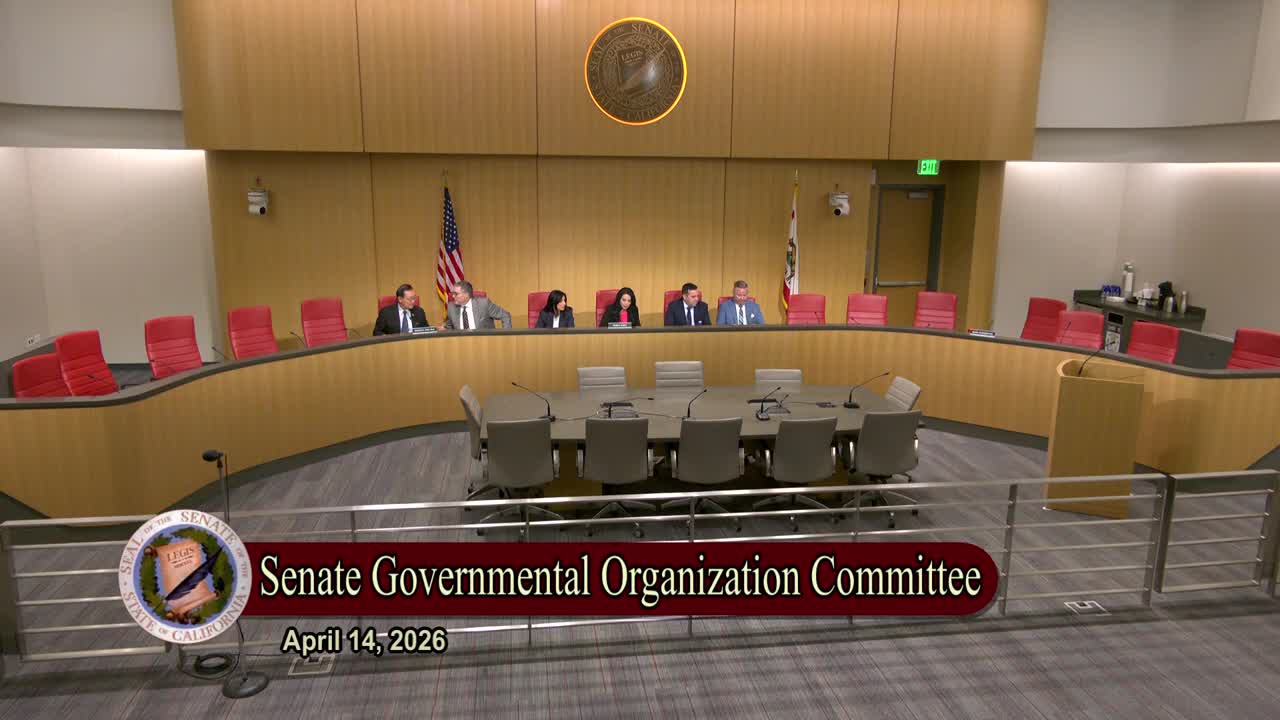 13MIN
Senate Standing Committee on Governmental Organization
Bill Author

Bill Co-Author(s):