SB 398: Green Assistance Program.
- Session Year: 2015-2016
- House: Senate
- Latest Version Date: 2015-06-02
The California Global Warming Solutions Act of 2006 designates the State Air Resources Board as the state agency charged with monitoring and regulating sources of emissions of greenhouse gases. The act authorizes the state board to include the use of market-based compliance mechanisms. Existing law requires all moneys, except for fines and penalties, collected by the state board from the auction or sale of allowances as part of a market-based compliance mechanism to be deposited in the Greenhouse Gas Reduction Fund and to be available upon appropriation by the Legislature.
Existing law generally designates the state board as the state agency with the primary responsibility for the control of vehicular air pollution, and air pollution control and air quality management districts with the primary responsibility for the control of air pollution from all sources other than vehicular sources.
This bill would establish the Green Assistance Program, to be administered by the Secretary for Environmental Protection in concert with environmental justice programs, that, among other things, would provide technical assistance to small businesses, small nonprofits, and disadvantaged communities in applying for an allocation of moneys from the Greenhouse Gas Reduction Fund. The bill would declare that the secretary use existing resources for the program.
The California Global Warming Solutions Act of 2006 designates the State Air Resources Board as the state agency charged with monitoring and regulating sources of emissions of greenhouse gases. The act authorizes the state board to include the use of market-based compliance mechanisms. Existing law requires all moneys, except for fines and penalties, collected by the state board from the auction or sale of allowances as part of a market-based compliance mechanism to be deposited in the Greenhouse Gas Reduction Fund and to be available upon appropriation by the Legislature.
Existing law generally designates the state board as the state agency with the primary responsibility for the control of vehicular air pollution, and air pollution control and air quality management districts with the primary responsibility for the control of air pollution from all sources other than vehicular sources.
This bill would establish the Green Assistance Program, to be administered by the Secretary for Environmental Protection, Protection in concert with environmental justice programs, that, among other things, would provide technical assistance to small businesses and small cities businesses, small nonprofits, and disadvantaged communities in applying for an allocation of moneys from the Greenhouse Gas Reduction Fund and would provide assistance to small businesses and small cities in complying with all applicable state, federal, and local air quality laws. Fund. The bill would declare that the secretary use existing resources for the program.
The California Global Warming Solutions Act of 2006 designates the State Air Resources Board as the state agency charged with monitoring and regulating sources of emissions of greenhouse gases. The act authorizes the state board to include the use of market-based compliance mechanisms. Existing law requires all moneys, except for fines and penalties, collected by the state board from the auction or sale of allowances as part of a market-based compliance mechanism to be deposited in the Greenhouse Gas Reduction Fund and to be available upon appropriation by the Legislature.
Existing law generally designates the state board as the state agency with the primary responsibility for the control of vehicular air pollution, and air pollution control and air quality management districts with the primary responsibility for the control of air pollution from all sources other than vehicular sources.
This bill would establish the Green Assistance Program, to be administered by the Secretary for Environmental Protection, that, among other things, would provide technical assistance to small businesses and small cities in applying for an allocation of moneys from the Greenhouse Gas Reduction Fund and would provide assistance to small businesses and small cities in complying with all applicable state, federal, and local air quality laws.
The Legislature finds and declares all of the following:
(a)Small businesses, small nonprofits, and disadvantaged communities often lack the technical expertise to develop grant and financing options.
(b)In order for the state to meet its greenhouse gas emissions reductions goals, every entity and community must have the same opportunity to compete for funding that is available to meet those goals.
SEC. 2.Part 10 (commencing with Section 44480) is added to Division 26 of the Health and Safety Code, to read:10.Green Assistance Program44480.For purposes of this part, secretary means the Secretary for Environmental Protection.
44482.(a)The Green Assistance Program is hereby established and shall be administered by the secretary in concert with environmental justice programs. The program shall provide technical assistance to small businesses and small nonprofits, as both of those terms are defined by the secretary, and disadvantaged communities, as identified pursuant to Section 39711, in equitably applying for an allocation of the moneys deposited in the Greenhouse Gas Reduction Fund, created pursuant to Section 16428.8 of the Government Code.
(b)The technical assistance provided as part of the program established pursuant to this part may include, but is not limited to, any of the following:
(1)Basic information on available programs, eligibility requirements, and deadlines.
(2)Referrals to designated contact people in public agencies administering the programs.
(3)Assistance during the application preparation and submission process.
44484.(a)The secretary shall conduct outreach activities to inform small businesses, small nonprofits, and disadvantaged communities of the program established pursuant to this part.
(b)The secretary may coordinate outreach activities with other state agencies, local agencies, and nonprofits that serve eligible program applicants.
44486.The program established pursuant to this part shall use existing resources appropriated by the Legislature to the office of the Secretary for Environmental Protection in the annual Budget Act.
The Legislature finds and declares all of the following:
(a)Small businesses and small cities businesses, small nonprofits, and disadvantaged communities often lack the technical expertise to develop grant and financing options.
(b)In order for the state to meet its air quality greenhouse gas emissions reductions goals, every business entity and community must have the same opportunity to compete for funding that is available to meet those air quality goals.
SEC. 2.Part 10 (commencing with Section 44480) is added to Division 26 of the Health and Safety Code, to read:10.Green Assistance Program44480.The For purposes of this part, secretary means the Secretary for Environmental Protection.
44482.(a)The Green Assistance Program is hereby established and shall be administered by the Secretary for Environmental Protection. secretary in concert with environmental justice programs. The program shall do all of the following: provide technical assistance to small businesses and small nonprofits, as both of those terms are defined by the secretary, and disadvantaged communities, as identified pursuant to Section 39711, in equitably applying for an allocation of the moneys deposited in the Greenhouse Gas Reduction Fund, created pursuant to Section 16428.8 of the Government Code.
(a)Provide technical assistance to small businesses and small cities when applying for an allocation of the moneys deposited in the Greenhouse Gas Reduction Fund, created pursuant to Section 16428.8 of the Government Code.
(b)Assist small cities in equitably applying for funding to help mitigate the impacts of poor air quality and help improve the health of the states most disadvantaged communities.
(c)Assist small businesses in applying for funding for energy efficiency upgrades to meet and exceed the greenhouse gas emissions goals established by the state board pursuant to the California Global Warming Solutions Act of 2006 (Division 25.5 (commencing with Section 38500)).
(d)Assist small businesses and small cities in complying with all applicable state, federal, and local air quality laws.
(b)The technical assistance provided as part of the program established pursuant to this part may include, but is not limited to, any of the following:
(1)Basic information on available programs, eligibility requirements, and deadlines.
(2)Referrals to designated contact people in public agencies administering the programs.
(3)Assistance during the application preparation and submission process.
44484.(a)The secretary shall conduct outreach activities to inform small businesses, small nonprofits, and disadvantaged communities of the program established pursuant to this part.
(b)The secretary may coordinate outreach activities with other state agencies, local agencies, and nonprofits that serve eligible program applicants.
44486.The program established pursuant to this part shall use existing resources appropriated by the Legislature to the office of the Secretary for Environmental Protection in the annual Budget Act.
The Legislature finds and declares all of the following:
(a)Small businesses and small cities often lack the technical expertise to develop grant and financing options.
(b)In order for the state to meet its air quality goals, every business and community must have the same opportunity to compete for funding that is available to meet those air quality goals.
SEC. 2.Part 10 (commencing with Section 44480) is added to Division 26 of the Health and Safety Code, to read:10.Green Assistance Program44480.The Green Assistance Program is hereby established and shall be administered by the Secretary for Environmental Protection. The program shall do all of the following:
(a)Provide technical assistance to small businesses and small cities when applying for an allocation of the moneys deposited in the Greenhouse Gas Reduction Fund, created pursuant to Section 16428.8 of the Government Code.
(b)Assist small cities in equitably applying for funding to help mitigate the impacts of poor air quality and help improve the health of the states most disadvantaged communities.
(c)Assist small businesses in applying for funding for energy efficiency upgrades to meet and exceed the greenhouse gas emissions goals established by the state board pursuant to the California Global Warming Solutions Act of 2006 (Division 25.5 (commencing with Section 38500)).
(d)Assist small businesses and small cities in complying with all applicable state, federal, and local air quality laws.
|
Date
|
Status
|
|---|---|
| May 23, 2015 | Set for hearing May 28. |
| Aug 27, 2015 | August 27 hearing: Held in committee and under submission. |
| Aug 19, 2015 | August 19 set for first hearing. Placed on APPR. suspense file. |
| Jul 14, 2015 | From committee: Do pass and re-refer to Com. on APPR. with recommendation: To consent calendar. (Ayes 9. Noes 0.) (July 13). Re-referred to Com. on APPR. |
| Jun 18, 2015 | Referred to Com. on NAT. RES. |
| Jun 4, 2015 | In Assembly. Read first time. Held at Desk. |
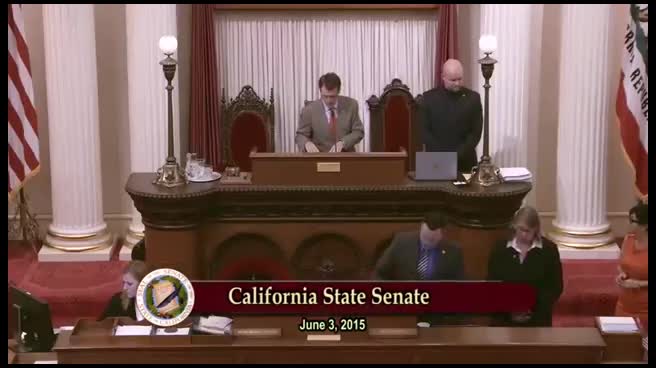
| Jun 3, 2015 | Read third time. Passed. (Ayes 31. Noes 9.) Ordered to the Assembly. |
| Jun 3, 2015 | Read third time. Passed. (Ayes 31. Noes 9. Page 1287.) Ordered to the Assembly. |
| Jun 2, 2015 | Read second time and amended. Ordered to third reading. |
| Jun 1, 2015 | From committee: Do pass as amended. (Ayes 5. Noes 2.) (May 28). |
| Jun 1, 2015 | From committee: Do pass as amended. (Ayes 5. Noes 2. Page 1153.) (May 28). |
| Feb 25, 2015 | Introduced. Read first time. To Com. on RLS. for assignment. To print. |
| May 11, 2015 | May 11 hearing: Placed on APPR. suspense file. |
| May 5, 2015 | Set for hearing May 11. |
| Apr 30, 2015 | From committee: Do pass and re-refer to Com. on APPR. (Ayes 6. Noes 1.) (April 29). Re-referred to Com. on APPR. |
| Apr 30, 2015 | From committee: Do pass and re-refer to Com. on APPR. (Ayes 6. Noes 1. Page 858.) (April 29). Re-referred to Com. on APPR. |
| Apr 14, 2015 | From committee with author's amendments. Read second time and amended. Re-referred to Com. on E.Q. |
| Apr 10, 2015 | Set for hearing April 29. |
| Apr 1, 2015 | April 15 hearing postponed by committee. |
| Mar 17, 2015 | Set for hearing April 15. |
| Mar 5, 2015 | Referred to Com. on E.Q. |
| Feb 26, 2015 | From printer. May be acted upon on or after March 28. |
|
Date
|
Description
|
Location
|
Votes
|
|
|---|---|---|---|---|
| Jul 13, 2015 | Do pass and be re-referred to the Committee on [Appropriations] with recommendation: To Consent Calendar | Assembly Standing Committee on Natural Resources |
Passed |
|
| Jun 3, 2015 | Senate 3rd Reading SB398 Leyva | Senate Floor |
Passed |
|
| May 28, 2015 | Do pass as amended | Senate Standing Committee on Appropriations |
Passed |
|
| May 11, 2015 | Placed on suspense file | Senate Standing Committee on Appropriations |
Passed |
|
| Apr 29, 2015 | Do pass, but first be re-referred to the Committee on [Appropriations] | Senate Standing Committee on Environmental Quality |
Passed |
This list shows positions taken on this bill by organizations on the date displayed, which is linked to the original source.
Positions by individuals are not included.
|
Organization
|
Position
|
Date
|
|---|---|---|
| American Lung Association in California | ** Support | Jun 3, 2015 |
| Asian Pacific Environmental Network | ** Support | Jun 3, 2015 |
| Breathe California | ** Support | Jun 3, 2015 |
| California League Of Conservation Voters | ** Support | Jun 3, 2015 |
| Climate Resolve | ** Support | Jun 3, 2015 |
| Coalition For Clean Air | ** Support | Jun 3, 2015 |
| Environmental Defense Fund | ** Support | Jun 3, 2015 |
| Leadership Council for Justice and Accountability | ** Support | Jun 3, 2015 |
| Lutheran Office of Public Policy, California | ** Support | Jun 3, 2015 |
| Move LA | ** Support | Jun 3, 2015 |
| National Resources Defense Council | ** Support | Jun 3, 2015 |
| Physicians for Social Responsibility | ** Support | Jun 3, 2015 |
| ReLeaf | ** Support | Jun 3, 2015 |
| Sierra Club California | ** Support | Jun 3, 2015 |
| Strategic Concepts in Organizing and Policy Education | ** Support | Jun 3, 2015 |
| Union Of Concerned Scientists | ** Support | Jun 3, 2015 |
| Valley Clean Air Now | ** Support | Jun 3, 2015 |
Date of Hearing: August 19, 2015
ASSEMBLY COMMITTEE ON APPROPRIATIONS
Jimmy Gomez, Chair
SB 398
(Leyva) – As Amended June 2, 2015
Policy Committee: |
Natural Resources |
Vote: |
9 - 0 |
|
|
|
|
|
|
|
|
Urgency: No State Mandated Local Program: No Reimbursable: No
SUMMARY:
This bill establishes the Green Assistance Program (GAP) to be administered by the Secretary for Environmental Protection (Cal EPA Secretary) in concert with environmental justice programs. Specifically, this bill:
Requires GAP to provide technical assistance to small businesses, small nonprofits and disadvantaged communities applying for funding from the Greenhouse Gas Reduction Fund (GGRF). The technical assistance may include:
Basic information on available programs, eligibility requirements, and deadlines.
Referrals to designated contact people in agencies administering the programs.
Requires the Cal EPA Secretary to conduct outreach activities to inform eligible entities about GAP. Authorizes the Cal EPA Secretary to coordinate outreach activities with other state agencies, local agencies, and nonprofits.
Requires GAP to use existing resources appropriated by the Legislature to Cal EPA in the annual budget act.
FISCAL EFFECT:
Cost pressures in the hundreds of thousands to low millions of dollars from an unspecified source (GF, GGRF or other special fund).
There are currently 14 state agencies that administer GGRF funds, approximately 40 sub-programs and hundreds of different project types. This bill requires Cal EPA to conduct outreach and directly work with over 2,000 disadvantaged communities identified by census track, as well as potentially thousands of small businesses and small nonprofit agencies.
Although this bill requires the Cal EPA Secretary to use existing resources to establish the program, it will likely create substantial new workload. It is unlikely that Cal EPA will be able to absorb the costs and meet the requirements of the bill.
COMMENTS:
Purpose. According to the author, currently there is no single place to assist small communities and businesses in accessing funds for mitigating the impacts of poor air quality.
This bill creates a program to provide technical assistance to such entities applying for funding from AB 32 Cap and Trade revenues (GGRF).
Background. The California Global Warming Solutions Act of 2006 (AB 32) requires ARB to adopt a statewide GHG emissions limit equivalent to 1990 levels by 2020 and adopt regulations, including market-based compliance mechanisms, to achieve maximum technologically feasible and cost-effective GHG emission reductions.
As part of the implementation of AB 32 market-based compliance measures, ARB adopted a cap-and-trade program that caps the allowable statewide emissions and provides for the auctioning of emission credits, the proceeds of which are quarterly deposited into the GGRF and available for appropriation by the Legislature.
The 2014-15 Budget Act allocated cap-and-trade revenues for the 2014-15 fiscal year and established a long-term plan for the allocation of cap-and-trade revenues beginning in fiscal year 2015-16.
The Budget continuously appropriates 35% of cap-and-trade funds for investments in transit, affordable housing, and sustainable communities. Twenty-five percent of the revenues are continuously appropriated to continue the construction of high-speed rail. The remaining 40% will be appropriated annually by the Legislature for investments in programs that include low-carbon transportation, energy efficiency and renewable energy, and natural resources and waste diversion.
The 2015-16 40% annual allocation expenditure plan has not yet been adopted by the Legislature.
Disadvantaged Communities. SB 535 (De León), Chapter 830, Statutes of 2012, requires no less than 10% of cap-and-trade revenues fund projects located within disadvantaged communities, and that 25% of available revenues fund projects that benefit those communities.
In October 2014, CalEPA released its list of disadvantaged communities for the purpose of SB 535. CalEPA relied on CalEnviroScreen, to identify the areas disproportionately burdened by and vulnerable to multiple sources of pollution. CalEnviroScreen is a tool that assesses all census tracts in California to identify the areas disproportionally affected and vulnerable to multiple sources of pollution.
Areas (census tracts) identified as disadvantaged for SB 535's purposes by CalEnviroScreen include the majority of the San Joaquin Valley; much of Los Angeles and the Inland Empire; pockets of other communities near ports, freeways, and major industrial facilities such as refineries and power plants; and large swaths of the Coachella Valley, Imperial Valley and Mojave Desert.
Environmental Justice. The principles of environmental justice call for fairness, regardless of race, color, national origin or income, in the development of laws and regulations that affect every community’s natural surroundings, and the places people live, work, play and learn.
Cal EPA administers an Environmental Justice Small Grant program and awarded more than $500,000 in grants to 28 organizations to improve environmental and health conditions and promote public engagement in California communities disproportionately burdened by pollution. This bill requires GAP to coordinate with this and any other state environmental justice programs.
Analysis Prepared by: Jennifer Galehouse / APPR. / (916) 319-2081
SB 398
Page 4
Date of Hearing: July 13, 2015
ASSEMBLY COMMITTEE ON NATURAL RESOURCES
Das Williams, Chair
SB 398
(Leyva) – As Amended June 2, 2015
SENATE VOTE: 31-9
SUBJECT: Green Assistance Program.
SUMMARY: Establishes the Green Assistance Program (GAP) to be administered by the Secretary for Environmental Protection (Secretary) in concert with environmental justice programs.
EXISTING LAW, under the California Global Warming Solutions Act of 2006 (AB 32):
Requires the Air Resources Board (ARB) to adopt a statewide GHG emissions limit equivalent to 1990 levels by 2020 and adopt regulations to achieve maximum technologically feasible and cost-effective GHG emission reductions.
Establishes the Greenhouse Gas Reduction Fund (GGRF); requires that all funds, except for fines and penalties, collected pursuant to a market-based mechanism be deposited in the fund; and requires the Department of Finance, in consultation with ARB and any other relevant state agency, to develop a three-year investment plan for the GGRF.
Requires that the GGRF be used to facilitate the achievement of GHG emissions reductions in the state consistent with AB 32 and the investment plan.
Requires the investment plan to allocate a minimum of 25% of the funds to projects that benefit disadvantaged communities and to allocate 10% of the funds to projects located within disadvantaged communities.
Requires ARB, in consultation with the California Environmental Protection Agency (CalEPA), to develop funding guidelines for administering agencies receiving allocations of the GGRF that include a component for how agencies should maximize benefits to disadvantaged communities.
THIS BILL:
Establishes GAP, and requires the Secretary to administer the program in concert with environmental justice programs.
Requires GAP to provide technical assistance to small businesses and small nonprofits, as defined by the Secretary, and disadvantaged communities applying funding from the GGRF. The technical assistance may include:
Basic information on available programs, eligibility requirements, and deadlines; and,
Referrals to designated contact people in agencies administering the programs.
Requires the Secretary to conduct outreach activities to inform eligible entities about the GAP. Authorizes the Secretary to coordinate outreach activities with other state agencies, local agencies, and nonprofits.
Requires that GAP use existing resources appropriated by the Legislature in the annual Budget Act.
FISCAL EFFECT: According to the Senate Appropriations Committee, this bill creates cost pressures in the hundreds of thousands to low millions of dollars from the General Fund or the GGRF to CalEPA for technical assistance and outreach.
COMMENTS:
This bill. According to the author:
Currently, there is no single place for small communities and businesses to turn to for assistance in accessing funds for mitigating the impacts of poor air quality. Housed at CalEPA, the GAP will provide small communities and businesses with information on all of the funding available and assistance on how to apply for funding at various agencies. As more funding becomes available, the state must ensure that every city and business has the same ability to participate in creating healthier neighborhoods.
AB 32. As part of AB 32's direction that ARB adopt a statewide GHG emissions limit equivalent to 1990 levels by 2020 and adopt regulations to achieve maximum technologically feasible and cost-effective GHG emission reductions, AB 32 requires ARB to prepare and approve a Scoping Plan at five-year intervals.
The first Scoping Plan, adopted by ARB in 2008, described the specific actions ARB and others must take to reduce statewide GHG emissions to 1990 levels by 2020. Pursuant to AB 32, the reduction measures identified in the Scoping Plan had to be proposed, reviewed, and adopted as individual regulations by January 1, 2011, to become operative beginning on January 1, 2012. According to ARB, a total reduction of 80 million metric tons (MMT), or 16% compared to business as usual, is necessary to achieve the 2020 limit. Approximately 78% of the reductions will be achieved through identified direct regulations. ARB intends to achieve the balance of reductions necessary to meet the 2020 limit (approximately 18 MMT) through a cap-and-trade program that covers an estimated 600 entities.
In May 2014, ARB adopted a Scoping Plan update. The Scoping Plan update discusses the objective of achieving an 80% reduction by 2050 and the need for a midterm target, but does not propose or adopt a specific target. According to ARB, the update defines ARB’s climate change priorities for the next five years and sets the groundwork to reach California's long-term climate goals.
The 2014-15 Budget Act allocates cap-and-trade revenues for the 2014-15 Fiscal Year and establishes a long-term plan for the allocation of cap-and-trade revenues beginning in Fiscal Year 2015-16. The Budget continuously appropriates 35% of cap-and-trade funds for investments in transit, affordable housing, and sustainable communities. Twenty-five percent of the revenues are continuously appropriated to continue the construction of high-speed rail. The remaining 40% will be appropriated annually by the Legislature for investments in programs that include low-carbon transportation, energy efficiency and renewable energy, and natural resources and waste diversion. In addition to reducing GHG emissions, 25% of the proceeds from the GGRF must also go to projects that provide a benefit to disadvantaged communities, as identified by the California Environmental Protection Agency (CalEPA). A minimum of 10% of the funds must be for projects located within those communities.
In his January 5, 2015 Inaugural Address, Governor Brown announced the following objectives: 1) Increase the amount of renewable energy used in California from 33% to 50%; 2) Reduce petroleum use in cars and trucks by up to 50%; and, 3) Double the efficiency of existing buildings and make heating fuels cleaner.Disadvantaged communities. In October 2014, CalEPA released its list of disadvantaged communities based on the California Communities Environmental Health Screening Tool (CalEnviroScreen), a tool that assesses all census tracts in California to identify the areas disproportionately burdened by and vulnerable to multiple sources of pollution. Areas identified as disadvantaged by CalEnviroScreen 2.0 include the majority of the San Joaquin Valley; much of Los Angeles and the Inland Empire; pockets of other communities near ports, freeways, and major industrial facilities such as refineries and power plants; and large swaths of the Coachella Valley, Imperial Valley and Mojave Desert.
Each of the programs administering funds from the GGRF have separate guidelines and grant proposal request documents on their respective websites. Eligibility criteria and application processes vary, as do recommendations about working with the administering agency to develop proposals or applications. For those small organizations and disadvantaged communities lacking experience in this area, assistance such as that proposed by this bill may help them successfully apply for and utilize the funding available.
REGISTERED SUPPORT / OPPOSITION:
Support
American Lung Association in California
Asian Pacific Environmental Network
Breathe California
California Bicycle Coalition
California Environmental Justice Alliance
California League of Conservation Voters
Clean Water Action
Climate Resolve
Coalition for Clean Air
Environmental Defense Fund
Leadership Counsel for Justice and Accountability
Lutheran Office of Public Policy, California
Move LA
National Resource Defense Council
Physicians for Social Responsibility
ReLeaf
Sierra Club California
Strategic Concepts in Organizing and Policy Education
Trust for Public Lands
Union of Concerned Scientists
Valley Clean Air
Opposition
None on file
Analysis Prepared by: Elizabeth MacMillan / NAT. RES. / (916) 319-2092
SB 398
Page 5
|
Office of Senate Floor Analyses (916) 651-1520 Fax: (916) 327-4478 |
THIRD READING
Bill No: SB 398
Amended: 6/2/15
SENATE ENVIRONMENTAL QUALITY COMMITTEE: 6-1, 4/29/15
AYES: Wieckowski, Gaines, Hill, Jackson, Leno, Pavley
NOES: Bates
SENATE APPROPRIATIONS COMMITTEE: 5-2, 5/28/15
AYES: Lara, Beall, Hill, Leyva, Mendoza
NOES: Bates, Nielsen
SUBJECT: Green Assistance Program
DIGEST: This bill establishes the Green Assistance Program (GAP) through the Office of the Secretary for Environmental Protection (Secretary) to provide technical assistance to small businesses, small nonprofits, and disadvantaged communities in applying for moneys from the Greenhouse Gas Reduction Fund (GGRF) and directs the Secretary to conduct outreach activities to inform applicants of GAP.
Existing law:
Requires, under the California Global Warming Solutions Act of 2006, the California Air Resources Board (ARB) to determine the 1990 statewide greenhouse gas (GHG) emissions level, to approve a statewide GHG emissions limit equivalent to that level that will be achieved by 2020, and to adopt GHG emissions reductions measures by regulation. ARB is authorized to include the use of market-based mechanisms to comply with the regulations. (Health and Safety Code §38500 et seq.)
Establishes GGRF as a special fund in the State Treasury; requires that all moneys, except for fines and penalties, collected pursuant to a market-based mechanism be deposited in GGRF; and requires the Department of Finance, in consultation with the ARB and any other relevant state agency, to develop, as specified, a three-year investment plan for the moneys deposited in the GGRF. (Government Code §16428.8)
Requires, under the GGRF Investment Plan and Communities Revitalization Act, GGRF moneys be used to facilitate the achievement of reductions of GHG emissions in the state consistent with the Global Warming Solutions Act of 2006. Appropriations of the GGRF funds in the annual budget are required to be consistent with the three-year investment plan. (HSC §39712)
Requires the GGRF investment plan to allocate a minimum of 25% of the funds to projects that benefit disadvantaged communities and to allocate 10% of the funds to projects located within disadvantaged communities. (HSC §39713)
Requires the ARB, in consultation with the California Environmental Protection Agency (CalEPA), to develop funding guidelines for administering agencies receiving allocations of GGRF funds that include a component for how agencies should maximize benefits to disadvantaged communities. (HSC §39715)
This bill:
Establishes GAP to be administered by the Secretary in concert with environmental justice programs.
Tasks the GAP with providing technical assistance to small businesses and small nonprofits, both as defined by the Secretary, and disadvantaged communities applying for GGRF moneys. The technical assistance may include, but is not limited to:
Basic information on available programs, eligibility requirements, and deadlines.
Referrals to designated contact people in agencies administering the programs.
Requires the Secretary, who may coordinate with other state agencies, local agencies, and nonprofits, to conduct outreach activities to inform eligible entities about the GAP.
Requires that the program use existing resources appropriated by the Legislature to the Office of the Secretary in the annual Budget Act.
Background
Cap-and-trade expenditure plan in the annual budget & administering agencies. For the 2014-15 budget year, the Budget provides $832 million of cap-and-trade proceeds to reduce GHG emissions and meet SB 535 (De León, Chapter 830, Statutes of 2012) goals. Of the Budget, 60% is permanently allocated to high-speed rail, public transit, affordable housing, and sustainable communities, administered by four departments. Seven additional departments receive appropriations to administer programs for low carbon transportation, energy efficiency upgrades and energy efficiency for public buildings, agricultural and operational efficiency, wetlands and watershed restoration, fire prevention and urban forestry projects, and waste diversion.
Disadvantaged communities. Using CalEnviroScreen, a tool developed by the Office of Environmental Health Hazard Assessment, and through the direction of SB 535, CalEPA determined a list of disadvantaged communities throughout California in October 2014. For the identified communities, at least 25% of GGRF moneys are required to be used for projects that benefit them and 10% for projects located within them. The areas within which the majority of disadvantaged communities were identified included the San Joaquin Valley, parts of Los Angeles and the Inland Empire, and large portions of the Coachella Valley and Mojave Desert, in addition to communities located near industrial areas and major roadways.
Comments
Purpose of bill. According to the author, “Many of our state’s most polluted areas are small disadvantaged communities – areas with higher rates of poverty and higher incidences of asthma and cancer. These smaller communities often do not have the technical expertise or marketing capabilities to develop and pursue grant and financing options. This situation oftentimes leaves our most vulnerable communities at a financial disadvantage.
“SB 398 helps to connect disadvantaged communities, small businesses, and small nonprofits with programs at various state agencies that provide GGRF monies. This will certainly help lower the cost of doing business and lessen the burden on taxpayers as these communities and organizations access state funds. SB 398 helps to level the playing field so that these disadvantaged and small entities have a fair shot and equal opportunity to meet air quality goals. The Green Assistance Program (GAP) addresses a very real gap between the resources currently available to these entities and their ability to access them.”
The need for assistance and outreach. Each of the programs administering GGRF moneys have separate guidelines and grant proposal request documents on their respective Web sites. Eligibility criteria and application processes vary, as do recommendations about working with the administering agency to develop proposals or applications. For those small organizations and disadvantaged communities lacking experience in this area, assistance through GAP may very well help them successfully apply for and utilize GGRF moneys, as intended by SB 535 and this bill.
Related Legislation
AB 156 (Perea, 2015) requires the GGRF Investment Plan to allocate funds to ARB to establish a technical assistance program to assist disadvantaged and low-income communities. AB 156 is on the Assembly Floor and due to be heard this week.
FISCAL EFFECT: Appropriation: No Fiscal Com.: Yes Local: No
According to the Senate Appropriations Committee:
Cost pressures in the hundreds of thousands to low millions of dollars from the General Fund or possibly the GGRF to the CalEPA for technical assistance and outreach.
American Lung Association in California
Asian Pacific Environmental Network
Breathe California
California League of Conservation Voters
Climate Resolve
Coalition for Clean Air
Environmental Defense Fund
Leadership Council for Justice and Accountability
Lutheran Office of Public Policy, California
Move LA
National Resources Defense Council
Physicians for Social Responsibility
ReLeaf
Sierra Club California
Strategic Concepts in Organizing and Policy Education
Trust for Public Lands
Union of Concerned Scientists
Valley Clean Air Now
None received
ARGUMENTS IN SUPPORT: The coalition of support states, “While AB 32 and SB 535 create momentous opportunities to address climate change and poverty in disadvantaged communities, these same communities too often lack the necessary resources and technical capacity to participate in shaping investment proposals that will be competitive for available funding.
“Establishing a technical assistance program that assists disadvantaged communities in developing project proposals that meet the goals and requirements of AB 32 and SB 535 is an important and necessary step towards the equitable distribution of GGRF funding.”
Prepared by: Laurie Harris / E.Q. / (916) 651-4108
6/2/15 21:20:07
SB 398 (Leyva) Page 3 of 3
SENATE COMMITTEE ON APPROPRIATIONS
Senator Ricardo Lara, Chair
2015 - 2016 Regular Session
SB 398 (Leyva) - Green Assistance Program
|
|
Version: April 14, 2015 |
Policy Vote: E.Q. 6 - 1 |
Urgency: No |
Mandate: No |
Hearing Date: May 28, 2015 |
Consultant: Marie Liu |
SUSPENSE FILE. AS AMENDED.
Bill Summary:
SB 398 would create a technical assistance and outreach program, administered by the secretary of the California Environmental Protection Agency (CalEPA), for small businesses and small nonprofits who are interested in applying for grants from programs funded by the Greenhouse Gas Reduction Fund (GGRF).
Fiscal Impact (as approved on May 28, 2015): Cost pressures in the hundreds of thousands to low millions of dollars from the General Fund or possibly the GGRF to the CalEPA for technical assistance and outreach.
Background:
Under the California Global Warming Solutions Act of 2006 (referred to as AB 32, HSC §38500 et seq.) requires the California Air Resources Board (ARB) to determine the 1990 statewide greenhouse gas (GHG) emissions level, to approve a statewide GHG emissions limit equivalent to that level that will be achieved by 2020, and to adopt GHG emissions reductions measures by regulation. ARB is authorized to include the use of market-based mechanisms to comply with the regulations. All monies, except for fines and penalties, collected pursuant to a market-based mechanism are deposited in the Greenhouse Gas Reduction Fund (GGRF) (Government Code §16428.8).
Existing law requires that the GGRF only be used to facilitate the achievement of reductions of GHG emissions consistent with AB 32 (HSC §39710 et seq.). To this end, the Department of Finance, in consultation with the ARB and any other relevant state agencies, is required to develop, as specified, a three-year investment plan for the moneys deposited in the GGRF. The investment plan must allocate a minimum of 25% of the funds to projects that benefit disadvantaged communities and to allocate 10% of the funds to projects located within disadvantaged communities. Additionally, the ARB, in consultation with CalEPA, is required to develop funding guidelines for administering agencies receiving allocations of GGRF funds that include a component for how agencies should maximize benefits to disadvantaged communities. Section 39718 allows the GGRF, upon appropriation, to be used by the ARB and administering agencies for administrative purposes.
The 2012-13 budget analysis of cap-and-trade auction revenue by the Legislative Analyst’s Office noted that, based on an opinion from the Office of Legislative Counsel, the auction revenues should be considered mitigation fee revenues, and their use requires that a clear nexus exist between an activity for which a mitigation fee is used and the adverse effects related to the activity on which that fee is levied. Therefore, in order for their use to be valid as mitigation fees, revenues from the cap-and-trade auction must be used to mitigate GHG emissions or the harms caused by GHG emissions.
Proposed Law:
This bill would require the secretary of CalEPA to administer a technical assistance program, named the Green Assistance Program, for small businesses, small nonprofits, and disadvantaged communities to apply for project funding from the GGRF. The secretary would be authorized to define what constitutes a small business and a small nonprofit. The technical assistance may include information on the available GGRF-funded programs as well as assistance in application preparation and submission.
The secretary would also be required to coordinate outreach activities to eligible program applicants.
This bill requires the program to be funded using existing resources.
Related Legislation:
AB 156 (Perea) would require the GGRF Investment plan to allocate technical assistance funds to the ARB for a technical assistance program for eligible applicants assisting disadvantaged communities and other communities as specified. AB 156 is currently on the Assembly Appropriations Suspense file.
Staff Comments:
The 2014-15 budget appropriated GGRF funds for a wide range of purposes including affordable housing, sustainable communities, low carbon transportation, energy efficiency upgrades, wetlands and watershed restoration, and waste diversion. These programs are managed by 11 departments, only some of which are part of CalEPA.
This bill would require several categories of assistance- (1) basic information on available programs, (2) referrals to designated contact people administering the program), and (3) assistance during the application preparation and submission process. The first two categories, depending on the level of interest by small business owners, small nonprofits, and disadvantaged communities, will likely require only a small increase in necessary positions at the agency, if at all. However, the third type of assistance, presuming it involves assisting the applicant in developing their application, could require a significant number of new positions as assistance in writing an application should not be done by the given program staff of the administering agency to ensure impartiality in the funding awards process. Also, additional staff would be necessary because CalEPA inherently does not have detailed knowledge about programs that are run by departments outside its jurisdiction.
While this bill will create substantial new workload for the secretary, the bill requires that the secretary use existing resources to create the Green Assistance Program. It is unclear what funding that CalEPA could redirect for this purpose. Staff notes that the secretary currently has 62 support positions funded by various special funds, including the Cost of Implementation Account (which funds the administration of AB 32) and the General Fund, but not the GGRF. The Cost of Implementation Account and the General Fund are likely the only two existing funding sources that can legally be used to support the activities required in this bill. Given that this bill may require expenditures that exceed what the secretary currently receives from either of these funds and that these existing positions have other existing responsibilities, the costs for this bill cannot be absorbed by the agency.
While the secretary does not currently receive an appropriation from the GGRF fund, the GGRF may be considered as a future funding source for the Green Assistance Program. However, staff notes that it is questionable whether the use of GGRF monies to implement this bill is appropriate. Existing law requires that GGRF monies be used to facilitate GHG emissions (HSC §39712) or for administrative purposes (HSC §39718(b)). The program envisioned in this bill does not neatly fall into either of these categories. In regards to GHG reductions, the purpose of the program in this bill is to help certain entities apply for GGRF monies. Technical assistance in itself does not result in GHG emissions though GHG emissions may eventually be achieved if the technical assistance results in a project being completed. Is this nexus close enough to satisfy HSC §39712? In regards to administrative costs, technical assistance is frequently considered an administrative cost in many funding programs. However, the technical assistance being offered in this bill is unique in that it includes assistance in actually preparing applications, not just providing general guidance. Arguably such assistance is no longer an administrative activity.
Committee amendments (as adopted on May 28, 2015):
Amend to delete inclusion of assistance during the application preparation and submission process as technical assistance.
-- END --
SB 398 (Leyva) Page 3 of 3
SENATE COMMITTEE ON APPROPRIATIONS
Senator Ricardo Lara, Chair
2015 - 2016 Regular Session
SB 398 (Leyva) - Green Assistance Program
|
|
Version: April 14, 2015 |
Policy Vote: E.Q. 6 - 1 |
Urgency: No |
Mandate: No |
Hearing Date: May 11, 2015 |
Consultant: Marie Liu |
This bill meets the criteria for referral to the Suspense File.
Bill Summary:
SB 398 would create a technical assistance and outreach program, administered by the secretary of the California Environmental Protection Agency (CalEPA), for small businesses and small nonprofits who are interested in applying for grants from programs funded by the Greenhouse Gas Reduction Fund (GGRF).
Fiscal Impact:
Cost pressures in the millions of dollars from the General Fund or possibly the GGRF to the CalEPA for technical assistance, outreach, and application preparation assistance.
Background:
Under the California Global Warming Solutions Act of 2006 (referred to as AB 32, HSC §38500 et seq.) requires the California Air Resources Board (ARB) to determine the 1990 statewide greenhouse gas (GHG) emissions level, to approve a statewide GHG emissions limit equivalent to that level that will be achieved by 2020, and to adopt GHG emissions reductions measures by regulation. ARB is authorized to include the use of market-based mechanisms to comply with the regulations. All monies, except for fines and penalties, collected pursuant to a market-based mechanism are deposited in the Greenhouse Gas Reduction Fund (GGRF) (Government Code §16428.8).
Existing law requires that the GGRF only be used to facilitate the achievement of reductions of GHG emissions consistent with AB 32 (HSC §39710 et seq.). To this end, the Department of Finance, in consultation with the ARB and any other relevant state agencies, is required to develop, as specified, a three-year investment plan for the moneys deposited in the GGRF. The investment plan must allocate a minimum of 25% of the funds to projects that benefit disadvantaged communities and to allocate 10% of the funds to projects located within disadvantaged communities. Additionally, the ARB, in consultation with CalEPA, is required to develop funding guidelines for administering agencies receiving allocations of GGRF funds that include a component for how agencies should maximize benefits to disadvantaged communities. Section 39718 allows the GGRF, upon appropriation, to be used by the ARB and administering agencies for administrative purposes.
The 2012-13 budget analysis of cap-and-trade auction revenue by the Legislative Analyst’s Office noted that, based on an opinion from the Office of Legislative Counsel, the auction revenues should be considered mitigation fee revenues, and their use requires that a clear nexus exist between an activity for which a mitigation fee is used and the adverse effects related to the activity on which that fee is levied. Therefore, in order for their use to be valid as mitigation fees, revenues from the cap-and-trade auction must be used to mitigate GHG emissions or the harms caused by GHG emissions.
Proposed Law:
This bill would require the secretary of CalEPA to administer a technical assistance program, named the Green Assistance Program, for small businesses, small nonprofits, and disadvantaged communities to apply for project funding from the GGRF. The secretary would be authorized to define what constitutes a small business and a small nonprofit. The technical assistance may include information on the available GGRF-funded programs as well as assistance in application preparation and submission.
The secretary would also be required to coordinate outreach activities to eligible program applicants.
This bill requires the program to be funded using existing resources.
Related Legislation:
AB 156 (Perea) would require the GGRF Investment plan to allocate technical assistance funds to the ARB for a technical assistance program for eligible applicants assisting disadvantaged communities and other communities as specified. AB 156 is currently on the Assembly Appropriations Suspense file.
Staff Comments:
The 2014-15 budget appropriated GGRF funds for a wide range of purposes including affordable housing, sustainable communities, low carbon transportation, energy efficiency upgrades, wetlands and watershed restoration, and waste diversion. These programs are managed by 11 departments, only some of which are part of CalEPA.
This bill would require several categories of assistance- (1) basic information on available programs, (2) referrals to designated contact people administering the program), and (3) assistance during the application preparation and submission process. The first two categories, depending on the level of interest by small business owners, small nonprofits, and disadvantaged communities, will likely require only a small increase in necessary positions at the agency, if at all. However, the third type of assistance, presuming it involves assisting the applicant in developing their application, could require a significant number of new positions as assistance in writing an application should not be done by the given program staff of the administering agency to ensure impartiality in the funding awards process. Also, additional staff would be necessary because CalEPA inherently does not have detailed knowledge about programs that are run by departments outside its jurisdiction.
While this bill will create substantial new workload for the secretary, the bill requires that the secretary use existing resources to create the Green Assistance Program. It is unclear what funding that CalEPA could redirect for this purpose. Staff notes that the secretary currently has 62 support positions funded by various special funds, including the Cost of Implementation Account (which funds the administration of AB 32) and the General Fund, but not the GGRF. The Cost of Implementation Account and the General Fund are likely the only two existing funding sources that can legally be used to support the activities required in this bill. Given that this bill may require expenditures that exceed what the secretary currently receives from either of these funds and that these existing positions have other existing responsibilities, the costs for this bill cannot be absorbed by the agency.
While the secretary does not currently receive an appropriation from the GGRF fund, the GGRF may be considered as a future funding source for the Green Assistance Program. However, staff notes that it is questionable whether the use of GGRF monies to implement this bill is appropriate. Existing law requires that GGRF monies be used to facilitate GHG emissions (HSC §39712) or for administrative purposes (HSC §39718(b)). The program envisioned in this bill does not neatly fall into either of these categories. In regards to GHG reductions, the purpose of the program in this bill is to help certain entities apply for GGRF monies. Technical assistance in itself does not result in GHG emissions though GHG emissions may eventually be achieved if the technical assistance results in a project being completed. Is this nexus close enough to satisfy HSC §39712? In regards to administrative costs, technical assistance is frequently considered an administrative cost in many funding programs. However, the technical assistance being offered in this bill is unique in that it includes assistance in actually preparing applications, not just providing general guidance. Arguably such assistance is no longer an administrative activity.
-- END --
SB 398 (Leyva) Page 5 of 5
SENATE COMMITTEE ON ENVIRONMENTAL QUALITY
Senator Wieckowski, Chair
2015 - 2016 Regular
Bill No: SB 398
Author: |
Leyva |
||
Version: |
4/14/2015 |
Hearing Date: |
4/29/2015 |
Urgency: |
No |
Fiscal: |
Yes |
Consultant: |
Laurie Harris |
||
SUBJECT: Green Assistance Program
ANALYSIS:
Existing law:
Under the California Global Warming Solutions Act of 2006 (referred to as AB 32) requires the California Air Resources Board (ARB) to determine the 1990 statewide greenhouse gas (GHG) emissions level, to approve a statewide GHG emissions limit equivalent to that level that will be achieved by 2020, and to adopt GHG emissions reductions measures by regulation. ARB is authorized to include the use of market-based mechanisms to comply with the regulations. (Health and Safety Code §38500 et seq.)
Establishes the Greenhouse Gas Reduction Fund (GGRF) as a special fund in the State Treasury; requires that all moneys, except for fines and penalties, collected pursuant to a market-based mechanism be deposited in the fund; and requires the Department of Finance, in consultation with the state board and any other relevant state agency, to develop, as specified, a three-year investment plan for the moneys deposited in the GGRF. (Government Code §16428.8)
Under the GGRF Investment Plan and Communities Revitalization Act, requires GGRF moneys be used to facilitate the achievement of reductions of GHG emissions in the state consistent with the Global Warming Solutions Act of 2006. Appropriations of the GGRF funds in the annual budget are required to be consistent with the three-year investment plan. (HSC §39712)
Requires the GGRF investment plan to allocate a minimum of 25% of the funds to projects that benefit disadvantaged communities and to allocate 10% of the funds to projects located within disadvantaged communities. (HSC §39713)
Requires the ARB, in consultation with the California Environmental Protection Agency (CalEPA), to develop funding guidelines for administering agencies receiving allocations of GGRF funds that include a component for how agencies should maximize benefits to disadvantaged communities. (HSC §39715)
This bill:
Establishes the Green Assistance Program (GAP) to be administered by the Secretary for Environmental Protection (Secretary) in concert with environmental justice programs.
Tasks the GAP with providing technical assistance to small businesses and small nonprofits, both as defined by the secretary, and disadvantaged communities applying for GGRF monies. The technical assistance may include, but is not limited to:
Basic information on available programs, eligibility requirements, and deadlines;
Referrals to designated contact people in agencies administering the programs; and
Assistance during the application preparation and submission process.
Requires the Secretary, who may coordinate with other state agencies, local agencies, and nonprofits, to conduct outreach activities to inform eligible entities about the GAP.
Requires that the program use existing resources appropriated by the Legislature to the Office of the Secretary in the annual Budget Act.
Background
Cap-and-Trade Expenditure Plan in the Annual Budget & Administering Agencies.
For the 2014-15 budget year, the Budget provides $832 million of cap-and-trade proceeds to reduce GHG emissions and meet SB 535 (de León), Chapter 830, Statutes of 2012, goals. Of the Budget, 60% is permanently allocated to high-speed rail, public transit, affordable housing, and sustainable communities, administered by four departments. Seven additional departments receive appropriations to administer programs for low carbon transportation, energy efficiency upgrades and energy efficiency for public buildings, agricultural and operational efficiency, wetlands and watershed restoration, fire prevention and urban forestry projects, and waste diversion.
Disadvantaged Communities.
Using CalEnviroScreen, a tool developed by the Office of Environmental Health Hazard Assessment (OEHHA), and through the direction of SB 535, CalEPA determined a list of disadvantaged communities throughout California in October 2014. For the identified communities, at least 25% of GGRF moneys are required to be used for projects that benefit them and 10% for projects located within them. The areas within which the majority of disadvantaged communities were identified included the San Joaquin Valley, parts of Los Angeles and the Inland Empire, and large portions of the Coachella Valley and Mojave Desert, in addition to communities located near industrial areas and major roadways.
Comments
Purpose of Bill.
According to the author, “Many of our state’s most polluted areas are small disadvantaged communities – areas with higher rates of poverty and higher incidences of asthma and cancer. These smaller communities often do not have the technical expertise or marketing capabilities to develop and pursue grant and financing options. This situation oftentimes leaves our most vulnerable communities at a financial disadvantage.
“SB 398 helps to connect disadvantaged communities, small businesses, and small non profits with programs at various state agencies that provide GGRF monies. This will certainly help lower the cost of doing business and lessen the burden on taxpayers as these communities and organizations access state funds. SB 398 helps to level the playing field so that these disadvantaged and small entities have a fair shot and equal opportunity to meet air quality goals. The Green Assistance Program (GAP) addresses a very real gap between the resources currently available to these entities and their ability to access them.”
The Need for Assistance and Outreach.
Each of the programs administering GGRF monies have separate guidelines and grant proposal request documents on their respective websites. Eligibility criteria and application processes vary, as do recommendations about working with the administering agency to develop proposals or applications. For those small organizations and disadvantaged communities lacking experience in this area, assistance through the Green Assistance Program may very well help them successfully apply for and utilize GGRF moneys, as intended by SB 535 and this bill.
Related/Prior Legislation
AB 156 (Perea) would require the GGRF Investment Plan to allocate technical assistance funds to the California Air Resources Board (ARB) to establish a technical assistance program for eligible applicants assisting disadvantaged communities and other communities as specified. AB 156 is currently referred to the Assembly Committee on Appropriations.
AB 1179 (Rendon) would require ARB to prepare and post on its website a report on the funded projects that provide benefits to, or are located within, disadvantaged communities. AB 1179 is currently referred to the Assembly Committee on Appropriations with recommendation to the consent calendar.
SOURCE:
Author
SUPPORT:
American Lung Association in California
Asian Pacific Environmental Network
Breathe California
California League of Conservation Voters
Climate Resolve
Coalition for Clean Air
Environmental Defense Fund
Leadership Council for Justice and Accountability
Lutheran Office of Public Policy, California
Move LA
National Resources Defense Council
Physicians for Social Responsibility
ReLeaf
Sierra Club California
Strategic Concepts in Organizing and Policy Education
Trust for Public Lands
Union of Concerned Scientists
Valley Clean Air Now
OPPOSITION:
None on file
ARGUMENTS IN SUPPORT:
The coalition of support states, “While AB 32 and SB 535 create momentous opportunities to address climate change and poverty in disadvantaged communities, these same communities too often lack the necessary resources and technical capacity to participate in shaping investment proposals that will be competitive for available funding.
“Establishing a technical assistance program that assists disadvantaged communities in developing project proposals that meet the goals and requirements of AB 32 and SB 535 is an important and necessary step towards the equitable distribution of GGRF funding.”
-- END --
Bill Author