SJR 25: Arbitration: class actions.
- Session Year: 2015-2016
- House: Senate
- Latest Version Date: 2016-08-18
This measure would urge the Consumer Financial Protection Bureau to issue final rules protecting consumers interests with respect to mandatory arbitration clauses that prohibit class actions.
This measure would urge the Consumer Financial Protection Bureau to issue final rules protecting consumers interests with respect to mandatory arbitration clauses that prohibit class actions.
WHEREAS, Class actions are the only remedy for consumers who cannot afford to seek redress alone but who can band together to stop illegal practices; and
WHEREAS, Contract language that bans consumers from joining class actions prevents consumers from exercising strength in numbers and allows corporations to pilfer small amounts of money from millions of individuals who cannot band together to stop that practice; and
WHEREAS, Bans against class actions are substantively unconscionable because they are often one-sidedonly consumers bring claims against corporations through class actions, not the other way around; and deprive consumers of their substantive and procedural rights, preventing consumers from bringing claims against corporations; and
WHEREAS, Bans against class actions are procedurally unconscionable because consumer contracts barring class actions are found in take-it-or-leave-it contracts that prohibit consumers from negotiating contract terms, effectively leaving consumers to choose between access to modern goods and services and access to justice; and
WHEREAS, In the Dodd-Frank Wall Street Reform and Consumer Protection Act of 2010, Congress authorized the Consumer Financial Protection Bureau (the Bureau) to study mandatory arbitration clauses in consumer contracts and to issue regulations restricting or prohibiting their use if the Bureau found that such regulations would be in the public interest and protect consumers; and
WHEREAS, The Bureau found that nearly all contracts containing mandatory arbitration clauses not only barred consumers from participating in future class action lawsuits, but also specified that any resulting arbitration proceeding could only be conducted on an individual, not a class, basis; and
WHEREAS, Accordingly, the Bureau has proposed a rule that would prohibit contracts for financial products or services from containing mandatory arbitration clauses barring consumers from filing or participating in a class action relating to the financial product or service; and
WHEREAS, This proposed rule is based on a finding that mandatory arbitration clauses are being widely used to prevent consumers from seeking relief from legal violations on a class basis and that consumers rarely seek redress as individuals; and
WHEREAS, Class actions deter violations from occurring and redress violations of consumers rights when they do occur; and
WHEREAS, Without class actions, corporations that engage in illegal practices will effectively remain unpunished, undeterred, and unaccountable; now, therefore, be it
Resolved by the Senate and the Assembly of the State of California, jointly, That the Legislature of the State of California encourages the Bureau to move forward in issuing final rules, either as proposed or in an amended form that even more stringently protects the right of consumers to pursue justice and relief and deters companies from violating the law; and be it further
Resolved, That the Secretary of the Senate transmit copies of this resolution to the author for appropriate distribution.
WHEREAS, Class actions are the only remedy for consumers who cannot afford to seek redress alone but who can band together to stop illegal practices; and
WHEREAS, Contract language that bans consumers from joining class actions prevents consumers from exercising strength in numbers and allows corporations to pilfer small amounts of money from millions of individuals who cannot band together to stop that practice; and
WHEREAS, Bans against class actions are substantively unconscionable because they are one-sidedonly consumers bring claims against corporations through class actions, not the other way around; and
WHEREAS, Bans against class actions are procedurally unconscionable because consumer contracts barring class actions are take-it-or-leave-it contracts that prohibit consumers from negotiating contract terms, effectively leaving consumers to choose between access to modern goods and services and access to justice; and
WHEREAS, In the Dodd-Frank Wall Street Reform and Consumer Protection Act of 2010, Congress authorized the Consumer Financial Protection Bureau (the Bureau) to study mandatory arbitration clauses in consumer contracts and to issue regulations restricting or prohibiting their use if the Bureau found that such regulations would be in the public interest and protect consumers; and
WHEREAS, The Bureau found that nearly all contracts containing mandatory arbitration clauses not only barred consumers from participating in future class action lawsuits, but also specified that any resulting arbitration proceeding could only be conducted on an individual, not a class, basis; and
WHEREAS, Accordingly, the Bureau has proposed a rule that would prohibit contracts for financial products or services from containing mandatory arbitration clauses barring consumers from filing or participating in a class action relating to the financial product or service; and
WHEREAS, This proposed rule is based on a finding that mandatory arbitration clauses are being widely used to prevent consumers from seeking relief from legal violations on a class basis and that consumers rarely seek redress as individuals; and
WHEREAS, Class actions deter violations from occurring and redress violations of consumers rights when they do occur; and
WHEREAS, Without class actions, corporations that engage in illegal practices will effectively remain unpunished, undeterred, and unaccountable; now, therefore, be it
Resolved by the Senate and the Assembly of the State of California, jointly, That the Legislature of the State of California encourages the Bureau to move forward in issuing final rules, either as proposed or in an amended form that even more stringently protects the right of consumers to pursue justice and relief and deters companies from violating the law; and be it further
Resolved, That the Secretary of the Senate transmit copies of this resolution to the author for appropriate distribution.
|
Date
|
Status
|
|---|---|
| Aug 3, 2016 | Introduced. Referred to Com. on RLS. |
| Aug 8, 2016 | From committee: Ordered to third reading. |
| Aug 11, 2016 | In Assembly. Held at Desk. |
| Aug 11, 2016 | Read. Adopted. (Ayes 21. Noes 13.) Ordered to the Assembly. |
| Aug 11, 2016 | Read. Adopted. (Ayes 21. Noes 14. Page 4883.) Ordered to the Assembly. |
| Aug 15, 2016 | Referred to Com. on JUD. |
| Aug 18, 2016 | From committee with author's amendments. Read second time and amended. Re-referred to Com. on JUD. |
| Aug 24, 2016 | From committee: Be adopted. Ordered to third reading. (Ayes 7. Noes 3.) (August 23). |
| Aug 30, 2016 | Ordered to inactive file on request of Assembly Member Calderon. |
|
Date
|
Description
|
Location
|
Votes
|
|
|---|---|---|---|---|
| Aug 23, 2016 | Be adopted. To third reading. | Assembly Standing Committee on Judiciary |
Passed |
|
| Aug 11, 2016 | Senate 3rd Reading SJR25 Wieckowski | Senate Floor |
Passed |
This list shows positions taken on this bill by organizations on the date displayed, which is linked to the original source.
Positions by individuals are not included.
|
Organization
|
Position
|
Date
|
|---|---|---|
| Acclamation Insurance Management Services | ** Against | Aug 24, 2016 |
| Alliance for Justice | ** Support | Aug 24, 2016 |
| Allied Managed Care | ** Against | Aug 24, 2016 |
| American Insurance Association | ** Against | Aug 24, 2016 |
| California Alliance For Retired Americans | ** Support | Aug 24, 2016 |
| California Assisted Living Association | ** Against | Aug 24, 2016 |
| California Bankers Association | ** Against | Aug 24, 2016 |
| California Building Industry Association | ** Against | Aug 24, 2016 |
| California Business Properties Association | ** Against | Aug 24, 2016 |
| California Chamber Of Commerce | * Against | Aug 24, 2016 |
| California Immigrant Policy Center | ** Support | Aug 24, 2016 |
| California League of Food Processors | ** Against | Aug 24, 2016 |
| California Manufacturers And Technology Association | * Against | Aug 24, 2016 |
| California Restaurant Association | * Against | Aug 24, 2016 |
| California Retailers Association | ** Against | Aug 24, 2016 |
| California Rural Legal Assistance Foundation, Inc. | ** Support | Aug 24, 2016 |
| California Teamsters Public Affairs Council | ** Support | Aug 24, 2016 |
| Center for Public Interest Law | ** Support | Aug 24, 2016 |
| Civil Justice Association Of California | * Against | Aug 24, 2016 |
| Congress of California Seniors | ** Support | Aug 24, 2016 |
| Consumer Action | ** Support | Aug 24, 2016 |
| Consumer Attorneys in California | * Support | Aug 24, 2016 |
| Consumer Attorneys Of California | * Support | Aug 24, 2016 |
| Consumer Federation of CA | * Support | Aug 24, 2016 |
| Consumer Federation Of California | * Support | Aug 24, 2016 |
| Consumer Watchdog | ** Support | Aug 24, 2016 |
| Consumers For Auto Reliability & Safety | * Support | Aug 24, 2016 |
| Consumers Union | ** Support | Aug 24, 2016 |
| Courage California | ** Support | Aug 24, 2016 |
| Courage Campaign | ** Support | Aug 24, 2016 |
| East Bay Community Law Center | ** Support | Aug 24, 2016 |
| Home Owners for Better Building | ** Support | Aug 24, 2016 |
| Homeowners Against Deficient Dwellings | ** Support | Aug 24, 2016 |
| Housing and Economic Rights Advocates | ** Support | Aug 24, 2016 |
| National Consumer Voice for Quality Long-Term Care | ** Support | Aug 24, 2016 |
| Privacy Rights Clearinghouse | ** Support | Aug 24, 2016 |
| Public Citizen | ** Support | Aug 24, 2016 |
| Public Good | ** Support | Aug 24, 2016 |
| Public Law Center | ** Support | Aug 24, 2016 |
| The Utility Reform Network | ** Support | Aug 24, 2016 |
| Woodstock Institute | ** Support | Aug 24, 2016 |
| Workplace Fairness | ** Support | Aug 24, 2016 |
SENATE THIRD READING
STR Bill Id:SJR 25
Author:(Wieckowski)
As Amended Ver:August 18, 2016
Majority vote
SENATE VOTE: 21-14
Committee | Votes | Ayes | Noes |
Judiciary | 7-3 | Mark Stone, Alejo, Chau, Chiu, Cristina Garcia, Holden, Ting | Wagner, Gallagher, Maienschein |
SUMMARY: Encourages the Consumer Financial Protection Bureau to issue its final rules, either as proposed or in a strengthened form to protect the rights of consumers by limiting the use of mandatory arbitration clauses in consumer contracts for financial products and services. Specifically, this resolution makes the following findings:
- Class actions are the only remedy for consumers who cannot afford to seek redress alone but who can band together to stop illegal practices; and
- Contract language that bans consumers from joining class actions prevents consumers from exercising strength in numbers and allows corporations to pilfer small amounts of money from millions of individuals who cannot band together to stop that practice; and
- Bans against class actions are often one-sided; and deprive consumers of their substantive and procedural rights, preventing consumers from bringing claims against corporations; and
- Bans against class actions are found in "take-it-or-leave-it" contracts that prohibit consumers from negotiating contract terms, effectively leaving consumers to choose between access to modern goods and services and access to justice; and
- In the Dodd-Frank Wall Street Reform and Consumer Protection Act of 2010, Congress authorized the Consumer Financial Protection Bureau (the Bureau) to study mandatory arbitration clauses in consumer contracts and to issue regulations restricting or prohibiting their use if the Bureau found that such regulations would be in the public interest and protect consumers; and
- The Bureau found that nearly all contracts containing mandatory arbitration clauses not only barred consumers from participating in future class action lawsuits, but also specified that any resulting arbitration proceeding could only be conducted on an individual, not a class, basis; and
- Accordingly, the Bureau has proposed a rule that would prohibit contracts for financial products or services from containing mandatory arbitration clauses barring consumers from filing or participating in a class action relating to the financial product or service; and
- This proposed rule is based on a finding that mandatory arbitration clauses are being widely used to prevent consumers from seeking relief from legal violations on a class basis and that consumers rarely seek redress as individuals; and
- Class actions deter violations from occurring and redress violations of consumers' rights when they do occur; and
- Without class actions, corporations that engage in illegal practices will effectively remain unpunished, undeterred, and unaccountable.
FISCAL EFFECT: As currently in print this resolution is keyed non-fiscal.
COMMENTS: Arbitration is a form of alternative dispute resolution held outside of courts where a third-party (rather than a judge) makes a binding (and rarely appealable) award. Because most arbitration is created by entering into a contract (usually a contract that is adhesive or take-it-or-leave-it), the arbitration agreement will lay-out the procedures that will be followed during the arbitration hearing. For example, the terms of the arbitration agreement may stipulate that the award need not be written or justified (unlike in court), and that the entire process be conducted in secret (rather than in public view). Arbitrators are not required to be lawyers, nor do they need to even be trained in the law. Arbitrators who issue favorable awards to a particular company can be repeatedly-hired by that same company to serve as the arbitration-neutral without ever notifying the public about that employment history. A company hiring such a business-friendly arbitration-neutral may find that it's easy to predict the calls made in an arbitration proceeding because it can hire the umpire.
Last year, the New York Times issued a three-part series titled, "Beware the Fine Print" – a special report examining how arbitration clauses buried in contracts deprives Americans of their fundamental constitutional rights:
Over the last 10 years, thousands of businesses across the country – from big corporations to storefront shops – have used arbitration to create an alternate system of justice. There, rules tend to favor businesses, and judges and juries have been replaced by arbitrators who commonly consider the companies their clients. The change has been swift and virtually unnoticed, even though it has meant that tens of millions of Americans have lost a fundamental right: their day in court. (Silver-Greenberg & Corkery, In Arbitration, a Privatization of the Justice System, N.Y. Times (Nov. 1, 2015).)
In fact, some legal scholars have stated that, arbitration "amounts to the whole-scale privatization of the justice system." (Ibid.) In an effort to protect consumers and workers, this Legislature has considered legislation aimed at leveling the playing field, a turf that has been used by corporate interests to evade public scrutiny, and even, avoid the law. This is because arbitrators do not need to be trained in the law, or even apply the law, or render a decision consistent with the evidence presented to them. What evidence is presented may, in fact, be incomplete because parties in arbitration have no legal right to obtain evidence in support of their claims or defenses, or the claims or defenses of the other party, contrary to the longstanding discovery practice in public courts. Advocates continue to debate the benefits and harms of mandatory-arbitration. Proponents of arbitration say that arbitration produces quicker results and reduces litigation costs. Opponents argue that arbitration harms consumers and workers because arbitration proceedings render unfair awards.
In light of these concerns, Congress has enacted various measures to restrict the use of arbitration in certain instances. In 2010, Congress enacted the Dodd-Frank Wall Street Reform and Consumer Protection Act (Dodd-Frank Act), which among other things, established the Bureau of Consumer Financial Protection Bureau (CFPB) and prohibited the use of arbitration agreements in connection with mortgage loans and certain whistleblower proceedings. (Public Law. No. 111-203 (July 21, 2010) 124 Stat. 1376.) The Dodd-Frank Act also authorized the CFPB to issue regulations to prohibit or limit the use of arbitration provisions in consumer financial product or service contracts, if the CFPB found that such regulations would be in the public's interest and protect consumers. (12 United States Code (U.S.C.) 5518.)
In 2012, the CFPB began to empirically study the impact of mandatory arbitration and class action clauses on consumers. In March 2015, the CFPB released its report, concluding that arbitration clauses had a detrimental effect on consumers. For example, the CFPB found that arbitration was primarily used as a venue for the financial services company to recover a debt from a consumer, rather than as a venue for the consumer to obtain relief from the financial services company. Indeed, the CFPB found that annually, only a handful of consumers subject to an arbitration clause were able to obtain relief, while over 32 million consumers not subject to an arbitration clause were able to obtain relief through class action settlements in federal court. In fact, CFPB concluded that consumers subject to arbitration were reluctant to bring claims against financial service companies. In its report, the CFPB concluded that arbitration clauses act as a barrier to class actions. (Consumer Financial Protection Bureau Study Finds that Arbitration Agreements Limit Relief for Consumers, Fact Sheet, Consumer Financial Protection Bureau, March 2015.) Additionally, CFPB found that there was no evidence that companies that eliminated their arbitration clauses increased the cost of doing business. (Ibid.)
The rules promulgated by CFPB seek to ensure that consumers are able to obtain relief if they suffer damages caused by a financial services provider. Relying upon the findings in its report, the CFPB announced that it would propose rules to regulate mandatory arbitration. According to the CFPB, the proposed rules generally do two things: First, the proposed rule prohibits companies that provide consumer financial products and services from relying on a pre-dispute arbitration clause to block a class action. Second, the proposed rule requires financial companies that are involved in an arbitration to submit specified arbitral records to CFPB.
This resolution urges the CFPB to either finalize the rules that it has promulgated, or to revise and strengthen those rules to further protect consumers. In light of the overwhelming demonstrative evidence in the CFPB report that arbitration clauses prevents consumers from seeking relief for the harm caused by certain financial service providers, and given that the proposed rules do not prohibit financial services providers from including arbitration clauses in its agreements, the rules promulgated by CFPB appear to be reasonable. Indeed, consistent with CFPB's findings, the Legislature has approved several measures aimed at protecting consumers and workers in contractual relationships where arbitration clauses are used to force Californians to waive important protections like civil rights. Accordingly, this resolution – which urges the CFPB to adopt such reasonable rules – appears to be consistent with the Legislature's previous efforts.
Analysis Prepared by: Eric Dang / JUD. / (916) 319-2334 FN: 0004893
Date of Hearing: August 23, 2016
ASSEMBLY COMMITTEE ON JUDICIARY
Mark Stone, Chair
SBPCA Bill Id:SJR 25
Author:(Wieckowski) – As Amended Ver:August 18, 2016
SENATE VOTE: 21-14
SUBJECT: ARBITRATION: CLASS ACTIONS
KEY ISSUE: IN ORDER TO PROTECT CONSUMERS AGAINST ONE-SIDED CONTRACTS THAT DEPRIVE CONSUMERS OF THEIR SUBSTANTIVE AND PROCEDURAL RIGHTS, SHOULD THE LEGISLATURE URGE THE CONSUMER FINANCIAL PROTECTION BUREAU TO FINALIZE ITS RULES—WHICH LIMIT THE USE OF MANDATORY ARBITRATION CLAUSES IN CONSUMER FINANCIAL SERVICES CONTRACTS AND have been PROMULGATED--TO PROTECT THE PUBLIC’S INTEREST?
SYNOPSIS
Arbitration is a form of alternative dispute resolution held outside of courts where a third-party (rather than a judge) makes a binding (and rarely appealable) award. Because most arbitration agreements are created by entering into a contract (usually a contract that is adhesive or take-it-or-leave-it), the arbitration agreement will lay-out the procedures that will be followed during the arbitration hearing. For example, the terms of the arbitration agreement may stipulate that the award need not be written or justified (unlike in court), and that the entire process must be conducted in secret (rather than in public view, like a court proceeding). Arbitrators are not required to be lawyers, nor to even be trained in the law. Arbitrators who issue favorable awards to a particular company can be repeatedly hired by that same company to serve as the arbitration-neutral without ever notifying the public about that employment history. A company hiring such an arbitration-neutral may find that it’s easy to predict the calls made in an arbitration proceeding because it can hire the umpire.
Due in part to significant policy concerns over the use of arbitration as a forum to resolve consumer disputes, Congress enacted the Dodd-Frank Wall Street Reform and Consumer Protection Act of 2010, which created the Consumer Financial Protection Bureau (CFPB) and authorized the CFPB to study the effect of arbitration clauses in consumer financial product contracts on consumers, and to promulgate rules limiting the use of arbitration clauses if rules would protect consumers. Consistent with that authority, the CFPB issued rules that primarily do two things: (1) Prohibit financial service providers from relying on an arbitration clause to block a consumer from instituting (or joining) a class action; and (2) Require financial service providers to submit certain arbitral records to the CFPB so that it can further study whether additional rules to protect consumers should be promulgated. This resolution urges the CFPB to either finalize those rules, or strengthen those rules. The resolution is supported by a coalition of consumer advocates including, among others, CalPIRG, Center for Public Interest Law, Congress of California Seniors, Consumer Attorneys of California, Consumers Union, and Public Citizen. The resolution is opposed by a coalition of business interests including, among others, the Chamber of Commerce, California Bankers Association, California Business Properties Association, Civil Justice Association of California, California Manufacturers and Technology Association, and the National Federation of Independent Business.
SUMMARY: Encourages the Consumer Financial Protection Bureau to issue its final rules, either as proposed or in a strengthened form to protect the rights of consumers by limiting the use of mandatory arbitration clauses in consumer contracts for financial products and services. Specifically, this resolution makes the following findings:
- Class actions are the only remedy for consumers who cannot afford to seek redress alone but who can band together to stop illegal practices; and
- Contract language that bans consumers from joining class actions prevents consumers from exercising strength in numbers and allows corporations to pilfer small amounts of money from millions of individuals who cannot band together to stop that practice; and
- Bans against class actions are often one-sided; and deprive consumers of their substantive and procedural rights, preventing consumers from bringing claims against corporations; and
- Bans against class actions are found in “take-it-or-leave-it” contracts that prohibit consumers from negotiating contract terms, effectively leaving consumers to choose between access to modern goods and services and access to justice; and
- In the Dodd-Frank Wall Street Reform and Consumer Protection Act of 2010, Congress authorized the Consumer Financial Protection Bureau (the Bureau) to study mandatory arbitration clauses in consumer contracts and to issue regulations restricting or prohibiting their use if the Bureau found that such regulations would be in the public interest and protect consumers; and
- The Bureau found that nearly all contracts containing mandatory arbitration clauses not only barred consumers from participating in future class action lawsuits, but also specified that any resulting arbitration proceeding could only be conducted on an individual, not a class, basis; and
- Accordingly, the Bureau has proposed a rule that would prohibit contracts for financial products or services from containing mandatory arbitration clauses barring consumers from filing or participating in a class action relating to the financial product or service; and
- This proposed rule is based on a finding that mandatory arbitration clauses are being widely used to prevent consumers from seeking relief from legal violations on a class basis and that consumers rarely seek redress as individuals; and
- Class actions deter violations from occurring and redress violations of consumers’ rights when they do occur; and
- Without class actions, corporations that engage in illegal practices will effectively remain unpunished, undeterred, and unaccountable.
EXISTING LAW:
- Establishes the California Arbitration Act which provides that agreements to arbitrate shall be valid, irrevocable, and enforceable, except upon such grounds as exist at law or in equity for the revocation of any contract. (Code of Civil Procedure Section 1280 et seq. Unless otherwise stated, all further statutory references are to the Code of Civil Procedure.)
- Similarly establishes the Federal Arbitration Act (FAA) which provides that agreements to arbitrate shall be valid, irrevocable, and enforceable, except such grounds as exist at law or in equity for the revocation of any contract. (9 U.S.C. Section 1 et seq.)
FISCAL EFFECT: As currently in print this resolution is keyed non-fiscal.
COMMENTS: Arbitration is a form of alternative dispute resolution held outside of courts where a third-party (rather than a judge) makes a binding (and rarely appealable) award. Because most arbitration is created by entering into a contract (usually a contract that is adhesive or take-it-or-leave-it), the arbitration agreement will lay-out the procedures that will be followed during the arbitration hearing. For example, the terms of the arbitration agreement may stipulate that the award need not be written or justified (unlike in court), and that the entire process be conducted in secret (rather than in public view). Arbitrators are not required to be lawyers, nor do they need to even be trained in the law. Arbitrators who issue favorable awards to a particular company can be repeatedly-hired by that same company to serve as the arbitration-neutral without ever notifying the public about that employment history. A company hiring such a business-friendly arbitration-neutral may find that it’s easy to predict the calls made in an arbitration proceeding because it can hire the umpire.
Last year, the New York Times issued a three-part series titled, “Beware the Fine Print” – a special report examining how arbitration clauses buried in contracts deprives Americans of their fundamental constitutional rights:
Over the last 10 years, thousands of businesses across the country – from big corporations to storefront shops – have used arbitration to create an alternate system of justice. There, rules tend to favor businesses, and judges and juries have been replaced by arbitrators who commonly consider the companies their clients. The change has been swift and virtually unnoticed, even though it has meant that tens of millions of Americans have lost a fundamental right: their day in court. (Silver-Greenberg & Corkery, In Arbitration, a Privatization of the Justice System, N.Y. Times (Nov. 1, 2015).)
In fact, some legal scholars have stated that, arbitration “amounts to the whole-scale privatization of the justice system.” (Ibid.) In an effort to protect consumers and workers, this Legislature has considered legislation aimed at leveling the playing field, a turf that has been used by corporate interests to evade public scrutiny, and even, avoid the law. This is because arbitrators do not need to be trained in the law, or even apply the law, or render a decision consistent with the evidence presented to them. What evidence is presented may, in fact, be incomplete because parties in arbitration have no legal right to obtain evidence in support of their claims or defenses, or the claims or defenses of the other party, contrary to the longstanding discovery practice in public courts. Advocates continue to debate the benefits and harms of mandatory-arbitration. Proponents of arbitration say that arbitration produces quicker results and reduces litigation costs. Opponents argue that arbitration harms consumers and workers because arbitration proceedings render unfair awards.
In light of these concerns, Congress has enacted various measures to restrict the use of arbitration in certain instances. In 2010, Congress enacted the Dodd-Frank Wall Street Reform and Consumer Protection Act (Dodd-Frank Act), which among other things, established the Bureau of Consumer Financial Protection Bureau (CFPB) and prohibited the use of arbitration agreements in connection with mortgage loans and certain whistleblower proceedings. (Pub.L. No. 111-203 (July 21, 2010) 124 Stat. 1376.) The Dodd-Frank Act also authorized the CFPB to issue regulations to prohibit or limit the use of arbitration provisions in consumer financial product or service contracts, if the CFPB found that such regulations would be in the public’s interest and protect consumers. (12 U.S.C. 5518.)
In 2012, the CFPB began to empirically study the impact of mandatory arbitration and class action clauses on consumers. In March 2015, the CFPB released its report, concluding that arbitration clauses had a detrimental effect on consumers. For example, the CFPB found that arbitration was primarily used as a venue for the financial services company to recover a debt from a consumer, rather than as a venue for the consumer to obtain relief from the financial services company. Indeed, the CFPB found that annually, only a handful of consumers subject to an arbitration clause were able to obtain relief, while over 32 million consumers not subject to an arbitration clause were able to obtain relief through class action settlements in federal court. In fact, CFPB concluded that consumers subject to arbitration were reluctant to bring claims against financial service companies. It will come as no surprise then that the CFPB concluded that arbitration clauses act as a barrier to class actions. (Consumer Financial Protection Bureau Study Finds that Arbitration Agreements Limit Relief for Consumers, Fact Sheet, Consumer Financial Protection Bureau, March 2015.) Additionally, CFPB found that there was no evidence that companies that eliminated their arbitration clauses increased the cost of doing business. (Ibid.)
The rules promulgated by CFPB seek to ensure that consumers are able to obtain relief if they suffer damages caused by a financial services provider. Relying upon the findings in its report, the CFPB announced that it would propose rules to regulate mandatory arbitration. According to the CFPB, the proposed rules generally do two things: First, the proposed rule prohibits companies that provide consumer financial products and services from relying on a pre-dispute arbitration clause to block a class action. Second, the proposed rule requires financial companies that are involved in an arbitration to submit specified arbitral records to CFPB.
This resolution urges the CFPB to either finalize the rules that it has promulgated, or to revise and strengthen those rules to further protect consumers. In light of the overwhelming demonstrative evidence in the CFPB report that arbitration clauses prevents consumers from seeking relief for the harm caused by certain financial service providers, and given that the proposed rules do not prohibit financial services providers from including arbitration clauses in its agreements, the rules promulgated by CFPB appear to be reasonable. Indeed, consistent with CFPB’s findings, this Committee has adopted several measures aimed at protecting consumers and workers in contractual relationships where arbitration clauses are used to force Californians to waive important protections like civil rights. Accordingly, this resolution—which urges the CFPB to adopt such reasonable rules—appears to be consistent with the Legislature’s previous efforts in leveling the playing field to prevent certain business or corporate interests from evading public scrutiny or the law.
ARGUMENTS IN SUPPORT: The East Bay Community Law Center supports the rules promulgated by the CFPB and urges the Legislature to encourage the CFPB in its efforts:
When it issued the proposed rules earlier this year, the CFPB noted that it was targeting “gotcha” clauses that allow companies to “sidestep the legal system, avoid accountability, and continue to pursue profitable practices that may violate the law and harm countless consumers.” SJR 25 [encourages] the CFPB to issue final rules protecting the rights of wronged consumers to join together to seek redress when they have been ripped off over financial products and services, including credit cards, checking and deposit accounts, auto loans, consumer mortgages, prepaid cards, consumer debt acquisition, credit reporting and debt collection services.
ARGUMENTS IN OPPOSITION: The Civil Justice Association of California opposes this resolution, arguing that CFPB’s proposed rule is flawed and promotes class-action lawsuits over individual arbitration:
Arbitration provides consumers with a meaningful way to resolve disputes. The proposed CFPB rule prohibiting class-action waivers in arbitration agreements will increase the cost of consumer financial services without improving consumer protection or serving the public interest. Instead, consumers will be pushed into class actions, often without their knowledge or consent, from which the lawyers will make millions while the consumers get pennies—or coupons for pennies.
REGISTERED SUPPORT / OPPOSITION:
Support
Alliance for Justice
California Alliance for Retired Americans
California Immigrant Policy Center
California Rural Legal Assistance Foundation
California Public Interest Research Group
Center for Public Interest Law
Congress of California Seniors
Consumer Action
Consumer Attorneys of California
Consumer Federation of California
Consumer Watchdog
Consumers for Auto Reliability & Safety
Consumers Union
Courage Campaign
East Bay Community Law Center
Homeowners Against Deficient Dwellings
Home Owners for Better Building
Housing and Economic Rights Advocates
National Consumer Voice for Quality Long-Term Care
Privacy Rights Clearinghouse
Public Citizen
Public Good
Public Law Center
Service Employees International Union
The Utility Reform Network
Woodstock Institute
Workplace Fairness
Opposition
California Chamber of Commerce
Acclamation Insurance Management Services
Allied Managed Care
American Insurance Association
California Assisted Living Association
California Bankers Association
California Building Industry Association
California Business Properties Association
California League of Food Processors
California Manufacturers and Technology Association
California Restaurant Association
California Retailers Association
Civil Justice Association of California
Coalition of Small and Disabled Veteran Business
Flasher Barricade Association
National Federation of Independent Business
Western Growers Association
Western Manufactured Housing Communities Association
Analysis Prepared by: Eric Dang / JUD. / (916) 319-2334
Office of Senate Floor Analyses (916) 651-1520 Fax: (916) 327-4478 | SJR 25 |
THIRD READING
Bill No: SJR 25
Author: Wieckowski (D), et al.
Introduced: 8/3/16
SUBJECT: Arbitration: class actions
DIGEST:
This resolution urges the Consumer Financial Protection Bureau to issue final rules protecting consumers’ interests with respect to mandatory arbitration clauses that prohibit class actions.
ANALYSIS: This resolution makes the following legislative findings:
- Class actions are the only remedy for consumers who cannot afford to seek redress alone but who can band together to stop illegal practices.
- Contract language that bans consumers from joining class actions prevents consumers from exercising strength in numbers and allows corporations to pilfer small amounts of money from millions of individuals who cannot band together to stop that practice. Bans against class actions are procedurally unconscionable because consumer contracts barring class actions are “take-it-or-leave-it” contracts that prohibit consumers from negotiating contract terms, effectively leaving consumers to choose between access to modern goods and services and access to justice.
- In the Dodd-Frank Wall Street Reform and Consumer Protection Act of 2010, Congress authorized the Consumer Financial Protection Bureau (the Bureau) to study mandatory arbitration clauses in consumer contracts and to issue regulations restricting or prohibiting their use if the Bureau found that such regulations would be in the public interest and protect consumers.
- The Bureau found that nearly all contracts containing mandatory arbitration clauses not only barred consumers from participating in future class action lawsuits, but also specified that any resulting arbitration proceeding could only be conducted on an individual, not a class, basis.
- Accordingly, the Bureau has proposed a rule that would prohibit contracts for financial products or services from containing mandatory arbitration clauses barring consumers from filing or participating in a class action relating to the financial product or service.
This resolution encourages the Bureau to move forward in issuing final rules, either as proposed or in an amended form that even more stringently protects the right of consumers to pursue justice and relief and deters companies from violating the law.
Background
The Bureau, through the Dodd-Frank Wall Street Reform and Consumer Protection Act, was tasked with studying the impact of mandatory arbitration and class action clauses. The CFPB began the study in 2012, released those findings to Congress in March 2015 and announced their proposed rules based on the results and requesting public comments in May 2016.
The proposed rules would impose two sets of limitations on the use of pre-dispute arbitration agreements by covered providers of consumer financial products and services.
First, it would prohibit providers from using a pre-dispute arbitration agreement to block consumer class actions in court and would require providers to insert language into their arbitration agreements reflecting this limitation. This proposal is based on the Bureau’s preliminary findings - which are consistent with the Study – that pre-dispute arbitration agreements are being widely used to prevent consumers from seeking relief from legal violations on a class basis, and that consumers rarely file individual lawsuits or arbitration cases to obtain such relief.
Second, the proposal would require providers that use pre-dispute arbitration agreements to submit certain records relating to arbitral proceedings to the Bureau. The Bureau intends to use the information it collects to continue monitoring arbitral proceedings to determine whether there are developments that raise consumer protection concerns that may warrant further Bureau action.
Comments
Purpose. According to the, “This resolution encourages the CFPB to move forward with making their proposed rules the law. These rules will result in protecting consumer’s rights to band together in order to pursue justice and deter unethical business practices that they are unable to do individually.”
FISCAL EFFECT: Appropriation: No Fiscal Com.: No Local: No
California Alliance for Retired Americans
California Rural Legal Assistance Foundation
California Public Interest Research Group
Center for Public Interest Law
California Teamsters Public Affairs Council
Consumer Action
Consumer Attorneys of California
Consumers for Auto Reliability & Safety
Consumer Federation of CA
Consumer Watchdog
Consumers Union
Courage California
East Bay Community Law Center
Housing and Economic Rights Advocates
Privacy Rights Clearinghouse
Public Good
SEIU
The Utility Reform Network
OPPOSITION: (Verified 8/10/16)
Civil Justice Association of California
Prepared by: Jonas Austin / SFA / (916) 651-1520
8/10/16 15:40:27
**** END ****
Discussed in Hearing
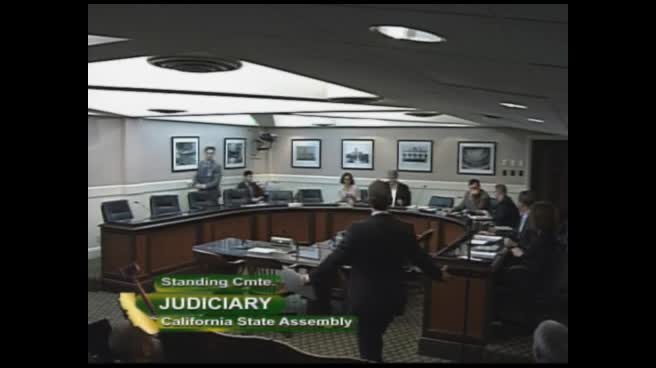 12MIN
Assembly Standing Committee on Judiciary
Bill Author