AB 1864: Personal income taxes: deductions: federal income tax paid.
- Session Year: 2017-2018
- House: Assembly
- Latest Version Date: 2018-02-27
The Personal Income Tax Law, in modified conformity with federal income tax laws, allows various deductions in computing the income that is subject to the taxes imposed by that law, including miscellaneous itemized deductions that are allowed only to the extent that the aggregate amount of those deductions exceeds 2% of adjusted gross income.
This bill, on or after January 1, 2019, for taxable years beginning on or after January 1, 2018, would allow as a deduction under that law in an amount equal to the amount of federal income tax paid, as defined, by a taxpayer on income that is attributable to a taxable year beginning on or after January 1, 2018, an individual for that taxable year, as specified.
This bill would take effect immediately as a tax levy.
The Personal Income Tax Law, in modified conformity with federal income tax laws, allows various deductions in computing the income that is subject to the taxes imposed by that law, including miscellaneous itemized deductions that are allowed only to the extent that the aggregate amount of those deductions exceeds 2% of adjusted gross income.
This bill, on or after January 1, 2019, would allow as a deduction under that law in an amount equal to the amount of federal income tax paid, as defined, by a taxpayer on income that is attributable to a taxable year beginning on or after January 1, 2018, as specified.
This bill would take effect immediately as a tax levy.
(a)On or after January 1, 2019, For taxable years beginning on or after January 1, 2018, there shall be allowed as a deduction in an amount equal to the amount of federal income tax paid by a taxpayer on income that is attributable to a taxable year beginning on or after January 1, 2018. an individual for that taxable year.
(b)For purposes of this section, federal income tax paid means the amount paid to the Internal Revenue Service for the taxpayers federal individuals federal income tax liability under Chapter 1 of the Internal Revenue Code for that taxable year after reduction for all credits allowed under Chapter 1 of the Internal Revenue Code, except for the credit for the payments of federal estimated tax, the credit for the overpayment of any federal tax, and the credit allowed by Section 31 of the Internal Revenue Code, relating to taxes withheld on wages.
(c)Any additional federal income tax paid by a taxpayer on income that is attributable to a an individual on income for that individuals federal tax liability for that taxable year beginning on or after January 1, 2018, that may be assessed for federal income tax under Chapter 1 of the Internal Revenue Code after the filing of the original return by a taxpayer an individual shall be allowed as a deduction for the taxable year in the year in which that the amount is paid.
(d)Any refund or credit of federal income tax paid by a taxpayer on income that is attributable to previously paid by an individual for a taxable year beginning on or after January 1, 2018, that may be received is received or credited after the filing of the original return by the taxpayer individual for which the taxpayer was individual was previously allowed as a deduction pursuant to subdivision (a) shall be included as income in for the taxable year in during which the refund is received.
(e)This section shall be known, and may be cited to as, the Prosperous Economy and Payer Protection through Equitable Rates Act.
SEC. 2.This act provides for a tax levy within the meaning of Article IV of the California Constitution and shall go into immediate effect.
(a)On or after January 1, 2019, there shall be allowed as a deduction in an amount equal to the amount of federal income tax paid by a taxpayer on income that is attributable to a taxable year beginning on or after January 1, 2018.
(b)For purposes of this section, federal income tax paid means the amount paid to the Internal Revenue Service for the taxpayers federal tax liability under Chapter 1 of the Internal Revenue Code after reduction for all credits allowed under Chapter 1 of the Internal Revenue Code, except for the credit for the payments of federal estimated tax, the credit for the overpayment of any federal tax, and the credit allowed by Section 31 of the Internal Revenue Code, relating to taxes withheld on wages.
(c)Any additional federal income tax paid by a taxpayer on income that is attributable to a taxable year beginning on or after January 1, 2018, that may be assessed for federal income tax under Chapter 1 of the Internal Revenue Code after the filing of the original return by a taxpayer shall be allowed as a deduction in the year in which that amount is paid.
(d)Any refund of federal income tax paid by a taxpayer on income that is attributable to a taxable year beginning on or after January 1, 2018, that may be received after the filing of the original return by the taxpayer for which the taxpayer was allowed as a deduction pursuant to subdivision (a) shall be included as income in the taxable year in which the refund is received.
(e)This section shall be known, and may be cited to as, the Prosperous Economy and Payer Protection through Equitable Rates Act.
SEC. 2.This act provides for a tax levy within the meaning of Article IV of the California Constitution and shall go into immediate effect.
|
Date
|
Status
|
|---|---|
| May 14, 2018 | From committee: Without further action pursuant to Joint Rule 62(a). |
| Apr 9, 2018 | In committee: Set, second hearing. Failed passage. |
| Mar 12, 2018 | In committee: Set, first hearing. Hearing canceled at the request of author. |
| Feb 28, 2018 | Re-referred to Com. on REV. & TAX. |
| Feb 27, 2018 | From committee chair, with author's amendments: Amend, and re-refer to Com. on REV. & TAX. Read second time and amended. |
| Jan 29, 2018 | Referred to Com. on REV. & TAX. |
| Jan 13, 2018 | From printer. May be heard in committee February 12. |
| Jan 12, 2018 | Read first time. To print. |
|
Date
|
Description
|
Location
|
Votes
|
|
|---|---|---|---|---|
| Apr 9, 2018 | Do pass and be re-referred to the Committee on [Appropriations] | Assembly Standing Committee on Revenue and Taxation |
Failed |
This list shows positions taken on this bill by organizations on the date displayed, which is linked to the original source.
Positions by individuals are not included.
|
Organization
|
Position
|
Date
|
|---|---|---|
| Howard Jarvis Taxpayers Association | * Support | Apr 9, 2018 |
| National Federation Of Independent Business | * Support | Apr 9, 2018 |
Date of Hearing: April 9, 2018
ASSEMBLY COMMITTEE ON REVENUE AND TAXATION
Autumn R. Burke, Chairwoman
ABPCA Bill Id:AB 1864 (
Author:Kiley) – As Amended Ver:February 27, 2018
Majority vote. Tax levy. Fiscal committee.
SUBJECT: Personal income taxes: deductions: federal income tax paid
SUMMARY: Provides a deduction, under the Personal Income Tax (PIT) Law, equal to the amount of federal income tax paid. Specifically, this bill:
- Provides a deduction equal to the amount of "federal income tax paid" by an individual for taxable years beginning on or after January 1, 2018.
- Defines "federal income tax paid" as the amount paid to the Internal Revenue Service for the individual’s federal income tax liability, as specified.
- Provides that any additional federal income tax paid by an individual taxpayer on income that is attributable to a taxable year on or after January 1, 2018, shall be allowed as a deduction in the year in which that amount is paid if that liability was assessed after the filing of the original return.
- Provides that any refund of federal income tax paid by an individual taxpayer on income that is attributable to a taxable year beginning on or after January 1, 2018, that may be received after the filing of the original return by the taxpayer for which the taxpayer was allowed a deduction, shall be included as income for the taxable year in which the refund was received.
- Provides that this bill may be cited as the Prosperous Economy and Payer Protection through Equitable Rates Act.
- Takes immediate effect as a tax levy.
EXISTING FEDERAL LAW:
- Allows for a broad range of deductions in computing the income subject to tax.
- Allows up to $10,000 of state and local taxes to be deducted per year, for taxable years beginning January 1, 2018 to December 31, 2025.[1]
- Provides a standard deduction of $12,000 for single filers, and $24,000 for married-filing jointly filers.[2]
- Limits the home mortgage interest deduction to $750,000 of acquisition cost.[3]
- Provides an Alternative Minimum Tax (AMT), which assesses tax at tiered percentages above a statutorily excluded amount. For individual filers, the exempted amount is $70,300, for married filing jointly filers, the exempted amount is $109,400.[4] The exemption is phased out starting at $1,000,000.[5]
FISCAL EFFECT: The Franchise Tax Board (FTB) estimates that this bill will result in a General Fund revenue loss of $27 billion in Fiscal Year (FY) 2018-19, $18 billion in FY 2019-20, and $19 billion in FY 2020-21.
COMMENTS:
- The author has provided the following statement in support of this bill:
Federal tax reform has presented California with a unique opportunity to promote economic growth and renew the California dream for the next generation. To restore the full benefit of the SALT deduction, AB 1864 would simply allow California taxpayers to deduct their full federal liability from their state returns-SALT in reverse. This resolves concerns about double taxation and assures that Californians receive a tax cut from the federal legislation to the same degree as other Americans. It is modeled after current law in six other states, including Oregon and Iowa.
- Supporters of this bill state the following:
Following the passage of federal tax reform, there's been much concern regarding the financial impact to high income earners because of the loss of the state and local tax deduction (SALT). This bill (PEPPER) would provide tax relief to both high income Californians who have higher tax liability because of the reform as well as the majority of Californians who benefitted from the reform. In a perfect world, this would be accomplished by lowering California's extremely progressive income tax. But failing that, this bill would ensure that more Californians receive the same benefits of tax reform as those from other states.
- Committee Staff Comments:
- Background: Taxpayers who itemize may deduct SALT on their federal returns. Prior to the Tax Cuts and Jobs Act (TCJA), the SALT deduction did not have a hard cap. Instead, the deduction was limited only by the Pease limit and the AMT. Today, with a $10,000 cap on SALT deductions, the federal subsidy of state taxes has been reduced, and the burden has shifted to the taxing states. There is, however, an ongoing inquiry into how taxpayer's net liability will change, if at all, taking into account the increased federal standard deduction, and lowered tax rates. According to California's FTB, in 2015, 36% of California taxpayers itemized their federal returns. It is unknown how many California taxpayers will itemize their first return under the TCJA, but it is possible that there will be a drop in the number of taxpayers who itemize deductions based on the raised standard deduction.
The TCJA became Public Law No: 115-97 on December 22, 2017. Relevant changes enacted for taxable years starting January 1, 2018 include the $10,000 SALT cap, and the home mortgage interest limit was reduced from $1 million to $750,000. The Pease limitation has been fully repealed.[6] Therefore, itemized deductions will no longer be phased out for federal income tax purposes. Furthermore, the standard deduction has been doubled.[7] The child tax credit was doubled to $2,000 and the individual mandate penalty was effectively eliminated.[8] The rates have been lowered and brackets shifted downward.[9] For example, in 2017 a married couple with $300,000 of taxable income was in the 33% marginal rate bracket, while in 2018 they are in the 24% marginal rate bracket.[10] Certain pass through entities receive a 20% deduction[11] and the corporate tax rate has been lowered to 21%.[12]
- The Alternative Minimum Tax : The AMT could have significant interactions with this bill. The AMT is an independently calculated alternative tax system. High-income taxpayers can benefit from significant tax benefits in the regular tax system. Therefore, the AMT exists to ensure that taxpayers who can greatly reduce their tax liability in the regular system, through deductions and otherwise, have a minimum amount of liability. The AMT is the excess of the tentative minimum tax over the regular tax. The AMT is owed if the tentative minimum tax is greater than the regular tax. The tentative minimum tax is calculated with fewer deductions than the regular tax. A percentage is assessed after exemptions are applied to the tentative taxable income. For individual filers, the federal exempted amount is $70,300, while for married filing jointly filers the exempted amount is $109,400. The exemption is phased out starting at $1 million. In 2017, the California exemptions were $68,846, and $91,793 respectively.[13]
The California AMT may play a significant role in the effect of this bill. Even if under this bill taxpayers were theoretically able to deduct a large federal tax bill, the California AMT backstops taxpayer liability to an amount deemed appropriate by the Legislature. Therefore, a taxpayer's PIT bill is limited to a mandatory minimum amount in the alternative tax system regardless of the deduction's effect on regular income tax liability.
- What is a "Tax Expenditure"? Existing law provides various credits, deductions, exclusions, and exemptions for particular taxpayer groups. In the late 1960s, United States Treasury officials began arguing that these features of the tax law should be referred to as "expenditures," since they are generally enacted to accomplish some governmental purpose and there is a determinable cost associated with each of them (in the form of forgone revenues). This bill would enact a new tax expenditure program in the form of a tax deduction.
- Tax Expenditure vs. Direct Expenditure: As the Department of Finance notes in its annual Tax Expenditure Report, there are several key differences between tax expenditures and direct expenditures. First, tax expenditures are reviewed less frequently than direct expenditures once they are put in place. This can offer taxpayers greater certainty, but it can also result in tax expenditures remaining part of the tax code without demonstrating any public benefit. Second, there is generally no control over the amount of revenue losses associated with any given tax expenditure. Finally, it should also be noted that, once enacted, it takes a two-thirds vote to rescind an existing tax expenditure absent a sunset date. The committee may wish to add a five-year sunset to this bill.
- Problem to be addressed: It may be the case that the TCJA will result in a higher overall tax liability (combining federal and state) for some California taxpayers. The concern is that California's PIT and property tax assessments (as a function of high property values and the applicable tax rate) will result in California SALT liability in excess of $10,000 for a taxpayer who itemizes his/her federal return. However, because of the lowered rates and downward-shifted brackets, it is estimated that only 5% of taxpayers would face increased federal tax liability in 2018, and 9% in 2025.[14]
- Applying this bill to the identified problem: If enacted, this bill will have the effect of reducing California tax liability. As applied, this bill will reduce state income tax liability for taxpayers who itemize deductions on their state returns. In doing so, this bill eliminates what some people consider double taxation when the State taxes income that includes the amount already paid to the federal government.
- Other states: Currently, six states (Alabama, Iowa, Louisiana, Missouri, Montana, and Oregon) allow a federal tax deduction for state income tax purposes. Missouri and Montana have a $10,000 limit for taxpayers filing jointly ($5,000 for single filers). Oregon allows a deduction of $6,500 for single, head of household, and married filing jointly. Oregon's deduction is subject to a phase out, ending at $290,000. For the other three states, the deduction is not limited.[15]
- Policy Analysis: The TCJA SALT deduction cap is one component of sweeping tax provision changes that compose a uniform body of law independent and distinguished from the previous system. In high-tax states, such as California,[16] taxpayers have previously lowered their federal tax bill by itemizing deductions including SALT. Because of the changes to federal tax law, the net effect is currently under inquiry.
Opponents of the SALT deduction have historically contended that it is a regressive tax deduction because only high-income taxpayers with significant tax liability receive the benefit.[17] In 2014, more than 88% of the benefit went to taxpayers with incomes over $100,000, while only 1% of the benefit went to taxpayers with incomes below $50,000.[18] The top 1% of taxpayers received 33.2% of the benefit, and the top 0.1% received 14.2% of the benefit.[19]
REGISTERED SUPPORT / OPPOSITION:
Support:
Howard Jarvis Taxpayers Association
National Federation of Independent Businesses, California
Opposition:
None on file
Analysis Prepared by: Ken Conlan / REV. & TAX. / (916) 319-2098
26 U.S.C.A. §164(b)(6)(B) (West) ↑
26 U.S.C.A. §63(b)(7) (West) ↑
26 U.S.C.A. §163(h)(3)(F) (West) ↑
26 U.S.C.A. §55(d) (West) ↑
26 U.S.C.A. §55(d)(4)(A)(ii)(I) (West) ↑
26 U.S.C.A. §68(f)(West) ↑
26 U.S.C.A. §63(c)(West) ↑
26 U.S.C.A. §24(h)(West) ↑
26 U.S.C.A. §1(West) ↑
26 U.S.C.A. § 1(j)(2)(A) (West) ↑
26 U.S.C.A. §199A(West) ↑
26 U.S.C.A. §11(b)(West) ↑
https://www.ftb.ca.gov/forms/2017-California-Tax-Rates-and-Exemptions.shtml#ae ↑
Analysis of the Tax Cuts and Jobs Act, Tax Policy Center, December 22, 2017, http://www.taxpolicycenter.org/feature/analysis-tax-cuts-and-jobs-act ↑
Moreno, Tonya, CPA, States That Allow You to Deduct Federal Income Taxes, The Balance, November 28, 2017, https://www.thebalance.com/deducting-federal-income-taxes-on-your-state-return-3193248 ↑
State-Local Tax Burden Rankings FY 2012, Tax Foundation, 2012 https://taxfoundation.org/publications/state-local-tax-burden-rankings/ (Last year for which the data is available). ↑
How does the deduction for state and local taxes work?, Tax Policy Center, http://www.taxpolicycenter.org/briefing-book/how-does-deduction-state-and-local-taxes-work ↑
Walczak, Jared, The State and Local Tax Deduction: A Primer, Tax Foundation, March 15, 2017, https://taxfoundation.org/state-and-local-tax-deduction-primer/ ↑
T17-0132 - Tax Benefit for the Deduction and Refund for State and Local Taxes, Baseline: Current Law, Distribution of Federal Tax Change by Expanded Cash Income Percentile, 2017, Tax Policy Center, http://www.taxpolicycenter.org/model-estimates/individual-income-tax-expenditures-april-2017/t17-0132-tax-benefit-deduction-and ↑
Discussed in Hearing
 14MIN
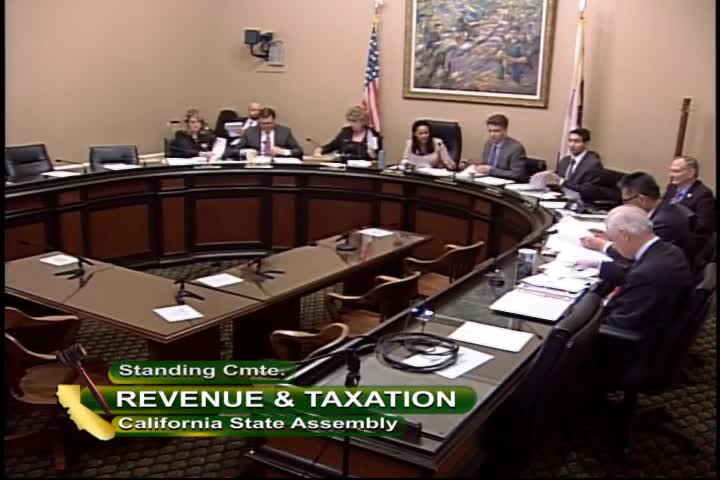
Assembly Standing Committee on Revenue and Taxation
Bill Author