ACR 115: Disabled individuals: technology and information access.
- Session Year: 2017-2018
- House: Assembly
- Latest Version Date: 2017-09-25
This measure would affirm that the states policies and procedures should ensure technology and information access for individuals with disabilities to the greatest extent possible.
This measure would affirm that the states policies and procedures should ensure technology and information access for individuals with disabilities to the greatest extent possible.
This measure would affirm that the statess policies and procedures should ensure technology and information access for individuals with disabilities to the greatest extent possible.
WHEREAS, According to the federal Centers for Disease Control and Prevention, 53 million, or one in five, individuals living in the United States have disabilities with the most common functional type of disability being mobility limitation followed by disability in thinking or memory, or both, independent living, vision, and self-care; and
WHEREAS, Individuals with disabilities are entitled to inclusion in our democratic society under federal laws, including the Americans with Disabilities Act, the Developmental Disabilities Assistance and Bill of Rights Act of 2000, the Individuals with Disabilities Education Act, Section 504 of the Rehabilitation Act of 1973, and under state and locals laws; and
WHEREAS, The disruptive convergence of computing and communication technologies has substantially altered how people acquire, utilize, and disseminate knowledge and information; and
WHEREAS, Access to comprehensible information and usable communication technologies is necessary for all people in our society, particularly for individuals with disabilities, to promote self-determination and to engage meaningfully in major aspects of life, including education, health promotion, employment, recreation, and civic participation; and
WHEREAS, The vast majority of individuals with disabilities have limited or no access to comprehensible information and usable communication technologies; and
WHEREAS, Individuals with disabilities must have access to commercially available devices and software that incorporate principles of universal design, including flexibility and ease of use for all; and
WHEREAS, Technology and information access by individuals with disabilities must be guided by standards and best practices, including personalization and compatibility across devices and platforms, and through the application of innovations, including automated and predictive technologies; and
WHEREAS, Security and privacy must be assured and managed to protect civil rights and personal dignity of individuals with disabilities; and
WHEREAS, Enhanced public and private funding is urgently required to allow individuals with disabilities to utilize technology and access information as a natural consequence of their rights to inclusion in our society; and
WHEREAS, Ensuring access to technology and information for the 53 million individuals with disabilities in the United States will create new markets and employment opportunities, decrease dependency on public services, reduce health care costs, and improve the independence, productivity, and quality of life of individuals with disabilities; now, therefore, be it
Resolved by the Assembly of the State of California, the Senate thereof concurring, That the Legislature affirms that state policies and procedures should ensure technology and information access for individuals with disabilities to the greatest extent possible; and be it further
Resolved, That the Chief Clerk of the Assembly transmit copies of this resolution to the author for appropriate distribution.
|
Date
|
Status
|
|---|---|
| Sep 25, 2017 | Chaptered by Secretary of State - Res. Chapter 191, Statutes of 2017. |
| Sep 25, 2017 | Enrolled and filed with the Secretary of State at 3 p.m. |
| Sep 14, 2017 | In Assembly. Ordered to Engrossing and Enrolling. |
| Sep 14, 2017 | Adopted and to Assembly. |
| Sep 12, 2017 | Ordered to special consent calendar. |
| Sep 11, 2017 | From committee: Ordered to third reading. |
| Sep 8, 2017 | In Senate. To Com. on RLS. |
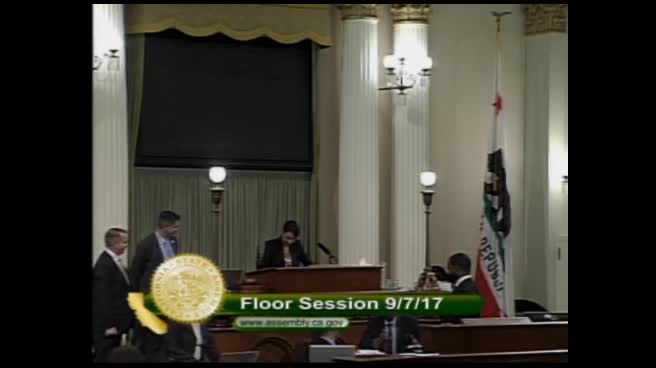
| Sep 7, 2017 | Adopted and to Senate. |
| Sep 5, 2017 | From Consent Calendar. |
| Aug 31, 2017 | From committee: Be adopted. To Consent Calendar. (Ayes 9. Noes 0.) (August 31). |
| Jul 20, 2017 | Referred to Com. on JUD. |
| Jul 19, 2017 | From printer. |
| Jul 18, 2017 | Introduced. To print. |
|
Date
|
Description
|
Location
|
Votes
|
|
|---|---|---|---|---|
| Sep 14, 2017 | Special Consent Calendar # ACR115 | Senate Floor |
Passed |
|
| Aug 31, 2017 | Be adopted. To Consent Calendar. | Assembly Standing Committee on Judiciary |
Passed |
This list shows positions taken on this bill by organizations on the date displayed, which is linked to the original source.
Positions by individuals are not included.
|
Organization
|
Position
|
Date
|
|---|---|---|
| AchieveKids | ** Support | Sep 11, 2017 |
| Coleman Institute For Cognitive Disabilities | ** Support | Sep 11, 2017 |
| Disability Rights California | ** Support | Sep 11, 2017 |
| Newark Unified School District | ** Support | Sep 11, 2017 |
| SELPA Administrators of California | ** Support | Aug 29, 2017 |
| Special Education Local Plan Area - Yolo County | ** Support | Sep 11, 2017 |
| Special Education Local Plan Area Administrators of California | ** Support | Sep 11, 2017 |
| West Contra Costa Unified School District | ** Support | Sep 11, 2017 |
Office of Senate Floor Analyses (916) 651-1520 Fax: (916) 327-4478 | ACR 115 |
THIRD READING
Bill No: ACR 115
Introduced: 7/18/17
ASSEMBLY FLOOR: Read and adopted, 9/7/17
SUBJECT: Disabled individuals: technology and information access
SOURCE: Coleman Institute for Cognitive Disabilities
Special Education Local Plan Area Administrators of California
DIGEST:
This resolution affirms that the states’s policies and procedures should ensure technology and information access for individuals with disabilities to the greatest extent possible.
ANALYSIS: This resolution makes the following legislative findings:
- According to the federal Centers for Disease Control and Prevention, 53 million, or one in five, individuals living in the United States have disabilities with the most common functional type of disability being mobility limitation followed by disability in thinking or memory, or both, independent living, vision, and self-care.
- Access to comprehensible information and usable communication technologies is necessary for all people in our society, particularly for individuals with disabilities, to promote self-determination and to engage meaningfully in major aspects of life, including education, health promotion, employment, recreation, and civic participation.
- Individuals with disabilities must have access to commercially available devices and software that incorporate principles of universal design, including flexibility and ease of use for all.
- Technology and information access by individuals with disabilities must be guided by standards and best practices, including personalization and compatibility across devices and platforms, and through the application of innovations, including automated and predictive technologies.
- Security and privacy must be assured and managed to protect civil rights and personal dignity of individuals with disabilities.
This resolution affirms that state policies and procedures should ensure technology and information access for individuals with disabilities to the greatest extent possible.
FISCAL EFFECT: Appropriation: No Fiscal Com.: No Local: No
Coleman Institute for Cognitive Disabilities (co-source)
Special Education Local Plan Area Administrators of California (co-source)
AchieveKids
Disability Rights California
Newark Unified School District
Special Education Local Plan Area – San Mateo County
Special Education Local Plan Area – Yolo County
West Contra Costa Unified School District
OPPOSITION: (Verified 9/11/17)
None received
ARGUMENTS IN SUPPORT: According the Special Education Local Plan Area Administrators of California:
California is known for being one of the most compliant states with the Americans with Disabilities Act (ADA), and it is important that we recognize the definition of accessibility is shifting as technology becomes a part of everyday life. It is possible that the ADA could even be amended to include technology access accommodations in the future. California should be proactive in providing technological resources to people with disabilities in our community and prioritize the issue as a solution to many other issues facing people with disabilities.
Assistive technology can help to close the gap for people with disabilities. It can provide the resources needed to succeed in school, and success in school and being able to attain higher education increases the chance of employment. Sometimes assistive technology is the barrier of entry into the labor force for individuals with disabilities. Every challenge that a person with a disability is able to overcome with the help of technology contributes to improving his or her quality of life.
Disability Rights Advocates writes, “This Resolution recognizes both the need for persons to have access to usable technology and also to ensure access to comprehensible information and services. It also recognizes the importance of compatibility across devices and platforms. These efforts will support broader accessibility for persons with disabilities.”
Prepared by: Karen Chow / SFA / (916) 651-1520
9/11/17 20:03:55
**** END ****
ASSEMBLY THIRD READING
ATR Bill Id:ACR 115
Author:(Eduardo Garcia)
As Introduced Ver:July 18, 2017
Majority vote
Committee | Votes | Ayes | Noes |
Judiciary | 9-0 | Mark Stone, Chau, Chiu, Cristina Garcia, Kalra, Kiley, Maienschein, Reyes, Ting |
SUMMARY: Encourages the state to ensure that its policies and procedures make, to the greatest extent possible, technology and information accessible to individuals with disabilities. Specifically, this resolution:
- Makes the following Legislative findings:
- According to the federal Centers for Disease Control and Prevention, 53 million, or one in five, individuals living in the United States have disabilities with the most common functional type of disability being mobility limitation followed by disability in thinking or memory, or both, independent living, vision, and self-care.
- Individuals with disabilities are entitled to inclusion in our democratic society under federal laws, including the Americans with Disabilities Act, the Developmental Disabilities Assistance and Bill of Rights Act of 2000, the Individuals with Disabilities Education Act, Section 504 of the Rehabilitation Act of 1973, and under state and locals laws.
- The disruptive convergence of computing and communication technologies has substantially altered how people acquire, utilize, and disseminate knowledge and information.
- Access to comprehensible information and usable communication technologies is necessary for all people in our society, particularly for individuals with disabilities, to promote self-determination and to engage meaningfully in major aspects of life, including education, health promotion, employment, recreation, and civic participation.
- The vast majority of individuals with disabilities have limited or no access to comprehensible information and usable communication technologies.
- Individuals with disabilities must have access to commercially available devices and software that incorporate principles of universal design, including flexibility and ease of use for all.
- Technology and information access by individuals with disabilities must be guided by standards and best practices, including personalization and compatibility across devices and platforms, and through the application of innovations, including automated and predictive technologies.
- Security and privacy must be assured and managed to protect civil rights and personal dignity of individuals with disabilities.
- Enhanced public and private funding is urgently required to allow individuals with disabilities to utilize technology and access information as a natural consequence of their rights to inclusion in our society.
- Ensuring access to technology and information for the 53 million individuals with disabilities in the United States will create new markets and employment opportunities, decrease dependency on public services, reduce health care costs, and improve the independence, productivity, and quality of life of individuals with disabilities.
- Resolves as follows, on behalf of the Legislature:
- The Legislature affirms that state policies and procedures should ensure technology and information access for individuals with disabilities to the greatest extent possible.
- The Chief Clerk of the Assembly shall transmit copies of this resolution to the author for appropriate distribution.
FISCAL EFFECT: None
COMMENTS: Under the twenty-seven year-old federal Americans with Disabilities Act (ADA), a business that constitutes a place of public accommodation (e.g., many places of lodging, entertainment, recreation, restaurants, bars, theaters, stores, health clubs, etc.) is prohibited from discriminating on the basis of disability if its operations affect interstate commerce. In 1992, shortly after passage of the ADA, the Legislature amended the state's disability protections to strengthen California law in areas where it is weaker than the ADA and to retain California law when it provides more protection for individuals with disabilities than the ADA. (Jankey v. Lee (2012) 55 Cal.4th 1038, 1044.) Two overlapping laws, the Unruh Civil Rights Act (Civil Code Section 51) and the Disabled Persons Act (Civil Code Sections 54–55.3), are the principal sources of state disability access protection. (Ibid.)
Barriers to the Accessibility of Internet Web sites. When the ADA was enacted in 1990, the Internet—at least as we now know and use it on a daily basis--did not exist. Yet today, Internet Web sites play a critical role today in the daily personal, professional, civic, and business lives of Americans. Private entities provide goods and services to the public through Internet Web sites that operate as places of public accommodation under title III of the ADA. Similarly, many public entities use Internet Web sites to provide the public with access to their programs, services, and activities that are governed by title II of the ADA.
Yet many Internet Web sites of public accommodations and governmental entities cannot be used by individuals with disabilities because the sites are designed without accessible features. The most common barrier to Internet Web site accessibility occurs when an image or photograph appears on an Internet Web site without corresponding text that describes the image. A screen reader or similar assistive technology cannot "read" an image, leaving individuals who are visually impaired without a way of knowing what information the image conveys (e.g., a simple graphic versus a link to another page). Similarly, complex Internet Web sites often lack navigational headings or links that would facilitate navigation with a screen reader, or contain tables with identifiers that display data, but fail to provide associated cells for each header and row so that the table information can be interpreted by a screen reader. As a result, individuals with disabilities may experience insurmountable barriers to doing such things as traveling, leaving their homes, and obtaining goods and services that are available to the public at large on Internet Web sites.
According to information provided by the author, the lack of access to Internet Web sites is a significant problem for a significant number of disabled Americans. The author cites an American Printing House for the Blind survey in 2015 that showed there were 61,739 visually impaired students (up to age 21 years old) in the United States. According to that same study, 34% of visually impaired students are non-readers. And according to a 2014 Cornell University's American Community Survey, 7,358,400 adults with a visual disability live in the United States. According to the Pew study, two percent of Americans (approximately 6.35 million people) report that their disability or illness makes it difficult or impossible to use the Internet.
In most instances, removing the barriers that impair Internet access is neither difficult nor especially costly. Furthermore, ensuring accessibility will not change the format or appearance of an Internet Web site in most cases. For example, Internet Web site designers can easily add headings, which facilitate page navigation using a screen reader, to their Web pages. They can also add cues to ensure the proper functioning of keyboard commands and set up their programs to respond to assistive technology, such as voice recognition technology.
The ADA Clearly Applies to Internet Web sites. Federal courts have repeatedly affirmed that the ADA is not limited to goods and services which are available in physical structures, but rather also applies to goods and services offered by a place of public accommodation through other mediums, such as via telephone or mail. (See Nat'l Fed'n of the Blind v. Target Corp. (N.D.Cal. 2006) 452 F.Supp.2d 946.) However, federal courts—including the 9th Circuit Court of Appeals--have also held that "public accommodations" are physical places and therefore the Internet Web site accessibility requirements of the ADA only apply to public accommodations doing business in a concrete place of accommodation. (Id., at p. 952.) Furthermore, there must be a nexus between the Internet Web site and such a place of public accommodation. (See Weyer v. Twentieth Century Fox Film Corp. (9th Cir. 2000) 198 F.3d 1104, 1114-16.) The United States Department of Justice (Department) has consistently taken the position that title III applies to any activity or service offered by a public accommodation, on or off the premises.
Fate of Federal ADA Regulations Regarding Internet Web sites and Accessibility. In its Guidance and Analysis of its 2016 ADA regulations, the Department stated that it "expects to engage in rulemaking relating to website accessibility under the ADA in the near future" but in the meantime planned to continue its practice of enforcing "the ADA in the area of website accessibility on a case-by-case basis under existing rules consistent with the guidance noted above, and will continue to do so until the issue is addressed in a final regulation." (Ibid.)
It is unclear whether and when such rulemaking will occur under the Trump Administration. The administration has finally released its first Unified Regulatory Agenda and the Internet Web site accessibility regulations, most recently earmarked for 2018, have been marked as "Inactive." Therefore, such regulations – clarifying the law and providing guidance to both businesses and local governments about how to avoid Internet Web site accessibility lawsuits – is highly unlikely. With no reasonable expectation for clarifying regulations in the near future, the courts will continue to serve as the primary forum for the development of this body of law. Therefore, the best way for public entities (and private businesses operating public accommodations) to avoid litigation remains for them to promptly take steps to make their Internet Web sites accessible.
Analysis Prepared by: Alison Merrilees / JUD. / (916) 319-2334 FN 0001871
Date of Hearing: August 31, 2017
ASSEMBLY COMMITTEE ON JUDICIARY
Mark Stone, Chair
ABPCA Bill Id:ACR 115
Author:(Eduardo Garcia) – As Introduced Ver:July 18, 2017
PROPOSED CONSENT
SUBJECT: DISABLED INDIVIDUALS: TECHNOLOGY AND INFORMATION ACCESS
KEY ISSUE: SHOULD THE LEGISLATURE URGE THE STATE TO ENSURE, TO THE GREATEST EXTENT POSSIBLE, THAT STATE TECHNOLOGY AND INFORMATION IS ACCESSIBLE TO INDIVIDUALS WITH DISABILITIES?
SYNOPSIS
When the Americans with Disabilities Act (ADA) was enacted in 1990, the Internet—at least as we know and use it today--did not exist. Yet today, Internet websites play a critical role today in the daily personal, professional, civic, and business lives of Americans. Private entities provide goods and services to the public through websites that operate as places of public accommodation under title III of the ADA. Similarly, many public entities use websites to provide the public with access to their programs, services, and activities that are governed by title II of the ADA. Yet many websites of public accommodations and governmental entities cannot be used by individuals with disabilities because the sites are designed without accessible features. According to information provided by the author, the lack of access to Internet websites is a significant problem for a significant number of disabled Americans. In most instances, removing these and other website barriers is neither difficult nor especially costly. Furthermore, ensuring accessibility will not change the format or appearance of a website in most cases. For example, website designers can easily add headings, which facilitate page navigation using a screen reader, to their Web pages.
Federal courts have repeatedly affirmed that the ADA is not limited to goods and services which are available in physical structures, but rather also applies to goods and services offered by a place of public accommodation through other mediums, such as via telephone or mail. Likewise, state law directs state agencies and entities to follow federal law and regulations and make electronic and information technology accessible to all members of the public. In August of 2016, the Obama Administration issued final rules clarifying how government offices are required to make their services accessible to the public. While the regulations do not specifically require public entities to make their Internet websites accessible, the Civil Rights Division of the U.S. Department of Justice (Department) stated that it “expects to engage in rulemaking relating to website accessibility under the ADA in the near future.” It is unclear whether and when such rulemaking will occur under the Trump Administration. The website accessibility regulations, most recently earmarked for 2018, have been marked as “Inactive.” Therefore, the prospects of the Department promulgating such regulations—to clarify the law and provide guidance to both businesses and local governments about how to avoid website accessibility lawsuits—are very unlikely. With no reasonable expectation of clarifying regulations in the near future, the courts will continue to serve as the primary forum for the development of this body of law. Therefore, the best way for public entities (and private businesses operating public accommodations) to avoid litigation remains for them to promptly take steps to make their Internet websites accessible.
This resolution, sponsored by Special Education Local Plan Area (SELPA) Administrators of California, seeks to encourage public entities to make their Internet websites fully accessible. According to the author, this resolution recognizes the crucial need for the State of California to provide access to technology to all Californians, regardless of their physical and cognitive ability. The resolution is supported by a number of school districts, several county SELPAs, and Disability Rights California. There is no opposition on file.
SUMMARY: Encourages the state to ensure that its policies and procedures make, to the greatest extent possible, technology and information accessible to individuals with disabilities. Specifically, this resolution:
- Makes the following Legislative findings:
- According to the federal Centers for Disease Control and Prevention, 53 million, or one in five, individuals living in the United States have disabilities with the most common functional type of disability being mobility limitation followed by disability in thinking or memory, or both, independent living, vision, and self-care.
- Individuals with disabilities are entitled to inclusion in our democratic society under federal laws, including the Americans with Disabilities Act, the Developmental Disabilities Assistance and Bill of Rights Act of 2000, the Individuals with Disabilities Education Act, Section 504 of the Rehabilitation Act of 1973, and under state and locals laws.
- The disruptive convergence of computing and communication technologies has substantially altered how people acquire, utilize, and disseminate knowledge and information.
- Access to comprehensible information and usable communication technologies is necessary for all people in our society, particularly for individuals with disabilities, to promote self-determination and to engage meaningfully in major aspects of life, including education, health promotion, employment, recreation, and civic participation.
- The vast majority of individuals with disabilities have limited or no access to comprehensible information and usable communication technologies.
- Individuals with disabilities must have access to commercially available devices and software that incorporate principles of universal design, including flexibility and ease of use for all.
- Technology and information access by individuals with disabilities must be guided by standards and best practices, including personalization and compatibility across devices and platforms, and through the application of innovations, including automated and predictive technologies.
- Security and privacy must be assured and managed to protect civil rights and personal dignity of individuals with disabilities.
- Enhanced public and private funding is urgently required to allow individuals with disabilities to utilize technology and access information as a natural consequence of their rights to inclusion in our society.
- Ensuring access to technology and information for the 53 million individuals with disabilities in the United States will create new markets and employment opportunities, decrease dependency on public services, reduce health care costs, and improve the independence, productivity, and quality of life of individuals with disabilities.
- Resolves as follows, on behalf of the Legislature:
- The Legislature affirms that state policies and procedures should ensure technology and information access for individuals with disabilities to the greatest extent possible.
- The Chief Clerk of the Assembly shall transmit copies of this resolution to the author for appropriate distribution.
EXISTING LAW:
- Pursuant to federal law, under the Americans with Disabilities Act (ADA), provides that no individual shall be discriminated against on the basis of disability in the full and equal enjoyment of the goods, services, facilities, privileges, advantages, or accommodations of any place of public accommodation by any person who owns, leases, or leases to, or operates a place of public accommodation. (42 U.S.C. Section 12182.)
- Pursuant to federal law, under title III of the ADA, prohibits discrimination on the basis of disability in the full and equal enjoyment of the goods, services, facilities, privileges, advantages, or accommodations of any place of public accommodation. (42 U.S.C. 12182(a).)
- Pursuant to federal law, under title II of the ADA, prohibits exclusion of disabled persons from "participation in or be denied the benefits of the services, programs, or activities of a public entity. (42 U.S.C. 12132.)
- Pursuant to the Unruh Civil Rights Act (Unruh), provides that all persons, regardless of sex, race, color, religion, ancestry, national origin, disability or medical condition, are entitled to the full and equal accommodations, advantages, facilities, privileges, or services in all business establishments of every kind whatsoever. A violation of the ADA also constitutes a violation of Unruh. A violation of this section subjects a person to actual damages incurred by an injured party, treble actual damages but not less than $4,000, and any attorney’s fees as the court may determine to be proper. (Civil Code Section 51 et seq. All further statutory references are to the California Civil Code, unless otherwise indicated.)
- Provides that individuals with disabilities or medical conditions have the same right as the general public to the full and free use of the streets, highways, sidewalks, walkways, public buildings, medical facilities, including hospitals, clinics and physicians’ offices, public facilities and other public places. It also provides that a violation of an individual’s rights under the ADA constitutes a violation of state law. (Section 54.)
- Provides that individuals with disabilities shall be entitled to full and equal access to public accommodations, subject only to the conditions and limitations established by law, or state or federal regulation, and applicable alike to all persons. It further provides that individuals with disabilities shall be entitled to full and equal access to all housing accommodations offered for rent or lease, subject to conditions and limitations established by law. (Section 54.1.)
- Provides that a violation of the ADA also constitutes a violation of Section 54.1. A violation of Section 54.1 subjects a person to injunctive and actual damages – plus treble actual damages but not less than $1,000, and attorney’s fees as the court deems proper. (Section 55.)
- Finds and declares, on behalf of the Legislature, that the ability to utilize electronic or information technology is often an essential function for successful employment in the current work world. (Gov. Code Section 7405.)
- Provides that, in order to improve accessibility of existing technology, and therefore increase the successful employment of individuals with disabilities, particularly blind and visually impaired and deaf and hard-of-hearing persons, state governmental entities, in developing, procuring, maintaining, or using electronic or information technology, either indirectly or through the use of state funds by other entities, shall comply with the accessibility requirements of Section 508 of the federal Rehabilitation Act of 1973 and regulations implementing that act. (Gov. Code Section 7405 (a).)
- Requires any entity that contracts with a state or local entity for the provision of electronic or information technology or for the provision of related services shall agree to respond to, and resolve any complaint regarding accessibility of, its products or services that is brought to the attention of the entity. (Gov. Code Section 7405 (b).)
FISCAL EFFECT: As currently in print this resolution is keyed non-fiscal.
COMMENTS: Under the twenty-seven year-old federal Americans with Disabilities Act (ADA), a business that constitutes a place of public accommodation (e.g., many places of lodging, entertainment, recreation, restaurants, bars, theaters, stores, health clubs, etc.) is prohibited from discriminating on the basis of disability if its operations affect interstate commerce. Prohibited discrimination can take a number of forms – e.g., denial of participation in the facility, or a service, benefit, or good of the business; denial of equal participation in a good, service, or facility; or provision of a different or separate facility, service or good (unless necessary to provide services and the like that are as effective as that provided to others). Government facilities are also covered by the access obligations of the ADA.
According to the California Supreme Court, “In 1992, shortly after passage of the ADA, the Legislature amended the state's disability protections ‘to strengthen California law in areas where it is weaker than the [ADA] and to retain California law when it provides more protection for individuals with disabilities than the [ADA].’ Two overlapping laws, the Unruh Civil Rights Act (§ 51) and the Disabled Persons Act (§§ 54–55.3), are the principal sources of state disability access protection.” (Jankey v. Lee (2012) 55 Cal.4th 1038, 1044 [Citation to internal quotation deleted].) All violations under the Disabled Persons Act are liable for the actual damages and an amount determined by a jury, or the court sitting without a jury, up to a maximum of three times the actual damages (there is a minimum fine of $1,000) and attorney’s fees. All violations of Unruh are subject to statutory damages of at least four thousand dollars per violation, except some cases where the violation is based on a construction-related accessibility claim, in which case lower damages (a minimum of one thousand or two thousand dollars, depending on the circumstances of the case) apply.
Barriers to the Accessibility of Internet Websites. When the ADA was enacted in 1990, the Internet—at least as we now know and use it on a daily basis--did not exist. Yet today, Internet websites play a critical role today in the daily personal, professional, civic, and business lives of Americans. Private entities provide goods and services to the public through websites that operate as places of public accommodation under title III of the ADA. Similarly, many public entities use websites to provide the public with access to their programs, services, and activities that are governed by title II of the ADA.
Yet many websites of public accommodations and governmental entities cannot be used by individuals with disabilities because the sites are designed without accessible features. The most common barrier to website accessibility occurs when an image or photograph appears on a website without corresponding text that describes the image. A screen reader or similar assistive technology cannot "read" an image, leaving individuals who are visually impaired without a way of knowing what information the image conveys (e.g., a simple graphic versus a link to another page). Similarly, complex websites often lack navigational headings or links that would facilitate navigation with a screen reader, or contain tables with identifiers that display data, but fail to provide associated cells for each header and row so that the table information can be interpreted by a screen reader. As a result, individuals with disabilities may experience insurmountable barriers to doing such things as traveling, leaving their homes, and obtaining goods and services that are available to the public at large on Internet websites.
According to information provided by the author, the lack of access to Internet websites is a significant problem for a significant number of disabled Americans. The author cites an American Printing House for the Blind survey in 2015 that showed there were 61,739 visually impaired students (up to age 21 years old) in the United States. According to that same study, 34 percent of visually impaired students are non-readers. And according to a 2014 Cornell University’s American Community Survey, 7,358,400 adults with a visual disability live in the United States.
Yet many disabled Americans lack access to the Internet. The author cites a 2011 Pew Research Center study that shows the following shortcomings in rates of Internet access:
- 41% of adults living with a disability have broadband at home, compared to 69% of those without a disability.
- 39% of those without broadband Internet access are disabled.
Most relevant to this resolution, the author cites the same Pew Research Center study to show that even those disabled Americans who have Internet access encounter significant barriers to full use of many websites on the Internet. According to the Pew study, two percent of Americans (approximately 6.35 million people) report that their disability or illness makes it difficult or impossible to use the Internet.
In most instances, removing the barriers that impair Internet access is neither difficult nor especially costly. Furthermore, ensuring accessibility will not change the format or appearance of a website in most cases. For example, website designers can easily add headings, which facilitate page navigation using a screen reader, to their Web pages. They can also add cues to ensure the proper functioning of keyboard commands and set up their programs to respond to assistive technology, such as voice recognition technology.
The ADA Clearly Applies to Internet Websites. When it enacted the ADA, Congress contemplated that the ADA, or at least the interpretation of its application, would evolve over time. Congress delegated authority to the Attorney General to promulgate regulations to carry out the Act´s broad mandate. (See H.R. Rep. No. 101-485 (II), 101st Cong., 2nd Sess. 108 (1990); 42 U.S.C. 12186 (b). In the preamble to the original 1991 ADA regulations, the Civil Rights Division of the U.S. Department of Justice (Department) stated that the regulations should be interpreted to keep pace with developing technology. (28 CFR 36, app. B.)
Both title III of the ADA (which prohibits discrimination on the basis of disability in the full and equal enjoyment of the goods, services, facilities, privileges, advantages, or accommodations of any "place of public accommodation") and title II (which prohibits exclusion of disabled persons from "participation in or be denied the benefits of the services, programs, or activities of a public entity") apply to discrimination in offering the goods and services "of" a place of public accommodation or the services, programs, and activities "of" a public entity, rather than being limited to those goods and services provided "at" or "in" a place of public accommodation, or the facility of a public entity. (See National Federation of the Blind v. Target Corp. (N.D. Cal. 2006) 452 F. Supp. 2d 946, 953.) Federal courts have repeatedly affirmed that the ADA is not limited to goods and services which are available in physical structures, but rather also applies to goods and services offered by a place of public accommodation through other mediums, such as via telephone or mail. (See Nat'l Fed'n of the Blind v. Target Corp. (N.D.Cal. 2006) 452 F.Supp.2d 946.) However, federal courts—including the 9th Circuit Court of Appeals--have also held that “public accommodations” are physical places and therefore the Internet website accessibility requirements of the ADA only apply to public accommodations doing business in a concrete place of accommodation. (Id., at p. 952.) Furthermore, there must be a nexus between the website and such a place of public accommodation. (See Weyer v. Twentieth Century Fox Film Corp. (9th Cir. 2000) 198 F.3d 1104, 1114-16.) The Department has consistently taken the position that title III applies to any activity or service offered by a public accommodation, on or off the premises.
Websites of state and local government entities are likewise required by federal law to comply with ADA accessibility standards. Title II of the ADA "applies to all services, programs, and activities provided or made available by public entities." (See 28 CFR 35.102.) For example, the websites of recipients of federal financial assistance are covered by section 504 of the Rehabilitation Act. (See Accessibility of State and Local Government Websites to People with Disabilities, Civil Rights Division, U.S. Department of Justice (June 2003), available at http://www.ada.gov/websites2.htm.) Likewise, state law (Government Code Section 7405) directs state agencies and entities to follow federal law and regulations (29 U.S.C. 794d, 36 C.F.R. 1194) and make electronic and information technology accessible to all members of the public.
Federal Regulations Providing Guidance to Businesses and Governments – Shortcomings in Guidance Regarding the Accessibility of Internet Websites. The Department has provided guidance to businesses and government offices about compliance with the ADA. In 2003, the Department of Justice issued a technical assistance document addressing website accessibility. (Accessibility of State and Local Government Websites to People with Disabilities, supra.) In August of 2016, the Obama Administration issued final rules clarifying how government offices are required to make their services accessible to the public. (28 CFR Part 35, Title II Regulations, Revised Final Title II, Regulation with Integrated Text, Guidance and Analysis, Civil Rights Division, U.S. Department of Justice (2016), pp. 177-78, found at www.ada.gov) While the regulations do not specifically require public entities to make their Internet websites accessible, the Department explained that such an amendment of the regulations was unnecessary (because the ADA already requires such compliance):
Public entities that choose to provide services through web-based applications (e.g., renewing library books or driver’s licenses) or that communicate with their constituents or provide information through the Internet must ensure that individuals with disabilities have equal access to such services or information, unless doing so would result in an undue financial and administrative burden or a fundamental alteration in the nature of the programs, services, or activities being offered. . . .[A]n agency with an inaccessible Web site may also meet its legal obligations by providing an alternative accessible way for citizens to use the programs or services, such as a staffed telephone information line. However, such an alternative must provide an equal degree of access in terms of hours of operation and the range of options and programs available. For example, if job announcements and application forms are posted on an inaccessible Web site that is available 24 hours a day, seven days a week to individuals without disabilities, then the alternative accessible method must also be available 24 hours a day, 7 days a week.
(Guidance and Analysis, supra, at pp. 177-78.)
Fate of Federal ADA Regulations Regarding Websites and Accessibility. In its Guidance and Analysis of its 2016 ADA regulations, the Department stated that it “expects to engage in rulemaking relating to website accessibility under the ADA in the near future” but in the meantime planned to continue its practice of enforcing “the ADA in the area of website accessibility on a case-by-case basis under existing rules consistent with the guidance noted above, and will continue to do so until the issue is addressed in a final regulation.” (Ibid.)
It is unclear whether and when such rulemaking will occur under the Trump Administration. The administration has finally released its first Unified Regulatory Agenda and the website accessibility regulations, most recently earmarked for 2018, have been marked as “Inactive.” Therefore, such regulations—clarifying the law and providing guidance to both businesses and local governments about how to avoid website accessibility lawsuits—is highly unlikely. With no reasonable expectation for clarifying regulations in the near future, the courts will continue to serve as the primary forum for the development of this body of law. Therefore, the best way for public entities (and private businesses operating public accommodations) to avoid litigation remains for them to promptly take steps to make their Internet websites accessible.
This Resolution Seeks to Encourage Public Entities to Make their Internet Websites Accessible. According to the author, this resolution recognizes the crucial need for the State of California to provide access to technology to all Californians, regardless of their physical and cognitive ability:
As technology becomes more and more integrated into our everyday lives, it is essential that the state of California ensure equality in access to such technological resources.
In the near future, there will be a new standard for equality: access to technology. Computing and communication technologies have revolutionized how people acquire information. Being able to access such information is essential for everyone in society, but especially those with disabilities. Technology is used in education, health promotion, employment, recreation, and civic participation.
Most individuals with disabilities have limited access to such technology, thus limiting their access to valuable resources that allow them to lead full and equal lives.
The author states that this ACR, although it provides no funding for the upgrades that would be necessary to make all state and local government websites fully accessible, makes an important first symbolic step forward by affirming that the goal of providing full access is important to the Legislature:
ACR No. 115 will affirm that the state’s policies and procedures should ensure technology and information access for individuals with disabilities to the greatest extent possible.
REGISTERED SUPPORT / OPPOSITION:
Support
SELPA Administrators of California (sponsor)
Achieve Kids
Coleman Institute for Cognitive Disabilities
Disability Rights California
Newark Unified School District
Special Education Local Plan Area – San Mateo County
Special Education Local Plan Area – Yolo County
West Contra Costa Unified School District
Opposition
None on file
Analysis Prepared by: Alison Merrilees / JUD. / (916) 319-2334
Bill Author

Bill Co-Author(s):