AB 11: Milton Marks “Little Hoover” Commission on California State Government Organization and Economy.
- Session Year: 2023-2024
- House: Assembly
- Latest Version Date: 2023-03-23
Current Status:
Failed
(2024-02-01: From committee: Filed with the Chief Clerk pursuant to Joint Rule 56.)
Introduced
In Committee
First Chamber
In Committee
Second Chamber
Enacted
Existing law establishes the Milton Marks Little Hoover Commission on California State Government Organization and Economy (the commission) for the purpose of securing assistance for the Governor and itself in promoting economy, efficiency, and improved service in the transaction of the public business, as specified, and in making the operation of all state departments, agencies, and instrumentalities, and all expenditures of public funds, more directly responsive to the wishes of the people as expressed by their elected representatives through various means. Existing law requires the commission to review final reports and make recommendations to the Legislature and the Governor concerning the results of state audits and the revenues and expenditures of the state, its departments, subdivisions, and agencies, and other public entities. Existing law authorizes the commission to meet at any time and place as it may deem proper.
Existing law declares that the availability of housing is of vital statewide importance. Existing law declares that the provision of housing affordable to low- and moderate-income households requires the cooperation of all levels of government. Existing law declares that housing prices in California have risen dramatically in all parts of the state in the past decade, while the wealth gap, especially the racial wealth gap, continues to be a growing problem in California.
This bill would, upon appropriation by the Legislature, would require the commission to study the causes and effects of the rising cost of living in California and develop solutions toward making California a more affordable place to live, as specified. The bill would require the commission to meet quarterly, as specified. The bill would require the commission to complete 2 reports describing the commissions findings and recommendations, as specified. The bill would repeal these provisions as of January 1, 2027.
Existing law establishes the Milton Marks Little Hoover Commission on California State Government Organization and Economy (the commission) for the purpose of securing assistance for the Governor and itself in promoting economy, efficiency, and improved service in the transaction of the public business, as specified, and in making the operation of all state departments, agencies, and instrumentalities, and all expenditures of public funds, more directly responsive to the wishes of the people as expressed by their elected representatives through various means. Existing law requires the commission to review final reports and make recommendations to the Legislature and the Governor concerning the results of state audits and the revenues and expenditures of the state, its departments, subdivisions, and agencies, and other public entities. Existing law authorizes the commission to meet at any time and place as it may deem proper.
Existing law declares that the availability of housing is of vital statewide importance. Existing law declares that the provision of housing affordable to low- and moderate-income households requires the cooperation of all levels of government. Existing law declares that housing prices in California have risen dramatically in all parts of the state in the past decade, while the wealth gap, especially the racial wealth gap, continues to be a growing problem in California. Existing law establishes various programs for the development and preservation of affordable housing, including the Affordable Housing Revolving Development and Acquisition Program and the California Dream for All Program.
This bill would create the Affordable California Commission. The bill would require that the commission be composed of 11 members, including 9 members appointed by the Governor, the Speaker of the Assembly, and the President pro Tempore of the Senate, as provided, and one member each from the Assembly and the Senate, who would serve as ex officio nonvoting members, as specified. The bill would prescribe the goals of the commission, which include studying would, upon appropriation by the Legislature, require the commission to study the causes and effects of the rising cost of living in California and developing develop solutions toward making California a more affordable place to live, as specified. The bill would require the commission to meet quarterly, as specified. The bill would require the commission to complete 2 reports describing the commissions findings and recommendations, as specified. The bill would repeal these provisions as of January 1, 2027.
Existing law declares that the availability of housing is of vital statewide importance. Existing law declares that the provision of housing affordable to low- and moderate-income households requires the cooperation of all levels of government. Existing law declares that housing prices in California have risen dramatically in all parts of the state in the past decade, while the wealth gap, especially the racial wealth gap, continues to be a growing problem in California. Existing law establishes various programs for the development and preservation of affordable housing, including the Affordable Housing Revolving Development and Acquisition Program and the California Dream for All Program.
This bill would create the Affordable California Commission. The bill would require that the commission be composed of 11 members, including 9 members appointed by the Governor, the Speaker of the Assembly, and the President pro Tempore of the Senate, as provided, and one member each from the Assembly and the Senate, who would serve as ex officio nonvoting members, as specified. The bill would prescribe the goals of the commission, which include studying the causes and effects of the rising cost of living in California and developing solutions toward making California a more affordable place to live, as specified. The bill would require the commission to complete 2 reports describing the commissions findings and recommendations, as specified. The bill would repeal these provisions as of January 1, 2027.
(a)The commission shall study the causes and effects of the rising cost of living in California and develop solutions toward making California a more affordable place to live, with an emphasis on maintaining and retaining the states middle-class population and creating upward mobility for individuals and families who are at 200 percent or below the federal poverty rate, and with a particular focus on historically marginalized, disadvantaged, or oppressed populations. The commission shall study, but shall not be limited to studying, all of the following issues:
(1)The causes and effects of the rising cost of living and inflation.
(2)The causes and effects of economic recession.
(3)The difference between the market rate for housing and affordable housing costs.
(4)Difficulties Californians have in obtaining and affording housing.
(5)The causes and effects of food insecurity.
(6)The effects of supply chain issues on product availability and employment.
(7)The effects of increasing costs of transportation, including the costs of alternative fuel vehicles.
(8)The effects of high tax rates on businesses and personal incomes, and the impact of high tax rates on affordability of housing and costs of living.
(9)The causes and effects of stagnant wages and wages that are not keeping up with inflation and the cost of living.
(b)The commission shall meet quarterly, beginning on July 30, 2024, with the final quarterly meeting occurring on July 30, 2026.
(c)(1)The commission shall submit a report to the Legislature detailing the commissions final findings and recommendations by August 31, 2025.
(2)Reports submitted pursuant to this section shall be submitted in compliance with Section 9795.
(d)This section shall remain in effect only until January 1, 2027, and as of that date is shall be repealed.
(a)The commission shall study the causes and effects of the rising cost of living in California and develop solutions toward making California a more affordable place to live, with an emphasis on maintaining and retaining the states middle-class population and creating upward mobility for individuals and families who are at 200 percent or below the federal poverty rate, and with a particular focus on historically marginalized, disadvantaged, or oppressed populations. The commission shall study, but shall not be limited to studying, all of the following issues:
(1)The causes and effects of the rising cost of living and inflation.
(2)The causes and effects of economic recession.
(3)The difference between the market rate for housing and affordable housing costs.
(4)Difficulties Californians have in obtaining and affording housing.
(5)The causes and effects of food insecurity.
(6)The effects of supply chain issues on product availability and employment.
(7)The effects of increasing costs of transportation, including the costs of alternative fuel vehicles.
(8)The effects of high tax rates on businesses and personal incomes, and the impact of high tax rates on affordability of housing and costs of living.
(9)The causes and effects of stagnant wages and wages that are not keeping up with inflation and the cost of living.
(b)The commission shall meet quarterly, beginning on July 30, 2024, with the final quarterly meeting occurring on July 30, 2026.
(c)(1)The commission shall submit a report to the Legislature detailing the commissions final findings and recommendations by August 31, 2025.
(2)Reports submitted pursuant to this section shall be submitted in compliance with Section 9795.
(d)This section shall remain in effect only until January 1, 2027, and as of that date is repealed.
SECTION 1.Chapter 1.2 (commencing with Section 8020) is added to Division 1 of Title 2 of the Government Code, to read:1.2.Affordable California Commission8020.(a)There is hereby established in state government the Affordable California Commission.(b)For purposes of this chapter, commission shall mean the Affordable California Commission.8021.The commission shall be composed of 11 members, as follows:(a)(1)Nine nonlegislative members who shall have expertise specializing in economics or professional sociological disciplines and shall reflect the geographic and demographic diversity of the state, and who shall be appointed as follows:(A)Three members appointed by the Governor.(B)Three members appointed by the Speaker of the Assembly.(C)Three members appointed by the President pro Tempore of the Senate.(2)The members appointed pursuant to this subdivision shall receive reimbursement for per diem and expenses while engaged in commission activities.(b)One member of the Assembly who shall serve on the commission as an ex officio member without vote and shall participate in the activities of the commission to the extent that their participation is not inconsistent with their legislative duties.(c)One member of the Senate who shall serve on the commission as an ex officio member without vote and shall participate in the activities of the commission to the extent that their participation is not inconsistent with their legislative duties.8022.The goals of the commission shall be to study the causes and effects of the rising cost of living in California and to develop solutions toward making California a more affordable place to live, with an emphasis on maintaining and retaining the states middle-class population and creating upward mobility for individuals and families who are at 200 percent or below the federal poverty rate, and a particular focus on historically marginalized, disadvantaged, or oppressed populations. In furtherance of those goals, the commission shall study, but shall not be limited to studying, all of the following issues:(a)The causes and effects of the rising cost of living and inflation.(b)The causes and effects of economic recession.(c)The difference between the market rate for housing and affordable housing costs.(d)Difficulties Californians have in obtaining and affording housing.(e)The causes and effects of food insecurity.(f)The effects of supply chain issues on product availability and employment.(g)The effects of increasing costs of transportation, including the costs of alternative-fuel vehicles.(h)The effects of high tax rates on businesses and personal incomes, and the impact of high tax rates on affordability of housing and costs of living.(i)The causes and effects of stagnant wages and wages that are not keeping up with inflation and the cost of living.8023.The commission shall meet quarterly, beginning on July 30, 2024, with the final quarterly meeting occurring on July 30, 2026.8024.(a)The commission shall submit a report to the Legislature detailing the commissions findings and recommendations to date by August 31, 2025.(b)The commission shall submit a report to the Legislature detailing the commissions final findings and recommendations by August 31, 2026.(c)Reports submitted pursuant to this section shall be submitted in compliance with Section 9795.8025.This chapter shall remain in effect only until January 1, 2027, and as of that date is repealed.(a)There is hereby established in state government the Affordable California Commission.
(b)For purposes of this chapter, commission shall mean the Affordable California Commission.
8021.The commission shall be composed of 11 members, as follows:
(a)(1)Nine nonlegislative members who shall have expertise specializing in economics or professional sociological disciplines and shall reflect the geographic and demographic diversity of the state, and who shall be appointed as follows:
(A)Three members appointed by the Governor.
(B)Three members appointed by the Speaker of the Assembly.
(C)Three members appointed by the President pro Tempore of the Senate.
(2)The members appointed pursuant to this subdivision shall receive reimbursement for per diem and expenses while engaged in commission activities.
(b)One member of the Assembly who shall serve on the commission as an ex officio member without vote and shall participate in the activities of the commission to the extent that their participation is not inconsistent with their legislative duties.
(c)One member of the Senate who shall serve on the commission as an ex officio member without vote and shall participate in the activities of the commission to the extent that their participation is not inconsistent with their legislative duties.
8022.The goals of the commission shall be to study the causes and effects of the rising cost of living in California and to develop solutions toward making California a more affordable place to live, with an emphasis on maintaining and retaining the states middle-class population and creating upward mobility for individuals and families who are at 200 percent or below the federal poverty rate, and a particular focus on historically marginalized, disadvantaged, or oppressed populations. In furtherance of those goals, the commission shall study, but shall not be limited to studying, all of the following issues:
(a)The causes and effects of the rising cost of living and inflation.
(b)The causes and effects of economic recession.
(c)The difference between the market rate for housing and affordable housing costs.
(d)Difficulties Californians have in obtaining and affording housing.
(e)The causes and effects of food insecurity.
(f)The effects of supply chain issues on product availability and employment.
(g)The effects of increasing costs of transportation, including the costs of alternative-fuel vehicles.
(h)The effects of high tax rates on businesses and personal incomes, and the impact of high tax rates on affordability of housing and costs of living.
(i)The causes and effects of stagnant wages and wages that are not keeping up with inflation and the cost of living.
8023.The commission shall meet quarterly, beginning on July 30, 2024, with the final quarterly meeting occurring on July 30, 2026.
8024.(a)The commission shall submit a report to the Legislature detailing the commissions findings and recommendations to date by August 31, 2025.
(b)The commission shall submit a report to the Legislature detailing the commissions final findings and recommendations by August 31, 2026.
(c)Reports submitted pursuant to this section shall be submitted in compliance with Section 9795.
8025.This chapter shall remain in effect only until January 1, 2027, and as of that date is repealed.
|
Date
|
Status
|
|---|---|
| Feb 1, 2024 | From committee: Filed with the Chief Clerk pursuant to Joint Rule 56. |
| Jan 31, 2024 | Died pursuant to Art. IV, Sec. 10(c) of the Constitution. |
| May 18, 2023 | In committee: Held under submission. |
| Mar 29, 2023 | In committee: Set, first hearing. Referred to APPR. suspense file. |
| Mar 27, 2023 | Re-referred to Com. on APPR. |
| Mar 23, 2023 | From committee chair, with author's amendments: Amend, and re-refer to Com. on APPR. Read second time and amended. |
| Mar 20, 2023 | Re-referred to Com. on APPR. |
| Mar 16, 2023 | Read second time and amended. |
| Mar 15, 2023 | From committee: Amend, and do pass as amended and re-refer to Com. on APPR. (Ayes 6. Noes 0.) (March 15). |
| Jan 26, 2023 | Referred to Com. on A. & A.R. |
| Dec 6, 2022 | From printer. May be heard in committee January 5. |
| Dec 5, 2022 | Read first time. To print. |
|
Date
|
Description
|
Location
|
Votes
|
|
|---|---|---|---|---|
| Mar 15, 2023 | Do pass as amended and be re-referred to the Committee on [Appropriations] | Assembly Standing Committee on Accountability and Administrative Review |
Passed |
This list shows positions taken on this bill by organizations on the date displayed, which is linked to the original source.
Positions by individuals are not included.
|
Organization
|
Position
|
Date
|
|---|---|---|
| American Federation of State, County, and Municipal Employees | ** Support | |
| California Pan-Ethnic Health Network | ** Support |
Date of Hearing: March 29, 2023
ASSEMBLY COMMITTEE ON APPROPRIATIONS
Chris Holden, Chair
ABPCA Bill Id:AB 11
Author:(Jackson) – As Amended Ver:March 23, 2023
Policy Committee: | Accountability and Administrative Review | Vote: | 6 - 0 |
|
| ||
|
|
Urgency: No State Mandated Local Program: No Reimbursable: No
SUMMARY:
This bill requires the Little Hoover Commission (LHC) to study the causes and effects of the rising cost of living in California and develop solutions to make California a more affordable place to live.
Specifically, this bill requires LHC to meet quarterly, beginning July 30, 2024, with the final meeting on July 30, 2026, and submit a report to the Legislature with findings and recommendations by August 31, 2025. The study must emphasize maintaining and retaining the state’s middle-class population and creating upward mobility for individuals and families at 200% or below the federal poverty rate, with a particular focus on historically marginalized, disadvantaged, or oppressed populations.
FISCAL EFFECT:
General Fund costs of approximately $725,000 to LHC to hold eight hearings and conduct the study. The LHC notes several of the study’s specific research and recommendation criteria, especially those focused on broad economic conditions, are well beyond the traditional scope of the LHC’s work, staff expertise, and resources. Thus, the LHC anticipates needing to engage outside expertise through a research collaboration with the University of California or another partner. Additionally, as an independent agency, the LHC’s existing ongoing research agenda and advocacy of current policy recommendations will continue to comprise the bulk of staff workload, necessitating at least two additional staff hires.
COMMENTS:
- Purpose. According to the author, California’s cost of living has climbed to historic levels in recent years, with research-based, data-driven recommendations needed to solve the state’s affordability crisis. This bill is supported by several social justice groups.
- New Approach. As originally introduced, this bill would have created the Affordable California Commission, comprised of 11 members, to undertake the study envisioned by this bill. Recent amendments to this bill adopted by the Committee on Accountability and Administrative Review task the LHC with the study, instead of creating a new commission.
The LHC is an independent state oversight agency responsible for investigating state government operations and policy and making recommendations to the Governor and Legislature to “promote economy, efficiency and improved service in state operations.” During the 2021-22 Legislative Session, the LHC produced 16 reports, including those recommending California do a better job facilitating equitable regional economic development, increase access to affordable housing, improve its approach to law enforcement training, improve children’s mental health care, and support workers impacted by the COVID-19 pandemic.
Analysis Prepared by: Irene Ho / APPR. / (916) 319-2081
Date of Hearing: March 15, 2023
ASSEMBLY COMMITTEE ON ACCOUNTABILITY AND ADMINISTRATIVE REVIEW
Cottie Petrie-Norris, Chair
ABPCA Bill Id:AB 11 (
Author:Jackson) – As Introduced Ver:December 5, 2022
SUBJECT: Affordable California Commission
SUMMARY: This bill would create the Affordable California Commission to study the causes and effects of the rising cost of living in California, develop solutions to address the causes, and report its findings and recommendations to the Legislature. Specifically, this bill:
- Would create a commission composed of 11 members, as follow:
- Nine non-legislative members with expertise in economics or professional sociological disciplines and reflect the geographic and demographic diversity of the state. They shall be appointed as follows:
- Three members appointed by the Governor;
- Three members appointed by the Speaker of the Assembly, and;
- Three members appointed by the President pro Tempore of the Senate.
- Three members appointed by the Governor;
- One non-voting ex officio member from the State Assembly.
- One non-voting ex officio member from the State Senate.
- Nine non-legislative members with expertise in economics or professional sociological disciplines and reflect the geographic and demographic diversity of the state. They shall be appointed as follows:
- The goal of the commission would be to study the causes and effects of the rising cost of living in California and to develop solutions that would make it more affordable to live in this state. The study would focus on supporting the state’s middle class, individuals or families at the 200 percent or below federal poverty level, and historically marginalized, disadvantaged, or oppressed populations.
- Would require the commission to study, but not limited to, the following issues:
- Causes and effects of the rising cost of living and inflation;
- The causes and effects of economic recession;
- The differences between the market rate for housing and affordable housing costs;
- Difficulties Californians have in obtaining and affording housing;
- The causes and effects of food insecurity;
- The effects of supply chain issues on product availability and employment;
- The effects of increasing costs of transportation, including the costs of alternative-fuel vehicles;
- The effects of high tax rates on businesses and personal incomes, and the impact of high tax rates on affordability of housing and costs of living, and;
- The causes and effects of stagnant wages and wages that are not keeping up with inflation and the cost of living.
4) Would require the commission to meet quarterly, beginning on July 30, 2024.
5) Would require the commission to submit a preliminary report to the Legislature on the commission’s findings and recommendations by August 31, 2025.
6) Would require the commission to submit a final report to the Legislature on the commission’s findings and recommendations by August 31, 2026.
7) Sets a sunset date for the bill’s provisions on January 1, 2027.
EXISTING LAW: Affordable Housing Revolving Development and Acquisition Program funds the acquisition of property to develop and preserve affordable housing. (Health & Safety Code Section 50705 et seq.)
California Dream for All Program provides loans to first-time homebuyers. (Health & Safety Code Section 51520 et seq.).
Commission on the Status of Women and Girls develops recommendations to the Legislature that would enable women to make the maximum contribution to society. (Government Code Section 8240 et seq.).
Milton Marks Commission on California State Government Organization and Economy (Little Hoover Commission) was created to advise the Governor and the Legislature on creating a more efficient government that is responsive to Californians. (Government Code Section 8521 et seq.).
FISCAL EFFECT: Unknown, this bill has not been analyzed by a fiscal committee.
COMMENTS:
The need for this bill is based on an assumption that government lacks the necessary comprehensive information to address the issue of affordability in California. As such, the proposed Affordable California Commission would be comprised of subject matter experts that would study the various causes of affordability issues and develop comprehensive solutions for the Legislature to consider to make the state a more affordable place to live and thrive, especially for Californians that have economically been left behind.
There are currently numerous federal, state and local government programs targeted to address the high-cost of healthcare, food, and housing. And there are numerous government programs to address access to an equitable education and employment. In fact, most of the issues to be studied by this proposed new commission have previously been studied by various state agencies and interested third parties. However, what appears to be lacking is a single entity to compile all the information into a single, comprehensive report.
The California Association of Realtors (CAR) states that homeownership provides working families with the unparalleled ability to achieve housing security and stability and accrue generational wealth. CAR believes adding a realtor to the commission would “ensure that the study can incorporate an accurate view of California’s housing landscape and the challenges it presents to not just homeowners but to those seeking to become first time or first-generation homeowners.”
The state’s Little Hoover Commission is an independent state oversight agency that investigates state government operations and policy, and makes recommendations to the Governor and Legislature to “promote economy, efficiency and improved service in state operations.” During the 2021-22 Legislative Session, the Little Hoover Commission produced 16 reports that recommended, among other issues, California do a better job facilitating equitable regional economic development, increase access to affordable housing, improve its approach to law enforcement training, improve children’s mental health care, and support workers impacted by the COVID-19 pandemic.
According to the Author
Assembly Bill 11 will create the Affordable California Commission which will provide the Legislature with research-based and data driven recommendations to solve the state’s affordability crisis. In recent years California’s cost of living has climbed to historic levels.
AB 11 will form a commission of experts to study the causes and effects of California’s high cost of living. The goal of AB 11 is to ensure that California is able to retain its middle class and provide upward mobility for individuals, and families who are at 200 percent or below the federal poverty rate with a particular focus on historically marginalized, disadvantaged, or oppressed populations.
Amendments
The Committee proposes amendments to AB 11 that would direct the state’s Little Hoover Commission to comprehensively review existing studies and reports on affordability issues and submit an interim and final report to the Legislature with recommendations to improve affordability.
Committee Proposed Amendments to AB 11 (Jackson)
Strike all of Government Code Section 8020 and 8021.
Amend the first sentence in Government Code Section 8022 to read:
The goals of the commission Little Hoover Commission shall be to study the causes and effects of the rising cost of living in California and to develop solutions toward making California a more affordable place to live, with an emphasis on maintaining and retaining the state’s middle-class population and creating upward mobility for individuals and families who are at 200 percent or below the federal poverty rate, and a particular focus on historically marginalized, disadvantaged, or oppressed populations. In furtherance of those goals, the commission shall study, but shall not be limited to studying, all of the following issues:
Arguments in Support:
The American Federation of State, County, and Municipal Employees (AFSCME) notes that the high cost of living in California fuels the state’s homelessness crisis and fuels an exodus of lower-income workers to more affordable states. Despite laws being passed to address different aspects of the affordability crisis, Californians continue to face ever-increasing costs of housing, health care, transportation, and other necessities. AFSCME states “California must tackle the affordability crisis with a firm commitment to ensuring that working families can not only sustain their lives in the state but thrive.”
The California Pan-Ethnic Health Network states the commission reports will help identify the root causes of California’s affordability crisis and will provide recommendations to begin to resolve the growing affordability crisis and issues relating to housing, food access, healthcare, and other necessities.
Arguments in Opposition:
None on file.
REGISTERED SUPPORT / OPPOSITION:
Support
American Federation of State, County, and Municipal Employees (AFSCME)
California Pan-Ethnic Health Network
Opposition
None on file.
Analysis Prepared by: Bernie Orozco/ A. & A.R. / (916) 319-3600
Discussed in Hearing
 17MIN
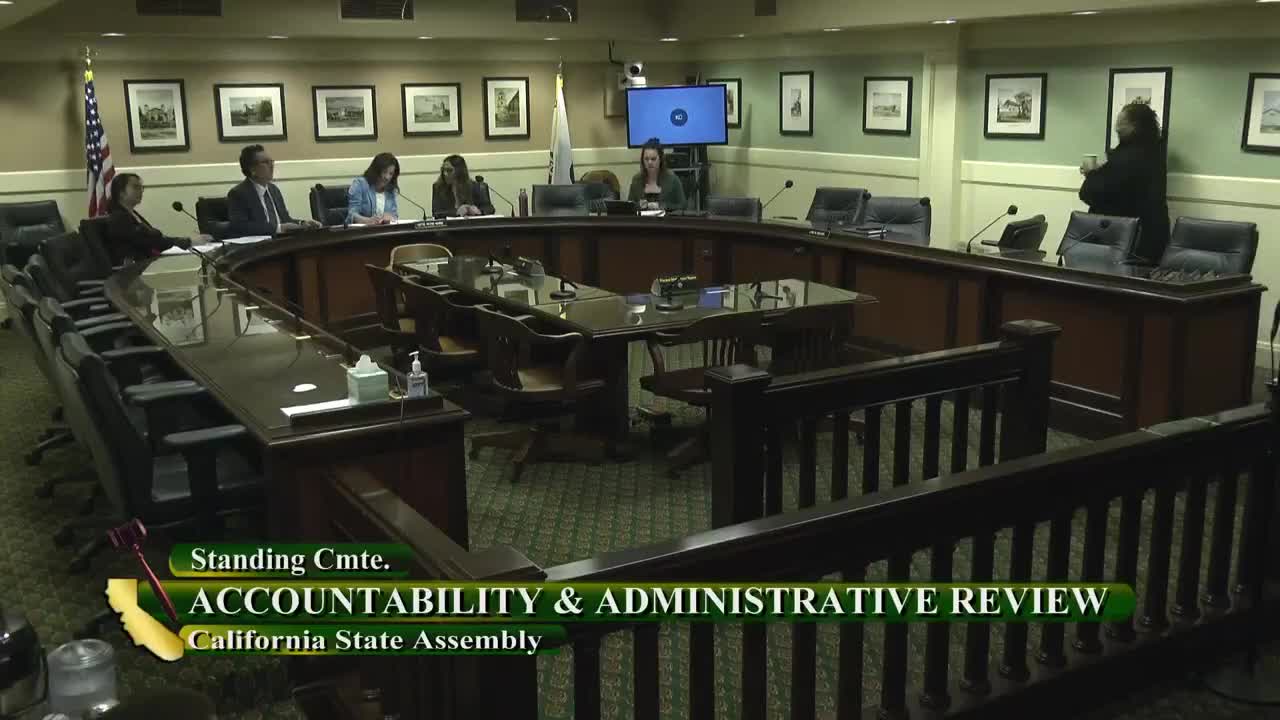
Assembly Standing Committee on Accountability and Administrative Review
Bill Author

Bill Co-Author(s):