AB 1833: Mushrooms.
- Session Year: 2023-2024
- House: Assembly
- Latest Version Date: 2024-01-12
Current Status:
Failed
(2024-05-16: In committee: Held under submission.)
Introduced
In Committee
First Chamber
In Committee
Second Chamber
Enacted
What does this bill do?
The bill bans labeling mushrooms in California as “California Mushroom,” “California Grown,” or similar unless the mushrooms are 100% grown in California. It says “grown” includes mushrooms that are inoculated, incubated, and harvested in California. The Department of Food and Agriculture would fine violators at least $5,000 for a first violation, $10,000 for a second, and $20,000 for a third or later violation.
The summary is provided by generative AI which can make mistakes. For original language, please view the details in the table below.
Existing law makes it unlawful to produce, process, sell, offer for sale, give away, or possess olive oil that indicates on its label California Olive Oil, or uses similar words to indicate that California is the source of the oil, unless 100% of that oil is derived from olives grown in California.
This bill would similarly make it unlawful to produce, process, sell, offer for sale, give away, or possess a mushroom in California, that indicates on the label California Mushroom, California Grown, or words of similar import that indicate that California is the source of the mushroom, unless 100% of that mushroom is grown in California, and would require the Department of Food and Agriculture to assess a civil penalty against any person violating that prohibition, as specified.
(a)If a mushroom is produced, processed, sold, offered for sale, given away, or possessed in California, that indicates on its label California Mushroom, California Grown, or uses words of similar import that indicate that California is the source of the mushroom, 100 percent of that mushroom shall be grown in California.
(b)For purposes of this section, grown includes mushrooms that are inoculated, incubated, and harvested in California.
112955.The Department of Food and Agriculture shall assess a civil penalty against a person violating this chapter in an amount not less than five thousand dollars ($5,000) for the first violation, not less than ten thousand dollars ($10,000) for the second violation, and not less than twenty thousand dollars ($20,000) for the third or any subsequent violations.
REVISIONS: HeadingLine 2.|
Date
|
Status
|
|---|---|
| May 16, 2024 | In committee: Held under submission. |
| Apr 24, 2024 | In committee: Set, first hearing. Referred to APPR. suspense file. |
| Apr 11, 2024 | Coauthors revised. |
| Apr 11, 2024 | From committee: Do pass and re-refer to Com. on APPR. (Ayes 10. Noes 0.) (April 10). Re-referred to Com. on APPR. |
| Jan 29, 2024 | Referred to Com. on AGRI. |
| Jan 13, 2024 | From printer. May be heard in committee February 12. |
| Jan 12, 2024 | Read first time. To print. |
|
Date
|
Description
|
Location
|
Votes
|
|
|---|---|---|---|---|
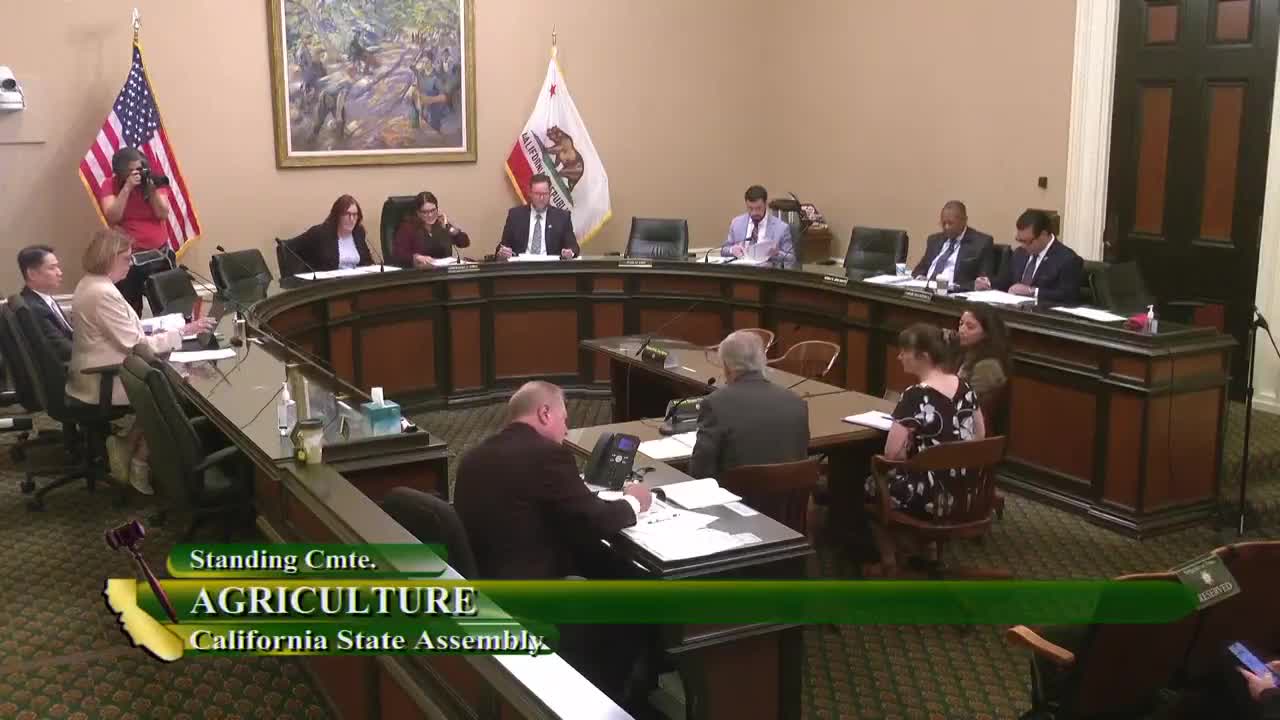
| Apr 10, 2024 | Do pass and be re-referred to the Committee on [Appropriations] | Assembly Standing Committee on Agriculture |
Passed |
This list shows positions taken on this bill by organizations on the date displayed, which is linked to the original source.
Positions by individuals are not included.
|
Organization
|
Position
|
Date
|
|---|---|---|
| Agricultural Institute of Marin | ** Support | |
| California Certified Organic Farmers | * Support | Apr 10, 2024 |
| Community Alliance With Family Farmers | * Support | Apr 10, 2024 |
| County Of Santa Clara | * Support | Apr 10, 2024 |
| Del Fresh Produce | ** Support | |
| E&h Farms | ** Support | |
| Far West Fungi | * Support | Apr 10, 2024 |
| Far West Fungi | ** Support | |
| Foggy Dew Fungi | ** Support | |
| Fungaia Farm | ** Support | |
| Global Mushrooms | ** Support | |
| Growing Roots | ** Support | |
| Long Beach Mushrooms | ** Support | |
| Mighty CAP Mushrooms | ** Support | |
| Monterey Mushrooms | ** Support | |
| Roots of Change | ** Support | |
| Smallhold | ** Support | |
| Sumano's Organic Mushrooms | ** Support | |
| Sustainable Agriculture Education | ** Support | |
| We Grow Urban Farm | ** Support |
Date of Hearing: April 24, 2024
ASSEMBLY COMMITTEE ON APPROPRIATIONS
Buffy Wicks, Chair
ABPCA Bill Id:AB 1833
Author:(Addis) – As Introduced Ver:January 12, 2024
Policy Committee: | Agriculture | Vote: | 10 - 0 |
|
| ||
|
|
Urgency: No State Mandated Local Program: No Reimbursable: No
SUMMARY:
This bill makes it unlawful to produce, process, sell, offer for sale, give away, or possess a mushroom in California that indicates on the label “California Mushroom,” “California Grown,” or words of similar import that indicate that California is the source of the mushroom, unless 100% of that mushroom is grown in California. This bill also requires the California Department of Food and Agriculture (CDFA) to assess a civil penalty against any person violating this prohibition.
This bill requires CDFA to assess a civil penalty against a person violating this bill of at least $5,000 for the first violation, at least $10,000 for the second violation, and at least $20,000 for the third or any subsequent violations.
FISCAL EFFECT:
Costs of an unknown amount, likely in the low- to mid-hundreds of thousands of dollars, for CDFA to enforce this bill (General Fund.) Penalty revenue of an unknown and variable amount, likely in the tens of thousands of dollars annually. This bill does not specify a fund into which penalty revenue is to be deposited (for example, the Food and Agriculture Fund). Typically, penalty revenue is deposited in the General Fund unless statute specifies another destination.
CDFA estimates initial costs ranging from $204,000 to $358,000 and ongoing annual costs in the range of $154,000 and $308,000 to hire additional staff members, investigate complaints, develop implementing regulations, if needed, and provide adequate due process. In addition, CDFA anticipates unquantifiable legal costs related to appeals (General Fund.) According to the Legislative Analyst’s Office, the General Fund faces a structural deficit in the tens of billions of dollars over the next several fiscal years.
Since this bill does not specify enforcement protocols and there is no registration process for mushroom producers, handlers, and sellers, CDFA’s enforcement would likely be complaint-driven. CDFA notes its exact costs are difficult to determine and would depend on the scale of operations that are labeling products in a manner that is inconsistent with the requirements of this bill as well as the number of complaints filed.
COMMENTS:
1) Purpose. According to the author:
AB 1833 creates clear guidelines for when mushroom growers can use the term “California” in marketing and product labeling. Not only will this help our local farmers by making them more visible in grocery stores, it will also help consumers make more informed choices for their health and the local economy.
2) Background. California is the second largest mushroom-producing state in the country. In 2022, mushroom production in Santa Clara County alone increased by 9%, generating nearly $87 million in value. According to the California Certified Organic Farmers (CCOF), mushrooms are unique because they are not grown in the ground. Instead, farmers grow mushrooms in transportable containers, such as beds or bags. Over weeks to several months, farmers add substrate to these containers, sterilize the substrate, and manage the mushroom growth from seed to fruit. Because mushrooms are grown in containers, they can be transported during any growth cycle stage. CCOF contends:
California farmers who grow mushrooms entirely in California, from inoculation and incubation to harvest, cannot distinguish themselves in the marketplace. At the same time, California farmers face some of the highest production costs in the world, including labor, land, water, and compliance with state regulations. California farmers should be able to share with consumers that they meet the high bar of growing mushrooms in California.
As noted previously, this bill does not specify an enforcement process or protocol (aside from penalties) against a person who improperly labels mushrooms. According to CDFA, several decades ago, CDFA’s Standardization Program was funded by the General Fund and included grade and labeling standards for mushrooms produced in the state. However, this program lost General Fund support in the 1990s, and the mushroom industry, unlike 30 other major fruit and vegetable commodities, opted out of establishing an industry assessment to support the work for grade and labeling standards for mushrooms produced in the state. The mushroom industry could support enforcement of the labeling standards contemplated by this bill through imposition of an industry-wide assessment, if at least 51% of mushroom producers opt in to the standardization and fee program.
Alternatively, the mushroom industry could decide to establish a commission, which is funded through assessments levied on growers or handlers, or both, of the commodity. Typically, a commission will establish an assessment, which supports the functions of a commission upon a favorable vote by two-thirds of the industry. Commissions have a number of responsibilities, depending on the way each commission is structured, with some empowering a commission to investigate and prosecute civil violations and file complaints with law enforcement agencies.
3) Previous Legislation. AB 535 (Aguiar-Curry), Chapter 466, Statutes of 2021, requires a container of olive oil produced, processed, sold, offered for sale, given away, or possessed in California that includes "California" in any form on its principal display panel and contains olive oil derived from olives grown outside California to disclose the minimum percentage of olive oil in the container derived from olives grown in California.
Analysis Prepared by: Nikita Koraddi / APPR. / (916) 319-2081
Date of Hearing: April 10, 2024
ASSEMBLY COMMITTEE ON AGRICULTURE
Esmeralda Soria, Chair
ABPCA Bill Id:AB 1833
Author:(Addis) – As Introduced Ver:January 12, 2024
SUBJECT: Mushrooms
SUMMARY: This bill defines what constitutes a California-grown mushroom, for labeling purposes, and set penalties for mislabeling of mushrooms that do not met California definitions. Specifically, this bill:
- Requires mushrooms that indicate on its label “California Mushroom,” “California Grown,” or uses words of similar import that indicate that California is the source of the mushroom is 100 percent grown in California.
- Defines “grown” to include mushrooms that are inoculated, incubated, and harvested in California, for purpose of this law.
- Requires the California Department of Food and Agriculture (CDFA) to assess a civil penalty for violations of this law in an amount not less than five thousand dollars ($5,000) for the first violation, not less than ten thousand dollars ($10,000) for the second violation and not less than twenty thousand dollars ($20,000) for the third or any further violations.
EXISTING LAW:
- Makes it unlawful to produce, process, sell, offer for sale, give away, or possess olive oil that indicates on its label “California Olive Oil,” or uses similar words to indicate that California is the source of the oil, unless 100% of that oil is derived from olives grown in California. (Health and Safety Code (HSC) 112895)
- Defines “California grown,” “California-grown,” and similar terms with identical connotations shall be used in the labeling or advertising of agricultural products as follows: The terms “California grown,” “California-grown,” and similar terms with identical connotations food or agricultural products that have been produced in the state or harvested in its surface or coastal waters. (Food and Ag Code (FAC) 43100)
- Requires, if a false, deceptive, or misleading use of the term “California grown,” “California-grown,” or similar terms with identical connotations, violators to be subject to the provisions and penalties. (FAC 43100)
FISCAL EFFECT: Unknown.
COMMENTS: California is the second largest mushroom producing state with annual sales totaling $255 million, There were 70 mushroom farms reported in the 2017 Census of Agriculture totaling over 6 million square feet of growing area.
The demand for medicinal and functional mushrooms has been increasing recently, with 15.25 million tons sold in 2021. That number is projected to increase to 24.05 million by 2028 at a compound annual growth rate estimated between 6-11% (Fortune Business Insights, 2022).
Supporters state, a barrier preventing California mushrooms farmers from capitalizing on the strong market demand is misrepresentation in the marketplace. California farmers growing mushrooms in the state face unfair competition from companies growing mushrooms mostly abroad but labeling them as “Product of USA.”
Mushrooms are unique because they are not grown in the ground, instead they are grown in containers, such as beds or bags, which are very easy to transport overseas. This makes it easy to begin the growth cycle in one location, and then transport them to a different location for the final fruiting stage.
Currently, as long as a mushroom is harvested in the United States, it can be labeled as a “Product of the USA.” This creates an uneven playing field for farmers who complete the entire growth cycle in California from producing mushroom seed, sterilizing the substrate, and introducing the spawn all the way through fruiting.
California farmers who grow mushrooms entirely in California, from inoculation and incubation to harvest, have no way to distinguish themselves in the marketplace. At the same time, California farmers face some of the highest production costs in the world with high costs of labor, land, water, and compliance with state regulations. California farmers should have the opportunity to share with consumers that they meet the high bar of growing mushrooms entirely in California.
According to the author, the current labeling system creates a lack of transparency for consumers. There is no clear way for a consumer to distinguish where the mushroom originates. When consumers want to make a mindful decision to support their local food economy, they lack the correct data.
Prior Legislation:
AB 535 (Aguiar-Curry) Chapter 466, Statutes of 2021: Required a container of olive oil produced, processed, sold, offered for sale, given away, or possessed in California that includes "California" in any form on its principal display panel and contains olive oil derived from olives grown outside California to disclose the minimum percentage of olive oil in the container derived from olives grown in California.
SB 1293 (Chesbro), Chapter 831, Statutes of 2000: Prohibited the sale of wine-using a brand name or appellation suggesting the wine is made from Napa Valley grapes-unless the wine qualifies for Napa Valley or Napa County appellation of origin.
REGISTERED SUPPORT / OPPOSITION:
Support
Agricultural Institute of Marin
California Certified Organic Farmers (CCOF)
Community Alliance With Family Farmers
County of Santa Clara
Del Fresh Produce
E&h Farms
Far West Fungi
Foggy Dew Fungi
Fungaia Farm
Global Mushrooms
Growing Roots
Long Beach Mushrooms
Mighty CAP Mushrooms
Monterey Mushrooms
Roots of Change
Smallhold
Sumano's Organic Mushrooms
Sustainable Agriculture Education
We Grow Urban Farm
Opposition
None on file.
Analysis Prepared by: Victor Francovich / AGRI. / (916) 319-2084
Discussed in Hearing
 10MIN
Assembly Standing Committee on Agriculture
Bill Author

Bill Co-Author(s):
