AB 1898: Crimes: child pornography: early release credits.
- Session Year: 2023-2024
- House: Assembly
- Latest Version Date: 2024-01-23
Current Status:
Failed
(2024-05-16: In committee: Held under submission.)
Introduced
In Committee
First Chamber
In Committee
Second Chamber
Enacted
What does this bill do?
The bill makes people convicted of certain child pornography felonies or lewd or lascivious acts on a child under 14 ineligible to earn credits that shorten their prison time if they have two or more prior convictions and have served two or more prior prison terms for listed felonies. It adds specified child pornography offenses to the list of disqualifying crimes and expands the lewd-and-lascivious-on-a-child offense to include acts that do not require force.
The summary is provided by generative AI which can make mistakes. For original language, please view the details in the table below.
Notwithstanding any other law, the California Constitution, as amended by Proposition 57 at the November 8, 2016, statewide general election, grants the Department of Corrections and Rehabilitation the authority to award credits earned for good behavior and approved rehabilitative or educational achievements.
Under existing law, a prisoner can reduce their term of imprisonment by earning credit for, among other things, continuous incarceration, good behavior, and participation in approved rehabilitative programming. Existing law prohibits a prisoner convicted of specified felony offenses from earning credit if the prisoner previously has been convicted of one of those felony offenses 2 or more times and has served 2 or more separate prior prison terms. Under existing law, the felonies for which credits may not be earned include lewd and lascivious acts on a child under 14 years of age by use of force, violence, duress, menace, or fear and continuous sexual abuse of a child, as specified. Under existing law, a person sentenced to a determinate sentence is released after serving the term of their sentence, minus any credits earned, and is required to serve a period of time after release under parole supervision.
This bill would include specified felonies involving, among other things, the knowing depiction, production, distribution, advertising, possession, control, and use of material depicting a person under 18 years of age engaging in or simulating sexual conduct, as defined, in the list of felonies that the commission of which make a person ineligible for credits against a sentence as provided above. The bill would also expand the prohibition on lewd and lascivious acts on a child under 14 years of age to include acts that do not require the use of force, violence, duress, menace, or fear.
(a)(1)Notwithstanding any other law, a person who is convicted of any a felony offense listed in paragraph (2), and who previously has been convicted two or more times, on charges separately brought and tried, and who previously has served two or more separate prior prison terms, as defined in subdivision (g) of Section 667.5, of any an offense or offenses listed in paragraph (2), shall be ineligible to earn credit on the persons their term of imprisonment pursuant to this article.
(2)As used in this subdivision, felony offense includes any of the following:
(A)Murder, as defined in Sections 187 and 189.
(B)Voluntary manslaughter, as defined in subdivision (a) of Section 192.
(C)Mayhem, as defined in Section 203.
(D)Aggravated mayhem, as defined in Section 205.
(E)Kidnapping, as defined in Section 207, 209, or 209.5.
(F)Assault with vitriol, corrosive acid, or caustic chemical of any nature, as described in Section 244.
(G)Rape, as defined in paragraph (2) or (6) of subdivision (a) of Section 261 or paragraph (1) or (4) of subdivision (a) of former Section 262.
(H)Sodomy by means of force, violence, duress, menace, or fear of immediate and unlawful bodily injury on the victim or another person, as described in subdivision (c) of Section 286.
(I)Sodomy while voluntarily acting in concert, as described in subdivision (d) of Section 286.
(J)Lewd or lascivious acts on a child under 14 years of age, as described in subdivision (b) of Section 288.
(K)Oral copulation by means of force, violence, duress, menace, or fear of immediate and unlawful bodily injury on the victim or another person, as described in subdivision (c) of Section 287 or of former Section 288a.
(L)Continuous sexual abuse of a child, as described in Section 288.5.
(M)Sexual penetration, as described in subdivision (a) of Section 289.
(N)Exploding a destructive device or explosive with intent to injure, as described in Section 18740, with intent to murder, as described in Section 18745, or resulting in great bodily injury or mayhem, as described in Section 18750.
(O)Any A felony in which the defendant personally inflicted great bodily injury, as provided in Section 12022.53 or 12022.7.
(P)A felony involving child pornography in violation of Section 311.1, 311.2, 311.3, 311.4, 311.10, or 311.11.
(b)A prior conviction of an offense listed in subdivision (a) shall include includes a conviction in another jurisdiction for an offense that includes all of the elements of the particular felony as defined under California law.
(c)This section shall apply whenever if the present felony is committed on or after the effective date of this section, regardless of the date of commission of the prior offense or offenses resulting in credit-earning ineligibility.
(d)This section shall be in addition to, and shall does not preclude the imposition of, any applicable sentence enhancement terms, terms or probation ineligibility and habitual offender provisions authorized under any other section.
|
Date
|
Status
|
|---|---|
| May 16, 2024 | In committee: Held under submission. |
| Apr 10, 2024 | In committee: Set, first hearing. Referred to APPR. suspense file. |
| Mar 19, 2024 | From committee: Do pass and re-refer to Com. on APPR. (Ayes 7. Noes 0.) (March 19). Re-referred to Com. on APPR. |
| Feb 5, 2024 | Referred to Com. on PUB. S. |
| Jan 24, 2024 | From printer. May be heard in committee February 23. |
| Jan 23, 2024 | Read first time. To print. |
|
Date
|
Description
|
Location
|
Votes
|
|
|---|---|---|---|---|
| Mar 19, 2024 | Do pass and be re-referred to the Committee on [Appropriations] | Assembly Standing Committee on Public Safety |
Passed |
This list shows positions taken on this bill by organizations on the date displayed, which is linked to the original source.
Positions by individuals are not included.
|
Organization
|
Position
|
Date
|
|---|---|---|
| ACLU of Northern California | * Against | Mar 19, 2024 |
| California Police Chiefs Association | * Support | Mar 19, 2024 |
| California Public Defenders Association | * Against | Mar 19, 2024 |
| Californians United for a Responsible Budget | * Against | Mar 19, 2024 |
| Ella Baker Center For Human Rights | * Against | Mar 19, 2024 |
| Essie Justice Group | * Against | Mar 19, 2024 |
Date of Hearing: April 10, 2024
ASSEMBLY COMMITTEE ON APPROPRIATIONS
Buffy Wicks, Chair
ABPCA Bill Id:AB 1898
Author:(Flora) – As Introduced Ver:January 23, 2024
Policy Committee: | Public Safety | Vote: | 7 - 0 |
|
| ||
|
|
Urgency: No State Mandated Local Program: No Reimbursable: No
SUMMARY:
This bill makes a person convicted of a specified felony child pornography offense ineligible to earn credits that reduce the length of time they must serve in custody.
FISCAL EFFECT:
Incarceration costs (General Fund) to the California Department of Corrections and Rehabilitation (CDCR) of an unknown but significant amount, potentially in the tens of millions of dollars annually. Costs will depend on the number of convictions and the length of each sentence, which range from one to six years in state prison under existing law. Under this bill, a defendant convicted of a qualifying offense would be ineligible for credits and would be required to serve the full length of their sentence in custody. According to the Legislative Analyst’s Office (LAO), the average annual cost to incarcerate one person in state prison is $133,000. In 2023, there were 153 people in CDCR custody with a principal conviction that would bar them from credit earning under this bill. If each of those people must spend an additional six months in prison because they can no longer earn credits, the cost to CDCR would be $10.2 million. Actual costs will likely be higher because an unknown number of additional people with a qualifying subordinate offense would also serve longer prison terms under this bill, and some incarcerated people will serve more than six additional months in prison if this bill prohibits them from earning credits. CDCR also anticipates potentially significant litigation costs resulting from this measure.
According to the LAO, the General Fund faces a structural deficit in the tens of billions of dollars over the next several fiscal years.
COMMENTS:
- Purpose. According to the author:
This bill would add convicted non-violent child sex predators who commit specified non-violent felonies involving the knowing depiction, production, distribution, advertising, possession, control, and use of material depicting a person under 18 years of age engaging in or simulating sexual conduct (child pornography), to the list of felonies that make a person ineligible for early release credits against their sentence as provided by existing law.
- Background. Under existing statutes, there are a number of credits that may be applied to an incarcerated person’s sentence to reduce the actual amount of time in custody they are required to serve. Some credits are based on an incarcerated person’s good behavior, while others are awarded upon completion of specific rehabilitative programs. The maximum amount of credits an incarcerated person may earn also depends on their conviction offense and when the conviction occurred. In 2016, voters passed Proposition 57, which, in pertinent part, amended the California Constitution to give CDCR authority to award credits for good behavior and approved rehabilitative and education achievements. As stated in Proposition 57, the goal of these credits is “to enhance public safety, improve rehabilitation, and avoid the release of prisoners by federal court order” due to significant prison overcrowding in the state. As required by Proposition 57, CDCR promulgated regulations that allow the department to award a variety of credits, including for good conduct, milestone completion, rehabilitative achievement, educational merit, and extraordinary conduct. In addition to potential rehabilitative benefits, credit earning helps promote a safer environment inside detention facilities by incentivizing incarcerated people to follow the rules, refrain from violence, and participate in self-help programming, vocational training, and education programs.
This bill prohibits CDCR from applying credits to the sentence of an incarcerated person convicted of specified child pornography and molestation crimes, including bringing or sending child pornography into the state, bringing or sending child pornography into the state with the intent to distribute, and child sexual exploitation. The bill does not state whether this prohibition applies retrospectively to people who have already been convicted of these offenses or whether it applies prospectively for future convictions. As described in more detail in the analysis of this bill by the Assembly Committee on Public Safety, it is not clear whether the Legislature may change CDCR’s constitutional authority to award credits absent a constitutional amendment. If this bill is chaptered and the courts determine that it is constitutional, it will result in significant, ongoing incarceration costs to CDCR, as described above.
- Related Legislation. AB 2766 (Low) makes specified information about parole calculations and release credits subject to disclosure under the Public Records Act. AB 2766 is pending hearing in this committee.
ACA 15 (Alanis) specifies that CDCR does not have authority to control credits for registered sex offenders. ACA 15 was not referred to committee.
ACA 17 (Fong) authorizes the Legislature to enact legislation to prescribe the earning of credits by those convicted of offenses related to fentanyl. ACA 17 was not referred to committee.
Analysis Prepared by: Annika Carlson / APPR. / (916) 319-2081
Date of Hearing: March 19, 2024
Counsel: Kimberly Horiuchi
ASSEMBLY COMMITTEE ON
Kevin McCarty, Chair
ABPCA Bill Id:
Author:() – As Ver:
SUMMARY:
Eliminates custody credits for any person convicted and sentenced to a charge of felony child pornography, as specified. Specifically, this bill:
- Prohibits custody credits for any person convicted of:
- Bringing or sending child pornography into the state;
- Brining or sending child pornography into the state with the intent to distribute;
- Child sexual exploitation;
- Use of a minor to perform sexual acts;
- Advertising obscene matter depicting a person under the age of 18 for sexual purposes; or
- Possession of child pornography.
- Bringing or sending child pornography into the state;
- Prohibits custody credits for any person convicted of specified acts of child molestation.
EXISTING LAW:
- States any person who willfully and lewdly commits any lewd or lascivious act, as specified, upon or with the body, or any part or member of, of a child who is under the age of 14 years, with the intent of arousing, appealing to, or gratifying the lust, passions, or sexual desires of that person or the child, is guilty of a felony punishable by imprisonment in state prison for three, six, or eight years. (Pen. Code, § 288, subd. (a).)
- Sentences any person who uses fear, violence, duress, menace, or fear of imminent or unlawful bodily harm to the person under the age of 14 or someone else to a term of imprisonment of five, eight, or ten years in state prison. (Pen. Code, § 288, subd. (b)(1).)
- States any person who willfully commits any lewd or lascivious acts on a child either 14 or 15 years of age and the person is at least 10 years older is guilty of an alternate felony-misdemeanor punishable by up to one year in county jail or a term of one, two, or three years in state prison. (Pen. Code, 288, subd. (c).)
- Punishes any person who knowingly sends or brings obscene matter into the state depicting a person under the age of 18 personally engaged in or simulating sexual conduct by a term of imprisonment of up to one year in the county jail and a fine not to exceed $1,000 or a term of sixteen, two, or three in state prison, and a fine of not more than $10,000. (Pen. Code, § 311.1, subd. (a).)
- States any person who knowingly brings or sends obscene material for sale depicting a person under the age of 18 obscene material depicting a person under the age of 18 engaging in sexual conduct is guilty of a felony punishable by imprisonment in state prison for two, three, or six years, and a fine of up to $100,000. (Pen. Code, § 311.2, subd. (b).)
- Imposes an additional one, two, or three year enhancement on any person who solicits a minor who is at least four years younger than the defendant. (Health & Saf. Code, § 11353.1, subd. (a)(3).)
- States any person convicted of a specified violent felony including murder, manslaughter, mayhem, kidnapping, rape, assault, as specified, and rape, and who was previously convicted two or more times, on charges separately brought and tried, and who previously served two or more separate prior prison terms, as specified, is ineligible to earn credits. (Pen. Code, § 2933.5, subd. (a).)
- States for each for each four-day period in which a prisoner is confined in or committed to a facility as specified in this section, one day shall be deducted from the prisoner’s period of confinement unless it appears by the record that the prisoner has refused to satisfactorily perform labor as assigned by the sheriff, chief of police, or superintendent of an industrial farm or road camp. (Pen. Code, § 4019, subd. (b).)
- Requires any person convicted of a nonviolent felony offense and sentenced to state prison be eligible for parole consideration after completing the full term for his or her primary offense. (Cal. Const. Art. 1, § 32, subd. (a)(1).)
- Defines “full term for the primary offense” as the longest term of imprisonment imposed by the court for any offense, excluding the imposition of an enhancement, consecutive sentence, or alternative sentence. (Cal. Const. Art. 1, § 32, subd. (a)(1)(A).)
- States the California Department of Corrections and Rehabilitation (“CDCR”) shall have authority to award credits earned for good behavior and approved rehabilitative or educational achievements. (Cal. Const. Art. 1, § 32, subd. (b).)
FISCAL EFFECT:
Unknown
COMMENTS:
- Author's Statement: According to the author, “This bill would add convicted non-violent child sex predators who commit specified non-violent felonies involving the knowing depiction, production, distribution, advertising, possession, control, and use of material depicting a person under 18 years of age engaging in or simulating sexual conduct (child pornography), to the list of felonies that make a person ineligible for early release credits against their sentence as provided by existing law. This bill expands the current law to include offenders who commit lewd and lascivious acts on a child under 14 years of age without the use of force, violence, duress, menace, or fear with violent offenders who commit the same crimes but with violence.”
- Penalties for Child Pornography: Possession and distribution of child pornography, in most cases, may be charged as a felony subject to a state prison sentence. (See e.g., Pen. Code, § 311.1, subd. (a) [up to three years in state prison]; Pen. Code, § 311.2, subd. (b) [up to six years in state prison]; Pen. Code, § 311.3, subd. (d) [up to three years in state prison].) These statutes remained mostly unamended by Realignment and are not subject to sentencing in the county jail pursuant to Penal Code section 1170, subdivision (h).
- County Jail Credits: California permits a person to receive credits against their county jail or state prison sentence for time spent in pre-trial custody. (See Pen. Code, § 2933; § 4019.) County jail conduct credits, both pre-sentence and post-sentence, are authorized under Penal Code Section 4019. The purpose of Section 4019 is to authorize good behavior and work participation credits for certain prisoners confined in jail. (Pen. Code, § 4019; People v. Sage (1980) 26 Cal.3d 498.)
Although Section 4019 originally applied only to misdemeanor-detainees, it was amended in 1982 to include felony-detainees. The legislative intent was both to eliminate the inequality suffered by indigent defendants who might serve a longer period of confinement because of their inability to post pretrial bail and to equalize the time served in custody for given offenses. (See In re Atiles (1983) 33 Cal. 3d 805, 812, disapproved on other grounds; In re Joyner (1989) 48 Cal. 3d 487, and overruled on other grounds by People v. Bruner (1995) 9 Cal. 4th 1178, 1194.)
In addition to credits awarded pursuant to Section 4019, a sheriff or county director of corrections may also award credits pursuant to an educational or work program. (Pen. Code, § 4019.4.) A county sheriff who elects to participate in this credit reduction program must create guidelines that provide for credit reductions for an inmate who successfully complete specific program’s performance objectives for approved rehabilitative programming, including, but not limited to, credit reduction of not less than one week to credit reduction of not more than six weeks for each performance milestone. (Pen. Code, § 4019.4, subd. (a), (e) (stating that program credits are also available to inmates sentenced to county jail pursuant to Penal Code section 1170, subdivision (h).) Approved rehabilitative programming for this purpose includes, but is not limited to, academic programs, vocational programs, vocational training, substance abuse programs, and core programs such as anger management and social life skills. (Pen. Code, § 4019.4, subd. (d).)
- State Prison Credits: Penal Code section 2930, et seq., governs the application of custody credits when a person is incarcerated in state prison, which, as explained below, is likely subject to approval by CDCR. Penal Code Section 2933 credits were formerly awarded for performance in work assignments and educational programs, and were called “worktime” credits. However, effective January 25, 2010, Section 2933 was amended to provide for the award of credits on the basis of continuous incarceration. (See former Pen. Code, § 2933(a) (operative until Jan. 25, 2010.) The amendment to Section 2933 were accompanied by the enactment of Penal Code Section 2933.05, which authorizes the awarding of credits for completion of specific program objectives for approved rehabilitative programming.
Certain restrictions may apply to the amount of credits a person may earn, or reduction of sentence that may be awarded. An inmate convicted of murder or a violent felony, as defined in Penal Code section 667.5, subd. (c), may only be entitled to 15% credit depending on what the person was convicted of and when the conviction occurred. (Former Pen. Code, § 190, subd. (a) and §§ 190, subd. (c); Pen. Code, §§ 667.70, 2933, 2934; People v. Jenkins (1995) 10 Cal. 4th 234 [murderer subject to sentencing under Penal Code § 667.7 is to be sentenced under that statute and not under Penal Code § 190, but credit restrictions under Penal Code § 2933 still apply as if sentenced under Penal Code § 190].)
A person sentenced to state prison may also be entitled to “continuous incarceration credits.” For every six months of continuous incarceration, an eligible person may be awarded credit reductions of six months. (Pen. Code, § 2933, subd. (b).)
People sentenced to CDCR may also be entitled to “program credits.” In addition to any credit awarded pursuant to Penal Code Section 2933, CDCR may also award a prisoner program credit reductions from their term of confinement pursuant to Penal Code Section 2933.05. Section 2933.05 requires CDCR to promulgate regulations that provide for credit reductions for inmates who successfully complete specific program performance objectives for approved rehabilitative programming, ranging from credit reduction of not less than one week to credit reduction of no more than six weeks for each performance milestone.(See Pen. Code, § 2933.05, subd. (a).)
- Proposition 57 and CDCR Exclusive Authority to Adopt Credits: Proposition 57, the “The Public Safety and Rehabilitation Act of 2016” (hereinafter “Prop. 57”) of the November 2016 election changed the rules governing parole and the granting of custody credits to incarcerated person in state prison. Prop. 57 authorized CDCR to award credits earned for good behavior and approved rehabilitative or educational achievements. Voters approved Proposition 57 by a margin of nearly 30 points.[1]
Before Prop. 57, the matter of conduct credits earned in prison was governed by statute. (See e.g., Pen. Code, §§ 2933 and 2933.1.) Specifically, Prop. 57 added section 32 to article I of the California Constitution which states, in pertinent part:
“§32. (a) The following provisions are hereby added to enhance public safety, improve rehabilitation, and avoid the release of prisoners by federal court order, notwithstanding anything in this article or any other provision of law….
(2) Credit Earning: The Department of Corrections and Rehabilitation shall have authority to award credits earned for good behavior and approved rehabilitative or educational achievements.
(b) The Department of Corrections and Rehabilitation shall adopt regulations in furtherance of these provisions, and the Secretary of the Department of Corrections and Rehabilitation shall certify that these regulations protect and enhance public safety.” (Emphasis added.) (Cal. Const., art. I, § 32, subd. (a)(2).)
As required, CDCR issued regulations to effectuate Prop. 57’s purpose. (Cal. Const., art. I, § 32, subd. (b); 15 CCR § 3043, et seq.) Awarding credits is based on several different eligibilities including Good Conduct, Milestone Completion, Rehabilitative Achievement, Educational Merit, and Extraordinary Conduct.
Furthermore, some appellate courts are currently interpreting section 32 as granting exclusive authority to CDCR to decide when, and under what circumstances, a person may receive conduct credits. Judge J. Richard Couzens (Ret.) and Presiding Justice of the 2nd Appellate District both held that it appears Prop 57 granted CDCR sole authority to decide credits – not the Legislature. Both Judge Couzens and Justice Bigelow are the Judicial Council statewide experts on Realignment and felony sentencing post-2014.
“[I]t is not clear whether the credits awarded by CDCR for good behavior are in addition to the credits currently authorized under sections 2933 and 2933.05, or whether CDCR has exclusive jurisdiction to determine all good conduct and rehabilitation credits earned by inmates. It is unlikely that it was the intent of the sponsors of the Act to simply confirm CDCR’s existing authority to grant conduct credits. Rather, the Act is intended to increase the authority of CDCR to grant conduct credits for good behavior and participation in rehabilitation programs. At a minimum, therefore, the Act likely gives CDCR authority to award credits in addition to those already provided by statute, and not to be limited because of the nature of the current crime. If CDCR has exclusive jurisdiction to determine conduct credits, presumably it may set credits at a higher or lower rate than currently provided by statute. It is at least arguable that CDCR is given total control over credits because the Act specifies that CDCR ‘shall have authority to award credits notwithstanding . . . any other provision of law.’”
Additionally, in People v. Brown (2016) 63 Cal.4th 335, the Supreme Court considered the scope of Elections Code section 9002, which permits amendments to an initiative if they are “reasonably germane” to the measure’s theme, purpose, or subject. In opining the proposed amendments to Proposition 57 which would grant CDCR the power to award credits violated this section, Justice Chin’s dissenting opinion discussed the implications:
“The constitutional amendment would also give the Department of Corrections and Rehabilitation (department) constitutional authority to award behavior and other credits. The Legislature has already enacted detailed mandatory provisions for the department to award conduct and participation credits. (See Pen. Code, § 2931 et seq.) But the amended measure's proposed constitutional language is permissive. Presumably, authority to award credits includes authority not to award credits or to award lower credits than the statutes currently require. Because the Constitution prevails over mere statutes, it appears the proposed constitutional amendment would displace the current statutory provisions for credits and shift authority over such credits from the legislative to the executive branch of government. For the moment, I will assume that altering the balance of power between the two branches of government in this way would not be an impermissible constitutional revision. … But shifting power from one branch of government to another is not reasonably germane to the original measure, which left the separation of powers between the branches of government untouched.” (Brown, supra, 63 Cal.4th at p. 359.)
Justice Chin’s dissent further states:
“The proposed constitutional amendment gives the department “authority to award credits earned for good behavior and approved rehabilitative or educational achievements.” (Amended measure, § 3, adding art. I, proposed § 32, subd. (a)(2).) But it does not explain how this new, apparently permissive constitutional provision would interact with the detailed, mandatory provisions for credits the Legislature has enacted. As I have already discussed, the constitutional provision would seem to displace the statutory scheme. But I am not sure that is the intent. Displacing the statutory credit scheme might be one of the measure's “unintended consequences”…. (Brown, supra, 63 Cal.4th at p. 361.)
It remains an open question whether the Legislature still has the authority to enact statutes pertaining to credits. However, as noted by Justice Chin, it is possible that one of the “unintended consequences” of Prop. 57 was to shift this authority exclusively to the executive branch.
This bill directs CDCR to eliminate credits for anyone sentenced for child pornography and specified child molestation crimes, as specified. It is not clear that the Legislature has the authority to make these changes and may be stricken as unconstitutional and an unlawful violation of the delegation of powers. Any changes to Proposition 57 would likely require a constitutional amendment.
- Rehabilitative Programs Are Critical to Reduce Recidivism and Combat Violence: In 2019, the California State Auditor (“CSA”) reported that CDCR needed additional oversight to ensure that rehabilitative programs are effective in preparing incarcerated people for success upon release. (CSA (January 2019) CDCR: Several Poor Administrative Practices have Hindered Reductions in Recidivism and Denied Inmates Access to In-Prison Rehabilitation Programs, Report 2018-113, p. 1-2.) A significant concern outlined in the report was how CDCR had neither developed any performance measures for its rehabilitation programs, such as a target reduction in recidivism, nor assessed program cost-effectiveness. Further, as the State Auditor’s report noted, in order to analyze whether CDCR’s rehabilitation programs reduce recidivism, CDCR needs to collect additional data and take steps to ensure it delivers specified programs as intended across all its facilities. The report also recommended that CDCR ensure it has reliable tools for assessing the needs of its incarcerated persons. “Research shows that rehabilitation programs can reduce recidivism by changing inmates’ behavior based on their individual needs and risks.” (Id.)
CDCR contracted with the Public Policy Institute of California (“PPIC”) for a multi-year and multi-phased longitudinal research study of CDCR’s rehabilitative programming. The 2022-23 Budget Act provided $6 million to CDCR, Office of Research to enhance CDCR’s existing data collection and evaluation capabilities regarding the outcomes of individuals released from prison.
Specifically, CDCR engaged PPIC to evaluate CDCR’s rehabilitative programs and their effects on offender outcomes in a variety of areas including recidivism, employment, and housing. (2022-23 Budget Act, p. 114.) One key element: PPIC intends to explore is how racial inequality can impact program outcomes. Available research indicates a positive correlation between rehabilitation programs and reduced recidivism rates. One of the most notable interventions is access to higher education opportunities in state prisons that equip inmates with the necessary tools to compete in the job market. Since 2014, all state prisons have offered associate degrees.
There are also programs through the California Prison Industry Authority (CALPIA), a self-funded state entity that aims to provide real-world job skills to over 6,500 individuals incarcerated in prison. Those who participate and graduate from the program can also receive sentence reductions. CALPIA recently held a graduation ceremony for inmates at the Avenal State Prison who received job certificates.
Avenal has poultry, egg production, general fabrication, furniture, laundry and healthcare facility maintenance. Avenal also has administrative, warehouse and maintenance and repairs support functions. By allowing inmates to learn new trades and skill sets, they will also be able to better compete in the job market, similar to those in educational credit programs. “CALPIA proudly reported that individuals who participate in their programs have lower rates of recidivism, compared to those who were qualified to, but did not participate.” (Moreno, Inmates at Avenal State Prison Celebrate Job Certification with CalPIA programs, Hanford Sentinel, January 26, 2023, p. B1.) CALPIA also operates a dive school for inmates at the California Institute for Men in Chino. It is a six to 18 month program offering classes of roughly 15 inmates multiple certifications in commercial diving. The school has proven to reduce recidivism rates below 6%, indicating that rehabilitative programs have a positive correlation to recidivism reductions.
Finally, the Legislative Analyst’s Office reported in 2017 that programming, and the credits that incentivize participation in programming is critical for controlling violence and protecting correctional officers.
“In addition to reducing recidivism, rehabilitation programs can also serve other related goals, such as making it easier to safely manage the inmate population, improving overall inmate wellbeing, and improving inmate educational attainment. These secondary goals can also result in direct and indirect fiscal benefits. For example, an easier‑to‑manage inmate population could result in fewer inmates needing to be housed in higher security units, which could minimize the need and costs for additional security staff.”[2]
- Argument in Support: According to Sacramento County Sheriff Jim Cooper: Currently, non-violent criminals convicted of possession, manufacture and distribution of child pornography and exploitation of are eligible to earn early release credit; this bill would correct that and make these offenders ineligible. Child sex exploitation and trafficking has a become a rampant crime in the state of California and children are injured physically, mentally, and emotionally by predators who exploit and abuse them daily via the many avenues available innocent children by the manufacture, distribution, possession, and use of child pornography ineligible for early prison release credits. This legislation is needed to heighten penalties for these unspeakable crimes.
- Argument in Opposition: According to the California Public Defenders Association: AB 1898 would amend Penal Code section 2933.5 to render an additional crime and an additional category of crimes ineligible to earn credit on the person’s term of imprisonment pursuant to the Penal Code’s “Credit on Term of Imprisonment” article, Penal Code section 2930 – 2936. Section 2933.5 currently applies to people convicted of any of 14 listed offenses or categories of offenses, who have previously been twice convicted and twice served prior prison terms for any of the enumerated offenses. The 14 crimes, or categories of crimes, range from murder to kidnapping to rape to forcible child molestation and several other of the most heinous crimes.
AB 1898 would add to that list persons convicted of lewd and lascivious acts on a child under age 14 accomplished by acts that do not require the use of force, violence, duress, menace, or fear. The category of crimes added to that list would be persons convicted of pornography in violation of Penal Code sections 311.1, 311.2, 311.3, 311.4, 311.10, or 311.11, that is, among other things, the knowing depiction, production, distribution, advertising, possession, control, and use of material depicting a person under 18 years of age engaging in or simulating sexual conduct, as defined. The offenses that would be added to section 2933.5 are unlike the existing offenses.
The offenses currently listed in section 2933.5 either involve violence or threat of violence, i.e., the intent to injure or murder, etc. or an ongoing course of child molestation lasting at least three months. None of the offenses that AB 1898 would add involve such conduct. Section 2933.5 should be reserved for the worst conduct that is already covered. Conduct that is not the worst should not be added. Credit on the person’s prison term serves rehabilitative, safety, and security purposes. An incarcerated individual who is motivated to evidence good behavior and successful programming to get credit against their sentence is more likely to be rehabilitated and is less likely to be a danger to the safety of other incarcerated individuals or guards. The potential to earn credits makes prisons safer environments for everyone.
Additionally, these individuals will be released back into our communities. Californians have a compelling interest in providing the opportunities and incentivizing participation so that incarcerated individuals will be able to find gainful employment utilizing the skills from their prison classes. Rehabilitation will benefit not only the formerly incarcerated but their families and the community. Conversely, if incarcerated individuals are denied credits, they are less likely to take part in rehabilitative programs and will have less incentive to keep the prison safe and secure. AB 1898 is bad public policy because it wastes government resources on creating the need for additional prison guards and ultimately will endanger Californians by reducing the public safety benefit of rehabilitating incarcerated individuals.”
- Related Legislation:
- ACA 15 (Alanis) specifies that CDCR does not have authority to control credits for registered sex offenders. ACA 15 was never referred to committee.
- AB 15 (Dixon) states CDCR records pertaining to an inmate’s release date and their earned release credits are public records subject to disclosure under the California Public Records Act. AB 15 failed passage in this Committee.
- ACA 17 (Fong) authorizes the Legislature to enact legislation to prescribe the earning of credits by those convicted of offenses related to fentanyl. ACA 17 was never referred to committee.
- AB 367 (Maienschein) applies the “great bodily injury” enhancement to any person who sells, furnishes, administers, or gives away fentanyl or an analog of fentanyl when the person to whom the fentanyl was sold, furnished, administered or given suffers a significant or substantial physical injury from using the substance.
- AB 1848 (Davies) expands an existing one year sentencing enhancement for any person over the age of 18 who induces a minor to transport, carry, sell, give away, prepare for sale, or sell heroin, cocaine, or cocaine base on any church, synagogue, youth center, day care, or public swimming pool grounds to include the transport, carry, sell, give away, prepare for sale, or sell heroin, cocaine, cocaine base, and fentanyl either on the grounds of, or within 1000 feet from a church, synagogue, youth center, day care, or public swimming pool. AB 1848 is set for hearing today in this committee.
- AB 2024 (Hoover) applies enhancements for sales of a controlled substance on or near a school to fentanyl. AB 2024 is pending in this committee.
- AB 2341 (V. Fong) eliminates custody credits for any person incarcerated for the manufacture, possession, sale, transfer, transportation, administration, or inducing a minor to possess or sell fentanyl, or any fentanyl-related analog, or any substance containing fentanyl or any fentanyl-related analog. AB 2341has been pulled by the author.
- SB 359 (Umberg) requires CDCR to compile data regarding the relationship between the awarding of credits and the recidivism rates of inmates who were awarded credits for good behavior and approved rehabilitative or educational achievements and to submit an annual report to the Legislature commencing on or before January 1, 2025. SB 359 failed passage in this committee.
- ACA 15 (Alanis) specifies that CDCR does not have authority to control credits for registered sex offenders. ACA 15 was never referred to committee.
- Prior Legislation:
- AB 1688 (Calderon), of the 2019-2020 Legislative Session, would have required the CDCR to contract with a researcher to conduct a recidivism analysis of the effectiveness of rehabilitation programs and to submit a report to the Legislature. AB 1688 was vetoed by the Governor.
- AB 3105 (Waldron), of the 2017-2018 Legislative Session, would have made sale of fentanyl punishable by a term of 10 years to life in a case involving 20 grams or more of a mixture or substance containing a detectable amount of fentanyl, as defined, or 5 grams or more of a mixture or substance containing an analogue. AB 3105 failed passage in this committee.
REGISTERED SUPPORT / OPPOSITION:
Support
California Association of Highway Patrolmen
California Police Chiefs Association
Peace Officers Research Association of California (PORAC)
Oppose
ACLU California Action
California Public Defenders Association
Californians United for A Responsible Budget
Ella Baker Center for Human Rights
Friends Committee on Legislation of California
Initiate Justice
Initiate Justice Action
LA Defensa
Root & Rebound
San Francisco Public Defender
Analysis Prepared by:
Discussed in Hearing
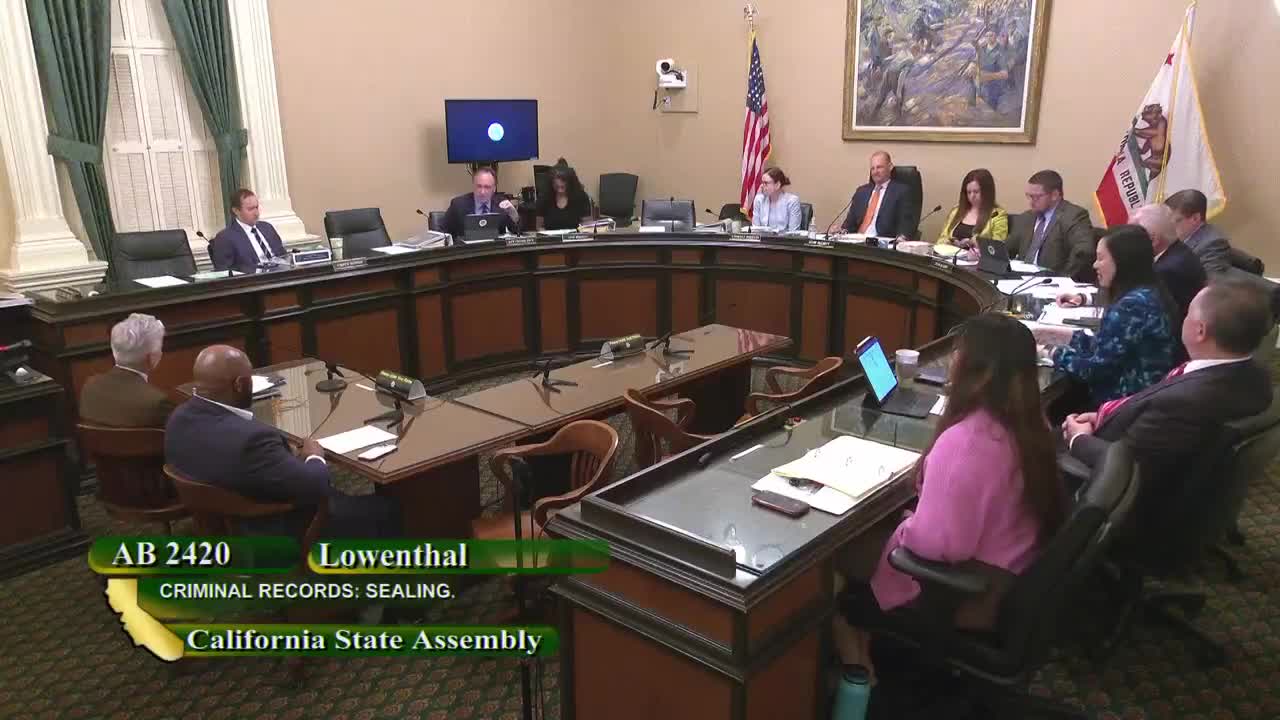 26MIN
Assembly Standing Committee on Public Safety
Bill Author

Bill Co-Author(s):